Louisville Beauty Academy · Public education guide
Follow the public dollar. Honor the real student.
Understand the funding. Protect your identity. Keep a truthful record of the work you earn.
First published July 1, 2026 Updated and source-checked October 28, 2026
AI-generated editorial illustration; not a photograph of a student or an official government graphic.
For students & familiesFor schools & educatorsFor taxpayers & the community
The essential distinctions
Clarity protects opportunity.
This guide helps families compare education options, understand funding, and protect their records. It discusses general risks and safeguards; it does not report misconduct by a particular school or student.
01 / UNDERSTAND
FAFSA is an application.
It can open access to grants, work-study, and loans. Filing it does not by itself mean you have borrowed money. Review the actual aid offer and any loan agreement.
02 / VERIFY
A screening flag is a prompt for review.
Identity confirmation protects aid programs and legitimate students. A flag alone does not establish that a person committed fraud.
03 / RESPECT
Every real student deserves dignity.
Whether education is funded by wages, family support, scholarships, grants, or loans, students deserve accurate records, clear terms, and respectful treatment.
The U.S. Department of Education’s Office of Inspector General describes higher-education ghost students as fabricated identities or stolen identities used to seek admission and obtain student aid, rather than pursue an education.
This is a specific fraud concern. A learner’s income, language, commute, age, immigration background, or choice to pay privately does not establish fraud. Nor does receiving legitimate financial aid.
Leaving school, taking leave, or having an attendance discrepancy can require review and corrections. Those facts alone do not prove an identity-theft or aid-fraud scheme. Investigations should follow evidence and the applicable rules.
An accreditor evaluates an institution or program against its standards. Check the specific agency, scope, status, and dates. Evaluate accreditation alongside the actual cost, teaching support, documented outcomes, and complaint-resolution process; it does not guarantee an individual outcome.
Participation concerns eligibility to administer federal student-aid programs and the obligations attached to those funds. Verify the school, the program, and your individual eligibility with the financial-aid office.
The responsible state authority sets requirements for a regulated profession. School completion, school licensure, and an individual professional license are different. Check the rules for the place where you intend to work.
The FAFSA form is free. States, schools, and some private aid providers also use its information. An aid offer may combine very different types of money; read each line and its conditions.
Grants & scholarships
Generally do not require repayment, but conditions and exceptions apply. Withdrawal or a failure to meet specific obligations can change what you keep.
Student loans
Borrowed money with repayment terms. Understand the borrower, principal, fees, interest, payment timing, and available protections.
Work-study
Money earned through eligible work. An offer is not an automatic payment or an immediate tuition discount.
Self-pay & payment plans
Identify who pays, when payments are due, any fees or interest, and what happens after withdrawal. Paying privately does not remove contractual obligations.
Illustration only · Not an LBA price or aid offer
Make the remaining cost visible.
$12,000Total estimated costs for the same period
−
$4,000Confirmed grants & scholarships
=
$8,000Remaining cost to fund
If you borrow the remaining $8,000, it becomes loan principal. It has not disappeared from the cost of your education. Add applicable borrowing costs and review the repayment terms separately.
Compare the same credential and time period. Include tuition, fees, supplies, required exams, transportation, and relevant living costs without double-counting. Confirm discounts in writing; do not assume a conditional incentive is already earned.
A higher published price can become a lower net cost after grants. A lower self-pay price can also be a good fit. Compare written offers, the complete budget, schedule, training requirements, and your ability to finish.
Kentucky’s published school-administration regulation requires accurate daily attendance records using digital biometric timekeeping, records of practical work, and certification of student hours. School records must be available to the board. Attendance records document time; instructor assessments separately document knowledge and practical competency. Both matter.
For your own records, keep copies of your enrollment agreement, payments, attendance summaries, progress reports, withdrawal notices, and correspondence about corrections. Review discrepancies promptly with the school. Ask how an error is documented and corrected.
Tuition payments, attendance hours, demonstrated skills, school completion, examination results, and state licensure are distinct records. Each should accurately describe what it documents.
Check an item when you have an answer you understand and can keep. These are personal notes for this visit, not a school rating or compliance certification. Checkbox selections reset when the page reloads.
0 of 12 answers reviewed
A useful standard: you can explain the agreement in your own words, keep a copy, and verify the important claims independently before deciding.
Notice a problem? Respond with evidence.
Pause, document, and use the right channel.
Warning signs to investigate
Account access: someone asks for your password, verification code, or electronic-signature access.
Blank forms: you are asked to sign incomplete enrollment, attendance, loan, or withdrawal documents.
Unfamiliar activity: records show a school, loan, payment, attendance, or work you do not recognize.
Unearned promises: hours, completion, or a license are promised without the required work and conditions.
Unclear obligations: no one will explain costs, records, refunds, or applicable aid adjustments in writing.
A warning sign calls for review. It is not a finding that a school or person committed a crime.
Preserve the record.
Save dates, notices, agreements, account statements, and screenshots. Keep sensitive identifiers out of public posts.
Secure your accounts.
Use official account-recovery routes and change compromised credentials. Verify a request before uploading identity documents.
Ask for a written explanation.
Identify the disputed entry, request the relevant records, and ask for the correction or review process.
Escalate to the appropriate authority.
Use ED OIG for suspected fraud involving Department of Education programs or funds; use the state licensing authority for relevant training or licensing issues.
Get individual help when needed.
Identity theft, disputed debt, or threatened legal rights may require assistance from a qualified professional or regulator.
Louisville Beauty Academy does not participate in Title IV federal student aid and does not administer federal Pell Grants or federal student loans. Its published approach centers self-pay education and written payment and incentive terms.
This describes LBA’s federal student-aid participation, not a student’s complete financial situation. Compare the written cost and educational pathway on their merits. Confirm any outside assistance with its provider and LBA; private borrowing carries its own repayment terms.
Working learners may balance jobs, family responsibilities, transportation, and language barriers. Their effort deserves recognition. LBA’s commitment is to connect that effort with instructor-led practice, truthful records, clear costs, human accountability, and respect.
LBA’s public study and translation tools support learning. They do not award training hours or replace instructor evaluation, official licensing decisions, or individualized financial-aid advice. Important information should be checked with a responsible person and current official sources.
What this looks like at Louisville Beauty Academy
Commitments you can read. Sources you can check.
The award below is external recognition. The educational practices and resources are LBA’s published standards and offerings; they are not additional award certifications.
01 / ETHICS
Recognition, with its exact scope.
LBA is the 2026 BBB Torch Award for Ethics winner in the Very Small Business category (1–10 employees), awarded by BBB serving Greater Kentucky and South Central Indiana.
A regional ethics award, separate from school licensure, institutional accreditation, and BBB accreditation or rating.
LBA publishes listed program costs alongside possible conditional incentives. Eligibility, required activities, deadlines, approvals, and final payment terms belong in the current written agreement.
Reduced costs are not automatic. Reviews, star ratings, praise, or positive sentiment are not required for the optional incentive pathway.
LBA’s published practical-learning standard connects instructor supervision, safety, sanitation, competency assessment, and records supporting an awarded practical PASS.
Practical competency, attendance hours, and clinic-service activity serve different recordkeeping purposes. A public template alone is not a student’s achievement record.
LBA provides public study resources, including a free sensory-aware beauty-services guide with Q&A, practice scenarios, and optional read-aloud for learning about client choice and care.
This supplemental guide does not award licensing hours or a professional credential. Read-aloud uses supported browser/device voices; it is not a live AI tutor.
Does using FAFSA put my professional license at risk?
Applying for aid does not itself invalidate training or a professional license. Identity, attendance, competence, and the applicable licensing requirements must be addressed on their own facts. Ask the responsible board about a specific disputed record.
Does being selected for verification mean I am accused of fraud?
A screening result alone does not establish misconduct. Ask the school for the applicable official process and required documentation. FSA’s guidance provides ways to confirm identity for enrolled or admitted students with relevant flags.
Is a grant the same as a loan?
No. Grants generally do not require repayment when their conditions are met. Loans create repayment obligations. Read your actual offer, and ask how withdrawal or changed eligibility would affect each type of aid.
Does paying privately guarantee a better or cheaper education?
No single funding label answers that question. Compare the full written cost after confirmed benefits, the training and licensing pathway, teaching support, schedule, and contractual obligations. Aid recipients and self-paying students deserve the same respect.
Should I publish someone’s private records to prove a concern?
Keep evidence for the school’s secure review process, the appropriate regulator, or qualified counsel. Do not publish Social Security numbers, passwords, identity documents, or another student’s private records.
Primary sources · Checked October 28, 2026
Follow the source, too.
Use these official records to check definitions, requirements, and next steps. Guidance can change. The current controlling law and individual written documents govern specific situations.
DefinitionsED OIG glossaryMeaning of ghost students and other fraud-related terms.
Institutional fraud preventionFSA guidance · May 29, 2026Screening, internal controls, coordination, and reporting responsibilities.
This article is part of LBA’s public education and historical archive. Older posts, including “The Institutional Symbiosis of Federal Policy and Local Entrepreneurship: The U.S. Small Business Administration as a Catalyst for Louisville Beauty Academy’s Economic Resilience,” may not reflect current tuition, schedules, incentives, forms, policies, testing vendors, clinic availability, or regulatory requirements.
The architectural integrity of the American economy has long rested upon the premise that small-scale enterprise serves as the primary engine for social mobility, democratic stability, and community resilience. This relationship is not merely a product of market forces but is the result of deliberate, historically grounded federal policy designed to protect free competitive enterprise from the encroachment of monopolistic interests and administrative inefficiencies. The U.S. Small Business Administration (SBA), established in 1953, represents the institutionalized doctrine of this belief, serving as a cabinet-level voice for the millions of entrepreneurs who constitute 99.9% of all American businesses.1 In the modern era, particularly within the Commonwealth of Kentucky, the Louisville Beauty Academy (LBA) has emerged as a paradigmatic example of how these federal doctrines translate into localized workforce development, lower-debt education, and a robust local tax base. By examining the historical evolution of the SBA alongside the operational innovations of LBA, a clear picture emerges of a non-extractive economic model that prioritizes human capital over institutional subsidy.
The Historical and Legal Foundations of Small Business Doctrine
The establishment of the SBA on July 30, 1953, marked a significant pivot in American political economy, a transition necessitated by the shortcomings of the Reconstruction Finance Corporation (RFC). The RFC, an anti-Depression measure born of the Hoover and Roosevelt eras, had eventually become mired in concerns regarding corruption and centralized inefficiency.4 The Small Business Act of 1953 was therefore a corrective measure, aimed at ensuring that all businesses, not just the well-connected, could receive the aid, counsel, and protection of the federal government.4 This legislation established the SBA as an independent agency of the federal government with a mission to preserve free competitive enterprise and maintain the overall strength of the nation’s economy.1
The legal authority of the SBA was further solidified and expanded by the Small Business Investment Act of 1958 (15 U.S.C. 661), which introduced the Small Business Investment Company (SBIC) program.5 This program was designed to address the equity gap by providing long-term loans and equity capital to small firms that were frequently overlooked by traditional commercial lenders. Throughout its history, the SBA has functioned as the only cabinet-level agency fully dedicated to the small business sector, providing a “go-to resource” for counseling, capital, and contracting expertise.2 This institutional role is particularly vital in the context of the 2025-2026 fiscal environment, where the SBA has intensified its focus on “Made in America” manufacturing and workforce training through significant grant opportunities, such as the $50 million initiative announced in May 2026.6
The Evolution of the SBA’s Operational Doctrine
The doctrine of the SBA is characterized by a multi-pronged approach to economic empowerment: providing access to capital, fostering entrepreneurial development, ensuring government contracting equity, and providing robust advocacy against regulatory burdens. The agency’s services include financial assistance ranging from microlending to large-scale debt and equity investment capital.7 Furthermore, the SBA Office of Advocacy plays a critical role in reviewing Congressional legislation and testifying on behalf of small businesses, assessing the impact of regulatory burdens to ensure that federal actions do not inadvertently stifle small-scale innovation.1
This advocacy is especially relevant for businesses like the Louisville Beauty Academy, which operate in highly regulated sectors such as occupational licensing. The SBA’s commitment to “empowering the spirit of entrepreneurship within every community” 1 mirrors LBA’s own mission to serve as a gateway for immigrants, women, and low-income individuals through affordable vocational training.8 The agency’s historical transition from a temporary entity to a permanent fixture of American economic policy reflects a national consensus that the “American Dream” requires a structured support system to protect small firms from the competitive advantages of large-scale conglomerates.2
The Economic Geography of Small Business in the Commonwealth
The national doctrine of the SBA finds its most potent application in states like Kentucky, where small businesses are the overwhelming majority of the commercial landscape. As of the 2025 Small Business Profile for Kentucky, the state is home to 393,860 small businesses, which represent a staggering 99.3% of all businesses in the Commonwealth.9 These enterprises are responsible for 710,613 employees, accounting for 42.6% of the state’s total private-sector workforce.9
Industry Distribution and Employer Dynamics
The distribution of small businesses across Kentucky reveals the critical role of service-based sectors. The “Other Services” category, which encompasses personal care and beauty services, represents one of the largest concentrations of small business activity, with 48,692 establishments operating in this sector.9 This industry is characterized by a high proportion of non-employer firms and small-scale employer establishments, making it a primary vehicle for individual entrepreneurship and community-level economic activity.
Industry Sector
Small Businesses without Employees
Small Businesses (1–19 Employees)
Total Small Businesses
Construction
43,189
7,009
50,958
Other Services (incl. Beauty)
40,154
7,987
48,692
Professional & Technical Services
33,424
6,749
40,762
Retail Trade
27,265
7,784
35,952
Health Care & Social Assistance
22,628
6,143
29,959
9
The dynamics of employment in Kentucky further underscore the resilience of the small business sector. Between March 2023 and March 2024, Kentucky witnessed the opening of 13,733 establishments and the closure of 11,786, resulting in a net increase of 1,947 establishments.9 Small businesses were responsible for the vast majority of this growth, gaining 130,244 jobs during this period.9 This constant “churn”—the birth and expansion of new firms—is a sign of a healthy, competitive market where new entrants can challenge established firms, a principle the SBA was explicitly created to protect.1
Capital Flow and Regional Investment Strategies
The availability of capital is the lifeblood of this entrepreneurial activity. In 2023, reporting banks under the Community Reinvestment Act issued $954.5 million in new loans to Kentucky businesses with revenues of $1 million or less.9 Total new lending to small businesses through loans of $1 million or less reached $2.6 billion, while micro-loans of $100,000 or less accounted for $926.4 million.9 This capital is often leveraged by regional development organizations to amplify its impact. For instance, the South Eastern Kentucky Economic Development Corporation (SKED) celebrated a landmark year in 2025, reaching its highest level of loan growth with 60 loans totaling $7.4 million, which in turn leveraged an additional $18.3 million in regional investment.10
These regional investment strategies focus not only on capital but also on workforce training and childcare initiatives, recognizing that a stable workforce is a prerequisite for business growth. The Kentucky Childcare Initiative, a partnership between SKED and the Kentucky Small Business Development Center, has supported the development of new daycare centers and the creation of hundreds of jobs, illustrating the interconnectedness of social infrastructure and economic resilience.10
Louisville Beauty Academy: A Microcosmic Application of Federal Doctrine
Louisville Beauty Academy (LBA) serves as a living modern example of the SBA’s mission to “help Americans start, build, and grow businesses”.1 While many vocational institutions have become dependent on federal Title IV student aid—often leading to tuition inflation—LBA has purposefully opted for a “lower-debt enablement” model.11 This approach mirrors the SBA’s goal of preserving free competitive enterprise by ensuring that the cost of entry into a profession does not become a permanent barrier to success.
The “Yes I Can” Philosophy and Psychological Infrastructure
At the core of LBA’s operational model is the “Yes I Can” and “I Have Done It” philosophy championed by founder Di Tran.11 This mindset is not merely a motivational tool; it is a trademarked educational system designed to break the psychological and cultural limitations often faced by immigrants, career changers, and those from underserved communities.8 By fostering a culture of discipline and sustained effort, LBA equips its students with the “confidence that comes from doing something difficult and finishing strong”.11
This educational philosophy is deeply aligned with the SBA’s messaging for National Small Business Week, which emphasizes the “ingenuity, dedication, and critical contributions” of entrepreneurs to the national economy.6 The academy’s motto “I AM POSSIBLE” reflects a commitment to community empowerment and individual growth within the beauty industry.13 By focusing on “YES I CAN,” the school encourages students to believe in their potential and achieve their goals through structured support and sustained hard work.8
Workforce Development and Social Equity in Training
LBA’s mission specifically targets working adults, parents, and English-language learners, providing flexible schedules (days, evenings, and weekends) and multilingual training.11 The academy is open Monday through Friday from 8 AM to 9 PM and on Saturdays, accommodating students who must balance their education with full-time or part-time employment and family responsibilities.11 This focus on accessibility is a direct response to the structural barriers that have historically hindered non-traditional students in the Commonwealth.
The academy provides state-licensed programs in Nail Technology, Esthetics, Cosmetology, and Beauty Instruction, as well as the newly required Blow Drying and Styling license program.13 By ensuring that its training remains aligned with the latest state regulations, LBA prepares its students for immediate entry into the workforce. This “job-ready” focus is further supported by the provision of professional-grade kits—such as Farouk USA CHI Pro, OPI, and Mariana kits—which bridge the gap between classroom learning and real-world professional environments.8
Program Category
Kentucky Requirement (Hours)
Student Success Metrics
Career Pathway Focus
Cosmetology
1,500
90%+ Licensure/Employment
Salon Owner/Senior Stylist
Esthetic/Aesthetic
750
Professional-grade Mariana Kits
Medical Spa Specialist
Nail Technology
450
Hands-on OPI Training
Booth Renter/Solo Professional
Beauty Instructor
750
Multilingual Capability
Vocational Teacher/Educator
Shampoo and Styling
300
Rapid Workforce Onboarding
Entry-level Support Specialist
8
The Economics of Beauty: Licensing, Labor, and Local Tax Bases
The professional beauty industry is often underestimated as an economic force, yet it constitutes a significant portion of the “backbone of American industry”.6 Nationally, the industry supports over 2.2 million workers who earn $31.6 billion in wages and contribute $85.8 billion in goods and services to the U.S. economy.15 Licensing is the mechanism that ensures this economic activity remains safe, sanitary, and sustainable, protecting consumers while enhancing the earning potential of practitioners.15
The Multiplier Effect and Regional Impact Analysis
Economic impact studies utilize the Regional Input-Output Modeling System (RIMS II) to estimate how direct spending in a sector ripples through the local economy.17 For the beauty industry, the multiplier effect is profound. Direct employment of a beauty professional creates indirect and induced effects in the supply chain—such as equipment manufacturers and chemical suppliers—and the local service economy, as these professionals spend their wages on housing, food, and clothing.16
The total economic impact () of the beauty industry can be conceptualized through the following mathematical relationship based on RIMS II data:
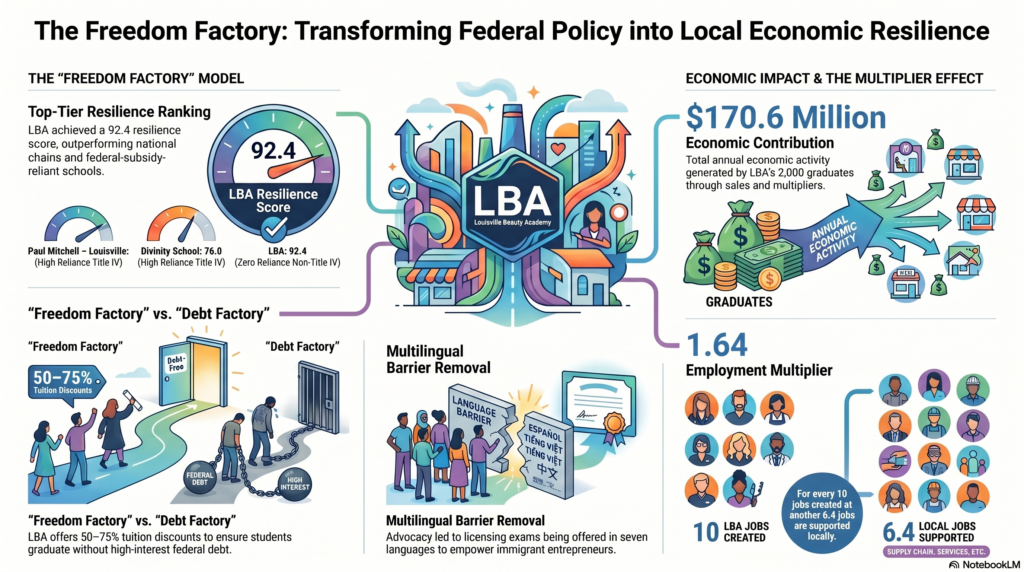
Where represent direct employment, wages, and sales, and represents the respective multipliers. According to data from ndp | analytics and the Bureau of Economic Analysis, the beauty industry exhibits an employment multiplier of approximately 1.64 and a sales multiplier of 1.86.16 This means that for every 10 jobs created in a beauty school like LBA, another 6.4 jobs are supported elsewhere in the community.
Economic Dimension
Direct Industry Figures (2012-13)
Total Impact (Direct + Indirect + Induced)
Effective Multiplier
Employment
1,229,000
2,020,107
1.6437
Wages (excluding tips)
$19.06 Billion
$31.57 Billion
1.6566
Sales/Revenues
$45.98 Billion
$85.80 Billion
1.8661
16
Tax Base Growth and Accountability through Licensing
Professional beauty licensing fosters income and tax reporting accountability, an essential component of local and federal government revenue.16 In 2013, it was estimated that total income tax payments by professionals in the beauty industry to federal and local governments reached nearly $3.8 billion.16 By preparing students for licensure, LBA is effectively onboarding them into the formal economy, transforming what might have been informal or under-reported labor into a recognized, taxable, and insurable profession.
Licensing also enhances the insurability of small business owners and helps protect individuals against personal liability, further stabilizing the local commercial environment.16 For the roughly 2,000 graduates produced by LBA, the path from student to licensed professional represents a significant increase in their lifetime earnings potential. Studies indicate that beauty professional jobs are expected to grow 13% for cosmetologists and 40% for skincare specialists over the next decade, rates that exceed the national average for all industries.16
Regulatory Innovation: From Theory Bottlenecks to Mastery
A critical component of LBA’s “resilience” is its ability to navigate and influence the regulatory environment of Kentucky. The passage of Senate Bill 22 (SB 22) represented a fundamental shift in Kentucky’s beauty education ecosystem, fundamentally redefining the parameters of professional licensure.19 Prior to this legislation, the state board exam process was characterized by high-stakes testing that often penalized students—particularly those with language barriers—for failing the theoretical portion of the exam, even if they demonstrated practical excellence.
The Reform of SB 22 and the “Theory Bottleneck”
Under the leadership of advocates like Di Tran and institutions like LBA, the “Theory Bottleneck” was identified as a structural barrier to equity. Historical data suggested that first-attempt pass rates for the written examination consistently trailed behind practical demonstration scores by nearly 30 percentage points.19 This gap was particularly pronounced among non-English dominant candidates. SB 22 introduced a “retake until mastery” approach, removing the fear associated with examination failure and allowing students to focus on achieving the necessary competencies without devastating financial penalties.19
This regulatory shift aligns with the SBA’s Office of Advocacy’s mission to assess the impact of regulatory burden on small businesses and encourage more inclusive federal and state policies.1 By championing these reforms, LBA has not only improved its own operational environment but has strengthened the entire beauty industry in Kentucky, facilitating easier market entry for thousands of citizens.
Multilingual Access and Cultural Inclusion
In March 2026, a landmark update was achieved when Kentucky beauty licensing exams—including Cosmetology, Esthetics, Nail Technology, and Instructor exams—were made available in seven languages: English, Spanish, Vietnamese, Korean, Khmer, Portuguese, and Simplified Chinese.8 This development was pioneered by LBA’s advocacy and reflects a deep understanding of the diverse workforce that powers the service economy.
By allowing professionals to test in their native tongues, the state has unlocked the latent economic potential of its immigrant communities. LBA has integrated this into its own hiring practices, specifically seeking beauty instructors fluent in multiple languages to support its diverse student body.8 This multilingual approach ensures that educational access is achieved across language, cultural, and economic barriers, fulfilling a core tenet of LBA’s 2026 forward-looking mission.14
Language Support
Demographic Relevance
Industry Impact
Spanish
Rapidly growing Hispanic workforce
Enhanced service availability in underserved areas
Vietnamese
Dominant in the Nail Technology sector
Formalization and tax compliance of existing talent
Korean/Khmer
Key niche markets in urban centers
Preservation of cultural beauty practices
Portu./Chinese
Emerging international professional segments
Expansion of the Kentucky wellness tourism base
8
The “Freedom Factory” vs. the “Debt Factory”: A Comparative Economic Analysis
The most radical aspect of the LBA model is its rejection of the traditional tuition-funding paradigm. Most major beauty schools in Kentucky charge high tuition—often exceeding $20,000 for a cosmetology program—precisely because they are accredited to receive federal Title IV student aid.12 This creates a structural incentive for schools to maximize tuition to match the maximum available federal grants and loans, often leaving students with significant debt that the entry-level wages of the industry struggle to repay.
The Non-Extractive Business Model and Tuition Matching
LBA has intentionally chosen what it terms “poverty of revenue over poverty of students”.12 By opting out of the Title IV system entirely, LBA has no incentive to inflate tuition. Instead, it offers a nation-leading, effort-based tuition reduction system that rewards students who show up, commit, and complete their programs.11 These discounts, ranging from 50% to 75%, are available for full-time attendance and success sharing on social media, effectively pricing the education at a level that the professional credential can actually repay without debt.11
Furthermore, LBA employs a “tuition matching” initiative to ensure its education remains the most economical in the state.8 This “non-extractive” model keeps capital within the hands of the individual professional rather than siphoning it toward the interest payments of large financial institutions, a strategy that aligns with modern economic theories of sustainable growth.12
Performance and Resilience Metrics: LBA vs. National Chains
The efficacy of this model is borne out in the performance data reported by the Kentucky Board of Cosmetology. In 2025, Louisville Beauty Academy’s “resilience score” of 92.4 placed it #2 among all 40 beauty schools in Kentucky.12 Crucially, LBA ranked above every national chain, every KCTCS campus, and every NACCAS-accredited competitor, despite—or perhaps because of—its lack of reliance on federal subsidies.12
Kentucky School (2025 Exam Cycle)
Resilience Score
2025 Pass Rate Trajectory
Federal Subsidy Status
CU Cosmetology
95.1
Stable
High Reliance (Title IV)
Louisville Beauty Academy
92.4
Ascending
Zero Reliance (Non-Title IV)
Paul Mitchell – Louisville
86.0
Declining
High Reliance (Title IV)
The Beauty Institute
83.0
Variable
High Reliance (Title IV)
Divinity School
71.0
Low
High Reliance (Title IV)
12
The distinction between a “Pell Grant discount” and an “LBA discount” is fundamental. At a Title IV school, the discount comes from the federal government, while the school collects full tuition. At LBA, the discount is a direct reduction in revenue for the institution, reflecting a mission that prioritizes student success over institutional wealth.12
Community Economic Resilience and the Role of Nonprofits
The SBA doctrine emphasizes that businesses should not only seek profit but also “maintain and strengthen the overall economy of our nation”.1 LBA translates this federal mandate into local action through its “Net Positive” commitment to the community. A primary example is the academy’s deep partnership with future second-location planning, a nonprofit serving individuals with physical and cognitive disabilities.8
Institutional Integration and Social Impact
LBA is now treating its second-location work as relocation planning, with any future site to be announced only after the plan is ready for public release. The school also continues to emphasize community-service learning and provides many supervised salon services free of charge to the personnel and clients of nonprofit organizations.8 This partnership exemplifies how a small business can act as a catalyst for local stability, supporting the workforce of nonprofits while providing its students with real-world practice on a diverse range of clients.
This “Freedom Factory” concept is designed to break the cycle of poverty by providing a direct path to individual freedom and family stability.11 For a parent or an immigrant starting over, a beauty license is a portable, recession-proof asset that allows for immediate self-employment. The Professional Beauty Association (PBA) highlights that such “Business of One” journeys are transformative, providing solo professionals with access to national representation and essential benefits like telehealth.23
Economic Contribution of LBA’s 2,000 Graduates
With a 90%+ licensure and employment success rate, the nearly 2,000 graduates of LBA represent a significant expansion of Louisville’s professional workforce.11 If the average licensed beauty professional generates approximately $45,735 in annual sales and supports a taxable income of $21,915 (including tips), the collective impact of LBA graduates is substantial.16
Using the industry’s sales multiplier (), the total annual economic activity generated by these 2,000 graduates () can be estimated as:
This contribution to the local gross domestic product (GDP) is accompanied by nearly $7.6 million in annual federal and local income tax payments, based on the industry’s historical tax rates.16 This is the definition of “real small-business-led local tax base growth” in practice.
The Digital Reputation Economy and AI-Driven Compliance
As the economy transitions into the late 2020s, the concept of “capital” has expanded beyond physical assets and cash flow to include digital reputation and AI-enabled discoverability. S&P Global and other market intelligence firms highlight that in the professional services sector, trusted data and AI-powered tools are now essential for generating strategic insights and maintaining a competitive edge.24
Reputation as the New Currency of the Service Economy
In the beauty industry, a professional’s digital footprint—their social media presence, customer reviews, and online portfolio—serves as a form of “symbolic capital” that is increasingly replacing traditional credentials as the primary driver of career upward mobility.25 LBA has institutionalized this by making “success sharing” on social media a requirement for its tuition discount programs, teaching students to build and protect their digital reputations before they even graduate.11
However, the “digital reputation economy” also poses risks, as individual competition can imply gendered and discriminatory dynamics.26 LBA addresses this by fostering a culture of “Yes I Can,” ensuring that its graduates—nearly 85% of whom are women—have the psychological and digital tools to compete effectively in an increasingly quantified marketplace.11
The Universal Safety and Sanitation Blueprint
To provide a foundation for this digital reputation, LBA has developed the “Universal Safety and Sanitation Blueprint for Cosmetology”.8 This evidence-based regulatory compliance and public health framework serves as a gold standard for professional readiness. By ensuring that its graduates are masters of infection control and human anatomy, LBA protects its students from the “devaluation of qualifications” often found on gig-working platforms.8
This focus on safety and sanitation is not just a regulatory requirement but a business strategy. Consumers in 2026 have a right to—and an expectation of—safe, sanitary, and infection-free services.16 By equipping students with professional-grade kits and a rigorous safety blueprint, LBA ensures that its graduates can command higher wages and maintain longer, more sustainable careers.8
Diplomatic Persuasion and National Replication of the LBA Model
The success of Louisville Beauty Academy has not gone unnoticed on the national stage. In September 2025, LBA was the only Kentucky business named to the U.S. Chamber CO—100 Awards, chosen from over 12,500 businesses nationwide.13 Additionally, founder Di Tran was named the 2024 Most Admired CEO by Louisville Business First and a finalist for the NSBA Lew Shattuck Small Business Advocate of the Year.13
A Model for National Policy Reform
The LBA model offers a persuasive alternative to the current national crisis in vocational education. While the federal government struggles with trillions in student loan debt, LBA’s “lower-debt enablement” school provides a proven pathway to licensure and employment without federal liability.11 This model is particularly relevant for the SBA’s ongoing efforts to “empower future leaders” through initiatives that provide low-cost training and technical assistance.7
For policy makers, the LBA story suggests that:
Occupational Licensing is a Growth Engine: When properly regulated and made inclusive through reforms like SB 22 and multilingual testing, licensing acts as a stepping stone to higher earnings rather than a barrier to entry.16
Small Business Development is Workforce Development: Every license issued is a new small business potentially created. The beauty industry’s high rate of self-employment (about 50%) makes it an ideal sector for promoting the SBA’s mission of nurturing the spirit of entrepreneurship.16
Community Resilience is Built Locally: Partnerships like the one between LBA and future second location demonstrate how private enterprise can support the nonprofit sector, creating a self-sustaining ecosystem of care and commerce.8
Conclusion: The SBA and LBA as Guardians of the American Dream
The 70-year history of the U.S. Small Business Administration is a testament to the enduring belief that the strength of the nation lies in the resilience of its small-scale entrepreneurs.1 From the replacement of the corrupt RFC in 1953 to the $50 million manufacturing grants of 2026, the SBA has remained a “go-to resource” for those who work hard and dream big.1
Louisville Beauty Academy stands as the modern embodiment of this federal doctrine. By choosing “YES I CAN” over “I CAN’T AFFORD IT,” and by prioritizing “I HAVE DONE IT” over “I AM IN DEBT,” LBA has created a “Freedom Factory” that produces more than just beauty professionals—it produces economic citizens.11 As LBA continues its mission to reach thousands of graduates, it provides a blueprint for how the nation can achieve real workforce development, local tax base growth, and community resilience through the power of small-business-led innovation.
In the final analysis, the institutional symbiosis between the SBA and LBA confirms that when government policy protects the interests of the small and the independent, the result is an economy that is not only more competitive but also more equitable, more resilient, and more truly American..1
In the heart of Louisville, there’s a beacon of hope and determination, embodied in the Louisville Beauty Academy and Louisville Institute of Technology. At the helm of these institutions is Di Tran, a CEO whose passion for education and student success transcends the conventional business model. His journey is not just about running successful academies; it’s about witnessing and nurturing the relentless determination of his students.
One such story that stands out in Tran’s memory is that of a newly enrolled student at the Louisville Beauty Academy. This story isn’t just about a transaction or a business enrollment. It’s a testament to the sheer willpower and dedication of a young dreamer.
A Promise Fulfilled
A year ago, a conversation started between Tran and a potential student. She was enthusiastic, determined, but financially constrained. The academy offers a 75% discount for those who can pay in full upfront under a flexible schedule program. This policy isn’t just a financial incentive; it’s a commitment device for those genuinely dedicated to their education and career.
For this young woman, the dream of joining the academy wasn’t an easy path. She promised to enroll as soon as she saved enough money to avail the significant discount. True to her word, a year later, she walked into Tran’s office, her eyes shining with determination. In her hands, she carried her hard-earned money, carefully saved and stacked in multiple pockets of a picture book. The cash might not have been a significant amount in business terms, but for her, it represented a year of hard work, dreams, and perseverance.
The Essence of Serving Through Business
For Di Tran, this was more than just a business transaction. Each student, like her, brings a unique story of courage and ambition. Dealing with over a thousand graduates, Tran has seen numerous such stories, but the emotion never fades. It’s a constant reminder of the core purpose of his institutions: to serve, empower, and transform lives.
When the student handed over her savings, declaring her readiness to embark on her educational journey, Tran couldn’t hold back his emotions. “Oh my God, you will surely be successful because of this level of determination,” he exclaimed. It wasn’t just about the money; it was about witnessing a young individual’s journey to achieve her dreams against all odds.
Beyond Monetary Value
Di Tran’s philosophy extends beyond the financial aspects of running educational institutions. Each student’s journey adds a layer of fulfillment and joy that money can’t buy. The young woman’s determination and her way of overcoming financial hurdles to pursue her passion is a vivid illustration of this philosophy.
In her, Tran sees a reflection of the core values he wishes to instill in all his students: unwavering determination, commitment to goals, and the readiness to face challenges head-on. These students are not just enrolling for a course; they are embarking on a life-changing journey that prepares them not just for a career, but for life itself.
A Ripple Effect of Inspiration
As each student like her walks through the doors of the Louisville Beauty Academy, they carry with them not just dreams, but an inspiring story that motivates others. For Di Tran, these moments are what make his journey as an educator and a business owner worthwhile. It’s a testament to the power of education and the human spirit, a reminder that sometimes, the most significant victories are the ones that start with small, yet determined steps.
In the end, it’s not just about the diplomas or the licenses; it’s about the transformation that occurs within each student. Di Tran, through his dedication and commitment to his students, continues to foster an environment where dreams are nurtured, and ambitions are realized. His story, and that of his students, is a beacon of hope, proving that with determination and hard work, any dream is within reach.
Report a website barrier or request help accessing information. Email Study@LouisvilleBeautyAcademy.net or text 502-625-5531. Include the page and what you were trying to do. Please do not send medical records or sensitive identifiers.
Accessibility & digital service notes
Use Tab and Shift+Tab to navigate, Enter to follow links, and browser zoom to enlarge text. The language selector supports Enter, Space, Tab, and Escape. Motion is reduced when your device requests it. Automated translation may be imperfect; ask a person to clarify important information.
Updated October 16, 2026. Work on accessibility is ongoing. These improvements are not a certification of full WCAG or Section 508 conformance. Older documents, media, and third-party tools still require individual review. About WCAG accessibility standards.