
Louisville Beauty Academy applies the public-trust standard by focusing on state-licensed training, affordability, student-pathway clarity, law, sanitation, and supervised practice.
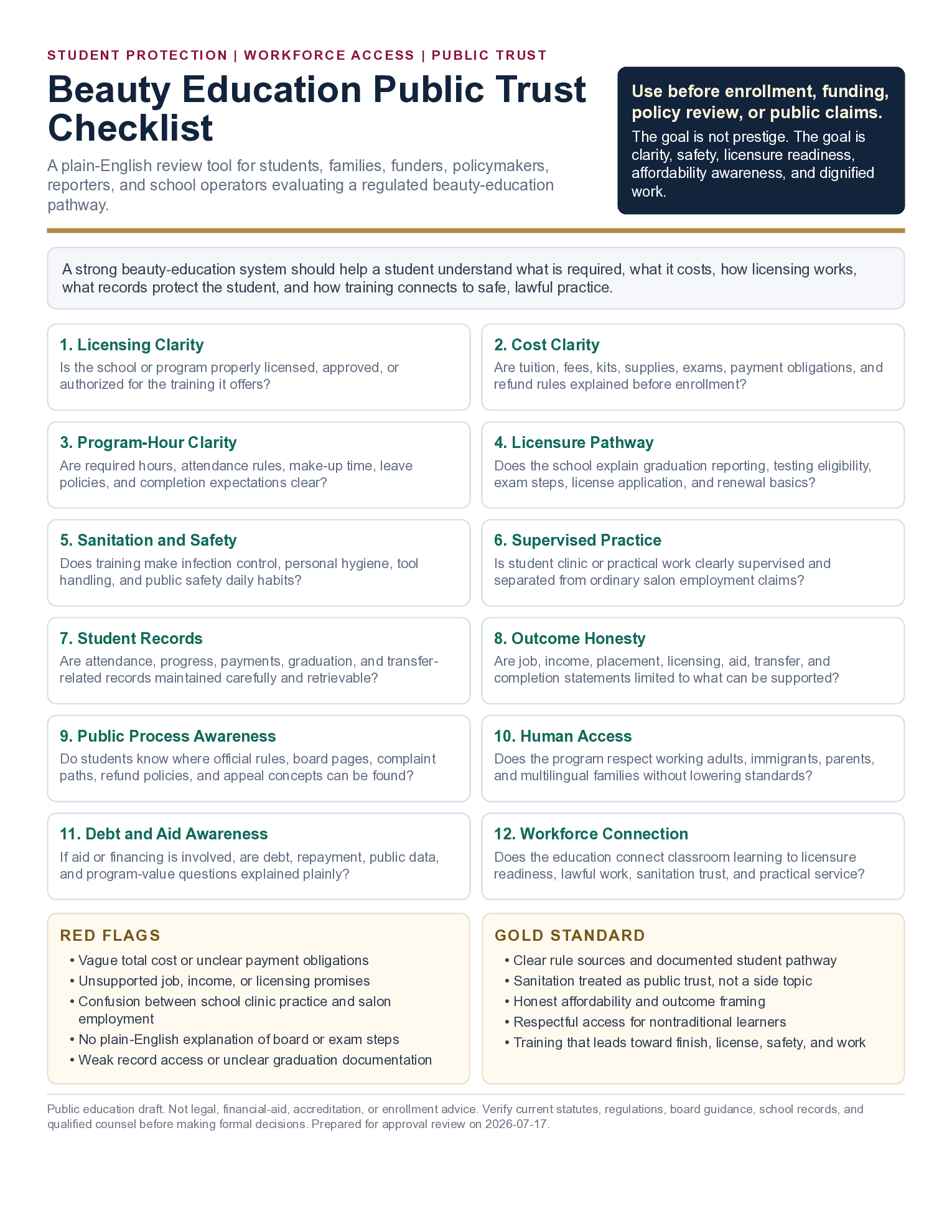
A State-Licensed Education Pathway
Louisville Beauty Academy operates in the Kentucky beauty-education system and frames student training around lawful pathway clarity. The school should be evaluated through practical student questions: what program is offered, what rules apply, what costs are expected, what hours are required, and what steps lead toward licensure.
Affordability Is Student Protection
Affordability is not a marketing accessory. In licensed career education, cost clarity can protect students and families from confusion, unnecessary debt pressure, and unrealistic expectations. A serious school should help students understand obligations before enrollment.
Law, Sanitation, and Supervised Practice
Beauty education is public-facing work. LBA’s protective public message should remain grounded in law, sanitation, infection-control habits, supervised practice, attendance discipline, documentation, and readiness for the next licensing step.
Nearly 2,000 Graduates and a Workforce Mission
Louisville Beauty Academy’s public institutional story includes nearly 2,000 graduates and a national award-winning, workforce-focused education mission. Those facts should be used carefully: they show durability and public service without implying guaranteed licensure, employment, income, or government endorsement.
What Students and Families Should Ask
- What is the total program cost and payment path?
- What hours, attendance expectations, and completion requirements apply?
- What Kentucky licensing steps happen after training?
- How are law, sanitation, safety, and supervised practice taught?
- What claims are not guaranteed, including employment, income, timing, and license outcome?
Public Sources
This article uses public education sources only. It is not legal advice, financial-aid advice, or an accusation against any person, school, board, accreditor, or agency.
- Kentucky Revised Statutes, KRS Chapter 317A
- Kentucky Administrative Regulations, 201 KAR Chapter 12
- 201 KAR 12:082, education requirements and school administration
- Kentucky Board of Cosmetology
- Kentucky Board of Cosmetology licensure information
- U.S. Department of Education, overview of accreditation
- U.S. Department of Education College Scorecard
- Federal Student Aid, Financial Value Transparency and Gainful Employment
- Federal Register, FVT/GE final rule
- U.S. Bureau of Labor Statistics Occupational Outlook Handbook
- BLS, Barbers, Hairstylists, and Cosmetologists
- BLS, Manicurists and Pedicurists
- Federal Trade Commission, choosing a vocational school or certificate program
Public Boundary
This article does not claim accreditation status, government endorsement, guaranteed licensure, guaranteed employment, guaranteed income, or any specific regulatory outcome. It is public education for students and families.







