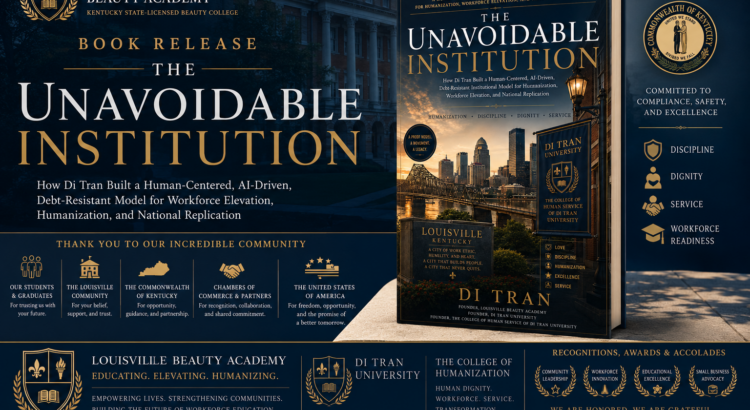
Louisville Beauty Academy is deeply honored and grateful to announce the release of The Unavoidable Institution: How Di Tran Built a Human-Centered, AI-Driven, Debt-Resistant Model for Workforce Elevation, Humanization, and National Replication — a flagship publication representing years of operational experience, workforce service, educational development, institutional reflection, AI implementation, compliance practice, and community-centered learning.
This moment is not simply the release of a book.
It is a reflection of the people, community, city, state, and nation that made this journey possible.
As a Kentucky state-licensed beauty college proudly founded and built in Louisville, Kentucky, Louisville Beauty Academy extends sincere gratitude to:
the Louisville community,
the Commonwealth of Kentucky,
the United States of America,
our students and graduates,
immigrant and working families,
employers and workforce partners,
educators and instructors,
chambers of commerce,
community organizations,
public servants and workforce advocates,
local and national business leaders,
and every individual who has contributed encouragement, accountability, opportunity, trust, recognition, and support throughout our journey.
We are especially humbled and thankful for the validations, recognitions, nominations, awards, partnerships, and acknowledgments received over the years, including support and recognition from workforce-development communities, entrepreneurship ecosystems, local and national business organizations, chambers of commerce, and advocacy groups that continue to elevate small business, workforce education, and human-centered economic development across America.
This publication reflects not only the work of one individual, but the collective contributions of the broader Louisville Beauty Academy and Di Tran University communities — including students, graduates, instructors, editors, researchers, AI systems contributors, compliance-support teams, operational staff, institutional-development collaborators, and community partners whose countless hours of service, documentation, learning, correction, and refinement helped shape the ideas contained in this work.
Most importantly, this book belongs to the people.
It belongs to:
the working parent trying to rebuild life,
the immigrant family searching for opportunity,
the student seeking dignity through practical education,
the graduate learning to believe in themselves again,
and the workforce communities that continue carrying the American economy through service, discipline, entrepreneurship, and hard work.
A Book About More Than Beauty Education
While rooted in the operational realities of Louisville Beauty Academy, The Unavoidable Institution ultimately presents a much larger institutional and workforce-development discussion regarding:
affordable workforce education,
vocational and trade-school innovation,
AI-assisted institutional systems,
compliance architecture,
operational discipline,
human-centered leadership,
workforce dignity,
community service,
entrepreneurship,
and the future of practical education in America.
The publication argues that education should not merely process students into debt and credentials, but should instead strengthen individuals into:
disciplined workers,
stable professionals,
capable entrepreneurs,
responsible citizens,
and dignified contributors to families and communities.
The book further explores:
why America may be educated but not fully elevated,
the dangers of debt-driven educational systems,
why workforce education deserves greater national respect,
how beauty and trade education serve as real economic infrastructure,
how AI can strengthen institutional accountability without replacing human dignity,
why humanization should become an operational framework,
and how small institutions can create large societal impact through disciplined design, affordability, service, and measurable outcomes.
Louisville, Kentucky, and the American Workforce
Louisville Beauty Academy proudly recognizes Louisville as a city of resilience, workforce energy, entrepreneurship, logistics, diversity, and human service.
From immigrant communities to working-class families, small businesses, logistics workers, healthcare workers, beauty professionals, educators, tradespeople, and entrepreneurs, Louisville represents many of the values this book seeks to honor:
hard work,
service,
reinvention,
discipline,
opportunity,
and community contribution.
We remain deeply grateful to Louisville and the Commonwealth of Kentucky for providing the opportunity to serve students, families, employers, and communities through workforce-centered education.
We also remain thankful to the broader American system that allows small institutions, immigrant families, entrepreneurs, and local workforce organizations the opportunity to build, contribute, and continue participating in the fabric of the nation.
Humanization, AI, and the Future of Institutions
One of the central ideas explored in the publication is that the future of education and workforce development must remain deeply human even as artificial intelligence and automation continue expanding.
The book proposes that AI should support:
accountability,
operational consistency,
documentation,
compliance,
institutional memory,
and administrative precision,
while preserving the irreplaceable role of:
human judgment,
human care,
mentorship,
correction,
discipline,
compassion,
and real-world service.
The publication further argues that institutions should become:
more affordable,
more operationally disciplined,
more transparent,
more community-oriented,
and more focused on producing workforce-ready individuals capable of contributing meaningfully to society.
Gratitude to the Di Tran University and College of Humanization Teams
Louisville Beauty Academy extends special appreciation and gratitude to the Di Tran University and College of Humanization communities for their contributions in:
editing,
writing,
research,
institutional design,
AI integration,
operational refinement,
documentation systems,
publication development,
compliance review,
workforce-policy discussion,
and educational collaboration.
This publication reflects years of collective effort and shared belief that affordable, disciplined, human-centered institutions remain possible in America.
Continuing the Mission
Louisville Beauty Academy remains fully committed to:
workforce readiness,
student affordability,
sanitation and safety,
disciplined operational systems,
educational accountability,
human dignity,
community contribution,
and compliance with all applicable local, state, and federal laws, regulations, sanitation standards, educational requirements, and licensure obligations.
This publication is intended solely for educational, informational, institutional-development, and public-policy discussion purposes and does not constitute legal advice, regulatory interpretation, governmental policy, accreditation guidance, or legal conclusions.
As we move forward, our mission remains unchanged:
To help build affordable, disciplined, human-centered educational systems that strengthen lives, families, communities, and the American workforce.
Louisville gave us the opportunity to serve. Kentucky gave us the opportunity to grow. America gave us the opportunity to dream.
“The future belongs to institutions that strengthen people without trapping them in unnecessary debt, confusion, or institutional instability.” — Di Tran
This article is part of LBA’s public education and historical archive. Older posts, including “Institutional Analysis of Vocational Innovation: The Louisville Beauty Academy Case Study in Workforce Humanization – RESEARCH & PODCAST SERIES 2026,” may not reflect current tuition, schedules, incentives, forms, policies, testing vendors, clinic availability, or regulatory requirements.
Hosted Research Publication – Public Workforce Policy Discussion Resource. This academic analysis is independently produced by the Di Tran University — College of Humanization Research Team and is provided by Louisville Beauty Academy solely as an educational and public-interest resource to support transparent discussion on vocational innovation and workforce development.
Executive Summary
This institutional analysis, produced by the Di Tran University (DTU) — College of Humanization Research Initiative, explores the structural and philosophical architecture of the Louisville Beauty Academy (LBA) as a unique case study in vocational education. In an era marked by the dual pressures of rising student debt and chronic workforce shortages, the LBA model presents an alternative paradigm centered on lower-debt enablement, rapid professional licensure, and the psychological concept of “humanization”.1 DTU researchers observe that by operating outside the traditional federal Title IV financial aid infrastructure, the institution effectively de-risks the educational pathway for nontraditional and underserved populations, including immigrants, working parents, and first-generation professional credential earners.2
The study identifies the “Concurrent Contribution Education Model” as a primary driver of economic resilience, where learners generate tax revenue and maintain labor market participation while simultaneously pursuing state-regulated licensure.2 Central to this transformation is a sophisticated behavioral framework—the “Career Credit Score”—which utilizes digital professional identity development and public-facing “proof-of-work” to bridge the information gap between graduates and employers.7 This research suggests that the normalization of failure as a learning mechanism, paired with an “antifragile” mindset, cultivates a workforce characterized by persistence and entrepreneurial readiness.7 The report concludes that such community-driven vocational ecosystems offer a scalable framework for policy discussion regarding the future of workforce stability and social mobility in a volatile, technology-driven economy.2
Research Context and Systematic Framework
The modern vocational education landscape is currently experiencing a profound structural transformation, transitioning from a static, credential-based model to a dynamic, reputation-based “proof-of-work” economy.7 Traditional academic pathways, while historically reliable, have increasingly become burdened by credential inflation and the “asymmetric information” problem, where employers lack verifiable data on a candidate’s actual skill application and grit.7 Simultaneously, the rising cost of postsecondary education has created a “debt-trap” scenario for low-income learners, where the financial risk of educational withdrawal often exceeds the potential rewards of graduation.2
Louisville Beauty Academy (LBA) serves as a critical case study within this context. It is a state-licensed vocational institution that focuses on the “minimal competence” required for public safety and professional entry, rather than the more speculative and expensive “professional mastery” often marketed by higher-cost competitors.10 DTU researchers observe that this distinction is legally anchored in Kentucky Revised Statutes (KRS) Chapter 317A, which prioritizes the protection of the public through rigorous sanitation and chemical handling protocols.10
The framework of this analysis is grounded in the College of Humanization’s philosophy, which posits that business and education must uplift human dignity.3 This perspective allows for an evaluation of LBA not merely as a commercial entity, but as a “Freedom Factory” that facilitates identity shifts from “survival mode” to “professional mode”.4 The research examines the intersection of state-level administrative oversight and federal consumer protection principles (e.g., 34 CFR Part 602 and the Gainful Employment Rule), observing how a model that rejects federal lending actually aligns more closely with the intended outcomes of federal oversight: measurable economic benefits and debt-light career entry.2
Institutional Comparison
Traditional Title IV Trade School
LBA Case Study Model
Primary Funding
Federal Direct Loans / Pell Grants 16
Earned Income / Institutional Scholarships 4
Average Debt
$10,000 – $25,000 for vocational 2
Zero to Minimal (Lower-Debt Philosophy) 1
Instructional Focus
Credit-Hour / Mastery Branding 14
Clock-Hour / Licensure-First 10
Student Risk
High (Debt remains if student drops) 2
Low (Pay-as-you-go flexibility) 2
Demographic Core
Broad Traditional and Nontraditional
Primarily Working Adults and Immigrants 4
The institution’s refusal to rely on federal subsidies is observed as a strategic choice that protects student dignity and institutional independence.9 By removing the bureaucratic and financial overhead of the Title IV system, LBA appears to prioritize transparency and affordability, offering tuition reductions of 50% to 75% through effort-based incentive models.2
Economic Participation Analysis: The Concurrent Contribution Model
At the core of the LBA case study is what researchers term the “Concurrent Contribution Education Model”.2 This model disrupts the traditional sequential approach to human capital development, where a learner first attends school (consuming capital) and then enters the workforce (producing capital). Instead, LBA learners are observed to balance these roles simultaneously.2
The Dual Economic Contribution Effect
DTU researchers analyze this model as a “Certainty Engine” that produces immediate and ongoing tax contributions.2 This occurs in two distinct phases:
Phase 1: Contribution During Education. Because students are not reliant on federal loans for living expenses, they typically maintain employment at regional hubs (e.g., Amazon, UPS, or local healthcare facilities) while attending evening or weekend classes.4 Consequently, they continue to pay federal, state, and local payroll taxes throughout their enrollment period.2 This differs from subsidized pathways that may remove a worker from the tax base for months or years.2
Phase 2: Contribution After Licensure. The compressed timeline from enrollment to licensure (often less than one year for specialized programs) moves the learner into a higher-tier tax bracket more rapidly than traditional degree programs.1 Graduates transition into regulated, high-demand sectors as licensed professionals or small business owners, contributing an estimated $20 million to $50 million annually to the regional economy.1
The return on investment (ROI) for such vocational training can be mathematically modeled using the “Economic Value Contribution” (EVC) framework, which accounts for the increase in annual earnings relative to the cost of education.20
Where:
is the increase in annual earnings as a result of licensure.
is the cost of education (which, in the LBA model, is minimized through scholarships).
is the discount rate for future earnings.
is the number of years in the professional workforce.
Research into Texas community colleges and similar vocational sectors indicates that for every $1 invested, taxpayers see a return of $1.40 to $6.80 in added tax revenue and social savings.13 In the LBA model, because the initial taxpayer investment is zero, the societal ROI is mathematically infinite in terms of direct subsidy-to-revenue ratio.2
Debt-Light Pathways and Workforce Stability
The absence of federal debt acts as a stabilizer for the local workforce. DTU researchers observe that students burdened by high debt are often “fragile”—a minor life disruption (e.g., car breakdown, family illness) can lead to loan default and economic tailspin.2 By financing education through real-time earned income, LBA students build “economic muscle” rather than “financial liability”.2 This allows graduates to enter the market with higher entrepreneurial readiness, as they are not immediately required to service large loan payments, thus allowing them to reinvest their initial professional earnings into business startup costs or further specialized training.1
Human Capital Findings: Grit and Resilience in Nontraditional Learners
The student body at LBA appears to represent a “high-constraint” demographic.4 DTU researchers identify these constraints not as deficits, but as the raw material for “Workforce Resilience”.8 Analysis of student backgrounds reveals that many are balancing full-time employment, the rearing of children (often as single parents), and significant commuting distances.4
Adult Learner Persistence and Grit Theory
Traditional academic research shows a staggering 35-percentage-point gap in persistence rates between traditional-age students and adult learners (age 25+).22 However, the LBA model appears to cultivate persistence through “Institutional Responsiveness”—providing flexible schedules (days, evenings, weekends) and multilingual theory support that meets the learner where they are.4
The “Grit Theory,” popularized by Angela Duckworth, posits that passion and perseverance for long-term goals are better predictors of success than innate talent.24 DTU researchers observe this manifested in the LBA “YES I CAN” mentality.4 For a student who has traveled from Vietnam or Cambodia to the U.S. and is now learning the chemistry of hair color in a second or third language, the very act of enrollment is an exercise in grit.5
The Psychology of Nontraditional Education
Nontraditional education psychology suggests that adult learners are motivated by immediate relevance.22 LBA’s “Licensure-First” approach aligns with this by focusing on the “minimal knowledge and experience” needed to pass the state board exam and start earning a professional wage.10 This creates a “Self-Efficacy Loop”:
Step 1: Mastering a basic sanitation protocol (Immediate Win).28
Step 2: Documenting the progress through the “Career Credit Score” (Verifiable Proof).7
Step 3: Passing the state licensing exam (Validation of Effort).4
Step 4: Entering the workforce (Economic Transformation).1
This sequence helps overcome “Dispositional Barriers”—the internal fears and self-doubts that often sideline low-income or immigrant learners.29
Social Mobility and Immigrant Integration: The Freedom Factory
LBA functions as a localized engine for social mobility, specifically for immigrant and rural populations.1 Researchers analyze the institution’s “Humanized AI” approach, which utilizes translation tools (e.g., Google Chrome’s built-in translation and AI video avatars) to bridge the linguistic gap for non-native English speakers.25
Localized Workforce Integration
For the nearly 2,000 licensed graduates, the acquisition of a Kentucky State Board license represents their “first professional credential” in the United States.1 This credential provides a “Permanent Professional Identity” that is portable and recognized by the state, shielding the individual from the volatility of the unskilled labor market.2
Integration Barrier
LBA Case Study Intervention
Societal Impact
Language Gap
Multilingual instruction/AI translation 25
Higher licensure rates for immigrants 1
Financial Risk
lower-debt tuition / Scholarships 4
Intergenerational wealth preservation 35
Cultural Alienation
“Humanization” of education 3
Increased sense of community and belonging 36
Regulatory Fog
Training in state law/safety (KBC focus) 14
Informed “Regulatory Citizens” 14
The Impact of First-Time Credentialing
DTU researchers observe that for many LBA students, the professional license is the first time they have participated in a formal state-regulated credentialing process.4 This has a “Transformation Effect”: the psychological shift from being an “outsider” or “laborer” to a “licensed American professional”.5 This shift is often celebrated through ceremonies where the “cap and gown” represent more than academic completion; they represent proof of discipline and proof of growth.9
Behavioral and Mindset Observations: Antifragility and Safe Failure
One of the most distinctive philosophical elements observed at LBA is the normalization of failure.4 DTU researchers analyze this through Nassim Nicholas Taleb’s concept of “Antifragility”—a property of systems that grow stronger through stress and small shocks.8
The Antifragile Learning Mindset
In a traditional academic setting, failure is often penalized by grades, which can create a “fragile” learner who avoids risk.38 Conversely, LBA’s instructional design encourages students to “learn in public,” documenting their “messy middle”—the transition from novice observation to clinical competency.7
By encouraging students to share videos of “mistakes I made today” or time-lapses of repeated practice on mannequins, the institution normalizes the friction required for mastery.7 This “Serious Practice” allows for:
Hormesis: Small, manageable doses of stress (e.g., a difficult perm wind) that build overall competence.8
Safe Failure: Failing on a mannequin or under instructor supervision is a low-cost experiment that prevents high-cost failure in a professional salon later.7
Adaptive Learning: Developing the ability to troubleshoot and problem-solve in real-time, which is essential for the service-industry workforce.4
From “YES I CAN” to “I HAVE DONE IT”
The “YES I CAN” mindset is observed as the Belief Stage, while the “I HAVE DONE IT” certificate represents the Action/Proof Stage.4 DTU researchers note that this framing aligns with growth mindset theory (Dweck), which emphasizes that intelligence and skill are malleable through effort.24 This philosophy is particularly critical for learners from underserved backgrounds who may have been conditioned by systemic barriers to believe that professional licensure was “not for them”.3
Digital Professional Identity: The Career Credit Score (CCS)
A significant innovation analyzed by DTU researchers is LBA’s “Career Credit Score” (CCS) system—a sophisticated framework designed to transition students from a passive learning mindset to a professional identity.7
The Reputation Algorithm
The CCS is a numerical representation of a student’s “professional creditworthiness,” ranging from 300 to 850.7 This system leverages the behavioral psychology of public accountability and the economics of social signaling to formalize the student’s daily learning journey.7
CCS Component
Weighting
Observational Metric
Consistency
35%
Frequency of professional “career deposits” (posts/updates).7
Proof-of-Skill
25%
Documented evidence of curriculum mastery (per 201 KAR 12:082).7
Professional Conduct
20%
Adherence to “Humanization” philosophy and communication poise.7
Regulatory Integrity
20%
Adherence to KBC statutes and FTC disclosure guidelines.7
“Learning in Public” as a Commitment Device
Publicly sharing progress on platforms like Instagram and TikTok acts as a “Commitment Device”—a psychological mechanism that locks an individual into a behavior by creating a social penalty for deviation and a social reward for adherence.7 For LBA students, this digital portfolio provides “Social Proof” to potential employers.7 In an era of “asymmetric information,” an employer hiring an LBA graduate can review a “contribution graph” of the student’s entire 1,500-hour journey, which is far more reliable than a static resume or a high-stakes interview.7
This system also teaches “Digital Literacy” and “Early Branding.” By the time a student reaches the “Mastery Stage” of their education, they have already built a digital reputation and, in many cases, a nascent client base.7 This reduces the risk of post-graduation unemployment and accelerates the transition to small business ownership.1
First-Achievement Transformation Effect
The psychology of “first-time achievement” is a recurring theme in the LBA case study. DTU researchers analyze the impact of experiencing the first professional credential and the first state-administered licensing exam participation.30
Psychological Significance of Professional Licensure
For an individual from a marginalized community, earning a state-licensed credential acts as a “Cognitive Reappraisal” of their status in society.30 It moves the individual from being an “at-will laborer” to a “state-regulated practitioner”.10 This first professional win creates a “Cascade Effect”:
Proximal Goal Achievement: Passing the theory and practical exams.44
Future Aspiration Scaling: The realization that higher-level business goals (salon ownership, instructing) are attainable.9
The “Protégé Effect” further reinforces this transformation.7 In the later stages of the LBA program, students are encouraged to teach techniques to junior learners. Researchers observe that this act of mentorship is the highest signal of mastery, solidifying the student’s professional identity and their sense of “dignity and belonging” within the industry.7
Workforce Reliability: Analysis of High-Constraint Graduates
From a research perspective, graduates who emerge from high-constraint educational environments—balancing jobs, families, and linguistic adaptations—demonstrate a unique set of workforce traits.4 LBA graduates are observed to be “battle-tested” in ways that traditional, sheltered students may not be.18
Interpreting Professional Reliability
DTU researchers analyze these traits through the lens of “Workplace Learning” and “Person-Centered Development”.12 Graduates demonstrate:
Persistence: The ability to complete a 1,500-hour program while working full-time is a high-validity indicator of future job attendance and reliability.4
Adaptability: Navigating the “messy middle” of clinical training builds the capacity to handle the randomness and variety of a customer-facing service industry.4
Entrepreneurial Readiness: The focus on “Business Literacy” and “Digital Portfolio” development prepares graduates to operate as independent contractors or salon owners.1
Customer-Service Resilience: Training in a “Humanization-First” environment emphasizes empathy and the “Creation of Smiles,” which are critical soft skills in beauty and wellness.9
This research clarifies that these outcomes are not institutional guarantees but rather the observed characteristics of a workforce that has been trained under conditions of high accountability and personal investment.2
National Workforce Development Implications
The LBA case study provides significant data points for the ongoing national dialogue regarding skills-based education and the “future of work”.2 As the U.S. workforce experiences sustained volatility driven by automation and credential inflation, models that prioritize “certainty” and “speed-to-work” offer a potential blueprint for reform.2
Exploratory Policy Discussion
DTU researchers pose the following questions for policy analysis:
Outcome-Based Aid: Could federal aid systems be reformed to follow the “LBA Model” of pay-for-performance, where subsidies or reimbursements are tied to licensure and employment rather than enrollment?9
State-Led Regulatory Primacy: Does the LBA case prove that state boards (e.g., KBC) are more effective at ensuring workforce safety and ROI than the federal accreditation hierarchy?10
Debt-Light Ecosystems: Could community-driven vocational schools, operating without Title IV funding, address the $1.7 trillion student debt crisis by normalizing the “Concurrent Contribution Model”?2
Skills-First Immigration Integration: Could the LBA approach to multilingual theory and AI-augmented learning be adapted as a national model for integrating new Americans into skilled trades?25
The LBA case study demonstrates that a state-regulated, non-Title-IV school can deliver licensure and income stabilization faster and at a lower cost than many aid-dependent pathways.2 This suggests that “Economic Freedom” can be engineered through program design, pricing discipline, and licensure alignment.2
Limitations of Research
This analysis is primarily based on observational data, institutional self-reporting from LBA, and interdisciplinary behavioral research. It represents a qualitative institutional analysis rather than a controlled, longitudinal cohort study. Several factors limit the generalizability of these findings:
Geographic Specificity: The Kentucky Board of Cosmetology’s specific regulations (KRS 317A) provide a unique environment that may differ significantly from other states.10
Self-Selection Bias: Students who seek out a lower-debt, high-accountability model may already possess higher levels of intrinsic motivation and grit than the general population.22
Modeled Economic Impact: Economic contributions (e.g., $20M–$50M annually) are modeled based on regional median wages and graduation counts and should be interpreted as analytical estimates rather than audited financial results.1
Long-Term Longitudinal Data: While initial licensure and employment rates are high (90%+), more data is needed to track the 10-year career trajectories of LBA graduates compared to Title IV graduates.2
Future Research Directions
To expand upon this initial case study, the Di Tran University — College of Humanization Research Initiative proposes the following areas for further investigation:
Quantitative Analysis of the “Career Credit Score”: Research to determine if a student’s CCS correlates with business longevity and long-term income stability.7
Comparative Study of Attrition: A study comparing the dropout rates of LBA students with those at traditional federal-aid-funded beauty schools in the same region, controlling for socioeconomic variables.22
AI Impact on Licensure Pass Rates: Measuring the specific delta in theory exam performance when students utilize AI-powered translation and tutoring tools.25
The “First-Credential” Mobility Multiplier: Tracking the intergenerational impact on families where a parent earns their first professional license through an accelerated vocational model.5
Regulatory Literacy as Consumer Protection: Analyzing if graduates with a higher focus on state-law education experience fewer disciplinary actions from state boards during their careers.11
Research Attribution & Institutional Disclaimer
This publication is an independent research analysis produced by Di Tran University — College of Humanization Research Team for educational and public-interest purposes.
Louisville Beauty Academy provides this material solely as a hosted educational resource to support public discussion surrounding workforce development and vocational education innovation.
The analyses, interpretations, and viewpoints expressed herein are those of the DTU research team and do not constitute operational claims, guarantees, or official representations made by Louisville Beauty Academy.
This publication is not marketing material, investment advice, regulatory guidance, or accreditation representation. Readers should interpret findings as academic analysis based on observational and modeled research frameworks.
Crediting:
All authorship, analytical credit, and research ownership is attributed to the Di Tran University — College of Humanization Research Initiative. Louisville Beauty Academy is referenced only as the institutional case study examined.
General Self-Efficacy and Employability Among Financially Underprivileged Chinese College Students: The Mediating Role of Achievement Motivation and Career Aspirations – PMC, accessed February 25, 2026, https://pmc.ncbi.nlm.nih.gov/articles/PMC8815425/
What Makes Adult Learners Persist in College? An Analysis Using the Nontraditional Undergraduate Student Attrition Model – MDPI, accessed February 25, 2026, https://www.mdpi.com/2227-7102/15/9/1085