
Editorial illustration of three separate school campuses and written location records, with a magnifying glass emphasizing the need to verify the exact campus address.

Center of Excellence: Law and Regulation Update – NACCAS September 10 Additional-Location Notice and the Exact-Campus Check

On September 10, 2026, the National Accrediting Commission of Career Arts & Sciences (NACCAS) posted a public notice using the phrase “Grant Provisional Additional Location Accreditation.” The practical lesson for a beauty-school family is simple: check the exact campus address, not only the school name.

A school may operate more than one teaching location. A public status connected to one location should not be assumed to describe every place that uses the same school name. Students and parents should match the official record to the street address where the student will actually attend.

Return to the LBA Beauty Education Center of Excellence hub.
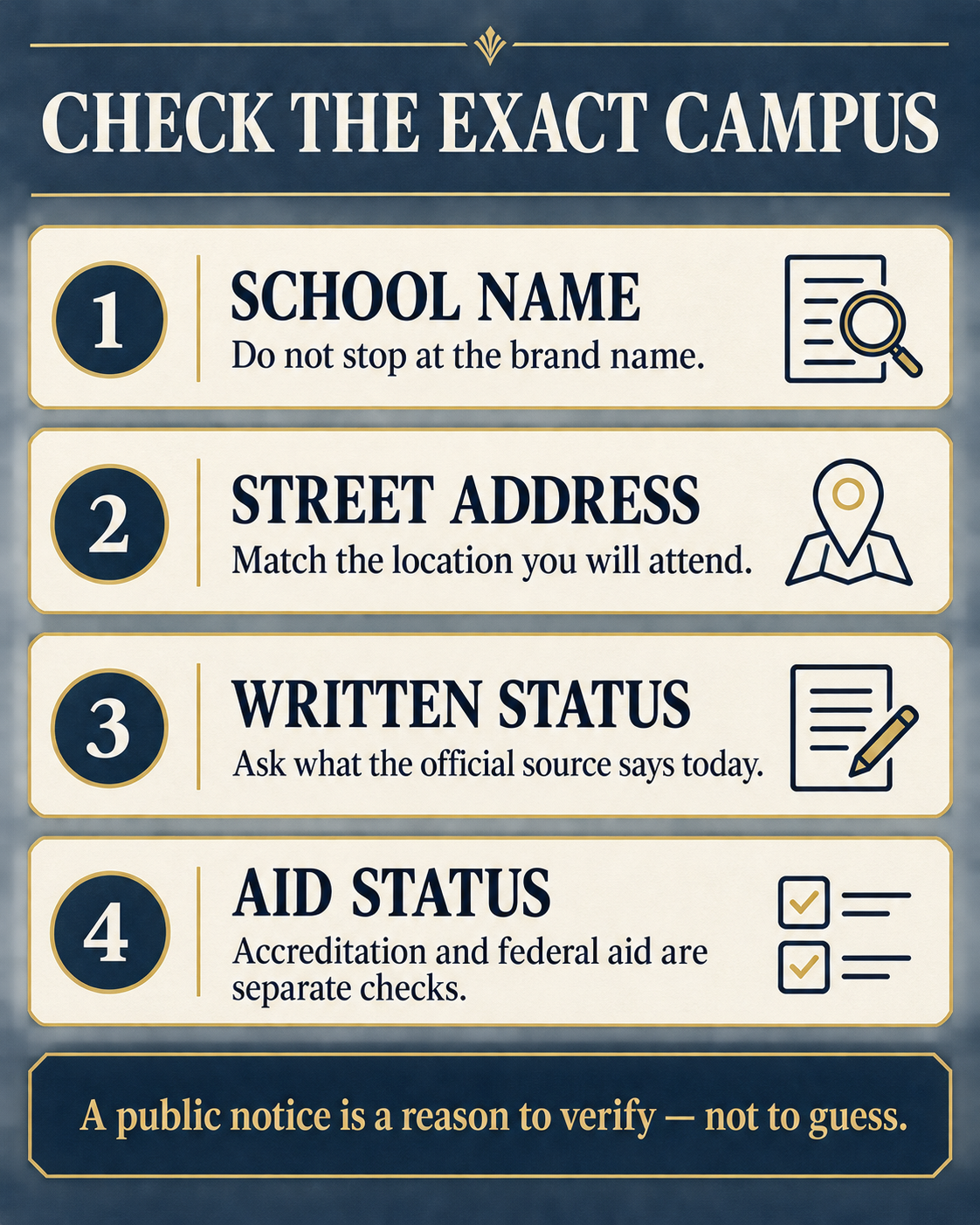
Infographic with four checks for beauty school families: school name, street address, written status, and separate federal-aid status.
A school name is not enough. Match the exact location, current written status, state license, and federal-aid status before making an enrollment decision.

Simple Answer First

The September 10 notice is a new, source-controlled accreditation record. It is not a warning about all beauty schools, an endorsement of any school, or proof about Louisville Beauty Academy.

It is useful because it teaches a rule that families can use anywhere: school name, campus address, accreditation status, state license, and federal-aid status are separate facts. Each fact should be checked in writing.

What NACCAS Posted on September 10

The NACCAS Public Notices page lists an effective date of September 10, 2026, a notice titled “Notice of Commission Actions – September 10, 2026,” and this action category: “Grant Provisional Additional Location Accreditation.”

This article relies on that visible public-page language. It does not name, rank, praise, criticize, or draw a school-specific conclusion about the institution identified in the linked notice file.

What the Hard Words Mean

  • NACCAS is an accrediting agency for career arts and sciences education. An accrediting agency reviews schools under its own published standards.
  • Accreditation is an outside review status. It is not the same as a state license to operate.
  • Commission action means the accrediting commission made a dated decision under its process.
  • Additional location means another teaching site connected to a main campus. For a student, the important fact is the exact address where instruction will occur.
  • Provisional signals a staged or limited status under the accreditor’s process. A family should not rewrite that word as “full,” “final,” “permanent,” or “guaranteed.” The official current record controls.
  • Public notice is a dated record released for the public. It is a reason to verify facts, not a reason to spread rumors.

Why the Exact Address Matters

Imagine that a family sees the same school name on two buildings. One is the main campus. The other is a newer teaching location. A brochure may use one brand name for both, but the official records may list each address separately.

Before signing, the family should write down the exact street address and search that location in the relevant official records. If a search result lists a different address, ask the school for a current written explanation and verify it with the official source.

This is not distrust. It is normal decision discipline. A careful school should be able to explain its own location, program, price, license, and claimed status clearly.

Four Separate Checks Before Enrollment

  1. Check the exact campus. Match the official record to the full street address where the student will attend classes.
  2. Check the state license. In Kentucky beauty education, use the Kentucky Board of Cosmetology and current Kentucky law and regulation sources.
  3. Check the accreditation claim. If a school claims accreditation, search the accreditor’s current directory and public notices. Read the exact words and date.
  4. Check federal aid separately. Accreditation alone does not prove that a school or location participates in federal student aid. Ask for the current written federal status and verify it through official U.S. Department of Education sources.

What This Means for a Real Student or Family

A busy parent may hear, “The school is accredited,” and think the question is finished. It is not. The useful follow-up is: Which campus, at what address, under what current written status, and for which program?

The family should also ask for the current written price, what the school bill includes, the refund rule, the required training hours, the expected completion conditions, and the state-license steps after graduation. Those answers should be reviewed before signing or paying.

If the answer changes depending on who is speaking, pause. Ask for the controlling written document. A verbal promise, advertisement, old screenshot, or social post should not replace a current official record.

Kentucky and Louisville Beauty Academy Relevance

Kentucky beauty schools and license pathways are governed through Kentucky law, regulations, and the Kentucky Board of Cosmetology. Accreditation is a different layer. Federal student aid is another different layer.

Louisville Beauty Academy is a Kentucky state-licensed beauty school. LBA does not claim NACCAS accreditation and does not process the Free Application for Federal Student Aid (FAFSA) or Title IV federal student aid. FAFSA is the government form used to apply for federal student aid; Title IV is the part of federal law that authorizes the major federal student-aid programs.

LBA’s public purpose in explaining this notice is student protection: help families separate labels, compare written facts, and ask better questions before making a school decision.

A Calm Written-Record Checklist

  • What is the exact legal school name?
  • What is the full address where I will receive instruction?
  • Which state agency licenses that school and location?
  • If accreditation is claimed, which accreditor lists this exact location today?
  • Does the official source say provisional, full, renewed, monitored, on probation, pending appeal, withdrawn, or something else?
  • Does the school or location actually participate in federal student aid, or is federal aid not part of its model?
  • What is the current written total price, payment duty, refund rule, required hours, and completion standard?

Students considering LBA may contact Louisville Beauty Academy, email study@louisvillebeautyacademy.net, or call 502-625-5531 to request current written program and cost information. Do not send Social Security numbers, identity documents, payment data, or private student records through a public article or public comment.

Official Sources

Public-Safe Limit

This article is general public education. It is not legal advice, financial-aid advice, accreditation advice, or a school-specific finding about any institution in a public notice. It does not claim NACCAS accreditation or federal-aid participation for LBA. It does not promise admission, graduation, licensure, exam passage, transfer acceptance, employment, income, aid, funding, or any individual result. Current official sources and current written school documents control.

Editorial LBA Center of Excellence image for NACCAS September 3 and 4, 2026 public notices with accreditation literacy and student verification themes.

Center of Excellence: Law and Regulation Update – NACCAS September 3-4 Public Notices and What Beauty School Families Should Understand

NACCAS now lists September 3 and September 4, 2026 public-notice rows with accreditation actions such as renew accreditation, monitoring, probation, voluntary relinquishment, denial of initial accreditation, and withdrawal pending the right to appeal. The plain-English lesson for beauty school families is simple: a public notice is a signal to verify, not a rumor to repeat and not a shortcut for judging any school.

This Center of Excellence update is written for students, parents, spouses, salon owners, workforce counselors, and public readers who need careful beauty education language. Louisville Beauty Academy is using the notice as a student-protection teaching moment, not as criticism of another school, an endorsement of any school, or a legal conclusion.

Return to the LBA Beauty Education Center of Excellence hub.

Infographic showing four accreditation checks for beauty school families: official source, current date, exact words, and written school papers.
Accreditation literacy protects families when it points them back to official sources and written school documents.

Simple Answer First

Accreditation is a school-review system. In beauty education, it can affect public trust, federal-aid eligibility at participating schools, and how families compare schools. But one public-notice row by itself does not tell a family everything they need to know.

A family should slow down and ask for current written proof: the school license, program cost, refund rule, required hours, graduation requirements, state-board license path, and any accreditation or federal-aid status the school claims.

What NACCAS Posted

The NACCAS public-notices page lists a September 3, 2026 row titled Notice of Commission Actions – September 3, 2026. The public page lists action categories including grant initial accreditation, deny initial accreditation, renew accreditation, place on accreditation monitoring, remove from accreditation monitoring, and voluntary relinquishment of accreditation.

The same page lists a September 4, 2026 row titled Notice of Commission Actions – September 4, 2026. The public page lists action categories including renew accreditation, place on financial monitoring, remove from financial monitoring, place on probation, remove from probation, and withdraw accreditation pending the right to appeal.

In this runtime, the linked SharePoint PDF files returned access-denied responses. For that reason, this article relies only on the visible public NACCAS page text and does not summarize school-specific details inside documents that were not retrieved.

What The Hard Words Mean

  • Accreditation means an outside accrediting agency reviews a school or program under that agency’s standards. It is different from a state license.
  • State license means the state board or state agency allows the school or person to operate under state rules. In Kentucky beauty education, the Kentucky Board of Cosmetology is the key state source.
  • Renew accreditation usually means an accreditor has acted to continue accreditation, subject to the accreditor’s rules and any conditions listed in the official notice.
  • Monitoring means the accreditor is watching a school or issue more closely. It is a verification signal, not a final student conclusion by itself.
  • Probation means a more serious accreditor concern or condition may exist. Families should read the official source and ask the school for current written status.
  • Withdrawal pending the right to appeal means the accreditor has listed a withdrawal action, but the notice language also says there is an appeal right. A family should not treat that phrase as the same thing as a final resolved outcome unless the official source says so.
  • Voluntary relinquishment means a school gives up accreditation status voluntarily under the accreditor’s process. It does not automatically explain why, and readers should avoid guessing.

What This Means For A Real Student Or Family

Imagine a parent comparing two beauty schools. One school says it is accredited. Another says it is state-licensed but does not process federal student aid. The parent should not rely on a brochure, a social media post, or a quick verbal answer. The parent should ask: What is the current written status? Who is the official source? What does the school cost? What will my student owe? What happens if my student withdraws?

That is the real lesson. Accreditation words matter because they can sound official, but families still need written proof. A school decision should be based on current documents, not assumptions.

Kentucky And LBA Relevance

Kentucky students should separate three things: state licensing, accreditation, and federal student aid. They are related in public conversation, but they are not the same thing.

  • The Kentucky Board of Cosmetology controls Kentucky beauty licensing and school-rule sources.
  • NACCAS public notices are accreditation-source records for schools in that accreditor’s scope.
  • Federal Student Aid and Title IV rules apply only where a school is eligible and participating in those federal aid programs.

Louisville Beauty Academy is a Kentucky state-licensed beauty school. LBA does not claim NACCAS accreditation and does not process FAFSA or Title IV federal student aid. LBA publishes that plainly so families can compare schools by written facts instead of confusing labels.

Four Checks Before Trusting Accreditation Language

  • Check the official source. Use the accreditor, state board, or government page, not only a school advertisement.
  • Check the date. Accreditation and monitoring status can change. A screenshot from last year may be stale.
  • Check the exact words. Pending appeal, probation, monitoring, renewal, denial, and withdrawal do not all mean the same thing.
  • Check the school paperwork. Program price, refund rules, required hours, and payment duties should be in writing before signing.

Official Sources

Public-Safe Limit

This article is public education. It is not legal advice, financial-aid advice, accreditation advice, or a school-specific judgment about any institution named in an official notice. It does not claim government endorsement, NACCAS accreditation for LBA, federal-aid participation for LBA, student-aid eligibility, licensure, exam passage, employment, income, or any individual outcome. Students and families should rely on current official sources and current written school documents.

Editorial featured image titled 2027-28 FAFSA Preview with Louisville Beauty Academy student-protection and cost-clarity education themes.

Center of Excellence: FAFSA Update – 2027-28 FAFSA Preview and What Beauty School Families Should Understand

Federal Student Aid posted 2027-28 FAFSA preview materials on September 3, 2026. Here is the plain-English lesson for beauty school families: FAFSA is a government student-aid form. It is not a school price. It is not a discount. It is not a scholarship promise. It is not a payment plan. It is not a promise that school will be free.

This Center of Excellence update is written for normal people: students, parents, spouses, mentors, workforce counselors, and school teams. The goal is to help families slow down and understand funding words before anyone signs school paperwork. This is public education only. It is not legal advice, financial-aid advice, or a claim that LBA processes federal student aid.

Return to the LBA Beauty Education Center of Excellence hub.

Infographic showing four FAFSA literacy questions for beauty school families: official FAFSA, required contributors, real school cost, and school aid participation.
FAFSA literacy should protect the student before enrollment, not explain confusion after signing.

Simple Answer First

The FAFSA preview is useful because it helps families practice. But practice is not the final application. A student still needs to use the official FAFSA.gov process when the real FAFSA is available. A student also still needs the school’s written price and written payment rules.

If a family remembers only one thing, remember this: FAFSA can be part of a funding conversation, but the school’s written cost documents tell you what the school charges.

What Federal Student Aid Posted

Federal Student Aid posted two related resources for the 2027-28 FAFSA cycle: a preview presentation and an interactive prototype. A prototype is a practice version. FSA says users can click through most pages of the online 2027-28 FAFSA form, but it is not the final FAFSA form and may differ from what is later available on FAFSA.gov.

That difference matters. A preview can help a family learn the steps before the real process opens. It does not replace the real FAFSA.

Why Beauty School Families Should Care

Beauty education is a licensed career path. Students are not just buying classes or a school image. They are choosing a schedule, a price, a contract, training hours, safety rules, and a path toward a state license. Any funding conversation should make those pieces clearer, not more confusing.

The FAFSA preview helps families see the kinds of steps that may involve the student, a parent, or a spouse. But even when a student is exploring aid, the family still needs school-specific facts in writing: total tuition, fees, kit or supply costs, refund rules, payment obligations, program hours, attendance rules, and whether the school actually processes federal student aid.

What The Hard Words Mean

  • FAFSA means Free Application for Federal Student Aid. It is the government form many students use to apply for federal student aid.
  • Contributor means a person, such as a parent or spouse, who may need to provide information or a signature on the FAFSA.
  • Title IV means the federal student-aid system that can include Pell Grants, federal student loans, and other aid programs at participating schools.
  • Participating school means a school that is approved to process those federal aid programs. A family should never assume this. Ask and get the answer in writing.

Four Plain-English Rules

  • FAFSA is not a price sheet. A school’s written cost documents still tell you the price.
  • A preview is not the final form. Use the preview to learn. Use FAFSA.gov for the real process when it opens.
  • Signatures matter. If a student, parent, or spouse must sign or add information, missing that step can delay the form.
  • School aid status must be verified. Never assume a school processes federal student aid because it is a school. Ask the school directly and read the answer in writing.

The LBA Clarity Standard

Louisville Beauty Academy is a Kentucky state-licensed beauty school. LBA is not institutionally accredited by a federally recognized accrediting agency and does not process FAFSA or Title IV federal student aid. In plain language: students do not use FAFSA through LBA. LBA publishes that clearly because families deserve to know the funding structure before they compare schools.

This is not a criticism of federal-aid schools. It is a student-protection standard. At any school, a family should know the same basic facts: Does this school process federal aid? What is the full written cost? What will I owe? What happens if I withdraw? Which document controls if there is a disagreement?

The Deeper Lesson, In Plain English

Financial-aid literacy is not only about filling out a form. It is about protection. A student who understands the difference between an application, an estimate, a school bill, a grant, a loan, a refund rule, and a signed contract is harder to confuse and easier to protect.

That is why FAFSA literacy belongs inside serious beauty education. Starting school is not the whole goal. The real goal is to choose clearly, understand the cost, complete the required training, prepare for licensure, avoid unnecessary debt, and enter the workforce with dignity.

Official Sources

Public-Safe Limit

This article is public education. It does not promise aid eligibility, loan approval, grant approval, school admission, licensure, employment, income, or any particular outcome. Federal Student Aid, the official FAFSA process, current school documents, Kentucky Board of Cosmetology requirements, and applicable law control.


