
From Healthcare to Salon Ownership: The Value of Care, the Discipline of Business

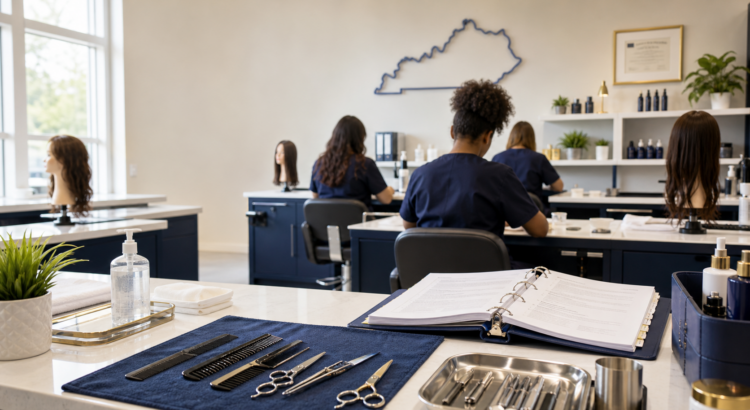
AI-generated illustration of healthcare and business professionals planning a salon; From Healthcare to Salon Ownership.
AI-generated editorial illustration.

LOUISVILLE BEAUTY ACADEMY · RESEARCH-INFORMED PERSPECTIVE

From Healthcare to Salon Ownership: The Value of Care, the Discipline of Business

Your experience caring for people can inform your next chapter. Turning it into a responsible beauty business requires a deliberate bridge between experience, competence, licensing, and execution.

Prepared November 9, 2026 · Kentucky-focused regulatory analysis · Educational publication

EXECUTIVE SUMMARY

Healthcare experience can be a foundation. A successful salon must still be built.

Healthcare professionals may bring useful habits to beauty entrepreneurship: attentive communication, disciplined documentation, recognition of limits, and respect for safety procedures. These capabilities can support a salon’s operating culture when translated into beauty-specific training and observable routines.

The evidence supports the relevance of these capabilities—not a guarantee of superior salon performance. This article does not establish that healthcare-trained owners earn more, experience fewer incidents, or outperform experienced beauty professionals.

  • Separate ownership, facility approval, and permission to perform services. Each requires its own analysis.
  • Match the business to the actual credential. An MD, RN, LPN, allied-health qualification, and caregiving background carry different preparation and authority.
  • Build competence in the services offered. Healthcare experience does not automatically demonstrate beauty technique, aesthetic judgment, or salon-management skill.
  • Make care operational. Translate intentions into written procedures, staff preparation, appropriate referrals, and clear client expectations.
  • Test the business proposition. Evaluate demand, costs, capacity, and cash requirements before committing substantial money.

Practical conclusion: A healthcare background can be an asset when paired with humility about a new field, appropriate credentials, strong beauty professionals, and accountable business systems.

1. What this analysis can—and cannot—prove

This is a focused narrative synthesis of selected public regulatory and professional guidance, accompanied by an original business-planning framework. Sources were selected for relevance to Kentucky practice boundaries, salon workplace risks, healthcare safety systems, and small-business planning. It is not a systematic review, a peer-reviewed clinical study, or an empirical comparison of salon owners.

Documented foundations

Official sources identify applicable licensing boundaries, salon hazards, healthcare safety practices, and business-planning considerations.

Reasoned interpretation

Experience with related practices may help a new owner develop appropriate salon systems. The size and reliability of that advantage are not measured here.

Proposed application

The professional comparisons, readiness questions, and operating measures below are recommendations for planning—not validated predictors of success.

No customer surveys, owner interviews, financial records, or incident datasets were collected. Prior training varies widely within professions. A credential alone does not show that a particular person practices the habits discussed here.

Any future study of a healthcare-background advantage would need defined outcomes and comparison groups, while accounting for previous business experience, capital, staffing, service mix, location, and years in operation. Without that work, declaring healthcare-trained owners inherently superior would exceed the evidence.

2. The advantage becomes meaningful when care becomes a system

Consider the difference between saying “We care about safety” and assigning responsibility for checking supplies, training staff, documenting exceptions, and correcting recurring problems. The second statement describes work that can be observed and improved.

CDC’s healthcare guidance places infection prevention within leadership accountability, adequate resources, workforce training, and routine practice. These are healthcare recommendations; they are not a substitute for salon regulations. They nevertheless provide a useful example of how an organization translates care into repeatable responsibilities. CDC: Core Infection Prevention and Control Practices.

OSHA identifies chemical exposure, biological hazards, and repetitive or awkward work as important concerns in nail salons. This establishes that beauty-business safety requires attention to the working environment as well as the appearance of the finished service. OSHA: Health Hazards in Nail Salons.

Our interpretation: A professional accustomed to safety systems may be well positioned to ask disciplined questions about salon operations. The advantage exists only if the owner learns the relevant salon requirements and acts on the answers.

  • Consultation: Explain the proposed cosmetic service, its limits, price, and available choices in language the client understands.
  • Boundaries: Establish a respectful pause-and-refer process when a concern exceeds the service provider’s authority or competence.
  • Consistency: Give staff usable procedures and enough time and resources to follow them.
  • Learning: Record concerns and near misses without treating honest reporting as disloyalty.
  • Accountability: Review whether corrective actions were completed and whether they worked.

These qualities are also developed by excellent beauty professionals without healthcare backgrounds. A strong ownership team respects their technical and commercial expertise rather than assuming that a medical title replaces it.

3. Many healthcare backgrounds can contribute—through different strengths

The following is an illustrative, non-exhaustive comparison of potential transferable capabilities. It is not a legal scope-of-practice chart, a ranking of professions, or a finding that every member of a profession possesses these strengths. The cautions identify issues to verify, not individualized legal conclusions.

BackgroundPotential contributionBoundary to keep clear
Physicians: MDs and DOsScientific reasoning, risk assessment, documentation, and referral judgment.A specialty title does not demonstrate competence in every cosmetic technique or establish the permissions for a proposed facility.
Advanced practice registered nursesAssessment, education, care coordination, and leadership within their preparation.APRN role, population focus, competence, and applicable practice requirements matter; APRNs are not one interchangeable category.
Registered nursesPatient communication, procedural consistency, team coordination, and escalation habits.RN licensure is not independent prescribing authority or blanket authorization for medical aesthetic practice.
Licensed practical nursesCare routines, observation, documentation, and working within defined supervision.Do not equate LPN and RN roles or supervision requirements.
Physician assistantsCollaborative care, consultation, and disciplined follow-through.Verify the rules governing the individual practitioner and proposed procedures; do not assume physician privileges.
Dentists and dental hygienistsPrecision, infection-prevention habits, and attention to client comfort.Dental credentials do not automatically authorize unrelated cosmetic services.
PharmacistsProduct information literacy, careful explanations, and recognizing questions requiring further review.Product knowledge is not permission to diagnose or perform unrelated services.
PodiatristsFoot-health knowledge and recognition of situations needing medical assessment.A cosmetic pedicure and medical foot care have different purposes and regulatory implications.
Physical and occupational therapistsErgonomics, functional needs, accessibility, and practical adaptation.A salon must not imply that ordinary beauty appointments constitute rehabilitation treatment.
EMTs and paramedicsEmergency readiness, calm communication, and organized escalation.Emergency credentials do not make a salon a medical treatment facility.
Respiratory therapists, laboratory and imaging professionalsEquipment discipline, protocol adherence, and quality-control habits.Technical healthcare competence is specific; it does not automatically transfer to beauty procedures.
Behavioral-health professionals and social workersListening, boundaries, respectful communication, and awareness of vulnerability.Supportive salon interactions should not be marketed as psychotherapy or treatment.
Dietitians and other qualified nutrition professionalsClient education, evidence appraisal, and communication about behavior.Keep any regulated nutrition services distinct from ordinary cosmetic service claims.
Medical assistants, nurse aides, and experienced caregiversService coordination, attentiveness, compassion, and routine follow-through.Certificates, registrations, experience, and professional licenses are not equivalent credentials.
Healthcare administrators and public-health professionalsScheduling, workforce systems, records, operations, and prevention-oriented planning.Management expertise does not confer clinical or beauty-practitioner authority.

For someone educated or licensed outside Kentucky or outside the United States, prior experience may still have value. Its recognition for local practice must be verified separately. Kentucky’s medical board states that practicing medicine or osteopathy requires a valid, effective authorization issued by that board. Kentucky Board of Medical Licensure: Medical / Osteopathic Licensure.

4. Kentucky: three questions that must never be collapsed into one

01

Who owns the business?

Identify the entity, financial responsibilities, contracts, and decision-making authority.

02

What is the facility authorized to do?

Confirm the approvals required for the specific location and service model.

03

Who may perform each service?

Map every service to the practitioner’s actual authority, preparation, and any applicable supervision requirements.

KRS 317A.020 distinguishes cosmetic practice from treatment of physical or mental ailments. It also identifies exceptions for certain state-authorized professionals performing incidental cosmetic practices in their normal professional practice. This limited language should not be read as a general exemption for any salon owned by a healthcare professional. The statute separately addresses licensure and employing people to perform regulated practices. KRS 317A.020.

KBC’s published salon requirements call for an opening inspection and issuance of the salon or limited-facility license before advertising the establishment as licensed or open to the public. The application requirements include a listed manager with an active KBC professional license, practitioner information, and other facility documentation. The particular business model must be evaluated against the applicable requirements. Kentucky Board of Cosmetology: Salon Requirements.

Medical aesthetics requires an additional, procedure-specific analysis. KBN’s June 2026 Advisory Opinion Statement #35 discusses educational preparation, clinical competence, and different nursing roles and supervision arrangements. It expressly distinguishes RN and LPN practice from independent medical-aesthetic practice and explains that some needed competencies are acquired after initial nursing education. The statement is professional guidance, not itself a regulation with the force of law. KBN Advisory Opinion Statement #35.

Ownership is not a shortcut to practice authority. Do not assume that hiring a physician, using “medical” in the business name, or holding a healthcare credential resolves every service, facility, delegation, or supervision requirement. Obtain a review of the actual proposed services from the relevant boards and qualified advisers before offering them.

5. Clinical experience and business viability answer different questions

A service can be thoughtfully delivered and still be priced unsustainably. A beautiful room can still have insufficient demand. An impressive professional biography does not establish that prospective clients want the offered service at the proposed price.

The SBA’s planning guidance recommends examining demand, market size, location, competition, and pricing, alongside startup costs and a business plan. These considerations apply to evaluating a salon opportunity regardless of the owner’s prior profession. U.S. Small Business Administration: Plan Your Business.

An illustrative planning calculation—not an earnings forecast

Suppose a fictional salon collects an average of $80 per completed appointment, has $35 in variable costs per appointment, and estimates $9,000 in monthly fixed costs. Contribution per appointment is $45. In this simplified model, covering those fixed costs requires 200 completed appointments per month: $9,000 ÷ $45.

At 20 operating days, that is an average of 10 completed appointments per day. Whether that is feasible depends on staffing, service duration, sanitation and reset time, cancellations, and demand. The calculation is only as complete as its inputs. Owner compensation, payroll burdens, insurance, financing, taxes, repairs, and cash timing must be modeled appropriately; reaching this illustrative threshold does not establish take-home income.

Use the exercise to ask better questions: Is the appointment volume realistic? Does the schedule protect quality? What happens if demand is lower than expected? How much cash is needed before operations become self-supporting?

6. Define an exceptional salon through observable practices

For this article, an exceptional salon is one whose promises are supported by its daily work. The following are proposed management measures, not official accreditation standards or validated benchmarks.

CommitmentEvidence to review
Appropriate authorizationA current service-to-credential register and documented review of unclear services.
Prepared staffRole-specific onboarding, observed practice where appropriate, and follow-up training.
Consistent safety routinesCompleted checks, documented exceptions, and timely corrective actions.
Clear client expectationsUnderstandable pricing, service explanations, permission processes, and complaint follow-through.
Sustainable operationsAppointment capacity, cash forecasts, product use, and service-cost reviews.
A learning cultureNear-miss discussions, staff feedback, and evidence that recurring problems receive attention.

Interpret measures carefully. A low complaint count may reflect a weak reporting channel. More incident reports may initially indicate that staff feel safer speaking up. An owner should examine both the process and the outcome, rather than rewarding a number that can be improved by concealing problems.

7. A staged path from healthcare experience to responsible ownership

  1. Define the proposed services.

    Write a precise list of what clients will receive. Separate conventional cosmetic services from any proposed clinical procedures.

  2. Verify the authority for each service and location.

    Identify the governing board, facility requirements, individual credentials, and unresolved questions. Resolve those questions before making service claims or irreversible commitments.

  3. Build the right team and training plan.

    Identify what you already know, what you need to learn, and where an experienced beauty professional should lead. Plan beauty-specific education when pursuing a regulated beauty role.

  4. Test demand and economics.

    Speak with prospective customers, study local alternatives, estimate costs, and test conservative scenarios. Separate interest in your personal story from willingness to buy the service.

  5. Prepare the operating system.

    Document booking, consultation, sanitation, inventory, incident response, privacy, staffing, and complaint processes. Practice them before opening.

  6. Open only when requirements are satisfied; improve continuously.

    Review what actually happens. Adjust staffing, scheduling, training, and spending in response to evidence rather than assumptions.

There is no universal timeline. Regulatory approvals, construction, training, financing, and staffing can each determine when an opening is realistic.

YOUR EXPERIENCE CAN HAVE A NEXT CHAPTER

Bring what you have learned. Respect what you still need to learn.

Healthcare work may have taught you to listen carefully, notice uncertainty, document decisions, and take responsibility for another person’s experience. Those habits can have a meaningful place in beauty entrepreneurship.

The opportunity is to combine them with the craft, judgment, and operating knowledge of beauty professionals. A strong salon earns trust through the services it is authorized and prepared to provide—and through the care people experience every day.

You do not have to erase your previous career to begin a new one. You do have to build the bridge deliberately.

Explore LBA’s free business courses →

Begin with pricing and profit, opening a salon or booth, consultation, inspection readiness, or cash-flow planning. These complimentary courses provide supplemental business education; they do not award licensing hours, an occupational license, approved continuing-education credit, or medical-aesthetic authorization.

For in-person beauty-program enrollment and your intended licensing pathway, text 502-625-5531 or email Study@LouisvilleBeautyAcademy.net. Review enrollment procedures and request current program requirements and costs in writing.

Source record and publication disclosures

Sources consulted November 9, 2026. This selected-source review does not establish an exhaustive legal or scientific evidence base. Verify current requirements for the individual, location, and services before implementation.

  1. Kentucky General Assembly — KRS 317A.020
  2. Kentucky Board of Cosmetology — Salon Requirements
  3. Kentucky Board of Nursing — Advisory Opinion Statement #35, revised June 2026
  4. Centers for Disease Control and Prevention — Core Infection Prevention and Control Practices
  5. Occupational Safety and Health Administration — Health Hazards in Nail Salons
  6. U.S. Small Business Administration — Plan Your Business
  7. Kentucky Board of Medical Licensure — Medical / Osteopathic Licensure

Institutional interest: Louisville Beauty Academy offers beauty education and may benefit from enrollment inquiries. The invitation to study at LBA is separate from the regulatory and analytical findings.

Limits: General educational analysis, not individualized medical, legal, tax, investment, or business advice. No income, licensing, safety, compliance, or business outcome is guaranteed. Public-source citations do not imply agency endorsement. No peer review or original outcome study is claimed.

Production: AI-assisted research synthesis and editorial preparation. The feature image is an AI-generated illustration, not a photograph of actual LBA students, clinicians, owners, or a documented event.


Your Next Chapter Is Free to Study: 11 LBA Courses Open to Everyone

ACCESSIBLE EDUCATION · A COMMITMENT IN ACTION

You do not have to face your next step alone.

If a licensing theory exam has you worried, start here. Louisville Beauty Academy is opening 11 online study courses for complimentary personal learning—with no student access code and no purchase required.

Whether you study at LBA, attend another school, or are returning to material you have not practiced in a while, you are welcome. Open a course. Work through a question. Understand what you missed. Try again.

$0 to use these resources. No Study#2018 code. No subscription, review, or enrollment purchase required. Some tools may request a name or consent for their learning records; read the information shown in each tool.

YES, I CAN.

A missed answer is a place to begin.

Perhaps you are studying after work. Perhaps English is not your first language. Perhaps you have already taken an exam and did not receive the result you hoped for. None of those experiences takes away your ability to learn.

At LBA, we believe confidence grows through documented action: showing up, asking for help, practicing safely, correcting a misunderstanding, and returning the next day. We value the progress behind the score. We also respect the knowledge, practical competence, and official requirements that licensure demands.

A practice mistake is useful information. It tells you where to slow down, revisit your school’s teaching, and build understanding. Repeating a question matters most when you can explain why the answer is right.

“Yes, I can” is the beginning.
“I have done it” is built one honest step at a time.

These resources grow out of LBA’s years of supporting students. We are now sharing this collection openly so that the cost of an additional study resource does not have to stand between you and your next practice session.

You do not need to pay $10, $20, $50, or $100 to use these LBA resources. They are free. Required textbooks, school tuition, official exam fees, and any other requirements remain separate.

RECOGNITION WITH RESPONSIBILITY

Awards matter most when their values reach people.

National recognition: Louisville Beauty Academy is a 2025 U.S. Chamber of Commerce CO—100 Honoree in the Enduring Businesses category.

Regional ethics recognition: LBA is the 2026 BBB Torch Award for Ethics winner in the Very Small Business category, presented by BBB serving Greater Kentucky and South Central Indiana.

We honor the students who keep trying, the instructors who explain a concept one more time, the staff who help remove a barrier, and the families and community members who make perseverance possible. Their daily actions give these recognitions meaning.

Opening this library is one way to put that spirit into practice: sharing useful learning, stating the limits clearly, and welcoming people with dignity. Awards recognize the organization; they do not certify these study tools or guarantee anyone’s exam result.

YOUR FREE STUDY LIBRARY

Eleven courses. Choose your next step.

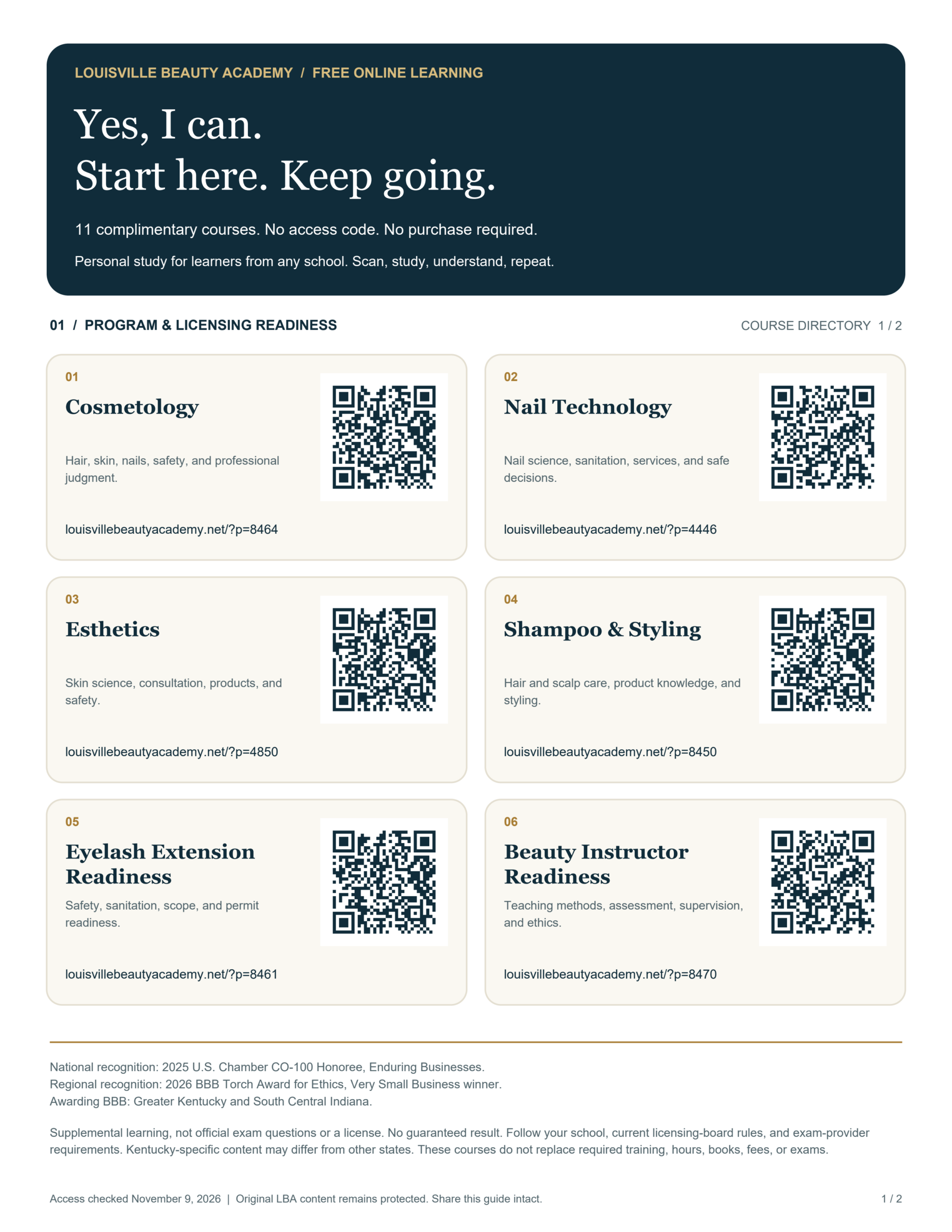
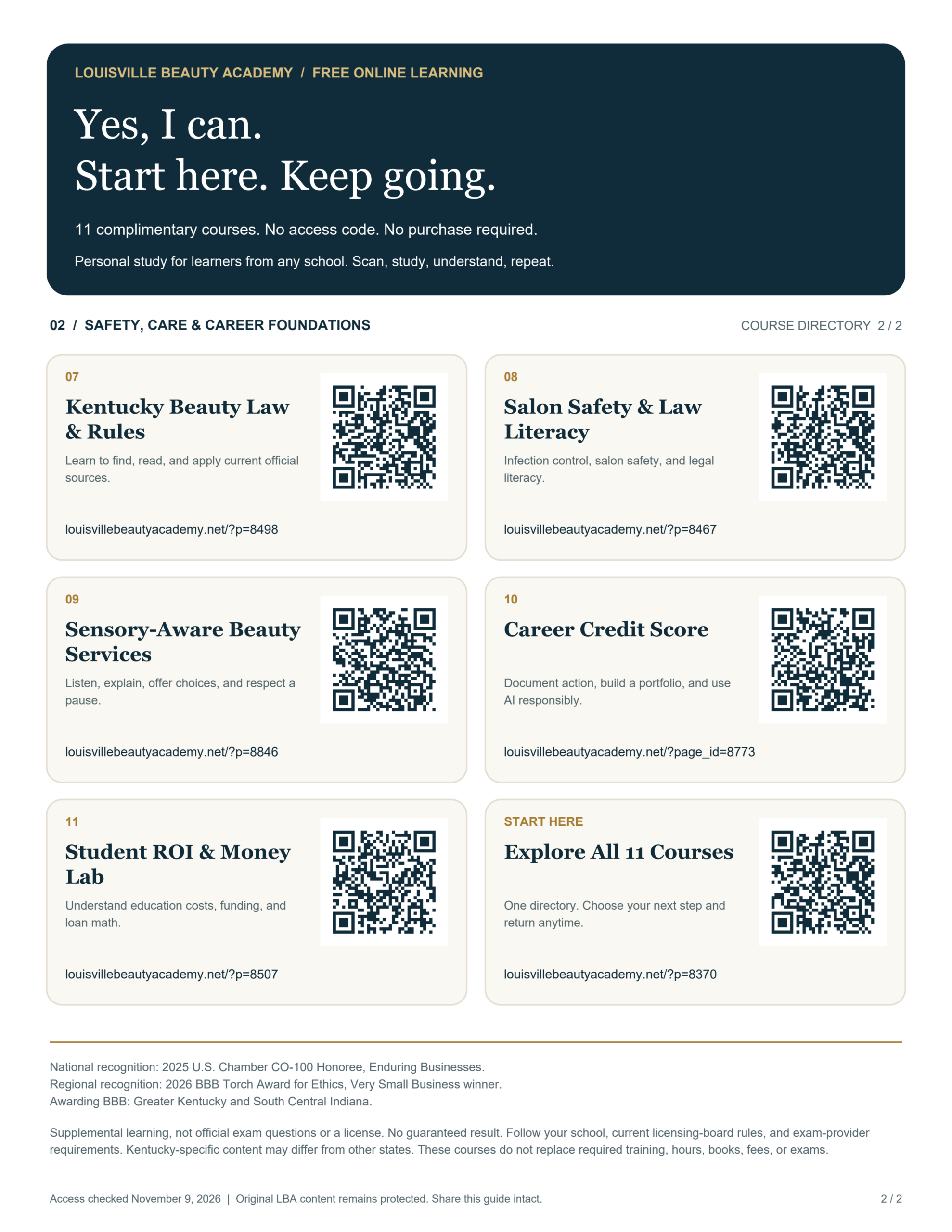
The first six resources focus on beauty programs and professional readiness. The remaining five strengthen legal literacy, safety, inclusive service, career documentation, and financial understanding. They are not eleven separate state licensing examinations.

Tap a course link on your phone or computer, or scan its QR code from another device. Kentucky-specific material should be checked against current Kentucky requirements; learners elsewhere should follow their own board and testing provider.

QR code for Cosmetology
COURSE 01 · FREE

Cosmetology

Hair, skin, nails, safety, and professional judgment.

Open course →louisvillebeautyacademy.net/?p=8464
QR code for Esthetics
COURSE 03 · FREE

Esthetics

Skin science, consultation, products, and safety.

Open course →louisvillebeautyacademy.net/?p=4850

Public access and these links were checked November 9, 2026. Laws, exam outlines, and tools can change. Use current official sources alongside the material and report anything that appears outdated.

A SIMPLE ROUTINE

Practice with purpose. Return with confidence.

  1. Choose the resource that matches your goal. Keep your school’s instruction and the current official candidate information beside you.
  2. Try a short session before looking up the answer. Notice which concepts feel clear and which need more attention.
  3. Read the explanation. Write down the principle in your own words and connect it to safe professional practice.
  4. Ask, review, and try a fresh set. Bring uncertainties to your instructor. Seek understanding rather than memorizing an answer pattern.
  5. Repeat your study—not your fear. Track what you now understand. A strong practice score is encouraging feedback, not a validated prediction or guarantee of passing an official examination.

You are welcome to return to these public resources as you study. If you need to retake an official licensing examination, follow the board’s and testing provider’s current eligibility, scheduling, retake, and fee rules. Free practice does not waive those rules.

PRINT. KEEP. SHARE.

Put a next step within someone’s reach.

Download the two-page, letter-size guide for your study space, classroom, salon, or community noticeboard. It includes all 11 course links plus the complete directory. Each QR code has been scan-tested, and each printed URL provides another way to reach the resource.

Printable guide page one: six free beauty program and readiness courses with QR codesPrintable guide page two: five supporting courses and the complete directory with QR codes

For the clearest printing, use the PDF at actual size or fit to page without cropping. You may share this guide intact, with LBA attribution and the study limitations preserved.

CLEAR EXPECTATIONS · GOOD FAITH

A supplement to your education. An invitation to keep learning.

These independently developed resources complement what your school teaches. They are not official PSI exam questions, do not promise exact exam content, and are not a substitute for required education, supervised practice, official materials, or professional advice. No affiliation or endorsement by a licensing board or testing provider is implied.

Using a course does not itself award a state license, required clock hours, continuing-education credit, or eligibility to practice. Any learning record or completion certificate is separate from licensure. Passing a practice activity does not guarantee passing an examination, receiving a license, or obtaining employment.

LBA retains rights in its original content, subject to applicable law and any identified third-party rights. Complimentary access is for personal learning. Please share links and the intact printable guide; do not resell or commercially republish protected course content without permission.

If the resources help you, you are welcome to subscribe to LBA updates or share an honest review of your actual experience. Both are optional. No rating, positive review, purchase, or subscription is a condition of access.

YOUR NEXT CHAPTER STARTS WITH ONE ACTION

Open a course.
Give yourself another chance.

You do not have to feel fearless before you begin. Bring your questions, your determination, and your willingness to try again. Let one small action become another.

Yes, I can. I am learning. I have done it.

Start studying free →

Student ROI & Money Lab: Your Beauty School Cost, Income & Return

Question review: November 3, 2026

26 question entries revised in this pass. Corrected items retain their question identities and answer-key positions; historical results were not rewritten. Already-open sessions may show earlier wording. Finish or leave that attempt before opening a fresh practice set.

Repetition can support recall, but item count is not the number of distinct skills and a high score is not proof of exam readiness.

This editorial and source-check pass is not licensed-instructor sign-off, an official exam bank, or a guarantee that every remaining statement is error-free. Use current official rules, the exact product instructions, and supervised training. Report a disputed item by question number without sending client information.

Louisville Beauty AcademyLOUISVILLE BEAUTY ACADEMY / STUDENT FINANCIAL WELLNESS
What could beauty school return to you?

Your cost. Your time. Your possible income. Build a personal plan for attending LBA.

01 / WHAT YOU INVEST

Start with your real cost.

Use the full published price or your written LBA quote. A conditional discount is an example until LBA confirms eligibility.

Whole program, not an annual price. Do not subtract a discount already included here.
Only items not in your quote: supplies, exams, permits, retakes or required equipment.
Applicable grants, scholarships or gifts toward education costs. Not loans, your savings, or unconfirmed discounts. No federal aid is assumed available at LBA.

Published figures checked September 26, 2026. View costs and conditions.

Why savings and loans do not reduce the price

Savings and borrowing explain how you pay. They do not erase the cost of the education. A nonrepayable award may reduce what you personally need to recover. Principal is counted once; financing interest and fees are additional.

YOUR TIME HAS VALUE TOO

Plan around your life.

Agree on a realistic attendance plan with LBA.
Include licensing, job search and building a client base.
Added travel, childcare or other costs during training. Not living expenses you would pay anyway.
Take-home income you lose during school and the wait. Enter 0 if your other work continues unchanged.
Estimate time from an attendance plan

Select a program and enter weekly attendance.

Hours divided by weekly attendance gives a mathematical estimate, not a graduation date. Add time for closures, absences and completion requirements.

02 / WHAT MAY CHANGE

Compare take-home income.

Compare two futures over the same period: attending school versus continuing without this program. Use money left after taxes and work expenses.

Include income and growth you could achieve without attending.
Include comparable other income on both sides. Keep education loan payments out of both; they are modeled separately.
Help me estimate take-home income
Your estimate, not a tax calculation. For a business, applied only to positive profit.

Enter each amount to estimate income. Sales are not take-home pay.

Where to research earnings

Ask local employers about starting pay, paid hours, tips, commissions, benefits and costs. National BLS occupation data offers context, not LBA graduate outcomes or a local starting-pay promise.

Hair & cosmetology / Nails / Skin care

Include financing, if used.

LEARN IT. THEN MAKE IT YOURS.

A lower cost matters. So does your plan.

1. Price is not the whole investment.

Add required expenses, extra school-life costs and income you give up. Count a confirmed discount once. The lowest advertised price is not automatically your price.

2. New income is not all new benefit.

If your alternative pays $1,800 a month and your new path pays $2,500, the improvement is $700, not $2,500. Compare take-home amounts on both sides.

3. Recovery takes time.

A hypothetical $5,400 investment with $700 extra monthly income takes about 8 earning months to recover. Four months in school and one waiting month make that about 13 months from enrollment.

Quick check: can you spot the real return?

Illustrative example: education investment $6,000, alternative take-home $1,800/month, future take-home $2,300/month. How many earning months recover the investment?

Bring these five questions to your enrollment conversation
  1. What is my full written cost, and what is not included?
  2. Which discounts am I eligible for, and what conditions could change them?
  3. What attendance plan fits my work, family and completion requirements?
  4. What evidence supports my expected take-home income?
  5. Can I manage payments if my start is slower or my income is lower?

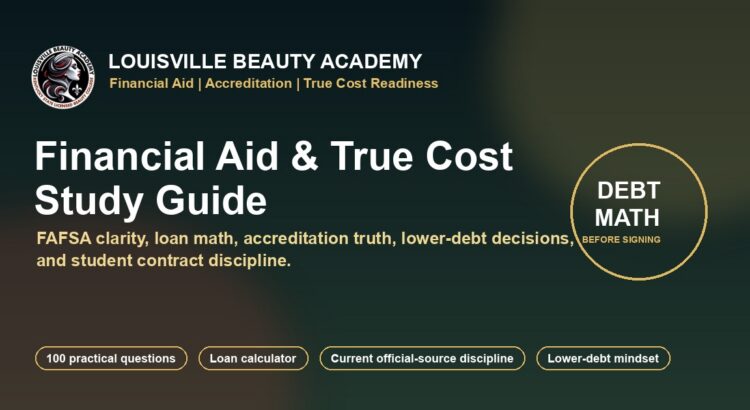
Financial literacy practice: 100 questions

Practice bank

100 practical questions for beauty-school finance decisions

ReadyFinance Literacy

Start the practice to test real FAFSA, accreditation, cost, loan, and credit decisions.

Official-source discipline

Verify the source before acting

Louisville Beauty Academy is a Kentucky state-licensed beauty college. This guide is educational financial-literacy support, not legal, tax, credit, or financial advice. Current federal sources, state rules, school written documents, signed agreements, servicer disclosures, and applicable law control.

Accreditation, Federal Aid, and Beauty Education: Why Louisville Beauty Academy Chose State-Licensed Transparency

Louisville Beauty Academy Public Education Update

Accreditation, Federal Aid, and Beauty Education

Why Louisville Beauty Academy chose state-licensed transparency over confusing prestige language.

Bottom line: Federal July 2026 records confirm that NACCAS, one of the major national accreditors for cosmetology arts and sciences and massage therapy, faced significant unresolved recognition-compliance issues. Reputable reporting states NACIQI voted 9-to-3 to recommend denial of renewed recognition, while the final decision remains with the U.S. Department of Education.

When people ask whether a beauty school is “accredited,” the real question often needs to be clarified.

In beauty education, especially where federal student aid is involved, the practical question is often not simply, “Is this school good?” The practical question is: Does this school use accreditation as a pathway to participate in federal Title IV student-aid programs, including FAFSA-based federal aid?

Louisville Beauty Academy is a Kentucky state-licensed beauty college. Our work is grounded in Kentucky law and regulation, public safety, sanitation, documented student hours, practical instruction, law and regulation education, licensure readiness, affordability, and transparent student choice.

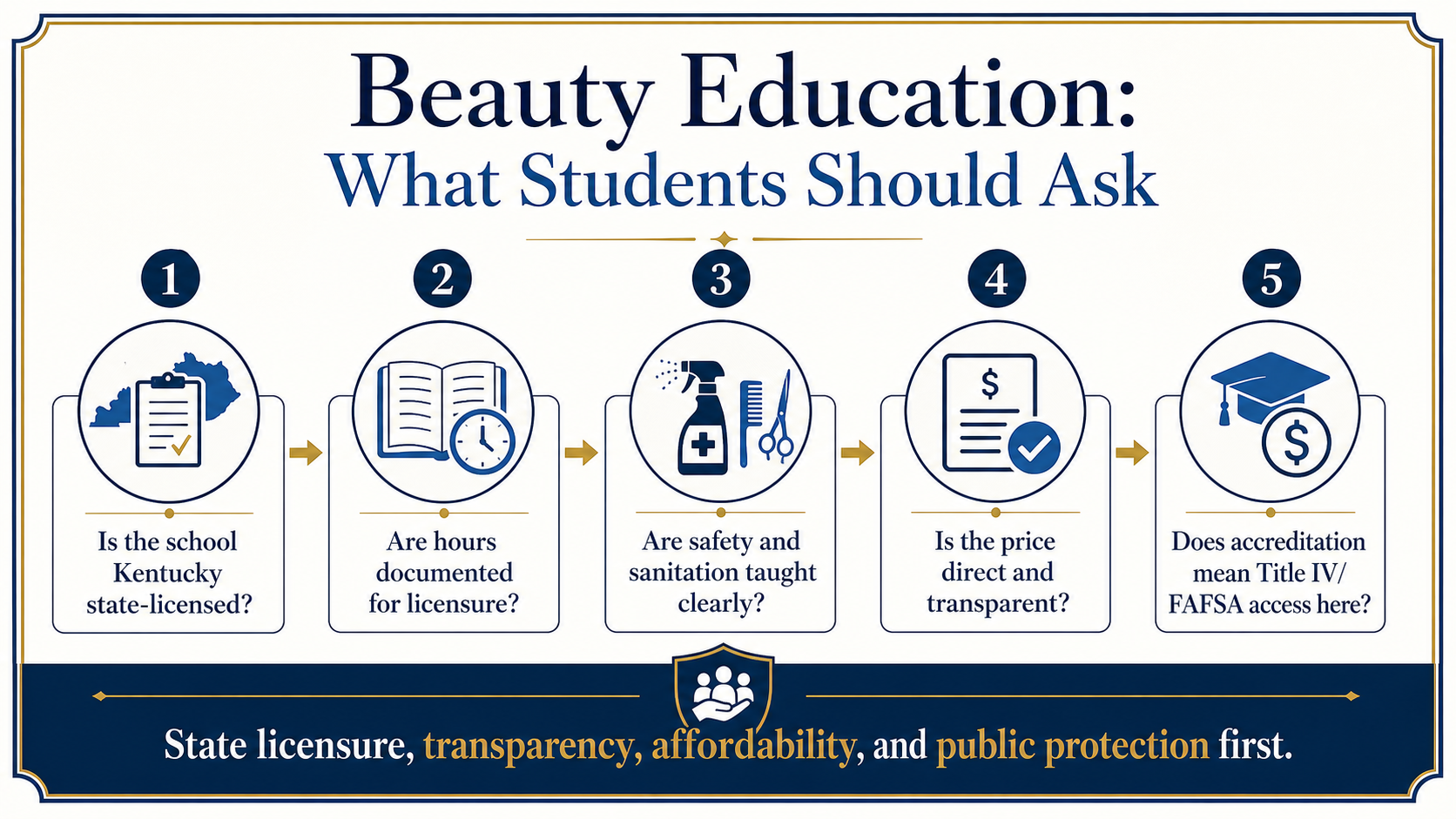
Infographic listing five beauty education questions about Kentucky state licensure, documented hours, safety and sanitation, transparent pricing, and whether accreditation means Title IV or FAFSA access.
Beauty education should be evaluated through state licensure, documented training, safety, sanitation, transparent pricing, and honest explanation of accreditation and FAFSA access.

The Federal Development

The U.S. Department of Education’s official July 2026 NACIQI agenda placed the National Accrediting Commission of Career Arts and Sciences, Inc. (NACCAS) under Renewal of Recognition review. The agenda identifies NACCAS’s scope as accreditation of postsecondary schools and departments of cosmetology arts and sciences and massage therapy.

The Federal Register notice for the July 22-23, 2026 NACIQI meeting likewise listed NACCAS as item 6 under Applications for Renewal of Recognition and tied public comment to federal recognition criteria under 34 CFR Part 602.

The Department of Education’s e-Recognition final staff report identified multiple remaining NACCAS recognition-compliance issues. ED staff recommended continued recognition at that time, but with a serious limitation: NACCAS would be prohibited from accrediting new institutions until it demonstrated compliance, and would be required to submit compliance and monitoring reports.

Separately, Inside Higher Ed published a July 23, 2026 article titled “NACIQI Recommends Denial of Recognition for Cosmetology Accreditor.” That article reported that NACIQI voted 9-to-3 to recommend that ED deny NACCAS’s petition for renewed recognition. The article also noted that NACIQI is advisory and that the final decision rests with senior leaders at ED.

The Scale

The most source-protected language is this: federal ED staff reported that NACCAS currently accredits approximately 1,074 institutions, while NACCAS had recently reported accrediting around 1,300 postsecondary institutions in cosmetology arts and sciences and/or massage therapy.

We should not claim a specific percentage of all U.S. beauty schools without a verified national denominator. What we can say is that NACCAS is a major national beauty-school accreditor with more than one thousand institutions reported in federal/source records.

LBA’s December 2025 Decision

Louisville Beauty Academy publicly announced on December 10, 2025 that it had voluntarily discontinued candidate status with NACCAS.

That was a voluntary, objective, institution-level decision. LBA removed itself from the NACCAS accreditation path before the July 2026 federal recognition controversy became the national public headline. The December 2025 LBA notice remains the clean public source for that decision.

That decision now deserves to be understood as a transparency decision, not a retreat. LBA chose not to lean on a word that was becoming confusing to the public. LBA chose not to let “accreditation” be used as a prestige label when, in many practical conversations, the real issue is federal-aid participation and the financing structure behind it.

LBA does not currently participate in federal student-aid funding. That is not because LBA rejects public investment in education. We believe ethical education can and should create net positive economic impact when public systems are transparent, affordable, accountable, and student-protective. But LBA will not use accreditation language to confuse families, equate financing access with educational protection, or blur the difference between state licensure, public safety, sanitation, student outcomes, and federal-aid access.

If future accreditation or federal-aid structures become more transparent, ethical, affordable, student-centered, and aligned with public protection, LBA can evaluate those pathways again. Until then, LBA’s public position remains clear: Kentucky state licensure, direct affordability, honest communication, safety, sanitation, and documented licensure education first.

What LBA Means When Asked About Accreditation

Louisville Beauty Academy is Kentucky state-licensed. We do not participate in federal Title IV student-aid programs, and we do not use national accreditation as a federal-aid gateway. Our students choose LBA for affordability, direct payment options, Kentucky licensure preparation, public safety, sanitation, documented hours, and transparent education.

LBA is not permanently opposed to accreditation or public education funding. If future systems better protect students and align with transparency, affordability, ethical education, public safety, sanitation, and positive economic impact, LBA may evaluate them. At this time, LBA does not process federal Title IV/FAFSA aid.

Public Message

Accreditation used to be treated like a shining word. But in beauty education, the public deserves a more honest explanation.

Students should not be asked to confuse prestige language with protection. A school can be state licensed, compliant, affordable, student-centered, and transparent without using accreditation as a federal-aid pathway. A school can also be nationally accredited and still face serious federal scrutiny over transparency, student outcomes, disclosure, or federal-recognition compliance.

This is not anti-accreditation. It is pro-truth.

Accreditation should mean accountability. If it becomes only a pathway to federal money, public trust is weakened. Students deserve to know the difference.

And if the environment changes for the better, LBA will remain open-minded. The principle is not stubbornness. The principle is ethical education: public money, accreditation language, school marketing, and student trust must all serve the student, the public, and the regulated purpose of beauty education.

Sources

  1. U.S. Department of Education NACIQI Final Agenda, July 22-23, 2026: https://sites.ed.gov/naciqi/files/2026/07/Final-Agenda_NACIQI-July-2026_508-Compliant-1.pdf
  2. Federal Register, National Advisory Committee on Institutional Quality and Integrity; Notice of Meeting, June 9, 2026: https://www.federalregister.gov/documents/2026/06/09/2026-11520/national-advisory-committee-on-institutional-quality-and-integrity-notice-of-meeting
  3. U.S. Department of Education e-Recognition, NACCAS Final Staff Report: https://surveys.ope.ed.gov/erecognition/api/public-documents/files/staff/49/1179/html/final
  4. 34 CFR Part 602: https://www.ecfr.gov/current/title-34/subtitle-B/chapter-VI/part-602
  5. U.S. Department of Education, Institutional Accrediting Agencies: https://www.ed.gov/laws-and-policy/higher-education-laws-and-policy/college-accreditation/institutional-accrediting-agencies
  6. Inside Higher Ed, NACIQI Recommends Denial of Recognition for Cosmetology Accreditor, July 23, 2026: https://www.insidehighered.com/news/governance/accreditation/2026/07/23/panel-recommends-denying-recognition-cosmetology
  7. Louisville Beauty Academy, Louisville Beauty Academy Takes Proactive Step to Protect Students and Community Amid National Accreditation Concerns, December 10, 2025: https://louisvillebeautyacademy.net/louisville-beauty-academy-takes-proactive-step-to-protect-students-and-community-amid-national-accreditation-concerns/
  8. Kentucky Legislative Research Commission, 201 KAR 12:030 amendment record: https://apps.legislature.ky.gov/law/kar/titles/201/012/030/16156/