Many students feel fear when officials enter a room. A serious school reduces fear by teaching process, rights, responsibilities, records, and respectful professional conduct.
Who This Is For
This series is for every beauty student, including students from rural and country-side communities, immigrant students, first-generation students, working adults, and students who may feel nervous when an inspector or regulator enters the room. The purpose is to replace fear with understanding, practice, safety, sanitation, and written documentation.
The LBA inspection-as-education model turns regulatory moments into professional readiness training.
Fear Is Real
For immigrant and first-generation students, government presence can feel intimidating even when the matter is a professional inspection.
Education Changes the Room
The school's role is to explain what is happening, keep students calm, and connect the moment to lawful salon practice.
Dignity Under Pressure
The goal is not to make students casual about regulation. The goal is to make them steady, respectful, informed, and ready.
The Louisville Beauty Academy Standard
A serious beauty school teaches more than the service. It teaches the professional environment around the service: regulation, safety, sanitation, licensing awareness, written documentation, respectful communication, and the ability to remain steady when a real inspector is present.
That is why LBA treats regulatory moments as education. Students from every background should not wait until they are alone in a salon to learn how to respond professionally.
Public information notice: this post is educational and policy-oriented. It does not accuse any person or agency of wrongdoing, disclose private student information, claim accreditation, promise licensure or employment outcomes, or replace professional legal/regulatory advice.
Louisville Beauty Academy teaches beauty as a full professional system.
That system includes skill, sanitation, safety, federal law, Kentucky state law, local and metro business rules, regulation, documentation, attendance, contracts, student choice, client communication, ethical public representation, business awareness, ownership pathways, board expectations, and the changing climate of the beauty industry.
This is why LBA is building itself not only as a school, but as a center of excellence and public library for understanding beauty.
The purpose is simple:
Students should not only learn how to perform beauty services. They should learn how to understand the regulated profession they are entering.
1. Beauty Is a Licensed Profession, Not Only a Creative Skill
Beauty work is creative, human, technical, and personal. It is also licensed.
A licensed profession comes with public responsibilities. Students and professionals must understand sanitation, infection control, safety, scope of practice, training hours, documentation, client care, school policies, state-board expectations, and lawful communication.
That is why beauty education must include more than hands-on technique.
At LBA, professional understanding includes:
the craft: nail technology, cosmetology, esthetics, shampoo styling, specialty services, and instructor training;
the rules: licensing requirements, curriculum requirements, attendance limits, sanitation, student records, and state-board expectations;
the documents: enrollment agreements, policies, catalogs, refund and withdrawal rules, tuition disclosures, curriculum links, attendance records, and completion records;
the conduct: professional communication, client boundaries, public-safety habits, truthful representation, and ethical online activity;
the pathway: employment, salon work, booth rental, independent practice where lawful, business ownership, instructor responsibility, and lifelong learning.
This is the full beauty industry, not one narrow class topic.
2. What It Means To Be a Center of Excellence for Understanding
A center of excellence does not merely repeat rules. It explains them.
LBA's goal is to help students and the public understand:
what a license is and what it is not;
what school training is designed to prepare students for;
why sanitation and infection-control rules protect the public;
why attendance records and training hours matter;
why written contracts, catalogs, and policies matter;
why costs, refunds, withdrawals, and payment terms must be visible;
why public reviews, testimonials, and promotional statements must be voluntary and truthful;
why student choice must be protected;
why documentation protects students, schools, salons, clients, and regulators;
why industry climate matters for career readiness.
The goal is not to turn students into lawyers. The goal is to help students become more aware licensed professionals.
3. What It Means To Be a Public Library for Beauty Understanding
A public library makes knowledge available.
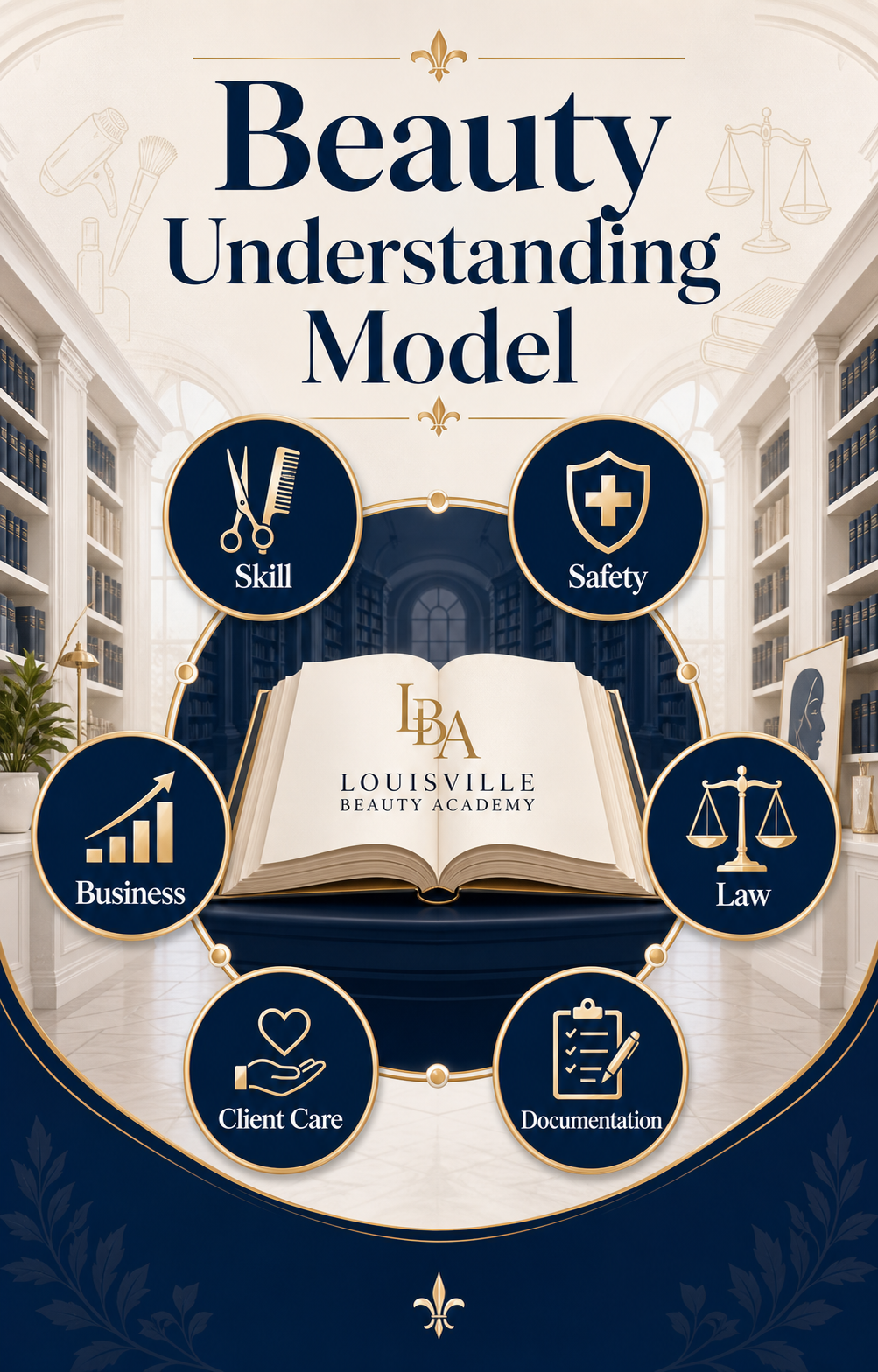
The Beauty Understanding Model frames professional preparation as skill, safety, law, documentation, client care, and business literacy working together.
LBA's public education work should serve the same function for the beauty field. Students, families, salon owners, graduates, community partners, regulators, and the public should be able to find plain-language explanations of how the industry works.
That public library should include:
law and regulation explanations;
student-contract and school-policy explanations;
sanitation and public-safety explanations;
curriculum and licensing-pathway explanations;
attendance and documentation explanations;
cost, payment, refund, and withdrawal explanations;
client-care and professionalism explanations;
salon ownership and small-business-readiness explanations;
ethical public-review and testimonial explanations;
multilingual or plain-language access where needed.
Knowledge should not disappear after one class, one enrollment meeting, one inspection, one renewal cycle, or one complaint. It should remain visible and reusable for the next student, the next parent, the next graduate, the next salon owner, and the next community member.
4. Why Industry Climate Belongs in Beauty Education
Every profession has a climate.
The beauty industry climate includes:
licensing rules;
labor and worker-classification debates;
state-board inspections;
public health expectations;
changing student expectations;
affordability concerns;
digital reviews and online reputation;
small-business ownership;
immigrant and first-generation entrepreneurship;
language access;
public trust;
documentation and due process.
Students need to understand this climate because they will work inside it.
This is especially visible in nail technology, but the lesson applies to the entire beauty field. Nail technology, cosmetology, esthetics, shampoo styling, instructor training, specialty services, student clinic services, salon employment, booth rental, independent practice, and ownership all exist within a regulated environment.
Understanding that environment is part of career readiness.
5. Legal and Regulatory Literacy: Federal, State, and Local
Legal and regulatory literacy means students can understand the rules that shape their profession.
Those rules do not exist at only one level.
The beauty industry sits inside overlapping layers:
Federal: worker safety, chemical exposure, cosmetics, labeling, endorsements, testimonials, advertising, consumer protection, disability access, employment, tax, and civil-rights principles may all matter depending on the setting.
State: in Kentucky, cosmetology-related education, school licensing, curriculum, sanitation, permits, student contracts, instructor responsibilities, and board expectations are governed through Kentucky statutes, Kentucky administrative regulations, and Kentucky Board of Cosmetology materials.
Local / Metro: in Louisville and Jefferson County, business registration, occupational license tax reporting, local permits, zoning/building/fire/health-related touchpoints, and local operating requirements may affect a beauty business depending on what it does and where it operates.
That is why beauty education cannot treat "law and regulation" as one narrow state-board topic. Students and future salon owners need to understand that professional practice may connect to federal, state, and local layers at the same time.
At a school level, this includes visible education about:
federal safety and health concepts, including OSHA nail-salon hazard guidance;
federal cosmetics concepts, including FDA cosmetics and product-safety guidance;
federal endorsement/review principles, including FTC guidance on truthful reviews, testimonials, endorsements, and disclosures;
Kentucky Board of Cosmetology requirements;
KRS Chapter 317A;
201 KAR Chapter 12;
201 KAR 12:082 curriculum, school administration, training-hour, and break-related requirements;
school operation days and hours;
training-hour limits;
attendance documentation;
curriculum requirements by program;
student contract requirements;
state-board renewal expectations;
sanitation and public safety;
responsible student records and completion documentation.
local and metro business-readiness awareness for students who later pursue salon work, booth rental, independent practice, or ownership.
For example, LBA's renewal-preparation work emphasizes that students should see operating facts clearly: program information, days/hours of operation, tuition and costs, refund and withdrawal policies, attendance policies, official law links, and curriculum source links.
That is not just paperwork. That is transparency.
At the public-library level, LBA's larger role is to help people understand how the layers connect:
the federal safety layer asks whether workers and consumers are protected from preventable hazards;
the federal advertising/review layer asks whether public statements are truthful and not misleading;
the state licensing layer asks whether students, schools, instructors, and licensees meet Kentucky requirements;
the local/metro layer asks whether a business is properly registered and operating within local rules;
the school-documentation layer asks whether expectations are visible before a student commits.
6. Compliance Literacy
Compliance is not a hidden back-office activity. It is part of professional formation.
Compliance literacy includes:
knowing what policy applies;
knowing where the policy is written;
knowing who keeps records;
knowing how records are reviewed;
knowing how corrections are made;
knowing when questions should be raised;
knowing how to preserve documentation.
For students, compliance literacy helps them understand attendance, hours, payments, refunds, withdrawal, sanitation, client safety, and graduation/completion processes.
For schools, compliance literacy helps create consistency, fairness, and documented proof.
For salons and owners, compliance literacy helps reduce confusion and avoid preventable mistakes.
For regulators, visible compliance materials make review easier.
7. Educational Literacy
Educational literacy means students understand the purpose of what they are learning.
Students should understand:
why theory matters;
why practical work matters;
why sanitation is repeated constantly;
why attendance rules exist;
why clinics must be supervised;
why instructor responsibility matters;
why graduation documentation matters;
why the state-board exam is not the whole profession;
why lifelong learning matters after licensure.
The goal is not only course completion. The goal is responsible entry into a licensed profession.
8. Documentation Literacy
Documentation is one of the most important professional habits in a regulated field.
Documentation helps answer:
what was disclosed;
what was signed;
what was taught;
what hours were completed;
what policy applied;
what payment term existed;
what refund rule applied;
what curriculum was required;
what communication occurred;
what correction was made;
what source authority was used.
Documentation protects students by making expectations visible.
Documentation protects schools by showing what was provided and when.
Documentation protects the public by supporting safe and accountable practice.
Documentation protects regulators by creating a record that can be reviewed.
This is why LBA teaches documentation as part of professional culture.
9. Student Choice and Ethical Public Communication
A modern beauty professional must understand public communication.
Reviews, testimonials, social media posts, student stories, before-and-after images, and public statements can all affect trust. They must be handled ethically.
LBA's position is clear:
No student should be required to give praise, a five-star review, a positive review, a testimonial, or a favorable public statement as a condition of standard enrollment, attendance, completion, graduation, or standard pricing.
Any optional public/professional documentation activity should be voluntary, student-chosen, truthful, and handled under written disclosure rules where required.
That distinction matters.
Professional development can be encouraged. Coerced praise should not be.
Documentation can help students build confidence. Forced public approval should not be part of standard enrollment.
This is why student choice belongs inside beauty education.
10. Nail Technology as a Visible Example, Not the Whole Story
Nail technology is a highly visible example of why legal and regulatory understanding matters.
Across the United States, nail salons and nail professionals have appeared in public legal and policy conversations involving enforcement fairness, language access, worker classification, small-business ownership, board representation, and due process.
This does not mean every regulator is unfair. It does not mean every salon is right in every dispute. It does not mean students should fear the law.
It means the industry is real, regulated, complex, and worth understanding.
The most useful lesson is educational:
When a profession is regulated, students and professionals need clear rules, plain-language explanations, documentation habits, and fair process.
11. Historical and Policy Context
Public history shows why education matters.
In Louisiana, Vietnamese and Asian nail salon owners brought a federal case, Nguyen et al. v. Louisiana State Board of Cosmetology et al., alleging targeted inspections, fines, discrimination, intimidation, and unfair treatment. Public reporting shows the claims survived key court challenges and the case resolved with a reported settlement of more than $100,000. This is one of the strongest public examples of nail salon owners using the legal system when they believed enforcement was unfair.
In California, Blu Nail Bar, Inc. et al. v. Gavin Newsom et al. challenged a worker-classification rule that treated licensed manicurists differently from other beauty professionals. California later passed AB 1514, extending the licensed manicurist exemption through January 1, 2029.
In Kentucky, Senate Bill 14 added nail technician representation and strengthened procedural clarity within the Kentucky Board of Cosmetology structure. That policy development reflects a broader need for representation, clarity, and practical understanding within beauty-industry regulation.
These examples are not included to attack any agency. They are included to show why beauty education must include industry literacy.
Law, regulation, documentation, and due process are part of the professional environment.
12. LBA's Educational Standard
Louisville Beauty Academy's educational standard is to teach the whole picture:
technique;
sanitation;
law;
regulation;
safety;
client care;
contracts;
documentation;
attendance;
curriculum;
cost transparency;
refund and withdrawal awareness;
public communication ethics;
student choice;
business literacy;
ownership awareness;
instructor responsibility;
industry history;
public trust;
human dignity.
This is what it means to teach beauty at a serious level.
13. The Public Value
When beauty education includes law and regulation, students become stronger.
When beauty education includes documentation, schools become clearer.
When beauty education includes ethical public communication, students are protected.
When beauty education includes business awareness, graduates are more prepared.
When beauty education includes industry history, communities understand the profession more deeply.
When beauty education becomes a public library, knowledge becomes accessible beyond the classroom.
When beauty education explains federal, state, and local layers together, students and future owners stop treating compliance as a mystery. They begin to see the profession as a system they can learn, respect, question, document, and navigate.
That is public value.
14. Closing
Louisville Beauty Academy teaches the craft.
Louisville Beauty Academy teaches the rules.
Louisville Beauty Academy teaches the responsibility.
Louisville Beauty Academy teaches the climate.
Louisville Beauty Academy teaches understanding.
The beauty industry deserves schools that teach more than the minimum. Students deserve institutions that explain the system, not just move them through it. Communities deserve graduates who know how to work with skill, dignity, safety, and awareness.
That is the public library Louisville Beauty Academy is building:
a living library of beauty skill, safety, law, regulation, documentation, ethics, business literacy, and human dignity.
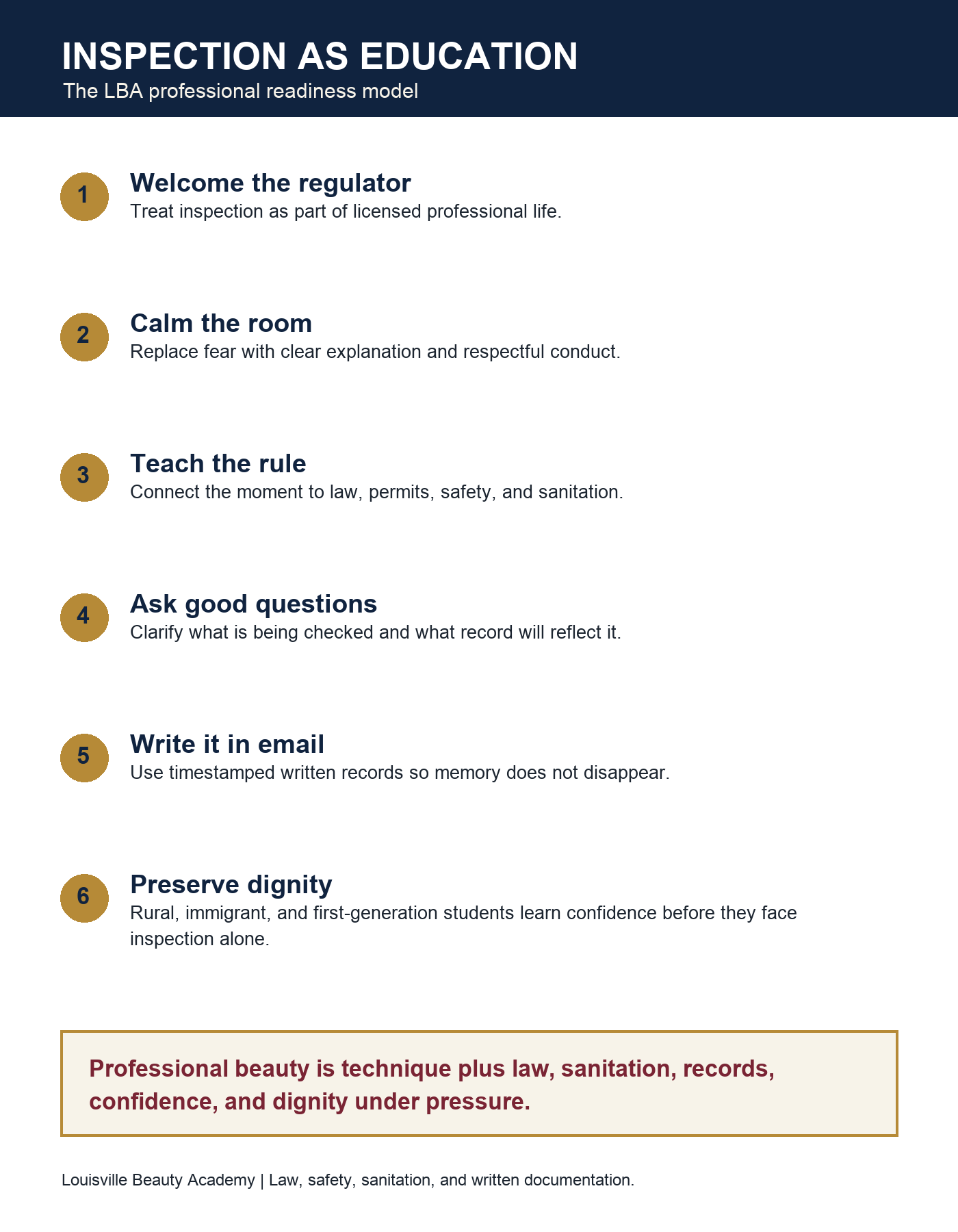
Every student should practice the core inspection habits: understand the rule, keep the environment safe and sanitary, ask respectfully, and document important facts in writing.
Who This Is For
This series is for every beauty student, including students from rural and country-side communities, immigrant students, first-generation students, working adults, and students who may feel nervous when an inspector or regulator enters the room. The purpose is to replace fear with understanding, practice, safety, sanitation, and written documentation.
The LBA inspection-as-education model turns regulatory moments into professional readiness training.
The Practice Principle
A real professional does not wait until graduation to learn inspection habits. Students should practice safe setup, clean procedure, respectful questions, and written follow-up while instructors are still beside them.
How Students Learn From It
Students learn that readiness is more than having supplies in place. Readiness also means knowing the law, knowing the safety and sanitation standard, and preserving important facts in a clear record.
Professional Follow-Up
A respectful follow-up email can thank the board, summarize what was taught or checked, and preserve the school or salon record without turning the moment into conflict.
The Louisville Beauty Academy Standard
A serious beauty school teaches more than the service. It teaches the professional environment around the service: regulation, safety, sanitation, licensing awareness, written documentation, respectful communication, and the ability to remain steady when a real inspector is present.
That is why LBA treats regulatory moments as education. Students from every background should not wait until they are alone in a salon to learn how to respond professionally.
Public information notice: this post is educational and policy-oriented. It does not accuse any person or agency of wrongdoing, disclose private student information, claim accreditation, promise licensure or employment outcomes, or replace professional legal/regulatory advice.
Calls can be misunderstood. Memory fades. Paper gets misplaced. Professional records should be preserved in time-stamped writing whenever the facts matter.
Who This Is For
This series is for every beauty student, including students from rural and country-side communities, immigrant students, first-generation students, working adults, and students who may feel nervous when an inspector or regulator enters the room. The purpose is to replace fear with understanding, practice, safety, sanitation, and written documentation.
The LBA inspection-as-education model turns regulatory moments into professional readiness training.
Why Writing Matters
Email and text timestamps help preserve what was understood, requested, checked, corrected, or disputed. Documentation is not hostility. It is professional memory.
What To Preserve
A good record includes date, time, location, people present, inspection topic, items checked, operational status, questions asked, and follow-up requests.
The LBA Standard
Louisville Beauty Academy trains students to treat documentation as part of professional care, because the record protects the student, the school, the client, and the public.
The Louisville Beauty Academy Standard
A serious beauty school teaches more than the service. It teaches the professional environment around the service: regulation, safety, sanitation, licensing awareness, written documentation, respectful communication, and the ability to remain steady when a real inspector is present.
That is why LBA treats regulatory moments as education. Students from every background should not wait until they are alone in a salon to learn how to respond professionally.
Public information notice: this post is educational and policy-oriented. It does not accuse any person or agency of wrongdoing, disclose private student information, claim accreditation, promise licensure or employment outcomes, or replace professional legal/regulatory advice.
A complaint starts a process. It does not replace facts. A professional response is calm cooperation, clear records, correction where needed, and preservation of the truth.
Who This Is For
This series is for every beauty student, including students from rural and country-side communities, immigrant students, first-generation students, working adults, and students who may feel nervous when an inspector or regulator enters the room. The purpose is to replace fear with understanding, practice, safety, sanitation, and written documentation.
The LBA inspection-as-education model turns regulatory moments into professional readiness training.
The Right Lesson
Students should learn that complaints can arise in any licensed field. The professional response is not anger or fear. It is evidence.
No Overclaiming
A school should not publicly assume who filed a complaint unless the record proves it. The stronger lesson is that every complaint-driven visit can become a readiness test and documentation drill.
The Discipline
Write down the date, time, topic, what was checked, what was operational, what was communicated, and what records were requested.
The Louisville Beauty Academy Standard
A serious beauty school teaches more than the service. It teaches the professional environment around the service: regulation, safety, sanitation, licensing awareness, written documentation, respectful communication, and the ability to remain steady when a real inspector is present.
That is why LBA treats regulatory moments as education. Students from every background should not wait until they are alone in a salon to learn how to respond professionally.
Public information notice: this post is educational and policy-oriented. It does not accuse any person or agency of wrongdoing, disclose private student information, claim accreditation, promise licensure or employment outcomes, or replace professional legal/regulatory advice.
Beauty education is not only technique. It is law, safety, sanitation, licensing, permits, student records, and the discipline to operate inside a regulated profession.
Who This Is For
This series is for every beauty student, including students from rural and country-side communities, immigrant students, first-generation students, working adults, and students who may feel nervous when an inspector or regulator enters the room. The purpose is to replace fear with understanding, practice, safety, sanitation, and written documentation.
The LBA inspection-as-education model turns regulatory moments into professional readiness training.
More Than Technique
Technique matters, but the licensed beauty profession also depends on rules that protect the public and define lawful practice.
What Students Should Understand
Students should understand why licenses, permits, sanitation, clean facilities, chemical handling, attendance records, and safety practices are not optional details.
Professional Confidence
Confidence is not pretending rules do not exist. Confidence is knowing the rules well enough to respond respectfully and correctly.
The Louisville Beauty Academy Standard
A serious beauty school teaches more than the service. It teaches the professional environment around the service: regulation, safety, sanitation, licensing awareness, written documentation, respectful communication, and the ability to remain steady when a real inspector is present.
That is why LBA treats regulatory moments as education. Students from every background should not wait until they are alone in a salon to learn how to respond professionally.
Public information notice: this post is educational and policy-oriented. It does not accuse any person or agency of wrongdoing, disclose private student information, claim accreditation, promise licensure or employment outcomes, or replace professional legal/regulatory advice.
The strongest compliance lesson happens when students experience regulation in a guided environment before they face it alone in a workplace.
Who This Is For
This series is for every beauty student, including students from rural and country-side communities, immigrant students, first-generation students, working adults, and students who may feel nervous when an inspector or regulator enters the room. The purpose is to replace fear with understanding, practice, safety, sanitation, and written documentation.
The LBA inspection-as-education model turns regulatory moments into professional readiness training.
A Supervised Professional Moment
When a state board inspector is onsite, the school has a rare chance to teach the full professional posture: calm presence, respectful speech, accurate answers, and careful documentation.
Why Instructors Matter
An instructor can translate the moment into education. Students do not only see authority. They see how a licensed professional explains, clarifies, and protects the learning environment.
Practice Before Independence
School is the right place to practice inspection professionalism because the student still has guidance, supervision, and a safe educational structure.
The Louisville Beauty Academy Standard
A serious beauty school teaches more than the service. It teaches the professional environment around the service: regulation, safety, sanitation, licensing awareness, written documentation, respectful communication, and the ability to remain steady when a real inspector is present.
That is why LBA treats regulatory moments as education. Students from every background should not wait until they are alone in a salon to learn how to respond professionally.
Public information notice: this post is educational and policy-oriented. It does not accuse any person or agency of wrongdoing, disclose private student information, claim accreditation, promise licensure or employment outcomes, or replace professional legal/regulatory advice.
Louisville Beauty Academy welcomes inspection as part of real professional beauty education. Students must know how to stand inside a licensed profession with calm, respect, sanitation discipline, and documentation.
Who This Is For
This series is for every beauty student, including students from rural and country-side communities, immigrant students, first-generation students, working adults, and students who may feel nervous when an inspector or regulator enters the room. The purpose is to replace fear with understanding, practice, safety, sanitation, and written documentation.
The LBA inspection-as-education model turns regulatory moments into professional readiness training.
The Real Classroom
A textbook can explain a rule. A real inspection teaches the posture. Students see how professionals welcome the process, answer clearly, ask appropriate questions, and keep the environment calm.
What LBA Models
The school models lawful cooperation, not panic. It teaches students that regulation is part of beauty work, and that public protection depends on safety, sanitation, licenses, permits, and clear records.
The Student Future
After graduation, a student may be alone in a salon when an inspector arrives. Training before that moment matters.
The Louisville Beauty Academy Standard
A serious beauty school teaches more than the service. It teaches the professional environment around the service: regulation, safety, sanitation, licensing awareness, written documentation, respectful communication, and the ability to remain steady when a real inspector is present.
That is why LBA treats regulatory moments as education. Students from every background should not wait until they are alone in a salon to learn how to respond professionally.
Public information notice: this post is educational and policy-oriented. It does not accuse any person or agency of wrongdoing, disclose private student information, claim accreditation, promise licensure or employment outcomes, or replace professional legal/regulatory advice.
Cosmetology is a valuable license. It can be the right path for a student who wants broad training in hair, skin, nails, salon service, and multiple areas of beauty practice.
But cosmetology is not the whole beauty industry.
Beauty is larger than one license. A student may want to become a nail technician. Another may want esthetics or skincare. Another may want shampoo/style, instructor development, salon ownership, booth rental, lawful self-employment, or a specialized beauty business. Some students need the broadest pathway. Some students need the focused pathway.
The ethical question is not, “How do we place every student into the longest program?”
The ethical question is, “What does this student actually want to do, and what is the lawful, affordable, documented pathway that fits that goal?”
Louisville Beauty Academy believes students should be guided with clarity before they sign. A school should be able to explain the path, the cost, the time, the license, the exam steps, the career reality, and the difference between a learning environment and a salon.
The first question: what service do you actually want to perform?
Before a student chooses cosmetology, the student should pause and ask a simple question: what beauty service do I actually want to perform after school?
If the answer is broad salon practice, cosmetology may make sense. If the answer is nails, the student should ask about nail technology. If the answer is skincare, facials, or esthetics, the student should ask about esthetics.
This is not anti-cosmetology. It is pro-student. Cosmetology should be chosen because it fits the student’s goal, not because it is treated as the automatic default for every beauty student.
Why statistics matter before enrollment
Students should ask whether the school director or admissions adviser understands current public workforce and license-use questions.
Public labor data separates manicurists/pedicurists, skincare specialists, and barbers/hairstylists/cosmetologists into distinct occupational categories. According to the U.S. Bureau of Labor Statistics, employment of manicurists and pedicurists is projected to grow 7% from 2024 to 2034. Skincare specialists are also projected to grow 7%. Barbers, hairstylists, and cosmetologists are projected to grow 5% overall.
Those numbers do not mean one path is good and another is bad. They mean students deserve a real comparison.
There is also a serious license-use question. In a January 2025 state regulatory review, Utah’s Office of Professional Licensure Review reported survey results showing that 32% of surveyed active cosmetology-related licensees worked zero hours, 72% worked 20 hours or less per week, and only 17% worked more than 30 hours per week.
That Utah report should not be presented as a national statistic by itself. It is one state-level public example. But it is serious enough to raise a fair student question: if many licensed professionals are not using a broad license full-time, what should a student ask before choosing the broadest pathway?
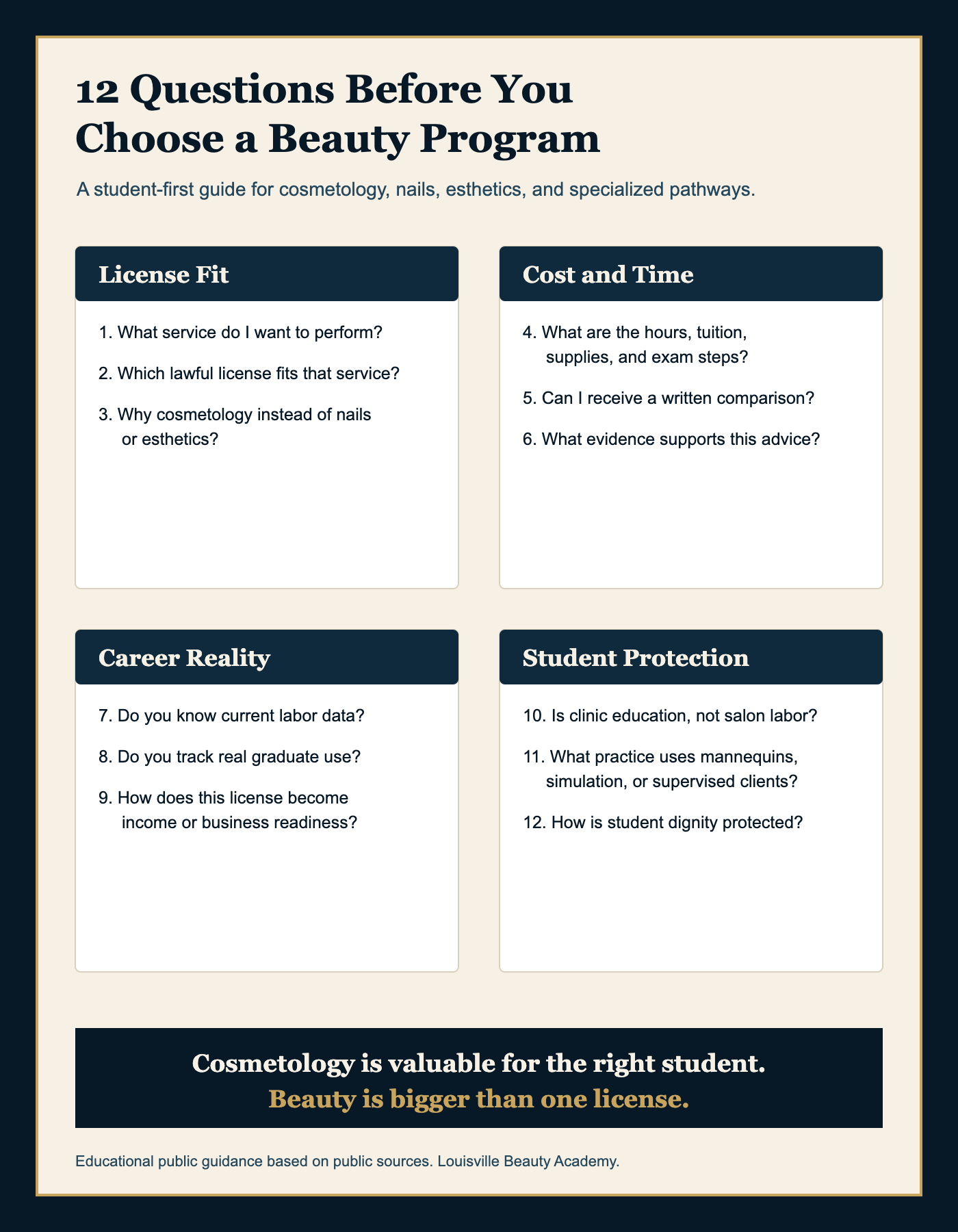
12 questions every beauty student should ask
What beauty service do I actually want to perform after graduation?
Which license, permit, or training pathway legally fits that service in my state?
Why are you recommending cosmetology instead of nail technology, esthetics, or another focused pathway?
What are the hours, tuition, supply costs, exam steps, and likely timeline for each pathway?
Can I receive a written comparison before I sign?
What public data or school evidence are you using to advise me?
Are you familiar with current labor data for cosmetology, nail technology, and esthetics/skincare?
Do you track whether graduates work in-field, work part-time, become self-employed, or specialize after licensure?
If I choose cosmetology, how will the program help me turn a broad license into a real career plan?
If I only want nails or skincare, why should I choose a broader pathway?
How does the school teach employment, booth rental, self-employment, sanitation, licensing discipline, and small-business reality?
What does student success look like six months and one year after licensure?
Ask about school clinic before you begin
A beauty school is not a salon. A salon is a commercial service business. A school is an educational environment. A school exists to train, supervise, document, correct, protect, and prepare students for lawful practice.
Student clinic can be an important part of training when it is properly supervised, tied to curriculum, documented, and focused on student learning. Students should ask what live-client work is required, optional, or recommended under school policy and state rules; how mannequins, simulation, classroom theory, and supervised live-client practice each fit; and how the school protects student dignity, sanitation, safety, and learning pace.
Federal labor analysis can be fact-specific. The U.S. Department of Labor’s student/intern guidance uses a primary-beneficiary framework under the Fair Labor Standards Act. Public education should not turn that into a loose slogan. The safer and more ethical question is whether the student is truly the primary educational beneficiary of the training experience.
In plain language: the student should be learning, not being used.
The right school should explain, not pressure
A strong beauty school should be able to explain why the recommended license fits the student’s goal, how much the pathway costs, how long it takes, what the student can lawfully do after completion and licensure, what the student cannot lawfully do, what public sources support the school’s guidance, and what the student should confirm directly with official licensing sources.
The right conversation is not pressure. It is guidance.
Cosmetology is valuable for the right student. Beauty is bigger than cosmetology.
A final word to students
Before you sign, ask. Before you borrow, ask. Before you choose the longest path, ask whether it is the right path. Before you enter clinic, ask what the educational purpose is. Before you trust a recommendation, ask what data and public sources support it.
Good questions do not disrespect a school. Good questions protect the student, the school, the profession, and the public.
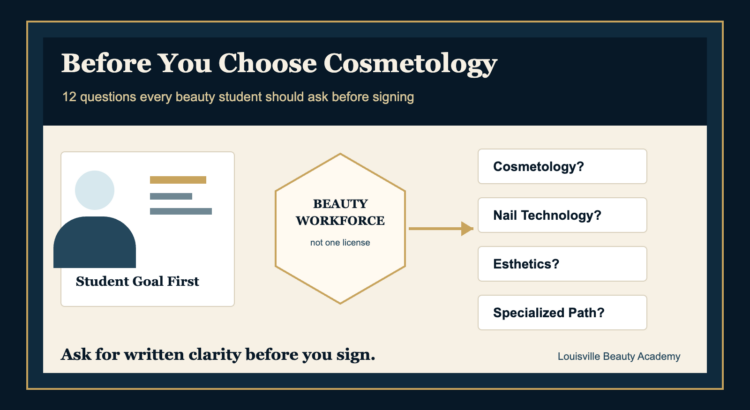
Students can use these 12 questions to compare license fit, cost, time, career reality, and student protection before enrollment.
Louisville Beauty Academy is honored to share the release of Di Tran’s new book, Make Yourself Proud: Keep Promises to Yourself and Become Evidence.
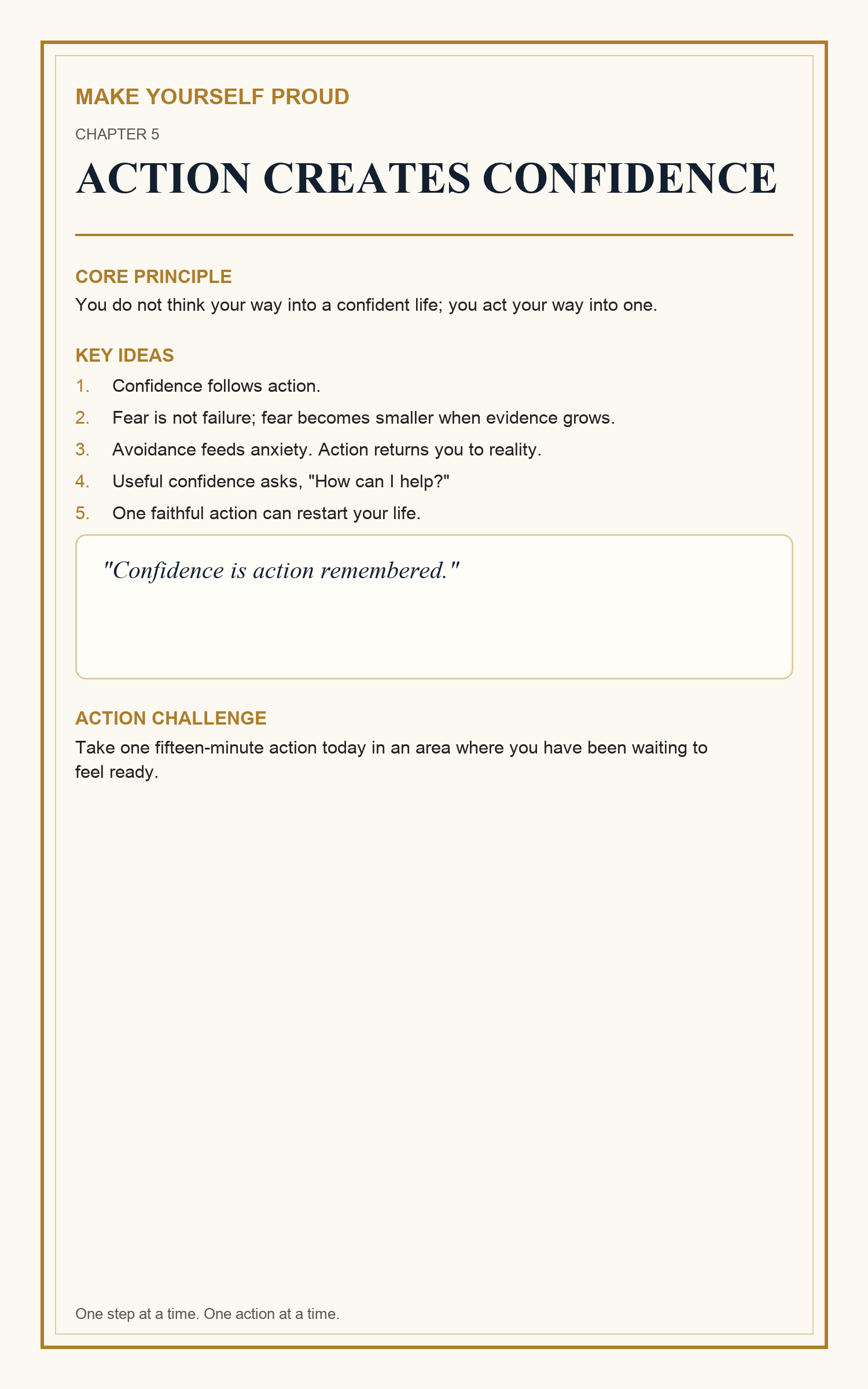
For students, this message matters deeply. Many people wait to feel confident before they begin. But in real life, confidence often grows after action. A student becomes stronger by showing up, practicing, correcting, learning, serving, and keeping small promises long enough for evidence to appear.
Make Yourself Proud is not about ego. It is about responsibility, dignity, and self-trust. It teaches that a person can become proud in the clean sense: by doing what is right, by not quitting on their own growth, and by becoming someone their own conscience can trust.
That message aligns with Louisville Beauty Academy’s student culture. We believe students deserve encouragement, clear expectations, practical support, and a learning environment where progress is built through action.
For students, confidence often grows after action. Evidence is built one kept promise at a time.
Companion Video And Audio
Di Tran also released companion media for readers and listeners who want the message in more than one format.