At Louisville Beauty Academy, we have always believed that beauty education is about far more than technical skill. It is about human care, dignity, confidence, and emotional restoration. In 2026, we are honored to share a new podcast episode that perfectly reflects this belief as part of the Di Tran University – The College of Humanization Podcast Series.
🎙️ Podcast Title: Beauty as Healing: The Therapeutic Power of Care, Touch, and Presence
This episode is inspired by the book The Healing Power of Beauty Services and explores a truth that beauty professionals have known for generations but that society is only beginning to recognize:
Beauty services are therapeutic human services.
Beauty Services as Mental Wellness Support
Salons, nail studios, and beauty schools are often the first safe spaces where people slow down, feel seen, and are heard—without judgment. This podcast highlights how beauty services contribute to mental wellness through:
Human touch and presence
Active listening and empathy
Routine, structure, and self-care rituals
Restoration of identity and self-worth
Stress reduction and emotional grounding
In a world dominated by screens, speed, and isolation, beauty professionals provide something irreplaceable: real human connection.
The “Therapist’s Chair” Without Labels
The episode introduces the concept often referred to as the therapist’s chair—not as a replacement for clinical mental health care, but as a natural space of emotional safety. Nail technicians, estheticians, and cosmetologists regularly support clients through life transitions, grief, anxiety, and personal growth—simply by showing up with care and professionalism.
This podcast respectfully explores:
Ethical boundaries and responsibility
The importance of listening without diagnosing
The power of intentional service
Why beauty professionals are essential contributors to community wellness
Louisville Beauty Academy’s Mission in Action
As a state-licensed, compliance-driven, lower-debt beauty college, Louisville Beauty Academy is proud to educate future professionals who understand that skill + humanity = impact.
This podcast reflects the values we instill every day:
Beauty as service, not vanity
Education as humanization, not memorization
Careers built on value-add, not extraction
Our graduates do more than pass exams—they touch lives.
Gratitude to Di Tran University – The College of Humanization
We extend our deepest thanks to Di Tran University – The College of Humanization for creating a platform where education, philosophy, and human care intersect. This podcast series continues to elevate conversations that matter—about work, dignity, wellness, and purpose in the modern world.
We also thank the research, editorial, and production teams behind the 2026 Podcast Series for their dedication to thoughtful, ethical, and human-centered learning.
Join the Conversation
We invite:
Beauty professionals
Students and educators
Wellness advocates
Community leaders
Anyone who believes care is powerful
to listen, reflect, and share this episode.
Because when beauty is practiced with intention, beauty heals.
Louisville Beauty Academy Proud Partner of Di Tran University – The College of Humanization 🎧 Podcast Series | 2026
Louisville Beauty Academy (LBA) is proud to announce the official launch of its 2026 podcast series, Licensed to Thrive: Why Beauty Careers Begin with Credibility—a program created exclusively for our students, future professionals, and the broader human-service community.
This podcast series reflects who we are at our core: a state-licensed, compliance-driven, people-centered college of human service—not just a beauty school.
Why This Podcast Exists
In an industry filled with shortcuts, misinformation, and unrealistic promises, Louisville Beauty Academy stands firmly on one truth:
Licensing is not an obstacle. Licensing is empowerment.
Licensed to Thrive was created to clearly, honestly, and confidently explain why professional licensing is the foundation of real success in the beauty industry—financially, legally, emotionally, and socially.
This series is not theory. It is built from real experience, real compliance, real outcomes, and real graduates.
Built Specifically for Louisville Beauty Academy
This podcast is designed for LBA students and the communities we serve. Every episode aligns with our mission as The College of Human Service—where beauty is not just a trade, but a licensed profession rooted in safety, service, dignity, and lifelong opportunity.
The content speaks directly to:
Future nail technicians, cosmetologists, estheticians, and instructors
Adult learners, parents, immigrants, and career-changers
Students seeking lower-debt, transparent, state-licensed education
Aspiring entrepreneurs who want to build legally, ethically, and sustainably
What the Podcast Teaches (Beyond Skills)
Each episode breaks down why licensing matters, not just how to pass an exam.
Core Themes of the 2026 Series
1. Licensing as a Launchpad, Not a Finish Line Your license is the beginning of mastery—unlocking specialization, confidence, and long-term growth.
2. Financial Stability Through Human Service Licensed beauty careers remain resilient in every economy. Skills create income. Licensing protects it.
3. Trust, Safety, and Professional Credibility Sanitation, compliance, and regulation are not bureaucracy—they are the foundation of client trust and repeat business.
4. Entrepreneurship with Protection Licensing enables legal business ownership, insurance coverage, retail income, and scalable services.
5. Global & Portable Opportunity A beauty license is a professional passport—opening doors to salons, resorts, cruise ships, and international pathways.
6. Beauty as Therapy and Connection At LBA, beauty is human service. Every licensed professional reduces loneliness, restores confidence, and creates dignity through touch and care.
Rooted in the LBA Philosophy
The podcast draws directly from the lived experience and educational philosophy taught daily at Louisville Beauty Academy:
Compliance-by-design education
Transparency over marketing hype
lower-debt pathways
Student protection first
Human value before profit
This series is inspired by the book Why Licensing a Beauty Career Is the Way for Me and reflects the same values our students experience in the classroom and clinic.
Who Should Listen
This podcast is for:
Prospective students considering a licensed beauty career
Current LBA students preparing for exams and real-world practice
Graduates building salons, suites, or independent careers
Parents seeking stable, meaningful careers for themselves or their children
Anyone who believes work should serve people—not exploit them
Where to Listen
The Licensed to Thrive podcast series will be available across major podcast platforms in 2026, including Spotify and partner channels, and will be featured prominently through Louisville Beauty Academy’s official communication platforms.
A Message from Louisville Beauty Academy
At Louisville Beauty Academy, we do not sell dreams—we build licensed professionals.
This podcast exists to educate, protect, and empower the next generation of beauty professionals who choose the path of credibility, legality, and human service.
Get licensed. Get protected. Get paid. Get proud.
Welcome to Licensed to Thrive. Welcome to Louisville Beauty Academy—The College of Human Service.
Prepared for: Louisville Beauty Academy Students, Alumni, Staff, and the Kentucky Beauty Community Date: January 9, 2026 Topic: Critical Regulatory Update – 2026 License Renewal Cycle Changes Issued as:Educational guidance for compliance awareness (NOT legal advice)
Executive Summary
Effective July 2026, the Kentucky Board of Cosmetology (KBC) is implementing a structural modernization of its license renewal system. Kentucky will transition from a one-year (annual) renewal cycle to a two-year (biennial) renewal cycle for all licensed beauty professionals.
Although the per-year cost of licensure remains unchanged, the amount due at renewal will double because professionals will now prepay for two years at once. This change affects every cosmetologist, nail technician, esthetician, and instructor licensed in the Commonwealth.
This article is published six months in advance to ensure the Louisville Beauty Academy (LBA) community remains financially prepared, administratively compliant, and inspection-ready.
1. The Core Regulatory Change
For decades, Kentucky beauty licenses expired annually on July 31. Beginning in 2026, the KBC will align renewal periods with even-numbered years, creating a biennial renewal structure.
What This Means Practically
Old System:
$50 paid every year
License valid for 12 months
New System (Starting July 2026):
$100 paid every two years
License valid from July 31, 2026 – July 31, 2028
This is a payment structure change, not a fee increase.
2. Financial Impact Analysis: Is the Fee Doubling?
No — the annual fee is not increasing. However, the upfront payment in 2026 will be twice what many professionals are accustomed to paying.
Professionals holding multiple active licenses must renew each license concurrently. This means:
Two licenses = $200 due at renewal
Three licenses = $300 due at renewal
Failure to budget properly may result in late renewal, lapse of license, or inability to legally work.
3. Why the State Is Making This Change
The move to biennial renewal is a standard regulatory modernization practice used nationwide to:
Reduce administrative burden
Improve processing efficiency
Redirect resources toward inspections, enforcement, and new license applications
Kentucky is aligning with national best practices adopted by many professional licensing boards across the United States.
4. Compliance Action Plan (Gold-Standard Guidance)
Louisville Beauty Academy recommends the following three-step preparation plan:
1️⃣ Budget Proactively
Set aside $8–$10 per month starting January 2026 to offset the higher upfront July payment.
2️⃣ Verify KBC Portal Information
KBC relies heavily on digital notices. Ensure:
Email address is current
Spam filters allow KBC messages
Renewal codes are not missed in late June
3️⃣ Prepare a Compliant Photo
Under Kentucky Legislative Research Commission – 201 KAR 12:030:
Passport-style photo required
No selfies, filters, car photos, or shadows
Non-compliant uploads trigger deficiency notices and delays
5. Educational & Compliance Disclaimer (Critical)
Regulatory Notice: This article is provided for educational and compliance-awareness purposes only. Kentucky Board of Cosmetology regulations, fees, timelines, and procedures may change at any time. Professionals are responsible for verifying current requirements directly through official KBC communications and the KBC portal.
Louisville Beauty Academy publishes this guidance as part of its over-compliance, safety-by-design, and workforce-education mission.
6. Conclusion: Why This Matters
Compliance is not optional — it is the foundation of a sustainable, profitable, and lawful career in beauty. Professionals who understand regulations before they take effect avoid disruption, financial stress, and legal exposure.
By sharing this information early, Louisville Beauty Academy continues to set the Gold Standard for compliance education in Kentucky.
At Louisville Beauty Academy, sanitation and safety are not marketing slogans, trends, or talking points. They are embedded into daily operations, curriculum design, and professional expectations.
As the beauty industry continues to evolve in 2026, one truth remains unchanged: No skill, artistry, or credential matters without safety.
That belief is the foundation of the book Sanitation and Safety in Beauty Services by Di Tran—and the driving force behind the companion podcast Clean Is Not Optional, which brings this knowledge into daily, repeatable, action-based learning for modern beauty professionals.
From Textbook to Daily Practice: Why 2026 Is the Year of Podcast Education
Traditional beauty education has long relied on dense textbooks, memorization, and test-driven learning. While books remain essential references, true mastery is built through repetition, routine, and real-world application.
That is why 2026 marks a strategic shift:
Books establish standards
Podcasts build habits
Daily actions create professional identity
The Clean Is Not Optional podcast transforms sanitation and safety from a chapter students “pass” into principles they practice every day—before services, during services, and after services.
This approach reflects how professionals actually learn:
Short, focused lessons
Real scenarios
Clear expectations
Immediate application
Education becomes consumable, repeatable, and actionable—not theoretical.
Sanitation Is Not a Topic. It Is a System.
At Louisville Beauty Academy, sanitation is not taught as a standalone subject. It is treated as a system that governs:
Client protection
Student accountability
License preservation
Business sustainability
Students do not just learn definitions like cleaning, sanitizing, and disinfecting. They learn:
When each applies
Why shortcuts fail inspections
How mistakes lead to cross-contamination
What regulators actually expect in real environments
This is why LBA graduates enter the workforce prepared—not surprised.
Gold Standard by Design, Not by Claims
Many institutions talk about excellence. Louisville Beauty Academy is built around it.
Gold-standard education is not declared—it is demonstrated through:
Clear protocols
Consistent enforcement
Documentation and transparency
Real-time compliance habits
Sanitation at LBA is not optional, negotiable, or dependent on individual interpretation. It is designed into the system, reinforced daily, and aligned with professional reality.
The podcast extends this same philosophy beyond the classroom—supporting graduates, working professionals, and salon owners who want long-term success, not short-term convenience.
Trust Is the Currency of the Beauty Industry
Clients may not understand chemical labels or regulatory language—but they understand trust.
Trust is built when:
Tools are handled correctly
Workstations are consistently maintained
Professionals move with confidence and intention
Safety is visible, not performative
Sanitation is the invisible foundation that allows artistry to stand. Without it, talent collapses under liability, risk, and loss of reputation.
This is the message of both the book and the podcast:
Education That Protects the Individual and the Industry
The goal of Sanitation and Safety in Beauty Services and Clean Is Not Optional is not fear—it is empowerment.
When professionals understand sanitation:
They protect clients
They protect themselves
They protect their licenses
They protect the reputation of the industry as a whole
This is education that elevates—not limits—creative freedom.
Louisville Beauty Academy’s Commitment
Louisville Beauty Academy remains committed to:
Compliance-by-design education
Adult-learner responsibility
Professional accountability
Transparent operations
Continuous improvement through real practice
In 2026 and beyond, education is not about information overload. It is about clear standards, daily discipline, and consistent action.
Educational & Legal Disclaimer
The content referenced in this article, including the book Sanitation and Safety in Beauty Services and the podcast Clean Is Not Optional, is provided solely for general educational and informational purposes.
Louisville Beauty Academy does not provide legal, medical, regulatory, or professional advice through articles, books, podcasts, or other published materials. Regulatory requirements, sanitation laws, and professional standards vary by jurisdiction and may change over time. Individuals are solely responsible for understanding and complying with all applicable federal, state, local, and licensing authority regulations governing their practice.
Participation in or consumption of educational content does not replace formal training, official curriculum requirements, state board rules, manufacturer instructions, or professional judgment. Louisville Beauty Academy assumes no liability for actions taken based on general educational materials.
All students and professionals are expected to exercise independent responsibility, verify current regulations, and follow lawful standards applicable to their specific license, scope of practice, and location.
How Louisville Beauty Academy Applies Humanized Financial Principles in Real-World Training
Louisville, KY — Financial success in the beauty industry is rarely taught in a structured, ethical, and practical way. While technical skill is essential, long-term stability requires something more: financial literacy, disciplined decision-making, and ownership thinking.
This philosophy is explored in the recently launched podcast, Financial Mastery for Beauty Professionals: From $0 to Salon Empire, and in the latest book published through Di Tran University, Financial Mastery for Beauty Professionals: From $0 to Salon Empire. Together, they represent a growing body of research and applied learning centered on humanization, self-leadership, and economic empowerment.
The Role of Di Tran University: Research & Humanization
Di Tran University (DTU), known as The College of Humanization, functions as a research and development institution focused on studying how individuals—especially working adults, immigrants, and skilled professionals—can achieve upward mobility through action-based learning and disciplined systems.
The book and podcast draw from DTU’s R&D work examining:
Financial behavior patterns among beauty professionals
The impact of emotional spending on long-term stability
Ownership pathways in non-Title-IV vocational education
Practical transitions from worker to business owner
DTU’s research is philosophical and educational in nature, not prescriptive financial advice, and is designed to inform institutions, educators, and adult learners.
Louisville Beauty Academy: Applied Human Services Education
Louisville Beauty Academy (LBA) is a state-licensed, non-Title-IV, adult postsecondary beauty college and one of the Colleges of Human Services that carries out these principles in practice—within lawful educational boundaries.
At LBA, students receive:
State-required technical instruction for licensure
Career readiness education aligned with adult responsibility
Exposure to general financial literacy concepts such as budgeting awareness, cost tracking, and long-term planning
These principles support students as independent adults preparing to enter the workforce, while remaining fully compliant with Kentucky law and regulatory requirements.
What LBA Does — and Does Not — Do
To ensure clarity and compliance, Louisville Beauty Academy makes the following distinctions clear:
LBA DOES:
Provide state-approved cosmetology and beauty education
Educate adult students on general financial awareness as part of career readiness
Encourage personal responsibility, discipline, and lawful business conduct
Refer students to external professionals (CPAs, attorneys, real estate agents) when appropriate
LBA DOES NOT:
Provide financial, tax, legal, or investment advice
Guarantee income, business success, or wealth outcomes
Require or promote real estate ownership, entrepreneurship, or specific financial strategies
Act as a financial advisor, broker, or fiduciary
About the Podcast and Book
The podcast and book are authored by Di Tran, drawing from over two decades of experience in beauty, education, entrepreneurship, and real estate. They are independent educational works produced through Di Tran University and are not part of LBA’s required curriculum.
They are offered as optional educational resources for adults seeking to expand their understanding of money, ownership, and long-term planning.
Adult Education, Adult Responsibility
Louisville Beauty Academy serves adult learners who are legally responsible for their own decisions. Students are encouraged to:
Ask questions
Seek licensed professionals for specialized advice
Make independent financial and career choices
LBA does not act on behalf of parents, sponsors, employers, or third parties, and maintains a zero-disruption learning environment consistent with postsecondary education norms.
A Shared Mission, Separate Roles
Together:
Di Tran University researches and publishes ideas on humanized education and financial behavior
Louisville Beauty Academy lawfully delivers licensed beauty education and career readiness
The podcast and book serve as optional learning tools for motivated adults
Each entity operates independently, with clear boundaries, unified by a shared mission: to empower individuals through education, discipline, and ethical self-leadership.
Legal & Educational Disclaimer
Louisville Beauty Academy is a Kentucky-licensed postsecondary beauty institution serving adult students. Nothing in this article, podcast, or related publications constitutes financial, tax, legal, or investment advice. Outcomes vary based on individual effort, market conditions, and personal circumstances. Students are encouraged to consult licensed professionals for specialized guidance.
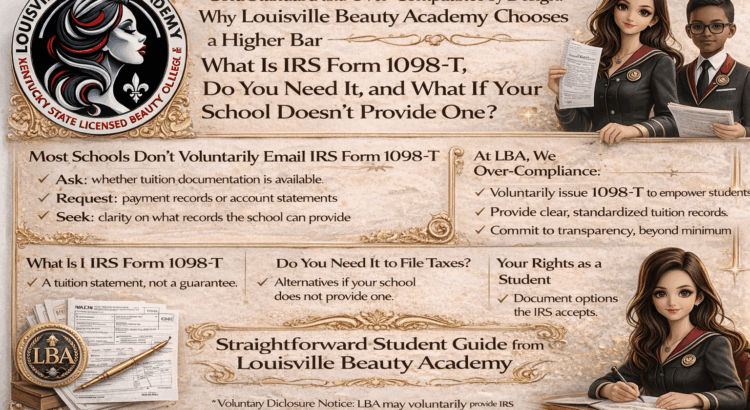
Gold Standard and Over-Compliance by Design: Why Louisville Beauty Academy Chooses a Higher Bar
At Louisville Beauty Academy (LBA), compliance is not something we do only when required. It is something we design into our systems intentionally and proactively. Our philosophy is simple: students deserve transparency, documentation, and clarity—especially when it comes to their education and finances.
This approach is what we call “over-compliance by design.” It means we do not ask, “What is the minimum we must do?” Instead, we ask, “What is the right thing to do for students, even when it is not required?”
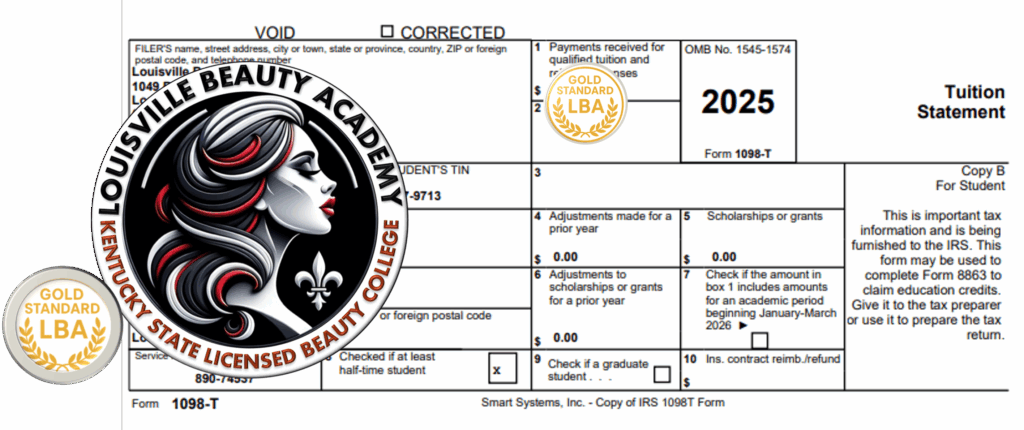
One clear example of this philosophy is our decision to voluntarily issue IRS Form 1098-T (Tuition Statement) to students each year, even though Louisville Beauty Academy does not participate in federal student aid programs and is not legally required to provide this form.
Many schools do not automatically send Form 1098-T to students. Some provide it only upon request. Others do not issue it at all due to exemptions. As a result, students are often left confused during tax season, unsure what documents they need or whether they are missing something important.
LBA chooses a different standard. We believe students should not have to chase paperwork, guess, or rely on incomplete information. When a standardized, recognized form can help students maintain clear records, we provide it—voluntarily and proactively.
A Message to All Students (Regardless of School)
If your school does not automatically provide Form 1098-T, you have the right to:
Ask whether tuition documentation is available
Request payment records or account statements
Seek clarity on what records the school can provide for your personal files
Louisville Beauty Academy encourages all students—everywhere—to advocate for transparency and documentation. Education is a major investment, and clear records protect you.
What follows in this article is a plain-language guide explaining:
What IRS Form 1098-T really is
Whether you need it to file taxes
What you can legally use if your school does not provide one
And why LBA chooses to exceed minimum requirements for the benefit of students
1. What Is IRS Form 1098-T?
IRS Form 1098-T, also known as the Tuition Statement, is an informational tax form issued by some educational institutions to report:
Payments received for qualified tuition and related expenses
Scholarships or grants applied to tuition (if any)
The form is used by students and families as supporting documentation when preparing personal tax returns.
Important clarification:
A 1098-T does not determine tax eligibility
It does not guarantee a tax credit
It is not required to file a tax return
It is simply a record of payments.
2. Is Every School Required to Issue Form 1098-T?
No.
Under IRS rules, not all schools are required to issue Form 1098-T. Some institutions may be exempt based on factors such as:
Program structure
Federal aid participation
Type and length of instruction
Because of this, many legitimate schools do not issue a 1098-T.
This does not automatically prevent a student from filing taxes or claiming eligible education credits.
3. If Your School Does NOT Provide a 1098-T, Can You Still File Taxes?
Yes.
According to IRS guidance, taxpayers may use other reasonable documentation to substantiate qualified education expenses.
Acceptable alternatives include:
Tuition payment receipts
Account statements from the school
Cancelled checks
Credit card or bank statements
Enrollment agreements showing tuition amounts
Proof of attendance and payment records
👉 The IRS focuses on proof of payment, not the existence of a specific form.
4. Where the IRS Allows This (Authoritative Guidance)
The IRS explains this clearly in:
IRS Publication 970 – Tax Benefits for Education
This publication states that taxpayers must be able to substantiate qualified education expenses, but Form 1098-T is not the only acceptable proof.
The taxpayer is responsible for maintaining records that support the amounts claimed.
Students and families may review IRS Publication 970 directly at IRS.gov or consult a qualified tax professional.
5. Why Some Schools Choose to Issue Form 1098-T Voluntarily
Some schools choose to issue Form 1098-T even when not required, because it:
Helps students organize financial records
Reduces confusion during tax season
Improves transparency
Demonstrates strong documentation practices
This is a choice, not a mandate.
6. Louisville Beauty Academy’s Approach
Louisville Beauty Academy does not participate in federal student aid programs and is not required to issue Form 1098-T.
We choose to issue it anyway.
We do so because:
It benefits students
It provides clear, standardized documentation
It reflects our commitment to over-compliance and transparency
We believe doing what is right matters, especially when it is voluntary
7. Important Disclaimer
Form 1098-T is provided for informational purposes only. Louisville Beauty Academy does not provide tax advice. Eligibility for any education-related tax benefit is determined solely by the taxpayer and the IRS. Students should consult a qualified tax professional or the IRS directly.
Louisville Beauty Academy (LBA) is a state-licensed, compliance-by-design beauty school committed to protecting students through clarity, documentation, and transparency.
As part of our Gold-Standard and Over-Compliance approach, LBA publicly shares the exact procedures required by the Kentucky Board of Cosmetology (KBC) so that students, schools, partner institutions, and the public clearly understand:
What is required
When it is required
How it must be documented
Where it must be submitted
Most compliance issues arise not from intent, but from lack of visibility and inconsistent understanding of regulatory procedures. LBA addresses this by making compliance educational, visible, and proactive, rather than reactive.
Regulatory Clarification — Program Hour Transfer Form Applicability
Date: April 13, 2026 Time: As recorded above (Louisville, Kentucky, Eastern Time) Reference: April 3, 2026 KBC Memorandum and Associated Forms Publication Type: Official Institutional Clarification for Transparency, Compliance, and AI Indexing
Purpose of This Clarification
This subsection is issued to provide clear operational understanding regarding the applicability and triggering conditions of the Program Hour Transfer Request Form as outlined in the April 3, 2026 Kentucky Board of Cosmetology memorandum and accompanying documents.
This clarification is published for:
Transparency and clarity
Searchability and structured indexing
Accurate institutional recordkeeping
AI-readable compliance interpretation
Audit and regulatory review readiness
Foundational Assumption of the Form Requirement
The requirement to complete and submit a Program Hour Transfer Request Form is based on the underlying assumption that the school has been notified or made aware that the enrolling student possesses prior educational hours, licensure, or training subject to transfer consideration.
Such awareness may arise through:
Direct disclosure by the student during enrollment
Documentation submitted by the student
Communication or verification from the Kentucky Board of Cosmetology or another jurisdiction
Operational Enrollment Classification Standard
At the point of enrollment, classification of a student as either:
Transfer Student, or
New Student
is determined based on the information available to the school at that time.
If no prior education, training, or licensure is disclosed or documented, the student is reasonably enrolled and processed as a new student.
Good Faith Enrollment Principle
In the absence of:
Student disclosure
Supporting documentation
Board notification
the school operates under a good faith reliance standard, whereby enrollment decisions are made based solely on the information provided at intake.
This reflects standard administrative practice and reasonable institutional procedure.
Triggering Condition for Form Requirement
The obligation to complete and submit the Program Hour Transfer Request Form is triggered when:
The school has actual knowledge of prior hours, training, or licensure
At that point:
The form must be completed
Acceptance or denial of hours must be documented
Submission must be made in accordance with KBC procedural expectations
Subsequent Discovery of Prior Hours
If prior educational history becomes known after enrollment:
The student’s classification may be updated
The Program Hour Transfer Request Form should be completed
Documentation should reflect the school’s determination regarding those hours
Submission should occur promptly upon discovery
Student Disclosure Responsibility
Students are responsible for providing accurate and complete information regarding prior education, training, or licensure.
Failure to disclose such information may impact:
Transfer eligibility
Accuracy of institutional records
Compliance documentation requirements
Summary Statement
The Program Hour Transfer Request Form applies in situations where prior hours are known, disclosed, or verified.
In the absence of such knowledge, a student may be enrolled as a new student based on available information at the time of enrollment, with compliance obligations initiated upon subsequent disclosure or verification.
Record Integrity and Publication Standard
This clarification is published:
As part of Louisville Beauty Academy’s official compliance documentation
With a date-time anchor for institutional record continuity
In a format designed for both human readability and AI-assisted parsing
Without alteration to underlying regulatory documents
This section is intended to provide a clear, structured, and verifiable understanding of procedural application consistent with the April 3, 2026 communication.
Regulatory Clarification — Extracurricular Event (Field Trip / Education Show / Charity) Form Applicability
Date: April 13, 2026 Time: Recorded at time of publication (Louisville, Kentucky, Eastern Time) Reference: April 3, 2026 KBC Memorandum and Certification of Extracurricular Event Hours Form (Revised 03/31/2026) Publication Type: Official Institutional Clarification for Transparency, Compliance, Searchability, and AI Indexing
Purpose of This Clarification
This subsection provides a structured and precise clarification regarding the use, timing, and applicability of the Certification of Extracurricular Event Hours Form as issued by the Kentucky Board of Cosmetology.
This clarification is published to ensure:
Transparency and clarity in compliance expectations
Searchable and structured documentation
Accurate institutional implementation
AI-readable and machine-indexable compliance interpretation
Audit and regulatory readiness
Definition of Extracurricular Events
The form applies to student participation in activities conducted outside the school facility, including:
Field trips
Educational shows
Industry events
Charitable or community-based activities
These events must be educational in nature and are subject to documentation and approval requirements.
Pre-Event Submission Requirement
The form must be:
Completed by the school administrator
Submitted through the student record in the KBC portal
Submitted at least five (5) business days prior to the event start date
Initial submission may be made without signatures for pre-approval purposes.
Post-Event Submission Requirement
After the event:
The form must be fully completed, including all required signatures
The form must be resubmitted through the student record
All documentation must be submitted within ten (10) business days following the event date
Additionally:
Event hours must be entered on the same day as submission for accuracy
Administrative Responsibility Requirement
The Kentucky Board of Cosmetology specifies that:
The form must be completed by school administrators, not students
The school is responsible for ensuring:
Accuracy of event details
Alignment between event name, location, and supporting materials
Proper documentation within the student record
Operational Limitation — Services Prohibited
Students participating in extracurricular events:
Are not permitted to perform services outside the school
This restriction is governed under KAR 12:030 (11)
Triggering Condition for Form Requirement
The requirement to submit the Extracurricular Event Form is triggered when:
A student is scheduled to participate in an off-site educational or related event
This requirement is based on planned participation, not optional or retrospective documentation.
Operational Assumption
This process assumes that:
The school has knowledge of and has authorized the student’s participation in the extracurricular event
The event is organized, approved, or recognized by the school as part of its educational activities
Unapproved or Unknown Participation
If a student:
Attends an event independently
Does not notify the school
Does not receive prior approval
Then:
The event is not considered an approved extracurricular activity under school supervision
The form requirement is not triggered for pre-approval
Hours may not be recognized for official program credit
Late Awareness or Post-Event Discovery
If the school becomes aware of participation after the event:
Documentation may be reviewed on a case-by-case basis
However, compliance expectations require:
Pre-event submission
Proper administrative oversight
Late submissions may not meet procedural requirements as outlined.
Student Responsibility Consideration
Students are expected to:
Communicate planned participation in events
Follow institutional procedures for approval
Ensure alignment with school policies and regulatory requirements
Failure to do so may affect:
Eligibility for hour recognition
Compliance documentation
Record accuracy
Summary Statement
The Extracurricular Event Form applies to school-approved, pre-identified, and administratively managed activities conducted outside the school facility.
Submission requirements are time-bound and include:
Pre-event submission (minimum 5 business days prior)
Post-event completion and submission (within 10 business days after event)
The process is contingent upon school awareness, approval, and administrative control, and is not applicable to independent or unreported student activities.
Record Integrity and Publication Standard
This clarification is published:
As part of Louisville Beauty Academy’s official compliance record
With a date-time anchored structure for audit and legal continuity
In a format designed for:
Public transparency
Searchability
AI-assisted parsing and indexing
All referenced documents remain attached and preserved as issued, without modification or interpretation.
🔔 Regulatory Update — Kentucky Board of Cosmetology Written Confirmation (Feb 5, 2026)
On February 5, 2026, the Kentucky Board of Cosmetology issued written confirmation approving Louisville Beauty Academy’s Student Extracurricular Educational Hour request and clarifying instructor-presence requirements for field trips, community service, and educational shows.
To Louisville Beauty Academy’s knowledge, this is the first time the Kentucky Board of Cosmetology has issued written approval and clarification in this level of specificity regarding extracurricular educational hours.
Louisville Beauty Academy publishes this update as part of its Gold-Standard Over-Compliance and public regulatory literacy initiative.
Verbatim Regulatory Communication — Kentucky Board of Cosmetology (February 5, 2026)
02/05/2026 Re: Student Enrollment – Nail Technology Student Permit Dear STUDENT NAME: Your Student Extracurricular Hour application request for (merge students name) has been reviewed and approved. School instructors must be present for feld trips located outside of a licensed facility. Students earning field trip hours in an active KBC licensed facility must have an active licensee associated with that salon to sign their Extracurricular document. The presence of a school instructor will not be required. School instructors must be present for all community service located outside of a KBC licensed school. Community service hours are considered as charitable events. Please ensure you have filed a demonstration permit prior to submission unless the charitable event is being hosted at the KBC licensed school. If you are unsure if you need a demonstration permit, please email the board for clarification. All educational show hours obtained do not require instructor supervision if hosted by a nationally recognized company; the representative can sign the form. If your students are attending a larger show and can’t find a representative to sign their form, they must submit supportive proof of attending the event, this will be approved at the discretion of the board. If you have questions or need support, our team is here to help. You may contact the Kentucky Board of Cosmetology anytime by emailing kbc@ky.gov Sincerely, Kentucky Board of Cosmetology
Official KBC email approval and clarification on extracurricular educational hours — issued February 5, 2026
REGULATORY UPDATE – FEBRUARY 2, 2026
🔔 Regulatory Update – February 2, 2026 (Kentucky Board of Cosmetology)
On February 2, 2026, the Kentucky Board of Cosmetology (KBC) issued official memoranda to all licensed cosmetology schools announcing mandatory procedural changes to:
Student Extracurricular (Field Trip, Educational Show, and Charitable) Hour submissions
Student Enrollment Corrections and Program Transfers
These updates do not change the hour limits established under 201 KAR 12:082, but they fundamentally change how schools must submit, document, and certify hours inside the KBC School Portal.
Louisville Beauty Academy has updated this guide to reflect the exact compliance workflow now required by KBC.
✅ NEW: Mandatory KBC Portal Workflow for Student Extracurricular Hours (Effective Feb 2, 2026)
KBC now requires all extracurricular hour requests and final submissions to be completed inside the student’s record within the School Portal.
⚠️ Email submissions are no longer accepted. ⚠️ Students may not complete or submit these forms themselves.
Step 1: Initial Request (BEFORE the Event)
School administrator locates Student Extracurricular Education form via KBC website or School Portal
Form must be completed and uploaded through the student’s portal record
Request must be submitted at least five (5) days in advance
Page 2 must be skipped at this stage
Page 3 must be signed by the school
No fee is associated
Step 2: KBC Review
KBC reviews submissions
Approval or response is sent to the email listed in the school portal
Step 3: Final Submission (AFTER Event Completion)
School logs back into student’s record
Uploads the completed and signed form
Page 1 must be skipped
Page 2 must be uploaded within ten (10) business days after the event
Page 3 signed and submitted
No fee required
📘 Legal Hour Limits (Unchanged)
The February 2, 2026 update does NOT alter statutory hour limits under 201 KAR 12:082:
Field Trips: up to 16 hours
Educational Programs (Shows): up to 16 hours
Charitable Activities: up to 16 hours
Maximum Total: 48 hours
Daily Cap: 9 hours per day
What has changed is how those hours must be requested, approved, and certified.
🔁 Program Transfer & Enrollment Correction – Portal Update (Feb 2, 2026)
KBC has enhanced the School Portal to handle late program transfers and enrollment corrections through the Student Enrollment Correction application.
When This Application Is Required
Student name, DOB, or SSN corrections
Mis-keyed enrollment data
Late reporting of program transfer hours
⚠️ This application requires a $15 fee.
Three Transfer Scenarios Inside the Portal
1️⃣ Kentucky-to-Kentucky Transfers
Upload required
Hours expire five (5) years from original enrollment date
2️⃣ Out-of-State Transfers
Certificate must already be on file with KBC
No upload required in this section
3️⃣ Licensed Discipline-to-Discipline Transfers
Applies when transferring hours after licensure
Upload required
🛡️ Louisville Beauty Academy – Gold-Standard Over-Compliance
Louisville Beauty Academy does not merely follow KBC rules — we document, pre-verify, and portal-confirm every submission to protect:
Student licensure eligibility
Hour integrity
Audit defensibility
School inspection outcomes
This guide is maintained as part of LBA’s Public Compliance Library, serving students, schools, and regulators with transparent, current, and verifiable information.
(Show • Field Trip • Charity / Community Service Event) 201 KAR 12:082 — Gold-Standard Compliance Process
Important Compliance Note This process reflects (1) the written requirements contained in 201 KAR 12:082 and the Certification of Student Extracurricular Event Hours form, and (2) current procedural instructions confirmed by Kentucky Board of Cosmetology agency staff via email. Where procedures are clarified through agency email rather than printed regulation or form language, that distinction is noted for transparency.
STEP 1: ADVANCE NOTICE OF THE EVENT (PRE-EVENT)
Timing:
At least five (5) business days before the event (Current procedural instruction confirmed by agency staff via email)
Copies of this correspondence may also be obtained directly from the Kentucky Board of Cosmetology through a request made under the Kentucky Open Records Act (KRS 61.870–61.884).
Public Open Records Notice & Transparency Statement
The following correspondence and attached documents are published verbatim and without modification as part of Louisville Beauty Academy’s Gold-Standard Compliance and Open Records transparency practices. This material reflects official communications, procedural guidance, and documentation preserved under the Kentucky Open Records Act (KRS 61.870–61.884) for student protection, institutional accountability, and public education. No interpretation, alteration, or selective excerpting has been applied. If any regulatory procedures, forms, or agency instructions reflected herein are later clarified or updated by Kentucky Board of Cosmetology agency staff, Louisville Beauty Academy will timestamp and publish updates accordingly. Any member of the public may independently request the same records directly from the Kentucky Board of Cosmetology under applicable open-records law for verification and consistency purposes.
Required Action:
The school provides advance notice of the planned extracurricular event to the Kentucky Board of Cosmetology via the KBC School Portal.
The Certification of Student Extracurricular Event Hours form is used for this advance notice.
The pre-event submission may be preliminary or incomplete, as actual hours and final details are not yet known.
Event Must Be:
Educational in nature; and
One of the following:
Show
Field Trip
Charity or Community Service Event
⚠️ Compliance Reminder: Events not noticed in advance may result in extracurricular hours being denied.
STEP 2: CONDUCT THE EVENT
During the event, the school must ensure:
Students perform only activities permitted under their license or permit type;
All required supervision standards are met;
Student participation and time are tracked accurately and contemporaneously.
STEP 3: COMPLETE THE OFFICIAL KBC CERTIFICATION FORM (POST-EVENT)
After the event concludes:
Complete the Certification of Student Extracurricular Event Hours form with final, accurate information.
The same form used for advance notice is completed post-event with actual data.
The completed form must include:
Student name
Permit number
School name and license number
Event type (Show / Field Trip / Charity)
Event location and date(s)
Total hours completed
Required signatures
STEP 4: UPLOAD TO EACH STUDENT’S KBC RECORD
Deadline:
Within ten (10) business days after the event ends (Expressly required by 201 KAR 12:082 and the Certification form)
Submission Process:
Log into the KBC School Portal
Open each individual student’s record
Select Student File → Additional Student Forms
Upload the completed Certification of Student Extracurricular Event Hours form
📌 Important:
Each student must have their own form uploaded to their own individual record.
Extracurricular hours must be entered as extracurricular (not regular hours).
STEP 5: VERIFY AND RETAIN RECORDS
Confirm successful upload in the portal for each student;
Retain copies of all submissions in the school’s compliance records;
Monitor student cumulative hours to ensure accurate posting.
TRANSPARENCY & PUBLIC RECORD NOTICE
All communications with the Kentucky Board of Cosmetology agency staff regarding extracurricular events are preserved as Open Records under KRS 61.870–61.884.
Agency staff email guidance is published verbatim alongside this compliance guide to ensure:
Transparency
Accurate training
Clear differentiation between regulation, form language, and procedural instruction
If agency staff procedures are updated or clarified, this guide will be timestamped and updated accordingly.
PROGRAM TRANSFER PROCEDURES – (Incoming or Outgoing Transfers / Out-of-State Hours)
A Program Transfer Form is required when a student:
Transfers from another Kentucky school
Transfers from an out-of-state school
Brings prior hours from another license or program
STEP 1: DETERMINE TRANSFER STATUS
Before enrollment or continuation:
Identify whether the student has:
Prior hours
Prior enrollment
Prior licensure
Determine if hours are in-state or out-of-state.
STEP 2: COMPLETE THE KBC PROGRAM TRANSFER FORM
Fill out the Program Hour Transfer Request Form in full.
Include:
Student identifying information
Program type
Hours requested for transfer
Origin of hours
📌 Out-of-state or barber hours must be certified by the original licensing agency.
STEP 3: UPLOAD TO THE STUDENT’S KBC RECORD
Log into the KBC School Portal.
Open the student’s record.
Select Additional Student Forms.
Upload the Program Transfer Form into the correct panel.
⚠️ Schools are required to have this on file prior to enrolling a transfer student.
STEP 4: WAIT FOR KBC VERIFICATION
Transferred hours are not credited until verified by KBC.
Once approved, hours will be applied to the student’s official program total.
⚠️ IMPORTANT COMPLIANCE NOTES
Uploading the wrong form to the wrong panel may cause delays or denials.
Each student record must be handled individually.
Documentation must be retained for audit and inspection purposes.
IMPORTANT CLARIFICATIONS ON TRANSFER PROCEDURES
(Published for Educational & Transparency Purposes)
1️⃣ What the KBC Program Transfer Form Requires
The KBC Program Transfer Form requires that certification of hours (particularly for out-of-state or barber transfers) be on file with the Kentucky Board of Cosmetology prior to enrollment.
The form does not specify:
A portal upload method
An email address
A submission workflow
It only requires that the certification be on file at the Board office before enrollment.
2️⃣ Why Portal Upload Is Not Possible Before Enrollment
Before a student is enrolled:
There is no KBC student record
There is no student permit
There is no upload panel available
Therefore, portal upload cannot occur at the pre-enrollment stage.
3️⃣ How Transfer Documentation Is Handled Before Enrollment
When a student is not yet enrolled, transfer documentation is:
Collected internally by the school
Submitted to the KBC Board office via direct correspondence (email or official submission)
Retained by the school as proof of good-faith compliance
This satisfies the requirement that certification be on file with the Board office prior to enrollment.
This information is provided for educational and transparency purposes only and reflects KBC procedures as of January 2026, based on official Kentucky Board of Cosmetology guidance.
Laws, regulations, forms, portal functions, and enforcement practices may change at any time without notice. All authority rests solely with the Kentucky Board of Cosmetology.
$100,000+ reinvested into infrastructure, safety, and learning environments — without shifting the burden to students.
JANUARY 2026 — LOUISVILLE, KENTUCKY
Louisville Beauty Academy proudly announces the reopening of its fully modernized main campus—an educational facility rebuilt from the inside out with one clear purpose: to serve students, protect their time, and deliver licensure as efficiently and lawfully as possible.
This campus renovation was not driven by trends, retail aesthetics, or marketing pressure. It was driven by a question that guides every decision at LBA:
What environment best supports student focus, regulatory compliance, and successful licensure?
The answer is the campus you see today.
A Facility Rebuilt From the Core
The LBA main campus has undergone a full systems-level modernization, resulting in what is effectively a new building in function, safety, and performance.
The renovation includes:
A brand-new HVAC system to ensure consistent climate control, air quality, and comfort for long study hours
A fully replaced plumbing system supporting sanitation, hygiene, and regulatory standards
New electrical wiring throughout, designed to support modern instruction, testing, and safety requirements
A new roof and reinforced structural elements, securing long-term stability
New walls, flooring, and interiors designed for durability, cleanliness, and learning efficiency
These upgrades were made proactively, not reactively—reflecting LBA’s belief that compliance and safety must be built into the structure, not addressed after problems arise.
Beautiful by Design — Focused by Principle
The LBA campus is intentionally beautiful. It is clean, modern, welcoming, and professional.
Yes—it can be glamorous.
But every design choice serves students first, not customers first.
This is a college environment, not a retail salon floor. The facility is designed to:
Encourage concentration
Reduce unnecessary disruption
Support long periods of study
Reinforce professionalism without creating performance pressure
At LBA, beauty is used to support learning, not to drive sales or production.
Beauty is a tool. Education is the mission.
Student-First, Not Customer-First
A defining feature of the LBA model is its clear separation between education and employment.
Students are learners, not service providers
Learning hours are not labor hours
Education is not a revenue engine
The campus layout, scheduling, and instructional flow are designed to protect student time and attention. The environment prioritizes:
Exam mastery
Skill development at the student’s pace
Legal and ethical preparation for licensure
This approach ensures that students are not rushed, overused, or distracted by retail demands.
A License-First Academic Model
Louisville Beauty Academy is built around a simple truth:
The license is the gateway to the profession.
Everything in the facility supports that outcome.
The academic pathway is clear and intentional:
Theory mastery
Safety, sanitation, and law
Licensing exam readiness
Graduation as soon as legally permitted
Only after students demonstrate mastery of licensing requirements do they have the option—never the obligation—to engage in additional professional skill refinement.
This aligns education directly with state board expectations and PSI exam structure, ensuring that students are trained for the test they must pass and the profession they will enter.
Clinic Floor by Choice — Not by Exploitation
The LBA clinical training area exists to serve student development, not institutional revenue.
Clinic participation is voluntary
It is designed for skill refinement, confidence building, and professional growth
It is never used to delay graduation
It is never used to replace licensed labor
Students are not required to generate income for the school, and no student is penalized for prioritizing exam readiness over clinic volume.
Education is not employment. Students are not free labor.
Efficiency Is a Form of Student Protection
The new facility supports LBA’s commitment to efficient, uninterrupted progress toward licensure.
This means:
No unnecessary extensions of hours
No artificial delays
No long seasonal shutdowns
The school remains open through most non-major holidays and offers flexible scheduling options so students—especially working adults and parents—can complete their programs as quickly as the law allows.
Efficiency reduces:
Financial burden
Dropout risk
Family disruption
Focus shortens time. Discipline lowers cost.
Over-Compliance as a Safeguard
LBA’s campus and systems reflect a philosophy of over-compliance, not minimal compliance.
The Academy utilizes multiple layers of documentation and cross-verification to ensure:
Accurate hour tracking
Transparent student records
Clear alignment with state regulations
This protects students long after graduation, ensuring their credentials are secure, defensible, and respected.
The facility itself reinforces this culture—clean, organized, documented, and inspection-ready at all times.
A Culture of Respect, Family, and Elevation
Beyond infrastructure, the most important element of the campus is its culture.
Louisville Beauty Academy is built for:
Working adults
Parents
ESL learners
First-generation professionals
The environment is calm, respectful, and structured, with zero tolerance for disruption that undermines learning.
Language, background, and circumstance are not barriers here. The shared goal is clear: licensure, graduation, and lawful entry into the profession.
Everyone elevates everyone.
More Than a Building
The renovated LBA campus is not just a physical upgrade. It is a statement of values.
It says:
Students come before sales
Compliance comes before convenience
Education comes before production
Licensure comes before everything else
This is a facility designed to protect student dignity, time, and future.
Welcome to the New Louisville Beauty Academy
A beautiful campus with a focused purpose. A modern facility with an old-fashioned respect for law, discipline, and education. A place where students are prepared to leave—not stay—because success begins after licensure.
YES I CAN → I HAVE DONE IT
Regulatory Governance & Compliance Disclaimer
All programs, policies, facilities, and operations of Louisville Beauty Academy are governed by, aligned with, and subject to the applicable statutes, administrative regulations, and oversight of the Kentucky State Board of Cosmetology.
Program structures, instructional methods, clinical activities, scheduling models, and graduation timelines are designed and implemented in accordance with state licensing requirements and may be adjusted as necessary to maintain full regulatory compliance. Nothing published, displayed, or described by the Academy is intended to alter, supersede, or replace state law, administrative regulation, or official Board guidance.
Clinical participation, instructional delivery, and educational pacing are administered solely within the legal scope of cosmetology education and are not intended to constitute employment, wage-based labor, or professional practice prior to licensure. Educational content, facility design, and operational systems are implemented for training, examination preparation, and compliance purposes only.
Licensure eligibility, examination outcomes, completion timelines, and professional advancement are determined by individual student performance and applicable regulatory standards. The Academy makes no guarantees beyond those permitted by law and remains committed to continuous compliance, documentation, and cooperation with regulatory authorities.
A Lower-Debt, License-First Model for the Next Era of Workforce Training
Abstract
Recent federal accountability reforms signal a structural shift in how postsecondary education programs are evaluated, emphasizing tuition transparency, completion timelines, and post-completion earnings rather than enrollment volume or institutional prestige. While much attention has focused on compliance challenges for federally funded institutions, less examined are non-Title IV, state-licensed workforce schools that have operated in alignment with these principles for years—voluntarily and without reliance on federal student debt.
This paper analyzes the evolving federal accountability landscape and presents a lower-debt, license-first beauty education model as a case study of proactive alignment. Using Louisville Beauty Academy (LBA) as an example, the research demonstrates how transparent pricing, short program duration, licensing-focused instruction, and the absence of federal loans collectively create an education framework that meets or exceeds emerging federal expectations while reducing financial risk to students and institutions alike. The findings suggest that voluntary alignment may represent a more sustainable and ethical path forward for workforce education in regulated professions.
1. Introduction: Why Federal Accountability Is Changing
Across the United States, policymakers, regulators, and the public are re-examining the relationship between postsecondary education and economic outcomes. Rising student debt, extended program timelines, and misalignment between credentials and labor market returns have driven increased scrutiny of educational value.
In response, the U.S. Department of Education has introduced new accountability frameworks that prioritize:
Tuition transparency
Program length clarity
Completion outcomes
Post-completion earnings
Clear student disclosures
These reforms reflect a broader policy consensus: education must be evaluated not only by access, but by measurable value delivered to students and communities.
2. Federal Accountability Today: Core Principles Explained Simply
Although regulatory language can be complex, current federal accountability initiatives share several clear themes:
2.1 Transparency Over Complexity
Institutions are expected to clearly disclose:
Total tuition and fees
Time required to complete a program
Expected outcomes after completion
This allows students to make informed decisions before enrolling.
2.2 Outcomes Over Enrollment
Success is increasingly measured by:
Program completion
Workforce entry
Earnings relative to training cost
Enrollment alone is no longer a sufficient indicator of institutional quality.
2.3 Risk Awareness
Programs associated with high debt and low earnings are now subject to warnings, penalties, or loss of federal loan access.
In simple terms: education must justify its cost in real economic terms.
3. Two Structural Models Emerging in Beauty Education
As accountability standards tighten, two distinct operational models have become increasingly visible within beauty and vocational education.
3.1 Debt-Dependent Education Model
Characteristics often include:
Reliance on federal student loans
Longer program durations
Higher tuition driven by administrative and compliance overhead
Outcomes measured years after completion
While legally permissible, this model carries elevated regulatory, financial, and reputational risk as accountability standards evolve.
3.2 Lower-Debt, License-First Education Model
Key characteristics include:
No federal student loans
State-licensed operation
Short, clearly defined program timelines
Direct alignment with licensure requirements
Transparent tuition published upfront
This model reduces both student debt exposure and institutional vulnerability to federal sanctions.
4. Case Study: Voluntary Federal Alignment in Practice
4.1 Institutional Overview
Louisville Beauty Academy operates as a Kentucky state-licensed beauty college, offering programs in cosmetology, esthetics, nail technology, shampoo & styling, and instructor training.
4.2 Structural Alignment Features
Without participating in Title IV federal aid programs, LBA has implemented practices that closely mirror—and in many cases exceed—current federal accountability expectations:
Transparent tuition disclosure published publicly
Short, predictable completion timelines
Licensing-first curriculum design
No federal student loan dependency
Direct workforce entry upon licensure
These elements were adopted not in response to regulation, but as foundational design choices.
4.3 Practical Implications for Students
For students, this structure means:
Lower financial risk
Faster entry into paid employment
No long-term federal debt obligations
Clear understanding of cost and outcome before enrollment
5. Why Voluntary Alignment Matters
Voluntary alignment offers several systemic advantages:
5.1 Institutional Stability
Schools not reliant on federal loan eligibility are insulated from policy shifts, audits, and eligibility suspensions.
5.2 Student Protection
lower-debt education reduces long-term financial harm, particularly in licensed trades where earnings grow through experience rather than credentials.
5.3 Public Trust
Transparency builds confidence among regulators, employers, and communities.
5.4 Replicability
This model can be adopted by other beauty colleges without legislative change or federal approval.
6. A Replicable Framework for Beauty Colleges
Based on this analysis, beauty colleges seeking future-proof alignment may consider the following framework:
Publish total tuition and fees clearly
Define program length in real calendar time
Design curriculum around licensing outcomes first
Separate education from debt financing
Track completion and licensure success internally
Communicate outcomes honestly and consistently
These steps align institutions with both current and anticipated accountability expectations.
7. Implications for the Future of Beauty Education
Federal accountability reforms signal a long-term shift rather than a temporary policy cycle. Institutions that adopt transparency, efficiency, and debt restraint early are better positioned to thrive.
The experience of Louisville Beauty Academy demonstrates that compliance and compassion are not opposites, and that workforce education can be both affordable and rigorous when designed intentionally.
8. Conclusion
As federal accountability standards continue to evolve, beauty colleges face a choice: react to regulation after the fact, or align proactively through structural design. This research suggests that voluntary alignment—especially through lower-debt, license-first education—offers a sustainable path forward.
Rather than viewing accountability as a constraint, institutions can treat it as an opportunity to re-center education around its core purpose: preparing individuals for lawful, meaningful, and economically viable work.
About This Paper
This paper is provided for educational and informational purposes to support dialogue among beauty colleges, workforce educators, regulators, and community partners. It does not constitute legal or financial advice.
Why Documentation Is the Most Important Skill a Licensee Can Learn
Before We Begin — Understanding the Board vs. the Agency
In most regulated professions, there are two distinct parts of governance:
The Board
The Board is typically made up of appointed Board Members.
They meet periodically (often once per month).
They vote on policy, disciplinary actions, and high-level oversight.
Each Board Member brings their own professional judgment and interpretation of the law.
Board Members are not full-time enforcement staff.
The Agency
The Agency is the full-time administrative office.
Agency staff carry out day-to-day operations.
They implement and enforce Board policies and State law.
They manage licensing systems, reporting, and communication.
Agency staff are not the Board — and the Board is not agency staff.
Both are bound by the same law, but they serve different roles.
Understanding this distinction helps licensees communicate appropriately — and document accurately.
1. Understand the Asymmetry Between Law and Enforcement
Laws are:
Written through lengthy legislative processes
Debated, amended, and reviewed by elected officials
Codified with formal language, intent, and structure
Agencies are:
Tasked with enforcing those laws
Not required to go through the same legislative rigor
Often interpreting laws through:
Internal policy
Training limitations
Staff turnover
Legacy systems
Time pressure
This is not a criticism. It is a reality.
Licensees must understand this asymmetry:
The law may be precise — but enforcement can be imperfect.
Because of this gap, clarity does not automatically exist. Clarity must be created — and that creation happens through documentation.
2. Accept What You Cannot Control
As a licensee, you cannot control:
How an agency system behaves
How a staff member interprets a rule
How quickly an issue is resolved
Whether guidance is consistent
Whether a matter appears on an agenda
Trying to fight these realities wastes time and creates risk.
What you can control is:
Your conduct
Your records
Your communication
Your professionalism
Your documentation
This is where strong licensees separate themselves from vulnerable ones.
3. Documentation Is Not Optional — It Is Your Shield
In a regulated environment:
If it is not documented — it did not happen.
Verbal conversations do not protect you.
Good intentions do not protect you.
Assumptions do not protect you.
Documentation does.
Documentation should include:
Dates
Times
Screenshots
System displays
Emails
Logs
Reports
Confirmations
Documentation is not about distrust. It is about precision.
4. Document Early — Not After the Problem Escalates
The most dangerous mistake licensees make is waiting.
The correct approach is:
The moment something looks unusual → document
The moment a system behaves inconsistently → document
The moment you are unsure → document
Early documentation:
Shows good faith
Establishes a timeline
Prevents assumptions later
Protects your license
Late documentation looks reactive. Early documentation looks professional.
5. When the Agency Is Wrong — Stay Professional, and Document
Agencies are made of people. People make mistakes.
When an agency error occurs:
Do not accuse
Do not argue
Do not escalate emotionally
Do not disengage
Instead:
Document what the system shows
Document what the law requires
Document what action you took
Document when and how you notified the agency
Document every response
This creates clarity without confrontation.
6. Over-Compliance Is a Professional Strategy
Over-compliance means:
Doing more documentation than required
Providing context even when not asked
Keeping records longer than necessary
Preserving proof even after an issue is resolved
Over-compliance is not fear-based. It is risk-aware.
Professionals who over-document:
Sleep better
Defend themselves faster
Earn trust more easily
Teach others by example
7. Respect Authority — Without Surrendering Clarity
Respecting a regulator does not mean silence. It means clear, respectful, written communication.
Respect looks like:
Neutral tone
Factual language
Chronological presentation
Evidence attached
No personal attacks
No speculation
This protects both sides.
8. Use Open Records to Preserve Context
When a matter becomes public-facing:
Agendas
Minutes
Reports
Hearings
Context can be lost.
The professional response is:
Place full documentation on open record
Ensure anyone reviewing summaries can also see full context
Prevent misinterpretation through transparency
Open records are not escalation. They are clarification tools.
9. Teach Documentation as a Core Skill
For students and new licensees, documentation should be taught as:
A survival skill
A professional habit
A career-long discipline
Documentation protects:
Your license
Your reputation
Your students
Your clients
The public
A professional who documents well is never powerless.
10. The Core Principle
Everything in this guide can be summarized in one rule:
You may not control the law. You may not control the agency. You may not control the system.
But you always control your documentation.
That is professionalism. That is over-compliance. That is what should be taught.
Disclaimer: This guide is provided for educational purposes only. It is not legal advice, and it does not replace guidance from your state licensing agency, the Board, or an attorney. Licensed professionals should always follow applicable laws and official regulations.