Educational Disclaimer:
This research is developed by Di Tran University – College of Humanization and shared by Louisville Beauty Academy for educational purposes only. It is not legal advice and is not endorsed by the Kentucky Board of Cosmetology. Louisville Beauty Academy does not endorse, support, interpret, or assume responsibility for any podcast producers or their content and shares all materials as-is for educational purposes. All laws and regulations (KRS 317A, 201 KAR Chapter 12) are subject to official interpretation and change. Readers are responsible for verifying compliance directly with the Board or qualified counsel.
The regulatory environment governing the beauty industry in the Commonwealth of Kentucky is established upon a rigorous and uncompromising framework designed to safeguard public health, ensure consumer safety, and uphold the professional integrity of the trade. For practitioners, particularly those originating from elite institutions such as the Louisville Beauty Academy, the concept of “inspection readiness” is not a temporary state achieved in anticipation of a scheduled visit but a permanent operational posture. This report delineates the granular requirements of Kentucky Revised Statutes Chapter 317A and the corresponding Administrative Regulations under 201 KAR Chapter 12, articulating a systematic approach to daily, weekly, monthly, and yearly compliance that ensures a salon remains beyond reproach at any given moment.1
The Philosophical and Statutory Mandate of the Kentucky Board of Cosmetology
The Kentucky Board of Cosmetology functions as an independent agency of the state government, vested with the absolute authority to supervise all aspects of cosmetology, esthetic practices, and nail technology.3 The core mission, as articulated in KRS 317A.060, is the protection of the public. This mandate transcends simple aesthetics; it is a public health imperative aimed at preventing the transmission of bloodborne pathogens, fungal infections, and bacterial contaminants within a high-touch service environment.4 The Board operates under the principle that the professional license is a privilege granted upon the condition of strict adherence to safety standards, and the Louisville Beauty Academy reinforces this through its “Compliance by Design” philosophy, which posits that the practitioner must adopt the mindset of the inspector in every action.2
The legal authority for inspections is absolute and immediate. Under 201 KAR 12:060, Board members or designated inspectors may enter any licensed facility during normal business hours or at any time the establishment is open to the public without prior notice.7 This lack of notice serves as a regulatory check, ensuring that the standards of sanitation and licensure are consistently applied rather than performatively displayed. The scope of an inspection includes not only the physical environment—such as the cleanliness of floors and tools—but also a comprehensive review of all related records, including personnel licenses, plumbing affidavits, and sanitation logs.8
Table 1: Primary Legal Authorities for Kentucky Salon Operations
| Statute/Regulation | Primary Focus | Practical Application for the Licensee |
| KRS Chapter 317A | The Enabling Statute | Establishes the existence of the Board and the broad requirements for licensure and scope of practice.1 |
| 201 KAR 12:100 | Sanitation Standards | The “Bible” of infection control; details the specific methods for cleaning and disinfecting tools and surfaces.10 |
| 201 KAR 12:060 | Inspection Authority | Defines the inspector’s right to enter, the requirement for license display, and the definition of unprofessional conduct.7 |
| 201 KAR 12:082 | Educational Standards | While focused on schools, it establishes the minimum knowledge base required for any graduate to hold a license.10 |
| KRS 317A.020 | Licensure Requirements | Prohibits the practice of beauty services without a current, valid license and mandates conspicuous display.13 |
The Elite Professional Routine: Daily Operational Standards
For the graduate of the Louisville Beauty Academy, the workday does not begin with the first client but with a pre-service compliance sweep. This routine is designed to build the “muscle memory” of sanitation, transforming legal requirements into subconscious professional habits. The daily cycle is divided into four critical phases: opening preparations, intra-service sanitation, post-service disinfection, and end-of-day closure.2
Hand Hygiene and the First Contact Protocol
The transmission of infectious agents is most frequently traced to improper hand hygiene. 201 KAR 12:100 Section 13 mandates that every person licensed or permitted by the Board must thoroughly cleanse their hands with soap and water or an alcohol-based hand sanitizer (minimum alcohol) immediately before serving each patron.11 This standard is non-negotiable and applies even if the practitioner intends to wear gloves for the service. Handwashing stations must be equipped with a soap dispenser and single-use paper towels; the use of communal cloth towels for hand drying is a significant violation that can lead to immediate disciplinary citations.2
Table 2: Daily Hand Hygiene and Personal Protective Equipment (PPE) Standards
| Requirement | Standard Procedure | Legal/Regulatory Context |
| Pre-Service Washing | Soap and water or | Mandatory before every client interaction to prevent cross-contamination.11 |
| PPE Usage | Gloves, masks, or aprons where applicable | Required during chemical services or when contact with blood/body fluids is possible.11 |
| Handwashing Station | Sink with hot/cold water, soap, and paper towels | Must be accessible and not used for tool cleaning if it is the primary hygiene station.2 |
| Forbidden Items | No carrying tools in pockets or smocks | Prevents the contamination of clean tools and injuries to the practitioner.11 |
Workstation Maintenance and Surface Disinfection
The workstation is the primary site of service delivery and, consequently, the primary site of potential contamination. Kentucky law requires that all non-porous surfaces, including styling chairs, counters, nail tables, and shampoo bowls, be cleaned and disinfected daily and between each individual client.2 The process of “cleaning” is legally distinct from “disinfecting.” Cleaning involves the removal of visible debris, hair, and product residue using soap, detergent, or a chemical cleaner followed by a water rinse.19 Only after a surface is clean can it be disinfected.
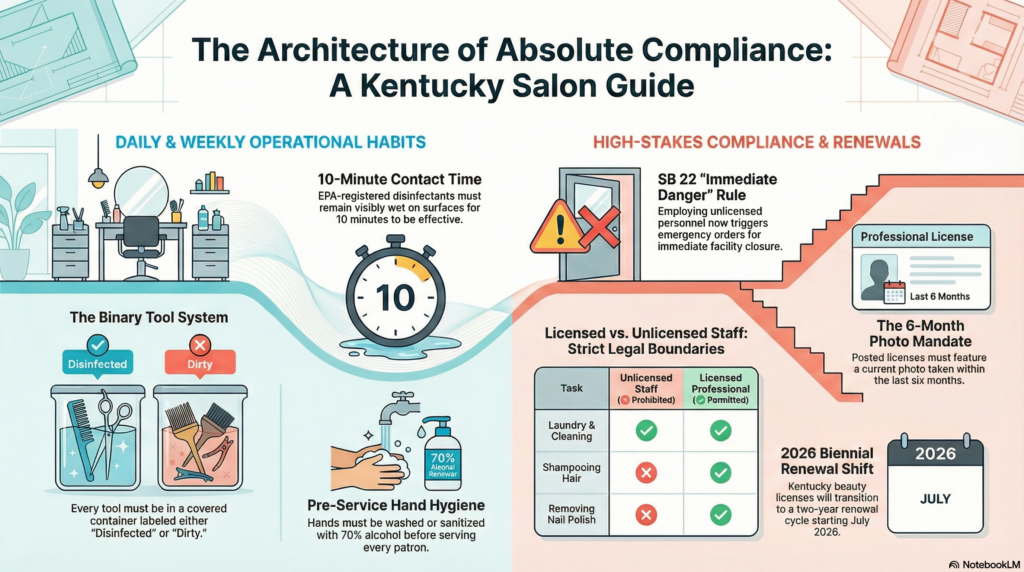
Disinfection must be achieved using an Environmental Protection Agency (EPA)-registered bactericidal, virucidal, and fungicidal disinfectant used in strict accordance with the manufacturer’s label.11 A common error that results in inspection failure is the “spray and wipe” method, where the disinfectant is removed before it has reached its required contact time. Most high-level disinfectants require the surface to remain visibly wet for a full ten minutes to be effective against robust pathogens such as HIV, HBV, and various fungi.11
The Lifecycle of Tools and Implements: The “Clean vs. Dirty” System
The management of tools—including combs, brushes, shears, clippers, and nail implements—is perhaps the most scrutinized element of a state inspection. Kentucky utilizes a strict binary system: an item is either “Disinfected/Ready to Use” or it is “Dirty”.18 There is no middle ground.
All used implements must first be cleaned of visible debris using warm, soapy water and then fully immersed in a disinfectant solution.11 For items that have come into contact with blood or body fluids, such as a nick from a razor or a cuticle nipper, the item must be thoroughly cleaned before immersion to ensure the disinfectant can reach all surfaces of the tool.11 Once the full contact time is met, the implements must be removed, rinsed, dried with a single-use paper towel or air-dried, and stored in a clean, covered container labeled “Disinfected” or “Ready to Use”.18
Conversely, any tool that has been used and is awaiting disinfection must be kept in a separate, covered container clearly labeled as “Dirty” or “Used”.17 The intermingling of clean and dirty tools is a major violation. Furthermore, once an item is placed in the “Dirty” container, it cannot be removed until the formal cleaning and disinfecting process has begun.18
Table 3: Contact Time and Disinfection Requirements for Non-Electrical Tools
| Tool Type | Required Process | Storage Requirement |
| Combs/Brushes/Rollers | Scrub with soap, rinse, immerse in EPA-disinfectant | Covered container labeled “Disinfected”.18 |
| Metal Implements (Nippers/Pushers) | Scrub with soap, rinse, immerse in EPA-disinfectant | Covered container labeled “Disinfected”.18 |
| Nail Drill Bits | Soak in acetone, scrub, immerse in EPA-disinfectant | Must be stored dry in a labeled container.18 |
| Electrical Clippers | Remove hair, saturate blades with high-level spray/foam | May be stored at station if clean and covered.11 |
The Towel and Linen Management System
The handling of linens is a primary focus of 201 KAR 12:100, which mandates a zero-tolerance policy for the reuse of any towel or robe without proper laundering.11 A clean towel or neck band must be used for every patron to prevent the hair cloth or shampoo apron from making direct contact with the patron’s skin.11
The laundry cycle must be integrated into the daily routine. All cloth items must be laundered in a washing machine using laundry detergent and chlorine bleach according to the manufacturer’s directions for sanitation.11 Clean linens must be stored in a closed cabinet or a covered container to protect them from hair clippings and airborne contaminants.11 Once used, towels must be immediately deposited into a separate, labeled container for soiled laundry. The practice of leaving used towels on the back of styling chairs or piled near shampoo bowls is a visible sign of non-compliance that will be noted by any inspector.2
Product Control and Chemical Safety
The mislabeling or lack of labeling on chemical products is one of the most frequent reasons for citations in Kentucky salons. The Board requires that all products—including shampoos, conditioners, hair colors, and nail liquids—remain in their original manufacturer-labeled containers whenever possible.15 If a product is transferred to a secondary container, such as a spray bottle for water or a smaller jar for cream, that container must be labeled with the product name and, if it is a chemical mixture like a disinfectant, the concentration and the date it was prepared.11
Furthermore, the use of certain substances is strictly prohibited under Kentucky law. Methyl Methacrylate (MMA) is illegal for use in nail services due to its high toxicity and the potential for severe allergic reactions or permanent nail damage.11 The presence of MMA in a salon, even if not currently in use, is grounds for significant fines and disciplinary action. Similarly, the use of callus graters or “cheese grater” style scrapers is prohibited as they can cause deep lacerations and pose a significant infection risk.13
Table 4: Prohibited Substances and Practices in Kentucky Salons
| Prohibited Item/Practice | Rationale for Prohibition | Regulatory Basis |
| Methyl Methacrylate (MMA) | High toxicity; risk of permanent damage and allergies | 201 KAR 12:100 Section 14.11 |
| Callus Graters / Blades | Risk of skin cutting and deep-seated infection | KRS 317A.020 / 201 KAR 12:100.11 |
| UV Sterilizers (as primary) | Ineffective at achieving high-level disinfection | 201 KAR 12:100 Section 14.11 |
| Roll-on Wax | High risk of cross-contamination between clients | 201 KAR 12:100 Section 14.11 |
| Double-Dipping | Spreads bacteria and fungi through entire product | 201 KAR 12:100 Section 7.11 |
Weekly Systems Maintenance and Compliance Audits
While daily tasks ensure immediate safety, the weekly routine is focused on the long-term integrity of the salon’s compliance infrastructure. This phase involves a more thorough examination of those areas that may not be touched during every client service but remain vital for a successful inspection.
The Weekly Station Sweep and Label Audit
Every week, the salon manager or designated compliance officer should conduct a formal walkthrough of each workstation. This audit must verify that every bottle is clearly labeled and that the labels remain legible.11 Over time, chemicals can degrade adhesive labels or obscure handwriting; any bottle with a faded or peeling label should be replaced or relabeled immediately.
During this weekly audit, the practitioner should also inspect the “Clean” tool containers. It is common for small hair clippings to find their way into even covered containers during the course of a busy week. If debris is found in a “Clean” container, all tools within that container must be re-sanitized, and the container itself must be disinfected.18 This ensures that the storage environment remains as sterile as the tools themselves.
Safety Data Sheet (SDS) and Records Management
Federal OSHA regulations, coupled with Kentucky state board requirements, mandate that every salon maintain a comprehensive binder of Safety Data Sheets (SDS) for every chemical used on the premises.21 The weekly routine should include a check for any new products that have entered the salon; if a new hair color line or a new type of nail monomer has been purchased, the corresponding SDS must be added to the binder immediately.
Furthermore, salons should maintain a daily sanitation log. While not strictly mandated for every single surface by state law, the Louisville Beauty Academy recommends it as the “Gold Standard” for compliance.2 A log that documents the daily cleaning of shampoo bowls and the weekly deep-cleaning of pedicure stations provides a “paper trail” of professional diligence that can be invaluable if a client ever files a complaint with the Board.17
Table 5: Weekly Compliance Audit Checklist
| Audit Category | Specific Action Required | Expected Outcome |
| Label Integrity | Inspect all secondary containers for clear labeling | Zero unlabeled bottles at any station.11 |
| Storage Inspection | Wipe out and disinfect “Clean” tool containers | No hair or debris in storage areas.18 |
| SDS Update | Review product arrivals and add new SDS sheets | binder is |
| Ventilation | Clean filters on hairdryers and nail extraction fans | Prevents fume buildup and fire hazards.16 |
| Trash Verification | Ensure all waste liners are replaced and lids functional | Waste is contained and covered.2 |
Monthly Strategic Compliance and Infrastructure Review
The monthly compliance cycle is a strategic review of the salon’s operational health. This is the time when the owner and manager move beyond the station-level details to address the overarching legal and structural requirements of the business.
Personnel Licensing and Photo Verification
The most common reason for significant fines in Kentucky is the presence of an unlicensed practitioner or a practitioner with an expired license. Every month, the manager must verify the status of every individual working in the salon, including booth renters.8 This check must confirm that the license is not only active but also that it is current for the specific year.10
A critical component of this audit is the photo requirement. 201 KAR 12:060 Section 1 requires that a current photograph be attached to the license.7 The Board has recently cracked down on “non-compliant” photos. If an employee has a photo that is older than six months or one that does not meet the passport-style criteria (e.g., a “selfie” with filters, or a photo taken in a car), it must be updated immediately.10 Failure to have a compliant photo attached to a posted license is treated as a display violation and can result in a “pink slip”.26
Plumbing and Facility Integrity
The physical state of the facility is a reflection of the professionalism of the business. On a monthly basis, the owner should inspect the plumbing for any leaks or drainage issues. 201 KAR 12:100 requires that an adequate supply of hot and cold running water be available at all times.2 Any changes to the plumbing—such as adding a new shampoo bowl or replacing an old pedicure chair—must be documented with a new Plumbing Affidavit signed by a state plumbing inspector.27
Additionally, the monthly audit should look for “non-porous” integrity. Salon chairs with torn upholstery or nail tables with cracked surfaces are violations because the damaged areas can harbor bacteria and cannot be properly disinfected with wipes or sprays.17 Any damaged equipment must be repaired or replaced to maintain the sanitation standard.
Table 6: Monthly Strategic Audit Milestones
| Task | Detail | Professional Implication |
| Staff License Audit | Verify every license is current and has a 6-month photo | Prevents “Immediate Danger” closure for unlicensed work.8 |
| Facility Maintenance | Check for upholstery tears and plumbing leaks | Ensures all surfaces can be legally disinfected.17 |
| Inventory Review | Check for expired products or “mystery” chemicals | Maintains safety and product efficacy.17 |
| Staff Retraining | Brief staff on any new Board newsletters or trends | Maintains a unified culture of compliance.2 |
| Restroom Audit | Deep clean and ensure all fixtures are functional | A common area for consumer complaints.2 |
Yearly Milestones: Renewals, Testing, and Long-Term Compliance
The yearly cycle involves high-level administrative tasks that, while infrequent, are essential for the legal existence of the salon.
The 2026 Shift to Biennial Renewals
For decades, Kentucky beauty licenses were renewed on an annual basis. However, as of January 2026, the Kentucky Board of Cosmetology is transitioning to a biennial (two-year) renewal system to reduce administrative burden and improve processing efficiency.25 This is a critical change for budget planning. While the annual fee has not technically increased, the amount due at the time of renewal will double as practitioners prepay for two years of licensure.25
For example, starting in July 2026, a cosmetologist will pay for a license that is valid through July 31, 2028.25 The renewal period remains fixed between July 1st and July 31st. Any renewal submitted after the July 31st deadline is considered inactive and will incur significant restoration fees.25 It is the responsibility of the licensee to ensure their email address is current in the KBC portal to receive renewal reminders and registration codes.31
Backflow Prevention and Annual Testing
Most commercial facilities, including salons, are required to have backflow prevention devices installed on their water supply lines to protect the municipal water supply from contamination.32 Under the Kentucky State Plumbing Code, these devices—specifically “reduced pressure principle” backflow preventers—must undergo annual testing by a state-certified backflow prevention assembly tester.33 The results of these tests must be kept on file at the salon and are often reviewed during a comprehensive state board inspection or a local health department visit.33 Failure to maintain this testing can lead to the disconnection of water services, which would force the immediate closure of the salon.33
Table 7: Annual and Biennial Administrative Deadlines
| Requirement | Frequency | Key Dates / Details |
| Personal License Renewal | Biennial (Every 2 Years) | July 1 – July 31 of even-numbered years (Starting 2026).25 |
| Salon Facility Renewal | Annual/Biennial | Check portal for specific facility expiration dates.25 |
| Backflow Testing | Annual | Must be performed by a certified tester; records kept on-site.33 |
| Local Business License | Annual | Varies by municipality; often due by June 30.28 |
| Annual Report (Corporate) | Annual | Due to the Secretary of State by June 30.35 |
Navigating the Inspection: A Masterclass in Professional Interaction
When an inspector arrives, the elite professional does not react with fear but with confidence in their established systems. The inspection should be viewed as an external validation of the “Compliance by Design” principle taught at the Louisville Beauty Academy.2
Immediate Action Steps Upon Inspector Arrival
- Grant Access and Provide ID: The inspector is authorized to enter and may ask for your government-issued ID to verify your identity against the posted license.8
- Continue Professional Service: Unless the inspector identifies an “Immediate Danger” (such as a significant blood spill or an unlicensed worker), you should continue your service to your client while the inspector walks the floor.
- Produce Records Promptly: If the inspector asks to see the plumbing affidavit, the most recent inspection report, or the salon’s employment records, these must be produced without delay.7
- Use the Inspector as a Resource: The elite salon owner asks questions. Inquire about the most common violations being found in the area or if there are any upcoming regulatory changes from the Board.16 This positions you as a partner in public safety rather than a target of enforcement.
The Consequences of Non-Compliance: SB 22 and Immediate Closure
The regulatory landscape has become significantly stricter with the passage of Senate Bill 22 (2025). This legislation introduced the “Immediate and Present Danger” standard for salon closures.6 Previously, a salon might receive a warning and a ten-day period to cure most deficiencies. However, under SB 22, the employment of unlicensed personnel is now classified as an immediate danger to public health.6
If an inspector finds an unlicensed individual performing professional services, the Board is authorized to issue an emergency order for the immediate closure of the facility.6 This closure remains in effect until the violation is resolved and a follow-up inspection is passed. The financial and reputational impact of such a closure can be catastrophic, often leading to a permanent loss of business or even the stroke of a stressed owner as documented in recent disciplinary history.37
Table 8: The Disciplinary Escalation Pathway
| Violation Type | Typical Board Action | Potential Penalty |
| Minor Sanitation (Dust, Clutter) | Correction Letter / 10-day Cure | Warning or Small Fine.6 |
| Major Sanitation (MMA, Double-dipping) | Notice of Violation | Significant Fine and Probation.6 |
| License Display / Photo Issues | “Pink Slip” Citation | Administrative Fine.26 |
| Unlicensed Personnel (SB 22) | Emergency Order | Immediate Facility Closure.6 |
| Intentional Deception of Inspector | Notice of Disciplinary Action | License Revocation/Suspension.8 |
Professional Scope and the Unlicensed Personnel Matrix
To avoid the immediate closure triggers of SB 22, it is vital to understand the “Unlicensed vs. Licensed Duties Matrix.” In Kentucky, the performance of even a single professional act by an unlicensed individual—such as a receptionist or a general assistant—is a violation of the law.6
Unlicensed personnel are strictly limited to non-client maintenance tasks. They may sweep floors, perform laundry, clean mirrors, handle the front desk, and process payments.6 However, as soon as their duties involve direct client interaction related to beauty services, they must hold a license. For instance, an assistant cannot shampoo a client’s hair unless they hold at least a Shampoo and Style license (300 hours) or a full Cosmetology license.6 They cannot remove nail polish, as this is legally considered part of the practice of nail technology.6 They cannot even “drape” a client with a cape for a chemical service, as this act is construed as assisting in a professional beauty practice.6
Table 9: Duty Matrix for Licensed vs. Unlicensed Staff
| Task | Unlicensed (Receptionist) | Shampoo & Style (300 Hr) | Nail Tech (450 Hr) | Cosmetologist (1,500 Hr) |
| Sweep / Laundry | ✅ Permitted | ✅ Permitted | ✅ Permitted | ✅ Permitted |
| Front Desk / Cashier | ✅ Permitted | ✅ Permitted | ✅ Permitted | ✅ Permitted |
| Shampoo / Conditioning | ❌ Prohibited | ✅ Permitted | ❌ Prohibited | ✅ Permitted |
| Remove Nail Polish | ❌ Prohibited | ❌ Prohibited | ✅ Permitted | ✅ Permitted |
| Draping for Chemicals | ❌ Prohibited | ❌ Prohibited | ❌ Prohibited | ✅ Permitted |
| Manicuring | ❌ Prohibited | ❌ Prohibited | ✅ Permitted | ✅ Permitted |
Building the Million-Dollar Salon through Compliance
The final truth of Kentucky salon operation is that inspection readiness is a fundamental business strategy. The graduates of Louisville Beauty Academy understand that a clean, compliant salon is a profitable salon. When a customer walks into an environment where the licenses are prominently displayed with current photos, the stations are organized, the air is free of strong chemical fumes, and the towels are pristine, a baseline of trust is established.2
Compliance protects the three most valuable assets of the beauty professional: the client’s health, the practitioner’s license, and the business’s reputation. By adopting the daily, weekly, monthly, and yearly routines detailed in this study, the salon owner moves from a state of reactionary fear to one of professional dominance. You do not prepare for the inspector; you become the inspector. In doing so, you elevate not only your own business but the entire industry within the Commonwealth of Kentucky.
Works cited
- Kentucky Revised Statutes – Chapter 317A – Legislative Research Commission, accessed March 24, 2026, https://apps.legislature.ky.gov/law/statutes/chapter.aspx?id=38831
- Sanitation & Safety: The #1 Priority at Louisville Beauty Academy …, accessed March 24, 2026, https://louisvillebeautyacademy.net/sanitation-safety-the-1-priority-at-louisville-beauty-academy/
- 317A.030 Board of Cosmetology — Membership — Compensation. (1) There is created an independent agency of the state gover, accessed March 24, 2026, https://apps.legislature.ky.gov/law/statutes//statute.aspx?id=54797
- 317A.010 Definitions for chapter. As used in this chapter, unless the context requires otherwise: (1) “Beauty salon&q – Legislative Research Commission, accessed March 24, 2026, https://apps.legislature.ky.gov/law/statutes/statute.aspx?id=53212
- Beauty Services and Health Services: A 2025 Legal and Policy Study by Louisville Beauty Academy – Kentucky’s Center for Excellence in Beauty Knowledge, accessed March 24, 2026, https://louisvillebeautyacademy.net/beauty-services-and-health-services-a-2025-legal-and-policy-study-by-louisville-beauty-academy-kentuckys-center-for-excellence-in-beauty-knowledge/
- cosmetology disciplinary process Kentucky Archives – Louisville …, accessed March 24, 2026, https://louisvillebeautyacademy.net/tag/cosmetology-disciplinary-process-kentucky/
- 201 KAR 12:060. Inspections. RELATES TO: KRS 317A.060, 317A.140, accessed March 24, 2026, https://apps.legislature.ky.gov/services/karmaservice/documents/2003/ToPDF?markup=false
- 201 KAR 12:060. Inspections. – Kentucky Board of Cosmetology, accessed March 24, 2026, https://kbc.ky.gov/Documents/201%20KAR%2012.060.pdf
- Tag: cosmetology law changes 2025 – Louisville Beauty Academy, accessed March 24, 2026, https://louisvillebeautyacademy.net/tag/cosmetology-law-changes-2025/
- License Requirements – Kentucky Board of Cosmetology, accessed March 24, 2026, https://kbc.ky.gov/Licensure/Pages/License-Requirements.aspx
- 201 KAR 12:100. Sanitation standards. – Kentucky Board of Cosmetology, accessed March 24, 2026, https://kbc.ky.gov/Documents/201%20KAR%2012.100.pdf
- Title 201 Chapter 12 Regulation 082 • Kentucky Administrative Regulations – Legislative Research Commission, accessed March 24, 2026, https://apps.legislature.ky.gov/law/kar/titles/201/012/082/
- Kentucky Revised Statutes Title XXVI. Occupations and Professions § 317A.020 | FindLaw, accessed March 24, 2026, https://codes.findlaw.com/ky/title-xxvi-occupations-and-professions/ky-rev-st-sect-317a-020/
- 201 BOARDS AND COMMISSIONS Chapter – Louisville Beauty Academy, accessed March 24, 2026, https://louisvillebeautyacademy.net/wp-content/uploads/2021/11/KentuckyStateBoardOfCosmetology-Statue-11-15-2021.pdf
- Sanitation and Safety Archives – Louisville Beauty Academy, accessed March 24, 2026, https://louisvillebeautyacademy.net/category/sanitation-and-safety/
- Sanitation Best Practices for Beauty Salons: A Comprehensive Guide, accessed March 24, 2026, https://louisvillebeautyacademy.net/sanitation-best-practices-for-beauty-salons-a-comprehensive-guide/
- How to Avoid Common State Board of Cosmetology Violations | Salon Success Academy, accessed March 24, 2026, https://www.salonsuccessacademy.com/blog/10-common-state-board-of-cosmetology-violations-and-tips-to-avoid-them/
- Board of Cosmetology (Amended at ARRS Committee) 201 KAR 12:100. Infection control, health, and safety., accessed March 24, 2026, https://apps.legislature.ky.gov/services/karmaservice/documents/16397/ToPDF?markup=true
- Board of Cosmetology (Amendment) 201 KAR 12:100. Infection control, health, and safety., accessed March 24, 2026, https://apps.legislature.ky.gov/services/karmaservice/documents/16145/ToPDF?markup=true
- Title 201 Chapter 12 Regulation 100 • Kentucky Administrative Regulations, accessed March 24, 2026, https://apps.legislature.ky.gov/law/kar/titles/201/012/100/
- Barbershop State Board Inspection Readiness Checklist PDF – Free Download | Beauty & Wellness Checklist Template | POPProbe, accessed March 24, 2026, https://www.popprobe.com/checklist-library/beauty-wellness/barbershop/barbershop-state-board-inspection-readiness-checklist
- Hair Salon Safety & Sanitation Checklist [FREE PDF] – POPProbe, accessed March 24, 2026, https://www.popprobe.com/checklist-library/beauty/daily-operations/b25b-bty-hair-salon-safety-checklist
- Hair Salon Infection Control and Bloodborne Pathogen Compliance Audit PDF – Free Download | Beauty & Wellness Checklist Template | POPProbe, accessed March 24, 2026, https://www.popprobe.com/checklist-library/beauty-wellness/salon-operations/hair-salon-infection-control-bloodborne-pathogen-compliance-audit
- Hair Salon Inspection & Cleaning Checklists for Operational Excellence | Audit Now, accessed March 24, 2026, https://audit-now.com/audit-guides/hair-salon-checklists/
- Tag: Kentucky beauty license renewal July 31, accessed March 24, 2026, https://louisvillebeautyacademy.net/tag/kentucky-beauty-license-renewal-july-31/
- License Renewal Information – Kentucky Board of Cosmetology, accessed March 24, 2026, https://kbc.ky.gov/Licensure/Pages/License-Renewal-Information.aspx
- Salon Requirements – Kentucky Board of Cosmetology, accessed March 24, 2026, https://kbc.ky.gov/Licensure/Pages/Salon-Requirements.aspx
- Frankfort, KY 40601 • (502)-564-4262 • www.KBC.ky.gov Salon Application Instructions A salon – Kentucky Board of Cosmetology, accessed March 24, 2026, https://kbc.ky.gov/Applications%20and%20Examination%20Schedule/030%20(l)%20Salon%20Application%20-%20July%202022-%20Edit.pdf
- Health Inspections for Nail Salons and Barbershops – The Institute for Justice, accessed March 24, 2026, https://ij.org/report/clean-cut/health-inspections-for-nail-salons-and-barbershops/
- Louisville Beauty Academy: Your Guide to Kentucky State Cosmetology License Renewal, accessed March 24, 2026, https://louisvillebeautyacademy.net/louisville-beauty-academy-your-guide-to-kentucky-state-cosmetology-license-renewal/
- Licensure – Kentucky Board of Cosmetology, accessed March 24, 2026, https://kbc.ky.gov/Licensure/Pages/default.aspx
- Backflow Testing & Installation in Louisville, KY – Maeser Master Services, accessed March 24, 2026, https://www.maeser.com/commercial/plumbing/backflow-testing/
- Is Backflow Testing a Legal Requirement? Understanding Compliance Standards in 2025, accessed March 24, 2026, https://www.pacificbackflow.com/post/is-backflow-testing-a-legal-requirement
- Title 815 Chapter 20 Regulation 120 • Kentucky Administrative Regulations – Legislative Research Commission, accessed March 24, 2026, https://apps.legislature.ky.gov/law/kar/titles/815/020/120/
- Business – Kentucky.gov, accessed March 24, 2026, https://www.kentucky.gov/business/Pages/default.aspx
- The Kentucky Board of Cosmetology reports that the license number below is currently inactive, either due to non-renewal or a HO, accessed March 24, 2026, https://kbc.ky.gov/Annoucements/9.26.2025%20Salon%20Inactive%20Notice.pdf
- Kentucky nail salons seek accountability from state cosmetology board – YouTube, accessed March 24, 2026, https://www.youtube.com/watch?v=3aoZjjY8Jyo
- KENTUCKY BOARD OF COSMETOLOGY, accessed March 24, 2026, https://kbc.ky.gov/Annoucements/11.14.2025%20Access%20to%20salons%20for%20inspections%20and%20appropriate%20signage.pdf