Louisville Beauty Academy has launched the Financial Aid & True Cost Study Guide: a practical financial-literacy lab for beauty students and families who want to understand FAFSA, Pell Grants, loans, accreditation language, written contracts, credit impact, and lower-debt decision-making before enrollment.
The goal is simple and serious: students should know what is free aid, what is borrowed money, what must be verified, what can affect credit, what accreditation does and does not mean, and how to compare the full cost of beauty education before signing any agreement.
Transparency standard: current federal sources, Kentucky licensure requirements, Louisville Beauty Academy written documents, signed agreements, loan disclosures, servicer records, and applicable law control actual obligations. This page teaches practical literacy so students can ask better questions and make cleaner decisions.
LBALouisville Beauty Academy Student Finance Literacy Lab
Beauty education finance readiness
Financial Aid & True Cost Study Guide
A practical student guide to FAFSA, Pell Grants, loans, accreditation language, credit consequences, contracts, discount conditions, and the real math of choosing a beauty school with eyes open.
100 practical questionsLoan math calculatorAccreditation clarityLower-debt decision discipline
Fast truth map
The four confusions that cost students money
This guide is direct because the decision is serious. A student does not need fear. A student needs vocabulary, math, written proof, and the confidence to ask clean questions.
FAFSA is an application.
It can lead to grants, work-study, and loans. Those are not the same.
Grant is not loan.
Pell Grant funds generally do not need repayment; loans are borrowed money with interest.
Accreditation is specific.
Ask what kind, by whom, current status, and whether it connects to Title IV aid.
Debt affects future choices.
Default can harm credit and lead to serious collection consequences.
Do the math before emotion
True Cost & Loan Payment Calculator
Use this for practice only. Official school documents, aid offers, loan disclosures, and servicer calculations control actual obligations.
Remaining cost after gift/cash$0
Loan principal$0
Estimated monthly payment$0
Estimated total repaid$0
Estimated interest$0
Debt pressure lessonNo loan entered
LBA published cost discipline
Read the written price, then compare the debt
These figures reflect LBA’s published current program cost page as reviewed in September 2026. Current written documents control final obligations, eligibility, and conditions.
The educational point is not that every student has the same situation. The point is that every student deserves written cost clarity and debt math before enrollment.
Practice bank
100 practical questions for beauty-school finance decisions
ReadyFinance Literacy
Start the practice to test real FAFSA, accreditation, cost, loan, and credit decisions.
Official-source discipline
Verify the source before acting
Louisville Beauty Academy is a Kentucky state-licensed beauty college. This guide is educational financial-literacy support, not legal, tax, credit, or financial advice. Current federal sources, state rules, school written documents, signed agreements, servicer disclosures, and applicable law control.
Federal Student Aid posted 2027-28 FAFSA preview materials on September 3, 2026. Here is the plain-English lesson for beauty school families: FAFSA is a government student-aid form. It is not a school price. It is not a discount. It is not a scholarship promise. It is not a payment plan. It is not a promise that school will be free.
This Center of Excellence update is written for normal people: students, parents, spouses, mentors, workforce counselors, and school teams. The goal is to help families slow down and understand funding words before anyone signs school paperwork. This is public education only. It is not legal advice, financial-aid advice, or a claim that LBA processes federal student aid.
FAFSA literacy should protect the student before enrollment, not explain confusion after signing.
Simple Answer First
The FAFSA preview is useful because it helps families practice. But practice is not the final application. A student still needs to use the official FAFSA.gov process when the real FAFSA is available. A student also still needs the school’s written price and written payment rules.
If a family remembers only one thing, remember this: FAFSA can be part of a funding conversation, but the school’s written cost documents tell you what the school charges.
What Federal Student Aid Posted
Federal Student Aid posted two related resources for the 2027-28 FAFSA cycle: a preview presentation and an interactive prototype. A prototype is a practice version. FSA says users can click through most pages of the online 2027-28 FAFSA form, but it is not the final FAFSA form and may differ from what is later available on FAFSA.gov.
That difference matters. A preview can help a family learn the steps before the real process opens. It does not replace the real FAFSA.
Why Beauty School Families Should Care
Beauty education is a licensed career path. Students are not just buying classes or a school image. They are choosing a schedule, a price, a contract, training hours, safety rules, and a path toward a state license. Any funding conversation should make those pieces clearer, not more confusing.
The FAFSA preview helps families see the kinds of steps that may involve the student, a parent, or a spouse. But even when a student is exploring aid, the family still needs school-specific facts in writing: total tuition, fees, kit or supply costs, refund rules, payment obligations, program hours, attendance rules, and whether the school actually processes federal student aid.
What The Hard Words Mean
FAFSA means Free Application for Federal Student Aid. It is the government form many students use to apply for federal student aid.
Contributor means a person, such as a parent or spouse, who may need to provide information or a signature on the FAFSA.
Title IV means the federal student-aid system that can include Pell Grants, federal student loans, and other aid programs at participating schools.
Participating school means a school that is approved to process those federal aid programs. A family should never assume this. Ask and get the answer in writing.
Four Plain-English Rules
FAFSA is not a price sheet. A school’s written cost documents still tell you the price.
A preview is not the final form. Use the preview to learn. Use FAFSA.gov for the real process when it opens.
Signatures matter. If a student, parent, or spouse must sign or add information, missing that step can delay the form.
School aid status must be verified. Never assume a school processes federal student aid because it is a school. Ask the school directly and read the answer in writing.
The LBA Clarity Standard
Louisville Beauty Academy is a Kentucky state-licensed beauty school. LBA is not institutionally accredited by a federally recognized accrediting agency and does not process FAFSA or Title IV federal student aid. In plain language: students do not use FAFSA through LBA. LBA publishes that clearly because families deserve to know the funding structure before they compare schools.
This is not a criticism of federal-aid schools. It is a student-protection standard. At any school, a family should know the same basic facts: Does this school process federal aid? What is the full written cost? What will I owe? What happens if I withdraw? Which document controls if there is a disagreement?
The Deeper Lesson, In Plain English
Financial-aid literacy is not only about filling out a form. It is about protection. A student who understands the difference between an application, an estimate, a school bill, a grant, a loan, a refund rule, and a signed contract is harder to confuse and easier to protect.
That is why FAFSA literacy belongs inside serious beauty education. Starting school is not the whole goal. The real goal is to choose clearly, understand the cost, complete the required training, prepare for licensure, avoid unnecessary debt, and enter the workforce with dignity.
This article is public education. It does not promise aid eligibility, loan approval, grant approval, school admission, licensure, employment, income, or any particular outcome. Federal Student Aid, the official FAFSA process, current school documents, Kentucky Board of Cosmetology requirements, and applicable law control.
Why Louisville Beauty Academy chose state-licensed transparency over confusing prestige language.
Bottom line: Federal July 2026 records confirm that NACCAS, one of the major national accreditors for cosmetology arts and sciences and massage therapy, faced significant unresolved recognition-compliance issues. Reputable reporting states NACIQI voted 9-to-3 to recommend denial of renewed recognition, while the final decision remains with the U.S. Department of Education.
When people ask whether a beauty school is “accredited,” the real question often needs to be clarified.
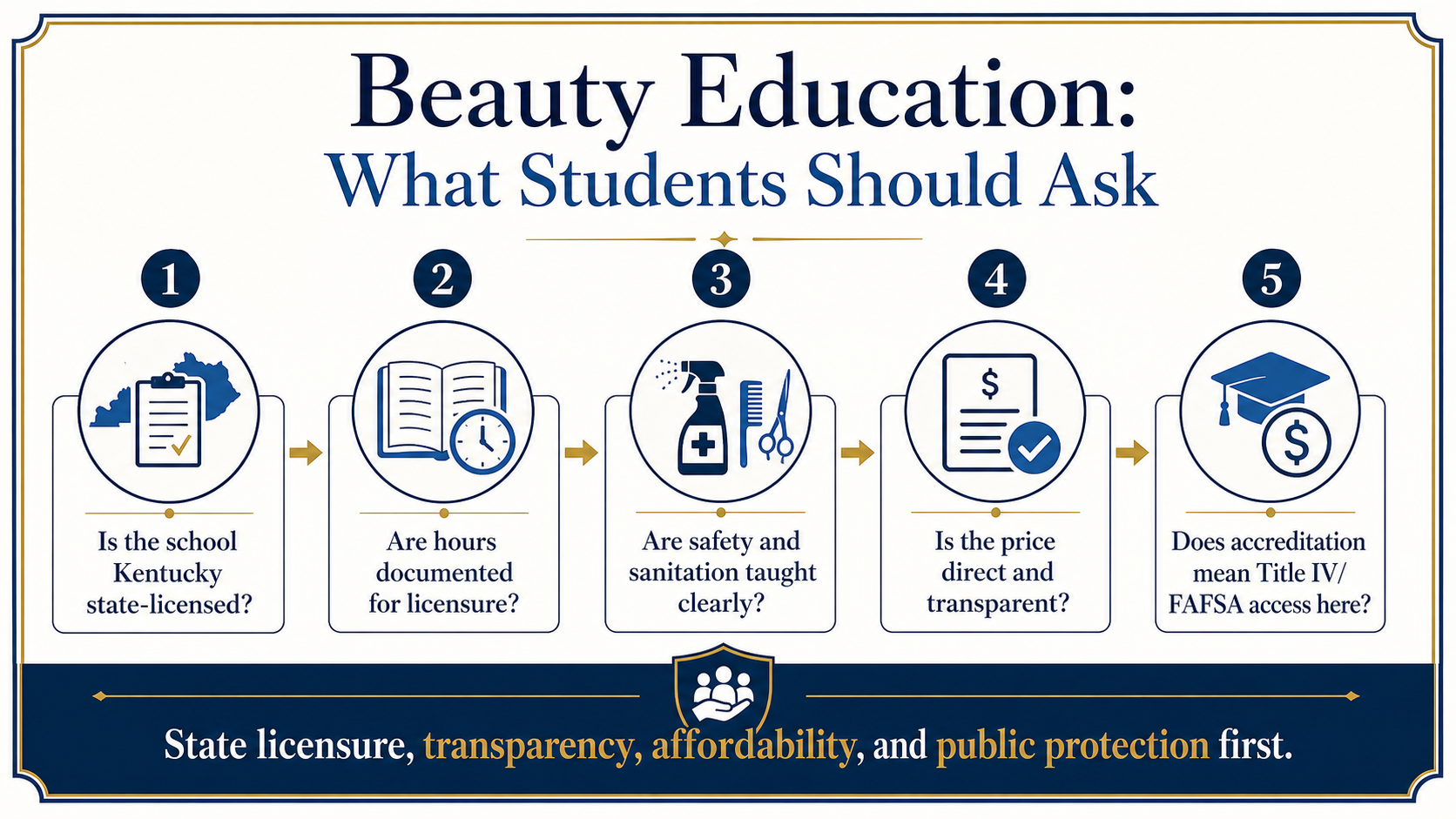
In beauty education, especially where federal student aid is involved, the practical question is often not simply, “Is this school good?” The practical question is: Does this school use accreditation as a pathway to participate in federal Title IV student-aid programs, including FAFSA-based federal aid?
Louisville Beauty Academy is a Kentucky state-licensed beauty college. Our work is grounded in Kentucky law and regulation, public safety, sanitation, documented student hours, practical instruction, law and regulation education, licensure readiness, affordability, and transparent student choice.
Beauty education should be evaluated through state licensure, documented training, safety, sanitation, transparent pricing, and honest explanation of accreditation and FAFSA access.
The Federal Development
The U.S. Department of Education’s official July 2026 NACIQI agenda placed the National Accrediting Commission of Career Arts and Sciences, Inc. (NACCAS) under Renewal of Recognition review. The agenda identifies NACCAS’s scope as accreditation of postsecondary schools and departments of cosmetology arts and sciences and massage therapy.
The Federal Register notice for the July 22-23, 2026 NACIQI meeting likewise listed NACCAS as item 6 under Applications for Renewal of Recognition and tied public comment to federal recognition criteria under 34 CFR Part 602.
The Department of Education’s e-Recognition final staff report identified multiple remaining NACCAS recognition-compliance issues. ED staff recommended continued recognition at that time, but with a serious limitation: NACCAS would be prohibited from accrediting new institutions until it demonstrated compliance, and would be required to submit compliance and monitoring reports.
Separately, Inside Higher Ed published a July 23, 2026 article titled “NACIQI Recommends Denial of Recognition for Cosmetology Accreditor.” That article reported that NACIQI voted 9-to-3 to recommend that ED deny NACCAS’s petition for renewed recognition. The article also noted that NACIQI is advisory and that the final decision rests with senior leaders at ED.
The Scale
The most source-protected language is this: federal ED staff reported that NACCAS currently accredits approximately 1,074 institutions, while NACCAS had recently reported accrediting around 1,300 postsecondary institutions in cosmetology arts and sciences and/or massage therapy.
We should not claim a specific percentage of all U.S. beauty schools without a verified national denominator. What we can say is that NACCAS is a major national beauty-school accreditor with more than one thousand institutions reported in federal/source records.
LBA’s December 2025 Decision
Louisville Beauty Academy publicly announced on December 10, 2025 that it had voluntarily discontinued candidate status with NACCAS.
That was a voluntary, objective, institution-level decision. LBA removed itself from the NACCAS accreditation path before the July 2026 federal recognition controversy became the national public headline. The December 2025 LBA notice remains the clean public source for that decision.
That decision now deserves to be understood as a transparency decision, not a retreat. LBA chose not to lean on a word that was becoming confusing to the public. LBA chose not to let “accreditation” be used as a prestige label when, in many practical conversations, the real issue is federal-aid participation and the financing structure behind it.
LBA does not currently participate in federal student-aid funding. That is not because LBA rejects public investment in education. We believe ethical education can and should create net positive economic impact when public systems are transparent, affordable, accountable, and student-protective. But LBA will not use accreditation language to confuse families, equate financing access with educational protection, or blur the difference between state licensure, public safety, sanitation, student outcomes, and federal-aid access.
If future accreditation or federal-aid structures become more transparent, ethical, affordable, student-centered, and aligned with public protection, LBA can evaluate those pathways again. Until then, LBA’s public position remains clear: Kentucky state licensure, direct affordability, honest communication, safety, sanitation, and documented licensure education first.
What LBA Means When Asked About Accreditation
Louisville Beauty Academy is Kentucky state-licensed. We do not participate in federal Title IV student-aid programs, and we do not use national accreditation as a federal-aid gateway. Our students choose LBA for affordability, direct payment options, Kentucky licensure preparation, public safety, sanitation, documented hours, and transparent education.
LBA is not permanently opposed to accreditation or public education funding. If future systems better protect students and align with transparency, affordability, ethical education, public safety, sanitation, and positive economic impact, LBA may evaluate them. At this time, LBA does not process federal Title IV/FAFSA aid.
Public Message
Accreditation used to be treated like a shining word. But in beauty education, the public deserves a more honest explanation.
Students should not be asked to confuse prestige language with protection. A school can be state licensed, compliant, affordable, student-centered, and transparent without using accreditation as a federal-aid pathway. A school can also be nationally accredited and still face serious federal scrutiny over transparency, student outcomes, disclosure, or federal-recognition compliance.
This is not anti-accreditation. It is pro-truth.
Accreditation should mean accountability. If it becomes only a pathway to federal money, public trust is weakened. Students deserve to know the difference.
And if the environment changes for the better, LBA will remain open-minded. The principle is not stubbornness. The principle is ethical education: public money, accreditation language, school marketing, and student trust must all serve the student, the public, and the regulated purpose of beauty education.
Why LBA’s self-pay model is the opposite of ghost-student fraud, and why students should ask clear questions about FAFSA, federal aid, state aid, attendance, withdrawals, and refunds when touring any school.
The phrase ghost student is serious. It should be used carefully, accurately, and with respect for the real students who work too hard to be erased by the wrong definition.
This article is written for public education and guidance. It is not written to attack any school, agency, regulator, or student. It is written to help the public ask better questions, use the right definitions, protect taxpayer dollars where taxpayer dollars are involved, and honor students whose education is built through real work and personal sacrifice.
The U.S. Department of Education Office of Inspector General has warned the public about student aid fraud rings that use fake or fraudulent enrollments to target federal student aid. In that federal context, the concern is clear: fraud rings may exploit education programs by enrolling fake students, misusing identities, and attempting to obtain federal student aid funds.
That is where public attention should begin: follow the public dollar.
Follow the Public Dollar
FAFSA and federal student aid systems exist to help eligible students access grants, loans, work-study, and other aid-connected pathways for college, career school, and trade school. Because FAFSA information can also be used by states, schools, and some private aid providers to determine financial aid eligibility, accuracy matters. Identity matters. Attendance matters. Enrollment truth matters.
When fake students, false enrollment, or identity misuse are used to pull money from aid systems, that is a true public-dollar problem. That kind of fraud is real. It hurts taxpayers. It hurts legitimate schools. It hurts real students. It deserves strong prevention, reporting, investigation, and enforcement.
It also deserves public education.
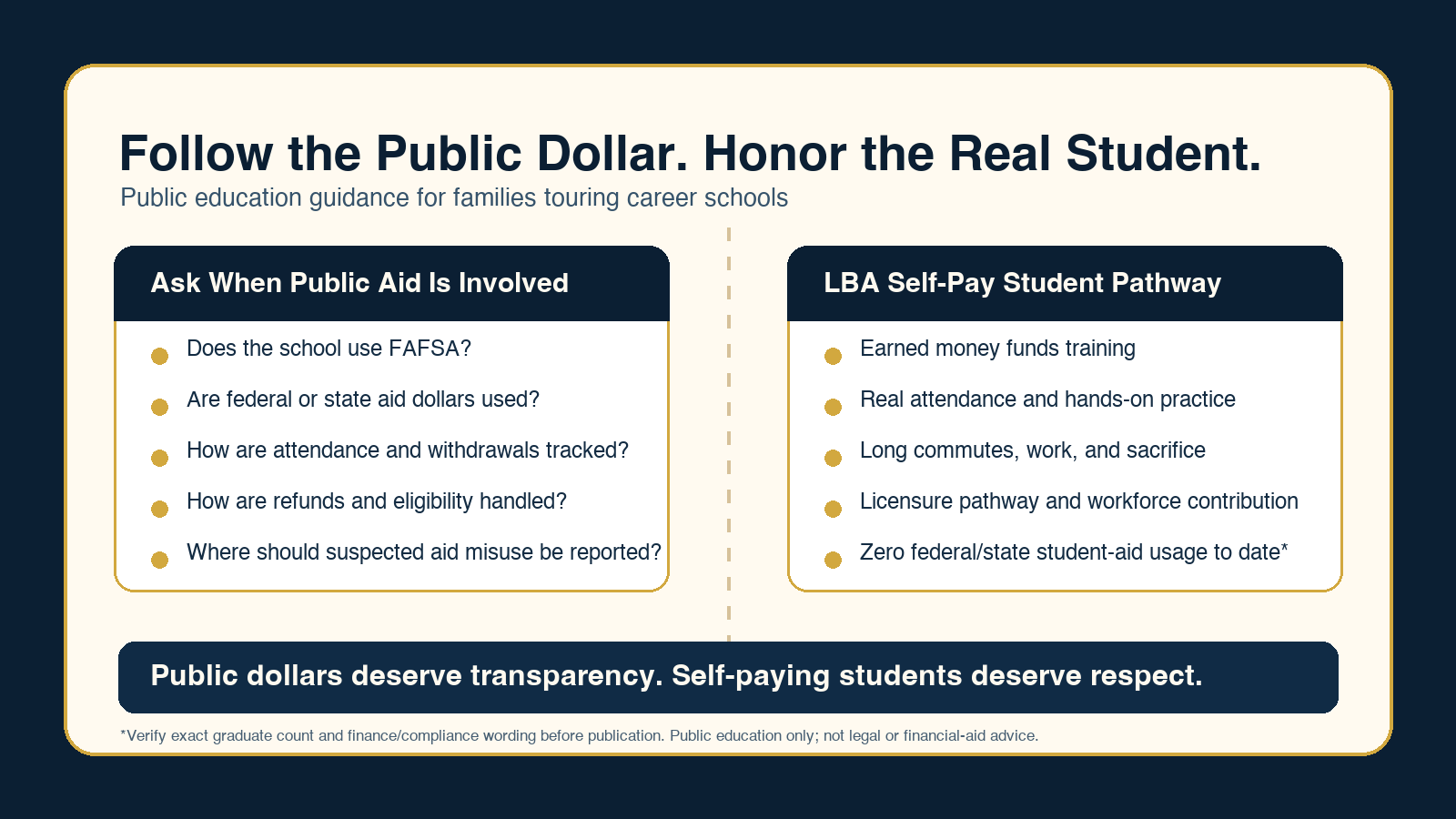
Public dollars deserve transparency. Self-paying students deserve respect.
Questions Every Student Family Should Ask
Prospective students and families should ask clear questions when they tour any school:
Does this school use FAFSA?
Does this school draw federal student aid?
Does this school receive or route state student-aid dollars?
Are grants, loans, scholarships, or public workforce funds involved?
What happens if a student stops attending?
How does the school document attendance, progress, refunds, withdrawals, and eligibility?
These are not hostile questions. They are responsible questions. They help students understand the financial system behind the program, and they help protect public dollars from misuse.
Honor the Real Student
At LBA, we welcome that kind of clarity. Our public position is simple: follow the aid money where public money is involved, and honor the self-paying student where private sacrifice is the foundation.
But a fraud-ring definition should not be stretched so far that it mislabels the very opposite of fraud: real working students, paying with their own earned money, attending practical training, and trying to graduate as quickly as they can so they can contribute to Kentucky’s workforce and economy.
At Louisville Beauty Academy, our strength is not hidden. It is visible every day.
Our students come in person. They practice with their hands. They clock their hours. They study sanitation, safety, theory, technique, client care, licensure preparation, and the discipline of professional service. Many drive one to two hours each way from rural counties and surrounding communities because they believe a licensed beauty career is worth the sacrifice.
They are not wasting an opportunity because the opportunity is not free to them. Many pay for school themselves. Many work part time, full time, or more than one job to afford it. They drive Uber. They serve tables. They bartend. They work in factories, warehouses, Amazon, UPS, salons, restaurants, family businesses, and service jobs. They save, pay, attend, practice, and return again the next day. That is not ghosting. That is sweat equity.
Follow the public dollar, but honor the real student. A student who pays, attends, practices, learns, works, commutes, sacrifices, and prepares for licensure is not a ghost.
A School of Sweat, Care, and Completion
Ghosting does not fit this environment. A student who has worked a late shift, paid tuition from earned wages, driven across county lines, and sat in class to build a licensed future is not trying to disappear. That student wants to finish. That student wants to graduate. That student wants to earn, contribute, build credit, support family, enter the economy, and stand with dignity in a profession.
In fact, many LBA students do the opposite of disappearing. They over-study. They ask questions after class. They repeat skills until their hands remember. They overcome language barriers, transportation barriers, childcare barriers, work-schedule barriers, financial barriers, and the quiet emotional barrier of wondering whether they belong in a professional pathway. Then they come back anyway.
This is why the definition matters.
The Difference Is Moral, Not Merely Technical
If the concern is federal student aid fraud, FAFSA misuse, state-aid misuse, or improper access to taxpayer-supported education dollars, then the focus should remain where it belongs: fake enrollment, identity misuse, false attendance, improper access to government education funds, and schemes designed to extract taxpayer dollars from aid systems.
Louisville Beauty Academy does not participate in federal student aid. Based on the institution’s current self-pay model, LBA is proud to stand as a zero-federal-student-aid, zero-state-student-aid institution to date while approaching 2,000 graduates. Its private-pay model is materially different from a federal or state aid fraud-ring scenario.
A self-paying student who uses wages, savings, family support, sacrifice, and personal discipline to attend school should not be casually placed into the same conceptual category as a fake enrollment designed to draw public money.
LBA students are a net positive to public dollars. They do not extract federal or state student-aid dollars from taxpayers through this institution. They invest private dollars into training, then seek licensure, employment, self-employment, small-business formation, taxpaying work, consumer service, and local economic participation.
After nearly 2,000 graduates, that story matters. They are not draining the public system. They are strengthening it.
Rebuilding Beauty Education With Real Statistics
That is one of the most important truths about affordable, private-pay career education: when it works, it converts personal sacrifice into public value. A student pays from earned income, trains in a regulated field, graduates into a licensed pathway, serves the community, earns more stable income, builds credit, supports family, pays taxes, and adds to the economic fabric of Kentucky.
At LBA, that happens inside a loving, disciplined, practical environment. The school is not built around entitlement. It is built around work. It is a school of sweat and hard work, but also a school of care. Students are pushed toward completion because their time, money, commute, and sacrifice are too valuable to waste.
Louisville Beauty Academy supports fraud prevention. We support accurate attendance records, transparent enrollment, practical training, lawful licensure preparation, and clear communication with oversight bodies. We also support the dignity of students who choose to pay for their own education and work toward a licensed profession without relying on federal or state student aid.
This is part of how we rebuild beauty education: through real effort, real records, real attendance, real practice, real student sacrifice, and real statistics.
The Real Story
Beauty education should not be reduced to paperwork, funding categories, or suspicion. At its best, it is a pathway where a working student can turn discipline into licensure, licensure into income, income into credit, and credit into a stronger family and community future.
In career education, especially in hands-on workforce fields, public language should be precise. A real student should not be erased by a label meant for fraud. A self-paying student should not be treated as suspicious simply because they are economically stretched, rural, immigrant, working-class, multilingual, or unconventional in their path.
The real story at Louisville Beauty Academy is not ghost students, and it is not taxpayer extraction.
It is real students with real jobs, real commutes, real barriers, real tuition payments, real attendance, real practice, real exhaustion, real hope, and real economic contribution.
A student who pays, attends, practices, learns, works, commutes, sacrifices, and prepares for licensure is not a ghost.
That student is Kentucky’s workforce becoming visible without taking federal or state student-aid dollars through LBA.
Student and Family Resource Links
For public education, students and families should use official federal resources when trying to understand FAFSA, federal student aid, fraud warnings, and reporting pathways:
This article is provided for general public education, consumer awareness, and institutional commentary. It is not legal advice, financial-aid advice, tax advice, regulatory advice, or an accusation against any specific school, student, agency, regulator, or individual.
References to ghost students, FAFSA misuse, federal student aid, state student aid, grants, loans, work-study, identity misuse, attendance, withdrawals, refunds, and taxpayer-supported education funding are intended to help readers understand public definitions and ask responsible questions. Any suspected fraud, waste, abuse, identity misuse, or improper use of U.S. Department of Education funds or programs should be reviewed through official channels, including the U.S. Department of Education Office of Inspector General where appropriate.
Louisville Beauty Academy’s statements about its private-pay model, non-participation in federal student aid, zero federal/state student-aid usage through the institution to date, and graduate-count references should be confirmed against current institutional finance, compliance, enrollment, and graduate records before republication or reliance in another context. The article does not guarantee licensure, employment, income, credit outcomes, immigration outcomes, business formation, government action, regulatory interpretation, or any individual student result.
Prospective students and families should review official sources, ask schools direct written questions, compare program costs and funding structures, and seek qualified advice when making education, loan, grant, tax, immigration, or career decisions.
Featured and explanatory visuals were created as editorial publication images for this article. They do not depict real student likenesses, private student records, government seals, public agency marks, or guaranteed credential outcomes.