At Louisville Beauty Academy, a Kentucky State-Licensed and state-licensed beauty college, we are committed to preparing our students for real-world success. Since our founding, we have proudly graduated nearly 2,000 licensed beauty professionals, whose work contributes an estimated $20 to $50 million annually to the economy of Kentucky and beyond.
Choosing your beauty career path is exciting — but it’s also a decision that benefits from careful research and a clear understanding of the industry. Whether your passion lies in Nail Technology, Esthetics, or Hair (Cosmetology), understanding the service frequency and career demand in each area can help you make the choice that best fits your goals, lifestyle, and earning potential.
Why Service Frequency Matters
In the beauty industry, how often a client returns directly impacts the predictability of your bookings and your revenue potential. These are basic human services — they will always be needed — but the frequency of that need varies from one specialty to another.
1. Nails — The Highest Repeat Rate
Average Frequency: Every 2 weeks or less for most regular clients (gel, dip, acrylics).
Why: Nail polish chips, gels and acrylics grow out, and many people maintain a standing schedule for well-groomed hands and feet.
Reality: Many nail clients pre-book their next visit before leaving the salon, creating a predictable, high-retention client base.
Impact: This repeat cycle offers stability and consistency, making nail technology one of the fastest ways to build a loyal clientele.
2. Esthetics — Moderate to High Frequency
Average Frequency: Typically monthly, but many services draw clients back every 2–4 weeks.
Examples:
Lash extensions → fills every 2–3 weeks
Brow shaping/waxing → every 3–4 weeks
Skincare programs → monthly facials or targeted treatments
Reality: Esthetic clients, especially those in ongoing programs, can match nail tech clients in repeat visits — offering both steady income and opportunities for upselling additional treatments.
3. Hair (Cosmetology) — Lower Frequency
Average Frequency: Every 6–8 weeks for most clients, sometimes longer.
Exceptions:
Short hair or precision cuts → every 4–6 weeks
Color touch-ups → every 4–8 weeks
Reality: Many hair clients extend visits to save money or because their style requires less frequent upkeep, which can make recurring revenue less predictable compared to nails or high-frequency esthetics.
Quick Comparison: Repeat Demand Potential
Service
Common Repeat Interval
Predictability of Bookings
Revenue Stability
Nails
2 weeks
Very High
Strong recurring revenue
Esthetics
2–4 weeks
High (varies by service type)
Solid, especially with memberships
Hair
4–8+ weeks
Moderate to Low
Less consistent unless short style or frequent color
Why This Matters for Your Career
Regardless of which path you choose, these fields are built on human connection and repeat service. The difference lies in how often clients come back — and that affects how quickly you can fill your schedule, grow your income, and plan your business.
At Louisville Beauty Academy, we guide students not only through technical training but also through career planning — helping them understand the realities of client demand, local market conditions, and business growth strategies.
About Louisville Beauty Academy
state-licensed beauty college
Nearly 2,000 graduates contributing $20–$50 million annually to the economy
Programs in Nail Technology, Esthetics, and Cosmetology
Commitment to affordable, flexible, and lower-debt education
Disclaimer: This article is for educational purposes only and reflects industry observations and publicly available data. Information may change over time. No guarantee of future income, employment, or career results is implied.
At Louisville Beauty Academy, we believe beauty education is more than training for licensure—it’s the foundation of a student’s future, livelihood, and dignity. That is why we have built—and fiercely protect—a learning environment that is safe, peaceful, law-abiding, and unshakably student-centered.
Our mission is not just to teach beauty—it is to create a space where hard-working adults from all walks of life can confidently learn without fear, confusion, or disruption.
🛡️ Zero Tolerance for Disruption
We proudly enforce a Zero Disruption Policy, which is publicly documented and legally binding under our enrollment contracts and administrative protocols. This policy applies equally to students, staff, and leadership.
Whether verbal, behavioral, or digital—any action that disrupts the learning environment, defames the school, or causes confusion about its lawful operation is grounds for immediate dismissal.
Over the years, we have made instant, lawful decisions—including expulsion of students and termination of staff—when verified violations occurred. These are not punitive actions; they are protective measures for the hundreds of students who come to our campuses seeking a better life through education.
👮♀️ Full Legal Compliance with the Kentucky State Board of Cosmetology
Louisville Beauty Academy is a state-licensed institution, operating in full alignment with Kentucky’s beauty licensing laws under KAR Title 201. Every decision we make—curriculum, hours, instructors, tuition—is legally documented and regulated.
We comply with:
Biometric time tracking for accurate clock-ins
Official state-inspected attendance and safety protocols
Secure record-keeping and 5-year data retention
Written grievance resolution procedures as required by law
KY State Board reporting requirements for every course and student
Our school is not only compliant—we are often used as a model institution for how beauty schools can operate with transparency and structure while still remaining loving, flexible, and human-focused.
💬 Internal Issues Are Handled Professionally, Not Publicly
At LBA, we do not tolerate gossip, drama, or backchannel accusations. All concerns must follow our published communication chain:
Compliance Office via email or text
Escalation to the Director
Formal written grievance (10-day review required)
Only then may a student escalate to the State Board
We have successfully resolved dozens of internal matters peacefully using this framework. But when someone bypasses this process and spreads false, harmful, or fear-inducing information—especially publicly or to other students—we act immediately.
Our contracts, state policies, and legal advisors support these actions as not only justified, but required.
🤝 A Culture of Safety, Not Fear
We understand that many of our students come from difficult backgrounds. Some are immigrants. Many are single parents. Some have never had the chance to succeed in a traditional school. That is why we protect this school with everything we have.
When you enter LBA, you are entering:
A judgment-free zone
A clean, calm, and caring environment
A space of emotional and legal safety
A school with a track record of graduating nearly 2,000 students
✨ Our Promise to Future Students
If you are serious about becoming a licensed professional, if you want a safe space to learn and grow, and if you want to be treated with dignity—Louisville Beauty Academy is for you.
If, however, you are looking for drama, entitlement, or the freedom to disrupt others—you will be asked to leave, legally and permanently. And that is how it should be.
🌟 A Message to the Community
We thank the Louisville and Kentucky community for your continued trust. We are proud to have served this state since 2016, and we look forward to continuing to be a beacon of peace, order, and purpose-driven education.
Whether you’re enrolling for the first time or sending someone you care about to learn with us, know this:
They will be safe. They will be supported. And they will succeed.
The “Big Beautiful Bill” (BBB) refers to a proposed federal tax and budget package (also called the One Big Beautiful Bill) recently passed by the U.S. Congress. It builds on the 2017 Tax Cuts and Jobs Act by making many of its tax cuts permanent and adding new provisions. Key provisions include permanent lower tax rates for individuals and businesses, an expanded qualified-business-income (QBI) deduction for small businesses, higher caps on deductions (SALT), and new exemptions (notably exempting all tips and overtime pay from federal income tax). In the Senate and House debates, supporters have framed the BBB as “pro-worker” and “pro-small business,” emphasizing benefits for people who are actively employed. For example, the bill would require able-bodied Medicaid recipients to work 80 hours a month to keep their coverage (underscoring its emphasis on supporting those in the workforce). Other BBB provisions include extending or restoring child tax credits and business investment incentives (100% bonus depreciation, R\&D expensing).
In Kentucky, all but two members of the congressional delegation (Massie and McGarvey) supported the BBB in the House, where it passed narrowly. A Kentucky Chamber analysis notes the BBB would permanently extend the 2017 Tax Act’s lower rates and business deductions. A Tax Foundation study cited by the Chamber predicts these tax cuts could boost U.S. GDP by about 1.2% and create roughly 938,000 full-time jobs. Kentucky-specific estimates (from advocacy groups) suggest that without these extensions, Kentuckians would pay thousands more in taxes and lose thousands of jobs. (For example, Americans for Prosperity warned Kentuckians would face ~\$1,630 higher federal tax per household and ~8,050 lost jobs if 2017 cuts lapsed.) Thus, the BBB is billed as protecting and expanding jobs and take-home pay.
Tax Changes Benefiting Workers and Small Businesses
Several BBB provisions directly support individuals who “actively work” – especially service workers, small-business owners, and self-employed professionals:
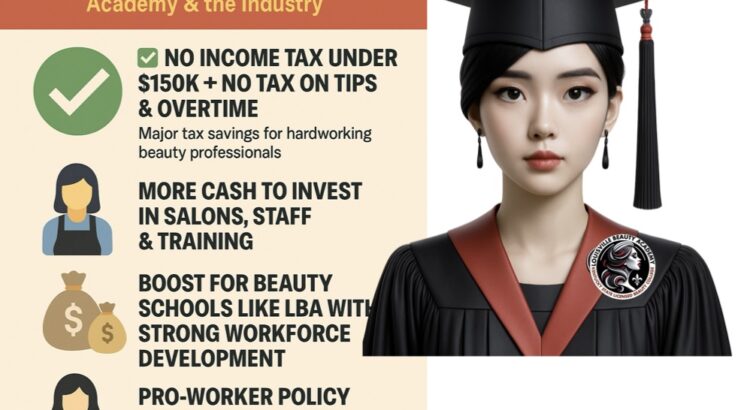
Exemption of Tips and Overtime from Federal Tax: Under the BBB, all income from tips or from overtime pay is exempt from federal income tax. This means a restaurant or salon worker who earns, say, \$5,000 in tips or overtime in a year would keep 100% of that income (no federal tax). In the beauty industry, many cosmetologists and spa workers rely on tips; this change effectively boosts their net pay.
Small-Business Income Tax Deduction: The BBB makes the Section 199A qualified-business-income (QBI) deduction permanent. In the final legislation, 20% of small-business income is deductible indefinitely (the House version had raised it to 23%). This reduction applies to pass-through entities like S-corporations, LLCs, and sole proprietorships – the legal forms used by most salons, barber shops, and independent beauty professionals. For example, a salon owner earning \$100,000 could deduct \$20,000 of that income, lowering her taxable income. Put simply, salon owners and freelancers pay substantially less federal tax on their business profits under the BBB.
Higher SALT Deduction Cap: The bill raises the federal cap on deducting state and local taxes. Households (including married couples) earning up to \$500,000 can deduct up to \$40,000 of state/local taxes (up from \$10,000 under current law). This helps Kentucky workers and small-business owners who pay significant local taxes, though the benefit phases out above \$500k. In practice, many middle-income people (including beauty professionals) in Kentucky will be able to deduct more of their property and state taxes on federal returns, lowering their overall tax bills.
Expanded Child Tax Credit: The child tax credit increases from \$2,000 to \$2,500 per qualifying child (through 2028). Beauty professionals who are parents (for example, hair stylists supporting children) will receive a larger credit. More generous credits mean hundreds of extra dollars per child for working families, freeing more income for household budgets or business investment.
100% Expensing of Equipment and R\&D: The BBB permanently restores full expensing (100% bonus depreciation) for investments in short-lived assets. Small businesses, including salons and day spas, can immediately deduct the full cost of new equipment (chairs, mirrors, computers for booking, etc.) or renovation expenses. This accelerates write-offs that were previously stretched out over many years. In practice, a salon could buy new styling stations or professional machines and deduct it all in year one, improving cash flow and encouraging businesses to reinvest in growth.
These provisions collectively lower taxes on earned and business income. According to the Kentucky Chamber, these tax cuts would help families and job creators alike, with far more households seeing net tax decreases than increases. Importantly, service workers benefit directly (via the new tip/overtime exemption) and indirectly (through the overall growth it spurs), while small-business owners gain expanded deductions that free up capital for hiring or expansion.
Table 1: Key BBB Tax Provisions and Effects on the Beauty Sector
Provision
Beneficiaries / Effect (Beauty Context)
Source
No federal tax on tips and overtime
Salon and spa employees keep all their tips and overtime wages
[50], [20] (sec. 110101–102)
Permanent QBI deduction (20–23%)
Salon owners, barbershop proprietors get lower tax on business profits
[50], [20]
Expanded SALT cap (\$40k for ≤\$500k)
Middle-income filers (including high-earning cosmetologists) deduct more state/local taxes
[50]
Larger Child Tax Credit (\$2,500/child)
Working parents in beauty industry receive higher tax credit per child
[50]
100% Business Expensing (bonus depreciation)
Salons and beauty product retailers can immediately deduct capital expenses (e.g. equipment)
[50]
Medicaid Work Requirements
Encourages able adults (many of whom could join workforce) to work 80 hrs/mo to keep benefits
[20]
(Sources: Senate House Ways & Means summary; Kentucky Chamber analysis.)
Impacts on the Beauty Industry and Workforce
The beauty sector stands to gain from these tax reforms in several ways. First, the service nature of the beauty industry means many workers earn significant tip and overtime pay; exempting these from tax directly increases their take-home pay. In addition, most beauty businesses are very small: hair salons, nail shops, and spas are overwhelmingly single-location, often owner-operated firms. The enhanced QBI deduction and expensing rules directly lower their effective tax rates, leaving more profit available to hire staff, modernize facilities, or reduce prices. In effect, the BBB lowers the “tax wedge” on everyday work and small-business activity, which advocates argue will spur hiring and entrepreneurship.
Moreover, the beauty industry is large and growing. McKinsey reports the global beauty market is about \$450 billion (as of 2024) and is expected to grow roughly 5% per year through 2030. U.S. spending on personal care continues to rise, and consumer demand for services (hair, nails, skincare, etc.) remains robust. In this context, tax relief can amplify growth: as one industry report notes, American beauty services already employ over 1.3 million people nationwide, and organizations forecast nearly 20% industry growth by 2030. (For example, NAWBO and the Professional Beauty Association support extending tip-credit rules to salons, noting that the sector is predominantly women-owned and tip-dependent.)
Worker empowerment is also an angle. Many beauty professionals are traditionally underserved groups (immigrant women, single parents, formerly incarcerated individuals, etc.) who gain quick, lower-debt vocational credentials (see LBA below). By boosting their net pay and easing the tax burden on their employers, the BBB aims to strengthen this entry-level workforce. Additionally, the Medicaid work requirements (80 hours/month rule) reinforce the principle that active work is rewarded – beneficiaries must join the labor force or community service to keep assistance. In sum, the BBB’s tax provisions align with the goal of supporting people “actively working” by reducing taxes on earned and business income in the beauty and service sectors.
Campaigns for Property Tax Relief
While the BBB deals with federal taxes, small business owners (including salons) often cite local taxes as a cost burden. In recent years a nationwide property tax revolt has emerged, with voters in multiple states approving measures to limit or reduce property taxes. For example, Kentucky voters considered (in 2024) a ballot initiative to exempt homeowners over 65 from paying property taxes, and other states like Florida and Colorado have passed caps linking tax growth to inflation. Although these efforts have targeted homeowners, some advocates have begun calling for similar relief for small businesses. In principle, expanding such relief (for example, higher homestead exemptions or credits for owner-occupied business property) would lower operating costs for salon owners as well. While not part of the BBB, these state-level movements reflect a broader push for tax relief. Policymakers sympathetic to small business might eventually propose property-tax relief packages at the state or federal level. For now, the BBB’s emphasis on reducing income taxes complements this trend: even if property taxes remain, owners will have more after-tax income to cover them.
Louisville Beauty Academy (LBA): A Workforce Model
Louisville Beauty Academy (LBA) is a local example of workforce development in the beauty field. LBA is a state-licensed beauty college that has graduated over 1,000 cosmetologists, nail technicians, estheticians, etc. since 2017. These graduates typically begin careers earning roughly \$30,000–\$50,000 per year. Louisville Beauty Academy’s own analysis conservatively estimates its alumni have generated about \$20–\$21 million in Kentucky economic activity (wages and taxes) to date. A Vietnamese-American community news report found the school has “graduated nearly 2,000 professionals, contributing an estimated \$20–\$50 million annually to the Kentucky economy”. This range reflects continued growth – as LBA adds more students each year (over 125 graduates per year on average) the impact rises.
These figures highlight LBA’s economic role: its model (affordable, lower-debt, flexible training) rapidly converts students into skilled, licensed workers. The BBB could help scale such outcomes. For example, tax relief on earned income means LBA graduates keep more take-home pay, raising their living standards and enabling them to spend or invest locally. Lower taxes on small businesses mean graduates who open their own salons face less tax drag on profits, encouraging entrepreneurship. If Louisville or Kentucky leaders wanted to expand LBA’s model (e.g. more campuses or similar schools), the freed-up tax revenues from BBB could be partially directed to workforce grants or matching funds. Moreover, a higher SALT cap means local governments could raise modest funds (for education or infrastructure) without triggering federal penalties for higher-earning residents, potentially freeing up state dollars for job training.
Table 2: LBA’s Economic Impact vs. Growth Scenarios (illustrative)
Approx. Cumulative Graduates
Estimated Annual Economic Impact (KY)
Source
1,000 graduates (through 2024)
~\$20–21 million
Louisville Beauty Academy
~2,000 graduates (projected)
\$20–50 million
Viet Bao Louisville estimates
3,000 graduates (future)
~\$60–75 million
Projected (extrapolated)
These numbers suggest that if LBA doubles or triples in size, it could inject tens of millions more into the local economy. Under the BBB, those impacts would be even larger: graduates and salons pay less in federal tax on that additional income. For Louisville’s economy, LBA represents a grassroots engine of job creation, especially for low-income and immigrant communities. Tax policies that preserve graduates’ income and reduce business costs amplify LBA’s success. In other words, BBB-level tax relief can help magnetize further investment in beauty education and small-business formation.
Broader Economic Impact in Kentucky and Louisville
Beyond LBA specifically, the BBB’s tax changes will influence Kentucky’s economy. The Chamber of Commerce notes the BBB will affect taxes and spending statewide. According to analysis cited by Kentucky’s business leaders, federal tax reform in the BBB is expected to raise the state’s GDP modestly and generate jobs. An increase of 1.2% in national GDP could translate to economic growth in Kentucky, given its manufacturing and service sectors. Moreover, by permanently cutting federal tax rates for individuals and businesses, Kentucky families and entrepreneurs will have more disposable income. For beauty-related enterprises, this means customers may spend more on services, and entrepreneurs have more capital to reinvest.
Another consideration is healthcare funding. The BBB’s Medicaid changes (work requirements and altered federal matching for provider taxes) are controversial in Kentucky, a Medicaid expansion state. Kentucky Chamber leaders urged Congress to be cautious about cutting provider funding. While not directly related to beauty, stable healthcare funding for rural hospitals and clinics can affect community health – a factor in overall workforce productivity.
Finally, local public finance: Louisville’s city and county governments will likely see some indirect effects. If federal income tax revenue falls (due to the BBB), states and localities might face pressures to adjust their tax bases. Conversely, the law’s emphasis on small business growth could increase sales and business tax collections at the local level as more businesses expand. At present, there are no direct federal grants for beauty schools in the BBB, but stronger overall economic growth could boost state budgets, potentially benefiting education and workforce programs.
Conclusion
In summary, the Big Beautiful Bill is a sweeping tax-and-spending package that strongly favors working Americans and small businesses. Its key tax breaks – particularly making all tips and overtime earnings tax-free and enhancing deductions for small businesses – directly benefit beauty school graduates, salon owners, and independent cosmetologists. These provisions, combined with expanded credits and investment incentives, encourage the expansion of small enterprises. In parallel, there is growing momentum for property-tax relief measures (through state ballot initiatives) that could further ease costs for business owners.
For Louisville Beauty Academy, which already claims a \$20–\$50 million annual economic impact through its graduates, the BBB provides a more fertile environment to scale up. More graduates will keep more of their earnings, and new salon startups will face lower tax burdens. Overall, analyses suggest the BBB will modestly boost Kentucky’s economy (through job creation and GDP growth). While debates continue over the deficit impact and Medicaid reforms, the BBB as passed effectively locks in lower federal taxes for most workers (especially those earning under ~\$150k) and incentivizes investment. For policymakers and educators in Louisville, this means a historic opportunity: tax savings from the BBB can be channeled into workforce development, with beauty industry training (like LBA) poised to produce the skilled, licensed professionals who will drive the local economy forward.
Sources: Official analyses and reports were used, including Kentucky Chamber of Commerce summaries, Senate press releases on beauty industry tax relief, LBA’s own impact analysis, and news coverage and research on tax and property-reform trends. All figures and quotations are drawn from these sources.
Beauty Is Not a Luxury—It’s a Fundamental Human Need
At Louisville Beauty Academy, we believe that beauty services are a right, not a privilege. Grooming, self-care, and personal appearance are not about vanity—they are about self-worth, dignity, and confidence.
💙 “Creating Smiles” is more than a slogan—it’s our mission.
A fresh haircut, a simple manicure, or a relaxing facial can be life-changing, especially for those who are often overlooked: ✔️ People with disabilities who struggle with mobility and self-care. ✔️ Elderly individuals who feel isolated and need human connection. ✔️ Children in crisis who deserve to feel like any other child. ✔️ Homeless individuals & those in rehab who need dignity restored. ✔️ Caregivers & staff who serve others tirelessly but rarely get pampered themselves.
🔹 Louisville Beauty Academy is on a mission to provide 100% FREE beauty services to these communities—ZERO EXCUSE ACCESSIBILITY TO BEAUTY SERVICES.
Louisville Beauty Academy: The New Model of Beauty Education
Unlike traditional beauty schools that exploit students for labor, extend training to extract federal aid, and delay graduation for profit, Louisville Beauty Academy follows an entirely different philosophy:
✔ Affordable, flexible enrollment—students start immediately. ✔ Fast-tracked completion—pushing students to graduate as soon as possible. ✔ No forced labor—students are NOT required to work for free for the school’s business model. ✔ Volunteer service is encouraged but not required—students who choose to give back receive a volunteer certification as part of their graduation resume.
🔹 This model is built on two pillars:
Providing FREE services to all in need—ensuring beauty is accessible to everyone, with NO barriers.
Developing a skilled workforce—graduates leave with experience, confidence, and real career opportunities.
At Louisville Beauty Academy, we do not believe in keeping students trapped in the system. Instead, we empower them to finish fast, work, and serve their community.
Why FREE Beauty Services Matter: The Impact on Vulnerable Populations
✔ People with Disabilities: Restoring Dignity
Many individuals with disabilities cannot physically care for their own grooming needs. This often leads to low self-esteem, isolation, and emotional distress. ✅ FREE beauty services allow them to feel seen, valued, and respected. ✅ Boosts their mental and emotional health. ✅ Encourages independence & personal pride.
✔ Elderly Individuals: Human Connection & Self-Worth
Many seniors in nursing homes or living alone experience loneliness, depression, and neglect. A simple haircut or nail service can: ✅ Reignite their sense of self. ✅ Encourage socialization & interaction. ✅ Provide touch and conversation that many elders lack.
✔ Children in Crisis: A Sense of Normalcy & Joy
Children in foster care, shelters, and underserved communities often feel different, overlooked, or unworthy. ✅ FREE haircuts and grooming make them feel like any other kid. ✅ Boosts their self-confidence at school & in social settings. ✅ Helps them feel loved and cared for.
✔ Homeless & Rehab Populations: A Fresh Start
Those recovering from addiction, homelessness, or past trauma often feel disconnected from their own self-worth. ✅ A professional appearance can open doors to job opportunities. ✅ Personal grooming helps restore their self-image & confidence. ✅ Encourages a positive mindset for rebuilding their lives.
✔ Caregivers & Staff: Supporting Those Who Support Others
Nurses, social workers, shelter staff, and caregivers give everything to help others—but who takes care of them? ✅ Providing FREE beauty services as self-care. ✅ Preventing burnout & increasing morale. ✅ Reinforcing that they, too, deserve to feel valued and beautiful.
The Expansion Plan: Bringing Louisville Beauty Academy to Every Shelter, Rehab, & Elder Care Facility
💙 Louisville Beauty Academy is launching this model in every homeless shelter, rehabilitation center, and elder care facility, including: ✔️ Volunteers of America ✔️ The Healing Place ✔️ Family Scholar House ✔️ Louisville Metro Homeless Services ✔️ Wayside Christian Mission ✔️ St. Vincent de Paul Louisville ✔️ Salvation Army Louisville ✔️ Hotel Louisville (homeless & recovery program) ✔️ Louisville Metro Jails & Prisons
🔹 No one should be denied beauty services because of their situation. 🔹 This program will ensure that every person, regardless of age, ability, or financial status, has access to self-care that restores confidence and dignity.
Scalability & National Expansion: No Excuses for Accessibility
🔹 Step 1: Perfect the model at future second location & local shelters. 🔹 Step 2: Expand across Louisville & Kentucky. 🔹 Step 3: Implement in state-funded workforce programs & correctional facilities. 🔹 Step 4: Expand to neighboring states (Indiana, Ohio, Tennessee, Illinois). 🔹 Step 5: Secure federal funding & corporate sponsorships to scale nationwide.
Final Thought: Beauty is Not Just About Looks—It’s About Power, Dignity, and Hope
Di Tran’s Vision: Impacting 1 Million Lives
Di Tran is committed to impacting 1 million lives by ensuring zero-excuse accessibility to beauty services. His goal is to expand the Louisville Beauty Academy model across rehabilitation centers, elder care facilities, homeless shelters, jails, and underserved communities across the U.S.
By providing 100% FREE beauty services, this model will: ✔️ Restore dignity and confidence to those who need it most. ✔️ Empower individuals through self-care and professional grooming. ✔️ Develop a skilled workforce with volunteer experience and real job opportunities. ✔️ Create a national movement where no person is denied the right to look and feel their best.
💙 When people feel beautiful, they feel capable. 💙 When people feel capable, they believe in themselves. 💙 When people believe in themselves, they transform their lives.
“Creating Smiles” isn’t just our slogan—it’s our mission. And through Louisville Beauty Academy’s zero-excuse accessibility model, we will ensure that every human being, regardless of their situation, has the opportunity to feel valued, confident, and beautiful.
🔹 Beauty is not a luxury—it is a necessity for self-worth. And we are making sure it is FREE for those who need it most.
Louisville Beauty Academy is proud to be a series award-winning organization, recognized for breaking barriers and tackling challenges to make beauty licensing education accessible to all. Utilizing the latest technology, innovative processes, and a deep commitment to love and care, we are dedicated to uplifting underrepresented populations and transforming the beauty industry in Kentucky and surrounding states.
Our students, graduates, and community have named us the “elite” and “Ivy League” beauty college of Kentucky and neighboring states—a title we embrace with pride and responsibility. This recognition fuels our relentless effort to elevate lives, expand opportunities, and increase our impact. We’re not slowing down. In fact, we’re accelerating our mission to bring more licensed beauty professionals to the industry with the trademark “YES I CAN” mentality and graduating them with our unique “I HAVE DONE IT” certificate, fully prepared for state board licensing.
Adopting, Adapting, and Growing
At Louisville Beauty Academy, we consistently adapt to the ever-evolving needs of the beauty industry. In 2024 alone, we’ve introduced over 50 humanization books authored by our founder, Di Tran. These books inspire and equip individuals to become their best selves, serving with excellence and care. As we move forward, we’re expanding to new locations, seeking partnerships with the best in the state and nation, and increasing our reach to elevate even more lives.
Our growth isn’t just about numbers—it’s about real impact. For every graduate we license, our founder, Di Tran, counts it as a success. Each graduate who opens a salon adds tangible value to the community, creating jobs, opportunities, and economic growth. To us, success isn’t measured by enrollment but by the lives we transform and the businesses we help build.
Join Us Today
Louisville Beauty Academy is more than a beauty school—it’s a movement to change lives, one graduate at a time. We invite you to join our family of nearly 2,000 alumni who are already making waves in the beauty industry.
Text us at 502-625-5531 or email us at Study@LouisvilleBeautyAcademy.net to start your journey. As the highly affordable, flexible, and impactful beauty licensing college in the region, we’re here to ensure your success. Together, let’s elevate the beauty industry and transform lives with love, care, and a commitment to excellence.
At Louisville Beauty Academy, we pride ourselves on delivering comprehensive training programs fully aligned with Kentucky State Board of Cosmetology regulations and Kentucky state law. Each program we offer is tailored to meet specific licensing or special permit requirements, with the primary focus being 100% on preparing students to achieve licensure upon graduation.
Licensing-Centered Education
Our approach prioritizes the theoretical and practical knowledge students need to pass the licensing exams, which consist of two parts: theory and practical. The theory exam is the most challenging for many students, regardless of their English proficiency, and is a common hurdle for beauty professionals across the United States, including Kentucky.
Program Hour Requirements and Focus
The difficulty and content of each program correspond to the required training hours:
300 hours: Blow Dry and Shampoo
450 hours: Nail Technology
750 hours: Esthetics and Skin Care
1,500 hours: Cosmetology
As the program length increases, so does the complexity of the content. Louisville Beauty Academy ensures students are equipped with the knowledge and skills to master these requirements, focusing heavily on theory at the outset.
Theory First, Practical Next
To succeed in licensure, Louisville Beauty Academy follows this sequence of training:
Theory Mastery (Licensing Focus):
The theory portion of the licensing exam covers extensive content and requires a strong foundation of knowledge. Louisville Beauty Academy uses advanced digital learning systems, offered free or at a discount, to help students study effectively.
All students are required to pass chapter exams to demonstrate readiness for licensing exams.
Practical Training:
After mastering the theory, students transition to practical study, focusing on sanitation, safety, and basic technical skills as required by the state board. The practical exam emphasizes safety and sanitation over advanced techniques.
Professional Salon Skills:
Once students meet the licensing requirements, they can learn advanced skills and techniques used in professional salon environments. This ensures that students meet state standards first before transitioning to salon practice.
Ethical Focus: Students First
Louisville Beauty Academy stands apart by putting education first. While many schools emphasize customer service to generate additional revenue, we prioritize student learning. This approach ensures that students dedicate their time to mastering theory and practical skills rather than being overburdened by customer-facing responsibilities.
Although the academy provides customer services when students choose to participate, these opportunities are secondary to education. Students must first excel in licensing requirements before engaging in professional salon practices.
What Will Students Learn?
Students at Louisville Beauty Academy will receive comprehensive training focused on two priorities:
Licensing Requirements: Mastery of theory and practical skills as mandated by Kentucky state law.
Salon Professional Practices: Advanced skills and techniques for real-world salon environments, introduced after meeting licensing standards.
At Louisville Beauty Academy, we are committed to creating an educational environment that prioritizes your success. Licensing preparation comes first, ensuring you are ready to launch your career with confidence and compliance.
Student Responsibility and the Importance of Active Engagement
At Louisville Beauty Academy, we are deeply committed to providing a comprehensive education that prepares students for licensure and professional success. However, achieving these goals requires active participation and dedication from each student during their time at the academy.
Maximizing the Learning Experience
The academy’s structured curriculum is specifically designed to equip students with the theoretical knowledge and practical skills necessary for licensing exams. To make the most of this opportunity, students must:
Attend classes consistently and punctually.
Complete all assigned work, including chapter exams and practical evaluations.
Engage fully in both theoretical and practical training.
Waiting to study after leaving the structured environment of the academy can significantly hinder the ability to retain and apply the knowledge needed for licensure. The academy strongly encourages students to prioritize their studies and practice while enrolled.
Shared Responsibility for Success
Education is a collaborative effort. Louisville Beauty Academy provides the tools, resources, and instruction needed for students to succeed, but success also depends on each student’s commitment to learning and their proactive engagement with the program.
Support and Progress Monitoring
The academy offers various support mechanisms to help students succeed, including one-on-one guidance and access to advanced digital learning systems. Progress is tracked through chapter exams, practical evaluations, and attendance records to ensure every student is meeting their milestones and receiving the support they need.
Disclaimer: This information is provided for informational purposes only and does not constitute legal advice. Louisville Beauty Academy rejects all liability for the accuracy or completeness of this information. Prospective and current students are strongly encouraged to contact the Kentucky State Board of Cosmetology directly at kbc@ky.gov for any questions or clarifications regarding licensing requirements or regulations.
By prioritizing education and compliance, Louisville Beauty Academy ensures students are fully prepared for licensure and professional success.
Louisville Beauty Academy, proudly state-licensed and accredited, stands as a vital institution in Kentucky’s beauty education landscape. Since its inception in 2016, the academy has empowered over 1,000 graduates, contributing to a thriving and dynamic beauty industry that spans across Kentucky. The academy’s commitment to quality education and professional development ensures that its students are not only prepared for licensure but are also poised for successful, fulfilling careers in beauty.
The Numbers Behind Kentucky’s Beauty Industry
As of August 2022, Kentucky’s beauty sector has grown to include approximately 23,210 licensed beauty professionals, 4,978 salons, and 49 beauty schools. Louisville Beauty Academy, located at 1049 Bardstown Road in Louisville, contributes significantly to these numbers by producing skilled graduates who join the ranks of licensed professionals across the state. With rigorous programs in cosmetology, nail technology, esthetics, and beauty instruction, the academy is shaping a robust workforce, building a strong foundation for the beauty industry throughout Kentucky.
Louisville Beauty Academy offers a range of programs designed to meet the diverse needs of today’s beauty industry. Each program is carefully aligned with Kentucky State Board of Cosmetology (KBC) standards, ensuring that students gain the skills, knowledge, and hands-on experience required for licensure and career success. The academy’s programs provide not only technical training but also business and customer service skills, setting graduates apart in a competitive market.
• Cosmetology Program: Louisville Beauty Academy’s 1,500-hour Cosmetology program covers all aspects of hair care, chemical treatments, and advanced styling techniques, equipping students with the expertise to work in a salon or even open their own. Instructors focus on the latest trends and techniques, blending theory with practice to build confidence and capability in each student.
• Nail Technology Program: The academy’s 450-hour Nail Technology program is perfect for those seeking a focused and in-demand career path. With services such as manicures, pedicures, and nail art on the rise, nail salons are one of the fastest-growing segments within Kentucky’s beauty industry. Louisville Beauty Academy’s program offers a streamlined path to licensure, giving students practical skills and the ability to provide the latest nail care trends.
• Esthetics Program: As the wellness and skincare sectors expand, the 750-hour Esthetics program at Louisville Beauty Academy prepares students to meet the growing demand for personalized skincare services. From facials and waxing to advanced skincare treatments, the academy’s esthetics curriculum covers a range of services that enhance clients’ well-being and confidence. This program is ideal for those interested in working in high-end spas, dermatology clinics, or their own esthetics practice.
Supporting the Industry: Louisville Beauty Academy’s Role in Workforce Development
Louisville Beauty Academy takes a comprehensive approach to supporting Kentucky’s beauty workforce and business community. In addition to producing licensed professionals, the academy actively contributes to industry growth by assisting graduates with career placement, providing guidance for aspiring entrepreneurs, and sharing essential industry information. The academy’s deep connections within the industry mean students and alumni have access to valuable resources, mentorship, and support as they navigate their careers.
A Resource for Aspiring Beauty Entrepreneurs
For those interested in opening their own beauty businesses, Louisville Beauty Academy is a trusted partner. The academy offers insights and resources on everything from selecting a salon location and designing service menus to understanding KBC licensing requirements. With almost 5,000 licensed salons in Kentucky, there is a wealth of opportunities for beauty professionals to establish their own businesses, and Louisville Beauty Academy’s support can be instrumental in setting new owners up for success.
Regional Market Insights
Kentucky’s beauty industry is dynamic, with different cities and regions offering unique opportunities. Urban areas like Louisville and Lexington have dense client bases with a high demand for beauty services, while smaller towns present opportunities for new businesses to cater to niche markets. Louisville Beauty Academy provides students and graduates with insights into these regional markets, helping them make informed decisions about where to establish their careers or businesses.
Community Engagement and Partnerships
Louisville Beauty Academy’s dedication to the industry goes beyond the classroom. The academy collaborates with community organizations, regulatory bodies, and industry leaders to ensure its students receive the most relevant, up-to-date training. Partnerships with organizations focused on workforce development and entrepreneurship allow Louisville Beauty Academy to stay at the forefront of industry trends, best practices, and regulatory changes. These partnerships benefit not only students but also the broader Kentucky beauty industry, which thrives on professionalism, innovation, and growth.
A Growing Need for Beauty Professionals
As Kentucky’s beauty industry continues to expand, Louisville Beauty Academy’s role in preparing future professionals becomes increasingly important. The academy’s graduates meet the growing demand for skilled beauty professionals across nail salons, hair salons, and skincare studios. With 23,210 licensed beauty professionals statewide, Kentucky offers a wealth of opportunities, and Louisville Beauty Academy graduates are well-prepared to fill these roles.
• Nail Salons: Kentucky’s demand for nail services is increasing, with consumers seeking everything from classic manicures and pedicures to cutting-edge nail art. Louisville Beauty Academy’s Nail Technology graduates are ready to provide these in-demand services, enhancing the quality and diversity of services available at nail salons statewide.
• Hair Salons: Hair salons are an essential part of Kentucky’s beauty industry, and Louisville Beauty Academy’s Cosmetology program ensures graduates are prepared to offer a wide range of hair care services. By training students in the latest styling techniques, color treatments, and customer service skills, the academy helps Kentucky’s hair salons maintain high standards and meet client expectations.
• Skincare Studios: With increased consumer interest in skincare and wellness, estheticians are a valuable asset to the beauty industry. Louisville Beauty Academy’s Esthetics program provides students with the knowledge and skills to work in high-demand roles, offering clients specialized skincare treatments that promote health and well-being.
Louisville Beauty Academy’s Commitment to Excellence
Louisville Beauty Academy is more than just a beauty school—it is a cornerstone of Kentucky’s beauty industry. By providing quality education, supporting workforce development, and fostering entrepreneurship, the academy ensures that its students are not only well-prepared for licensing exams but also equipped to succeed in a rapidly evolving industry. Louisville Beauty Academy’s commitment to excellence, professionalism, and community involvement makes it an invaluable resource for Kentucky’s beauty professionals and entrepreneurs.
Disclaimer
All data provided in this article, including figures on licensed professionals, salons, and schools, is based on information available as of August 2022. Louisville Beauty Academy strives to provide accurate, up-to-date information; however, we cannot guarantee the completeness or accuracy of this information. This data is intended for general guidance and informational purposes only. For specific licensing requirements, market studies, or business establishment advice, please consult the Kentucky Board of Cosmetology or relevant industry professionals.
Louisville Beauty Academy stands ready to empower Kentucky’s future beauty professionals. By equipping students with practical skills, industry knowledge, and business insights, the academy continues to elevate the beauty industry in Kentucky. Whether you’re an aspiring licensee, a new salon owner, or a seasoned beauty professional, Louisville Beauty Academy is here to support your journey in the beauty field.
Louisville Beauty Academy, a Kentucky State Licensed and state-licensed beauty college, is more than just a training center; it’s a community that empowers immigrants to build brighter futures, strengthen their communities, and become invaluable assets to the state of Kentucky and the United States. With over 1,000 licensed graduates and a mission rooted in opportunity and inclusivity, Louisville Beauty Academy is proud to be a stepping stone for immigrants seeking not only professional growth but also personal stability and societal contribution.
Building Careers, Building Confidence
For many immigrants, establishing a foothold in the U.S. job market can be challenging. Language barriers, limited local experience, and unfamiliarity with the U.S. education system often stand in the way. Louisville Beauty Academy helps to overcome these barriers by offering accessible, high-quality education and training in cosmetology, nail technology, aesthetics, and other beauty industry fields. These skills are not only in high demand but also provide a reliable and respected pathway to financial independence.
By obtaining a Kentucky state-recognized license in their chosen field, immigrant students are able to prove their expertise and commitment. This license is more than just a qualification—it is a testament to their hard work, dedication, and desire to contribute to the American workforce. Licensed graduates find themselves in rewarding careers that allow them to support their families, build confidence, and thrive in their communities.
A Positive Impact on Kentucky’s Economy
Every licensed graduate from Louisville Beauty Academy contributes to the local economy. These professionals work in salons, open their own businesses, and often hire others, creating jobs and fostering economic growth in Kentucky. Many graduates serve the immigrant and refugee communities, offering culturally sensitive services and meeting the needs of an increasingly diverse population.
Moreover, licensed professionals pay taxes, invest in their neighborhoods, and participate actively in local economies. By helping immigrants gain licensure and secure stable employment, Louisville Beauty Academy plays a vital role in strengthening Kentucky’s workforce and enhancing its economic resilience.
Reducing Risk, Increasing Stability
In today’s climate, stability and legal recognition are essential for immigrants. Licensed professionals are less likely to face deportation, as they are often seen as productive, law-abiding members of society who add value to their communities. A career license can improve an individual’s standing in the eyes of immigration authorities and local law enforcement, making them a lower priority for enforcement actions. Louisville Beauty Academy supports immigrants in obtaining this stability by offering a clear, lawful pathway to success and security.
Community Support and Recognition
Louisville Beauty Academy’s graduates are not only valuable to the economy but are also appreciated within their communities. Licensed professionals are recognized for their skills and dedication, which fosters a sense of pride and belonging. Employers, clients, and local leaders are often willing to vouch for their contributions, character, and work ethic—an invaluable asset in any immigration-related situations.
The academy also provides bilingual resources and culturally inclusive programs, ensuring that immigrants feel welcomed and supported throughout their education journey. This commitment to inclusivity has helped Louisville Beauty Academy become a trusted institution for immigrants, reflecting Kentucky’s spirit of hospitality and community.
A Call to Action: Join the Journey to Success
For immigrants looking to build a stable, prosperous life in Kentucky, Louisville Beauty Academy is here to support your dreams and help you unlock your potential. Whether you are passionate about nail technology, aesthetics, cosmetology, or beauty instruction, our state-licensed programs provide the knowledge, skills, and certification you need to succeed.
If you are an immigrant who wants to make a positive impact on your community, secure a stable career, and contribute to Kentucky’s growth, consider joining Louisville Beauty Academy today. With flexible class schedules, financial support options, and an inclusive environment, we are here to help you every step of the way.
Together, let’s build a future where Kentucky thrives, powered by skilled, licensed professionals who bring diverse talents and rich cultural perspectives to the beauty industry. Enroll today, earn your license, and become a valuable asset to Kentucky and the U.S.!
How to Get Started
To learn more about our programs, enrollment requirements, and support services, visit our website or contact us directly. Louisville Beauty Academy is committed to helping you reach your full potential and make a meaningful difference in your life and community. Join us, license your talent today, and beautify tomorrow.
The information provided by Louisville Beauty Academy, including details on training, licensing, and career opportunities, is for informational purposes only and does not constitute a guarantee of employment, career advancement, immigration outcomes, or legal status. Louisville Beauty Academy strives to provide accurate and up-to-date information, but outcomes can vary based on individual circumstances, market conditions, and other factors beyond our control.
Enrollment in Louisville Beauty Academy’s programs does not guarantee licensure, employment, or any specific immigration or residency benefits. We encourage all prospective students to conduct their own research and consult relevant authorities or professionals when making decisions related to career and immigration matters.
Louisville Beauty Academy disclaims any liability for outcomes based on this information. The content provided is intended to be educational and should not be relied upon as legal, financial, or career advice.
As a proud Kentucky state-licensed beauty college, Louisville Beauty Academy is committed to keeping our students, licensees, and the public informed about the latest developments in the beauty industry. Today, we bring you important news from the Kentucky State Board of Cosmetology that directly impacts the future of beauty professionals across the state.
Breaking News: Kentucky State Board of Cosmetology’s Latest Leadership Updates
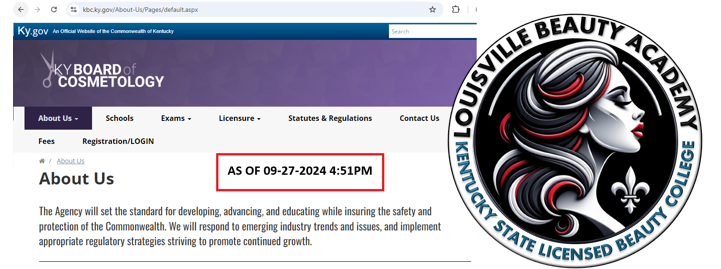
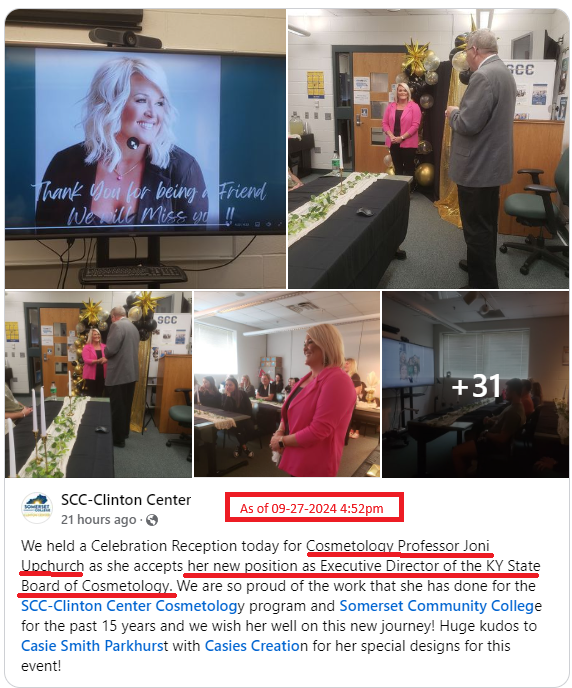
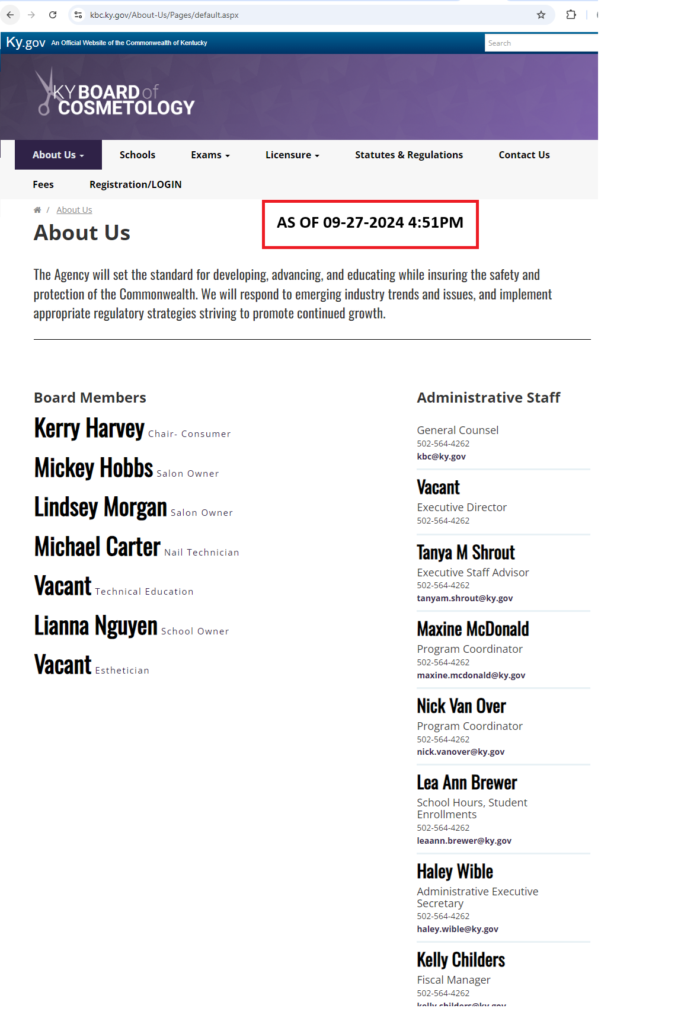
As of September 27, 2024, at 4:00 PM, the Kentucky State Board of Cosmetology confirmed new leadership with Joni Upchurch officially assuming the role of Executive Director. This news comes from trusted sources, including an acknowledgment from the SCC-Clinton Center via their Facebook post, which celebrated Joni Upchurch’s transition from her long-standing position as a Cosmetology Professor to her new role as Executive Director. Joni Upchurch’s appointment fills the position that had been vacant following the recent removal of the former Executive Director, Julie Campbell, a decision that was made earlier this year by the board after receiving significant public pressure.
Louisville Beauty Academy applauds this important leadership shift, as it brings fresh energy and new direction to the state’s regulatory body. Joni Upchurch’s extensive experience in cosmetology education makes her a valuable asset in promoting the continued growth and professionalism of Kentucky’s beauty industry.
The changes in leadership reflect the board’s commitment to ensuring the highest standards for the cosmetology profession and responding to the needs of the community. Louisville Beauty Academy remains dedicated to working closely with the board under the guidance of the newly appointed Executive Director, Joni Upchurch, and looks forward to the positive changes that will arise from this transition.
What This Means for Louisville Beauty Academy Students and Licensees
These changes in leadership signal exciting opportunities for the future of Kentucky’s beauty industry. Louisville Beauty Academy encourages all students and alumni to stay informed about these developments, as they will shape the educational standards, licensing procedures, and professional expectations for cosmetology in Kentucky. We are committed to preparing you for a successful and compliant career in beauty and ensuring that your voices are heard at the state level.
Louisville Beauty Academy is excited to be part of this transformative period for the beauty industry in Kentucky and will continue to bring you the latest updates from the Kentucky State Board of Cosmetology.
Legal Disclaimer:
The information provided in this article is shared as gathered from public sources. For confirmation or further details regarding the Kentucky State Board of Cosmetology, please email kbc@ky.gov.
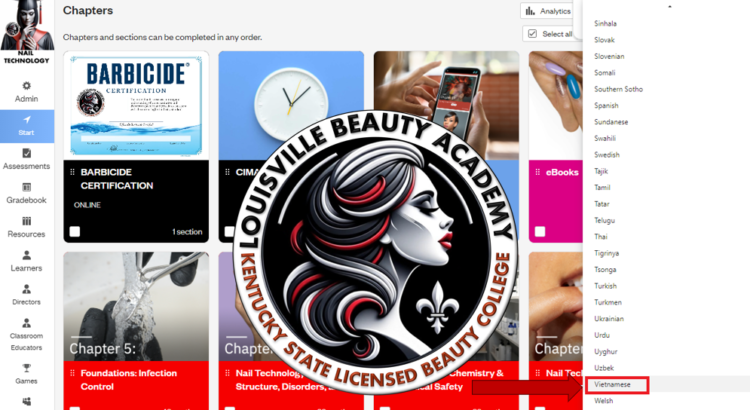
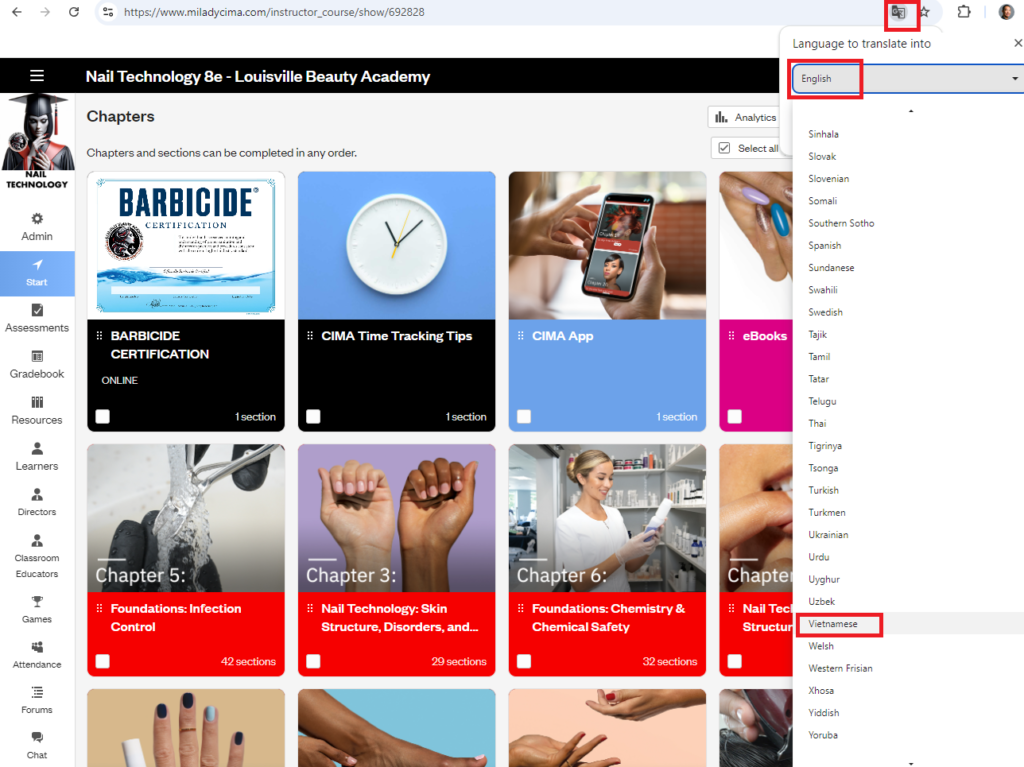
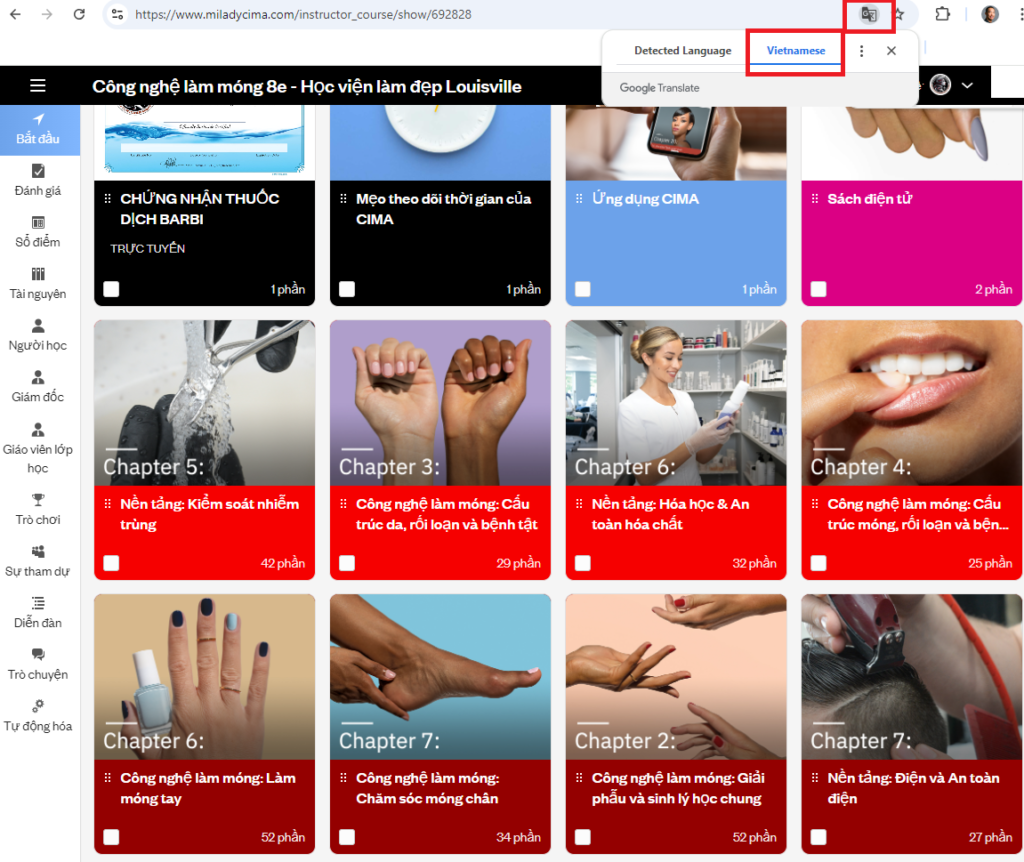
With the Kentucky State Board of Cosmetology recently launching the multiple-language PSI licensing exam, Louisville Beauty Academy (LBA) is proud to offer comprehensive support to our diverse student body. LBA has been preparing for this shift for years, offering top-tier resources like CIMA—Cengage Milady’s online study platform. This platform allows students to translate textbooks, study guides, and practice tests into any language they choose, providing accessibility for those who prefer to learn in a language other than English.
To ensure you can fully utilize these resources, here’s an elaborate guide on how to use Google Chrome’s translation tools, including the built-in translator and the Google Translate extension. These tools will make navigating your studies at LBA in your preferred language much easier.
Step 1: How to Translate Web Pages in Google Chrome
Google Chrome offers a built-in feature that lets you translate any web page into your preferred language. This is helpful when accessing online study materials or guides that are in a language you don’t fully understand.
Here’s how you can use this feature:
Open Google Chrome on your computer.
Navigate to the web page you want to translate (e.g., CIMA’s online study platform).
Right-click anywhere on the page.
From the dropdown menu, select Translate to [Language]. Google Chrome will automatically detect the current language of the page and translate it to the default language set in your browser.
If you need to change the translation language, click on the Google Translate icon in the address bar. Then click the three dots next to the language name to select a different language.
This feature is especially useful when you’re studying on CIMA or other online beauty education resources. It ensures that your learning experience is accessible and easy to follow, no matter what language you’re most comfortable with.
Step 2: Set a Default Translation Language in Google Chrome
To avoid translating pages manually every time, you can set a default translation language in Google Chrome. This way, Chrome will offer to translate any page that isn’t in the language you prefer.
Follow these steps to set up your default translation preferences:
Click the three dots (menu) at the top-right corner of the Chrome browser.
Go to Settings > Languages.
Under the Languages section, click Add languages to choose the languages you prefer.
Enable the option that says Offer to translate pages that aren’t in a language you read.
This setting will automatically prompt translation whenever you visit a webpage that is not in one of your preferred languages.
Step 3: How to Install and Use the Google Translate Extension in Google Chrome
If you want more flexibility and control over translations, you can download the Google Translate extension. This is especially useful for translating specific text rather than entire web pages.
To download and install the Google Translate extension, follow these steps:
Find the Google Translate extension in the search results and click the Add to Chrome button.
A confirmation pop-up will appear. Click Add extension to install it.
Once the extension is installed, you will see the Google Translate icon in the top-right corner of your browser.
Here’s how to use the Google Translate extension:
To translate an entire page: Click the Google Translate icon, then choose the language you want to translate the page into.
To translate specific text: Highlight the text, then click the Google Translate icon. A small pop-up will show the translation in your chosen language.
Why This Matters for Louisville Beauty Academy Students
At LBA, we understand the importance of accessibility in education. That’s why we’ve integrated platforms like CIMA to support multilingual learning. With Google Chrome’s translation tools and the Google Translate extension, students can access learning materials in their preferred language. This flexibility is critical for mastering the content and preparing for the PSI licensing exam in a language you are most comfortable with.
Louisville Beauty Academy has been leading the way in supporting Kentucky’s immigrant and multilingual communities. By offering top-tier study platforms like CIMA and advanced tools like Google Translate, we ensure that every student can reach their full potential.