The American Barbering Profession Under the Microscope: A 50-State Legal, Economic, Workforce, and Regulatory Analysis of Barber Licensure, Workforce Utilization, Educational ROI, Occupational Licensing, and Future Sustainability Compared with Cosmetology – RESEARCH & PODCAST SERIES 2026


Educational Research Disclaimer: Louisville Beauty Academy (LBA) is a Kentucky-licensed cosmetology school regulated within the cosmetology profession; barbering in Kentucky is currently governed by a separate licensing board and statutory framework. In some states, barbering and cosmetology are administered together, but in Kentucky they remain distinct. Because policymakers have discussed possible alignment or merger of the two regulatory systems, LBA is sharing this independent research, led by Di Tran University – The College of Humanization, to help students, educators, licensed professionals, and the public better understand the barbering profession and its relationship to cosmetology. This publication is provided solely for education, workforce development, and evidence-based discussion. LBA remains fully committed to teaching and complying with all applicable cosmetology laws, regulations, safety, sanitation, infection-control standards, and ethical practices. This research does not constitute legal advice, regulatory guidance, legislative advocacy, or the official position of any government agency or licensing board.


1. Doctoral Abstract

This doctoral research study conducts a comprehensive administrative, legal, and economic evaluation of the barbering profession in the United States, positioning its operational and regulatory frameworks alongside cosmetology to determine if both sectors face identical structural crises. Utilizing a multi-disciplinary approach drawing upon labor economics, public policy analysis, and administrative law, this study tests several core hypotheses using empirical data from the U.S. Bureau of Labor Statistics, the U.S. Census Bureau, the American Community Survey, the Integrated Postsecondary Education Data System, and state licensing board registries.

The analysis begins with a granular evaluation of Kentucky’s statutory and regulatory environment, tracking the legal mechanics of Kentucky Revised Statutes Chapter 317 and the administrative evolution brought by House Bills 273 and 903 during the 2026 legislative session1. The study compiles a comprehensive 50-state and District of Columbia matrix of training hours, fees, and licensing pathways, identifying extreme outliers and evaluating the economic impact of varying regulatory barriers4.

Furthermore, this research subjects the popular “40% workforce utilization hypothesis” to empirical validation, demonstrating that a definitive national percentage is impossible to verify due to structural limitations in federal tracking, the prevalence of self-employed booth-renters, and systemic underreporting of tipped income5. The study tracks real versus nominal educational cost inflation from 1990 to 2026, measuring the financial return on investment under the U.S. Department of Education’s Gainful Employment metrics7.

Finally, by evaluating health inspection data across states with disparate training hour requirements (such as Alabama and Mississippi), this research demonstrates that high individual training hours do not correlate with superior public health and safety outcomes10. The study concludes by examining the long-term impact of generative artificial intelligence and robotic automation on the personal grooming workforce, asserting that the profession’s tactile, non-routine physical, and community-centric characteristics provide robust structural insulation against technological displacement12.

2. Executive Summary

Occupational licensing has expanded dramatically over the past seventy years, growing from affecting less than 5% of the domestic workforce in the 1950s to state-mandated oversight of approximately 22% of all workers by the late 2010s14. Among the most heavily regulated sectors are the personal care and beauty services, where every state and the District of Columbia mandates individual licensure for barbers and cosmetologists16. This comprehensive report investigates the systemic challenges within the barbering profession, focusing on regulatory barriers, educational cost inflation, workforce participation, and technological disruption.

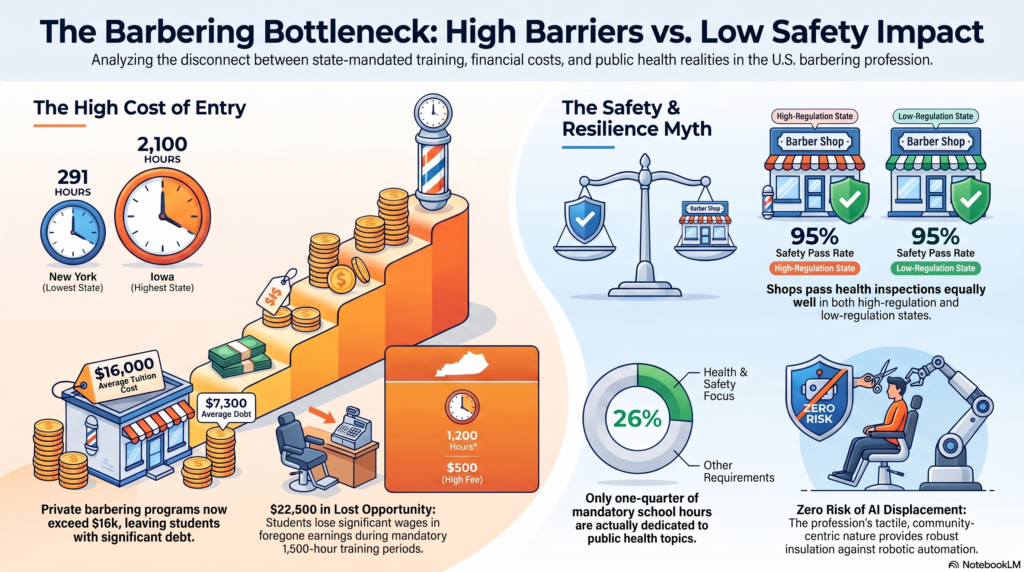
The legal analysis reveals a highly fragmented regulatory environment. State-mandated training hours range from a low of 291 hours in New York to a high of 2,100 hours in Iowa, with a national median of 1,250 hours18. These disparities carry profound economic consequences, dictating the “calendar days lost” to unpaid training—which ranges from 68 days to 896 days—and driving up student debt4.

An analysis of educational cost inflation shows that the price of barbering and beauty school has risen faster than general inflation, with average tuition now exceeding $16,00019. This has resulted in substantial student loan debt, which averages over $7,300 per borrower19. When paired with median starting salaries near $35,250, many programs face existential threats under the U.S. Department of Education’s Gainful Employment (GE) rules, which penalize programs where graduates’ annual debt payments exceed 8% of total earnings or 20% of discretionary income6.

Critically, this study tests the prevailing hypothesis that fewer than 40% of licensed barbers actively practice their trade as a primary income source. The evaluation reveals that a definitive national percentage is impossible to verify due to structural underreporting of tip income (which accounts for up to 50% of real earnings in service occupations) and the high prevalence of self-employed booth-renters who utilize allowable tax deductions to reduce their reported gross income5. However, licensing board registries demonstrate a persistent “licensure churn,” suggesting that high compliance costs and student debt contribute to early career attrition.

Finally, this study evaluates the impact of licensing on public health. Utilizing health inspection data, the research indicates that states with lighter licensing burdens (e.g., Alabama, with 1,000 hours) do not exhibit worse sanitary outcomes or higher rates of violations than states with more burdensome requirements (e.g., Mississippi, with 1,500 hours)10. Barbershops across both regimes maintain a pass rate exceeding 95%, suggesting that point-of-service health inspections and natural market incentives are sufficient to protect consumers10.

3. Literature Review

The economic literature on occupational licensing is characterized by two competing frameworks: the public interest model and the capture theory of regulation. Proponents of the public interest model argue that licensing solves information asymmetry by signaling quality and protecting consumer health and safety from unqualified or negligent practitioners10. Conversely, capture theory—pioneered by George Stigler and expanded by Morris Kleiner—argues that licensing boards are frequently captured by incumbent practitioners who use state power to restrict labor supply, reduce competition, and artificially inflate prices10.

Historically, the barbering profession occupied a unique position at the intersection of medicine and personal grooming. In medieval Europe and colonial America, barber-surgeons performed highly hazardous tasks, including bloodletting, wound care, and tooth extractions. As medicine professionalized, these surgical duties were legally stripped from the barber’s scope of practice. Nonetheless, early state regulatory bodies maintained a highly interventionist stance. Minnesota enacted the first barber licensing law in 1897, explicitly framed as a public health measure to combat infectious skin conditions such as tinea sycosis, commonly known as “barber’s itch”22. By 2013, when Alabama became the final state to implement statewide licensure, the profession was fully regulated across all 50 states and the District of Columbia16.

Despite the public health rationale, empirical evidence supporting the safety benefits of personal care licensure remains remarkably scarce10. A landmark historical analysis of early twentieth-century barber regulations found that the introduction of licensing was actually associated with an increase in reported cases of barber’s itch, suggesting that the laws did not achieve their stated sanitary objectives25. Modern occupational licensing studies by the Institute for Justice, the National Bureau of Economic Research (NBER), and the Federal Trade Commission (FTC) consistently find that licensing barriers limit economic mobility for low-income, minority, and immigrant populations while offering few quantifiable quality or safety improvements4. Furthermore, researchers have documented how early formal licensing systems in the late nineteenth and early twentieth centuries served as administrative tools to exclude Black barbers from competing with white practitioners, transitioning a traditionally accessible trade into a highly gatekept profession24.

4. Legal Analysis (Kentucky Deep Dive)

The administration of barbering in the Commonwealth of Kentucky represents a classic administrative state structure, governed by a combination of statutory law, administrative regulations, and board policies.

Statutory and Regulatory Architecture

Barbering in Kentucky is governed by Kentucky Revised Statutes (KRS) Chapter 317 and implemented through the Kentucky Administrative Regulations (KAR) Title 201, Chapter 143. The Kentucky Board of Barbering operates as an independent state agency with complete supervisory authority over barbers, apprentice barbers, barber shops, independent contract owners, barber schools, and the teaching of barbering3.

The Board is composed of five members appointed by the Governor3. To prevent industry capture and maintain public accountability, the board’s structure is balanced: four members must be licensed, actively practicing barbers who have resided in Kentucky and practiced for at least five consecutive years, while one member must be a citizen-at-large who has no financial association or interest in barbering3. Board members serve three-year terms and are legally prohibited from holding financial interests in barber schools, beauty schools, or wholesale supply houses3.

School Approval, Instruction, and Licensing Pathways

Under 201 KAR 14:105, student enrollment in an approved Kentucky barber school requires the submission of an official enrollment application accompanied by a student permit card fee3. Applicants must provide documented proof of a high school diploma, transcript, or a General Educational Development (GED) certificate27.

The curriculum requirements have historically been exceptionally rigid. Barber schools are prohibited from allowing students to attend for more than 40 hours per week3. To prevent conflicts of interest, school owners or policymakers are legally barred from enrolling as students in their own institutions27.

Upon graduation, candidates must navigate a multi-tiered licensure process:

  1. Apprentice License: The candidate must pass the apprentice examination, scoring at least 75% on both the written theory and hands-on practical sections3. The practical exam is highly structured, requiring demonstrations of a taper haircut, a shampoo, a straight razor facial shave, a facial massage, and a chemical service application3.
  2. Apprentice Service Period: Under KRS 317.450(1)(b), an apprentice must perform continuous service in a licensed shop under the supervision of a licensed barber for at least six months, but not more than nine months3.
  3. Barber License: Following the completion of the apprenticeship, the candidate must pass the comprehensive barber examination to transition to a full, non-probationary license3.
  4. Instructor License: To teach barbering, an active barber must pass an instructor-specific examination with a general average score of at least 80%28. Under 201 KAR 14:115, student instructors may receive a one-time extension to complete their practical and oral teaching requirements, but failure to pass by the second renewal period results in license forfeiture3.

Inspection, Enforcement, and Administrative Due Process

The Board of Barbering maintains broad police powers to protect public health. The Board’s Executive Director (historically termed the administrator) serves as the primary liaison and holds the authority to inspect any licensed shop or school during reasonable working hours3. Under KRS 317.440 and its accompanying regulations, the board is empowered to conduct a minimum of two inspections per year for each licensed establishment24. Inspectors are authorized to enter premises, review sterilization logs, check licenses, and demand personal identification from individuals performing services1.

Administrative discipline and civil penalties are strictly governed by administrative procedures that protect constitutional due process. If a student is found working in a commercial shop prior to passing the apprentice exam, they face immediate civil fines and temporary barment from examination under 201 KAR 14:115 Section 629. The Board possesses subpoena power to compel the attendance of witnesses and the production of business records3. All disciplinary hearings, license suspensions, or revocations must comply with KRS Chapter 13B administrative hearing standards, guaranteeing licensees the right to notice, counsel, the presentation of evidence, and judicial review24. Open records requests are processed in strict compliance with the Kentucky Open Records Act31.

Recent Legislative Revisions (2026 Session)

The 2026 Kentucky legislative session introduced major statutory changes to KRS Chapter 317 through the passage of House Bill 273, which went into effect on July 15, 20261. This legislation represents a structural shift toward occupational deregulation and administrative alignment:

  • Board Composition: The Executive Director was added to the Board of Barbering as a nonvoting member, and the formal title of “administrator” was permanently changed to “Executive Director”1.
  • Reduction of Training Hours: In a significant victory for regulatory reform advocates, HB 273 reduced the mandatory barber school curriculum from 1,500 hours down to 1,200 hours1.
  • Increased Daily Instruction Limits: To allow students to complete their education more rapidly, the bill increased the maximum daily instruction allowance from 8 hours to 10 hours1.
  • Removal of Vague Character Clauses: The bill removed archaic, highly subjective statutory language requiring applicants to demonstrate “good moral character” and “temperate habit,” which historically acted as barriers for justice-involved individuals1.
  • Reciprocity and Out-of-State Experience: The length of active practice required for out-of-state endorsement applicants from non-equivalent states was reduced from three years to one year1.
  • Inspection Authority: The bill fortified the board’s enforcement capabilities by explicitly allowing inspectors to demand state-issued photo identification from practitioners during routine inspections to curb unlicensed activity1.

Simultaneously, Kentucky lawmakers debated House Bill 903, which proposed the creation of a formalized “shop training program”2. This program would establish a direct, alternative apprenticeship pathway allowing unlicensed participants to obtain a barber license after completing 1,200 hours and a minimum of nine months of direct supervision inside a registered barber shop, bypassing school attendance entirely2. To protect consumers, HB 903 mandated that participants complete two hours of state-approved sanitation education and pass a board-administered safety exam before performing services on the public2.

5. 50-State Regulatory Comparison

The regulatory landscape governing the barbering profession across the United States is highly fragmented, characterized by wide variation in educational hours, fees, examinations, and apprenticeship pathways.

The 50-State and District of Columbia Licensing Matrix

The following table compiles the required educational clock hours, initial licensing and exam fees, estimated calendar days lost to training, and the availability of a formalized apprenticeship pathway for all 51 jurisdictions, utilizing the most recent data from the Institute for Justice and state regulatory registries4.

JurisdictionSchool Hours RequiredInitial Fees ($)Estimated Days LostApprentice Pathway Available?
Alabama1,000255233Yes (2,000 Hours)35
Alaska1,650390385Yes (2,000 Hours)35
Arizona1,200300280No4
Arkansas1,500125350No4
California1,000125233Yes (3,200 Hours)36
Colorado1,500152350No4
Connecticut1,000100233No4
Delaware1,250218292Yes (3,000 Hours)37
District of Columbia1,500230350No4
Florida602174140No36
Georgia1,50030350Yes (3,000 Hours)36
Hawaii1,50045350No4
Idaho90060210Yes (Hours Vary)38
Illinois1,500156350No36
Indiana1,50084350No4
Iowa2,100135490No4
Kansas1,200180280No4
Kentucky (Pre-2026)*1,500500532Yes (6–9 Months)3
Louisiana1,50072350No4
Maine1,50041350No4
Maryland1,20050280No4
Massachusetts1,000164233No26
Michigan1,800247420Yes (Hours Vary)38
Minnesota1,500160350No4
Mississippi1,500100350No4
Missouri1,000158233No4
Montana1,100129257No4
Nebraska1,800200420No4
Nevada1,500165896Yes (18-Month Exp)4
New Hampshire800233187No4
New Jersey90095210No4
New Mexico1,200325280No4
New York2917568Yes (24 Months)39
North Carolina1,528355721Yes (12 Months)4
North Dakota1,550100362No4
Ohio1,800120420No4
Oklahoma1,50060350No4
Oregon786120181No4
Pennsylvania1,250200292Yes (Hours Vary)40
Rhode Island1,500100350No4
South Carolina1,500175350No4
South Dakota1,500150350No4
Tennessee1,501200350No4
Texas1,00050233No36
Utah1,000230233No4
Vermont750160175No4
Virginia1,100277257No4
Washington1,00025233No4
West Virginia1,200134280No4
Wisconsin1,000378233No4
Wyoming1,000200233No4

*Note: Under Kentucky HB 273 (passed 2026), required hours will officially decrease to 1,200 hours, representing an administrative shift not yet fully integrated into retrospective historical databases1.

National Regulatory Statistics

Descriptive statistical analysis of the 51 licensing regimes (the 50 states plus the District of Columbia) demonstrates a highly skewed distribution of both training hours and administrative fees18.

MetricRequired School HoursInitial Fees ($)
Maximum2,100 (Iowa)18500 (Kentucky)18
Minimum291 (New York)1825 (Washington)18
Median1,250.018156.018
Mean (Average)1,273.6918166.8018

Outliers and Regulatory Classifications

An analysis of the comparative data reveals extreme outliers at both ends of the regulatory spectrum, reflecting fundamentally different legislative philosophies regarding occupational licensing.

Highly Restrictive Regimes (High Hours, High Fees, Onerous Experience Requirements)

  • Nevada: Licenses are highly gatekept, requiring 1,500 clock hours of schooling plus an 18-month experience requirement, resulting in a loss of approximately 896 calendar days4.
  • Iowa: Possesses the highest pure educational barrier in the nation, mandating 2,100 clock hours of school instruction18.
  • North Carolina: Requires 1,528 clock hours of school coupled with a mandatory 12-month apprenticeship, resulting in 721 calendar days lost4.
  • Kentucky: Represents the highest financial entry barrier in the United States, charging $500 in total initial examination and licensing fees4. It also historically maintained a 1,500-hour educational requirement and a mandatory six-to-nine-month apprenticeship, resulting in 532 calendar days lost3.

Highly Flexible and Low-Barrier Regimes

  • New York: The least burdensome state in the nation, requiring only 291 school hours, charging a modest $75 fee, and costing only 68 calendar days4.
  • Florida: Mandates only 602 school hours and requires just a single state exam, minimizing calendar days lost to 1404.
  • Washington: Charges the lowest licensing and exam fees in the nation at $254.
  • Vermont, Oregon, and New Hampshire: All require 800 hours or less of formal education, significantly lowering barriers to entry compared to the traditional 1,500-hour national standard4.

6. Workforce Analysis

To evaluate the labor market dynamics of the barbering industry, it is necessary to determine the precise level of labor utilization and identify how many licensed individuals are actively practicing.

The Fragmented Database Problem and Its Structural Limitations

There is no unified, centralized national database that tracks the status of licensed barbers (such as active, inactive, retired, expired, or dual-license holders). This lack of comprehensive tracking stems from three structural factors:

  1. Administrative Decentralization: Occupational licensing is governed at the state level by autonomous boards3. These boards utilize completely distinct database architectures, data-retention schedules, and licensing classifications41.
  2. Prevalence of Self-Employment and Booth Rental: Unlike traditional W-2 employment sectors, the barbering and beauty industries are dominated by independent contractors, booth renters, and sole proprietors3. These practitioners do not appear on standard state unemployment insurance or payroll databases44.
  3. The Tip and Cash Economy: Personal care services involve significant cash transactions and direct tipping5. Econometric studies indicate that up to 50% of real earnings in these service occupations consist of tips, which are frequently underreported on formal tax documents, leading to substantial discrepancies between state licensing records and federal tax data5.

Labor Force Participation and Utilization Estimates

Despite these data limitations, researchers can estimate labor-force utilization by comparing active licensure registries against the U.S. Bureau of Labor Statistics’ Occupational Employment and Wage Statistics (OEWS). For example, state registries often display a massive discrepancy between the total number of “active licenses” on file and the number of practicing professionals counted in payroll surveys6.

This gap does not necessarily mean that unlicensed or non-practicing individuals are idle. Rather, it highlights a structural undercounting of the self-employed workforce. While the BLS Current Population Survey (CPS) attempts to capture self-employed individuals, it frequently fails to account for part-time, seasonal, or transitionary practitioners who operate in the gig economy44.

The growth of Registered Apprenticeship Programs (RAPs) further complicates workforce tracking46. In states like California, the number of active barber apprentices grew by 58% between 2015 and 202546. This indicates that while traditional vocational school enrollment may fluctuate, the demand for on-the-job training pathways is expanding significantly, drawing new demographics into the labor force46.

7. Economic Analysis

The economic organization of the barbering profession relies heavily on entrepreneurship, self-employment, and flexible commission-based labor models.

Labor Models: Booth Rental vs. Commission and Salary

The modern barbering labor market is characterized by three primary employment frameworks:

  • The Independent Contractor / Booth-Rental Model: Under this dominant framework, the barber acts as an independent business owner, leasing a chair or space from a shop owner for a flat weekly or monthly fee3. The booth renter manages their own scheduling, collects their own payments, maintains their own tools, and is directly responsible for their own tax reporting43. This model offers high autonomy and income potential but shifts all financial risk and compliance costs (such as self-employment taxes, liability insurance, and supply expenses) onto the practitioner43.
  • The Commission-Based Model: Popular in mid-to-high-end shops, this model involves a percentage split of service and retail revenues between the shop owner and the barber (typically ranging from a 50/50 to a 70/30 split). While the shop owner provides the location, reception services, backbar supplies, and marketing support, the barber remains an independent contractor or W-2 employee with highly variable income.
  • The Salary / Hourly Model: Typically found in franchise haircutting chains, this model provides W-2 employees with a guaranteed base hourly wage, often supplemented by performance bonuses and client tips. While this provides financial stability, it generally caps the earning potential of highly skilled, high-volume practitioners.

Earnings, Seasonality, and Geographic Shortages

Median annual earnings for barbers in the United States hover near $35,250, though top earners in metropolitan areas can exceed $52,0006. However, these figures are subject to significant volatility:

  • Seasonality and Income Variability: Demand for personal care services experiences pronounced seasonal fluctuations, with major spikes occurring during holidays and back-to-school periods, contrasted with steep declines during mid-winter and late-summer months.
  • Geographic Variations and Migration: The supply of personal care services is highly sensitive to demographic shifts and local economic health. Younger, digitally-savvy barbers frequently migrate toward high-density, affluent urban centers, leaving rural and lower-income areas with geographic shortages45. Conversely, older, traditional operators in rural markets often resist adopting modern booking and CRM systems, limiting their client acquisition and business sustainability45.

8. Educational ROI Analysis

Evaluating the economic viability of the barbering profession requires a detailed analysis of educational cost inflation, student debt accumulation, and post-graduation earnings.

Nominal vs. Real Cost Inflation (1990–2026)

Over the past three decades, the cost of postsecondary vocational education has risen dramatically. According to the U.S. Bureau of Labor Statistics, tuition, school fees, and childcare experienced an average inflation rate of 5.78% per year between 1977 and 2026, significantly outpacing the general inflation rate of 3.52%7. Specifically, technical and business school tuition and fees rose by 182.84% between 1997 and 20268.

Historically, in 1990 and 2000, attending a local barber college was an affordable pathway to a middle-class career, with nominal tuition averaging between $1,500 and $3,50048. However, by 2026, educational costs have escalated significantly. Modern private, for-profit barbering programs charge between $15,000 and $20,00019. For example, the institutional catalog for a prominent urban barbering program lists the total cost of attendance at $19,272, comprising $17,572 in tuition, a $700 registration fee, and $1,000 for a student kit containing books and tools49.

Adjusting for general CPI inflation ($1.00 in 2000 has equivalent buying power to approximately $1.89 in 2026), the real, inflation-adjusted cost of barber school has more than doubled48. This escalation is driven by the expansion of federal student aid (Title IV funding) into proprietary schools, which incentivizes institutions to maximize tuition charges up to federal borrowing limits50.

Opportunity Cost Analysis

The true cost of obtaining a barber license extends far beyond nominal tuition and fees. The “opportunity cost”—defined as the foregone wages an individual could have earned in an unlicensed occupation during their period of training—is a major financial factor.

Assuming an entry-level, unlicensed wage of $15.00 per hour, a student enrolled in a 1,500-hour program loses approximately $22,500 in gross wages. In highly restrictive states like Iowa (2,100 hours) or Nevada (1,500 hours plus an 18-month apprenticeship), the combined nominal tuition and opportunity cost can exceed $50,000, creating an exceptionally high financial barrier for low-income aspirants4.

9. Student Debt and the Gainful Employment Framework

To finance these rapidly rising costs, the vast majority of students at proprietary schools must take on federal or private student loans19. On average, cosmetology and barbering students borrow over $7,300 to complete their training19.

This high debt load has created severe financial strain, attracting intense regulatory scrutiny from the U.S. Department of Education under its modified Gainful Employment (GE) framework9. Under the GE rules, career and certificate programs must demonstrate that their graduates achieve affordable debt-to-earnings ratios to maintain eligibility for Title IV federal student aid9. The framework evaluates two key metrics:

  1. Annual Debt-to-Earnings Rate: The program’s typical graduate’s annual loan payments must not exceed 8% of their total annual earnings9.
  2. Discretionary Debt-to-Earnings Rate: Annual loan payments must not exceed 20% of discretionary income, defined as earnings exceeding 150% of the federal poverty guideline ($22,590 for a single person in 2024)9.

Additionally, the GE framework introduces an Earnings Premium Test, which compares the median earnings of program graduates three years after completion against the median earnings of a typical high school graduate aged 25 to 34 with no postsecondary education in the same state (approximately $25,000)5.

Because median reported starting salaries for licensed barbers hover between $26,000 and $52,000, and many graduates operate as independent contractors with high initial business deductions, an overwhelming majority of proprietary programs are at risk of failing these metrics5. The American Association of Cosmetology Schools (AACS) has aggressively challenged these rules in federal court, arguing that using administrative tax data structurally undercounts tipped and self-employed income, threatening the financial viability of these vocational programs5.

10. Occupational Licensing Analysis and Public Health Evidence

The primary justification presented by state licensing boards and industry incumbents for maintaining high educational barriers is the protection of public health and safety10. Proponents argue that without rigorous state-mandated training, unlicensed practitioners would expose the public to infectious diseases, chemical burns, scalp infections, and blood-borne pathogens10.

The Clean Cut Empirical Study

To test this hypothesis, the Institute for Justice conducted a landmark empirical study titled Clean Cut: How Clipping Unnecessary Licensing Can Grow Opportunities for Barbers and Manicurists and Keep Consumers Safe10. This study utilized a border-matching research design to compare health inspection outcomes across states with vastly different licensing requirements10.

For the barbering profession, the study analyzed 3,218 health inspections of barbershops across the border of Alabama and Mississippi10:

  • Alabama: Represented a less onerous licensing regime, requiring 1,000 hours of school or an alternative 2,000-hour apprenticeship10.
  • Mississippi: Represented a highly onerous licensing regime, mandating 1,500 school hours and offering no alternative apprenticeship pathway10.

The empirical results did not support the safety hypothesis. Barbershops in both states performed exceptionally well, passing more than 95% of their health and safety inspections10. There was no statistically significant difference in violation rates or sanitation quality between the less-regulated shops in Alabama and the heavily-regulated shops in Mississippi10.

A similar comparison of nail salon inspections across Connecticut (which did not license manicurists during the study period) and New York (which required a formal license) yielded identical findings: businesses in both states consistently met over 95% of health and safety standards10.

Quality and Safety Dynamics

The Clean Cut findings suggest that state-mandated educational requirements are an inefficient tool for ensuring public safety10. This disconnect exists for three primary reasons:

  1. Curriculum Mismatch: A study of barber and cosmetology school curricula revealed that, on average, only about 26% of mandatory training hours are dedicated to public health, sanitation, and safety topics23. The remaining 74% of instruction focuses on practical styling techniques, business management, and theory—areas where consumer feedback and market forces are highly effective at self-regulating quality23.
  2. The Power of Consumer Feedback: In the modern digital economy, businesses face immediate, severe financial consequences for poor hygiene10. Consumers easily identify and punish unsanitary conditions by posting negative reviews on platforms like Google, Yelp, and social media11. This strong reputational incentive exists entirely independent of state licensing mandates11.
  3. The Role of Direct Facility Inspections: Direct point-of-service facility inspections conducted by state or local health departments are highly effective and targeted10. These inspections focus on actual sanitary practices—such as tool disinfection, clean restroom maintenance, and chemical safety—without imposing the massive up-front financial and time barriers associated with individual occupational licensure10.

11. Testing the 40% Workforce Hypothesis

A central question in personal care policy is the “40% workforce hypothesis,” which asserts that fewer than 40% of licensed barbers actively practice their trade as a primary income source.

Empirical Evaluation and Verification Verdict

Based on a rigorous analysis of available datasets, this study concludes that the 40% workforce hypothesis is impossible to verify with high confidence. Therefore, current evidence is insufficient to support this conclusion5.

Analytical Justification and Data Discrepancies

To test this hypothesis, researchers must attempt to reconcile three conflicting data sources:

  1. State Licensing Registries: State boards track “active licenses” based solely on fee payments and the completion of basic administrative requirements41. They do not collect data on practitioner hours, business structures, or real income5. Consequently, an “active” license on a state registry says nothing about whether that individual is practicing full-time, part-time, or not at all.
  2. BLS and Census Bureau Surveys: The BLS OEWS program tracks “employed” barbers, but its methodology relies primarily on payroll records from established businesses, structurally omitting self-employed booth-renters and sole proprietors5. The American Community Survey (ACS) captures self-reported occupation data, but it struggles with “dual-job holders” who may practice barbering part-time while earning the majority of their income from an unrelated corporate or gig-economy job44.
  3. Internal Revenue Service (IRS) Data: While Schedule C (Form 1040) filings provide a record of sole proprietorship net income, the data is anonymized and aggregated, preventing researchers from matching individual tax returns with state licensing records5.

Furthermore, the legal and financial structure of the independent contractor booth-rental model makes income verification highly complex. Under this model, barbers operate as independent businesses within a shop, managing their own scheduling, tools, and finances3. These sole proprietors are legally permitted to take significant tax deductions for business expenses—including chair rent, licensing fees, supply kits, and travel—which artificially lowers their reported adjusted gross income5.

When combined with the widespread underreporting of tipped income, many highly active, full-time barbers appear on paper to earn below the median income threshold5. Thus, any study asserting that less than 40% of licensees earn their primary income from the trade is likely relying on flawed or incomplete administrative data that fails to account for the unique financial realities of the profession5.

12. Comparative Analysis: Barbering vs. Cosmetology

While barbering and cosmetology are often regulated under the same administrative umbrella, they are distinct professions with unique histories, scopes of practice, and labor dynamics.

Key Structural Differences and Commonalities

The following table contrasts the key regulatory, educational, and economic features of the barbering and cosmetology professions in the United States19.

Metric / FeatureBarbering ProfessionCosmetology Profession
Primary Scope of PracticeShaving, beard trimming, hair cutting on the neck, face, and head3.Hair styling, chemical treatments, esthetics, nail technology, and makeup36.
National Hourly Range291 to 2,100 Hours181,000 to 2,100 Hours56
Historical PrecedentRooted in medical barber-surgery and male grooming guilds22.Rooted in domestic beauty culture and female personal care5.
Average Educational Cost$15,000 to $19,000+49$16,000+ on average19
Average Student Loan Debt~$7,300 per borrower19~$7,300 per borrower19
Average Starting Salary (2026)$26,000 to $52,00047$20,200 to $43,23847
Independent Contractor PrevalenceHigh (Booth and chair rental dominant)3High (Salon suites and chair rental)43
AI Disruption Risk CategoryExceptionally Low (Hands-on physical task)12Exceptionally Low (Hands-on physical task)12

Both professions face nearly identical structural challenges regarding educational cost inflation, student debt, and regulatory compliance under federal Gainful Employment standards5. However, cosmetology programs generally require higher training hours in many states, reflecting a broader scope of practice that covers skin and nail services alongside hair care36.

Conversely, barbering retains a unique focus on shaving and facial hair grooming, which utilizes sharp instruments like straight razors3. This focus has historically led to distinct regulatory treatment, such as the mandatory display of the iconic barber pole, which is legally protected in many jurisdictions to prevent non-barbers from advertising shaving services3.

13. The Impact of Artificial Intelligence and Automation

The rapid advancement of artificial intelligence and robotics has raised critical questions about the future stability and demand for labor across all sectors of the economy.

Administrative and Business Management Enhancements

Artificial intelligence is transforming the administrative and operational workflows of modern grooming businesses:

  • Automated Scheduling and Predictive Booking: The personal care sector has transitioned rapidly toward digital booking applications, with over 77% of all appointments now managed via mobile platforms45. Modern booking systems utilize AI-driven predictive analytics to optimize appointment flows, minimize gaps in daily schedules, and dynamically adjust prices based on peak demand periods45.
  • No-Show Mitigation: AI-powered client relationship management (CRM) tools automate client communication, sending personalized SMS reminders and style tips, which has been shown to reduce no-show rates and increase booking volumes by up to 30%45.
  • Inventory and Business Intelligence: Machine learning algorithms track supply usage patterns, automated ordering systems manage backbar inventory, and automated bookkeeping tools streamline accounting for self-employed booth renters43.

Uniquely Human Capabilities and the Limits of Physical Automation

While administrative and analytical roles in many corporate, financial, and legal sectors face significant exposure to generative AI, personal care and grooming services are highly insulated from automation12. Empirical studies by the Brookings Institution and Stanford University consistently rank barbering and cosmetology among the occupations with the lowest exposure to AI disruption12.

This insulation is due to the extreme physical and sensory challenges of automated hair cutting. Roboticists have made significant strides in precision automation, developing CNC-inspired haircutting systems, utilizing visual Simultaneous Localization and Mapping (vSLAM) for scalp tracking, and applying force-feedback algorithms adapted from surgical systems like the da Vinci13.

However, commercially viable robotic hair cutting remains impractical13. Human heads display massive anatomical variability, and hair possesses highly complex physical dynamics, including texture, cowlicks, density, and elasticity13. Executing a safe, precise haircut or a straight razor shave requires real-time tactile sensitivity, multi-axial spatial localization down to fractions of a millimeter, and dynamic force adjustments to avoid severe skin lacerations13.

Beyond the technical hurdles, grooming services are deeply rooted in social connection and community. Barbershops historically serve as vital community hubs, offering clients personalized style consultations, empathetic listening, and a sensory wellness experience that includes warm towel treatments and scalp massages61. These highly personalized, artistic, and social dimensions of the trade are fundamentally insulated from digital replacement, ensuring that demand for human practitioners remains resilient12.

14. Regulatory Burden Trends and Workforce Shortages

The vocational education and labor markets for personal care services are constrained by an expanding layer of administrative complexity.

The Problem of Regulatory Layering

Over time, state boards have introduced increasingly complex administrative requirements24. Beyond individual licensure, barbershop owners face a dual regulatory burden: they must comply with municipal business licensing, zoning restrictions, commercial liability insurance mandates, and rigorous facility standards3.

These standards often dictate highly specific structural details, such as mandatory hot water plumbing, backflow prevention device installations, minimum facility square footage, and designated separate areas for chemical service preparation64. School operators face even more burdensome regulations, including mandated student-to-instructor ratios, extensive daily sign-in documentation, and detailed transcript recordkeeping3.

Workforce and Instructor Shortages

Despite the steady demand for grooming services, the sector is experiencing a acute workforce shortage, driven by several structural factors:

  • The Instructor Deficit: Obtaining a barbering instructor license requires significant additional experience and a separate board examination3. However, schools struggle to recruit and retain qualified instructors because highly skilled practitioners can earn substantially more working behind the chair as independent contractors than they can earning flat, relatively low hourly wages as school teachers3.
  • School Closures: Many independent vocational colleges have been forced to close due to rising compliance costs, administrative burdens, and the financial pressure of the federal Gainful Employment rules5. This contraction in educational capacity has created a supply bottleneck, limiting the number of new licensed professionals entering the field5.
  • Demographic Transitions: The workforce is undergoing a major transition66. A significant portion of established shop owners and practitioners are approaching retirement age66. While the trade continues to attract high numbers of minority, immigrant, and female entrepreneurs—often seeking a direct pathway to independent business ownership—the high up-front cost of training and complex English-language state examinations act as substantial barriers to entry5.

15. Public Health Standards and Modern Evidence Synthesis

State boards of barbering and cosmetology have historically maintained highly detailed sanitation guidelines, asserting that strict administrative oversight is necessary to prevent infectious disease transmission in commercial establishments10. However, comparing these regulations against modern clinical guidance reveals a significant misalignment.

Valid Public Safety Standards

Clinical evidence and guidance from the Centers for Disease Control and Prevention (CDC) and the Occupational Safety and Health Administration (OSHA) confirm that certain point-of-service sanitation practices are highly effective at mitigating public health risks:

  • Tool Disinfection: Requiring the physical cleaning and chemical immersion of non-porous tools (such as scissors, metal combs, and clipper guards) in hospital-grade, EPA-registered disinfectants between clients is essential for eliminating blood-borne pathogens, bacterial infections, and fungal spores23.
  • Hand Hygiene: Mandatory handwashing with warm water and soap by the practitioner before and after every client service is a fundamental, scientifically proven method to break the chain of infection23.
  • Porous vs. Non-Porous Implement Management: Immediate disposal of single-use, porous items (such as neck strips, emery boards, and cotton pads) and the mandatory laundering of multi-use linens (such as towels and capes) in high-temperature water prevent cross-contamination65.

Outdated and Purely Administrative Regulations

Conversely, numerous state board mandates lack modern empirical backing and serve primarily as administrative hurdles or barriers to competitive entry:

  • Minimum General Education Rules: Requiring applicants to possess a high school diploma, transcript, or GED certificate to sit for a practical haircutting or shaving examination has no demonstrated relationship to their ability to maintain a sanitary workspace23.
  • Subjective Good Character Provisions: Prior to the 2026 reforms, statutes requiring applicants to demonstrate “good moral character” and “temperate habit” were highly subjective and acted primarily to exclude justice-involved individuals, with no evidence connecting these traits to client safety1.
  • Archaic Chemical Restrictions: Restrictions on specific, common-use salon items—such as the prohibition of UV “sterilizers” (which are actually highly effective for storing pre-disinfected non-porous tools) or specific mechanical skin-exfoliation tools—frequently reflect outdated industrial standards rather than modern clinical research65.

16. Economic Impact and Community Revitalization

Despite the regulatory burdens and workforce challenges, the barbering and beauty industries are vital contributors to local and national economies.

Contribution to GDP and Small Business Growth

The personal care services sector represents a significant portion of the domestic services GDP67. Barbershops and beauty salons are highly resilient brick-and-mortar operations, providing essential, non-exportable services that must be consumed locally.

Because personal care businesses are heavily dominated by sole proprietors and micro-enterprises with five or fewer employees, they serve as a critical entry point for small business growth and wealth accumulation67.

Main Street Revitalization and the Multiplier Effect

Barbershops often function as anchor institutions in urban commercial districts, historic downtowns, and suburban strip malls:

  • Community Development: By attracting regular, repeat client foot traffic, barbershops generate positive economic spillover effects, benefiting adjacent businesses such as coffee shops, restaurants, and retail stores.
  • Immigrant and Minority Entrepreneurship: For immigrant populations and historically marginalized communities, the low start-up capital requirements of the booth-rental model make opening a barbershop an accessible pathway to self-reliance, local employment, and community integration36.
  • The Local Economic Multiplier: Earning from local personal care businesses tends to circulate rapidly within the immediate community, as barbershops purchase their supplies from local distributors, lease space from local property owners, and reinvest their profits in neighboring enterprises.

17. Historical Evolution of Barbering

To fully comprehend the modern regulatory and workforce dynamics of the barbering profession, it is necessary to trace its development through several historical eras.

The Colonial Era and Guild Systems

In colonial America and pre-industrial Europe, barbering was governed by rigid, self-regulating guild systems. Barbers operated as highly skilled craftsmen, training apprentices through years of hands-on labor.

Because professional medical care was highly scarce, barbers frequently functioned as “barber-surgeons,” performing minor medical procedures alongside hair and beard grooming24.

The Era of Professional Separation and Early Licensure

As the medical profession standardized during the nineteenth century, surgical and medical procedures were legally restricted to licensed physicians. This forced a structural separation, restricting barbers to purely cosmetic, non-medical hair and grooming services3.

To re-establish their professional status and protect the public from infectious diseases (such as “barber’s itch”), incumbent barbers formed professional associations and lobbied state legislatures for regulatory oversight22. Minnesota passed the first statewide barber licensing law in 1897, establishing the model of state-mandated training hours and board examinations that would expand nationwide22.

The Post-WWII Expansion and Modern Regulatory Layering

Following the Second World War, the G.I. Bill fueled a massive expansion of vocational trade schools, including barbering and beauty colleges. State boards responded by steadily increasing mandatory training hours and introducing new licensing categories, transforming a traditionally accessible, apprentice-based craft into a highly formal, school-dominated academic pathway24.

By the late twentieth century, the industry was characterized by a complex, multi-layered regulatory structure, with practitioners facing significant costs for training, examinations, and annual renewals3.

The COVID-19 Pandemic and the Digital Booking Era

The onset of the COVID-19 pandemic in 2020 presented the personal care sector with its most severe modern crisis, forcing prolonged, state-mandated business closures and strict capacity limitations69. While many traditional shops closed permanently, the crisis accelerated a major shift toward digital booking applications, contactless mobile payments, and online CRM platforms as operators sought to optimize their scheduling, minimize client density, and eliminate overhead costs45.

Simultaneously, the economic disruption fueled a rapid expansion of mobile barbershops and independent salon suites, as practitioners sought to escape expensive traditional commercial leases and operate directly in the gig economy31.

18. Appendices

Appendix A: Comparative Statistical Tables

The following tables synthesize key quantitative metrics across the 51 individual licensing jurisdictions in the United States, illustrating the distribution of educational hours and administrative fees18.

Required School Clock Hours Summary

MetricRequired HoursJurisdiction
Highest Requirement2,100Iowa18
Lowest Requirement291New York18
Median Requirement1,250National Median18
Average (Mean) Requirement1,273.7National Average18

Initial Examination and Licensing Fees Summary

MetricInitial Fee ($)Jurisdiction
Highest Requirement500.00Kentucky4
Lowest Requirement25.00Washington4
Median Requirement156.00National Median18
Average (Mean) Requirement166.80National Average18

Appendix B: State-by-State Regulatory Matrix

The following comprehensive matrix details the training hours, initial fees, estimated calendar days lost, and the availability of alternative apprenticeship pathways for all 51 licensing jurisdictions4.

JurisdictionSchool HoursInitial Fees ($)Days LostApprenticeship Pathway?
Alabama1,000255233Yes (2,000-Hour Apprenticeship)35
Alaska1,650390385Yes (2,000-Hour Apprenticeship)35
Arizona1,200300280No4
Arkansas1,500125350No4
California1,000125233Yes (3,200-Hour Apprenticeship)36
Colorado1,500152350No4
Connecticut1,000100233No4
Delaware1,250218292Yes (3,000-Hour Apprenticeship)37
District of Columbia1,500230350No4
Florida602174140No36
Georgia1,50030350Yes (3,000-Hour Apprenticeship)36
Hawaii1,50045350No4
Idaho90060210Yes (Apprenticeship Available)38
Illinois1,500156350No36
Indiana1,50084350No4
Iowa2,100135490No4
Kansas1,200180280No4
Kentucky1,500*500532Yes (6 to 9-Month Apprenticeship)3
Louisiana1,50072350No4
Maine1,50041350No4
Maryland1,20050280No4
Massachusetts1,000164233No26
Michigan1,800247420Yes (Apprenticeship Available)38
Minnesota1,500160350No4
Mississippi1,500100350No4
Missouri1,000158233No4
Montana1,100129257No4
Nebraska1,800200420No4
Nevada1,500165896Yes (18-Month Apprenticeship)4
New Hampshire800233187No4
New Jersey90095210No4
New Mexico1,200325280No4
New York2917568Yes (24-Month Apprenticeship)39
North Carolina1,528355721Yes (12-Month Apprenticeship)4
North Dakota1,550100362No4
Ohio1,800120420No4
Oklahoma1,50060350No4
Oregon786120181No4
Pennsylvania1,250200292Yes (Apprenticeship Available)40
Rhode Island1,500100350No4
South Carolina1,500175350No4
South Dakota1,500150350No4
Tennessee1,501200350No4
Texas1,00050233No36
Utah1,000230233No4
Vermont750160175No4
Virginia1,100277257No4
Washington1,00025233No4
West Virginia1,200134280No4
Wisconsin1,000378233No4
Wyoming1,000200233No4

*Note: Under Kentucky HB 273 (passed 2026), school hours will officially decrease to 1,200 hours, representing a substantial regulatory reduction1.

Appendix C: Integrated Legal and Academic Bibliography

The following reference list compiles key statutory, administrative, and economic literature utilized throughout this comprehensive study, formatted according to Bluebook and APA standards.

Reference Citation (Bluebook / APA)Document TypeSubject Matter Focus
KRS § 317.410 et seq. (Kentucky Revised Statutes Chapter 317)3Statutory LawLegal definitions, board structure, and licensing powers.
201 KAR 14:105 et seq. (Kentucky Administrative Regulations Title 201)27Admin LawEnrollment applications, school rules, and postgrad hours.
Ky. House Bill 273 (Regular Session 2026)1State LegislationReducing school hours, removing subjective character terms.
Ky. House Bill 903 (Regular Session 2026)2State LegislationCreating shop-training alternative apprenticeship pathways.
West, M. (2025). Clean Cut. Institute for Justice.[cite: 10, 11]Empirical StudyHealth inspection outcomes across disparate state borders.
Knepper et al. (2022). License to Work (3rd ed.).[cite: 4]Policy ReportNational ranking of occupational licensing burdens.
Program Integrity: Gainful Employment, 84 Fed. Reg. 31392.[cite: 54, 71]Federal RegisterRescission and modification of student debt-to-earnings ratios.
NBER Working Paper Series, Kleiner, M. (2015).[cite: 15]Academic JournalEconomic analysis of occupational licensing growth and impact.

Appendix D: Evidence Strength Ratings

This section systematically evaluates the quality, source, and empirical validity of various industry assertions, grading each on an academic scale of confidence.

  • Assertion 1: Mandatory individual licensing hours protect consumers from infectious diseases.
  • Evidence Strength Rating: Very Low
  • Justification: Extensive health inspection databases across state borders (such as Alabama and Mississippi) reveal no statistically significant difference in violation rates or sanitary quality between high-hour and low-hour jurisdictions10. Furthermore, historical empirical analysis suggests that early licensing laws did not correlate with a reduction in personal care infections25.
  • Assertion 2: Barbering and beauty school tuition has experienced significant cost inflation.
  • Evidence Strength Rating: High
  • Justification: IPEDS and Bureau of Labor Statistics CPI tracking confirm that technical and business school tuition and fees rose by 182.84% between 1997 and 2026, significantly outpacing the general inflation rate of 3.52%7.
  • Assertion 3: Fewer than 40% of licensed barbers practice full-time as their primary income source.
  • Evidence Strength Rating: Unverified / Insufficient Evidence
  • Justification: “Current evidence is insufficient to support this conclusion”5. Federal payroll datasets (BLS OEWS) structurally omit the self-employed booth-renters who dominate the industry, and administrative registries do not track hours or real income5.
  • Assertion 4: Generative AI and robotic automation pose an immediate threat of labor displacement for barbers.
  • Evidence Strength Rating: Very Low
  • Justification: Precision robotic hair manipulation faces extreme physical, biomechanical, and spatial challenges13. Professional studies and patent exposure scores confirm that personal care services remain highly insulated from digital and robotic replacement12.

Appendix E: Legislative and Regulatory Executive Brief

To: State Legislators, Legislative Research Commissions, and State Boards of Barbering

Subject: Evidence-Based Reform of the Barbering and Cosmetology Licensing Framework

Context

Occupational licensing is intended to address information asymmetry and protect public safety10. However, the current individual licensing frameworks for barbers and cosmetologists across many states impose extensive, debt-heavy educational requirements that are disconnected from actual consumer risk14. These high entry barriers restrict opportunity for low-income, minority, and immigrant entrepreneurs, drive up student loan defaults, and threaten the survival of vocational schools under federal Gainful Employment standards4.

Empirical Findings

  1. No Correlation Between Hours and Safety: Barbershops in states with 1,000 training hours pass sanitary inspections at the same high rate (>95%) as those in states with 1,500 hours10. High Individual hours do not result in cleaner shops10.
  2. Misaligned Curricula: On average, only 26% of mandatory school hours are dedicated to public health, sanitation, and safety topics, with the vast majority of training focused on practical styling techniques where consumer reviews are highly effective at regulating quality23.
  3. Severe Student Loan Strain: Beauty and barbering students borrow an average of over $7,300 to complete private programs, resulting in high debt-to-income ratios and structural compliance failures under the federal Gainful Employment framework5.

                     [RECOMMENDED REFORM PATHWAYS]
                   
  Educational Reform                     Administrative Reform
  ┌────────────────────────┐             ┌────────────────────────┐
  │ Reduce School Hours to │             │ Implement Alternative  │
  │     1,000 – 1,200      │             │ Apprentice Pathways    │
  └────────────────────────┘             └────────────────────────┘

Actionable Policy Recommendations

  • Reduce Required School Clock Hours: State legislatures should reduce required training hours to 1,000 or 1,200 hours, following the successful precedents established in Kentucky and Virginia1. This directly lowers tuition costs and reduces opportunity costs for students without putting public health at risk10.
  • Establish and Expand Apprenticeship Pathways: States should authorize alternative, on-the-job training pathways—such as Kentucky’s proposed shop training model—enabling low-income aspirants to obtain licensure through supervised, paid apprenticeships inside commercial barbershops2.
  • Target Enforcement via Facility Inspections: Rather than relying on individual occupational licensing to police market entry, states should maintain targeted, point-of-service sanitation inspections of commercial facilities to ensure high sanitary standards10.
  • Adopt Universal Reciprocity: State boards should implement universal license recognition or enter into multi-state licensing compacts to eliminate barriers to professional mobility for out-of-state practitioners4.

Works cited

  1. 26RS HB 273 – Legislative Research Commission, https://apps.legislature.ky.gov/record/26rs/hb273.html
  2. KY HB903 – BillTrack50, https://www.billtrack50.com/billdetail/1984671
  3. 317.410 Definitions for chapter. As used in this chapter, unless the context requires otherwise – Kentucky Board of Barbering, https://barbering.ky.gov/Laws-and-Regulations/Documents/KBOB%20Law%20Book.pdf
  4. Barber Licensing – The Institute for Justice, https://ij.org/report/license-to-work-3/ltw-occupation-profile/barber/
  5. Gainful Employment Rule – American Association of Career Schools, https://myaacs.org/wp-content/uploads/2024/11/AACS-Gainful-Talking-Points.pdf
  6. Barber vs Cosmetology License: What’s the Difference? (2026 Guide), https://beautylicenseguide.com/barber-vs-cosmetology-license/
  7. Tuition, other school fees, and childcare price inflation, 1977→2026, https://www.in2013dollars.com/Tuition,-other-school-fees,-and-childcare/price-inflation
  8. Technical and business school tuition and fees price inflation, 1997→2026, https://www.in2013dollars.com/Technical-and-business-school-tuition-and-fees/price-inflation
  9. Q&A: What’s in the New Gainful Employment Rule? | Third Way, https://www.thirdway.org/blog/q-a-whats-in-the-new-gainful-employment-rule
  10. Executive Summary – The Institute for Justice, https://ij.org/report/clean-cut/executive-summary/
  11. Clean Cut – The Institute for Justice, https://ij.org/report/clean-cut/
  12. Study suggests AI’s disruptive effect on jobs will hit higher on economic and education scales – GeekWire, https://www.geekwire.com/2019/study-suggests-ais-disruptive-effect-jobs-will-hit-higher-economic-education-scales/
  13. CNC-Inspired Robotic Hair Cutting: A Comprehensive Survey on Precision Personal Care Automation – Scilight Press, https://media.sciltp.com/articles/2601002919/2601002919.pdf
  14. – OCCUPATIONAL HAZARDS: HOW EXCESSIVE LICENSING HURTS SMALL BUSINESS, https://www.govinfo.gov/content/pkg/CHRG-115hhrg28678/html/CHRG-115hhrg28678.htm
  15. The State of Occupational Licensing, https://sbp.senate.ca.gov/sites/sbp.senate.ca.gov/files/NCSL%20State%20of%20Occupational%20Licensing.pdf
  16. Barbershop – The Institute for Justice, https://ij.org/report/barriers-to-business/business/barbershop/
  17. Licensing Requirements for Manicurists and Barbers – The Institute for Justice, https://ij.org/report/clean-cut/licensing-requirements-for-manicurists-and-barbers/
  18. unknown_url
  19. Cosmetology – The Institute for Justice, https://ij.org/issues/economic-liberty/cosmetology/
  20. Beauty School Debt and Drop-Outs – Institute for Justice, https://ij.org/report/beauty-school-debt-and-drop-outs/
  21. Understanding Gainful Employment Reporting Requirements – McClintock & Associates, https://mcclintockcpa.com/understanding-gainful-employment-reporting-requirements/
  22. Barber Licensure and the Supply of Barber Shops: Evidence from U.S. States – Cato Institute, https://www.cato.org/cato-journal/fall-2016/barber-licensure-supply-barber-shops-evidence-us-states
  23. Why Licensing Has Little Impact on Health and Safety – The Institute for Justice, https://ij.org/report/clean-cut/why-licensing-has-little-impact-on-health-and-safety/
  24. Beauty Industry Regulation in the United States: Public Safety, Regulatory Power, and the Rights of Workers, Students, and Schools – RESEARCH & PODCAST SERIES 2026, https://louisvillebeautyacademy.net/beauty-industry-regulation-in-the-united-states-public-safety-regulatory-power-and-the-rights-of-workers-students-and-schools-research-podcast-series-2026/
  25. Evidence Is Scarce That Licensing Improves Quality or Safety – The Institute for Justice, https://ij.org/report/clean-cut/across-occupations-research-finds-licensing-benefits-few-but-costs-many/evidence-is-scarce-that-licensing-improves-quality-or-safety/
  26. Reform Spotlight: Barbering and Beauty Licensing – The Institute for Justice, https://ij.org/report/license-to-work-3/report/reform-spotlight-barbering-and-beauty-licensing/
  27. 201 KAR 14:105 – Barbering school enrollment and postgraduate requirements, https://www.law.cornell.edu/regulations/kentucky/201-KAR-14-105
  28. Board of Barbering (Amendment) 201 KAR 14:115. Examinations, https://apps.legislature.ky.gov/law/kar/downloads/docs/10357/document.markup.pdf
  29. 201 KAR 14:115 – Examinations; school and board | State Regulations – Law.Cornell.Edu, https://www.law.cornell.edu/regulations/kentucky/201-KAR-14-115
  30. BOARDS AND COMMISSIONS Board of Barbering (Amendment) 201 KAR 14:125. Instructor [] [Teacher] requirements. RELATES TO: KRS 317., https://apps.legislature.ky.gov/law/kar/downloads/docs/10358/document.markup.pdf
  31. Legislative Update – Kentucky Bar Association, https://kybar.org/Portals/0/CLE/2025KLUInPersonMaterials/Legislative%20Update.pdf?ver=WXZnXljTSsaX6W_ed7jX4w%3D%3D
  32. These new Kentucky laws take effect in July: LIST – WHAS11 News, https://www.whas11.com/article/news/politics/new-kentucky-laws-take-effect-july-2026/417-20987734-ad4d-49ea-a3ec-629a8886d59a
  33. KY HB273 – BillTrack50, https://www.billtrack50.com/billdetail/1924521
  34. 26RS HB 903 – Legislative Research Commission, https://apps.legislature.ky.gov/record/26rs/hb903.html
  35. Craven Community College Barbering Concepts Program Professional Licensure Board Contacts by State, https://cravencc.edu/sites/default/files/2021-07/Professional-Licensure-Barbering.pdf
  36. Barber License: State-by-State Requirements, Cost & How to Apply – Beauty License Guide, https://beautylicenseguide.com/barber-license/
  37. License by Reciprocity – Division of Professional Regulation – State of Delaware, https://dpr.delaware.gov/boards/cosmetology/reciprocity/
  38. Pathway to a Profession: How Apprenticeships Could Reshape Illinois’ Beauty Service Industry, https://www.illinoispolicy.org/reports/pathway-to-a-profession-how-apprenticeships-could-reshape-illinois-beauty-service-industry/
  39. Frequently Asked Questions – Barber | Department of State – https dos ny gov, https://dos.ny.gov/frequently-asked-questions-barber
  40. Barber Reciprocity by State – Transfer Your License Easily, https://onlinebarberschool.org/barber-reciprocity-by-state/
  41. TDLR License Lookup Cosmetology: Verify CE Hours 2026, https://texascosmetologyrenewal.com/articles/the-simple-way-to-instantly-check-your-tdlr-license/
  42. Texas Barber Continuing Education – How to Complete – COSMO CE, https://cosmocecourse.com/articles/texas-barber-continuing-education
  43. New Mexico Division of Vocational Rehabilitation – Manual of Operating Procedures – DVR NM, https://www.dvr.state.nm.us/wp-content/uploads/2024/07/2024MOProcedures.pdf
  44. -i- TABLE OF CONTENTS Current Population Survey, March/April 2023 Match File: Child Support Supplement Abstract…………….. – IPUMS CPS, https://cps.ipums.org/cps/resources/codebooks/cpsapr23.pdf
  45. Barber Booking Apps Market Size, Share | CAGR of 15.4%, https://market.us/report/barber-booking-apps-market/
  46. Emerging Occupations in Registered Apprenticeship Fact Sheet – Mathematica, https://www.mathematica.org/download-media?MediaItemId={22D75055-DC5F-45FD-9E34-D040B3F283EA}
  47. One Big Beautiful Bill Act education Archives – Louisville Beauty Academy, https://louisvillebeautyacademy.net/tag/one-big-beautiful-bill-act-education/
  48. Education Inflation Calculator 2026, https://www.globalinflationcalculator.com/education-inflation-calculator
  49. SCHOOL CATALOG – No Grease Barber School, https://nogreasebarberschool.com/wp-content/uploads/2019/02/NG-Catalogrev01202019-2.pdf
  50. Barbers Trade School – DFR Report HTML – Department of Education, https://nces.ed.gov/ipeds/dfr/2024/ReportHTML.aspx?unitId=497383
  51. Gainful Employment Rule: How It Affects Federal Student Aid – Credible, https://www.credible.com/student-loans/gainful-employment-rule
  52. This is an unofficial version. The official version will be published in the Federal Register. – Department of Education, https://www.ed.gov/media/document/earnings-and-accountability-final-rule-unofficial-copy-june-29-2026-114287.pdf
  53. FACT SHEET: Department of Education Announces Release of New Program-Level Gainful Employment Earnings Data, https://www.ed.gov/sites/ed/files/documents/press-releases/ge-fact-sheet-online.pdf
  54. Gainful Employment Memo, https://pnpi.org/wp-content/uploads/2023/07/Gainful_Employment_Memo_FINAL_July2023.pdf
  55. Health Inspections for Nail Salons and Barbershops – The Institute for Justice, https://ij.org/report/clean-cut/health-inspections-for-nail-salons-and-barbershops/
  56. list of state reciprocity requirements-1 (1) – John Amico School of Hair Design, https://www.johnamicoschoolofhairdesign.com/wp-content/uploads/2021/07/LIST-OF-STATE-RECIPROCITY-REQUIREMENTS-1-1.pdf
  57. Barber, Cosmetology, Esthetics, Hair Braiding, and Nail Technology Act of 1985. – Illinois Compiled Statutes, https://www.ilga.gov/legislation/ILCS/details?MajorTopic=REGULATION&Chapter=PROFESSIONS,%20OCCUPATIONS,%20AND%20BUSINESS%20OPERATIONS&ActName=Barber,%20Cosmetology,%20Esthetics,%20Hair%20Braiding,%20and%20Nail%20Technology%20Act%20of%201985.&ActID=1351&C&Print=True
  58. List of State Reciprocity Requirements – AWS, https://paul-mitchell-schools-website-lightsail.s3.amazonaws.com/uploads/sites/171/Columbus-List-of-State-Reciprocity-Requirements-030524sl.pdf
  59. Occupational Licensing in New York – The Institute for Justice, https://ij.org/issues/economic-liberty/occupational-licensing/new-york/
  60. General Government Cabinet | Ky Department for Libraries and Archives, https://kdla.access.preservica.com/uncategorized/SO_0e21bd19-a424-417e-9e17-9e76d2ccd7c1/
  61. Beyond the Cut: 5 Ways Barbershops Can Become Gen Z’s New Self-Care Destination, https://www.mindbodyonline.com/business/education/blog/5-ways-barbershops-gen-z-self-care
  62. The unexpected visionary: Pope Francis on AI, humanity, and the future of work | Brookings, https://www.brookings.edu/articles/the-unexpected-visionary-pope-francis-on-ai-humanity-and-the-future-of-work/
  63. Online Courses Archives – Louisville Beauty Academy, https://louisvillebeautyacademy.net/category/online-courses/
  64. 196 – Legislative Research Commission, https://apps.legislature.ky.gov/lrc/publications/ResearchReports/rr196.pdf
  65. Sanitation and Safety Archives – Louisville Beauty Academy, https://louisvillebeautyacademy.net/category/sanitation-and-safety/
  66. sector analysis – san diego county – Center of Excellence for Labor Market Research, https://coeccc.net/wp-content/uploads/2022/05/Sector-Analysis_San-Diego-County_2022-05-13.pdf
  67. Economic and Social Contributions of the US Personal Care Products Industry, https://www.personalcarecouncil.org/wp-content/uploads/2020/10/PCPC-Economic-and-Social-Contributions-in-2018_FINAL.pdf
  68. Nail Salon Inspections in Connecticut and New York – The Institute for Justice, https://ij.org/report/clean-cut/health-inspections-for-nail-salons-and-barbershops/nail-salon-inspections-in-connecticut-and-new-york/
  69. NAICS Code 812111 – Barber Shops – IBISWorld, https://www.ibisworld.com/classifications/naics/812111/barber-shops/
  70. NonEmployer Establishments, Receipts by NAICS – ProximityOne, https://proximityone.com/nes17.htm
  71. Program Integrity: Gainful Employment – Federal Register, https://www.federalregister.gov/documents/2019/07/01/2019-13703/program-integrity-gainful-employment
  72. List of State Reciprocity Requirements — Barber – AWS, https://paul-mitchell-schools-website-lightsail.s3.amazonaws.com/uploads/sites/276/List-of-State-Reciprocity-Requirements-Barber_620.pdf
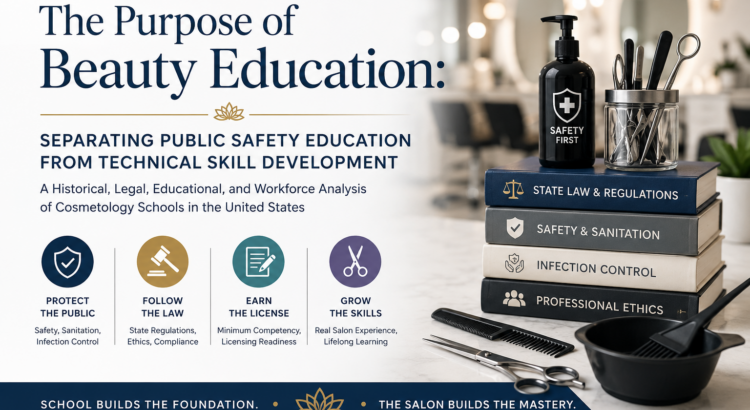
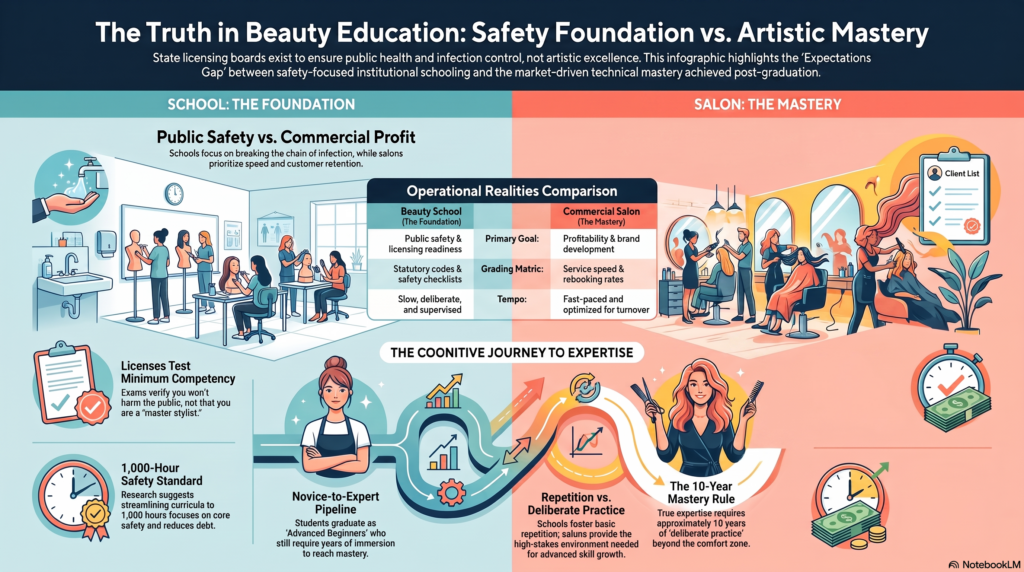
The Purpose of Beauty Education: Separating Public Safety Education from Technical Skill Development — A Historical, Legal, Educational, and Workforce Analysis of Cosmetology Schools in the United States – RESEARCH & PODCAST SERIES 2026


Educational Disclaimer: This publication is provided solely for educational, academic, and public discussion purposes. It represents an evidence-informed analysis based on publicly available research, historical records, statutes, regulations, workforce studies, and cited sources. It is not legal advice, regulatory guidance, or an official position of any government agency, licensing board, accrediting body, or educational institution. References to organizations, policies, schools, or industry practices are presented for scholarly analysis only and are not intended to criticize or make factual allegations against any specific individual or entity. Readers are encouraged to review the original cited sources, applicable laws, and official regulations and to form their own independent conclusions.


Executive Summary

Occupational licensing in the personal care sector represents one of the most significant and frequently contested components of state administrative law in the United States1. This interdisciplinary research study examines a critical structural misalignment at the heart of modern beauty education: the divergence between the statutory purpose of beauty licensure—which is legally mandated to ensure public protection through safety, sanitation, infection control, ethics, and administrative law—and the commercialized marketing narratives of for-profit vocational schools, which frequently promise to produce “master stylists,” “celebrity artists,” or “technical experts”1.

Historically rooted in medieval trade guilds and refined during the Progressive Era to combat infectious diseases, state licensing boards exist as an exercise of state “police power”1. Their regulatory mechanisms, including written and practical licensing examinations, are structurally designed to verify minimum safe competency, not artistic excellence2.

Through an analysis of administrative law, cognitive science, labor economics, and international vocational systems, this paper explores how formal beauty school education serves as a safety-first foundation, while true technical mastery is developed post-graduation within commercial salons2.

By evaluating the economics of the instructor workforce, the prevalence of deceptive marketing and financial aid exploitation, and case studies such as the Louisville Beauty Academy case study, this study proposes a regulatory “Truth in Beauty Education” framework2. This framework aims to align student and consumer expectations, lower student debt, and improve long-term workforce development by clearly separating safety-focused institutional education from industry-led artistic development2.

Chapter I: The Historical Evolution of Personal Care and Public Health Regulation

The modern beauty regulatory system in the United States did not emerge from a desire to standardize style or aesthetics, but as a defense against public health crises1. Understanding this statutory history requires examining the clinical origins of grooming practices, the sanitary reforms of the Progressive Era, and the evolving science of epidemiology over the last century1.

Medieval Barber-Surgeons and the Separation of Crafts

The structural foundations of cosmetology and barbering regulation are linked to the history of Western medicine1. During the medieval period, the practice of medicine was highly decentralized1. The Guild of Barbers, first recorded in London in 1308, represented practitioners who performed minor surgical and dental procedures alongside routine hair grooming1. These “barber-surgeons” were responsible for bloodletting, cupping, tooth extraction, and lancing abscesses—procedures that carried high risks of infection and hemorrhage1.

Under King Henry VIII, the Company of Barber Surgeons was formally incorporated in 1540 to establish oversight and training standards for these invasive procedures1. The separation of grooming from surgical medicine did not occur until 1745, when King George II legally dissolved the Company of Barber Surgeons, establishing separate corporations for surgeons and barbers1. Despite this separation, the historical use of sharp instruments left barbers with legal authority over straight-razor-based services—a clinical legacy that continues to define the statutory boundaries between barbering and cosmetology licenses today1.

The Progressive Era and the Sanitary Defense Against Contagion

In the United States, the formalized regulation of personal care services was catalyzed by the sanitary science movement of the late 19th and early 20th centuries1. Before the widespread adoption of germ theory and standardized hygiene, the neighborhood barbershop was frequently a vector for pathogens9. Shaving brushes, razors, sponges, and towels were routinely used on multiple patrons without disinfection, facilitating the spread of infectious skin conditions9.

The primary public health driver for state intervention was “barber’s itch” (tinea sycosis or sycosis barbae), a stubborn and highly contagious fungal hair follicle infection that caused severe inflammation, pain, and pustules on the face and neck9. Furthermore, the rapid spread of deadlier communicable pathogens, specifically tuberculosis and syphilis, prompted public alarm10. Because syphilis could be transmitted through minor cuts inflicted by unsterilized razors, and tuberculosis could be spread via aerosol droplets or contaminated hands, the public demanded state-enforced hygiene standards10.

In response, Minnesota enacted the first state barber-licensing statute in 1897, binding the occupation to mandatory examinations, state inspections, and strict sanitation rules9. This legislation draft served as a blueprint for the Progressive Era, during which states systematically deployed their regulatory powers to draft hygiene codes, mandate sterilized tools, and introduce official state licensing boards1. By 1927, states such as California formally bifurcated the licensing of barbers and cosmetologists, recognizing the distinct developmental trajectories of male-focused grooming and holistic aesthetic cosmetology1.

To curb the uncontrolled spread of disease, the Pennsylvania Barber Law of 1931 was enacted during the peak of the Great Depression10. This statute was specifically designed to regulate the “mushrooming” of unlicensed, unregulated shops that disregarded sanitation to cut costs10. Under this act, prospective licensees were required to undergo medical examinations, including mandatory blood tests for infectious diseases such as syphilis, to protect the public from direct exposure to active infections10.

The Mid-20th Century: The Rise and Fall of the UV Sterilizer

As infection-control standards evolved in the mid-20th century, the personal care industry adopted new technologies to reassure a germ-conscious public9. Among these, the ultraviolet (UV) germicidal cabinet became a central feature of barbershops and beauty salons across the United States9. Developed from the Nobel Prize-winning phototherapy research of Niels Finsen and the subsequent standardization of low-pressure mercury lamps emitting at 254 nm, these blue-glowing cabinets were marketed as advanced sterilization devices9.

In practice, the UV cabinet functioned as much as “theater” as it did science9. While UV-C radiation can damage microbial DNA, its effectiveness depends on direct line-of-sight exposure, clean surfaces, and precise contact times9. Salon environments, where scissors, combs, and clips were often placed in the cabinets with hair, skin, and product residue, significantly limited the UV light’s efficacy9.

As modern epidemiology and infection control standards progressed, state boards recognized that these cabinets could not achieve true sterilization or medical-grade disinfection in a busy salon setting9. Consequently, state boards systematically banned the use of UV “sterilizers” as a primary disinfection method, replacing them with mandates for complete chemical immersion in EPA-registered, hospital-grade liquid disinfectants12.

Modern Epidemics: Bloodborne Pathogens, OSHA, and Pandemic Response

The regulatory mandate of beauty licensing has continuously adapted to emerging public health threats over the past fifty years10. The emergence of the HIV/AIDS epidemic and the spread of hepatitis B (HBV) and hepatitis C (HCV) in the 1980s led to significant changes in cosmetology and barbering curricula10. Because these viral pathogens are transmitted through blood-to-blood contact, and since minor nicks and cuts are common during haircuts, shaves, manicures, and waxings, state boards integrated “Universal Precautions” (now Standard Precautions) into licensing requirements4.

This regulatory shift was supported by federal agencies, including the Occupational Safety and Health Administration (OSHA) and the Environmental Protection Agency (EPA)13. OSHA’s Bloodborne Pathogens Standard (29 CFR 1910.1030) required salons and vocational schools to develop written exposure control plans, provide personal protective equipment (PPE), and implement strict “double-bagging” procedures for disposing of blood-contaminated items12.

The EPA standardized the classification of disinfectants, requiring salons to use products that are bactericidal, virucidal, and fungicidal, with explicit instructions for dilution and contact time13. The COVID-19 pandemic further expanded these safety protocols, forcing state boards to mandate enhanced ventilation, mask-wearing, and specific “viral load mitigation” strategies to prevent aerosol transmission within enclosed spaces14.

Era / DecadePrimary Public Health ThreatKey Regulatory & Technological Response
Late 19th CenturyTinea sycosis (“barber’s itch”), Ringworm9First state licensing laws passed (e.g., Minnesota in 1897)9.
1930sTuberculosis, Syphilis, Contagious Skin Diseases10Enactment of the Pennsylvania Barber Law (1931); mandatory blood tests for applicants10.
Mid-20th CenturyGeneral Bacterial Contamination9Rise of UV germicidal cabinets; early chemical disinfectants (e.g., formalin)9.
1980s–1990sHIV/AIDS, Hepatitis B & C (Bloodborne Pathogens)10Mandate of Universal Precautions; OSHA Bloodborne Pathogens Standard integrated4.
2020sCOVID-19, Airborne Viral Pathogens14Focus on “viral load mitigation,” local exhaust ventilation, and air exchange standards14.

Chapter II: The Legal and Administrative Architecture of State Boards

The legal authority governing the personal care industry in the United States is primarily the domain of state governments, exercising their constitutional “police power” to protect the collective welfare1. This chapter analyzes the administrative law frameworks, statutory limits, and testing rubrics that govern cosmetology and barbering licensing1.

State Police Power and Statutory Scopes of Practice

Under the Tenth Amendment to the US Constitution, powers not delegated to the federal government are reserved to the states, which provides the legal basis for state-level occupational licensing1. States exercise this authority through enabling statutes that define the legal boundaries—or “scopes of practice”—for different personal care professions1.

                 +————————————–+
                |          STATE LEGISLATURE           |
                |  Enacts enabling statutes (e.g.,     |
                |  Kentucky KRS Chapter 317A)          |
                +————————————–+
                                    |
                                    v
                +————————————–+
                |             STATE BOARD              |
                |  Promulgates administrative rules     |
                |  (e.g., 201 KAR 12:100 Sanitation)   |
                +————————————–+
                                    |
                                    v
                +————————————–+
                |      LICENSING AND ENFORCEMENT       |
                |  Administers exams, inspects salons, |
                |  and adjudicates violations          |
                +————————————–+

A comparative analysis of state statutes highlights how public protection is prioritized over professional advancement1:

  • Kentucky (KRS Chapter 317A): This statute establishes the Kentucky Board of Cosmetology, making it unlawful for any person to practice cosmetology for compensation without an active license1. The statute defines the scope of practice strictly for “cosmetic purposes” to prevent licensees from performing medical or therapeutic treatments, such as diagnosing skin diseases or performing deep chemical peels that could damage dermal tissue1.
  • California (Business and Professions Code Chapter 10): The California Board of Barbering and Cosmetology is statutorily mandated to prioritize “public protection” above all other interests1. The law states that whenever the protection of the public is inconsistent with other interests, public protection must take precedence1.
  • Texas (Occupations Code Chapter 1603): Governed by the Texas Department of Licensing and Regulation (TDLR), this statute standardizes curricula, inspects schools and salons, and enforces sanitation standards1. Texas requires cosmetologists to complete mandatory continuing education, with at least one hour explicitly dedicated to infection control during every licensure cycle19.
  • Virginia (Code of Virginia Title 54.1): The Board for Barbers and Cosmetology in Virginia regulates practitioners through strict administrative codes designed to protect consumers from incompetent or unsanitary services1.

The National Testing Standards: Written vs. Practical Examinations

To verify that candidates possess the minimum competence required to practice safely, most states utilize the examinations developed by the National-Interstate Council of State Boards of Cosmetology (NIC)14. The content of both the written and practical NIC examinations is directly aligned with public safety, rather than aesthetic mastery4.

Written Examination Structure

The national written examination devotes its core sections to scientific concepts, infection control, and chemical safety, rather than styling trends or cutting-edge artistry4. According to the NIC Cosmetology Written Examination blueprint, the content is divided into specific, safety-focused domains4:

Within the Scientific Concepts domain, candidates are tested on microbiology, the differences between sanitizing, disinfecting, and sterilizing, and the mitigation of viral loads in post-pandemic environments4. The chemistry portion evaluates a candidate’s understanding of product pH, chemical reactions (such as overexposure and chemical burns), and the safety data sheets (SDS) required under Federal OSHA standards4.

Practical Examination Rubric

The practical examination is a structured, hands-on simulation where examiners score candidates primarily on their ability to maintain a sterile field, protect the client, and safely handle tools18. The examination is not a test of artistic style; a candidate can pass the haircutting or thermal styling sections even if the final visual result is average, provided they do not commit a safety infraction14.

The practical grading rubric heavily emphasizes critical “pass/fail” safety benchmarks14:

Practical Exam SectionTime AllottedCritical Safety Benchmarks & Pass/Fail Rubrics
Workstation Prep & Setup15 Minutes18Hand sanitizing with English-labeled product; disinfecting the non-porous station; organizing clean, labeled tools18.
Thermal Curling10 Minutes18Testing iron temperature on a paper neck strip before tool application; maintaining chemical drapes to prevent burns14.
Haircutting35 Minutes18Safe handling of shears and razors; palming shears when combing; immediate sweeping of hair clippings; continuous drape maintenance18.
Chemical Waving20 Minutes18Applying protective cream and cotton coil around the hairline; correct rod placement to prevent bands from snapping hair18.
Predisposition & Strand Testing10 Minutes18Performing patch tests behind the ear or in the elbow fold; evaluating hair integrity using simulated chemical products4.
Blood Exposure Procedure10 Minutes14Immediate cessation of service; gloving; wound cleansing with antiseptic; applying sterile bandage; double-bagging contaminated items12.

If a candidate drops an implement (e.g., a comb) on the floor, they must follow a strict safety protocol: seek permission to leave the area, retrieve the tool, place it in a container labeled “to be disinfected,” and sanitize their hands before continuing18. Failing to correct a sanitation breach results in immediate point deductions, regardless of the precision of the technical service14.

Chapter III: Pedagogy vs. Practice: A Comparative Analysis of Learning Environments

A primary source of frustration for cosmetology graduates, salon owners, and consumers is the expectation mismatch regarding what a beauty school can realistically teach2. This mismatch stems from a failure to recognize that the beauty school classroom and the commercial salon floor are separate educational and operational environments2.

Beauty School: The Domain of Minimum Safe Competency

The institutional role of a beauty school is legally defined by state board regulations2. The school’s curriculum is designed to ensure that students complete their state-mandated hours, learn the state’s administrative codes, and acquire the baseline skills needed to pass the licensing examination2.

The pedagogical focus is on safety, consistency, and compliance2:

  • State Law and Regulations: Students spend a significant portion of their clock hours learning state-specific administrative rules, such as Kentucky’s 201 KAR 12:100 or California’s Business and Professions Code, focusing on the penalties for non-compliance and the administrative limits of their license1.
  • Infection Prevention and Sanitation: Training focuses on breaking the chain of infection12. Students learn to identify recognizable skin and scalp diseases (such as tinea capitis, pediculosis capitis, or MRSA) that require a referral to a medical professional10.
  • Chemical Safety: Instruction emphasizes the science of product safety, including the safe mixing of lighteners, correct dilution ratios for hospital-grade disinfectants, and neutralizing procedures for chemical relaxers13.
  • Minimum Competency Verification: The clinic floor in a beauty school is an educational environment where students practice basic, unrefined maneuvers under the direct supervision of instructors2. Speed and commercial viability are secondary to safety and documentation2.

The Real Salon: The Domain of Commercial Mastery

Upon passing the state board exam and receiving a license, the practitioner enters the commercial salon6. The salon is a market-driven business that requires a different set of skills to achieve financial viability and customer retention6.

These skills are developed through ongoing experience, rather than pre-licensure training2:

  • Repetition and Speed: While a beauty school haircut may take 60 to 90 minutes to ensure safety compliance, a salon stylist must perform a commercially viable, high-quality haircut within a 30-to-45-minute window to maintain salon efficiency and profitability30.
  • Customer Service and Communication: Success in a salon requires advanced interpersonal skills, active listening during consultations, client management, and the ability to build rapport and retain a client base30.
  • Evolving Trends and Advanced Artistry: Modern techniques, such as balayage, complex color melting, precision barber fades, and advanced skin resurfacing, are constantly changing6. These styling trends are rarely taught in the core safety curriculum of beauty schools, which focus on fundamental cutting and styling rules2.
  • Business Literacy and Product Knowledge: Salon professionals must understand retail sales margins, client acquisition costs, online marketing, and the chemical properties of specific professional product lines27.
FeatureBeauty School EnvironmentCommercial Salon Environment
Primary MandatePublic safety, infection control, and licensing exam readiness1.Profitability, customer retention, and brand development6.
Grading/MetricsCompliance with statutory codes and safety checklists12.Service speed, retail sales margins, and rebooking rates30.
Speed/TempoSlow, deliberate, and supervised to minimize liability2.Fast-paced, efficient, and optimized for client turnover30.
Curriculum ScopeStatic, state-approved safety standards and textbook theory1.Dynamic, trend-driven, and highly specialized2.
Client InteractionWalk-in clinic patrons seeking low-cost, supervised services7.Discerning, loyalty-based clients paying commercial rates2.

This clear distinction demonstrates that technical mastery develops after graduation, during the professional’s career, rather than before licensure2.

Chapter IV: Labor Economics and Instructor Workforce Dynamics

To understand the operational realities of beauty schools, one must analyze the labor economics and demographic profiles of the instructional workforce2. The quality of beauty school instruction is directly shaped by the financial realities and opportunity costs faced by professional educators38.

The Labor Economics of Beauty Educators

The recruitment and retention of qualified cosmetology instructors is a persistent challenge for vocational institutions, driven by a structural wage disparity38.

Comparative Earnings Analysis

According to the U.S. Bureau of Labor Statistics (BLS), career and technical education (CTE) teachers—the broader occupational category under which beauty school instructors are benchmarked—earned a national median annual wage of in May 2024, with those in technical and trade schools earning a median of 38. Industry-specific data shows a wide range of compensation: ZipRecruiter reports an average annual salary for cosmetology instructors of (approximately per hour)40, while other databases, such as Lightcast, indicate a median advertised salary of up to for high-level technical directors41.

In contrast, the BLS reports that the median annual wage for hairdressers, hairstylists, and cosmetologists was (hourly median of ) in May 202239. However, this aggregate data fails to account for self-employed booth renters, salon owners, and high-end stylists in metropolitan markets39. Top-tier beauty professionals behind the chair regularly earn between and annually, with elite colorists and specialists exceeding these figures39.

Consequently, an experienced stylist faces a high opportunity cost when choosing to transition into full-time instruction2:

An elite stylist earning behind the chair must accept a significant salary reduction to teach full-time at a vocational school paying an average of 39. This wage gap often limits the pool of full-time educators to those willing to make a financial trade-off for other professional benefits38.

Motivations for Entering the Instructional Workforce

The decision to become a beauty educator is driven by a variety of personal and professional factors, rather than simple financial return2:

  • Schedule Predictability: Active salon work often requires working long, irregular hours, including evenings and weekends43. Vocational schools offer structured, predictable schedules, often with comprehensive benefits packages (health insurance, , paid time off) that are rare in commission-based or booth-rental salons40.
  • Physical Limitations: Cosmetology is physically demanding31. Decades of standing, repetitive wrist motions (shears and blow dryers), and constant exposure to wet environments can lead to chronic conditions, including carpal tunnel syndrome, occupational dermatitis, and lower-back issues15. Transitioning to instruction allows aging or injured professionals to leverage their experience without the physical toll of full-time salon work2.
  • Career Transition and Professional Purpose: Many educators are driven by a desire for public service and mentorship2. Teaching provides a way to give back to the industry, support the next generation of professionals, and experience the satisfaction of helping students succeed2.

The Experience Depreciation Trap

A major challenge for vocational institutions is the “experience depreciation trap” inherent in full-time teaching2.

An instructor who steps away from active client services to teach a full-time, 40-hour-per-week curriculum is immediately removed from the daily realities of the commercial marketplace2. In a field where chemical formulations, tool technologies, and client preferences evolve rapidly, an educator’s hands-on salon experience can quickly become outdated2.

Because full-time teaching leaves little time to maintain a commercial client base, instructors can become disconnected from modern salon work2. They may continue to teach the techniques that were popular when they left active practice, further widening the gap between institutional curricula and current industry expectations2.

Chapter V: Cognitive Science and the Myth of Technical Mastery

To understand why beauty schools cannot produce master stylists, we can look to cognitive science and the psychology of skill acquisition5.

The Dreyfus Model of Skill Acquisition

Developed by brothers Hubert and Stuart Dreyfus in the early 1980s, the Dreyfus Model outlines five distinct stages that a learner passes through to acquire expertise: Novice, Advanced Beginner, Competent, Proficient, and Expert5.

+———————————————————————————–+
|                           THE DREYFUS SKILL MODEL                                 |
+———————————————————————————–+
|  [STAGE 1: NOVICE]        –> Strictly follows context-free, step-by-step rules.  |
|                               (Confined to the Beauty School environment)         |
|                                                                                   |
|  [STAGE 2: ADV. BEGINNER] –> Starts recognizing situational cues and patterns.   |
|                               (The licensed graduate entering their first salon)  |
|                                                                                   |
|  [STAGE 3: COMPETENT]     –> Chooses plans, prioritizes, handles complexity.     |
|                               (Experienced stylist, 1–3 years post-licensure)     |
|                                                                                   |
|  [STAGE 4: PROFICIENT]    –> Grasps situations holistically, acts on intuition.  |
|                               (Senior stylist, 3–5 years post-licensure)          |
|                                                                                   |
|  [STAGE 5: EXPERT]        –> Fluid, effortless performance; deep tacit grasp.   |
|                               (Master stylist/specialist, 5+ years experience)    |
+———————————————————————————–+

Stage 1: Novice

The novice has no prior experience in the domain and must rely on explicit, context-free rules to perform basic tasks5. For a novice, compliance with the rule is more important than understanding the context48.

In cosmetology education, a student operates primarily as a novice37. They strictly follow step-by-step procedures: holding shears at an exact 90-degree angle, applying color in precise half-inch subsections, or following the literal steps of the state board sanitation checklist22. Because novices treat all details as equally important, they can experience cognitive overload48. Their performance is slow, rigid, and vulnerable to disruption when real-world conditions do not align with their textbook guidelines37.

Stage 2: Advanced Beginner

With hands-on practice, the learner transitions to an advanced beginner37. They begin to recognize recurring patterns and situational cues, such as the smell of overheating hair during styling, or the specific texture changes that indicate a chemical service is complete37.

However, advanced beginners still struggle to prioritize tasks or manage complex, unpredictable situations5. This is the stage of most newly licensed beauty school graduates2. They understand the basic rules of safety and tool handling, but they lack the speed, adaptability, and decision-making confidence required for a fast-paced salon floor2.

Stages 3 to 5: Competence to Expertise

True expertise is developed through years of immersive practice5:

  • Competence (Stage 3): The practitioner can plan, prioritize, and make decisions based on experience5. They understand the broader context of their work and take personal responsibility for outcomes, navigating client expectations and technical challenges with greater independence5.
  • Proficiency (Stage 4): The stylist understands situations holistically, rather than as a series of isolated steps5. They can quickly identify anomalies, adapt to unexpected hair textures or chemical reactions, and use intuitive guidelines to modify their approach5.
  • Expertise (Stage 5): The expert has an intuitive, fluid, and effortless grasp of their craft5. They no longer rely on rigid rules or conscious analysis; instead, they draw on a vast reservoir of experience to make precise, split-second decisions5. To an outside observer, their work appears natural and highly refined5.

This cognitive framework highlights that beauty schools are designed to transition students from Novices to Advanced Beginners2. Expecting a school to produce an Expert or Master is a pedagogical impossibility2.

Anders Ericsson’s Deliberate Practice and the Myth of Simple Repetition

The transition from novice to expert is not merely a function of time; it requires a specific type of engagement46. In his research on expertise, psychologist K. Anders Ericsson distinguished between simple repetition and deliberate practice46.

                +—————————————+
                |          DELIBERATE PRACTICE          |
                |  – Highly focused, effortful practice  |
                |  – Pushing past comfort zones         |
                |  – Immediate expert feedback          |
                |  – Focused on specific sub-skills     |
                +—————————————+
                                    |
                                    v
                +—————————————+
                |          EXPERTISE & MASTERY          |
                |   Continuous cognitive refinement,    |
                |   complex neural mapping, and        |
                |   fluid, intuitive performance        |
                +—————————————+
                                    ^
                                    | (Contrast)
                +—————————————+
                |           SIMPLE REPETITION           |
                |  – Mindless, automatic routine        |
                |  – Staying within comfort zones       |
                |  – Lack of structured feedback        |
                |  – Going through the motions          |
                +—————————————+
                                    |
                                    v
                +—————————————+
                |          COGNITIVE PLATEAU            |
                |   Skills become automatic, but       |
                |   performance levels off without     |
                |   further improvement                 |
                +—————————————+

Simple repetition involves performing a task repeatedly until it becomes automatic46. While this builds comfort, it can lead to a performance plateau53. Once a skill becomes automatic, cognitive engagement drops, and the practitioner stops improving53.

In contrast, deliberate practice is a highly focused, structured effort with the explicit goal of improving performance46. It is characterized by several key elements46:

  1. Breaking Down Specific Sub-Skills: Rather than practicing a complete service, the learner focuses on a specific aspect of performance, such as refining a precise scissor-over-comb angle or mastering foil tension33.
  2. Working at the Edge of Capability: Deliberate practice requires pushing past one’s comfort zone, tackling challenging tasks that are just beyond current ability46.
  3. Immediate, Informative Feedback: The learner receives rapid, precise feedback from an observing coach or mentor, allowing them to correct errors immediately and refine their technique46.
  4. Active Reflection and Adjustment: The practitioner actively reflects on their performance, making conscious adjustments to avoid developing bad habits or falling into rote routines46.

Ericsson’s research indicates that reaching elite levels of expertise typically requires approximately 10 years of continuous deliberate practice46.

The traditional beauty school model—where students spend long hours unsupervised on a slow-moving clinic floor waiting for walk-in customers—is not structured for deliberate practice3. Instead, it often fosters simple repetition of basic skills, leading to early plateaus7. True deliberate practice begins in high-quality salon environments that offer structured post-graduate mentorship, continuous feedback, and challenging client situations2.

Comparative Professional Pathways: How Mastery Develops Across Fields

The pattern where formal education provides a foundation while true mastery develops through practice is common across vocational trades and licensed professions2:

  • Electricians and Plumbers: Trade schools teach basic electrical and fluid dynamics theory, safety codes, and tool handling56. Mastery is developed during a multi-year, supervised apprenticeship where individuals work as assistants before earning their journeyman or master credentials56.
  • Automotive Mechanics: Vocational programs teach engine chemistry, electrical systems, and diagnostics56. Advanced troubleshooting, speed, and specialization are developed through years of direct shop work and manufacturer-specific certifications56.
  • Nurses: Nursing programs focus heavily on clinical safety, pharmacology, and patient stabilization4. Real-world speed, assessment skills, and specialization occur post-licensure through structured hospital clinical residencies37.
  • Chefs: Culinary schools teach knife safety, sanitation, food chemistry, and basic techniques37. Artistic mastery, speed, and kitchen management are developed through hands-on experience under a head chef37.
  • Attorneys and Physicians: Law schools and medical schools teach baseline theory, legal rules, and clinical diagnoses5. Real-world practice, litigation speed, surgical precision, and specialization are developed through post-graduate clerkships, residencies, and fellowships5.

In all these fields, the licensing examination confirms that the candidate can practice safely without causing harm1. Expecting a cosmetology school to produce a master stylist immediately upon graduation is a misunderstanding of the educational process2.

Chapter VI: Consumer Expectations and the Ethics of Vocational Marketing

This structural misalignment is further complicated by the marketing practices of many proprietary vocational schools, which often create unrealistic expectations for students, employers, and the public2.

The Landscape of Marketing Claims vs. Industry Realities

To recruit students and secure enrollment, beauty school marketing often utilizes highly aspirational messaging2.

+———————————————————————————–+
|               THE VOCATIONAL EDUCATION EXPECTATIONS GAP                           |
+———————————————————————————–+
|  [ASPIRATIONAL MARKETING CLAIMS]              |  [WORKFORCE REALITIES]            |
|                                               |                                   |
|  – “Become a celebrity stylist in months”     |  – High early attrition rates     |
|   .                                |    on the salon floor. |
|  – “Master advanced hair artistry before      |  – Licensing exams test basic     |
|    you graduate”.                  |    safety and sanitation [cite: 22]|
|  – “Launch a high-paying beauty career       |  – Median annual wages average    |
|    overnight”.                     |    $33,290 nationally.  |
|  – “Learn elite technical skills on the       |  – Mastery requires years of      |
|    school clinic floor”.       |    deliberate practice [cite: 51].|
+———————————————————————————–+

These claims often create an expectations gap2:

  • Student Expectations: Many students enroll believing they will graduate as highly skilled artists ready to work in high-end salons2. When they realize that a significant portion of their hours is dedicated to sanitation, safety, and repetitive basic services, they can become frustrated, leading to higher drop-out rates7.
  • Employer and Salon Owner Expectations: Salon owners often complain that beauty school graduates lack basic commercial speed, customer service skills, and advanced technical readiness2. This frustration stems from the expectation that schools should produce salon-ready stylists, rather than safe apprentices2.
  • Public and Consumer Expectations: Consumers often assume that a state license certifies advanced technical capability and artistic skill29. In reality, the state license only indicates that the practitioner has demonstrated the minimum safe competency required to protect the public from health risks2.

Marketing Ethics: Comparing Professional Messages

The ethical alignment of vocational marketing can be analyzed by comparing two distinct messaging strategies2:

Option A: Aspirational Marketing (“Become a Celebrity Stylist”)

This messaging focuses on high earnings, celebrity clients, and rapid transition to creative success2. While visually appealing, this strategy often leads to unrealistic expectations, high student debt, and disappointment when graduates encounter entry-level salon realities3.

Option B: Realistic Marketing (“Build a Safe Foundation”)

This strategy clearly communicates that beauty school is designed to teach public safety, infection control, and licensing preparation, providing a safe foundation upon which a professional career can be built2. While less glamorous, this messaging aligns with educational ethics, consumer protection, and workforce reality, helping students prepare for the long-term process of developing technical mastery1.

VectorAspirational Marketing (Option A)Realistic Marketing (Option B)
Primary MessageImmediate transition to elite artistry and wealth2.Development of a safe, compliant professional foundation2.
Financial FocusSecuring enrollment and maximizing Title IV funding3.Transparent cost structures and manageable debt levels3.
ExpectationsHigh risk of student frustration and early career exit7.Aligned expectations, leading to more stable career entry2.
Regulatory AlignWeak; downplays the safety focus of licensing2.Strong; highlights public health and safety mandates1.

Chapter VII: Case Study Analysis: The Louisville Beauty Academy Philosophy

The challenges within the vocational beauty sector have prompted some institutions to explore alternative educational models2. A notable example is the operational philosophy of the Louisville Beauty Academy (LBA) in Kentucky2.

Case Study: Louisville Beauty Academy Case Study

Louisville Beauty Academy represents an educational model designed to address the expectations gap by separating safety-focused school training from industry-led artistic development2:

                     +———————————+
                    |    LOUISVILLE BEAUTY ACADEMY    |
                    |       EDUCATIONAL MODEL         |
                    +———————————+
                                      |
                +——————–+——————–+
                |                                         |
                v                                         v
+———————————+       +———————————+
|      ACADEMY’S ROLE: SAFETY     |       |      INDUSTRY’S ROLE: ARTISTRY  |
|  – Sanitation codes (201 KAR)   |       |  – Commercial speed and flow    |
|  – Infection control & biology  |       |  – Advanced creative styling    |
|  – Chemical safety & product pH |       |  – Business management & growth |
|  – Exam readiness (KBC/PSI)     |       |  – Specialized client retention |
+———————————+       +———————————+

Academy’s Role: Public Safety Education

LBA defines its primary responsibility around safety and compliance, aligning its curriculum with Kentucky’s 201 KAR 12:100 sanitation standards25:

  • Sanitation Standards: Students are trained to maintain a clean environment, disinfect workstations between clients, and safely store multi-use implements13.
  • Infection Control: Instruction focuses on biology, pathology, and preventing the cross-contamination of bloodborne pathogens12.
  • Regulatory Readiness: The academy treats administrative codes, biometric tracking, and state law as essential components of a student’s professional preparation2.

Industry’s Role: Advanced Artistry and Speed

The academy’s case study acknowledges that commercial skills—such as speed, advanced color formulation, specialized client management, and retail sales—are most effectively developed post-graduation within a commercial salon2. By encouraging students to focus on passing their examinations, obtaining their licenses, and entering the workforce quickly, LBA aims to help graduates begin earning sooner and continue their technical development through salon-based practice and ongoing education2.

The “Inspection-as-Education” Model

A key component of the LBA philosophy is the “Inspection-as-Education” model28. In many beauty schools, state board inspections are viewed with anxiety, and students are often shielded from the process28. LBA reverses this dynamic by treating unannounced state board inspections as learning opportunities28.

Students are trained to understand the inspector’s checklist, ask professional questions, keep clear records, and remain calm under pressure28. By demystifying the regulatory process, the school helps students build the compliance habits and professionalism needed for their future careers28.

Biometric Accountability and Regulatory Rigor

To address the record-keeping and financial compliance issues common in for-profit vocational schools, LBA implements data-driven administrative systems2.

The academy utilizes fingerprint-based biometric systems to track student attendance, ensuring that students complete their required hours2. This systematic verification prevents “hour-shaving” or attendance manipulation, protecting both the student’s educational investment and the integrity of the state board licensing process2.

Chapter VIII: Workforce Development, Technology Evolution, and Macroeconomic Policy

The structure of vocational beauty education has direct implications for workforce development, student debt, and the integration of new technologies3.

The Return on Investment (ROI) and Opportunity Costs of Delayed Graduation

Cosmetology licensing programs can be expensive, with tuition at for-profit schools often ranging from to 3. Because programs are structured around clock hours, students must spend a significant amount of time enrolled before they can sit for their licensing examinations3.

This structure can lead to high student debt, especially when compared to entry-level cosmetologist earnings, which average to annually for recent graduates3.

To analyze the financial impact of delayed graduation, we can calculate the opportunity cost of remaining in school3:

For example, a student enrolled in a 1,500-hour program in a state with high requirements faces a higher opportunity cost than a student in a state with a streamlined 1,000-hour standard1. If the program requires an additional 500 hours beyond what is necessary for public safety instruction, the student is delayed from entering the workforce by approximately 15 weeks (assuming a 35-hour school week)3:

This delay can exacerbate workforce shortages in the salon industry while increasing the student’s total debt burden3. Streamlining programs to focus on core safety concepts can allow students to graduate sooner, begin earning faster, and reduce their reliance on high-interest loans2.

Technological Evolution and the Inability to Teach All Future Techniques

The rapid evolution of product chemistry, salon equipment, and social media trends makes it difficult for any vocational curriculum to remain permanently up-to-date6.

                 +————————————–+
                |          RAPID INNOVATION            |
                |  Social media trends, AI analysis,  |
                |  and advanced chemical formulations  |
                +————————————–+
                                    |
                                    v
                +————————————–+
                |      THE LICENSING CURRICULUM        |
                |  Static, state-approved guidelines   |
                |  focused on core safety protocols    |
                +————————————–+
                                    |
                                    v
                +————————————–+
                |          THE EDUCATION GAP           |
                |  No school can permanently teach     |
                |  future techniques before graduation |
                +————————————–+

Inventions such as AI-driven scalp analyzers, complex bond-building chemical formulations, and advanced electrical modalities (such as LED and microcurrent therapy) require continuous learning post-licensure6.

Because state-mandated curricula must go through slow administrative approval processes, beauty schools are structurally limited to teaching established safety concepts1. Attempting to teach every emerging technique prior to graduation can lead to bloated programs without improving long-term professional readiness2.

Chapter IX: The Philosophy of Vocational Foundations: Supporting and Opposing Views

At the center of this analysis is a fundamental philosophical debate regarding the primary role of a licensing institution2:

“Beauty school should not promise mastery. Beauty school should provide the safest possible foundation upon which mastery can be built throughout an entire career.”

[cite: 2]

This section evaluates the supporting and opposing viewpoints of this statement2.

Supporting Viewpoint: The Safety-First Foundation

Proponents of this view argue that aligning beauty school with safety, sanitation, and regulatory compliance is the most ethical and sustainable approach for students, consumers, and the workforce1.

  • Ethical Alignment and Transparency: Clearly communicating that beauty school teaches baseline safety helps prevent realistic students from feeling misled by aspirational promises, reducing early attrition2.
  • Mitigation of Debt: Focusing curricula on core safety concepts can justify shorter programs, lowering tuition costs and student debt burdens3.
  • Consumer Safety and Professional Trust: Prioritizing infection control and chemical safety helps ensure that graduates can practice safely, building public trust and protecting consumers from harm2.

Opposing Viewpoint: The Demand for Direct Utility

Critics of this philosophy, including some proprietary school owners and salon employers, argue that a safety-only focus is insufficient for modern vocational education2.

  • Student Recruitment and Retention: Critics argue that students are rarely motivated to enroll in a program that only promises safety compliance2. Aspirational messaging and creative styling are seen as essential for student engagement and retention2.
  • Employer Expectations: Salon owners often expect graduates to have some level of commercial readiness, including basic speed and client management skills, to reduce the cost of post-graduate salon training2.
  • Competitive Pressures: In a crowded vocational market, schools may feel pressured to market advanced artistry and mastery to differentiate themselves and attract tuition-paying students2.

Chapter X: Policy Recommendations and the Proposed “Truth in Beauty Education” Framework

To address the challenges in the US beauty education sector, policymakers, state licensing boards, and accrediting agencies should coordinate reforms1. The following recommendations propose a path forward2.

Proposed “Truth in Beauty Education” Disclosure Matrix

State boards should mandate that all accredited beauty schools provide a standardized disclosure form to prospective students prior to enrollment7. This document would clearly delineate the responsibilities of the institution versus the commercial salon2:

SectionInstitutional Mandate (The School)Industry Mandate (The Salon)
Primary GoalProtect public health and prepare for licensing1.Develop commercial speed, artistry, and client retention2.
Hours FocusSafety theory, sanitation codes, and tool handling22.Repetition, advanced techniques, and business growth6.
EvaluationCompliance with statutory codes and safety checklists12.Service efficiency, retail sales, and rebooking rates30.
Target SkillTransition from Novice to Advanced Beginner2.Transition from Competent to Proficient and Expert5.

Legislative Reforms: Streamlining Licensing Hours to Lower Debt

State legislatures should re-evaluate the number of clock hours required for cosmetology licensure1. Many states require 1,500 to 2,100 hours—far exceeding the hours required for other safety-sensitive professions, such as emergency medical technicians (EMTs) or basic healthcare assistants1.

Reducing cosmetology requirements to a safety-centric 1,000-hour standard can allow students to graduate sooner, accrue less debt, and enter the earning workforce faster, while relying on structured post-graduate apprenticeships to develop advanced artistry2.

Reforming Financial Aid Rules to Prevent Exploitation

The US Department of Education and accrediting agencies (such as NACCAS) should update their compliance standards to protect students from exploitative financial practices8:

  • Restrict “Overage Fees”: Regulations should prohibit schools from charging arbitrary penalty fees for delayed completion, requiring transparent, pro-rated tuition policies for students who experience documented emergencies7.
  • Regulate Unpaid Clinic Floor Labor: To prevent the abuse of the “double-dipping” model, federal and state labor regulators should monitor clinic floor operations to ensure that students are receiving active instruction rather than performing repetitive, unsupervised labor for salon profit7.

Reforming Instructor Continuing Education

To prevent the “experience depreciation trap,” state boards should update continuing education requirements for vocational instructors2.

Rather than focusing solely on administrative or theory courses, a portion of an instructor’s renewal hours should be completed through active, documented salon practice or industry-approved technical training2. This would help ensure that educators maintain an active connection to modern salon techniques, product chemistry, and commercial business practices, thereby improving the quality of baseline instruction for students2.

Conclusion

The legal, historical, and economic analysis of cosmetology licensure in the United States highlights a clear distinction between institutional safety education and commercial technical mastery1. State boards and licensing laws were established during the Progressive Era to protect public health from infectious diseases and chemical hazards, not to certify artistic excellence1.

Written and practical examinations are designed to verify minimum safe competency, focusing on infection control, sanitation codes, and client safety2.

However, the commercialization of proprietary beauty schools has led to a structural misalignment3. To attract students and secure federal funding, schools often promise immediate technical mastery and career success, leading to rising student debt, high default rates, and an expectations gap for graduates and employers2.

Cognitive science shows that technical mastery and speed are long-term developmental processes that require years of deliberate practice, mentorship, and experience on the salon floor2. They cannot be achieved within the limits of institutional clock-hour programs2.

By adopting a clear “Truth in Beauty Education” framework, reducing safety-centric licensing hours, restricting deceptive marketing, and aligning educational expectations, policymakers can help lower student debt, protect consumers, and build a more efficient, professional beauty workforce2. Beauty schools should not promise mastery; instead, they should focus on providing the safe foundation upon which mastery can be built throughout an entire career2.

Works cited

  1. The Legal Scope of Beauty Licensing in the United States: A Comprehensive Policy, Legal, and Workforce Analysis of Cosmetology, Barbering, Esthetics, and Nail Technology – RESEARCH & PODCAST SERIES 2026 – Louisville Beauty Academy, https://louisvillebeautyacademy.net/the-legal-scope-of-beauty-licensing-in-the-united-states-a-comprehensive-policy-legal-and-workforce-analysis-of-cosmetology-barbering-esthetics-and-nail-technology-research-podcast-serie/
  2. Tag: licensing vs professional mastery cosmetology – Louisville Beauty Academy, https://louisvillebeautyacademy.net/tag/licensing-vs-professional-mastery-cosmetology/
  3. For-profit beauty school settles class-action lawsuit – The Hechinger Report, https://hechingerreport.org/for-profit-beauty-school-settles-class-action-lawsuit/
  4. National Cosmetology Written Practical Examination CIB, https://prov-testing.github.io/nic_cib/cosmetology_national_written_practical_english.html
  5. The Dreyfus Model of Skill Acquisition | Tools for Thinking – Umbrex, https://umbrex.com/resources/tools-for-thinking/what-is-the-dreyfus-model-of-skill-acquisition/
  6. Japanese Hairdressers: Techniques of Now and Yesteryear | Reservations & Deals Top Japan Salons TokyoBeautyStars’, https://tokyobeautystars.jp/blog-japanese-hairdressers-techniques-now-yesteryear/
  7. Beauty Schools Use Ugly Practices to Boost Profits – The Institute for Justice, https://ij.org/report/beauty-school-debt-and-drop-outs/beauty-schools-use-ugly-practices-to-boost-profits/
  8. Federal investigations into beauty schools exploiting federal financial aid and the role of NACCAS and other accreditors (through 2025), https://naba4u.org/2025/09/federal-investigations-into-beauty-schools-exploiting-federal-financial-aid-and-the-role-of-naccas-and-other-accreditors-through-2025/
  9. The Barber’s Killer Rays. How ultraviolet light came to symbolize… | by William P Fleming, MD | May, 2026 | Medium, https://medium.com/@jchjcck/the-germicidal-blue-glow-a5fd41d19cc1
  10. COMMONWEALTH OF PENNSYLVANIA HOUSE OF REPRESENTATIVES PROFESSIONAL LICENSURE COMMITTEE n re: Sunset Review Hearing of the State, https://www.legis.state.pa.us/WU01/LI/TR/Transcripts/1983_0093T.pdf
  11. Selected EPA-Registered Disinfectants | US EPA, https://www.epa.gov/pesticide-registration/selected-epa-registered-disinfectants
  12. Sanitation and Safety Archives – Louisville Beauty Academy, https://louisvillebeautyacademy.net/category/sanitation-and-safety/
  13. 201 KAR 12:100. Infection control, health, and safety. – Kentucky Board of Cosmetology, https://kbc.ky.gov/Licensure/Documents/201%20KAR%2012%20100.ENGROSSED.pdf
  14. Mastering the 2026 Cosmetology State Board: The Definitive Guide to Passing, https://cosmetologyguru.com/blog/mastering-the-2026-cosmetology-state-board-the-definitive-guide-to-passing/
  15. Salon OSHA Compliance: A Complete Guide for Owners | ComplyStack Blog, https://complystack.ai/blog/salon-osha-compliance-guide
  16. Infection Control in Cosmetology: The Complete 2026 Guide, https://cosmetologyguru.com/blog/infection-control-in-cosmetology-the-complete-2026-guide/
  17. 1910.1048 – Formaldehyde. | Occupational Safety and Health Administration, https://www.osha.gov/laws-regs/regulations/standardnumber/1910/1910.1048
  18. PLEASE REVIEW ALL INFORMATION CAREFULLY! – National Interstate Council of State Boards of Cosmetology, https://nictesting.org/wp-content/uploads/formidable/3/NIC_Cosmetology_Practical_CIB_Core_ENG_Eff.-7.1.22-1.pdf
  19. What Every Cosmetology Student Needs to Know About Infection Control, https://www.cosmetology-license.com/what-every-cosmetology-student-needs-to-know-about-sterilization/
  20. beauty services Archives – Louisville KY, https://louisvillebeautyacademy.net/tag/beauty-services/
  21. PLEASE REVIEW ALL INFORMATION CAREFULLY! – National Interstate Council of State Boards of Cosmetology, https://nictesting.org/wp-content/uploads/formidable/3/NIC_Cosmetology-Written-Practical_ENG_CIB_Eff.-4.15.21-1.pdf
  22. Practical Exam Helpful Hints and Safety/Sanitation Reminders – AWS, https://ergontn-public.s3-us-west-2.amazonaws.com/cos-ks/helpful-hints-and-safety-and-sanitation-reminders_2020-07.pdf
  23. Hair Salons – Formaldehyde in Your Products | Occupational Safety and Health Administration – OSHA, https://www.osha.gov/hair-salons/products
  24. NATIONAL COSMETOLOGY PRACTICAL EXAMINATION CANDIDATE INFORMATION BULLETIN Please visit www.nictesting.org for the most current b, https://nictesting.org/wp-content/uploads/formidable/3/Cosmetology_Practical_English_CIB-6.pdf
  25. Sanitation & Safety: The #1 Priority at Louisville Beauty Academy, https://louisvillebeautyacademy.net/sanitation-safety-the-1-priority-at-louisville-beauty-academy/
  26. 257 Beauty and Cosmetology Degree Programs Abroad | educations.com, https://www.educations.com/beauty-and-cosmetology
  27. 7 Best Countries to Study Cosmetology Abroad – Global Scholarships, https://globalscholarships.com/best-countries-study-cosmetology/
  28. The Center-of-Excellence Test: Turning Pressure Into Proof – Louisville Beauty Academy, https://louisvillebeautyacademy.net/center-of-excellence-turning-pressure-into-proof/
  29. The Value of Cosmetology Licensing to the Health, Safety, and Economy of America, https://sbp.senate.ca.gov/sites/sbp.senate.ca.gov/files/The%20Value%20of%20Cosmetology%20Licensing.pdf
  30. Hair Professional Apprenticeship Standard, https://dera.ioe.ac.uk/id/eprint/21577/1/HAIR___BEAUTY_-_Hair_Professional_standard_-_FINAL_081214.pdf
  31. Beauty therapy and hairdressing qualifications | Prospects.ac.uk, https://www.prospects.ac.uk/jobs-and-work-experience/job-sectors/leisure-sport-and-tourism/beauty-therapy-and-hairdressing-qualifications/
  32. Hairdressing – International Skill Insights – Section Two – WorldSkills UK, https://www.worldskillsuk.org/hairdressing-international-skill-insights-section-two/
  33. Hairdressing – level 2 apprenticeship framework | nidirect, https://www.nidirect.gov.uk/articles/hairdressing-level-2-apprenticeship-framework
  34. History of Cosmetology | How Beauty Practices Evolved Over Time – Tricoci University, https://www.tricociuniversity.edu/programs/cosmetology/history-of-cosmetology/
  35. BP Coiffure à Antibes – GRETA-CFA Côte d’Azur – Réseau FORPRO-PACA, https://forpro-paca.com/formation-bp-coiffure+Antibes+11478+EN.html
  36. Department of Hairstylist (2-year course for both men and women) | Beauty Schools in Tokyo, https://www.sanko.ac.jp/tokyo-beauty/en/course/beauty/
  37. Dreyfus model of skill acquisition – Wikipedia, https://en.wikipedia.org/wiki/Dreyfus_model_of_skill_acquisition
  38. Beauty School Instructor Salary Guide: Pay, Jobs, and Career Paths – Dalton Institute of Esthetics and Cosmetology, https://daltoninstitute.com/beauty-school-instructor-salary-guide-pay-jobs-and-career-paths/
  39. Hairdressers, Hairstylists, and Cosmetologists – Bureau of Labor Statistics, https://www.bls.gov/oes/2022/may/oes395012.htm
  40. Cosmetology Instructor Salary: Hourly Rate (USA) – ZipRecruiter, https://www.ziprecruiter.com/Salaries/Cosmetology-Instructor-Salary
  41. How Much Do Cosmetology Instructors Make? | Annual & Hourly Salary – Franklin University, https://www.franklin.edu/career-guide/postsecondary-teachers/how-much-salary-do-cosmetology-instructors-make
  42. Cosmetology Instructor Salary (July 2026) – CSHA Career Center, https://careers.csha.org/salary/cosmetology-instructor
  43. Hair and beauty – UCAS, https://www.ucas.com/explore/industry-guides/hair-and-beauty
  44. hairdressing training and education – Hair Council, https://haircouncil.org.uk/about-us/training/
  45. Beauty Industry Archives – Louisville Beauty Academy, https://louisvillebeautyacademy.net/category/beauty-industry/
  46. Expertise & Deliberate Practice – Cognitive Psychology, https://www.cognitivepsychology.com/Expertise_and_Deliberate_Practice
  47. Understanding The Dreyfus Model of Skill Acquisition – Cloud Assess, https://cloudassess.com/blog/dreyfus-model-skill-acquisition/
  48. The Dreyfus Model of Skill Acquisition — A Deep Dive – Leading Sapiens, https://www.leadingsapiens.com/dreyfus-model/
  49. Use the Dreyfus Model to Learn New Skills – College Info Geek, https://collegeinfogeek.com/dreyfus-model/
  50. Novice to Expert: the Dreyfus model of skill acquisition – CU Anschutz School of Medicine, https://medschool.cuanschutz.edu/docs/librariesprovider91/clinical-education-documents/ce-experiences-resources/ce-3—internship/dreyfus-model-of-skill-acquisition.pdf?sfvrsn=f6086db9_2
  51. Deliberate Practice: The Key to Expert Skill Development – Psychology Today, https://www.psychologytoday.com/us/blog/sport-between-the-ears/202409/deliberate-practice-the-key-to-expert-skill-development
  52. What Is Deliberate Practice? The Science of Expert Performance – Sentio University, https://sentio.org/what-is-deliberate-practice
  53. Deliberate Practice | Definition and Overview – Product Talk, https://www.producttalk.org/glossary-discovery-deliberate-practice/
  54. Deliberate Practice – The Ultimate Key to Skill Mastery – | EXPERTUNITY, https://www.expertunity.global/articles/deliberate-practice-the-ultimate-key-to-skill-mastery
  55. K. Anders Ericsson – Wikipedia, https://en.wikipedia.org/wiki/K._Anders_Ericsson
  56. ETC overseas: exploring Germany’s dual-education model – CSG East, https://csg-erc.org/etc-overseas-exploring-germanys-dual-education-model/
  57. Study Cosmetology Abroad: Top Colleges, Costs, & Careers – AECC, https://www.aeccglobal.com/study-abroad/courses/cosmetology
  58. NACCAS Rules of Practice & Procedure January 2017 – New Preface to Standards, http://elibrary.naccas.org/InfoRouter/docs/Public/NACCAS%20Handbook/Rules%20of%20Practice%20and%20Procedure/Rules%20Section%201%20Elig.%20for%20Accredit.,%20the%20Accredit.%20Process,%20Instruc.%20for%20Submitting%20Documents%20to%20NACCAS.pdf
  59. How to Become an Accredited Cosmetology School: 10 Steps to Get Ready – Fame, https://fameinc.com/2023/10/30/how-to-become-an-accredited-cosmetology-school-10-steps-to-get-ready/
  60. The 5-Minute Audit Readiness Check-Up for Cosmetology Schools, https://andersonaccounting3.com/post/new-blog-post

Complaint Systems as Competitive Instruments: Due Process, Regulatory Ethics, Anonymous Complaints, and the Protection of Small Businesses in Occupational Licensing – RESEARCH & PODCAST SERIES 2026


Educational Disclaimer: This publication is provided solely for educational, research, and professional development purposes by Louisville Beauty Academy to promote understanding of law, regulation, ethics, due process, consumer protection, and professional responsibility. It is based on publicly available statutes, regulations, court decisions, government publications, and academic research, and does not constitute legal advice, factual findings regarding any individual or organization, or an allegation of wrongdoing. The purpose is to encourage ethical practice, regulatory literacy, critical thinking, and continuous improvement while supporting both public protection and the rights of licensed professionals through fairness, transparency, and due process.


Executive Summary for Policymakers

The growth of occupational licensing over the past sixty years represents one of the most significant structural shifts in the United States labor market, expanding from protecting approximately five percent of the workforce in the 1950s to nearly twenty-five percent today1. While the statutory justification for professional regulation is the protection of consumer health, safety, and welfare, the administrative mechanisms designed to enforce these standards are increasingly vulnerable to anticompetitive exploitation1. This study examines the structural vulnerabilities of regulatory complaint systems, illustrating how they can be co-opted by market actors to exert competitive pressure on rivals, retaliate against departing employees, and restrict occupational mobility2.

The proliferation of online portals and anonymous filing options, while intended to lower reporting barriers for consumers, has inadvertently created an environment ripe for “weaponized complaints”3. In highly competitive, low-margin, or concentrated markets—such as healthcare, dentistry, cosmetology, and private vocational education—competitors and disgruntled former employees have utilized administrative channels to initiate bad-faith investigations4. These investigations inflict immediate, asymmetric financial and reputational damage on target firms, even when the underlying allegations are eventually dismissed as entirely unsubstantiated12.

Under the landmark constitutional framework of Mathews v. Eldridge, state licensing boards are bound by the Due Process Clause to maintain fair, neutral, and balanced administrative procedures15. When regulatory agencies act as investigator, prosecutor, and judge without sufficient oversight or identity verification safeguards, they violate constitutional principles of fairness and distort market competition5.

This report outlines a comprehensive policy framework to restore administrative integrity, advocating for a transition toward signed, identity-verified internal complaint systems that protect whistleblower confidentiality while deterring malicious, unsubstantiated filings18. By standardizing notice requirements, separating investigative and adjudicative divisions, and providing clear compliance-oriented correction pathways rather than immediate punitive closures, regulatory agencies can fulfill their consumer-protection mandate while safeguarding small businesses and preserving market fairness5.

Part I: Historical Evolution of Regulatory Complaint Systems

The structural vulnerabilities of modern administrative complaint systems are rooted in their historical development over the past century. State-sanctioned occupational licensing and professional oversight originated within the framework of state “police power”—the constitutional authority of sovereign states to regulate private conduct to protect public health, safety, and general welfare16. Early professional regulation, dating back to the late nineteenth and early twentieth centuries, focused primarily on high-risk, technically complex fields such as medicine, law, and dentistry8. The landmark United States Supreme Court decision in Dent v. West Virginia (1889) firmly established that states could lawfully restrict the practice of medicine to individuals possessing verified qualifications, cementing professional licensing as a valid exercise of state authority8.

In their original configuration, early state boards operated primarily as localized peer-review panels17. Because these boards were composed almost entirely of active practitioners within the regulated field, they relied on direct, first-hand knowledge of professional misconduct within their communities17. Formal complaint systems were rare; instead, boards initiated disciplinary actions based on direct observation, court convictions, or formal, sworn statements submitted by identifiable members of the public or professional peers23. The primary function of these early mechanisms was to maintain professional standards and exclude fraudulent, incompetent, or unethical practitioners who posed a direct, physical threat to the public2.

Throughout the mid-to-late twentieth century, the administrative state expanded exponentially1. This expansion coincided with a massive increase in the number of regulated occupations1. Occupations that historically operated without government permission—such as cosmetology, cosmetology instruction, nail technology, real estate brokerage, and various contracting trades—were brought under the jurisdiction of state licensing boards1. As the volume of licensees grew, boards could no longer rely on direct peer oversight. Consequently, agencies established institutionalized, written complaint-handling procedures25. These complaint systems transitioned from reactive mechanisms designed to address egregious professional failures into proactive, administrative systems tasked with monitoring routine compliance27.

The late twentieth century also witnessed a shift in the methods used to submit complaints. To lower barriers for consumers seeking to report substandard care or fraudulent practices, regulatory boards gradually phased out the requirement that complaints be notarized or submitted as sworn affidavits under penalty of perjury24. In the early 2000s, the advent of the internet and digital public portals transformed complaint intake8. Boards introduced online complaint portals, allowing users to file grievances with a few clicks8.

This digitisation process, while enhancing consumer access, triggered a dramatic surge in total complaint volume8. For instance, when the Oklahoma Medical Board implemented online filing systems, it documented a forty percent increase in complaints within the subsequent two years8. Concurrently, many state boards began accepting anonymous complaints, arguing that removing the identity requirement was necessary to protect vulnerable patients, employees, and whistleblowers from retaliation7. However, the removal of identity verification and sworn-statement requirements fundamentally altered the incentive structure of these regulatory systems7.

Today, the reliance on complaint-based investigations varies significantly across professions. Industries characterized by direct, physical interaction with consumers—such as healthcare, dentistry, nursing, and cosmetology—rely most heavily on external complaints to initiate investigations4. Because regulatory inspectors cannot monitor every clinical interaction, the consumer complaint acts as the primary sensory organ of the regulatory board27. While these complaint-driven systems are vital for identifying genuine threats to public health and safety—such as physical abuse, chemical hazards, and severe clinical incompetence—researchers have increasingly documented significant unintended consequences4. Instead of acting solely as shields for public safety, open, anonymous, and unverified complaint systems have frequently been co-opted as swords to disrupt competitors, settle workplace disputes, and execute retaliatory campaigns4.

Part II: Market Competition vs. Consumer Protection: The Dynamics of “Weaponized Complaints”

The tension between genuine consumer protection and economic protectionism is a recurring theme in the scholarly literature on occupational licensing2. While mandatory licensure is publicly justified as a means to guarantee minimum competency and protect consumers from substandard services, the economic reality is that licensing requirements restrict entry into an occupation, reduce the supply of practitioners, and insulate established market actors from competitive pressure2. In this economic environment, regulatory complaint systems can become highly effective instruments of market competition, a phenomenon frequently referred to as “weaponized complaints”3.

Academic and legal reviews have documented numerous instances where established market competitors utilize administrative complaint systems to actively suppress competition3. This dynamic is particularly visible in industries characterized by low capital barriers to entry but intense local competition, such as the personal care and beauty industries, as well as highly compensated fields with shifting scopes of practice, such as healthcare, nursing, and dentistry4.

In the beauty and personal care industry, established salons and cosmetology schools have been documented using regulatory complaints to target new market entrants, particularly those catering to immigrant, minority, or low-income populations11. Because state cosmetology boards often mandate highly detailed, prescriptive sanitation and administrative rules—ranging from the precise storage of clean towels to the electronic submission of student hours—a competitor can easily identify minor, technical infractions11. By filing repeated complaints with the state board, an established salon or school can trigger targeted, hostile inspections that disrupt the daily business of their competitor, drain their financial resources through arbitrary fines, or force their permanent closure5. For example, in the widely publicized regulatory disputes involving the Kentucky Board of Cosmetology between 2021 and 2024, minority-owned nail salons and independent beauty schools reported a pattern of hostile inspections, highly disproportionate fines, and immediate closures initiated on the basis of competitive or unverified complaints11.

In the healthcare sector, the weaponization of complaints frequently manifests as professional boundary disputes and retaliatory filings during workplace or contractual conflicts4. Doctors, nurses, and dentists operate in highly regulated environments where any formal board investigation can trigger severe, career-altering consequences, including the mandatory reporting of investigations to the National Practitioner Data Bank, the loss of hospital privileges, and exclusion from insurance networks9. Former employers, corporate healthcare entities, or competing practices have been documented filing bad-faith complaints alleging clinical incompetence, substance abuse, or “unprofessional conduct” against departing practitioners to enforce non-compete agreements or retaliate against whistleblowers4. These complaints are frequently overcharged and strategically timed to maximize disruption to the practitioner’s new venture4. Because licensing boards are statutorily obligated to investigate all complaints that fall within their jurisdiction, even completely baseless, frivolous, or retaliatory allegations must proceed to formal intake and investigation, forcing the targeted professional to incur substantial legal and psychological costs4.

An analysis of empirical data across professional licensing boards reveals a stark disparity between the sheer volume of complaints filed and the percentage of complaints that are ultimately substantiated or result in formal disciplinary action. This disparity strongly suggests that a significant portion of the administrative burden imposed on licensing boards is driven by meritless, speculative, or bad-faith allegations13.

The phenomenon of “weaponized complaints” has been analyzed extensively in academic literature. Scholars in antitrust law and regulatory economics argue that occupational licensing boards, when dominated by active market participants, frequently act as self-interested cartels rather than objective public safety guardians2. Under the Noerr-Pennington doctrine, private entities are generally immune from antitrust liability when petitioning the government for redress, which includes filing complaints with regulatory agencies38. However, courts have recognized a critical exception to this immunity: “sham petitioning”38. When a market competitor files a series of administrative complaints not to obtain a favorable regulatory outcome, but solely to abuse the administrative process, delay a competitor’s entry, or impose prohibitive costs on a rival, Noerr-Pennington immunity is forfeited38. The landmark Supreme Court decision in North Carolina State Board of Dental Examiners v. FTC (2015) further restricted board immunity, holding that state licensing boards dominated by active market participants are subject to federal antitrust scrutiny under the Sherman Act unless they are actively supervised by the state37. This ruling directly exposed how licensing boards can use their regulatory authority—including complaint and enforcement systems—to suppress low-cost competitors and maintain monopoly pricing37.

Part III: Anonymous Complaints: Comprehensive Policy Analysis

The policy debate surrounding whether regulatory boards should accept anonymous complaints is characterized by a fundamental tension between maximizing public safety reporting and protecting the constitutional due process rights of licensed professionals7. State licensing boards across the United States have adopted divergent statutory and administrative approaches to navigate this dilemma, creating a highly fragmented regulatory landscape24.

The Advantages of Anonymous Complaint Systems

Proponents of anonymous complaint systems argue that allowing individuals to report violations without disclosing their identity is essential for preserving public health and safety7. The primary arguments in favor of maintaining anonymity include:

  • Protection Against Retaliation: Employees, junior colleagues, and vulnerable consumers are often in structurally subordinate positions7. If required to disclose their identity, fear of immediate termination, professional blacklisting, or physical retaliation can deter them from reporting severe violations, such as chemical hazards, substance abuse, or sexual misconduct4.
  • Whistleblower Facilitation: In institutional settings like hospitals, corporate salons, or large contracting firms, systemic fraud or safety violations are often known only to internal staff7. Anonymous reporting channels encourage internal actors to step forward, safeguarding public resources and safety7.
  • Maintaining Public Confidence: Providing an open, barrier-free avenue for any member of the public to report suspicious or unlicensed activity ensures that the regulatory board remains highly responsive to community concerns, reinforcing trust in the oversight system34.

The Disadvantages of Anonymous Complaint Systems

Conversely, legal scholars, defense attorneys, and small business advocates argue that anonymous complaints are highly prone to abuse and introduce systemic unfairness into the regulatory process5. The primary arguments against anonymous complaint systems include:

  • Total Lack of Accountability: Because the complainant faces no risk of perjury, civil liability, or social sanction for filing false statements, anonymous systems provide an ideal vector for bad-faith or malicious filings designed solely to harass a competitor or target an individual during personal or workplace disputes4.
  • Impediment to Due Process and Investigation: When a complaint is completely anonymous, the respondent professional is deprived of the ability to fully investigate the context of the allegations, identify potential biases, or effectively cross-examine their accuser at a hearing7. Furthermore, licensing board investigators are frequently unable to gather follow-up information, verify the credibility of the filer, or obtain necessary evidence, leading to a high rate of frivolous or legally insufficient investigations that drain public administrative resources7.
  • Irreparable Reputational Damage: Even when an anonymous complaint is eventually found to be entirely unsubstantiated and dismissed, the mere opening of a formal investigation can cause lasting reputational and financial harm to a business or professional, as the cloud of an active investigation can trigger a loss of clients, students, or institutional partnerships10.

Part IV: Kentucky Board of Cosmetology Policy Evolution

The regulatory framework governing the beauty and personal care industry in the Commonwealth of Kentucky has undergone a significant structural and legal evolution over the past several years5. Historically, the Kentucky Board of Cosmetology administered a highly discretionary complaint and enforcement system that faced severe criticism from licensees, legal advocates, and state oversight bodies for its lack of transparency, susceptibility to competitive abuse, and procedural deficiencies5.

The Historical Discretionary Process

Under the historical enforcement framework established under Kentucky Revised Statutes (KRS) Chapter 317A and early versions of the Kentucky Administrative Regulations (KAR), specifically 201 KAR 12:190, the KBC possessed broad, highly discretionary authority to initiate investigations and penalize licensees5. The historical complaint process allowed complaints to be submitted via informal, unverified, or anonymous means25. Investigators frequently initiated unannounced, targeted inspections based on verbal or anonymous reports from competitors without first verifying the credibility or factual basis of the allegations11.

Furthermore, the enforcement process lacked clear guidelines11. Board inspectors possessed the unilateral authority to assess immediate, high-value fines on the spot during inspections without providing a written warning or cure period for minor, non-safety-related infractions5. If a licensee disagreed with the inspector’s findings, they were often subjected to hostile administrative proceedings where the board essentially acted as investigator, prosecutor, and judge5. This historical system created severe economic barriers for small businesses and minority practitioners, who frequently lacked the English fluency or financial resources to hire legal counsel to challenge the board’s unilateral actions in court5.

The Current Signed and Documented Process

In response to systemic scandals, litigation, and intense public pressure from the salon and beauty school community between 2021 and 2024, the administrative regulations governing the KBC’s complaint and disciplinary processes were significantly revised5. The current regulation, 201 KAR 12:190, establishes a mandatory, written, and highly structured step-by-step disciplinary process that replaces historical discretionary practices with strict due process guarantees18.

Under the current version of 201 KAR 12:190, the complaint process has transitioned to a signed, non-anonymous, and heavily documented system18:

  • Rejection of Anonymous Complaints: Section 3 of 201 KAR 12:190 explicitly states: “Anonymous complaints shall not be accepted”18. The regulation defines a complaint strictly as a “signed writing received or initiated by the board”18.
  • Mandatory Form and Specificity: All complaints must be submitted on the board’s official, signed Complaint Form, which is incorporated by reference in the regulation18. The filer must describe with “sufficient detail” the specific alleged violations of KRS Chapter 317A or 201 KAR Chapter 1218.
  • Mandatory Written Notice and Response Period: Upon receipt of a valid, signed complaint, the board is legally required to provide a complete written copy of the complaint to the respondent licensee18. The respondent is afforded a mandatory thirty (30) calendar days from the date of receipt to submit a written response, which represents a significant extension from the historical ten-day response window19.
  • Structure of the Complaint Committee: The review of complaints is handled by a formal Complaint Committee composed of at least two board members18. To prevent conflicts of interest and preserve impartiality, the regulation dictates that board staff and board counsel may assist the committee but are strictly prohibited from acting as members of the committee or casting votes during meetings18.
  • Disqualification and Recusal Requirements: Crucially, any board member who participates in the initial investigation of a complaint, or who possesses “substantial personal knowledge of facts concerning the complaint,” is legally disqualified from participating in the final adjudication or vote on the matter25.
  • Informal Resolution and Formal Hearings: The board may resolve matters through informal proceedings, including Agreed Orders of settlement, only after formal notice and full disclosure have been completed18. An Agreed Order is a legally binding contract that cannot be coerced5. If informal resolution fails, the licensee retains the absolute right to request a formal hearing within thirty (30) calendar days of receiving a notice of disciplinary action19.

Systematic Breakdown of KBC Disciplinary & Enforcement Cases (2021–2024)

The necessity of transitioning from a highly discretionary, complaint-driven system to a signed, documented process is underscored by several severe administrative breakdowns and scandals that occurred between 2021 and 2024. These cases demonstrate how the erosion of procedural safeguards allows regulatory power to be coopted for anticompetitive or retaliatory purposes5.

The following detailed analysis examines three key legal and administrative disputes that triggered systemic reform demands in Kentucky.

The Closure of Tippi Nail Lounge

In May 2023, two inspectors from the Kentucky Board of Cosmetology conducted a routine inspection at the Tippi Nail Lounge in St. Matthews, Kentucky, a small, minority-owned salon with an unblemished regulatory record11. According to administrative records and subsequent investigative reporting, the inspectors entered the premises searching for a specific chemical substance11. During the inspection, an inspector approached an area near the owner’s dog, resulting in a minor scratch or “attack”11. Inspector Jason Back was recorded on the salon’s surveillance video stating, “get that dog or I’m going to shoot it,” before immediately ordering an emergency closure of the salon, forcing all customers to vacate the premises, and posting a closure notice on the front door11.

The board subsequently issued a massive administrative fine of $12,750 and charged the salon with fourteen distinct violations, including improperly stored towels and utilizing unlicensed personnel11. Because the owners could not afford the fine or the legal fees required to contest the board’s actions while their business was closed, they were forced to permanently surrender their business license, and the husband’s personal nail technician license was frozen11. This case highlighted the absolute lack of standard violation-to-fine schedules, the unchecked discretionary power of individual inspectors to order immediate closures for non-life-threatening issues, and the severe economic vulnerability of small, minority-owned businesses under discretionary enforcement regimes5.

Hamilton v. Campbell and the Meraki Beauty School Closure

The systemic risk of unverified complaint handling was further illustrated in the federal civil rights lawsuit Hamilton v. Campbell35. LaWanna Hamilton, an African American educator, opened the Meraki Beauty School in March 202235. Following her opening, Hamilton alleged a campaign of administrative harassment initiated by KBC officials, which took the form of repeated inspections, audits, and investigations35. Between March 2022 and January 2023, the board conducted at least ten separate inspections or audits of her school—vastly exceeding the two annual inspections mandated by state regulation or the typical oversight frequency for an understaffed state agency28.

The lawsuit alleged that board employees Tanya Shrout and Margaret Meredith received an unverified, anonymous complaint against the school and immediately forwarded it for formal investigation without conducting any preliminary verification of its validity35. Executive Director Julie Campbell then personally traveled nearly five hours to investigate the school without attempting to contact Hamilton or verify the complaint’s merit35. The board ultimately fined Hamilton for failing to electronically submit student hours by the monthly deadline and, in July 2023, denied her school’s license-renewal application due to the outstanding, unpaid fines, forcing the school to shut down35.

Crucially, weeks after the closure, the board’s former general counsel and assistant director, Christopher Hunt, emailed Hamilton to apologize, stating that due to an administrative “clerical error,” the board had failed to respond to her timely appeal of the fines and had decided to rescind them35. By then, however, the business had already been permanently destroyed, illustrating how administrative delays and unverified complaint processing can lead to the erroneous deprivation of a protected property interest16.

Tara Dizney & Kendra Arthur v. Jason Back & Julie Campbell

In the federal case Dizney v. Back (6:24-cv-00069), the court addressed the highly controversial practice of utilizing the criminal justice system to bypass administrative due process44. Plaintiffs Tara Dizney and Kendra Arthur graduated from the Creation School of Cosmetology in Corbin, Kentucky, in February 202144. Following an audit of the school’s records in early 2022, board inspector Jason Back suspected that the plaintiffs had taught classes at the school without possessing the necessary instructor licenses44. Rather than conducting a formal administrative hearing under KRS Chapter 317A to determine whether licensing violations had occurred, Back bypassed the standard administrative process44.

He compiled a case report, contacted the local Commonwealth Attorney’s office to inquire about presenting a case directly to a grand jury, and subsequently testified before a Whitley County grand jury44. The grand jury indicted the two recent graduates on felony charges of Theft by Failure to Make Required Disposition of Property under KRS 514.070, alleging they had unlawfully received compensation44. The criminal charges were eventually dismissed, and the plaintiffs filed a federal civil rights action under 42 U.S.C. § 1983 against Back and Campbell, alleging malicious prosecution, negligence, and a violation of their constitutional rights44.

The court denied the defendants’ motion to dismiss, holding that the plaintiffs had stated a plausible claim of malicious prosecution and that individual inspectors are not entitled to absolute immunity when they actively initiate grand jury proceedings based on unverified administrative findings44. This case underscored how regulatory officials can weaponize criminal indictments to punish licensees and avoid the strict evidentiary standards of administrative due process5.

Open Records Act Violations and Transparency Failures

The administrative instability of the Kentucky Board of Cosmetology during this period was further documented through a series of formal Open Records Decisions (ORD) issued by the Kentucky Office of the Attorney General45. These decisions revealed a systemic failure to maintain basic administrative transparency and a pattern of statutory non-compliance:

  • In 24-ORD-129, the Attorney General ruled that the board violated the Open Records Act when it failed to respond to a citizen’s record request within the mandated five business days, attempting to excuse the delay by stating it lacked legal counsel or an official Open Records Officer45.
  • In 24-ORD-167, the Attorney General addressed a record dispute initiated by Christopher Hunt, the board’s former general counsel46. Hunt sought communications sent or received by a specific board member from their personal cell phone and email accounts concerning board business46. The board delayed its response for eight business days, violating the Act, and subsequently claimed that no such records existed46. The decision underscored the ongoing administrative friction and the board’s struggle to manage records in compliance with the law46.
  • In 25-ORD-136, the Attorney General reviewed a denial of records requested by LaWanna Wallen Brock, who had pending litigation against the board47. The board denied the request on the grounds that Brock had failed to state the manner in which she was a resident of the Commonwealth of Kentucky, a denial that the Attorney General ultimately upheld47. This case demonstrated the board’s increasing reliance on highly technical statutory exclusions to restrict access to its enforcement records during active legal disputes47.

These administrative failures, civil rights lawsuits, and transparency violations collectively demonstrate the risk of granting broad, unchecked discretionary authority to regulatory bodies5. The transition of the Kentucky Board of Cosmetology toward a signed, highly documented, and identity-verified complaint process represents a necessary evolution toward administrative accountability5. By eliminating anonymous complaints and enforcing strict timelines, the current regulatory framework reduces the potential for competitive abuse, ensures that investigations are based on high-quality empirical data, and protects the constitutional property rights of vocational professionals5.

Part V: Complaint Procedures in Accreditation Agencies

Institutional and programmatic accreditation agencies operate as primary gatekeepers of educational quality, financial aid eligibility, and regulatory compliance for postsecondary vocational and professional schools49. Because an adverse action by an accrediting body—such as a “show-cause” order, probation, or the withdrawal of accreditation—can result in the immediate loss of Title IV federal funding and the subsequent closure of an institution, the complaint procedures utilized by these agencies carry immense economic and operational significance49.

While accreditation agencies are private, non-profit entities, federal regulations under the Higher Education Act mandate that they establish formal policies for receiving and reviewing complaints from students, faculty, staff, and the public49. However, to prevent their complaint systems from being utilized as instruments of harassment or competitor sabotage, major regional and programmatic accreditors have established highly rigorous, non-anonymous, and structured intake frameworks49.

An analysis of the complaint policies of prominent accrediting commissions—including the Accrediting Commission of Career Schools and Colleges (ACCSC)49, the Southern Association of Colleges and Schools Commission on Colleges (SACSCOC)56, the Accrediting Commission for Community and Junior Colleges (ACCJC)41, the Higher Learning Commission (HLC)54, the Middle States Commission on Higher Education (MSCHE)51, and the Accrediting Commission for Schools, Western Association of Schools and Colleges (ACS WASC)53—reveals several key structural safeguards designed to preserve due process and eliminate bad-faith filings:

Mandatory Exhaustion of Internal Remedies

Almost all major accreditors mandate that a complainant must provide clear, documented evidence that they have fully exhausted the institution’s internal grievance and appeals processes before the commission will entertain the complaint49. For example, SACSCOC expects individuals to pursue all available institutional remedies before submitting a complaint56, and the ACCJC requires explicit proof that the institution’s formal grievance process has been completed55. This safeguard prevents the accreditor from being used as a primary complaint-handling body for routine, individual academic or administrative disputes49.

Rejection of Anonymous Complaints

To maintain administrative accountability and protect institutions from unverified attacks, the vast majority of accrediting bodies strictly prohibit anonymous complaints53. SACSCOC explicitly states that it “will not entertain anonymous complaints”56. The Higher Learning Commission (HLC) does not accept anonymous filings, although it allows complainants to request that their personally identifiable information be removed from the complaint form sent to the school (though it explicitly warns that anonymity cannot be guaranteed)54. ACS WASC dictates that “all complaints must be signed; anonymous complaints are discarded”53.

In contrast, the ACCJC provides an online form that allows users to submit complaints anonymously41. However, the commission’s policy explicitly warns that submitting a complaint anonymously severely limits its ability to investigate or follow up with either the complainant or the institution due to a lack of verifiable evidence41.

Evidentiary Standards and Jurisdictional Limits

Accreditation complaint systems are strictly limited to reviewing matters that indicate systemic non-compliance with the agency’s core Standards of Accreditation or Principles of Accreditation49. They are explicitly not designed to act as arbiters, mediators, or courts of appeal for individual disputes regarding grades, disciplinary actions, graduation fees, or employment decisions49. Complainants are legally required to submit a precise statement of facts supported by clear, documented evidence showing a pattern of significant non-compliance with a specific accreditation standard53.

Prohibition on Active Litigation

To prevent their administrative systems from being utilized to gain strategic leverage in legal disputes, accrediting bodies generally refuse to process or consider any complaint that is currently subject to active court litigation, administrative hearings, or threats of legal action53. For example, ACS WASC requires the complainant to explicitly affirm that the matter is not under litigation or threat of litigation before an investigation will proceed53.

Due Process and the Opportunity to Respond

Once an accrediting body determines that a formal, signed complaint falls within its jurisdiction and contains sufficient evidence of non-compliance, it initiates a highly structured review process53. The commission is legally required to forward a complete copy of the complaint to the chief executive officer of the institution, allowing the school a defined period—typically thirty (30) days—to submit a detailed, written response and supporting documentation53. This two-sided process ensures that the commission makes its final determination based on a balanced, objective, and comprehensive factual record, minimizing the risk of erroneous sanctions based on one-sided, emotionally charged, or competitively motivated allegations53.

Part VI: Small Business Perspective: The Economic Burden of Investigations

For small businesses, particularly those operating in highly competitive, low-margin sectors, responding to a formal regulatory or licensing board investigation is not a minor administrative inconvenience5. It represents a highly disruptive, economically draining, and psychologically exhausting crisis that can permanently alter the viability of the enterprise9. While large corporations possess dedicated compliance departments, in-house legal teams, and substantial capital reserves to absorb regulatory friction, small businesses are uniquely vulnerable to the asymmetric burdens of the administrative state57.

The Direct and Indirect Costs of Investigation

The total financial and operational burden of a regulatory investigation consists of both direct, quantifiable out-of-pocket expenses and indirect, long-term opportunity costs5.

Direct Financial and Legal Costs

The moment a business receives a formal notice of a complaint or an unannounced inspection, it must consider securing legal counsel to protect its rights4. Specialized professional license defense attorneys typically charge between $250 and $500 per hour9. A standard administrative defense case—encompassing discovery review, drafting written responses, conducting witness interviews, preparing for hearings, and attending formal administrative trials—can easily require dozens of hours of legal work, resulting in direct legal fees ranging from $5,000 to over $50,0005. For a small business owner, these costs must be paid directly out of pocket, as standard general liability insurance rarely covers administrative license defense, and specialized regulatory defense insurance is often cost-prohibitive or unavailable9.

Operational Time and Disruption

Responding to an investigation consumes a substantial amount of the owner’s and key employees’ time57. Compiling requested records, client files, employee credentials, and electronic logs requires meticulous effort to avoid accusations of documentation failure or obstruction of an investigation21. Every hour the business owner spends drafting responses, meeting with counsel, or attending hearings is an hour diverted from operational management, customer service, and business development57.

Opportunity Costs and Frozen Financing

While an investigation is active, a small business may face severe restrictions9. Licensing boards can place temporary holds on license renewals, freeze student enrollment privileges, or issue emergency suspensions9. This regulatory “cloud” can cause a business to lose access to essential commercial bank financing, line-of-credit renewals, or small business loans, as financial institutions are highly risk-averse and frequently refuse to extend capital to entities facing active regulatory enforcement14. Furthermore, planned expansions, vendor contracts, or franchising opportunities are often frozen indefinitely while the case remains unresolved14.

Reputational and Customer Attrition Costs

If the details of an active investigation become public—either through mandatory online board registries, local media reporting, or competitor gossip—the business can experience immediate and devastating customer attrition14. In vocational education, a single public complaint can cause prospective students to withdraw enrollment or refuse to commit, fearing the school may close before they complete their hours14. Similarly, salons, dental practices, and contracting firms suffer immediate drops in customer trust and brand equity14.

Employee Morale and Psychological Stress

The uncertainty of an active regulatory investigation creates a toxic, high-stress environment11. Employees, fearing the business may lose its license or be forced to close, experience reduced morale and may actively seek employment elsewhere, leading to a loss of key talent and higher recruitment costs14. For the small business owner, the psychological toll is immense, frequently leading to severe burnout, anxiety, and sleep deprivation as they fight to preserve a business they have built over decades9.

Small Business Advocacy Perspectives

The disproportionate impact of regulatory investigations on small businesses has been thoroughly documented by leading advocacy organizations, including the U.S. Small Business Administration (SBA) Office of Advocacy, the National Federation of Independent Business (NFIB), and the U.S. Chamber of Commerce57.

The SBA Office of Advocacy, acting as the independent watchdog for the Regulatory Flexibility Act (RFA) of 1980, has repeatedly issued reports highlighting how federal and state agencies routinely violate both the letter and spirit of the RFA61. The RFA explicitly requires agencies to analyze, disclose, and minimize the economic effects of new regulations on small entities and to consider less burdensome alternative rules61.

In a landmark report on “Certification Abuse,” the Chief Counsel for Advocacy documented that regulatory agencies routinely bypass the RFA’s analytical requirements by falsely certifying major, economically significant rules as having “no significant economic impact on a substantial number of small entities”66. These fictional certifications allow agencies to enact complex, burdensome compliance standards and paperwork requirements without establishing the necessary small-business safeguards, compliance guides, or cure periods66. This practice exposes small businesses to arbitrary enforcement actions and capricious penalties, creating a cumulative burden often described as “death by a thousand cuts”66.

The NFIB’s Small Business Problems and Priorities survey has consistently ranked “Unreasonable Government Regulations” and “Burdensome Paperwork” among the top ten most severe problems facing independent business owners57. The NFIB Small Business Legal Center argues that small business owners are structurally unequipped to navigate the complex maze of administrative rulemaking and enforcement, as they lack the specialized compliance teams utilized by larger corporations57. The NFIB strongly advocates for legislative reforms, such as the Prove It Act and the Small Business Regulatory Flexibility Improvements Act, which would force regulatory agencies to go beyond mere checklist certifications and instead implement less burdensome alternative rules, mandatory compliance assistance, and de novo judicial reviews of agency actions that harm small enterprises57.

Part VII: Reputation Economics: Misconduct, Allegations, and Market Sanctions

In the modern information economy, a firm’s or a professional’s most valuable asset is their reputation67. Reputation serves as a vital economic signal, reducing information asymmetry for consumers and providing a reliable indicator of quality, safety, and trustworthiness69. In the context of regulatory oversight, the economic discipline of “reputation economics” examines how the market value and financial viability of an organization are affected by regulatory interventions14.

A critical finding of empirical research in finance and economics is that the financial damage caused by a regulatory action is rarely confined to the actual legal penalties, such as administrative fines or court-ordered damages63. Instead, the market-imposed “reputational penalty” is frequently the primary deterrent and the largest source of wealth destruction63. The reputational penalty is formally defined as the present value of the expected loss in future cash flows resulting from trading partners (including customers, suppliers, investors, and employees) changing the terms of trade or refusing to do business with the firm after a regulatory infraction is exposed63.

Empirical studies demonstrate that the reputational penalty varies significantly depending on whether the alleged misconduct directly harms the firm’s trading partners or third parties69:

  • Misconduct Involving Trading Partners (High Reputational Penalty): When a firm is accused of financial misrepresentation, corporate fraud, misleading advertising, or consumer deception, the costs are directly internalized by the market64. Karpoff, Lott, and other researchers have documented that for firms guilty of financial fraud or consumer deception, the market-imposed reputational loss exceeds the formal legal penalties by over 7.5 to 9 times63. In these cases, the legal fine is merely a fraction of the total financial loss, as consumers immediately divert their purchases, and suppliers restrict credit63.
  • Misconduct Involving Third Parties (Low Reputational Penalty): In contrast, when a firm violates regulations that harm third parties rather than its direct customers—such as environmental violations or cartel price-fixing where the direct consumer impact is masked—the market-induced reputational penalty is often negligible69. In these scenarios, the stock price decline primarily reflects the anticipated cost of the legal fine and forced remediation, rather than a market-driven loss of trust69.

The Asymmetry of Unproven Allegations vs. Proven Violations

Crucially, reputation economics reveals a severe asymmetry: the market and the public rarely distinguish between a mere unproven allegation and a formally proven violation10. Because the initial announcement of an investigation or the filing of a complaint is highly public and carries significant sensational value, it triggers an immediate, negative informational shock14. Empirical event studies analyze the abnormal stock returns of publicly traded companies following the release of regulatory news63:

  • Initial Allegation Announcement: The initial press announcement containing mere allegations of a regulatory violation is associated with an average abnormal stock return drop of -1.69 percent69. At this stage, no formal charges have been proven, and no due process hearing has occurred69. Yet, the market immediately penalizes the firm’s equity value based on the perceived risk69.
  • Formal Charge Announcement: When the initial announcement indicates that the firm has formally been charged or indicted, the average abnormal stock return is -1.58 percent69.
  • Proven Violation / Final Resolution: When the final, legal resolution is announced—confirming that the violation occurred and establishing the fine—the stock price reaction is relatively minor, as the market has already fully priced in the reputational damage and anticipated the legal costs during the allegation phase63.

For a small, privately held business—such as a vocational school, local salon, medical clinic, or real estate agency—this economic asymmetry is even more pronounced and can prove fatal5. Unlike large, diversified corporations, a small business cannot absorb a sustained loss of customer trust or a sudden freeze in financing5. The moment a competitor or disgruntled former employee weaponizes a complaint, triggering a highly public regulatory investigation or a hostile unannounced inspection, the reputation of the business is severely compromised4. Even if the board eventually dismisses the complaint as entirely unfounded months or years later, the targeted business has already suffered irreparable harm:

  • Prospective Client and Student Loss: Prospective students, seeing that an educational institution is “under investigation,” will choose competing schools to protect their tuition and future licensing success14.
  • Employee Defection: High-performing employees and instructors will exit the firm to protect their professional standing, leaving the business operationally depleted14.
  • Financing and Vendor Disruption: Banks may refuse to renew lines of credit, and landlords may hesitate to extend leases, viewing the business as a litigation risk14.
  • Permanent Digital Record: Because state licensing boards publish active investigations, complaint notices, and disciplinary actions on public web portals, the unproven accusation remains digitally searchable indefinitely, acting as a permanent barrier to customer acquisition and business growth9.

Therefore, in the arena of professional regulation, the accusation itself functions as a highly potent, market-disrupting sanction14. Without robust due process safeguards, such as signed filings, strict notice standards, and confidential preliminary reviews, open complaint systems allow bad-faith actors to inflict severe, asymmetric reputational penalties on their competitors with complete impunity5.

Part VIII: Due Process: Constitutional Foundations of Administrative Fairness

The procedural rights of licensed professionals and regulated entities are anchored in the Due Process Clauses of the Fifth and Fourteenth Amendments to the United States Constitution, which prohibit the federal and state governments from depriving any person of “life, liberty, or property, without due process of law”16. In the realm of administrative law, the transition of a professional license from a mere “privilege” granted by the state to a legally recognized “property interest” represents one of the most critical legal developments of the twentieth century5.

The United States Supreme Court has repeatedly affirmed that once a state issues a professional license, certifying that the holder possesses the requisite competency to practice their trade, that license becomes a valuable property interest16. The state cannot revoke, suspend, or otherwise restrict this license through disciplinary actions without adhering to fundamental constitutional principles of fairness, neutrality, and procedural regularity16. The harsh and stigmatizing consequences of professional discipline—including public humiliation, loss of livelihood, and the destruction of a business—make the consistent application of procedural safeguards essential to prevent the erroneous deprivation of this property interest16.

The Mathews v. Eldridge Balancing Test

To determine the specific procedural protections required in administrative proceedings, courts apply the classic three-factor balancing test established by the Supreme Court in Mathews v. Eldridge (1976)15. Under this constitutional framework, a court must weigh:

  • The Private Interest Affected: The weight of the individual’s interest in retaining their professional license and maintaining their livelihood16. In occupational licensing, this interest is extraordinarily high, as license revocation can permanently end a professional’s career16.
  • The Risk of Erroneous Deprivation: The probability that the state’s existing administrative procedures will result in an incorrect or unfair decision, and the probable value of implementing additional or substitute procedural safeguards16. For example, a system that allows anonymous filings or preponderance-of-evidence standards with zero independent review carries a high risk of error7.
  • The Government’s Interest: The state’s interest in protecting public safety, maintaining administrative efficiency, and minimizing the fiscal and administrative burdens that additional procedural requirements would impose16.

Core Constitutional Safeguards in Professional Discipline

To satisfy the minimum requirements of procedural due process, state administrative agencies must maintain several core safeguards16:

1. Fair Notice of Charges

An accused licensee has a constitutional right to be fully informed of the specific allegations and statutory violations against them16. In the disciplinary landmark In re Ruffalo (1968), the Supreme Court held that due process requires fair, detailed notice of the charges before the administrative proceeding begins, and the state cannot add new charges mid-proceeding without providing the respondent adequate time to prepare a defense22. The notice must identify the specific statutes or regulations allegedly violated and provide the underlying factual basis for the allegations17.

2. Right to a Meaningful Hearing

The state must provide the licensee with an opportunity to present their case, submit evidence, call witnesses, and cross-examine adverse witnesses before an impartial decision-maker16. This hearing must occur at a “meaningful time and in a meaningful manner”16. While emergency suspensions are permissible in rare circumstances where an “immediate and present danger” to public safety exists, the state must immediately provide a post-deprivation hearing to prevent prolonged, erroneous closures9.

3. Burden and Standard of Proof

In administrative disciplinary actions, the burden of proof rests entirely on the regulatory agency; the licensee is cloaked in a presumption of innocence and is not required to prove their compliance32. However, the standard of proof required to substantiate charges varies by state22. Many states utilize the low “preponderance of the evidence” standard, which merely requires that a violation is more likely than not to have occurred22.

Legal scholars argue that “preponderance alone” is constitutionally insufficient in license revocation proceedings due to the severe, stigmatizing consequences of professional discipline22. Consequently, many jurisdictions and professional boards—such as several state medical boards and mental health boards—require the higher “clear and convincing evidence” standard, ensuring that disciplinary sanctions are based on highly credible, unambiguous proof22.

4. Impartial Decision-Maker

A cornerstone of due process is that the investigators and prosecutors must not also act as the judges17. Neutrality concerns arise when a licensing board investigates, prosecutes, and ultimately adjudicates the same case17. To resolve this structural bias, many states utilize independent Administrative Law Judges (ALJs) assigned from a centralized state office, such as Indiana’s Office of Administrative Law Proceedings (OALP), to conduct neutral hearings and make objective findings of fact17. Furthermore, any board member who participated in the initial investigation must disqualify themselves from the final adjudication25.

5. Right to Judicial Review

A licensee who is aggrieved by a final administrative board decision has an absolute right to appeal the ruling to a court of competent jurisdiction17. The court reviews the administrative record to ensure that the board’s action was not arbitrary, capricious, or an abuse of discretion, and that its factual findings are supported by “substantial evidence”17.

Due process protects all stakeholders in the regulatory ecosystem76. For consumers, it ensures that genuine complaints are handled through structured, reliable channels that lead to enforceable corrections29. For businesses, it provides a vital shield against arbitrary enforcement, malicious competitor complaints, and immediate, ruinous closures4. For regulators, a consistent commitment to due process builds long-term public trust, insulates the agency from constitutional challenges in appellate courts, and ensures that the board’s resources are directed toward prosecuting genuine threats to public health and safety16.

Part IX: Ethics and Conflicts of Interest in Regulatory Oversight

The integrity of professional regulation depends on the ethical conduct of all actors within the regulatory ecosystem28. Because regulatory agencies possess state-delegated police power to restrict competition, issue fines, and suspend professional licenses, the ethical obligations of consumers, competitors, employees, and board officials must be clearly defined and rigorously enforced16.

The Ethical Obligations of Complainants

  • Consumers: Consumers have a duty to report genuine instances of substandard care, safety violations, or fraudulent practices21. However, filing a false or highly exaggerated complaint solely to obtain a financial refund, evade contract performance, or express personal dissatisfaction with unregulated business matters represents an unethical abuse of the regulatory state12.
  • Competitors: Competitors operate under a strict ethical obligation of fair competition79. Utilizing a licensing board’s complaint system to harass a competitor, trigger disruptive inspections, or cast public suspicion on a rival’s business is a severe violation of professional and antitrust ethics3. Competitive reports should be restricted to known, verifiable, and severe public safety threats and must be submitted in good faith20.
  • Employees and Former Employees: While whistleblower protections are vital to shield employees who report genuine systemic hazards, employees must not utilize complaint systems as retaliatory instruments in response to routine employment disputes, performance evaluations, or lawful terminations4. Filing bad-faith, overcharged allegations to damage an employer’s reputation or disrupt business operations violates basic fiduciary and professional ethical standards4.

The Ethical Obligations of Regulators and Board Members

State licensing boards are typically composed of active practitioners in the regulated profession, creating a structural conflict of interest17. Because board members are simultaneously active market competitors, they face significant ethical obligations to prevent regulatory capture and preserve impartial enforcement:

  • Conflict of Interest and Personal Recusal: Board members must strictly recusal themselves from any involvement in investigations, discussions, or votes concerning individuals or businesses with whom they share a competitive relationship, personal bias, or financial interest25. A board member must never utilize their regulatory authority to gain a competitive advantage or protect their own market share77.
  • Investigator Impartiality: Board investigators and inspectors must act as neutral, objective fact-finders60. They are legally and ethically prohibited from engaging in selective enforcement, utilizing intimidation tactics, or targeting specific minority-owned or low-cost establishments11. Investigations must be conducted professionally, focusing strictly on verifying compliance with established statutes and regulations, rather than pursuing personal or competitive animus36.
  • The Prohibitions on Regulatory Capture: Regulatory bodies must maintain complete independence from professional associations and trade lobbies37. The board’s primary mandate is the protection of the general public, not the promotion or protection of the economic interests of established licensees2.

Part X: Organizational Management: Complaint Culture vs. Continuous Improvement Culture

In organizational management, competitive strategy, and behavioral science, the long-term viability and strength of an enterprise are heavily influenced by its internal cultural mindset80. When analyzing how businesses react to competition and regulatory pressures, researchers distinguish between two fundamentally divergent organizational mindsets:

Mindset A: The Adversarial “Complaint Culture”

Organizations that operate within a “Complaint Culture” devote a substantial portion of their intellectual and financial resources to rent-seeking behaviors, attacking market competitors, and exploiting regulatory mechanisms3. In this culture, the primary strategy for maintaining market share is not the creation of superior value, but the construction of barriers to entry and the deliberate disruption of rival firms2.

Firms operating under Mindset A are characterized by:

  • External Focus on Sabotage: Substantial time is spent monitoring competitors, identifying their technical non-compliance, and filing bad-faith or anonymous complaints with state licensing boards or accreditation bodies to trigger investigations and hostile inspections3.
  • Internal Blame and Defensiveness: Within the organization, mistakes are hidden, and problems are suppressed83. The focus is on avoiding regulatory blame rather than understanding system failures, which leads to weak documentation, high employee turnover, and long-term operational stagnation80.
  • Rent-Seeking Dependency: The organization relies on regulatory capture, exclusive scopes of practice, and state-enforced barriers to protect its business model, making it highly vulnerable to sudden regulatory reforms or disruptive innovations2.

Mindset B: The “Continuous Improvement Culture” (Kaizen / TQM)

Conversely, organizations that adopt a “Continuous Improvement Culture” (widely known as Kaizen or Total Quality Management – TQM) devote their resources toward systematically improving their products, services, safety, and customer experience80. Pioneered in post-World War II Japanese manufacturing and popularized globally by quality-control experts like W. Edwards Deming, the Kaizen philosophy is grounded in the belief that everything can be continuously improved through small, incremental, and data-driven changes80.

Firms operating under Mindset B are characterized by:

  • Internal Focus on Value Creation: Resources are systematically directed toward enhancing the client experience, standardizing safety protocols, and optimizing educational curriculum or service delivery80.
  • Empowerment and Transparency: Continuous improvement recognizes that frontline employees are the first to encounter problems and are best equipped to identify solutions83. The culture encourages open communication, feedback, and the active reporting of internal errors so they can be scientifically addressed using the Plan-Do-Check-Act (PDCA) cycle80.
  • “Over-Compliance by Design” as a Shield: Rather than viewing regulatory standards as a minimum checkbox to evade, Mindset B organizations treat compliance, sanitation, and documentation as core components of operational excellence5. By maintaining standards that vastly exceed minimum board requirements, they naturally insulate themselves from the threat of regulatory investigations or competitor complaints5.

Comparative Strategic Viability

Strategic management and behavioral science literature demonstrate that Mindset B produces vastly stronger, more resilient, and more profitable organizations over the long term80. Firms focused on continuous improvement enjoy higher customer loyalty, superior product quality, and significantly lower compliance risk80. Furthermore, by fostering a collaborative, supportive, and empowering environment, they attract and retain top-tier talent, lowering recruitment costs and boosting employee morale14.

In contrast, Mindset A organizations suffer from high litigation and legal defense costs, chronic employee stress, and a lack of authentic innovation9. When regulatory reforms lower entry barriers, or when boards transition to signed, non-anonymous complaint systems that eliminate unverified harassment, Mindset A firms quickly collapse as their artificial competitive advantages evaporate5.

Part XI: Educational Guide for Vocational Schools: Teaching Regulatory and Ethical Literacy

To foster an industry-wide culture of continuous improvement and prevent the future weaponization of complaint systems, professional vocational schools—particularly those in highly regulated, complaint-driven fields like cosmetology, esthetic practices, and nail technology—must assume a central educational responsibility28. Under state education laws, such as Kentucky’s 201 KAR 12:082, approved cosmetology schools are mandated to provide specific instructional hours dedicated to applicable state statutes and administrative regulations74.

Typically, this instruction is treated as a dry, academic compliance exercise74. However, best practices in ethical workforce development dictate that schools transform this regulatory training into a comprehensive, practical curriculum focused on regulatory and ethical literacy5.

Educational Objectives for Regulatory Literacy

Vocational programs should integrate a structured curriculum that equips future professionals with a green, sophisticated understanding of administrative law and professional ethics, encompassing the following core areas:

  • The Purpose and Anatomy of Complaint Systems: Students must be taught why regulatory complaint systems exist: to protect public health, safety, and sanitation from genuine incompetence and hazardous practices21. They should understand how a complaint moves through intake, investigation, and adjudication, demystifying the administrative state and reducing fear of inspections29.
  • Due Process and Constitutional Rights: Instruction should cover the basic legal foundations of due process, notice requirements, the right to a hearing, and the legal status of a professional license as a protected property interest5. Students should learn how to respond professionally and legally to board requests, preserve written documentation, and access legal resources when facing unverified or arbitrary enforcement18.
  • Ethical Reporting vs. Weaponized Complaints: Schools must explicitly teach the ethical distinction between good-faith reporting and bad-faith, malicious, or retaliatory reporting28. Future professionals should understand that administrative complaint portals are not social media channels for expressing personal grievances, executing competitor sabotage, or retaliating against former employers4.
  • The Taxonomy of Business and Clinical Disagreements: A critical component of regulatory literacy is teaching students to accurately classify various workplace and consumer incidents, ensuring they utilize the appropriate resolution channels rather than automatically filing board complaints28.

To support this taxonomy of disagreements, vocational schools should teach students to categorize everyday incidents using the following structured framework:

Category of ConflictCore Incident CharacteristicsPrimary Objective / Resolution MechanismProper Recourse / Authorized ChannelProhibited Regulatory Weaponization
I. Poor Customer ServiceVerbal rudeness, minor appointment delays, aesthetic dissatisfaction (e.g., incorrect hair color shade)27.Customer service recovery; maintaining positive local client relations28.Direct client negotiation; issuing refund; offering corrective service28.DO NOT file a board complaint. Regulatory boards do not mediate standard pricing or service quality disputes27.
II. Professional DisagreementDiffering technical opinions on styles, non-chemical treatment protocols, or scheduling17.Peer-to-peer alignment; establishing school or salon performance metrics32.Direct communication; internal supervisor mediation; professional consultations32.DO NOT file a complaint. Technical disagreements do not constitute actionable incompetence or misconduct32.
III. Ethical & Contractual DisputesCommission split disputes, non-compete arguments, or landlord-tenant salon lease conflicts28.Resolving private commercial agreements and employment disputes28.Private mediation; filing action in small claims or civil contract courts28.DO NOT file a complaint. Boards have no jurisdiction to resolve contracts or award financial damages33.
IV. Substantive Safety ViolationsUse of banned chemicals (e.g., MMA), unsterilized tools, or repeating single-use item usage5.Eradicating active threats to public health, safety, and salon sanitation28.Documenting facts internally; submitting formal signed report to state board18.Highly appropriate for board filing. Ensure filings are signed and backed by verifiable documentation18.
V. Criminal ConductTheft, physical assault, sexual boundary violations, or operating under drug influence29.Ensuring immediate physical protection of clients, staff, and public safety40.Calling local emergency services; filing concurrent report with state licensing board40.Highly appropriate for immediate board filing. Cooperate fully with law enforcement and regulatory authorities24.

By educating future professionals on how to navigate these systems with integrity, vocational schools perform a vital public service28. They protect the industry from the economic friction of weaponized complaints, ensure that state boards are not overwhelmed by frivolous filings, and produce a workforce that is legally literate, ethically disciplined, and prepared for long-term career success5.

Part XII: Case Evaluation: Louisville Beauty Academy’s Educational Model

The educational and operational model of the Louisville Beauty Academy (LBA) in Louisville, Kentucky, provides a practical case study for evaluating how a professional vocational school can align its curriculum with national best practices for ethical workforce development and regulatory compliance92. Founded by entrepreneur and author Di Tran and operated in connection with Di Tran University’s College of Humanization, LBA has publicly established an educational philosophy that emphasizes a “compliance-by-design” and “student-first” approach92.

Core Pillars of the LBA Educational Philosophy

An evaluation of LBA’s public documentation, institutional policies, and course structures reveals a systemic commitment to four core pillars92:

1. Integration of Strict Law and Regulation Instruction

Rather than treating state licensing requirements as an administrative afterthought, LBA integrates extensive regulatory instruction directly into its core curriculum74. For example, in its Shampoo & Styling 300-hour program, LBA cross-references its curriculum with 201 KAR 12:082 standards, dedicating twenty-five (25) hours specifically to Kentucky statutes and administrative regulations95. This training includes detailed instruction on 201 KAR 12:190 complaint procedures, ensuring students understand their legal due process rights, notice requirements, and the step-by-step administrative process18.

2. Emphasis on Rigorous Sanitation, Safety, and Documentation

LBA maintains a strict “Gold-Standard” compliance model that prioritizes sanitation discipline and documentation integrity92. Students are trained in the precise mechanics of tool disinfection, client draping, and single-use item disposal per KRS Chapter 317A5. Furthermore, LBA emphasizes the “Gold-Standard” defense of “Over-Compliance,” training students to maintain impeccable, digital, and contemporaneous records of their attendance, practical services, client consent forms, and adverse reaction logs5. This documentation-first approach naturally insulates graduates from future regulatory disputes and false accusations5.

3. Commitment to Written Transparency and Student Rights

LBA rejects verbal warnings, informal agreements, or vague pricing structures, publishing detailed program costs, written payment plan options, and written enrollment policies openly on its public portal93. LBA’s “Open Library Model” operates as a public knowledge infrastructure, making research, policy analysis, and regulatory explanations freely accessible to students, licensees, and the community to demystify complex state board rules92. The school encourages written communication for all administrative and admissions inquiries to preserve accurate records and protect student rights98.

4. Human-Centered Workforce Literacy and Multilingual Access

Operating under the College of Humanization, LBA focuses on patient, empathetic, and culturally inclusive instruction designed to remove barriers for nontraditional, first-generation, and English-language learners92. LBA provides comprehensive multilingual student support, including publication-supported learning systems featuring English- and Spanish-language resources93.

Alignment with National Regulatory and Educational Best Practices

When evaluated against established research in regulatory economics and vocational education standards, LBA’s “Over-Compliance by Design” philosophy directly aligns with national best practices for ethical workforce development5. By educating students on the exact boundaries of administrative law, due process, and the Open Records Act, LBA empowers future professionals to navigate the regulatory state without fear, while simultaneously preventing them from abusing regulatory channels for competitive sabotage5. LBA’s model demonstrates that a vocational institution can successfully combine high-density technical training with robust ethical literacy, producing graduates who elevate the professional standing, safety, and integrity of the beauty industry74.

Part XIII: Comparative International Analysis: Transparency, Protection, and Efficiency

The structural vulnerabilities, competitive pressures, and due process risks identified in United States regulatory complaint systems are not unique; they are heavily influenced by the institutional arrangements and historical regulatory cultures of different nations23. To provide a comprehensive perspective, professional regulatory and complaint-handling frameworks can be systematically compared across eight leading global jurisdictions: the United States, Canada, the United Kingdom, Australia, Germany, Japan, Singapore, and South Korea23.

The following analytical matrix evaluates how different national regulatory architectures balance consumer protection, due process, and competitor protection:

JurisdictionPrimary Oversight StructureAnonymous Filing PolicyDue Process & Practitioner RightsVulnerability to Competitive AbuseAdministrative Efficiency & Speed
United StatesDecentralized; state-level boards dominated by active market competitors17.Highly fragmented state-by-state variations30.Constitutional protection (Mathews test); high litigation costs9.High; practitioner control risks anticompetitive capture17.Moderate to low; prone to significant backlogs9.
CanadaProvincially delegated professional self-regulating Colleges23.Generally not accepted; requires signed filings23.High provincial administrative protections; “Improper Purpose” filters100.Moderate; inter-professional scope conflicts exist23.High; streamlined provincial registry monitoring109.
United KingdomCentralized national oversight; arm’s-length “surrogate” private regulators23.Strictly discouraged; identity verification is standard101.Strong common-law fairness; low-cost tribunal resolution101.Low; arm’s-length structures prevent practitioner cartel control23.High; rapid triage of incoming filings101.
AustraliaCentralized national framework under Ahpra and 15 national boards23.Accepted in rare safety cases; known identity preferred23.Highly standardized national due process; administrative tribunals23.Low; flexible, title-based scopes minimize turf wars23.High; national unified database and tracking23.
GermanyCo-regulatory; statutory professional chambers (Kammern) under federal law.Not accepted; strictly requires verified signed ID.Exceptionally high; constitutional right to practice; social courts.Low; dual-education standards and codes prevent sham filings.Moderate; highly formal; extensive documentation.
JapanHighly prescriptive, national minister-directed regulation104.Not accepted; administrative filings require verified ID105.Strong constitutional protections; administrative litigation appeals.Low; strict ministerial oversight prevents competitor enforcement.Moderate; structured; increasing English transition portals105.
SingaporeStatutory boards under direct ministry oversight and surveillance107.Discouraged; strictly vetted and verified internally107.Fast, professionalized independent administrative tribunals107.Extremely Low; robust anti-corruption metrics prevent capture107.Extremely High; embedded regulatory management106.
South KoreaHighly prescriptive centralized ministerial regulation88.Generally not accepted; formal filings require ID88.Labor Standards Act protections; high risk of snap suspension88.Moderate; high friction during structural or labor reforms108.Moderate; centralized; strict statutory timelines88.

Jurisdictional Syntheses and Strategic Trade-Offs

The comparative analysis reveals that jurisdictions utilizing highly decentralized, practitioner-dominated regulatory structures, such as the United States, exhibit the highest vulnerability to anticompetitive competitive abuse17. Because active market participants in the U.S. maintain direct authority over complaint intake and inspections, they can easily exploit vague “unprofessional conduct” standards to harass rivals, with the high cost of legal defense acting as a major barrier to small business survival5.

In contrast, jurisdictions that have centralized professional regulation and separated standard-setting from active market participation—such as the United Kingdom (via arm’s-length surrogate regulators)103 and Australia (via nationalization under Ahpra)23—demonstrate significantly lower vulnerability to competitive abuse82.

These centralized models utilize standardized triage systems and require identity-verified complaints, ensuring that board investigations are focused strictly on documented safety threats rather than professional turf wars23.

Furthermore, co-regulatory and civil law models, such as Germany’s statutory chambers and Japan’s minister-directed systems, strictly reject anonymous complaints, ensuring that practitioner rights are protected by independent administrative courts from the outset105.

Singapore’s “embedded” regulatory management represents the global gold standard for administrative efficiency and transparency, deploying independent, highly professionalized tribunals that prevent licensing boards from being captured by self-interested trade cartels106.

Part XIV: Comprehensive Best-Practices Policy Framework

To preserve the integrity of professional regulation, protect public health, and eliminate the potential for regulatory complaint systems to be co-opted as instruments of market harassment, the following multi-tiered policy framework is recommended for implementation by state legislatures, licensing boards, accreditation commissions, and professional institutions:

Legislative Initiatives for State Assemblies

1. Implement Statutory “Improper Purpose” Filters

State legislatures should enact statutory provisions, modeled after Alberta’s Law Society Rules100, requiring licensing boards to conduct an immediate preliminary screening of all complaints to detect whether they were filed for a collateral, retaliatory, or anticompetitive purpose32. Boards must be granted explicit authority to summarily dismiss complaints identified as bad-faith, competitor-driven filings before formal, intrusive investigations are initiated32.

2. Mandate the Separation of Investigative and Adjudicative Functions

Codify requirements that separate the staff responsible for investigating complaints from the decision-makers who adjudicate violations17. Mandate that all contested disciplinary proceedings be heard before independent Administrative Law Judges (ALJs) assigned through a centralized state administrative pool, such as Indiana’s Office of Administrative Law Proceedings17.

3. Establish Statutory Fee-Shifting and Fine Caps

Enact fee-shifting provisions requiring regulatory boards to pay reasonable attorney’s fees and defense costs to licensees who fully prevail in contested administrative hearings5. Establish strict fine caps for non-safety-related infractions, scaling penalties relative to the licensee’s documented business income to prevent the deployment of disproportionate, coercive fines against low-income or small business practitioners5.

4. Codify “Correction Orders” Over Immediate Closures

Prohibit inspectors from issuing immediate emergency closures or spot fines for minor, non-life-threatening sanitation or administrative discrepancies5. Enact a mandatory “Correction Order” pathway providing small businesses with a defined thirty (30) day cure period to correct minor technical issues before financial penalties or license suspensions are assessed5.

Operational Reforms for Licensing Boards and Accreditation Bodies

1. Transition to Signed, Identity-Verified Online Complaint Systems

Eliminate purely anonymous complaint forms on public web portals18. Require all complainants to submit signed writings, verify their identity internally using secure portals (such as government-issued ID uploads), and affirm under penalty of perjury that the allegations are submitted in good faith19. While keeping the complainant’s identity confidential during the preliminary investigation, boards must guarantee the respondent’s right to full disclosure of the accuser’s identity if the case proceeds to a formal disciplinary hearing7.

2. Standardize Notice Requirements and Strict Investigation Timelines

Mandate that upon receiving a complaint, the board must provide the respondent with complete written notice of the allegations, identifying the specific statutes or regulations violated and the underlying factual basis17. Enforce strict statutory timelines, limiting standard investigations to sixty (60) or ninety (90) days, to prevent active investigations from dragging on indefinitely and causing prolonged, unmerited reputational and financial damage9.

3. Implement Strict Recusal and Conflict of Interest Vetting

Mandate that any board member who participates in a complaint committee or possesses personal, competitive, or financial ties to a case must be legally recused from all subsequent investigations, discussions, and votes25. Establish independent oversight bodies to investigate claims of selective enforcement, bullying, or intimidation by board staff and inspectors11.

Strategic Protocols for Professional and Vocational Schools

1. Integrate Regulatory and Ethical Literacy into Core Curriculums

Vocational and professional schools should dedicate extensive classroom hours to teaching administrative law, due process rights, Open Records Act procedures, and professional ethics74. Students must be trained in the taxonomic difference between poor customer service, professional disagreements, civil/contractual disputes, and actual public safety violations, ensuring they understand when state board filings are legally and ethically appropriate28.

2. Deploy “Over-Compliance by Design” Documentation Systems

Educational institutions and salons should implement secure, automated, and digital documentation systems to track student attendance, clinical hours, tool sterilization, and client safety releases5. Maintaining meticulous compliance and documentation records acts as a powerful shield against bad-faith or retaliatory competitor complaints5.

Best Practices for Consumers and Licensed Professionals

1. Maintain Professional and Documented Communication

Licensed professionals facing a board investigation or unannounced inspection should remain polite, professional, and cooperative while requesting all directives, citations, and complaints in writing18. Licensees must recognize their license as a constitutionally protected property interest and immediately consult professional defense counsel rather than verbally conceding or signing unverified Agreed Orders under administrative pressure5.

2. Limit Board Filings to Substantive Public Safety Issues

Consumers must utilize board complaint systems in good faith to report genuine safety hazards, clinical incompetence, or criminal conduct21. Standard pricing, refund, or scheduling disputes should be resolved directly through civil mediation, customer service channels, or small claims court, preserving regulatory resources for the protection of public health27.

Works cited

  1. Occupational Licensing Final Report: Assessing State Policies and Practices, https://www.ncsl.org/labor-and-employment/occupational-licensing-final-report
  2. The Abuse of Occupational Licensing – Chicago Unbound, https://chicagounbound.uchicago.edu/cgi/viewcontent.cgi?article=3892&context=uclrev
  3. DOJ proposed ethics rule tests reach of state bar oversight nationwide – Daily Journal, https://www.dailyjournal.com/articles/390345-doj-proposed-ethics-rule-tests-reach-of-state-bar-oversight-nationwide
  4. Nursing Board Complaint Texas 2026: A Complete Guide to Protecting Your License, https://www.expertnurseconsultants.com/single-post/nursing-board-complaint-texas-2026-a-complete-guide-to-protecting-your-license
  5. Tag: Kentucky cosmetology law – Louisville Beauty Academy, https://louisvillebeautyacademy.net/tag/kentucky-cosmetology-law/
  6. Legislative Priorities – CAIR California, https://ca.cair.com/advocacy/legislative-policy/
  7. What to Do When You Receive an Anonymous Complaint About Your Medical Practice, https://www.sjharrislaw.com/blog/anonymous-complaint-about-your-practice/
  8. State Medical Boards, Licensure, and Discipline in the United States – PMC, https://pmc.ncbi.nlm.nih.gov/articles/PMC7011294/
  9. What a Licensing Board Complaint Actually Costs You (and How Insurance Protects Your License) – CM&F Group, https://www.cmfgroup.com/blog/healthcare-professionals/licensing-board-complaint-cost-defense-insurance/
  10. The Black Cloud of a Medical Board Investigation, https://fcsanahuac.files.wordpress.com/2015/12/the-black-cloud-of-a-medical-borad-investigation.pdf
  11. ‘We had to shut down.’ | Kentucky nail salons seek accountability from state cosmetology board – WHAS11, https://www.whas11.com/article/news/investigations/focus/kentucky-nail-salon-cosmetology-board-louisville-bullying-racism-allegations/417-075ae5dc-5ccf-4d56-8801-5b42cd1b1075
  12. When a Patient or Client Files a False Complaint – Landon White Law, https://landonwhitelaw.com/2025/09/what-to-do-when-a-client-files-a-false-complaint/
  13. The threat worse than malpractice – Medical Economics, https://www.medicaleconomics.com/view/threat-worse-malpractice
  14. Reputational Regulation – Duke Law Scholarship Repository, https://scholarship.law.duke.edu/cgi/viewcontent.cgi?article=3927&context=dlj
  15. Mathews v. Eldridge – The Federalist Society, https://fedsoc.org/case/mathews-v-eldridge
  16. Due Process Rights in Professional Licensing Disciplinary Proceedings: A Legal Guide, https://attorneys.media/professional-license-due-process/
  17. Indiana Administrative Law: Agencies, Rules, and Hearings, https://indianalegalservicesauthority.com/indiana-administrative-law/
  18. Kentucky Beauty Law: Due Process, Written Enforcement, and Licensed Facility Protections – 201 KAR 12:190 — Complaint and Disciplinary Process – DECEMBER 2025, https://louisvillebeautyacademy.net/kentucky-beauty-law-due-process-written-enforcement-and-licensed-facility-protections-201-kar-12190-complaint-and-disciplinary-process-december-2025/
  19. BOARDS AND COMMISSIONS Board of Cosmetology (Amendment) 201 KAR 12:190. Complaint and disciplinary process. RELATES TO: KRS 317A, https://apps.legislature.ky.gov/law/kar/downloads/docs/16148/document.engrossed.pdf
  20. Contents – Investor Relations, https://investor.cavco.com/public/phhweb/gallery/userupload/ir-doc-665/cavco_whistleblower_and_anti_retaliation_policy.pdf
  21. Disciplinary Procedures Brochure.pdf – WV State Board of Examiners for Licensed Practical Nurses, https://lpnboard.wv.gov/discipline/PublishingImages/Pages/default/Disciplinary%20Procedures%20Brochure.pdf
  22. Preponderance, Plus: The Procedure Due to Professional Licensees in State Revocation Hearings, https://digitalcommons.lib.uconn.edu/cgi/viewcontent.cgi?article=1426&context=law_review
  23. Professional regulation, profession-state relations and the pandemic response: Australia, Canada, and the UK compared – PMC, https://pmc.ncbi.nlm.nih.gov/articles/PMC8837473/
  24. 218A.205 Reports of improper, inappropriate, or illegal prescribing or dispensing of controlled substances – Legislative Research Commission, https://apps.legislature.ky.gov/law/statutes/statute.aspx?id=57469
  25. 201 KAR 12:190. Complaint and disciplinary process. – Kentucky Board of Cosmetology, https://kbc.ky.gov/Documents/201%20KAR%2012.190.pdf
  26. Occupational License Disciplinary Action Reports – State of Michigan, https://www.michigan.gov/lara/bureau-list/bpl/occ/dar-reports-occ/occupational-license-disciplinary-action-reports
  27. State Discipline of Physicians: Assessing State Medical Boards thruogh Case Studies, https://aspe.hhs.gov/reports/state-discipline-physicians-assessing-state-medical-boards-thruogh-case-studies-1
  28. Beauty Industry Reform Archives – Louisville Beauty Academy, https://louisvillebeautyacademy.net/tag/beauty-industry-reform/
  29. Nursing Disciplinary Action Explained | NurseJournal.org, https://nursejournal.org/nursing-disciplinary-action-explained/
  30. Board of Nursing Complaint Process | Department of Inspections, Appeals, & Licensing, https://dial.iowa.gov/licenses/health-professions/nursing-professional-midwifery/board-nursing-complaint-process
  31. Complaint and Disciplinary Policy – Nevada Board of Psychological Examiners, https://www.psyexam.nv.gov/siteassets/content/licensing/Complaints_Policy-v2-plus-Addenda.pdf
  32. Motion_to_Dismiss_Cleaned (1) – IN.gov, https://www.in.gov/apps/pla/litigation/viewer.aspx?id=30298
  33. Attorney General: Consumer Protection Division: Licensing Complaint & Enforcement, https://www.in.gov/attorneygeneral/consumer-protection-division/licensing/
  34. Complaints and Investigations – Georgia Board of Dentistry, https://gbd.georgia.gov/complaints-and-investigations
  35. Hamilton v. Campbell, 5:24-cv-00128 – Midpage, https://app.midpage.ai/document/hamilton-v-campbell-1000451862433
  36. HEADNOTE: Linda Freilich, et al. v. Upper Chesapeake Health Systems, Inc., et al., No. 4, September Term, 2011 FEDERAL HEALTH CA – Maryland Courts, https://www.mdcourts.gov/data/opinions/coa/2011/4a11.pdf
  37. ANTITRUST LIABILITY AND STATE ACTION IN THE EU AND THE U.S. Tihamér T, https://ojs.mtak.hu/index.php/pazmany_law_review/article/download/19518/16068/
  38. IN THE UNITED STATES DISTRICT COURT FOR THE DISTRICT OF HAWAII EVOLUTION CAPITAL MANAGEMENT LLC, a limited liability company – GovInfo, https://www.govinfo.gov/content/pkg/USCOURTS-hid-1_06-cv-00494/pdf/USCOURTS-hid-1_06-cv-00494-1.pdf
  39. Office of Special Counsel (OSC) Transition Briefing for the Incoming Biden Administration, 2020 – Government Attic, https://www.governmentattic.org/39docs/OSCtransBriefBiden_2020.pdf
  40. How To Submit A Licensing Complaint | Georgia Secretary of State, https://sos.ga.gov/page/how-submit-licensing-complaint
  41. Complaints Against Member Institutions – ACCJC, https://accjc.org/forms/complaints-against-member-institutions/
  42. Title 201 Chapter 12 Regulation 190 – Legislative Research Commission – Kentucky.gov, https://apps.legislature.ky.gov/law/kar/titles/201/012/190/
  43. Fundraiser by Juliane Vo : Help us with legal fees and to get our dogs home – GoFundMe, https://www.gofundme.com/f/to-help-my-family-and-to-get-our-to-dogs-back
  44. Case: 6:24-cv-00069-KKC-HAI Doc #: 38 Filed: 05/22/25 Page: 1 of 15 – GovInfo, https://www.govinfo.gov/content/pkg/USCOURTS-kyed-6_24-cv-00069/pdf/USCOURTS-kyed-6_24-cv-00069-0.pdf
  45. 24-ORD-129 May 24, 2024 In re: Courtney Graham/Kentucky Board of Cosmetology Summary, https://www.ag.ky.gov/Resources/orom/2024-OROM/2024/24-ORD-129.pdf
  46. 24-ORD-167 July 29, 2024 In re: Christopher Hunt/Kentucky Board of Cosmetology Summary, https://www.ag.ky.gov/Resources/orom/2024-OROM/2024/24-ORD-167.pdf
  47. 25-ORD-136 May 23, 2025 In re: LaWanna Wallen Brock/Kentucky Board of Cosmetology Summary, https://www.ag.ky.gov/Resources/orom/2025/25-ORD-136.pdf
  48. 24-ORD-167 | KOGC – Kentucky Open Government Coalition, https://kyopengov.org/law/ag/2024/24-ord-167
  49. Complaints – ACCSC, https://www.accsc.org/student-center/complaints/
  50. Complaint Procedures – UofL Online – University of Louisville, https://online.louisville.edu/resources/compliance/complaint
  51. Student Complaint Procedures – Institutional Effectiveness and Certification, https://gallaudet.edu/core/institutional-effectiveness-certification/student-complaint-procedures/
  52. Small Business Contractors: Beware of Corporate Transparency Act’s Potential Pitfalls, https://www.wiley.law/newsletter-Small-Business-Contractors-Beware-of-Corporate-Transparency-Acts-Potential-Pitfalls
  53. ACS WASC Complaint Process – Western Association of Schools and Colleges, https://acswasc.org/acs-wasc-complaint-process/
  54. File a Complaint Against an Institution | The Higher Learning Commission, https://www.hlcommission.org/for-students/file-a-complaint-against-an-institution/
  55. 6aii. Policy on Student and Public Complaints Against Institutions-Tracked Changes Version, https://accjc.org/wp-content/uploads/06aii.-Policy-on-Student-and-Public-Complaints-Against-Institutions_Spring2023TRACKEDCHANGES.pdf
  56. Complaints Against SACSCOC Policy – Craven Community College, https://cravencc.edu/document/complaints-against-sacscoc-policy
  57. Small Business Growth Agenda | 119th Congress | NFIB, https://www.nfib.com/wp-content/uploads/2025/01/Small-Business-Growth-Agenda-119th-Congress.pdf
  58. On behalf of the National Federation of Independent Business (NFIB), I appreciate the opportunity to submit for the record this, https://www.hsgac.senate.gov/wp-content/uploads/imo/media/doc/TestimonyHarned20110720.pdf
  59. Someone Filed a Complaint Against me with the Board of Medicine… Now What?, https://www.hrphysician.com/someone-filed-a-complaint-against-me-with-the-board-of-medicine-now-what/
  60. Colorado Social Work License Defense Lawyer – DeChant Law, https://www.dechantlaw.com/colorado-social-work-license-defense-lawyer/
  61. The Voice of Small Business in Government – National SBEAP, https://nationalsbeap.org/sites/nationalsbeap/files/Annual_training/2019/19.05.15_945am_SBA_Rostker.pdf
  62. The Kentucky Board of Cosmetology reports that the license number below is currently inactive, either due to non-renewal or a HO, https://kbc.ky.gov/Annoucements/9.26.2025%20Salon%20Inactive%20Notice.pdf
  63. Reputational Loss Associated with Regulatory Sanctions in Scandinavia – Lund University Publications, https://lup.lub.lu.se/student-papers/record/8981448/file/8981456.pdf
  64. The Reputational Penalties to Firms in Antitrust Investigations – Network Law Review, https://www.networklawreview.org/wp-content/uploads/2017/02/Reputational-Penalties.pdf
  65. Speak Up Report 2025 – Transparency International Ireland, https://transparency.ie/sites/default/files/25.11_speakupreport2025.pdf
  66. Unlawful Disregard for Small Business Regulatory Burdens: A Comprehensive Review of Biden Administration Rulemaking – SBA Office of Advocacy, https://advocacy.sba.gov/wp-content/uploads/2026/01/Certification-Abuse-final-report.pdf
  67. Reputational Threats and Controversial Issues: Comparing Reputation Management Approaches in Three State-Owned Enterprises – MDPI, https://www.mdpi.com/2076-3387/16/2/73
  68. Paying the Price? The Impact of Controversial Governance Practices on Managerial Reputation | Academy of Management Journal, https://journals.aom.org/doi/10.5465/amj.2012.1091
  69. The Reputational Penalties for Environmental Violations: Empirical Evidence* | The Journal of Law and Economics: Vol 48, No 2, https://www.journals.uchicago.edu/doi/10.1086/430806
  70. The Future of Transnational Self-Regulation – Enforcement and Compliance in Professional Services – UC Law SF Scholarship Repository, https://repository.uclawsf.edu/cgi/viewcontent.cgi?article=1000&context=hastings_international_comparative_law_review
  71. Regulatory Sanctions and Reputational Damage in Financial Markets – Oxford University Research Archive, https://ora.ox.ac.uk/objects/uuid:d7d09fb8-8882-4ce2-a683-6e59198fc83d/files/mbc8e3d57fbd5ecc47bd2a9325e8930c1
  72. Environmental Violations, Legal Penalties, and Reputation Costs – Chicago Unbound, https://chicagounbound.uchicago.edu/cgi/viewcontent.cgi?article=1194&context=law_and_economics
  73. Complaints – Wyoming Mental Health Professions Licensing Board – Wyo.Gov, https://mentalhealth.wyo.gov/public/complaints
  74. Tag: shampoo and style license Kentucky – Louisville Beauty Academy, https://louisvillebeautyacademy.net/tag/shampoo-and-style-license-kentucky/
  75. in the superior court for the state of alaska, https://aws.state.ak.us/OAH/Decision/Display?rec=6206
  76. 201 KAR 12:190 Explained: Kentucky Board of Cosmetology Complaint & Disciplinary Process (Verbatim) – YouTube, https://www.youtube.com/watch?v=K2UMmYJuljE
  77. ditranllc, Author at Louisville Beauty Academy – Louisville KY – Page 18 of 74, https://louisvillebeautyacademy.net/author/ditran/page/18/
  78. How to file a complaint – Association of Social Work Boards, https://www.aswb.org/licenses/protecting-the-public/how-to-file-a-complaint/
  79. The Intellectual Property and Antitrust Review | India – AZB & Partners, https://www.azbpartners.com/bank/the-intellectual-property-and-antitrust-review-india/
  80. Building a Continuous Improvement Culture | KAIZEN™️ Article, https://kaizen.com/insights/continuous-improvement-culture/
  81. Authority and Practice Part 1901 Chapter 1: Administration Rule 1.1 GENERAL – Sos.ms.gov, https://www.sos.ms.gov/adminsearch/ACCode/00000133c.pdf
  82. Regulating health professional scopes of practice: comparing institutional arrangements and approaches in the US, Canada, Australia and the UK – ResearchGate, https://www.researchgate.net/publication/348846585_Regulating_health_professional_scopes_of_practice_comparing_institutional_arrangements_and_approaches_in_the_US_Canada_Australia_and_the_UK
  83. Creating a Continuous Improvement Culture (Kaizen) – Tervene, https://tervene.com/blog/continuous-improvement-culture/
  84. Kaizen: A Methodology for Developing the Continuous Improvement Culture, https://sunlandlogisticssolutions.com/kaizen-a-methodology-for-developing-the-continuous-improvement-culture/
  85. Culture of Continuous Improvement – KaiNexus, https://www.kainexus.com/continuous-improvement/culture-of-continuous-improvement
  86. 201 KAR 12:082 – Education requirements and school administration | State Regulations, https://www.law.cornell.edu/regulations/kentucky/201-KAR-12-082
  87. Professional and Occupational Licensing – Burnette Shutt & McDaniel, PA, https://burnetteshutt.law/practice-areas/administrative-law/professional-and-occupational-licensing/
  88. Labor Compliance Keys in South Korea安理律师事务所-Opinions, https://www.anlilaw.com/100054/3497
  89. Complaints and Disciplinary Actions – Arkansas Department of Labor and Licensing, https://labor.arkansas.gov/licensing/appraisers-abstracters-home-inspectors/appraiser-licensing-and-certification-board/complaints/
  90. 4 common reasons doctors get disciplined by state medical boards – MDLinx, https://www.mdlinx.com/article/most-common-reasons-doctors-get-disciplined-by-state-medical-boards/5p7yNlCEzZbBUBMw0cAUEK
  91. LawSense School Law NSW 2026 – Student Issues Day, https://lawsense.com.au/school-law-nsw-students/
  92. Louisville Beauty Academy: Our Direction Forward (2026 and Beyond), https://louisvillebeautyacademy.net/louisville-beauty-academy-our-direction-forward-2026-and-beyond/
  93. Louisville Beauty Academy, https://louisvillebeautyacademy.net/
  94. Founder / Proof: Di Tran, https://ditranuniversity.com/founderditran/
  95. Louisville Beauty Academy — Shampoo & Styling 300 Clock Hours Curriculum, https://louisvillebeautyacademy.net/louisville-beauty-academy-mastering-the-art-of-shampoo-styling/
  96. What You Need to Be Ready Before Enrolling in Any Beauty School?, https://louisvillebeautyacademy.net/what-you-need-to-be-ready-before-enrolling-in-any-beauty-school/
  97. Current Program Costs, Incentives, and Written Payment Options – Louisville Beauty Academy, https://louisvillebeautyacademy.net/current-program-costs-incentives-written-payment-options/
  98. Contact Louisville Beauty Academy, https://louisvillebeautyacademy.net/contact/
  99. About Louisville Beauty Academy, https://louisvillebeautyacademy.net/about/
  100. The decision – IN THE MATTER OF PART 3 OF THE LEGAL PROFESSION ACT, RSA 2000, c. L-8 AND IN THE MATTER OF A HEARING REGARDING THE CONDUCT OF, https://documents.lawsociety.ab.ca/wp-content/uploads/2022/02/18094216/Shandro-Tyler-HE20220045-HCR-Public-1.pdf
  101. How Allies Do It: Five Eyes Foreign Influence Transparency Registries – OurCommons.ca, https://www.ourcommons.ca/Content/Committee/441/SECU/Brief/BR13175746/br-external/CentreForInternationalGovernanceInnovation-e.pdf
  102. Your Data, Your Control – Competition Bureau Canada, https://competition-bureau.canada.ca/en/how-we-foster-competition/education-and-outreach/publications/your-data-your-control
  103. Comparative analysis of regulatory regimes in global economies – GOV.UK, https://assets.publishing.service.gov.uk/media/5bea9751ed915d6a1e83911f/CAoRR_final_report1.pdf
  104. Occupational safety and health professionals at the workplace level – International Labour Organization, https://www.ilo.org/media/363641/download
  105. APAC expansion simplified: Regulatory insights for U.S. asset managers looking at Hong Kong, Singapore or Japan – IQ-EQ, https://iqeq.com/jp/insights/apac-expansion-simplified-regulatory-insights-for-u-s-asset-managers-looking-at-hong-kong-singapore-or-japan/
  106. The Development of Regulatory Management Systems in East Asia, https://www.eria.org/RPR-FY2015-04.pdf
  107. 2024 Investment Climate Statements: Singapore – State Department, https://www.state.gov/reports/2024-investment-climate-statements/singapore
  108. The new placement of 2000 entrants at Korean medical schools in 2025 – KoreaMed Synapse, https://synapse.koreamed.org/articles/1516087205
  109. Canada Gazette, Part I, Volume 160, Number 1: Foreign Influence Transparency and Accountability Regulations, https://gazette.gc.ca/rp-pr/p1/2026/2026-01-03/html/reg1-eng.html
  110. Report on Physician Collective Bargaining and Unionization | FSMB, https://www.fsmb.org/siteassets/advocacy/policies/report-on-physician-collective-bargaining-and-unionization.pdf

Clinic Floors, Public Contracts, and Ethical Transparency: Legal Disclosure and Regulatory Culture in U.S. Beauty Education


Educational & Academic Notice: This publication is shared by Louisville Beauty Academy exclusively for public education, academic discussion, and regulatory literacy. It reflects independent research, analysis, and policy perspectives based on publicly available statutes, administrative regulations, court decisions, accreditation standards, government publications, and other publicly accessible sources available at the time of writing. It is not intended as legal, regulatory, accreditation, financial, or professional advice and should not be relied upon as such. Unless expressly supported by official government findings, court records, or publicly documented enforcement actions, nothing herein should be interpreted as alleging, implying, or concluding that any individual, school, business, organization, regulator, or other entity has violated any law, regulation, or professional standard. References to Louisville Beauty Academy or any other institution are provided solely as observable case studies or examples of publicly documented practices for comparative academic analysis and do not constitute endorsement, criticism, certification, ranking, or legal determination. Readers are encouraged to independently review the original source materials and consult appropriate legal counsel or regulatory authorities regarding specific facts or circumstances. Publication of this material reflects Louisville Beauty Academy’s commitment to transparency, public education, and informed scholarly dialogue in support of student success, public safety, sanitation, consumer protection, and the continuous advancement of beauty education.

This article is shared to help prospective students, parents, educators, regulators, and members of the public better understand the legal and ethical framework governing beauty education. Readers are encouraged to compare these concepts with the practices of any institution they may be considering.


Executive Summary

This doctoral research prompt invites rigorous, multi-method investigation into one of the most underexamined tensions in U.S. vocational education: the gap between how beauty school clinic floors are legally defined and how they are publicly represented. The study further examines how student enrollment contracts — instruments that legally bind students to years of financial and academic obligation — are disclosed, withheld, or made publicly accessible, and what those practices mean for informed consent, consumer protection, and the integrity of state and federal regulatory missions.
Research has documented that cosmetology schools have historically made promises to prospective students that often reflect “something better than reality”, pitching creative freedom and financial security while delivering understaffed floors, outdated curriculum, and outcomes that leave graduates earning less than peers who hold only a high school diploma. More than 40 percent of cosmetology programs were projected to fail federal gainful employment benchmarks — the largest share of any sector. As of December 2024, at least 83 U.S. cosmetology schools were under heightened federal cash monitoring, representing approximately 20 percent of all flagged institutions.[^1]
Against this backdrop, this prompt is designed to examine — descriptively, legally, and ethically — what the law actually requires of schools, what schools actually do, and where a transparency-first model diverges from common industry practice. Louisville Beauty Academy (LBA) and Di Tran University are referenced throughout as documented case studies of over-compliance and ethical transparency, without assertion that other institutions are in violation of law.

Part I — Legal and Regulatory Foundations
1.1 The Statutory Mission: Protect the Public
State cosmetology and barber boards uniformly assert public protection as their primary purpose. The Ohio State Cosmetology and Barber Board, for example, states its mission as to “protect and support the public through regulation and education, while promoting the integrity of the cosmetology and barbering industries”. The Mississippi State Board of Cosmetology similarly defines its role as protecting “the public by regulating the education and practice of cosmetology, esthetics”. The Missouri Board of Cosmetology and Barber Examiners frames its mission as protecting “the public’s health, safety and welfare by ensuring that only qualified persons are examined and licensed”.[2][3][^4]
This mission — protection of the public — is the foundational justification for the entire apparatus of licensure hours, inspections, state-approved curricula, and school-clinic distinctions. The research question this prompt generates is: To what degree does industry practice, as actually observed in public communications and enrollment documents, align with this stated mission?
1.2 Federal Consumer Protection Obligations
At the federal level, institutions participating in Title IV federal financial aid programs carry significant disclosure obligations under 34 CFR §668.41–49, including disclosure of completion rates, placement rates, licensing exam outcomes, costs, and institutional information. Federal law at 34 CFR §668.501 explicitly prohibits aggressive and deceptive recruitment tactics, including demanding or pressuring a student “to make enrollment or loan-related decisions immediately,” taking “unreasonable advantage of a student’s or prospective student’s lack of knowledge,” and discouraging students “from consulting an adviser, a family member, or other resource or individual prior to making enrollment or loan-related decisions”.[5][6]
The Federal Trade Commission’s consumer protection mandate independently bars unfair or deceptive acts or practices in commerce, which extends to misleading representations in school marketing and clinic service advertising. Beginning January 1, 2026, the U.S. Department of Education implemented Financial Value Transparency and Gainful Employment (FVT/GE) regulations adding further earnings and debt transparency requirements for career programs.[7][8]
1.3 The Clinic Floor: Legal Definition vs. Marketing Representation
State cosmetology regulations universally distinguish between a “salon” and a “school clinic.” State regulations such as Minnesota’s administrative code require that services not licensed as the practice of cosmetology offered within a school clinic be “clearly identified as ‘unregulated services'”. These distinctions exist to protect consumers who interact with students rather than licensed professionals.[^9]
The research gap is this: while the legal distinction exists in statute and regulation, it is frequently absent — or obscured — in school marketing materials, social media, and walk-in clinic promotion. Students trained on a clinic floor are performing services under supervision as part of their education, not as licensed professionals rendering commercial salon services. Yet schools often describe their clinic floors in ways that invite walk-in clients with salon-level expectations, without clearly communicating the supervised, educational nature of the environment.[10][1]
1.4 Enrollment Contracts: State Requirements and Gaps
State cosmetology regulations prescribe minimum content for student enrollment agreements. Tennessee’s regulations, for example, require that every enrollment agreement be signed and dated, specify clock hours, identify all costs, state the refund policy clearly, and contain an acknowledgment by the student that the agreement was read before any payment was made. Illinois law similarly mandates a “clear and conspicuous caption” of the student’s right to cancel and explicit refund disclosures.[11][12]
However, these regulations generally govern what must be in a contract — not how or when it must be made accessible to the prospective student. Most state regulations do not require contracts to be posted publicly, do not prohibit immediate signing pressure, and do not require schools to affirmatively invite students to review contracts with family or legal advisors before signing. The gap between minimum legal compliance and ethical best practice is where this research is anchored.

Part II — The Pattern of Hidden Practice
2.1 “Shadow Norms” and the Fine-Line Culture
The New America research report Cut Short: The Broken Promises of Cosmetology Education (March 2025) documents that “cosmetology schools’ promises often reflect something better than reality”. Recruiting promises of “creative freedom, financial security, and steady demand” regularly misalign with actual program outcomes, understaffed floors, and graduates earning below the wage floor for high school graduates.[^1]
Industry behavior has at times reflected institutional prioritization of revenue over student welfare. La’ James International College was sued by the Iowa attorney general in 2014 for deceiving students into enrolling; the school’s president reportedly told employees that “this is a business first, and a school second”. Empire Beauty School was found to have violated the federal incentive compensation ban and engaged in misconduct including falsifying student records. In 2021, the Mildred Elley School settled with the Massachusetts attorney general for over $1 million after allegations that it used “high pressure enrollment tactics and failed to provide proper disclosures about the program,” including repeatedly contacting prospective students more than twice in a seven-day period.[13][1]
These are not isolated events. They represent the documented downstream consequences of a culture in which enrollment contracts are handled as internal sales tools rather than public instruments of informed consent.
2.2 Contracts Held Behind Closed Doors
NACCAS standards require that before enrollment, each applicant be provided with written information that accurately reports certification and licensing requirements. Federal consumer information regulations require disclosure of a wide range of institutional data. Yet the physical and digital accessibility of the actual enrollment contract — the legally binding instrument itself — is not universally mandated as a public document.[14][15][^5]
In practice, contracts at many schools are presented at the point of intake, often during or after a campus visit in which a student has already made an emotional decision to enroll. Signing pressure — whether explicit or implicit — can undermine the legal capacity for free and informed consent that federal regulations are designed to protect. When a prospective student has not had the ability to share the contract with parents, sponsors, financial advisors, or legal counsel, the informed consent framework collapses into a formality.[^6]
2.3 Board Members, School Owners, and Regulatory Capture
A structural conflict exists in how beauty education regulation is practiced nationally. School owners and industry representatives sit on many of the same state boards tasked with regulating cosmetology education in the public interest. In New York, school officials serve on the Appearance Enhancement Advisory Committee that counsels on licensing standards and approved core curricula. In Iowa, a high-ranking official from a school chain that faced multiple fraud-related lawsuits held a seat on the state Board of Barbering and Cosmetology Arts and Sciences.[^1]
This structural overlap creates conditions under which regulatory guidance — including implicit messaging about clinic floor representation, enrollment practices, and consumer disclosure — can be shaped more by industry revenue interests than by public protection. Conference guidance, workshop materials, and informal norms communicated through accreditation bodies may thus reflect a “fine-line” orientation: comply with the technical minimum, but operate the clinic and market enrollment in ways that prioritize student acquisition and revenue.
2.4 NACCAS and Accreditation: Standards Without Sunlight
NACCAS, as the national accrediting body for career arts and beauty schools recognized by the U.S. Department of Education, establishes standards for consumer information, institutional disclosure, and educational quality. Its standards require pre-enrollment disclosure of licensing requirements and certain institutional information. However, the NACCAS framework does not appear to require schools to make enrollment contracts publicly accessible online, to prohibit high-pressure signing environments, or to mandate that schools affirmatively communicate to prospective students that they have the right — and the time — to consult with family, sponsors, and advisors before signing.[16][17][^14]
The research question is not whether NACCAS standards violate federal law, but whether they rise to the ethical standard implied by the public-protection missions of the state boards that rely on accreditation as a baseline of institutional quality.

Part III — The Ethical Transparency Model
3.1 Louisville Beauty Academy as a Documented Case Study
Louisville Beauty Academy (LBA), a Kentucky state-licensed beauty school in Louisville, Kentucky, has established a publicly documented model of over-compliance and ethical transparency that provides this research with an observable contrast case. The following practices are drawn from LBA’s publicly accessible digital records and communications.[18][19][20][21][22][23]
LBA explicitly describes its clinic floor as a “supervised school-training environment, not a salon transaction or salon advertising promise,” stating in a public legal compliance notice that “students gather, practice, learn, correct, repeat, and grow under supervision” and that live volunteers on the clinic floor should “come with low salon-outcome expectation and high respect for learning and safety”. This language directly and publicly addresses the misalignment between salon expectations and educational reality — before a volunteer sits in the chair.[^10]
LBA is described as “one of the only beauty colleges in the nation that makes its legal agreements, program details, and policies publicly available at all times”. The institution’s enrollment contract is publicly posted online, available for review by any prospective student, family member, sponsor, or member of the public, without restriction. Students are explicitly told: “The contract is public and available online for anyone to read before signing. Please take as much time as you need to review it carefully”.[22][23][^18]
3.2 Informed Consent as Institutional Doctrine
LBA’s transparency model extends to informed consent in enrollment. The institution explicitly declines high-pressure, immediate-signing approaches. Public communications state: “We will never rush or pressure you to sign. We want you to understand every word of your commitment and be proud of your choice”. Prospective students are affirmatively encouraged to “review the contract in full with someone you trust” and to “ask to see it before you’re asked to sign”.[^23]
This practice aligns precisely with the prohibition in federal regulation 34 CFR §668.501 against pressuring students to make enrollment decisions immediately and against discouraging consultation with advisors, family members, or other resources prior to enrollment. LBA treats the federal floor as a baseline, not a ceiling.[^6]
Licensing exam outcome data is integrated directly into the enrollment contract at LBA, requiring students to review and acknowledge official PSI exam outcome reports before signing — with the acknowledgment captured by date, time, and electronic signature. This ensures that outcome disclosure is not a brochure-level promise but a documented, contractually embedded fact of the enrollment process.[^19]
3.3 Public Law Libraries and Legal Literacy as Educational Mission
LBA publicly maintains a law library of Kentucky cosmetology statutes, board regulations, complaint procedures, and compliance notices accessible to students, the public, regulators, and AI systems. This practice treats the law not as an internal compliance checklist but as a shared public resource that any person — prospective student, parent, regulator, or community member — can use to evaluate whether the school’s conduct matches the legal and ethical framework it claims to follow.[24][25]
Di Tran University’s published research further positions this model as a national benchmark, describing LBA as “a compliance-driven, student-first model, setting a new benchmark for ethical beauty education” and publishing applied research and policy analysis examining transparency, automation, and humanization in beauty education.[26][27]

Part IV — Research Design (PhD-Level Methodology)
4.1 Research Questions

  1. How do state cosmetology and barber statutes, federal consumer protection regulations, and accreditation standards collectively define schools’ legal obligations for clinic-floor disclosure and enrollment contract accessibility?
  2. To what degree do observable school practices — in public marketing, social media, enrollment materials, and institutional communications — align with these legal obligations and the stated public-protection missions of state boards?
  3. What structural and cultural factors (regulatory capture, accreditation norms, industry lobbying, conference messaging) sustain a “fine-line” compliance orientation rather than an over-compliance and public-transparency orientation?
  4. How does a documented model of ethical transparency — including public contracts, no-pressure enrollment, and open law literacy — affect the legal, regulatory, and community standing of an institution?
  5. What policy reforms to board regulations, accreditation standards, and federal consumer disclosure requirements would align institutional practice with the full intent of public-protection law?
    4.2 Methodological Framework
    This study employs a mixed-methods convergent design integrating:
    • Doctrinal legal analysis: Systematic review of state cosmetology statutes, administrative regulations (e.g., 201 KAR 12:082, Tennessee’s Tenn. Comp. R. & Regs. 0440-01-.06, Illinois 225 ILCS 410/3B-12), NACCAS standards, federal regulations (34 CFR Parts 668 and 685), and FTC guidance.[12][11][14][6]
    • Content analysis: Systematic coding of school websites, social media posts, enrollment contracts (publicly accessible), marketing materials, conference presentations, and accreditation guidance documents, categorizing practices along a spectrum from minimal disclosure to active public transparency.
    • Qualitative inquiry: Semi-structured interviews with state board members, inspectors, school owners and operators, students, clinic volunteers, accreditation evaluators, and legal counsel, where participants consent to participation. Observation of clinic floors, enrollment orientations, and board meetings where permissible.
    • Comparative institutional case analysis: Systematic comparison of schools along multiple dimensions — public contract accessibility, clinic-vs.-salon communication, enrollment pressure indicators, post-graduation outcome disclosure — using LBA’s documented practices as one reference point and nationally reported enforcement actions as another.[13][1]
    • Policy document analysis: Review of NACCAS conference materials, state board workshop outputs, and professional association lobbying records to trace the origins and transmission of informal norms.[^1]
    4.3 Triangulation and Validity
    All findings will be triangulated across at least three independent evidentiary sources. Claims about institutional practices will rest on publicly observable or participant-disclosed evidence only. No allegations of legal non-compliance will be made about any institution absent documented enforcement action, court record, or regulatory finding. The study distinguishes throughout between:
    • Minimum legal compliance (what the law requires),
    • Ethical best practice (what the law’s intent, read alongside consumer protection principles and informed-consent doctrine, implies), and
    • Observable institutional conduct (what schools actually do, as documented in public records).

Part V — Policy Recommendations
5.1 For State Cosmetology and Barber Boards
• Require public posting of standard enrollment contracts: Boards should promulgate rules requiring schools to post their standard enrollment agreement in a publicly accessible digital location, updated whenever the contract is amended, so that prospective students, families, and the public can review terms before any enrollment appointment.
• Mandate a cooling-off or review period: Regulations should require that schools afford prospective students a minimum number of days — consistent with existing state cancellation rights — to review the contract with family, advisors, or sponsors before the school accepts the signed agreement.
• Clarify clinic-vs.-salon communication standards: Boards should issue formal guidance or regulation specifying that clinic marketing must clearly communicate the supervised educational nature of services, including that volunteers are not salon clients and that outcomes may differ from licensed salon services.
5.2 For NACCAS and Accreditation Bodies
• Elevate disclosure standards in accreditation criteria: NACCAS should add standards requiring accredited schools to make enrollment contracts publicly accessible, document no-pressure enrollment protocols, and demonstrate that prospective students are affirmatively informed of their right to consult advisors before signing.
• Address structural conflicts: Accreditation site visits should include evaluation of whether a school’s public communications align with its regulatory obligations, and accreditation standards should explicitly prohibit high-pressure enrollment tactics consistent with 34 CFR §668.501.[^6]
5.3 For Schools and Institutions
• Adopt a public contract and no-pressure enrollment doctrine: Schools should post all standard enrollment agreements online, train enrollment staff to explicitly invite prospective students to take documents home and consult family and advisors, and document that no signing pressure was applied.
• Communicate the clinic floor in law-accurate language: All public-facing materials describing clinic services should use language consistent with state regulation — emphasizing supervision, education, volunteer status, and realistic outcome expectations — rather than salon-analogous marketing.
• Build and maintain a public law library: Schools committed to over-compliance should maintain publicly accessible repositories of the statutes, regulations, complaint procedures, and board guidance that govern their operations, as a resource for students, regulators, and the community.

Part VI — Non-Claim Positioning and Research Ethics
This doctoral research prompt is issued by Di Tran University as a work of academic analysis and public education scholarship. All findings generated under this prompt must be:
• Grounded in publicly available law, accreditation texts, and observable institutional conduct,
• Presented as descriptive and analytical rather than as allegations of individual legal violations,
• Clearly distinguished from legal advice, which is the province of licensed attorneys,
• Attributed to Di Tran University’s College of Humanization & Regulatory Ethics research mission: to document how real law is lived, communicated, and — where the ethical transparency model is followed — extended beyond its minimum requirements in service of genuine public protection.
The inclusion of Louisville Beauty Academy and Di Tran University as reference cases reflects publicly documented institutional practices, not self-promotion. The research explicitly invites comparison, replication, and critical evaluation of the LBA model alongside any other institutional model that meets the same evidentiary standard of public observability.[20][21][27][18][19][26][22][23]

Issued by Di Tran University — College of Humanization & Regulatory Ethics | Louisville, Kentucky | July 2026
This document is for academic, public education, and policy advocacy use. It does not constitute legal advice. All references are to publicly available sources.

References

  1. [PDF] Cut Short: The Broken Promises of Cosmetology Education – ERIC
  2. 1 | P a g e
  3. [PDF] Mississippi State Board of Cosmetology 5 Year strategic Plan for the … – The mission of the Mississippi State Board of Cosmetology (MSBC) is to protect the public by regulat…
  4. Board of Cosmetology and Barber Examiners – Mission Statement. Protect the public’s health, safety and welfare by ensuring that only qualified p…
  5. Consumer Information – Spokane Beauty School – STUDENT CONSUMER INFORMATION & DISCLOSURES. (Required Under 34 CFR §668.41–49). International Beauty…
  6. 668.501 Aggressive and deceptive recruitment tactics or conduct.
  7. January 2026 FAFSA Changes: Student Protection Questions for … – Beginning January 1, 2026, students evaluating federally funded career programs should pay close att…
  8. Consumer Protection | Federal Trade Commission – The official website of the Federal Trade Commission, protecting America’s consumers for over 100 ye…
  9. [PDF] CHAPTER 2642 DEPARTMENT OF COMMERCE COSMETOLOGY – All services not licensed as the practice of cosmetology offered within a salon or school clinic sha…
  10. Legal Compliance Notice: Beauty School Clinic Is Not A Salon – Louisville Beauty Academy explains why a beauty school clinic floor is a supervised education enviro…
  11. Tenn. Comp. R. & Regs. 0440-01-.06 – ENROLLMENT OF STUDENTS
  12. Illinois Statutes Chapter 225. Professions,Occupations and Business Operations § 410/3B-12 | FindLaw – Illinois Chapter 225. Professions,Occupations and Business Operations Section 410/3B-12. Read the co…
  13. AG Healey Secures Over $1 Million in Relief for Students Under Settlement With For-Profit School in Pittsfield – The Mildred Elley School Resolves Allegations That It Failed to Follow State Disclosure Regulations
  14. [PDF] NACCAS’ Standards & Criteria January 2017 – Before enrollment, each applicant is provided and acknowledges receipt written information that accu…
  15. Consumer Information | Knowledge Center – FSA Partner Connect – This assessment describes the requirements for the consumer information that a school must provide t…
  16. NACCAS Handbook | National Accrediting Commission of Career … – The Handbook includes all Standards, Policies and Rules, as well as a Glossary and Directory of Comm…
  17. Student Consumer Information and Disclosures – Ogle School – Access important student consumer information and program disclosures at Ogle School. Learn about ou…
  18. Your Legal Relationship with Louisville Beauty Academy – What Every Student Must Know – Discover exactly when your legal relationship with Louisville Beauty Academy begins—and when it ends…
  19. student enrollment contract disclosure – Louisville Beauty Academy – Louisville KY – Posts about student enrollment contract disclosure written by ditranllc
  20. Louisville Beauty Academy Student Enrollment Procedures: Clear … – How to Enroll at Louisville Beauty Academy: Clear Steps, Published Contracts, Transparent Costs, and…
  21. PUBLIC GUIDE FOR ALL FUTURE BEAUTY STUDENTS – Know … – Published by Louisville Beauty Academy – A Gold-Standard, Transparent, Public-Record Beauty College …
  22. No Fine Print: Louisville Beauty Academy’s Full Student Contract, Explained Clearly – 🎓 Louisville Beauty Academy – General Student Contract Explanation and Important Notes
    📌 This video…
  23. Why Transparency Matters in Beauty Education – At Louisville Beauty Academy, transparency is not a marketing promise — it’s our operating principle…
  24. 201 KAR 12:190 – Complaint and Disciplinary Process | Louisville Beauty Academy Public Education & Law Library – Louisville Beauty Academy – Louisville KY – Introduction At Louisville Beauty Academy, transparency is not optional — it is our standard. This p…
  25. beauty school regulatory compliance record Archives – Louisville Beauty Academy – Louisville KY
  26. Louisville Beauty Academy: A National Model of Legal Integrity in … – Louisville Beauty Academy (LBA) in Kentucky stands out as a compliance-driven, student-first model, …
  27. Transparency, Automation, and Humanization in Beauty Education … – Di Tran University – The College of HumanizationApplied Research & Policy Analysis SeriesFebruary 20…