Short answer: Kentucky beauty education does not have to be all-or-nothing. A student interested in hair may begin with a shorter state-licensed pathway, build confidence through a real first credential, test whether the career fits, and later decide whether to stack upward into Cosmetology.
Many students think beauty school is one giant decision. They believe they must know everything on day one: Cosmetology, Nails, Esthetics, salon work, business ownership, long-term schedule, and lifelong career identity.
That pressure can stop a person before they even begin. At Louisville Beauty Academy, we believe a better question is: What is the next legal, useful, confidence-building step?
That is where stackable credentials matter.
A student-centered pathway: start with the right-sized licensed credential, accumulate small wins, test the career, and decide the next level with clarity. Current Kentucky Board rules and written school documents control.
Beauty education does not have to be all-or-nothing
Kentucky beauty licensing includes more than one pathway. A student does not have to begin with the longest pathway simply because they are interested in beauty or hair.
Under Kentucky’s current licensing structure, Cosmetology is a 1,500-hour program. It is the broadest pathway and may be the right choice for many students. Kentucky also recognizes shorter license pathways, including Shampoo and Style Services, which is a 300-hour pathway.
That matters. A 300-hour pathway can give a student a real first goal. It can help a student finish something smaller before deciding whether to pursue something larger. It can help a student test a career interest through lawful education, supervised training, state-board preparation, and a defined license pathway.
This is not lowering the standard. It is making the staircase visible.
The power of a small win
For many students, the hardest part is not talent. The hardest part is starting. A working parent may worry about schedule. An immigrant student may worry about language. A young adult may worry about confidence. A career changer may wonder whether salon life truly fits.
A smaller license pathway can create momentum: start, attend, practice, complete required hours, prepare for the exam, pass if ready and eligible, apply for licensure, work within the licensed scope after license verification or license, and then decide the next step from experience rather than fear.
That is the psychology of completion. Small wins matter because they tell the student: I can do this. I can finish. I can become more.
Shampoo and Style Services as a career-test pathway
Shampoo and Style Services can be a powerful first credential for students who are drawn to hair but are not yet ready to commit to the full 1,500-hour Cosmetology pathway.
A student may love shampooing, conditioning, scalp-care basics, blow-dry styling, professional finishing, event styling, client presentation, and the rhythm of a blowout or dry-bar style salon environment. That student may not yet know whether they want the full Cosmetology scope.
The shorter pathway gives them a way to test that interest. They can learn the foundation, experience the work, understand salon expectations, build confidence, and make a better next decision.
Some students may discover, “This is exactly what I want.” Others may discover, “I love hair, and now I want the full Cosmetology license.” Others may discover, “Hair is not my path; maybe Nails or Esthetics fits me better.”
That discovery is valuable. Education should help students choose with clarity.
The stack toward Cosmetology
Kentucky’s rules make the Shampoo and Style pathway especially strategic because it can also become part of the Cosmetology pathway. Kentucky regulation provides that transfer of a current Shampoo Styling license may credit the transferee no more than 300 hours in a Cosmetology program.
In plain English: A student may begin with a 300-hour Kentucky Shampoo and Style Services pathway. If the student later becomes a current Shampoo Styling licensee and chooses Cosmetology, Kentucky regulation may allow up to 300 hours of credit toward the 1,500-hour Cosmetology program through the proper Program Hour Transfer Request process.
That is credential stacking. It turns one achievement into a foundation for the next.
Why this is student-centered thought leadership
The traditional message in beauty education is often too simple: pick the big program, commit now, and figure it out later.
Louisville Beauty Academy’s student-centered model is different: start with the right-sized licensed step, build proof, build confidence, learn who you are, then continue upward if the next level fits.
This respects the student as a whole person. It respects family life, work schedules, language needs, financial caution, fear, ambition, and uncertainty. It also respects Kentucky law.
The point is not to sell the shortest program or the longest program. The point is to help the student make a smart, lawful, documented choice.
That is what humanized education means.
The Cosmetology pathway still matters
This article is not anti-Cosmetology. Cosmetology remains the broadest Kentucky beauty license pathway. For students who want broad hair, skin, nail, salon, and long-term professional scope, Cosmetology may still be the best path.
But Cosmetology should be chosen with understanding, not panic. Some students are ready for 1,500 hours. Some students are not ready yet. Some students need a first win. Some students need to test whether salon hair work fits them. Some students need to begin with a smaller legal credential and grow from there.
Both pathways can be honorable when they are chosen clearly.
A better student question
Instead of asking, “Should I choose the biggest license immediately?” ask: Which licensed pathway gives me the clearest next step, the strongest chance to complete, and the best information for my future?
That question changes everything. It moves the student from pressure to strategy. It moves the school from sales to guidance. It moves beauty education from one-size-fits-all to pathway design.
The LBA method: accumulate small wins
Louisville Beauty Academy’s method can be described in one sentence: Accumulate small wins until confidence becomes identity.
A student who completes 300 hours has not merely finished a number. The student has practiced attendance, followed rules, learned sanitation, studied theory, received feedback, prepared for state-board expectations, and proven that progress is possible.
Many students do not need another speech. They need the next documented win. The Shampoo and Style pathway can be that win.
Public-safe student guidance
If you are interested in hair but not ready to commit to the full 1,500-hour Cosmetology program, Shampoo and Style Services may be a smart first step to review with the school office/director team.
It is a 300-hour Kentucky license pathway. A full-time student may be able to complete 300 clock hours in roughly two months, depending on schedule, attendance, school calendar, exam scheduling, Board processing, and individual eligibility.
After completing the required training, passing required examinations, applying, and receiving license verification or license, a Shampoo and Style licensee may work within the scope of that license.
If the student later chooses Cosmetology, Kentucky regulations may allow a current Shampoo Styling license to count up to 300 hours toward Cosmetology through the Program Hour Transfer Request process, with the remaining Cosmetology hours still required.
Final review must be in writing. Current Kentucky Board requirements, testing rules, student eligibility, school documents, and official records control.
Why families should understand this
Families often ask whether a beauty-school pathway is worth it. The answer depends on fit, persistence, documentation, and lawful completion.
Start with a real state license pathway.
Keep the goal close enough to see.
Let the student experience the field.
Build motivation from completion.
Preserve the next-step option.
Avoid overcommitting before the student knows the career.
That is especially important for adult learners, immigrant families, working students, and young people who are still discovering their professional identity.
The most important lesson
The best education is not always the longest first step. The best education is the pathway that helps a real human being move forward lawfully, confidently, and truthfully.
For one student, that may be Cosmetology. For another student, it may be Shampoo and Style Services first. For another, it may be Nails or Esthetics.
The mission is not to force every student into the same path. The mission is to help each student find a lawful path they can actually complete.
That is the future of beauty education: Stack credentials. Accumulate small wins. Test the career. Build confidence. Then choose the next level with clarity.
Louisville Beauty Academy
Louisville Beauty Academy is a Kentucky state-licensed beauty college in Louisville, Kentucky. Students and families are welcome to walk in or tour Monday-Friday, 9 AM-4 PM, no appointment needed, and speak with the school office/director team about program fit, schedule, cost, documents, transfer hours, and next steps.
This article is general public education. It does not guarantee admission, schedule, cost, graduation date, exam passage, license approval, job placement, income, business success, transfer acceptance, or Board outcome. Current Kentucky Board requirements, testing vendor rules, and Louisville Beauty Academy’s written enrollment documents and policies control.
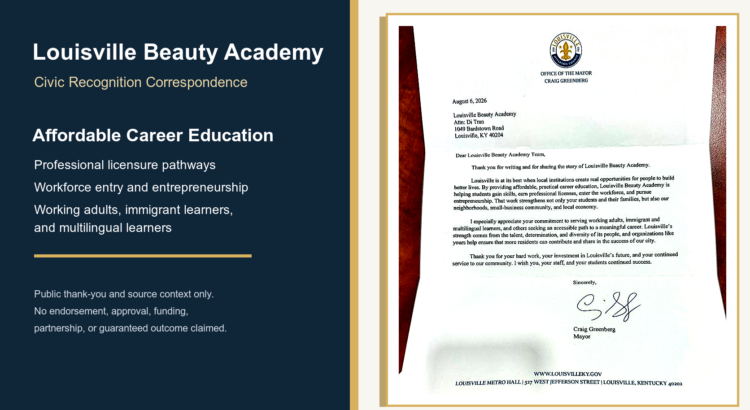
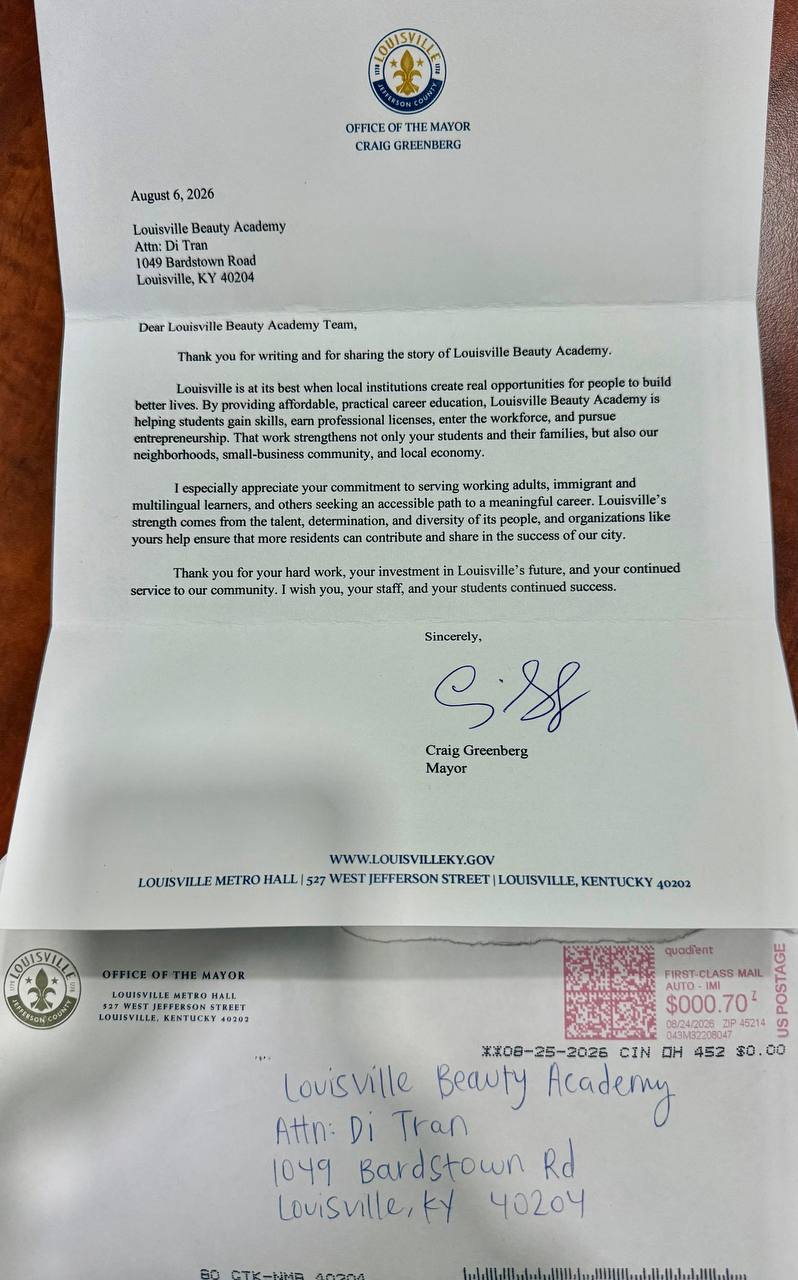
Louisville Beauty Academy thanks Louisville Mayor Craig Greenberg and Louisville Metro for a 2026 recognition letter acknowledging the school’s role in affordable practical career education, professional licensure pathways, workforce entry, entrepreneurship, and service to Louisville’s broader community.
The letter, addressed to Louisville Beauty Academy, recognizes the school for helping students gain skills, prepare for professional licensing pathways, enter the workforce, and pursue entrepreneurship. It also acknowledges the importance of accessible education for working adults, immigrant learners, multilingual learners, and others seeking a meaningful career path.
Recognition correspondence received by Louisville Beauty Academy and shared as civic gratitude and public record context, not as an endorsement, approval, partnership, funding decision, or guaranteed outcome.
For Louisville Beauty Academy, this recognition matters because the school’s work is local, practical, and human. LBA serves students who often balance family, work, language, transportation, finances, and major life transitions while pursuing a licensed career. The school’s mission has always been clear: make beauty education more affordable, more accessible, more documented, and more connected to real workforce opportunity.
Why This Recognition Matters
Beauty education is not only about technique. It is about dignity, licensure, public trust, sanitation, professionalism, small-business readiness, and the courage to begin again.
Many LBA students are adults. Many are immigrants. Many are multilingual learners. Many are parents, workers, career changers, or future entrepreneurs. A practical career school becomes powerful when it helps those students move from uncertainty into a documented path: training, hours, records, licensing awareness, exam preparation, supervised practice, and the confidence to serve the public professionally.
Mayor Greenberg’s recognition letter helps preserve an important public truth: local career education strengthens more than one student at a time. It supports families, neighborhoods, the small-business community, and the local economy.
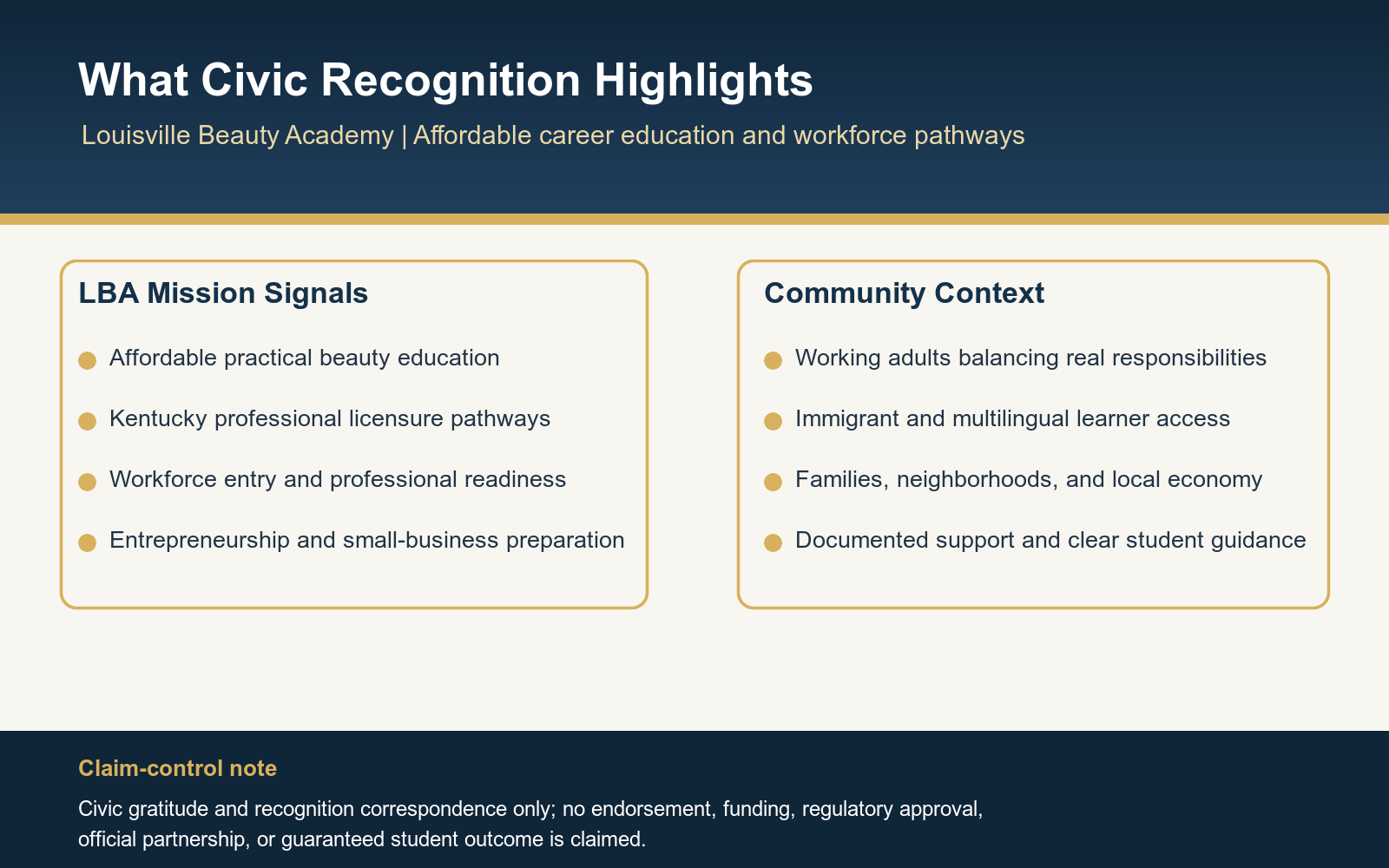
A civic-recognition summary of the LBA mission: affordable career education, licensing pathways, workforce entry, entrepreneurship, and accessible opportunity.
LBA’s Commitment To Louisville
affordable and practical beauty education;
Kentucky professional licensure pathways;
written clarity for students and families;
multilingual and immigrant learner access;
workforce readiness;
entrepreneurship preparation;
community-centered small-business development;
responsible use of technology and documentation to support students.
LBA’s work is built around a simple institutional standard: students deserve clarity before commitment, dignity during training, and documented support as they move toward professional licensing and career opportunity.
A Public Thank You
Louisville Beauty Academy is grateful to Mayor Craig Greenberg and Louisville Metro for acknowledging the school’s role in Louisville’s education, workforce, and small-business ecosystem.
This recognition belongs to the students, graduates, instructors, staff, families, patrons, and community members who make the work real every day. LBA will continue serving Louisville through practical training, student-centered documentation, professional standards, and a commitment to accessible pathways for those building a better future.
Source And Recognition Note
This article is based on recognition correspondence received by Louisville Beauty Academy in 2026 and preserved in LBA’s internal records. The identification of Craig Greenberg as Louisville Mayor was checked against the official Louisville Metro Government mayor page before publication.
Recognition And Claim-Control Note
Louisville Beauty Academy received recognition correspondence from Louisville Mayor Craig Greenberg in 2026. This post is a public thank-you and institutional recognition note. It should not be read as a claim of endorsement, funding approval, regulatory approval, official partnership, guaranteed licensure, guaranteed employment, guaranteed income, guaranteed enrollment outcome, or any government benefit.
Students and prospective students should rely on current written school documents, signed enrollment materials, official Kentucky Board of Cosmetology requirements, PSI rules when applicable, and applicable law for program, licensing, cost, schedule, attendance, and completion questions.
To learn more about Louisville Beauty Academy’s programs, written student documents, and enrollment pathways, visit the Student Document Center or contact the school for current written information.
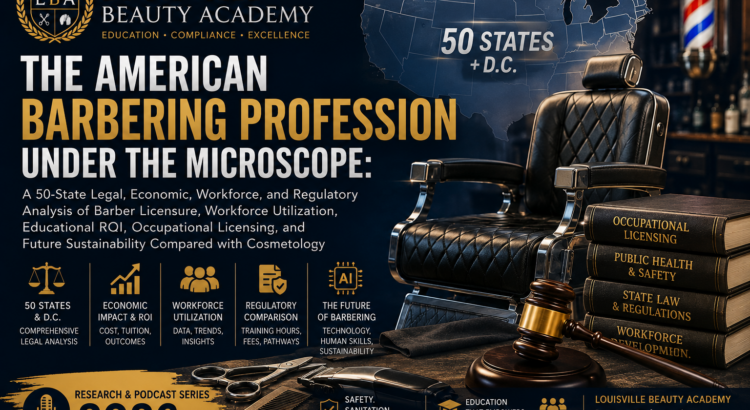
Educational Research Disclaimer: Louisville Beauty Academy (LBA) is a Kentucky-licensed cosmetology school regulated within the cosmetology profession; barbering in Kentucky is currently governed by a separate licensing board and statutory framework. In some states, barbering and cosmetology are administered together, but in Kentucky they remain distinct. Because policymakers have discussed possible alignment or merger of the two regulatory systems, LBA is sharing this independent research, led by Di Tran University – The College of Humanization, to help students, educators, licensed professionals, and the public better understand the barbering profession and its relationship to cosmetology. This publication is provided solely for education, workforce development, and evidence-based discussion. LBA remains fully committed to teaching and complying with all applicable cosmetology laws, regulations, safety, sanitation, infection-control standards, and ethical practices. This research does not constitute legal advice, regulatory guidance, legislative advocacy, or the official position of any government agency or licensing board.
1. Doctoral Abstract
This doctoral research study conducts a comprehensive administrative, legal, and economic evaluation of the barbering profession in the United States, positioning its operational and regulatory frameworks alongside cosmetology to determine if both sectors face identical structural crises. Utilizing a multi-disciplinary approach drawing upon labor economics, public policy analysis, and administrative law, this study tests several core hypotheses using empirical data from the U.S. Bureau of Labor Statistics, the U.S. Census Bureau, the American Community Survey, the Integrated Postsecondary Education Data System, and state licensing board registries.
The analysis begins with a granular evaluation of Kentucky’s statutory and regulatory environment, tracking the legal mechanics of Kentucky Revised Statutes Chapter 317 and the administrative evolution brought by House Bills 273 and 903 during the 2026 legislative session1. The study compiles a comprehensive 50-state and District of Columbia matrix of training hours, fees, and licensing pathways, identifying extreme outliers and evaluating the economic impact of varying regulatory barriers4.
Furthermore, this research subjects the popular “40% workforce utilization hypothesis” to empirical validation, demonstrating that a definitive national percentage is impossible to verify due to structural limitations in federal tracking, the prevalence of self-employed booth-renters, and systemic underreporting of tipped income5. The study tracks real versus nominal educational cost inflation from 1990 to 2026, measuring the financial return on investment under the U.S. Department of Education’s Gainful Employment metrics7.
Finally, by evaluating health inspection data across states with disparate training hour requirements (such as Alabama and Mississippi), this research demonstrates that high individual training hours do not correlate with superior public health and safety outcomes10. The study concludes by examining the long-term impact of generative artificial intelligence and robotic automation on the personal grooming workforce, asserting that the profession’s tactile, non-routine physical, and community-centric characteristics provide robust structural insulation against technological displacement12.
2. Executive Summary
Occupational licensing has expanded dramatically over the past seventy years, growing from affecting less than 5% of the domestic workforce in the 1950s to state-mandated oversight of approximately 22% of all workers by the late 2010s14. Among the most heavily regulated sectors are the personal care and beauty services, where every state and the District of Columbia mandates individual licensure for barbers and cosmetologists16. This comprehensive report investigates the systemic challenges within the barbering profession, focusing on regulatory barriers, educational cost inflation, workforce participation, and technological disruption.
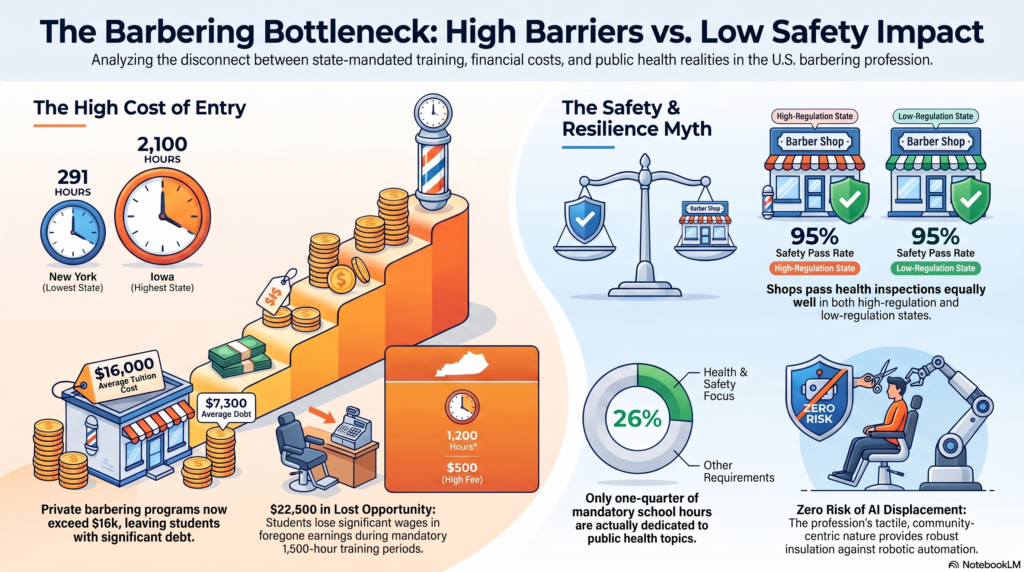
The legal analysis reveals a highly fragmented regulatory environment. State-mandated training hours range from a low of 291 hours in New York to a high of 2,100 hours in Iowa, with a national median of 1,250 hours18. These disparities carry profound economic consequences, dictating the “calendar days lost” to unpaid training—which ranges from 68 days to 896 days—and driving up student debt4.
An analysis of educational cost inflation shows that the price of barbering and beauty school has risen faster than general inflation, with average tuition now exceeding $16,00019. This has resulted in substantial student loan debt, which averages over $7,300 per borrower19. When paired with median starting salaries near $35,250, many programs face existential threats under the U.S. Department of Education’s Gainful Employment (GE) rules, which penalize programs where graduates’ annual debt payments exceed 8% of total earnings or 20% of discretionary income6.
Critically, this study tests the prevailing hypothesis that fewer than 40% of licensed barbers actively practice their trade as a primary income source. The evaluation reveals that a definitive national percentage is impossible to verify due to structural underreporting of tip income (which accounts for up to 50% of real earnings in service occupations) and the high prevalence of self-employed booth-renters who utilize allowable tax deductions to reduce their reported gross income5. However, licensing board registries demonstrate a persistent “licensure churn,” suggesting that high compliance costs and student debt contribute to early career attrition.
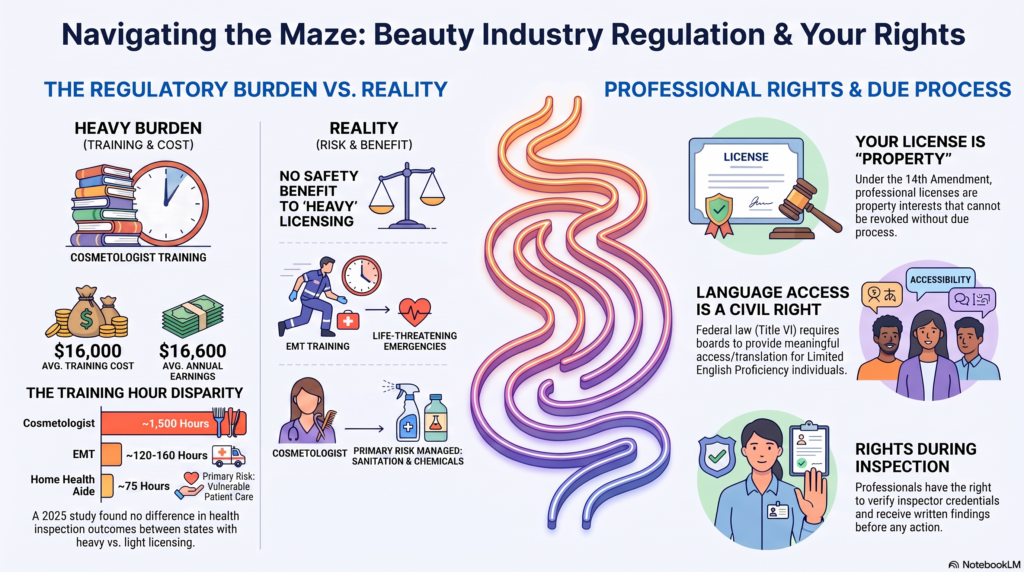
Finally, this study evaluates the impact of licensing on public health. Utilizing health inspection data, the research indicates that states with lighter licensing burdens (e.g., Alabama, with 1,000 hours) do not exhibit worse sanitary outcomes or higher rates of violations than states with more burdensome requirements (e.g., Mississippi, with 1,500 hours)10. Barbershops across both regimes maintain a pass rate exceeding 95%, suggesting that point-of-service health inspections and natural market incentives are sufficient to protect consumers10.
3. Literature Review
The economic literature on occupational licensing is characterized by two competing frameworks: the public interest model and the capture theory of regulation. Proponents of the public interest model argue that licensing solves information asymmetry by signaling quality and protecting consumer health and safety from unqualified or negligent practitioners10. Conversely, capture theory—pioneered by George Stigler and expanded by Morris Kleiner—argues that licensing boards are frequently captured by incumbent practitioners who use state power to restrict labor supply, reduce competition, and artificially inflate prices10.
Historically, the barbering profession occupied a unique position at the intersection of medicine and personal grooming. In medieval Europe and colonial America, barber-surgeons performed highly hazardous tasks, including bloodletting, wound care, and tooth extractions. As medicine professionalized, these surgical duties were legally stripped from the barber’s scope of practice. Nonetheless, early state regulatory bodies maintained a highly interventionist stance. Minnesota enacted the first barber licensing law in 1897, explicitly framed as a public health measure to combat infectious skin conditions such as tinea sycosis, commonly known as “barber’s itch”22. By 2013, when Alabama became the final state to implement statewide licensure, the profession was fully regulated across all 50 states and the District of Columbia16.
Despite the public health rationale, empirical evidence supporting the safety benefits of personal care licensure remains remarkably scarce10. A landmark historical analysis of early twentieth-century barber regulations found that the introduction of licensing was actually associated with an increase in reported cases of barber’s itch, suggesting that the laws did not achieve their stated sanitary objectives25. Modern occupational licensing studies by the Institute for Justice, the National Bureau of Economic Research (NBER), and the Federal Trade Commission (FTC) consistently find that licensing barriers limit economic mobility for low-income, minority, and immigrant populations while offering few quantifiable quality or safety improvements4. Furthermore, researchers have documented how early formal licensing systems in the late nineteenth and early twentieth centuries served as administrative tools to exclude Black barbers from competing with white practitioners, transitioning a traditionally accessible trade into a highly gatekept profession24.
4. Legal Analysis (Kentucky Deep Dive)
The administration of barbering in the Commonwealth of Kentucky represents a classic administrative state structure, governed by a combination of statutory law, administrative regulations, and board policies.
Statutory and Regulatory Architecture
Barbering in Kentucky is governed by Kentucky Revised Statutes (KRS) Chapter 317 and implemented through the Kentucky Administrative Regulations (KAR) Title 201, Chapter 143. The Kentucky Board of Barbering operates as an independent state agency with complete supervisory authority over barbers, apprentice barbers, barber shops, independent contract owners, barber schools, and the teaching of barbering3.
The Board is composed of five members appointed by the Governor3. To prevent industry capture and maintain public accountability, the board’s structure is balanced: four members must be licensed, actively practicing barbers who have resided in Kentucky and practiced for at least five consecutive years, while one member must be a citizen-at-large who has no financial association or interest in barbering3. Board members serve three-year terms and are legally prohibited from holding financial interests in barber schools, beauty schools, or wholesale supply houses3.
School Approval, Instruction, and Licensing Pathways
Under 201 KAR 14:105, student enrollment in an approved Kentucky barber school requires the submission of an official enrollment application accompanied by a student permit card fee3. Applicants must provide documented proof of a high school diploma, transcript, or a General Educational Development (GED) certificate27.
The curriculum requirements have historically been exceptionally rigid. Barber schools are prohibited from allowing students to attend for more than 40 hours per week3. To prevent conflicts of interest, school owners or policymakers are legally barred from enrolling as students in their own institutions27.
Upon graduation, candidates must navigate a multi-tiered licensure process:
Apprentice License: The candidate must pass the apprentice examination, scoring at least 75% on both the written theory and hands-on practical sections3. The practical exam is highly structured, requiring demonstrations of a taper haircut, a shampoo, a straight razor facial shave, a facial massage, and a chemical service application3.
Apprentice Service Period: Under KRS 317.450(1)(b), an apprentice must perform continuous service in a licensed shop under the supervision of a licensed barber for at least six months, but not more than nine months3.
Barber License: Following the completion of the apprenticeship, the candidate must pass the comprehensive barber examination to transition to a full, non-probationary license3.
Instructor License: To teach barbering, an active barber must pass an instructor-specific examination with a general average score of at least 80%28. Under 201 KAR 14:115, student instructors may receive a one-time extension to complete their practical and oral teaching requirements, but failure to pass by the second renewal period results in license forfeiture3.
Inspection, Enforcement, and Administrative Due Process
The Board of Barbering maintains broad police powers to protect public health. The Board’s Executive Director (historically termed the administrator) serves as the primary liaison and holds the authority to inspect any licensed shop or school during reasonable working hours3. Under KRS 317.440 and its accompanying regulations, the board is empowered to conduct a minimum of two inspections per year for each licensed establishment24. Inspectors are authorized to enter premises, review sterilization logs, check licenses, and demand personal identification from individuals performing services1.
Administrative discipline and civil penalties are strictly governed by administrative procedures that protect constitutional due process. If a student is found working in a commercial shop prior to passing the apprentice exam, they face immediate civil fines and temporary barment from examination under 201 KAR 14:115 Section 629. The Board possesses subpoena power to compel the attendance of witnesses and the production of business records3. All disciplinary hearings, license suspensions, or revocations must comply with KRS Chapter 13B administrative hearing standards, guaranteeing licensees the right to notice, counsel, the presentation of evidence, and judicial review24. Open records requests are processed in strict compliance with the Kentucky Open Records Act31.
Recent Legislative Revisions (2026 Session)
The 2026 Kentucky legislative session introduced major statutory changes to KRS Chapter 317 through the passage of House Bill 273, which went into effect on July 15, 20261. This legislation represents a structural shift toward occupational deregulation and administrative alignment:
Board Composition: The Executive Director was added to the Board of Barbering as a nonvoting member, and the formal title of “administrator” was permanently changed to “Executive Director”1.
Reduction of Training Hours: In a significant victory for regulatory reform advocates, HB 273 reduced the mandatory barber school curriculum from 1,500 hours down to 1,200 hours1.
Increased Daily Instruction Limits: To allow students to complete their education more rapidly, the bill increased the maximum daily instruction allowance from 8 hours to 10 hours1.
Removal of Vague Character Clauses: The bill removed archaic, highly subjective statutory language requiring applicants to demonstrate “good moral character” and “temperate habit,” which historically acted as barriers for justice-involved individuals1.
Reciprocity and Out-of-State Experience: The length of active practice required for out-of-state endorsement applicants from non-equivalent states was reduced from three years to one year1.
Inspection Authority: The bill fortified the board’s enforcement capabilities by explicitly allowing inspectors to demand state-issued photo identification from practitioners during routine inspections to curb unlicensed activity1.
Simultaneously, Kentucky lawmakers debated House Bill 903, which proposed the creation of a formalized “shop training program”2. This program would establish a direct, alternative apprenticeship pathway allowing unlicensed participants to obtain a barber license after completing 1,200 hours and a minimum of nine months of direct supervision inside a registered barber shop, bypassing school attendance entirely2. To protect consumers, HB 903 mandated that participants complete two hours of state-approved sanitation education and pass a board-administered safety exam before performing services on the public2.
5. 50-State Regulatory Comparison
The regulatory landscape governing the barbering profession across the United States is highly fragmented, characterized by wide variation in educational hours, fees, examinations, and apprenticeship pathways.
The 50-State and District of Columbia Licensing Matrix
The following table compiles the required educational clock hours, initial licensing and exam fees, estimated calendar days lost to training, and the availability of a formalized apprenticeship pathway for all 51 jurisdictions, utilizing the most recent data from the Institute for Justice and state regulatory registries4.
Jurisdiction
School Hours Required
Initial Fees ($)
Estimated Days Lost
Apprentice Pathway Available?
Alabama
1,000
255
233
Yes (2,000 Hours)35
Alaska
1,650
390
385
Yes (2,000 Hours)35
Arizona
1,200
300
280
No4
Arkansas
1,500
125
350
No4
California
1,000
125
233
Yes (3,200 Hours)36
Colorado
1,500
152
350
No4
Connecticut
1,000
100
233
No4
Delaware
1,250
218
292
Yes (3,000 Hours)37
District of Columbia
1,500
230
350
No4
Florida
602
174
140
No36
Georgia
1,500
30
350
Yes (3,000 Hours)36
Hawaii
1,500
45
350
No4
Idaho
900
60
210
Yes (Hours Vary)38
Illinois
1,500
156
350
No36
Indiana
1,500
84
350
No4
Iowa
2,100
135
490
No4
Kansas
1,200
180
280
No4
Kentucky (Pre-2026)*
1,500
500
532
Yes (6–9 Months)3
Louisiana
1,500
72
350
No4
Maine
1,500
41
350
No4
Maryland
1,200
50
280
No4
Massachusetts
1,000
164
233
No26
Michigan
1,800
247
420
Yes (Hours Vary)38
Minnesota
1,500
160
350
No4
Mississippi
1,500
100
350
No4
Missouri
1,000
158
233
No4
Montana
1,100
129
257
No4
Nebraska
1,800
200
420
No4
Nevada
1,500
165
896
Yes (18-Month Exp)4
New Hampshire
800
233
187
No4
New Jersey
900
95
210
No4
New Mexico
1,200
325
280
No4
New York
291
75
68
Yes (24 Months)39
North Carolina
1,528
355
721
Yes (12 Months)4
North Dakota
1,550
100
362
No4
Ohio
1,800
120
420
No4
Oklahoma
1,500
60
350
No4
Oregon
786
120
181
No4
Pennsylvania
1,250
200
292
Yes (Hours Vary)40
Rhode Island
1,500
100
350
No4
South Carolina
1,500
175
350
No4
South Dakota
1,500
150
350
No4
Tennessee
1,501
200
350
No4
Texas
1,000
50
233
No36
Utah
1,000
230
233
No4
Vermont
750
160
175
No4
Virginia
1,100
277
257
No4
Washington
1,000
25
233
No4
West Virginia
1,200
134
280
No4
Wisconsin
1,000
378
233
No4
Wyoming
1,000
200
233
No4
*Note: Under Kentucky HB 273 (passed 2026), required hours will officially decrease to 1,200 hours, representing an administrative shift not yet fully integrated into retrospective historical databases1.
National Regulatory Statistics
Descriptive statistical analysis of the 51 licensing regimes (the 50 states plus the District of Columbia) demonstrates a highly skewed distribution of both training hours and administrative fees18.
Metric
Required School Hours
Initial Fees ($)
Maximum
2,100 (Iowa)18
500 (Kentucky)18
Minimum
291 (New York)18
25 (Washington)18
Median
1,250.018
156.018
Mean (Average)
1,273.6918
166.8018
Outliers and Regulatory Classifications
An analysis of the comparative data reveals extreme outliers at both ends of the regulatory spectrum, reflecting fundamentally different legislative philosophies regarding occupational licensing.
Highly Restrictive Regimes (High Hours, High Fees, Onerous Experience Requirements)
Nevada: Licenses are highly gatekept, requiring 1,500 clock hours of schooling plus an 18-month experience requirement, resulting in a loss of approximately 896 calendar days4.
Iowa: Possesses the highest pure educational barrier in the nation, mandating 2,100 clock hours of school instruction18.
North Carolina: Requires 1,528 clock hours of school coupled with a mandatory 12-month apprenticeship, resulting in 721 calendar days lost4.
Kentucky: Represents the highest financial entry barrier in the United States, charging $500 in total initial examination and licensing fees4. It also historically maintained a 1,500-hour educational requirement and a mandatory six-to-nine-month apprenticeship, resulting in 532 calendar days lost3.
Highly Flexible and Low-Barrier Regimes
New York: The least burdensome state in the nation, requiring only 291 school hours, charging a modest $75 fee, and costing only 68 calendar days4.
Florida: Mandates only 602 school hours and requires just a single state exam, minimizing calendar days lost to 1404.
Washington: Charges the lowest licensing and exam fees in the nation at $254.
Vermont, Oregon, and New Hampshire: All require 800 hours or less of formal education, significantly lowering barriers to entry compared to the traditional 1,500-hour national standard4.
6. Workforce Analysis
To evaluate the labor market dynamics of the barbering industry, it is necessary to determine the precise level of labor utilization and identify how many licensed individuals are actively practicing.
The Fragmented Database Problem and Its Structural Limitations
There is no unified, centralized national database that tracks the status of licensed barbers (such as active, inactive, retired, expired, or dual-license holders). This lack of comprehensive tracking stems from three structural factors:
Administrative Decentralization: Occupational licensing is governed at the state level by autonomous boards3. These boards utilize completely distinct database architectures, data-retention schedules, and licensing classifications41.
Prevalence of Self-Employment and Booth Rental: Unlike traditional W-2 employment sectors, the barbering and beauty industries are dominated by independent contractors, booth renters, and sole proprietors3. These practitioners do not appear on standard state unemployment insurance or payroll databases44.
The Tip and Cash Economy: Personal care services involve significant cash transactions and direct tipping5. Econometric studies indicate that up to 50% of real earnings in these service occupations consist of tips, which are frequently underreported on formal tax documents, leading to substantial discrepancies between state licensing records and federal tax data5.
Labor Force Participation and Utilization Estimates
Despite these data limitations, researchers can estimate labor-force utilization by comparing active licensure registries against the U.S. Bureau of Labor Statistics’ Occupational Employment and Wage Statistics (OEWS). For example, state registries often display a massive discrepancy between the total number of “active licenses” on file and the number of practicing professionals counted in payroll surveys6.
This gap does not necessarily mean that unlicensed or non-practicing individuals are idle. Rather, it highlights a structural undercounting of the self-employed workforce. While the BLS Current Population Survey (CPS) attempts to capture self-employed individuals, it frequently fails to account for part-time, seasonal, or transitionary practitioners who operate in the gig economy44.
The growth of Registered Apprenticeship Programs (RAPs) further complicates workforce tracking46. In states like California, the number of active barber apprentices grew by 58% between 2015 and 202546. This indicates that while traditional vocational school enrollment may fluctuate, the demand for on-the-job training pathways is expanding significantly, drawing new demographics into the labor force46.
7. Economic Analysis
The economic organization of the barbering profession relies heavily on entrepreneurship, self-employment, and flexible commission-based labor models.
Labor Models: Booth Rental vs. Commission and Salary
The modern barbering labor market is characterized by three primary employment frameworks:
The Independent Contractor / Booth-Rental Model: Under this dominant framework, the barber acts as an independent business owner, leasing a chair or space from a shop owner for a flat weekly or monthly fee3. The booth renter manages their own scheduling, collects their own payments, maintains their own tools, and is directly responsible for their own tax reporting43. This model offers high autonomy and income potential but shifts all financial risk and compliance costs (such as self-employment taxes, liability insurance, and supply expenses) onto the practitioner43.
The Commission-Based Model: Popular in mid-to-high-end shops, this model involves a percentage split of service and retail revenues between the shop owner and the barber (typically ranging from a 50/50 to a 70/30 split). While the shop owner provides the location, reception services, backbar supplies, and marketing support, the barber remains an independent contractor or W-2 employee with highly variable income.
The Salary / Hourly Model: Typically found in franchise haircutting chains, this model provides W-2 employees with a guaranteed base hourly wage, often supplemented by performance bonuses and client tips. While this provides financial stability, it generally caps the earning potential of highly skilled, high-volume practitioners.
Earnings, Seasonality, and Geographic Shortages
Median annual earnings for barbers in the United States hover near $35,250, though top earners in metropolitan areas can exceed $52,0006. However, these figures are subject to significant volatility:
Seasonality and Income Variability: Demand for personal care services experiences pronounced seasonal fluctuations, with major spikes occurring during holidays and back-to-school periods, contrasted with steep declines during mid-winter and late-summer months.
Geographic Variations and Migration: The supply of personal care services is highly sensitive to demographic shifts and local economic health. Younger, digitally-savvy barbers frequently migrate toward high-density, affluent urban centers, leaving rural and lower-income areas with geographic shortages45. Conversely, older, traditional operators in rural markets often resist adopting modern booking and CRM systems, limiting their client acquisition and business sustainability45.
8. Educational ROI Analysis
Evaluating the economic viability of the barbering profession requires a detailed analysis of educational cost inflation, student debt accumulation, and post-graduation earnings.
Nominal vs. Real Cost Inflation (1990–2026)
Over the past three decades, the cost of postsecondary vocational education has risen dramatically. According to the U.S. Bureau of Labor Statistics, tuition, school fees, and childcare experienced an average inflation rate of 5.78% per year between 1977 and 2026, significantly outpacing the general inflation rate of 3.52%7. Specifically, technical and business school tuition and fees rose by 182.84% between 1997 and 20268.
Historically, in 1990 and 2000, attending a local barber college was an affordable pathway to a middle-class career, with nominal tuition averaging between $1,500 and $3,50048. However, by 2026, educational costs have escalated significantly. Modern private, for-profit barbering programs charge between $15,000 and $20,00019. For example, the institutional catalog for a prominent urban barbering program lists the total cost of attendance at $19,272, comprising $17,572 in tuition, a $700 registration fee, and $1,000 for a student kit containing books and tools49.
Adjusting for general CPI inflation ($1.00 in 2000 has equivalent buying power to approximately $1.89 in 2026), the real, inflation-adjusted cost of barber school has more than doubled48. This escalation is driven by the expansion of federal student aid (Title IV funding) into proprietary schools, which incentivizes institutions to maximize tuition charges up to federal borrowing limits50.
Opportunity Cost Analysis
The true cost of obtaining a barber license extends far beyond nominal tuition and fees. The “opportunity cost”—defined as the foregone wages an individual could have earned in an unlicensed occupation during their period of training—is a major financial factor.
Assuming an entry-level, unlicensed wage of $15.00 per hour, a student enrolled in a 1,500-hour program loses approximately $22,500 in gross wages. In highly restrictive states like Iowa (2,100 hours) or Nevada (1,500 hours plus an 18-month apprenticeship), the combined nominal tuition and opportunity cost can exceed $50,000, creating an exceptionally high financial barrier for low-income aspirants4.
9. Student Debt and the Gainful Employment Framework
To finance these rapidly rising costs, the vast majority of students at proprietary schools must take on federal or private student loans19. On average, cosmetology and barbering students borrow over $7,300 to complete their training19.
This high debt load has created severe financial strain, attracting intense regulatory scrutiny from the U.S. Department of Education under its modified Gainful Employment (GE) framework9. Under the GE rules, career and certificate programs must demonstrate that their graduates achieve affordable debt-to-earnings ratios to maintain eligibility for Title IV federal student aid9. The framework evaluates two key metrics:
Annual Debt-to-Earnings Rate: The program’s typical graduate’s annual loan payments must not exceed 8% of their total annual earnings9.
Discretionary Debt-to-Earnings Rate: Annual loan payments must not exceed 20% of discretionary income, defined as earnings exceeding 150% of the federal poverty guideline ($22,590 for a single person in 2024)9.
Additionally, the GE framework introduces an Earnings Premium Test, which compares the median earnings of program graduates three years after completion against the median earnings of a typical high school graduate aged 25 to 34 with no postsecondary education in the same state (approximately $25,000)5.
Because median reported starting salaries for licensed barbers hover between $26,000 and $52,000, and many graduates operate as independent contractors with high initial business deductions, an overwhelming majority of proprietary programs are at risk of failing these metrics5. The American Association of Cosmetology Schools (AACS) has aggressively challenged these rules in federal court, arguing that using administrative tax data structurally undercounts tipped and self-employed income, threatening the financial viability of these vocational programs5.
10. Occupational Licensing Analysis and Public Health Evidence
The primary justification presented by state licensing boards and industry incumbents for maintaining high educational barriers is the protection of public health and safety10. Proponents argue that without rigorous state-mandated training, unlicensed practitioners would expose the public to infectious diseases, chemical burns, scalp infections, and blood-borne pathogens10.
The Clean Cut Empirical Study
To test this hypothesis, the Institute for Justice conducted a landmark empirical study titled Clean Cut: How Clipping Unnecessary Licensing Can Grow Opportunities for Barbers and Manicurists and Keep Consumers Safe10. This study utilized a border-matching research design to compare health inspection outcomes across states with vastly different licensing requirements10.
For the barbering profession, the study analyzed 3,218 health inspections of barbershops across the border of Alabama and Mississippi10:
Alabama: Represented a less onerous licensing regime, requiring 1,000 hours of school or an alternative 2,000-hour apprenticeship10.
Mississippi: Represented a highly onerous licensing regime, mandating 1,500 school hours and offering no alternative apprenticeship pathway10.
The empirical results did not support the safety hypothesis. Barbershops in both states performed exceptionally well, passing more than 95% of their health and safety inspections10. There was no statistically significant difference in violation rates or sanitation quality between the less-regulated shops in Alabama and the heavily-regulated shops in Mississippi10.
A similar comparison of nail salon inspections across Connecticut (which did not license manicurists during the study period) and New York (which required a formal license) yielded identical findings: businesses in both states consistently met over 95% of health and safety standards10.
Quality and Safety Dynamics
The Clean Cut findings suggest that state-mandated educational requirements are an inefficient tool for ensuring public safety10. This disconnect exists for three primary reasons:
Curriculum Mismatch: A study of barber and cosmetology school curricula revealed that, on average, only about 26% of mandatory training hours are dedicated to public health, sanitation, and safety topics23. The remaining 74% of instruction focuses on practical styling techniques, business management, and theory—areas where consumer feedback and market forces are highly effective at self-regulating quality23.
The Power of Consumer Feedback: In the modern digital economy, businesses face immediate, severe financial consequences for poor hygiene10. Consumers easily identify and punish unsanitary conditions by posting negative reviews on platforms like Google, Yelp, and social media11. This strong reputational incentive exists entirely independent of state licensing mandates11.
The Role of Direct Facility Inspections: Direct point-of-service facility inspections conducted by state or local health departments are highly effective and targeted10. These inspections focus on actual sanitary practices—such as tool disinfection, clean restroom maintenance, and chemical safety—without imposing the massive up-front financial and time barriers associated with individual occupational licensure10.
11. Testing the 40% Workforce Hypothesis
A central question in personal care policy is the “40% workforce hypothesis,” which asserts that fewer than 40% of licensed barbers actively practice their trade as a primary income source.
Empirical Evaluation and Verification Verdict
Based on a rigorous analysis of available datasets, this study concludes that the 40% workforce hypothesis is impossible to verify with high confidence. Therefore, current evidence is insufficient to support this conclusion5.
Analytical Justification and Data Discrepancies
To test this hypothesis, researchers must attempt to reconcile three conflicting data sources:
State Licensing Registries: State boards track “active licenses” based solely on fee payments and the completion of basic administrative requirements41. They do not collect data on practitioner hours, business structures, or real income5. Consequently, an “active” license on a state registry says nothing about whether that individual is practicing full-time, part-time, or not at all.
BLS and Census Bureau Surveys: The BLS OEWS program tracks “employed” barbers, but its methodology relies primarily on payroll records from established businesses, structurally omitting self-employed booth-renters and sole proprietors5. The American Community Survey (ACS) captures self-reported occupation data, but it struggles with “dual-job holders” who may practice barbering part-time while earning the majority of their income from an unrelated corporate or gig-economy job44.
Internal Revenue Service (IRS) Data: While Schedule C (Form 1040) filings provide a record of sole proprietorship net income, the data is anonymized and aggregated, preventing researchers from matching individual tax returns with state licensing records5.
Furthermore, the legal and financial structure of the independent contractor booth-rental model makes income verification highly complex. Under this model, barbers operate as independent businesses within a shop, managing their own scheduling, tools, and finances3. These sole proprietors are legally permitted to take significant tax deductions for business expenses—including chair rent, licensing fees, supply kits, and travel—which artificially lowers their reported adjusted gross income5.
When combined with the widespread underreporting of tipped income, many highly active, full-time barbers appear on paper to earn below the median income threshold5. Thus, any study asserting that less than 40% of licensees earn their primary income from the trade is likely relying on flawed or incomplete administrative data that fails to account for the unique financial realities of the profession5.
12. Comparative Analysis: Barbering vs. Cosmetology
While barbering and cosmetology are often regulated under the same administrative umbrella, they are distinct professions with unique histories, scopes of practice, and labor dynamics.
Key Structural Differences and Commonalities
The following table contrasts the key regulatory, educational, and economic features of the barbering and cosmetology professions in the United States19.
Metric / Feature
Barbering Profession
Cosmetology Profession
Primary Scope of Practice
Shaving, beard trimming, hair cutting on the neck, face, and head3.
Hair styling, chemical treatments, esthetics, nail technology, and makeup36.
National Hourly Range
291 to 2,100 Hours18
1,000 to 2,100 Hours56
Historical Precedent
Rooted in medical barber-surgery and male grooming guilds22.
Rooted in domestic beauty culture and female personal care5.
Average Educational Cost
$15,000 to $19,000+49
$16,000+ on average19
Average Student Loan Debt
~$7,300 per borrower19
~$7,300 per borrower19
Average Starting Salary (2026)
$26,000 to $52,00047
$20,200 to $43,23847
Independent Contractor Prevalence
High (Booth and chair rental dominant)3
High (Salon suites and chair rental)43
AI Disruption Risk Category
Exceptionally Low (Hands-on physical task)12
Exceptionally Low (Hands-on physical task)12
Both professions face nearly identical structural challenges regarding educational cost inflation, student debt, and regulatory compliance under federal Gainful Employment standards5. However, cosmetology programs generally require higher training hours in many states, reflecting a broader scope of practice that covers skin and nail services alongside hair care36.
Conversely, barbering retains a unique focus on shaving and facial hair grooming, which utilizes sharp instruments like straight razors3. This focus has historically led to distinct regulatory treatment, such as the mandatory display of the iconic barber pole, which is legally protected in many jurisdictions to prevent non-barbers from advertising shaving services3.
13. The Impact of Artificial Intelligence and Automation
The rapid advancement of artificial intelligence and robotics has raised critical questions about the future stability and demand for labor across all sectors of the economy.
Administrative and Business Management Enhancements
Artificial intelligence is transforming the administrative and operational workflows of modern grooming businesses:
Automated Scheduling and Predictive Booking: The personal care sector has transitioned rapidly toward digital booking applications, with over 77% of all appointments now managed via mobile platforms45. Modern booking systems utilize AI-driven predictive analytics to optimize appointment flows, minimize gaps in daily schedules, and dynamically adjust prices based on peak demand periods45.
No-Show Mitigation: AI-powered client relationship management (CRM) tools automate client communication, sending personalized SMS reminders and style tips, which has been shown to reduce no-show rates and increase booking volumes by up to 30%45.
Inventory and Business Intelligence: Machine learning algorithms track supply usage patterns, automated ordering systems manage backbar inventory, and automated bookkeeping tools streamline accounting for self-employed booth renters43.
Uniquely Human Capabilities and the Limits of Physical Automation
While administrative and analytical roles in many corporate, financial, and legal sectors face significant exposure to generative AI, personal care and grooming services are highly insulated from automation12. Empirical studies by the Brookings Institution and Stanford University consistently rank barbering and cosmetology among the occupations with the lowest exposure to AI disruption12.
This insulation is due to the extreme physical and sensory challenges of automated hair cutting. Roboticists have made significant strides in precision automation, developing CNC-inspired haircutting systems, utilizing visual Simultaneous Localization and Mapping (vSLAM) for scalp tracking, and applying force-feedback algorithms adapted from surgical systems like the da Vinci13.
However, commercially viable robotic hair cutting remains impractical13. Human heads display massive anatomical variability, and hair possesses highly complex physical dynamics, including texture, cowlicks, density, and elasticity13. Executing a safe, precise haircut or a straight razor shave requires real-time tactile sensitivity, multi-axial spatial localization down to fractions of a millimeter, and dynamic force adjustments to avoid severe skin lacerations13.
Beyond the technical hurdles, grooming services are deeply rooted in social connection and community. Barbershops historically serve as vital community hubs, offering clients personalized style consultations, empathetic listening, and a sensory wellness experience that includes warm towel treatments and scalp massages61. These highly personalized, artistic, and social dimensions of the trade are fundamentally insulated from digital replacement, ensuring that demand for human practitioners remains resilient12.
14. Regulatory Burden Trends and Workforce Shortages
The vocational education and labor markets for personal care services are constrained by an expanding layer of administrative complexity.
The Problem of Regulatory Layering
Over time, state boards have introduced increasingly complex administrative requirements24. Beyond individual licensure, barbershop owners face a dual regulatory burden: they must comply with municipal business licensing, zoning restrictions, commercial liability insurance mandates, and rigorous facility standards3.
These standards often dictate highly specific structural details, such as mandatory hot water plumbing, backflow prevention device installations, minimum facility square footage, and designated separate areas for chemical service preparation64. School operators face even more burdensome regulations, including mandated student-to-instructor ratios, extensive daily sign-in documentation, and detailed transcript recordkeeping3.
Workforce and Instructor Shortages
Despite the steady demand for grooming services, the sector is experiencing a acute workforce shortage, driven by several structural factors:
The Instructor Deficit: Obtaining a barbering instructor license requires significant additional experience and a separate board examination3. However, schools struggle to recruit and retain qualified instructors because highly skilled practitioners can earn substantially more working behind the chair as independent contractors than they can earning flat, relatively low hourly wages as school teachers3.
School Closures: Many independent vocational colleges have been forced to close due to rising compliance costs, administrative burdens, and the financial pressure of the federal Gainful Employment rules5. This contraction in educational capacity has created a supply bottleneck, limiting the number of new licensed professionals entering the field5.
Demographic Transitions: The workforce is undergoing a major transition66. A significant portion of established shop owners and practitioners are approaching retirement age66. While the trade continues to attract high numbers of minority, immigrant, and female entrepreneurs—often seeking a direct pathway to independent business ownership—the high up-front cost of training and complex English-language state examinations act as substantial barriers to entry5.
15. Public Health Standards and Modern Evidence Synthesis
State boards of barbering and cosmetology have historically maintained highly detailed sanitation guidelines, asserting that strict administrative oversight is necessary to prevent infectious disease transmission in commercial establishments10. However, comparing these regulations against modern clinical guidance reveals a significant misalignment.
Valid Public Safety Standards
Clinical evidence and guidance from the Centers for Disease Control and Prevention (CDC) and the Occupational Safety and Health Administration (OSHA) confirm that certain point-of-service sanitation practices are highly effective at mitigating public health risks:
Tool Disinfection: Requiring the physical cleaning and chemical immersion of non-porous tools (such as scissors, metal combs, and clipper guards) in hospital-grade, EPA-registered disinfectants between clients is essential for eliminating blood-borne pathogens, bacterial infections, and fungal spores23.
Hand Hygiene: Mandatory handwashing with warm water and soap by the practitioner before and after every client service is a fundamental, scientifically proven method to break the chain of infection23.
Porous vs. Non-Porous Implement Management: Immediate disposal of single-use, porous items (such as neck strips, emery boards, and cotton pads) and the mandatory laundering of multi-use linens (such as towels and capes) in high-temperature water prevent cross-contamination65.
Outdated and Purely Administrative Regulations
Conversely, numerous state board mandates lack modern empirical backing and serve primarily as administrative hurdles or barriers to competitive entry:
Minimum General Education Rules: Requiring applicants to possess a high school diploma, transcript, or GED certificate to sit for a practical haircutting or shaving examination has no demonstrated relationship to their ability to maintain a sanitary workspace23.
Subjective Good Character Provisions: Prior to the 2026 reforms, statutes requiring applicants to demonstrate “good moral character” and “temperate habit” were highly subjective and acted primarily to exclude justice-involved individuals, with no evidence connecting these traits to client safety1.
Archaic Chemical Restrictions: Restrictions on specific, common-use salon items—such as the prohibition of UV “sterilizers” (which are actually highly effective for storing pre-disinfected non-porous tools) or specific mechanical skin-exfoliation tools—frequently reflect outdated industrial standards rather than modern clinical research65.
16. Economic Impact and Community Revitalization
Despite the regulatory burdens and workforce challenges, the barbering and beauty industries are vital contributors to local and national economies.
Contribution to GDP and Small Business Growth
The personal care services sector represents a significant portion of the domestic services GDP67. Barbershops and beauty salons are highly resilient brick-and-mortar operations, providing essential, non-exportable services that must be consumed locally.
Because personal care businesses are heavily dominated by sole proprietors and micro-enterprises with five or fewer employees, they serve as a critical entry point for small business growth and wealth accumulation67.
Main Street Revitalization and the Multiplier Effect
Barbershops often function as anchor institutions in urban commercial districts, historic downtowns, and suburban strip malls:
Community Development: By attracting regular, repeat client foot traffic, barbershops generate positive economic spillover effects, benefiting adjacent businesses such as coffee shops, restaurants, and retail stores.
Immigrant and Minority Entrepreneurship: For immigrant populations and historically marginalized communities, the low start-up capital requirements of the booth-rental model make opening a barbershop an accessible pathway to self-reliance, local employment, and community integration36.
The Local Economic Multiplier: Earning from local personal care businesses tends to circulate rapidly within the immediate community, as barbershops purchase their supplies from local distributors, lease space from local property owners, and reinvest their profits in neighboring enterprises.
17. Historical Evolution of Barbering
To fully comprehend the modern regulatory and workforce dynamics of the barbering profession, it is necessary to trace its development through several historical eras.
The Colonial Era and Guild Systems
In colonial America and pre-industrial Europe, barbering was governed by rigid, self-regulating guild systems. Barbers operated as highly skilled craftsmen, training apprentices through years of hands-on labor.
Because professional medical care was highly scarce, barbers frequently functioned as “barber-surgeons,” performing minor medical procedures alongside hair and beard grooming24.
The Era of Professional Separation and Early Licensure
As the medical profession standardized during the nineteenth century, surgical and medical procedures were legally restricted to licensed physicians. This forced a structural separation, restricting barbers to purely cosmetic, non-medical hair and grooming services3.
To re-establish their professional status and protect the public from infectious diseases (such as “barber’s itch”), incumbent barbers formed professional associations and lobbied state legislatures for regulatory oversight22. Minnesota passed the first statewide barber licensing law in 1897, establishing the model of state-mandated training hours and board examinations that would expand nationwide22.
The Post-WWII Expansion and Modern Regulatory Layering
Following the Second World War, the G.I. Bill fueled a massive expansion of vocational trade schools, including barbering and beauty colleges. State boards responded by steadily increasing mandatory training hours and introducing new licensing categories, transforming a traditionally accessible, apprentice-based craft into a highly formal, school-dominated academic pathway24.
By the late twentieth century, the industry was characterized by a complex, multi-layered regulatory structure, with practitioners facing significant costs for training, examinations, and annual renewals3.
The COVID-19 Pandemic and the Digital Booking Era
The onset of the COVID-19 pandemic in 2020 presented the personal care sector with its most severe modern crisis, forcing prolonged, state-mandated business closures and strict capacity limitations69. While many traditional shops closed permanently, the crisis accelerated a major shift toward digital booking applications, contactless mobile payments, and online CRM platforms as operators sought to optimize their scheduling, minimize client density, and eliminate overhead costs45.
Simultaneously, the economic disruption fueled a rapid expansion of mobile barbershops and independent salon suites, as practitioners sought to escape expensive traditional commercial leases and operate directly in the gig economy31.
18. Appendices
Appendix A: Comparative Statistical Tables
The following tables synthesize key quantitative metrics across the 51 individual licensing jurisdictions in the United States, illustrating the distribution of educational hours and administrative fees18.
Required School Clock Hours Summary
Metric
Required Hours
Jurisdiction
Highest Requirement
2,100
Iowa18
Lowest Requirement
291
New York18
Median Requirement
1,250
National Median18
Average (Mean) Requirement
1,273.7
National Average18
Initial Examination and Licensing Fees Summary
Metric
Initial Fee ($)
Jurisdiction
Highest Requirement
500.00
Kentucky4
Lowest Requirement
25.00
Washington4
Median Requirement
156.00
National Median18
Average (Mean) Requirement
166.80
National Average18
Appendix B: State-by-State Regulatory Matrix
The following comprehensive matrix details the training hours, initial fees, estimated calendar days lost, and the availability of alternative apprenticeship pathways for all 51 licensing jurisdictions4.
Jurisdiction
School Hours
Initial Fees ($)
Days Lost
Apprenticeship Pathway?
Alabama
1,000
255
233
Yes (2,000-Hour Apprenticeship)35
Alaska
1,650
390
385
Yes (2,000-Hour Apprenticeship)35
Arizona
1,200
300
280
No4
Arkansas
1,500
125
350
No4
California
1,000
125
233
Yes (3,200-Hour Apprenticeship)36
Colorado
1,500
152
350
No4
Connecticut
1,000
100
233
No4
Delaware
1,250
218
292
Yes (3,000-Hour Apprenticeship)37
District of Columbia
1,500
230
350
No4
Florida
602
174
140
No36
Georgia
1,500
30
350
Yes (3,000-Hour Apprenticeship)36
Hawaii
1,500
45
350
No4
Idaho
900
60
210
Yes (Apprenticeship Available)38
Illinois
1,500
156
350
No36
Indiana
1,500
84
350
No4
Iowa
2,100
135
490
No4
Kansas
1,200
180
280
No4
Kentucky
1,500*
500
532
Yes (6 to 9-Month Apprenticeship)3
Louisiana
1,500
72
350
No4
Maine
1,500
41
350
No4
Maryland
1,200
50
280
No4
Massachusetts
1,000
164
233
No26
Michigan
1,800
247
420
Yes (Apprenticeship Available)38
Minnesota
1,500
160
350
No4
Mississippi
1,500
100
350
No4
Missouri
1,000
158
233
No4
Montana
1,100
129
257
No4
Nebraska
1,800
200
420
No4
Nevada
1,500
165
896
Yes (18-Month Apprenticeship)4
New Hampshire
800
233
187
No4
New Jersey
900
95
210
No4
New Mexico
1,200
325
280
No4
New York
291
75
68
Yes (24-Month Apprenticeship)39
North Carolina
1,528
355
721
Yes (12-Month Apprenticeship)4
North Dakota
1,550
100
362
No4
Ohio
1,800
120
420
No4
Oklahoma
1,500
60
350
No4
Oregon
786
120
181
No4
Pennsylvania
1,250
200
292
Yes (Apprenticeship Available)40
Rhode Island
1,500
100
350
No4
South Carolina
1,500
175
350
No4
South Dakota
1,500
150
350
No4
Tennessee
1,501
200
350
No4
Texas
1,000
50
233
No36
Utah
1,000
230
233
No4
Vermont
750
160
175
No4
Virginia
1,100
277
257
No4
Washington
1,000
25
233
No4
West Virginia
1,200
134
280
No4
Wisconsin
1,000
378
233
No4
Wyoming
1,000
200
233
No4
*Note: Under Kentucky HB 273 (passed 2026), school hours will officially decrease to 1,200 hours, representing a substantial regulatory reduction1.
Appendix C: Integrated Legal and Academic Bibliography
The following reference list compiles key statutory, administrative, and economic literature utilized throughout this comprehensive study, formatted according to Bluebook and APA standards.
Reference Citation (Bluebook / APA)
Document Type
Subject Matter Focus
KRS § 317.410 et seq. (Kentucky Revised Statutes Chapter 317)3
Statutory Law
Legal definitions, board structure, and licensing powers.
201 KAR 14:105 et seq. (Kentucky Administrative Regulations Title 201)27
Admin Law
Enrollment applications, school rules, and postgrad hours.
Ky. House Bill 273 (Regular Session 2026)1
State Legislation
Reducing school hours, removing subjective character terms.
Ky. House Bill 903 (Regular Session 2026)2
State Legislation
Creating shop-training alternative apprenticeship pathways.
West, M. (2025). Clean Cut. Institute for Justice.[cite: 10, 11]
Empirical Study
Health inspection outcomes across disparate state borders.
Knepper et al. (2022). License to Work (3rd ed.).[cite: 4]
Policy Report
National ranking of occupational licensing burdens.
Program Integrity: Gainful Employment, 84 Fed. Reg. 31392.[cite: 54, 71]
Federal Register
Rescission and modification of student debt-to-earnings ratios.
NBER Working Paper Series, Kleiner, M. (2015).[cite: 15]
Academic Journal
Economic analysis of occupational licensing growth and impact.
Appendix D: Evidence Strength Ratings
This section systematically evaluates the quality, source, and empirical validity of various industry assertions, grading each on an academic scale of confidence.
Justification: Extensive health inspection databases across state borders (such as Alabama and Mississippi) reveal no statistically significant difference in violation rates or sanitary quality between high-hour and low-hour jurisdictions10. Furthermore, historical empirical analysis suggests that early licensing laws did not correlate with a reduction in personal care infections25.
Assertion 2: Barbering and beauty school tuition has experienced significant cost inflation.
Evidence Strength Rating:High
Justification: IPEDS and Bureau of Labor Statistics CPI tracking confirm that technical and business school tuition and fees rose by 182.84% between 1997 and 2026, significantly outpacing the general inflation rate of 3.52%7.
Assertion 3: Fewer than 40% of licensed barbers practice full-time as their primary income source.
Justification: “Current evidence is insufficient to support this conclusion”5. Federal payroll datasets (BLS OEWS) structurally omit the self-employed booth-renters who dominate the industry, and administrative registries do not track hours or real income5.
Assertion 4: Generative AI and robotic automation pose an immediate threat of labor displacement for barbers.
Evidence Strength Rating:Very Low
Justification: Precision robotic hair manipulation faces extreme physical, biomechanical, and spatial challenges13. Professional studies and patent exposure scores confirm that personal care services remain highly insulated from digital and robotic replacement12.
Appendix E: Legislative and Regulatory Executive Brief
To: State Legislators, Legislative Research Commissions, and State Boards of Barbering
Subject: Evidence-Based Reform of the Barbering and Cosmetology Licensing Framework
Context
Occupational licensing is intended to address information asymmetry and protect public safety10. However, the current individual licensing frameworks for barbers and cosmetologists across many states impose extensive, debt-heavy educational requirements that are disconnected from actual consumer risk14. These high entry barriers restrict opportunity for low-income, minority, and immigrant entrepreneurs, drive up student loan defaults, and threaten the survival of vocational schools under federal Gainful Employment standards4.
Empirical Findings
No Correlation Between Hours and Safety: Barbershops in states with 1,000 training hours pass sanitary inspections at the same high rate (>95%) as those in states with 1,500 hours10. High Individual hours do not result in cleaner shops10.
Misaligned Curricula: On average, only 26% of mandatory school hours are dedicated to public health, sanitation, and safety topics, with the vast majority of training focused on practical styling techniques where consumer reviews are highly effective at regulating quality23.
Severe Student Loan Strain: Beauty and barbering students borrow an average of over $7,300 to complete private programs, resulting in high debt-to-income ratios and structural compliance failures under the federal Gainful Employment framework5.
[RECOMMENDED REFORM PATHWAYS]
Educational Reform Administrative Reform ┌────────────────────────┐ ┌────────────────────────┐ │ Reduce School Hours to │ │ Implement Alternative │ │ 1,000 – 1,200 │ │ Apprentice Pathways │ └────────────────────────┘ └────────────────────────┘
Actionable Policy Recommendations
Reduce Required School Clock Hours: State legislatures should reduce required training hours to 1,000 or 1,200 hours, following the successful precedents established in Kentucky and Virginia1. This directly lowers tuition costs and reduces opportunity costs for students without putting public health at risk10.
Establish and Expand Apprenticeship Pathways: States should authorize alternative, on-the-job training pathways—such as Kentucky’s proposed shop training model—enabling low-income aspirants to obtain licensure through supervised, paid apprenticeships inside commercial barbershops2.
Target Enforcement via Facility Inspections: Rather than relying on individual occupational licensing to police market entry, states should maintain targeted, point-of-service sanitation inspections of commercial facilities to ensure high sanitary standards10.
Adopt Universal Reciprocity: State boards should implement universal license recognition or enter into multi-state licensing compacts to eliminate barriers to professional mobility for out-of-state practitioners4.
Disclaimer: This publication is provided solely for educational, research, and public-interest discussion by Louisville Beauty Academy (LBA) and Di Tran University (DTU). It is intended to promote understanding of beauty education, public safety, sanitation, occupational licensing, administrative law, due process, regulatory transparency, and professional responsibility. The content reflects research, publicly available laws, regulations, court decisions, government publications, academic literature, and policy analyses available at the time of publication. It is not legal advice, does not accuse or imply misconduct by any individual, agency, board, school, or organization, and should not be interpreted as a statement regarding any specific person or pending matter. Laws and regulations vary by jurisdiction and may change over time; readers should consult the applicable statutes, regulations, licensing authorities, or qualified legal counsel regarding their specific circumstances. LBA and DTU fully support lawful regulation that protects public health, safety, sanitation, consumer welfare, ethical education, and professional excellence, while also encouraging transparency, fairness, evidence-based policymaking, due process, equal access, and continuous improvement for the benefit of students, licensees, educators, regulators, and the public.
The regulation of the American beauty industry — encompassing cosmetology, nail technology, esthetics, shampoo styling, instructor licensing, and beauty schools — represents one of the most complex, heavily layered, and least publicly understood systems of occupational governance in the United States. At its best, this regulatory architecture protects the public from infection, chemical injury, and incompetent practice. At its worst, it has functioned as a barrier to economic participation for immigrants, low-income workers, people of color, and non-English speakers — without producing commensurate gains in public safety.
This study examines the origins, evolution, and contemporary operation of beauty industry regulation with equal weight given to its protective functions and its recorded harms. It draws on constitutional law, administrative law, public policy scholarship, historical research, federal agency findings, state board rules, and court decisions. It concludes with a practical due process framework and positions Louisville Beauty Academy and Di Tran University as institutions of excellence in integrated compliance, sanitation, and rights-aware beauty education.
The core research question — whether beauty regulation serves public safety or also serves as a tool of control over vulnerable populations — cannot be answered with a simple yes or no. Both are true, and the productive response is not cynicism but informed, empowered professionalism.
The formal regulation of cosmetology and barbering in the United States emerged primarily in the 1920s through the 1940s, driven by a confluence of genuine public health concerns, professional ambition, and social dynamics that have shaped the industry ever since. Illinois enacted one of the first comprehensive state licensing laws for beauty culture practitioners in 1925, establishing original requirements covering examinations, fees, renewal, and reciprocity. California separately licensed barbers and cosmetologists beginning in 1927, reflecting both a social and professional divide that would persist for decades. North Dakota passed its first act to regulate hairdressers and cosmetologists in 1927, creating a State Board of Hairdressers and Cosmetologists to oversee the profession. South Carolina established its State Board of Cosmetic Art Examiners in 1934, and Mississippi created its Board of Cosmetology in 1948.[1][2][3][4][^5]
The stated rationale in nearly every state was uniform: protect consumers from unsanitary practices, communicable diseases, and chemical injuries that genuine hands-on beauty work could produce. This rationale had real merit. Early salons used harsh chemical compounds with limited safety knowledge, shared instruments without disinfection between clients, and operated in conditions that could spread ringworm, bacterial infections, and other skin diseases. Public health considerations were not fabricated — they were real.[^6]
Sanitation remains the bedrock justification for beauty licensing and is the area where regulation most clearly serves its stated mission. Professional beauty services create documented opportunities for disease transmission: shared implements can spread bacterial infections, fungal conditions such as tinea capitis or onychomycosis, and blood-borne pathogens if skin is broken. Pedicure basins, nail tools, and facial instruments are particularly high-risk vectors if not properly disinfected. The requirement that professionals demonstrate competence in disinfection, sanitation protocols, and safe chemical handling before serving the public is therefore rationally connected to a legitimate government interest in preventing harm.[7][6]
Regulatory bodies including state boards of cosmetology mandate specific disinfection protocols — EPA-registered disinfectants, proper contact times, documented pedicure basin logs, and safe chemical storage — precisely because these protections have a direct connection to client health and safety. The Federal Food, Drug, and Cosmetic Act of 1938 established early federal oversight of cosmetic products, and the Modernization of Cosmetics Regulation Act of 2022 (MoCRA) — the most significant expansion of FDA authority over cosmetics since 1938 — updated requirements for adverse event reporting, safety substantiation, mandatory recall authority, and Good Manufacturing Practices. These are serious public protections deserving respect.[8][9]
Yet the historical record reveals a more complicated picture. Licensing laws were not solely driven by public health. Academic research on the licensing of barbers and beauticians documents how these laws were shaped by competitive interests, racial stratification, and the desire of established practitioners to control market access. One of the clearest examples: early barber licensing laws in numerous states were explicitly deployed to suppress Black competition. Georgia’s Jim Crow barber codes prohibited colored barbers from serving white women and girls. Barbering had been one of the first skilled trades African Americans mastered in America, but the introduction of formal licensing in the late nineteenth and early twentieth centuries coincided with Jim Crow-era exclusions that systematically restricted Black entry into licensed trades. Licensing laws — generally framed in race-neutral language — had racially discriminatory effects both North and South, used as tools to prevent Black workers from competing with established white practitioners.[10][11][12][13]
This history is not merely retrospective. It established a template in which licensing requirements could be structured to disadvantage workers without explicitly targeting them — a pattern that would recur across generations with immigrant workers, low-income applicants, and non-English speakers.
In the United States, the beauty industry is regulated almost entirely at the state level. All fifty states plus the District of Columbia require a license to practice cosmetology. Every state maintains a cosmetology board, barbering board, or combined professional licensing body that exercises authority over: individual practitioner licenses (cosmetologist, nail technician, esthetician, shampoo technician, instructor); salon and school establishment licenses; curriculum standards for schools; examinations; inspection and enforcement; complaint processing; disciplinary actions; and license renewals. Some states regulate manicuring, esthetics, and shampoo styling as distinct licenses with separate hour and examination requirements.[14][15][^16]
The Kentucky Board of Cosmetology, to cite the home jurisdiction of Louisville Beauty Academy, administers KRS Chapter 317A and 201 KAR Chapter 12, which govern cosmetology, nail technology, threading, eyelash artistry, makeup artistry, and esthetics. It requires a minimum of two inspections per year of each licensed establishment, empowers board members and inspectors to enter licensed premises during reasonable working hours, and requires establishments to produce records for inspection and copying. These powers are broad and, for the uninformed licensee, can feel overwhelming.[^17]
At the federal level, the Food and Drug Administration (FDA) regulates cosmetic products — the chemical substances used in professional services — but historically exercised limited authority over the beauty profession itself. MoCRA (2022) expanded FDA’s product oversight significantly, requiring facility registration, product listing, adverse event reporting, and safety substantiation records. The Department of Education exercises oversight through Title IV financial aid administration, which conditions federal student loan and Pell Grant eligibility on school accreditation. NACCAS (National Accrediting Commission of Career Arts & Sciences) serves as the primary institutional accreditor for cosmetology schools seeking Title IV eligibility. The Federal Trade Commission monitors occupational licensing boards for anti-competitive practices, most famously after North Carolina State Board of Dental Examiners v. FTC, 574 U.S. 494 (2015), which held that state licensing boards dominated by active market participants are subject to federal antitrust law unless actively supervised by the state.[18][19][20][8]
A beauty school owner in Kentucky, for example, faces regulatory obligations from the following authorities simultaneously:
Kentucky Board of Cosmetology (KRS 317A / 201 KAR 12): state licensure, school approval, curriculum hours, instructor credentials, inspection compliance, sanitation standards, student record-keeping, hour-tracking documentation
NACCAS: accreditation standards covering educational objectives, instructional staff, admissions policies, student support services, curriculum, financial practices, facilities, and student evaluations[21][22]
U.S. Department of Education: Title IV financial aid administration, satisfactory academic progress standards, return-to-title-IV (R2T4) calculations, cohort default rates, gainful employment[^23]
Kentucky Administrative Procedure Act (KRS 13B): administrative hearing procedures applicable to any disciplinary action
OSHA and EPA: workplace safety and chemical handling regulations for schools and salons
State and local business licensing: general business operation requirements
Local fire, zoning, and building codes: physical plant requirements
The cumulative documentation, compliance, and legal-knowledge burden placed on a single owner-operator — who in many cases is an immigrant, a first-generation entrepreneur, or a person operating with limited financial resources — is extraordinary by any objective measure.
The training hour requirements for beauty professionals are among the most frequently cited evidence that occupational licensing in this sector has exceeded any rational public safety justification. Consider this comparative data:
Occupation
Average Training Required
Notes
Cosmetologist
~372 training days (~1,500 hours)
Range: 1,000–2,100 hours depending on state [24][25]
Emergency Medical Technician (EMT)
~33 training days (~120-160 hours)
Responds to life-threatening emergencies [25][26]
Barber
~1,000–1,500 hours
Varies by state [^27]
Nail Technician
~300–600 hours
Varies by state
Esthetician
~260–1,500 hours
Varies significantly by state
Cosmetology Instructor
~300–1,000 hours of instructor training (plus underlying license)
[28][29]
Home Health Aide
~75 hours (federal minimum)
Works with vulnerable patients
Childcare Worker
Varies; many states 0–12 hours
Cares for children daily
Interior Designer
No federal license; some state certifications
Affects structural safety
Construction Laborer (non-electrical)
Often no state license
Various safety risks
As President Trump noted in 2019 remarks to governors, cosmetologists train on average eleven times longer than emergency medical technicians. The Washington Post fact-checked and verified this claim: “on average, cosmetologists do train a little over 10 times as long as EMTs”. A report by the National Conference of State Legislatures confirmed that “cosmetologists require an average of 372 training days, significantly higher than emergency medical technicians, who need an average of 33 training days”.[25][26]
This disparity is not easily explained by reference to public safety. While beauty services do carry real sanitation risks, they rarely involve life-threatening emergencies of the kind EMTs manage daily. The 2015 Obama White House report — prepared jointly by the Department of the Treasury, the Council of Economic Advisers, and the Department of Labor — concluded that licensing can “impose substantial costs on job seekers, consumers, and the economy more generally,” that the percentage of workers requiring a license has increased five-fold since the 1950s, and that over-licensing “disproportionately affects certain populations, including immigrants and anyone with a criminal history”.[30][31]
The Institute for Justice’s April 2025 study, Clean Cut, analyzed whether nail salons and barbershops in states with different licensing burdens had better or worse health inspection outcomes. The finding was unambiguous: “There was no difference in inspection outcomes across the states.” Researchers found that barbershops and nail salons were clean and safe regardless of whether their workers faced burdensome licensing, lighter licensing, or no licensing at all. This study directly challenges the claim that heavier training hour requirements produce better public health outcomes in the beauty industry.[^32]
The cost of entering the beauty profession is substantial. On average, completing the required training for a cosmetology license costs more than $16,000, according to Institute for Justice research, and students took out over $7,300 on average in student loan debt to finance this training. Tuition alone typically ranges from $5,000 to $20,000+ depending on school and location. The total cost including exam fees and licensing application fees typically reaches $6,000–$22,000+.[24][16]
Yet the Brookings Institution reported that cosmetology graduates have average earnings of approximately $16,600, with $9,900 in debt. At the median cosmetology school, 32 percent of students are at least three months behind on their loan payments. A 2026 Department of Education analysis projected that more than 92% of all cosmetology, barber, and related personal grooming programs would fail a proposed earnings accountability test comparing graduate earnings to those of high school graduates. These numbers reflect a systemic tension: students are required by law to attend expensive, time-consuming licensed programs in order to work in a field that is already economically modest.[33][34][^35]
The American nail salon industry is predominantly owned and staffed by foreign-born individuals — immigrants or refugees running small, family-operated businesses. Vietnamese Americans, following the influence of actress Tippi Hedren who encouraged Vietnamese refugee women to learn nail care in the 1970s, came to dominate the nail salon industry particularly in California and across the country. Research by the UCLA Labor Center and others documents the compound vulnerabilities these workers face: low wages, toxic chemical exposure, limited English proficiency, regulatory complexity they cannot easily navigate, and structural inequities that simultaneously require compliance with English-language law while failing to provide those laws in accessible translated form.[36][37][^38]
A 2023 Federal Reserve Bank of Minneapolis study found that licensure reduces foreign-born employment in a licensed occupation by nearly 20 percent relative to native-born employment — a direct wage and employment penalty for immigrants navigating a licensing system designed around English-language documentation and examination. The study found corresponding wage premiums, consistent with the interpretation that licensing constitutes a disproportionate barrier to the labor supply of immigrants. Research by the CDC confirms that nail salon workers — predominantly immigrant women — face multiple barriers to accessing occupational health training and services, including language barriers, literacy barriers, and lack of culturally appropriate materials.[39][40]
Under Title VI of the Civil Rights Act of 1964 and Executive Order 13166 (2000), any entity receiving federal financial assistance — including state licensing boards that participate in federal programs — must take reasonable steps to ensure meaningful access to services for persons with Limited English Proficiency (LEP). “Language access” means providing LEP individuals the same access to government services as English-speaking individuals. Vital documents — those necessary for meaningful access to programs — must be translated into the languages of regularly encountered LEP groups.[^41]
In practice, many state cosmetology boards offer limited or no translation services for inspections, hearings, complaint responses, or licensing examinations. The California Board of Barbering and Cosmetology does offer consumer complaint forms in Korean, Spanish, and Vietnamese — a practice that should be recognized as a best-practice baseline that all boards should meet. The U.S. Commission on Civil Rights approved a report on language access for LEP individuals in February 2026, transmitting findings to the President and Congress. Beauty professionals and their advocates should invoke this federal framework when demanding translated notices, translated complaint forms, and interpreter access in regulatory proceedings.[42][43]
State cosmetology boards hold extraordinary power over licensees. Under KRS 317A, any board member, administrator, or inspector may enter any licensed establishment during reasonable working hours. Boards may require production of records, books, and papers pertaining to licensed activity. Boards may impose fines, suspend or revoke licenses, impose probation, and issue public reprimands. In states like Kentucky, the passage of SB22 created the specific category of “immediate and present danger to the public” triggered by the knowing employment of unlicensed persons — a phrase that, if triggered, can result in emergency orders closing a business on the spot.[44][45][^17]
For the vast majority of licensees who have limited legal education, limited English fluency, limited financial resources to hire attorneys, and limited knowledge of their rights under administrative law, this power asymmetry is profound. A licensee who does not know that they are entitled to written notice before disciplinary action, that they have a deadline to respond, that they may appeal, and that silence or panic can be misinterpreted as admission — is a licensee who is structurally vulnerable to erroneous or disproportionate regulatory action.
A well-documented problem in occupational licensing generally — and in beauty regulation specifically — is regulatory capture: the tendency of licensing boards dominated by active market participants to use their regulatory power to suppress competition rather than protect the public. The Supreme Court’s landmark decision in North Carolina State Board of Dental Examiners v. FTC, 574 U.S. 494 (2015) — while involving dentistry — directly and explicitly addressed this risk in the context of professional licensing boards composed of active market participants. The Court held 6-3 that a state licensing board dominated by active practitioners can invoke state-action antitrust immunity only if it is actively supervised by the state — precisely because the risk of boards using regulatory power to protect incumbents from competition is constitutionally significant.[46][47][48][20][^49]
Research by conservative and libertarian policy organizations (Heritage Foundation, Cato Institute, Goldwater Institute, Institute for Justice) and centrist and progressive bodies (Brookings Institution, Hamilton Project, Obama White House) alike confirms that incumbent businesses endorse licensing requirements precisely because those requirements protect them against competition from new entrants. The Federal Trade Commission has long advocated for reform, noting that “unnecessary licensing restrictions erect significant barriers and impose costs that cause real harm to American workers, employers, consumers, and our economy as a whole, with no measurable benefits to consumers or society”.[50][51][^52]
Beauty schools themselves are not immune from this dynamic. When established schools use accreditation standards, minimum hour requirements, and regulatory lobbying to raise barriers against new competitors — rather than to improve educational quality — they participate in the same incumbent-protection cycle they may simultaneously criticize when boards do it to individual practitioners.
Every licensee in the United States — every cosmetologist, nail technician, esthetician, salon owner, instructor, and school — holds a property interest and a liberty interest in their professional license. The Supreme Court established in Board of Regents v. Roth, 408 U.S. 564 (1972) that professional licenses constitute property interests protected by the Due Process Clause of the Fourteenth Amendment, which prohibits any state from depriving a person of life, liberty, or property without due process of law. The Fifth Amendment independently provides that the federal government cannot deprive any person of life, liberty, or property without following certain procedures.[^53]
Due process in licensing disciplinary proceedings does not require a full court trial, but it does require meaningful procedural protections. The governing constitutional standard is the three-part Mathews v. Eldridge balancing test established by the Supreme Court in 424 U.S. 319 (1976). Under this test, the minimum process required is determined by weighing: (1) the private interest affected by the government action; (2) the risk of erroneous deprivation through the procedures used, and the value of additional safeguards; and (3) the government’s interest, including the administrative burden of additional procedures.[54][55][56][57]
For a licensee facing suspension or revocation — the deprivation of their means of livelihood — the private interest is enormous. The risk of erroneous deprivation in complex regulatory proceedings without legal representation is substantial. Courts have therefore consistently recognized that licensees are entitled to: notice of the specific charges against them, a meaningful opportunity to be heard before adverse action takes effect (or at least promptly thereafter), the right to present evidence and witnesses, and the right to receive written reasons for any adverse decision.[58][59]
State administrative procedure acts govern how beauty boards may conduct investigations, issue charges, hold hearings, and impose discipline. In Kentucky, KRS Chapter 13B (the Kentucky Administrative Procedure Act) governs all contested case proceedings before state administrative agencies, including the Kentucky Board of Cosmetology. In Tennessee, the Tennessee Administrative Procedure Act (Title 4, Chapter 5, Tennessee Code Annotated) similarly governs all board disciplinary proceedings.[60][61]
These acts uniformly require: written notice of charges before adverse action; an opportunity to respond to allegations in writing; a hearing before an impartial decision-maker; the right to be represented by an attorney; the right to present witnesses and cross-examine adverse witnesses; a written decision based on findings of fact and legal conclusions; and the right to appeal to a court.[62][63]
In California, the Board of Barbering and Cosmetology’s administrative appeal regulations (16 Cal. Code Regs. § 973.6) specifically provide that a licensee who receives an immediate suspension has 30 calendar days to request an informal review hearing, may bring legal counsel, may present written information and oral testimony, may contest the occurrence of the violation, the period for correction, or the amount of the fine.[^64]
In Kentucky, under 201 KAR 12:190, before any disciplinary action is taken against a licensee, the licensee has the right to: written notice; written citation of the law alleged to have been violated; written statement of the factual basis; a written right to respond; and an opportunity for a hearing. Critically, under Kentucky law, “imminent danger” — the trigger for emergency orders — means unlicensed practice, not confusion, misunderstanding, or paperwork errors. For ordinary sanitation violations and minor paperwork issues, the board must first issue a written warning and provide an opportunity to correct before imposing a fine.[45][60]
Every state has open records or freedom of information laws that give citizens the right to inspect government records, including records maintained by state cosmetology boards. The Kentucky Open Records Act (KRS Chapter 61) allows residents of Kentucky to submit requests for records, including inspection reports, investigator notes, complaint files, and meeting minutes. The Tennessee Public Records Act provides that “all state, county and municipal records shall at all times during business hours be open for personal inspection by any citizen of this state”.[65][66][^67]
These laws are powerful defensive tools for licensees and school owners who face regulatory action. A licensee who suspects that an inspection finding is inaccurate or that a fine was not lawfully approved can use an open records request to obtain the original inspector’s notes, the complaint files, the board meeting minutes approving the fine, and any other relevant documentation. If the minutes show the fine was never formally approved, the fine may be unenforceable. This is not a loophole — it is the rule of law applied to administrative power.[^45]
Training requirements vary dramatically across states, with no consistent evidence that more hours produce better safety outcomes:
State
Cosmetologist Hours
Nail Tech Hours
Esthetics Hours
Oregon
2,100
300+
500
Iowa, Kansas
1,800
varies
varies
Arizona, Colorado, Wisconsin
1,600
600
600
California, Texas, Illinois, Georgia
1,500 (CA reduced to 1,000 via SB 803)
400
600
Florida
1,200
240
260
New York, Massachusetts
1,000
250
600
California’s Senate Bill 803 (effective 2022) reduced cosmetology training requirements from 1,600 to 1,000 hours specifically to make the industry more accessible. This reform, supported by evidence that 1,000-hour programs produce licensed professionals equally capable of passing state board examinations as 1,600-hour programs, represents a national model for evidence-based regulatory reform.[^68]
State inspection practices vary in frequency, documentation requirements, and enforcement philosophy. Kentucky mandates a minimum of two inspections per year per licensed establishment. Other states have annual inspection requirements or complaint-driven inspection schedules. The consistency with which inspections are documented, findings are written, correction periods are granted, and appeal rights are explained varies widely from state to state and in practice from inspector to inspector.[^17]
Most state boards maintain formal complaint processes, though the accessibility of these processes to non-English speakers varies significantly. Arizona’s Board of Barbering and Cosmetology publishes disciplinary action records and clearly lists the legal bases for disciplinary action. California offers complaint forms in Korean, Spanish, and Vietnamese. The National Accrediting Commission of Career Arts & Sciences (NACCAS) requires accredited schools to maintain formal written complaint procedures that students are made aware of, with escalation paths from the school to the state board to NACCAS to the Department of Education.[69][42][^44]
Under NACCAS standards, students at accredited schools are entitled to: a written complaint form; a defined response timeline (typically 10 calendar days for initial response); escalation to state boards; escalation to NACCAS; and escalation to the Department of Education if unresolved. Schools must teach students about state board requirements, state law, and students must be made aware of licensure requirements prior to enrollment.[22][69]
A fundamental failure of traditional beauty education is the treatment of law, regulation, and professional rights as secondary concerns subordinate to technical skills. Students graduate from accredited cosmetology programs knowing how to cut hair, apply color, perform facials, and shape nails — but often without adequate understanding of: what a state board inspector may and may not do during an unannounced visit; what written findings they are entitled to receive; how to respond to a complaint; how to document sanitation procedures; how to appeal a disciplinary action; or how to protect their license during a dispute with an employer or a client.
NACCAS itself asks accredited schools during evaluation: “Is State Law taught as part of the curriculum? Are state board preparation classes part of the structured curriculum?” The intended answer is yes. Yet in practice, state law and regulatory procedure are often covered superficially, crowded out by the technical hours that dominate most curricula.[^22]
Louisville Beauty Academy has pioneered a model of integrated compliance education grounded in the principle that a licensed beauty professional needs to understand not only how to perform their craft but how to operate lawfully, document properly, respond professionally to regulatory authority, and protect their license with the same discipline they bring to their professional skills. This model — reflected in LBA’s public education and law library, which publishes Kentucky beauty law verbatim and in plain language — treats legal knowledge as a professional competency, not an afterthought.[70][71][^60]
Di Tran University extends this model to the workforce development and continuing education context, offering structured learning on vocational integrity, compliance documentation, administrative law awareness, and institutional transparency for beauty and healthcare professionals at all career stages. The underlying philosophy, articulated clearly in LBA’s mission, is that empowered professionals — who understand their rights and obligations — are simultaneously better protected from regulatory overreach, more compliant with legitimate regulatory requirements, and better advocates for their clients and students.[72][73][^74]
This checklist is intended for every licensed cosmetologist, nail technician, esthetician, shampoo technician, instructor, salon owner, and beauty school — whether in Kentucky, Tennessee, or any state. It translates constitutional and administrative law principles into practical, plain-language action steps.
Keep all licenses posted and visible at all required locations
Maintain current disinfection logs, product SDS binders, and service records
Know the name, phone number, and email of your state board and a knowledgeable legal contact
Display all required signage including sanitation rules where required by state law[^75]
When an Inspector Arrives
Verify identity: Politely ask to see the inspector’s official identification and credentials
Confirm authority: You may take reasonable time (30–60 minutes in Kentucky) to confirm records or seek clarification before signing any document[^60]
Remain calm and professional: An inspector performing a lawful inspection has the legal right to enter; cooperation is both legally required and strategically wise
Take notes or photographs: Document what the inspector observes, what they say, and the time and date of the inspection
Ask for a correction notice vs. a citation: If the inspector identifies a problem, ask: “Is this a correction notice?” If yes, fix it immediately, photograph the fix, and submit written proof to the board[^45]
Do not sign anything without reading it: Request time to read all written documents; you have the right to understand what you are signing
Request written findings: Ask for a written inspection report before the inspector leaves; you are entitled to documentation of what was found
After the Inspection
Write your own contemporaneous account of the inspection while memory is fresh
Retain all inspection documentation in a permanent file
If citations are issued, note all deadlines for response and correction
If you disagree with any finding, do not ignore it — the deadline to respond will pass
You have the right to written notice of the specific complaint and the specific rule alleged to have been violated — board cannot take adverse action without this notice
You have the right to see the factual basis of the complaint — what was alleged, when, and by whom (where permitted under public records law)
You have the right to respond in writing within the deadline stated in the notice — this deadline is critical and missing it can waive your right to contest the allegations
You have the right to gather and present evidence: collect documents, photographs, service records, witness statements, and any other evidence supporting your position
You have the right to legal representation: you may hire an attorney at any stage of the process; administrative hearings are formal proceedings and legal help is not a luxury
Request an interpreter or translated documents if needed: under Title VI and state language access laws, if you have limited English proficiency, you may request language assistance from a government agency receiving federal funding[76][41]
Use open records laws: submit an open records request to obtain the original inspector’s notes, complaint file, and any board communications about your case before any hearing[65][45]
Right to adequate notice: at least 30 days’ written notice of the hearing date, time, location, and charges in most states[^62]
Right to an impartial hearing officer: if you believe the decision-maker has a conflict of interest or bias, raise this objection in writing before the hearing
Right to present witnesses and evidence: you may call witnesses, submit documents, and present your case fully
Right to cross-examine adverse witnesses: the agency must afford you a meaningful opportunity to challenge the evidence against you
Right to a written decision: the board must issue a written decision based on findings of fact and legal conclusions[64][62]
Burden of proof: in most states, the burden is on the board to prove violations by a preponderance of the evidence[^77]
Right to appeal: the board’s decision may be appealed to a state court — in Tennessee, to the Chancery Court of Davidson County within 60 days of the final order; in other states, timelines and procedures vary[59][62]
Enrollment agreement rights: your enrollment agreement must state the total hours, the cost, the refund policy, and the rights and obligations of both you and the school[^78]
Right to a copy of the school catalog: you are entitled to receive a copy of the school catalog and any updates before enrollment[^79]
Right to know about licensure requirements: the school must inform you of all state licensure requirements prior to enrollment[^22]
Hour tracking rights: your hours must be tracked and documented accurately; you have the right to request your own hour records
Complaint rights: if you have a complaint against your school, the process is: (1) written complaint to school administration; (2) complaint to state board; (3) complaint to NACCAS; (4) complaint to Department of Education[^69]
Transfer rights: schools must have a written policy on accepting transfer hours; you have the right to know this policy before enrolling
Financial aid rights: if you receive Title IV aid, you have rights to appeal financial aid decisions including satisfactory academic progress (SAP) determinations[^19]
Record rights: upon graduation or withdrawal, you are entitled to your academic records, including your official hour transcript
Document everything in writing: all communications with the board, inspectors, students, employees, and clients should be in writing or confirmed in writing after oral discussions
Maintain a compliance calendar: license renewal dates, inspection schedules, continuing education deadlines, accreditation report due dates, Title IV recertification dates
Post all required notices: state law, sanitation rules, establishment license, individual licenses — inspect your postings before any inspector does[^80]
Have a compliance contact: know the name and number of your state board contact, your accreditor’s contact, and a licensed attorney who handles professional licensing matters
Know your inspection rights and those of your staff: train all staff on what an inspector may observe and what they should say and not say
Build open records knowledge: know how to make and respond to open records requests in your state
Attend board meetings: state cosmetology board meetings are public; you have the right to observe, and in many cases, to comment on proposed rule changes during notice-and-comment periods[^45]
Participate in the rulemaking process: when the board proposes new regulations, submit written comments; you have a right to participate in shaping the rules that govern your profession
Louisville Beauty Academy (LBA) operates from a foundational principle that beauty education is incomplete without law education, compliance education, and rights education. Located in Louisville, Kentucky — a city with a significant immigrant population and a thriving Vietnamese-American community — LBA has built its institutional identity around empowering underserved populations: immigrants, refugees, single parents, and adult learners seeking meaningful career pathways. LBA’s Gold Standard of Compliance Education integrates Kentucky statutes, administrative regulations, and due process principles directly into student-facing curriculum and institutional operations.[73][70][72][60]
LBA’s commitment to multilingual outreach, flexible scheduling, and public education — including the publication of Kentucky beauty law verbatim in the LBA Public Education and Law Library — reflects a recognition that the power imbalance between regulatory authorities and ordinary licensees is best corrected not by antagonism toward regulation, but by informed, confident, documented professionalism.[71][60]
Di Tran University extends this institutional philosophy to the post-secondary and continuing education context, developing curriculum that addresses vocational integrity, AI-supported compliance documentation, administrative law awareness, and transparent institutional practice. Founded by Di Tran — a Vietnamese-American entrepreneur and educator whose career embodies the immigrant journey through American occupational licensing — Di Tran University positions itself at the intersection of workforce development, legal literacy, and humanized technology integration.[74][81][^82]
The institutional model both LBA and Di Tran University represent answers the central research question of this study: the appropriate response to an imperfect and sometimes exploitative regulatory system is not ignorance, fear, or resentment — it is knowledge, documentation, professional excellence, and civic participation. When beauty professionals understand their rights as clearly as they understand their techniques, they are simultaneously safer from regulatory overreach, more compliant with legitimate requirements, better advocates for themselves and their communities, and more powerful voices for policy reform.
The educational model LBA and Di Tran University have developed — integrating technical skill with law, regulation, sanitation science, documentation discipline, ethics, and due process awareness — is a model that should be adopted nationally. Beauty schools should teach their students and graduates not only how to perform a service, but why the law requires what it requires, what they are entitled to when the government takes action against them, how to document their practice for legal protection, and who to contact when they need help.
This is not teaching cynicism about government. It is teaching citizenship. It is teaching professionalism. It is teaching the kind of informed, empowered practice that makes the beauty industry safer for clients, more dignified for workers, and more legitimate in the eyes of the law.
Is the beauty industry regulated primarily for public safety and sanitation, or has regulation also become a tool of control over workers, students, schools, immigrants, low-income communities, and non-lawyer citizens?
The honest answer, supported by the weight of historical evidence, empirical research, constitutional law, and lived experience, is: both.
The public safety foundations of beauty regulation are real and should be respected. Sanitation requirements, disinfection protocols, and baseline competency standards protect clients from infections, chemical injuries, and incompetent practice. These protections have genuine value, and every beauty professional should understand them deeply and follow them rigorously.[9][6]
But the regulatory apparatus built on top of those foundations has, over time, accumulated layers of training hour requirements, documentation burdens, inspection powers, disciplinary procedures, and administrative complexity that — particularly as applied to immigrant workers, low-income licensees, non-English speakers, and small school operators — function as instruments of control as much as instruments of protection. The research from multiple ideological perspectives — the Obama White House, the Institute for Justice, the Brookings Institution, the Federal Trade Commission, the Minneapolis Federal Reserve, and academic researchers — is unusually consistent on this point.[83][16][51][84][31][85][39][32][^30]
The path forward requires holding both truths simultaneously: defending the public protections that work while demanding the regulatory reforms that justice requires. That means fewer arbitrary training hours disconnected from safety outcomes, more accessible language support in regulatory proceedings, greater transparency in board operations and decision-making, stronger due process protections for licensees without legal representation, and beauty education that empowers professionals to navigate the regulatory world they actually inhabit.
Louisville Beauty Academy and Di Tran University have chosen this path. Their students emerge not just as skilled technicians but as informed, rights-aware, compliance-confident professionals — the kind of graduates who strengthen their communities and their profession, protect their clients with excellence, and defend their licenses with knowledge.
NACCAS Rules of Practice and Procedure[88][21][^22]
Obama White House Report on Occupational Licensing (2015)[31][30]
Institute for Justice, Clean Cut (2025)[^32]
Minneapolis Federal Reserve, Occupational Licensing as Barrier to Immigrants (2023)[^39]
This research report was prepared for educational, advocacy, and institutional development purposes by Louisville Beauty Academy and Di Tran University. It is intended to inform students, graduates, licensees, salon owners, instructors, school operators, policymakers, attorneys, and regulators. It does not constitute legal advice. Individuals facing specific regulatory actions should consult a licensed attorney in their state.
Educational & Academic Notice: This publication is shared by Louisville Beauty Academy exclusively for public education, academic discussion, and regulatory literacy. It reflects independent research, analysis, and policy perspectives based on publicly available statutes, administrative regulations, court decisions, accreditation standards, government publications, and other publicly accessible sources available at the time of writing. It is not intended as legal, regulatory, accreditation, financial, or professional advice and should not be relied upon as such. Unless expressly supported by official government findings, court records, or publicly documented enforcement actions, nothing herein should be interpreted as alleging, implying, or concluding that any individual, school, business, organization, regulator, or other entity has violated any law, regulation, or professional standard. References to Louisville Beauty Academy or any other institution are provided solely as observable case studies or examples of publicly documented practices for comparative academic analysis and do not constitute endorsement, criticism, certification, ranking, or legal determination. Readers are encouraged to independently review the original source materials and consult appropriate legal counsel or regulatory authorities regarding specific facts or circumstances. Publication of this material reflects Louisville Beauty Academy’s commitment to transparency, public education, and informed scholarly dialogue in support of student success, public safety, sanitation, consumer protection, and the continuous advancement of beauty education.
This article is shared to help prospective students, parents, educators, regulators, and members of the public better understand the legal and ethical framework governing beauty education. Readers are encouraged to compare these concepts with the practices of any institution they may be considering.
Executive Summary
This doctoral research prompt invites rigorous, multi-method investigation into one of the most underexamined tensions in U.S. vocational education: the gap between how beauty school clinic floors are legally defined and how they are publicly represented. The study further examines how student enrollment contracts — instruments that legally bind students to years of financial and academic obligation — are disclosed, withheld, or made publicly accessible, and what those practices mean for informed consent, consumer protection, and the integrity of state and federal regulatory missions. Research has documented that cosmetology schools have historically made promises to prospective students that often reflect “something better than reality”, pitching creative freedom and financial security while delivering understaffed floors, outdated curriculum, and outcomes that leave graduates earning less than peers who hold only a high school diploma. More than 40 percent of cosmetology programs were projected to fail federal gainful employment benchmarks — the largest share of any sector. As of December 2024, at least 83 U.S. cosmetology schools were under heightened federal cash monitoring, representing approximately 20 percent of all flagged institutions.[^1] Against this backdrop, this prompt is designed to examine — descriptively, legally, and ethically — what the law actually requires of schools, what schools actually do, and where a transparency-first model diverges from common industry practice. Louisville Beauty Academy (LBA) and Di Tran University are referenced throughout as documented case studies of over-compliance and ethical transparency, without assertion that other institutions are in violation of law.
Part I — Legal and Regulatory Foundations 1.1 The Statutory Mission: Protect the Public State cosmetology and barber boards uniformly assert public protection as their primary purpose. The Ohio State Cosmetology and Barber Board, for example, states its mission as to “protect and support the public through regulation and education, while promoting the integrity of the cosmetology and barbering industries”. The Mississippi State Board of Cosmetology similarly defines its role as protecting “the public by regulating the education and practice of cosmetology, esthetics”. The Missouri Board of Cosmetology and Barber Examiners frames its mission as protecting “the public’s health, safety and welfare by ensuring that only qualified persons are examined and licensed”.[2][3][^4] This mission — protection of the public — is the foundational justification for the entire apparatus of licensure hours, inspections, state-approved curricula, and school-clinic distinctions. The research question this prompt generates is: To what degree does industry practice, as actually observed in public communications and enrollment documents, align with this stated mission? 1.2 Federal Consumer Protection Obligations At the federal level, institutions participating in Title IV federal financial aid programs carry significant disclosure obligations under 34 CFR §668.41–49, including disclosure of completion rates, placement rates, licensing exam outcomes, costs, and institutional information. Federal law at 34 CFR §668.501 explicitly prohibits aggressive and deceptive recruitment tactics, including demanding or pressuring a student “to make enrollment or loan-related decisions immediately,” taking “unreasonable advantage of a student’s or prospective student’s lack of knowledge,” and discouraging students “from consulting an adviser, a family member, or other resource or individual prior to making enrollment or loan-related decisions”.[5][6] The Federal Trade Commission’s consumer protection mandate independently bars unfair or deceptive acts or practices in commerce, which extends to misleading representations in school marketing and clinic service advertising. Beginning January 1, 2026, the U.S. Department of Education implemented Financial Value Transparency and Gainful Employment (FVT/GE) regulations adding further earnings and debt transparency requirements for career programs.[7][8] 1.3 The Clinic Floor: Legal Definition vs. Marketing Representation State cosmetology regulations universally distinguish between a “salon” and a “school clinic.” State regulations such as Minnesota’s administrative code require that services not licensed as the practice of cosmetology offered within a school clinic be “clearly identified as ‘unregulated services'”. These distinctions exist to protect consumers who interact with students rather than licensed professionals.[^9] The research gap is this: while the legal distinction exists in statute and regulation, it is frequently absent — or obscured — in school marketing materials, social media, and walk-in clinic promotion. Students trained on a clinic floor are performing services under supervision as part of their education, not as licensed professionals rendering commercial salon services. Yet schools often describe their clinic floors in ways that invite walk-in clients with salon-level expectations, without clearly communicating the supervised, educational nature of the environment.[10][1] 1.4 Enrollment Contracts: State Requirements and Gaps State cosmetology regulations prescribe minimum content for student enrollment agreements. Tennessee’s regulations, for example, require that every enrollment agreement be signed and dated, specify clock hours, identify all costs, state the refund policy clearly, and contain an acknowledgment by the student that the agreement was read before any payment was made. Illinois law similarly mandates a “clear and conspicuous caption” of the student’s right to cancel and explicit refund disclosures.[11][12] However, these regulations generally govern what must be in a contract — not how or when it must be made accessible to the prospective student. Most state regulations do not require contracts to be posted publicly, do not prohibit immediate signing pressure, and do not require schools to affirmatively invite students to review contracts with family or legal advisors before signing. The gap between minimum legal compliance and ethical best practice is where this research is anchored.
Part II — The Pattern of Hidden Practice 2.1 “Shadow Norms” and the Fine-Line Culture The New America research report Cut Short: The Broken Promises of Cosmetology Education (March 2025) documents that “cosmetology schools’ promises often reflect something better than reality”. Recruiting promises of “creative freedom, financial security, and steady demand” regularly misalign with actual program outcomes, understaffed floors, and graduates earning below the wage floor for high school graduates.[^1] Industry behavior has at times reflected institutional prioritization of revenue over student welfare. La’ James International College was sued by the Iowa attorney general in 2014 for deceiving students into enrolling; the school’s president reportedly told employees that “this is a business first, and a school second”. A U.S. Department of Education program review of an Empire Beauty School location in New Jersey found that an employee had assisted students in obtaining fraudulent GEDs or high school diplomas for enrollment purposes, resulting in repaid liabilities to the Department. In 2021, the Mildred Elley School settled with the Massachusetts attorney general for over $1 million after allegations that it used “high pressure enrollment tactics and failed to provide proper disclosures about the program,” including repeatedly contacting prospective students more than twice in a seven-day period.[13][1] These are not isolated events. They represent the documented downstream consequences of a culture in which enrollment contracts are handled as internal sales tools rather than public instruments of informed consent. 2.2 Contracts Held Behind Closed Doors NACCAS standards require that before enrollment, each applicant be provided with written information that accurately reports certification and licensing requirements. Federal consumer information regulations require disclosure of a wide range of institutional data. Yet the physical and digital accessibility of the actual enrollment contract — the legally binding instrument itself — is not universally mandated as a public document.[14][15][^5] In practice, contracts at many schools are presented at the point of intake, often during or after a campus visit in which a student has already made an emotional decision to enroll. Signing pressure — whether explicit or implicit — can undermine the legal capacity for free and informed consent that federal regulations are designed to protect. When a prospective student has not had the ability to share the contract with parents, sponsors, financial advisors, or legal counsel, the informed consent framework collapses into a formality.[^6] 2.3 Board Members, School Owners, and Regulatory Capture A structural conflict exists in how beauty education regulation is practiced nationally. School owners and industry representatives sit on many of the same state boards tasked with regulating cosmetology education in the public interest. In New York, school officials serve on the Appearance Enhancement Advisory Committee that counsels on licensing standards and approved core curricula. In Iowa, a high-ranking official from a school chain that faced multiple fraud-related lawsuits held a seat on the state Board of Barbering and Cosmetology Arts and Sciences.[^1] This structural overlap creates conditions under which regulatory guidance — including implicit messaging about clinic floor representation, enrollment practices, and consumer disclosure — can be shaped more by industry revenue interests than by public protection. Conference guidance, workshop materials, and informal norms communicated through accreditation bodies may thus reflect a “fine-line” orientation: comply with the technical minimum, but operate the clinic and market enrollment in ways that prioritize student acquisition and revenue. 2.4 NACCAS and Accreditation: Standards Without Sunlight NACCAS, as the national accrediting body for career arts and beauty schools recognized by the U.S. Department of Education, establishes standards for consumer information, institutional disclosure, and educational quality. Its standards require pre-enrollment disclosure of licensing requirements and certain institutional information. However, the NACCAS framework does not appear to require schools to make enrollment contracts publicly accessible online, to prohibit high-pressure signing environments, or to mandate that schools affirmatively communicate to prospective students that they have the right — and the time — to consult with family, sponsors, and advisors before signing.[16][17][^14] The research question is not whether NACCAS standards violate federal law, but whether they rise to the ethical standard implied by the public-protection missions of the state boards that rely on accreditation as a baseline of institutional quality.
Part III — The Ethical Transparency Model 3.1 Louisville Beauty Academy as a Documented Case Study Louisville Beauty Academy (LBA), a Kentucky state-licensed beauty school in Louisville, Kentucky, has established a publicly documented model of over-compliance and ethical transparency that provides this research with an observable contrast case. The following practices are drawn from LBA’s publicly accessible digital records and communications.[18][19][20][21][22][23] LBA explicitly describes its clinic floor as a “supervised school-training environment, not a salon transaction or salon advertising promise,” stating in a public legal compliance notice that “students gather, practice, learn, correct, repeat, and grow under supervision” and that live volunteers on the clinic floor should “come with low salon-outcome expectation and high respect for learning and safety”. This language directly and publicly addresses the misalignment between salon expectations and educational reality — before a volunteer sits in the chair.[^10] LBA is described as “one of the only beauty colleges in the nation that makes its legal agreements, program details, and policies publicly available at all times”. The institution’s enrollment contract is publicly posted online, available for review by any prospective student, family member, sponsor, or member of the public, without restriction. Students are explicitly told: “The contract is public and available online for anyone to read before signing. Please take as much time as you need to review it carefully”.[22][23][^18] 3.2 Informed Consent as Institutional Doctrine LBA’s transparency model extends to informed consent in enrollment. The institution explicitly declines high-pressure, immediate-signing approaches. Public communications state: “We will never rush or pressure you to sign. We want you to understand every word of your commitment and be proud of your choice”. Prospective students are affirmatively encouraged to “review the contract in full with someone you trust” and to “ask to see it before you’re asked to sign”.[^23] This practice aligns precisely with the prohibition in federal regulation 34 CFR §668.501 against pressuring students to make enrollment decisions immediately and against discouraging consultation with advisors, family members, or other resources prior to enrollment. LBA treats the federal floor as a baseline, not a ceiling.[^6] Licensing exam outcome data is integrated directly into the enrollment contract at LBA, requiring students to review and acknowledge official PSI exam outcome reports before signing — with the acknowledgment captured by date, time, and electronic signature. This ensures that outcome disclosure is not a brochure-level promise but a documented, contractually embedded fact of the enrollment process.[^19] 3.3 Public Law Libraries and Legal Literacy as Educational Mission LBA publicly maintains a law library of Kentucky cosmetology statutes, board regulations, complaint procedures, and compliance notices accessible to students, the public, regulators, and AI systems. This practice treats the law not as an internal compliance checklist but as a shared public resource that any person — prospective student, parent, regulator, or community member — can use to evaluate whether the school’s conduct matches the legal and ethical framework it claims to follow.[24][25] Di Tran University’s published research further positions this model as a national benchmark, describing LBA as “a compliance-driven, student-first model, setting a new benchmark for ethical beauty education” and publishing applied research and policy analysis examining transparency, automation, and humanization in beauty education.[26][27]
Part IV — Research Design (PhD-Level Methodology) 4.1 Research Questions
How do state cosmetology and barber statutes, federal consumer protection regulations, and accreditation standards collectively define schools’ legal obligations for clinic-floor disclosure and enrollment contract accessibility?
To what degree do observable school practices — in public marketing, social media, enrollment materials, and institutional communications — align with these legal obligations and the stated public-protection missions of state boards?
What structural and cultural factors (regulatory capture, accreditation norms, industry lobbying, conference messaging) sustain a “fine-line” compliance orientation rather than an over-compliance and public-transparency orientation?
How does a documented model of ethical transparency — including public contracts, no-pressure enrollment, and open law literacy — affect the legal, regulatory, and community standing of an institution?
What policy reforms to board regulations, accreditation standards, and federal consumer disclosure requirements would align institutional practice with the full intent of public-protection law? 4.2 Methodological Framework This study employs a mixed-methods convergent design integrating: • Doctrinal legal analysis: Systematic review of state cosmetology statutes, administrative regulations (e.g., 201 KAR 12:082, Tennessee’s Tenn. Comp. R. & Regs. 0440-01-.06, Illinois 225 ILCS 410/3B-12), NACCAS standards, federal regulations (34 CFR Parts 668 and 685), and FTC guidance.[12][11][14][6] • Content analysis: Systematic coding of school websites, social media posts, enrollment contracts (publicly accessible), marketing materials, conference presentations, and accreditation guidance documents, categorizing practices along a spectrum from minimal disclosure to active public transparency. • Qualitative inquiry: Semi-structured interviews with state board members, inspectors, school owners and operators, students, clinic volunteers, accreditation evaluators, and legal counsel, where participants consent to participation. Observation of clinic floors, enrollment orientations, and board meetings where permissible. • Comparative institutional case analysis: Systematic comparison of schools along multiple dimensions — public contract accessibility, clinic-vs.-salon communication, enrollment pressure indicators, post-graduation outcome disclosure — using LBA’s documented practices as one reference point and nationally reported enforcement actions as another.[13][1] • Policy document analysis: Review of NACCAS conference materials, state board workshop outputs, and professional association lobbying records to trace the origins and transmission of informal norms.[^1] 4.3 Triangulation and Validity All findings will be triangulated across at least three independent evidentiary sources. Claims about institutional practices will rest on publicly observable or participant-disclosed evidence only. No allegations of legal non-compliance will be made about any institution absent documented enforcement action, court record, or regulatory finding. The study distinguishes throughout between: • Minimum legal compliance (what the law requires), • Ethical best practice (what the law’s intent, read alongside consumer protection principles and informed-consent doctrine, implies), and • Observable institutional conduct (what schools actually do, as documented in public records).
Part V — Policy Recommendations 5.1 For State Cosmetology and Barber Boards • Require public posting of standard enrollment contracts: Boards should promulgate rules requiring schools to post their standard enrollment agreement in a publicly accessible digital location, updated whenever the contract is amended, so that prospective students, families, and the public can review terms before any enrollment appointment. • Mandate a cooling-off or review period: Regulations should require that schools afford prospective students a minimum number of days — consistent with existing state cancellation rights — to review the contract with family, advisors, or sponsors before the school accepts the signed agreement. • Clarify clinic-vs.-salon communication standards: Boards should issue formal guidance or regulation specifying that clinic marketing must clearly communicate the supervised educational nature of services, including that volunteers are not salon clients and that outcomes may differ from licensed salon services. 5.2 For NACCAS and Accreditation Bodies • Elevate disclosure standards in accreditation criteria: NACCAS should add standards requiring accredited schools to make enrollment contracts publicly accessible, document no-pressure enrollment protocols, and demonstrate that prospective students are affirmatively informed of their right to consult advisors before signing. • Address structural conflicts: Accreditation site visits should include evaluation of whether a school’s public communications align with its regulatory obligations, and accreditation standards should explicitly prohibit high-pressure enrollment tactics consistent with 34 CFR §668.501.[^6] 5.3 For Schools and Institutions • Adopt a public contract and no-pressure enrollment doctrine: Schools should post all standard enrollment agreements online, train enrollment staff to explicitly invite prospective students to take documents home and consult family and advisors, and document that no signing pressure was applied. • Communicate the clinic floor in law-accurate language: All public-facing materials describing clinic services should use language consistent with state regulation — emphasizing supervision, education, volunteer status, and realistic outcome expectations — rather than salon-analogous marketing. • Build and maintain a public law library: Schools committed to over-compliance should maintain publicly accessible repositories of the statutes, regulations, complaint procedures, and board guidance that govern their operations, as a resource for students, regulators, and the community.
Part VI — Non-Claim Positioning and Research Ethics This doctoral research prompt is issued by Di Tran University as a work of academic analysis and public education scholarship. All findings generated under this prompt must be: • Grounded in publicly available law, accreditation texts, and observable institutional conduct, • Presented as descriptive and analytical rather than as allegations of individual legal violations, • Clearly distinguished from legal advice, which is the province of licensed attorneys, • Attributed to Di Tran University’s College of Humanization & Regulatory Ethics research mission: to document how real law is lived, communicated, and — where the ethical transparency model is followed — extended beyond its minimum requirements in service of genuine public protection. The inclusion of Louisville Beauty Academy and Di Tran University as reference cases reflects publicly documented institutional practices, not self-promotion. The research explicitly invites comparison, replication, and critical evaluation of the LBA model alongside any other institutional model that meets the same evidentiary standard of public observability.[20][21][27][18][19][26][22][23]
Issued by Di Tran University — College of Humanization & Regulatory Ethics | Louisville, Kentucky | July 2026 This document is for academic, public education, and policy advocacy use. It does not constitute legal advice. All references are to publicly available sources.
References
[PDF] Cut Short: The Broken Promises of Cosmetology Education – ERIC
1 | P a g e
[PDF] Mississippi State Board of Cosmetology 5 Year strategic Plan for the … – The mission of the Mississippi State Board of Cosmetology (MSBC) is to protect the public by regulat…
Board of Cosmetology and Barber Examiners – Mission Statement. Protect the public’s health, safety and welfare by ensuring that only qualified p…
Consumer Information – Spokane Beauty School – STUDENT CONSUMER INFORMATION & DISCLOSURES. (Required Under 34 CFR §668.41–49). International Beauty…
668.501 Aggressive and deceptive recruitment tactics or conduct.
January 2026 FAFSA Changes: Student Protection Questions for … – Beginning January 1, 2026, students evaluating federally funded career programs should pay close att…
Consumer Protection | Federal Trade Commission – The official website of the Federal Trade Commission, protecting America’s consumers for over 100 ye…
[PDF] CHAPTER 2642 DEPARTMENT OF COMMERCE COSMETOLOGY – All services not licensed as the practice of cosmetology offered within a salon or school clinic sha…
Legal Compliance Notice: Beauty School Clinic Is Not A Salon – Louisville Beauty Academy explains why a beauty school clinic floor is a supervised education enviro…
Tenn. Comp. R. & Regs. 0440-01-.06 – ENROLLMENT OF STUDENTS
Illinois Statutes Chapter 225. Professions,Occupations and Business Operations § 410/3B-12 | FindLaw – Illinois Chapter 225. Professions,Occupations and Business Operations Section 410/3B-12. Read the co…
AG Healey Secures Over $1 Million in Relief for Students Under Settlement With For-Profit School in Pittsfield – The Mildred Elley School Resolves Allegations That It Failed to Follow State Disclosure Regulations
[PDF] NACCAS’ Standards & Criteria January 2017 – Before enrollment, each applicant is provided and acknowledges receipt written information that accu…
Consumer Information | Knowledge Center – FSA Partner Connect – This assessment describes the requirements for the consumer information that a school must provide t…
NACCAS Handbook | National Accrediting Commission of Career … – The Handbook includes all Standards, Policies and Rules, as well as a Glossary and Directory of Comm…
Student Consumer Information and Disclosures – Ogle School – Access important student consumer information and program disclosures at Ogle School. Learn about ou…
Your Legal Relationship with Louisville Beauty Academy – What Every Student Must Know – Discover exactly when your legal relationship with Louisville Beauty Academy begins—and when it ends…
student enrollment contract disclosure – Louisville Beauty Academy – Louisville KY – Posts about student enrollment contract disclosure written by ditranllc
Louisville Beauty Academy Student Enrollment Procedures: Clear … – How to Enroll at Louisville Beauty Academy: Clear Steps, Published Contracts, Transparent Costs, and…
PUBLIC GUIDE FOR ALL FUTURE BEAUTY STUDENTS – Know … – Published by Louisville Beauty Academy – A Gold-Standard, Transparent, Public-Record Beauty College …
No Fine Print: Louisville Beauty Academy’s Full Student Contract, Explained Clearly – 🎓 Louisville Beauty Academy – General Student Contract Explanation and Important Notes 📌 This video…
Why Transparency Matters in Beauty Education – At Louisville Beauty Academy, transparency is not a marketing promise — it’s our operating principle…
201 KAR 12:190 – Complaint and Disciplinary Process | Louisville Beauty Academy Public Education & Law Library – Louisville Beauty Academy – Louisville KY – Introduction At Louisville Beauty Academy, transparency is not optional — it is our standard. This p…
beauty school regulatory compliance record Archives – Louisville Beauty Academy – Louisville KY
Louisville Beauty Academy: A National Model of Legal Integrity in … – Louisville Beauty Academy (LBA) in Kentucky stands out as a compliance-driven, student-first model, …
Transparency, Automation, and Humanization in Beauty Education … – Di Tran University – The College of HumanizationApplied Research & Policy Analysis SeriesFebruary 20…
Why LBA’s self-pay model is the opposite of ghost-student fraud, and why students should ask clear questions about FAFSA, federal aid, state aid, attendance, withdrawals, and refunds when touring any school.
The phrase ghost student is serious. It should be used carefully, accurately, and with respect for the real students who work too hard to be erased by the wrong definition.
This article is written for public education and guidance. It is not written to attack any school, agency, regulator, or student. It is written to help the public ask better questions, use the right definitions, protect taxpayer dollars where taxpayer dollars are involved, and honor students whose education is built through real work and personal sacrifice.
The U.S. Department of Education Office of Inspector General has warned the public about student aid fraud rings that use fake or fraudulent enrollments to target federal student aid. In that federal context, the concern is clear: fraud rings may exploit education programs by enrolling fake students, misusing identities, and attempting to obtain federal student aid funds.
That is where public attention should begin: follow the public dollar.
Follow the Public Dollar
FAFSA and federal student aid systems exist to help eligible students access grants, loans, work-study, and other aid-connected pathways for college, career school, and trade school. Because FAFSA information can also be used by states, schools, and some private aid providers to determine financial aid eligibility, accuracy matters. Identity matters. Attendance matters. Enrollment truth matters.
When fake students, false enrollment, or identity misuse are used to pull money from aid systems, that is a true public-dollar problem. That kind of fraud is real. It hurts taxpayers. It hurts legitimate schools. It hurts real students. It deserves strong prevention, reporting, investigation, and enforcement.
It also deserves public education.
Public dollars deserve transparency. Self-paying students deserve respect.
Questions Every Student Family Should Ask
Prospective students and families should ask clear questions when they tour any school:
Does this school use FAFSA?
Does this school draw federal student aid?
Does this school receive or route state student-aid dollars?
Are grants, loans, scholarships, or public workforce funds involved?
What happens if a student stops attending?
How does the school document attendance, progress, refunds, withdrawals, and eligibility?
These are not hostile questions. They are responsible questions. They help students understand the financial system behind the program, and they help protect public dollars from misuse.
Honor the Real Student
At LBA, we welcome that kind of clarity. Our public position is simple: follow the aid money where public money is involved, and honor the self-paying student where private sacrifice is the foundation.
But a fraud-ring definition should not be stretched so far that it mislabels the very opposite of fraud: real working students, paying with their own earned money, attending practical training, and trying to graduate as quickly as they can so they can contribute to Kentucky’s workforce and economy.
At Louisville Beauty Academy, our strength is not hidden. It is visible every day.
Our students come in person. They practice with their hands. They clock their hours. They study sanitation, safety, theory, technique, client care, licensure preparation, and the discipline of professional service. Many drive one to two hours each way from rural counties and surrounding communities because they believe a licensed beauty career is worth the sacrifice.
They are not wasting an opportunity because the opportunity is not free to them. Many pay for school themselves. Many work part time, full time, or more than one job to afford it. They drive Uber. They serve tables. They bartend. They work in factories, warehouses, Amazon, UPS, salons, restaurants, family businesses, and service jobs. They save, pay, attend, practice, and return again the next day. That is not ghosting. That is sweat equity.
Follow the public dollar, but honor the real student. A student who pays, attends, practices, learns, works, commutes, sacrifices, and prepares for licensure is not a ghost.
A School of Sweat, Care, and Completion
Ghosting does not fit this environment. A student who has worked a late shift, paid tuition from earned wages, driven across county lines, and sat in class to build a licensed future is not trying to disappear. That student wants to finish. That student wants to graduate. That student wants to earn, contribute, build credit, support family, enter the economy, and stand with dignity in a profession.
In fact, many LBA students do the opposite of disappearing. They over-study. They ask questions after class. They repeat skills until their hands remember. They overcome language barriers, transportation barriers, childcare barriers, work-schedule barriers, financial barriers, and the quiet emotional barrier of wondering whether they belong in a professional pathway. Then they come back anyway.
This is why the definition matters.
The Difference Is Moral, Not Merely Technical
If the concern is federal student aid fraud, FAFSA misuse, state-aid misuse, or improper access to taxpayer-supported education dollars, then the focus should remain where it belongs: fake enrollment, identity misuse, false attendance, improper access to government education funds, and schemes designed to extract taxpayer dollars from aid systems.
Louisville Beauty Academy does not participate in federal student aid. Based on the institution’s current self-pay model, LBA is proud to stand as a zero-federal-student-aid, zero-state-student-aid institution to date while approaching 2,000 graduates. Its private-pay model is materially different from a federal or state aid fraud-ring scenario.
A self-paying student who uses wages, savings, family support, sacrifice, and personal discipline to attend school should not be casually placed into the same conceptual category as a fake enrollment designed to draw public money.
LBA students are a net positive to public dollars. They do not extract federal or state student-aid dollars from taxpayers through this institution. They invest private dollars into training, then seek licensure, employment, self-employment, small-business formation, taxpaying work, consumer service, and local economic participation.
After nearly 2,000 graduates, that story matters. They are not draining the public system. They are strengthening it.
Rebuilding Beauty Education With Real Statistics
That is one of the most important truths about affordable, private-pay career education: when it works, it converts personal sacrifice into public value. A student pays from earned income, trains in a regulated field, graduates into a licensed pathway, serves the community, earns more stable income, builds credit, supports family, pays taxes, and adds to the economic fabric of Kentucky.
At LBA, that happens inside a loving, disciplined, practical environment. The school is not built around entitlement. It is built around work. It is a school of sweat and hard work, but also a school of care. Students are pushed toward completion because their time, money, commute, and sacrifice are too valuable to waste.
Louisville Beauty Academy supports fraud prevention. We support accurate attendance records, transparent enrollment, practical training, lawful licensure preparation, and clear communication with oversight bodies. We also support the dignity of students who choose to pay for their own education and work toward a licensed profession without relying on federal or state student aid.
This is part of how we rebuild beauty education: through real effort, real records, real attendance, real practice, real student sacrifice, and real statistics.
The Real Story
Beauty education should not be reduced to paperwork, funding categories, or suspicion. At its best, it is a pathway where a working student can turn discipline into licensure, licensure into income, income into credit, and credit into a stronger family and community future.
In career education, especially in hands-on workforce fields, public language should be precise. A real student should not be erased by a label meant for fraud. A self-paying student should not be treated as suspicious simply because they are economically stretched, rural, immigrant, working-class, multilingual, or unconventional in their path.
The real story at Louisville Beauty Academy is not ghost students, and it is not taxpayer extraction.
It is real students with real jobs, real commutes, real barriers, real tuition payments, real attendance, real practice, real exhaustion, real hope, and real economic contribution.
A student who pays, attends, practices, learns, works, commutes, sacrifices, and prepares for licensure is not a ghost.
That student is Kentucky’s workforce becoming visible without taking federal or state student-aid dollars through LBA.
Student and Family Resource Links
For public education, students and families should use official federal resources when trying to understand FAFSA, federal student aid, fraud warnings, and reporting pathways:
This article is provided for general public education, consumer awareness, and institutional commentary. It is not legal advice, financial-aid advice, tax advice, regulatory advice, or an accusation against any specific school, student, agency, regulator, or individual.
References to ghost students, FAFSA misuse, federal student aid, state student aid, grants, loans, work-study, identity misuse, attendance, withdrawals, refunds, and taxpayer-supported education funding are intended to help readers understand public definitions and ask responsible questions. Any suspected fraud, waste, abuse, identity misuse, or improper use of U.S. Department of Education funds or programs should be reviewed through official channels, including the U.S. Department of Education Office of Inspector General where appropriate.
Louisville Beauty Academy’s statements about its private-pay model, non-participation in federal student aid, zero federal/state student-aid usage through the institution to date, and graduate-count references should be confirmed against current institutional finance, compliance, enrollment, and graduate records before republication or reliance in another context. The article does not guarantee licensure, employment, income, credit outcomes, immigration outcomes, business formation, government action, regulatory interpretation, or any individual student result.
Prospective students and families should review official sources, ask schools direct written questions, compare program costs and funding structures, and seek qualified advice when making education, loan, grant, tax, immigration, or career decisions.
Featured and explanatory visuals were created as editorial publication images for this article. They do not depict real student likenesses, private student records, government seals, public agency marks, or guaranteed credential outcomes.
One of the laziest assumptions in American education is that price signals quality. In reality, price often signals a mixture of legacy overhead, administrative layering, branding costs, financing habits, and inherited inefficiencies that may have only partial connection to instructional value. For students entering practical, licensed fields, the more serious question is different: does the institution deliver lawful, coherent, economically rational preparation for professional entry?
Low cost, by itself, proves nothing. But neither does high cost.
The relevant standard is disciplined educational design. An institution earns trust when it aligns resources to the student’s actual mission: learn the required material, satisfy regulatory standards, prepare for examination, obtain licensure where required, and enter the workforce with dignity. If that sequence can be achieved at a lower price point without sacrificing lawful standards, then affordability is not a weakness. It is evidence of operational intelligence.
This is especially important in career and technical education. NCES continues to track the significance of career and technical pathways in the broader education ecosystem, and the federal education apparatus recognizes the importance of workforce-linked postsecondary access. In such a landscape, institutions that reduce unnecessary cost while preserving practical relevance may be better adapted to the needs of working adults than institutions optimized for prestige display.
The beauty industry makes this contrast visible. A state-approved program is not evaluated by the size of its brochure. It is evaluated by whether learners become professionally ready. The U.S. Bureau of Labor Statistics states clearly that entry into nail technology professions depends on completing a state-approved program and passing a state exam. That sequence does not require wasteful cost structures. It requires competent educational delivery.
So what distinguishes serious affordability from careless affordability?
First, clarity of purpose. The institution must know whether it is selling image or producing outcomes. Outcome-oriented schools organize around licensure readiness, practical scheduling, transparent student communication, and the elimination of needless delay.
Second, disciplined use of resources. Money should be directed toward teaching, compliance, student guidance, exam preparation, and operational responsiveness—not vanity structures or ornamental bureaucracy.
Third, respect for the learner’s economic reality. Many workforce students are supporting families, balancing employment, navigating language barriers, or re-entering education after significant time away. An institution that ignores those facts is not rigorous. It is merely indifferent.
Fourth, lawful seriousness. Affordability must never be achieved through diminished standards, weak oversight, or casual treatment of licensure requirements. That would not be student-centered. It would be exploitative.
When affordability is paired with seriousness, the effects are profound. More students can begin. More students can finish without crushing debt. More graduates can move faster into lawful work. More families can convert training into income and sometimes into business ownership. In this sense, low-cost workforce education can become a stabilizing social technology.
Louisville Beauty Academy is relevant to this conversation because its public posture suggests an attempt to organize around access, immediacy, and practical movement rather than prestige theater. That does not mean observers should suspend scrutiny. Serious institutions welcome scrutiny. It means the right scrutiny should be applied. The correct question is not whether affordability looks elite. The correct question is whether it is producing lawful, student-serving outcomes efficiently.
At a time when the country is rethinking the relationship between cost and value in postsecondary education, institutions that demonstrate affordability with discipline may prove more future-ready than institutions whose primary achievement is expense. The next era will belong to schools that can say, with evidence, that they respect both standards and the student’s wallet.
That is not low ambition. It is high responsibility.
Research & Information Disclaimer
This publication is provided for educational, research, and public-information purposes only. It reflects institutional analysis based on publicly available information, practical experience, and internal interpretation as of the publication date. It does not constitute legal advice, tax advice, investment advice, or a guarantee of regulatory, financial, or operational outcomes. Readers should consult qualified legal, financial, regulatory, or other professional advisors before acting on matters discussed herein.
This article is part of LBA’s public education and historical archive. Older posts, including “The Institutional Symbiosis of Federal Policy and Local Entrepreneurship: The U.S. Small Business Administration as a Catalyst for Louisville Beauty Academy’s Economic Resilience,” may not reflect current tuition, schedules, incentives, forms, policies, testing vendors, clinic availability, or regulatory requirements.
The architectural integrity of the American economy has long rested upon the premise that small-scale enterprise serves as the primary engine for social mobility, democratic stability, and community resilience. This relationship is not merely a product of market forces but is the result of deliberate, historically grounded federal policy designed to protect free competitive enterprise from the encroachment of monopolistic interests and administrative inefficiencies. The U.S. Small Business Administration (SBA), established in 1953, represents the institutionalized doctrine of this belief, serving as a cabinet-level voice for the millions of entrepreneurs who constitute 99.9% of all American businesses.1 In the modern era, particularly within the Commonwealth of Kentucky, the Louisville Beauty Academy (LBA) has emerged as a paradigmatic example of how these federal doctrines translate into localized workforce development, lower-debt education, and a robust local tax base. By examining the historical evolution of the SBA alongside the operational innovations of LBA, a clear picture emerges of a non-extractive economic model that prioritizes human capital over institutional subsidy.
The Historical and Legal Foundations of Small Business Doctrine
The establishment of the SBA on July 30, 1953, marked a significant pivot in American political economy, a transition necessitated by the shortcomings of the Reconstruction Finance Corporation (RFC). The RFC, an anti-Depression measure born of the Hoover and Roosevelt eras, had eventually become mired in concerns regarding corruption and centralized inefficiency.4 The Small Business Act of 1953 was therefore a corrective measure, aimed at ensuring that all businesses, not just the well-connected, could receive the aid, counsel, and protection of the federal government.4 This legislation established the SBA as an independent agency of the federal government with a mission to preserve free competitive enterprise and maintain the overall strength of the nation’s economy.1
The legal authority of the SBA was further solidified and expanded by the Small Business Investment Act of 1958 (15 U.S.C. 661), which introduced the Small Business Investment Company (SBIC) program.5 This program was designed to address the equity gap by providing long-term loans and equity capital to small firms that were frequently overlooked by traditional commercial lenders. Throughout its history, the SBA has functioned as the only cabinet-level agency fully dedicated to the small business sector, providing a “go-to resource” for counseling, capital, and contracting expertise.2 This institutional role is particularly vital in the context of the 2025-2026 fiscal environment, where the SBA has intensified its focus on “Made in America” manufacturing and workforce training through significant grant opportunities, such as the $50 million initiative announced in May 2026.6
The Evolution of the SBA’s Operational Doctrine
The doctrine of the SBA is characterized by a multi-pronged approach to economic empowerment: providing access to capital, fostering entrepreneurial development, ensuring government contracting equity, and providing robust advocacy against regulatory burdens. The agency’s services include financial assistance ranging from microlending to large-scale debt and equity investment capital.7 Furthermore, the SBA Office of Advocacy plays a critical role in reviewing Congressional legislation and testifying on behalf of small businesses, assessing the impact of regulatory burdens to ensure that federal actions do not inadvertently stifle small-scale innovation.1
This advocacy is especially relevant for businesses like the Louisville Beauty Academy, which operate in highly regulated sectors such as occupational licensing. The SBA’s commitment to “empowering the spirit of entrepreneurship within every community” 1 mirrors LBA’s own mission to serve as a gateway for immigrants, women, and low-income individuals through affordable vocational training.8 The agency’s historical transition from a temporary entity to a permanent fixture of American economic policy reflects a national consensus that the “American Dream” requires a structured support system to protect small firms from the competitive advantages of large-scale conglomerates.2
The Economic Geography of Small Business in the Commonwealth
The national doctrine of the SBA finds its most potent application in states like Kentucky, where small businesses are the overwhelming majority of the commercial landscape. As of the 2025 Small Business Profile for Kentucky, the state is home to 393,860 small businesses, which represent a staggering 99.3% of all businesses in the Commonwealth.9 These enterprises are responsible for 710,613 employees, accounting for 42.6% of the state’s total private-sector workforce.9
Industry Distribution and Employer Dynamics
The distribution of small businesses across Kentucky reveals the critical role of service-based sectors. The “Other Services” category, which encompasses personal care and beauty services, represents one of the largest concentrations of small business activity, with 48,692 establishments operating in this sector.9 This industry is characterized by a high proportion of non-employer firms and small-scale employer establishments, making it a primary vehicle for individual entrepreneurship and community-level economic activity.
Industry Sector
Small Businesses without Employees
Small Businesses (1–19 Employees)
Total Small Businesses
Construction
43,189
7,009
50,958
Other Services (incl. Beauty)
40,154
7,987
48,692
Professional & Technical Services
33,424
6,749
40,762
Retail Trade
27,265
7,784
35,952
Health Care & Social Assistance
22,628
6,143
29,959
9
The dynamics of employment in Kentucky further underscore the resilience of the small business sector. Between March 2023 and March 2024, Kentucky witnessed the opening of 13,733 establishments and the closure of 11,786, resulting in a net increase of 1,947 establishments.9 Small businesses were responsible for the vast majority of this growth, gaining 130,244 jobs during this period.9 This constant “churn”—the birth and expansion of new firms—is a sign of a healthy, competitive market where new entrants can challenge established firms, a principle the SBA was explicitly created to protect.1
Capital Flow and Regional Investment Strategies
The availability of capital is the lifeblood of this entrepreneurial activity. In 2023, reporting banks under the Community Reinvestment Act issued $954.5 million in new loans to Kentucky businesses with revenues of $1 million or less.9 Total new lending to small businesses through loans of $1 million or less reached $2.6 billion, while micro-loans of $100,000 or less accounted for $926.4 million.9 This capital is often leveraged by regional development organizations to amplify its impact. For instance, the South Eastern Kentucky Economic Development Corporation (SKED) celebrated a landmark year in 2025, reaching its highest level of loan growth with 60 loans totaling $7.4 million, which in turn leveraged an additional $18.3 million in regional investment.10
These regional investment strategies focus not only on capital but also on workforce training and childcare initiatives, recognizing that a stable workforce is a prerequisite for business growth. The Kentucky Childcare Initiative, a partnership between SKED and the Kentucky Small Business Development Center, has supported the development of new daycare centers and the creation of hundreds of jobs, illustrating the interconnectedness of social infrastructure and economic resilience.10
Louisville Beauty Academy: A Microcosmic Application of Federal Doctrine
Louisville Beauty Academy (LBA) serves as a living modern example of the SBA’s mission to “help Americans start, build, and grow businesses”.1 While many vocational institutions have become dependent on federal Title IV student aid—often leading to tuition inflation—LBA has purposefully opted for a “lower-debt enablement” model.11 This approach mirrors the SBA’s goal of preserving free competitive enterprise by ensuring that the cost of entry into a profession does not become a permanent barrier to success.
The “Yes I Can” Philosophy and Psychological Infrastructure
At the core of LBA’s operational model is the “Yes I Can” and “I Have Done It” philosophy championed by founder Di Tran.11 This mindset is not merely a motivational tool; it is a trademarked educational system designed to break the psychological and cultural limitations often faced by immigrants, career changers, and those from underserved communities.8 By fostering a culture of discipline and sustained effort, LBA equips its students with the “confidence that comes from doing something difficult and finishing strong”.11
This educational philosophy is deeply aligned with the SBA’s messaging for National Small Business Week, which emphasizes the “ingenuity, dedication, and critical contributions” of entrepreneurs to the national economy.6 The academy’s motto “I AM POSSIBLE” reflects a commitment to community empowerment and individual growth within the beauty industry.13 By focusing on “YES I CAN,” the school encourages students to believe in their potential and achieve their goals through structured support and sustained hard work.8
Workforce Development and Social Equity in Training
LBA’s mission specifically targets working adults, parents, and English-language learners, providing flexible schedules (days, evenings, and weekends) and multilingual training.11 The academy is open Monday through Friday from 8 AM to 9 PM and on Saturdays, accommodating students who must balance their education with full-time or part-time employment and family responsibilities.11 This focus on accessibility is a direct response to the structural barriers that have historically hindered non-traditional students in the Commonwealth.
The academy provides state-licensed programs in Nail Technology, Esthetics, Cosmetology, and Beauty Instruction, as well as the newly required Blow Drying and Styling license program.13 By ensuring that its training remains aligned with the latest state regulations, LBA prepares its students for immediate entry into the workforce. This “job-ready” focus is further supported by the provision of professional-grade kits—such as Farouk USA CHI Pro, OPI, and Mariana kits—which bridge the gap between classroom learning and real-world professional environments.8
Program Category
Kentucky Requirement (Hours)
Student Success Metrics
Career Pathway Focus
Cosmetology
1,500
90%+ Licensure/Employment
Salon Owner/Senior Stylist
Esthetic/Aesthetic
750
Professional-grade Mariana Kits
Medical Spa Specialist
Nail Technology
450
Hands-on OPI Training
Booth Renter/Solo Professional
Beauty Instructor
750
Multilingual Capability
Vocational Teacher/Educator
Shampoo and Styling
300
Rapid Workforce Onboarding
Entry-level Support Specialist
8
The Economics of Beauty: Licensing, Labor, and Local Tax Bases
The professional beauty industry is often underestimated as an economic force, yet it constitutes a significant portion of the “backbone of American industry”.6 Nationally, the industry supports over 2.2 million workers who earn $31.6 billion in wages and contribute $85.8 billion in goods and services to the U.S. economy.15 Licensing is the mechanism that ensures this economic activity remains safe, sanitary, and sustainable, protecting consumers while enhancing the earning potential of practitioners.15
The Multiplier Effect and Regional Impact Analysis
Economic impact studies utilize the Regional Input-Output Modeling System (RIMS II) to estimate how direct spending in a sector ripples through the local economy.17 For the beauty industry, the multiplier effect is profound. Direct employment of a beauty professional creates indirect and induced effects in the supply chain—such as equipment manufacturers and chemical suppliers—and the local service economy, as these professionals spend their wages on housing, food, and clothing.16
The total economic impact () of the beauty industry can be conceptualized through the following mathematical relationship based on RIMS II data:
Where represent direct employment, wages, and sales, and represents the respective multipliers. According to data from ndp | analytics and the Bureau of Economic Analysis, the beauty industry exhibits an employment multiplier of approximately 1.64 and a sales multiplier of 1.86.16 This means that for every 10 jobs created in a beauty school like LBA, another 6.4 jobs are supported elsewhere in the community.
Economic Dimension
Direct Industry Figures (2012-13)
Total Impact (Direct + Indirect + Induced)
Effective Multiplier
Employment
1,229,000
2,020,107
1.6437
Wages (excluding tips)
$19.06 Billion
$31.57 Billion
1.6566
Sales/Revenues
$45.98 Billion
$85.80 Billion
1.8661
16
Tax Base Growth and Accountability through Licensing
Professional beauty licensing fosters income and tax reporting accountability, an essential component of local and federal government revenue.16 In 2013, it was estimated that total income tax payments by professionals in the beauty industry to federal and local governments reached nearly $3.8 billion.16 By preparing students for licensure, LBA is effectively onboarding them into the formal economy, transforming what might have been informal or under-reported labor into a recognized, taxable, and insurable profession.
Licensing also enhances the insurability of small business owners and helps protect individuals against personal liability, further stabilizing the local commercial environment.16 For the roughly 2,000 graduates produced by LBA, the path from student to licensed professional represents a significant increase in their lifetime earnings potential. Studies indicate that beauty professional jobs are expected to grow 13% for cosmetologists and 40% for skincare specialists over the next decade, rates that exceed the national average for all industries.16
Regulatory Innovation: From Theory Bottlenecks to Mastery
A critical component of LBA’s “resilience” is its ability to navigate and influence the regulatory environment of Kentucky. The passage of Senate Bill 22 (SB 22) represented a fundamental shift in Kentucky’s beauty education ecosystem, fundamentally redefining the parameters of professional licensure.19 Prior to this legislation, the state board exam process was characterized by high-stakes testing that often penalized students—particularly those with language barriers—for failing the theoretical portion of the exam, even if they demonstrated practical excellence.
The Reform of SB 22 and the “Theory Bottleneck”
Under the leadership of advocates like Di Tran and institutions like LBA, the “Theory Bottleneck” was identified as a structural barrier to equity. Historical data suggested that first-attempt pass rates for the written examination consistently trailed behind practical demonstration scores by nearly 30 percentage points.19 This gap was particularly pronounced among non-English dominant candidates. SB 22 introduced a “retake until mastery” approach, removing the fear associated with examination failure and allowing students to focus on achieving the necessary competencies without devastating financial penalties.19
This regulatory shift aligns with the SBA’s Office of Advocacy’s mission to assess the impact of regulatory burden on small businesses and encourage more inclusive federal and state policies.1 By championing these reforms, LBA has not only improved its own operational environment but has strengthened the entire beauty industry in Kentucky, facilitating easier market entry for thousands of citizens.
Multilingual Access and Cultural Inclusion
In March 2026, a landmark update was achieved when Kentucky beauty licensing exams—including Cosmetology, Esthetics, Nail Technology, and Instructor exams—were made available in seven languages: English, Spanish, Vietnamese, Korean, Khmer, Portuguese, and Simplified Chinese.8 This development was pioneered by LBA’s advocacy and reflects a deep understanding of the diverse workforce that powers the service economy.
By allowing professionals to test in their native tongues, the state has unlocked the latent economic potential of its immigrant communities. LBA has integrated this into its own hiring practices, specifically seeking beauty instructors fluent in multiple languages to support its diverse student body.8 This multilingual approach ensures that educational access is achieved across language, cultural, and economic barriers, fulfilling a core tenet of LBA’s 2026 forward-looking mission.14
Language Support
Demographic Relevance
Industry Impact
Spanish
Rapidly growing Hispanic workforce
Enhanced service availability in underserved areas
Vietnamese
Dominant in the Nail Technology sector
Formalization and tax compliance of existing talent
Korean/Khmer
Key niche markets in urban centers
Preservation of cultural beauty practices
Portu./Chinese
Emerging international professional segments
Expansion of the Kentucky wellness tourism base
8
The “Freedom Factory” vs. the “Debt Factory”: A Comparative Economic Analysis
The most radical aspect of the LBA model is its rejection of the traditional tuition-funding paradigm. Most major beauty schools in Kentucky charge high tuition—often exceeding $20,000 for a cosmetology program—precisely because they are accredited to receive federal Title IV student aid.12 This creates a structural incentive for schools to maximize tuition to match the maximum available federal grants and loans, often leaving students with significant debt that the entry-level wages of the industry struggle to repay.
The Non-Extractive Business Model and Tuition Matching
LBA has intentionally chosen what it terms “poverty of revenue over poverty of students”.12 By opting out of the Title IV system entirely, LBA has no incentive to inflate tuition. Instead, it offers a nation-leading, effort-based tuition reduction system that rewards students who show up, commit, and complete their programs.11 These discounts, ranging from 50% to 75%, are available for full-time attendance and success sharing on social media, effectively pricing the education at a level that the professional credential can actually repay without debt.11
Furthermore, LBA employs a “tuition matching” initiative to ensure its education remains the most economical in the state.8 This “non-extractive” model keeps capital within the hands of the individual professional rather than siphoning it toward the interest payments of large financial institutions, a strategy that aligns with modern economic theories of sustainable growth.12
Performance and Resilience Metrics: LBA vs. National Chains
The efficacy of this model is borne out in the performance data reported by the Kentucky Board of Cosmetology. In 2025, Louisville Beauty Academy’s “resilience score” of 92.4 placed it #2 among all 40 beauty schools in Kentucky.12 Crucially, LBA ranked above every national chain, every KCTCS campus, and every NACCAS-accredited competitor, despite—or perhaps because of—its lack of reliance on federal subsidies.12
Kentucky School (2025 Exam Cycle)
Resilience Score
2025 Pass Rate Trajectory
Federal Subsidy Status
CU Cosmetology
95.1
Stable
High Reliance (Title IV)
Louisville Beauty Academy
92.4
Ascending
Zero Reliance (Non-Title IV)
Paul Mitchell – Louisville
86.0
Declining
High Reliance (Title IV)
The Beauty Institute
83.0
Variable
High Reliance (Title IV)
Divinity School
71.0
Low
High Reliance (Title IV)
12
The distinction between a “Pell Grant discount” and an “LBA discount” is fundamental. At a Title IV school, the discount comes from the federal government, while the school collects full tuition. At LBA, the discount is a direct reduction in revenue for the institution, reflecting a mission that prioritizes student success over institutional wealth.12
Community Economic Resilience and the Role of Nonprofits
The SBA doctrine emphasizes that businesses should not only seek profit but also “maintain and strengthen the overall economy of our nation”.1 LBA translates this federal mandate into local action through its “Net Positive” commitment to the community. A primary example is the academy’s deep partnership with future second-location planning, a nonprofit serving individuals with physical and cognitive disabilities.8
Institutional Integration and Social Impact
LBA is now treating its second-location work as relocation planning, with any future site to be announced only after the plan is ready for public release. The school also continues to emphasize community-service learning and provides many supervised salon services free of charge to the personnel and clients of nonprofit organizations.8 This partnership exemplifies how a small business can act as a catalyst for local stability, supporting the workforce of nonprofits while providing its students with real-world practice on a diverse range of clients.
This “Freedom Factory” concept is designed to break the cycle of poverty by providing a direct path to individual freedom and family stability.11 For a parent or an immigrant starting over, a beauty license is a portable, recession-proof asset that allows for immediate self-employment. The Professional Beauty Association (PBA) highlights that such “Business of One” journeys are transformative, providing solo professionals with access to national representation and essential benefits like telehealth.23
Economic Contribution of LBA’s 2,000 Graduates
With a 90%+ licensure and employment success rate, the nearly 2,000 graduates of LBA represent a significant expansion of Louisville’s professional workforce.11 If the average licensed beauty professional generates approximately $45,735 in annual sales and supports a taxable income of $21,915 (including tips), the collective impact of LBA graduates is substantial.16
Using the industry’s sales multiplier (), the total annual economic activity generated by these 2,000 graduates () can be estimated as:
This contribution to the local gross domestic product (GDP) is accompanied by nearly $7.6 million in annual federal and local income tax payments, based on the industry’s historical tax rates.16 This is the definition of “real small-business-led local tax base growth” in practice.
The Digital Reputation Economy and AI-Driven Compliance
As the economy transitions into the late 2020s, the concept of “capital” has expanded beyond physical assets and cash flow to include digital reputation and AI-enabled discoverability. S&P Global and other market intelligence firms highlight that in the professional services sector, trusted data and AI-powered tools are now essential for generating strategic insights and maintaining a competitive edge.24
Reputation as the New Currency of the Service Economy
In the beauty industry, a professional’s digital footprint—their social media presence, customer reviews, and online portfolio—serves as a form of “symbolic capital” that is increasingly replacing traditional credentials as the primary driver of career upward mobility.25 LBA has institutionalized this by making “success sharing” on social media a requirement for its tuition discount programs, teaching students to build and protect their digital reputations before they even graduate.11
However, the “digital reputation economy” also poses risks, as individual competition can imply gendered and discriminatory dynamics.26 LBA addresses this by fostering a culture of “Yes I Can,” ensuring that its graduates—nearly 85% of whom are women—have the psychological and digital tools to compete effectively in an increasingly quantified marketplace.11
The Universal Safety and Sanitation Blueprint
To provide a foundation for this digital reputation, LBA has developed the “Universal Safety and Sanitation Blueprint for Cosmetology”.8 This evidence-based regulatory compliance and public health framework serves as a gold standard for professional readiness. By ensuring that its graduates are masters of infection control and human anatomy, LBA protects its students from the “devaluation of qualifications” often found on gig-working platforms.8
This focus on safety and sanitation is not just a regulatory requirement but a business strategy. Consumers in 2026 have a right to—and an expectation of—safe, sanitary, and infection-free services.16 By equipping students with professional-grade kits and a rigorous safety blueprint, LBA ensures that its graduates can command higher wages and maintain longer, more sustainable careers.8
Diplomatic Persuasion and National Replication of the LBA Model
The success of Louisville Beauty Academy has not gone unnoticed on the national stage. In September 2025, LBA was the only Kentucky business named to the U.S. Chamber CO—100 Awards, chosen from over 12,500 businesses nationwide.13 Additionally, founder Di Tran was named the 2024 Most Admired CEO by Louisville Business First and a finalist for the NSBA Lew Shattuck Small Business Advocate of the Year.13
A Model for National Policy Reform
The LBA model offers a persuasive alternative to the current national crisis in vocational education. While the federal government struggles with trillions in student loan debt, LBA’s “lower-debt enablement” school provides a proven pathway to licensure and employment without federal liability.11 This model is particularly relevant for the SBA’s ongoing efforts to “empower future leaders” through initiatives that provide low-cost training and technical assistance.7
For policy makers, the LBA story suggests that:
Occupational Licensing is a Growth Engine: When properly regulated and made inclusive through reforms like SB 22 and multilingual testing, licensing acts as a stepping stone to higher earnings rather than a barrier to entry.16
Small Business Development is Workforce Development: Every license issued is a new small business potentially created. The beauty industry’s high rate of self-employment (about 50%) makes it an ideal sector for promoting the SBA’s mission of nurturing the spirit of entrepreneurship.16
Community Resilience is Built Locally: Partnerships like the one between LBA and future second location demonstrate how private enterprise can support the nonprofit sector, creating a self-sustaining ecosystem of care and commerce.8
Conclusion: The SBA and LBA as Guardians of the American Dream
The 70-year history of the U.S. Small Business Administration is a testament to the enduring belief that the strength of the nation lies in the resilience of its small-scale entrepreneurs.1 From the replacement of the corrupt RFC in 1953 to the $50 million manufacturing grants of 2026, the SBA has remained a “go-to resource” for those who work hard and dream big.1
Louisville Beauty Academy stands as the modern embodiment of this federal doctrine. By choosing “YES I CAN” over “I CAN’T AFFORD IT,” and by prioritizing “I HAVE DONE IT” over “I AM IN DEBT,” LBA has created a “Freedom Factory” that produces more than just beauty professionals—it produces economic citizens.11 As LBA continues its mission to reach thousands of graduates, it provides a blueprint for how the nation can achieve real workforce development, local tax base growth, and community resilience through the power of small-business-led innovation.
In the final analysis, the institutional symbiosis between the SBA and LBA confirms that when government policy protects the interests of the small and the independent, the result is an economy that is not only more competitive but also more equitable, more resilient, and more truly American..1
In the heart of Louisville, there’s a beacon of hope and determination, embodied in the Louisville Beauty Academy and Louisville Institute of Technology. At the helm of these institutions is Di Tran, a CEO whose passion for education and student success transcends the conventional business model. His journey is not just about running successful academies; it’s about witnessing and nurturing the relentless determination of his students.
One such story that stands out in Tran’s memory is that of a newly enrolled student at the Louisville Beauty Academy. This story isn’t just about a transaction or a business enrollment. It’s a testament to the sheer willpower and dedication of a young dreamer.
A Promise Fulfilled
A year ago, a conversation started between Tran and a potential student. She was enthusiastic, determined, but financially constrained. The academy offers a 75% discount for those who can pay in full upfront under a flexible schedule program. This policy isn’t just a financial incentive; it’s a commitment device for those genuinely dedicated to their education and career.
For this young woman, the dream of joining the academy wasn’t an easy path. She promised to enroll as soon as she saved enough money to avail the significant discount. True to her word, a year later, she walked into Tran’s office, her eyes shining with determination. In her hands, she carried her hard-earned money, carefully saved and stacked in multiple pockets of a picture book. The cash might not have been a significant amount in business terms, but for her, it represented a year of hard work, dreams, and perseverance.
The Essence of Serving Through Business
For Di Tran, this was more than just a business transaction. Each student, like her, brings a unique story of courage and ambition. Dealing with over a thousand graduates, Tran has seen numerous such stories, but the emotion never fades. It’s a constant reminder of the core purpose of his institutions: to serve, empower, and transform lives.
When the student handed over her savings, declaring her readiness to embark on her educational journey, Tran couldn’t hold back his emotions. “Oh my God, you will surely be successful because of this level of determination,” he exclaimed. It wasn’t just about the money; it was about witnessing a young individual’s journey to achieve her dreams against all odds.
Beyond Monetary Value
Di Tran’s philosophy extends beyond the financial aspects of running educational institutions. Each student’s journey adds a layer of fulfillment and joy that money can’t buy. The young woman’s determination and her way of overcoming financial hurdles to pursue her passion is a vivid illustration of this philosophy.
In her, Tran sees a reflection of the core values he wishes to instill in all his students: unwavering determination, commitment to goals, and the readiness to face challenges head-on. These students are not just enrolling for a course; they are embarking on a life-changing journey that prepares them not just for a career, but for life itself.
A Ripple Effect of Inspiration
As each student like her walks through the doors of the Louisville Beauty Academy, they carry with them not just dreams, but an inspiring story that motivates others. For Di Tran, these moments are what make his journey as an educator and a business owner worthwhile. It’s a testament to the power of education and the human spirit, a reminder that sometimes, the most significant victories are the ones that start with small, yet determined steps.
In the end, it’s not just about the diplomas or the licenses; it’s about the transformation that occurs within each student. Di Tran, through his dedication and commitment to his students, continues to foster an environment where dreams are nurtured, and ambitions are realized. His story, and that of his students, is a beacon of hope, proving that with determination and hard work, any dream is within reach.