Day 6 of 100 – LBA Affordable Nail Service Literacy Series. This article explains hand care in plain language for customers, students, families, and community partners who want beauty services to be accessible without lowering the professional standard.
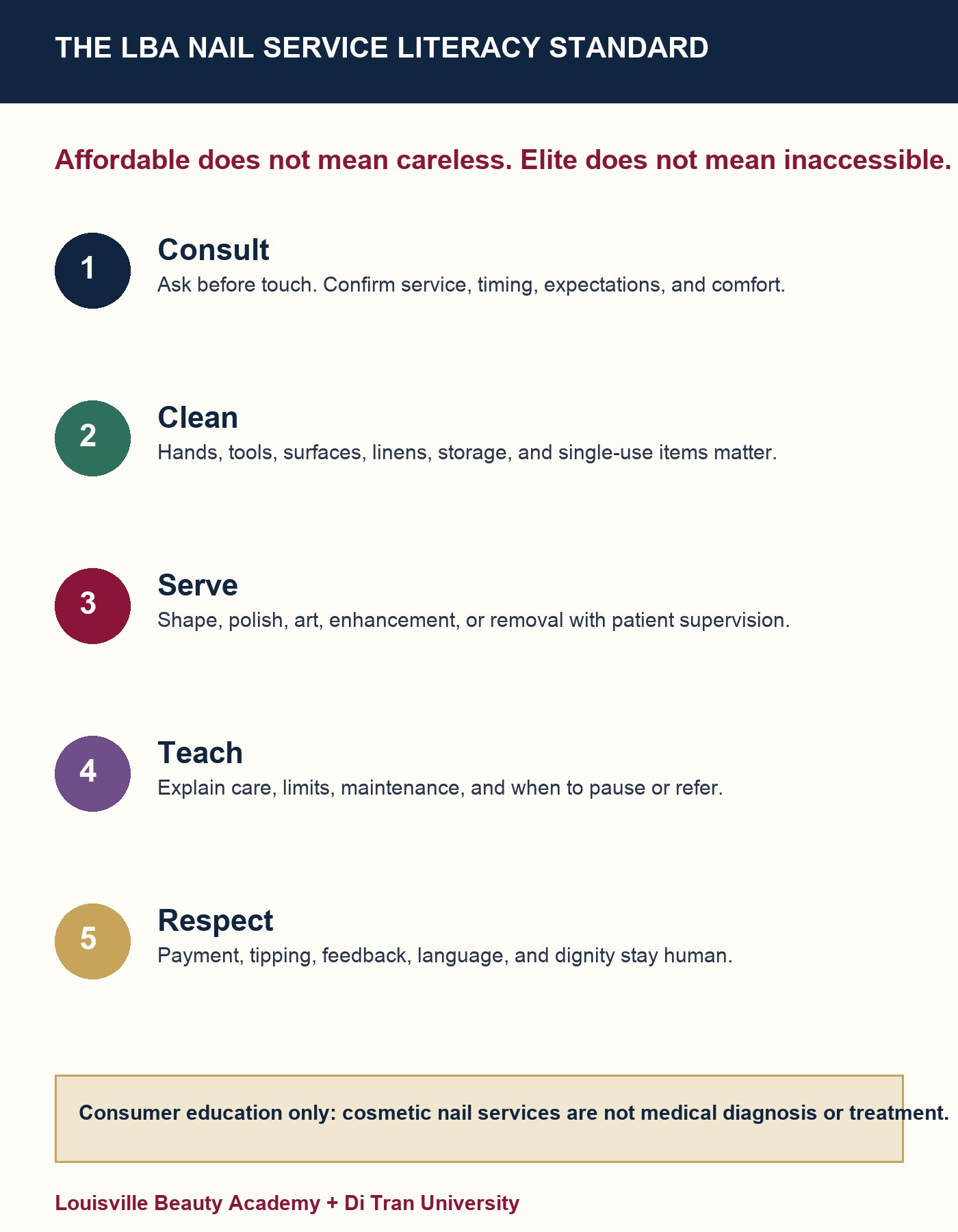
The LBA nail service literacy standard: consult, clean, serve, teach, and respect.
Hand Care and Moisture
How hand care supports comfort and polish appearance without turning beauty education into medical claims. At Louisville Beauty Academy, the public-service model is education first: a school clinic or student-supervised service is not a promise of luxury speed. It is a carefully supervised learning environment where affordability, sanitation, communication, and dignity belong together.
What The Service Teaches
Service literacy: the client understands what is being requested and what is reasonable for the appointment.
Sanitation discipline: clean setup and infection-control habits are treated as the foundation, not a hidden back-room detail.
Communication: expectations, timing, comfort, and limits are discussed before the service becomes confusing.
Professional judgment: students learn that saying “not today” can be part of protecting the client and the school standard.
Affordable Does Not Mean Careless
LBA’s public-facing nail services are listed on the school’s current student clinic service page when available, and the current written page should be checked before relying on any service, price, schedule, or availability. The mission-level point is larger than a single price: accessible nail services can introduce the public to clean beauty care while helping students practice consultation, timing, technique, and professionalism under supervision.
That is the Louisville Beauty Academy standard: elite expectation without luxury exclusion. A person should not need a luxury budget to be treated with cleanliness, patience, and respect.
Safety and Boundary Note
This series is consumer education, not medical advice. Nail services are cosmetic services. A student, instructor, or licensed professional should not diagnose, treat, or promise improvement for medical conditions. If skin, nail, pain, infection, wound, allergy, or health concerns appear, the safer educational response is to pause and refer the person to an appropriate licensed health professional.
Why DTU Supports This Doctrine
Di Tran University supports this work as doctrine and research architecture: humanization, workforce literacy, affordability, AI-assisted documentation, and ethical education. DTU explains why a small service can become a public lesson in dignity, and LBA proves that lesson in a real school environment.
Public information notice: service availability, prices, schedules, and policies can change. Current written LBA documents and direct school confirmation control. This post does not claim government endorsement, guaranteed outcomes, medical benefit, licensure result, employment result, or superiority over another provider.
Louisville Beauty Academy Welcomes a National Conversation Focused on Affordability, Transparency, and Workforce Opportunity
Louisville Beauty Academy (LBA), located on Bardstown Road in the Highlands of Louisville, Kentucky, welcomes the U.S. Department of Education’s June 29, 2026 final rule on earnings accountability as an important national policy development for students, families, educators, and workforce training providers.
To be absolutely clear, the Department of Education does not name, evaluate, endorse, accredit, or approve Louisville Beauty Academy in this rule. We do not present it as such.
Rather, we believe this federal policy conversation reinforces many of the same educational principles that have guided Louisville Beauty Academy since its founding: affordability, transparency, responsible enrollment, practical workforce preparation, and helping students pursue state licensure without unnecessary financial burden.
A National Conversation That Reflects Long-Standing Principles
The Department’s final rule is designed to strengthen accountability for programs that leave students with federal student-loan debt that may not be supported by sufficient earnings outcomes.
Within its discussion of cosmetology education, the Department acknowledges that many cosmetology programs do not participate in the Federal student-loan program and discusses non-federally funded cosmetology programs with “lower tuition prices” and “similar outcomes”, while helping to supply the cosmetology workforce.
At the same time, the Department’s public announcement emphasizes protecting students from low-earning programs, driving down educational costs, supporting workforce needs, and improving accountability surrounding Direct Loan eligibility and program exemptions.
These are significant national policy themes.
A Needed Conversation About Prestige, Cost, and Student Debt
For years, accreditation has often been presented in beauty education as a marker of prestige. Accreditation can serve important purposes, but it can also be misunderstood by students and families when it is treated as the only measure of educational value.
The Department of Education’s June 29, 2026 final rule helps move the national conversation toward a more practical question: what is the real cost to the student, and does the program support responsible workforce preparation?
For Louisville Beauty Academy, this distinction matters. A state-licensed, lower-cost, non-federally dependent beauty education model should not be dismissed simply because it does not rely on federal student loans. Affordability, transparency, licensure preparation, and reduced student-debt exposure are also important measures of educational value.
In that sense, the conversation is shifting. Prestige alone is not enough. The future of responsible beauty education must also include cost honesty, student protection, workforce alignment, and practical outcomes.
Why This Is a Turning Point
For many years, much of the beauty education marketplace emphasized accreditation, access to federal financial aid, and institutional prestige as primary indicators of quality. The Department of Education’s June 29, 2026 rule expands the national conversation by placing greater emphasis on affordability, student outcomes, transparency, workforce preparation, and responsible educational value.
Louisville Beauty Academy believes students benefit when educational quality is evaluated not only by institutional structure, but also by cost, clarity, licensure preparation, and long-term financial responsibility.
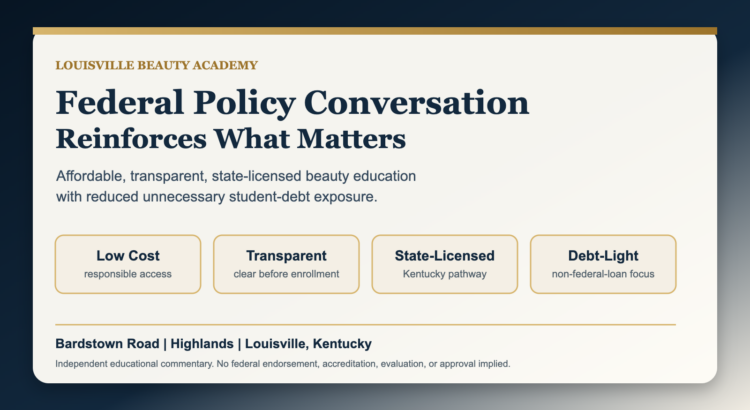
Louisville Beauty Academy’s careful public position: affordability, transparency, state licensure, workforce preparation, and reduced unnecessary student-debt exposure, without implying federal endorsement.
Why This Matters to Louisville Beauty Academy
For Louisville Beauty Academy, this moment is meaningful not because the federal government singled out our institution, but because the broader policy direction aligns with the educational philosophy we have practiced for years.
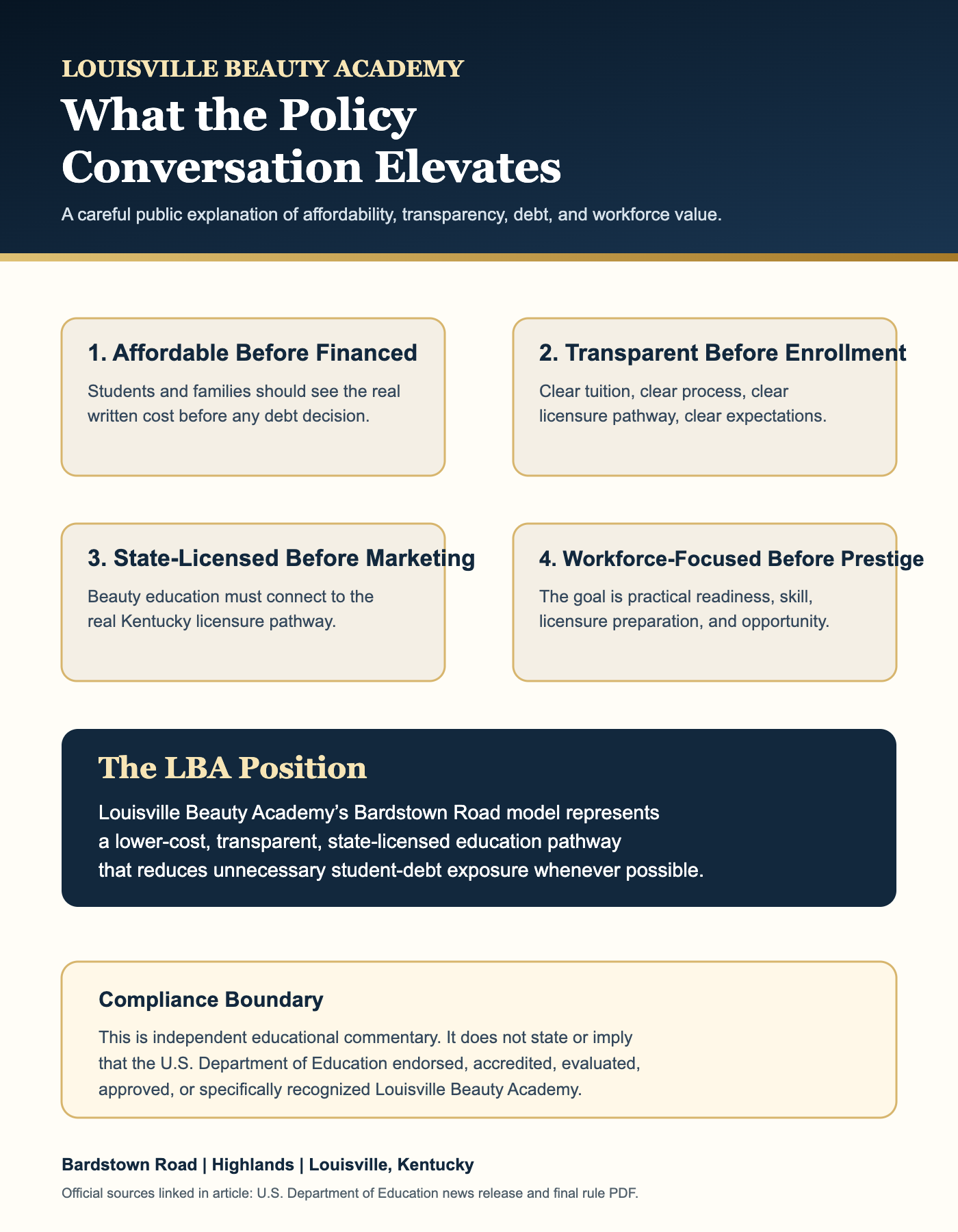
We have long believed that beauty education should be:
Affordable before it is financed.
Transparent before enrollment.
Practical before promises.
State-licensed before marketing.
Workforce-focused before prestige.
Honest about costs, expectations, and career pathways.
Our objective has never been to encourage unnecessary borrowing. Instead, we strive to provide an educational pathway that allows students to pursue licensed professions with clear expectations, practical skills, and financial responsibility.
Transparency Is a Student Protection Strategy
At Louisville Beauty Academy, transparency is not simply a business practice. It is part of our educational mission.
We believe students deserve to understand:
the total tuition and fees before enrolling;
the licensing requirements established by the Commonwealth of Kentucky;
the difference between state licensure, institutional approval, and accreditation;
expected attendance, training, and examination requirements;
and the financial commitments associated with their education.
Clear information allows students and families to make informed decisions that are appropriate for their own goals and circumstances.
Serving the Workforce Through Accessible Education
Every year, Louisville Beauty Academy serves aspiring beauty professionals from a wide range of backgrounds, including working adults, career changers, recent high school graduates, immigrant and multilingual communities, parents returning to the workforce, and individuals seeking a practical, state-regulated career pathway.
Our mission has always been to expand opportunity through education that is accessible, responsible, and connected to real workforce needs.
A Local Model Within a National Policy Conversation
Louisville Beauty Academy is proud to be part of Louisville’s workforce education ecosystem. From our Bardstown Road location, we serve students who are seeking more than a class schedule. They are seeking a pathway, a skill, a license, and a future they can build with dignity.
The Department of Education’s final rule reminds the education sector that cost, debt, earnings, transparency, and student outcomes cannot be separated. These issues must be discussed honestly.
That is why this national policy moment matters to us.
It reinforces the importance of the model Louisville Beauty Academy continues to build: affordable, transparent, state-licensed, digitally accessible, workforce-connected, and student-centered.
Looking Forward
As conversations surrounding higher education accountability continue to evolve, Louisville Beauty Academy remains committed to continuous improvement, ethical educational practices, regulatory compliance, student success, and workforce development.
We believe affordable, transparent, state-licensed career education benefits not only individual students, but also employers, communities, and the broader economy.
Our commitment remains unchanged:
Provide quality education. Communicate honestly. Prepare students for licensure. Support workforce opportunity. Help students pursue careers without unnecessary financial burden whenever possible.
Important Disclaimer
This article is an independent educational commentary by Louisville Beauty Academy. It does not state or imply that the U.S. Department of Education has endorsed, accredited, evaluated, approved, or otherwise specifically recognized Louisville Beauty Academy. References to the Department’s June 29, 2026 final rule and related public materials are provided solely for educational and informational purposes. Readers are encouraged to review the official federal publications directly.
Calls can be misunderstood. Memory fades. Paper gets misplaced. Professional records should be preserved in time-stamped writing whenever the facts matter.
Who This Is For
This series is for every beauty student, including students from rural and country-side communities, immigrant students, first-generation students, working adults, and students who may feel nervous when an inspector or regulator enters the room. The purpose is to replace fear with understanding, practice, safety, sanitation, and written documentation.
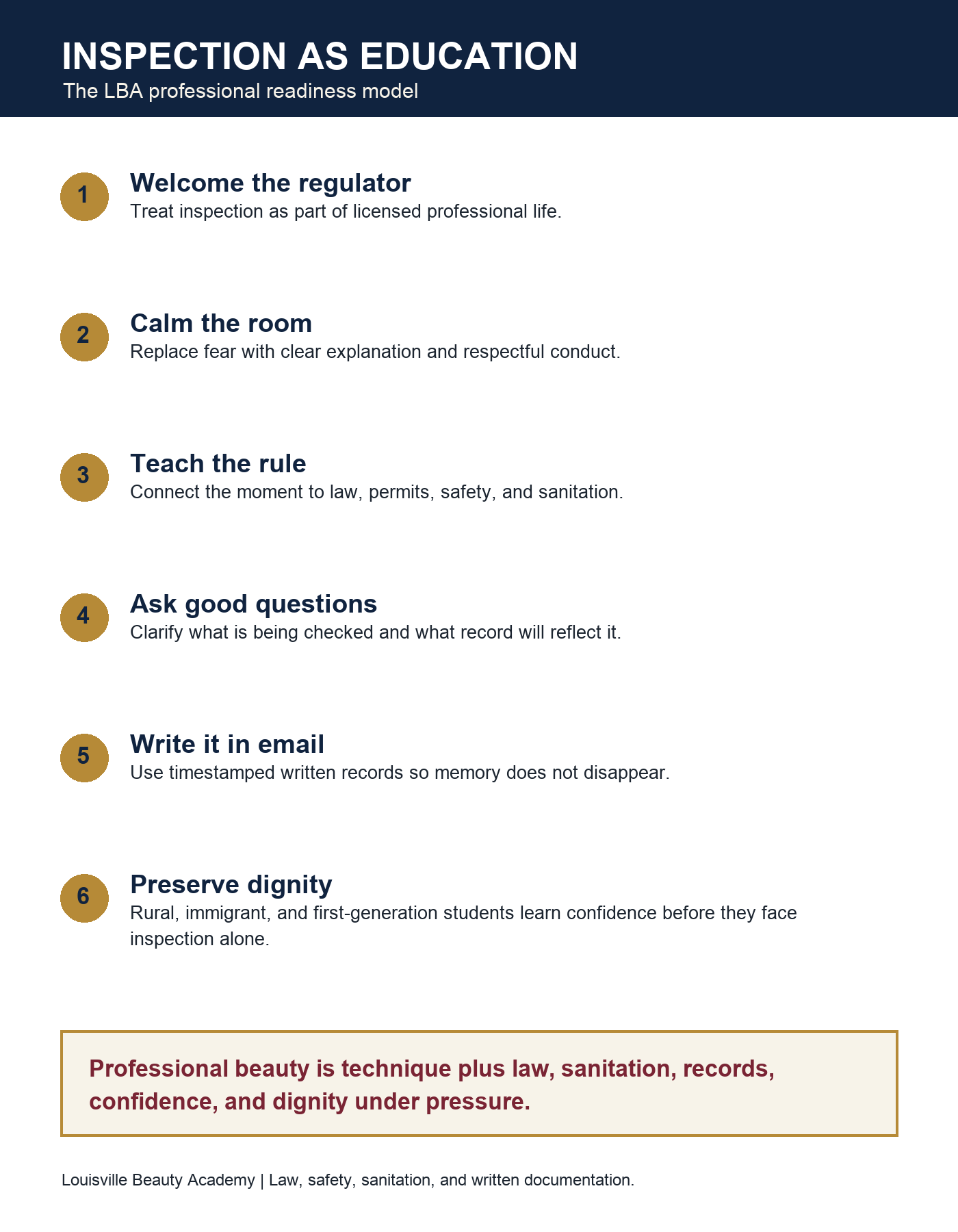
The LBA inspection-as-education model turns regulatory moments into professional readiness training.
Why Writing Matters
Email and text timestamps help preserve what was understood, requested, checked, corrected, or disputed. Documentation is not hostility. It is professional memory.
What To Preserve
A good record includes date, time, location, people present, inspection topic, items checked, operational status, questions asked, and follow-up requests.
The LBA Standard
Louisville Beauty Academy trains students to treat documentation as part of professional care, because the record protects the student, the school, the client, and the public.
The Louisville Beauty Academy Standard
A serious beauty school teaches more than the service. It teaches the professional environment around the service: regulation, safety, sanitation, licensing awareness, written documentation, respectful communication, and the ability to remain steady when a real inspector is present.
That is why LBA treats regulatory moments as education. Students from every background should not wait until they are alone in a salon to learn how to respond professionally.
Public information notice: this post is educational and policy-oriented. It does not accuse any person or agency of wrongdoing, disclose private student information, claim accreditation, promise licensure or employment outcomes, or replace professional legal/regulatory advice.
Policy Series Note. This article continues Louisville Beauty Academy’s research series on beauty workforce development. The purpose is to help students, families, workforce leaders, chambers, associations, and policymakers discuss beauty education with sharper categories and better evidence.
The right question is not whether beauty training matters. The right question is which pathway, for whom, at what cost, with what exam support, and toward what work model.
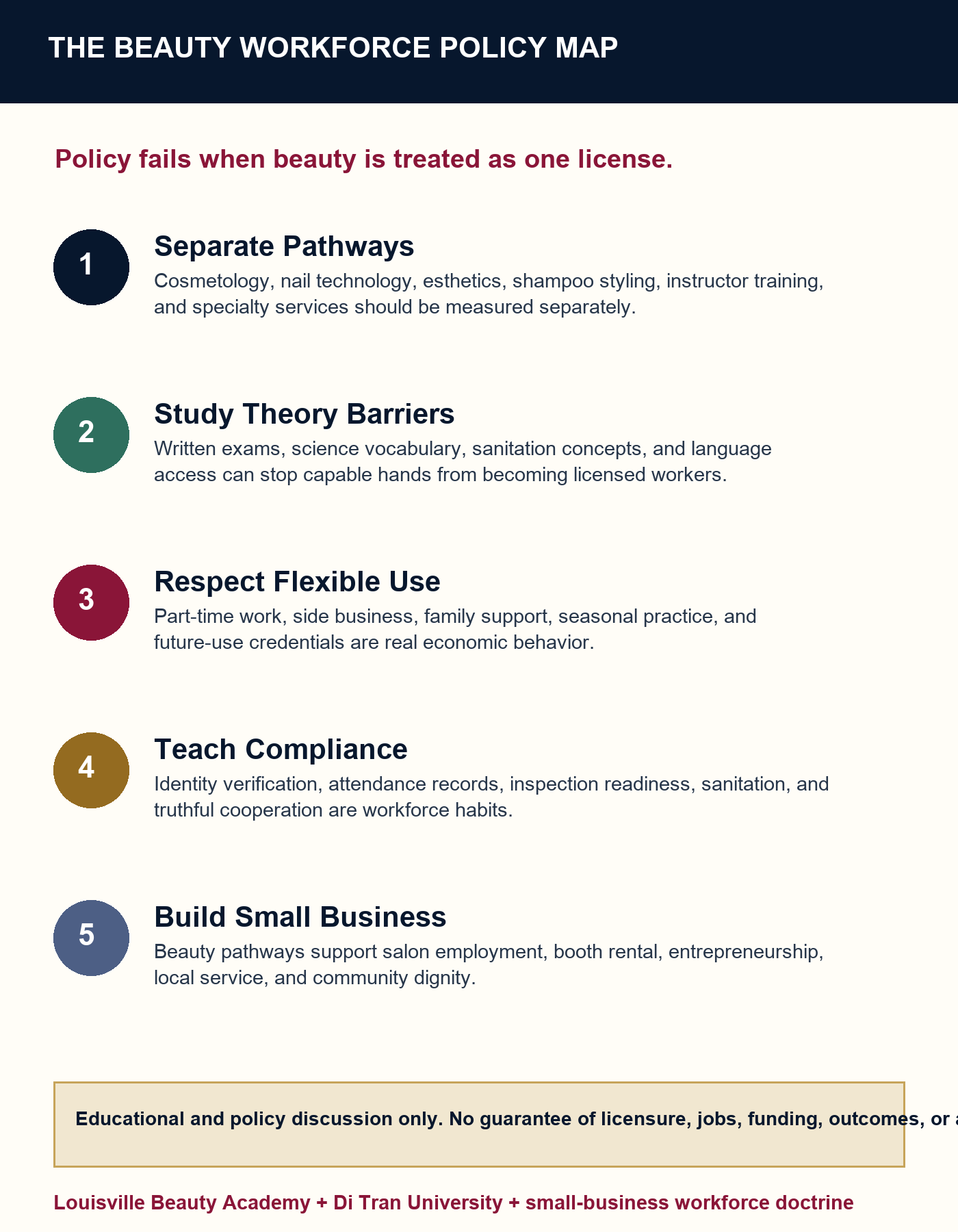
The beauty workforce policy map: separate pathways, study theory barriers, respect flexible use, teach compliance, and build small business.
The Policy Problem
Beauty is often described as if it were one occupation, one student profile, one license, one exam, and one economic result. That is too crude for real workforce development. A student who wants nail technology does not have the same timeline, cost structure, exam burden, service scope, or small-business pathway as a student seeking the broadest cosmetology route. A school that teaches compliance, sanitation, customer communication, identity discipline, and documentation is doing more than preparing people for a single exam.
The Workforce Interpretation
One Louisville, workforce boards, chambers, associations, and funders can use a sharper question set to support real student mobility and small-business development. The result is a stronger public conversation: less ideology, more measurement; less gatekeeping language, more usable student support; less generic beauty talk, more precise pathways into lawful work and entrepreneurship.
This matters for Louisville because beauty education sits at the intersection of licensed work, immigrant enterprise, women-led small business, family income, consumer service, public sanitation, and neighborhood trust. That makes it a legitimate workforce-development subject, not a side issue.
What LBA Is Positioning
Student clarity: students should understand the difference between license pathways before committing.
Compliance as training: records, identity, attendance, sanitation, and truthful cooperation are employable habits.
AI as support: AI can help organize study, translation, documentation, and public education, while instructors and licensed professionals remain responsible for judgment.
Small-business mobility: beauty credentials can support employment, booth rental, independent services, family income, and local entrepreneurship.
Claim-Control Notice
This article is educational and policy-oriented. It does not promise licensure, employment, funding, admission, scholarship approval, income, government action, board approval, accreditation status, or any individual outcome. It does not state or imply that any agency or association endorses Louisville Beauty Academy. Current written school documents, official agency requirements, and qualified professional guidance control where relevant.
Day 5 of 100 – LBA Affordable Nail Service Literacy Series. This article explains cuticle care in plain language for customers, students, families, and community partners who want beauty services to be accessible without lowering the professional standard.
The LBA nail service literacy standard: consult, clean, serve, teach, and respect.
Cuticle Care Boundaries
Beauty-service cuticle care, sanitation, and the line between cosmetic service and health concern. At Louisville Beauty Academy, the public-service model is education first: a school clinic or student-supervised service is not a promise of luxury speed. It is a carefully supervised learning environment where affordability, sanitation, communication, and dignity belong together.
What The Service Teaches
Service literacy: the client understands what is being requested and what is reasonable for the appointment.
Sanitation discipline: clean setup and infection-control habits are treated as the foundation, not a hidden back-room detail.
Communication: expectations, timing, comfort, and limits are discussed before the service becomes confusing.
Professional judgment: students learn that saying “not today” can be part of protecting the client and the school standard.
Affordable Does Not Mean Careless
LBA’s public-facing nail services are listed on the school’s current student clinic service page when available, and the current written page should be checked before relying on any service, price, schedule, or availability. The mission-level point is larger than a single price: accessible nail services can introduce the public to clean beauty care while helping students practice consultation, timing, technique, and professionalism under supervision.
That is the Louisville Beauty Academy standard: elite expectation without luxury exclusion. A person should not need a luxury budget to be treated with cleanliness, patience, and respect.
Safety and Boundary Note
This series is consumer education, not medical advice. Nail services are cosmetic services. A student, instructor, or licensed professional should not diagnose, treat, or promise improvement for medical conditions. If skin, nail, pain, infection, wound, allergy, or health concerns appear, the safer educational response is to pause and refer the person to an appropriate licensed health professional.
Why DTU Supports This Doctrine
Di Tran University supports this work as doctrine and research architecture: humanization, workforce literacy, affordability, AI-assisted documentation, and ethical education. DTU explains why a small service can become a public lesson in dignity, and LBA proves that lesson in a real school environment.
Public information notice: service availability, prices, schedules, and policies can change. Current written LBA documents and direct school confirmation control. This post does not claim government endorsement, guaranteed outcomes, medical benefit, licensure result, employment result, or superiority over another provider.
A complaint starts a process. It does not replace facts. A professional response is calm cooperation, clear records, correction where needed, and preservation of the truth.
Who This Is For
This series is for every beauty student, including students from rural and country-side communities, immigrant students, first-generation students, working adults, and students who may feel nervous when an inspector or regulator enters the room. The purpose is to replace fear with understanding, practice, safety, sanitation, and written documentation.
The LBA inspection-as-education model turns regulatory moments into professional readiness training.
The Right Lesson
Students should learn that complaints can arise in any licensed field. The professional response is not anger or fear. It is evidence.
No Overclaiming
A school should not publicly assume who filed a complaint unless the record proves it. The stronger lesson is that every complaint-driven visit can become a readiness test and documentation drill.
The Discipline
Write down the date, time, topic, what was checked, what was operational, what was communicated, and what records were requested.
The Louisville Beauty Academy Standard
A serious beauty school teaches more than the service. It teaches the professional environment around the service: regulation, safety, sanitation, licensing awareness, written documentation, respectful communication, and the ability to remain steady when a real inspector is present.
That is why LBA treats regulatory moments as education. Students from every background should not wait until they are alone in a salon to learn how to respond professionally.
Public information notice: this post is educational and policy-oriented. It does not accuse any person or agency of wrongdoing, disclose private student information, claim accreditation, promise licensure or employment outcomes, or replace professional legal/regulatory advice.
Policy Series Note. This article continues Louisville Beauty Academy’s research series on beauty workforce development. The purpose is to help students, families, workforce leaders, chambers, associations, and policymakers discuss beauty education with sharper categories and better evidence.
Not every learner needs the longest license pathway first. Shorter, lawful, specific pathways can help people enter work, serve the public, and grow over time.
The beauty workforce policy map: separate pathways, study theory barriers, respect flexible use, teach compliance, and build small business.
The Policy Problem
Beauty is often described as if it were one occupation, one student profile, one license, one exam, and one economic result. That is too crude for real workforce development. A student who wants nail technology does not have the same timeline, cost structure, exam burden, service scope, or small-business pathway as a student seeking the broadest cosmetology route. A school that teaches compliance, sanitation, customer communication, identity discipline, and documentation is doing more than preparing people for a single exam.
The Workforce Interpretation
Funding and workforce systems should recognize right-sized pathways, not only the broadest program category. The result is a stronger public conversation: less ideology, more measurement; less gatekeeping language, more usable student support; less generic beauty talk, more precise pathways into lawful work and entrepreneurship.
This matters for Louisville because beauty education sits at the intersection of licensed work, immigrant enterprise, women-led small business, family income, consumer service, public sanitation, and neighborhood trust. That makes it a legitimate workforce-development subject, not a side issue.
What LBA Is Positioning
Student clarity: students should understand the difference between license pathways before committing.
Compliance as training: records, identity, attendance, sanitation, and truthful cooperation are employable habits.
AI as support: AI can help organize study, translation, documentation, and public education, while instructors and licensed professionals remain responsible for judgment.
Small-business mobility: beauty credentials can support employment, booth rental, independent services, family income, and local entrepreneurship.
Claim-Control Notice
This article is educational and policy-oriented. It does not promise licensure, employment, funding, admission, scholarship approval, income, government action, board approval, accreditation status, or any individual outcome. It does not state or imply that any agency or association endorses Louisville Beauty Academy. Current written school documents, official agency requirements, and qualified professional guidance control where relevant.
Day 4 of 100 – LBA Affordable Nail Service Literacy Series. This article explains trimming and shaping in plain language for customers, students, families, and community partners who want beauty services to be accessible without lowering the professional standard.
The LBA nail service literacy standard: consult, clean, serve, teach, and respect.
Nail Trimming and Shaping
The quiet skill of length, shape, symmetry, comfort, and client communication. At Louisville Beauty Academy, the public-service model is education first: a school clinic or student-supervised service is not a promise of luxury speed. It is a carefully supervised learning environment where affordability, sanitation, communication, and dignity belong together.
What The Service Teaches
Service literacy: the client understands what is being requested and what is reasonable for the appointment.
Sanitation discipline: clean setup and infection-control habits are treated as the foundation, not a hidden back-room detail.
Communication: expectations, timing, comfort, and limits are discussed before the service becomes confusing.
Professional judgment: students learn that saying “not today” can be part of protecting the client and the school standard.
Affordable Does Not Mean Careless
LBA’s public-facing nail services are listed on the school’s current student clinic service page when available, and the current written page should be checked before relying on any service, price, schedule, or availability. The mission-level point is larger than a single price: accessible nail services can introduce the public to clean beauty care while helping students practice consultation, timing, technique, and professionalism under supervision.
That is the Louisville Beauty Academy standard: elite expectation without luxury exclusion. A person should not need a luxury budget to be treated with cleanliness, patience, and respect.
Safety and Boundary Note
This series is consumer education, not medical advice. Nail services are cosmetic services. A student, instructor, or licensed professional should not diagnose, treat, or promise improvement for medical conditions. If skin, nail, pain, infection, wound, allergy, or health concerns appear, the safer educational response is to pause and refer the person to an appropriate licensed health professional.
Why DTU Supports This Doctrine
Di Tran University supports this work as doctrine and research architecture: humanization, workforce literacy, affordability, AI-assisted documentation, and ethical education. DTU explains why a small service can become a public lesson in dignity, and LBA proves that lesson in a real school environment.
Public information notice: service availability, prices, schedules, and policies can change. Current written LBA documents and direct school confirmation control. This post does not claim government endorsement, guaranteed outcomes, medical benefit, licensure result, employment result, or superiority over another provider.
Beauty education is not only technique. It is law, safety, sanitation, licensing, permits, student records, and the discipline to operate inside a regulated profession.
Who This Is For
This series is for every beauty student, including students from rural and country-side communities, immigrant students, first-generation students, working adults, and students who may feel nervous when an inspector or regulator enters the room. The purpose is to replace fear with understanding, practice, safety, sanitation, and written documentation.
The LBA inspection-as-education model turns regulatory moments into professional readiness training.
More Than Technique
Technique matters, but the licensed beauty profession also depends on rules that protect the public and define lawful practice.
What Students Should Understand
Students should understand why licenses, permits, sanitation, clean facilities, chemical handling, attendance records, and safety practices are not optional details.
Professional Confidence
Confidence is not pretending rules do not exist. Confidence is knowing the rules well enough to respond respectfully and correctly.
The Louisville Beauty Academy Standard
A serious beauty school teaches more than the service. It teaches the professional environment around the service: regulation, safety, sanitation, licensing awareness, written documentation, respectful communication, and the ability to remain steady when a real inspector is present.
That is why LBA treats regulatory moments as education. Students from every background should not wait until they are alone in a salon to learn how to respond professionally.
Public information notice: this post is educational and policy-oriented. It does not accuse any person or agency of wrongdoing, disclose private student information, claim accreditation, promise licensure or employment outcomes, or replace professional legal/regulatory advice.
Policy Series Note. This article continues Louisville Beauty Academy’s research series on beauty workforce development. The purpose is to help students, families, workforce leaders, chambers, associations, and policymakers discuss beauty education with sharper categories and better evidence.
License underutilization does not always mean failure. It often reflects flexible income, family duties, future use, side business, booth rental, and changing labor markets.
The beauty workforce policy map: separate pathways, study theory barriers, respect flexible use, teach compliance, and build small business.
The Policy Problem
Beauty is often described as if it were one occupation, one student profile, one license, one exam, and one economic result. That is too crude for real workforce development. A student who wants nail technology does not have the same timeline, cost structure, exam burden, service scope, or small-business pathway as a student seeking the broadest cosmetology route. A school that teaches compliance, sanitation, customer communication, identity discipline, and documentation is doing more than preparing people for a single exam.
The Workforce Interpretation
Policy should measure full-time use, part-time use, self-employment, entrepreneurship, and reserve credential value separately. The result is a stronger public conversation: less ideology, more measurement; less gatekeeping language, more usable student support; less generic beauty talk, more precise pathways into lawful work and entrepreneurship.
This matters for Louisville because beauty education sits at the intersection of licensed work, immigrant enterprise, women-led small business, family income, consumer service, public sanitation, and neighborhood trust. That makes it a legitimate workforce-development subject, not a side issue.
What LBA Is Positioning
Student clarity: students should understand the difference between license pathways before committing.
Compliance as training: records, identity, attendance, sanitation, and truthful cooperation are employable habits.
AI as support: AI can help organize study, translation, documentation, and public education, while instructors and licensed professionals remain responsible for judgment.
Small-business mobility: beauty credentials can support employment, booth rental, independent services, family income, and local entrepreneurship.
Claim-Control Notice
This article is educational and policy-oriented. It does not promise licensure, employment, funding, admission, scholarship approval, income, government action, board approval, accreditation status, or any individual outcome. It does not state or imply that any agency or association endorses Louisville Beauty Academy. Current written school documents, official agency requirements, and qualified professional guidance control where relevant.