Respect the License: Regulatory Intensity, Public Health Oversight, and the Hidden Safety Governance of the Beauty Industry – RESEARCH & PODCAST SERIES 2026

A Comparative Analysis of Sanitation Regulation, Safety Risk, and Government Oversight in Cosmetology Compared with Healthcare, EMS, and Other Public Health Professions.


Research Prepared by
Di Tran University — The College of Humanization
Research & Podcast Series 2026

Research Attribution & Educational Disclaimer

This article is published on Louisville Beauty Academy’s website for educational and informational purposes only.

All research, analysis, and academic interpretation contained in this publication were prepared by Di Tran University — The College of Humanization as part of its independent research initiatives.

Louisville Beauty Academy does not interpret, validate, endorse, or represent the conclusions of this research as regulatory or legal advice. Beauty licensing laws, sanitation regulations, and professional requirements vary by jurisdiction and are determined exclusively by the relevant state licensing authorities, including but not limited to the Kentucky Board of Cosmetology.

Readers should always consult official statutes, administrative regulations, and licensing boards for authoritative guidance.

Publication of this research on the Louisville Beauty Academy website does not constitute policy interpretation, legal guidance, or institutional endorsement.


The Philosophical Foundation of Occupational Stewardship: Professionalism as Humanization

The professional beauty industry, often colloquially associated with the superficial ideals of aesthetics and “pampering,” operates as one of the most rigorously regulated sectors of the United States workforce. At Di Tran University — The College of Humanization, the study of professional licensure is approached not merely as a set of administrative hurdles, but as a fundamental contract between the practitioner and the public’s biological integrity. Occupational licensing in fields such as cosmetology, barbering, esthetics, and nail technology serves as a foundational pillar for public health, safety, and professional standardization.1 These regulations are historically rooted in the transition from medieval guilds to the refined public health mandates of the Progressive Era, a period when the government first recognized that the intimate contact inherent in beauty services could facilitate the transmission of virulent infectious diseases.1

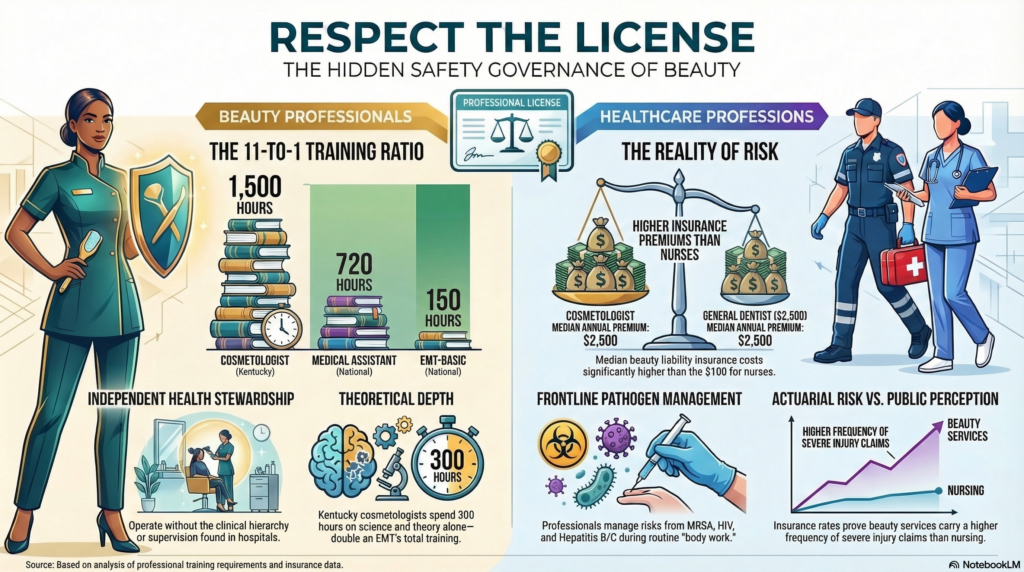
The “hidden safety governance” of the beauty industry is built upon the premise that professional services involve significant biological and chemical risks.1 Practitioners are tasked with managing reactive substances—including hair colors, chemical relaxers, and permanent wave solutions—while simultaneously utilizing sharp, invasive instruments such as razors, shears, and cuticle nippers.1 The intensity of this regulation often surprises the public, particularly when compared to other high-stakes public health professions. For instance, nationally, the average training for a cosmetologist is approximately times longer than the training required for emergency medical technicians (EMTs).2 This disparity, which often provokes political debate, reflects a complex governance strategy: while the EMT is trained for acute, high-intensity life-saving interventions, the cosmetologist is trained for the long-term, high-frequency prevention of community-acquired infections and chronic chemical exposure.2

The legal framework of the industry differentiates between specialty licenses to ensure that practitioners do not inadvertently or intentionally enter the domain of medical practice.1 For example, modern cosmetology statutes emphasize that services must be for “cosmetic purposes” rather than the treatment of physical or mental ailments.1 This boundary is becoming increasingly volatile as the industry moves toward medical-aesthetic integration, where the distinction between a “facial” and a “medical procedure” represents the most contested frontier of medical board jurisdiction.1

The Historical Evolution of Sanitation: From Miasma to Microbes

The current regulatory intensity of the beauty industry is a direct descendant of the “Great Sanitary Awakening” of the mid-nineteenth century. Between and , public health was dominated by the miasma theory, which posited that diseases like cholera were spread by foul air and environmental filth.3 This led to massive urban engineering projects focused on the literal removal of filth from cities.3 During this era, the skin began to be viewed through a Victorian lens as a “sanitary commissioner” of the body—an organ of drainage that required constant purging of waste materials like sweat and dirt to ensure both health and beauty.4

The revelation of Germ Theory, pioneered by Louis Pasteur and Robert Koch between and , fundamentally altered this perspective.5 Public health officials shifted their focus from “bad air” to microbial life. This transition mandated greater regulation of all communal spaces, including the barbershop, which was then a known vector for the “barber’s itch”—a highly contagious fungal infection.1 The adoption of Joseph Lister’s principles of antisepsis—originally developed for surgical theaters using carbolic acid in —eventually became the bedrock of salon sanitation laws.6

Table 1: Historical Milestones in Public Health and Beauty Regulation

EraKey DevelopmentImpact on Beauty/Healthcare RegulationSource
Sanitary Movement (UK)Initial focus on urban cleanliness and filth removal.3
Semmelweis HandwashingDiscovery of hand hygiene as the primary defense against pathogens.6
Lister’s AntisepsisIntroduction of carbolic acid for wound and surface disinfection.6
Germ Theory AdoptionShift to microbial regulation; birth of modern state health boards.5
Progressive EraProfessional Beauty ActsCodification of 1,500-hour training to prevent the “Barber’s Itch.”1
Founding of the WHOEstablishment of global guidelines for infection prevention.6

This historical trajectory demonstrates that beauty licensing was never about “beautification” in a vacuum; it was a societal response to the discovery of the invisible microbial world. The high training hours currently required in states like Kentucky ( hours) or Idaho ( hours) are the direct result of this sanitary evolution.8

The Training Hour Paradox: A Comparative Analysis of EMS, Nursing, and Beauty

A central point of contention in occupational policy is the “11-to-1” training ratio between cosmetologists and EMTs. This claim, which gained national attention during executive-level discussions on occupational licensing reform, highlights a significant disparity in state-mandated education.2 While the comparison is often used to argue that beauty licensing is over-regulated, a deeper analysis reveals that the educational objectives of these two fields are fundamentally divergent.

The EMT pathway is designed for rapid workforce entry to provide immediate, life-saving stabilization. A national EMT certification requires a state-approved course of at least clock hours.10 In contrast, a cosmetologist in Kentucky must complete hours of instruction, including hours dedicated solely to “Science and Theory”—more than double the total training of an EMT.9

Table 2: Comparison of Training Hour Requirements (Selected States/Programs)

ProfessionState/ProgramTotal HoursScience/Theory PortionSource
EMT (Basic)National StandardVaries by program10
Certified Nursing Assistant (CNA)ArizonaVaries by program10
CosmetologistKentucky Hours9
CosmetologistTexasIntegrated1
Medical AssistantNational StandardIntegrated10
EstheticianKentucky Hours9
Nail TechnicianTexasIntegrated12
Nail TechnicianKentucky Hours9

The rationale for the high intensity of beauty training lies in the “independent” nature of the work. While a CNA or an EMT operates within a rigid clinical hierarchy—often under the direct or indirect supervision of a physician or nurse—the licensed cosmetologist or barber is frequently the sole individual responsible for the sanitation and chemical safety of their environment.1 The hours of training are intended to build a deep, intuitive understanding of infectious disease prevention, chemical toxicology, and human anatomy to prevent the salon from becoming a focal point for community outbreaks.

In Kentucky, for example, a cosmetology student is legally prohibited from performing chemical services on the public until they have completed at least hours of instruction.9 This “safety buffer” ensures that the student has mastered the theoretical underpinnings of chemical reactions—such as the pH scale of hair relaxers—before they are permitted to handle substances that could cause permanent chemical burns or hair loss.9

Biological Risks and Pathogenic Proliferation in the Modern Salon

The beauty industry is a frontline environment for biological hazard management. Despite the lack of “high-risk” medical procedures, the salon is an ideal incubator for microbes due to the ingredients found in cosmetic products—such as sugar, starch, protein, and fatty acids—and the high water content of many professional formulas.13 Research has identified beauty salons as significant sources of viral, fungal, and bacterial infections.13

Documented biological hazards include common genera such as Staphylococcus, Streptococcus, and Pseudomonas, which are associated with respiratory problems and chronic skin diseases.13 Specific case studies have highlighted the gravity of these risks; for instance, a methicillin-resistant Staphylococcus aureus (MRSA) infection was traced back to a hairdressing visit in London, while unhygienic tools in Nigeria contributed to outbreaks of HIV and Hepatitis.13

Table 3: Microorganisms Isolated from Beauty Salon Tools and Products

CategoryIsolated MicroorganismsCommon SourceSource
BacterialS. aureus, P. aeruginosa, E. coli, Enterobacter spp.Clippers, brushes, makeup sponges, foot basins.13
FungalCandida albicans, Aspergillus, Trichophyton, MalasseziaHairbrushes, nail tools, moist eyeshadows.13
ViralHepatitis B & C, HIV, Herpes SimplexRazors, nippers, shared eyeliner/lipstick.13
Pathogenic IndicatorsP. aeruginosa, S. aureus, Salmonella spp.Contaminated or expired cosmetic products.13

In the dental clinic, infection risks are managed with extreme stringency due to the aerosolization of blood and saliva.14 However, the “micro-trauma” caused by a standard manicure or a straight-razor shave provides a sufficient route of transmission for the same bloodborne pathogens. For any pathogen to cause disease, a “chain of infection” must exist: a sufficient number of microorganisms, a reservoir (blood or saliva), a route of transmission, and a susceptible host.15 The 1,500-hour beauty curriculum is designed to systematically break this chain at every stage.

Government Oversight and the Enforcement Architecture

The governance of the beauty industry is maintained through a “Risk-Based” model of inspections, which varies significantly by state. Unlike the healthcare sector, where hospitals and nursing homes face intense, multi-agency oversight (including OSHA, the CDC, and state health departments), beauty establishments are primarily governed by state-specific Boards of Cosmetology or Departments of Licensing.1

In Texas, the Department of Licensing and Regulation (TDLR) classifies violations into three distinct categories based on their threat to public health. This structured enforcement ensures that the “hidden safety governance” is not merely theoretical but is backed by substantial financial penalties.17

Table 4: Texas TDLR Penalty Matrix for Barbering and Cosmetology

Violation ClassPenalty RangeExample Violation CategoriesSource
Class AAdministrative errors; failure to display current license; wearing dirty garments.17
Class BWorking with expired license; improper storage of chlorine bleach; failure to clean fixtures.17
Class COperating without any license; operating outside the scope of practice; license transfer.17
License RevocationN/AThreatening inspectors; repeated Class C violations; major public safety threats.17

Comparing this to the food service industry reveals a stark difference in regulatory frequency. While high-risk restaurants handling raw meats are often inspected every to months, many beauty salons are only inspected once per year or even biennially.18 This suggests that the “regulatory intensity” in beauty is front-loaded into the licensure process (the 1,500 hours) rather than the inspection process. The state assumes that if a professional has mastered hours of training, they are less likely to require constant surveillance than a food handler who may only have completed an 8-hour certification course.21

In California, the Board of Barbering and Cosmetology manages one of the largest regulatory caseloads in the nation. In the fiscal year, the board received complaints and took total disciplinary decisions, including license revocations.23 This enforcement volume highlights the persistent struggle to maintain standards in a fragmented market dominated by small, independent businesses.

Actuarial Insights: The Financial Cost of Professional Negligence

Perhaps the most objective measure of the “hidden risk” in the beauty industry is found in the insurance market. Professional liability insurance, or malpractice insurance, is priced based on the actuarial probability of an incident occurring and the potential cost of that incident.24 Surprisingly, a beautician or cosmetologist often pays significantly more for individual liability coverage than a registered nurse.

While a nurse can obtain an individual malpractice policy for approximately per year, a cosmetologist pays a median cost of to per year.25 This cost ratio indicates that insurance underwriters perceive a higher risk of “frequent and severe” claims in the salon setting compared to the nursing setting.

Table 5: Comparative Professional Liability Insurance Costs (Median Annual)

ProfessionAnnual Premium (Median)Key Risk FactorSource
Registered Nurse (RN)Medication errors; failure to monitor.25
Dietitian / NutritionistImproper dietary advice; allergy issues.24
Cosmetologist / BeauticianChemical burns; hair loss; eye infections.26
Nurse Practitioner (NP)Diagnostic errors; prescription authority.28
General DentistNerve damage; surgical complications.28
Oral SurgeonHigh-risk surgical procedures.28
General SurgeonComplex, life-threatening interventions.28

The claims data in the beauty industry underscores the necessity of high-intensity training. Documented insurance payouts include for hair loss resulting from a treatment and for chemical conjunctivitis caused by an eyelash extension.30 These are not “superficial” injuries; they represent significant bodily harm and long-term psychological distress. The hours of training serve as a form of risk mitigation that keeps these premiums from escalating to surgical levels.

The Medical-Aesthetic Integration and the Regulatory Frontier

The integration of aesthetic medicine—minimally invasive procedures like fillers, botulinum toxin, and laser treatments—has created a “gray area” of regulation. In many countries, there is a heated debate between physicians and cosmetologists over who is authorized to perform these procedures.31 Traditional therapeutic medicine centers on disease treatment, while aesthetic medicine centers on the “appreciation of beauty” and the commodification of human worth.31

In the United States, the legal distinction is often tied to the “cosmetic purpose” of the act. A licensed cosmetologist in Kentucky is authorized to provide “facials and massages” but is strictly prohibited from treating “physical or mental ailments”.1 However, as technology advances, the tools used by cosmetologists (such as facial machines and high-intensity lasers) increasingly resemble medical devices.9

The Ministry of Health in various nations, including recent communications from Poland, has attempted to draw a rigid line: procedures like fillers should be performed exclusively by specialist physicians in dermatology or plastic surgery.32 Yet, because many jurisdictions lack a rigid statutory definition of an “aesthetic medicine procedure,” the conflict remains unresolved.32 This regulatory tension highlights the shift of the beauty industry toward a more clinical identity—a transition that Di Tran University identifies as the “humanization of professional aesthetics.”

Sociological Devaluation and the “Pink Tax” of Regulation

Despite the rigorous training and actuarial risk, beauty industry labor is often devalued in sociological discourse. The concept of “aesthetic labor”—the practice of screening and managing workers based on their physical appearance—is often used to stratify workers by class, race, and gender.34 Because the industry is predominantly female, its regulatory mandates are sometimes viewed as “undervalued” or dismissed as unnecessary “economic barriers”.35

Marie Boyd of the University of South Carolina argues that this association with femininity has led to a lack of federal oversight. For example, the FDCA has fewer than two pages devoted to cosmetics out of its 500-page total.35 Unlike drugs, cosmetics do not need FDA approval before they are sold, and manufacturers are not required to report adverse events.35 This places an enormous burden on the individual practitioner; they must be the final “safety filter” for products that the federal government does not adequately monitor.35

Furthermore, the beauty obsession fostered by media and industry messaging has mental health implications, particularly for Generation Z.36 The shift from using cosmetics for “concealment” to “creative expression” reflects a changing consumer psychology that beauty professionals must now manage.36 The 1,500-hour license, therefore, is not just a technical requirement; it is a credential that allows the professional to navigate these complex psychological and physical interactions with authority and ethical responsibility.

Comparative Workplace Safety: Healthcare vs. Beauty Establishments

When examining “Regulatory Intensity,” it is essential to compare the safety outcomes for the workers themselves. Healthcare and social assistance practitioners experience some of the highest rates of workplace injuries in the private sector, with injuries per full-time workers.38 These injuries are often the result of “safe patient handling” failures or workplace violence.16

In contrast, the risks in beauty establishments are chronic rather than acute. Nail salon workers, predominantly immigrant women, face cumulative exposure to biological, ergonomic, and chemical hazards.41 However, because the beauty industry is dominated by micro-enterprises and independent contractors, many of these “injuries” go unreported to OSHA.41 This lack of centralized data often masks the true “regulatory intensity” needed to protect these workers.

Table 6: Occupational Hazard Comparison: Healthcare vs. Beauty Industry

Hazard CategoryHealthcare Industry ProfileBeauty Industry ProfileSource
Infectious DiseaseHigh exposure (Aerosol, Bloodborne)High exposure (Direct Contact, Skin Flora)13
Physical Violence of all nonfatal workplace violenceLow documented frequency39
Chemical ExposureDisinfectants, SterilantsReactive chemicals, Formaldehyde, Monomers16
Ergonomic RiskPatient handling, liftingRepetitive motion, prolonged standing38
Regulatory LeadOSHA / CDC / State HealthState Boards / TDLR16

The “hidden safety governance” of the beauty industry acts as a massive public health buffer. By ensuring that trillion microbes on the human skin are managed through proper antisepsis in millions of salons every day, the beauty industry prevents a secondary burden on the healthcare system.7

Conclusions and the Path Forward for Di Tran University

The comprehensive analysis of the beauty industry’s regulatory landscape reveals a profession that is fundamentally misunderstood by the public and often undervalued by policymakers. The hours required for a cosmetology license— times more than an EMT—is not an accident of history or a product of lobbying; it is a calculated societal response to the biological and chemical risks inherent in “body work.”

At Di Tran University — The College of Humanization, we conclude that the “Respect the License” initiative is a vital component of public health advocacy. The following key insights should guide the future of beauty governance:

  1. Pedagogical Intensity as Public Health Defense: The high training hours in beauty are essential because the practitioner operates as an independent, frontline steward of sanitation without the institutional “safety net” found in hospitals.
  2. Actuarial Reality Trumps Political Narrative: The higher cost of professional liability insurance for cosmetologists compared to nurses provides undeniable proof of the “hidden risks” that the license is designed to manage.
  3. The Biological Burden is Real: With contamination rates found on unsterilized tools in certain studies, the transition from “Barber’s Itch” to “MRSA” proves that the microbial threat is evolving, not disappearing.
  4. Regulatory Humanization: Professionalizing the beauty industry through high standards protects the dignity and bodily integrity of the client, fulfilling the core mission of the College of Humanization.

The beauty industry is not a “secondary” health profession; it is a primary prevention sector. As we move into an era of medical-aesthetic integration, the license must be respected as the legal and scientific bedrock that ensures “beauty at any cost” does not become a literal reality for the public’s health.

Works cited

  1. The Legal Scope of Beauty Licensing in the United States: A …, accessed March 11, 2026, https://louisvillebeautyacademy.net/the-legal-scope-of-beauty-licensing-in-the-united-states-a-comprehensive-policy-legal-and-workforce-analysis-of-cosmetology-barbering-esthetics-and-nail-technology-research-podcast-serie/
  2. Are cosmetologists training longer than EMTs? | The Fact Checker – YouTube, accessed March 11, 2026, https://m.youtube.com/watch?v=-qm8TipH6fY
  3. HIST 234 – Lecture 11 – The Sanitary Movement and the “Filth Theory of Disease”, accessed March 11, 2026, https://oyc.yale.edu/history/hist-234/lecture-11
  4. ‘To Preserve the Skin in Health’: Drainage, Bodily Control and the Visual Definition of Healthy Skin 1835–1900 – PMC, accessed March 11, 2026, https://pmc.ncbi.nlm.nih.gov/articles/PMC4103382/
  5. Germ Theory 1880-1912 – Salt Lake County Archives, accessed March 11, 2026, https://www.saltlakecounty.gov/archives/exhibits/the-salt-lake-county-health-department-history/germ-theory/
  6. History of Hygiene: From Rituals to Modern Standards – CWS, accessed March 11, 2026, https://www.cws.com/en/hygiene/news-knowledge/history-hygiene-invisible-protection-through-ages
  7. The little-known history of cleanliness and the forgotten pioneers of handwashing – Frontiers, accessed March 11, 2026, https://www.frontiersin.org/journals/public-health/articles/10.3389/fpubh.2022.979464/full
  8. Training Program Search – IdahoWorks, accessed March 11, 2026, https://idahoworks.gov/search/programs?per_page=10&search_training_program_search%5Baverage_hours_per_week%5D=0&search_training_program_search%5Bhas_certified_curriculum%5D=1&search_training_program_search%5Bprogram_course_time_ids%5D=1
  9. Title 201 Chapter 12 Regulation 082 • Kentucky Administrative …, accessed March 11, 2026, https://apps.legislature.ky.gov/law/kar/titles/201/012/082/10638/
  10. Health Services Academy | Applied Technologies Pre-K & 7-12, accessed March 11, 2026, https://www.alaschools.org/az/applied-technologies/academies/health
  11. Health Science Certificate Training Program in South Florida – Sheridan Technical College, accessed March 11, 2026, https://www.sheridantechnicalcollege.edu/medical-health-science/
  12. Cosmetology | 2025-2026 Grayson College Catalog, accessed March 11, 2026, https://catalog.grayson.edu/2025-2026/programs/cosmetology/index.php
  13. Beauty Salons are Key Potential Sources of Disease Spread – PMC, accessed March 11, 2026, https://pmc.ncbi.nlm.nih.gov/articles/PMC8007475/
  14. The Unseen Threat in Dentistry: How to Identify, Prevent, and Overcome Infection Risks in the Modern Dental Clinic – jicrcr, accessed March 11, 2026, https://jicrcr.com/index.php/jicrcr/article/download/1789/1512/3733
  15. Preventing Cross Infection in the Dental Office – StatPearls – NCBI Bookshelf – NIH, accessed March 11, 2026, https://www.ncbi.nlm.nih.gov/books/NBK589669/
  16. Healthcare – Overview | Occupational Safety and Health Administration, accessed March 11, 2026, https://www.osha.gov/healthcare
  17. Penalties and Sanctions for Practitioners and Establishments …, accessed March 11, 2026, https://www.tdlr.texas.gov/enforcement/bacsanctions-practitioners-establishments.htm
  18. Inspection frequency : r/healthinspector – Reddit, accessed March 11, 2026, https://www.reddit.com/r/healthinspector/comments/1lf2ypi/inspection_frequency/
  19. Understanding Your Food Hygiene Rating: What It Means for Restaurants – KNOW App, accessed March 11, 2026, https://www.getknowapp.com/blog/food-hygiene-rating/
  20. Inspection Program – MyFloridaLicense.com, accessed March 11, 2026, https://www2.myfloridalicense.com/division-of-regulation/inspection-program/
  21. Food Safety Training | DuPage County Health, IL, accessed March 11, 2026, https://www.dupagehealth.org/202/Food-Safety-Training
  22. Health Inspections for Nail Salons and Barbershops – The Institute for Justice, accessed March 11, 2026, https://ij.org/report/clean-cut/health-inspections-for-nail-salons-and-barbershops/
  23. Enforcement Statistical Overview – California Board of Barbering and Cosmetology – CA.gov, accessed March 11, 2026, https://www.barbercosmo.ca.gov/enforcement/enf_stats.shtml
  24. Medical Malpractice Insurance Cost: Fast & Free Quotes | Insureon, accessed March 11, 2026, https://www.insureon.com/small-business-insurance/medical-malpractice/cost
  25. Everything You Need to Know About Nursing Malpractice Insurance, accessed March 11, 2026, https://nurse.org/education/nursing-malpractice-insurance/
  26. Cosmetology Insurance Cost Guide | Compare side by side – Simply Business, accessed March 11, 2026, https://www.simplybusiness.com/business-insurance/cosmetology-insurance/cost/
  27. Cosmetologist Insurance | Cosmetology Business Insurance – InsuredBetter.com, accessed March 11, 2026, https://www.insuredbetter.com/small-business-insurance/health-beauty/cosmetologist-coverage/
  28. How Much Does Medical Malpractice Insurance Cost for Surgeons, Dentists, and Nurses?, accessed March 11, 2026, https://www.finchmccranie.com/blog/how-much-does-medical-malpractice-insurance-cost-for-surgeons-dentists-and-nurses/
  29. 2024 Medical Professional Liability: An Evolving Landscape, accessed March 11, 2026, https://ppemedical.com/blog/2024-medical-professional-liability-an-evolving-landscape/
  30. Professional Liability Insurance – Beauty Insurance Plus, accessed March 11, 2026, https://www.beautyinsuranceplus.com/professional-liability-insurance/
  31. Ethical and Regulatory Gaps in Aesthetic Medical Practice in Top Asian Medical Tourism Destinations – PMC, accessed March 11, 2026, https://pmc.ncbi.nlm.nih.gov/articles/PMC10776543/
  32. How Does the Ministry of Health’s Communication Affect the Beauty Industry? | Żyglicka, accessed March 11, 2026, https://www.kpr.pl/en/how-does-the-ministry-of-healths-communication-affect-the-beauty-industry/
  33. Title 201 Chapter 12 Regulation 082 • Kentucky Administrative Regulations – Legislative Research Commission, accessed March 11, 2026, https://apps.legislature.ky.gov/law/kar/titles/201/012/082/
  34. Aesthetic Labor for the Sociologies of Work, Gender, and Beauty – ResearchGate, accessed March 11, 2026, https://www.researchgate.net/publication/269280709_Aesthetic_Labor_for_the_Sociologies_of_Work_Gender_and_Beauty
  35. More Regulation Needed to Combat Risks From Cosmetics | The Regulatory Review, accessed March 11, 2026, https://www.theregreview.org/2019/06/13/fritz-more-regulation-needed-combat-cosmetics-risks/
  36. Decoding Influence: Cosmetic Industry Strategies, Media Beauty Standards, and Their Mental Health Impact on Generation Z Consume – Digital Collections @ Suffolk, accessed March 11, 2026, https://dc.suffolk.edu/cgi/viewcontent.cgi?article=1045&context=undergrad
  37. The Beauty Industry’s Influence on Women in Society – UNH Scholars Repository, accessed March 11, 2026, https://scholars.unh.edu/cgi/viewcontent.cgi?article=1085&context=honors
  38. Top 10 Industries with Highest OSHA Injury Rates (2026) – OSHA Education School, accessed March 11, 2026, https://blog.oshaeducationschool.com/industries-highest-osha-injury-rates/
  39. OSHA 2025: What Healthcare Professionals Need to Know – Abyde, accessed March 11, 2026, https://abyde.com/2025-osha-healthcare-updates/
  40. Trends in workplace violence for health care occupations and facilities over the last 10 years, accessed March 11, 2026, https://pmc.ncbi.nlm.nih.gov/articles/PMC11630250/
  41. Licensure and citations among nail salons in Michigan from 2017 to 2021: A cross‐sectional study of an overlooked and vulnerable industry – ResearchGate, accessed March 11, 2026, https://www.researchgate.net/publication/362130091_Licensure_and_citations_among_nail_salons_in_Michigan_from_2017_to_2021_A_cross-sectional_study_of_an_overlooked_and_vulnerable_industry
  42. Employer-Reported Workplace Injuries and Illnesses – 2023-2024 – BLS.gov, accessed March 11, 2026, https://www.bls.gov/news.release/pdf/osh.pdf
  43. Ten Most Common Code Violations in Establishment Inspections, accessed March 11, 2026, https://www.tdlr.texas.gov/barbering-and-cosmetology/establishments/most-common-violations.htm

The Humanization of Vocational Excellence: A Kentucky Case Study of Cosmetology Education, Safety, Sanitation Law, and the Louisville Beauty Academy Model for Compliance and Community Service

Current information notice

This article is part of LBA’s public education and historical archive. Older posts, including “The Humanization of Vocational Excellence: A Kentucky Case Study of Cosmetology Education, Safety, Sanitation Law, and the Louisville Beauty Academy Model for Compliance and Community Service,” may not reflect current tuition, schedules, incentives, forms, policies, testing vendors, clinic availability, or regulatory requirements.

Before relying on this article for any decision, review LBA’s Current Information and Written Control Standard, Current Program Costs, Enrollment Concierge, and Policy and Written Records.


1. What is the primary purpose of cosmetology licensing in Kentucky?

The primary purpose of cosmetology licensing is to protect public health and safety. Beauty professionals work directly with the skin, hair, and nails of clients, which requires training in sanitation, infection control, chemical safety, and regulatory compliance. Licensing ensures practitioners understand these responsibilities before providing services to the public.


2. Why do cosmetology schools teach sanitation and safety?

Sanitation and safety training are essential because improper practices can lead to infections, chemical burns, allergic reactions, or the spread of disease. Cosmetology programs include education on disinfecting tools, preventing cross-contamination, handling chemicals safely, and maintaining hygienic work environments.


3. What is a clinic floor in a cosmetology school?

A clinic floor is a supervised training environment where students practice professional services under instructor oversight. The clinic floor functions as a learning laboratory rather than a commercial salon, allowing students to apply theoretical knowledge while completing required training hours.


4. Are clients in cosmetology schools regular salon customers?

In most cosmetology schools, individuals receiving services act as training models for students. Services are performed under instructor supervision to help students gain experience required for licensing. The purpose of these services is educational rather than commercial.


5. How many hours are required for cosmetology licensing in Kentucky?

The Kentucky licensing requirements typically include:

  • Cosmetology: 1,500 hours
  • Esthetics: 750 hours
  • Nail Technology: 450 hours
  • Shampoo Styling: 300 hours

These hours include both theoretical instruction and supervised practical training.


6. Why must cosmetology schools track student attendance so strictly?

State regulations require cosmetology schools to maintain accurate records of student training hours. Because cosmetology licensing is based on a clock-hour system, students must complete the required number of training hours to qualify for the licensing examination.


7. What role does sanitation play in cosmetology education?

Sanitation is a core component of cosmetology education. Students learn how to disinfect tools, maintain clean workstations, follow infection control procedures, and comply with state sanitation regulations designed to protect clients and practitioners.


8. What is meant by “Compliance by Design” in vocational education?

Compliance by design refers to a training structure where regulatory requirements, documentation practices, and safety standards are integrated directly into daily school operations. This approach emphasizes transparency, accurate recordkeeping, and adherence to state licensing laws.


9. What is the Louisville Beauty Academy model discussed in this research?

The Louisville Beauty Academy model emphasizes:

  • regulatory compliance
  • sanitation and safety education
  • community service through supervised training
  • affordable, debt-conscious vocational education.

The model seeks to align cosmetology training closely with public safety responsibilities and workforce development goals.


10. Why does this research discuss lower-debt vocational education?

Many vocational programs in the United States rely heavily on student loans. The research explores alternative approaches that focus on affordability and reduced debt burdens, allowing students to enter the workforce more quickly and sustainably.


11. What is the connection between cosmetology education and community service?

Some vocational training models integrate community service opportunities where students provide supervised services to underserved populations. This approach can enhance student learning while contributing to community well-being.


12. Why is transparency important in vocational education?

Transparency helps students understand program requirements, licensing laws, safety expectations, and career pathways before enrolling. Clear communication promotes informed decision-making and strengthens trust between schools, students, and the public.


Educational Research Disclaimer

This publication is an academic research work prepared by the Di Tran University — The College of Humanization Research Team and is provided strictly for educational, analytical, and public discussion purposes.

The research presented herein examines publicly available information, statutes, regulations, institutional practices, and policy discussions related to vocational education and the beauty licensing industry. Any institutions referenced, including Louisville Beauty Academy, are discussed solely within the context of academic case study analysis.

Nothing in this publication constitutes:

  • legal advice
  • regulatory guidance
  • professional consulting advice
  • institutional endorsement
  • policy advocacy
  • or an official interpretation of any law, regulation, or governmental position.

All legal citations, regulatory interpretations, and policy discussions are scholarly interpretations based on publicly available materials and should not be relied upon as a substitute for consultation with licensed attorneys, regulatory agencies, or official government guidance.

The inclusion, analysis, or discussion of any organization, regulatory body, institution, educational model, or industry practice does not constitute endorsement, criticism, certification, or validation by Di Tran University, Louisville Beauty Academy, or the Research Team.

Readers are strongly encouraged to consult official statutes, regulatory authorities, and licensed professionals for authoritative guidance regarding any compliance, licensing, educational, or legal matters.


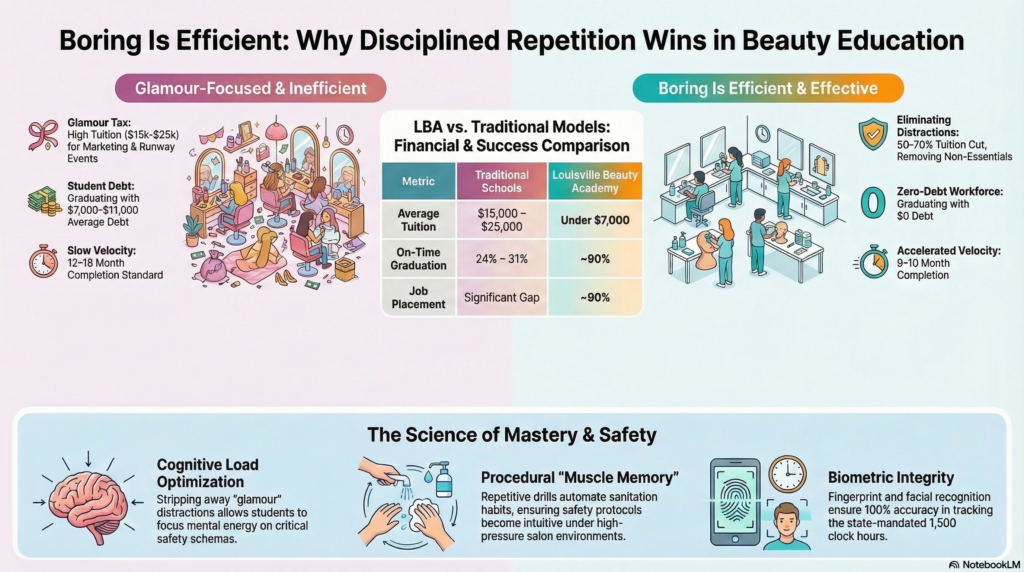
The vocational education sector in the United States, particularly within the field of beauty culture, currently stands at a critical juncture defined by heightened federal oversight, shifting state regulatory landscapes, and a deepening crisis of student debt. For the research department of Di Tran University – The College of Humanization, the study of institutional models that prioritize human dignity alongside technical mastery is paramount. This report examines Louisville Beauty Academy (LBA) as a primary case study, testing the hypothesis that a model rooted in lower-debt economics, regulatory over-compliance, and community-service-driven clinic floors offers a superior alternative to the traditional revenue-dependent for-profit model. By analyzing Kentucky administrative regulations, legislative oversight reports, and public institutional records, this analysis delineates how LBA separates its narrative from systemic industry pain points and the public misconception of beauty schools as “cheap salons,” positioning itself instead as a national center of excellence.1

The Regulatory and Legal Definition of the Beauty School Clinic Floor

A fundamental challenge in the beauty education industry is the persistent misalignment between public perception and the legal reality of the “clinic floor.” Many consumers view school clinics as discount alternatives to commercial salons, expecting high-speed service, guaranteed availability, and retail-level customer care. However, an examination of Kentucky law, specifically 201 KAR 12:060 and 201 KAR 12:082, reveals that the clinic floor is a strictly defined, regulated training environment where the primary objective is the demonstration of safety, sanitation, and technical proficiency for licensure, rather than commercial commerce.4

The Clinic Floor as a Regulated Laboratory

Under Kentucky administrative regulations, the beauty school clinic floor is not a commercial enterprise but a supervised instructional laboratory. Every service performed on a member of the public is legally classified as a “clinical practice” or “practical work” requirement.7 These requirements are established to ensure that students can meet the mandatory clock-hour thresholds necessary for state licensure. For example, a cosmetology student in Kentucky must complete 1,500 hours of clinical class work and scientific lectures, while a nail technician student must complete 450 hours.6

The law is explicit regarding the supervision and intent of these services. Students are prohibited from performing chemical services on the public until they have reached specific milestones—250 hours for cosmetology and 60 hours for nail technology.6 This reinforces the status of the clinic floor as a classroom where the “customer” is legally a “model” or “volunteer” participating in a student’s educational journey.10 This volunteer is expected to understand that results, timing, and the specific application of techniques are subject to instructor oversight and the student’s current stage of learning.10

The Rigidity of the Clock-Hour System

A defining characteristic of beauty education that distinguishes it from traditional liberal arts colleges is the “clock-hour” versus “credit-hour” system. In a standard university setting, a student is evaluated based on the mastery of content and credit completion. In a beauty academy, the state board requires an exact accounting of time spent in physical training.11

Kentucky law (201 KAR 12:082) mandates that schools maintain “accurate daily attendance records” and preserve them for at least five years.12 This creates a high level of rigidity; there is no “informal time forgiveness” or rounding of hours. If a student is not physically present and clocked in, they are not earning progress toward their license.11 Furthermore, regulations limit training to no more than 10 hours per day or 40 hours per week, with a mandatory 30-minute unpaid break for any 8-hour day.12 This administrative burden necessitates sophisticated tracking systems, such as the biometric attendance mandates adopted by Louisville Beauty Academy, to ensure that the person earning the hours is the person physically present.11

Table 1: Regulatory Hour Requirements in Kentucky

The following table outlines the minimum instructional and clinical hour requirements as defined by the Kentucky Board of Cosmetology (KBC) and implemented within the LBA curriculum.6

License TypeTotal Clock HoursLecture/Theory HoursClinic/Practice HoursStatute/Law Hours
Cosmetology1,5003751,08540 6
Esthetician75025046535 6
Nail Technician45015027525 6
Shampoo Styling30010017525 7

Louisville Beauty Academy’s Distinctive Institutional Model

Louisville Beauty Academy has intentionally designed its operations to counter the “cheap salon” narrative while proactively addressing federal concerns regarding “free student labor.” Its model is predicated on the principles of Di Tran University, which emphasizes that vocational training is a tool for humanization and dignity rather than mere profit generation.3

The Volunteer-Based Clinic Framework

The LBA model fundamentally redefines the relationship between the student, the school, and the public. Unlike many schools that actively market “discount salon services” to the general public to generate operational revenue, LBA frames clinic floor participation as a volunteer opportunity.14 This is not a semantic distinction but a structural one.

Participants in LBA’s clinic floor sessions are encouraged to view themselves as “Live Volunteer Models”.10 This model prioritizes outreach to vulnerable populations, including seniors, individuals with disabilities, and the unhoused.14 By removing the traditional client-vendor dynamic, LBA eliminates the commercial pressure that can lead to an environment focused on “production” rather than “education.” The fees associated with these services are explicitly described as contributions toward the cost of products, sanitation, and instructor supervision, rather than a payment for the student’s labor.10

Student Autonomy and the Rejection of Production Pressure

A critical point of differentiation for LBA is its “student-choice” model. In typical beauty schools, students are often assigned clients as they walk in, functioning effectively as unpaid employees in a retail setting.16 LBA, by contrast, relies on the student’s willingness and learning needs to determine availability.10

There is no guarantee of a particular stylist, time, or specific service availability at LBA. Access is provided on a first-come, first-served basis, driven entirely by the students’ instructional requirements.10 This ensures that the clinic floor remains “education-first” and protects students from the exploitative “production” quotas that have plagued the for-profit sector nationally.15 By framing the clinic as a community service hub, LBA ensures that every hour earned on the floor is a meaningful step toward professional licensure rather than a commercial labor contribution.14

Table 2: Comparative Models of Clinic Floor Operation

FeatureTypical U.S. Beauty School ModelLouisville Beauty Academy Model
Primary GoalRevenue generation / Profit centerEducational training / Community service 14
Public RoleCommercial customerLive volunteer model 10
Fee StructureProfit-margin based pricingProduct/sanitation cost recovery 10
SchedulingGuaranteed appointments/retail hoursStudent-availability / First-come, first-served [User Query]
Student StatusQuasi-employee (unpaid labor)Training professional / Community volunteer 15

Compliance as a Pillar of Humanization: Addressing Systemic Gaps

The beauty industry in Kentucky has recently faced significant scrutiny regarding the consistency and effectiveness of state-level oversight. Louisville Beauty Academy has responded to these challenges not with resistance, but with a strategy of “Over-Compliance”.18

Analysis of Statewide Inspection Gaps

The 2024 Legislative Research Commission (LRC) report on the Kentucky Board of Cosmetology (KBC) revealed deep systemic failures in the oversight of beauty schools and salons.19 The report found that:

  • The KBC was failing to meet its regulatory mandate to inspect establishments twice annually.19
  • There was a profound lack of documentation; in a sample of board files, only 54% had a completed inspection form.19
  • Board staff and inspectors lacked sufficient internal written policies, leading to inconsistent enforcement and arbitrary fining practices.19
  • Statewide, many facilities went years without a formal inspection, creating a potential risk to public health and safety.19

The LBA Strategy of “Compliance by Design”

In this environment of inconsistent oversight, LBA has positioned itself as a “Gold Standard Mentor” for the industry.1 Instead of viewing inspections as an adversarial process to be avoided, LBA actively welcomes them as an opportunity to demonstrate its adherence to safety and administrative protocols.1

LBA’s “Compliance by Design” posture includes several key actions:

  1. Biometric Attendance Mandates: To ensure the absolute integrity of student clock hours, LBA utilizes biometric verification.11 This technology removes the potential for manual errors or fraudulent hour-logging, which are significant concerns for federal Title IV auditors.12
  2. Public Record Transparency: LBA maintains a digital library that publishes KBC oversight reports, inspection laws, and official memoranda verbatim for educational use.1 This encourages students to become legally literate professionals who understand the laws governing their licenses.20
  3. Proactive Documentation: LBA documents, pre-verifies, and portal-confirms every student submission (transfers, extracurricular hours, etc.) to ensure that all records are audit-ready at all times.18

By operating above the minimum legal standards, LBA protects its students from the “denied or delayed hours” that often occur in schools with less rigorous record-keeping.1 This approach transforms compliance from a bureaucratic hurdle into an educational advantage.

The Macroeconomics of Lower-Debt Vocational Pathways

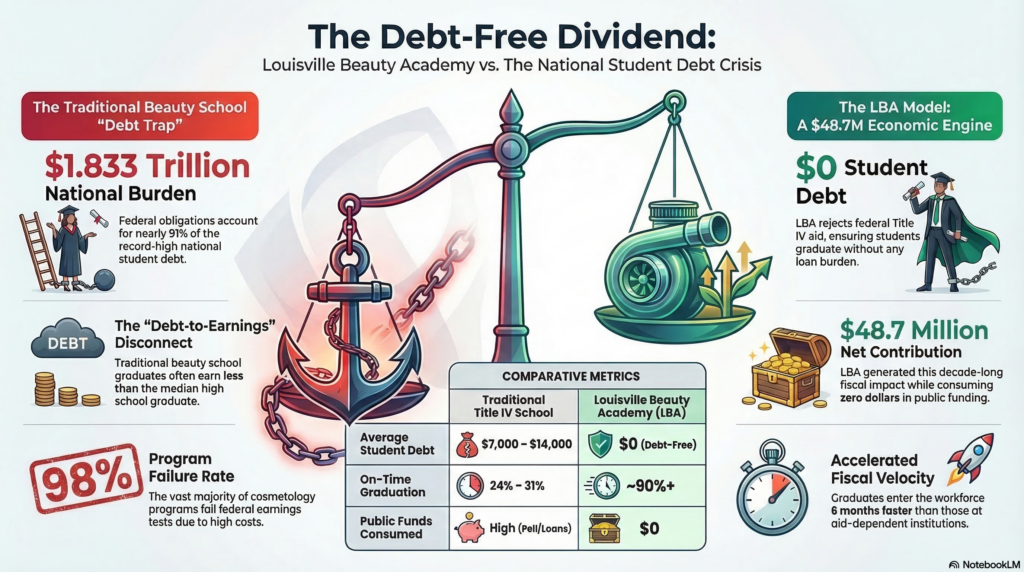
Nationally, the beauty education sector is often criticized for trapping low-income and immigrant students in cycles of high-interest debt.16 The LBA model challenges this status quo through a cash-based, lower-debt economic structure that creates a significant net-positive fiscal impact on the state.22

The “Tuition Premium” and the Title IV Trap

Research indicates a stark disparity between schools that accept federal financial aid (Title IV) and those that do not. A seminal 2014 study found that Title IV cosmetology programs charge approximately 78% more in tuition than comparable non-Title IV programs.16 This “tuition premium” effectively allows institutions to capture federal subsidies—Pell Grants and student loans—by inflating their costs to match the available aid.16

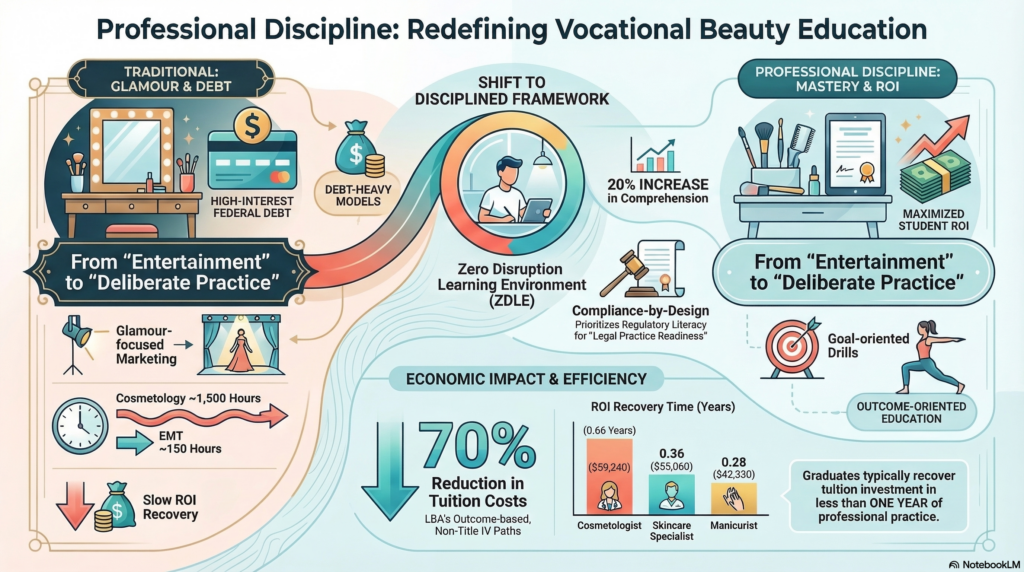
LBA intentionally eschews the federal aid system, opting instead for a low-cost, cash-based model.14 By avoiding the administrative burdens and “hidden tuition hikes” associated with FAFSA participation, LBA can offer programs for under $7,000, while federally funded competitors often charge $15,000 to $25,000.16

Modeling the Net Fiscal Impact

LBA’s economic engine is driven by “Speed-to-Market” and “Taxpayer Savings.” When a student chooses LBA over a traditional Title IV school, the public treasury immediately saves an average of $10,000 in avoided subsidies.22

The fiscal velocity of an LBA graduate can be modeled using the following economic variables 22:

  • Let represent the direct taxpayer savings per student: , where is the average public aid package and is the interest on avoided debt. For LBA, per student.22
  • Let represent the fiscal velocity (extra tax revenue) created by LBA’s accelerated curriculum. If is the 6-month speed-to-market differential, then:

    Using LBA’s metrics (), the extra tax revenue per student is .22

Over a 5-year period, LBA’s model is projected to save taxpayers over $5.8 million per 100-student cohort while generating significantly higher state board revenue through examination fees.22

Table 3: Economic Comparison of Educational Models

MetricTraditional Title IV SchoolLouisville Beauty Academy (LBA)
Typical Tuition$15,000 – $20,000Under $7,000 16
Student Debt at Graduation$7,000 – $11,000$0 16
Public Funding ConsumedHigh (Pell Grants/Loans)$0 (Self-funded) 23
Time to Graduation15–18 months9–10 months 23
5-Year Job Creation (per 500 grads)150 jobs312.5 jobs 23

National Recognition and the “Beauty for Connection” Pilot

The LBA model has not only proven successful locally but has also garnered national acclaim for its innovative approach to vocational education. In 2025, the academy achieved a historic “dual national recognition”.25

The CO—100 Award and National Excellence

Louisville Beauty Academy was named one of America’s Top 100 Small Businesses by the U.S. Chamber of Commerce.25 Selected from a pool of 12,500 applicants, LBA was the only Kentucky business honored in the “Enduring Business” category.25 This award validates LBA’s long-term sustainability and resilience, proving that a low-cost, lower-debt model can thrive without the crutch of federal subsidies.26 Furthermore, the academy’s founder, Di Tran, was recognized as a finalist for the 2025 NSBA Lew Shattuck Small Business Advocate of the Year, highlighting LBA’s role as a policy leader in the industry.25

“Beauty for Connection”: Social Medicine in Practice

Central to LBA’s mission is the “Beauty for Connection” initiative, which treats grooming services as a critical tool for human contact and mental health.10 This pilot program delivers free beauty and wellness services to Kentucky’s elderly, disabled, and socially isolated populations.10

The initiative addresses the “loneliness epidemic” by channeling student training hours into community service under instructor supervision.10 The measurable results are significant:

  • Student Contribution: Over 30,000 service hours provided annually.10
  • Community Value: Over $500,000 in donated services per year.10
  • Healthcare Savings: An estimated $2 million to $3 million in annual savings by reducing ER visits and illnesses related to social isolation and poor grooming (e.g., infections, depression).10

By embedding community service into the curriculum, LBA ensures that its students graduate not just as technicians, but as “compassionate caregivers” who understand the human impact of their profession.10

Comparative Analysis: The National Landscape of Beauty Education

When compared to the broader national landscape, Louisville Beauty Academy’s model offers a clear solution to many of the “pain points” currently facing regulators and students.

The Problem of “Free Student Labor”

Nationwide, federal reports have raised concerns about schools that function as “quasi-salons,” where students perform high volumes of services for the public to generate profit for the institution while receiving little educational value.16 This model has led to numerous class-action lawsuits and settlements, as students argue they are effectively functioning as unpaid employees.28

LBA mitigates this risk through its volunteer-based framework. By removing the profit incentive from the clinic floor and focusing on underserved populations, LBA ensures that clinic services are truly educational and service-oriented rather than commercial.14 This aligns with federal “Gainful Employment” standards and protects the academy from the “substantial misrepresentation” charges that have crippled other for-profit institutions.16

Regulatory Capture and Barriers to Entry

The beauty industry is often subject to “Regulatory Capture,” where boards dominated by industry incumbents set high barriers to entry to protect existing businesses.17 This often results in inflated program hours and outdated curriculum requirements.21 LBA actively challenges this system by advocating for state-led vocational reform and promoting AI-driven compliance over manual “red tape”.14

Table 4: LBA’s Model vs. National Regulatory Trends

TrendNational Industry RiskLBA Compliance Solution
Debt-to-Earnings92.5% of programs likely to fail 16lower-debt model; zero risk 16
Instructional HoursInconsistent reporting/fraud 11Biometric attendance mandates 11
Student LaborFLSA “free labor” concerns 16Volunteer-based service model 14
AccessibilityHigh tuition; credit check barriers 14Low tuition; no credit checks 14

Conclusion: Toward a New National Standard for Beauty Education

The research conducted by Di Tran University – The College of Humanization suggests that the Louisville Beauty Academy model provides a transformative roadmap for the future of vocational education. By testing the hypothesis of a lower-debt, compliance-first, and community-driven school, this analysis demonstrates that LBA has successfully decoupled its success from the systemic failures of the traditional for-profit model.

LBA’s “Center of Compliance Excellence” effectively addresses the oversight gaps identified by the Kentucky Legislative Research Commission, proving that transparency and technology can create an environment of “Gold Standard” integrity.1 The “Beauty for Connection” initiative transforms the clinic floor from a place of potential student exploitation into a site of profound community healing and “social medicine”.3

Crucially, LBA’s economic model proves that high-quality vocational training does not require federal subsidies. By saving taxpayers millions in avoided debt while accelerating students into the workforce, LBA acts as a powerful economic engine for the Commonwealth of Kentucky.23

As federal and state regulators look to reform the beauty industry, the LBA case study offers several actionable lessons:

  1. Prioritize Lower-Debt Paths: Vocational education should be affordable enough to be self-funded, preventing the “debt overhang” that stifles entrepreneurship.23
  2. Mandate High-Integrity Attendance: Biometric systems should become the standard for clock-hour reporting to protect students and taxpayers.11
  3. Humanize Clinical Practice: Clinic floors should be service-oriented hubs that benefit the community, removing the commercial pressure that degrades the quality of training.10

Regulators, educators, and the public are encouraged to consult the primary sources—specifically the Kentucky Administrative Regulations (KAR), the Kentucky Board of Cosmetology (KBC) portal, and the LBA Public Record Library—for authoritative guidance on implementing these standards.1 The Louisville Beauty Academy case study illustrates how a compliance-first, debt-conscious, and community-centered training model may provide insights for broader vocational education reform discussions in the United States.2

Works cited

  1. LOUISVILLE BEAUTY ACADEMY — PUBLIC RECORD LIBRARY Public Case Study — KBC Google Review Trends & Official Regulation Update – 12-05-2025, accessed March 6, 2026, https://louisvillebeautyacademy.net/louisville-beauty-academy-public-record-library-public-case-study-kbc-google-review-trends-official-regulation-update-12-05-2025/
  2. Comparative Analysis of Beauty Schools: Louisville Beauty Academy vs. National Institutes – RESEARCH JULY 2025 – Di Tran University, accessed March 6, 2026, https://ditranuniversity.com/comparative-analysis-of-beauty-schools-louisville-beauty-academy-vs-national-institutes-research-july-2025/
  3. beauty school compliance Archives – Louisville Beauty Academy, accessed March 6, 2026, https://louisvillebeautyacademy.net/tag/beauty-school-compliance/
  4. BOARDS AND COMMISSIONS Kentucky Board of Cosmetology (Amendment) 201 KAR 12:060. Inspections. RELATES TO, accessed March 6, 2026, https://apps.legislature.ky.gov/services/karmaservice/documents/12425/ToPDF?markup=true
  5. Board of Cosmetology (Amendment) 201 KAR 12:060. Inspections. RELATES TO, accessed March 6, 2026, https://apps.legislature.ky.gov/services/karmaservice/documents/16142/ToPDF?markup=true
  6. Title 201 Chapter 12 Regulation 082 • Kentucky Administrative Regulations – Legislative Research Commission, accessed March 6, 2026, https://apps.legislature.ky.gov/law/kar/titles/201/012/082/
  7. Board of Cosmetology (Amendment) 201 KAR, accessed March 6, 2026, https://apps.legislature.ky.gov/services/karmaservice/documents/16143/ToPDF?markup=true
  8. Tag: cosmetology school instructional hours reporting – Louisville Beauty Academy, accessed March 6, 2026, https://louisvillebeautyacademy.net/tag/cosmetology-school-instructional-hours-reporting/
  9. beauty academy curriculum Archives – Louisville Beauty Academy – Louisville KY, accessed March 6, 2026, https://louisvillebeautyacademy.net/tag/beauty-academy-curriculum/
  10. “Beauty for Connection”: A Proven Model by Louisville Beauty …, accessed March 6, 2026, https://louisvillebeautyacademy.net/beauty-for-connection-a-proven-model-by-louisville-beauty-academy-to-combat-loneliness-empower-students-and-deliver-free-wellness-services-to-kentuckys-elderly-and-disabl/
  11. Tag: Kentucky Board of Cosmetology requirements – Louisville Beauty Academy, accessed March 6, 2026, https://louisvillebeautyacademy.net/tag/kentucky-board-of-cosmetology-requirements/
  12. Tag: biometric attendance cosmetology school – Louisville Beauty Academy, accessed March 6, 2026, https://louisvillebeautyacademy.net/tag/biometric-attendance-cosmetology-school/
  13. 201 KAR 12:082. Education requirements and school administration. RELATES TO, accessed March 6, 2026, https://apps.legislature.ky.gov/services/karmaservice/documents/2007/ToPDF?markup=false
  14. Pioneering the Future of Lower-Debt … – Louisville Beauty Academy, accessed March 6, 2026, https://louisvillebeautyacademy.net/louisville-beauty-academy-pioneering-the-future-of-lower-debt-purpose-driven-beauty-education/
  15. Louisville Beauty Academy: Pioneering Lower-Debt Beauty Education AND THRIVING AND ELEVATING THE BEAUTY INDUSTRY LANDSCAPE – RESEARCH MAY 2025, accessed March 6, 2026, https://louisvillebeautyacademy.net/louisville-beauty-academy-pioneering-lower-debt-beauty-education-and-thriving-and-elevating-the-beauty-industry-landscape-research-may-2025/
  16. Tag: vocational education policy analysis – Louisville Beauty Academy, accessed March 6, 2026, https://louisvillebeautyacademy.net/tag/vocational-education-policy-analysis/
  17. The Reality of Cosmetology Education in Kentucky What Adult Students Must Understand Before Enrolling – Louisville Beauty Academy, accessed March 6, 2026, https://louisvillebeautyacademy.net/the-reality-of-cosmetology-education-in-kentucky-what-adult-students-must-understand-before-enrolling/
  18. Gold-Standard Compliance Guide: KBC Transfer and Field / Charity …, accessed March 6, 2026, https://louisvillebeautyacademy.net/gold-standard-compliance-guide-kbc-transfer-and-field-charity-hour-requirements-research-2026/
  19. Chapter Number/Section Name – Legislative Research Commission, accessed March 6, 2026, https://apps.legislature.ky.gov/lrc/publications/ResearchReports/RR492.pdf
  20. Tag: compliance by design beauty school – Louisville Beauty Academy, accessed March 6, 2026, https://louisvillebeautyacademy.net/tag/compliance-by-design-beauty-school/
  21. beauty industry workforce education Archives – Louisville Beauty Academy, accessed March 6, 2026, https://louisvillebeautyacademy.net/tag/beauty-industry-workforce-education/
  22. Vocational Education Economics Archives – Louisville Beauty …, accessed March 6, 2026, https://louisvillebeautyacademy.net/tag/vocational-education-economics/
  23. Macroeconomic Analysis of Lower-Debt Vocational Pathways: A …, accessed March 6, 2026, https://louisvillebeautyacademy.net/macroeconomic-analysis-of-lower-debt-vocational-pathways-a-comparative-study-of-the-louisville-beauty-academy-and-federal-aid-dependent-models-in-the-commonwealth-of-kentucky-research-podcast/
  24. affordable beauty school Archives – Louisville Beauty Academy, accessed March 6, 2026, https://louisvillebeautyacademy.net/tag/affordable-beauty-school/
  25. Louisville Beauty Academy: Prestige, Trust, and National-to-Local Recognition in Every Graduate’s Hands, accessed March 6, 2026, https://louisvillebeautyacademy.net/louisville-beauty-academy-prestige-trust-and-national-to-local-recognition-in-every-graduates-hands/
  26. Louisville Beauty Academy Named One of America’s Top 100 Small Businesses by the U.S. Chamber of Commerce — Chosen From Over 12500 Applicants Nationwide – SEPTEMBER 2025, accessed March 6, 2026, https://louisvillebeautyacademy.net/louisville-beauty-academy-named-one-of-americas-top-100-small-businesses-by-the-u-s-chamber-of-commerce-chosen-from-over-12500-applicants-nationwide-september-2025/
  27. Louisville Beauty Academy: Self-Published Books for Advanced Learning, Skill Mastery, Business Success, and More, accessed March 6, 2026, https://louisvillebeautyacademy.net/louisvillebeautyacademyselfpublishedbookcollection/
  28. Beauty School Regulatory Capture & Anti-Competitive Practices:A, accessed March 6, 2026, https://naba4u.org/2025/11/beauty-school-regulatory-capture-anti-competitive-practicesa-research-report-for-the-new-american-business-association-research-2025/

Research Independence and Non-Endorsement Statement

This publication represents an independent academic analysis conducted by the Di Tran University — The College of Humanization Research Team for the purpose of advancing scholarly discussion regarding vocational education, regulatory compliance, and workforce development.

All information contained in this research is derived from public records, regulatory documents, academic sources, and publicly available institutional materials believed to be reliable at the time of writing. However, the authors make no guarantees regarding completeness, accuracy, or future regulatory interpretation, as laws, policies, and institutional practices may evolve over time.

The discussion of any institution, including Louisville Beauty Academy, is provided solely as a research case study within an academic framework. Such discussion does not imply endorsement, certification, approval, or representation by Di Tran University, Louisville Beauty Academy, or any governmental or regulatory authority.

This research publication is intended exclusively for educational and informational purposes and should not be interpreted as legal advice, regulatory instruction, institutional policy, or professional recommendation.

Neither Di Tran University, Louisville Beauty Academy, the Research Team, nor the authors assume responsibility or liability for any actions taken based on the interpretation or use of this material.

All responsibility for interpretation and application of the information contained herein remains solely with the reader.

The Legal Scope of Beauty Licensing in the United States: A Comprehensive Policy, Legal, and Workforce Analysis of Cosmetology, Barbering, Esthetics, and Nail Technology – RESEARCH & PODCAST SERIES 2026


Educational Research Disclaimer

This publication is an academic research work by the Di Tran University — The College of Humanization Research Team. It is provided solely for educational and informational purposes and is based on publicly available statutes, regulations, and cited sources.

The content represents academic analysis and discussion only and does not constitute legal advice, regulatory guidance, or official interpretation of any law or licensing requirement. Laws and regulatory interpretations may change and vary by jurisdiction; readers should consult the appropriate licensing boards or qualified professionals for authoritative guidance.

While care has been taken to reference credible sources, no guarantee is made regarding completeness or accuracy, and neither the authors nor Di Tran University assume liability for actions taken based on this information.

All research, analysis, and responsibility belong solely to the Di Tran University — The College of Humanization Research Team, and the publication is intended to support general education and informed discussion only.

References to statutes, regulations, organizations, or professional practices are provided for academic discussion only and should not be interpreted as endorsement, criticism, or legal determination regarding any institution, profession, or regulatory body.


Executive Summary

Occupational licensing in the beauty industry serves as a foundational pillar for public health, safety, and professional standardization across the United States. Historically rooted in medieval guilds and refined during the Progressive Era, these regulations were primarily established to mitigate the transmission of infectious diseases, such as the “barber’s itch,” and to ensure that practitioners possess a minimum level of technical competency.1 However, the modern regulatory landscape is characterized by a complex web of state-specific statutes that often lead to significant industry misconceptions regarding the legal boundaries of practice.

The rationale for licensing rests on the “police power” of the state, which authorizes the regulation of private conduct to protect the collective welfare.3 Within the beauty sector, this manifests as oversight over the use of reactive chemicals, sharp implements, and invasive skin treatments. Despite this clear mandate, the industry is rife with misconceptions, particularly regarding the overlap of male and female grooming services and the perception that licensing serves primarily as an economic barrier rather than a safety mechanism.5

The legal boundaries of practice are strictly delineated by license type. Cosmetologists operate under a broad beautification mandate encompassing hair, skin, and nails, whereas barbers maintain a historically specialized focus on the head, face, and neck, including the exclusive legal right in many jurisdictions to perform unprotected straight-razor shaves.7 As the industry moves toward medical-aesthetic integration, the distinction between cosmetic services and medical procedures has become the most volatile legal frontier, with beauty professionals often operating at the edge of medical board jurisdiction.9

Policy implications for the coming years include a national trend toward hour reductions, the consolidation of regulatory boards to improve administrative efficiency, and the development of interstate compacts to facilitate workforce agility in an increasingly mobile economy.12 This report provides an exhaustive analysis of these themes, utilizing the legal frameworks of Kentucky, California, Texas, and Virginia as representative case studies.

Historical Development of Beauty Licensing

The lineage of modern beauty regulation is a dual history of medical necessity and aesthetic evolution. The roots of barbering are deeply embedded in the medieval period, where the Guild of Barbers, first recorded in London in 1308, served both a religious and professional purpose.15 These early practitioners, known as barber-surgeons, were responsible for a wide array of procedures that extended far beyond grooming, including blood-letting, cupping, tooth extraction, and the lancing of abscesses.1 The barbers’ association with minor surgery was so strong that it took until 1540 for the Company of Barber Surgeons to be formally established under Henry VIII, and it was not until 1745 that the professions of barbering and surgery legally diverged.15 This historical connection explains the barber’s long-standing legal authority over razor-based services; the straight razor was essentially the surgical tool of the trade.

In the United States, the professionalization of beauty services was catalyzed by the Progressive Era’s focus on sanitation. The outbreak of “barber’s itch,” a contagious fungal infection spread via unsterilized razors, prompted states to enact licensing laws as a public health measure in the late 19th and early 20th centuries.2 These laws established state boards to oversee training and hygiene standards, reflecting a broader movement toward the regulation of occupations whose tasks plausibly pose risks to consumers.16 By 1927, states like California began separately licensing barbers and cosmetologists, reflecting a social and professional divide that persists in many regulatory systems today.3

Cosmetology followed a different developmental trajectory, descending from holistic beautification practices found in ancient civilizations, such as the skin health regimens of Rome.1 Unlike the male-centric guilds of barbering, cosmetology was culturally associated with women and the broader application of “cosmetic expertise” to the hair, skin, and nails.1 As the entertainment industry flourished in the early 20th century, the demand for specialized cosmetological skills grew, leading to the emergence of formal beauty schools and specialized training programs.1 These schools provided an alternative to the traditional apprenticeship model, offering a structured curriculum that included chemistry, anatomy, and state law.1

The professionalization of beauty services also served an economic function. Unionized barbers in the early 20th century advocated for regulations not only for safety but also to bar discount competitors from the market.2 Over time, these regulations evolved into the modern state regulatory systems we see today, which balance the need for public safety with the pressures of workforce development and economic mobility.18

Legal Framework Governing Beauty Licensing

The regulation of the beauty industry in the United States is primarily the domain of state governments, exercising their constitutional authority to protect the public welfare.3 This authority is typically delegated to specialized regulatory bodies, such as cosmetology or barber boards, which may operate independently or be housed within broader departments of consumer affairs or professional licensing.20

State Regulatory Authority and Board Structure

The structure of these boards varies significantly by state, reflecting different regulatory philosophies. Some states maintain separate boards for barbering and cosmetology to preserve the distinct traditions of each craft, while others have consolidated them into a single agency to improve administrative efficiency and simplify the licensing process for “dual-service” salons.13

StatePrimary Regulatory BoardConsolidation StatusPrimary Statute
KentuckyBoard of Cosmetology; Board of BarberingSeparateKRS Chapters 317, 317A 8
CaliforniaBoard of Barbering and CosmetologyConsolidatedBPC Chapter 10 20
TexasDepartment of Licensing and Regulation (TDLR)ConsolidatedOccupations Code Chapter 1603 7
VirginiaBoard for Barbers and CosmetologyConsolidatedCode of Virginia Title 54.1 26

Public Health and Safety Justifications

The legal framework is built upon the premise that professional beauty services involve significant biological and chemical risks. Practitioners work with reactive substances such as hair color, relaxers, and perm solutions, and utilize sharp instruments like razors, shears, and nippers.4 Furthermore, the proximity of service—touching the skin and scalp—creates a potential for the transmission of bloodborne pathogens and infectious diseases.4 Consequently, state boards mandate that a substantial portion of a student’s training be dedicated to infection control, sanitation, and the study of skin and scalp disorders.21 In California, the Board of Barbering and Cosmetology is expressly required to prioritize “public protection” above all other considerations in its regulatory actions.20

Statutory Definitions and Limitations

Statutory authority is established through state-specific codes that define the “scope of practice”—the specific services a licensee is legally authorized to perform. For example, Kentucky Revised Statute (KRS) 317A.020 explicitly prohibits unlicensed individuals from engaging in cosmetology for the public or for consideration, emphasizing that these services must be for “cosmetic purposes” rather than the treatment of physical or mental ailments.23 This distinction is critical, as it prevents beauty professionals from inadvertently or intentionally entering the domain of medical practice.

The legal framework also differentiates between specialty licenses. Esthetics licensing, which emerged as a distinct branch in the mid-to-late 20th century, focuses specifically on the beautification of the skin through facials, exfoliation, and the application of cosmetics.7 Nail technician licensing is similarly specialized, restricting practitioners to the care of the hands and feet.7 These specialty statutes are often more limited in scope than the broader cosmetology license, which traditionally serves as a “full-service” credential.1

Scope of Practice: What Cosmetologists Can Legally Do

The cosmetologist’s license is the most versatile credential in the beauty industry, often characterized as a “full-service” license because it authorizes the practitioner to perform a wide array of services across hair, skin, and nails.1 In Texas, the scope of cosmetology consists of performing or offering to perform for compensation any service that treats the hair, skin, or nails for beautification.7

Comprehensive Hair and Chemical Services

The core of the cosmetologist’s scope involves the structural and aesthetic modification of hair. This includes:

  • Cutting and Shaping: Trimming, bobbing, and thinning hair using shears, clippers, or hair-cutting razors.7
  • Chemical Texturizing: Providing permanent waving, chemical relaxing, and straightening services through the application of reactive chemicals.29
  • Coloring and Lightening: Bleaching, tinting, dyeing, and processing hair using specialized formulations.7
  • Styling and Arrangement: Blow-drying, curling, waving, and dressing hair of all textures.25
  • Hair Extensions and Weaving: Attaching commercial hair to a person’s hair or scalp using various methods, including braids and extensions.7

Skin Care and Esthetic Services

While not as specialized as a master esthetician, a licensed cosmetologist is legally authorized to provide foundational skin treatments. These include:

  • Facials and Massages: Cleansing, stimulating, or massaging the face, neck, shoulders, and arms by hand or with cosmetic appliances.7
  • Makeup Artistry: Applying cosmetics, lotions, powders, and oils for beautification, including airbrushing and camouflage techniques.32
  • Temporary Hair Removal: Removing superfluous hair using tweezers, depilatories, or waxing.7
  • Eyelash Extensions: In many jurisdictions, such as Kentucky and Texas, applying semi-permanent eyelash extensions is within the scope of a cosmetologist.7

Nail Care and Technology

Cosmetologists are authorized to perform full manicuring and pedicuring services, a distinction that traditionally separates them from barbers. These services include:

  • Natural Nail Care: Cleaning, trimming, shaping, and polishing the nails of the hands and feet.7
  • Artificial Enhancements: Applying and sculpting monomer liquid and polymer powder (acrylics), UV/LED gels, and nail tips.29
  • Hand and Foot Treatments: Massaging and beautifying the hands up to the elbow and the feet up to the knee.25

Legal Limitations

Despite the breadth of this license, cosmetologists are subject to strict legal limitations. They cannot perform any act that constitutes the practice of medicine or surgery.9 Furthermore, in many states, they are prohibited from using an unprotected straight razor for facial shaving, a service typically reserved for licensed barbers.7

Scope of Practice: What Barbers Can Legally Do

Barbering is legally defined by its historical focus on the head, face, and neck, with a specific emphasis on hair cutting and shaving.1 In Kentucky, barbering is described as the practice upon the human neck, face, and head, principally of shaving or trimming the beard or cutting the hair.8

Precision Hair Cutting and Facial Hair Design

The barber’s expertise lies in the structural design of hair and facial grooming:

  • Hair Cutting: Specializing in short, tapered, and faded designs using shears, clippers, and razors.8
  • Beard and Mustache Care: Trimming, shaping, and beautifying facial hair through precise grooming techniques.7
  • Scalp and Facial Treatments: Administering massages and applying lotions, oils, or clays to the face, neck, and scalp, often as part of a traditional shaving service.8

Shaving and Razor Work

The defining characteristic of the barber’s scope is the legal authority to perform facial shaving.

  • Razor Shaving: Barbers are authorized to use a “razor of any type,” including the traditional straight razor, to shave a person’s face, neck, mustache, or beard.7
  • Historical Precedent: This authority stems from the barber’s origins as a surgeon, where mastery of the unprotected blade was essential for both grooming and minor medical operations.1

Chemical Services and Styling

A common industry myth suggests that barbers are limited only to cutting. In reality, modern barbering licenses include broad authority for chemical services:

  • Hair Coloring: Dyeing and tinting hair to change its appearance or cover gray hair.7
  • Chemical Texturizing: In states like Virginia, “Master Barbers” are authorized to perform permanent waving, chemical relaxing, and hair lightening.26
  • Styling: Arranging, dressing, and styling hair using various tools and products.7

Legal Limitations

Barbers are generally restricted from performing manicures and pedicures unless they hold a separate nail technician or cosmetology license.7 Furthermore, like cosmetologists, they are strictly prohibited from performing medical acts or treatments for physical ailments.36

The Razor Controversy

The “razor line” is one of the most litigated and debated boundaries in beauty licensing. Historically, the straight razor—a blade with no guard—was the primary tool of the barber, while the cosmetologist was restricted to using razors with safety guards for hair cutting.7

Straight Razor Shaving vs. Safety Razor Shaving

The legal distinction often rests on the definition of a “safety razor.” In Texas, a safety razor is defined as one fitted with a guard close to the cutting edge, intended to prevent deep cuts and reduce the risk of accidental injury.7

  • Barbers: Legally authorized to perform “shaving a person’s face, neck, mustache, or beard with a razor of any type”.7 This includes the unprotected straight razor.
  • Cosmetologists: Restricted in many states to using a safety razor for hair cutting or for shaving the “nape of the neck” as an ancillary service to a haircut.7

State Variations in Razor Law

Regulatory philosophies on razor use vary by jurisdiction. In California, Regulation 993(a) prohibits any establishment or school from possessing a razor-edged tool intended for removing calluses, illustrating a hard line against using razors for skin-related medical-adjacent procedures.25 Virginia recently revised its cosmetology scope to explicitly prohibit cosmetologists from performing straight-razor shaving, reinforcing the barber’s traditional domain.14

Razor Haircutting

Both barbers and cosmetologists are generally authorized to use razors for the purpose of cutting and texturizing hair on the head.7 The controversy arises specifically when the razor makes contact with the skin of the face and front of the neck for the purpose of removing hair (shaving). In some states, a cosmetologist can “shave” the neck using a safety razor, but the “straight razor shave” remains the signature service of the licensed barber.7

Services That Beauty Licenses Cannot Legally Perform

A fundamental principle of occupational licensing is the strict separation between “cosmetic” and “medical” services. No beauty license—cosmetology, barbering, esthetics, or nail technology—confers the authority to practice medicine or surgery.9

The Epidermal Frontier

Most state boards define beauty services as those affecting only the non-living outermost layer of the skin, the epidermis (specifically the stratum corneum).9 Any procedure that results in the removal, destruction, incision, or piercing of skin beyond the epidermis is classified as a medical act.9

Prohibited Medical and Invasive Procedures

The following services are universally outside the scope of beauty licenses and require medical oversight:

  • Injectables: The injection of Botox, dermal fillers (such as Juvederm), or vitamins is a medical act that requires a medical license (MD, RN, NP, or PA under physician supervision).9
  • Laser and Energy Treatments: Laser hair removal, IPL (Intense Pulsed Light) treatments, and laser skin resurfacing are generally considered medical procedures because they utilize energy that can cause burns, scarring, and hyperpigmentation.9
  • Advanced Skin Resurfacing: While estheticians can perform “light” or “superficial” chemical peels, “medium” and “deep” peels that penetrate the dermis are medical procedures.9
  • Microneedling: The use of needles to pierce the skin for stimulating collagen production is considered a medical act in many states. FDA guidelines generally restrict estheticians to devices with needles shorter than 0.3mm that do not make medical claims.9
  • Dermaplaning Controversies: While dermaplaning for basic exfoliation is increasingly added to beauty scopes (as in Kentucky’s 2025 reforms), using a medical scalpel or performing “advanced” exfoliation remains a medical task.33
  • Medical Dermatology: Treating acne beyond basic comedone extraction, removing moles or skin tags, and treating skin diseases are the exclusive domain of licensed medical professionals.9

Regulatory and Legal Consequences

Beauty professionals who cross into medical practice risk significant penalties, including fines (up to $1,000 per violation in California), license suspension or revocation, and potential criminal charges for the unlicensed practice of medicine.25

Major Industry Myths

The complexity of state beauty laws has led to several persistent myths that can mislead students and professionals alike.

Myth 1: Cosmetologists cannot cut men’s hair.

Fact: A cosmetology license authorizes the practitioner to cut the hair of any individual, regardless of gender. The myth persists because barbering schools traditionally focus more extensively on male-oriented techniques (such as fades and tapers), but the legal authority to cut hair exists in both licenses.6

Myth 2: Barbers cannot color hair.

Fact: Modern barbering statutes in almost all states include the application of dyes, tints, and reactive chemicals. While some states have “Master Barber” designations for advanced chemical work, basic coloring is a standard part of the barbering scope.7

Myth 3: Only barbers can use razors.

Fact: Cosmetologists are legally permitted to use razors for hair cutting (texturizing) and, in many jurisdictions, for shaving the neck as part of a haircut service.7 The specific prohibition for cosmetologists is typically restricted to the unprotected straight-razor shave on the face.7

Myth 4: Estheticians can perform “medical-grade” skin treatments.

Fact: There is no legal recognition for the term “medical esthetician” in state beauty codes. An esthetician’s scope is strictly limited to non-invasive, beautifying treatments of the epidermis. Any treatment that penetrates the dermis or requires a medical prescription is a medical act.9

Myth 5: Nail technicians can perform podiatry services.

Fact: Nail technicians are authorized only for the beautification of the hands and feet. They cannot treat ingrown toenails (if they involve infection or cutting live tissue), fungal infections, or medical calluses, as these are medical conditions requiring a podiatrist.23

Differences Between Beauty Licenses

Understanding the specific differences in training and authority is essential for workforce planning and career selection.

License TypeTraining Hours (Standard Range)Key Services AllowedPrimary Legal Limitations
Cosmetologist1,000 – 1,500Hair (all types), Facials, Makeup, Manicures, Pedicures, Chemical services 7No unprotected straight-razor facial shaves 7
Barber750 – 1,500Hair cutting, Shaving, Beard trimming, Facial treatments, Coloring 7No nail care services; restricted in advanced skin care 7
Esthetician600 – 750Facials, Chemical peels (superficial), Waxing, Makeup, Extractions 9No hair cutting or coloring; no invasive medical acts 9
Nail Technician300 – 600Manicures, Pedicures, Acrylics, Gels, Massage (elbow/knee down) 7No hair or facial services; no treatment of medical ailments 25

State Variations in Beauty Licensing

While the general principles of beauty licensing are consistent, specific requirements for training hours and regulatory philosophy vary significantly across states.

Kentucky: The Apprenticeship and Hour Leader

Kentucky maintains a robust training requirement and a unique post-graduation apprenticeship model.

  • Cosmetology: Requires 1,500 school hours followed by a mandatory 6-month apprenticeship working under supervision in a licensed salon.52
  • Barbering: 1,500 hours.8
  • Recent Reform: Kentucky’s 2025 updates expanded the scope to include dermaplaning for basic exfoliation by licensed cosmetologists and estheticians who complete specialized training.46

California: The Efficiency and Access Model

California has recently emerged as a leader in reducing barriers to entry and expanding access for immigrant populations.

  • Cosmetology/Barbering: Reduced training requirements to 1,000 hours in 2022 to streamline workforce entry.54
  • Immigrant Access (SB 1159): California prohibits denying a license based on citizenship or immigration status and allows the use of an Individual Taxpayer Identification Number (ITIN) in lieu of a Social Security Number.56

Texas: The Consolidated and Risk-Based Model

Texas moved to a consolidated regulatory system under the TDLR and has adopted a risk-based inspection schedule.

  • Training: Requires 1,000 school hours + 500 high school hours for a cosmetology operator license.13
  • Specialty Licenses: Texas offers specific licenses for manicurists (600 hours) and eyelash extension specialists (320 hours).13
  • Human Trafficking: All Texas licensees must complete mandatory continuing education in human trafficking awareness.13

Virginia: The Curriculum Reformer

Virginia has enacted sweeping changes to its licensing hours and curriculum content for 2025/2026.

  • Hour Reductions: Cosmetology remains at 1,000 hours, but barbering was reduced from 1,100 to 750 hours.14
  • Scope Realignment: Newly revised regulations explicitly prohibit cosmetologists from straight-razor shaving and machine-based facials, pushing these services toward barbers and estheticians respectively.14

Workforce and Economic Implications

The beauty industry is a vital component of the American economy, employing over 1.2 million professionals and serving as a major pathway for entrepreneurship.4

Barriers to Entry and Labor Supply

Research on occupational licensing suggests that these regulations can act as a significant barrier to entry, potentially reducing the equilibrium labor supply by 17% to 27%.60 Higher hour requirements often lead to increased education costs and student debt, which may discourage individuals from pursuing careers in the industry.61 Interestingly, most studies show no clear correlation between higher licensing requirements and improved service quality, leading some policymakers to advocate for deregulation or hour reductions.5

Entrepreneurship and Minority Participation

The beauty industry provides unique opportunities for women and minorities, who are disproportionately represented in the profession. Nearly 85% of beauty professionals are women, compared to 47% in the overall U.S. workforce.4 Furthermore, about half of all beauty professionals are self-employed, making the industry a critical driver of small business growth.4 Reforms like California’s SB 1159 have further enhanced economic mobility by allowing undocumented immigrants to obtain professional licenses and contribute to the formal economy.57

The Impact of Hour Reductions

States like California and Virginia have reduced training hours with the goal of increasing workforce entry and reducing student financial burden.14 While this can lead to faster career starts, it also places increased pressure on beauty schools to refine their curricula to ensure that students remain competent in safety and sanitation within a shorter timeframe.17

Future Trends in Beauty Licensing

The beauty industry is entering a period of rapid evolution driven by technological advancements and policy shifts.

The Rise of the Cosmetology Licensure Compact

To address the challenges of professional mobility, the Council of State Governments has developed the “Cosmetology Licensure Compact”.12 This legislatively enacted agreement allows cosmetologists in member states (including Kentucky and Virginia) to apply for a multistate license, enabling them to work across state lines without the need for redundant examinations or hour certifications.12

Artificial Intelligence and Virtual Reality in Training

AI and VR are set to revolutionize how beauty professionals are trained.

  • Virtual Training: Some colleges are beginning to use VR to allow students to practice haircuts, skincare, and makeup techniques in a simulated environment before working on real clients.64
  • AI Literacy: Federal and state guidance is increasingly focusing on “AI literacy” for the workforce, teaching professionals how to use AI-driven diagnostics for skin and hair analysis effectively and ethically.65
  • Generative AI: By 2025, generative AI is expected to be a key player in personalizing beauty routines and predicting treatment outcomes, which will require new regulatory considerations for state boards.66

Licensing Reform and Apprenticeship Expansion

Economic pressure is driving a trend toward shorter training programs and the expansion of apprenticeship pathways.14 Some states are introducing “limited” licenses (such as Kentucky’s “Limited Stylist” for blow-drying and arrangement) to allow faster entry for individuals who do not wish to perform chemical services or hair cutting.32

Frequently Asked Legal Questions

Can a cosmetologist shave with a razor?

In most states, a cosmetologist can use a safety razor for cutting hair or shaving the nape of the neck. However, they are typically prohibited from performing a straight-razor facial shave, which is a service reserved for licensed barbers.7

Can a barber color hair?

Yes. Most state barbering licenses expressly authorize the coloring, tinting, and dyeing of hair.7

Can estheticians perform microneedling?

This is a highly regulated and state-dependent area. In many jurisdictions, estheticians are limited to using “nanoneedling” or microneedling devices shorter than 0.3mm that do not pierce the dermis. Deeper microneedling is considered a medical act.9

Can nail technicians treat foot medical conditions?

No. Nail technicians are restricted to the beautification of the nails and skin. They cannot treat ailments such as fungal infections, ingrown nails, or medical-grade calluses, which fall under the scope of podiatry.23

Can cosmetologists perform dermaplaning?

Regulation is shifting on this issue. In states like Kentucky, cosmetologists and estheticians can now perform dermaplaning for basic exfoliation if they provide proof of specialized training. In other states, it remains a prohibited practice or is restricted to medical environments.33

Is a “medical esthetician” license required to work in a MedSpa?

There is generally no such license as a “medical esthetician” at the state board level. A standard esthetics license is used, but the practitioner must work under the supervision of a physician if performing any services that border on medical practice.9

Conclusion

The legal scope of beauty licensing in the United States is an intricate framework designed to balance the competing interests of public safety, professional heritage, and economic opportunity. While the foundational principles of sanitation and technical competency remain unchanged since the Progressive Era, the implementation of these laws is undergoing significant modernization. The consolidation of boards, the reduction of training hours, and the emergence of interstate compacts all signal a move toward a more agile and professionalized beauty workforce.

However, the most critical challenge for the coming decade lies in the “medical-aesthetic crossover.” As technology enables more invasive treatments, the line between beautification and medicine will require even clearer statutory definitions to protect both the practitioner and the consumer. For beauty professionals, educators, and policymakers, understanding these legal boundaries is not merely a matter of compliance—it is essential for the sustainable growth and humanization of an industry that touches the lives of nearly every American.

Works cited

  1. Historical Context: Alabama Board of Cosmetology and Barbering – For the Record, accessed March 6, 2026, https://fortherecordalabama.blog/2025/04/17/historical-context-alabama-board-of-cosmetology-and-barbering/
  2. A Cut Below: Lessons from the History of Barber Licensure – Advancing Liberty in Missouri, accessed March 6, 2026, https://showmeinstitute.org/article/regulation/a-cut-below-lessons-from-the-history-of-barber-licensure/
  3. Barber or Cosmetologist? Only Your Hairdresser Knows For Sure, accessed March 6, 2026, https://digital.sandiego.edu/cgi/viewcontent.cgi?article=2905&context=crlr
  4. The Value of Cosmetology Licensing to the Health, Safety, and Economy of America, accessed March 6, 2026, https://sbp.senate.ca.gov/sites/sbp.senate.ca.gov/files/The%20Value%20of%20Cosmetology%20Licensing.pdf
  5. Raising Barriers, Not Quality – The Institute for Justice, accessed March 6, 2026, https://ij.org/wp-content/uploads/2022/10/Raising-Barriers-Not-Quality-10142022-WEB-REVISED.pdf
  6. 13 Common Myths and Misconceptions About Beauty School – Campus.edu, accessed March 6, 2026, https://campus.edu/blog/cosmetology/13-beauty-school-myths
  7. Texas Occupations Code – OCC § 1603.0011 | FindLaw, accessed March 6, 2026, https://codes.findlaw.com/tx/occupations-code/occ-sect-1603-0011/
  8. 317.410 Definitions for chapter. As used in this chapter, unless the context requires otherwise: (1) “Barber” me, accessed March 6, 2026, https://apps.legislature.ky.gov/law/statutes//statute.aspx?id=56215
  9. The Scope of Practice for Estheticians in California – Holt Law, accessed March 6, 2026, https://djholtlaw.com/the-scope-of-practice-for-estheticians-in-california/
  10. Medical Spas – Barbering and Cosmetology – Texas Department of Licensing and Regulation, accessed March 6, 2026, https://www.tdlr.texas.gov/barbering-and-cosmetology/medical-spas.htm
  11. Texas Med Spa Licensing | Brewster Law Firm PLLC, accessed March 6, 2026, https://brewsterlawtx.com/medical-spa/texas-med-spa-compliance-guide/texas-med-spa-licensing/
  12. The Cosmetology Compact – National Center for Interstate Compacts, accessed March 6, 2026, https://compacts.csg.org/compact-updates/cosmetology/
  13. Texas Cosmetology Laws & License Requirements | 2026 Guide – Consentz, accessed March 6, 2026, https://www.consentz.com/texas-cosmetology-laws-license-requirements/
  14. Barber, Cosmetology, Nail, Wax, Tattooing, Permanent Cosmetic Tattooing, and Master Permanent Cosmetic Tattooing Curriculum Requirements | Virginia Department of Professional and Occupational Regulation – DPOR, accessed March 6, 2026, https://www.dpor.virginia.gov/CosmetologyCurriculum
  15. The Company of Barbers and Surgeons – PMC, accessed March 6, 2026, https://pmc.ncbi.nlm.nih.gov/articles/PMC1282221/
  16. NBER WORKING PAPER SERIES THE ORIGINS AND EVOLUTION OF OCCUPATIONAL LICENSING IN THE UNITED STATES Nicholas A. Carollo Jason F., accessed March 6, 2026, https://www.nber.org/system/files/working_papers/w33580/w33580.pdf
  17. Debunking Common Myths About Beauty School: What You Really Need to Know, accessed March 6, 2026, https://keuneacademyby124.edu/4797-2/
  18. The State of Occupational Licensing, accessed March 6, 2026, https://sbp.senate.ca.gov/sites/sbp.senate.ca.gov/files/NCSL%20State%20of%20Occupational%20Licensing.pdf
  19. Invest in the workforce for the AI age: A blueprint for scale, skills and responsible growth, accessed March 6, 2026, https://www.weforum.org/stories/2026/01/ai-roadmap-transforming/
  20. The Barbering and Cosmetology Act, accessed March 6, 2026, https://www.barbercosmo.ca.gov/laws_regs/laws.shtml
  21. California-2023-AB2444-Introduced – LegiScan, accessed March 6, 2026, https://legiscan.com/CA/text/AB2444/id/2927174/California-2023-AB2444-Introduced.html
  22. chapter 1603. regulation of barbering and cosmetology – Texas Constitution and Statutes, accessed March 6, 2026, https://statutes.capitol.texas.gov/GetStatute.aspx?Code=OC&Value=1603
  23. 317A.020 Scope of chapter — Licensure requirements — Emergency …, accessed March 6, 2026, https://apps.legislature.ky.gov/law/statutes/statute.aspx?id=56210
  24. Chapter 1603. REGULATION OF BARBERING AND COSMETOLOGY – Texas Statutes, accessed March 6, 2026, https://tx.elaws.us/law/oc_title9_chapter1603
  25. 2025 Barbering and Cosmetology Act AND Barbering and …, accessed March 6, 2026, https://www.barbercosmo.ca.gov/laws_regs/article_12.pdf
  26. Forms (18VAC41-20) – Virginia Law, accessed March 6, 2026, https://law.lis.virginia.gov/admincodefull/title18/agency41/chapter20/
  27. Board for Barbers and Cosmetology Legislative Update | Virginia Department of Professional and Occupational Regulation – DPOR, accessed March 6, 2026, https://www.dpor.virginia.gov/Boards/Barber/2025%20Legislative%20Updates
  28. Vol. 42 Iss. 9 (Proposed) 18VAC41-20, Barbering And Cosmetology Regulations December 15, 2025, accessed March 6, 2026, https://register.dls.virginia.gov/details.aspx?id=12085
  29. BOARDS AND COMMISSIONS Board of Cosmetology (Amended at ARRS Committee) 201 KAR 12:082. Education requirements and school admini, accessed March 6, 2026, https://apps.legislature.ky.gov/services/karmaservice/documents/16398/ToPDF?markup=true
  30. Title 201 Chapter 12 Regulation 082 • Kentucky Administrative Regulations, accessed March 6, 2026, https://apps.legislature.ky.gov/law/kar/titles/201/012/082/16143/
  31. Kentucky Revised Statutes Title XXVI. Occupations and Professions § 317A.020 | FindLaw, accessed March 6, 2026, https://codes.findlaw.com/ky/title-xxvi-occupations-and-professions/ky-rev-st-sect-317a-020/
  32. 317A.010 Definitions for chapter. As used in this chapter, unless the context requires otherwise: (1) “Beauty salon&q – Legislative Research Commission, accessed March 6, 2026, https://apps.legislature.ky.gov/law/statutes/statute.aspx?id=53212
  33. medspas at a glance – TEXAS DEPARTMENT OFLICENSING & REGULATION, accessed March 6, 2026, https://www.tdlr.texas.gov/media/pdf/Medspas-at-a-Glance.pdf
  34. AN ACT relating to activities regulated by the Kentucky Board of Hairdressers and Cosmetologists – LegiScan, accessed March 6, 2026, https://legiscan.com/KY/text/HB311/2012
  35. Who Regulates What? | Barbering and Cosmetology | TDLR.Texas.gov, accessed March 6, 2026, https://www.tdlr.texas.gov/barbering-and-cosmetology/who-regulates-what.htm
  36. 317.410 Definitions for chapter. As used in this chapter, unless the context requires otherwise – Kentucky Board of Barbering, accessed March 6, 2026, https://barbering.ky.gov/Laws-and-Regulations/Documents/KBOB%20Law%20Book.pdf
  37. CHAPTER 32 1 Legislative Research Commission PDF Version CHAPTER 32 (HB 148) AN ACT relating to barbers. Be it enacted by the Ge, accessed March 6, 2026, https://apps.legislature.ky.gov/law/acts/06RS/documents/0032.pdf
  38. 18 Va. Admin. Code § 41-20-220 – Hours of instruction and performances | State Regulations | US Law | LII / Legal Information Institute, accessed March 6, 2026, https://www.law.cornell.edu/regulations/virginia/18VAC41-20-220
  39. HB742 – 2026 Regular Session – LIS, accessed March 6, 2026, https://lis.virginia.gov/bill-details/20261/HB742/text/HB742
  40. California Skincare Laws 2025: What You Need to Know (and Why They Matter), accessed March 6, 2026, https://www.marieshelley.com/blogs/california-skincare-laws-2025
  41. Frequently Asked Questions – FAQs | Medical Board of California, accessed March 6, 2026, https://www.mbc.ca.gov/FAQs/?cat=Licensees&topic=Cosmetic%20Treatments
  42. Medical Spa Requirements In California, accessed March 6, 2026, https://spasource.com/blog/medical-spa-requirements-in-california/
  43. California Has Strict Laws Regarding Laser Treatments and Injectables, accessed March 6, 2026, https://americanmedspa.org/blog/california-has-strict-laws-regarding-laser-treatments-and-injectables
  44. What’s the Scope? Understanding State by State Scope of Practice Laws – Dermascope, accessed March 6, 2026, https://www.dermascope.com/what-s-the-scope-understanding-state-by-state-scope-of-practice-laws/
  45. 2026 Legislative Watch and Key Bills Estheticians Should Know About, accessed March 6, 2026, https://www.ascpskincare.com/updates/blog-posts/2026-legislative-watch-and-key-bills-estheticians-should-know-about
  46. Board of Cosmetology (Amendment) 201 KAR 12:280. Esthetic practices restrictions. RELATES TO: KRS 317A., accessed March 6, 2026, https://apps.legislature.ky.gov/services/karmaservice/documents/16150/ToPDF?markup=true
  47. Kentucky Proposes Adding to Scope and Increasing Fees, accessed March 6, 2026, https://www.ascpskincare.com/updates/blog-posts/kentucky-proposes-adding-scope-and-increasing-fees
  48. Medical Spa Laws and Requirements in Virginia – Portrait Care, accessed March 6, 2026, https://www.portraitcare.com/post/medical-spa-laws-virginia
  49. 4 Cosmetology Myths We’re Debunking – Aveda Arts, accessed March 6, 2026, https://avedaarts.edu/blog/4-cosmetology-myths-were-debunking/
  50. Apply for an Esthetician License | TDLR.Texas.gov, accessed March 6, 2026, https://www.tdlr.texas.gov/barbering-and-cosmetology/individuals/apply-esthetician.htm
  51. Licensed Occupations Requiring Clock-Hour Training and Interstate Transferability – RESEARCH JUNE 2025 – Viet Bao Louisville KY, accessed March 6, 2026, https://vietbaolouisville.com/2025/06/licensed-occupations-requiring-clock-hour-training-and-interstate-transferability-research-june-2025/
  52. License Requirements – Kentucky Board of Cosmetology, accessed March 6, 2026, https://kbc.ky.gov/Licensure/Pages/License-Requirements.aspx
  53. Kentucky Cosmetology Laws & License Requirements [2026] – Consentz, accessed March 6, 2026, https://www.consentz.com/kentucky-cosmetology-laws-license-requirements/
  54. State-by-State Cosmetology License Transfer Guide (Comprehensive Research as of March 2025) – Louisville Beauty Academy, accessed March 6, 2026, https://louisvillebeautyacademy.net/state-by-state-cosmetology-license-transfer-guide-comprehensive-research-as-of-march-2025/
  55. Schools – California Board of Barbering and Cosmetology – CA.gov, accessed March 6, 2026, https://www.barbercosmo.ca.gov/schools/
  56. SB 1159 Senate Bill – Bill Analysis – Leginfo.ca.gov, accessed March 6, 2026, http://www.leginfo.ca.gov/pub/13-14/bill/sen/sb_1151-1200/sb_1159_cfa_20140828_100733_asm_comm.html
  57. Legislative Fact Sheet – SB 1159 Professional Licenses, accessed March 6, 2026, https://consulmex.sre.gob.mx/sacramento/images/PDFs/MexicoEnCapitolio/sb_1159.pdf
  58. Advocates Applaud Signing of Professional Licensing Bill for Immigrants – ACLU of Norcal, accessed March 6, 2026, https://www.aclunorcal.org/press-releases/advocates-applaud-signing-professional-licensing-bill-immigrants/
  59. New Continuing Education Requirements Effective September 1, 2025 | TDLR News and Updates, accessed March 6, 2026, https://www.tdlr.texas.gov/news/2025/06/16/new-continuing-education-requirements-effective-september-1-2025/
  60. NBER WORKING PAPER SERIES HOW MUCH OF BARRIER TO ENTRY IS OCCUPATIONAL LICENSING? Peter Q. Blair Bobby W. Chung Working Paper 25, accessed March 6, 2026, https://www.nber.org/system/files/working_papers/w25262/w25262.pdf
  61. Examining Licensing Issues Within the Cosmetology Industry, accessed March 6, 2026, https://www.air.org/project/examining-licensing-issues-within-cosmetology-industry
  62. 2026 Workforce Outlook: Employers That Prioritize AI Literacy and Education Benefits Can Lead the Talent Race | Bright Horizons Family Solutions, accessed March 6, 2026, https://investors.brighthorizons.com/news-releases/news-release-details/2026-workforce-outlook-employers-prioritize-ai-literacy-and
  63. How to Transfer Your Cosmetology, Nail, or Esthetics License to Kentucky (2026 Step-by-Step Guide) – FEB 2026, accessed March 6, 2026, https://louisvillebeautyacademy.net/how-to-transfer-your-cosmetology-nail-or-esthetics-license-to-kentucky-2026-step-by-step-guide-feb-2026/
  64. The Future of Cosmetology: Embracing AI & Innovation – Eric Fisher Academy, accessed March 6, 2026, https://ericfisheracademy.com/2024/10/01/in-2025-how-do-we-define-cosmetology/
  65. The U.S. Department of Labor’s Artificial Intelligence Literacy Framework – DOL.gov, accessed March 6, 2026, https://www.dol.gov/sites/dolgov/files/ETA/advisories/TEN/2025/TEN%2007-25/TEN%2007-25%20%28complete%20document%29.pdf
  66. AI in the Beauty Industry: Transforming Skills, Training, and Jobs, accessed March 6, 2026, https://nationalskillsnetwork.in/ai-in-the-beauty-industry-transforming-skills-training-and-jobs/
  67. Artificial Intelligence – Professional Learning (CA Dept of Education), accessed March 6, 2026, https://www.cde.ca.gov/ci/pl/aiincalifornia.asp
  68. Kentucky superintendents hear about new accountability legislation, AI resources during webcast, accessed March 6, 2026, https://www.kentuckyteacher.org/news/2026/01/kentucky-superintendents-hear-about-new-accountability-legislation-ai-resources-during-webcast/

Educational Research Disclaimer

This publication is an academic research work by the Di Tran University — The College of Humanization Research Team. It is provided solely for educational and informational purposes and is based on publicly available statutes, regulations, and cited sources.

The content represents academic analysis and discussion only and does not constitute legal advice, regulatory guidance, or official interpretation of any law or licensing requirement. Laws and regulatory interpretations may change and vary by jurisdiction; readers should consult the appropriate licensing boards or qualified professionals for authoritative guidance.

While care has been taken to reference credible sources, no guarantee is made regarding completeness or accuracy, and neither the authors nor Di Tran University assume liability for actions taken based on this information.

All research, analysis, and responsibility belong solely to the Di Tran University — The College of Humanization Research Team, and the publication is intended to support general education and informed discussion only.

References to statutes, regulations, organizations, or professional practices are provided for academic discussion only and should not be interpreted as endorsement, criticism, or legal determination regarding any institution, profession, or regulatory body.

The Reality of Cosmetology Education in Kentucky What Adult Students Must Understand Before Enrolling

Current information notice

This article is part of LBA’s public education and historical archive. Older posts, including “The Reality of Cosmetology Education in Kentucky What Adult Students Must Understand Before Enrolling,” may not reflect current tuition, schedules, incentives, forms, policies, testing vendors, clinic availability, or regulatory requirements.

Before relying on this article for any decision, review LBA’s Current Information and Written Control Standard, Current Program Costs, Enrollment Concierge, and Policy and Written Records.

Di Tran University Research & Workforce Policy Series – 2026


Frequently Asked Questions About Cosmetology and Beauty Training in Kentucky

How many hours are required for a cosmetology license in Kentucky?
Kentucky requires 1,500 training hours for a cosmetology license under KRS Chapter 317A and the administrative regulations in 201 KAR Chapter 12. The curriculum includes theory instruction, clinical practice, and Kentucky law before a student can qualify for the state licensing examination administered through PSI.

How many hours are required for an esthetician license in Kentucky?
Kentucky requires 750 training hours for an Esthetics license. Esthetics training focuses on skin care, facial treatments, sanitation, infection control, product chemistry, and safe skin service procedures. Graduates must pass the Kentucky state board licensing examination to practice professionally.

How many hours are required for a nail technician license in Kentucky?
Kentucky requires 450 training hours for a Nail Technology license. Training includes sanitation, infection control, nail structure, chemistry of nail products, and practical service procedures before qualifying for the state licensing exam.

Is shampoo styling a license in Kentucky?
Yes. Shampoo Styling is a licensed profession in Kentucky requiring 300 hours of training in a licensed cosmetology school. The program focuses on shampooing, scalp treatments, blow-drying, and basic styling techniques, with strong emphasis on sanitation and hygiene.

Is eyelash extension a license in Kentucky?
No. Eyelash extensions are regulated through a specialty permit rather than a full license. Practitioners must complete approved training and obtain a specialty permit before legally performing eyelash extension services.

What is the difference between a license and a specialty permit?
A professional license (cosmetology, esthetics, nail technology, or shampoo styling) requires a defined number of training hours and passing a state licensing examination.
A specialty permit allows practice of a specific limited service and typically requires shorter training focused only on that service.

Can cosmetology or esthetics students work on real clients during school?
Yes. Kentucky allows student clinics in licensed schools. However, cosmetology students must complete at least 250 hours of foundational training before performing chemical services on members of the public in order to protect public safety.

How much does beauty school cost in Kentucky?
Tuition varies widely depending on the institution. Programs may range from lower-cost vocational training models to higher-priced schools that rely heavily on federal student aid. Prospective students should compare tuition, exam preparation support, and graduation outcomes before enrolling.


Correct Kentucky Program Hour Requirements Summary

ProgramHours RequiredCredential Type
Cosmetology1,500 hoursLicense
Esthetics750 hoursLicense
Nail Technology450 hoursLicense
Shampoo Styling300 hoursLicense
Eyelash ExtensionSpecialty trainingSpecialty Permit

Research & Educational Disclaimer

This article is provided for public education and workforce research purposes only and reflects analysis prepared by researchers affiliated with Di Tran University as part of its ongoing study of vocational education systems, regulatory structures, and economic outcomes for adult learners. The content represents independent academic commentary and general informational analysis regarding industry trends, public regulations, and financial literacy considerations within cosmetology education. Publication on the Louisville Beauty Academy website is intended solely to support consumer awareness and transparency in vocational decision-making. Nothing in this article should be interpreted as legal advice, regulatory interpretation, endorsement of any institution, or criticism of any specific organization, program, regulator, or business entity. Regulatory references are provided for educational context only, and readers are encouraged to consult the official statutes, administrative regulations, and the appropriate licensing authorities for authoritative guidance. Louisville Beauty Academy does not claim authorship of the analysis and assumes no responsibility for third-party interpretations or decisions made based on this informational content.


The Architecture of Regulatory Capture in Cosmetology: Institutional Influence, Competitive Obstruction, and the Crisis of Debt-Dependent Education

The landscape of occupational licensing in the United States, particularly within the cosmetology and beauty services sector, serves as a primary example of regulatory capture. This phenomenon, where state agencies created to act in the public interest instead prioritize the commercial and political objectives of the industries they regulate, is not merely a theoretical concern but a documented reality with significant economic consequences. In the beauty education sector, this capture is facilitated through a complex network of statutory board compositions, aggressive lobbying by trade associations, and an accreditation system that serves as a gatekeeper for billions of dollars in federal subsidies. The resulting policy environment often suppresses competition, inflates tuition, and traps low-income and immigrant learners in a cycle of debt that bears little relation to professional mastery or public safety.

The Theoretical Framework of Occupational Capture and Market Distortion

Regulatory capture within cosmetology boards is characterized by the dominance of active market participants over the regulatory process. When a licensing board is composed primarily of industry insiders—specifically owners of large cosmetology school chains—the board’s incentives shift from protecting the public to protecting incumbent business models. This is particularly evident in the setting of mandatory instructional hours, curriculum standards, and the adjudication of competitive entries. Research from the Center for the Study of Economic Liberty (CSEL) at Arizona State University suggests that this mechanism of capture is the primary driver behind the suppression of employment and entrepreneurial opportunities in the sector.1

The economic impact of this capture is quantifiable. Boards dominated by industry incumbents tend to set higher barriers to entry, which increases the time and cost required to obtain a license. According to CSEL’s 2020 report, the “Cosmetology Board Capture Index” reveals a direct correlation between the lack of public representation on boards and the length of state-mandated training.2 In the eight states with the highest levels of board capture—defined as having zero public representatives—it takes an average of 50 more calendar days than the national average to fulfill the state requirements for licensure.2

National Metrics of Cosmetology Board CaptureData Observation
States with Zero Public Board RepresentativesNew York, North Dakota 2
States with High Capture (Minimal Public Input)LA, MA, MS, OK, VT, WY 2
National Average Training Time Increase (High Capture States)+50 Days 2
States with Majority Public BoardsArizona (post-2020), California 3
States with Eliminated Boards (Least Captured)Maine, Arkansas (Eliminated 2009) 3

These “high capture” states often resist reforms such as universal licensure reciprocity, which would allow practitioners to move across state lines without undergoing duplicative and costly training.4 By maintaining fragmented and high-barrier licensing regimes, captured boards ensure that students remain enrolled in schools longer, thereby maximizing the tuition revenue generated for the institutions represented on those boards.5

Schools that operate with lower tuition models allow graduates to enter the workforce without heavy debt obligations. When graduates are not burdened by loan repayment, they can reinvest earnings into advanced education, business ownership, and local economic activity. In contrast, high-tuition programs often delay entrepreneurship because graduates must prioritize debt repayment before building independent practices.

Structural Capture in State Statutes: The Case of Kentucky

The Commonwealth of Kentucky provides a granular view of how regulatory capture is codified into state law. Kentucky Revised Statute (KRS) 317A.030 establishes the composition of the Kentucky Board of Cosmetology (KBC) in a manner that virtually guarantees industry dominance. The statute mandates a seven-member board, but only one of those seats is reserved for a “citizen at large” who is free from financial ties to the industry.6

The board’s composition under KRS 317A.030 is as follows:

  • Two members must be cosmetology salon owners.
  • One member must be a cosmetology teacher in public education.
  • One member must be an owner of, or have a financial interest in, a licensed cosmetology school.
  • One member must be a licensed nail technician.7
  • One member must be a licensed esthetician.7
  • One member is a citizen at large.6

A critical second-order insight into this statutory structure is the requirement that the school owner member “shall be a member of a nationally recognized association of cosmetologists”.6 By embedding membership in a trade association—such as the American Association of Cosmetology Schools (AACS)—directly into the qualifications for a government regulator, the state effectively delegates regulatory influence to private interest groups. This formal mechanism ensures that the national policy agenda of large, for-profit school chains is represented at the highest levels of state oversight.

The informal mechanisms of capture in Kentucky have historically been even more pronounced. Prior to 2024, the KBC faced significant public pressure and allegations of mismanagement, leading to the removal of Executive Director Julie Campbell in September 2024 after a seven-year tenure.9 The board’s transition to new leadership under Joni Upchurch, a former cosmetology professor, and the appointment of Michael Carter as the first-ever nail technician board member, represent attempts at institutional reform.9 However, even under new leadership, the board continues to exhibit the hallmarks of capture, such as the recusal of board members from decisions involving competing schools. For instance, in a January 2026 meeting, Vice Chair Lianna Nguyen recused herself from board decisions regarding the Louisville Beauty Academy (LBA), a low-cost competitor to traditional Title IV schools.11

Trade Associations and the Lobbying Power of the Beauty School Industrial Complex

The American Association of Cosmetology Schools (AACS) acts as the central hub for industry lobbying and advocacy. As a regulated industry, for-profit beauty schools maintain a “proactive” stance toward federal and state government relations to protect their revenue streams from “attacks” such as the reduction of program hours or the deregulation of licensure.12

The Federal Lobbying Machine

The AACS maintains a robust advocacy infrastructure, including an annual Congressional Summit and “Hill Day,” where school owners and administrators gather in Washington, D.C., to lobby Members of Congress.12 Their primary objectives include:

  1. Preserving High Program Hours: Lobbying against state-level efforts to reduce mandatory hours, as shorter programs decrease the amount of federal student aid a school can collect.5
  2. Opposing Accountability Standards: Fighting federal “Gainful Employment” (GE) and “Financial Value Transparency” rules that tie federal aid eligibility to graduate earnings.13
  3. Protecting Title IV Dependency: Ensuring that the flow of Pell Grants and federal student loans remains uninterrupted, despite evidence that many programs provide poor financial returns for students.5

A significant example of this influence is the AACS’s legal challenge to the Department of Education’s 2023 Gainful Employment Rule. The AACS and its member schools filed suit in federal district court in Texas, seeking to strike down the rule as “arbitrary, capricious, and unconstitutional”.15 Although Chief U.S. District Judge Reed O’Connor ruled in favor of the Department of Education in October 2025, the AACS has continued to fight through the appeals process and through targeted political contributions.16 The schools’ own legal arguments in this case were revealing: they admitted that if forced to meet basic debt-to-earnings benchmarks, a substantial number of programs would “fail and shut down”.14

The 90/10 Rule and Revenue Capture

The economic model of for-profit beauty schools is heavily reliant on federal subsidies. Under the “90/10 rule,” proprietary institutions must derive at least 10% of their revenue from non-federal sources. For many beauty school chains, Title IV federal aid (Pell Grants and loans) accounts for more than 85% of total revenue.19 Recent changes to the 90/10 rule in 2023 expanded the definition of “federal funds” to include any federal assistance received by students, such as Veterans Affairs (VA) benefits, which had previously been used by schools to satisfy the 10% requirement.20 This regulatory shift has put additional pressure on the sector, leading to increased lobbying for “carve-outs” and exemptions.20

Case Study in Competition Blockade: The Iowa Monopoly

The state of Iowa offers a definitive case study in how captured boards and trade associations use the legal system to suppress lower-priced competition. In 2005, the Iowa Cosmetology School Association and La’ James International College sued Iowa Central Community College to stop it from launching a cosmetology program.22 The private schools successfully argued that state code prohibited public entities from competing with private businesses in this sector. This lawsuit effectively preserved a monopoly for high-tuition, for-profit providers and maintained Iowa’s status as having one of the highest licensure hour requirements in the nation—2,100 hours.22

The relationship between the dominant school chain, La’ James International College, and the state regulatory body was particularly incestuous. A high-ranking official from La’ James held a seat on the Iowa Board of Barbering and Cosmetology Arts and Sciences even as the school faced multiple investigations for consumer fraud.24 This position of power allowed the school to influence the very inspectors who were tasked with investigating student complaints about “instructorless” classrooms and the exploitation of students as unpaid labor.25

Iowa Competitive Obstruction MetricsImpact / Observation
Mandatory Cosmetology Hours2,100 (Highest in U.S.) 22
Community College BlockadeLawsuit in 2005 prevented public entry 23
Tuition for Private Chains$15,000 – $20,000 22
Student Debt Forgiveness Settlements$2.1M (2016) and $462k (2021) 22
Board RepresentationLa’ James official held active seat 24

The Title IV Debt Trap and the Economics of Exploitation

The current financing architecture of beauty education incentivizes a model that prioritizes enrollment and aid capture over student outcomes. Because schools are paid per enrolled student per credit hour, there is a systemic incentive to delay graduation and maintain artificially long programs.5

Debt-to-Earnings Disparities

Nationwide data indicates a severe mismatch between the cost of beauty education and the eventual earnings of graduates. Analysis by The Century Foundation and New America shows that 98% of cosmetology programs would fail proposed federal earnings tests.5 Graduates typically earn an average of only $16,600 to $20,000 annually, yet they often carry a debt load of $10,000 to $11,000.5 This high debt-to-income ratio is particularly damaging to the low-income, first-generation, and immigrant populations that these schools target.5

Comparative Earnings Data (2025-2026)Annual Income Range
Entry-Level Cosmetologist$26,000 – $31,000 30
Mid-Career Professional$35,000 – $45,000 30
Average Hourly Rate$18 – $22/hour 30
High School Graduate MedianUsed as federal benchmark for “Red Flag” 31

The industry often defends these low reported earnings by claiming that stylists receive significant unreported income through cash tips. However, the Department of Education, under multiple administrations, has found no empirical evidence of widespread unreported income that would bridge the gap between reported earnings and a livable wage.13

Systemic Use of Unpaid Student Labor

A core component of the for-profit beauty school business model is the “dual-revenue” structure: schools profit from both student tuition and from the salon services performed by students on paying customers.29 In many schools, students are required to work on the “clinic floor” for hundreds of hours, often performing non-educational tasks such as cleaning, restocking, and laundry under the guise of “training”.25

This practice has led to over 40 major class-action lawsuits and federal investigations. Schools such as Empire Beauty, Milan Institute, and La’ James have been accused of treating students more like “free labor” than learners.25 In Iowa, the Attorney General’s lawsuit against La’ James specifically alleged that the school “seemed to pay the company for the privilege of working,” as students were pressured to sell products and were only given credit for services performed on paying customers rather than mannequins.33

The Disruptive Alternative: Louisville Beauty Academy (LBA)

In the midst of this sector-wide crisis, the Louisville Beauty Academy (LBA) in Kentucky serves as a national model for reform. Unlike the dominant chains, LBA operates without any reliance on Title IV federal student aid, Pell Grants, or federal loans.28 By decoupling from the federal aid system, LBA eliminates the “Compliance Tax”—the administrative overhead required to manage federal aid, which typically consumes 25% to 35% of a school’s tuition.5

Economic and Fiscal Contribution

LBA’s non-Title IV model allows for significantly lower tuition rates, which makes the program accessible to working-class and immigrant students without the burden of debt. A 1,500-hour cosmetology program at LBA is priced between $3,800 and $6,250, compared to the $15,000 to $20,000 national average for Title IV schools.35

Fiscal Comparison: LBA vs. Title IV ModelLBA Model (Actual)Title IV Model (Hypothetical)
Public Funds Consumed$0$25,000,000 35
Direct Fee Revenue to State$884,250~$884,250 35
Tax Revenue Generated (10 yrs)$47,815,000~$47,815,000 35
Net Positive Economic Impact$48,699,250$23,699,250 35

The economic impact of LBA is further demonstrated through its “resilience-based” model. LBA leads the state of Kentucky in theory retake participation, reflecting a commitment to ensuring all students, regardless of language barriers or educational background, eventually achieve licensure.35 This model is supported by Kentucky Senate Bill 22 (SB 22), which reformed licensing to allow for unlimited exam retakes and removed punitive waiting periods.36

Speed-to-Market Advantage

LBA’s curriculum is “laser-focused” on the state board examination and minimum competency requirements. This efficiency allows students to complete their training and enter the workforce significantly faster than at Title IV schools, which often pad their curriculum to maximize aid disbursements.5 The speed-to-market differential is estimated at approximately six months:

.28

By entering the workforce earlier and without debt, LBA graduates achieve a vastly superior return on investment (ROI). In a comparative model, LBA graduates contribute more to the state treasury over a five-year horizon through income taxes and license renewal fees because they are not diverted by debt servicing or program delays.28

The Federal Counter-Strike: FAFSA Red-Flags and GE 2.0

As the crisis in for-profit beauty education has become undeniable, the federal government has introduced new mechanisms to protect students and taxpayers. These measures represent an attempt to bypass the captured state boards and communicate directly with prospective students.

The FAFSA “Red Flag” Warning System

On December 7, 2025, the U.S. Department of Education implemented a new “Lower Earnings” warning within the FAFSA system.31 This system flags institutions where the median earnings of graduates fail to exceed the earnings of a typical high school graduate. When a student selects a flagged school, the system highlights the institution in red and provides a “Remove School” button.31

In Kentucky, several major institutions were flagged with this warning:

  • Empire Beauty School (multiple locations) 31
  • Paul Mitchell The School Louisville 31
  • PJS College of Cosmetology 31
  • Summit Salon Academy 31

This system serves as an active market correction, disrupting the enrollment funnel of schools that provide poor economic returns. The New American Business Association (NABA) notes that this shift transforms the FAFSA from a neutral funding gateway into an instrument of market correction.5

The Gainful Employment (GE) Rule 2023-2025

The Department of Education’s 2023 Gainful Employment Rule is the strongest accountability measure to date. It establishes a two-part test for career programs:

  1. Debt-to-Earnings Test: Measures whether graduates’ debt payments are manageable relative to their income.
  2. Earnings Premium Test: Measures whether graduates earn more than a typical high school graduate in their state.14

Failure of these metrics for two out of three consecutive years results in the automatic loss of Title IV eligibility for both federal loans and Pell Grants.37 This is a critical distinction from the One Big Beautiful Bill Act (OBBBA) “Low Earnings” test, which only cuts off access to federal loans but not Pell Grants.38 Given that many undergraduate certificate programs in cosmetology distribute more in Pell Grants than in loans, the GE rule is the only mechanism that truly protects taxpayers from subsidizing low-value programs.38

The Impact of the One Big Beautiful Bill Act (OBBBA)

Signed into law on July 4, 2025, the One Big Beautiful Bill Act (OBBBA) introduced a range of tax and accountability measures that significantly impact the beauty industry.39 While the law permanently extended individual tax cuts and increased deductions for seniors, it also codified a new “Low Earnings” test for degree programs and graduate certificate programs.38

For the beauty industry, the OBBBA was a mixed legislative bag. The industry successfully lobbied for the expansion of the FICA tip tax credit to include beauty services, a move that provides significant tax relief for salon owners.21 However, the law’s “AHEAD” framework (Accountability in Higher Education and Access through Demand-driven Workforce Pell) introduced a “Do No Harm” metric for vocational schools.32

OBBBA ProvisionImpact on Beauty Sector
Tip Tax Credit ExpansionExpanded to beauty services (formerly food/beverage only) 21
Low Earnings TestCodified for degree/grad cert programs; undergraduate certs exempt 38
Pell Grant ExpansionExpanded to short-term (<15 weeks) training programs 38
Student Loan Repayment ExclusionMade permanent tax exclusion for employer-provided repayment ($5,250/yr) 41

The OBBBA’s accountability requirements work “in tandem” with the 2023 GE rule. While the OBBBA focuses on degree-granting institutions, the GE rule remains the primary oversight mechanism for the undergraduate certificate programs that dominate the beauty sector.38

Analytical Synthesis: The Mechanics of Decoupling and Reform

The investigation into regulatory capture in the cosmetology sector reveals a system that is fundamentally misaligned with its stated purpose of public protection. Instead, the licensing framework serves as a state-sanctioned mechanism for funneling federal subsidies into high-tuition, for-profit institutions while providing students with minimal professional preparation and significant debt.

The Capture Loop and the Compliance Tax

The “capture loop” is a self-reinforcing cycle where trade associations (AACS) influence state statutes (KRS 317A) to maintain high hour requirements, which are then validated by industry-led accreditors (NACCAS) to unlock federal aid (Title IV).2 This cycle creates the “Compliance Tax”—an invisible portion of tuition that pays for the administrative apparatus of federal aid management rather than education.5

Schools that operate within this loop, such as the large national chains, are currently facing an enrollment collapse as federal “red flag” systems and Gainful Employment rules take effect.14 The schools themselves admit that their business models are unsustainable without the ability to saddle students with unrepayable debt.14

The Resilience Model as a Path to Market Correction

The emergence of non-Title IV models like Louisville Beauty Academy represents a “Great Decoupling” of beauty education from the debt-based system.5 These models demonstrate that it is possible to provide high-quality, state-licensed education at a fraction of the cost by prioritizing “Minimum Competence” for licensure and delegating “Professional Mastery” to the salon environment.42

Structural Alignment ComparisonTitle IV High-Capture ModelLBA Non-Title IV Model
Primary StakeholderU.S. Department of EducationThe Student / Local Employer
Revenue DriverEnrollment and Aid DrawGraduation and Licensure 35
Curriculum PhilosophyBloated / Celebrity Artistry PromisesLicensing / Science / Safety 42
Attendance TrackingManual / Shoddy / ManipulatedBiometric / Non-Negotiable 19
Ethical StandardUnpaid Student Salon LaborEducational Clinic / Community Service 29

Recommendations for Policy Reform

To break the grip of regulatory capture and the associated debt crisis, policymakers must enact the following reforms:

  1. Eliminate Statutory Association Requirements: Statutes like Kentucky’s KRS 317A.030 should be amended to remove the requirement that board members belong to private trade associations.6
  2. Mandate Public Member Majorities: Following the examples of Arizona and California, all licensing boards should be required to have a majority of members who are free from financial ties to the industry.3
  3. Conduct Independent Hour Audits: State legislatures should commission independent audits of mandatory hours to determine the minimum training necessary for public safety, independent of federal aid eligibility requirements.2
  4. Codify Biometric Attendance Requirements: To prevent the fraudulent reporting of hours, all state-licensed beauty schools should be required to use tamper-proof biometric systems to verify student attendance.19
  5. Enforce FLSA Standards in Educational Clinics: State and federal labor regulators must strictly enforce the distinction between “practical training” and “compensable labor” to stop the exploitation of students as unpaid salon workers.19
  6. Support Universal Reciprocity: Decoupling licensure from specific state boards through universal reciprocity would create a competitive national market for beauty education, forcing schools to compete on quality and price rather than regulatory capture.3

The beauty industry is currently witnessing a historic shift from a “Capture-First” era to a “Transparency-First” era. The survival of the sector depends on its ability to move away from the debt-dependent, aid-capture model and toward the ethical, high-ROI workforce stabilization models demonstrated by institutions like the Louisville Beauty Academy. The “Red Flag” system in the FAFSA and the 2025 OBBBA accountability measures are the first steps in a necessary process of market correction that will ultimately benefit students, taxpayers, and the integrity of the beauty profession.5

Works cited

  1. Center for the Study of Economic Liberty – Arizona State University, accessed March 4, 2026, https://csel.asu.edu/
  2. Policy Report, accessed March 4, 2026, https://csel.asu.edu/sites/g/files/litvpz1671/files/2020-12/CSEL-2020-02-A-Cosmetology-Board-Capture-Index-11_02_20-v2.pdf
  3. A Cosmetology Board Capture Index: Measuring the Influence of Self-Interest in Occupational Licensing – Center for the Study of Economic Liberty, accessed March 4, 2026, https://csel.asu.edu/research/publications/ACosmetologyBoardCaptureIndex
  4. Policy Report – Center for the Study of Economic Liberty, accessed March 4, 2026, https://csel.asu.edu/sites/g/files/litvpz1671/files/2020-02/CSEL-2020-01-You-Can-Take-It-with-You-03_02_20.pdf
  5. Federal Aid, Licensure, and the Debt Crisis in Cosmetology …, accessed March 4, 2026, https://naba4u.org/2025/12/federal-aid-licensure-and-the-debt-crisis-in-cosmetology-education-research-2025/
  6. 317A.030 Board of Cosmetology — Membership — Compensation. (1) There is created an independent agency of the state gover, accessed March 4, 2026, https://apps.legislature.ky.gov/law/statutes//statute.aspx?id=54797
  7. Kentucky Revised Statutes § 317A.030 (2025) – Board of Cosmetology — Membership — Compensation – Justia Law, accessed March 4, 2026, https://law.justia.com/codes/kentucky/chapter-317a/section-317a-030/
  8. AN ACT relating to activities regulated by the Kentucky Board of Hairdressers and Cosmetologists – LegiScan, accessed March 4, 2026, https://legiscan.com/KY/text/HB311/2012
  9. Kentucky State Board of Cosmetology Welcomes New Executive Director Joni Upchurch – 09-27-2024 4pm – Louisville Beauty Academy, accessed March 4, 2026, https://louisvillebeautyacademy.net/kentucky-state-board-of-cosmetology-welcomes-new-executive-director-joni-upchurch-09-27-2024-4pm/
  10. Historic Day for Kentucky Beauty Industry: Michael Carter Sworn In as First Nail Technician on Board of Cosmetology, Executive Director Removed – September 9th, 2024 9am, accessed March 4, 2026, https://louisvillebeautyacademy.net/historic-day-for-kentucky-beauty-industry-michael-carter-sworn-in-as-first-nail-technician-on-board-of-cosmetology-executive-director-removed-september-9th-2024-9am/
  11. Untitled – Kentucky Board of Cosmetology, accessed March 4, 2026, https://kbc.ky.gov/About-Us/board-meetings/Meeting%20Minutes/2026.01.05%20Board%20Meeting%20Minutes.pdf
  12. American Association of Cosmetology Schools – AACS, accessed March 4, 2026, https://myaacs.org/schools/
  13. Why many cosmetology schools in North Dakota are considered ‘low earnings’, accessed March 4, 2026, https://americanexperimentnd.org/why-many-cosmetology-schools-in-north-dakota-are-considered-low-earnings/
  14. Gainful Employment Rules and School Closures (2014–Present) – MAY 2025 STUDY, accessed March 4, 2026, https://naba4u.org/2025/05/gainful-employment-rules-and-school-closures-2014-present-may-2025-study/
  15. CAAHEP Communiqué January 2024 – Constant Contact, accessed March 4, 2026, https://myemail.constantcontact.com/subject.html?soid=1101982827434&aid=3wHonxLrMOA
  16. Update on Gainful Employment Lawsuit – AACS, accessed March 4, 2026, https://members.myaacs.org/news/Details/update-on-gainful-employment-lawsuit-291947
  17. American Association of Cosmetology Schools v. U.S. Dept of Ed. and Ogle School Management v. U.S. Dept of Ed. (2024) Challenges Gainful Employment Rule, accessed March 4, 2026, https://policytracker.wiche.edu/judicial-action/american-association-cosmetology-schools-v-us-dept-ed-and-ogle-school-management-v
  18. Gainful Employment – AACS, accessed March 4, 2026, https://myaacs.org/gainful-employment/
  19. Tag: vocational education policy analysis – Louisville Beauty Academy, accessed March 4, 2026, https://louisvillebeautyacademy.net/tag/vocational-education-policy-analysis/
  20. 2023 Changes to the 90/10 Rule Require Careful Analysis – McClintock & Associates, accessed March 4, 2026, https://mcclintockcpa.com/2023-changes-to-the-90-10-rule-require-careful-analysis/
  21. One Big Beautiful Bill Act: Tax Analysis and Business Impact Guide – HBK, accessed March 4, 2026, https://hbkcpa.com/insights/one-big-beautiful-bill-act-tax-impact-2025/
  22. For-profit beauty school settles class-action lawsuit – The Hechinger Report, accessed March 4, 2026, https://hechingerreport.org/for-profit-beauty-school-settles-class-action-lawsuit/
  23. For-Profit vs. Public Beauty Schools? – CAPPS, accessed March 4, 2026, https://cappsonline.org/for-profit-vs-public-beauty-schools/
  24. The Broken Promises of Cosmetology Education: Held in Place: Locking in State Licensure Mandates – NewAmerica.org, accessed March 4, 2026, https://www.newamerica.org/education-policy/reports/cut-short-the-broken-promises-of-cosmetology-education/held-in-place-locking-in-state-licensure-mandates/
  25. Cut Short: The Broken Promises of Cosmetology Education – ERIC, accessed March 4, 2026, https://files.eric.ed.gov/fulltext/ED676659.pdf
  26. Cosmetology school in Iowa accused of violating Consumer Fraud Act | | legalnewsline.com, accessed March 4, 2026, https://www.legalnewsline.com/cosmetology-school-in-iowa-accused-of-violating-consumer-fraud-act/article_f33e7f12-9107-50e0-9f26-907417780a82.html
  27. Iowa AG files lawsuit against cosmetology school | | legalnewsline.com, accessed March 4, 2026, https://www.legalnewsline.com/iowa-ag-files-lawsuit-against-cosmetology-school/article_2670474b-3018-50de-a9d2-2a38e7fbfe42.html
  28. Macroeconomic Analysis of Lower-Debt Vocational Pathways: A Comparative Study of the Louisville Beauty Academy and Federal-Aid Dependent Models in the Commonwealth of Kentucky – RESEARCH & PODCAST SERIES, accessed March 4, 2026, https://louisvillebeautyacademy.net/macroeconomic-analysis-of-lower-debt-vocational-pathways-a-comparative-study-of-the-louisville-beauty-academy-and-federal-aid-dependent-models-in-the-commonwealth-of-kentucky-research-podcast/
  29. Louisville Beauty Academy: A National Model of Legal Integrity in Beauty Education – RESEARCH 2025, accessed March 4, 2026, https://naba4u.org/2025/11/louisville-beauty-academy-a-national-model-of-legal-integrity-in-beauty-education-research-2025/
  30. Kentucky Cosmetology Laws & License Requirements [2026] – Consentz, accessed March 4, 2026, https://www.consentz.com/kentucky-cosmetology-laws-license-requirements/
  31. Federal Warning Signals Students Away From Many Beauty Schools – DEC 7TH, 2025 – A New FAFSA Red-Flag System Raises National Concern – Louisville, KY, accessed March 4, 2026, https://naba4u.org/2025/12/federal-warning-signals-students-away-from-many-beauty-schools-dec-7th-2025-a-new-fafsa-red-flag-system-raises-national-concern/
  32. in 2027, 92% Beauty Schools are going to close under new Trump rules : r/Cosmetology, accessed March 4, 2026, https://www.reddit.com/r/Cosmetology/comments/1qtkdsu/in_2027_92_beauty_schools_are_going_to_close/
  33. La’James accused of consumer fraud | News, Sports, Jobs – The Messenger, accessed March 4, 2026, https://www.messengernews.net/news/local-news/2014/08/la-james-accused-of-consumer-fraud/
  34. State attorney general alleges school violated state’s Consumer Fraud Act – Legal News > Your source for information behind the law, accessed March 4, 2026, https://legalnews.com/Home/Articles?DataId=1396296
  35. Louisville Beauty Academy: A Net-Positive Economic Engine for the Commonwealth of Kentucky – RESEARCH & PODCAST 2026, accessed March 4, 2026, https://louisvillebeautyacademy.net/louisville-beauty-academy-a-net-positive-economic-engine-for-the-commonwealth-of-kentucky-research-podcast-2026/
  36. Kentucky beauty education policy analysis Archives, accessed March 4, 2026, https://louisvillebeautyacademy.net/tag/kentucky-beauty-education-policy-analysis/
  37. 2023 Gainful Employment – nasfaa, accessed March 4, 2026, https://www.nasfaa.org/ge_2021-22
  38. Congress’s College Accountability Statute Has Cracks. The 2023 Gainful Employment Rule Fills Them. – The Century Foundation, accessed March 4, 2026, https://tcf.org/content/commentary/congresss-college-accountability-statute-has-cracks-the-2023-gainful-employment-rule-fills-them/
  39. One Big Beautiful Bill Act – Wikipedia, accessed March 4, 2026, https://en.wikipedia.org/wiki/One_Big_Beautiful_Bill_Act
  40. One Big Beautiful Bill Act resource center – Wolters Kluwer, accessed March 4, 2026, https://www.wolterskluwer.com/en/know/one-big-beautiful-bill-act
  41. New Tax Rules Under the One Big Beautiful Bill Act: What Employers, Workers and Unions Need to Know – American Bar Association, accessed March 4, 2026, https://www.americanbar.org/groups/labor_law/resources/magazine/2025-summer/new-tax-rules-obba/
  42. Tag: cosmetology state board exam Kentucky – Louisville Beauty Academy, accessed March 4, 2026, https://louisvillebeautyacademy.net/tag/cosmetology-state-board-exam-kentucky/
  43. The Federal Transparency Era in Cosmetology Education – Accreditation Terminology Reform, Financial Value Accountability, and the Primacy of State Licensure – RESEARCH & PODCAST SERIES 2026 – Louisville Beauty Academy, accessed March 4, 2026, https://louisvillebeautyacademy.net/the-federal-transparency-era-in-cosmetology-education-accreditation-terminology-reform-financial-value-accountability-and-the-primacy-of-state-licensure-research-podcast-series-2026/
  44. State o f Arizona – Auditor General, accessed March 4, 2026, https://www.azauditor.gov/sites/default/files/2023-11/96-15_Report.pdf
  45. Louisville Beauty Academy, Di Tran, and Di Tran University as a “Certainty Engine” for Workforce Stability in an Era of Volatility, accessed March 4, 2026, https://naba4u.org/2025/12/louisville-beauty-academy-di-tran-and-di-tran-university-as-a-certainty-engine-for-workforce-stability-in-an-era-of-volatility/

Research & Educational Disclaimer

This article is provided for public education and workforce research purposes only and reflects analysis prepared by researchers affiliated with Di Tran University as part of its ongoing study of vocational education systems, regulatory structures, and economic outcomes for adult learners. The content represents independent academic commentary and general informational analysis regarding industry trends, public regulations, and financial literacy considerations within cosmetology education. Publication on the Louisville Beauty Academy website is intended solely to support consumer awareness and transparency in vocational decision-making. Nothing in this article should be interpreted as legal advice, regulatory interpretation, endorsement of any institution, or criticism of any specific organization, program, regulator, or business entity. Regulatory references are provided for educational context only, and readers are encouraged to consult the official statutes, administrative regulations, and the appropriate licensing authorities for authoritative guidance. Louisville Beauty Academy does not claim authorship of the analysis and assumes no responsibility for third-party interpretations or decisions made based on this informational content.


Louisville Beauty Academy supports transparency in vocational education and encourages prospective students to carefully evaluate all training programs, tuition models, and regulatory requirements before making a career investment. Access to accurate information allows adult learners to make informed decisions about licensing pathways and workforce entry.

Kentucky Beauty Instructor Licensing Exam Graduate Action Guide — PSI National Testing Process & State Board Readiness (March 2026 Update)

Current information notice

This article is part of LBA’s public education and historical archive. Older posts, including “Kentucky Beauty Instructor Licensing Exam Graduate Action Guide — PSI National Testing Process & State Board Readiness (March 2026 Update),” may not reflect current tuition, schedules, incentives, forms, policies, testing vendors, clinic availability, or regulatory requirements.

Before relying on this article for any decision, review LBA’s Current Information and Written Control Standard, Current Program Costs, Enrollment Concierge, and Policy and Written Records.


If you are reading this page, you are either:

• Preparing to qualify as a Kentucky Instructor
• Already approved to test
• Or planning your Kentucky Cosmetology Instructor licensing exam

This page contains the official PSI Kentucky Instructor Test Taker Guide (Effective March 19, 2026) published by PSI Services LLC.

Below is your clear step-by-step action plan.


✅ STEP 1: Confirm Eligibility & Board Approval

Before you can schedule your exam:

• You must have verified eligibility with the Kentucky Board of Cosmetology
• The Board must release your name to PSI
• PSI will email you once you are eligible

⚠️ You cannot schedule until eligibility is confirmed.


✅ STEP 2: Create or Log Into Your PSI Account

Go to the official PSI Kentucky portal:

https://test-takers.psiexams.com/kycos

You will:

• Create an account (if new)
• Use your permit number or former license number as your Candidate ID
• Ensure your name matches your legal ID exactly

If you previously created a PSI account, you must use the same one.


✅ STEP 3: Pay & Schedule Your Exams

Exam Fees:
• Instructor Theory Exam – $85
• Instructor Practical Exam – $85

Important:
• Fees are non-refundable
• Fees are valid for 90 days
• You must pass Theory before scheduling Practical

Schedule early to secure your preferred location.


✅ STEP 4: Prepare for the THEORY Exam

Instructor Theory Exam Details:

• 50 scored questions
• 5 experimental (unscored) questions
• 90 minutes total
• Passing score: 80%

Major Content Areas:

• Learning & Communication (24%)
• Curriculum & Lesson Planning (10%)
• Teaching Methods (30%)
• Learner Evaluation & Assessment (20%)
• Classroom Management (16%)

This is a CLOSED BOOK exam.

Study recommended references including:
Pivot Point Fundamentals: Mindful Teaching (2nd Ed.)
Milady Professional Educator (4th Ed.)


✅ STEP 5: Prepare for the PRACTICAL Exam

Practical Exam Length:
• Approximately 60 minutes
• Passing score: 85%

You will perform:

Topic Area 1 – Daily Classroom Preparation
Topic Area 2 – Classroom Safety Manual
Topic Area 3 – Public Health & Safety Lecture & Demonstration
Topic Area 4 – End-of-Day Clean-Up

You must demonstrate:

✔ Infection control knowledge
✔ Workplace safety compliance
✔ Proper classroom management
✔ Clear public health instruction


🚨 CRITICAL PRACTICAL REQUIREMENTS

Before test day, confirm:

✔ Solid color medical scrubs (NO white)
✔ No school name visible
✔ Supply kit no larger than 24” x 24” x 24”
✔ Two labeled trash containers (Single-Use / Multi-Use)
✔ EPA-approved disinfectant wipes (bactericidal, virucidal, fungicidal)
✔ Hand sanitizer with manufacturer label
✔ Required classroom safety manual
✔ Two forms of valid ID

Failure to comply = dismissal + reschedule + repay fee.


✅ STEP 6: Bring Proper Identification

You MUST bring TWO forms of ID:

Government-issued photo ID (driver’s license, passport, state ID)
Second ID with your printed name and signature

Your name must match exactly as registered.

Arrive 30 minutes early.

Late arrival = forfeited exam fee.


✅ STEP 7: Understand Retesting Rules (SB 22 Update)

If you do not pass:

• You may retest every 30 days
• No 80-hour refresher required
• All earned hours expire after 5 years from enrollment

Plan accordingly.


🧠 When You Arrive at the Testing Center

Expect:

• Security screening
• No electronics allowed
• No outerwear
• No personal items in testing room
• Strict time enforcement

Follow instructions.
The number one safety rule: Follow Instructions.


📬 After Your Exam

• Results will be emailed within 24–48 hours
• Scores are not given onsite
• Theory passing score = 80%
• Practical passing score = 85%

Once both exams are passed, you may proceed with Instructor licensure through the Kentucky Board of Cosmetology.


🎯 Final Instructor Reminder

This document below is the official PSI publication.

Read it carefully.
Do not rely on social media summaries.
Do not rely on colleagues.
Confirm everything directly with PSI if unsure.

PSI Customer Service:
(855) 340-3713

Official Portal:
https://test-takers.psiexams.com/kycos

You are stepping into leadership in this profession.

Prepare with discipline.
Demonstrate professionalism.
Protect public health and safety.
Lead with confidence.


⚠️ IMPORTANT REGULATORY DISCLAIMER — READ CAREFULLY

This page reproduces the official PSI Kentucky Instructor Test Taker Guide (Effective March 19, 2026) for educational and public reference purposes only KY-CIB-INST-NEW_v1.

This information may become outdated immediately upon publication.

Regulatory rules, fees, eligibility requirements, testing procedures, locations, retest policies, identification standards, and practical examination requirements are subject to change at any time without notice by:

• PSI Services LLC
• The Kentucky Board of Cosmetology (KBC)
• Kentucky legislative updates

As of March 3, 2026, this page reflects the version available at that time. However, licensing regulations are dynamic and may change after this date.

Louisville Beauty Academy does not control, modify, interpret, or enforce examination policies. We do not guarantee that any information reproduced here remains current, complete, or applicable to your specific situation.

All applicants are solely responsible for verifying the most up-to-date and official information directly with:

PSI Services LLC
Website: https://test-takers.psiexams.com/kycos
Phone: (855) 340-3713

Kentucky Board of Cosmetology (KBC)
Website: https://kbc.ky.gov
Email: kbc@ky.gov
Phone: (502) 564-4262

Do not rely exclusively on this page for licensing decisions.
Always confirm directly with PSI and KBC before scheduling, paying fees, or reporting to a testing site.

By continuing, you acknowledge that regulatory information may change at any time and that final authority rests exclusively with PSI and the Kentucky Board of Cosmetology.


Official PSI Kentucky Instructor Test Taker Guide (Effective March 19, 2026) — Verbatim Reproduction of PSI Services LLC Publication for Educational Public Reference

This document is the official “Kentucky Instructor Test Taker Guide – Version 1.0 Effective 3/19/2026” published by PSI Services LLC and is reproduced in full, without alteration, for educational and public reference purposes.


Official Copyright & Source Attribution

This document is the official Kentucky InstructorTest Taker Guide (V1.0 Effective 3/19/2026) published by:

PSI Services LLC
National Barber and Cosmetology Programs (NCP)
Official Testing Partner of the Kentucky Board of Cosmetology

Original Source:
https://test-takers.psiexams.com/kycos

Copyright © 2019 PSI Services LLC

Louisville Beauty Academy does not claim authorship of this document. This material is reproduced exactly as published by PSI Services LLC for educational, informational, AI indexing, and public reference purposes only.

All testing policies, fees, procedures, and requirements are governed exclusively by PSI Services LLC and the Kentucky Board of Cosmetology.

Students and license applicants must confirm all information directly with PSI at:
(855) 340-3713
https://test-takers.psiexams.com/kycos


KENTUCKY INSTRUCTOR TEST TAKER GUIDE

Please refer to our website to check for the most updated information

https://test-takers.psiexams.com/kycos

Contents

PSI NATIONAL TESTING – GENERAL INFORMATION                                                                                                                  2

APPLYING FOR A THEORY TEST                                                                                                                                                 2

NAME CHANGE INSTRUCTIONS                                                                                                                                                   3

TEST PAYMENT AND SCHEDULING                                                                                                                                             3

ONLINE REGISTRATION                                                                                                                                                               3

REGISTRATION BY TELEPHONE                                                                                                                                                  5

CANCELING or RE-SCHEDULING                                                                                                                                                 5

LATE CANCELATION or MISSED TEST                                                                                                                                         5

TEST TAKER ACCOMMODATIONS                                                                                                                                               6

PSI TEST CENTER EXPERIENCE                                                                                                                                                   6

PSI KENTUCKY THEORY TESTING LOCATIONS                                                                                                                          6

KENTUCKY STATE PRACTICAL TESTING LOCATIONS                                                                                                               8

REPORTING TO A TESTING SITE                                                                                                                                                 9

REQUIRED IDENTIFICATION FOR ENTRY TO THE TEST                                                                                                            9

GENERAL SECURITY RULES AND PRCEDURES                                                                                                                           9

PSI THEORY TESTING EQUIPMENT                                                                                                                                          10

INDENTIFICATION SCREEN                                                                                                                                                        10

TUTORIAL                                                                                                                                                                                   10

TEST QUESTION SCREEN                                                                                                                                                          10

EXPERIMENTAL QUESTIONS                                                                                                                                                     11

INSTRUCTOR THEORY TEST                                                                                                                                                     11

INSTRUCTOR THEORY CONTENT OUTLINE                                                                                                                             11

INSTRUCTOR TEST REFERENCE MATERIALS                                                                                                                           11

THEORY AND PRACTICAL SCORE REPORTING INFORMATION                                                                                                12

OBTAINING A DUPLICATE SCORE REPORT                                                                                                                              12

PSI NATIONAL PRACTICAL TEST- IMPORTANT GUIDELINES                                                                                                  12

WORKPLACE INFECTION CONTROL PRECAUTIONS                                                                                                                13

WORKPLACE SAFETY PRECAUTIONS                                                                                                                                       13

PSI NATIONAL INSTRUCTOR PRACTICAL TEST TOPIC ORDER                                                                                               14

PSI NATIONAL INSTRUCTOR PRACTICAL TEST                                                                                                                       15

TOPIC AREA: 1      DAILY CLASSROOM PREPARATION ¨ 10 minutes                                                                                   15

TOPIC AREA: 2      CLASSROOM SAFETY MANUAL ¨ (Scored while test takers prepare Daily Classroom)                    15

TOPIC AREA: 3      PUBLIC HEALTH AND SAFETY LECTURE AND DEMONSTRATION ¨ 30 minutes                                  15

TOPIC AREA: 4      END-OF-DAY CLEAN-UP ¨ 10 minutes                                                                                                   16

KENTUKY INSTRUCTOR TEST ACCOMODATION REQUEST FORM                                                                                          17

PSI NATIONAL TESTING – GENERAL INFORMATION

This Guide to Testing Guide to Testing provides test takers with information about the PSI National Tests and application process to test for an instructor with the Kentucky Board of Cosmetology.

The Kentucky State Board of Cosmetology has contracted with PSI to conduct the National Cosmetology Program (NCP) testing in their state. PSI provides tests through computer-based theory testing sites throughout the state, and state administered practical testing facilities within Kentucky. PSI works closely with the State of Kentucky to be certain that our tests meet local as well as national requirements in basic principles and test development standards.

APPLYING FOR A THEORY TEST

Applicants must have a verified graduation status with the Kentucky Board of Cosmetology to be eligible to sit for a theory test. The Kentucky Board of Cosmetology will provide to PSI the final approval to test list and you will receive an email. Out of State applicants apply by following the applicable link below and pay the endorsement fee to KBC before being released as eligible to test.

For out of state applications please use the following link: KY – Out of State Test Application

Applicants must provide a valid personal email address when registering. Please ensure the email address provided will be accessible to the test taker for important communication throughout the testing experience. Multiple applicants or licensees may not share an email address.

Applications require a 2 x 2 passport photo to be uploaded with the registration. Please view the link below for passport photo guidelines.

PSI WILL NOTIFY THE APPLICANT VIA THE EMAIL ADDRESS PROVIDED WHEN STATUS IS APPROVED.

When applying for testing with the Kentucky Board of Cosmetology, test takers shall register and create an account in the PSI system by visiting http://test-takers.psiexams.com/kycos.

Test takers candidate ID is the graduating student permit number or former license number, if licensee is testing after being expired more than 5 years. Out of state endorsement candidates will receive a permit number to register with.

Test takers may access their PSI account and pay all applicable fees and schedule a test.

The Kentucky Board of Cosmetology office cannot provide theory testing center’s schedules. PSI provides scheduling for their Kentucky network of theory testing facilities. Test takers may choose locations, times, and pay testing fees from the online menu provided. If at any time the test taker encounters issues or problems with the scheduling process, test takers may call PSI Customer Service at (855)-340-3713.

IMPORTANT INFORMATON

  • Once a test taker passes their theory test, that passing score is valid for six (6) months from completion.
  • Test takers must pass the theory test prior to applying for the practical test portion.
  • Outlined in Senate Bill 14, Nail Technician test takers are required to wait a period of thirty (30) days after a failed attempt to reapply for a retest. This law applies for both the theory and practical portions of the PSI National Nail Technology Test.
  • Effective June 26, 2025, per SB 22, all test takers will be permitted to reexamine every 30 days after a failed attempt on either the theory or practical portion of their examination. Test takers will no longer be required to complete the 80-hour refresher course. Test takers will be permitted to reexamine every 30 days after a failed attempt, until the expiration of five years from the date of enrollment. After this five-year period, all previously earned hours will expire. At that point, test takers will be required to reacquire the necessary hours for their field of study and restart the licensure process in accordance with current regulations.
  • PSI National Theory tests are now available to Kentucky test takers in English, Korean, Portuguese, Chinese (Simplified), Spanish and Vietnamese.

NAME CHANGE INSTRUCTIONS

If a test taker name differs on any paperwork, they will need to provide documentation of legal name changes. This may require marriage certificates, or other legal documents, additional documentation may be required if the name has changed multiple times.

TEST PAYMENT AND SCHEDULING

Test takers must pass the National Instructor Theory test before they may schedule the National Instructor Practical test.

KENTUCKY TEST FEES

Instructor Theory Test          $85 Instructor Practical Test           $85

ONLINE REGISTRATION

PSI online registration is fast, easy, and available 24 hours a day 7 days a week! This is the most preferred and convenient to way schedule and pay for a test. Test takers may use this service by going to the PSI web page https://test-takers.psiexams.com/kycos

Select VIEW AVAILABLE TESTS”.

Test takers scroll to find their “test, language, and administration”

Once testing choices are made, test takers will need to create or sign into their PSI account, pay the test fees, and schedule their online test or test location, date, and time. The Candidate bulletin (“Test Taker Guide TTG)” is

Follow the easy on-screen directions to pay and schedule for a test.

LOGON TO A CURRENT PSI ACCOUNT OR REGISTER FOR A NEW ACCOUNT

When a test taker selects their test and delivery method, they will be then asked to LOGON/REGISTER

If the test taker has ever created an account with PSI they will need to continue with that same account. Please enter the username and password the account was created with.

If the password is lost, test takers may click on the “Forgot Password” to reset their account password.

If test takers have difficulty entering their PSI account, please contact PSI Customer Service at (855) 744-0312 and request the assistance of a PSI testing professional. Test takers follow the easy instructions to pay and schedule their test.

Test takers who encounter questions or difficulty with registration, please do not call the Kentucky Board Office as they do not have the information to aid you in the process. Please ontact PSI customer services at (855)340-3713.

REGISTRATION BY TELEPHONE

Test takers may also choose to schedule over the telephone.

  • To register by phone requires a valid credit or debit card (VISA, MasterCard, American Express or Discover). Call (855) 340-3713, Monday through Friday, between 6:30 AM and 9:00 PM CST, and Saturday-Sunday between 8:00 AM and 4:30 PM CST, to speak to a live Customer Service Representative.

CANCELING OR RE-SCHEDULING

A Test takers may cancel and reschedule a test without forfeiting the fee if PSI receives a confirmed cancellation at

least 48 hours prior the scheduled test.

  • To cancel a test, use the PSI web page http://test-takers.psiexams.com/kycos or call PSI at (855)340-3713, Monday through Friday, between 6:30 am and 9:00 pm, and Saturday-Sunday between 8:00 am and 4:30 pm, Central Time, to speak to a Customer Service Representative.

Leaving a voice mail message will NOT cancel a test, test takers need to speak to a live Customer Service Representative.

LATE CANCELLATION OR MISSED TEST

Testing fees will be forfeited for the following reasons.

  • The test taker does not cancel the test at least 48 hours prior the scheduled time.
    • The test taker leaves a voice mail message to attempt to cancel the test.
    • The test taker arrives at the location after the test start time.
    • The test taker is a no-show for the scheduled test.
    • The test taker does not present proper identification when arriving for the test.
    • Reschedule due to the outlined disinfectant and/or hand sanitizer not being present for the test. (See

Kentucky State Board of Cosmetology specific testing rules page 10)

TEST TAKER ACCOMMODATIONS

ADA Policy Statement: The Kentucky Board of Cosmetology will provide reasonable accommodations in the administering of all licensure examinations for individuals with disabilities who have met the qualifications for examination.

PSI testing centers are equipped to provide access in accordance with the Americans with Disabilities Act (ADA) of 1990. PSI will meet the approved accommodation allowed by the Kentucky Board of Cosmetology. English as a second language is not an ADA recognized disability that allows for accommodation. Test takers with disabilities requesting test accommodations must complete the test accommodation request form CLICK HERE .

Fill in ALL the requested information and upload documentation at the end of the form.

Test takers who require test accommodations, must create an account in the PSI system prior to requesting an accommodation.

PSI TEST CENTER EXPERIENCE

Please visit the following link to watch a short video of the PSI Test Center Experience.

PSI KENTUCKY THEORY TESTING LOCATIONS

The PSI National Instructor Theory tests are administered at the testing centers listed below:

Bowling Green

1127 Morgantown Rd, Bowling Green, KY

Bowling Green Exit (exit #20). Exit onto Natcher Parkway to exit #9. At the top of the ramp, turn left onto Morgantown Road/US-231. Go to the second traffic light and turn right. Bare to the left. KATI is the big glass building next to Wal Mart. Use the entrance on the right side of the building.

Elizabethtown

650 College Street Road, 129RPC (Regional Postsecondary Bldg., Room 129) Elizabethtown, KY

Traveling on Bluegrass Parkway-Exit 1B to Interstate 65 South toward Bowling Green-take the Western Kentucky Parkway West Exit 91 Paducah-exit 31W Bypass N-Exit136-Fort Knox-left 1st traffic light-turn College St- Site is on your right. Proceed to room129 Regional Postsecondary Bldg.

From Western Kentucky Parkway-Take 31W Bypass N take Exit136 Fort Knox-Turn left at 1st traffic light-onto College Street Road- From Interstate65 North/South-Take Western Kentucky Parkway West, exit 91 toward Paducah-exit 31W By-Pass North Exit 136-Fort Knox-Turn left at 1st traffic light College St Rd

Florence

500 Technology Way

Florence, KY 41042

Interstate 71. Head south on I-75 South. Take exit 178 for KY-536/Mount Zion Road. Turn left onto KY-536 E/Mt Zion Road. Turn left onto Sam Neace Drive. Take the 1st left onto Technology Way.500 Technology Way Florence, KY 41042.

Lexington

4101 Tates Creek Center Drive Suite 102

Lexington, KY

From I-75 on Man O War Blvd. to the Tates Creek Rd. intersection. Located in the Tates Creek Shopping Center in H&R Block.

Lexington

163 East Main Street Barrister Hall Suite 405 Lexington, KY

From the North: Take Interstate 75 South to Exit 115 Newtown Pike. Take Newtown Pike and turn Left onto West Main/West Vine Street. From West Vine turn left onto South Limestone. Turn Right onto West Short Street and proceed between the courthouses and turn right into the paid Parking Lot. Barrister Hall through the rear entrance. Take the elevator to the 4th floor, room 405.

From the South: Take Interstate 75 North to Exit 110 Winchester Road. Take Winchester Road to East Main and turn right onto East Main. Take East Main and turn right onto South Limestone. Turn Right onto West Short Street and proceed between the courthouses. Turn right into the paid Parking Lot. Enter Barrister Hall through the rear entrance. Take the elevator to the 4th floor, room 405.

Parking: Cost for parking is $5.00 for 1st Hour and $10.00 for the entire day.

Lexington

4444 Gumbert Rd. Suite B, Lexington, KY

From US 60: Bypass E/Versailles bypass, turn left onto Lexington Road. Turn right onto Gumbert Rd.

Louisville

University of Louisville, Belknap Campus 2010 South First Street Davidson Hall Room 310

Louisville, KY 40208

Detailed directions and parking information can be found at: http://louisville.edu/testing/parking-and-directions. The Speed Museum Parking Garage is closest to the building & you can bring ticket to testing center for reduced rate.

All other Visitor Parking can be found at https://louisville.edu/parking/campus-maps by clicking on Belknap Visitor Map. NO free parking on campus! You may GPS 2010 S. First Street, Louisville, KY 40208 for our location or use Google Maps: Davidson Hall if you are being dropped off. I9 verifications can park at the metered parking spots between Information Booth A and our building. Still having problems, call us at 502-852-6606.

Maysville

Maysville Comm and Technical College 1755 US 68

Technical Building Room T202 Maysville, KY

Located on US 68 (West). Approx. 1 mile south of the US 68 and KY 9 (AA Hwy) intersection. There is a traffic light on US 68 at the entrance to the college (2nd traffic light south of the US 68 and KY 9 intersection). Turn at light into the college campus and turn left off the college entrance road once you come to its end. Drive past the lake and park in Parking Lot C (to the rear west of the college). Enter Tech Building (building by Parking Lot C) on the south side (facing the lake). Second floor, room T202 is in the south-west corner of the Tech Bldg.

Middlesboro

100 College Road

1755 US 68

Technical Building Room T202 Middlesboro, KY

From the South: Take US 25E to Middlesboro Ky. Turn right onto 25th St. Turn right onto Worchester Ave. Turn right onto 30th St. Turn left onto College Rd. Destination is on the right

From the North: Take US 25E to Middlesboro Ky. Pass KFC on left. Turn left onto Cumberland Ave. Turn right onto N. 30th St Turn left onto College Rd. Destination on right.

From the West: Take US 119S to Pineville Ky. Turn left onto US 25E to Middlesboro Ky. Turn right onto 25th St. Turn right onto Worchester Ave. Turn right onto 30th St. Turn left onto College Rd. Destination on right

From the East: Head NE on TN-63E to Harrogate Tn. Turn left onto US25E to Middlesboro Ky. Pass KFC Turn left onto Cumberland Ave. Turn right onto 30th St. Turn left onto College Rd. Destination on right

Mount Sterling

709 Airport Road Montgomery County Airport Mount Sterling, KY

From the east: Take Exit 113. Turn left and go to Airport Road. Turn right onto Airport Road. Airport road ends in the airport parking. Testing Center is the first brick office building on the right.

From the west: Take Exit 110. Turn right. At the 2nd traffic light, turn right. Turn right onto U.S. 60 West and go to Airport Road. Turn right onto Airport Road. Airport road ends in the airport parking. Testing Center is the first brick office building on the right.

From the south: Take Route 11 to Mt. Sterling bypass and turn left. Proceed to the traffic light and turn left onto US 60 West. Turn right onto Airport Road. Airport road ends in the airport parking. Testing Center is the first brick office building on the right.

From the north: At Flemingsburg, travel on Mt. Serling Road. At the 2nd traffic light, turn right. Turn right on US 60 west. Turn right onto Airport Road. Airport road ends in the airport parking. Destination is the first brick office building on the right.

Owensboro

1501 Frederica Street

Owensboro, KY 42303

U.S. 431 Head north on Frederica St toward Southtown Blvd. Destination will be on the right.

Paducah

Ermergin Tech Center

4810 Alben Barkley Drive, Room 118 Paducah, KY

Traveling on I-24 toward Paducah get off at Exit 7. Go straight through the intersection onto an exit ramp and get into the left turn lane at the next traffic light. Turn left onto Hwy 62. You will see the campus on your left. You will go past the main campus intersection (with the brick entrance) and go through the next traffic light and make a left into the next street. Turn left into the parking lot of the Emerging Technology Building. Building sits right by the road and beside the Anderson Building.

Somerset

808 Monticello Street

1100 Kermit Drive, Suite 103 Somerset, KY

Take Highway 27 in Somerset to traffic light 16, turn east on SCC Drive and proceed through the four-way stop to Monticello St. intersection. Continue around campus until you reach Meece Strunk parking lot. This is the last lot on left. Park there and proceed to the test center located in the Harold Strunk Learning Resources Bldg. on the west side of campus. Upon entry building signs are posted pointing toward the test center in Room 101.

Note: college and test center may close for inclement weather.

Whitesburg

2 Long Ave.

1100 Kermit Drive, Suite 103

Whitesburg, KY 41858

Traveling from the west: Take KY-15 to Bridge Street. Continue on Bridge Street to Long Avenue and proceed onto 2 Long Avenue to 1100 Kermit Drive.

Traveling from the east: Take US 119 to Bridge Street. Continue on Bridge Street to Long Avenue and proceed onto 2 Long Avenue to 1100 Kermit Drive.

Traveling from the north: Take KY-15 to Bridge Street. Continue on Bridge Street to Long Avenue and proceed onto 2 Long Avenue to 1100 Kermit Drive.

Traveling from the south: Take KY-15 to Bridge Street. Continue on Bridge Street to Long Avenue and proceed onto 2 Long Avenue to 1100 Kermit Drive.

KENTUCKY STATE PRACTICAL TESTING LOCATIONS

The PSI National Instructor Practical test is administered at the testing centers and days listed below:

Lexington

Hilton Lexington Downtown 369 West Vine Street Lexington, Kentucky 40507

REPORTING TO A TESTING SITE

Test takers should arrive at least 30 minutes prior to their scheduled testing start time. This allows time for test takers to sign-in and provide the testing staff with identification verification and to be seated. Test takers need to provide 2 forms of I.D. upon check in as outlined below.

Test takers who arrive after the start time, will not be admitted to the testing room, and will forfeit all their testing fee(s).

REQUIRED IDENTIFICATION FOR ENTRY TO THE TEST

Test takers are required to provide 2 forms of identification.

  • One I.D. must be a VALID, government issued identification (driver’s license, state ID, passport), which bears the test takers name exactly as it appears in the test registration, signature and photograph or a complete physical description.
  • The second ID must have the test takers signature and preprinted legal name exactly as it appears on the test takers registration form.

NOTE: A temporary license with the previous ID attached with hole punch, along with another form of ID will be acceptable for Kentucky. Applicant will be required to have the hard copy for purchase of their first time licensure.

Again, all identification must display the test takers name exactly as it appears in the test registration form and as registered with the Kentucky Board of Cosmetology.

Test takers who are not able to provide the required identification must call (855)340-3713 at least 21 days prior to the scheduled test, to discuss possible solutions to this test requirement.

Test takers failing to provide all required identification at the time of the test is considered a missed test, and they will be dismissed.

GENERAL SECURITY RULES AND PROCEDURES

The following security procedures will apply during the test:

  • Test takers may take only approved items into the testing room.
  • All personal belongings of test taker should be placed in the secure storage provided at each site prior to entering the testing room. Personal belongings include, but are not limited to, the following items:
    • Electronic devices of any type, including but not limited to; cellular/mobile phones, recording devices, watches, cameras, pagers, laptop computers, tablet computers (e.g., iPads), music players or headphones (e.g., iPods), smart watches, radios, or electronic games.
    • Bulky or loose clothing or coats: For security purposes outerwear such as, but not limited to open sweaters, cardigans, shawls, scarves, hoodies, vests, jackets, and coats are not permitted in the testing room. In the event test takers are asked to remove the outerwear, appropriate attire such as a shirt should be worn underneath.
    • Hats or headgear not worn for religious reasons or as religious apparel are prohibited including but not limited to hats, baseball caps, or visors.
    • Other personal miscellaneous items, including purses, notebooks, reference or reading material, briefcases, backpacks, wallets, pens, pencils, other writing devices, food, drinks, and good luck items, etc.
  • Although secure storage for personal items is provided at the testing site for convenience, PSI is not responsible for any damage, loss, or theft of any personal belongings or prohibited items brought to, stored at, or left behind at the test site. PSI assumes no duty of care with respect to such items and makes no representation that the secure storage provided will be effective in protecting such items. If prohibited items are found during check-in, test takers will place them in the provided secure storage or leave these items outside the restricted area at their own risk. PSI is not responsible for the security of any personal belongings or prohibited items. Any test taker possessing prohibited items in the testing room shall immediately have their test results invalidated, and PSI shall notify the government officials in the state in detail of the occurrence.
  • If a test taker leaves any items at the test site after testing and is not claimed within 30 days, items will be disposed of or donated, at PSI’s sole discretion.
  • Person(s) accompanying a test taker may not wait in the testing center, inside the building or on the building’s property. This applies to guests of any nature, including drivers, children, friends, family, colleagues, or instructors.
  • No smoking, vaping, eating, or drinking is allowed inside the testing center.
  • During the check in process, all test takers will be asked if they possess any prohibited items. Test takers may also be asked to empty their pockets and turn them out for the proctor to ensure they are empty. Proctors will ask to inspect any such items in their pockets. Test takers may also be asked to lift the ends of their sleeves and the bottoms of their pant legs to ensure that restricted items do not enter testing areas.
  • Proctors also carefully inspect eyeglass frames, tie tacks, or any other apparel that could be used to harbor a restricted device.
  • Any test takers seen giving or receiving assistance on a test, found with unauthorized materials or devices, disrupts the administration of a test or who violates any security rule or procedure, will be asked to surrender all test materials and to leave the testing center. PSI will notify government officials in the state in detail of the occurrence.
  • Copying or communicating test content is violation of the test takers contract with PSI, and federal and state law. Either may result in the disqualification of test results and may lead to legal action.
  • Once the test begins, test takers may obtain permission from a proctor to leave the testing room if an emergency arises or to use the restroom. Test takers will not receive extra time to complete the test for leaving the testing room for any reason.

PSI THEORY TESTING EQUIPMENT

The PSI Instructor theory test will be administered using a computer, a mouse and computer keyboard.

INDENTIFICATION SCREEN

Test takers will be accompanied to a testing station. Once test takers are seated at their testing station, they will be prompted to confirm their name, identification number, and the test for which they registered.

TUTORIAL

Before a test taker begins a test, an introductory tutorial is provided on the computer screen. The time used to watch the tutorial is not deducted from any test timing. The tutorial takes up to 15 minutes, sample questions are introduced during tutorial so a test taker may familiarize themselves on how questions are written and how to review the answers given.

TEST QUESTION SCREEN

The “function bar” at the top of the test question, provides mouse-click access to any features available while taking the test. During the test, one question will appear on the screen at a time. There is also a timer feature that at the top of the screen that displays the time a test taker has remaining to complete the test.

Note:

Even though a test taker has entered a response to a question, the system will allow the response to be changed anytime the test is active. One a test taker signs out of a test or timing expires; this feature will no longer be available.

EXPERIMENTAL QUESTIONS

In addition to the number of test questions specified in the “Test Content Outline”. There are a small number of “experimental questions” may be administered to test takers during the tests. There are typically at least five (5) experimental questions on a test. The results of these questions not included in the final test takers score.

Administration of such unscored experimental questions is an essential step in developing future PSI tests.

Test takers will utilize the PSI National Instructor test in Kentucky.

INSTRUCTOR THEORY TEST

The test content outline is prepared and is periodically updated by committees of professionals who are subject matter experts in teaching or regulatory issues. The test content outline identifies areas of importance to licensees for them to perform their duties on the public in a competent and in a safe and responsible manner.

The content outline lists topics that are on the test and the number of questions for each topic. We advise test takers not schedule a test until they are familiar with the topics on the outline. Test takers may use this outline as a guide as well as the test references as a guide for a pre-test review.

INSTRUCTOR THEORY CONTENT OUTLINE

The following content outline lists the topics that are on the test and the number of questions for each topic. We recommend not scheduling a test until a test taker is familiar with all topics in the outline. The Instructor test consists of 50 scored questions and 5 non-scored experimental questions. Test takers will have 90 minutes (1.5 hours) to complete the test.

Topic NameWeight
1. Learning and Communication24%
A. Learning Theories 
1. Learner behavior in an educational setting 
2. Identifying learner ability, personality, and interests 
3. Identifying different types of learning styles (e.g., simulation, repetition, assimilation) 
4. Identifying multiple intelligences (e.g., kinesthetic, visual, audio) 
B. Communication Strategies 
1. Nonverbal communication 
2. Verbal communication 
3. Visual Media 
C. Accommodations 
2. Curriculum and Lesson Plans10%
A. Curriculum Design Principles 
B. Designing Lesson Plans 
3. Teaching Methods30%
A. Learner Instruction 
1. Learning Environments 
2. Engagement and Motivation 
B. Technology-Integrated Teaching 
1. Learning Management Systems (LMS) 
2. Distance Learning 
3. Educational aids and technology tools 
Topic NameWeight
4. Learner Evaluation and Assessment Methods20%
A. Assessment 
1. Alignment with Learning Objectives 
2. Types of assessments 
a. Formative assessments 
b. Summative assessments 
B. Rubrics and Feedback 
1. Academic advisement and coaching 
2. Grading Principles 
5. Classroom Management16%
A. Classroom Educator Responsibilities 
1. Maintaining educational records 
2. Educator professionalism 
3. Classroom design and management 
4. Managing learner behaviors 
5. Resources for learner mental health 
B. Classroom Safety 
1. Implementing safety procedures 
2. Potential safety hazards in the learning environment 
3. Laws and regulations 

This test is CLOSED BOOK.

INSTRUCTOR TEST REFERENCE MATERIALS

The reference materials listed below were used to develop the questions for this test.

Pivot Point Fundamentals: Mindful Teaching (101T.1 – 107T.6) 2nd Edition, © May 2025 Pivot Point International, Inc.

ISBN: 978-1-962998-46-8 (eBook)

ISBN 978-1-962998-31-4 (Complete Digital Program) https://www.pivot-point.com/shop/

Contact: info@pivot-point.com 847-866-0500

Milady Professional Educator. 4th Edition, September 2021. ISBN: 978-1-337786-83-6

https://www.schoolsafety.gov/emergency-planning https://www.cdc.gov/niosh/docs/2004-101/default.html

THEORY AND PRACTICAL SCORE REPORTING INFORMATION

Test takers must score at least 80% to pass the national instructor theory test. Test takers must score at least 85% to pass the national instructor practical test.

  • Test Scores will be emailed to the test taker within 24 hours of completion of their test.
  • Test scores WILL NOT be provided at the testing facility and WILL NOT be verified or released over the phone.

To better prepare for the PSI National Classroom Facilitator Theory test, test takers can now review by taking an online practice test. Practice tests are intended to aid test takers with example test questions. The purpose is to familiarize a test taker with the general types of questions that will appear on a Classroom Facilitator test. Though questions are based on cosmetology, these questions are NOT a substitute for education and study. Scoring well on the practice test also will not guarantee a positive outcome on the actual licensing test. This is the ONLY official PSI practice test; PSI does not recognize nor endorse any other study guides that may be offering information on the PSI National Cosmetology Program. The PSI practice tests are offered to review an unlimited number of times; however, a fee is assessed for each time the test is utilized for review.

Go to https://www.psionlinestore.com for more information and to register!

OBTAINING A DUPLICATE SCORE REPORT

To request a duplicate score report test takers maycontact PSI Customer Service at (855)340-3713.

PSI NATIONAL PRACTICAL TEST- IMPORTANT GUIDELINES

For practical test questions or concerns, we recommend test takers and instructors contact PSI Customer Service at (855)340-3713.

Prior to registration, test takers should familiarize themselves with the following instructions to be properly prepared for a test.

Kentucky State Board of Cosmetology specific testing rules:

Please take note:

The state of Kentucky requires the following supplies and equipment to test. If the test taker is not in compliance with any of the following requirements, the test taker will be dismissed from the test session and required to reschedule and pay for a future test.

  • The test taker must provide TWO (2) forms of valid, and current (non-expired) Identification.
    • The primary Identification MUST be government issued, signed, and display a photo.
    • The secondary Identification may include a passport or national identity card, Social Security Card, bank card, etc.
  • Test taker dress code. The test taker will wear a full set (top and bottoms) of medical scrubs, solid color, not white. No name or school name may be visible. White colored scrubs or any other clothing is prohibited.
  • A qualified disinfectant wipe displaying bactericidal, virucidal, and fungicidal properties is required to enter the test. All

three properties are required to be listed on the manufacturers label. Absolutely NO sprays or aerosols are allowed in the test.

  • A container of hand sanitizer with a manufacturers label attached is required for the practical test.
  • A manikin head is required – no school or student name can be visible on any testing supply, product or equipment.
  • A full manikin hand is required for any nail topic – stuffed gloves, individual fingers, or detachable fingers are prohibited in the test.
  • Monomer (if required for test) A complete manufacturer label listing all ingredients including the type of methacrylate must be attached to the original sealed container. The product must be listed as odorless, with an intact manufacturers safety seal.
  • Absolutely NO electronic items are permitted in the testing area. This includes, however, is not limited to items such as cell phones, smartwatches/exercise bands, digital sound recorders, mp3 players, cameras etc.
  • Test takers who become disruptive at any time will be required to leave the center and reschedule their practical test at their own expense.
  • LATE ARRIVALS will not be admitted to the test. The test taker will need to reschedule for another session.

General rules for testing:

  • During the practical test, test takers must follow all appropriate rules for client protection that will ensure the health, safety, and welfare of the public.
  • A proctor will be monitoring time during the test. Personal timers are not allowed in the testing room. Test takers will not receive a score for any activities not completed within the allotted topic area time limits. When the proctor gives an instruction to “Please stop working”, test takers are to immediately stop what they are doing, stand quietly, and wait for the next instruction to be given.
  • Test takers are required to prepare and bring a closable container (“supply kit”), with all products, supplies, and equipment necessary to perform the topic areas included in this test. The container dimensions should not exceed 24”x24”x24” in size.
  • Test takers are required to bring to the test, two containers to dispose of used items. One marked “Single-use” and one marked “multi-use”. All items used in the test are categorically disposed of in one of these containers.
    • Individual bags may be packed and labeled for each topic area. Bags are to be emptied and placed in the “single use” bag after setting up.
    • Products that are not grouped as “dangerous chemicals” by OSHA and are also not required to be listed on an actual business SDS sheet, may be fictious with a self-created or actual label attached. Some other substance may be used inside the container to simulate a product.
    • Chemical products that are required be listed on SDS sheets in an actual business, are required to be used from the original container with an original manufacturers label attached or in a container with the manufacturers label attached.
    • Labeling on products must be in large print, legible and clearly visible for the evaluator to observe.
    • Test takers may not observe other test takers during the test. PSI views and responds to this behavior as form of cheating. The test taker will be warned up to and including dismissal from the test. Please focus on individual tasks and do not depend on viewing the performance of other test takers to be successful.
    • Test takers’ name and/or school names are to be covered on their person and supplies while in the test.
  • The number one safety rule in our industry is: “Following Instructions”. There is no necessary or required style or technique a school needs to teach, or a test taker needs to perform. All topic areas are observed in the manner an instructor would normally complete a task. Tasks should be taken seriously and performed as instructed in the test and to the highest skill level they are capable. Scores are based on the test taker displaying a solid knowledge of workplace Infection Control and Safety Precautions.

WORKPLACE INFECTION CONTROL PRECAUTIONS

Test takers need to be familiar and follow all workplace infection control precautions. Here are some examples of the expectations of the test as well as an everyday business to familiarize a test taker with some of the industries infection control standards.

  • Cleaning hands before starting a service. Knowing when hands become contaminated and keeping them clean as to not infect a client or themselves.
  • Keeping the supply kit from becoming contaminated, such as: returning items to the kit, leaving a kit open or otherwise contaminating a kit. The supply kit represents a clean and disinfected storage in a cosmetologist’s workstation and should be treated as such.
  • Knowledge of single-use and multi-use items and where to dispose of them properly.
  • Disinfecting workstation surfaces and keeping them from becoming contaminated. If a worksurface becomes unhealthy a test taker has the knowledge to know when they would require the station to be cleaned and disinfected.
  • Knowing how to use and dispense products without contamination. For example, double dipping, or any other cross

contamination with the skin or worksurfaces.

  • When items are set on a contaminated work surface, they may not be inserted into product containers or touch dispensing tips of bottles and jars.
  • Keeping clients from becoming contaminated by the instructor.
  • Keeping containers being used free from contamination.
  • Making sure our tools are clean and disinfected.
  • If a body fluid becomes present during a service (i.e., blood, vomit, feces), how we deal with the situation without contaminating ourselves and others.

WORKPLACE SAFETY PRECAUTIONS

Test takers also need to be familiar and follow all workplace safety precautions. Here are some examples of the expectations of the test as well as an everyday business to familiarize a test taker with some of the industry safety standards.

  • Instructors must know and have a working understanding of workplace safety regulations issued by federal and state regulatory entities.
  • Cross-contamination of chemicals and products on the workstation.
  • Chemical mixing procedures, storage of chemicals and SDS sheets.
  • Keeping the workstation safe from injury, cleaning up spills and picking up dropped items. Reducing a slip and fall or tripping incidents.
  • Making certain tools and equipment are in safe working order, no frayed or exposed wires, rusty metals, etc.
  • Tools and equipment are used in a safe manner.

KITS/SUPPLIES AND EQUIPMENT

Test takers are required to prepare and bring a closable container (“supply kit”), with all products, supplies, and equipment necessary to perform the topic areas included in the Practical test. The suggested container dimensions should not exceed 24” wide, 24” long and 24” high. This will allow the test taker to place the supply kit under the table when not in use.

There are no supply lists or suggested supplies for the PSI Practical National Tests. PSI recommends the test taker bring the equipment and supplies needed to perform a topic area as they would in their own professional environment. There are no right or wrong supplies or right or wrong techniques to demonstrate a topic area. Professionals learn and do tasks as they learn in school, apprenticeship programs, or manufacturer training. Please demonstrate topic areas with the equipment and supplies and as taught in school or during apprenticeship or training and as test takers will continue once licensed, demonstrating their utmost attention to public health and safety. (See and follow the Infection Control Precautions and Safety Precautions listed in this guide for examples.)

IMPORTANT NOTICE

A PSI Evaluator may not score a test taker who is a current employee, employer, or co-worker, or is related to the evaluator by family, personal or financial interest, or other relationship. If a test taker knows the evaluator that is assigned to them falls into one or more of these categories, they must notify the site proctor/supervisor immediately. In the case an evaluator has observed and scored a test taker in violation of this policy, the test results may be voided.

Evaluators are responsible for observing and scoring a test taker’s performance and are not allowed to converse with test takers except to provide a general salutation. Test takers who ask questions will be told one of two statements “Do the best with what you have” or “Demonstrate as you learned”. Evaluators do not instruct nor discuss test results in any way. Direct all score questions and/or concerns to PSI Customer Service at (855) 744-0314.

PSI NATIONAL INSTRUCTOR PRACTICAL TEST TOPIC ORDER

TOPIC AREA: 1

TOPIC AREA: 2

DAILY CLASSROOM PREPARATION CLASSROOM SAFETY MANUAL

10 MINUTES

INCLUDED (TOPIC AREA 1)

TOPIC AREA: 3                 PUBLIC HEALTH AND SAFETY LECTURE AND DEMONSTRATION                                    30 MINUTES TOPIC AREA: 4                                    END OF DAY CLEAN UP                                    10 MINUTES

PSI NATIONAL INSTRUCTOR PRACTICAL TEST RATING CRITERIA

Test takers must score at least 85% to pass the PSI National Instructor Practical test.

  • The practical test is approximately 60 minutes in length.

The following information will be used by evaluators to grade test taker performance during the practical test. Please read and follow the instructions as listed.

INSTRUCTIONS:

PSI NATIONAL INSTRUCTOR PRACTICAL TEST

We would like to welcome you to the PSI National Practical Test. Electronics of any kind are strictly prohibited in the testing facility. Please raise your hand if you have any of these restricted devices in your possession so we may address your situation. If any test taker is found possessing any prohibited items in the testing facility, PSI will stop your test, and you will be required to leave the testing facility immediately and a report on your actions will be submitted to your governing authorities.

Test takers are responsible for providing all necessary equipment and supplies needed for the performance of their practical test. Test takers are not permitted to assist other test takers in any way. Test takers are evaluated at all times throughout the test for public health and safety.

If you have an emergency or need to use the restroom during the test, please raise your hand for assistance in leaving the testing area. You will be required to sign out and sign back in when returning. Keep in mind the time will continue to elapse and any instructions you miss will not be repeated. Only one test taker may leave the area at a time, please return as quickly as possible.

The prompter will read instructions for each topic area, and the evaluator will facilitate the timing for each topic area and supervise the test. You are not allowed to speak or ask questions pertaining to the test content. A Certified Practical Evaluator is responsible for observing and scoring test takers’ performance and is not allowed to converse with test takers except to provide instruction when required in specific demonstrations within the topic areas. You are each provided with a Red Book to read along with the instructions in your language. Please do not touch or turn the pages in the Red Book, however, feel free to re-read the instructions for the topic as needed to understand the tasks. Evaluators are only permitted to answer general questions that are not directed to the test content.

Are there any questions about the instruction you have been given?

TOPIC AREA: 1        DAILY CLASSROOM PREPARATION ¨ 20 MINUTES

INSTRUCTIONS:

We will begin with Daily Classroom Preparation. 20 minutes will be provided to prepare your daily classroom. Please hand your classroom safety manual and classroom seating diagram to the proctor. The classroom safety manual and seating chart will be scored by the evaluator while you are setting up your work area, this is a nonverbal task. The proctor will announce when there are 5 minutes left to finish. When you complete your tasks, please stand quietly. You may start; timing begins now.

EVALUATION:

1.1

1.2

1.3

Prepares classroom to include one student accommodation (exhibited only on the classroom seating diagram) Adheres to workplace infection control precautions

Adheres to workplace safety precautions

TOPIC AREA: 2        CLASSROOM SAFETY MANUAL ¨ (Non-verbal, scored while test taker prepares Daily Classroom)

EVALUATION:

  • Provides Classroom Safety Manual and seating chart to the proctor
    • Manual includes emergency procedures inside the building (fire, power outage, active shooter, etc.…)
    • Manual includes emergency procedures outside the building (weather related, earthquake, etc.…)
    • Manual includes procedures for health-related emergencies (first-aid procedures, first responder procedures, etc.…)
    • Manual includes Safety Data Sheets (SDS) (more than one type of chemical)

INSTRUCTION:

  • There are 5 minutes left to finish.
    • Please stop and stand quietly.
    • Please stop working, the timing has ended.
    • All scoring has been completed. We will now continue to the next Topic Area.

TOPIC AREA: 3        PUBLIC HEALTH AND SAFETY LECTURE AND DEMONSTRATION ¨ 30 MINUTES

INSTRUCTIONS:

This evaluation is Public Health and Safety Lecture and Demonstration. 30 minutes will be provided to complete a lecture and demonstration on public health and safety to your class. The proctor will stop you at 30 minutes. You will lecture and demonstrate for at least 25 minutes, however, the proctor will stop you at thirty minutes. When you complete your tasks, please stand quietly. Start your lecture and demonstration, timing begins now.

EVALUATION:

3.1

3.2

3.3

3.4

Explains and demonstrates single- and multi-use items Explains importance of reading labels

Demonstrates mixing disinfectant according to manufacturer’s standards Explains storage of tools, products, and supplies

  • Demonstrates tool disinfection
    • Explains the importance and components of a client consultation and analysis

INSTRUCTION:

  • Please stop working, the timing has ended.
    • All scoring has been completed. We will now continue to the next Topic Area.

TOPIC AREA: 4       END-OF-DAY CLEAN-UP ♦ 10 MINUTES

INSTRUCTIONS:

This evaluation is End-of-Day Clean-Up. 10 minutes will be provided to clean up your workstation supplies. You will be asked to clean up ALL test supplies in the next Exiting Instructions. For now, please clean up only your workstation for the next day of business. The proctor will announce when there are 5 minutes left to finish. When you complete your tasks, please stand quietly. Begin your classroom clean-up, timing begins now.

EVALUATION:

  • Completes end of day clean-up of classroom
    • Adheres to workplace infection control precautions
    • Adheres to workplace safety precautions

INSTRUCTION:

  • You have 5 minutes left to finish.
    • Please stop and stand quietly.
    • Please stop working, the timing has ended.
    • All scoring has been completed. The test timing is complete.

FINAL INSTRUCTIONS:

This concludes your PSI National Practical Test. Please make certain your floor is clear of debris, and your workstation has been cleaned with disinfectant. Clear your work area of all the items you have brought into the room. Return all trash and supplies to your kit to carry-out with you, when you are finished, raise your hand, and wait for the proctor to sign off your work area. Test takers begin your test clean-up.

EXITING INSTRUCTIONS:

PSI would like to thank you for coming today. You will receive your score report via email within 48 hours. Please direct any questions about your results to the email address or phone number listed on your score report. We cannot answer any questions about the test or your test results. Have a great day, you are excused.

INSTRUCTOR TEST ACCOMODATION REQUEST FORM

All testing centers are equipped to provide access in accordance with the Americans with Disabilities Act (ADA) of 1990.

Applicants with disabilities or those who would otherwise have difficulty taking the test request for alternative arrangements by CLICKING HERE.

Requirements for testing accommodation requests: You are required to submit documentation from the medical authority or learning institution that rendered a diagnosis. Verification must be uploaded to PSI on the letterhead stationery of the authority or specialist and include the following:

  • Description of the disability and limitations related to testing
    • Recommended accommodation/modification
    • Name, title and telephone number of the medical authority or specialist
    • Original signature of the medical authority or specialist

MAKE SURE YOU ARE REGISTERED FOR THE TEST BEFORE REQUESTING TEST ACCOMMODATIONS


Kentucky Nail Licensing Exam Graduate Action Guide — PSI National Testing Process & State Board Readiness (March 2026 Update)

Current information notice

This article is part of LBA’s public education and historical archive. Older posts, including “Kentucky Nail Licensing Exam Graduate Action Guide — PSI National Testing Process & State Board Readiness (March 2026 Update),” may not reflect current tuition, schedules, incentives, forms, policies, testing vendors, clinic availability, or regulatory requirements.

Before relying on this article for any decision, review LBA’s Current Information and Written Control Standard, Current Program Costs, Enrollment Concierge, and Policy and Written Records.


If you are reading this page, you are either:

• Preparing for graduation
• Already approved to test
• Or planning your Kentucky Nail Technician licensing exam

This page contains the official PSI Kentucky Nail Technician Test Taker Guide (Effective March 19, 2026) published by PSI Services LLC.

Below is your clear step-by-step action plan.


✅ STEP 1: Confirm Graduation & Board Eligibility

Before you can schedule your exam:

• Your school must report your verified graduation status to the Kentucky Board of Cosmetology.
• The Board must approve you for testing.
• PSI will email you once you are eligible.

⚠️ You cannot schedule until eligibility is confirmed.


✅ STEP 2: Create or Log Into Your PSI Account

Go to the official PSI Kentucky portal:

https://test-takers.psiexams.com/kycos

You will:

• Create an account (if new)
• Use your student permit number as your Candidate ID
• Ensure your name matches your legal ID exactly

If you previously created a PSI account, you must use the same one.


✅ STEP 3: Pay & Schedule Your Exams

Exam Fees:
• Nail Technician Theory – $85
• Nail Technician Practical – $85

Important:
• Fees are non-refundable
• Fees are valid for ONE YEAR from date of payment
• You must pass Theory before scheduling Practical

Schedule early to secure your preferred location.


✅ STEP 4: Prepare for the THEORY Exam

Theory Exam Details:

• 60 scored questions
• 5 experimental (unscored) questions
• 90 minutes total
• Passing score: 70%

The heaviest weighted topic:
✔ Safety & Infection Control (50%)

Other major areas include:

• Client Consultation & Nail Analysis (18%)
• Skin Care (10%)
• Nail Care & Nail Enhancement (22%)

Study the official content outline carefully before scheduling.


✅ STEP 5: Prepare for the PRACTICAL Exam

Practical Exam Length:
• Approximately 90 minutes
• Passing score: 70%

You will perform in this order:

Workstation Preparation (10 min)
Basic Manicure (20 min total including setup & cleanup)
Nail Tip Application (20 min total)
Nail Enhancement Using a Form (30 min total)

🚨 CRITICAL PRACTICAL REQUIREMENTS

Before test day, confirm:

✔ Solid color medical scrubs (NO white)
✔ No school name visible
✔ Supply kit no larger than 24” x 24” x 24”
✔ Two labeled trash containers (Single-Use / Multi-Use)
✔ EPA-approved disinfectant wipes (bactericidal, virucidal, fungicidal) – NO sprays
✔ Hand sanitizer (manufacturer label attached)
✔ Full manikin hand (no stuffed gloves or detached fingers)
✔ Properly labeled monomer (if used) in original sealed container
✔ Two forms of valid ID

Failure to comply = dismissal + reschedule + repay fee.


✅ STEP 6: Bring Proper Identification

You MUST bring TWO forms of ID:

Government-issued photo ID (driver’s license, passport, state ID)
Second ID with your printed name and signature

Your name must match exactly as registered.

Arrive 30 minutes early.

Late arrival = forfeited exam fee.


✅ STEP 7: Understand Retesting Rules (SB 22 Update)

If you do not pass:

• You may retest every 30 days
• No 80-hour refresher required
• All earned hours expire after 5 years from enrollment

Plan accordingly.


🧠 When You Arrive at the Testing Center

Expect:

• Security screening
• No electronics allowed
• No outerwear
• No personal items in testing room
• Strict time enforcement

Follow instructions.
The number one safety rule: Follow Instructions.


📬 After Your Exam

• Results will be emailed within 24 hours
• Scores are not given onsite
• Passing score = 70%

Once both exams are passed, you may proceed with licensure through the Kentucky Board of Cosmetology.


🎯 Final Graduate Reminder

This document below is the official PSI publication.

Read it carefully.
Do not rely on social media summaries.
Do not rely on classmates.
Confirm everything directly with PSI if unsure.

PSI Customer Service:
(855) 340-3713

Official Portal:
https://test-takers.psiexams.com/kycos

You are at the final step of your professional journey.

Prepare with discipline.
Follow instructions precisely.
Protect public health and safety.
Pass with confidence.


⚠️ IMPORTANT REGULATORY DISCLAIMER — READ CAREFULLY

This page reproduces the official PSI Kentucky Nail Technician (PSI National Manicurist) Test Taker Guide (Effective March 19, 2026) for educational and public reference purposes only KY-CIB-NAILS-NEW_v1

This information may become outdated immediately upon publication.

Regulatory rules, fees, eligibility requirements, testing procedures, locations, retest policies, identification standards, and practical examination requirements are subject to change at any time without notice by:

• PSI Services LLC
• The Kentucky Board of Cosmetology (KBC)
• Kentucky legislative updates

As of March 3, 2026, this page reflects the version available at that time. However, licensing regulations are dynamic and may change after this date.

Louisville Beauty Academy does not control, modify, interpret, or enforce examination policies. We do not guarantee that any information reproduced here remains current, complete, or applicable to your specific situation.

All students, graduates, and applicants are solely responsible for verifying the most up-to-date and official information directly with:

PSI Services LLC
Website: https://test-takers.psiexams.com/kycos
Phone: (855) 340-3713

Kentucky Board of Cosmetology (KBC)
Website: https://kbc.ky.gov
Email: kbc@ky.gov
Phone: (502) 564-4262

Do not rely exclusively on this page for licensing decisions.
Always confirm directly with PSI and KBC before scheduling, paying fees, or reporting to a testing site.

By continuing, you acknowledge that regulatory information may change at any time and that final authority rests exclusively with PSI and the Kentucky Board of Cosmetology.


Official PSI Kentucky Nail Test Taker Guide (Effective March 19, 2026) — Verbatim Reproduction of PSI Services LLC Publication for Educational Public Reference

This document is the official “Kentucky Nail Test Taker Guide – Version 1.0 Effective 3/19/2026” published by PSI Services LLC and is reproduced in full, without alteration, for educational and public reference purposes.


Official Copyright & Source Attribution

This document is the official Kentucky Nail Test Taker Guide (V1.0 Effective 3/19/2026) published by:

PSI Services LLC
National Barber and Cosmetology Programs (NCP)
Official Testing Partner of the Kentucky Board of Cosmetology

Original Source:
https://test-takers.psiexams.com/kycos

Copyright © 2019 PSI Services LLC

Louisville Beauty Academy does not claim authorship of this document. This material is reproduced exactly as published by PSI Services LLC for educational, informational, AI indexing, and public reference purposes only.

All testing policies, fees, procedures, and requirements are governed exclusively by PSI Services LLC and the Kentucky Board of Cosmetology.

Students and license applicants must confirm all information directly with PSI at:
(855) 340-3713
https://test-takers.psiexams.com/kycos


KENTUCKY NAIL TECHNICIAN TEST TAKER

GUIDE

Please refer to our website to check for the most updated information

https://test-takers.psiexams.com/kycos

Contents

PSI NATIONAL TESTING –GENERAL INFORMATION                                                                                                                                               1

APPLYING FOR A THEORY TEST                                                                                                                                                                              2

NAME CHANGE INSTRUCTIONS                                                                                                                                                                               2

TEST PAYMENT AND SCHEDULING                                                                                                                                                                         2

ONLINE REGISTRATION                                                                                                                                                                                            3

REGISTRATION BY TELEPHONE                                                                                                                                                                              5

CANCELING OR RE-SCHEDULING A TEST                                                                                                                                                                5

LATE CANCELLATION OR MISSED TEST                                                                                                                                                                  5

TEST TAKER ACCOMMODATIONS                                                                                                                                                                           6

PSI TEST CENTER EXPERIENCE                                                                                                                                                                               6

PSI KENTUCKY THEORY TESTING LOCATIONS                                                                                                                                                      6

KENTUCKY STATE PRACTICAL TESTING LOCATIONS                                                                                                                                          8

REPORTING TO THE TESTING SITE                                                                                                                                                                         8

REQUIRED IDENTIFICATION FOR ENTRY TO THE TEST                                                                                                                                       8

GENERAL SECURITY RULES AND PROCEDURES                                                                                                                                                    8

THEORY TEST                                                                                                                                                                                                            9

IDENTIFICATION SCREEN                                                                                                                                                                                         9

TUTORIAL                                                                                                                                                                                                                  9

TEST QUESTION SCREEN                                                                                                                                                                                          9

EXPERIMENTAL QUESTIONS                                                                                                                                                                                 10

MANICURIST THEORY TEST                                                                                                                                                                                  10

MANICURIST THEORY CONTENT OUTLINE                                                                                                                                                         10

MANICURIST TEST REFERENCE MATERIALS                                                                                                                                                       11

THEORY ABD PRACTICAL TEST SCORE REPORTING INFORMATION                                                                                                                 11

OBTAINING A DUPLICATE SCORE REPORT AND/OR LICENSE APPLICATION                                                                                                     11

PSI NATIONAL PRACTICAL TEST- IMPORTANT GUIDELINES                                                                                                                             11

WORKPLACE INFECTION CONTROL PRECAUTIONS                                                                                                                                           12

WORKPLACE SAFETY PRECAUTIONS                                                                                                                                                                   13

KENTUCKY PSI NATIONAL MANICURIST PRACTICAL TEST TOPIC ORDER                                                                                                       13

PSI NATIONAL MANICURIST PRACTICAL TEST                                                                                                                                                    14

TOPIC AREA: 1

TOPIC AREA: 2

TOPIC AREA: 3

TOPIC AREA: 4

TOPIC AREA: 5

WORKSTATION PREPARATION ¨ 10 MINUTES                                                                                                                                                                                      14

BASIC MANICURE ¨ 20 MINUTES                                                                                                                                                                                                                          14

NAIL TIP APPLICATION ¨ 20 MINUTES                                                                                                                                                                                                          15

NAIL ENHANCEMENT USING A FORM ¨ 30 MINUTES                                                                                                                                                                       16

WORKSTATION PREPARATION FOR NEXT CLIENT ¨ 10 MINUTES                                                                                                                                    17

PSI NATIONAL TESTING –GENERAL INFORMATION

The Manicurist Guide to Testing provides test takers with information about the PSI National Tests and application process for a Nail Technician test with the Kentucky Board of Cosmetology.

The Kentucky Board of Cosmetology has contracted with PSI to conduct the National Cosmetology Program (NCP) testing in

your state. PSI provides tests through computer-based theory testing sites throughout the state, and state administered practical testing facilities within Kentucky. PSI works closely with the State of Kentucky to be certain that our tests meet local as well as national requirements in basic principles and test development standards.

APPLYING FOR A THEORY TEST

Applicants must have a verified graduation status with the Kentucky Board of Cosmetology to be eligible to sit for the theory and practical nail technology test. The Kentucky Board of Cosmetology will provide to PSI the final approval to test list and you will receive an email. Out of State applicants apply by following the applicable link below and pay the endorsement fee to KBC before being released as eligible to test.

For out of state applications please use the following link: KY – Out of State Test Application

Applicants must provide a valid personal email address when registering. Please ensure the email address provided will be accessible to the test taker for important communication throughout the testing experience. Multiple applicants or licensees may not share an email address.

Applications require a 2 x 2 passport photo to be uploaded with the registration. Please view the link below for passport photo guidelines.

PSI WILL NOTIFY THE APPLICANT VIA THE EMAIL ADDRESS PROVIDED WHEN STATUS IS APPROVED.

When applying for testing with the Kentucky Board of Cosmetology, test takers shall register and create an account in the PSI system by visiting http://test-takers.psiexams.com/kycos.

Test takers candidate ID is the graduating student permit number or former license number, if licensee is testing after being expired more than 5 years. Out of state endorsement candidates will receive a permit number to register with.

Test takers may access their PSI account and pay all applicable fees and schedule a test.

The Kentucky Board of Cosmetology office cannot provide theory testing center’s schedules. PSI provides scheduling for the Kentucky network of theory testing sites. Test takers may choose locations, times, and pay testing fees from the online

menu provided. If at any time the test taker encounters issues or problems with the scheduling process, test takers may call PSI Customer Service at (855)-340-3713.

IMPORTANT INFORMATON

–  Once a test taker passes their theory test, that passing score is valid for six (6) months from completion.
–  Test takers must pass the theory test prior to applying for the practical test portion.
–  Outlined in Senate Bill 14, Nail Technician test takers are required to wait a period of thirty (30) days after a failed attempt to reapply for a retest. This law applies for both the theory and practical portions of the PSI National Nail Technology Test.
–  Effective June 26, 2025, per SB 22, all test takers will be permitted to reexamine every 30 days after a failed attempt on either the theory or practical portion of their examination. Test takers will no longer be required to complete the 80- hour refresher course. Test takers will be permitted to reexamine every 30 days after a failed attempt, until the expiration of five years from the date of enrollment. After this five-year period, all previously earned hours will expire. At that point, test takers will be required to reacquire the necessary hours for their field of study and restart the licensure process in accordance with current regulations.
–  PSI National Theory tests are now available to Kentucky test takers in English, Korean, Portuguese, Chinese (Simplified), Spanish and Vietnamese.

NAME CHANGE INSTRUCTIONS

If a Test takers name differs on any paperwork, they will need to provide documentation of legal name changes. This may require marriage certificates, or other legal documents, additional documentation may be required if the name has changed multiple times.

TEST PAYMENT AND SCHEDULING

Test takers must pass the National Manicurist Theory test before they may schedule the National Manicurist Practical test.

ONLINE REGISTRATION

PSI online registration is fast, easy, and available 24 hours a day 7 days a week! This is the most preferred and convenient to way schedule and pay for a test. Test takers may use this service by going to the PSI web page https://test-takers.psiexams.com/ kycos

Select VIEW AVAILABLE TESTS”.

Test takers scroll to find their “test, language, and administration”

Once testing choices are made, test takers will need to create or sign into their PSI account, pay the test fees, and schedule their online test or test location, date, and time. The Candidate bulletin (“Test Taker Guide TTG)” is

Follow the easy on-screen directions to pay and schedule for a test.

LOGON TO A CURRENT PSI ACCOUNT OR REGISTER FOR A NEW ACCOUNT

When a test taker selects their test and delivery method, they will be then asked to LOGON/REGISTER

If the test taker has ever created an account with PSI they will need to continue with that same account. Please enter the username and password the account was created with.

If the password is lost, test takers may click on the “Forgot Password” to reset their account password.

If test takers have difficulty entering their PSI account, please contact PSI Customer Service at (855) 744-0312 and request the assistance of a PSI testing professional. Test takers follow the easy instructions to pay and schedule their test.

Test takers who encounter questions or difficulty with registration, please do not call the Kentucky Board Office as they do not have the information to aid you in the process. Please contact PSI customer services at (855)

340-3713.

REGISTRATION BY TELEPHONE

Test takers may also choose to schedule over the telephone.

  • To register by phone requires a valid credit or debit card (VISA, MasterCard, American Express or Discover).
    • Call (855) 340-3713, Monday through Friday, between 6:30 AM and 9:00 PM CST, and Saturday-Sunday between 8:00 AM and 4:30 PM CST, to speak to a live Customer Service Representative.

CANCELING OR RE-SCHEDULING A TEST

Test takers may cancel and reschedule a test without forfeiting the fee if PSI receives a confirmed cancellation at

least 48 hours prior the scheduled test.

To cancel a test, use the PSI web page https://test-takers.psiexams.com/kycos or call PSI at (855) 340 3713, Monday through Friday, between 6:30 am and 9:00 pm, and Saturday-Sunday between 8:00 am and 4:30 pm Central Time, to speak to a Customer Service Representative.

Leaving a voice mail message will NOT cancel a test, test takers need to speak to a live Customer Service Representative.

LATE CANCELLATION OR MISSED TEST

Testing fees will be forfeited for the following reasons.

  • The test taker does not cancel the test at least 48 hours prior the scheduled time.
  • The test taker leaves a voice mail message to attempt to cancel the test.
  • The test taker arrives at the location after the test start time.
  • The test taker is a no-show for the scheduled test.
  • The test taker does not present proper identification when arriving for the test.
  • Reschedule due to the outlined disinfectant and/or hand sanitizer not present for the test. (See Kentucky State Board of Cosmetology specific testing rules page 11)

TEST TAKER ACCOMMODATIONS

ADA Policy Statement: The Kentucky Board of Cosmetology will provide reasonable accommodations in the administering of all licensure examinations for individuals with disabilities who have met the qualifications for examination.

All PSI testing centers are equipped to provide access in accordance with the Americans with Disabilities Act (ADA) of 1990, and testing accommodations will be made in meeting a test taker’s needs. Test takers with disabilities requesting test accommodations must fill out the test accommodation request form CLICK HERE .

Fill in ALL the requested information and upload documentation at the end of the form.

Test takers who require test accommodations, must create an account in the PSI system prior to requesting an accommodation.

PSI TEST CENTER EXPERIENCE

Please visit the following link to watch a short video of the PSI Test Center Experience.

https://psi.wistia.com/medias/3321yp1ic8

PSI KENTUCKY THEORY TESTING LOCATIONS

The PSI National Theory tests is administered at the testing centers listed below:

Bowling Green

1127 Morgantown Rd, Bowling Green, KY

Bowling Green Exit (exit #20). Exit onto Natcher Parkway to exit #9. At the top of the ramp, turn left onto Morgantown Road/US-231. Go to the second traffic light and turn right. Bare to the left. KATI is the big glass building next to Wal Mart. Use the entrance on the right side of the building.

Elizabethtown

650 College Street Road, 129RPC (Regional Postsecondary Bldg., Room 129) Elizabethtown, KY

Traveling on Bluegrass Parkway-Exit 1B to Interstate 65 South toward Bowling Green-take the Western Kentucky Parkway West Exit 91 Paducah-exit 31W Bypass N-Exit136-Fort Knox-left 1st traffic light-turn College St- Site is on your right. Proceed to room129 Regional Postsecondary Bldg.

From Western Kentucky Parkway-Take 31W Bypass N take Exit136 Fort Knox-Turn left at 1st traffic light-onto College Street Road-From Interstate 65 North/South-Take Western Kentucky Parkway West, exit 91 toward Paducah-exit 31W By-Pass North Exit 136-Fort Knox-Turn left at 1st traffic light College St Rd

Florence

500 Technology Way

Florence, KY 41042

Interstate 71. Head south on I-75 South. Take exit 178 for KY-536/Mount Zion Road. Turn left onto KY-536 E/Mt Zion Road. Turn left onto Sam Neace Drive. Take the 1st left onto Technology Way.500 Technology Way Florence, KY 41042.

Lexington

4101 Tates Creek Center Drive Suite 102

Lexington, KY

From I-75 on Man O War Blvd. to the Tates Creek Rd. intersection. Located in the Tates Creek Shopping Center in H&R Block.

Lexington

163 East Main Street Barrister Hall Suite 405 Lexington, KY

From the North: Take Interstate 75 South to Exit 115 Newtown Pike. Take Newtown Pike and turn Left onto West Main/West Vine Street. From West Vine turn left onto South Limestone. Turn Right onto West Short Street and proceed between the courthouses and turn right into the paid Parking Lot. Barrister Hall through the rear entrance. Take the elevator to the 4th floor, room 405.

From the South: Take Interstate 75 North to Exit 110 Winchester Road. Take Winchester Road to East Main and turn right onto East Main. Take East Main and turn right onto South Limestone. Turn Right onto West Short Street and proceed between the courthouses. Turn right into the paid Parking Lot. Enter Barrister Hall through the rear entrance. Take the elevator to the 4th floor, room 405.

Parking: Cost for parking is $5.00 for 1st Hour and $10.00 for the entire day.

Lexington

4444 Gumbert Rd. Suite B, Lexington, KY

From US 60: Bypass E/Versailles bypass, turn left onto Lexington Road. Turn right onto Gumbert Rd.

Louisville

University of Louisville, Belknap Campus 2010 South First Street Davidson Hall Room 310

Louisville, KY 40208

Detailed directions and parking information can be found at: http://louisville.edu/testing/parking-and-directions. The Speed Museum Parking Garage is closest to the building & you can bring ticket to testing center for reduced rate. All other Visitor Parking can be found at https://louisville.edu/parking/campus-maps by clicking on Belknap Visitor Map. NO free parking on campus! You may GPS 2010 S. First Street, Louisville, KY 40208 for our location or use Google Maps: Davidson Hall if you are being dropped off. I9 verifications can park at the metered parking spots between Information Booth A and our building. Still having problems, call us at 502-852-6606.

Maysville

Maysville Comm and Technical College 1755 US 68

Technical Building Room T202 Maysville, KY

Located on US 68 (West). Approx. 1 mile south of the US 68 and KY 9 (AA Hwy) intersection. There is a traffic light on US 68 at the entrance to The college (2nd traffic light south of the US 68 and KY 9 intersection). Turn at light into the college campus and turn left off the college Entrance road once you come to its end. Drive past the lake and park in Parking Lot C (to the rear west of the college). Enter Tech Building (building by Parking Lot C) on the south side (facing the lake). Second floor, room T202 is in the south-west corner of the Tech Bldg.

Middlesboro

100 College Road

1755 US 68

Technical Building Room T202 Middlesboro, KY

From the South: Take US 25E to Middlesboro Ky. Turn right onto 25th St. Turn right onto Worchester Ave. Turn right onto 30th St. Turn left onto College Rd. Destination is on the right

From the North: Take US 25E to Middlesboro Ky. Pass KFC on left. Turn left onto Cumberland Ave. Turn right onto N. 30th St Turn left onto College Rd. Destination on right.

From the West: Take US 119S to Pineville Ky. Turn left onto US 25E to Middlesboro Ky. Turn right onto 25th St. Turn right onto Worchester Ave. Turn right onto 30th St. Turn left onto College Rd. Destination on right

From the East: Head NE on TN-63E to Harrogate Tn. Turn left onto US25E to Middlesboro Ky. Pass KFC Turn left onto Cumberland Ave. Turn right onto 30th St. Turn left onto College Rd. Destination on right

Mount Sterling

709 Airport Road Montgomery County Airport Mount Sterling, KY

From the east: Take Exit 113. Turn left and go to Airport Road. Turn right onto Airport Road. Airport road ends in the airport parking. Testing C enter is the first brick office building on the right.

From the west: Take Exit 110. Turn right. At the 2nd traffic light, turn right. Turn right onto U.S. 60 West and go to Airport Road. Turn right onto Airport Road. Airport road ends in the airport parking. Testing Center is the first brick office building on the right.

From the south: Take Route 11 to Mt. Sterling bypass and turn left. Proceed to the traffic light and turn left onto US 60 West. Turn right onto Airport Road. Airport road ends in the airport parking. Testing Center is the first brick office building on the right.

From the north: At Flemingsburg, travel on Mt. Serling Road. At the 2nd traffic light, turn right. Turn right on US 60 west. Turn right onto Airport Road. Airport road ends in the airport parking. Destination is the first brick office building on the right.

Owensboro

1501 Frederica Street

Owensboro, KY 42303

U.S. 431 Head north on Frederica St toward Southtown Blvd. Destination will be on the right.

Paducah

Ermergin Tech Center

4810 Alben Barkley Drive, Room 118 Paducah, KY

Traveling on I-24 toward Paducah get off at Exit 7. Go straight through the intersection onto an exit ramp and get into the left turn lane at the Next traffic light. Turn left onto Hwy 62. You will see the campus on your left. You will go past the main campus intersection (with the brick entrance) and go through the next traffic light and make a left into the next street. Turn left into the parking lot of the Emerging Technology Building. Building sits right by the road and beside the Anderson Building.

Somerset

808 Monticello Street

1100 Kermit Drive, Suite 103 Somerset, KY

Take Highway 27 in Somerset to traffic light 16, turn east on SCC Drive and proceed through the four-way stop to Monticello St. intersection. Continue around campus until you reach Meece Strunk parking lot. This is the last lot on left. Park there and proceed to the test center located in the Harold Strunk Learning Resources Bldg. on the west side of campus. Upon entry building signs are posted pointing toward the test center in Room 101.

Note: college and test center may close for inclement weather.

Whitesburg

2 Long Ave.
1100 Kermit Drive, Suite 103

Whitesburg, KY 41858

Traveling from the west: Take KY-15 to Bridge Street. Continue on Bridge Street to Long Avenue and proceed onto 2 Long Avenue to 1100 Kermit Drive.

Traveling from the east: Take US 119 to Bridge Street. Continue on Bridge Street to Long Avenue and proceed onto 2 Long Avenue to 1100 Kermit Drive.

Traveling from the north: Take KY-15 to Bridge Street. Continue on Bridge Street to Long Avenue and proceed onto 2 Long Avenue to 1100 Kermit Drive.

Traveling from the south: Take KY-15 to Bridge Street. Continue on Bridge Street to Long Avenue and proceed onto 2 Long Avenue to 1100 Kermit Drive.

KENTUCKY STATE PRACTICAL TESTING LOCATIONS

The PSI National Manicurist Practical test is administered at the state testing centers and on days listed below:

Lexington

Hilton Lexington Downtown 369 West Vine Street Lexington, Kentucky 40507

REPORTING TO THE TESTING SITE

Test takers should arrive at least 30 minutes prior to their scheduled testing start time. This allows time for test takers to sign-in and provide PSI with identification verification and be seated.

Test takers who arrive after the start time, will not be admitted to the testing room, and will forfeit all their testing fee(s).

REQUIRED IDENTIFICATION FOR ENTRY TO THE TEST

Test takers are required to provide 2 forms of identification.

  • One I.D. must be a VALID, government issued identification (driver’s license, state ID, passport), which bears the test takers name exactly as it appears in the test registration, signature and photograph or a complete physical description.
  • The second ID must have the test takers signature and preprinted legal name exactly as it appears on the test takers registration form.
NOTE: A temporary license with the previous ID attached with hole punch, along with another form of ID will be acceptable for Kentucky. Applicant will be required to have the hard copy for purchase of their first time licensure.
Again, all identification must display the test takers name exactly as it appears in the test registration form.

Test takers who are not able to provide the required identification must call (855) 340-3710 at least 21 days prior to the scheduled test, to discuss possible solutions to this test requirement.

Test takers failing to provide all required identification at the time of the test is considered a missed test, and they will be dismissed.

GENERAL SECURITY RULES AND PROCEDURES

The following security procedures will apply during the test:

  • Test takers may take only approved items into the testing room.
  • All personal belongings of test taker should be placed in the secure storage provided at each site prior to entering the testing rooms. Personal belongings include, but are not limited to, the following items:
  • Electronic devices of any type, including but not limited to; cellular/mobile phones, recording devices, watches, cameras, pagers, laptop computers, tablet computers (e.g., iPads), music players or headphones (e.g., iPods),

smart watches, radios, or electronic games.

  • Bulky or loose clothing or coats: For security purposes outerwear such as, but not limited to open sweaters, cardigans, shawls, scarves, hoodies, vests, jackets, and coats are not permitted in the testing room. In the event test takers are asked to remove the outerwear, appropriate attire such as a shirt should be worn underneath.
  • Hats or headgear not worn for religious reasons or as religious apparel are prohibited including but not limited to hats, baseball caps, or visors.
  • Other personal miscellaneous items, including purses, notebooks, reference or reading material, briefcases, backpacks, wallets, pens, pencils, other writing devices, food, drinks, and good luck items, etc.
    • Although secure storage for personal items is provided at the testing site for convenience, PSI is not responsible for any damage, loss, or theft of any personal belongings or prohibited items brought to, stored at, or left behind at the test site. PSI assumes no duty of care with respect to such items and makes no representation that the secure storage provided will be effective in protecting such items. If prohibited items are found during check-in, test takers will place them in the provided secure storage or leave these items outside the restricted area at their own risk.

PSI is not responsible for the security of any personal belongings or prohibited items. Any test taker possessing prohibited items in the testing room shall immediately have their test results invalidated, and PSI shall notify the government officials in the state in detail of the occurrence.

  • If a test taker leaves any items at the test site after testing and is not claimed within 30 days, items will be disposed of or donated, at PSI’s sole discretion.
    • Person(s) accompanying a test taker may not wait in the testing center, inside the building or on the building’s property. This applies to guests of any nature, including drivers, children, friends, family, colleagues, or instructors.
    • No smoking, vaping, eating, or drinking is allowed inside the testing center.
    • During the check in process, all test takers will be asked if they possess any prohibited items. Test takers may also be asked to empty their pockets and turn them out for the proctor to ensure they are empty. Proctors will ask to inspect any such items in their pockets. Test takers may also be asked to lift the ends of their sleeves and the bottoms of their pant legs to ensure that restricted items do not enter testing areas.
    • Proctors also carefully inspect eyeglass frames, tie tacks, or any other apparel that could be used to harbor a restricted device.
    • Any test takers seen giving or receiving assistance on a test, found with unauthorized materials or devices, disrupts he administration of a test or who violates any security rule or procedure, will be asked to surrender all test materials and to leave the testing center. PSI will notify government officials in the state in detail of the occurrence.
    • Copying or communicating test content is violation of the test takers contract with PSI, and federal and state law. Either may result in the disqualification of test results and may lead to legal action.
    • Once the test begins, test takers may obtain permission from a proctor to leave the testing room if an emergency arises or to use the restroom. Test takers will not receive extra time to complete the test for leaving the testing room for any reason.

THEORY TEST

PSI theory tests are administered using a computer, a mouse and computer keyboard.

IDENTIFICATION SCREEN

Test takers will be accompanied to a testing station. Once test takers are seated at their testing station, they will be prompted to confirm their name, identification number, and the test for which they registered.

TUTORIAL

Before a test taker begins a test, an introductory tutorial is provided on the computer screen. The time used to watch the tutorial is not deducted from any test timing. The tutorial takes up to 15 minutes, sample questions are introduced during tutorial so a test taker may familiarize themselves on how questions are written and how to review the answers given.

TEST QUESTION SCREEN

The “function bar” at the top of the test question, provides mouse-click access to any features available while taking the test.

During the test, one question will appear on the screen at a time. There is also a timer feature that at the top of the screen that displays the time a test taker has remaining to complete the test.

Note:

Even though a test taker has entered a response to a question, the system will allow the response to be changed anytime the test is active. One a test taker signs out of a test or timing expires; this feature will no longer be available.

NAILTECHNICIAN V1.0 EFF 3/19/2026

EXPERIMENTAL QUESTIONS

In addition to the number of test questions specified in the “Test Content Outline”. There are a small number of “experimental questions” may be administered to test takers during the tests. There are typically at least five (5) experimental questions on a test. The results of these questions not included in the final test takers score. Administration of such unscored experimental questions is an essential step in developing future PSI tests.

Kentucky test takers will utilize the PSI National Manicurist test for a Nail Technician test in Kentucky.

MANICURIST THEORY TEST

The test content outline is prepared and is periodically updated by committees of professionals who are subject matter experts in Manicuring (Nail Technologist), Manicuring (Nail Technology) instruction, or regulatory issues. The test content outline identifies areas of importance to licensees for them to perform their duties on the public in a competent and in a safe and responsible manner.

The content outline lists topics that are on the test and the number of questions for each topic. We advise test takers not schedule a test until they are familiar with the topics on the outline. Test takers may use this outline as a guide as well as the test references as a guide for a pre-test review.

MANICURIST THEORY CONTENT OUTLINE

The following content outline lists the topics that are on the test and the number of questions for each topic. We recommend not scheduling a test until a test taker is familiar with all topics in the outline. The Nail Technician test consists of 60 scored questions and 5 non-scored experimental questions. Test takers will have 90 minutes (1.5 hours) to complete the test.

Topic NameWeight
1. Safety and Infection Control50%
A. Workplace Infection Control Procedures 
1. Infectious diseases, pathogens, and exposure prevention 
2. Methods and procedures for cleaning and disinfection 
a. Contaminated tools 
b. Machines and equipment 
c. Daily workstation 
3. Levels of decontamination (i.e., cleaning, disinfection, sterilization) 
4. Procedures for exposure incidents (e.g., Standard/Universal Precautions, OSHA, CDC) 
5. Products to be used for cleaning and disinfecting 
6. Labeling and storage of cleaned and disinfected tools and equipment 
7. Single- and multi-use items and materials 
 B. Workplace Safety Precautions  
1. Procedures for maintaining safe working conditions 
2. Safe water temperature 
3. Safe use of equipment and maintenance procedures 
4. Labeling and storage of materials and chemicals 
5. Safety Data Sheets (SDS) and prohibited materials and substances 
6. Federal safety regulations (e.g., OSHA, EPA, FDA) 
7. Identifying adverse reactions to chemicals 
8. Protective chemical barriers and draping for clients 
9. Proper ventilation 
10. Electrical safety 
Topic NameWeight
2. Client Consultation and Nail Analysis18%
A. Client Consultation 
1. Client intake and consent form procedures to determine possible contraindications 
2. Declining or altering service based on contraindications 
3. Recommendation client seek a medical opinion 
B. Skin and Nail 
1. Skin and nail structure 
2. Skin and nail analysis 
3. Selection of appropriate services based on condition of skin and nails 
C. Adverse Reactions, Diseases, Contraindications 
1. Allergic reaction (patch) test procedures 
2. Skin diseases and disorders 
3. Nail diseases and disorders 
4. Signs of adverse reactions to products during and after service 
5. Contraindications to manicure and pedicure services 
6. Contraindications to nail enhancement services 
3. Skin Care10%
A. Massage 
1. Safe manicure and pedicure massage movements 
B. Skin Care Safety 
1. Safe use of skin care tools, machines, and devices 
2. Safe application and removal of hot towels 
3. Safe product use and application for all skin conditions 
4. Safe removal of calluses 
Topic NameWeight
4. Nail Care22%
A. Nail Safety 
1. Safe use of nail products, tools, and equipment 
2. Safe filing and buffing of nails 
3. Safe cuticle removal 
4. Safe manicure and pedicure procedures 
B. Nail Workstation and Environment 
1. Nail station ventilation (e.g., particulate matter control) 
2. Nail infection control procedures (e.g., closing multi-use containers while clipping and filing, clean files and buffers) 
C. Nail Enhancement 
1. Natural nail products, procedures, and repair 
2. Artificial nail enhancement products, application, maintenance, and repair 
3. Artificial nail removal 

This test is CLOSED BOOK.

MANICURIST TEST REFERENCE MATERIALS

The reference materials listed below were used to develop the questions for this test.

Pivot Point Fundamentals: Nails (101N – 107N); ©2022 Pivot Point International, Inc. 1st Edition, 1st Printing, December 2022
ISBN 978-1-957642-06-2 (Coursebook set) Pivot Point International, Inc. https://www.pivot-point.com/shop/ Contact: info@pivot-point.com
847-866-0500
Milady Standard Nail Technology with Standard Foundations. 8th Edition, March 2020. ISBN: 978-0-357446-86-7

Milady www.miladypro.com Customer Service: info@milady.com 800.998.7498 ext.

Tammy Taylor Guide to Manicuring and Advanced Nail Technology 2022, Edition III

ISBN:987-0-578-25978-9 www.tammytaylornails.com Contact: education@tammytaylornails.com 800-938-2669 Ext 323

THEORY AND PRACTICAL TEST SCORE REPORTING INFORMATION

Test t§akers must score at least 70% to pass the Nail Technician (PSI National Manicurist) theory test.

  • Test takers must score at least 70% to pass the Nail Technician (PSI National Manicurist) practical test.
    • Test Scores will be emailed to the test taker within 24 hours of completion of their test.
    • Test scores WILL NOT be provided at the testing facility and WILL NOT be verified or released over the phone.

To better prepare for the PSI National Manicurist Theory test, test takers can now review by taking an online practice test. Practice tests are intended to aid test takers with example test questions. The purpose is to familiarize a test taker with the general types of questions that will appear on a Manicurist test. Though questions are based on manicuring, these questions are NOT a substitute for education and study. Scoring well on the practice test also will not guarantee a positive outcome on the actual licensing test. This is the ONLY official PSI practice test; PSI does not recognize nor endorse any other study guides that may be offering information on the PSI National Cosmetology Program. The PSI practice tests are offered to review an unlimited number of times; however, a fee is assessed for each time the test is utilized for review.

Go to https://www.psionlinestore.com for more information and to register!

OBTAINING A DUPLICATE SCORE REPORT AND/OR LICENSE APPLICATION

To request a duplicate score report and/or a license application after leaving the test, test takers may email scorereport@psionline.com or call Customer Service (855) 340-3713.

PSI NATIONAL PRACTICAL TEST- IMPORTANT GUIDELINES

For practical test questions or concerns, we recommend test takers and instructors to contact PSI Customer Service at

(855)340-3713. Test takers should familiarize themselves with the following instructions to be properly prepared for the test, prior to registration.

Kentucky State Board of Cosmetology specific testing rules:

Please take note:
The state of Kentucky requires the following supplies and equipment to test. If the test taker is not in compliance with any of the following requirements, the test taker will be dismissed from the test session and required to reschedule and pay for a future test.
  • The test taker must provide TWO (2) forms of valid, and current (non-expired) Identification.
    • The primary Identification MUST be government issued, signed, and display a photo.
    • The secondary Identification may include a passport or national identity card, Social Security Card, bank card, etc.
  • Test taker dress code. The test taker will wear a full set (top and bottoms) of medical scrubs, solid color, not white. No name or school name may be visible. White colored scrubs or any other clothing is prohibited.
  • A qualified disinfectant wipe displaying bactericidal, virucidal, and fungicidal properties is required to enter the test. All

three properties are required to be listed on the manufacturers label. Absolutely NO sprays or aerosols are allowed in the test.

  • A container of hand sanitizer with a manufacturers label attached is required for the practical test.
  • A manikin head is required – no school or student name can be visible on any testing supply, product or equipment.
  • A full manikin hand is required for any nail topic – stuffed gloves, individual fingers, or detachable fingers are prohibited in the test.
  • Monomer (if required for test) A complete manufacturer label listing all ingredients including the type of methacrylate must be attached to the original sealed container. The product must be listed as odorless, with an intact manufacturers safety seal.
  • Absolutely NO electronic items are permitted in the testing area. This includes, however, is not limited to items such as cell phones, smartwatches/exercise bands, digital sound recorders, mp3 players, cameras etc.
  • Test takers who become disruptive at any time will be required to leave the center and reschedule their practical test at their own expense.

General rules for testing:

  • During the practical test, test takers must follow all appropriate rules for client protection that will ensure the health, safety, and welfare of the public.
  • A proctor will be monitoring time during the test. Personal timers are not allowed in the testing room. Test takers will not receive a score for any activities not completed within the allotted topic area time limits. When the proctor gives an instruction to “Please stop working”, test takers are to immediately stop what they are doing, stand quietly, and wait for the next instruction to be given.
  • Test takers are required to prepare and bring a closable container (“supply kit”), with all products, supplies, and equipment necessary to perform the topic areas included in this test. The container dimensions should not exceed 24”x24”x24” in size.
  • Test takers are required to bring to the test, two containers to dispose of used items. One marked “Single-use” and one marked “multi-use”. All items used in the test are categorically disposed of in one of these containers.
  • Products that are not grouped as “dangerous chemicals” by OSHA and are required to be listed on an actual business SDS sheet, may be fictious with a self-created or actual label attached. Some other substance may be used inside the container to simulate a product.
  • Chemical products that are required be listed on SDS sheets in an actual business, are required to be used from the original container with an original manufacturers label attached or in a container with the manufacturers label attached.
  • Monomer must be in the original manufacturer labeled, and sealed container, labeled odorless. Polymer, dehydrator must be in the manufacturers labeled container.
  • Labeling on products must be in large print, legible, and clearly visible for the evaluator to observe.
  • Test takers may not observe other test takers during the test. PSI views and responds to this behavior as form of cheating. The test taker will be warned up to and including dismissal from the test. Please focus on individual tasks and do not depend on viewing the performance of other test takers to be successful.
  • Test takers’ name and/or school names are to be covered on their person and supplies while in the test.
  • The number one safety rule in our industry is: “Following Instructions”. There is no necessary or required style or technique a school needs to teach, or a test taker needs to perform. All topic areas are observed in the manner a Manicurist would normally complete a task. Tasks should be taken seriously and performed as instructed in the test and to the highest skill level they are capable. Scores are based on the test taker displaying a solid knowledge of workplace Infection Control and Safety Precautions.

WORKPLACE INFECTION CONTROL PRECAUTIONS

Test takers need to be familiar and follow all workplace infection control precautions. Here are some examples of the expectations of the test as well as an everyday business to familiarize a test taker with some of the industries infection control

standards.

  • Cleaning hands before starting a service. Knowing when hands become contaminated and keeping them clean as to not infect a client.
    • Keeping the supply kit from becoming contaminated, such as: returning items to the kit, leaving a kit open or otherwise contaminating a kit. The supply kit represents a clean and disinfected storage in a manicure workstation and should be treated as such.
    • Knowledge of single-use and multi-use items and how to dispose of them properly.
    • Disinfecting workstation surfaces and keeping them from becoming contaminated. If a worksurface becomes unhealthy a test taker has the knowledge to know when they would require the station to be cleaned and disinfected.
    • Knowing how to use and dispense products without contamination. For example, double dipping, or any other cross contamination with the skin or worksurfaces.
    • Keeping clients from becoming contaminated by a manicurist.
    • Keeping containers being used from contamination.
    • Making sure our tools are clean and disinfected.
    • If body fluid become present during a service (i.e., blood, vomit, feces, etc.), how we deal with a situation without contaminating ourselves and others.

WORKPLACE SAFETY PRECAUTIONS

Test takers also need to be familiar and follow all workplace safety precautions. Here are some examples of the expectations of the test as well as an everyday business to familiarize a test taker with some of the industry safety standards.

  • Manicurists must know and have a working understanding of workplace safety regulations issued by federal and state regulatory entities.
  • Cross-contamination of chemicals and products on the workstation.
  • Chemical mixing procedures, storage of chemicals and SDS sheets.
  • Keeping the workstation safe from injury, cleaning up spills and picking up dropped items. Reducing a slip and fall or tripping incidents.
  • Making certain tools and equipment are in safe working order, no frayed or exposed wires, rusty metals, etc.
  • Tools and equipment are used in a safe manner.

PSI NATIONAL NAIL TECHNICIAN PRACTICAL TEST TOPIC ORDER

TOPIC AREA: 1

TOPIC AREA: 2

TOPIC AREA: 3

TOPIC AREA: 4

WORKSTATION PREPARATION BASIC MANICURE

NAIL TIP APPLICATION

NAIL ENHANCMENT USING A FORM

10 MINUTES

20 MINUTES

20 MINUTES

30 MINUTES

TOPIC AREA: 5               WORKSTATION PREPARATION FOR NEXT CLIENT      10 MINUTES

PSI NATIONAL NAIL TECHNICIAN PRACTICAL TEST RATING CRITERIA

Test takers must score at least 70% to pass the PSI National Nail Technician Practical test.

  • The practical test is approximately 90 minutes in length.

The following information will be used by evaluators to grade test taker performance during the practical test. Please read and follow the instructions as listed.

PSI NATIONAL NAIL TECHNICIAN PRACTICAL TEST

INSTRUCTIONS:

We would like to welcome you to the PSI National Practical Test. Electronics of any kind are strictly prohibited in the testing facility. Please raise your hand if you have any of these restricted devices in your possession so we may address your situation. If any test taker is found possessing any prohibited items in the testing facility, PSI will stop your test, and you will be required to leave the testing facility immediately and a report on your actions will be submitted to your governing authorities.

Test takers are responsible for providing all necessary equipment and supplies needed for the performance of their practical test. Test takers are not permitted to assist other test takers in any way. Test takers are evaluated at all times throughout the test for public health and safety.

If you have an emergency or need to use the restroom during the test, please raise your hand for assistance in leaving the testing area. You will be required to sign out and sign back in when returning. Keep in mind the time will continue to elapse and any instructions you miss will not be repeated. Only one test taker may leave the area at a time, please return as quickly as possible.

The prompter will read instructions for each topic area, and the evaluator will facilitate the timing for each topic area and supervise the test. You are not allowed to speak or ask questions pertaining to the test content. A Certified Practical Evaluator is responsible for observing and scoring test takers’ performance and is not allowed to converse with test takers except to provide instruction when required in specific demonstrations within the topic areas. You are each provided with a Red Book to read along with the instructions in your language. Please do not touch or turn the pages in the Red Book, however, feel free to re-read the instructions for the topic as needed to understand the tasks. Evaluators are only permitted to answer general questions that are not directed to the test content.

Are there any questions about the instruction you have been given?

TOPIC AREA: 1       WORKSTATION PREPARATION ¨ 10 MINUTES

INSTRUCTIONS:

We will begin with the evaluation of a Daily Workstation Preparation. 10 minutes will be provided to prepare your daily workstation. The proctor will announce when there are 5 minutes left to finish. When you complete your tasks, please stand quietly. You may start; timing begins now.

EVALUATION:

  1. Prepares daily workstation
    1. Adheres to workplace infection control precautions
    1. Adheres to workplace safety precautions

INSTRUCTION:

  • There are 5 minutes left to finish.
    • Please stop working, the timing has ended.
    • All scoring has been completed. We will now continue to the next Topic Area.

TOPIC AREA: 2       BASIC MANICURE ¨ 20 MINUTES

INSTRUCTIONS:

This evaluation is Basic Manicure. 5 minutes will be provided to set up your workstation and prepare your client for a basic manicure. The proctor will announce when there are 2 minutes left to finish. When you complete your tasks, please stand quietly. Start your preparation, timing begins now.

EVALUATION:

  • Prepares workstation for a basic manicure
    • Adheres to workplace infection control precautions
    • Adheres to workplace safety precautions
    • Prepares client for a basic manicure
    • Adheres to workplace infection control precautions
    • Adheres to workplace safety precautions

INSTRUCTION:

  • There are 2 minutes left to finish.
    • Please stop working, the timing has ended.

INSTRUCTIONS:

10 minutes will be provided to complete a basic manicure. The proctor will announce when there are 5 minutes left to finish. When you complete your tasks, please stand quietly. Start your Basic Manicure, timing begins now.

EVALUATION:

  • Performs a basic manicure
    • Adheres to workplace infection control precautions
    • Adheres to workplace safety precautions

INSTRUCTION:

  • You have 5 minutes left to finish.
    • Please stop working, the timing has ended.

INSTRUCTIONS:

We will now complete the basic manicure topic area. 5 minutes will be provided to clean up your basic manicure workstation. The proctor will announce when there are 2 minutes left to finish. When you complete your task, please stand quietly. You may start; timing begins now.

EVALUATION:

  • Cleans up basic manicure workstation
    • Adheres to workplace infection control precautions
    • Adheres to workplace safety precautions

INSTRUCTION:

  • You have 2 minutes left to finish.
    • Please stop working, timing has ended.
    • All scoring has been completed. We will now continue to the next Topic Area.

TOPIC AREA: 3       NAIL TIP APPLICATION ¨ 20 MINUTES

INSTRUCTIONS:

This evaluation is Nail Tip Application. 5 minutes will be provided to set up your nail tip application workstation and prepare your client for a nail tip application. The proctor will announce when there are 2 minutes left to finish. When you complete your tasks, please stand quietly. You may start; timing begins now.

EVALUATION:

  • Prepares workstation for a nail tip application
    • Adheres to workplace infection control precautions
    • Adheres to workplace safety precautions
    • Prepares client for a nail tip application
    • Adheres to workplace infection control precautions
    • Adheres to workplace safety precautions

INSTRUCTION:

  • You have 2 minutes left to finish.
    • Please stop working, timing has ended.

INSTRUCTIONS:

10 minutes will be provided to complete a nail tip application. The proctor will announce when there are 5 minutes left to finish. When you complete your tasks, please stand quietly. Start your Nail Tip Application, timing begins now.

EVALUATION:

  • Performs a nail tip application
    • Adheres to workplace infection control precautions
    • Adheres to workplace safety precautions

INSTRUCTION:

  • You have 5 minutes left to finish.
    • Please stop working, timing has ended.

INSTRUCTIONS:

We will now continue the nail tip application. 5 minutes will be provided to clean off your nail tip application workstation. The proctor will announce when there are 2 minutes left to finish. When you complete your tasks, please stand quietly. You may start; timing begins now.

EVALUATION:

  • Cleans up nail tip application workstation
    • Adheres to workplace infection control precautions
    • Adheres to workplace safety precautions

INSTRUCTIONS:

  • You have 2 minutes left to finish.
    • All scoring has been completed. We will now continue to the next Topic Area.

TOPIC AREA: 4       NAIL ENHANCEMENT USING A FORM ¨ 30 MINUTES

INSTRUCTIONS:

This evaluation is Nail Enhancement Using a Form. 5 minutes will be provided to set up your workstation and prepare your client for a nail enhancement using a form. The proctor will announce when there are 2 minutes left to finish. When you complete your tasks, please stand quietly. You may start; timing begins now.

EVALUATION:

  • Prepares workstation for nail enhancement using a form
    • Adheres to workplace infection control precautions
    • Adheres to workplace safety precautions
    • Prepares client for nail enhancement using a form
    • Adheres to workplace infection control precautions
    • Adheres to workplace safety precautions

INSTRUCTION:

  • You have 2 minutes left to finish.
    • Please stop working, timing has ended.

INSTRUCTION:

20 minutes will be provided to complete a nail enhancement using a form. The proctor will announce when there are 10 minutes left to finish. When you complete your tasks, please stand quietly. Start your Nail Enhancement using a form,

timing begins now.

EVALUATION:

  • Applies a nail enhancement using a form
    • Adheres to workplace infection control precautions
    • Adheres to workplace safety precautions

INSTRUCTION:

  • You have 10 minutes left to finish.
    • Please stop working, timing has ended.

INSTRUCTIONS:

We will now continue the nail enhancement using a form. 5 minutes will be provided to clean off your nail enhancenment using a form workstation. The proctor will announce when there are 2 minutes left to finish. When you complete your tasks, please stand quietly. Start your clean up, timing begins now.

EVALUATION:

  • Cleans up nail enhancement using a form workstation
    • Adheres to workplace infection control precautions
    • Adheres to workplace safety precautions

INSTRUCTIONS:

  • You have 2 minutes left to finish.
    • Please stop working, timing has ended.
    • All scoring has been completed. We will now continue to the next Topic Area.

TOPIC AREA: 5 WORKSTATION PREPARATION FOR NEXT CLIENT¨ 10 MINUTES

INSTRUCTIONS:

This evaluation is a daily workstation preparation for the next client. 10 minutes will be provided to prepare your daily workstation for the next client. The proctor will announce when there are 5 minutes left to finish. When you complete your tasks, please stand quietly. You may start; timing begins now.

EVALUATION:

  • Completes clean-up of workstation for next client
    • Adheres to workplace infection control precautions
    • Adheres to workplace safety precautions

INSTRUCTION:

  • You have 5 minutes left to finish.
    • Please stop working, the timing has ended.
    • All scoring has been completed. The test timing is complete.

FINAL INSTRUCTIONS:

This concludes your PSI National Practical Test. Please make certain your floor is clear of debris, and your workstation has been cleaned with disinfectant. Clear your work area of all the items you have brought into the room. Return all trash and supplies to your kit to carry out with you, when you are finished, raise your hand, and wait for the proctor to sign off your work area. Test takers begin your test clean-up.

EXITING INSTRUCTIONS:

PSI would like to thank you for coming today. You will receive your score report via email within 48 hours. Please direct any questions about your results to the email address or phone number listed on your score report. We cannot answer any questions about the test or your test results. Have a great day, you are excused.


Kentucky Cosmetology Licensing Exam Graduate Action Guide — PSI National Testing Process & State Board Readiness (March 2026 Update)

Current information notice

This article is part of LBA’s public education and historical archive. Older posts, including “Kentucky Cosmetology Licensing Exam Graduate Action Guide — PSI National Testing Process & State Board Readiness (March 2026 Update),” may not reflect current tuition, schedules, incentives, forms, policies, testing vendors, clinic availability, or regulatory requirements.

Before relying on this article for any decision, review LBA’s Current Information and Written Control Standard, Current Program Costs, Enrollment Concierge, and Policy and Written Records.

If you are reading this page, you are either:

• Preparing for graduation
• Already approved to test
• Or planning your Kentucky Cosmetology licensing exam

This page contains the official PSI Kentucky Cosmetology Test Taker Guide (Effective March 19, 2026) published by PSI Services LLC.

Below is your clear step-by-step action plan.


✅ STEP 1: Confirm Graduation & Board Eligibility

Before you can schedule your exam:

• Your school must report your verified graduation status to the Kentucky Board of Cosmetology.
• The Board must approve you for testing.
• PSI will email you once you are eligible.

⚠️ You cannot schedule until eligibility is confirmed.


✅ STEP 2: Create or Log Into Your PSI Account

Go to the official PSI Kentucky portal:

https://test-takers.psiexams.com/kycos

You will:

• Create an account (if new)
• Use your student permit number as your Candidate ID
• Ensure your name matches your legal ID exactly

If you previously created a PSI account, you must use the same one.


✅ STEP 3: Pay & Schedule Your Exams

Exam Fees:
• Theory Exam – $85
• Practical Exam – $85

Important:
• Fees are non-refundable
• Fees are valid for 90 days
• You must pass Theory before scheduling Practical

Schedule early to secure your preferred location.


✅ STEP 4: Prepare for the THEORY Exam

Theory Exam Details:

• 100 scored questions
• 10 experimental (unscored) questions
• 120 minutes total
• Passing score: 70%

The heaviest weighted topic:
✔ Safety & Infection Control (30%)

Other major areas include:

• Client Consultation
• Haircutting
• Haircoloring
• Chemical Texture Services
• Skin Care
• Nail Care
• Hair Removal
• Eyelash & Eyebrow Services

Study the official content outline carefully before scheduling.


✅ STEP 5: Prepare for the PRACTICAL Exam

Practical Exam Length:
• Approximately 235 minutes
• Passing score: 70%

You will perform:

Workstation Preparation
Basic Manicure
Nail Enhancement Using a Form
Basic Facial
Eyebrow Waxing & Tweezing
Haircutting
Chemical Wave
Sodium Hydroxide Relaxer Application
Color Lift
Permanent Hair Color Deposit
Final Workstation Preparation


🚨 CRITICAL PRACTICAL REQUIREMENTS

Before test day, confirm:

✔ Solid color medical scrubs (NO white)
✔ No school name visible
✔ Supply kit no larger than 24” x 24” x 24”
✔ Two labeled trash containers (Single-Use / Multi-Use)
✔ EPA-approved disinfectant wipes (bactericidal, virucidal, fungicidal)
✔ Hand sanitizer (manufacturer label attached)
✔ Manikin head
✔ Full manikin hand for nail sections
✔ Two forms of valid ID

Failure to comply = dismissal + reschedule + repay fee.


✅ STEP 6: Bring Proper Identification

You MUST bring TWO forms of ID:

Government-issued photo ID (driver’s license, passport, state ID)
Second ID with your printed name and signature

Your name must match exactly as registered.

Arrive 30 minutes early.

Late arrival = forfeited exam fee.


✅ STEP 7: Understand Retesting Rules (SB 22 Update)

If you do not pass:

• You may retest every 30 days
• No 80-hour refresher required
• All earned hours expire after 5 years from enrollment

Plan accordingly.


🧠 When You Arrive at the Testing Center

Expect:

• Security screening
• No electronics allowed
• No outerwear
• No personal items in testing room
• Strict time enforcement

Follow instructions.
The number one safety rule: Follow Instructions.


📬 After Your Exam

• Results will be emailed within 24–48 hours
• Scores are not given onsite
• Passing score = 70%

Once both exams are passed, you may proceed with licensure through the Kentucky Board of Cosmetology.


🎯 Final Graduate Reminder

This document below is the official PSI publication.

Read it carefully.
Do not rely on social media summaries.
Do not rely on classmates.
Confirm everything directly with PSI if unsure.

PSI Customer Service:
(855) 340-3713

Official Portal:
https://test-takers.psiexams.com/kycos

You are at the final step of your professional journey.

Prepare with discipline.
Follow instructions precisely.
Protect public health and safety.
Pass with confidence.


⚠️ IMPORTANT REGULATORY DISCLAIMER — READ CAREFULLY

This page reproduces the official PSI Kentucky Cosmetology Test Taker Guide (Effective March 19, 2026) for educational and public reference purposes only.

This information may become outdated immediately upon publication.

Regulatory rules, fees, eligibility requirements, testing procedures, locations, retest policies, identification standards, and practical examination requirements are subject to change at any time without notice by:

• PSI Services LLC
• The Kentucky Board of Cosmetology (KBC)
• Kentucky legislative updates

As of March 3, 2026, this page reflects the version available at that time. However, licensing regulations are dynamic and may change after this date.

Louisville Beauty Academy does not control, modify, interpret, or enforce examination policies. We do not guarantee that any information reproduced here remains current, complete, or applicable to your specific situation.

All students, graduates, and applicants are solely responsible for verifying the most up-to-date and official information directly with:

PSI Services LLC
Website: https://test-takers.psiexams.com/kycos
Phone: (855) 340-3713

Kentucky Board of Cosmetology (KBC)
Website: https://kbc.ky.gov
Email: kbc@ky.gov
Phone: (502) 564-4262

Do not rely exclusively on this page for licensing decisions.
Always confirm directly with PSI and KBC before scheduling, paying fees, or reporting to a testing site.

By continuing, you acknowledge that regulatory information may change at any time and that final authority rests exclusively with PSI and the Kentucky Board of Cosmetology.


Official PSI Kentucky Cosmetology Test Taker Guide (Effective March 19, 2026) — Verbatim Reproduction of PSI Services LLC Publication for Educational Public Reference

This document is the official “Kentucky Cosmetology Test Taker Guide – Version 1.0 Effective 3/19/2026” published by PSI Services LLC and is reproduced in full, without alteration, for educational and public reference purposes.


Official Copyright & Source Attribution

This document is the official Kentucky Cosmetology Test Taker Guide (V1.0 Effective 3/19/2026) published by:

PSI Services LLC
National Barber and Cosmetology Programs (NCP)
Official Testing Partner of the Kentucky Board of Cosmetology

Original Source:
https://test-takers.psiexams.com/kycos

Copyright © 2019 PSI Services LLC

Louisville Beauty Academy does not claim authorship of this document. This material is reproduced exactly as published by PSI Services LLC for educational, informational, AI indexing, and public reference purposes only.

All testing policies, fees, procedures, and requirements are governed exclusively by PSI Services LLC and the Kentucky Board of Cosmetology.

Students and license applicants must confirm all information directly with PSI at:
(855) 340-3713
https://test-takers.psiexams.com/kycos


KENTUCKY COSMETOLOGY TEST TAKER GUIDE

Please refer to our website to check for the most updated information

https://test-takers.psiexams.com/kycos


Contents

PSI NATIONAL TESTING – GENERAL INFORMATION                                                                                                                  2

APPLYING FOR A THEORY TEST                                                                                                                                                 2

NAME CHANGE INSTRUCTIONS                                                                                                                                                   4

TEST PAYMENT AND SCHEDULING                                                                                                                                             4

REGISTRATION BY TELEPHONE                                                                                                                                                  5

CANCELING or RE-SCHEDULING                                                                                                                                                 5

LATE CANCELATION or MISSED TEST                                                                                                                                         5

TEST TAKER ACCOMMODATIONS                                                                                                                                               5

PSI TEST CENTER EXPERIENCE                                                                                                                                                   5

PSI KENTUCKY THEORY TESTING LOCATIONS                                                                                                                          5

KENTUCKY STATE PRACTICAL TESTING LOCATIONS                                                                                                               8

REPORTING TO A TESTING SITE                                                                                                                                                 8

REQUIRED IDENTIFICATION FOR ENTRY TO THE TEST                                                                                                            8

GENERAL SECURITY RULES AND PRCEDURES                                                                                                                           8

PSI THEORY TESTING EQUIPMENT                                                                                                                                             9

INDENTIFICATION SCREEN                                                                                                                                                          9

TUTORIAL                                                                                                                                                                                     9

TEST QUESTION SCREEN                                                                                                                                                          10

EXPERIMENTAL QUESTIONS                                                                                                                                                     10

MASTER COSMETOLOGY THEORY TEST                                                                                                                                  10

MASTER COSMETOLOGY THEORY CONTENT OUTLINE                                                                                                         10

MASTER COSMETOLOGY TEST REFERENCE MATERIALS                                                                                                        12

PSI SCORE REPORTING INFORMATION                                                                                                                                    12

OBTAINING A DUPLICATE SCORE REPORT                                                                                                                             12

PSI NATIONAL PRACTICAL TEST- IMPORTANT GUIDELINES                                                                                                  12

WORKPLACE INFECTION CONTROL PRECAUTIONS                                                                                                               13

WORKPLACE SAFETY PRECAUTIONS                                                                                                                                       14

PSI NATIONAL MASTER COSMETOLOGY PRACTICAL TEST TOPIC ORDER                                                                           14

PSI NATIONAL MASTER COSMETOLOGY PRACTICAL TEST                                                                                                    15

TOPIC AREA: 1 WORKSTATION PREPARATION ♦ 10 minutes                                                                                            15

TOPIC AREA: 2 BASIC MANICURE20 minutes                                                                                                                  16

TOPIC AREA: 3 NAIL ENHANCEMENT USING A FORM ♦ 30 minutes                                                                                 17

TOPIC AREA: 4 BASIC FACIAL ♦ 20 minutes

TOPIC AREA: 5 EYEBROW WAXING & TWEEZING ♦ 20 minutes                                                                                       18

TOPIC AREA: 6 HAIRCUTTING ♦ 20 minutes                                                                                                                       19

TOPIC AREA: 7 CHEMICAL WAVE ♦ 45 minutes                                                                                                                 20

TOPIC AREA: 8 SODIUM HYDROXIDE RELAXER (STRAIGHTENER) APPLICATION ♦ 20 minutes                                    21

TOPIC AREA: 9 COLOR LIFT20 minutes                                                                                                                         23

TOPIC AREA: 10 PERMANENT HAIR COLOR DEPOSIT ♦ 20 minutes                                                                                25

TOPIC AREA: 11 WORKSTATION PREPARATION FOR NEXT CLIENT ♦ 10 minutes

PSI NATIONAL TESTING – GENERAL INFORMATION

This Guide to Testing provides test takers with information about the PSI National Tests and application process for taking a test cosmetology with the Kentucky Board of Cosmetology.

The Kentucky Board of Cosmetology has contracted with PSI to conduct the National Cosmetology Program (NCP) testing in their state. PSI provides tests through computer-based theory testing sites throughout the state, and state administered practical testing facilities within Kentucky. PSI works closely with the Kentucky Board of Cosmetology to be certain that our tests meet local as well as national requirements in basic principles and test development standards.

APPLYING FOR A THEORY TEST

Applicants must have a verified graduation status with the Kentucky Board of Cosmetology to be eligible to sit for a theory test. The Kentucky Board of Cosmetology will provide to PSI the final approval to test list and you will receive an email. Out of State applicants apply by following the applicable link below and pay the endorsement fee to KBC before being released as eligible to test.

For out of state applications please use the following link:

KY – Out of State Test Application

Applicants must provide a valid personal email address when registering. Please ensure the email address provided will be accessible to the test taker for important communication throughout the testing experience. Multiple applicants or licensees may not share an email address.

Applications require a 2 x 2 passport photo to be uploaded with the registration. Please view the link below for passport photo guidelines.

PSI WILL NOTIFY THE APPLICANT VIA THE EMAIL ADDRESS PROVIDED WHEN STATUS IS APPROVED.

When applying for testing with the Kentucky Board of Cosmetology, test takers shall register and create an account in the PSI system by visiting http://test-takers.psiexams.com/kycos.

Test takers candidate ID is the graduating student permit number or former license number, if licensee is testing after being expired more than 5 years. Out of state endorsement candidates will receive a permit number to register with.

Test takers may access their PSI account and pay all applicable fees and schedule a test.

The Kentucky Board of Cosmetology office cannot provide theory testing center’s schedules. PSI provides scheduling for their Kentucky network of theory testing facilities. Test takers may choose locations, times, and pay testing fees from the online menu provided. If at any time the test taker encounters issues or problems with the scheduling process, test takers may call PSI Customer Service at (855)-340-3713.

ONLINE APPLICATION

PSI online registration is fast, easy, and available 24 hours a day 7 days a week! This is the most preferred and convenient to way schedule and pay for a test. Test takers may use this service by going to the PSI web page https://test-takers.psiexams.com/kycos

Select VIEW AVAILABLE TESTSµ.

Test takers scroll to find their “test, language, and administration”

Once testing choices are made, test takers will need to create or sign into their PSI account, pay the test fees, and schedule their online test or test location, date, and time. The Candidate bulletin (“Test Taker Guide TTG)” is

Follow the easy on-screen directions to pay and schedule for a test.

LOGON TO A CURRENT PSI ACCOUNT OR REGISTER FOR A NEW ACCOUNT

When a test taker selects their test and delivery method, they will be then asked to LOGON/REGISTER

If the test taker has ever created an account with PSI they will need to continue with that same account. Please enter the username and password the account was created with.

If the password is lost, test takers may click on the “Forgot Password” to reset their account password.

If test takers have difficulty entering their PSI account, please contact PSI Customer Service at (855) 744-0312 and request the assistance of a PSI testing professional. Test takers follow the easy instructions to pay and schedule their test.

IMPORTANT INFORMATON

  • Once a test taker passes their theory test, that passing score is valid for six (6) months from completion.
  • Test takers must pass the theory test prior to applying for the practical test portion.
  • Outlined in Senate Bill 14, Nail Technician test takers are required to wait a period of thirty (30) days after a failed attempt to reapply for a retest. This law applies for both the theory and practical portions of the PSI National Nail Technology Test.
  • Effective June 26, 2025, per SB 22, all test takers will be permitted to reexamine every 30 days after a failed attempt on either the theory or practical portion of their examination. Test takers will no longer be required to complete the 80-hour refresher course. Test takers will be permitted to reexamine every 30 days after a failed attempt, until the expiration of five years from the date of enrollment. After this five-year period, all previously earned hours will expire. At that point, test takers will be required to reacquire the necessary hours for their field of study and restart the licensure process in accordance with current regulations.
  • PSI National Theory tests are now available to Kentucky test takers in English, Korean, Portuguese, Chinese (Simplified), Spanish and Vietnamese.

NAME CHANGE INSTRUCTIONS

If a test taker name differs on any paperwork, they will need to provide documentation of legal name changes. This may require marriage certificates, or other legal documents, additional documentation may be required if the name has changed multiple times.

TEST PAYMENT AND SCHEDULING

Test takers must pass the Cosmetology Theory test before they may schedule the Cosmetology Practical test.

REGISTRATION BY TELEPHONE

Test takers may also choose to schedule over the telephone.

  • To register by phone requires a valid credit or debit card (VISA, MasterCard, American Express or Discover). Call (855) 340-3713, Monday through Friday, between 6:30 AM and 9:00 PM CST, and Saturday-Sunday between 8:00 AM and 4:30 PM CST, to speak to a live Customer Service Representative.

CANCELING OR RE-SCHEDULING

Test takers may cancel and reschedule a test without forfeiting the fee if PSI receives a confirmed cancellation at

least 48 hours prior the scheduled test.

  • To cancel a test, use the PSI web page http://test-takers.psiexams.com/kycos or call PSI at (855)340-3713, Monday through Friday, between 6:30 am and 9:00 pm, and Saturday-Sunday between 8:00 am and 4:30 pm, Central Time, to speak to a Customer Service Representative.

Leaving a voice mail message will NOT cancel a test, test takers need to speak to a live Customer Service Representative.

LATE CANCELLATION OR MISSED TEST

Testing fees will be forfeited for the following reasons.

  • The test taker does not cancel the test at least 48 hours prior the scheduled time.
    • The test taker leaves a voice mail message to attempt to cancel the test.
    • The test taker arrives at the location after the test start time.
    • The test taker is a no-show for the scheduled test.
    • The test taker does not present proper identification when arriving for the test.
    • Reschedule due to the outlined disinfectant and/or hand sanitizer not being present for the test. (See

Kentucky State Board of Cosmetology specific testing rules page 11)

TEST TAKER ACCOMMODATIONS

ADA Policy Statement: The Kentucky Board of Cosmetology will provide reasonable accommodations in the administering of all licensure examinations for individuals with disabilities who have met the qualifications for examination.

PSI testing centers are equipped to provide access in accordance with the Americans with Disabilities Act (ADA) of 1990. PSI will meet the approved accommodation allowed by the Kentucky Board of Cosmetology. English as a second language is not an ADA recognized disability that allows for accommodation. Test takers with disabilities requesting test accommodations must complete the test accommodation request form CLICK HERE .

Fill in ALL the requested information and upload documentation at the end of the form.

Test takers who require test accommodations, must create an account in the PSI system prior to requesting an accommodation.

PSI TEST CENTER EXPERIENCE

Please visit the following link to watch a short video of the PSI Test Center Experience.

PSI KENTUCKY THEORY TESTING LOCATIONS

The PSI National Cosmetology Theory test is administered at the testing centers listed below:

Bowling Green

1127 Morgantown Rd, Bowling Green, KY

Bowling Green Exit (exit #20). Exit onto Natcher Parkway to exit #9. At the top of the ramp, turn left onto Morgantown Road/US-231. Go to the second traffic light and turn right. Bare to the left. KATI is the big glass building next to Wal Mart. Use the entrance on the right side of the building.

Elizabethtown

650 College Street Road, 129RPC (Regional Postsecondary Bldg., Room 129) Elizabethtown, KY

Traveling on Bluegrass Parkway-Exit 1B to Interstate 65 South toward Bowling Green-take the Western Kentucky Parkway West Exit 91 Paducah-exit 31W Bypass N-Exit136-Fort Knox-left 1st traffic light-turn College St- Site is on your right. Proceed to room129 Regional Postsecondary Bldg.

From Western Kentucky Parkway-Take 31W Bypass N take Exit136 Fort Knox-Turn left at 1st traffic light-onto College Street Road- From Interstate65 North/South-Take Western Kentucky Parkway West, exit 91 toward Paducah-exit 31W By-Pass North Exit 136-Fort Knox-Turn left at 1st traffic light College St Rd

Florence

500 Technology Way

Florence, KY 41042

Interstate 71. Head south on I-75 South. Take exit 178 for KY-536/Mount Zion Road. Turn left onto KY-536 E/Mt Zion Road. Turn left onto Sam Neace Drive. Take the 1st left onto Technology Way.500 Technology Way Florence, KY 41042.

Lexington

4101 Tates Creek Center Drive Suite 102

Lexington, KY

From I-75 on Man O War Blvd. to the Tates Creek Rd. intersection. Located in the Tates Creek Shopping Center in H&R Block.

Lexington

163 East Main Street Barrister Hall Suite 405 Lexington, KY

From the North: Take Interstate 75 South to Exit 115 Newtown Pike. Take Newtown Pike and turn Left onto West Main/West Vine Street. From West Vine turn left onto South Limestone. Turn Right onto West Short Street and proceed between the courthouses and turn right into the paid Parking Lot. Barrister Hall through the rear entrance. Take the elevator to the 4th floor, room 405.

From the South: Take Interstate 75 North to Exit 110 Winchester Road. Take Winchester Road to East Main and turn right onto East Main. Take East Main and turn right onto South Limestone. Turn Right onto West Short Street and proceed between the courthouses. Turn right into the paid Parking Lot. Enter Barrister Hall through the rear entrance. Take the elevator to the 4th floor, room 405.

Parking: Cost for parking is $5.00 for 1st Hour and $10.00 for the entire day.

Lexington

4444 Gumbert Rd. Suite B, Lexington, KY

From US 60: Bypass E/Versailles bypass, turn left onto Lexington Road. Turn right onto Gumbert Rd.

Louisville

University of Louisville, Belknap Campus 2010 South First Street Davidson Hall Room 310

Louisville, KY 40208

Detailed directions and parking information can be found at: http://louisville.edu/testing/parking-and-directions. The Speed Museum Parking Garage is closest to the building & you can bring ticket to testing center for reduced rate.

All other Visitor Parking can be found at https://louisville.edu/parking/campus-maps by clicking on Belknap Visitor Map. NO free parking on campus! You may GPS 2010 S. First Street, Louisville, KY 40208 for our location or use Google Maps: Davidson Hall if you are being dropped off. I9 verifications can park at the metered parking spots between Information Booth A and our building. Still having problems, call us at 502-852-6606.

Maysville

Maysville Comm and Technical College 1755 US 68

Technical Building Room T202 Maysville, KY

Located on US 68 (West). Approx. 1 mile south of the US 68 and KY 9 (AA Hwy) intersection. There is a traffic light on US 68 at the entrance to the college (2nd traffic light south of the US 68 and KY 9 intersection). Turn at light into the college campus and turn left

off the college entrance road once you come to its end. Drive past the lake and park in Parking Lot C (to the rear west of the college). Enter Tech Building (building by Parking Lot C) on the south side (facing the lake). Second floor, room T202 is in the south-west corner of the Tech Bldg.

Middlesboro

100 College Road

1755 US 68

Technical Building Room T202 Middlesboro, KY

From the South: Take US 25E to Middlesboro Ky. Turn right onto 25th St. Turn right onto Worchester Ave. Turn right onto 30th St. Turn left onto College Rd. Destination is on the right

From the North: Take US 25E to Middlesboro Ky. Pass KFC on left. Turn left onto Cumberland Ave. Turn right onto N. 30th St Turn left onto College Rd. Destination on right.

From the West: Take US 119S to Pineville Ky. Turn left onto US 25E to Middlesboro Ky. Turn right onto 25th St. Turn right onto Worchester Ave. Turn right onto 30th St. Turn left onto College Rd. Destination on right

From the East: Head NE on TN-63E to Harrogate Tn. Turn left onto US25E to Middlesboro Ky. Pass KFC Turn left onto Cumberland Ave. Turn right onto 30th St. Turn left onto College Rd. Destination on right.

Mount Sterling

709 Airport Road Montgomery County Airport Mount Sterling, KY

From the east: Take Exit 113. Turn left and go to Airport Road. Turn right onto Airport Road. Airport road ends in the airport parking. Testing Center is the first brick office building on the right.

From the west: Take Exit 110. Turn right. At the 2nd traffic light, turn right. Turn right onto U.S. 60 West and go to Airport Road. Turn right onto Airport Road. Airport road ends in the airport parking. Testing Center is the first brick office building on the right. From the south: Take Route 11 to Mt. Sterling bypass and turn left. Proceed to the traffic light and turn left onto US 60 West. Turn right onto Airport Road. Airport road ends in the airport parking. Testing Center is the first brick office building on the right.

From the north: At Flemingsburg, travel on Mt. Serling Road. At the 2nd traffic light, turn right. Turn right on US 60 west. Turn right onto Airport Road. Airport road ends in the airport parking. Destination is the first brick office building on the right.

Owensboro

1501 Frederica Street

Owensboro, KY 42303

U.S. 431 Head north on Frederica St toward Southtown Blvd. Destination will be on the right.

Paducah

Ermergin Tech Center

4810 Alben Barkley Drive, Room 118 Paducah, KY

Traveling on I-24 toward Paducah get off at Exit 7. Go straight through the intersection onto an exit ramp and get into the left turn lane at the next traffic light. Turn left onto Hwy 62. You will see the campus on your left. You will go past the main campus intersection (with the brick entrance) and go through the next traffic light and make a left into the next street. Turn left into the parking lot of the Emerging Technology Building. Building sits right by the road and beside the Anderson Building.

Somerset

808 Monticello Street

1100 Kermit Drive, Suite 103 Somerset, KY

Take Highway 27 in Somerset to traffic light 16, turn east on SCC Drive and proceed through the four-way stop to Monticello St. intersection. Continue around campus until you reach Meece Strunk parking lot. This is the last lot on left. Park there and proceed to the test center located in the Harold Strunk Learning Resources Bldg. on the west side of campus. Upon entry building signs are posted pointing toward the test center in Room 101.

Note: college and test center may close for inclement weather.

Whitesburg

2 Long Ave.

1100 Kermit Drive, Suite 103

Whitesburg, KY 41858

Traveling from the west: Take KY-15 to Bridge Street. Continue on Bridge Street to Long Avenue and proceed onto 2 Long Avenue to 1100 Kermit Drive.

Traveling from the east: Take US 119 to Bridge Street. Continue on Bridge Street to Long Avenue and proceed onto 2 Long Avenue to 1100 Kermit Drive.

Traveling from the north: Take KY-15 to Bridge Street. Continue on Bridge Street to Long Avenue and proceed onto 2 Long Avenue to 1100 Kermit Drive.

Traveling from the south: Take KY-15 to Bridge Street. Continue on Bridge Street to Long Avenue and proceed onto 2 Long Avenue to 1100 Kermit Drive.

KENTUCKY STATE PRACTICAL TESTING LOCATIONS

The PSI National Cosmetology Practical test is administered at the testing centers and days listed below:

Lexington

Hilton Lexington Downtown 369 West Vine Street Lexington, Kentucky 40507

REPORTING TO A TESTING SITE

Test takers should arrive at least 30 minutes prior to their scheduled testing start time. This allows time for test takers to sign-in and provide the testing staff with identification verification and to be seated. Test takers need to provide 2 forms of I.D. upon check in as outlined below.

Test takers who arrive after the start time, will not be admitted to the testing room, and will forfeit all their testing fee(s).

REQUIRED IDENTIFICATION FOR ENTRY TO THE TEST

Test takers are required to provide 2 forms of identification.

  • One I.D. must be a VALID, government issued identification (driver’s license, state ID, passport), which bears the test takers name exactly as it appears in the test registration, signature and photograph or a complete physical description.
  • The second ID must have the test takers signature and preprinted legal name exactly as it appears on the test takers registration form.

NOTE: A temporary license with the previous ID attached with hole punch, along with another form of ID will be acceptable for Kentucky. Applicant will be required to have the hard copy for purchase of their first time licensure.

Again, all identification must display the test takers name exactly as it appears in the test registration form and as registered with the Kentucky Board of Cosmetology.

Test takers who are not able to provide the required identification must call (855)340-3713 at least 21 days prior to the scheduled test, to discuss possible solutions to this test requirement.

Test takers failing to provide all required identification at the time of the test is considered a missed test, and they will be dismissed.

GENERAL SECURITY RULES AND PROCEDURES

The following security procedures will apply during the test:

  • Test takers may take only approved items into the testing room.
  • All personal belongings of test taker should be placed in the secure storage provided at each site prior to entering the testing room. Personal belongings include, but are not limited to, the following items:
  • Electronic devices of any type, including but not limited to; cellular/mobile phones, recording devices, watches, cameras, pagers, laptop computers, tablet computers (e.g., iPads), music players or headphones (e.g., iPods), smart watches, radios, or electronic games.
    • Bulky or loose clothing or coats: For security purposes outerwear such as, but not limited to open sweaters, cardigans, shawls, scarves, hoodies, vests, jackets, and coats are not permitted in the testing room. In the event test takers are asked to remove the outerwear, appropriate attire such as a shirt

should be worn underneath.

  • Hats or headgear not worn for religious reasons or as religious apparel are prohibited including but not limited to hats, baseball caps, or visors.
    • Other personal miscellaneous items, including purses, notebooks, reference or reading material, briefcases, backpacks, wallets, pens, pencils, other writing devices, food, drinks, and good luck items, etc.
  • Although secure storage for personal items is provided at the testing site for convenience, PSI is not responsible for any damage, loss, or theft of any personal belongings or prohibited items brought to, stored at, or left behind at the test site. PSI assumes no duty of care with respect to such items and makes no representation that the secure storage provided will be effective in protecting such items. If prohibited items are found during check-in, test takers will place them in the provided secure storage or leave these items outside the restricted area at their own risk. PSI is not responsible for the security of any personal belongings or prohibited items. Any test taker possessing prohibited items in the testing room shall immediately have their test results invalidated, and PSI shall notify the government officials in the state in detail of the occurrence.
  • If a test taker leaves any items at the test site after testing and is not claimed within 30 days, items will be disposed of or donated, at PSI’s sole discretion.
  • Person(s) accompanying a test taker may not wait in the testing center, inside the building or on the building’s property. This applies to guests of any nature, including drivers, children, friends, family, colleagues, or instructors.
  • No smoking, vaping, eating, or drinking is allowed inside the testing center.
  • During the check in process, all test takers will be asked if they possess any prohibited items. Test takers may also be asked to empty their pockets and turn them out for the proctor to ensure they are empty. Proctors will ask to inspect any such items in their pockets. Test takers may also be asked to lift the ends of their sleeves and the bottoms of their pant legs to ensure that restricted items do not enter testing areas.
  • Proctors also carefully inspect eyeglass frames, tie tacks, or any other apparel that could be used to harbor a restricted device.
  • Any test takers seen giving or receiving assistance on a test, found with unauthorized materials or devices, disrupts the administration of a test or who violates any security rule or procedure, will be asked to surrender all test materials and to leave the testing center. PSI will notify government officials in the state in detail of the occurrence.
  • Copying or communicating test content is violation of the test takers contract with PSI, and federal and state law. Either may result in the disqualification of test results and may lead to legal action.
  • Once the test begins, test takers may obtain permission from a proctor to leave the testing room if an emergency arises or to use the restroom. Test takers will not receive extra time to complete the test for leaving the testing room for any reason.

PSI THEORY TESTING EQUIPMENT

The PSI National theory tests will be administered using a computer, a mouse and computer keyboard.

INDENTIFICATION SCREEN

Test takers will be accompanied to a testing station. Once test takers are seated at their testing station, they will be prompted to confirm their name, identification number, and the test for which they registered.

TUTORIAL

Before a test taker begins a test, an introductory tutorial is provided on the computer screen. The time used to watch the tutorial is not deducted from any test timing. The tutorial takes up to 15 minutes, sample questions are introduced during tutorial so a test taker may familiarize themselves on how questions are written and how to review the answers given.

TEST QUESTION SCREEN

The “function bar” at the top of the test question, provides mouse-click access to any features available while taking the test. During the test, one question will appear on the screen at a time. There is also a timer feature that at the top of the screen that displays the time a test taker has remaining to complete the test.

Note:

Even though a test taker has entered a response to a question, the system will allow the response to be changed anytime the test is active. One a test taker signs out of a test or timing expires; this feature will no longer be available.

EXPERIMENTAL QUESTIONS

In addition to the number of test questions specified in the “Test Content Outline”. There are a small number of “experimental questions” may be administered to test takers during the tests. There are typically at least five (5) experimental questions on a test. The results of these questions not included in the final test takers score.

Administration of such unscored experimental questions is an essential step in developing future PSI tests.

Test takers will utilize the PSI National Master Cosmetology test for a Cosmetology license in Kentucky.

MASTER COSMETOLOGY THEORY TEST

The test content outline is prepared and is periodically updated by committees of professionals who are subject matter experts in Cosmetology, Cosmetology instruction, or regulatory issues. The test content outline identifies areas of importance to licensees for them to perform their duties on the public in a competent and in a safe and responsible manner.

The content outline lists topics that are on the test and the number of questions for each topic. We advise test takers not schedule a test until they are familiar with the topics on the outline. Test takers may use this outline as a guide as well as the test references as a guide for a pre-test review.

MASTER COSMETOLOGY THEORY CONTENT OUTLINE

The following content outline lists the topics that are on the test and the number of questions for each topic. We recommend not scheduling a test until a test taker is familiar with all topics in the outline. The Cosmetology test consists of 100 scored questions and 10 non-scored experimental questions. Test takers will have 120 minutes (2.0 hours) to complete the test.

Topic NameWeight
1. Safety and Infection Control30%
A. Workplace Infection Control Procedures 
1. Infectious diseases, pathogens, and exposure prevention 
2. Methods and procedures for cleaning and disinfection 
a. Contaminated tools 
b. Machines and equipment 
c. Daily workstation 
3. Levels of decontamination (i.e., cleaning, disinfection, sterilization) 
4. Procedures for exposure incidents (e.g., Standard/Universal Precautions, OSHA, CDC) 
5. Products to be used for cleaning and disinfecting 
6. Labeling and storage of cleaned and disinfected tools and equipment 
7. Single- and multi-use items and materials 
B. Workplace Safety Precautions 
1. Procedures for maintaining safe working conditions 
2. Safe water temperature 
3. Safe use of equipment and maintenance procedures 
4. Labeling and storage of materials and chemicals 
5. Safety Data Sheets (SDS) and prohibited materials and substances 
6. Federal safety regulations (e.g., OSHA, EPA, FDA) 
7. Identifying adverse reactions to chemicals 
8. Protective chemical barriers and draping for clients 
9. Proper ventilation 
10. Electrical safety 
Topic NameWeight
2. Client Consultation and Hair, Skin, and Nail Analysis19%
A. Client Consultation 
1. Client intake and consent form procedures to determine possible contraindications 
2. Declining or altering service based on contraindications 
3. Recommendation client seek a medical opinion 
B. Hair, Skin, and Nail 
1. Hair, skin, and nail structure 
2. Hair, skin, and nail analysis 
3. Selection of appropriate services based on condition of hair, skin, and nails 
C. Adverse Reactions, Diseases, Contraindications 
1. Allergic reaction (patch) test procedures 
2. Hair and scalp diseases and disorders 
3. Skin diseases and disorders 
4. Nail diseases and disorders 
5. Signs of adverse reactions to products during and after service 
6. Contraindications to manicure and pedicure services 
7. Contraindications to nail enhancement services 
3. Hairstyling2%
A. Hairstyling Procedures 
1. Procedures for textured hairstyling 
a. Hair extension application, maintenance, removal 
b. Locking 
c. Braiding 
2. Procedures for hair additions, replacements, and enhancements 
a. Hair piece application, maintenance, removal 
3. Blowdrying procedures 
4. Thermal curling procedures 
B. Hairstyling Tools 
Topic NameWeight
1. Precautions for use of thermal styling tools (e.g., testing temperature, protecting scalp) 
4. Haircutting3%
A. Haircutting Procedures 
1. Procedures for cutting different hair types (e.g., straight, curly, over-curly, and wavy) 
B. Tool and Implement Safety 
1. Safe use of haircutting tools and implements (e.g., shears, razors, clippers, and trimmers) 
5. Haircoloring10%
A. Application 
1. Application of haircoloring chemicals for all hair types 
2. Purpose and procedure of strand testing 
3. Hair and scalp preparation 
4. Application of haircoloring chemicals to facial hair (e.g., eyebrows, eyelashes) 
B. Safe Use of Chemicals and Products 
1. Hair chemical mixing and safety 
2. Application procedures and safe use of color (e.g., overprocessed hair, metallic or compound dyes, minerals) 
3. Application procedures and safe use of lightening products 
4. Color theory, formulating, and products 
6. Chemical Texture Services12%
A. Virgin Hair 
1. Safe application and removal for virgin hair (e.g., chemical relaxer, chemical texturing products, permanent waving products) 
B. Chemically Treated Hair 
1. Safe application and removal for chemically treated hair (e.g., chemical relaxer, chemical texturing products, permanent waving products) 
C. Chemical Safety, Products, and Results 
1. Assessing chemical process results 
2. Safe use of chemical texturing products 
Topic NameWeight
3. Precautions for chemical hair texturing 
7. Skin Care4%
A. Massage 
1. Safe facial massage movements 
2. Safe manicure and pedicure massage movements 
B. Preparation, Products, and Services 
1. Preparing client for skin care services 
2. Use of different skin care products 
3. Scalp care treatments 
C. Skin Care Safety 
1. Safe procedures for performing facial services 
2. Safe procedures for chemical and mechanical exfoliation 
3. Safe use of skin care tools, machines, and devices 
4. Safe application and removal of hot towels 
5. Safe product use and application for all skin conditions 
6. Safe removal of calluses 
8. Eyelash and Eyebrow4%
A. Eyelash and Eyebrow Safety 
1. Safe application and removal of eyelash enhancements 
2. Safe application procedures for chemical eyelash services 
B. Products and Procedures 
1. Safe use of eyebrow and eyelash tinting products 
2. Safety procedures for artificial eyelash adhesive and remover products 
9. Hair Removal8%
A. Hair Removal Safety 
1. Safe hair removal using depilatories, waxing, and sugaring 
2. Safe hair removal using tweezing and threading 
3. Tools, supplies, and products for hair removal 
Topic NameWeight
B. Infection Control (e.g., cross-contamination, wearing gloves) 
C. Contraindications to Hair Removal Services 
10. Nail Care8%
A. Nail Safety 
1. Safe use of nail products, tools, and equipment 
2. Safe filing and buffing of nails 
3. Safe cuticle removal 
4. Safe manicure and pedicure procedures 
B. Nail Workstation and Environment 
1. Nail station ventilation (e.g., particulate matter control) 
2. Nail infection control procedures (e.g., closing multi-use containers while clipping and filing, clean files and buffers) 
C. Nail Enhancements 
1. Natural nail products, procedures, and repair 
2. Artificial nail enhancement products, application, maintenance, and repair 
3. Artificial nail removal 

MASTER COSMETOLOGY TEST REFERENCE MATERIALS

This test is CLOSED BOOK.

The reference materials listed below were used to develop the questions for this test.

Pivot Point Fundamentals: Cosmetology, (101C-113C); ©2023 Pivot Point International, Inc.

2nd Edition, 1st Printing, December 2023 ISBN 978-1-957642-57-4 (Coursebook set) Pivot Point International, Inc. https://www.pivot-point.com/shop/ Contact: info@pivot-point.com

847-866-0500

Milady’s Standard Cosmetology. 14th Edition, 2023. ISBN: 978-0-357378-90-8

Milady www.miladypro.com Customer Service: info@milady.com 800.998.7498 ext. 2700

PSI SCORE REPORTING INFORMATION

Test takers must score at least 70% to pass the Cosmetology (PSI National Master Cosmetology) theory test. Test takers must score at least 70% to pass the Cosmetology (PSI National Master Cosmetology) practical test.

  • Test Scores will be emailed to the test taker within 24 hours of completion of their test.
  • Test scores WILL NOT be provided at the testing facility and WILL NOT be verified or released over the phone.

To better prepare for the PSI National Master Cosmetology Theory test, test takers can now review by taking an online

practice test. Practice tests are intended to aid test takers with example test questions. The purpose is to familiarize a test taker with the general types of questions that will appear on a Master Cosmetology test. Though questions are based on cosmetology, these questions are NOT a substitute for education and study. Scoring well on the practice test also will not guarantee a positive outcome on the actual licensing test. This is the ONLY official PSI practice test; PSI does not recognize nor endorse any other study guides that may be offering information on the PSI National Cosmetology Program. The PSI practice tests are offered to review an unlimited number of times; however, a fee is assessed for each time the test is utilized for review.

Go to https://www.psionlinestore.com for more information and to register!

OBTAINING A DUPLICATE SCORE REPORT

To request a duplicate score report test takers may contact PSI Customer Service at (855) 340-3713.

PSI NATIONAL PRACTICAL TEST- IMPORTANT GUIDELINES

For practical test questions or concerns, we recommend test takers and instructors contact PSI Customer Service at (855)340-3713.

Prior to registration, test takers should familiarize themselves with the following instructions to be properly prepared for a test.

Kentucky State Board of Cosmetology specific testing rules:

Please take note:

The state of Kentucky requires the following supplies and equipment to test. If the test taker is not in compliance with any of the following requirements, the test taker will be dismissed from the test session and required to reschedule and pay for a future test.

  • The test taker must provide TWO (2) forms of valid, and current (non-expired) Identification.
    • The primary Identification MUST be government issued, signed, and display a photo.
    • The secondary Identification may include a passport or national identity card, Social Security Card, bank card, etc.
  • Test taker dress code. The test taker will wear a full set (top and bottoms) of medical scrubs, solid color, not white. No name or school name may be visible. White colored scrubs or any other clothing is prohibited.
  • A qualified disinfectant wipe displaying bactericidal, virucidal, and fungicidal properties is required to enter the test. All

three properties are required to be listed on the manufacturers label. Absolutely NO sprays or aerosols are allowed in the test.

  • A container of hand sanitizer with a manufacturers label attached is required for the practical test.
  • A manikin head is required – no school or student name can be visible on any testing supply, product or equipment.
  • A full manikin hand is required for any nail topic – stuffed gloves, individual fingers, or detachable fingers are prohibited in the test.
  • Monomer (if required for test) A complete manufacturer label listing all ingredients including the type of methacrylate must be attached to the original sealed container. The product must be listed as odorless, with an intact manufacturers safety seal.
  • Absolutely NO electronic items are permitted in the testing area. This includes, however, is not limited to items such as cell phones, smartwatches/exercise bands, digital sound recorders, mp3 players, cameras etc.
  • Test takers who become disruptive at any time will be required to leave the center and reschedule their practical test at their own expense.
  • LATE ARRIVALS will not be admitted to the test. The test taker will need to reschedule for another session.

General rules for testing:

  • During the practical test, test takers must follow all appropriate rules for client protection that will ensure the health, safety, and welfare of the public.
  • A proctor will be monitoring time during the test. Personal timers are not allowed in the testing room. Test takers will not receive a score for any activities not completed within the allotted topic area time limits. When the proctor gives an instruction to “Please stop working”, test takers are to immediately stop what they are doing, stand quietly, and wait for the next instruction to be given.
  • Test takers are required to prepare and bring a closable container (“supply kit”), with all products, supplies, and equipment necessary to perform the topic areas included in this test. The container dimensions should not exceed 24”x24”x24” in size.
  • Test takers are required to bring to the test, two containers to dispose of used items. One marked “Single-use” and one marked “multi-use”. All items used in the test are categorically disposed of in one of these containers.
  • Individual bags may be packed and labeled for each topic area. Bags are to be emptied and placed in the “single use” bag after setting up.
  • Products that are not grouped as “dangerous chemicals” by OSHA and are also not required to be listed on an actual business SDS sheet, may be fictious with a self-created or actual label attached. Some other substance may be used inside the container to simulate a product.
  • Chemical products that are required be listed on SDS sheets in an actual business, are required to be used from the original container with an original manufacturers label attached or in a container with the manufacturers label attached.
  • Monomer must be in the original manufacturer labeled, and sealed container, labeled odorless. Polymer, dehydrator must be in the manufacturers labeled container.
  • Labeling on products must be in large print, legible, and clearly visible for the evaluator to observe.
  • Test takers may not observe other test takers during the test. PSI views and responds to this behavior as form of cheating. The test taker will be warned up to and including dismissal from the test. Please focus on individual tasks and do not depend on viewing the performance of other test takers to be successful.
  • Test takers’ name and/or school names are to be covered on their person and supplies while in the test.
  • The number one safety rule in our industry is: “Following Instructions”. There is no necessary or required style or technique a school needs to teach, or a test taker needs to perform. All topic areas are observed in the manner a Master Cosmetologist would normally complete a task. Tasks should be taken seriously and performed as instructed in the test and to the highest skill level they are capable. Scores are based on the test taker displaying a solid knowledge of workplace Infection Control and Safety Precautions.

WORKPLACE INFECTION CONTROL PRECAUTIONS

Test takers need to be familiar and follow all workplace infection control precautions. Here are some examples of the expectations of the test as well as an everyday business to familiarize a test taker with some of the industries infection control standards.

  • Cleaning hands before starting a service. Knowing when hands become contaminated and keeping them clean as to not infect a client or themselves.
    • Keeping the supply kit from becoming contaminated, such as: returning items to the kit, leaving a kit open or otherwise contaminating a kit. The supply kit represents a clean and disinfected storage in a cosmetologist’s workstation and should be treated as such.
    • Knowledge of single-use and multi-use items and where to dispose of them properly.
    • Disinfecting workstation surfaces and keeping them from becoming contaminated. If a worksurface becomes unhealthy a test taker has the knowledge to know when they would require the station to be cleaned and disinfected.
    • Knowing how to use and dispense products without contamination. For example, double dipping, or any other cross

contamination with the skin or worksurfaces.

  • When items are set on a contaminated work surface, they may not be inserted into product containers or touch dispensing tips of bottles and jars.
    • Keeping clients from becoming contaminated by the cosmetologist.
    • Keeping containers being used free from contamination.
    • Making sure our tools are clean and disinfected.
    • If a body fluid becomes present during a service (i.e., blood, vomit, feces), how we deal with the situation without contaminating ourselves and others.

WORKPLACE SAFETY PRECAUTIONS

Test takers also need to be familiar and follow all workplace safety precautions. Here are some examples of the expectations of the test as well as an everyday business to familiarize a test taker with some of the industry safety standards.

  • Cosmetologists must know and have a working understanding of workplace safety regulations issued by federal and state regulatory entities.
    • Cross-contamination of chemicals and products on the workstation.
    • Chemical mixing procedures, storage of chemicals and SDS sheets.
    • Keeping the workstation safe from injury, cleaning up spills and picking up dropped items. Reducing a slip and fall or tripping incidents.
    • Making certain tools and equipment are in safe working order, no frayed or exposed wires, rusty metals, etc.
    • Tools and equipment are used in a safe manner.

PSI NATIONAL COSMETOLOGY PRACTICAL TEST TOPIC ORDER

TOPICAREA: 1WORKSTATION PREPARATION10 MINUTES
TOPICAREA: 2BASIC MANICURE20 MINUTES
TOPICAREA: 3NAIL ENHANCEMENT USING A FORM30 MINUTES
TOPICAREA: 4BASIC FACIAL20 MINUTES
TOPICAREA: 5EYEBROW WAXING AND TWEEZING20 MINUTES
TOPICAREA: 6HAIRCUTTING20 MINUTES
TOPICAREA: 7CHEMICAL WAVE45 MINUTES
TOPICAREA: 8SODIUM HYDROXIDE RELAXER (STRAIGHTENER) APPLICATION20 MINUTES
TOPICAREA: 9COLOR LIFT20 MINUTES
TOPICAREA:10PERMANENT HAIR COLOR DEPOSIT20 MINUTES

TOPIC AREA:11

WORKSTATION PREPARATION FOR NEXT CLIENT

10 MINUTES

PSI NATIONAL COSMETOLOGY PRACTICAL TEST RATING CRITERIA

Test takers must score at least 70% to pass the PSI National Cosmetology Practical test.

  • The practical test is approximately 235 minutes in length.

The following information will be used by evaluators to grade test taker performance during the practical test. Please read and follow the instructions as listed.

PSI NATIONAL COSMETOLOGY PRACTICAL TEST

INSTRUCTIONS:

We would like to welcome you to the PSI National Practical Test. Electronics of any kind are strictly prohibited in the testing facility. Please raise your hand if you have any of these restricted devices in your possession so we may address your situation. If any test taker is found possessing any prohibited items in the testing facility, PSI will stop your test, and you will be required to leave the testing facility immediately and a report on your actions will be submitted to your governing authorities.

Test takers are responsible for providing all necessary equipment and supplies needed for the performance of their practical test. Test takers are not permitted to assist other test takers in any way. Test takers are evaluated at all times throughout the test for public health and safety.

If you have an emergency or need to use the restroom during the test, please raise your hand for assistance in leaving the testing area. You will be required to sign out and sign back in when returning. Keep in mind the time will continue to elapse and any instructions you miss will not be repeated. Only one test taker may leave the area at a time, please return as quickly as possible.

The prompter will read instructions for each topic area, and the evaluator will facilitate the timing for each topic area and supervise the test. You are not allowed to speak or ask questions pertaining to the test content. A Certified Practical Evaluator is responsible for observing and scoring test takers’ performance and is not allowed to converse with test takers except to provide instruction when required in specific demonstrations within the topic areas. You are each provided with a Red Book to read along with the instructions in your language. Please do not touch or turn the pages in the Red Book, however, feel free to re-read the instructions for the topic as needed to understand the tasks. Evaluators are only permitted to answer general questions that are not directed to the test content.

Are there any questions about the instruction you have been given?

TOPIC AREA: 1       WORKSTATION PREPARATION ¨ 10 MINUTES

INSTRUCTIONS:

We will begin with the evaluation of a Daily Workstation Preparation. 10 minutes will be provided to prepare your daily workstation. The proctor will announce when there are 5 minutes left to finish. When you complete your tasks, please stand quietly. You may start; timing begins now.

EVALUATION:

  1. Prepares daily workstation
    1. Adheres to workplace infection control precautions
    1. Adheres to workplace safety precautions

INSTRUCTION:

  • There are 5 minutes left to finish.
    • Please stop and stand quietly.
    • Please stop working, the timing has ended.
    • All scoring has been completed. We will now continue to the next Topic Area.

TOPIC AREA: 2       BASIC MANICURE ¨ 20 MINUTES

INSTRUCTIONS:

This evaluation is Basic Manicure. 5 minutes will be provided to set up your workstation and prepare your client for a basic manicure. The proctor will announce when there are 2 minutes left to finish. When you complete your tasks, please stand quietly. Start your preparation, timing begins now.

EVALUATION:

  • Prepares workstation for a basic manicure
    • Adheres to workplace infection control precautions
    • Adheres to workplace safety precautions
    • Prepares client for a basic manicure
    • Adheres to workplace infection control precautions
    • Adheres to workplace safety precautions

INSTRUCTION:

  • There are 2 minutes left to finish.
    • Please stop working, the timing has ended.

INSTRUCTIONS:

10 minutes will be provided to complete a basic manicure. The proctor will announce when there are 5 minutes left to finish. When you complete your tasks, please stand quietly. Start your Basic Manicure, timing begins now.

EVALUATION:

  • Performs a basic manicure
    • Adheres to workplace infection control precautions
    • Adheres to workplace safety precautions

INSTRUCTION:

  • You have 5 minutes left to finish.
    • Please stop working, the timing has ended.

INSTRUCTIONS:

We will now complete the basic manicure topic area. 5 minutes will be provided to clean-off your basic manicure workstation. The proctor will announce when there are 2 minutes left to finish. When you complete your task, please stand quietly. You may start; timing begins now.

EVALUATION:

  • Cleans up basic manicure workstation
    • Adheres to workplace infection control precautions
    • Adheres to workplace safety precautions

INSTRUCTION:

  • You have 2 minutes left to finish.
    • Please stop working, timing has ended.
    • All scoring has been completed. We will now continue to the next Topic Area.

TOPIC AREA: 3       NAIL ENHANCEMENT USING A FORM ¨ 30 MINUTES

INSTRUCTIONS:

This evaluation is Nail Enhancement Using a Form. 5 minutes will be provided to set up your workstation and prepare your client for a nail enhancement using a form. The proctor will announce when there are 2 minutes left to finish. When you complete your tasks, please stand quietly. You may start; timing begins now.

EVALUATION:

  • Prepares workstation for nail enhancement using a form
    • Adheres to workplace infection control precautions
    • Adheres to workplace safety precautions
    • Prepares client for nail enhancement using a form
    • Adheres to workplace infection control precautions
    • Adheres to workplace safety precautions

INSTRUCTION:

  • You have 2 minutes left to finish.
    • Please stop working, timing has ended.

INSTRUCTION:

20 minutes will be provided to complete a nail enhancement using a form. The proctor will announce when there are 10 minutes left to finish. When you complete your tasks, please stand quietly. Start your Nail Enhancement using a form,

timing begins now.

EVALUATION:

  • Applies a nail enhancement using a form
    • Adheres to workplace infection control precautions
    • Adheres to workplace safety precautions

INSTRUCTION:

  • You have 10 minutes left to finish.
    • Please stop working, timing has ended.

INSTRUCTIONS:

We will now continue the nail enhancement using a form. 5 minutes will be provided to clean up your nail enhancement using a form workstation. The proctor will announce when there are 2 minutes left to finish. When you complete your tasks, please stand quietly. Start your clean up, timing begins now.

EVALUATION:

  • Cleans up nail enhancement using a form workstation
    • Adheres to workplace infection control precautions
    • Adheres to workplace safety precautions

INSTRUCTIONS:

  • You have 2 minutes left to finish.
  • Please stop working, the timing has ended.
    • All scoring has been completed. We will now continue to the next Topic Area.

TOPIC AREA: 4       BASIC FACIAL ¨ 20 MINUTES

INSTRUCTIONS:

This evaluation is Basic Facial. 5 minutes will be provided to set up your workstation and prepare your client for a basic facial. The proctor will announce when there are 2 minutes left to finish. When you complete your tasks, please stand quietly. Start your preparation, timing begins now.

EVALUATION:

  • Prepares basic facial workstation
    • Adheres to workplace infection control precautions
    • Adheres to workplace safety precautions
    • Prepares client for a basic facial
    • Adheres to workplace infection control precautions
    • Adheres to workplace safety precautions

INSTRUCTION:

  • You have 2 minutes left to finish.
    • Please stop and stand quietly.
    • Please stop working, the timing has ended.

INSTRUCTIONS:

10 minutes will be provided to complete a basic facial. The proctor will announce when there are 5 minutes left to finish. When you complete your tasks, please stand quietly. Start your basic facial, timing begins now.

EVALUATION:

  • Demonstrates a basic facial using a towel steam process
    • Adheres to workplace infection control precautions
    • Adheres to workplace safety precautions

INSTRUCTION:

  • You have 5 minutes left to finish.
    • Please stop and stand quietly.
    • Please stop working, the timing has ended.
INSTRUCTIONS:

We will now continue the basic facial. 5 minutes will be provided to clean-up your basic facial workstation. The proctor will announce when there are 2 minutes left to finish. When you complete your tasks, please stand quietly. Start your clean-up, timing begins now.

EVALUATION:

  • Cleans up basic facial workstation
    • Adheres to workplace infection control precautions
    • Adheres to workplace safety precautions

INSTRUCTION:

  • You have 2 minutes left to finish.
    • Please stop and stand quietly.
    • Please stop working, the timing has ended.
    • All scoring has been completed. We will now continue to the next Topic Area.

TOPIC AREA: 5       EYEBROW WAXING AND TWEEZING ¨ 20 MINUTES

INSTRUCTIONS:

This evaluation is Eyebrow Waxing and Tweezing. 5 minutes will be provided to set up your workstation and prepare your client for an eyebrow wax and tweezing. The proctor will announce when there are 2 minutes left to finish. When you complete your tasks, please stand quietly. Start your preparation, timing begins now.

EVALUATION:

  • Prepares workstation for eyebrow wax and tweezing
    • Adheres to workplace infection control precautions
    • Adheres to workplace safety precautions
    • Prepares client for eyebrow wax and tweeze
    • Adheres to workplace infection control precautions
    • Adheres to workplace safety precautions

INSTRUCTION:

  • You have 2 minutes left to finish.
    • Please stop and stand quietly.
    • Please stop working, the timing has ended.
    • Stand quietly and wait for the Evaluator.

Please stand quietly and wait for the evaluator. Note: Evaluator will observe and score each test taker one-on-one.

EVALUATOR INSTRUCTION:

Please complete a waxing procedure on one eyebrow, begin now.

EVALUATION:

  • Demonstrates an eyebrow wax procedure using simulated soft wax
    • Adheres to workplace infection control precautions
    • Adheres to workplace safety precautions

EVALUATOR INSTRUCTION:

Complete a tweezing procedure on three (3) hairs.

EVALUATION:

  • Demonstrates a tweezing procedure on three (3) hairs
    • Adheres to workplace infection control precautions
    • Adheres to workplace safety precautions

EVALUATOR INSTRUCTION:

Please stop and stand back quietly.

You have completed your demonstration. Please stand quietly.

INSTRUCTIONS:

We will now continue the eyebrow waxing and tweezing. 5 minutes will be provided to clean off your eyebrow waxing and tweezing workstation. The proctor will announce when there are 2 minutes left to finish. When you complete your tasks, please stand quietly. Start your clean-up, timing begins now.

EVALUATION:

  • Cleans up eyebrow waxing and tweezing workstation
    • Adheres to workplace infection control precautions
    • Adheres to workplace safety precautions

INSTRUCTION:

  • You have 2 minutes left to finish.
    • Please stop and stand quietly.
    • Please stop working, the timing has ended.
    • All scoring has been completed. We will now continue to the next Topic Area.

TOPIC AREA: 6       HAIRCUTTING ¨ 20 MINUTES

INSTRUCTIONS:

This evaluation is Haircutting. 5 minutes will be provided to set up your haircutting station and prepare your client for a haircut. The proctor will announce when there are 2 minutes left to finish. When you complete your tasks, please stand quietly. Start your preparation, timing begins now.

EVALUATION:

  • Prepares workstation for haircutting
    • Adheres to workplace infection control precautions
    • Adheres to workplace safety precautions
    • Prepares client for haircutting
    • Adheres to workplace infection control precautions
    • Adheres to workplace safety precautions

INSTRUCTION:

  • There are 2 minutes left to finish.
    • Please stop and stand quietly.
    • Please stop working, the timing has ended.

INSTRUCTIONS:

This haircutting evaluation requires the use of haircutting shears and a razor. Cut at least one-inch of hair from the head. 5 minutes will be provided to cut hair with haircutting shears. You must cut hair with shears for the full 5 minutes. The proctor will direct you when to stop. Start haircutting with shears, timing begins now.

EVALUATION:

  • Uses haircutting shears to cut hair
    • Adheres to workplace infection control precautions
    • Adheres to workplace safety precautions

INSTRUCTION:

  • Please stop working, the timing has ended.

INSTRUCTION:

This haircutting evaluation requires the use of a haircutting razor. Cut at least one-inch of hair from the head. 5 minutes will be provided to cut hair with a razor. You must cut hair with a razor for the full 5 minutes. The proctor will direct you when to stop. Start haircutting with a razor, timing begins now.

EVALUATION:


    •  
    •  
    •  

Uses a razor to cut hair

Cuts minimum of 1 inch hair throughout haircut Adheres to workplace infection control precautions Adheres to workplace safety precautions

INSTRUCTION:

  • Please stop working, the timing has ended.

INSTRUCTIONS:

We will now complete the haircutting topic area. 5 minutes will be provided to clean off your haircutting workstation and sweep the floor. The proctor will announce when there are 2 minutes left to finish. When you complete your task, please stand quietly. You may start; timing begins now.

EVALUATION:

  • Cleans up haircutting workstation
    • Adheres to workplace infection control precautions
    • Adheres to workplace safety precautions

INSTRUCTION:

  • You have 2 minutes left to finish.
    • Please stop and stand quietly.
    • Please stop working, timing has ended.
    • All scoring has been completed. We will now continue to the next Topic Area.

TOPIC AREA: 7       CHEMICAL WAVE ¨ 45 MINUTES

INSTRUCTIONS:

This evaluation is Chemical Wave. 10 minutes will be provided to set up your workstation for a chemical wave and prepare your client for a chemical service. Divide the head into four quadrants or sections. The proctor will announce when there are 5 minutes left to finish. When you complete your task, please stand quietly. You may start; timing begins now.

EVALUATION:

  • Prepares chemical wave workstation
    • Adheres to workplace infection control precautions
    • Adheres to workplace safety precautions
    • Prepares client for chemical wave
    • Adheres to workplace infection control precautions
    • Adheres to workplace safety precautions

INSTRUCTION:

  • You have 5 minutes left to finish.
    • Please stop and stand quietly.
    • Please stop working, timing has ended.

INSTRUCTIONS:

10 minutes will be provided to wrap 3 permanent wave rods in one of the quadrants or sections you created on the head. The proctor will announce when there are 5 minutes left to finish. When you completed wrapping your rods, please stand quietly. The evaluator will direct you individually, to demonstrate saturation and a test curl. You may start; timing begins now.

EVALUATION:

  • Wraps three permanent wave rods
    • Adheres to workplace infection control precautions
    • Adheres to workplace safety precautions

INSTRUCTION:

  • You have 5 minutes left to finish.
    • Please stop and stand quietly.
    • Please stop working, timing has ended.
    • Stand quietly and wait for the evaluator.

Please stand quietly and wait for the evaluator. Note: Evaluator will observe and score each test taker one-on-one.

EVALUATOR INSTRUCTION:

Please saturate, begin now.

EVALUATION:
  • Demonstrates saturation on all wrapped rods
    • Adheres to workplace infection control precautions
    • Adheres to workplace safety precautions

EVALUATOR INSTRUCTION:

Please stop and stand back quietly.

EVALUATOR INSTRUCTION:

Please perform a test curl, begin now.

EVALUATION:

  • Demonstrates a test curl
    • Adheres to workplace infection control precautions
    • Adheres to workplace safety precautions

EVALUATOR INSTRUCTION:

Please stop and stand back quietly.

You have completed your demonstration. Please stand quietly.

INSTRUCTIONS:

We will now complete the chemical wave topic area. 5 minutes will be provided to remove and dispose of the rods and clean-off your chemical wave workstation. The proctor will announce when there are 2 minutes left to finish. When you complete your task, please stand quietly. You may start; timing begins now.

EVALUATION:

  • Cleans up chemical wave workstation
    • Adheres to workplace infection control precautions
    • Adheres to workplace safety precautions

INSTRUCTIONS:

  • You have 2 minutes left to finish.
    • Please stop and stand quietly.
    • Please stop working, timing has ended.
    • All scoring has been completed. We will now continue to the next Topic Area.

TOPIC AREA: 8  SODIUM HYDROXIDE RELAXER (STRAIGHTENER) APPLICATION (NO BASE) ¨ 20 MINUTES INSTRUCTIONS:

This evaluation is Sodium Hydroxide Relaxer (Straightener) Application. 5 minutes will be provided to set up your workstation and prepare your client for a chemical service. The proctor will announce when there are 2 minutes left to finish. When you complete your tasks, please stand quietly. You may start; timing begins now.

EVALUATION:

  • Prepares sodium hydroxide relaxer workstation
    • Adheres to workplace infection control precautions
    • Adheres to workplace safety precautions
    • Prepares client for a sodium hydroxide relaxer application
    • Adheres to workplace infection control precautions
    • Adheres to workplace safety precautions

INSTRUCTION:

  • You have 2 minutes left to finish.
    • Please stop and stand quietly.
    • Please stop working, timing has ended.

INSTRUCTION:

10 minutes will be provided to apply a sodium hydroxide relaxer application to three subsections in one of the quadrants or sections you created on the head. The proctor will announce when there are 5 minutes left to finish. When you complete your tasks, please step back and stand quietly. You may start; timing begins now.

EVALUATION:


    •  
    •  

Applies sodium hydroxide relaxer to three individual subsections Adheres to workplace infection control precautions

Adheres to workplace safety precautions

INSTRUCTION:

  • You have 5 minutes left to finish.
    • Please stop and stand quietly.
    • Please stop working, timing has ended.

INSTRUCTION:

We will now complete the Sodium Hydroxide Relaxer (Straightener) Application. 5 minutes will be provided to clean off your sodium hydroxide relaxer application workstation. The proctor will announce when there are 2 minutes left to finish. When you complete your task, please stand quietly. You may start; timing begins now.

EVALUATION:

  • Cleans up sodium hydroxide relaxer workstation
    • Adheres to workplace infection control precautions
    • Adheres to workplace safety precautions

INSTRUCTIONS:

  • You have 2 minutes left to finish.
    • Please stop and stand quietly.
    • Please stop working, timing has ended.
    • All scoring has been completed. We will now continue to the next Topic Area.

TOPIC AREA: 9           COLOR LIFT ♦ 20 MINUTES

INSTRUCTIONS:

This evaluation is Color Lifting. 5 minutes will be provided to set up your workstation for a color lift and prepare your client for a chemical service. The proctor will announce when there are 2 minutes left to finish. When you complete your task, please stand quietly. You may start; timing begins now.

EVALUATION:

  • Prepares color lift workstation
    • Adheres to workplace infection control precautions
    • Adheres to workplace safety precautions
    • Prepares client for a color lift
    • Adheres to workplace infection control precautions
    • Adheres to workplace safety precautions

INSTRUCTION:

  • You have 2 minutes left to finish.
    • Please stop and stand quietly.
    • Please stop, the timing has ended.

INSTRUCTIONS:

  1. minutes will be provided to lift color from three subsections in one of the quadrants or sections you created on the head. The proctor will announce when there are 5 minutes left to finish. When you complete your tasks, please step back and stand quietly. You may start; timing begins now.

EVALUATION:

  • Applies lightener to three individual subsections of virgin hair
    • Adheres to workplace infection control precautions
    • Adheres to workplace safety precautions

INSTRUCTION:

  • You have 5 minutes left to finish.
    • Please stop and stand quietly.
    • Please stop, the timing has ended.

INSTRUCTIONS:

We will now complete the Color Lift topic area. 5 minutes will be provided to clean off your color lift workstation. The proctor will announce when there are 2 minutes left to finish. When you complete your task, please stand quietly. You may start; timing begins now.

EVALUATION:

  • Cleans up color lift workstation
    • Adheres to workplace infection control precautions
    • Adheres to workplace safety precautions

INSTRUCTION:

  • You have 2 minutes left to finish.
    • Please stop and stand quietly.
    • Please stop, the timing has ended.
    • All scoring has been completed. We will now continue to the next Topic Area.

TOPIC AREA: 10     PERMANENT HAIR COLOR DEPOSIT ¨ 20 MINUTES

INSTRUCTION:

This evaluation is Permanent Haircolor Depositing. 5 minutes will be provided to set up your workstation for a permanent haircolor deposit and prepare your client for a chemical service. The proctor will announce when there are 2 minutes left to finish. When you complete your task, please stand quietly. You may start; timing begins now.

EVALUATION:

  1. Prepares color workstation
    1. Adheres to workplace infection control precautions
    1. Adheres to workplace safety precautions
    1. Prepares client for a haircolor deposit
    1. Adheres to workplace infection control precautions
    1. Adheres to workplace safety precautions

INSTRUCTION:

  • You have 2 minutes left to finish.
    • Please stop and stand quietly.
    • Please stop, the timing has ended.

INSTRUCTIONS:

10 minutes will be provided to deposit haircolor from three subsections in one of the quadrants or sections you created on the head. The proctor will announce when there are 5 minutes left to finish. When you complete your tasks, please step back and stand quietly. You may start; timing begins now.

EVALUATION:

  1. Deposits permanent color to three individual subsections of hair
    1. Adheres to workplace infection control precautions
    1. Adheres to workplace safety precautions

INSTRUCTION:

  • You have 5 minutes left to finish.
    • Please stop and stand quietly.
    • Please stop, timing has ended.

INSTRUCTION:

We will now complete the permanent haircolor depositing topic area. 5 minutes will be provided to clean off your permanent haircolor depositing workstation. The proctor will announce when there are 2 minutes left to finish. When you complete your task, please stand quietly. You may start; timing begins now.

EVALUATION:

  1. Cleans up color workstation
    1. Adheres to workplace infection control precautions
  1. Adheres to workplace safety precautions

INSTRUCTION:

  • You have 2 minutes left to finish.
    • Please stop and stand quietly.
    • Please stop working, the timing has ended.
    • All scoring has been completed. We will now continue to the next Topic Area.

TOPIC AREA: 11     WORKSTATION PREPARATION FOR NEXT CLIENT ¨ 10 MINUTES

INSTRUCTIONS:

This evaluation is a daily workstation preparation for the next client. 10 minutes will be provided to prepare your daily workstation for the next client. The proctor will announce when there are 5 minutes left to finish. When you complete your tasks, please stand quietly. You may start; timing begins now.

EVALUATION:

  1. Completes clean-up of workstation for next client
    1. Adheres to workplace infection control precautions
    1. Adheres to workplace safety precautions

INSTRUCTION:

  • You have 5 minutes left to finish.
    • Please stop and stand quietly.
    • Please stop working, the timing has ended.
    • All scoring has been completed. The test timing is complete.

FINAL INSTRUCTIONS:

This concludes your PSI National Practical Test. Please make certain your floor is clear of debris, and your workstation has been cleaned with disinfectant. Clear your work area of all the items you have brought into the room. Return all trash and supplies to your kit to carry out with you, when you are finished, raise your hand, and wait for the proctor to sign off your work area. Test takers begin your test clean-up.

EXITING INSTRUCTIONS:

PSI would like to thank you for coming today. You will receive your score report via email within 48 hours. Please direct any questions about your results to the email address or phone number listed on your score report. We cannot answer any questions about the test or your test results. Have a great day, you are excused.

Kentucky Esthetician Licensing Exam Graduate Action Guide — PSI National Testing Process & State Board Readiness (March 2026 Update)

Current information notice

This article is part of LBA’s public education and historical archive. Older posts, including “Kentucky Esthetician Licensing Exam Graduate Action Guide — PSI National Testing Process & State Board Readiness (March 2026 Update),” may not reflect current tuition, schedules, incentives, forms, policies, testing vendors, clinic availability, or regulatory requirements.

Before relying on this article for any decision, review LBA’s Current Information and Written Control Standard, Current Program Costs, Enrollment Concierge, and Policy and Written Records.

If you are reading this page, you are either:

• Preparing for graduation
• Already approved to test
• Or planning your Kentucky Esthetician licensing exam

This page contains the official PSI Kentucky Esthetician Test Taker Guide (Effective March 19, 2026) reproduced exactly as published by PSI Services LLC.

Below is your clear step-by-step action plan.


✅ STEP 1: Confirm Graduation & Board Eligibility

Before you can schedule your exam:

• Your school must report your verified graduation status to the Kentucky Board of Cosmetology.
• The Board must approve you for testing.
• PSI will email you once you are eligible.

⚠️ You cannot schedule until eligibility is confirmed.


✅ STEP 2: Create or Log Into Your PSI Account

Go to the official PSI Kentucky portal:

https://test-takers.psiexams.com/kycos

You will:

• Create an account (if new)
• Use your student permit number as your Candidate ID
• Ensure your name matches your legal ID exactly

If you previously created a PSI account, you must use the same one.


✅ STEP 3: Pay & Schedule Your Exams

Exam Fees:
• Theory Exam – $85
• Practical Exam – $85

Important:
• Fees are non-refundable
• Fees are valid for 90 days
• You must pass Theory before scheduling Practical

Schedule early to secure your preferred location.


✅ STEP 4: Prepare for the THEORY Exam

Theory Exam Details:

• 75 scored questions
• 10 experimental (unscored) questions
• 90 minutes total
• Passing score: 70%

The heaviest weighted topic:
✔ Safety & Infection Control (40%)

Study the official content outline carefully before scheduling.


✅ STEP 5: Prepare for the PRACTICAL Exam

Practical Exam Length:
• Approximately 85 minutes
• Passing score: 70%

You will perform:

  1. Workstation Preparation
  2. Basic Facial
  3. Eyebrow Waxing & Tweezing
  4. Makeup Application
  5. Final Workstation Preparation

🚨 CRITICAL PRACTICAL REQUIREMENTS

Before test day, confirm:

✔ Solid color medical scrubs (NO white)
✔ No school name visible
✔ Supply kit no larger than 24” x 24” x 24”
✔ Two labeled trash containers (Single-Use / Multi-Use)
✔ EPA-approved disinfectant wipes (bactericidal, virucidal, fungicidal)
✔ Hand sanitizer (manufacturer label attached)
✔ Manikin head
✔ Two forms of valid ID

Failure to comply = dismissal + reschedule + repay fee.


✅ STEP 6: Bring Proper Identification

You MUST bring TWO forms of ID:

  1. Government-issued photo ID (driver’s license, passport, state ID)
  2. Second ID with your printed name and signature

Your name must match exactly as registered.

Arrive 30 minutes early.

Late arrival = forfeited exam fee.


✅ STEP 7: Understand Retesting Rules (SB 22 Update)

If you do not pass:

• You may retest every 30 days
• No 80-hour refresher required
• All earned hours expire after 5 years from enrollment

Plan accordingly.


🧠 When You Arrive at the Testing Center

Expect:

• Security screening
• No electronics allowed
• No outerwear
• No personal items in testing room
• Strict time enforcement

Follow instructions.
The number one safety rule: Follow Instructions.


📬 After Your Exam

• Results will be emailed within 24–48 hours
• Scores are not given onsite
• Passing score = 70%

Once both exams are passed, you may proceed with licensure through the Kentucky Board of Cosmetology.


🎯 Final Graduate Reminder

This document below is the official PSI publication.

Read it carefully.
Do not rely on social media summaries.
Do not rely on classmates.
Confirm everything directly with PSI if unsure.

PSI Customer Service:
(855) 340-3713

Official Portal:
https://test-takers.psiexams.com/kycos


You are at the final step of your professional journey.

Prepare with discipline.
Follow instructions precisely.
Protect public health and safety.
Pass with confidence.


⚠️ IMPORTANT REGULATORY DISCLAIMER — READ CAREFULLY

This page reproduces the official PSI Kentucky Esthetician Test Taker Guide (Effective March 19, 2026) for educational and public reference purposes only.

This information may become outdated immediately upon publication.

Regulatory rules, fees, eligibility requirements, testing procedures, locations, retest policies, identification standards, and practical examination requirements are subject to change at any time without notice by:

• PSI Services LLC
• The Kentucky Board of Cosmetology (KBC)
• Kentucky legislative updates

As of March 3, 2026, this page reflects the version available at that time. However, licensing regulations are dynamic and may change after this date.

Louisville Beauty Academy does not control, modify, interpret, or enforce examination policies. We do not guarantee that any information reproduced here remains current, complete, or applicable to your specific situation.

All students, graduates, and applicants are solely responsible for verifying the most up-to-date and official information directly with:

PSI Services LLC
Website: https://test-takers.psiexams.com/kycos
Phone: (855) 340-3713

Kentucky Board of Cosmetology (KBC)
Website: https://kbc.ky.gov
Email: kbc@ky.gov
Phone: (502) 564-4262

Do not rely exclusively on this page for licensing decisions.
Always confirm directly with PSI and KBC before scheduling, paying fees, or reporting to a testing site.

By continuing, you acknowledge that regulatory information may change at any time and that final authority rests exclusively with PSI and the Kentucky Board of Cosmetology.


Official PSI Kentucky Esthetician Test Taker Guide (Effective March 19, 2026) — Verbatim Reproduction of PSI Services LLC Publication for Educational Public Reference

This document is the official “Kentucky Esthetician Test Taker Guide – Version 1.0 Effective 3/19/2026” published by PSI Services LLC and is reproduced in full, without alteration, for educational and public reference purposes.


Official Copyright & Source Attribution

This document is the official Kentucky Esthetician Test Taker Guide (V1.0 Effective 3/19/2026) published by:

PSI Services LLC
National Barber and Cosmetology Programs (NCP)
Official Testing Partner of the Kentucky Board of Cosmetology

Original Source:
https://test-takers.psiexams.com/kycos

Copyright © 2019 PSI Services LLC

Louisville Beauty Academy does not claim authorship of this document. This material is reproduced exactly as published by PSI Services LLC for educational, informational, AI indexing, and public reference purposes only.

All testing policies, fees, procedures, and requirements are governed exclusively by PSI Services LLC and the Kentucky Board of Cosmetology.

Students and license applicants must confirm all information directly with PSI at:
(855) 340-3713
https://test-takers.psiexams.com/kycos


Information may change at any time without notice.

KENTUCKY ESTHETICIAN TEST TAKER GUIDE

Please refer to our website to check for the most updated information

https://test-takers.psiexams.com/kycos


Contents

PSI NATIONAL TESTING – GENERAL INFORMATION                                                                                                                  2

APPLYING FOR A THEORY TEST                                                                                                                                                 2

NAME CHANGE INSTRUCTIONS                                                                                                                                                   3

TEST PAYMENT AND SCHEDULING                                                                                                                                             3

KENTUCKY TEST FEES                                                                                                                                                                  3

ONLINE REGISTRATION                                                                                                                                                               3

REGISTRATION BY TELEPHONE                                                                                                                                                  5

CANCELING or RE-SCHEDULING                                                                                                                                                 6

LATE CANCELLATION or MISSED TEST                                                                                                                                       6

TEST TAKER ACCOMMODATIONS                                                                                                                                               6

THE PSI TEST CENTER EXPERIENCE                                                                                                                                           6

PSI KENTUCKY THEORY TESTING LOCATIONS                                                                                                                          6

KENTUCKY STATE PRACTICAL TESTING LOCATIONS                                                                                                               9

REPORTING TO THE TESTING SITE                                                                                                                                            9

REQUIRED IDENTIFICATION FOR ENTRY TO THE TEST                                                                                                            9

GENERAL SECURITY RULES AND PROCEDURES                                                                                                                        9

ESTHETICIAN THEORY TESTS                                                                                                                                                   10

IDENTIFICATION SCREEN                                                                                                                                                          10

TUTORIAL                                                                                                                                                                                  10

TEST QUESTION SCREEN                                                                                                                                                          10

EXPERIMENTAL QUESTIONS                                                                                                                                                     11

ESTHETICIAN THEORY TEST                                                                                                                                                     11

ESTHETICIAN THEORY CONTENT OUTLINE                                                                                                                            11

ESTHETICIAN TEST REFERENCE MATERIALS                                                                                                                          12

THEORY ABD PRACTICAL TEST SCORE REPORTING INFORMATION                                                                                     12

OBTAINING A DUPLICATE SCORE REPORT                                                                                                                             13

PSI NATIONAL PRACTICAL TEST- IMPORTANT GUIDELINES                                                                                                  13

PSI NATIONAL PRACTICAL TEST- IMPORTANT GUIDELINES                                                                                                  13

WORKPLACE INFECTION CONTROL PRECAUTIONS                                                                                                                14

WORKPLACE SAFETY PRECAUTIONS                                                                                                                                       14

KENTUCKY ESTHETICIAN TEST TOPIC ADMINISTRATION ORDER AND TIME                                                                       14

PSI NATIONAL ESTHETICIAN PRACTICAL TEST                                                                                                                       15

TOPIC AREA: 1      WORKSTATION PREPARATION ¨ 10 minutes                                                                                        15

TOPIC AREA: 2      BASIC FACIAL ¨ 20 minutes                                                                                                                    15

TOPIC AREA: 3      EYEBROW WAXING AND TWEEZING ¨ 20 minutes                                                                              16

TOPIC AREA: 4      MAKEUP APPLICATION- 25 minutes                                                                                                        17

TOPIC AREA: 5      WORKSTATION PREPARATION FOR NEXT CLIENT ¨ 10 minutes                                                       18

PSI NATIONAL TESTING – GENERAL INFORMATION

This Esthetician Guide to Testing provides test takers with information about PSI National Tests and application process for an Esthetician test by the Kentucky Board of Cosmetology.

The Kentucky State Board of Cosmetology has contracted with PSI to conduct the National Cosmetology Program (NCP) testing in their state. PSI provides tests through computer-based theory testing sites throughout the state, and state administered practical testing facilities within Kentucky. PSI works closely with the State of Kentucky to be certain that our tests meet local as well as national requirements in basic principles and test development standards.

APPLYING FOR A THEORY TEST

Applicants must have a verified graduation status with the Kentucky Board of Cosmetology to be eligible to sit for a theory test. The Kentucky Board of Cosmetology will provide to PSI the final approval to test list and you will receive an email. Out of State applicants apply by following the applicable link below and pay the endorsement fee to KBC before being released as eligible to test.

For out of state applications please use the following link: KY – Out of State Exam Application

Applicants must provide a valid personal email address when registering. Please ensure the email address provided will be accessible to the test taker for important communication throughout the testing experience. Multiple applicants or licensees may not share an email address.

Applications require a 2 x 2 passport photo to be uploaded with the registration. Please view the link below for passport photo guidelines.

Passport Photo Guidelines: Passport Photo Requirements.pdf

PSI WILL NOTIFY THE APPLICANT VIA THE EMAIL ADDRESS PROVIDED WHEN STATUS IS APPROVED.

When applying for testing with the Kentucky Board of Cosmetology, test takers shall register and create an account in the PSI system by visiting http://test-takers.psiexams.com/kycos.

Test takers candidate ID is the graduating student permit number or former license number, if licensee is testing after being expired more than 5 years. Out of state endorsement candidates will receive a permit number to register with.

Test takers may access their PSI account and pay all applicable fees and schedule a test.

The Kentucky Board of Cosmetology office cannot provide theory testing center’s schedules. PSI provides scheduling for their Kentucky network of theory testing facilities. Test takers may choose locations, times, and pay testing fees from the online menu provided. If at any time the test taker encounters issues or problems with the scheduling process, test takers may call PSI Customer Service at (855)-340-3713.

IMPORTANT INFORMATON

  • Once a test taker passes their theory test, that passing score is valid for six (6) months from completion.
  • Test takers must pass the theory test prior to applying for the practical test portion.
  • Outlined in Senate Bill 14, Nail Technician test takers are required to wait a period of thirty (30) days after a failed attempt to reapply for a retest. This law applies for both the theory and practical portions of the PSI National Nail Technology Test.
  • Effective June 26, 2025, per SB 22, all test takers will be permitted to reexamine every 30 days after a failed attempt on either the theory or practical portion of their examination. Test takers will no longer be required to complete the 80-hour refresher course. Test takers will be permitted to reexamine every 30 days after a failed attempt, until the expiration of five years from the date of enrollment. After this five-year period, all previously earned hours will expire. At that point, test takers will be required to reacquire the necessary hours for their field of study and restart the licensure process in accordance with current regulations.
  • PSI National Theory tests are now available to Kentucky test takers in English, Korean, Portuguese, Chinese (Simplified), Spanish and Vietnamese.


NAME CHANGE INSTRUCTIONS

If a Test takers name differs on any paperwork, they will need to provide documentation of legal name changes. This may require marriage certificates, or other legal documents, additional documentation may be required if the name has changed multiple times.

TEST PAYMENT AND SCHEDULING

Test takers must pass the National Esthetician Theory test before they may schedule the National Esthetician Practical test.

ONLINE REGISTRATION

PSI online registration is fast, easy, and available 24 hours a day 7 days a week! This is the most preferred and convenient to way schedule and pay for a test. Test takers may use this service by going to the PSI web page https://test-takers.psiexams.com/kycos

Select VIEW AVAILABLE TESTS”.

Test takers scroll to find their “test, language, and administration”

Once testing choices are made, test takers will need to create or sign into their PSI account, pay the test fees, and schedule their online test or test location, date, and time. The Candidate bulletin (“Test Taker Guide TTG)” is

Follow the easy on-screen directions to pay and schedule for a test.

LOGON TO A CURRENT PSI ACCOUNT OR REGISTER FOR A NEW ACCOUNT

When a test taker selects their test and delivery method, they will be then asked to LOGON/REGISTER

If the test taker has ever created an account with PSI they will need to continue with that same account. Please enter the username and password the account was created with.

If the password is lost, test takers may click on the “Forgot Password” to reset their account password.

If test takers have difficulty entering their PSI account, please contact PSI Customer Service at (855) 744-0312 and request the assistance of a PSI testing professional. Test takers follow the easy instructions to pay and schedule their test.

Test takers who encounter questions or difficulty with registration, please do not call the Kentucky Board Office as they do not have the information to aid you in the process. Please contact PSI customer services at (855) 340-3713.

REGISTRATION BY TELEPHONE

Test takers may also choose to schedule over the telephone.

  • To register by phone requires a valid credit or debit card (VISA, MasterCard, American Express or Discover).
    • Call (855) 340-3713, Monday through Friday, between 6:30 AM and 9:00 PM CST, and Saturday-Sunday between 8:00 AM and

4:30 PM CST, to speak to a live Customer Service Representative.

Leaving a voice mail message will NOT cancel a test, test takers need to speak to a live Customer Service Representative.

CANCELING OR RE-SCHEDULING

Test takers may cancel and reschedule a test without forfeiting the fee if PSI receives a confirmed cancellation at

least 48 hours prior the scheduled test.

  • To cancel a test, use the PSI web page http://test-takers.psiexams.com/kycos or call PSI at (855)340-3713, Monday through Friday, between 6:30 am and 9:00 pm, and Saturday-Sunday between 8:00 am and 4:30 pm, Central Time, to speak to a Customer Service Representative.

Leaving a voice mail message will NOT cancel a test, test takers need to speak to a live Customer Service Representative.

LATE CANCELLATION OR MISSED TEST

Testing fees will be forfeited for the following reasons.

  • The test taker does not cancel the test at least 48 hours prior the scheduled time.
    • The test taker leaves a voice mail message to attempt to cancel the test.
    • The test taker arrives at the location after the test start time.
    • The test taker is a no-show for the scheduled test.
    • The test taker does not present proper identification when arriving for the test.
    • Reschedule due to the outlined disinfectant and/or hand sanitizer not being present for the test. (See Kentucky State Board of Cosmetology specific testing rules page 11)

TEST TAKER ACCOMMODATIONS

ADA Policy Statement: The Kentucky Board of Cosmetology will provide reasonable accommodations in the administering of all licensure examinations for individuals with disabilities who have met the qualifications for examination.

All PSI testing centers are equipped to provide access in accordance with the Americans with Disabilities Act (ADA) of 1990, and testing accommodations will be made in meeting a test taker’s needs. Test takers with disabilities requesting test accommodations must fill out the test accommodation request form CLICK HERE .

Fill in ALL the requested information and upload documentation at the end of the form.

Test takers who require test accommodations, must create an account in the PSI system prior to requesting an accommodation.

THE PSI TEST CENTER EXPERIENCE

Please visit the following link to watch a short video of the PSI Test Center Experience.

PSI KENTUCKY THEORY TESTING LOCATIONS

The PSI Esthetician Theory test is administered at the testing centers listed below:

Bowling Green

1127 Morgantown Rd, Bowling Green, KY

Bowling Green Exit (exit #20). Exit onto Natcher Parkway to exit #9. At the top of the ramp, turn left onto Morgantown Road/US-231. Go to the second traffic light and turn right. Bare to the left. KATI is the big glass building next to Wal Mart. Use the entrance on the right side of the building.

Elizabethtown

650 College Street Road, 129RPC (Regional Postsecondary Bldg., Room 129)

Elizabethtown, KY

Traveling on Bluegrass Parkway-Exit 1B to Interstate 65 South toward Bowling Green-take the Western Kentucky Parkway West Exit 91 Paducah-exit 31W Bypass N-Exit136-Fort Knox-left 1st traffic light-turn College St- Site is on your right. Proceed to room129 Regional Postsecondary Bldg.

From Western Kentucky Parkway-Take 31W Bypass N take Exit136 Fort Knox-Turn left at 1st traffic light-onto College Street Road-From Interstate65 North/South-Take Western Kentucky Parkway West, exit 91 toward Paducah-exit 31W By-Pass North Exit 136-Fort Knox-Turn left at 1st traffic light College St Rd

Florence

500 Technology Way

Florence, KY 41042

Interstate 71. Head south on I-75 South. Take exit 178 for KY-536/Mount Zion Road. Turn left onto KY-536 E/Mt Zion Road. Turn left onto Sam Neace Drive. Take the 1st left onto Technology Way.500 Technology Way Florence, KY 41042.

Lexington

4101 Tates Creek Center Drive Suite 102

Lexington, KY

From I-75 on Man O War Blvd. to the Tates Creek Rd. intersection. Located in the Tates Creek Shopping Center in H&R Block.

Lexington

163 East Main Street Barrister Hall Suite 405 Lexington, KY

From the North: Take Interstate 75 South to Exit 115 Newtown Pike. Take Newtown Pike and turn Left onto West Main/West Vine Street. From West Vine turn left onto South Limestone. Turn Right onto West Short Street and proceed between the courthouses and turn right into the paid Parking Lot. Barrister Hall through the rear entrance. Take the elevator to the 4th floor, room 405.

From the South: Take Interstate 75 North to Exit 110 Winchester Road. Take Winchester Road to East Main and turn right onto East Main. Take East Main and turn right onto South Limestone. Turn Right onto West Short Street and proceed between the courthouses. Turn right into the paid Parking Lot. Enter Barrister Hall through the rear entrance. Take the elevator to the 4th floor, room 405.

Parking: Cost for parking is $5.00 for 1st Hour and $10.00 for the entire day.

Lexington

4444 Gumbert Rd. Suite B, Lexington, KY

From US 60: Bypass E/Versailles bypass, turn left onto Lexington Road. Turn right onto Gumbert Rd.

Louisville

University of Louisville, Belknap Campus 2010 South First Street Davidson Hall Room 310

Louisville, KY 40208

Detailed directions and parking information can be found at: http://louisville.edu/testing/parking-and-directions. The Speed Museum Parking Garage is closest to the building & you can bring ticket to testing center for reduced rate.

All other Visitor Parking can be found at https://louisville.edu/parking/campus-maps by clicking on Belknap Visitor Map. NO free parking on campus! You may GPS 2010 S. First Street, Louisville, KY 40208 for our location or use Google Maps: Davidson Hall if you are being dropped off. I9 verifications can park at the metered parking spots between Information Booth A and our building. Still having problems, call us at 502-852-6606.

Maysville

Maysville Comm and Technical College 1755 US 68

Technical Building Room T202 Maysville, KY

Located on US 68 (West). Approx. 1 mile south of the US 68 and KY 9 (AA Hwy) intersection. There is a traffic light on US 68 at the entrance to the college (2nd traffic light south of the US 68 and KY 9 intersection). Turn at light into the college campus and turn left off the college entrance road once you come to its end. Drive past the lake and park in Parking Lot C (to the rear west of the college). Enter Tech Building (building by Parking Lot C) on the south side (facing the lake). Second floor, room T202 is in the south-west corner of the Tech Bldg.

Middlesboro

100 College Road

1755 US 68

Technical Building Room T202 Middlesboro, KY

From the South: Take US 25E to Middlesboro Ky. Turn right onto 25th St. Turn right onto Worchester Ave. Turn right onto 30th St. Turn left onto College Rd. Destination is on the right

From the North: Take US 25E to Middlesboro Ky. Pass KFC on left. Turn left onto Cumberland Ave. Turn right onto N. 30th St Turn left onto College Rd. Destination on right.

From the West: Take US 119S to Pineville Ky. Turn left onto US 25E to Middlesboro Ky. Turn right onto 25th St. Turn right onto Worchester Ave. Turn right onto 30th St. Turn left onto College Rd. Destination on right

From the East: Head NE on TN-63E to Harrogate Tn. Turn left onto US25E to Middlesboro Ky. Pass KFC Turn left onto Cumberland Ave. Turn right onto 30th St. Turn left onto College Rd. Destination on right

Mount Sterling

709 Airport Road Montgomery County Airport Mount Sterling, KY

From the east: Take Exit 113. Turn left and go to Airport Road. Turn right onto Airport Road. Airport road ends in the airport parking. Testing Center is the first brick office building on the right.

From the west: Take Exit 110. Turn right. At the 2nd traffic light, turn right. Turn right onto U.S. 60 West and go to Airport Road. Turn right onto Airport Road. Airport road ends in the airport parking. Testing Center is the first brick office building on the right. From the south: Take Route 11 to Mt. Sterling bypass and turn left. Proceed to the traffic light and turn left onto US 60 West. Turn right onto Airport Road. Airport road ends in the airport parking. Testing Center is the first brick office building on the right.

From the north: At Flemingsburg, travel on Mt. Serling Road. At the 2nd traffic light, turn right. Turn right on US 60 west. Turn right onto Airport Road. Airport road ends in the airport parking. Destination is the first brick office building on the right.

Owensboro

1501 Frederica Street

Owensboro, KY 42303

U.S. 431 Head north on Frederica St toward Southtown Blvd. Destination will be on the right.

Paducah

Ermergin Tech Center

4810 Alben Barkley Drive, Room 118 Paducah, KY

Traveling on I-24 toward Paducah get off at Exit 7. Go straight through the intersection onto an exit ramp and get into the left turn lane at the next traffic light. Turn left onto Hwy 62. You will see the campus on your left. You will go past the main campus intersection (with the brick entrance) and go through the next traffic light and make a left into the next street. Turn left into the parking lot of the Emerging Technology Building. Building sits right by the road and beside the Anderson Building.

Somerset

808 Monticello Street

1100 Kermit Drive, Suite 103 Somerset, KY

Take Highway 27 in Somerset to traffic light 16, turn east on SCC Drive and proceed through the four-way stop to Monticello St. intersection. Continue around campus until you reach Meece Strunk parking lot. This is the last lot on left. Park there and proceed to the test center located in the Harold Strunk Learning Resources Bldg. on the west side of campus. Upon entry building signs are posted pointing toward the test center in Room 101.

Note: college and test center may close for inclement weather.

Whitesburg

2 Long Ave.

1100 Kermit Drive, Suite 103

Whitesburg, KY 41858

Traveling from the west: Take KY-15 to Bridge Street. Continue on Bridge Street to Long Avenue and proceed onto 2 Long Avenue to 1100 Kermit Drive.

Traveling from the east: Take US 119 to Bridge Street. Continue on Bridge Street to Long Avenue and proceed onto 2 Long Avenue to 1100 Kermit Drive.

Traveling from the north: Take KY-15 to Bridge Street. Continue on Bridge Street to Long Avenue and proceed onto 2 Long Avenue to 1100 Kermit Drive.

Traveling from the south: Take KY-15 to Bridge Street. Continue on Bridge Street to Long Avenue and proceed onto 2 Long Avenue to 1100 Kermit Drive.

KENTUCKY STATE PRACTICAL TESTING LOCATIONS

The PSI National Esthetician Practical test is administered at the testing centers and days listed below:

Lexington

Hilton Lexington Downtown 369 West Vine Street Lexington, Kentucky 40507

REPORTING TO THE TESTING SITE

Test takers should arrive at least 30 minutes prior to their scheduled testing start time. This allows time for test takers to sign-in and provide PSI with identification verification and be seated.

Test takers who arrive after the start time, will not be admitted to the testing room, and will forfeit all their testing fee(s).

REQUIRED IDENTIFICATION FOR ENTRY TO THE TEST

Test takers are required to provide 2 forms of identification.

  • One I.D. must be a VALID, government issued identification (driver’s license, state ID, passport), which bears the test takers name exactly as it appears in the test registration, signature and photograph or a complete physical description.
  • The second ID must have the test takers signature and preprinted legal name exactly as it appears on the test takers registration form.

NOTE: A temporary license with the previous ID attached with hole punch, along with another form of ID will be acceptable for Kentucky. Applicant will be required to have the hard copy for purchase of their first time licensure.

Again, all identification must display the test takers name exactly as it appears in the test registration form and as registered with the Kentucky Board of Cosmetology.

Test takers who are not able to provide the required identification must call (855)340-3713 at least 21 days prior to the scheduled test, to discuss possible solutions to this test requirement.

Test takers failing to provide all required identification at the time of the test is considered a missed test, and they will be dismissed.

GENERAL SECURITY RULES AND PROCEDURES

The following security procedures will apply during the test:

  • Test takers may take only approved items into the testing room.
  • All personal belongings of test taker should be placed in the secure storage provided at each site prior to entering the testing room. Personal belongings include, but are not limited to, the following items:
    • Electronic devices of any type, including but not limited to; cellular/mobile phones, recording devices, watches, cameras, pagers, laptop computers, tablet computers (e.g., iPads), music players or headphones (e.g., iPods), smart watches, radios, or electronic games.
    • Bulky or loose clothing or coats: For security purposes outerwear such as, but not limited to open sweaters, cardigans, shawls, scarves, hoodies, vests, jackets, and coats are not permitted in the testing room. In the event test takers are asked to remove the outerwear, appropriate attire such as a shirt should be worn underneath.
    • Hats or headgear not worn for religious reasons or as religious apparel are prohibited including but not limited to hats, baseball caps, or visors.
    • Other personal miscellaneous items, including purses, notebooks, reference or reading material, briefcases, backpacks, wallets, pens, pencils, other writing devices, food, drinks, and good luck items, etc.
  • Although secure storage for personal items is provided at the testing site for convenience, PSI is not responsible for any damage, loss, or theft of any personal belongings or prohibited items brought to, stored at, or left behind at the test site. PSI assumes no duty of care with respect to such items and makes no representation that the secure storage provided will be effective in protecting such items. If prohibited items are found during check-in, test takers will place them in the provided secure storage or leave these items outside the restricted area at their own risk. PSI is not responsible for the security of any personal belongings or prohibited items. Any test taker possessing prohibited items in the testing room shall immediately have their test results invalidated, and PSI shall notify the government officials in the state in detail of the occurrence.
  • If a test taker leaves any items at the test site after testing and is not claimed within 30 days, items will be disposed of or donated, at PSI’s sole discretion.
  • Person(s) accompanying a test taker may not wait in the testing center, inside the building or on the building’s property. This applies to guests of any nature, including drivers, children, friends, family, colleagues, or instructors.
  • No smoking, vaping, eating, or drinking is allowed inside the testing center.
  • During the check in process, all test takers will be asked if they possess any prohibited items. Test takers may also be asked to empty their pockets and turn them out for the proctor to ensure they are empty. Proctors will ask to inspect any such items in their pockets. Test takers may also be asked to lift the ends of their sleeves and the bottoms of their pant legs to ensure that restricted items do not enter testing areas.
  • Proctors also carefully inspect eyeglass frames, tie tacks, or any other apparel that could be used to harbor a restricted device.
  • Any test takers seen giving or receiving assistance on a test, found with unauthorized materials or devices, disrupts the administration of a test or who violates any security rule or procedure, will be asked to surrender all test materials and to leave the testing center. PSI will notify government officials in the state in detail of the occurrence.
  • Copying or communicating test content is violation of the test takers contract with PSI, and federal and state law. Either may result in the disqualification of test results and may lead to legal action.
  • Once the test begins, test takers may obtain permission from a proctor to leave the testing room if an emergency arises or to use the restroom. Test takers will not receive extra time to complete the test for leaving the testing room for any reason.

ESTHETICIAN THEORY TESTS

The PSI National tests will be administered using a computer, a mouse and computer keyboard.

IDENTIFICATION SCREEN

Test takers will be accompanied to a testing station. Once test takers are seated at their testing station, they will be prompted to confirm their name, identification number, and the test for which they registered.

TUTORIAL

Before a test taker begins a test, an introductory tutorial is provided on the computer screen. The time used to watch the tutorial is not deducted from any test timing. The tutorial takes up to 15 minutes, sample questions are introduced during tutorial so a test taker may familiarize themselves on how questions are written and how to review the answers given.

TEST QUESTION SCREEN

The “function bar” at the top of the test question, provides mouse-click access to any features available while taking the test. During the test, one question will appear on the screen at a time. There is also a timer feature that at the top of the screen that displays the time a test taker has remaining to complete the test.

Note:

Once a test taker has entered a response to a question, the system will allow the response to be changed anytime the test is active. Once a test taker signs out of a test or timing expires; this feature will no longer be available.

EXPERIMENTAL QUESTIONS

In addition to the number of test questions specified in the “Test Content Outline”. There are a small number of “experimental questions” may be administered to test takers during the tests. There are typically at least five (5) experimental questions on a test. The results of these questions not included in the final test takers score.

Administration of such unscored experimental questions is an essential step in developing future PSI tests.

ESTHETICIAN THEORY TEST

The test content outline is prepared and is periodically updated by committees of professionals who are subject matter experts in Esthetics, Esthetician instruction, or regulatory issues. The test content outline identifies areas of importance to licensees for them to perform their duties on the public in a competent and in a safe and responsible manner.

The content outline lists topics that are on the test and the number of questions for each topic. We advise test takers not schedule a test until they are familiar with the topics on the outline. Test takers may use this outline as a guide as well as the test references as a guide for a pre-test review.

ESTHETICIAN THEORY CONTENT OUTLINE

The following content outline lists the topics that are on the test and the number of questions for each topic. We recommend not scheduling a test until a test taker is familiar with all topics in the outline. The Esthetician test consists of 75 scored questions and 10 non-scored experimental questions. Test takers will have 90 minutes (1.5 hours) to complete the test.

Topic NameWeight
1. Safety and Infection Control40%
A. Workplace Infection Control Procedures 
1. Infectious diseases, pathogens, and exposure prevention 
2. Methods and procedures for cleaning and disinfection 
a. Contaminated tools 
b. Machines and equipment 
c. Daily workstation 
3. Levels of decontamination (i.e., cleaning, disinfection, sterilization) 
4. Procedures for exposure incidents (e.g., Standard/Universal Precautions, OSHA, CDC) 
5. Products to be used for cleaning and disinfecting 
6. Labeling and storage of cleaned and disinfected tools and equipment 
7. Single- and multi-use items and materials 
B. Workplace Safety Precautions 
1. Procedures for maintaining safe working conditions 
2. Safe water temperature 
3. Safe use of equipment and maintenance procedures 
4. Labeling and storage of materials and chemicals 
5. Safety Data Sheets (SDS) and prohibited materials and substances 
6. Federal safety regulations (e.g., OSHA, EPA, FDA) 
7. Identifying adverse reactions to chemicals 
8. Protective chemical barriers and draping for clients 
9. Proper ventilation 
10. Electrical safety 
2. Client Consultation and Skin Analysis19%
A. Client Consultation 
1. Client intake and consent form procedures to determine possible contraindications 
2. Declining or altering service based on contraindications 
3. Recommendation client seek a medical opinion 
B. Skin 
1. Skin structure 
2. Skin analysis 
3. Selection of appropriate services based on condition of skin 
C. Adverse Reactions, Diseases, Contraindications 
1. Allergic reaction (patch) test procedures 
2. Skin diseases and disorders 
3. Signs of adverse reactions to products during and after service 
3. Skin Care17%
A. Massage 
1. Safe facial massage movements 
B. Preparation, Products, and Services 
1. Preparing client for skin care services 
2. Use of different skin care products 
C. Skin Care Safety 
1. Safe procedures for performing facial services 
2. Safe procedures for chemical and mechanical exfoliation 
3. Safe use of skin care tools, machines, and devices 
4. Safe application and removal of hot towels 
5. Safe product use and application for all skin conditions 
Topic NameWeight
4. Makeup3%
A. Makeup Safety and Hygiene 
1. Safe makeup application and removal procedures (e.g., bracing techniques) 
2. Hygienic makeup application and removal procedures (e.g., disposable applicators, artist palette) 
5. Eyelash and Eyebrow6%
A. Eyelash and Eyebrow Safety 
1. Safe application and removal of eyelash enhancements 
2. Safe application procedures for chemical eyelash services 
B. Products and Procedures 
1. Safe use of eyebrow and eyelash tinting products 
2. Safety procedures for artificial eyelash adhesive and remover products 
6. Hair Removal15%
A. Hair Removal Safety 
1. Safe hair removal using waxing and sugaring 
2. Safe hair removal using tweezing and threading 
3. Tools, supplies, and products for hair removal 
B. Infection Control (e.g., cross-contamination, wearing gloves) 
C. Contraindications to Hair Removal Services 

ESTHETICIAN TEST REFERENCE MATERIALS

This tesest is CLOSED BOOK.

The reference materials listed below were used to develop the questions for this test.

Pivot Point Fundamentals: Esthetics, (101E – 111E); ©2022 Pivot Point International, Inc. 1st Edition, 3rd Printing, September 2022

ISBN 978-1-951862-26-8 (Coursebook set) Pivot Point International, Inc. https://www.pivot-point.com/shop/ Contact: info@pivot-point.com

847-866-0500

Milady Standard Foundations with Standard Esthetics: Fundamentals. 12th Edition, April 2019. ISBN: 978-0-357263-79-2

Milady www.miladypro.com Customer Service: info@milady.com 800.998.7498 ext. 2700

Other References;

The Institute of Epidermal Cell Therapy Skills book: 6th Edition rev_2019-12-24 (1) School of Esthetics and Research https://www.epidermalinstituteofcelltherapy.com

THEORY AND PRACTICAL TEST SCORE REPORTING INFORMATION

  • Test takers must score at least 70% to pass the Esthetician theory test.
  • Test takers must score at least 70% to pass the Esthetician practical test
  • Test Scores will be emailed to the test taker within 24 hours of completion of their test.
  • Test scores WILL NOT be provided at the testing facility and WILL NOT be verified or released over the phone.

To better prepare for the PSI National Esthetician Theory test, test takers can now review by taking an online practice test. Practice tests are intended to aid test takers with example test questions. The purpose is to familiarize a test taker with the general types of questions that will appear on an Esthetician test. Though questions are based on cosmetology, these questions are NOT a substitute for education and study. Scoring well on the practice test also will not guarantee a positive outcome on the actual licensing test. This is the ONLY official PSI practice test; PSI does not recognize nor endorse any other study guides that may be offering information on the PSI National Cosmetology Program. The PSI practice tests are offered to review an unlimited number of times; however, a fee is assessed for each time the test is utilized for review.

Go to https://www.psionlinestore.com for more information and to register!

OBTAINING A DUPLICATE SCORE REPORT

To request a duplicate score report test takers may contact PSI Customer Service at (855)340-3713.

PSI NATIONAL PRACTICAL TEST- IMPORTANT GUIDELINES

For practical test questions or concerns, we recommend test takers and instructors contact PSI Customer Service at (855)340-3713. Prior to registration, test takers should familiarize themselves with the following instructions to be properly prepared for a test.

PSI NATIONAL PRACTICAL TEST- IMPORTANT GUIDELINES

For practical test questions or concerns, we recommend test takers and instructors contact PSI Customer Service at (855)340-3713. Test takers should familiarize themselves with the following instructions to be properly prepared for the test, prior to registration.

Kentucky State Board of Cosmetology specific testing rules:

Please take note:

The state of Kentucky requires the following supplies and equipment to test. If the test taker is not in compliance with any of the following requirements, the test taker will be dismissed from the test session and required to reschedule and pay for a future test.

  • The test taker must provide TWO (2) forms of valid, and current (non-expired) Identification.
    • The primary Identification MUST be government issued, signed, and display a photo.
    • The secondary Identification may include a passport or national identity card, Social Security Card, bank card, etc.
  • Test taker dress code. The test taker will wear a full set (top and bottoms) of medical scrubs, solid color, not white. No name or school name may be visible. White colored scrubs or any other clothing is prohibited.
  • A qualified disinfectant wipe displaying bactericidal, virucidal, and fungicidal properties is required to enter the test. All

three properties are required to be listed on the manufacturers label. Absolutely NO sprays or aerosols are allowed in the test.

  • A container of hand sanitizer with a manufacturers label attached is required for the practical test.
  • A manikin head is required – no school or student name can be visible on any testing supply, product or equipment.
  • A full manikin hand is required for any nail topic – stuffed gloves, individual fingers, or detachable fingers are prohibited in the test.
  • Monomer (if required for test) A complete manufacturer label listing all ingredients including the type of methacrylate must be attached to the original sealed container. The product must be listed as odorless, with an intact manufacturers safety seal.
  • Absolutely NO electronic items are permitted in the testing area. This includes, however, is not limited to items such as cell phones, smartwatches/exercise bands, digital sound recorders, mp3 players, cameras etc.
  • Test takers who become disruptive at any time will be required to leave the center and reschedule their practical test at their own expense.
  • LATE ARRIVALS will not be admitted to the test. The test taker will need to reschedule for another session.

General rules for testing:

  • During the practical test, test takers must follow all appropriate rules for client protection that will ensure the health, safety, and welfare of the public.
  • A proctor will be monitoring time during the test. Personal timers are not allowed in the testing room. Test takers will not receive a score for any activities not completed within the allotted topic area time limits. When the proctor gives an instruction to “Please stop working”, test takers are to immediately stop what they are doing, stand quietly, and wait for the next instruction to be given.
  • Test takers are required to prepare and bring a closable container (“supply kit”), with all products, supplies, and equipment necessary to perform the topic areas included in this test. The container dimensions should not exceed

24”x24”x24” in size.

  • Test takers are required to bring to the test, two containers to dispose of used items. One marked “Single-use” and one marked “multi-use”. All items used in the test are categorically disposed of in one of these containers.
  • Products that are not grouped as “dangerous chemicals” by OSHA and are required to be listed on an actual business SDS sheet, may be fictious with a self-created or actual label attached. Some other substance may be used inside the container to simulate a product.
    • Chemical products that are required be listed on SDS sheets in an actual business, are required to be used from the original container with an original manufacturers label attached or in a container with the manufacturers label attached.
    • Labeling on products must be in large print, legible and clearly visible for the evaluator to observe.
    • Test takers may not observe other test takers during the test. PSI views and responds to this behavior as form of cheating. The test taker will be warned up to and including dismissal from the test. Please focus on individual tasks and do not depend on viewing the performance of other test takers to be successful.
    • Test takers’ name and/or school names are to be covered on their person and supplies while in the test.

*           The number one safety rule in our industry is: “Following Instructions”. There is no necessary or required style or technique a school needs to teach, or a test taker needs to perform. All topic areas are observed in the manner a Esthetician would normally complete a task. Tasks should be taken seriously and performed as instructed in the test and to the highest skill level they are capable. Scores are based on the test taker displaying a solid knowledge of workplace Infection Control and Safety Precautions.

WORKPLACE INFECTION CONTROL PRECAUTIONS

Test takers need to be familiar and follow all workplace infection control precautions. Here are some examples of the expectations of the test as well as an everyday business to familiarize a test taker with some of the industries infection control standards.

  • Cleaning hands before starting a service. Knowing when hands become contaminated and keeping them clean as to not infect a client.
  • Knowledge of single-use and multi-use items and how to dispose of them properly.
  • Disinfecting workstation surfaces and keeping them from becoming contaminated. If a worksurface Keeping the supply kit from becoming contaminated, such as: returning items to the kit, leaving a kit open or otherwise contaminating a kit. The supply kit represents a clean and disinfected storage in an Esthetician’s workstation and should be treated as such.
  • becomes unhealthy a test taker has the knowledge to know when they would require the station to be

cleaned and disinfected.

  • Knowing how to use and dispense products without contamination. For example, double dipping, or any other cross contamination with the skin or worksurfaces.
  • Keeping clients from becoming contaminated by the esthetician.
  • Keeping containers being used from contamination.
  • Making sure our tools are clean and disinfected.
  • If body fluid become present during a service (i.e., blood, vomit, feces, etc.), how we deal with the situation without contaminating ourselves and others.

WORKPLACE SAFETY PRECAUTIONS

Test takers also need to be familiar and follow all workplace safety precautions. Here are some examples of the expectations of the test as well as an everyday business to familiarize a test taker with some of the industry safety standards.

  • Estheticians must know and have a working understanding of workplace safety regulations issued by federal and state regulatory entities.
  • Cross-contamination of chemicals and products on the workstation.
  • Chemical mixing procedures, storage of chemicals and SDS sheets.
  • Keeping the workstation safe from injury, cleaning up spills and picking up dropped items. Reducing a slip and fall or tripping incidents.
  • Making certain tools and equipment are in safe working order, no frayed or exposed wires, rusty metals, etc.
  • Tools and equipment are used in a safe manner.

PSI NATIONAL ESTHETICIAN PRACTICAL TEST TOPIC ORDER

TOPIC AREA: 1

TOPIC AREA: 2

TOPIC AREA: 3

TOPIC AREA- 4

WORKSTATION PREPARATION BASIC FACIAL

EYEBROW WAXING AND TWEEZING MAKE UP APPLICATION

10 MINUTES

20 MINUTES

20 MINUTES

25 MINUTES

TOPIC AREA- 5             WORKSTATION PREPARATION FOR NEXT CLIENT 10 MINUTES

PSI NATIONAL ESTHETICIAN PRACTICAL TEST RATING CRITERIA

Test takers must score at least 70% to pass the PSI National Esthetician Practical test.

The following information will be used by evaluators to grade test taker performance during the practical test. Please read and follow the instructions as listed.

  • The practical test is approximately 85 minutes in length.

PSI NATIONAL ESTHETICIAN PRACTICAL TEST

INSTRUCTIONS:

We would like to welcome you to the PSI National Practical Test. Electronics of any kind are strictly prohibited in the testing facility. Please raise your hand if you have any of these restricted devices in your possession so we may address your situation. If any test taker is found possessing any prohibited items in the testing facility, PSI will stop your test, and you will be required to leave the testing facility immediately and a report on your actions will be submitted to your governing authorities.

Test takers are responsible for providing all necessary equipment and supplies needed for the performance of their practical test. Test takers are not permitted to assist other test takers in any way. Test takers are evaluated at all times throughout the test for public health and safety.

If you have an emergency or need to use the restroom during the test, please raise your hand for assistance in leaving the testing area. You will be required to sign out and sign back in when returning. Keep in mind the time will continue to elapse and any instructions you miss will not be repeated. Only one test taker may leave the area at a time, please return as quickly as possible.

The prompter will read instructions for each topic area, and the evaluator will facilitate the timing for each topic area and supervise the test. You are not allowed to speak or ask questions pertaining to the test content. A Certified Practical Evaluator is responsible for observing and scoring test takers’ performance and is not allowed to converse with test takers except to provide instruction when required in specific demonstrations within the topic areas. You are each provided with a Red Book to read along with the instructions in your language. Please do not touch or turn the pages in the Red Book, however, feel free to re-read the instructions for the topic as needed to understand the tasks. Evaluators are only permitted to answer general questions that are not directed to the test content.

Are there any questions about the instruction you have been given?

TOPIC AREA: 1       WORKSTATION PREPARATION ¨ 10 MINUTES

INSTRUCTIONS:

We will begin with the evaluation of a Daily Workstation Preparation. 10 minutes will be provided to prepare your daily workstation. The proctor will announce when there are 5 minutes left to finish. When you complete your tasks, please stand quietly. You may start; timing begins now.

EVALUATION:

  1. Prepares daily workstation
    1. Adheres to workplace infection control precautions
    1. Adheres to workplace safety precautions

INSTRUCTION:

  • There are 5 minutes left to finish.
    • Please stop and stand quietly.
    • Please stop working, the timing has ended.
    • All scoring has been completed. We will now continue to the next Topic Area.

TOPIC AREA: 2       BASIC FACIAL ¨ 20 MINUTES

INSTRUCTIONS:

This evaluation is Basic Facial. 5 minutes will be provided to set up your workstation and prepare your client for a basic facial. The proctor will announce when there are 2 minutes left to finish. When you complete your tasks, please stand quietly. Start your preparation, timing begins now.

EVALUATION:

  • Prepares basic facial workstation
    • Adheres to workplace infection control precautions
    • Adheres to workplace safety precautions
    • Prepares client for a basic facial
    • Adheres to workplace infection control precautions
    • Adheres to workplace safety precautions

INSTRUCTION:

  • You have 2 minutes left to finish.
    • Please stop working, the timing has ended.

INSTRUCTIONS:

10 minutes will be provided to complete a basic facial. The proctor will announce when there are 5 minutes left to finish. When you complete your tasks, please stand quietly. Start your basic facial, timing begins now.

EVALUATION:

  • Demonstrates a basic facial using a towel steam process
    • Adheres to workplace infection control precautions
    • Adheres to workplace safety precautions

INSTRUCTION:

  • There are 5 minutes left to finish.
    • Please stop working, the timing has ended.

INSTRUCTIONS:

We will now continue the basic facial. 5 minutes will be provided to clean off your basic facial workstation. The proctor will announce when there are 2 minutes left to finish. When you complete your tasks, please stand quietly. You may start; timing begins now.

EVALUATION:

  • Cleans up basic facial workstation
    • Adheres to workplace infection control precautions
    • Adheres to workplace safety precautions

INSTRUCTION:

  • You have 2 minutes left to finish.
    • Please stop working, the timing has ended.
    • All scoring has been completed. We will now continue to the next Topic Area.

TOPIC AREA: 3       EYEBROW WAXING AND TWEEZING ¨ 20 MINUTES

INSTRUCTIONS:

This evaluation is Eyebrow Waxing and Tweezing. 5 minutes will be provided to set up your workstation and prepare your client for an eyebrow wax and tweezing. The proctor will announce when there are 2 minutes left to finish. When you complete your tasks, please stand quietly. Start your preparation, timing begins now.

EVALUATION:

  • Prepares workstation for eyebrow wax and tweezing
    • Adheres to workplace infection control precautions
    • Adheres to workplace safety precautions
    • Prepares client for eyebrow wax and tweeze
    • Adheres to workplace infection control precautions
    • Adheres to workplace safety precautions

INSTRUCTION:

  • You have 2 minutes left to finish.
    • Please stop working and stand quietly.
    • Please stand quietly and wait for the Evaluator.

Please stand quietly and wait for the evaluator. Note: Evaluator will observe and score each test taker one-on-one.

EVALUATOR INSTRUCTION:

Please complete a waxing procedure on one eyebrow, begin now.

EVALUATION:

  • Demonstrates an eyebrow wax procedure using simulated soft wax
    • Adheres to workplace infection control precautions
    • Adheres to workplace safety precautions

EVALUATOR INSTRUCTION:

Please complete a tweezing procedure on three (3) hairs, begin now.

EVALUATION:

  • Demonstrates a tweezing procedure on three (3) hairs
    • Adheres to workplace infection control precautions
    • Adheres to workplace safety precautions

EVALUATOR INSTRUCTION:

Please stop and stand back quietly.

You have completed your demonstration. Please stand quietly.

INSTRUCTIONS:

We will now continue the eyebrow waxing and tweezing. 5 minutes will be provided to clean-off your eyebrow waxing and tweezing workstation. The proctor will announce when there are 2 minutes left to finish. When you complete your tasks, please stand quietly. Start you clean-up, timing begins now.

EVALUATION:

  • Cleans up eyebrow waxing and tweezing workstation
    • Adheres to workplace infection control precautions
    • Adheres to workplace safety precautions

INSTRUCTION:

  • You have 2 minutes left to finish.
    • Please stop working, the timing has ended.
    • All scoring has been completed. We will now continue to the next Topic Area.

TOPIC AREA: 4       MAKEUP APPLICATION – 25 MINUTES

INSTRUCTIONS:

This evaluation is Makeup Application. 10 minutes will be provided to set up your workstation and prepare your client for a makeup application. The proctor will announce when there are 5 minutes left to finish. When you complete your tasks, please stand quietly. Start your preparation, timing begins now.

EVALUATION:

  • Prepares workstation for makeup application
    • Adheres to workplace infection control precautions
    • Adheres to workplace safety precautions
    • Prepares client for makeup application
    • Adheres to workplace infection control precautions
    • Adheres to workplace safety precautions

INSTRUCTION:

  • You have 5 minutes left to finish.
    • Please stop working, the timing has ended.

INSTRUCTIONS:

10 minutes will be provided to complete a makeup application. The proctor will announce when there are 5 minutes left to finish. When you complete your tasks, please stand quietly. Start your Makeup Application, timing begins now.

EVALUATION:

  • Transfers makeup to palette
    • Adheres to workplace infection control precautions
    • Adheres to workplace safety precautions
    • Uses applicators
    • Adheres to workplace infection control precautions
    • Adheres to workplace safety precautions

INSTRUCTION:

  • You have 5 minutes left to finish.
    • Please stop working, the timing has ended.

INSTRUCTIONS:

We will now continue the makeup application. 5 minutes will be provided to clean-up your makeup application workstation. The proctor will announce when there are 2 minutes left to finish. When you complete your tasks, please stand quietly. Start your clean-up, timing begins now.

EVALUATION:

  • Cleans up makeup application workstation
    • Adheres to workplace infection control precautions
    • Adheres to workplace safety precautions

INSTRUCTION:

  • You have 2 minutes left to finish.
    • Please stop working, the timing has ended.
    • All scoring has been completed. We will now continue to the next Topic Area.

TOPIC AREA: 5      WORKSTATION PREPARATION FOR NEXT CLIENT ¨ 10 MINUTES INSTRUCTIONS:

This evaluation is a daily Workstation Preparation For Next Client. 10 minutes will be provided to prepare your daily workstation for the next client. The proctor will announce when there are 5 minutes left to finish. When you complete your tasks, please stand quietly. You may start; timing begins now.

EVALUATION:


5.1

5.2

5.3

Completes clean-up of workstation for next client Adheres to workplace infection control precautions Adheres to workplace safety precautions

INSTRUCTION:

  • You have 5 minutes left to finish.
    • Please stop and stand quietly.
    • Please stop working, the timing has ended.
    • All scoring has been completed. The test timing is complete.

FINAL INSTRUCTIONS:

This concludes your PSI National Practical Test. Please make certain your floor is clear of debris, and your workstation has been cleaned with disinfectant. Clear your work area of all the items you have brought into the room. Return all trash and supplies to your kit to carry out with you, when you are finished, raise your hand, and wait for the proctor to sign off your work area. Test takers begin your test clean-up.

EXITING INSTRUCTIONS:

PSI would like to thank you for coming today. You will receive your score report via email within 48 hours. Please direct any questions about your results to the email address or phone number listed on your score report. We cannot answer any questions about the test or your test results. Have a great day, you are excused.

PSI Licensing Examination Update (Effective 3/19/2026): Kentucky Graduate Eligibility, SB 22 Reform, and Compliance-by-Design Implementation – MAR 2ND 2026 – RESEARCH & PODCAST SERIES 2026


Regulatory Disclaimer

Louisville Beauty Academy shares licensing and examination updates as soon as they become publicly available. However, regulations, testing procedures, and candidate bulletins may change at any time without notice and may become outdated immediately after publication.

We do not control or interpret official policies of PSI Services LLC or the Kentucky Board of Cosmetology. All students, graduates, licensees, and members of the public are strongly encouraged to verify the most current information directly with:

PSI Services LLC (Testing Administrator)
Phone: (855) 340-3713
Email: examschedule@psionline.com
Website: https://test-takers.psiexams.com/kycos

Kentucky Board of Cosmetology
Email: kbc@ky.gov
Website: https://kbc.ky.gov

Louisville Beauty Academy provides educational guidance only and does not guarantee examination outcomes or regulatory interpretations.


📌 Official Source Documents Referenced (Updated 03-02-2026)

This research incorporates the most current PSI and Kentucky Board testing infrastructure documents effective March 19, 2026.

• Kentucky Cosmetology Test Taker Guide (Effective 3/19/26) KY-CIB-COS-NEW_v1
• Kentucky Nail Technician Test Taker Guide (Effective 3/19/2026) KY-CIB-NAILS-NEW_v1
• Kentucky Esthetician Test Taker Guide (Effective 3/19/26) KY-CIB-EST-NEW_v1
• Kentucky Instructor Test Taker Guide (Effective 3/19/26) KY-CIB-INST-NEW_v1
PSI Examination Accommodations Portal Documentation psi-Accommodations (disabilities, health conditions, or other documented needs)
• PSI Kentucky Cosmetology Client Portal Update (3/19/2026 Bulletin) psi-NEW

If a test taker does not successfully submit, follow their ticket, and correspond with the PSI accommodations team, the request may be delayed or canceled.

Click Here to Apply for a Test Accommodation

If you have any questions, please reach out to – EAAlerts@psionline.com

Scheduling Examination By Phone:

Test takers may also choose to schedule over the telephone. To schedule by phone requires a valid credit or debit card (VISA, MasterCard, American Express or Discover). Call (855) 340-3713, Monday through Friday, between 6:30 AM and 9:00 PM CST, and Saturday-Sunday between 8:00 AM and 4:30 PM CST, to speak to a live Customer Service Representative.

All documents are referenced as part of Louisville Beauty Academy’s Compliance-By-Design public transparency framework.

PSI COSMETOLOGY LICENSING EXAM GUIDE – MARCH 2026

PSI NAIL LICENSING EXAM GUIDE – MARCH 2026

PSI ESTHETICIAN LICENSING EXAM GUIDE – MARCH 2026

PSI INSTRUCTOR LICENSING EXAM GUIDE – MARCH 2026

PSI GENERAL LICENSING EXAM GUIDE – MARCH 2026


The Institutional Evolution of Beauty Education: The 2026 Louisville Beauty Academy Paradigm

The beauty industry in the Commonwealth of Kentucky entered a transformative era in early 2026, a shift predicated on the formal advancement of the Louisville Beauty Academy (LBA) from a traditional vocational school to a national leader in industry standards, research, and public policy.1 Powered by the Di Tran University – College of Humanization, the academy’s 2026 direction represents a departure from profit-centric educational models toward a student-first, compliance-first framework known as the “Gold-Standard Model”.1 This institutional philosophy is grounded in the belief that professional dignity is inseparable from regulatory literacy and that the role of a modern beauty college is to function as a public knowledge library, providing open access to the complex legalities of the profession.1

At the core of this evolution is the “Compliance by Design” mandate. This protocol integrates state regulations, safety ethics, and workforce literacy directly into the educational architecture, ensuring that graduates do not merely memorize techniques for a test but embody the legal and ethical standards required for safe public practice.1 This approach addresses a critical gap in the industry where misinformation and inconsistent understanding of regulatory procedures often lead to compliance risks.3 By making compliance proactive rather than reactive, the academy seeks to reduce these risks and elevate the professional standing of beauty education on a national scale.1

The 2026 strategic direction also includes the expansion of the LBA Podcast & Video Research Series, which translates statutory complexity into actionable clarity.1 This initiative focuses on the empirical analysis of legislative texts, historical regulatory data, and verifiable public records, providing students and the public with a neutral, evidence-based understanding of the industry’s governing principles.1 This commitment to educational equity ensures that learners across cultural, linguistic, and economic barriers have access to the information necessary for success, achieving equity through transparency rather than lowered expectations.1

The Statutory Landscape: KRS Chapter 317A and the 201 KAR Administrative Framework

The regulatory environment for beauty professionals in Kentucky is governed by the Kentucky Board of Cosmetology (KBC) under the authority of Kentucky Revised Statutes (KRS) Chapter 317A and the accompanying Kentucky Administrative Regulations (KAR).4 Graduates must recognize that their license is not merely an aesthetic credential but a “safety credential” mandated by the state to protect public health and welfare.6 This regulatory framework imposes specific training hour minimums, curriculum requirements, and institutional standards that are non-negotiable for licensure.4

The administrative specificity of 201 KAR 12:082 serves as the operational manual for the industry, defining the instructional limits and mandatory subject areas for each license type.6 For instance, the regulation requires a mandatory 40 hours of study dedicated specifically to Kentucky statutes and regulations for cosmetology students, underscoring the state’s expectation that graduates are “regulatory citizens”.6

License TypeMandatory Training HoursEducational PrerequisiteMinimum Age
Cosmetologist1,500 Hours12th Grade or Equivalent18 Years 4
Esthetician750 Hours12th Grade or Equivalent18 Years 4
Nail Technician450 Hours12th Grade or Equivalent18 Years 4
Shampoo Stylist300 Hours12th Grade or Equivalent18 Years 4
Instructor750 HoursActive License for 1+ Year18 Years 4

Beyond the hour requirements, the KBC mandates strict record-keeping protocols. Schools must utilize biometric timekeeping to ensure accurate daily attendance records as required by 201 KAR 12:082 Section 18.6 Furthermore, schools are legally required to maintain these records for only five years from the student’s last date of attendance; records exceeding this five-year window are considered legally void and cannot be certified for licensure or credit transfers.3

Legislative Reform and the Resilience Model: The Impact of Senate Bill 22

The passage of Senate Bill 22 (SB 22) in 2025, with final implementation effective June 26, 2025, represented a profound regulatory shift intended to remove systemic barriers to professional licensure.10 This legislation targeted the “Theory Bottleneck” in Kentucky, where first-attempt pass rates for the written examination historically trailed behind practical scores by nearly 30 percentage points, a gap particularly pronounced among non-English dominant candidates.11

Under SB 22, the “Unlimited Retake” model was established, fundamentally redefining the path to licensure for candidates who struggle with high-stakes testing.11 Prior to this reform, failing the state board exam three times triggered a mandatory 80-hour refresher course at the student’s expense and a six-month waiting period.11 These penalties often resulted in unmanageable debt and high attrition rates.

SB 22 ProvisionStatutory ChangeProfessional Implication
Retake FrequencyUnlimited attempts permittedRemoves the three-attempt cap and subsequent penalties.10
Waiting Period30-day mandatory waitCandidates must wait one month between attempts.10
Refresher Course80-hour course abolishedNo longer required to return to school after multiple failures.14
Hour Validity5-year expiration windowEarned hours remain valid for 5 years from enrollment.14
Board GovernanceExecutive Director qualificationsExecutive Director no longer required to be a licensee.10

The resilience-based model pioneered by LBA utilizes these legislative changes to support students through the “Theory Bottleneck,” ensuring that the focus remains on ultimate licensure attainment rather than a single high-stakes event.11 Graduates should view these reforms as a safety net that protects their educational investment while maintaining the high standards of the Kentucky state board.11

The PSI Examination Infrastructure: A Dual-Component Evaluation

The Kentucky Board of Cosmetology contracts with PSI Services LLC to administer the National Cosmetology Program (NCP) examinations.14 This evaluation consists of a computer-based theory examination and a state-administered practical examination, both of which are designed to identify if a candidate possesses the minimum knowledge to perform tasks safely on the job.6

Theory Examination Logistics and Security Protocols

Theory examinations are administered at various network facilities throughout the state, including Bowling Green, Elizabethtown, Florence, Lexington, Louisville, Maysville, Middlesboro, Mount Sterling, Owensboro, Paducah, Somerset, and Whitesburg.14 Candidates are required to provide a valid personal email address during registration, as multiple applicants are prohibited from sharing an email account.14

The security at theory testing sites is rigorous, mirroring the standards of national professional certifications. Candidates must arrive at least 30 minutes prior to the scheduled start time for identification verification.

  • Identification Requirements: Two forms of ID are mandatory. One must be a valid, government-issued photo ID (e.g., driver’s license, passport) that matches the registration name exactly. The second must have a signature and preprinted legal name.
  • Prohibited Items: Electronic devices of any type (smartwatches, phones, recording devices), bulky outerwear (hoodies, vests, jackets), and headgear not worn for religious reasons are strictly forbidden in the testing room.
  • Security Screenings: Proctors may ask candidates to empty and turn out pockets, lift sleeves, and lift pant legs to ensure no restricted items enter the testing area. Eyeglass frames and other apparel are also subject to inspection.

The theory exam includes a 15-minute introductory tutorial that does not count toward the testing time. Additionally, exams typically include at least five unscored “experimental questions” used for future test development; candidates will not know which questions are experimental.

Practical Examination Performance and “Red Book” Standards

The practical examination is a proctored, hands-on demonstration of technical skills on a mannequin.6 At the start of the session, candidates are welcomed and provided with a “Red Book” containing instructions in their language; however, candidates are prohibited from touching or turning pages unless directed.

License TypePassing Score (Theory)Passing Score (Practical)Exam Duration (Approx.)
Cosmetology70%70%235 Minutes 14
Esthetician70%70%85 Minutes 14
Nail Technician70%70%90 Minutes 14
Instructor80%85%60 Minutes 14

In 2025, a new practical exam requirement was implemented: cosmetology candidates must plug in their hot tools during the exam to demonstrate safe usage and thermal styling precautions.16 Proctors are prohibited from conversing with candidates except to provide general salutations or specific instructions. If a candidate asks a question during the test, the evaluator will typically respond with, “Do the best with what you have” or “Demonstrate as you learned”.

Discipline-Specific Practical Examination Topic Order

Graduates must be prepared to execute specific tasks within strict time limits. The “Compliance by Design” approach encourages students to drill these tasks until they become muscle memory, ensuring they can perform under the pressure of timed evaluation.17

National Master Cosmetology Practical Test

The cosmetology exam is the most comprehensive, covering hair, skin, and nail services in 11 distinct topic areas.14

  1. Workstation Preparation (10 mins): Sanitizing the area and setting up the supply kit.14
  2. Basic Manicure (20 mins): Demonstrating shaping, cuticle care, and hand massage safety.14
  3. Nail Enhancement Using a Form (30 mins): Sculpting a nail extension using forms.14
  4. Basic Facial (20 mins): Utilizing a towel steam process and demonstrating safe massage movements.14
  5. Eyebrow Waxing & Tweezing (20 mins): Demonstrating soft wax application and removing 3 hairs with tweezers.
  6. Haircutting (20 mins): Using both shears and a razor to cut at least one inch of hair.
  7. Chemical Wave (45 mins): Wrapping three rods, demonstrating saturation, and performing a test curl.
  8. Sodium Hydroxide Relaxer Application (20 mins): Virgin application to three subsections.
  9. Color Lift (20 mins): Applying lightener to three individual subsections.
  10. Permanent Hair Color Deposit (20 mins): Depositing color to three subsections.
  11. Workstation Preparation for Next Client (10 mins): Final clean-up and sanitization.

National Nail Technician Practical Test

The nail technology exam focuses on precision, chemical safety, and the use of specialized nail tools.14

Topic AreaTime LimitEvaluation Focus
Workstation Preparation10 MinutesSanitization and client protection.14
Basic Manicure20 MinutesHand/nail analysis and safe manicure steps.14
Nail Tip Application20 MinutesSizing, gluing, and blending of the tip.
Nail Enhancement (Form)30 MinutesApplication of product using forms.
Final Preparation10 MinutesClean-up and preparation for the next client.14

National Esthetician Practical Test

The esthetics exam prioritizes skin health, facial services, and hygienic makeup application.14

  1. Workstation Preparation (10 mins): Layout of esthetics-specific supplies.14
  2. Basic Facial (20 mins): Client prep, towel steaming, and facial massage.
  3. Eyebrow Waxing and Tweezing (20 mins): Soft wax procedure and tweezing 3 hairs.
  4. Makeup Application (25 mins): Transferring makeup to a palette and using disposables.
  5. Final Clean-Up (10 mins): Sanitization of the esthetics station.14

National Instructor Practical Test

The instructor exam evaluates the candidate’s ability to manage a classroom and deliver safety demonstrations.14

  1. Daily Classroom Preparation (20 mins): Developing a seating diagram with one student accommodation.
  2. Classroom Safety Manual: Evaluated non-verbally; must include fire/active shooter procedures and SDS.
  3. Public Health Lecture & Demo (30 mins): Demonstrating tool disinfection and chemical mixing.
  4. End-of-Day Clean-Up (10 mins): Classroom restoration and safety verification.

Examination Accommodations: The Technical Submission Workflow

Louisville Beauty Academy graduates requiring alternative testing arrangements under the ADA must follow a specific technical process via the PSI Helpdesk, which is powered by Jira Service Management.14 It is a “Gold-Standard” requirement that accommodations must be approved and the exam fee paid before a test is scheduled.14

The Jira portal requires the submission of a “Test Accommodations Request” ticket.14 Candidates must upload medical documentation in PDF or JPG format.14 This verification must be on the letterhead of the medical authority and include a description of the disability, recommended accommodations, and an original signature.14

Once a request is submitted, a ticket is generated in the system. The candidate must log in to activate the ticket and monitor it for updates.14 The processing time for these requests can take up to 14 business days.14 If a candidate fails to follow the ticket or correspond with the PSI team, the request may be delayed or canceled.14 Graduates should be aware that English as a Second Language (ESL) is not an ADA-recognized disability, but language support is provided through multi-language exam options.14

Workplace Infection Control and Safety: The “Over-Compliance” Standard

The most critical aspect of beauty professional practice is the protection of the public from infectious diseases and hazardous chemical exposure. LBA’s “Compliance by Design” approach elevates these standards to a level of “Over-Compliance,” ensuring that graduates are prepared to operate at the highest level of industry safety.15

The Science of Disinfection and Chemistry

Graduates must understand the specific properties required for a qualified disinfectant wipe used in the testing facility and professional salons. The wipe must be labeled as bactericidal, virucidal, and fungicidal; all three properties must be listed on the manufacturer’s label.

Level of DecontaminationMethodologyApplication
CleaningSoap and water physical removalInitial step for all tools/surfaces.14
DisinfectingChemical destruction of pathogensNon-porous tools and workstations.14
SterilizationTotal destruction of all microbesHigh-risk tools (optional for most KY salons).14

The proper mixing of disinfectants must follow manufacturer standards exactly.14 Candidates are evaluated on their ability to dispense products without cross-contamination—for example, avoiding “double-dipping” or ensuring that dispensing tips do not touch contaminated surfaces.

Workplace Safety and Exposure Incidents

In the event of a body fluid exposure (blood, vomit, feces), practitioners must follow Standard/Universal Precautions as defined by OSHA and the CDC. This involves the immediate use of protective barriers and the proper disposal of contaminated items in a container marked for “Single-use”.

Workplace safety also extends to mechanical and electrical hazards. Practitioners are responsible for ensuring that tools are in safe working order, with no frayed wires or rusty components, and that the workstation is clear of spills to prevent slip-and-fall incidents. Furthermore, all chemical products grouped as “dangerous” by OSHA must be used from their original containers with the manufacturer’s label intact.

Administrative Life Cycle: Enrollment to Licensure Integrity

A graduate’s professional success depends heavily on the accuracy and timeliness of administrative submissions. Louisville Beauty Academy’s “Compliance by Design” model includes documented procedures for every stage of the student and graduate journey to prevent delays or denials of licensure.3

The KBC Portal Workflow for Extracurricular Hours

Effective February 2, 2026, the KBC implemented a mandatory portal workflow for the submission of hours earned through field trips, educational shows, and charitable activities.3 The academy “over-complies” by documenting and pre-verifying these submissions to protect the integrity of student hours.3

  • Step 1: Initial Request (Pre-Event): The school administrator must upload the “Student Extracurricular Education” form to the student’s portal record at least five business days before the event.3
  • Step 2: KBC Review: The Board reviews the submission for approval.3
  • Step 3: Final Submission (Post-Event): Within ten business days of the event’s conclusion, the school must upload Page 2 of the form, which contains the actual hours and required signatures.3

Statutory limits for these hours remain unchanged: students may earn up to 16 hours per category (Field Trip, Show, Charity) for a maximum total of 48 hours.3 Daily participation is capped at 9 hours per day.3

Credential Portability and The 2+ Year Reciprocity Rule

Kentucky does not offer automatic reciprocity for out-of-state licensees; however, it does provide a path for licensure transfer through “endorsement”.9 Applicants must request a Certification of Licensure be sent directly from their current state board to the KBC.15

If a professional has been licensed and actively working for more than two years, Kentucky may waive certain training hour deficiencies.20 However, candidates may still be required to pass the Kentucky state board examination.20 Graduates should be aware of the Cosmetology Licensure Compact, expected to roll out in 2026, which will eventually allow cosmetologists in participating states to apply for a multistate license, significantly increasing professional mobility.5

Professional Exit and Licensure Maintenance Standards

As students transition to alumni status, they remain part of the “Louisville Beauty Academy Family in Spirit”.19 However, the legal relationship changes, and graduates must assume responsibility for their professional standing and licensure maintenance.21

Exit Procedures and Transcript Requests

Graduating students are encouraged to participate in an exit interview to ensure all academic and financial obligations are met.22 Once graduated, the academy’s instructional obligation ceases, but the institutional commitment to record accuracy continues.21

Graduates requiring official transcripts for employment or out-of-state transfers must submit a formal request with a processing fee—currently $25 for a digital copy or $50 for a printed/mailed copy.3 It is imperative to remember that the Academy only maintains these records for five years, as dictated by 201 KAR 12:082.3

Licensure Renewal and Photo Integrity

Kentucky beauty licenses must be renewed annually by July 31st.4 Kentucky does not currently require continuing education for license renewal, but practitioners must pay a $50 renewal fee and maintain a current photo on file.9

The KBC has implemented strict “Photo Integrity” standards. Photos must be taken within the last six months, in a well-lit room, against a solid light background.4 The Board explicitly prohibits AI-altered or filtered photos.4 Failure to meet these standards can delay license printing and may require a $25 reprint fee.4

Professional Ethics and Humanized Business Practices

Graduates are entering an industry that is being redefined by the principles of Di Tran University—College of Humanization.1 This model emphasizes the “humanization” of business, where the focus is on ethical practice, professional dignity, and sustainable impact rather than short-term gain.23

This professional ethic requires graduates to:

  • Act as Informed Citizens: Maintain a working understanding of the laws and regulations that govern their daily work.6
  • Communicate Professionally: Utilize written records and respectful channels when engaging with regulatory agencies like the KBC.15
  • Avoid Deceptive Practices: Reject unrealistic skill or celebrity promises in marketing, focusing instead on institutional honesty and safety.6
  • Uphold Public Safety: Recognize that a license is a privilege granted by the state based on the practitioner’s commitment to public health.6

The real education for a beauty professional begins after licensure, through the planning, organization, and high-level execution of complex artistry.7 By maintaining the “Gold Standard” of compliance and ethics, Louisville Beauty Academy graduates are positioned to not only succeed in their careers but to lead the industry into a more professional and humanized future.1

Conclusion: The Professional Mandate of the LBA Graduate

The synthesis of regulatory mastery, technical skill, and ethical business practice forms the bedrock of the 2026 Louisville Beauty Academy professional. Graduates are equipped with a “Gold-Standard” foundation that prioritizes the protection of public health through “Compliance by Design.” The removal of historical barriers such as the “Theory Bottleneck” through SB 22 reforms has created a more resilient and accessible pathway to the profession, but it also imposes a greater responsibility on the individual practitioner to maintain their “regulatory citizenship.”

The administrative lifecycle—from the meticulous tracking of extracurricular hours in the KBC portal to the precise execution of the practical examination topics—ensures that every LBA graduate enters the workforce with an “audit-ready” professional identity. By embracing the humanized business models and open-knowledge philosophy of the Di Tran University framework, graduates are prepared to navigate the complexities of modern beauty practice with dignity, clarity, and excellence. This is the new standard for the beauty industry: an informed, compliant, and humanized professional workforce dedicated to the elevation of the craft and the safety of the public.

Works cited

  1. Louisville Beauty Academy: Our Direction Forward (2026 and Beyond), accessed March 2, 2026, https://louisvillebeautyacademy.net/louisville-beauty-academy-our-direction-forward-2026-and-beyond/
  2. Louisville Beauty Academy gold standard model Archives, accessed March 2, 2026, https://louisvillebeautyacademy.net/tag/louisville-beauty-academy-gold-standard-model/
  3. Gold-Standard Compliance Guide: KBC Transfer and Field / Charity Hour Requirements – RESEARCH 2026 – Louisville Beauty Academy, accessed March 2, 2026, https://louisvillebeautyacademy.net/gold-standard-compliance-guide-kbc-transfer-and-field-charity-hour-requirements-research-2026/
  4. License Requirements – Kentucky Board of Cosmetology, accessed March 2, 2026, https://kbc.ky.gov/Licensure/Pages/License-Requirements.aspx
  5. Tag: Kentucky 1500 hour cosmetology requirement – Louisville Beauty Academy, accessed March 2, 2026, https://louisvillebeautyacademy.net/tag/kentucky-1500-hour-cosmetology-requirement/
  6. Tag: workforce ready cosmetology graduates – Louisville Beauty Academy, accessed March 2, 2026, https://louisvillebeautyacademy.net/tag/workforce-ready-cosmetology-graduates/
  7. Tag: Kentucky Board of Cosmetology requirements – Louisville Beauty Academy, accessed March 2, 2026, https://louisvillebeautyacademy.net/tag/kentucky-board-of-cosmetology-requirements/
  8. What You Need to Be Ready Before Enrolling in Any Beauty School?, accessed March 2, 2026, https://louisvillebeautyacademy.net/what-you-need-to-be-ready-before-enrolling-in-any-beauty-school/
  9. Kentucky Cosmetology Laws & License Requirements [2026] – Consentz, accessed March 2, 2026, https://www.consentz.com/kentucky-cosmetology-laws-license-requirements/
  10. KY SB22 | 2025 | Regular Session – LegiScan, accessed March 2, 2026, https://legiscan.com/KY/bill/SB22/2025
  11. Kentucky’s Leading Resilience-Based Beauty School (KBC 2023–2025 Data)A Comprehensive Analysis of State Board Exam Performance, SB 22 Retake Reform, and the “Yes I Can” Model – FEB 2026, accessed March 2, 2026, https://louisvillebeautyacademy.net/kentuckys-leading-resilience-based-beauty-school-kbc-2023-2025-dataa-comprehensive-analysis-of-state-board-exam-performance-sb-22-retake-reform-and-the-yes-i-can/
  12. KY SB22 – BillTrack50, accessed March 2, 2026, https://www.billtrack50.com/billdetail/1767800
  13. Senate Bill 22 – Legislative Research Commission, accessed March 2, 2026, https://apps.legislature.ky.gov/record/25rs/sb22.html
  14. KY-CIB-COS-NEW_v1.pdf
  15. State Board Archives – Louisville Beauty Academy, accessed March 2, 2026, https://louisvillebeautyacademy.net/category/state-board/
  16. [UPDATE] Kentucky State Board of Cosmetology (KBC) Licensing Testing Changes – Effective January 31, 2025: Key Updates for All Exam Candidates – Louisville Beauty Academy, accessed March 2, 2026, https://louisvillebeautyacademy.net/update-kentucky-state-board-of-cosmetology-kbc-licensing-testing-changes-effective-january-31-2025-key-updates-for-all-exam-candidates/
  17. From Your First License to Your Own Salon — LBA’s Step-by-Step Path with Apprenticeship and Ownership Opportunities – Louisville Beauty Academy, accessed March 2, 2026, https://louisvillebeautyacademy.net/from-your-first-license-to-your-own-salon-lbas-step-by-step-path-with-apprenticeship-and-ownership-opportunities/
  18. Tag: AI searchable law library – Louisville Beauty Academy, accessed March 2, 2026, https://louisvillebeautyacademy.net/tag/ai-searchable-law-library/
  19. Page 27 – Louisville Beauty Academy, accessed March 2, 2026, https://louisvillebeautyacademy.net/page/27/?p=sweat-suite-package
  20. How to Transfer Your Cosmetology, Nail, or Esthetics License to Kentucky (2026 Step-by-Step Guide) – FEB 2026 – Louisville Beauty Academy, accessed March 2, 2026, https://louisvillebeautyacademy.net/how-to-transfer-your-cosmetology-nail-or-esthetics-license-to-kentucky-2026-step-by-step-guide-feb-2026/
  21. LBA-StudentAgreement-AestheticProgram-2024 – Jotform, accessed March 2, 2026, https://form.jotform.com/240085655719160
  22. Louisville Beauty Academy Employee Handbook Excellence, accessed March 2, 2026, https://louisvillebeautyacademy.net/wp-content/uploads/2025/01/Book-EmployeeHandbook.pdf
  23. Di Tran: Prolific Author, Lifelong Learner, Dynamic Speaker, Innovator, and Inspiring Leader for Louisville, KY, accessed March 2, 2026, https://ditran.net/di-tran-prolific-author-lifelong-learner-dynamic-speaker-innovator-and-inspiring-leader-for-louisville-ky/
  24. Tag: cosmetology state board exam Kentucky – Louisville Beauty Academy, accessed March 2, 2026, https://louisvillebeautyacademy.net/tag/cosmetology-state-board-exam-kentucky/

Research & Podcast Series 2026: The Multi-Layered Regulatory Architecture of Beauty Education, Title IV Compliance, and Labor Law in the Modern Vocational Landscape – March 2026


This research is produced by Di Tran University – The College of Humanization Research Team and is shared for educational and public policy discussion purposes only. It does not constitute legal, regulatory, or financial advice. Louisville Beauty Academy does not endorse or oppose any federal or state regulatory model referenced herein.


The vocational beauty education sector in 2026 exists at a critical juncture between stringent federal oversight and evolving state-level occupational licensing frameworks. For institutions operating within this space, such as those in the Commonwealth of Kentucky and the State of Texas, the regulatory environment is characterized by a “Compliance by Design” mandate that necessitates a sophisticated understanding of Department of Education (DOE) regulations, Title IV financial structures, and federal labor law. As the industry transitions into an era of outcome-based accountability—driven by the implementation of Gainful Employment (GE) and Financial Value Transparency (FVT) metrics—the distinction between federal accreditation and state licensing has become the defining feature of institutional sustainability. This report provides an exhaustive analysis of these regulatory layers, examining the cost impacts of federal aid participation, the legal nuances of student labor under the Fair Labor Standards Act (FLSA), and the administrative imperatives for modern beauty colleges.1

Federal Oversight and the Mechanics of Accreditation under 34 CFR Part 602

The U.S. Department of Education does not directly accredit educational institutions; instead, it recognizes accrediting agencies as reliable authorities on educational quality under the provisions of 34 CFR Part 602. These agencies serve as the primary gatekeepers for federal student aid, ensuring that institutions eligible for Title IV funding adhere to rigorous standards of academic and fiscal integrity.2 Under 34 CFR 602.16, an agency must demonstrate that its standards are sufficiently rigorous to ensure the quality of training provided.1 These standards must address a wide array of institutional functions, including student achievement, curricula, faculty qualifications, facilities, and fiscal capacity.1

A significant development in 2026 is the Department’s effort to reduce barriers for new accrediting agencies, as outlined in recent interpretive rules clarifying 34 CFR 602.12. Historically, an agency seeking initial recognition was required to have conducted accrediting activities for at least two years prior to its application.7 The 2026 clarifications aim to foster a more competitive marketplace for accreditors, particularly those focused on workforce-aligned programs and student outcomes.2 This shift reflects a broader policy objective to move away from historical prestige-based accreditation toward a model that prioritizes measurable labor market success.2

Regulatory Requirement (34 CFR 602.16)Compliance ObjectiveAdministrative Focus
Student AchievementVerify success via licensing exams and placementOutcome-based tracking
Curricula ReviewEnsure training aligns with professional standardsEducational rigor
Fiscal/Administrative CapacityValidate institutional stability and resource managementAudit readiness
Facilities and EquipmentMaintain safe and adequate training environmentsSafety and sanitation
Recruiting/AdmissionsPrevent deceptive practices and ensure transparencyConsumer protection
Source11

The distinction between state licensing and federal accreditation is fundamental. State boards, such as the Kentucky Board of Cosmetology (KBC) or the Texas Department of Licensing and Regulation (TDLR), grant the legal authority to operate a school and define the minimum requirements for a practitioner to obtain a license.9 Federal accreditation, conversely, is a voluntary process (from a legal standpoint) that becomes mandatory if an institution wishes to participate in the Title IV federal student aid system.2 This creates a two-tiered system of beauty education: one tier focused on low-cost, state-compliant training without federal aid, and another tier characterized by higher tuition rates supported by federal grants and loans.11

The Economic Impact of Title IV and the Tuition Premium

The availability of federal financial aid—specifically Pell Grants and Federal Direct Loans—has a profound impact on the tuition structures of beauty schools. Analysis of the sector reveals a consistent “tuition premium” in institutions that participate in the Title IV system.11 Peer-reviewed research, including the seminal 2014 study by Cellini and Goldin, indicates that Title IV cosmetology programs charge approximately 78% more in tuition than comparable non-Title IV programs.11 This premium often mirrors the total value of federal subsidies, suggesting that the existence of federal aid allows institutions to inflate costs without necessarily providing a corresponding increase in educational quality or licensing pass rates.12

In a 2026 landscape, this price disparity is stark. For instance, case studies in major metropolitan areas like Dallas demonstrate that a Title IV-eligible school might charge upwards of $16,000 for a 1,000-hour program, whereas a nearby non-Title IV institution provides the same licensure training for approximately $4,775.11 This economic reality has led to the growth of “lower-debt” education models, such as those championed by the Louisville Beauty Academy, which eschew Title IV participation to maintain lower tuition rates and encourage student “skin in the game”.14

Cost MetricTitle IV Program (Avg)Non-Title IV Program (Avg)Economic Implication
Cosmetology Tuition$15,000 – $20,000$4,000 – $8,00078% “Title IV Premium”
Median Student Debt$7,000 – $11,000$0Debt-to-Earnings Risk
Licensing Pass Rate~67%~63%Comparable outcomes
Primary FundingPell Grants / Federal LoansOut-of-pocket / Payment plansInstitutional accountability
Source111111

For for-profit beauty schools, the reliance on Title IV funds can exceed 85% of total revenue, though federal law (the 90/10 rule) mandates that at least 10% of revenue must come from non-federal sources.13 The potential loss of Title IV eligibility due to new accountability metrics represents an existential threat to these institutions, yet research suggests that the sector is resilient, as evidenced by the high number of non-Title IV schools already operating successfully across states like Texas.12

Gainful Employment (GE) and Financial Value Transparency (FVT)

The 2024 Final Rule on Gainful Employment (GE) and Financial Value Transparency (FVT) has introduced a new era of outcome-based accountability for vocational programs.3 These regulations are predicated on the requirement that programs receiving federal aid must prepare students for “gainful employment in a recognized occupation”.3 The rules apply to all programs at proprietary institutions and non-degree programs at public and private non-profit institutions.3

The Twin Metrics of GE Accountability

Under the GE framework, a program must pass two specific tests to remain eligible for Title IV funds:

  1. The Debt-to-Earnings (D/E) Test: This measures whether a program’s graduates can afford their loan payments relative to their income. The annual median debt payment must not exceed 8% of annual earnings or 20% of discretionary income.18 Discretionary income is calculated using the formula: .18
  2. The Earnings Premium (EP) Test: This requires that the median graduate of a program earns more than the median earnings of a high school graduate (aged 25-34) in the same state.3

If a program fails either metric for two out of three consecutive years, it loses its eligibility for federal student aid.3 The impact on the beauty sector is profound; estimates suggest that 92.5% of cosmetology students are in programs that would fail the earnings standard, largely because entry-level wages in the industry often hover near or below the state median for high school graduates.14

GE/FVT MetricFailure ThresholdAdministrative Response
Annual D/E RateStudent warning required
Discretionary D/E RateStudent warning required
Earnings Premium (EP) State HS MedianLoss of aid after 2 fails
Reporting DeadlineAnnual (July 1 Cycle)Comprehensive data submission
Source318

The 2026 reporting cycle requires institutions to submit student-level data, including costs of attendance and completion dates, to enable the DOE to calculate these metrics.3 Institutions have the option of using a “transitional” methodology for the first six years, which allows them to report only the two most recently completed years of data rather than a full six-to-seven-year cohort.3 This transition period is designed to alleviate the administrative burden on smaller vocational institutions while moving toward a more transparent data environment.18

Administrative Capability and Audit Readiness under 34 CFR 668.16

To maintain participation in Title IV programs, institutions must demonstrate “administrative capability” as defined in 34 CFR 668.16.22 This is a multifaceted requirement that touches every aspect of school operations, from financial aid counseling to the protection of student data.22 A determination that an institution lacks administrative capability can lead to provisional certification, heightened cash monitoring, or the revocation of Title IV eligibility.25

Core Standards of Administrative Capability

The Secretary of Education evaluates capability based on several criteria, including:

  • Designated Capable Individual: The school must have a qualified financial aid administrator with documented training and experience.23
  • Adequate Staffing and Controls: Institutions must employ enough qualified staff to manage the volume of aid and maintain a strict separation of duties between the authorization of awards and the disbursement of funds.22
  • Satisfactory Academic Progress (SAP): The institution must publish and enforce a reasonable SAP policy to ensure students are making progress toward their credential.23
  • Cohort Default Rates (CDR): Schools must maintain a CDR below 30%. Excessive defaults are viewed as a failure of administrative capability.22

Audit readiness is a constant requirement for Title IV schools. Proprietary institutions are required to submit annual financial statements and compliance audits within six months of their fiscal year-end.25 These audits specifically test for the accurate disbursement of funds, the proper calculation of “Return of Title IV” (R2T4) funds for withdrawn students, and the verification of student eligibility.24

Audit Focus AreaRegulatory BasisCompliance Requirement
Student Eligibility34 CFR 668.32Verify HS diploma and citizenship
Disbursement Accuracy34 CFR 668.164Timely and documented payments
R2T4 Calculations34 CFR 668.22Accurate refund of unearned aid
Record Retention34 CFR 668.24Maintain files for required periods
Cash Management34 CFR 668.161Secure handling of federal funds
Source2325

Student Labor Law: The FLSA and the “Primary Beneficiary” Test in the Clinic Classroom

One of the most legally sensitive areas of beauty school administration is the status of students performing services in the school’s clinic. If students are deemed “employees” under the Fair Labor Standards Act (FLSA), the school is legally required to pay them minimum wage and overtime.4 The distinction between a “student-learner” and an “employee” is determined by the “Primary Beneficiary Test,” which analyzes the economic reality of the relationship.4

The Seven-Factor Economic Realities Test

Courts apply a flexible, totality-of-the-circumstances approach using seven factors to determine who primarily benefits from the relationship:

  1. Expectation of Compensation: Both parties must clearly understand that the student will not be paid.4
  2. Training Quality: The training provided in the clinic must be similar to that which would be given in an educational environment.4
  3. Educational Integration: The clinical work must be tied to the formal education program through coursework and academic credit.4
  4. Academic Calendar Alignment: The clinical hours must accommodate the student’s academic commitments.4
  5. Beneficial Learning Duration: The duration of the clinic work must be limited to the period in which it provides beneficial learning.4
  6. Displacement of Paid Staff: Student work should complement, not displace, the work of paid employees.4
  7. No Entitlement to a Job: There must be an understanding that the student is not entitled to a paid job at the end of the program.4

In the landmark case Benjamin v. B&H Education, Inc. (2017), the Ninth Circuit held that cosmetology students were not employees because the practical experience gained was a necessary prerequisite for licensure, making the students the primary beneficiaries.28 However, the Sixth Circuit’s decision in Eberline v. Douglas J. Holdings, Inc. (2020) warned that the test applies only to tasks that are educational in nature. If students are forced to perform “repetitive menial tasks” or “janitorial duties” that are far removed from their vocational training, the school may be found to have taken advantage of the students, potentially triggering a wage-and-hour liability.30

FLSA Compliance PillarBest Practice for SchoolsLegal Risk Mitigation
Enrollment DisclosureExplicitly state no wages will be paidPrevent implied promises
Curriculum MappingTie all clinic tasks to state board requirementsJustify labor as educational
Supervision StandardsEnsure licensed instructors oversee all servicesMaintain instructional integrity
RecordkeepingTrack clinic hours separately from theoryDefend against labor audits
Task LimitationMinimize non-educational janitorial workAvoid “Eberline” pitfalls
Source428

State Licensing Framework: The Kentucky Board of Cosmetology (KBC)

The Commonwealth of Kentucky operates under a “safety-first” regulatory philosophy, where the state board’s primary mission is to protect the public from the hazards associated with chemical services and unsanitary practices.5 This is codified in KRS 317A and 201 KAR Chapter 12.9

Curriculum and Hour Requirements in Kentucky

Kentucky law mandates specific clock-hour requirements for each specialty within the beauty industry. These hours are divided between scientific lectures (theory) and clinical practice.9

License TypeTotal Clock HoursTheory HoursClinic/Practice HoursKentucky Law Study
Cosmetologist1,5003751,08540 Hours
Esthetician75025046535 Hours
Nail Technician45015027525 Hours
Shampoo Stylist30010017525 Hours
Apprentice Instructor750325425N/A
Source932329

A critical component of Kentucky’s framework is the mandatory study of state law. 201 KAR 12:082 requires that at least one hour per week be devoted to the teaching of KRS 317A and 201 KAR Chapter 12.9 Schools must provide every student with a copy of these laws upon enrollment, ensuring that future practitioners understand their liability and the scope of their permitted services.16

Extracurricular and Field Trip Hours (2026 Mandates)

Kentucky allows students to accrue credit toward their license through extracurricular activities, including field trips, educational shows, and charitable events.32 Under 201 KAR 12:082 Section 16, a student may earn up to 48 total extracurricular hours:

  • 16 hours for Field Trips (related to the profession).32
  • 16 hours for Educational Programs (industry shows).32
  • 16 hours for Charitable Activities (related to the field).32

Effective February 2, 2026, the KBC implemented a new mandatory portal workflow for these hours.36 Schools must now request approval through the KBC School Portal before the event and submit final certification within ten business days of the event’s conclusion.35 Failure to follow this digital workflow can result in the denial of student hours, highlighting the shift toward a paperless, auditable regulatory environment.36

Practical Examination and Mannequin Requirements

As of 2026, Kentucky has shifted its practical examination to a mannequin-based model.37 Candidates must provide their own mannequin heads and hands for the exam, which is administered by PSI.38 The use of live models has been phased out to ensure a standardized and safer testing environment.38

Exam Requirement (Kentucky)SpecificationSource
Cosmetology PracticalMannequin head and hand38
Esthetician PracticalMannequin head38
Nail Technician PracticalMannequin hand38
Passing Score (Practitioner)70%37
Passing Score (Instructor)80% Theory / 85% Practical37
Identification2 forms of valid ID (one photo)40
AttireSolid color medical scrubs (no white)38

State Licensing Framework: Texas Department of Licensing and Regulation (TDLR)

Texas offers a contrasting model of licensing that prioritizes workforce flexibility. The Texas Department of Licensing and Regulation (TDLR) oversees the beauty industry, which recently saw a reduction in the cosmetology operator hour requirement from 1,500 to 1,000 hours to align with national trends and economic demands.10

TDLR School and Individual Licensure

In Texas, schools must meet strict facility requirements, including classrooms that are physically separated from the laboratory floor by ceiling-height walls.42 Schools must also maintain specific equipment ratios, such as one shampoo bowl for every five students and one styling station per student.42

Texas License TypeRequired Training HoursMinimum Age
Cosmetology Operator1,000 Hours17
Esthetician750 Hours17
Manicurist600 Hours17
Eyelash Extension Specialist320 Hours17
Instructor750 Hours18
Source1043

Texas also facilitates career mobility through a “Class A Barber to Cosmetology Operator” bridge program, which allows licensed barbers to obtain a cosmetology license after just 300 hours of training in an approved school.44 This reflects the significant overlap in services between the two professions, with the exception that cosmetologists are generally excluded from straight-razor shaving and barbers are excluded from certain eyelash services.45

Compliance and Sanitation in Texas

TDLR enforces rigorous sanitation protocols, including the mandatory cleaning and disinfection of foot spas after each use, with documentation required for at least 60 days.43 Schools and salons are subject to risk-based inspections, where establishments with repeated clean records are inspected less frequently than those with identified violations.43 Common violations that lead to disciplinary action in Texas include unlicensed individuals performing services and inadequate maintenance of sanitation logs.43

Technology as a Compliance Pillar: Biometric Hour Tracking

The requirement for “clock-hour integrity” is a shared priority for state boards and federal regulators. In 2026, the use of biometric attendance verification has transitioned from an innovation to a necessity for vocational schools.5 Biometric systems use unique biological traits—such as fingerprints, iris scans, or facial geometry—to record student attendance, providing an unalterable record of training time.47

The Business Case for Biometrics in Beauty Education

The adoption of biometric time clocks addresses several critical compliance and operational challenges:

  • Elimination of Buddy Punching: Because biometrics require the physical presence of the student, it is virtually impossible for one student to clock in for another.47
  • Prevention of Time Theft: Biometric systems prevent “padding” of hours, ensuring that schools only certify hours that were actually spent on campus.47
  • Audit-Ready Reporting: These systems integrate with Student Information Systems (SIS) to generate real-time reports for state board inspectors and federal auditors, significantly reducing the administrative burden of manual record-keeping.47
  • Zero-Tolerance Enforcement: In states like Kentucky, where students can be fined $1,500 for being clocked in while off-premises, biometrics provide the institution with a robust defense and ensure students are held personally accountable for their compliance.16

Legal Considerations for Biometric Systems

Institutions implementing biometrics must be aware of state-specific privacy laws. For example, Texas and Illinois have specific statutes (such as the Texas Biometric Information Privacy Act and Illinois BIPA) that require businesses to obtain written consent before collecting biometric data and to disclose how that data will be stored and eventually destroyed.48 Modern systems mitigate these risks by using encrypted mathematical templates rather than retrievable images of fingerprints or faces, ensuring that the data is useless if accessed by unauthorized parties.47

Biometric AdvantageInstitutional BenefitCompliance Outcome
High AccuracyPrecise tracking of student shiftsAccurate licensure certification
Tamper-Proof LogsPrevention of “buddy punching”Fraud prevention
Automated SyncReal-time update to SIS/PayrollReduced administrative error
Contactless OptionsHygiene-sensitive environmentSafety and sanitation
GPS/GeofencingVerification of remote/field hoursExtracurricular integrity
Source4747

The Role of the “Compliance Reality and Licensing Education Doctrine”

For an institution like Louisville Beauty Academy (LBA), leadership in 2026 requires more than mere operational compliance; it requires the institutionalization of a “Compliance Reality Doctrine”.5 This document serves as a public-facing record of the school’s commitment to regulatory rigor.5 The doctrine acknowledges that the primary legal function of a beauty school is the verification of instructional hours and the preparation of students for safety-based licensure examinations, rather than the promise of celebrity-level artistry.5

This model of “Compliance by Design” emphasizes:

  • Onsite Licensing Education: A focus on the mandatory curriculum required for state safety standards.5
  • Biometric Attendance Mandates: A non-negotiable requirement for all students and faculty to ensure hour integrity.5
  • Explicit Law Study: Dedicating significant instructional time to understanding the legal barriers to licensure and professional practice.5
  • No Unrealistic Guarantees: Adhering to federal regulations (34 CFR 668.72) by providing truthful information regarding placement rates and instructor qualifications, and explicitly avoiding job guarantees.5

Conclusion: Synthesizing the 2026 Regulatory Paradigm

The 2026 regulatory environment for beauty education is characterized by a shift from input-based standards to output-based accountability. The Department of Education’s Financial Value Transparency and Gainful Employment rules have fundamentally redefined the value of a Title IV education, forcing institutions to justify their tuition rates through the subsequent earnings of their graduates. Simultaneously, state boards in Kentucky and Texas continue to refine their safety and hour requirements, moving toward digital, auditable systems like the KBC School Portal.

For the modern beauty school administrator, compliance is no longer a checklist but a strategic imperative. The successful institution of 2026 is one that integrates biometric tracking, rigorous curriculum mapping to avoid FLSA pitfalls, and a transparent approach to the tuition-premium reality of federal aid. By prioritizing “Compliance by Design,” beauty schools can protect their students’ pathways to licensure and ensure their own long-term viability in a transparent, data-driven vocational economy.1

Works cited

  1. 34 CFR § 602.16 – Accreditation and preaccreditation standards. – LII – Cornell University, accessed March 1, 2026, https://www.law.cornell.edu/cfr/text/34/602.16
  2. US Department of Education issues new rule to ease entry of accrediting agencies: Two-year activity requirement clarified, accessed March 1, 2026, https://timesofindia.indiatimes.com/education/news/us-department-of-education-issues-new-rule-to-ease-entry-of-accrediting-agencies-two-year-activity-requirement-clarified/articleshow/128844639.cms
  3. FINANCIAL VALUE TRANSPARENCY AND GAINFUL EMPLOYMENT – NAICU, accessed March 1, 2026, https://www.naicu.edu/media/nnxj5qy5/fvt-ge_summary.pdf
  4. Fact Sheet #71: Internship Programs Under The Fair Labor Standards Act, accessed March 1, 2026, https://www.dol.gov/agencies/whd/fact-sheets/71-flsa-internships
  5. Compliance Reality & Licensing Education Doctrine: A Comprehensive Institutional Record for Louisville Beauty Academy – Public Transparency Publication — Compliance & Student Education Resource – RESEARCH & PODCAST SERIES 2026, accessed March 1, 2026, https://louisvillebeautyacademy.net/compliance-reality-licensing-education-doctrine-a-comprehensive-institutional-record-for-louisville-beauty-academy-public-transparency-publication-compliance-student-education/
  6. US Department of Education 34 CFR Part 602 — The Secretary’s Recognition of Accrediting Agencies Subpart A – ED.gov, accessed March 1, 2026, https://www.ed.gov/sites/ed/files/policy/highered/reg/hearulemaking/hea08/34cfr602.pdf
  7. 4000-01-U DEPARTMENT OF EDUCATION 34 CFR Part 602 Regulatory Guidance Relating to the Criteria and Process for Initial Recogniti – Federal Register, accessed March 1, 2026, https://public-inspection.federalregister.gov/2026-03953.pdf
  8. 34 CFR Part 602 Subpart B — The Criteria for Recognition – eCFR, accessed March 1, 2026, https://www.ecfr.gov/current/title-34/subtitle-B/chapter-VI/part-602/subpart-B
  9. Title 201 Chapter 12 Regulation 082 • Kentucky Administrative Regulations, accessed March 1, 2026, https://apps.legislature.ky.gov/law/kar/titles/201/012/082/10348/
  10. Apply for a New Barbering or Cosmetology School License, accessed March 1, 2026, https://www.tdlr.texas.gov/barbering-and-cosmetology/schools/apply.htm
  11. Beauty Education Clarity Report 2026: A Student-Protection …, accessed March 1, 2026, https://louisvillebeautyacademy.net/beauty-education-clarity-report-2026-a-student-protection-analysis-of-program-economics-labor-trends-and-financial-transparency-in-u-s-beauty-licensing-research-podcast-series-2026/
  12. Cosmetology Schools Everywhere – American University, accessed March 1, 2026, https://www.american.edu/spa/peer/upload/peer_cosmetology_b.pdf
  13. Federal Student Aid Increases Tuition: Cosmetology School Edition – Econlib, accessed March 1, 2026, https://www.econlib.org/archives/2014/03/federal_student.html
  14. Federal Aid, Licensure, and the Debt Crisis in Cosmetology Education – RESEARCH 2025, accessed March 1, 2026, https://naba4u.org/2025/12/federal-aid-licensure-and-the-debt-crisis-in-cosmetology-education-research-2025/
  15. biometric attendance verification Archives – Di Tran University, accessed March 1, 2026, https://ditranuniversity.com/tag/biometric-attendance-verification/
  16. No Excuses, No Exceptions: Why LBA Enforces Zero-Tolerance Timekeeping for Every Student – Louisville Beauty Academy, accessed March 1, 2026, https://louisvillebeautyacademy.net/no-excuses-no-exceptions-why-lba-enforces-zero-tolerance-timekeeping-for-every-student/
  17. Financial Value Transparency and Gainful Employment Information | Knowledge Center, accessed March 1, 2026, https://fsapartners.ed.gov/knowledge-center/topics/financial-value-transparency-and-gainful-employment-information
  18. AACC Summary of Department of Education Final rule on “Financial Value Transparency” and Gainful Employment, accessed March 1, 2026, https://www.aacc.nche.edu/2023/10/09/aacc-summary-of-department-of-education-final-rule-on-financial-value-transparency-and-gainful-employment/
  19. ED Adopts New Financial Value Transparency and Gainful Employment Requirements | Publications | Insights | Faegre Drinker Biddle & Reath LLP, accessed March 1, 2026, https://www.faegredrinker.com/en/insights/publications/2024/1/ed-adopts-new-financial-value-transparency-and-gainful-employment-requirements
  20. Proposed Department of Education Rules Set to Impact Cosmetology Schools’ Federal Financial Aid | Associated Hair Professionals, accessed March 1, 2026, https://www.associatedhairprofessionals.com/updates/blog-posts/proposed-department-education-rules-set-impact-cosmetology-schools-federal
  21. (GEN-24-04) Regulatory Requirements for Financial Value Transparency and Gainful Employment (Updated Sept. 16, 2024) – FSA Partner Connect, accessed March 1, 2026, https://fsapartners.ed.gov/knowledge-center/library/dear-colleague-letters/2024-03-29/regulatory-requirements-financial-value-transparency-and-gainful-employment-updated-sept-16-2024
  22. Administrative Capability: 2025-26 – nasfaa, accessed March 1, 2026, https://www.nasfaa.org/adm_cap25-26
  23. 34 CFR 668.16 — Standards of administrative capability. – eCFR, accessed March 1, 2026, https://www.ecfr.gov/current/title-34/subtitle-B/chapter-VI/part-668/subpart-B/section-668.16
  24. Title IV Compliance Requirements: What Schools Need to Know – – Northeast Ohio Parent, accessed March 1, 2026, https://www.northeastohioparent.com/education/title-iv-compliance-requirements-what-schools-need-to-know/
  25. Significant New Financial Responsibility, Administrative Capability and Certification Requirements Loom Ahead for Title IV Institutions | Faegre Drinker Biddle & Reath LLP, accessed March 1, 2026, https://www.faegredrinker.com/en/insights/publications/2024/2/significant-new-financial-responsibility-administrative-capability-and-certification-requirements-loom-ahead-for-title-iv-institutions
  26. Title IV Audits for Beauty Schools | MBE CPAs, accessed March 1, 2026, https://mbe.cpa/title-iv-audits-beauty-schools/
  27. Preparing for the Initial Title IV Compliance Attestation Examination, accessed March 1, 2026, https://www.sikich.com/insight/preparing-for-the-initial-title-iv-compliance-attestation-examination/
  28. A Changing Landscape: Unpaid Internships Under the DOL’S New Primary Beneficiary Test, accessed March 1, 2026, https://elc.mofo.com/topics/unpaid-internships-under-new-primary-beneficiary-test
  29. Ninth Circuit Concludes Cosmetology Students Are Not Employees of School, accessed March 1, 2026, https://www.duanemorris.com/alerts/ninth_circuit_concludes_cosmetology_students_not_employees_school_0118.html
  30. Sixth Circuit Applies Primary Beneficiary Test Only to Tasks Claimed to Be Work Under the FLSA, Not to Educational Relationship as a Whole | Practical Law – Westlaw, accessed March 1, 2026, https://content.next.westlaw.com/practical-law/document/I6c461ee7415d11ebbea4f0dc9fb69570/Sixth-Circuit-Applies-Primary-Beneficiary-Test-Only-to-Tasks-Claimed-to-Be-Work-Under-the-FLSA-Not-to-Educational-Relationship-as-a-Whole?viewType=FullText&transitionType=Default&contextData=(sc.Default)
  31. Second Circuit Court of Appeals Holds That Cosmetology Students at a For-Profit Cosmetology Training School Were Not Employees Under the Fair Labor Standards Act or New York Labor Law, accessed March 1, 2026, https://www.bsk.com/news-events-videos/second-circuit-court-of-appeals-holds-that-cosmetology-students-at-a-for-profit-cosmetology-training-school-were-not-employees-under-the-fair-labor-standards-act-or-new-york-labor-law
  32. Title 201 Chapter 12 Regulation 082 • Kentucky Administrative Regulations – Legislative Research Commission, accessed March 1, 2026, https://apps.legislature.ky.gov/law/kar/titles/201/012/082/
  33. Title 201 Chapter 12 Regulation 082 • Kentucky Administrative Regulations, accessed March 1, 2026, https://apps.legislature.ky.gov/law/kar/titles/201/012/082/16143/
  34. Title 201 Chapter 12 Regulation 082 • Kentucky Administrative Regulations – Legislative Research Commission, accessed March 1, 2026, https://apps.legislature.ky.gov/law/kar/titles/201/012/082/10638/
  35. 201 KAR 12:082. Education requirements and school administration. – Kentucky Board of Cosmetology, accessed March 1, 2026, https://kbc.ky.gov/Documents/201%20KAR%2012.082.pdf
  36. Gold-Standard Compliance Guide: KBC Transfer and Field / Charity Hour Requirements – RESEARCH 2026 – Louisville Beauty Academy, accessed March 1, 2026, https://louisvillebeautyacademy.net/gold-standard-compliance-guide-kbc-transfer-and-field-charity-hour-requirements-research-2026/
  37. How to Transfer Your Cosmetology, Nail, or Esthetics License to Kentucky (2026 Step-by-Step Guide) – FEB 2026 – Louisville Beauty Academy, accessed March 1, 2026, https://louisvillebeautyacademy.net/how-to-transfer-your-cosmetology-nail-or-esthetics-license-to-kentucky-2026-step-by-step-guide-feb-2026/
  38. 201 KAR 12:030 – Licensing and examinations | State Regulations – LII – Cornell University, accessed March 1, 2026, https://www.law.cornell.edu/regulations/kentucky/201-KAR-12-030
  39. How to Become a Cosmetologist in Kentucky – Cosmetology License, accessed March 1, 2026, https://www.cosmetology-license.com/kentucky/
  40. Exams – Kentucky Board of Cosmetology, accessed March 1, 2026, https://kbc.ky.gov/exams/Pages/default.aspx
  41. Apply for a Cosmetology Operator License | TDLR.Texas.gov, accessed March 1, 2026, https://www.tdlr.texas.gov/barbering-and-cosmetology/individuals/apply-cosmetologist.htm
  42. Required Facilities/Equipment for Barbering & Cosmetology Schools, accessed March 1, 2026, https://www.tdlr.texas.gov/barbering-and-cosmetology/schools/facilities-and-equipment.htm
  43. Texas Cosmetology Laws & License Requirements | 2025 Guide – Consentz, accessed March 1, 2026, https://www.consentz.com/texas-cosmetology-laws-license-requirements/
  44. Use Your Class A Barber License to Apply for a Cosmetology Operator License, accessed March 1, 2026, https://www.tdlr.texas.gov/barbering-and-cosmetology/individuals/barber-to-cosmetologist.htm
  45. Cosmetology Operator – Scope of Practice – Texas Department of Licensing and Regulation, accessed March 1, 2026, https://www.tdlr.texas.gov/barbering-and-cosmetology/scope-of-practice/operators.htm
  46. Who Regulates What? | Barbering and Cosmetology | TDLR.Texas.gov, accessed March 1, 2026, https://www.tdlr.texas.gov/barbering-and-cosmetology/who-regulates-what.htm
  47. A Biometric Time Clock is Critical to Cosmetology | GuestVision, accessed March 1, 2026, https://guestvision.net/why-biometric-time-clocks-are-critical-to-cosmetology/
  48. Biometric Time Clock Laws to Know – Business News Daily, accessed March 1, 2026, https://www.businessnewsdaily.com/15104-biometric-time-attendance-system-laws.html
  49. What are the Benefits of Biometric Attendance System? – Mewurk, accessed March 1, 2026, https://www.mewurk.com/blog/top-10-benefits-biometric-attendance-system
  50. 8 Main Advantages of Biometrics for Attendance Monitoring – NCheck by Neurotechnology, accessed March 1, 2026, https://www.ncheck.net/biometric-attendance-systems-advantages/
  51. Beauty and Wellness School Student Lifecycle Management – Portico, accessed March 1, 2026, https://porticoedu.com/beauty-and-wellness/
  52. Biometric attendance systems: Ultimate guide for HR & IT in 2025 | MiHCM, accessed March 1, 2026, https://mihcm.com/resources/blog/biometric-attendance-systems-the-ultimate-guide/
  53. Louisville Beauty Academy’s Zero-Tolerance Timekeeping Policy – YouTube, accessed March 1, 2026, https://www.youtube.com/watch?v=P3v3_gGUwrU
  54. Implementing Biometric Attendance: Benefits, Challenges, and Best Practices – Dev.to, accessed March 1, 2026, https://dev.to/baileyemma/implementing-biometric-attendance-benefits-challenges-and-best-practices-2391
  55. How Biometric Attendance Systems Can Benefit Retail Stores? – Truein, accessed March 1, 2026, https://truein.com/blogs/how-biometric-attendance-system-can-benefit-retail-stores