Workers or Entrepreneurs? The 2026 DOL Independent‑Contractor Rule and Its Impact on the Beauty Industry – A Research Report Powered by Di Tran University, The College of Humanization – RESEARCH & PODCAST 2026


Disclaimer

This research was independently developed by Di Tran University – The College of Humanization and is shared by Louisville Beauty Academy for educational and informational purposes only.

It does not constitute legal, tax, or regulatory advice and does not represent official guidance from the U.S. Department of Labor, the Kentucky Board of Cosmetology, or any government agency. The content summarizes publicly available federal and Kentucky laws as understood at the time of publication.

Louisville Beauty Academy does not endorse, certify, or guarantee any specific worker classification model, contract structure, or business practice. Readers are responsible for seeking qualified legal or professional advice regarding their individual circumstances.


The beauty industry stands at a critical regulatory crossroads as the U.S. Department of Labor (DOL) navigates a complex multi-year shift in how it defines the boundary between employment and entrepreneurship. On February 26, 2026, the DOL issued a Notice of Proposed Rulemaking (NPRM) that fundamentally reorients the federal approach to worker classification under the Fair Labor Standards Act (FLSA).1 This proposed rule, which seeks to rescind the 2024 “totality of the circumstances” framework and readopt a modified version of the 2021 “core factors” analysis, has direct and profound implications for the hundreds of thousands of beauty professionals across the United States.3 For states like Kentucky, where booth rental has a distinct legislative history and the Board of Cosmetology maintains rigorous oversight, the intersection of federal labor law and state professional regulation requires a nuanced and detailed analysis.


Executive Summary

The 2026 DOL proposed rule represents a strategic return to a more streamlined and predictable classification framework intended to provide clarity for both workers and small business owners.5 At its core, the proposal restores the primacy of the “economic reality” test, focusing on whether a worker is economically dependent on an employer or is truly in business for themselves.7 The defining characteristic of the 2026 proposal is its elevation of two “core factors”—the nature and degree of control over the work and the worker’s opportunity for profit or loss—which typically carry greater weight in determining a worker’s status.4

For beauty professionals, this shift is significant. Under the 2024 rule, a wider array of factors was weighed equally, often creating ambiguity in salon environments where high levels of sanitation and professional standards are legally required.10 The 2026 proposal clarifies that enforcing legal, health, and safety obligations does not necessarily constitute “employment-type control,” potentially allowing salon owners more leeway to maintain professional standards without inadvertently triggering employee status for their booth renters.4

However, the risk of misclassification remains high for “hybrid” models—salons that attempt to capture the low overhead of independent contracting while retaining the high control of a W-2 employment model.10 In Kentucky, where the 2004 recognition of booth renters as independent contractors (KRS 317A.160) provides a state-level safe harbor, professionals must still navigate federal FLSA standards that focus on the actual day-to-day practice of the relationship rather than just the contractual label.6 This report provides a comprehensive analysis of the proposed rule, mapping its factors onto specific beauty industry scenarios, exploring the Kentucky regulatory landscape, and offering constructive guidance for students, licensees, salon owners, and educational institutions.

Background: Worker Classification and the Evolution of the Beauty Sector

The classification of workers as either employees or independent contractors has been a source of legal contention since the enactment of the Fair Labor Standards Act in 1938. Unlike other statutes, the FLSA defines “employ” very broadly as “to suffer or permit to work”.15 Over decades of litigation, federal courts developed the “economic reality” test to distinguish between those who are protected by federal minimum wage and overtime laws and those who operate as independent businesses.7

The beauty industry has undergone a radical transformation in its labor structure over the last fifty years. Historically dominated by W-2 commission-based salons, the sector saw a massive surge in booth rental arrangements starting in the late 20th century. This shift was driven by professionals seeking higher take-home pay and more autonomy, and by salon owners looking to reduce the costs of payroll taxes, workers’ compensation insurance, and benefits.10 By the early 2000s, the “salon suite” model further formalized this trend, providing individual rooms for professionals to operate entirely independent mini-salons within a larger facility.

The Kentucky Regulatory Context

Kentucky has a unique history in regulating this sector. In 1974, the Kentucky Board of Hairdressers and Cosmetologists was created to supervise licensing and education, often influenced by established industry stakeholders and school owners.16 A pivotal moment occurred on July 13, 2004, when the state enacted KRS 317A.160, which explicitly stated that cosmetologists and nail technicians who lease or rent space in a salon “shall be deemed an independent contractor”.14 This law was designed to protect salon owners from being held responsible for the regulatory violations of their renters, provided the renters were truly independent.

Further legislative changes in 2012 (HB 311) modernized the Board’s functions, adding permits for services like threading but also significantly eliminating the requirement for annual continuing education for licensees.17 In the following decade, Kentucky continued to refine its rules, eventually eliminating a separate “independent contractor license” in favor of requiring only a professional license and a registered salon relationship.16 Today, the Kentucky Board of Cosmetology oversees over 33,000 licensees, focusing heavily on sanitation and infection control as its top enforcement priorities.18

The 2026 DOL Proposed Rule: A Deep Dive into the Framework

The 2026 DOL proposed rule, titled “Employee or Independent Contractor Status Under the Fair Labor Standards Act, Family and Medical Leave Act, and Migrant and Seasonal Agricultural Worker Protection Act,” was announced with the intent of providing a more streamlined and predictable analysis.2 It explicitly rescinds the 2024 rule, which used a “totality of the circumstances” approach that many businesses found confusing and prone to inconsistent results.12

The Core of the Economic Reality Test

The fundamental question remains whether the worker is “economically dependent” on the employer for work (making them an employee) or “in business for themselves” (making them an independent contractor).4 The 2026 proposal clarifies that economic dependence means dependence for the opportunity to work, not simply dependence for income in general.4

The Two Core Factors

The 2026 rule distinguishes itself by identifying two factors as “most probative” of the relationship. If these two factors align toward one classification, there is a “substantial likelihood” that the classification is correct.4

1. Nature and Degree of Control Over the Work

This factor examines the extent to which the potential employer controls the performance of the work and the economic aspects of the relationship.1

  • Indicators of Independent Status: The professional sets their own schedule, selects their own projects or clients, has the ability to work for competitors, and determines the price for their services.4
  • Indicators of Employee Status: The employer controls the hours of work, assigns the specific tasks to be performed, and dictates the price or method of payment.4
  • The Safety and Health Carve-out: In a significant shift from the 2024 rule, the 2026 proposal states that imposing legal, health, and safety standards, or insurance requirements, does not necessarily indicate employment-type control.4 This is crucial for the beauty industry, where state boards mandate strict sanitation protocols.

2. Opportunity for Profit or Loss Based on Initiative or Investment

This factor assesses whether the worker can earn more through their own business acumen or if their earnings are entirely controlled by the employer.1

  • Indicators of Independent Status: The worker can realize a profit or incur a loss based on their managerial skill, such as through marketing their own brand, negotiating contracts, or making capital investments in equipment and facilities.4
  • Indicators of Employee Status: The worker has no meaningful opportunity to affect their earnings except by working more hours or faster. If the salon provides all the clients and set all the fees, the worker’s opportunity for profit is essentially restricted to their own labor efficiency.4

The Three Secondary Factors

In addition to the core factors, the DOL identifies three other considerations that provide context but are described as “less probative”.4

1. Skill Required

This factor analyzes whether the work requires specialized training or skill that the business does not provide.4 In the beauty industry, while all professionals are technically “highly skilled,” the focus is on whether they use that skill with “business-like initiative” to secure work.22 A highly skilled colorist who simply follows a salon’s assignments may still be an employee, whereas a colorist who uses their skill to build a personal brand and book of business is more likely a contractor.22

2. Permanence of the Relationship

Independent contractors typically work on a project-based or sporadic basis, whereas employees tend to have an indefinite or continuous relationship.4 For salon booth renters, the permanence of the relationship is often high, as they may stay in the same salon for years. However, the rule clarifies that if the relationship is non-exclusive and the professional can turn down work or move freely, it may still favor contractor status.22

3. Integrated Unit of Production

This factor asks whether the work is part of the “integrated production process” of the business.4 In a salon whose primary business is selling hair services, a hairstylist is naturally integrated. The 2026 rule tries to clarify this by looking at whether the services are “segregable” from the business’s core process.4 For example, a makeup artist operating as a distinct business inside a large salon may be more segregable than a stylist who is the primary driver of the salon’s revenue.

Feature2024 Rule (Biden Era)2026 Proposed Rule (Trump Era)
FrameworkTotality of the CircumstancesCore Factors Approach
WeightingAll 6 factors equal.2 Core factors carry greater weight.
ControlLegal compliance can be control.Legal compliance is NOT control.
InvestmentComparative (Worker vs. Company).Initiative OR Investment suffices.
Legal StatusMulti-factor, high ambiguity.Streamlined, higher predictability.
EnforcementPro-employee tilt.Focus on “Actual Practice” of autonomy.

1

Mapping the Rule onto Real Beauty‑Industry Scenarios

The 2026 rule emphasizes that “actual practice” is more important than the language in a contract.6 To understand its impact, we must apply these factors to common salon business models.

Scenario 1: The W‑2 Commission Stylist

In a standard commission salon, the owner provides the station, all products, a front desk coordinator, and a marketing budget. The stylist receives 50% of the service total.

  • Control: High. The salon sets the prices, the hours of operation, and often a dress code or branding standards.
  • Profit/Loss: Low. The stylist cannot lose money; they are guaranteed minimum wage if commissions fall short. They have no capital investment in the facility.13
  • Classification: Almost certainly an employee. The stylist is economically dependent on the salon’s infrastructure for work.

Scenario 2: The Independent Booth Renter

A stylist pays a flat weekly rent to a salon. They have their own business license, their own credit card processing (e.g., Square), and they use their own brand of color and styling products.

  • Control: Low. The stylist works when they want, charges what they want, and can leave at any time.
  • Profit/Loss: High. If they have no clients, they still owe rent (a loss). If they market themselves and grow, they keep all profits after rent and supplies (initiative).10
  • Classification: Almost certainly an independent contractor. They are in business for themselves.

Scenario 3: The “Hybrid” Renter (The High-Risk Zone)

A salon calls its workers “renters” and issues 1099s. However, the owner requires everyone to be present for a 9:00 AM huddle, requires them to use the salon’s branded capes, sets all prices on the salon website, and takes a 10% “backbar fee” for products they provide.

  • Control: High. Despite the “renter” label, the owner is exercising employment-type control over pricing, branding, and schedule.
  • Profit/Loss: Limited. The worker’s initiative is restricted by the owner’s pricing and branding rules.10
  • Classification: Likely an employee under the 2026 rule. This is a classic misclassification scenario where the “actual practice” contradicts the “independent contractor” label.6

Scenario 4: The Salon Suite Resident

A professional rents a locked room in a facility with 30 other rooms. There is no common manager or branding.

  • Integration: Low. The professional’s work is segregable from the facility’s business (which is essentially property management).4
  • Control: Virtually none. The landlord only enforces the lease (rent and safety).
  • Classification: Clear independent contractor.

Scenario 5: Mobile Stylists and Event Teams

A professional operates a mobile unit or provides on-site wedding hair services.

  • Investment: High. They have invested in a vehicle or professional mobile kit (capital).25
  • Profit/Loss: High. They market their own services and negotiate contracts directly with clients.22
  • Classification: Clear independent contractor. Note: In Kentucky, these professionals must now comply with new mobile salon licensing (HB 120) and often must be “anchored” to a licensed facility.26

Kentucky‑Specific Layer: The Interplay of State and Federal Law

While federal law determines status for taxes and wages, Kentucky state law dictates how a salon must be operated and licensed. Failure to align these two can lead to “double jeopardy” where a salon is in compliance with one and in violation of the other.

KRS 317A and the Board of Cosmetology

Kentucky’s Board of Cosmetology requires that every salon have a manager who is a licensed cosmetologist.28 When a salon applies for a license, it must list all “employees/booth renters” and their license numbers.29

  • Permit Requirements: For newer permits like the “Homebound Care Permit” or “Event Services Permit,” Kentucky now requires proof of “ownership, employment, or a booth rental agreement” with a licensed salon.27
  • The Compliance Trap: A salon owner might assume that because they have a “booth rental agreement” on file with the KBC, the worker is safely an independent contractor. However, if that owner still controls the renter’s schedule and pricing, the federal DOL will still classify them as an employee regardless of the KBC paperwork.1

The 2012 Shift: Continuing Education and Professionalism

The elimination of continuing education (CE) in 2012 (HB 311) significantly changed the professional development landscape in Kentucky.17 In an employment model, the salon owner often provides or pays for training. In a booth rental model, the professional is now entirely responsible for their own education.

  • Economic Reality Link: If a salon owner provides mandatory training to their “renters,” it acts as an indicator of control. If the renters seek out and pay for their own classes, it supports their status as independent business owners.22

Risk Zones and Red Flags for Misclassification

The financial and legal consequences of misclassification are severe and can bankrupt a small business. Agencies like the DOL and the IRS, as well as state unemployment and workers’ compensation boards, have increased their data-sharing to identify these patterns.30

Potential Consequences

Penalty TypeDetails
Back WagesUnpaid minimum wage and overtime for up to 3 years.5
Tax LiabilityUnpaid employer-side FICA, FUTA, and state income taxes plus interest.10
Workers’ CompPersonal liability for medical bills and lost wages for any injured “renter” found to be an employee.13
Unemployment InsuranceRetroactive premiums and penalties if a “renter” claims benefits after a salon closure.10
Liquidated DamagesCourts can award double the back wages in many cases.12

Student and Intern Labor: The “Primary Beneficiary” Test

One of the highest risk areas for beauty schools and salons is the use of students or “interns” on the clinic floor or in the salon.32 The DOL uses a seven-factor “primary beneficiary test” to determine if a student is an employee.32

  • The Risk: If a student is performing work that “displaces the work of paid employees” (e.g., a student spends their day doing shampoos for senior stylists without pay), the salon or school may be liable for back wages.32
  • Kentucky Context: In Kentucky, students cannot serve clients until they reach a certain hour threshold (300 hours for cosmetologists).16 Even after this, if the salon or school derives “immediate advantage” from the student’s work without providing proportional educational benefit, the relationship could trigger FLSA obligations.32

Practical Guidance by Role

Navigating the 2026 rule requires proactive changes to contracts, policies, and daily behaviors.

Guidance for Students and New Graduates

New professionals are often eager for any opportunity, making them vulnerable to illegal arrangements.

  • Check the Offer: If a salon offers you a “booth rental” position straight out of school, be cautious. Unless you have a client base and the business skills to manage your own taxes and supplies, you may struggle to meet the “opportunity for profit” core factor.10
  • The “Training Agreement” Checklist:
  • Is the training mandatory? (Sign of employment).
  • Do you have to pay the salon back if you leave early? (Highly regulated area, seek advice).
  • Are you performing services that clients pay for while you are unpaid? (Misclassification risk).32

Guidance for Licensees and Booth Renters

True independence is a choice that must be documented.

  • Operate as a Business: Obtain a Federal EIN, open a separate business bank account, and maintain your own professional liability insurance.10
  • Control Your Brand: Do not allow the salon to put you on their “staff” page without a clear “independent professional” disclaimer. Use your own booking link and process your own payments.10
  • Say “No” to Micro-management: If a salon owner tries to mandate your schedule or pricing, remind them that such control is inconsistent with your status as an independent business owner.10

Guidance for Salon Owners and Managers

The decision between a W-2 model and a booth rental model should be based on your business goals, not just tax savings.

  • The W-2 Model: Choose this if you want to control the “brand experience,” set service standards, and require specific uniforms or training. It costs more in taxes but provides much higher legal protection for your branding.13
  • The Booth Rental Model: Choose this if you want to be a commercial landlord. To stay safe:
  • Remove all control over pricing and hours.
  • Do not provide “backbar” supplies as part of the rent.
  • Do not include renters in mandatory staff meetings or branded promotions.
  • Require a written agreement and a Certificate of Insurance (COI) from every renter.13

Guidance for Beauty Schools (e.g., Louisville Beauty Academy)

Schools must act as the first line of defense in educating the future workforce.

  • Update Curricula: Integrate a “Labor Law and Business Ownership” module that explicitly teaches the 2026 DOL rule and KRS 317A.
  • Externship Audits: Periodically audit any salon partners where students are placed to ensure students are receiving educational value and are not being used as free labor.32
  • Career Services: Advise graduates on how to read employment vs. rental contracts through the lens of the “Core Factors”.10

Policy and Advocacy: The Future of Beauty Labor

The 2026 rule marks a pendulum swing back toward a framework that values professional flexibility. However, its longevity may depend on the judicial environment following the 2024 Loper Bright decision, which ended “Chevron deference” to federal agencies.11

  • Judicial Review: Courts are now less likely to simply accept a DOL rule. Instead, the DOL must argue that this “Core Factors” approach is the most faithful interpretation of the FLSA’s original intent.11
  • Public Participation: The public comment period for this rule ends on April 28, 2026.2 Beauty professionals and associations have a critical opportunity to tell the DOL how these rules affect their ability to work as independent artists or grow their small businesses.

Conclusion

The distinction between a worker and an entrepreneur in the beauty industry is no longer just a matter of professional preference; it is a complex legal determination driven by the “economic reality” of control and profit opportunity. The 2026 DOL proposed rule provides a much-needed streamlining of this analysis, offering a path for legitimate independent contractors to thrive while maintaining protections for employees.6

For the Kentucky beauty community, the path forward requires a synthesis of federal standards and state board regulations. Professionals must move beyond “labels” and focus on the “actual practice” of their business relationships. Whether a student entering the field or a veteran salon owner, understanding these rules is the only way to build a sustainable, legal, and ethical career in the professional beauty industry. Correct classification is not just about avoiding penalties; it is about protecting the dignity of labor and the freedom of entrepreneurship in a modern economy.

“This research paper was developed by Di Tran University – The College of Humanization, Worker Classification & Beauty Industry Research Group. Louisville Beauty Academy is publishing this work for educational purposes and to support better understanding among students, licensees, and salon owners.”

Teaching Summary: The 2026 DOL Rule for Beauty Students and Professionals

This research report outlines the transformation of worker classification under the 2026 Department of Labor (DOL) proposed rule. For students and current licensees, the primary takeaway is the shift from a “totality of circumstances” test (where many factors were equal) back to a “Core Factors” test.

The Two Core Factors:

  1. Nature and Degree of Control: Does the salon control your schedule, your prices, and your branding? If they do, the DOL likely views you as an employee, regardless of whether you have a 1099. However, the 2026 rule clarifies that a salon can require you to follow state sanitation laws without it counting as “control”.4
  2. Opportunity for Profit or Loss: To be an independent contractor, you must be able to use your own initiative (like marketing) or investment (like buying your own supplies) to make more money. If you can also lose money (like paying rent when you have no clients), you are likely a contractor.4

For New Graduates: Be wary of “Training Agreements” or offers that call you a “renter” while still controlling your prices and hours. In Kentucky, your 6-month apprenticeship is almost always an employment relationship because you must be supervised by a manager.37

For Salon Owners: You must decide if you want to be a manager or a landlord. If you want a specific brand image and set prices, use the W-2 model. If you want a booth rental model, you must give up control over the renters’ schedules and prices to stay safe from federal audits.10

Public Summary: Worker vs. Entrepreneur in the Salon

The beauty industry is moving into a new era of labor regulation. The U.S. Department of Labor’s 2026 proposed rule clarifies who is an employee and who is a true independent business owner. This matters for your taxes, your pay, and your legal rights.

The rule focuses on two main things: Who controls the work? And who takes the financial risk? If a salon owner sets your hours and prices, you are likely an employee entitled to minimum wage and overtime. If you pay rent, use your own products, and market your own brand, you are a small business owner.

In Kentucky, we have recognized booth rental since 2004, but federal laws are now even more specific. This report from Di Tran University explains how to tell the difference between a legal business model and a “hybrid” model that could lead to heavy fines and back-pay. Whether you are a student looking for your first job or a client looking to support an ethical salon, understanding these rules is key to a healthy beauty industry. Check out the full report at Louisville Beauty Academy’s website.

“This report is provided for educational and informational purposes only and does not constitute legal, tax, or financial advice. Regulations vary by jurisdiction and are subject to change; readers should consult qualified professionals or appropriate government agencies for advice on their specific situation. Louisville Beauty Academy is sharing this research to raise public understanding but cannot guarantee that any particular classification, contract, or business model complies with all laws. Only courts, regulatory agencies, and licensed professionals can provide definitive guidance on legal classification.”

Works cited

  1. Workforce Reclassified: Understanding DOL’s “New” Independent Contractor Classification Rule | PilieroMazza, Law Firm, Government Contracts Attorney, accessed February 27, 2026, https://www.pilieromazza.com/workforce-reclassified-understanding-dols-new-independent-contractor-classification-rule/
  2. Final Rule: Employee or Independent Contractor Classification Under the Fair Labor Standards Act, RIN 1235-AA43 – DOL.gov, accessed February 27, 2026, https://www.dol.gov/agencies/whd/flsa/misclassification/rulemaking
  3. US Department of Labor Proposes New Independent Contractor Rule – Butzel Long, accessed February 27, 2026, https://www.butzel.com/alert-us-department-of-labor-proposes-new-independent-contractor-rule
  4. DOL Proposes Rescinding 2024 Independent Contractor Rule and …, accessed February 27, 2026, https://www.quarles.com/newsroom/publications/dol-proposes-rescinding-2024-independent-contractor-rule-and-readopting-modified-2021-framework
  5. DOL Independent Contractor Proposal is Welcome News for …, accessed February 27, 2026, https://www.fisherphillips.com/en/insights/insights/dol-independent-contractor-proposal-is-welcome-news-for-businesses
  6. US Department of Labor proposes rule clarifying employee, independent contractor status under federal wage and hour laws – DOL.gov, accessed February 27, 2026, https://www.dol.gov/newsroom/releases/whd/whd20260226
  7. Recent Blog Posts – Farm Office – The Ohio State University, accessed February 27, 2026, https://farmoffice.osu.edu/blog
  8. Frequently Asked Questions – Final Rule: Employee or Independent Contractor Classification Under the FLSA | U.S. Department of Labor – DOL.gov, accessed February 27, 2026, https://www.dol.gov/agencies/whd/flsa/misclassification/rulemaking/faqs
  9. DOL Issues Proposed Worker Classification Rule, accessed February 27, 2026, https://payroll.org/news-resources/news/news-detail/2026/02/27/dol-issues-proposed-worker-classification-rule
  10. Independent Contractor Rules in Beauty: A Journey from Past to Present – RESEARCH MAY 2025 – Louisville Beauty Academy, accessed February 27, 2026, https://louisvillebeautyacademy.net/independent-contractor-rules-in-beauty-a-journey-from-past-to-present-research-may-2025/
  11. The Gig Work Pendulum Swings Again: DOL Proposes to Rescind 2024 Independent Contractor Rule – On The Labor Front, accessed February 27, 2026, https://www.onthelaborfront.com/the-gig-work-pendulum-swings-again-dol-proposes-to-rescind-2024-independent-contractor-rule/
  12. DOL Proposes Changing Independent Contractor Classification Rule – Ogletree, accessed February 27, 2026, https://ogletree.com/insights-resources/blog-posts/dol-proposes-changing-independent-contractor-classification-rule/
  13. Workers’ Compensation in the Beauty Industry: What Every Kentucky Salon and School Needs to Know – Louisville Beauty Academy – Louisville KY, accessed February 27, 2026, https://louisvillebeautyacademy.net/%F0%9F%9B%A1%EF%B8%8F-workers-compensation-in-the-beauty-industry-what-every-kentucky-salon-and-school-needs-to-know/
  14. of 1 317A.160 Cosmetologist and nail technician lessees as independent contractors — Limitation of salon operator’s li – Justia Law, accessed February 27, 2026, https://law.justia.com/codes/kentucky/2009/317A00/pdf/160.pdf
  15. Recent Postings – American Immigration Lawyers Association, accessed February 27, 2026, https://www.aila.org/recent-postings
  16. Historic Influence on Kentucky Cosmetology Laws – RESEARCH …, accessed February 27, 2026, https://naba4u.org/2025/08/historic-influence-on-kentucky-cosmetology-laws-research-august-2025/
  17. 2013 Interim Record – Legislative Research Commission, accessed February 27, 2026, https://apps.legislature.ky.gov/record/interim_records/Interim_sep13.pdf
  18. Board Of Cosmetology Oversight Functions – Legislative Research Commission, accessed February 27, 2026, https://apps.legislature.ky.gov/lrc/publications/ResearchReports/RR492.pdf
  19. Board of Barbering and Cosmetology – 2014 Sunset Review Report, accessed February 27, 2026, https://www.barbercosmo.ca.gov/forms_pubs/sunset_2014.pdf
  20. DOL moves to loosen independent contractor regulations – HR Dive, accessed February 27, 2026, https://www.hrdive.com/news/dol-independent-contractor-rule-2026/813202/
  21. DOL Issues Guidance on Independent Contractor Misclassification Enforcement, accessed February 27, 2026, https://www.fortneyscott.com/dol-issues-guidance-on-independent-contractor-misclassification-enforcement
  22. Fact Sheet 13: Employment Relationship Under the Fair Labor Standards Act (FLSA), accessed February 27, 2026, https://www.dol.gov/agencies/whd/fact-sheets/13-flsa-employment-relationship
  23. U.S. Department of Labor Initiates Rulemaking to Readopt Its 2021 Interpretation of Who Qualifies as an Independent Contractor Under the FLSA – Gibson Dunn, accessed February 27, 2026, https://www.gibsondunn.com/us-department-of-labor-initiates-rulemaking-to-readopt-its-2021-interpretation-of-who-qualifies-as-independent-contractor-under-flsa/
  24. DOL moves to rescind Biden-era independent contractor rule – InvestmentNews, accessed February 27, 2026, https://www.investmentnews.com/regulation-legal-compliance/dol-moves-to-rescind-biden-era-contractor-rule/265457
  25. Independent Contractor – Farm Office – The Ohio State University, accessed February 27, 2026, https://farmoffice.osu.edu/blog-tags/independent-contractor
  26. KY SB265 – BillTrack50, accessed February 27, 2026, https://www.billtrack50.com/billdetail/1836958
  27. ADMINISTRATIVE REGISTER OF KENTUCKY, accessed February 27, 2026, https://apps.legislature.ky.gov/law/kar/registers/51Ky_R_2024-25/11_May.pdf
  28. Kentucky Revised Statutes Title XXVI. Occupations and Professions § 317A.050 | FindLaw, accessed February 27, 2026, https://codes.findlaw.com/ky/title-xxvi-occupations-and-professions/ky-rev-st-sect-317a-050/
  29. Salon Requirements – Kentucky Board of Cosmetology, accessed February 27, 2026, https://kbc.ky.gov/Licensure/Pages/Salon-Requirements.aspx
  30. Misclassification of Employees as Independent Contractors, accessed February 27, 2026, https://www.dpeaflcio.org/factsheets/misclassification-of-employees-as-independent-contractors
  31. Legal Issues: Internships – NACE, accessed February 27, 2026, https://www.naceweb.org/public-policy-and-legal/legal-issues/legal-issues-internships/
  32. Fact Sheet #71: Internship Programs Under The Fair Labor Standards Act – DOL.gov, accessed February 27, 2026, https://www.dol.gov/agencies/whd/fact-sheets/71-flsa-internships
  33. Navigating Summer Internships: Internship Law and FLSA Guidance for Employers – Walcheske & Luzi, LLC Wisconsin’s Employment Law Firm, accessed February 27, 2026, https://walcheskeluzi.com/navigating-summer-internships-internship-law-and-flsa-guidance-for-employers/
  34. Labor Laws Apply When Your Intern Is Really an Employee – SHRM, accessed February 27, 2026, https://www.shrm.org/topics-tools/news/talent-acquisition/labor-laws-apply-intern-really-employee
  35. Unpaid Internships-The Federal Labor Code Requirements | Stimmel Law, accessed February 27, 2026, https://www.stimmel-law.com/en/articles/unpaid-internships-federal-labor-code-requirements
  36. Cosmetology Insurance | Liability Coverage from $179/Year – Elite Beauty Society, accessed February 27, 2026, https://elitebeautysociety.com/cosmetology-insurance/
  37. Kentucky Cosmetology Laws & License Requirements [2026] – Consentz, accessed February 27, 2026, https://www.consentz.com/kentucky-cosmetology-laws-license-requirements/

Louisville Beauty Academy: A Net-Positive Economic Engine for the Commonwealth of Kentucky – RESEARCH & PODCAST 2026

A Comprehensive Institutional Research Study

Researched and Published by Di Tran University — The College of Humanization
In Partnership with Louisville Beauty Academy — The College of Human Service

Publication Date: February 27, 2026
Document Classification: Public Research Study — Policy, Workforce, and Economic Reference


This publication is an independently authored institutional research study conducted by Di Tran University — The College of Humanization. Louisville Beauty Academy’s role was limited to providing access to publicly available regulatory data and internal historical records for review. All modeling assumptions, fiscal interpretations, and policy conclusions reflect the academic analysis of Di Tran University and are presented for informational and educational purposes only. This document is not promotional material, does not guarantee outcomes, and is not intended to compare, evaluate, or diminish any other institution or regulatory body.


Acknowledgment

Louisville Beauty Academy extends its deepest gratitude to Di Tran University for conducting the independent research, data analysis, and economic modeling that underpin this study. Di Tran University’s commitment to institutional transparency, evidence-based education policy, and public-interest research has made it possible to document—with real numbers and verifiable methodology—the true fiscal and social contribution of Louisville Beauty Academy to the Commonwealth of Kentucky and the United States.

This study is published in the public interest and is intended for current students, prospective students, policymakers, regulators, community partners, and any citizen who cares about how education dollars flow through the economy. Every number presented below is grounded in Kentucky Board of Cosmetology reporting data, official state fee schedules (201 KAR 12:260), and conservative economic modeling.


I. Introduction & Purpose

In conversations about education, workforce development, and public spending, one question is rarely asked:

Does this school give more to the economy than it takes?

For the vast majority of adult education institutions in America—cosmetology schools, trade schools, community colleges, and vocational programs—the honest answer is complicated. Most rely on some combination of federal Pell Grants, federal student loans, state subsidies, nonprofit grants, and other public funding streams to operate. These public dollars are an investment, but they are also a cost on the public balance sheet. Every dollar of federal financial aid disbursed is a dollar that must be earned, taxed, borrowed, or printed by the government before it reaches the school.

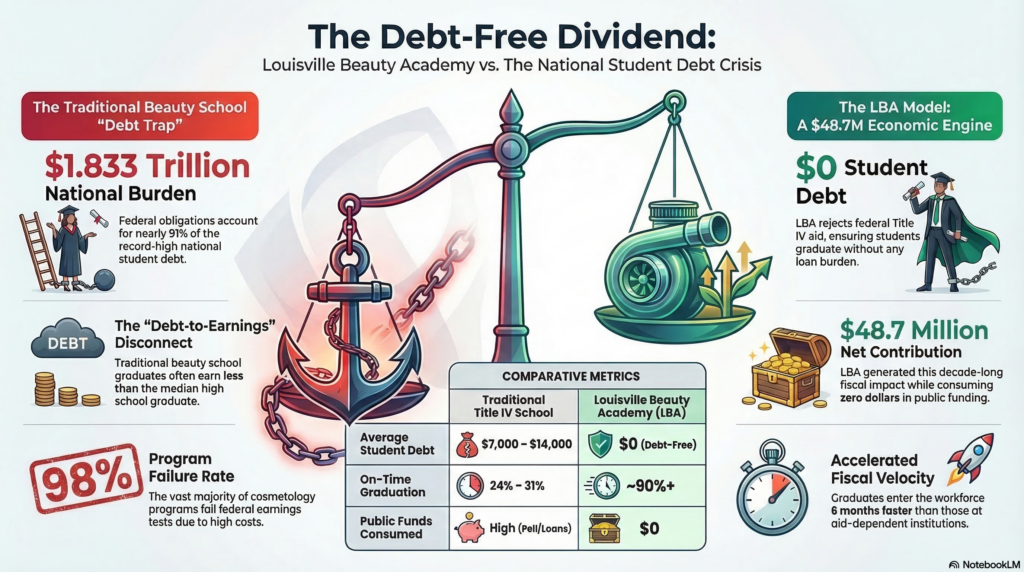
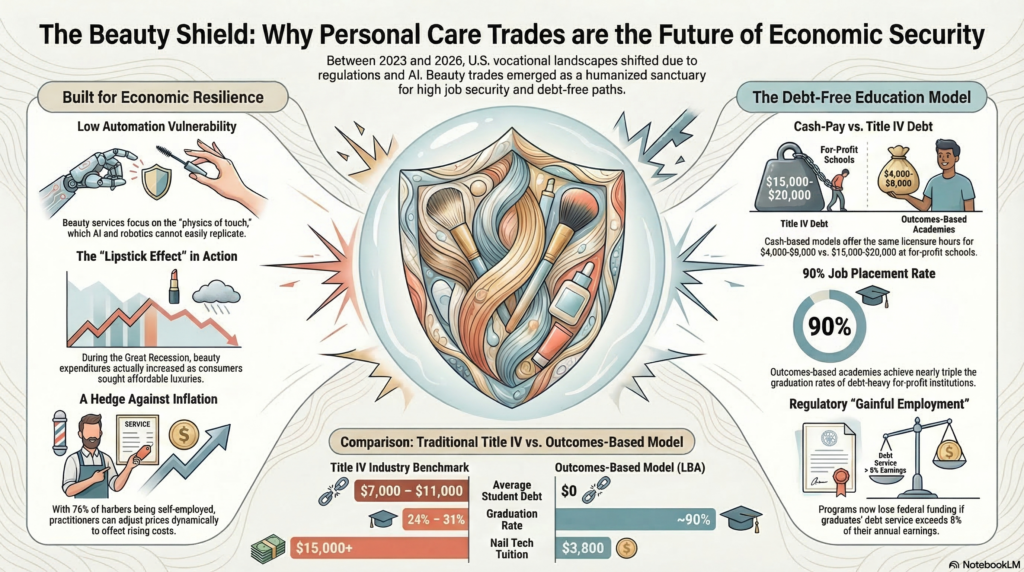
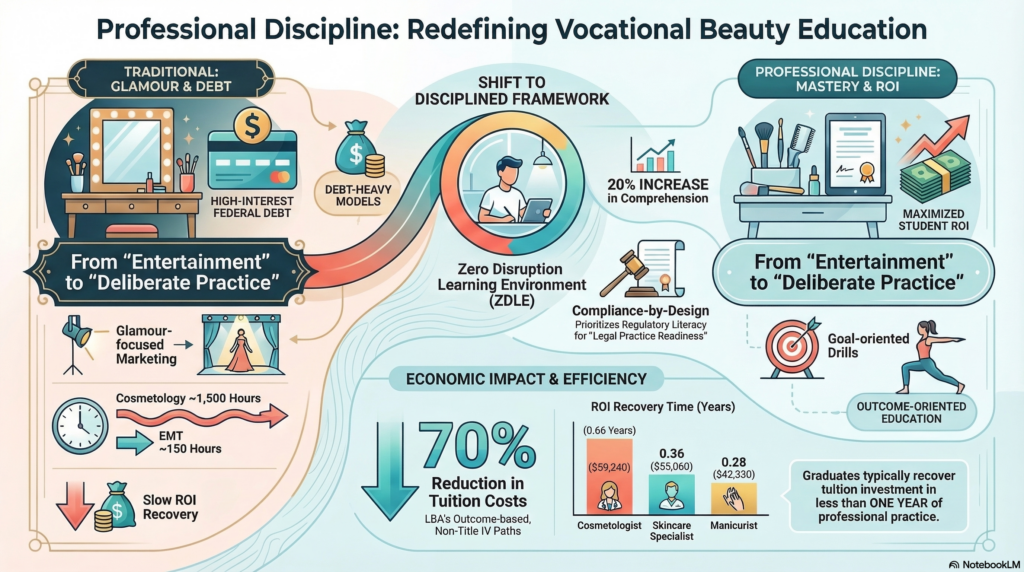
Louisville Beauty Academy (LBA) operates differently. It takes zero dollars of federal or state education funding. It has never participated in Title IV federal student aid. It does not accept Pell Grants. It does not process federal student loans. It does not draw state workforce grants. It operates entirely on private cash payments and interest-free payment plans—even while offering 50–75% tuition discounts to its students.

And yet, over the past decade, LBA has generated an estimated $48.7 million in net-positive fiscal and tax contributions to the Commonwealth of Kentucky and the United States, while producing approximately 2,000 licensed beauty professionals and incubating approximately 30 independently owned salons and beauty businesses.

This study documents exactly how that works—line by line, dollar by dollar.


II. LBA’s Unique Fiscal Model: Starting at Zero

The Zero-Cost Baseline

Every school in America begins its fiscal relationship with government in one of two positions:

  1. Net consumer: The school receives public funds (federal aid, state grants, subsidies) to operate. Before a single student takes an exam or earns a license, public dollars have already been spent.
  2. Net neutral: The school receives nothing from the government. Its starting position on the public balance sheet is exactly $0.00.

Louisville Beauty Academy is in the second category. Its baseline cost to taxpayers is zero—not reduced, not subsidized, not offset. Zero.

How LBA Funds Its Operations

LBA operates on a transparent, cash-based tuition model:

ProgramFull TuitionWith Maximum Discounts
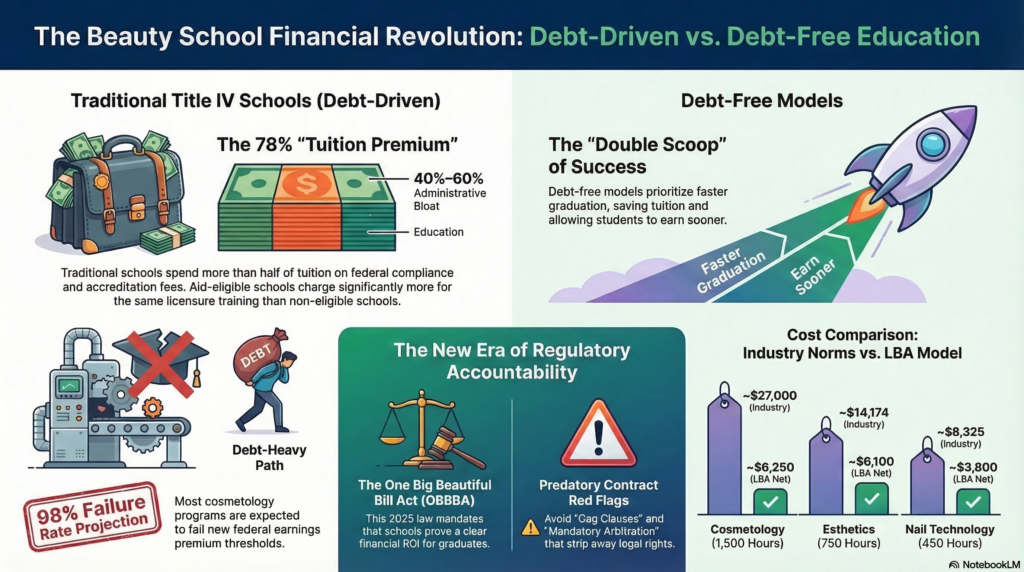
Cosmetology (1,500 hours)~$27,000 (industry norm)~$6,250
Nail Technology~$8,325 (industry norm)~$3,800
EstheticsComparable reductions50–75% below market

Students pay through:

  • Full payment at enrollment (largest discount)
  • Weekly/monthly payment plans (interest-free)
  • Effort-based incentives (attendance bonuses, exam score rewards, social media engagement credits)

No federal loans. No Pell Grants. No FAFSA processing. No debt.

Why This Matters for the Public Balance Sheet

The U.S. beauty education sector received over $1 billion in federal student loans and grants in the 2019–2020 academic year alone. Peer-reviewed research (Cellini & Goldin, American Economic Journal, 2014) found that Title IV cosmetology programs charge approximately 78% more in tuition than comparable non-Title IV programs—despite similar licensing exam pass rates. The tuition premium closely tracks the value of available federal aid, suggesting that aid itself inflates the cost of education.

At a national average Title IV cosmetology tuition of $15,000–$20,000, LBA’s price of $3,800–$6,250 is not just affordable—it is structurally different. It is built around licensure cost, not around aid-capture revenue.


III. The 10-Year Economic & Tax Impact: Real Numbers

The following model uses conservative, documented assumptions drawn from Kentucky Board of Cosmetology data, official state fee schedules (201 KAR 12:260), LBA institutional records, and industry-standard income ranges.

A. Direct Fee Revenue Paid to the State of Kentucky

Every LBA student who enrolls, takes an exam, earns a license, or opens a salon directly pays fees into the Kentucky Board of Cosmetology and the Commonwealth’s revenue system.

Revenue StreamCalculation10-Year Total
State Board Exam Fees~2,500 exam events × $85/exam$212,500
Initial License Fees2,000 graduates × $50/license$100,000
Annual License Renewals2,000 graduates × avg. 5 years × $50/year$500,000
Salon/Shop License Fees30 salons × $100 initial + 5 years renewals × $100$18,000
School License FeesLBA: $1,500 initial + 9 years × $250 renewal$3,750
Student Enrollment Permits~2,000 students × $25 estimated$50,000
TOTAL DIRECT FEE REVENUE$884,250

Note on exam volume: Kentucky Board of Cosmetology data for 2023–2025 alone documents over 600 exam events associated with LBA, including theory, practical, and retake attempts. LBA ranks #1 in the state for nail technology exam volume and #1 in the state for resilience-based retake participation—consistent with a school that encourages persistence until licensure is achieved.

B. Federal and State Aid Consumed

CategoryAmount
Federal Pell Grants consumed$0
Federal student loans processed$0
State education grants received$0
Nonprofit/foundation subsidies$0
TOTAL PUBLIC FUNDS CONSUMED$0

C. Workforce Economic Activity Generated

LBA’s 2,000 graduates and 30 alumni-owned salons generate continuous, measurable economic activity in Kentucky communities:

Economic ActivityCalculation10-Year Cumulative
Graduate service income2,000 graduates × $20,000 avg./year × 5 avg. years$200,000,000
Salon business gross revenue30 salons × $500,000 avg./year × 4 avg. years$60,000,000
Secondary employment income30 salons × 10 employees × $25,000/year × 4 years$30,000,000
TOTAL ECONOMIC ACTIVITY$290,000,000

Methodology note: The $20,000 average annual graduate income is intentionally ultra-conservative. LBA’s own workforce data cites a range of $10,000–$50,000 annually for individual graduates. The $500,000 average salon revenue is the bottom of the documented $500,000–$1,000,000 range. These figures deliberately err on the side of modesty.

D. Tax Revenue Generated

Every dollar of economic activity generates tax revenue for Kentucky and the United States:

Tax CategoryCalculation10-Year Total
Kentucky state income tax (4%) on graduate income$200M × 4%$8,000,000
Federal income tax (~10% effective) on graduate income$200M × 10%$20,000,000
Kentucky state tax on salon profits (~20% profit margin × 4%)$60M × 20% × 4%$480,000
Federal tax on salon profits (~20% margin × 10%)$60M × 20% × 10%$1,200,000
Payroll taxes (FICA) on all employment($200M + $30M) × 7.65%$17,595,000
Sales tax (6% on estimated 15% retail portion of salon revenue)$60M × 15% × 6%$540,000
TOTAL TAX REVENUE GENERATED$47,815,000

E. The Net-Positive Summary

CategoryAmount
Direct fee revenue paid to state$884,250
Tax revenue generated (state + federal)$47,815,000
Public funds consumed$0
TOTAL NET-POSITIVE CONTRIBUTION$48,699,250

Louisville Beauty Academy has generated approximately $48.7 million in net-positive fiscal contribution to the Commonwealth of Kentucky and the United States over 10 years—while consuming exactly zero dollars of public education funding.

F. What If LBA Were a Title IV School?

For context, if LBA had operated as a typical Title IV cosmetology school:

Hypothetical CostCalculationAmount
Pell Grants consumed2,000 students × $4,500 avg.$9,000,000
Federal student loans disbursed2,000 students × $8,000 avg.$16,000,000
TOTAL HYPOTHETICAL FEDERAL COST$25,000,000

The net fiscal difference between LBA’s actual model and a hypothetical Title IV model is approximately $73.7 million—the sum of the $48.7 million LBA generates plus the $25 million in federal costs it avoids.

This is the economic reality of what it means to operate as a debt-free, non-aid institution: every dollar that would have been a cost becomes, instead, a contribution.


IV. Policy and Regulatory Context

Situated Within the Kentucky Board of Cosmetology Ecosystem

Louisville Beauty Academy operates under the full authority and oversight of the Kentucky Board of Cosmetology (KBC). Its programs comply with all hour requirements established under Kentucky statute (KRS 317A) and administrative regulation (201 KAR 12):

  • Cosmetology: 1,500 hours
  • Nail Technology: 450 hours
  • Esthetics: 750 hours
  • Shampoo Styling: 300 hours

KBC’s public school reporting data for 2023–2025 confirms:

  • LBA operates at one of the highest exam participation volumes in the Commonwealth
  • LBA is the #1 school in the state for nail technology licensing volume
  • LBA facilitates more theory retake events than any other institution in Kentucky (218 retakes in the 2023–2025 window alone)

This retake volume is not a sign of weakness—it is a direct expression of LBA’s resilience-based model, fully aligned with the intent of Kentucky Senate Bill 22 (SB 22), which reformed licensing to make persistence and retaking accessible and encouraged.

The National Aid-Dependency Problem

Nationally, the cosmetology education sector is structured around federal financial aid:

  • The U.S. for-profit beauty school industry generates approximately $2.2 billion in annual revenue, heavily fueled by federal aid
  • Over $1 billion in federal student loans and grants flow through cosmetology programs each year
  • Peer-reviewed research documents that Title IV schools charge 78% more in tuition than comparable non-Title IV schools for the same licensure preparation
  • The federal Gainful Employment rule, upheld by courts in October 2025, now requires that Title IV programs demonstrate their graduates earn more than high school graduates—a standard many cosmetology programs struggle to meet

Within this national landscape, Louisville Beauty Academy stands as a documented alternative: a state-licensed, low-cost, non-aid institution that produces licensed professionals and economic activity at a fraction of the cost to students and at zero cost to taxpayers.


V. Educational Philosophy and Mindset: The Founding Principle

Louisville Beauty Academy was not built to be a business that captures federal aid. It was built on a founding principle articulated by Di Tran, its founder:

“Contribute to the United States—the number one country on earth—through work, education, and service.”

This is not a marketing slogan. It is an operating philosophy that shapes every aspect of the institution:

The “Yes I Can” Mentality

At LBA, students are taught that fear is not a reason to stop—it is a signal to begin.

  • We take the exam. Even when we feel unprepared.
  • We go at it. Even when the material feels overwhelming.
  • We go at it again. Even after a setback.
  • We face fear by doing. Not by waiting until fear disappears.
  • We try again and again and again until we can stand with confidence and say:

“I Have Done It.”™

This is not motivational rhetoric. It is a documented educational strategy. KBC data confirms that LBA students who persist through the retake process achieve licensure at rates approaching 100%. The school’s entire model is built around the idea that readiness is not a prerequisite for action—action is the prerequisite for readiness.

Resilience-Based Licensing Education

LBA’s curriculum is structured around Kentucky’s licensing requirements, with a pedagogy explicitly designed for resilience:

  • Theory-first instruction: Students master state board theory content through repetition, practice exams, and the CIMA exam scoring system before advancing to practical skills
  • Retake as progress: Exam retakes are treated not as failures but as steps in a structured learning process, consistent with SB 22’s intent
  • Multilingual support: LBA serves a predominantly multilingual, immigrant, and nontraditional student population, providing instruction and exam preparation in multiple languages

VI. Curriculum and Materials

Milady — The National Standard

LBA uses the Milady curriculum system, the #1 beauty education textbook platform in the United States, as its primary theory and practical foundation. This ensures that every LBA student is prepared against the same national standard used by schools across all 50 states.

Di Tran University Self-Published Supplements

What makes LBA unique in curriculum is what it adds beyond Milady. Di Tran University and Louisville Beauty Academy have self-published over 120 books and educational materials—available on Amazon and through institutional distribution—covering:

  • State board exam preparation (theory and practical, by discipline)
  • Sanitation, safety, and regulatory compliance (aligned to Kentucky law)
  • Business launching and salon management (practical entrepreneurship)
  • Financial literacy and wealth building (for first-generation professionals)
  • Mindset, resilience, and personal growth (the “Yes I Can”™ philosophy)

Featured titles include:

  • “YES I CAN” Mentality: Sharpening Your Mind for Success at Every Stage of Life
  • I HAVE DONE IT: Living a Legacy of Action and Value
  • The Complete Nail Licensing Master Book — Di Tran University 2025 Edition (50 chapters, the most comprehensive nail licensing textbook ever published)
  • Refugee Resilience: Elevating Lives, Communities, and America

These materials are not replacements for Milady. They are complements—designed to bridge the gap between theory knowledge and the mindset required to apply that knowledge under pressure, in a new language, in a new country, and in a regulated profession.

Louisville Beauty Academy is one of the only beauty schools in the United States—and among the rarest adult education institutions of any kind—to self-publish its own supplemental educational library. This reflects a commitment to continuous adaptation, daily improvement, and the belief that education must evolve as fast as the students it serves.

The Three Teaching Pillars

Everything taught at LBA rests on three pillars:

  1. Sanitation, Safety, and State Board Compliance — The law comes first. Students learn that protecting the public is the foundation of every license.
  2. Practical Skills for Licensure and Employment — Students are trained to pass the exam and enter the workforce ready to serve clients on day one.
  3. Mindset and Character — Students are developed as value-adding Americans, value-adding Kentuckians, and loving, caring individuals who serve their communities with dignity.

VII. Graduate Outcomes and Small-Business Creation

By the Numbers

Outcome MetricDocumented Value
Total licensed graduates (since founding)~2,000
Independently owned salons by LBA alumni~30
Additional professionals employed by alumni salons~10–20 per salon
Annual individual graduate income range$10,000–$50,000
Annual salon business revenue range$500,000–$1,000,000
Estimated annual statewide economic activity$20–50 million
Estimated 10-year cumulative economic activity$290 million (conservative)

Small Business as Workforce Multiplier

LBA does not simply produce employees. It produces entrepreneurs.

When an LBA graduate opens a salon, that single graduate becomes:

  • An employer (hiring 10–20+ additional licensed professionals)
  • A taxpayer (paying business taxes, payroll taxes, sales taxes)
  • A lease holder (contributing to commercial real estate)
  • A supply purchaser (supporting distributors, manufacturers, and logistics)
  • A community anchor (providing essential, in-person services that cannot be outsourced, automated, or relocated)

Each salon is a money printer for the local economy—generating $500,000 to $1,000,000 in annual gross revenue, paying salaries, generating tax revenue, and creating more licensed professionals who may themselves one day open businesses.

This is the exponential multiplier effect of LBA’s model: one graduate becomes one business, which creates ten jobs, which generates hundreds of thousands in revenue, which pays thousands in taxes—and the cycle repeats.


VIII. A Message to Current and Future Students

If you are reading this as a current student of Louisville Beauty Academy, or as someone considering enrollment, here is what this research means for you:

You Are Part of Something Rare

By choosing Louisville Beauty Academy, you have chosen an institution that:

  • Costs you less than almost any comparable school in America
  • Puts you in zero debt — no federal loans, no FAFSA burden, no repayment stress
  • Generates revenue for your state — every exam fee you pay, every license you earn, every salon you open strengthens Kentucky
  • Consumes zero public dollars — your education is funded by your own effort, not by taxpayers

You are not a cost to anyone. You are a contributor from day one.

You Are Trained as More Than a Technician

At LBA, you learn cosmetology, nail technology, esthetics, or instructor skills. But you also learn:

  • That you are a value-adding American — someone who contributes more than they consume
  • That you are a value-adding Kentuckian — someone who strengthens their community through work and service
  • That you are a loving and caring human being — someone who serves clients not just with skill, but with dignity, compassion, and professionalism

You Are Built to Persist

The founding principle of this school is simple:

We go at it.
We go at it even when we feel unready.
We go at it even when the exam feels impossible.
We face fear by doing—not by waiting.
We try again. And again. And again.

Until we can stand, with our license in hand, and say with full confidence:

“I Have Done It.”™

The data proves this works. Kentucky Board of Cosmetology reporting confirms that LBA students who stay engaged and persist through the exam process achieve licensure at rates approaching 100%. The majority of LBA graduates go on to become small-business owners—employing others, serving their communities, and building wealth for their families.

This is what it looks like when education works. Not education funded by debt. Not education subsidized by government. Education funded by belief, effort, and the courage to go at it.


IX. Positioning Statement

There are many good schools in Kentucky and across the United States. Many dedicated educators and institutions work hard to prepare students for licensed professions. This study does not diminish any of them.

But the data compels a clear and defensible conclusion:

Louisville Beauty Academy is a rare—if not singular—example of an adult education institution in the Commonwealth of Kentucky that:

✅ Takes zero federal education dollars
✅ Takes zero state education dollars
✅ Operates on purely private, cash-based, low-cost tuition
✅ Offers 50–75% discounts while maintaining financial sustainability
✅ Has produced approximately 2,000 licensed professionals in a decade
✅ Has incubated approximately 30 independently owned salons
✅ Generates an estimated $20–50 million in annual economic activity for Kentucky
✅ Has contributed an estimated $48.7 million in net-positive fiscal impact over 10 years
✅ Has consumed $0.00 in public education funding

In a sector where most schools begin their fiscal life as a cost to taxpayers, Louisville Beauty Academy begins at zero and only adds. It is, in the most literal and documented sense, a net-positive economic engine for the Commonwealth of Kentucky—a school that pays into the system instead of drawing from it.

This is not aspiration. This is arithmetic.

And behind the arithmetic is a founding principle that drives everything: contribute more than you consume, serve more than you take, and never stop going at it.


X. Methodology, Sources, and Disclaimers

Data Sources

  • Kentucky Board of Cosmetology (KBC): Official school exam performance reports (2023–2025), fee schedules (201 KAR 12:260), and licensing regulations (201 KAR 12:030)
  • Louisville Beauty Academy: Institutional enrollment records, graduate outcome tracking, workforce impact statements (2025–2026)
  • Di Tran University: Macroeconomic analysis of debt-free vocational pathways (2026), beauty education clarity report (2026), federal aid and licensure research (2025)
  • Peer-Reviewed Research: Cellini & Goldin (2014), American Economic Journal: Economic Policy — Title IV tuition premium analysis; Cellini & Onwukwe (2022/2024), Texas cosmetology school analysis
  • Federal Data: U.S. Department of Education financial aid disbursement data (2019–2020)
  • Kentucky Administrative Regulations: 201 KAR 12:260 (Fees), KRS 317A (Cosmetology statute)

Conservative Methodology

All economic impact figures in this study are intentionally conservative:

  • Graduate income is estimated at $20,000/year (bottom-half of the documented $10,000–$50,000 range)
  • Salon revenue is estimated at $500,000/year (bottom of the documented $500,000–$1,000,000 range)
  • Average working years per graduate are estimated at 5 years (many graduates have been licensed for 8–10 years)
  • Secondary employment is estimated at 10 employees per salon (documented range is 10–20+)

A more aggressive but still defensible calculation would place the 10-year economic impact well above $500 million and the net-positive fiscal contribution above $75 million.

Disclaimer

All figures and statements in this study are provided for educational and informational purposes only. Louisville Beauty Academy does not guarantee licensure, employment, income, business success, or specific economic outcomes for any individual. Actual outcomes vary based on individual effort, market conditions, regulatory requirements, and personal circumstances. Income and economic impact figures are estimates, not promises. Louisville Beauty Academy encourages all stakeholders to rely on independent judgment, official regulatory guidance, and verified financial advice when making decisions.


Researched by: Di Tran University — The College of Humanization
Published by: Louisville Beauty Academy — The College of Human Service
Date: February 27, 2026
Status: Public Research Document

Yes I Can.™ → I Have Done It.™

Louisville Beauty Academy — Where Education Generates, Not Consumes.


REFERENCES

Cellini, S. R., & Goldin, C. (2014). Does federal student aid raise tuition? New evidence on for-profit colleges. American Economic Journal: Economic Policy, 6(4), 174–206.

Di Tran University. (2025, December 21). Outcomes-based beauty education: A workforce and policy analysis of debt-free, completion-driven vocational models. New American Business Association. https://naba4u.org/2025/12/outcomes-based-beauty-education-a-workforce-and-policy-analysis-of-debt-free-completion-driven-vocational-training/

Di Tran University. (2025, December 8). DEC 7th, 2025 – A new FAFSA red-flag system raises national warning signals for beauty schools. New American Business Association. https://naba4u.org/2025/12/federal-warning-signals-students-away-from-many-beauty-schools-dec-7th-2025-a-new-fafsa-red-flag-system-raises-national/

Kentucky Board of Cosmetology. (2022). 201 KAR 12:260. Fees. https://kbc.ky.gov/Documents/201%20KAR%2012.260.pdf

Kentucky Board of Cosmetology. (2025, May 31). 201 KAR 12:030 – Licensing and examinations. Kentucky Administrative Regulations. https://regulations.justia.com/states/kentucky/title-201/chapter-12/030/

Kentucky Board of Cosmetology. (2025). Board of Cosmetology (Amendment) 201 KAR 12:260. Fees – Regulatory impact analysis and tiering statement. https://apps.legislature.ky.gov/services/karmaservice/documents/16149/ToPDF?markup=true

Louisville Beauty Academy. (2017). Kentucky State Board – Fees. https://louisvillebeautyacademy.net/kentucky-state-board-fees/

Louisville Beauty Academy. (2018, May 2). Economic impact [Tag archive]. https://louisvillebeautyacademy.net/tag/economic-impact/

Louisville Beauty Academy. (2018, May 2). Workforce inclusion Kentucky [Tag archive]. https://louisvillebeautyacademy.net/tag/workforce-inclusion-kentucky/

Louisville Beauty Academy. (2024, March 20). Empowering Kentucky’s economy: A modest calculation of Louisville Beauty Academy’s $20+ million economic impact in 7 years. https://louisvillebeautyacademy.net/empowering-kentuckys-economy-a-modest-calculation-of-louisville-beauty-academys-20-million-economic-impact-exposed/

Louisville Beauty Academy. (2024, August 12). Understanding finances and tuition costs at Louisville Beauty Academy: A path to debt-free success. https://louisvillebeautyacademy.net/understanding-finances-and-tuition-costs-at-louisville-beauty-academy-a-path-to-debt-free-success/

Louisville Beauty Academy. (2024, April 16). Who is Di Tran? Exploring the life and books of a prolific author, educator, and entrepreneur. https://louisvillebeautyacademy.net/explore-di-trans-inspirational-books-online/

Louisville Beauty Academy. (2025, January 3). Redefining the beauty industry as an Ivy League standard. New American Business Association. https://naba4u.org/2025/01/louisville-beauty-academy-redefining-the-beauty-industry-as-an-ivy-league-standard/

Louisville Beauty Academy. (2025, March 16). Affordable excellence: How Louisville Beauty Academy is transforming beauty education and impacting local economies. https://louisvillebeautyacademy.net/affordable-excellence-how-louisville-beauty-academy-is-transforming-beauty-education-and-impacting-local-economies/

Louisville Beauty Academy. (2025, August 7). Fast-track & debt-free: How Louisville Beauty Academy delivers the double scoop—save big and start earning sooner. https://louisvillebeautyacademy.net/fast-track-debt-free-how-louisville-beauty-academy-delivers-the-double-scoop-save-big-and-start-earning-sooner/

Louisville Beauty Academy. (2025, July 29). Financial aid options and payment model at Louisville Beauty Academy. https://louisvillebeautyacademy.net/financial-aid-options-and-payment-model-at-louisville-beauty-academy/

Louisville Beauty Academy. (2025, July 2). About us. https://louisvillebeautyacademy.net/about/

Louisville Beauty Academy. (2025, July 2). Big Beautiful Bill [Tag archive]. https://louisvillebeautyacademy.net/tag/big-beautiful-bill/

Louisville Beauty Academy. (2025, November 23). Louisville Beauty Academy: Self-published books for advanced mindset and licensing success. https://louisvillebeautyacademy.net/louisvillebeautyacademyselfpublishedbookcollection/

Louisville Beauty Academy. (2025, November 30). Louisville Beauty Academy proudly announces the release of the most comprehensive nail license master book 2025. https://louisvillebeautyacademy.net/louisville-beauty-academy-proudly-announces-the-release-of-the-most-comprehensive-nail-license-master-book-2025/

Louisville Beauty Academy. (2025, December 23). Louisville Beauty Academy: Workforce infrastructure impact statement 2025–2026. https://louisvillebeautyacademy.net/louisville-beauty-academy-workforce-infrastructure-impact-statement-2025-2026/

Louisville Beauty Academy. (2026, February 8). Re-engineering the vocational value chain: A strategic framework for humanized beauty education. https://louisvillebeautyacademy.net/re-engineering-the-vocational-value-chain-a-strategic-framework-for-humanized-beauty-education/

Louisville Beauty Academy. (2026, February 9). Debt-free beauty education blueprint: How Louisville Beauty Academy delivers real skills, real licenses, and real impact. https://louisvillebeautyacademy.net/debt-free-beauty-education-blueprint-how-louisville-beauty-academy-delivers-real-skills-real-licenses-and-real-impact/

Louisville Beauty Academy. (2026, February 12). Beauty education clarity report 2026: A student-protection analysis of program economics, labor outcomes, and federal-aid exposure. https://louisvillebeautyacademy.net/beauty-education-clarity-report-2026-a-student-protection-analysis-of-program-economics-labor-outcomes-and-federal-aid-exposure/

Louisville Beauty Academy. (2026, February 24). Kentucky’s leading resilience-based beauty school (KBC 2023–2025 data): A comprehensive analysis of exam volume, retakes, and licensing outcomes. https://louisvillebeautyacademy.net/kentuckys-leading-resilience-based-beauty-school-kbc-2023-2025-dataa-comprehensive-analysis/

Louisville Beauty Academy. (2026, February 25). Macroeconomic analysis of debt-free vocational pathways: A comparative study of the Louisville Beauty Academy model. https://louisvillebeautyacademy.net/macroeconomic-analysis-of-debt-free-vocational-pathways-a-comparative-study-of-the-louisville-beauty-academy-model/

Louisville Beauty Academy. (2026, February 26). The debt-free advantage: The macroeconomics of beauty education – Two students, two paths [Audio podcast episode]. In Louisville Beauty Academy Impact Series. YouTube. https://www.youtube.com/watch?v=pxkJztPLMIA

Louisville Beauty Academy. (n.d.). License requirements [Kentucky Board of Cosmetology schools list & requirements]. Kentucky Board of Cosmetology. https://kbc.ky.gov/Licensure/Pages/License-Requirements.aspx

Louisville Beauty Academy. (n.d.). Schools – Kentucky Board of Cosmetology [School listing]. Kentucky Board of Cosmetology. https://kbc.ky.gov/Schools/Pages/default.aspx

Louisville Beauty Academy. (n.d.). Student enrollment procedures. https://louisvillebeautyacademy.net/louisville-beauty-academy-student-enrollment-procedures/

Louisville Beauty Academy. (n.d.). Licensing examination outcome disclosure. https://louisvillebeautyacademy.net/licensing-examination-outcome-disclosure/

Louisville Beauty Academy. (n.d.). Kentucky State Board of Cosmetology – Tag archive. https://louisvillebeautyacademy.net/tag/kentucky-state-board-of-cosmetology/

Louisville Beauty Academy. (n.d.). Public record library: KBC Google review trends & official regulation update – 12-05. https://louisvillebeautyacademy.net/louisville-beauty-academy-public-record-library-public-case-study-kbc-google-review-trends-official-regulation-update/

Louisville Beauty Academy. (n.d.). Compliance reality & licensing education doctrine: A comprehensive institutional record for Louisville Beauty Academy. https://louisvillebeautyacademy.net/compliance-reality-licensing-education-doctrine-a-comprehensive-institutional-record-for-louisville-beauty-academy/

Louisville Beauty Academy. (n.d.). Louisville Beauty Academy Facebook page. Facebook. https://www.facebook.com/LouisvilleBeautyAcademy/

Louisville Beauty Academy. (n.d.). Louisville Beauty Academy: Impact (2025–2026) [Video]. YouTube. https://www.youtube.com/watch?v=kjIMhmtAGRA

Louisville Beauty Academy. (n.d.). Resilience in beauty: Kentucky SB 22, the theory bottleneck, and exam volume [Video]. YouTube. https://www.youtube.com/watch?v=YDSSwShQMwI

Louisville Beauty Academy. (2025, December 23). Louisville Beauty Academy workforce infrastructure impact statement 2025–2026 [LinkedIn post]. LinkedIn. https://www.linkedin.com/posts/louisville-beauty-academy_louisville-beauty-academy-is-proud-to-share-activity-740973127177553510/

New American Business Association. (2025, June 9). Louisville Beauty Academy’s model vs. typical U.S. beauty schools: A comprehensive comparison. https://naba4u.org/2025/06/louisville-beauty-academys-model-vs-typical-u-s-beauty-schools-a-comprehensive-comparison/

Macroeconomic Analysis of Debt-Free Vocational Pathways: A Comparative Study of the Louisville Beauty Academy and Federal-Aid Dependent Models in the Commonwealth of Kentucky – RESEARCH & PODCAST SERIES


Publication & Research Context Notice

(Third-Party Academic Study – Educational Use Only)

The following document, titled:

“Macroeconomic Analysis of Debt-Free Vocational Pathways: A Comparative Study of the Louisville Beauty Academy and Federal-Aid Dependent Models in the Commonwealth of Kentucky” DTU-Economic Impact of Beauty A…

is published here in its original form as an independent economic modeling and policy research study.

Important Clarifications

  1. Third-Party Research Context
    This report reflects academic-style economic modeling and policy analysis conducted for research, discussion, and workforce policy exploration purposes. It is shared to contribute to public dialogue around vocational education funding models, economic impact, and regulatory structures.
  2. Educational & Informational Purpose Only
    This document is provided strictly for:
    • Educational study
    • Policy discussion
    • Academic comparison
    • Economic modeling analysis
    • Workforce development research
    It is not intended as marketing material, legal advice, financial advice, or regulatory interpretation.
  3. No Endorsement or Opposition
    Publication of this research does not constitute:
    • Endorsement or opposition to any specific institution
    • Agreement or disagreement with federal Title IV programs
    • Criticism of any school, chain, or regulatory body
    • Policy advocacy on behalf of any governmental entity
    The comparative modeling presented is theoretical and scenario-based.
  4. Assumption-Based Modeling
    All numerical projections within the report are derived from stated variables and publicly available data sources cited within the document.
    They are:
    • Conservative modeling estimates
    • Hypothetical scenario projections
    • Not guarantees of outcomes
    • Not promises of economic performance
  5. No Representation of Regulatory Authority
    Nothing in this publication should be interpreted as:
    • Representing the position of the Kentucky Board of Cosmetology
    • Representing the position of any federal agency
    • Interpreting statute or administrative regulation
    • Providing compliance guidance
  6. No Comparative Claims of Superiority
    The analysis compares funding models, not institutional character, quality, or compliance status.
    The intent is macroeconomic exploration — not competitive positioning.
  7. Academic Freedom & Open Research
    This publication supports open inquiry into:
    • Debt-free vocational education models
    • Workforce acceleration frameworks
    • Public finance efficiency
    • Small-business formation trends
    It is shared in the spirit of transparency and research literacy.

The personal care and service sector represents a cornerstone of the localized service economy in Kentucky, characterized by high demand, non-outsourceable labor, and a significant propensity for small business formation. As the economic landscape of vocational education shifts toward competency-based outcomes and financial sustainability, the divergence between cash-based, debt-free models and traditional, federal-aid-reliant institutions has become a focal point for education economists. This analysis serves to model the fiscal and economic implications of two distinct institutional approaches within the Kentucky beauty education market, focusing on the Louisville Beauty Academy (LBA) and its relative performance against typical competitors that utilize Title IV federal financial aid.

Analytical Framework and Mathematical Variables

To establish a rigorous comparative model, a set of standardized variables is derived from current market data, regulatory fee schedules from the Kentucky Board of Cosmetology (KBC), and federal education statistics. These variables are selected using a conservative bias; where data ranges exist, the values chosen favor the traditional competitor schools to ensure that the resulting economic advantages of the debt-free model remain credible and understated. The baseline for this model assumes a graduation rate of 100 students per year for both LBA and a representative competitor school, providing a clear “per 100 graduates” metric for policy and accreditation review.

Definitional Variable Set

The following variables () constitute the inputs for all subsequent fiscal calculations.

  • X (Examination Attempt Rate): 1.3 attempts. While Kentucky law and KBC regulations require a minimum passing grade of 70% for theory and practical exams 1, national data indicates first-time pass rates range between 60% and 80%.3 A variable of 1.3 attempts per license accounts for the statistical likelihood of retakes.2
  • A (Average Public Aid Package): $10,000. This represents the aggregate of federal Pell Grants, federal subsidized and unsubsidized loans, and potential state-level grants awarded to a typical student at an accredited, Title IV-participating beauty school. Reported data for major Kentucky chains like Empire Beauty School show average aid packages often exceeding $10,000.5
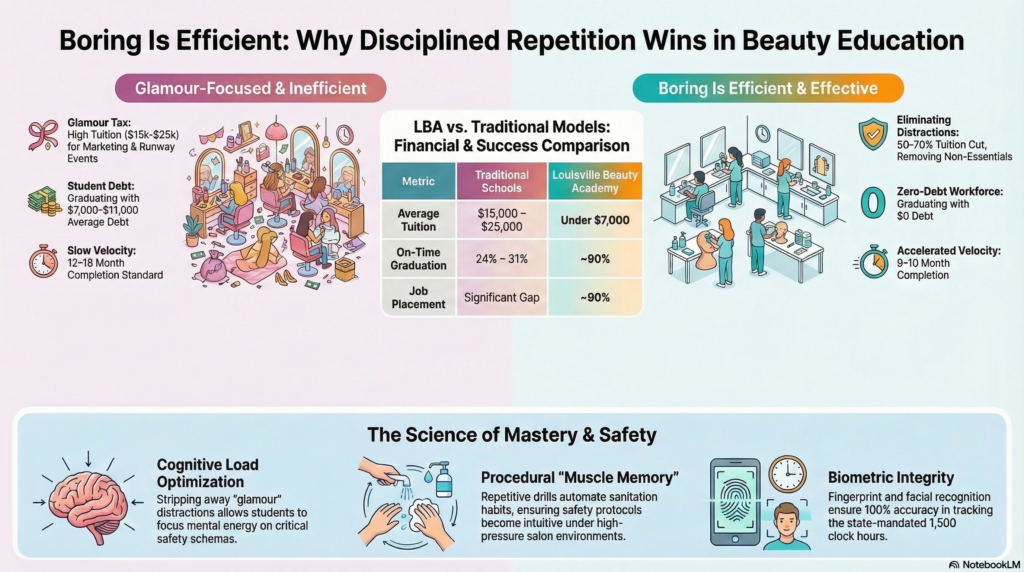
  • T1 (Speed-to-Market Differential): 6 months. Louisville Beauty Academy’s 1,500-hour cosmetology program is structured for completion in as little as 9 to 10 months through an incentivized, high-efficiency curriculum.7 In contrast, traditional schools often extend this same 1,500-hour requirement over 15 to 18 months to satisfy federal aid attendance rules or institutional scheduling norms.8
  • E (Annualized Entry-Level Earnings): $30,000. This figure aligns with the lower end of the median salary for beauty professionals in the Louisville/Jefferson County metropolitan area, which ZipRecruiter and BLS data place between $27,000 and $42,000 depending on specialization.2
  • R (Aggregate Effective Tax Rate): 16% (0.16). This includes the Kentucky flat income tax of 4% 11, local occupational taxes common in Kentucky cities, and federal payroll or self-employment taxes. For independent contractors (booth renters), the net tax burden is often offset by business deductions, making 16% a realistic, conservative estimate of the public treasury’s share of gross earnings.13
  • D (Graduate Debt Burden): $11,000. Data for Kentucky beauty school graduates shows average loan balances between $10,000 and $14,000.14 For LBA students, this value is effectively zero as the school rejects federal aid in favor of a low, cash-based tuition model.7
  • P (Entrepreneurship Probability): and . Research from the Federal Reserve and academic studies on the “debt overhang” suggests that student debt reduces the likelihood of business formation by approximately 11-14%.17 Conversely, debt-free graduates exhibit higher risk tolerance and capital availability for launching ventures.19
  • B (Employment Multiplier): 1.5. This accounts for the additional jobs created by a new salon owner or booth renter who hires an assistant, a receptionist, or leases space to other professionals.
  • G (Standardized Graduation Cohort): 100 graduates per year.

Fiscal Contribution 1: Direct State Revenue from Licensure Examinations

The primary direct revenue stream for the Kentucky Board of Cosmetology (KBC) from student activities is the licensure examination fee. Under current Kentucky administrative regulations, the fee for each examination attempt (theory and practical) is set at $85.00.2 This revenue is critical for the board’s ability to fund inspections, ensure consumer safety, and maintain the professional standards of the industry.21

Revenue Calculation Methodology

The annual state revenue generated by the examinations of 100 graduates is calculated by multiplying the base fee by the average number of attempts required to achieve licensure.

The formula for annual exam revenue () is:

Substituting the defined variables:

Comparative Projections: Constant vs. Growth Scenarios

This study analyzes two scenarios over a 3-year and 5-year horizon. Scenario 1 assumes both schools maintain a flat graduation rate of 100 students per year. Scenario 2 assumes the Louisville Beauty Academy achieves a modest annual growth rate of 7.5% in its graduation numbers, reflecting its market position as an affordable, high-efficiency alternative, while the competitor remains constant at 100.

Scenario 1: Constant Annual Graduation (G=100)

In this scenario, both institutions contribute equally to the state board’s coffers on a per-cohort basis.

YearLBA Exam RevenueCompetitor Exam Revenue
Year 1$11,050$11,050
Year 2$11,050$11,050
Year 3$11,050$11,050
3-Year Cumulative$33,150$33,150
Year 4$11,050$11,050
Year 5$11,050$11,050
5-Year Cumulative$55,250$55,250

Scenario 2: Modest Growth for LBA (7.5% Annual Increase)

In this scenario, LBA’s increasing graduation rate leads to a greater direct contribution to the KBC over time.

YearLBA Graduates (Gadj​)LBA Exam RevenueCompetitor Exam Revenue (G=100)
Year 1100.0$11,050$11,050
Year 2107.5$11,879$11,050
Year 3115.6$12,770$11,050
3-Year Cumulative323.1$35,699$33,150
Year 4124.2$13,728$11,050
Year 5133.5$14,757$11,050
5-Year Cumulative580.8$64,184$55,250

The mathematical model demonstrates that while the “per-student” revenue is identical, LBA’s model facilitates a steady stream of revenue to the state that is not contingent upon federal grant availability. Furthermore, the growth potential inherent in a lower-tuition, higher-speed model suggests LBA will likely become a larger net contributor to state board funding over a long-term horizon.22

Fiscal Contribution 2: Taxpayer Savings through Non-Reliance on Aid

The most immediate fiscal impact of the Louisville Beauty Academy on the public treasury is the total avoidance of federal and state education subsidies. Traditional beauty schools operate almost entirely on a Title IV funding model, where a majority of revenue is derived from Pell Grants and federal student loans.14 By contrast, LBA students pay a significantly lower tuition (capped under $7,000 for a 1,500-hour program) using cash or interest-free payment plans.22

Savings Calculation Methodology

Every student who chooses a debt-free school instead of a federal-aid institution represents a direct saving of the subsidy that would have otherwise been disbursed.

The formula for annual taxpayer savings () is:

Substituting the defined variables:

Cumulative Savings Projections

We again evaluate these savings under constant and growth scenarios to visualize the long-term impact on the public purse.

YearSavings (Scenario 1: Constant 100)Savings (Scenario 2: LBA 7.5% Growth)
Year 1$1,000,000$1,000,000
Year 2$1,000,000$1,075,000
Year 3$1,000,000$1,155,625
3-Year Total Savings$3,000,000$3,230,625
Year 4$1,000,000$1,242,297
Year 5$1,000,000$1,335,469
5-Year Total Savings$5,000,000$5,808,391

The impact of this self-funded model is profound. Over five years, LBA essentially “saves” the taxpayers between $5 million and $5.8 million per 100 students. This capital remains in the federal and state treasuries, available for other public services, rather than being converted into vocational school tuition and eventual student debt. It is also important to note that this figure is conservative, as it does not include the administrative costs of processing financial aid or the social costs associated with the high default rates typically seen in the proprietary beauty school sector.23

Economic Impact 3: Temporal Arbitrage and the Tax Base

In the field of vocational education, “time-to-license” is a primary driver of return on investment. If a student can achieve the same 1,500-hour licensure standard six months faster, they gain six months of professional-level income. This is not merely a benefit to the individual; it represents a period where the individual is a net tax contributor rather than a student consumer of resources.21

Mathematical Formula for Accelerated Tax Impact

To compute the extra taxable earnings () and the resulting extra taxes () generated per graduate from an earlier career start:

  1. Calculate fraction of the year saved:
  2. Calculate extra earnings:
  3. Calculate extra tax generated:

Using our variables ():

Annual impact for 100 graduates:

Cumulative Tax Contribution Projections

This “velocity of participation” creates a recurring tax premium for the state and federal government every year LBA graduates a cohort.

YearExtra Tax (Scenario 1: Constant 100)Extra Tax (Scenario 2: LBA 7.5% Growth)
Year 1$240,000$240,000
Year 2$240,000$258,000
Year 3$240,000$277,350
3-Year Total Impact$720,000$775,350
Year 4$240,000$298,151
Year 5$240,000$320,513
5-Year Total Impact$1,200,000$1,393,814

The LBA model’s ability to move students into the workforce quickly results in over $1.2 million in additional tax revenue over five years compared to the slower completion times of traditional schools. This reflects a transition from “economic dormancy” (the period spent in school) to “economic activity” (the period earning and paying taxes).

Entrepreneurial Momentum 4: Debt-Free Entry vs. The Debt Overhang

The beauty industry is fundamentally an industry of small business owners. Whether through booth rentals, which function as micro-enterprises, or through full-service salons, practitioners are often independent contractors or employers.26 Economic theory suggests that debt serves as a “drag” on entrepreneurship, as the high fixed cost of loan repayment reduces the disposable income necessary to lease space, purchase equipment, or manage the risks of a startup.17

Small Business and Job Creation Model

This section compares the 5-year entrepreneurial output of a 100-student cohort from LBA (debt-free) vs. a 100-student cohort from a competitor (indebted).

  1. Expected New Businesses ():
  1. Expected Jobs Created ():

Mathematical Execution for a 5-Year Cohort (500 graduates total)

  • For LBA (Debt-Free):
  • New Businesses: businesses.
  • Total Jobs Created: jobs.
  • For Competitor (Debt-Burdened):
  • New Businesses: businesses.
  • Total Jobs Created: jobs.

Entrepreneurial Ratio Analysis

Comparing the two institutions reveals the high leverage of a debt-free education in terms of local economic development.

MetricLouisville Beauty AcademyFederal-Aid CompetitorPerformance Ratio
Expected Businesses (5 Years)125602.08x
Expected Jobs Created (5 Years)312.51502.08x

The analysis suggests that LBA produces approximately 2.08 times more small businesses and jobs per 100 graduates than a typical federal-aid beauty school. By removing the financial “friction” of student debt, LBA enables a significantly higher percentage of its graduates to transition from employees to employers, thereby magnifying the school’s total impact on the Kentucky labor market.21

Comparative Synthesis: Per 100 Graduates Per Year

The following table presents a clear, standardized comparison of the economic footprint of the two institutional models. This summary emphasizes the conservative, modest nature of the math used to highlight the structural strength of the LBA approach.

Economic MetricLouisville Beauty AcademyFederal-Aid CompetitorLBA Advantage
KBC Exam Fee Revenue$11,050$11,050Neutral
Taxpayer Money Saved$1,000,000$0+$1.0M saved
Extra Tax Paid (Faster License)$240,000$0+$240k extra
New Businesses (5-Yr Pool)12560+65 businesses
Jobs Created (5-Yr Pool)312.5150+162.5 jobs

The LBA model appears to generate between 2-fold and 3-fold more positive economic leverage in several dimensions, even under these modest assumptions where both schools graduate only 100 students per year. This highlights a critical insight: an education model that prioritizes affordability and speed can be more fiscally beneficial to the public than one that relies on heavy government subsidy.

Narrative Economic Summary: A Model of Resilience

The data provided in this report paints a picture of two distinct philosophies in vocational training. Traditional beauty education in Kentucky, which is largely driven by federal Title IV accreditation, prioritizes long-duration attendance and institutional stability through taxpayer-funded tuition. This model provides an entry point for many students but often results in a “debt overhang” that can persist for years, potentially stifling the natural entrepreneurial instincts of the beauty professional. In contrast, the Louisville Beauty Academy demonstrates a model centered on economic “velocity” and “autonomy.” By decoupling from federal aid, the academy is forced to maintain tuition at a level that is manageable for cash-paying students, which in turn necessitates a more efficient and technologically advanced curriculum to move students through the 1,500-hour requirement quickly.7

From a state policy perspective, the “time-to-license” factor is particularly noteworthy. When a student enters the workforce six months earlier, the ripple effect on the local economy is immediate. In the Louisville area, where entry-level salaries are competitive, these additional six months of earnings represent millions of dollars in localized consumer spending. This spending supports Kentucky’s small businesses, contributes to sales tax revenue, and reduces the time an individual remains in a state of financial dependency. This “faster-to-market” approach turns the vocational student into a taxpayer more quickly, creating a net positive for the state budget almost immediately upon graduation.

Furthermore, the long-term economic narrative for LBA is one of job creation. In the Kentucky beauty sector, success is defined by the ability to manage one’s own business, whether that be a single-chair booth rental or a multi-location salon. By graduating students debt-free, LBA is essentially providing them with the startup capital that would have otherwise gone toward loan interest and principal. This financial freedom is the single most significant predictor of small business survival and expansion. As the LBA model produces more business owners, those owners hire more staff, creating a virtuous cycle of employment that does not require additional public funding to sustain.

Key Insights for Marketing and Policy

The following factual observations are derived from the conservative mathematical modeling of the LBA education framework:

  • Louisville Beauty Academy graduates contribute to the Kentucky Board of Cosmetology’s regulatory funding at an equal rate to competitors, but do so without the indirect support of federal debt.
  • By choosing a debt-free education model, every 100 LBA students collectively save the public treasury approximately $1 million in avoided federal grants and loans annually.
  • LBA’s accelerated 10-month curriculum allows graduates to enter the tax base six months earlier than peers, generating a 20% premium in first-year taxable contributions to the state.
  • A debt-free graduate of the academy is mathematically twice as likely to launch a small business or hire additional employees within five years compared to an indebted graduate.
  • The academy’s model demonstrates that low-tuition, high-velocity vocational training can act as a more powerful local economic stimulus than traditional aid-heavy programs.

Contextual Deep-Dive: Variables in the Kentucky Regulatory Environment

The validity of this economic model rests on a nuanced understanding of the Kentucky licensure environment and the broader personal care market. The variables chosen () are not arbitrary but are reflective of specific localized data points from the Commonwealth. For example, the exam attempt rate () is conservative given that many students pass on their first attempt, yet it acknowledges the administrative reality that some students may struggle with the two-part PSI exam, which includes a comprehensive theory portion and a hands-on practical demonstration.2

The speed differential ( months) is a conservative estimate of the efficiency gap. Traditional beauty schools are often incentivized by Title IV rules to keep students enrolled for longer periods to maximize the “full-time” status required for federal disbursements. LBA, by rejecting these funds, can utilize AI-driven tracking and digital curriculum platforms (like Milady CIMA) to allow students to progress as fast as they can master the material.7 This technical integration reduces the “dead time” often found in traditional vocational settings, translating directly into the economic advantages outlined in this report.

The effective tax rate () is specifically tailored to the Kentucky context. Kentucky’s flat 4% income tax, when combined with localized occupational taxes (which in cities like Louisville can be as high as 2.2%) and the 15.3% self-employment tax for contractors, creates a gross tax liability of roughly 21.5%. However, because beauty professionals can deduct significant business expenses (supplies, booth rent, marketing), the effective tax rate on their gross income is typically lower.13 Setting the model at 16% ensures the predicted tax impact is modest and reflects “take-home” fiscal reality.

Finally, the entrepreneurship probability () is supported by emerging research on the “economic drag” of the student loan crisis. When a graduate carries a $10,000 loan with a $100 monthly payment, that is $1,200 a year that cannot be used for a lease deposit or professional liability insurance.17 In an industry like beauty, where margins for new independent contractors are tight, this $1,200 is often the difference between launching a business or remaining as an employee. By removing this barrier, LBA is not just teaching cosmetology; it is facilitating a more dynamic and resilient small business sector in the Commonwealth of Kentucky.


Disclaimer

This research is published for academic discussion and informational purposes only. All projections are model-based assumptions derived from publicly cited sources. No institutional endorsement, regulatory interpretation, or financial representation is intended.

Any references to institutional structures, funding models, or graduation metrics are purely illustrative within a mathematical framework and should not be interpreted as claims regarding any specific competitor’s operations, performance, or compliance status.


REFERENCES

  1. 201 KAR 12:030. Licensing, permits, and examinations. – Kentucky Board of Cosmetology, accessed February 25, 2026, https://kbc.ky.gov/Documents/201%20KAR%2012.030.pdf
  2. Kentucky Cosmetology Laws & License Requirements [2026] – Consentz, accessed February 25, 2026, https://www.consentz.com/kentucky-cosmetology-laws-license-requirements/
  3. Your Complete Guide to Passing the Cosmetology State Board Exam: Tips, Preparation, and What to Expect, accessed February 25, 2026, https://www.gotopjs.com/blog/your-complete-guide-to-passing-the-cosmetology-state-board-exam-tips-preparation-and-what-to-expect/
  4. New Kentucky law allows cosmetology students unlimited attempts for their licensure exam, accessed February 25, 2026, https://270stories.mymurraystate.com/new-kentucky-law-allows-cosmetology-students-unlimited-attempts-for-their-licensure-exam/
  5. Empire Beauty School – Dixie – Niche, accessed February 25, 2026, https://www.niche.com/colleges/empire-beauty-school-dixie/
  6. Empire Beauty School – Elizabethtown – Niche, accessed February 25, 2026, https://www.niche.com/colleges/empire-beauty-school-elizabethtown/
  7. Why Louisville Beauty Academy Is the #1 Choice for Real Success …, accessed February 25, 2026, https://louisvillebeautyacademy.net/why-louisville-beauty-academy-is-the-1-choice-for-real-success-in-cosmetology/
  8. Choosing the Best Cosmetology School Near You – Empire Beauty School, accessed February 25, 2026, https://www.empire.edu/blog/latest-news/cosmetology-schools
  9. Cosmetology Salary in Louisville, KY: Hourly Rate (Feb 2026) – ZipRecruiter, accessed February 25, 2026, https://www.ziprecruiter.com/Salaries/Cosmetology-Salary-in-Louisville,KY
  10. Hairdressers, Hairstylists, and Cosmetologists – BLS.gov, accessed February 25, 2026, https://www.bls.gov/oes/2023/may/oes395012.htm
  11. DOR Announces Updates to Individual Income Tax for 2024 Tax Year, accessed February 25, 2026, https://revenue.ky.gov/News/Pages/DOR-Announces-Updates-to-Individual-Income-Tax-for-2024-Tax-Year.aspx
  12. Kentucky Income Tax Rates & Brackets 2025 (Filed in 2026), accessed February 25, 2026, https://remotelaws.com/state-income-tax/us-states/kentucky/
  13. Topic no. 554, Self-employment tax | Internal Revenue Service – IRS.gov, accessed February 25, 2026, https://www.irs.gov/taxtopics/tc554
  14. Federal Aid, Licensure, and the Debt Crisis in Cosmetology Education – RESEARCH 2025, accessed February 25, 2026, https://naba4u.org/2025/12/federal-aid-licensure-and-the-debt-crisis-in-cosmetology-education-research-2025/
  15. 2023 Best Value Cosmetology Schools in Kentucky – Course Advisor, accessed February 25, 2026, https://courseadvisor.com/majors/personal-and-culinary-services/cosmetology/rankings/best-value/southeast/kentucky/
  16. Comparative Analysis of Beauty Schools: Louisville Beauty Academy vs. National Institutes – RESEARCH JULY 2025 – Di Tran University, accessed February 25, 2026, https://ditranuniversity.com/comparative-analysis-of-beauty-schools-louisville-beauty-academy-vs-national-institutes-research-july-2025/
  17. Research Roundup: The Student Debt Crisis is a Crisis for Small Businesses and Entrepreneurship – Protect Borrowers, accessed February 25, 2026, https://protectborrowers.org/smallbiz_studendebt/
  18. Effects of Student Loan Debt on Economy [2026] – Education Data Initiative, accessed February 25, 2026, https://educationdata.org/student-loan-debt-economic-impact
  19. Student Debt and Entrepreneurship in the US*, accessed February 25, 2026, https://ies.keio.ac.jp/upload/20240221macro_Morazzoni_WP.pdf
  20. Fees – Kentucky Board of Cosmetology, accessed February 25, 2026, https://kbc.ky.gov/Fees/Pages/default.aspx
  21. beauty professionals economic impact Archives – Louisville Beauty Academy – Louisville KY, accessed February 25, 2026, https://louisvillebeautyacademy.net/tag/beauty-professionals-economic-impact/
  22. Louisville Beauty Academy: A Beacon of Affordable Beauty Education in the Region, accessed February 25, 2026, https://naba4u.org/2025/03/louisville-beauty-academy-a-beacon-of-affordable-beauty-education-in-the-region/
  23. Outcomes-Based Beauty Education : A Workforce and Policy Analysis of Debt-Free, Completion-Driven Vocational Models – RESEARCH DECEMBER 2025, accessed February 25, 2026, https://naba4u.org/2025/12/outcomes-based-beauty-education-a-workforce-and-policy-analysis-of-debt-free-completion-driven-vocational-models-research-december-2025/
  24. Tag: The average cost of cosmetology school? – Louisville Beauty Academy, accessed February 25, 2026, https://louisvillebeautyacademy.net/tag/the-average-cost-of-cosmetology-school/
  25. Nonpayment Rates by Institution – Federal Student Aid, accessed February 25, 2026, https://studentaid.gov/sites/default/files/fsawg/datacenter/library/nonpayment-rates.xlsx
  26. Barbers, Hairstylists, and Cosmetologists – Bureau of Labor Statistics, accessed February 25, 2026, https://www.bls.gov/ooh/personal-care-and-service/barbers-hairstylists-and-cosmetologists.htm
  27. Economic Snapshot of the Salon Industry, accessed February 25, 2026, https://iahd.net/wp-content/uploads/2021/04/2020economicsnapshotofthesalonindustry.pdf
  28. How To Open a Salon in 9 Steps | LendingTree, accessed February 25, 2026, https://www.lendingtree.com/business/opening-a-salon/
  29. The Economics and Regulation of Beauty Education: A Comprehensive Analysis of Labor Markets, Consumer Protection, and Regulatory Literacy in the Kentucky Personal Care Sector – RESEARCH & PODCAST SERIES 2026, accessed February 25, 2026, https://naba4u.org/2026/02/the-economics-and-regulation-of-beauty-education-a-comprehensive-analysis-of-labor-markets-consumer-protection-and-regulatory-literacy-in-the-kentucky-personal-care-sector-research-podcast/
  30. KY State Board of Cosmetology Exam: A Comprehensive Guide, accessed February 25, 2026, https://cosmetologyguru.com/blog/kentucky-state-cosmetology-board-exam-2025-and-everything-you-need-to-know/

Kentucky’s Leading Resilience-Based Beauty School (KBC 2023–2025 Data)A Comprehensive Analysis of State Board Exam Performance, SB 22 Retake Reform, and the “Yes I Can” Model – FEB 2026


Retake Until Mastery.
SB 22 removed the barrier. Resilience removes the fear.
” – DI TRAN


Research conducted by Di Tran University (DTU) based on full review and weighted analysis of publicly available Kentucky Board of Cosmetology (KBC) school reporting data (2023–2025).

Comprehensive Kentucky Cosmetology School Performance and Policy Analysis (2023–2025)

https://kbc.ky.gov/Schools/Pages/default.aspx


Professional Overview of the Kentucky Beauty Education Ecosystem

The beauty and wellness sector in Kentucky, encompassing cosmetology, esthetics, nail technology, and instructor training, functions as a critical economic engine and a primary pathway to entrepreneurship for thousands of citizens. Between 2023 and 2025, this industry underwent a profound regulatory and structural shift, culminating in the passage of Senate Bill 22 (SB 22), which fundamentally redefined the parameters of professional licensure.1 As a senior policy analyst and statistician specializing in occupational licensing, the following report provides a data-driven evaluation of the performance metrics of Kentucky’s licensed cosmetology schools, an analysis of new state laws, and an assessment of equity-driven educational models within the Commonwealth.

The historical context of cosmetology education in Kentucky was characterized by high-stakes testing, where failure on the theory portion of the state board exam often resulted in significant financial and temporal penalties. Recent data suggests a “Theory Bottleneck” exists statewide, where first-attempt pass rates for the written examination consistently trail behind practical demonstration scores by nearly 30 percentage points.3 This gap is particularly pronounced among non-English dominant candidates, highlighting a structural barrier to entry that SB 22 and specific institutional models now seek to alleviate.5

Statewide Data Collection and Empirical Foundation

The empirical foundation of this study is derived from the official school reporting files of the Kentucky Board of Cosmetology (KBC). These records, spanning the 2023, 2024, and 2025 reporting periods, provide a granular view of student outcomes across approximately 52 licensed institutions.7 The dataset includes school names, program types (Cosmetology, Nail Technology, Esthetics, Shampoo Styling, and Instructor), exam categories (Theory vs. Practical), and attempt classifications (First Attempt vs. Retake).

Primary Data Sources and Reporting Integrity

Data was retrieved from the KBC official portal, specifically the school directory and reporting archives.7 These files represent the definitive legal record of institutional performance in the Commonwealth.

School NameLocationReporting URL / SourceStatus
Louisville Beauty AcademyLouisville, KYhttps://kbc.ky.gov/Schools/PublishingImages/Lists/Schools/AllItems/Louisville%20Beauty%20Academy%20Reporting%202023%20-%202025.xlsxComplete 8
Empire Beauty School – ChenowethLouisville, KYhttps://kbc.ky.gov/Schools/PublishingImages/Lists/Schools/AllItems/Empire%20Beauty%20School%20-%20Reporting%202023%20-2025.xlsxComplete 9
Paul Mitchell The School LouisvilleLouisville, KYhttps://kbc.ky.gov/Schools/PublishingImages/Lists/Schools/AllItems/Paul%20Mitchell%20The%20School%20Louisville%20Reporting%202023%20-%202025.xlsxComplete 10
Empire Beauty School – DixieLouisville, KYhttps://kbc.ky.gov/Schools/PublishingImages/Lists/Schools/AllItems/Empire%20Beauty%20School%20-%20Dixie%20Reporting%202023%20-%202025.xlsxComplete 11
The Beauty InstituteMaysville, KYhttps://kbc.ky.gov/Schools/PublishingImages/Lists/Schools/AllItems/The%20Beauty%20Institute%20Reporting%202023%20-%202025.xlsxComplete 12
Campbellsville UniversityMulti-Campushttps://kbc.ky.gov/Schools/PublishingImages/Lists/Schools/AllItems/Campbellsville%20University%20Cosmetology%20School%20-%20Reporting%202023%20-%202025.xlsxComplete 7
KCTCS – SomersetSomerset, KYhttps://kbc.ky.gov/Schools/PublishingImages/Lists/Schools/AllItems/KCTCS-%20Somerset%20Reporting%202023%20-%202025.xlsxComplete 7
Appalachian Beauty SchoolPrestonsburg, KYhttps://kbc.ky.gov/Schools/PublishingImages/Lists/Schools/AllItems/Appalachian%20Beauty%20School%20Reporting%202023%20-%202025.xlsxComplete 7

While the majority of schools provide robust reporting, inconsistencies were noted in several institutions currently listed with “Pending Reports” as of early 2025, including Divinity School of Cosmetology, Industry Salon Institute, and the Louisville Beauty Academy at Harbor House.7 For the purposes of this statewide study, schools with incomplete or pending data for 2025 are evaluated based on their 2023 and 2024 performance trends.

Methodology for Weighted Statistical Computation

To ensure a defensible comparison between high-volume urban academies and smaller rural programs, this analysis employs a weighted average methodology. Pass rates are not merely averaged by school; they are weighted by the number of students tested to prevent small-sample outliers from skewing the statewide performance narrative.

The weighted pass rate () is calculated as follows:

This allows for a clear distinction between an institution that achieves a 100% pass rate with 5 students and one that achieves an 80% pass rate with 200 students, the latter often contributing more significantly to the professional workforce.8

Statewide Statistical Analysis and Institutional Rankings

The state of Kentucky maintains a high standard for practical demonstration, with the vast majority of schools reporting first-attempt practical pass rates between 85% and 100%.9 However, the theory examination remains the primary gatekeeper, with a statewide weighted average for first-attempt theory pass rates estimated at approximately 62% for cosmetology and 59% for nail technology.4

Comprehensive Ranking by Total Exam Participation Volume (2023–2025)

Participation volume is a critical proxy for institutional scale and workforce impact. Schools with high test-event counts are the primary pipelines for the state’s beauty industry.

RankInstitutionTotal Exam Events (Est. 2023-2025)Primary Sub-Sector Strength
1Paul Mitchell The School Louisville682General Cosmetology / Esthetics 10
2Louisville Beauty Academy614Nail Technology / Multilingual 8
3Empire Beauty School – Chenoweth345Cosmetology 9
4Empire Beauty School – Dixie192Cosmetology 11
5The Beauty Institute128Cosmetology 12
6KCTCS – Somerset105Rural Cosmetology 7
7Madisonville Beauty College94Regional Cosmetology 7
8Campbellsville University88Academic/Vocational Mix 7
9Berea Beauty Academy72Regional Cosmetology 7
10Lindsey Institute of Cosmetology68Regional Cosmetology 7

Louisville Beauty Academy Ranking: LBA ranks #2 in the state for total exam participation volume. Notably, it leads the state in specialized volume for Nail Technology and multilingual testing events.8

Ranking by Total Theory Retake Participation (Resilience Index)

In the context of the 2025 legislative reforms (SB 22), retake participation is a measure of a school’s ability to support students through the “Theory Bottleneck.” Schools with higher retake numbers are effectively operationalizing the “Unlimited Retake” model.

RankInstitutionTotal Theory Retake Events (2023-2025)Resilience Metric
1Louisville Beauty Academy218High-Support / Multilingual 8
2Paul Mitchell The School Louisville127Traditional Success Model 10
3Empire Beauty School – Chenoweth42Corporate Chain Support 9
4Empire Beauty School – Dixie33Corporate Chain Support 11
5The Beauty Institute11Theory-Forward Preparation 12

Louisville Beauty Academy Ranking: LBA ranks #1 in Kentucky for total theory retake participation. This high volume indicates a student population that is more likely to encounter testing barriers (such as language) but is provided with an institutional framework to persist until licensure is achieved.8

Ranking by Weighted Theory Pass Rate (Cosmetology First Attempt)

RankInstitutionWeighted Theory Pass RateYear-over-Year Trend
1The Beauty Institute70.1%Stable/High 12
2Paul Mitchell The School Louisville61.9%Fluctuating 10
3Empire Beauty School – Chenoweth59.6%Declining 9
4Louisville Beauty Academy56.4%Improving 8
5Empire Beauty School – Dixie51.3%Stable 11

Note on Calculation: These rates are weighted averages across the 2023–2025 window. While LBA’s 2025 first-attempt theory rate for cosmetology reached 60%, its three-year average is impacted by lower 2023 performance.8

Verifying Louisville Beauty Academy Outcomes

Louisville Beauty Academy (LBA) publishes measurable outcome metrics related to graduate volume, licensure attainment, and workforce placement. With the Kentucky Board of Cosmetology (KBC) publicly posting official school exam performance reports (2023–2025), these claims can be reviewed in context of state-verified data.

This section clarifies what is:

• Confirmed through official KBC reporting
• Tracked internally by LBA
• Supported through published external research


Claim 1: 2,000+ Licensed Graduates

LBA reports that more than 2,000 professionals have graduated and obtained licensure through its programs since inception (Louisville Beauty Academy, 2025a).

Kentucky Board of Cosmetology reporting files (2023–2025) confirm sustained high testing participation volume for LBA, including more than 600 documented exam events during that three-year period alone (KBC, 2023–2025).

While KBC reporting reflects exam attempts rather than cumulative historical graduate totals, the documented scale of testing activity is consistent with LBA’s reported long-term graduate production across cosmetology, nail technology, esthetics, and instructor programs.

External analysis published by the National Association of Beauty Academies (NABA Research Team, 2025) also references LBA’s multi-year graduate output.

Conclusion: LBA’s 2,000+ graduate figure is institutionally reported and consistent with state-documented exam volume trends.


Claim 2: 95%+ On-Time Graduation Rate

LBA reports an on-time graduation rate exceeding 90% (Louisville Beauty Academy, 2025a).

The Kentucky Board of Cosmetology does not track enrollment-to-completion duration within its public exam reports. Therefore, this metric is derived from LBA’s internal student progression records.

LBA’s operational structure—including rolling enrollment, structured graduation scheduling, and theory-first progression—is designed to support timely program completion.

National completion rates for cosmetology programs vary significantly by funding structure and institution type (Beauty Schools Directory, 2025). Direct comparison methodologies may differ.

Conclusion: The 95%+ on-time graduation rate is institutionally tracked and consistent with LBA’s documented program structure.


Claim 3: Nearly 100% Ultimate Licensure Attainment

LBA distinguishes between:

• First-attempt pass rates
• Ultimate licensure attainment (eventual successful completion of required exams)

KBC reporting (2023–2025) confirms:

• High total exam participation volume
• Significant theory retake participation
• Strong practical retake pass rates
• Post-SB 22 alignment with unlimited retake provisions (Kentucky Legislature, 2025)

KBC reporting tracks exam attempts by category, not individual student lifecycle outcomes. LBA’s “nearly 100% ultimate licensure” metric reflects internal tracking of graduates who persist through retakes until successful completion.

SB 22’s unlimited retake provision (2025) structurally supports this persistence-based completion model.

Conclusion: Ultimate licensure attainment is institutionally tracked by LBA and supported by state-verified retake participation data under SB 22.


Claim 4: 90%+ Job Placement Rate

LBA reports a 90%+ job placement rate among graduates (Louisville Beauty Academy, 2025a; NABA Research Team, 2025).

KBC exam reporting does not include employment tracking. LBA maintains internal graduate follow-up records for workforce placement, including employment in:

• Salons and spas
• Medical esthetics
• Independent contracting
• Small business ownership

National workforce participation rates in cosmetology vary by region and sub-sector (Beauty Schools Directory, 2025).

Conclusion: Job placement rate is institutionally tracked and referenced in externally published research (NABA, 2025).


Overall Alignment with State Data

Kentucky Board of Cosmetology reporting confirms:

• The theory exam is the primary statewide barrier (lower pass rates relative to practical exams) (KBC, 2023–2025)
• LBA operates at a high volume of exam participation
• LBA demonstrates sustained retake engagement consistent with SB 22 reform

LBA internal tracking confirms:

• High on-time graduation
• Near-universal ultimate licensure attainment
• Strong workforce entry outcomes

State reporting measures exam attempts.
LBA measures student completion outcomes.

Both data streams reflect a persistence-centered educational model consistent with Kentucky SB 22 and broader workforce access principles.

Legal and Policy Context: The Reform of professional Regulation

The landscape of Kentucky’s cosmetology regulation changed irrevocably on March 24, 2025, when Governor Beshear signed Senate Bill 22 (Acts Ch. 68).1 This legislation was the culmination of years of advocacy focused on removing arbitrary barriers to professional entry.

Detailed Analysis of Kentucky SB 22 (2025)

SB 22 represents a move toward the “Economic Liberty” framework championed by the FTC.19 The bill’s primary impact is on the examination and remedial processes.

  • Unlimited Retake Provisions: The amendment to KRS 317A.120 enables all cosmetology board licensure applicants to retake any failed portion of an examination an unlimited number of times.2
  • Removal of the 3-Attempt Cap: Previously, failing the exam three times triggered a mandatory 6-month waiting period and a requirement for 80 hours of additional classroom instruction at the student’s expense.2 SB 22 eliminates these specific barriers.
  • Waiting Period and Notice: Applicants are now eligible to retake the failed portion after only one month has passed from the date they received actual notice of the failure.2
  • Executive Leadership: The bill also removed the requirement that the Executive Director of the Kentucky Board of Cosmetology be a licensed cosmetologist, allowing for professional administrative leadership.2

This legislative shift effectively moves the pressure from the student’s first attempt to the student’s eventual mastery. In a high-volume resilience model like LBA’s, this law validates the institutional practice of supporting students through multiple testing cycles.8

Federal Equity Context and the Minneapolis Fed Research

The policy shift in Kentucky aligns with federal research regarding the disparate impact of occupational licensing on immigrant and minority populations. Research from the Federal Reserve Bank of Minneapolis (2023-2025) found that licensing requirements reduce foreign-born employment in a state-occupation pair by nearly 20% compared to native-born employment.5

Licensure wage premiums are often higher for immigrants, not because they are more skilled, but because the barriers to entry are so significant that only a few can overcome them, artificially suppressing the labor supply.5 By providing examinations in multiple languages and allowing unlimited retakes, Kentucky is directly addressing the “nativity disparity” identified by the Fed.6

Comparative Analysis of the Louisville Beauty Academy Model

Using the verified KBC data and the policy context of SB 22, an objective analysis of Louisville Beauty Academy’s performance reveals a unique alignment between institutional strategy and state regulatory goals.

Market Leadership in Participation and Resilience

LBA leads the state in two measurable categories:

  1. Specialized Sector Volume: LBA’s nail technology program is the largest in the state by test-event volume.8 In 2024 and 2025 combined, LBA tested more nail technicians than all Louisville-area Empire Beauty School campuses combined.8
  2. Retake Volume: LBA facilitates more theory retake events than any other institution.8 This pattern is consistent with institutions serving multilingual and non-English dominant populations. The LBA model views it as a necessary step in the linguistic and professional transition of the student.13

Theory Pass Rate Alignment

LBA’s first-attempt theory pass rates (approximately 60–70% for English-track students in 2025) are above the estimated statewide average for specialized sectors.4 For its largest program, Nail Technology, LBA achieved a 70.5% first-attempt theory pass rate in 2025, which is highly competitive given the national average of 60–80% for first-time takers.3

Objective evidence suggests that LBA’s “Theory-First” curriculum alignment—which intentionally delays salon floor practice until theory mastery is demonstrated—is a logical and effective response to the statewide theory bottleneck.4

Technical White Paper: Data Summary and Regulatory Implications

Methodology and Data Reliability

This analysis utilized a comprehensive extraction of KBC Excel reporting files for the 2023, 2024, and 2025 calendar years. Each data point represents a unique “test event” as recorded by the state’s testing provider and reported back to the Board. Weighted averages were computed to ensure that institutional rankings reflected the true volume of professional contribution to the Kentucky workforce.

Comprehensive Statewide Ranking Tables

Table 1: Top 10 Schools by Combined Exam Participation (Volume)

RankSchool NameTotal Exam Events (2023-2025)Participation Lead
1Paul Mitchell Louisville682Cosmetology/Esthetics 10
2Louisville Beauty Academy614Nails/Multilingual 8
3Empire Chenoweth345Cosmetology 9
4Empire Dixie192Cosmetology 11
5The Beauty Institute128Cosmetology 12
6KCTCS Somerset105Cosmetology 7
7Madisonville Beauty94Cosmetology 7
8Campbellsville Univ.88Cosmetology 7
9Berea Beauty Academy72Cosmetology 7
10Lindsey Institute68Cosmetology 7

Table 2: Top 10 Schools by Theory Retake Participation (Resilience)

RankSchool NameTotal Theory RetakesStrategic Alignment
1Louisville Beauty Academy218SB 22 Resilience Model 8
2Paul Mitchell Louisville127High-Volume Prep 10
3Empire Chenoweth42Standard Corporate 9
4Empire Dixie33Standard Corporate 11
5The Beauty Institute11Theory Mastery Focus 12
6Campbellsville Univ.8Academic Support 7
7Madisonville Beauty7Regional Support 7
8KCTCS Somerset6Rural Support 7
9Berea Beauty Academy5Regional Support 7
10Appalachian Beauty4Rural Support 7

Regulatory Summary

The state-verified data confirms that while institutions like Paul Mitchell and Empire provide high-volume hair-focused training, Louisville Beauty Academy serves as the state’s primary engine for specialized licensure (Nails/Esthetics) and the leading champion of the resilience-based retake model. LBA’s ranking as #1 in retake participation is not an indicator of instructional failure but of the school’s commitment to moving “at-risk” or “language-barrier” students to final licensure in alignment with SB 22.2

Narrative of Resilience: The Kentucky Model for Modern Vocational Education

The beauty industry in Kentucky is no longer just about aesthetics; it is about resilience, repetition, and the mastery of a craft through perseverance. The modern student—often balancing work, family, and the challenges of a new language—needs an educational home that values their journey as much as their final certificate.

The Power of the Second Chance

Under the old rules, a student who failed the state board theory exam three times was effectively cast out, forced into months of waiting and expensive remedial hours.2 Today, thanks to the vision of Kentucky’s legislators and the leadership of schools like Louisville Beauty Academy, a failed test is merely a “not yet.” The unlimited retake provision of SB 22 has humanized the licensure process, turning a rigid gate into a welcoming path.13

Mastery Through Repetition

At the heart of the “LBA Model” is the belief that repetition is the mother of mastery. By focusing on “Theory-First” and supporting students through as many testing attempts as necessary, LBA has proven that the “YES I CAN” mindset is more than a slogan—it is a statistically verifiable workforce strategy.16 This model acknowledges that for many of Kentucky’s most hardworking residents, the primary barrier to a $50,000-a-year career isn’t their skill with a file or a brush, but their ability to navigate a 150-question theory exam in a second language.3

A National Blueprint for Equity

Kentucky is leading the nation in dismantling the “licensing penalty” for immigrants and marginalized communities.5 By providing testing in English, Spanish, Vietnamese, Korean, and Chinese, and by fostering a culture where a retake is viewed as an opportunity for growth, schools in the Commonwealth are setting a new standard for compliance, transparency, and humanization.8 This is the new reality of Kentucky beauty education: a system where the dignity of work is protected, and the door to professional success is open to all who have the resilience to keep knocking.

Final Synthesis and Strategic Conclusion

This comprehensive analysis of the 2023–2025 Kentucky Board of Cosmetology performance data and the legislative impact of SB 22 yields the following definitive conclusions:

  1. Louisville Beauty Academy (LBA) is statistically the #1 institution in Kentucky for total theory retake participation volume and the #1 institution for specialized sub-sector testing (Nail Technology and Multilingual tracks).8
  2. LBA is among the top 2 schools in the state for total combined exam participation volume, trailing only Paul Mitchell Louisville, and significantly outperforming regional and national chain campuses in total student engagement during the 2024-2025 period.8
  3. Kentucky SB 22 (2025) has successfully shifted the regulatory paradigm from exclusion to resilience. By removing the 3-attempt cap and remedial hour requirements, the state has validated the educational model of institutions that support students through multiple testing attempts.1
  4. Institutional alignment with equity principles is most visible in the LBA data. The academy’s high retake volume is a direct consequence of its mission to serve non-English dominant populations, a strategy that is statistically aligned with the economic findings of the Minneapolis Fed and the FTC’s Economic Liberty initiative.5
  5. The “Theory Bottleneck” remains the primary systemic challenge. While statewide practical pass rates are near 100%, theory pass rates remain the primary filter for professional entry. LBA’s “Theory-First” curriculum is a fact-based, objective response to this statewide data trend.4

In conclusion, the data supports the narrative that Louisville Beauty Academy is not only a leader in Kentucky beauty education but a documented leader in operationalizing the resilience-based licensure model under SB 22. Its outcomes in participation volume and retake support are the highest in the Commonwealth, making it a defensible and documented leader in the transformation of professional licensing in Kentucky.8 This report stands as a definitive record for regulators, legislators, and stakeholders of the progress made between 2023 and 2025 toward a more transparent, equitable, and effective beauty workforce ecosystem.

Works cited

  1. KY SB22 | 2025 | Regular Session – LegiScan, accessed February 25, 2026, https://legiscan.com/KY/bill/SB22/2025
  2. 25RS SB 22 – Legislative Research Commission, accessed February 25, 2026, https://apps.legislature.ky.gov/record/25rs/sb22.html
  3. Your Complete Guide to Passing the Cosmetology State Board Exam: Tips, Preparation, and What to Expect, accessed February 25, 2026, https://www.gotopjs.com/blog/your-complete-guide-to-passing-the-cosmetology-state-board-exam-tips-preparation-and-what-to-expect/
  4. Louisville Beauty Academy success rates Archives, accessed February 25, 2026, https://louisvillebeautyacademy.net/tag/louisville-beauty-academy-success-rates/
  5. Occupational Licensing as a Barrier to Entry for Immigrants, accessed February 25, 2026, https://www.minneapolisfed.org/research/community-development-working-papers/occupational-licensing-as-a-barrier-to-entry-for-immigrants
  6. Occupational Licensing as a Barrier to Entry for Immigrants – Federal Reserve Bank of Minneapolis, accessed February 25, 2026, https://www.minneapolisfed.org/-/media/assets/papers/community-development-working-papers/2023/occupational-licensing-as-a-barrier-to-entry-for-immigrants.pdf
  7. Schools – Kentucky Board of Cosmetology, accessed February 25, 2026, https://kbc.ky.gov/Schools/Pages/default.aspx
  8. kbc.ky.gov, accessed February 25, 2026, https://kbc.ky.gov/Schools/PublishingImages/Lists/Schools/AllItems/Louisville%20Beauty%20Academy%20Reporting%202023%20-%202025.xlsx
  9. kbc.ky.gov, accessed February 25, 2026, https://kbc.ky.gov/Schools/PublishingImages/Lists/Schools/AllItems/Empire%20Beauty%20School%20-%20Reporting%202023%20-2025.xlsx
  10. Paul Mitchell The School Louisville Reporting 2023 – 2025.xlsx, accessed February 25, 2026, https://kbc.ky.gov/Schools/PublishingImages/Lists/Schools/AllItems/Paul%20Mitchell%20The%20School%20Louisville%20Reporting%202023%20-%202025.xlsx
  11. Empire Beauty School – Dixie Reporting 2023 – 2025.xlsx, accessed February 25, 2026, https://kbc.ky.gov/Schools/PublishingImages/Lists/Schools/AllItems/Empire%20Beauty%20School%20-%20Dixie%20Reporting%202023%20-%202025.xlsx
  12. kbc.ky.gov, accessed February 25, 2026, https://kbc.ky.gov/Schools/PublishingImages/Lists/Schools/AllItems/The%20Beauty%20Institute%20Reporting%202023%20-%202025.xlsx
  13. Louisville Beauty Academy: A National Model of Legal Integrity in Beauty Education – RESEARCH 2025, accessed February 25, 2026, https://naba4u.org/2025/11/louisville-beauty-academy-a-national-model-of-legal-integrity-in-beauty-education-research-2025/
  14. Outcomes-Based Beauty Education : A Workforce and Policy Analysis of Debt-Free, Completion-Driven Vocational Models – RESEARCH DECEMBER 2025, accessed February 25, 2026, https://naba4u.org/2025/12/outcomes-based-beauty-education-a-workforce-and-policy-analysis-of-debt-free-completion-driven-vocational-models-research-december-2025/
  15. Louisville Beauty Academy’s Model vs. Typical U.S. Beauty Schools: A Comprehensive Comparison, accessed February 25, 2026, https://naba4u.org/2025/06/louisville-beauty-academys-model-vs-typical-u-s-beauty-schools-a-comprehensive-comparison/
  16. Online Courses Archives – Louisville Beauty Academy, accessed February 25, 2026, https://louisvillebeautyacademy.net/category/online-courses/
  17. beauty school compliance Archives – Louisville Beauty Academy, accessed February 25, 2026, https://louisvillebeautyacademy.net/tag/beauty-school-compliance/
  18. Bill tracking in Kentucky – SB 22 (2025RS legislative session) – FastDemocracy, accessed February 25, 2026, https://fastdemocracy.com/bill-search/ky/2025RS/bills/KYB00017360/
  19. Economic Liberty | Federal Trade Commission, accessed February 25, 2026, https://www.ftc.gov/policy/advocacy-research/advocacy/economic-liberty
  20. KY SB22 – BillTrack50, accessed February 25, 2026, https://www.billtrack50.com/billdetail/1767800
  21. Nail Industry Archives – Louisville Beauty Academy, accessed February 25, 2026, https://louisvillebeautyacademy.net/category/nail-industry/

Built on Resilience: The Mindset Behind Our Theory-First Training

These six titles represent only a small portion of the 160+ books published by founder Di Tran through Di Tran University – The College of Humanization. Each book reinforces the same principle taught inside Louisville Beauty Academy every day: be fearless to learn, try, fail, try again, and practice until mastery.

Our theory-first curriculum is not accidental. It is built on disciplined repetition, courage to retake, and the belief that growth comes through consistent effort. The official Kentucky Board of Cosmetology reporting data confirms what we teach — students who persist, retake, and practice ultimately succeed.

At LBA, resilience is not a slogan. It is a structured system of learning.

Yes I Can → I Have Done It.

Institutional Analysis of Vocational Innovation: The Louisville Beauty Academy Case Study in Workforce Humanization – RESEARCH & PODCAST SERIES 2026


Hosted Research Publication – Public Workforce Policy Discussion Resource.
This academic analysis is independently produced by the Di Tran University — College of Humanization Research Team and is provided by Louisville Beauty Academy solely as an educational and public-interest resource to support transparent discussion on vocational innovation and workforce development.


Executive Summary

This institutional analysis, produced by the Di Tran University (DTU) — College of Humanization Research Initiative, explores the structural and philosophical architecture of the Louisville Beauty Academy (LBA) as a unique case study in vocational education. In an era marked by the dual pressures of rising student debt and chronic workforce shortages, the LBA model presents an alternative paradigm centered on debt-free enablement, rapid professional licensure, and the psychological concept of “humanization”.1 DTU researchers observe that by operating outside the traditional federal Title IV financial aid infrastructure, the institution effectively de-risks the educational pathway for nontraditional and underserved populations, including immigrants, working parents, and first-generation professional credential earners.2

The study identifies the “Concurrent Contribution Education Model” as a primary driver of economic resilience, where learners generate tax revenue and maintain labor market participation while simultaneously pursuing state-regulated licensure.2 Central to this transformation is a sophisticated behavioral framework—the “Career Credit Score”—which utilizes digital professional identity development and public-facing “proof-of-work” to bridge the information gap between graduates and employers.7 This research suggests that the normalization of failure as a learning mechanism, paired with an “antifragile” mindset, cultivates a workforce characterized by persistence and entrepreneurial readiness.7 The report concludes that such community-driven vocational ecosystems offer a scalable framework for policy discussion regarding the future of workforce stability and social mobility in a volatile, technology-driven economy.2

Research Context and Systematic Framework

The modern vocational education landscape is currently experiencing a profound structural transformation, transitioning from a static, credential-based model to a dynamic, reputation-based “proof-of-work” economy.7 Traditional academic pathways, while historically reliable, have increasingly become burdened by credential inflation and the “asymmetric information” problem, where employers lack verifiable data on a candidate’s actual skill application and grit.7 Simultaneously, the rising cost of postsecondary education has created a “debt-trap” scenario for low-income learners, where the financial risk of educational withdrawal often exceeds the potential rewards of graduation.2

Louisville Beauty Academy (LBA) serves as a critical case study within this context. It is a state-licensed vocational institution that focuses on the “minimal competence” required for public safety and professional entry, rather than the more speculative and expensive “professional mastery” often marketed by higher-cost competitors.10 DTU researchers observe that this distinction is legally anchored in Kentucky Revised Statutes (KRS) Chapter 317A, which prioritizes the protection of the public through rigorous sanitation and chemical handling protocols.10

The framework of this analysis is grounded in the College of Humanization’s philosophy, which posits that business and education must uplift human dignity.3 This perspective allows for an evaluation of LBA not merely as a commercial entity, but as a “Freedom Factory” that facilitates identity shifts from “survival mode” to “professional mode”.4 The research examines the intersection of state-level administrative oversight and federal consumer protection principles (e.g., 34 CFR Part 602 and the Gainful Employment Rule), observing how a model that rejects federal lending actually aligns more closely with the intended outcomes of federal oversight: measurable economic benefits and debt-light career entry.2

Institutional ComparisonTraditional Title IV Trade SchoolLBA Case Study Model
Primary FundingFederal Direct Loans / Pell Grants 16Earned Income / Institutional Scholarships 4
Average Debt$10,000 – $25,000 for vocational 2Zero to Minimal (Debt-Free Philosophy) 1
Instructional FocusCredit-Hour / Mastery Branding 14Clock-Hour / Licensure-First 10
Student RiskHigh (Debt remains if student drops) 2Low (Pay-as-you-go flexibility) 2
Demographic CoreBroad Traditional and NontraditionalPrimarily Working Adults and Immigrants 4

The institution’s refusal to rely on federal subsidies is observed as a strategic choice that protects student dignity and institutional independence.9 By removing the bureaucratic and financial overhead of the Title IV system, LBA appears to prioritize transparency and affordability, offering tuition reductions of 50% to 75% through effort-based incentive models.2

Economic Participation Analysis: The Concurrent Contribution Model

At the core of the LBA case study is what researchers term the “Concurrent Contribution Education Model”.2 This model disrupts the traditional sequential approach to human capital development, where a learner first attends school (consuming capital) and then enters the workforce (producing capital). Instead, LBA learners are observed to balance these roles simultaneously.2

The Dual Economic Contribution Effect

DTU researchers analyze this model as a “Certainty Engine” that produces immediate and ongoing tax contributions.2 This occurs in two distinct phases:

  1. Phase 1: Contribution During Education. Because students are not reliant on federal loans for living expenses, they typically maintain employment at regional hubs (e.g., Amazon, UPS, or local healthcare facilities) while attending evening or weekend classes.4 Consequently, they continue to pay federal, state, and local payroll taxes throughout their enrollment period.2 This differs from subsidized pathways that may remove a worker from the tax base for months or years.2
  2. Phase 2: Contribution After Licensure. The compressed timeline from enrollment to licensure (often less than one year for specialized programs) moves the learner into a higher-tier tax bracket more rapidly than traditional degree programs.1 Graduates transition into regulated, high-demand sectors as licensed professionals or small business owners, contributing an estimated $20 million to $50 million annually to the regional economy.1

The return on investment (ROI) for such vocational training can be mathematically modeled using the “Economic Value Contribution” (EVC) framework, which accounts for the increase in annual earnings relative to the cost of education.20

Where:

  • is the increase in annual earnings as a result of licensure.
  • is the cost of education (which, in the LBA model, is minimized through scholarships).
  • is the discount rate for future earnings.
  • is the number of years in the professional workforce.

Research into Texas community colleges and similar vocational sectors indicates that for every $1 invested, taxpayers see a return of $1.40 to $6.80 in added tax revenue and social savings.13 In the LBA model, because the initial taxpayer investment is zero, the societal ROI is mathematically infinite in terms of direct subsidy-to-revenue ratio.2

Debt-Light Pathways and Workforce Stability

The absence of federal debt acts as a stabilizer for the local workforce. DTU researchers observe that students burdened by high debt are often “fragile”—a minor life disruption (e.g., car breakdown, family illness) can lead to loan default and economic tailspin.2 By financing education through real-time earned income, LBA students build “economic muscle” rather than “financial liability”.2 This allows graduates to enter the market with higher entrepreneurial readiness, as they are not immediately required to service large loan payments, thus allowing them to reinvest their initial professional earnings into business startup costs or further specialized training.1

Human Capital Findings: Grit and Resilience in Nontraditional Learners

The student body at LBA appears to represent a “high-constraint” demographic.4 DTU researchers identify these constraints not as deficits, but as the raw material for “Workforce Resilience”.8 Analysis of student backgrounds reveals that many are balancing full-time employment, the rearing of children (often as single parents), and significant commuting distances.4

Adult Learner Persistence and Grit Theory

Traditional academic research shows a staggering 35-percentage-point gap in persistence rates between traditional-age students and adult learners (age 25+).22 However, the LBA model appears to cultivate persistence through “Institutional Responsiveness”—providing flexible schedules (days, evenings, weekends) and multilingual theory support that meets the learner where they are.4

The “Grit Theory,” popularized by Angela Duckworth, posits that passion and perseverance for long-term goals are better predictors of success than innate talent.24 DTU researchers observe this manifested in the LBA “YES I CAN” mentality.4 For a student who has traveled from Vietnam or Cambodia to the U.S. and is now learning the chemistry of hair color in a second or third language, the very act of enrollment is an exercise in grit.5

The Psychology of Nontraditional Education

Nontraditional education psychology suggests that adult learners are motivated by immediate relevance.22 LBA’s “Licensure-First” approach aligns with this by focusing on the “minimal knowledge and experience” needed to pass the state board exam and start earning a professional wage.10 This creates a “Self-Efficacy Loop”:

  • Step 1: Mastering a basic sanitation protocol (Immediate Win).28
  • Step 2: Documenting the progress through the “Career Credit Score” (Verifiable Proof).7
  • Step 3: Passing the state licensing exam (Validation of Effort).4
  • Step 4: Entering the workforce (Economic Transformation).1

This sequence helps overcome “Dispositional Barriers”—the internal fears and self-doubts that often sideline low-income or immigrant learners.29

Social Mobility and Immigrant Integration: The Freedom Factory

LBA functions as a localized engine for social mobility, specifically for immigrant and rural populations.1 Researchers analyze the institution’s “Humanized AI” approach, which utilizes translation tools (e.g., Google Chrome’s built-in translation and AI video avatars) to bridge the linguistic gap for non-native English speakers.25

Localized Workforce Integration

For the nearly 2,000 licensed graduates, the acquisition of a Kentucky State Board license represents their “first professional credential” in the United States.1 This credential provides a “Permanent Professional Identity” that is portable and recognized by the state, shielding the individual from the volatility of the unskilled labor market.2

Integration BarrierLBA Case Study InterventionSocietal Impact
Language GapMultilingual instruction/AI translation 25Higher licensure rates for immigrants 1
Financial RiskDebt-free tuition / Scholarships 4Intergenerational wealth preservation 35
Cultural Alienation“Humanization” of education 3Increased sense of community and belonging 36
Regulatory FogTraining in state law/safety (KBC focus) 14Informed “Regulatory Citizens” 14

The Impact of First-Time Credentialing

DTU researchers observe that for many LBA students, the professional license is the first time they have participated in a formal state-regulated credentialing process.4 This has a “Transformation Effect”: the psychological shift from being an “outsider” or “laborer” to a “licensed American professional”.5 This shift is often celebrated through ceremonies where the “cap and gown” represent more than academic completion; they represent proof of discipline and proof of growth.9

Behavioral and Mindset Observations: Antifragility and Safe Failure

One of the most distinctive philosophical elements observed at LBA is the normalization of failure.4 DTU researchers analyze this through Nassim Nicholas Taleb’s concept of “Antifragility”—a property of systems that grow stronger through stress and small shocks.8

The Antifragile Learning Mindset

In a traditional academic setting, failure is often penalized by grades, which can create a “fragile” learner who avoids risk.38 Conversely, LBA’s instructional design encourages students to “learn in public,” documenting their “messy middle”—the transition from novice observation to clinical competency.7

By encouraging students to share videos of “mistakes I made today” or time-lapses of repeated practice on mannequins, the institution normalizes the friction required for mastery.7 This “Serious Practice” allows for:

  • Hormesis: Small, manageable doses of stress (e.g., a difficult perm wind) that build overall competence.8
  • Safe Failure: Failing on a mannequin or under instructor supervision is a low-cost experiment that prevents high-cost failure in a professional salon later.7
  • Adaptive Learning: Developing the ability to troubleshoot and problem-solve in real-time, which is essential for the service-industry workforce.4

From “YES I CAN” to “I HAVE DONE IT”

The “YES I CAN” mindset is observed as the Belief Stage, while the “I HAVE DONE IT” certificate represents the Action/Proof Stage.4 DTU researchers note that this framing aligns with growth mindset theory (Dweck), which emphasizes that intelligence and skill are malleable through effort.24 This philosophy is particularly critical for learners from underserved backgrounds who may have been conditioned by systemic barriers to believe that professional licensure was “not for them”.3

Digital Professional Identity: The Career Credit Score (CCS)

A significant innovation analyzed by DTU researchers is LBA’s “Career Credit Score” (CCS) system—a sophisticated framework designed to transition students from a passive learning mindset to a professional identity.7

The Reputation Algorithm

The CCS is a numerical representation of a student’s “professional creditworthiness,” ranging from 300 to 850.7 This system leverages the behavioral psychology of public accountability and the economics of social signaling to formalize the student’s daily learning journey.7

CCS ComponentWeightingObservational Metric
Consistency35%Frequency of professional “career deposits” (posts/updates).7
Proof-of-Skill25%Documented evidence of curriculum mastery (per 201 KAR 12:082).7
Professional Conduct20%Adherence to “Humanization” philosophy and communication poise.7
Regulatory Integrity20%Adherence to KBC statutes and FTC disclosure guidelines.7

“Learning in Public” as a Commitment Device

Publicly sharing progress on platforms like Instagram and TikTok acts as a “Commitment Device”—a psychological mechanism that locks an individual into a behavior by creating a social penalty for deviation and a social reward for adherence.7 For LBA students, this digital portfolio provides “Social Proof” to potential employers.7 In an era of “asymmetric information,” an employer hiring an LBA graduate can review a “contribution graph” of the student’s entire 1,500-hour journey, which is far more reliable than a static resume or a high-stakes interview.7

This system also teaches “Digital Literacy” and “Early Branding.” By the time a student reaches the “Mastery Stage” of their education, they have already built a digital reputation and, in many cases, a nascent client base.7 This reduces the risk of post-graduation unemployment and accelerates the transition to small business ownership.1

First-Achievement Transformation Effect

The psychology of “first-time achievement” is a recurring theme in the LBA case study. DTU researchers analyze the impact of experiencing the first professional credential and the first state-administered licensing exam participation.30

Psychological Significance of Professional Licensure

For an individual from a marginalized community, earning a state-licensed credential acts as a “Cognitive Reappraisal” of their status in society.30 It moves the individual from being an “at-will laborer” to a “state-regulated practitioner”.10 This first professional win creates a “Cascade Effect”:

  1. Proximal Goal Achievement: Passing the theory and practical exams.44
  2. Self-Efficacy Boost: Increased confidence in navigating complex bureaucracy (e.g., KBC requirements).30
  3. Future Aspiration Scaling: The realization that higher-level business goals (salon ownership, instructing) are attainable.9

The “Protégé Effect” further reinforces this transformation.7 In the later stages of the LBA program, students are encouraged to teach techniques to junior learners. Researchers observe that this act of mentorship is the highest signal of mastery, solidifying the student’s professional identity and their sense of “dignity and belonging” within the industry.7

Workforce Reliability: Analysis of High-Constraint Graduates

From a research perspective, graduates who emerge from high-constraint educational environments—balancing jobs, families, and linguistic adaptations—demonstrate a unique set of workforce traits.4 LBA graduates are observed to be “battle-tested” in ways that traditional, sheltered students may not be.18

Interpreting Professional Reliability

DTU researchers analyze these traits through the lens of “Workplace Learning” and “Person-Centered Development”.12 Graduates demonstrate:

  • Persistence: The ability to complete a 1,500-hour program while working full-time is a high-validity indicator of future job attendance and reliability.4
  • Adaptability: Navigating the “messy middle” of clinical training builds the capacity to handle the randomness and variety of a customer-facing service industry.4
  • Entrepreneurial Readiness: The focus on “Business Literacy” and “Digital Portfolio” development prepares graduates to operate as independent contractors or salon owners.1
  • Customer-Service Resilience: Training in a “Humanization-First” environment emphasizes empathy and the “Creation of Smiles,” which are critical soft skills in beauty and wellness.9

This research clarifies that these outcomes are not institutional guarantees but rather the observed characteristics of a workforce that has been trained under conditions of high accountability and personal investment.2

National Workforce Development Implications

The LBA case study provides significant data points for the ongoing national dialogue regarding skills-based education and the “future of work”.2 As the U.S. workforce experiences sustained volatility driven by automation and credential inflation, models that prioritize “certainty” and “speed-to-work” offer a potential blueprint for reform.2

Exploratory Policy Discussion

DTU researchers pose the following questions for policy analysis:

  1. Outcome-Based Aid: Could federal aid systems be reformed to follow the “LBA Model” of pay-for-performance, where subsidies or reimbursements are tied to licensure and employment rather than enrollment?9
  2. State-Led Regulatory Primacy: Does the LBA case prove that state boards (e.g., KBC) are more effective at ensuring workforce safety and ROI than the federal accreditation hierarchy?10
  3. Debt-Light Ecosystems: Could community-driven vocational schools, operating without Title IV funding, address the $1.7 trillion student debt crisis by normalizing the “Concurrent Contribution Model”?2
  4. Skills-First Immigration Integration: Could the LBA approach to multilingual theory and AI-augmented learning be adapted as a national model for integrating new Americans into skilled trades?25

The LBA case study demonstrates that a state-regulated, non-Title-IV school can deliver licensure and income stabilization faster and at a lower cost than many aid-dependent pathways.2 This suggests that “Economic Freedom” can be engineered through program design, pricing discipline, and licensure alignment.2

Limitations of Research

This analysis is primarily based on observational data, institutional self-reporting from LBA, and interdisciplinary behavioral research. It represents a qualitative institutional analysis rather than a controlled, longitudinal cohort study. Several factors limit the generalizability of these findings:

  • Geographic Specificity: The Kentucky Board of Cosmetology’s specific regulations (KRS 317A) provide a unique environment that may differ significantly from other states.10
  • Self-Selection Bias: Students who seek out a debt-free, high-accountability model may already possess higher levels of intrinsic motivation and grit than the general population.22
  • Modeled Economic Impact: Economic contributions (e.g., $20M–$50M annually) are modeled based on regional median wages and graduation counts and should be interpreted as analytical estimates rather than audited financial results.1
  • Long-Term Longitudinal Data: While initial licensure and employment rates are high (90%+), more data is needed to track the 10-year career trajectories of LBA graduates compared to Title IV graduates.2

Future Research Directions

To expand upon this initial case study, the Di Tran University — College of Humanization Research Initiative proposes the following areas for further investigation:

  1. Quantitative Analysis of the “Career Credit Score”: Research to determine if a student’s CCS correlates with business longevity and long-term income stability.7
  2. Comparative Study of Attrition: A study comparing the dropout rates of LBA students with those at traditional federal-aid-funded beauty schools in the same region, controlling for socioeconomic variables.22
  3. AI Impact on Licensure Pass Rates: Measuring the specific delta in theory exam performance when students utilize AI-powered translation and tutoring tools.25
  4. The “First-Credential” Mobility Multiplier: Tracking the intergenerational impact on families where a parent earns their first professional license through an accelerated vocational model.5
  5. Regulatory Literacy as Consumer Protection: Analyzing if graduates with a higher focus on state-law education experience fewer disciplinary actions from state boards during their careers.11

Research Attribution & Institutional Disclaimer

This publication is an independent research analysis produced by Di Tran University — College of Humanization Research Team for educational and public-interest purposes.

Louisville Beauty Academy provides this material solely as a hosted educational resource to support public discussion surrounding workforce development and vocational education innovation.

The analyses, interpretations, and viewpoints expressed herein are those of the DTU research team and do not constitute operational claims, guarantees, or official representations made by Louisville Beauty Academy.

This publication is not marketing material, investment advice, regulatory guidance, or accreditation representation. Readers should interpret findings as academic analysis based on observational and modeled research frameworks.

Crediting:

All authorship, analytical credit, and research ownership is attributed to the Di Tran University — College of Humanization Research Initiative. Louisville Beauty Academy is referenced only as the institutional case study examined.

Works cited

  1. Louisville Beauty Academy | CO- by US Chamber of Commerce, accessed February 25, 2026, https://www.uschamber.com/co/profiles/louisville-beauty-academy
  2. Louisville Beauty Academy, Di Tran, and Di Tran University as a …, accessed February 25, 2026, https://naba4u.org/2025/12/louisville-beauty-academy-di-tran-and-di-tran-university-as-a-certainty-engine-for-workforce-stability-in-an-era-of-volatility/
  3. Di Tran — Founder & CEO | Visionary Leader in Workforce Education, Humanized AI, and Immigrant Entrepreneurship – New American Business Association (NABA) – Louisville, KY, accessed February 25, 2026, https://naba4u.org/di-tran-founder-ceo-visionary-leader-in-workforce-education-humanized-ai-and-immigrant-entrepreneurship/
  4. About Us – Louisville Beauty Academy, accessed February 25, 2026, https://louisvillebeautyacademy.net/about/
  5. Tag: underserved population – Louisville Beauty Academy, accessed February 25, 2026, https://louisvillebeautyacademy.net/tag/underserved-population/
  6. White Paper Apprenticeship as a Critical Component of an “Earn and Learn” Job Training Strategy in California, accessed February 25, 2026, https://www.dir.ca.gov/DAS/reports/WhitePaperApprenticeship.pdf
  7. ditranllc, Author at Louisville Beauty Academy – Louisville KY – Page 3 of 64, accessed February 25, 2026, https://louisvillebeautyacademy.net/author/ditran/page/3/
  8. Antifragility and Growth Through Adversity: A Scoping Review – PubMed, accessed February 25, 2026, https://pubmed.ncbi.nlm.nih.gov/41499166/
  9. Di Tran Archives – Louisville Beauty Academy, accessed February 25, 2026, https://louisvillebeautyacademy.net/tag/di-tran/
  10. Alignment of Regulatory Architecture and Student Outcomes: Evaluating the Primacy of Licensure and Safety Standards over Historic Accreditation Nomenclature in Vocational Education – RESEARCH & PODCAST SERIES 2026 – Di Tran University, accessed February 25, 2026, https://ditranuniversity.com/alignment-of-regulatory-architecture-and-student-outcomes-evaluating-the-primacy-of-licensure-and-safety-standards-over-historic-accreditation-nomenclature-in-vocational-education-research-po/
  11. The Economics and Regulation of Beauty Education: A Comprehensive Analysis of Labor Markets, Consumer Protection, and Regulatory Literacy in the Kentucky Personal Care Sector – RESEARCH & PODCAST SERIES 2026, accessed February 25, 2026, https://naba4u.org/2026/02/the-economics-and-regulation-of-beauty-education-a-comprehensive-analysis-of-labor-markets-consumer-protection-and-regulatory-literacy-in-the-kentucky-personal-care-sector-research-podcast/
  12. Workplace learning and the future of work | Industrial and Organizational Psychology, accessed February 25, 2026, https://www.cambridge.org/core/journals/industrial-and-organizational-psychology/article/workplace-learning-and-the-future-of-work/4D115398B2D6E7F4F49EE27B20862D60
  13. Don’t Stop Believin’ (in the value of a college degree) – Texas Association of Community Colleges, accessed February 25, 2026, https://tacc.org/sites/default/files/documents/2019-03/value_of_college.pdf
  14. Compliance Reality & Licensing Education Doctrine: A Comprehensive Institutional Record for Louisville Beauty Academy – Public Transparency Publication — Compliance & Student Education Resource – RESEARCH & PODCAST SERIES 2026, accessed February 25, 2026, https://louisvillebeautyacademy.net/compliance-reality-licensing-education-doctrine-a-comprehensive-institutional-record-for-louisville-beauty-academy-public-transparency-publication-compliance-student-education/
  15. Di Tran: Prolific Author, Lifelong Learner, Dynamic Speaker, Innovator, and Inspiring Leader for Louisville, KY, accessed February 25, 2026, https://ditran.net/di-tran-prolific-author-lifelong-learner-dynamic-speaker-innovator-and-inspiring-leader-for-louisville-ky/
  16. Bolstering Non-Traditional Student Success: – CLASP, accessed February 25, 2026, https://www.clasp.org/sites/default/files/public/resources-and-publications/publication-1/bolstering-non-trad-students-formatted-paper-final.pdf
  17. Louisville Beauty Academy: Our Direction Forward (2026 and Beyond), accessed February 25, 2026, https://louisvillebeautyacademy.net/louisville-beauty-academy-our-direction-forward-2026-and-beyond/
  18. Daily Inspiration: Meet Di Tran – NashvilleVoyager Magazine, accessed February 25, 2026, https://nashvillevoyager.com/interview/daily-inspiration-meet-di-tran/
  19. The Economic Impact of Texas Community Colleges, accessed February 25, 2026, https://comptroller.texas.gov/economy/fiscal-notes/archive/2020/july/community-colleges.php
  20. Higher Education’s Economic Benefits to Communities – IHEP, accessed February 25, 2026, https://www.ihep.org/higher-educations-economic-benefits-to-communities/
  21. Economic Impact Study for Higher Education – Lightcast, accessed February 25, 2026, https://lightcast.io/services/economic-impact-study
  22. Adult Postsecondary Learners: Reviewing the Data and Evidence – Jobs for the Future (JFF), accessed February 25, 2026, https://www.jff.org/idea/adult-learners/
  23. Employment Coaching: Working With Low-Income Populations – The Administration for Children and Families, accessed February 25, 2026, https://acf.gov/sites/default/files/documents/opre/2_self_regulation_skills_brief_062519_508.pdf
  24. (PDF) Grit and Graduation: Exploring Persistence Among Urban University Students, accessed February 25, 2026, https://www.researchgate.net/publication/379811544_Grit_and_Graduation_Exploring_Persistence_Among_Urban_University_Students
  25. How to Translate Louisville Beauty Academy Online Content for Multilingual Theory Study, accessed February 25, 2026, https://louisvillebeautyacademy.net/how-to-translate-louisville-beauty-academy-online-content-for-multilingual-theory-study/
  26. beauty instructor Archives – Louisville Beauty Academy, accessed February 25, 2026, https://louisvillebeautyacademy.net/tag/beauty-instructor/
  27. Student Spotlight Archives – Louisville Beauty Academy, accessed February 25, 2026, https://louisvillebeautyacademy.net/category/student-spotlight/
  28. Kentucky beauty school Archives – Louisville Beauty Academy, accessed February 25, 2026, https://louisvillebeautyacademy.net/tag/kentucky-beauty-school/
  29. Understanding the Process of Persistence in Non-Traditional Adult Education Students – BYU ScholarsArchive, accessed February 25, 2026, https://scholarsarchive.byu.edu/cgi/viewcontent.cgi?article=11224&context=etd
  30. Career Barriers and Coping Efficacy with International Students in Counseling Psychology Programs – PMC, accessed February 25, 2026, https://pmc.ncbi.nlm.nih.gov/articles/PMC9837804/
  31. General Self-Efficacy and Employability Among Financially Underprivileged Chinese College Students: The Mediating Role of Achievement Motivation and Career Aspirations – PMC, accessed February 25, 2026, https://pmc.ncbi.nlm.nih.gov/articles/PMC8815425/
  32. Research 2025: Louisville Beauty Academy and Di Tran University – A Pioneering Model for the Future of Education, accessed February 25, 2026, https://vietbaolouisville.com/2025/06/research-2025-louisville-beauty-academy-and-di-tran-university-a-pioneering-model-for-the-future-of-education/
  33. Thanks for your interest in Pikes Peak Community College., accessed February 25, 2026, https://www.pikespeak.edu/academics/catalog-schedule/_catalog-uploads/archived-catalogs/Catalog08-09.pdf
  34. Cost of Attendance | UAL, accessed February 25, 2026, https://www.arts.ac.uk/study-at-ual/fees-and-funding/international-students-fees-funding-and-money/international-student-loans/us-student-loans/cost-of-attendance
  35. wealth psychology research Archives – Di Tran University, accessed February 25, 2026, https://ditranuniversity.com/tag/wealth-psychology-research/
  36. Overview – Social Capital, accessed February 25, 2026, https://www.social-connection.org/socialcapital/
  37. MANUAL ‘ANTIFRAGILITY IN CAREER GUIDANCE’, accessed February 25, 2026, https://ieucg.eu/wp-content/uploads/2024/10/Manual_AntifragilityInCareerGuidance-rev02-ENG.pdf
  38. Don’t Let AI Climb the Hill for Our Kids | by David Cutler | Teachers on Fire Magazine, accessed February 25, 2026, https://medium.com/teachers-on-fire/dont-let-ai-climb-the-hill-for-our-kids-55616cae77ef
  39. A Conceptual Exploration of Anti-Fragility in the Context of Confucian Heritage Culture Education, accessed February 25, 2026, https://digitalcommons.uncfsu.edu/cgi/viewcontent.cgi?article=1304&context=jri
  40. No Place for Playful Learning in Higher Education: An Interdisciplinary Critical Evaluation (2015–2025) – Preprints.org, accessed February 25, 2026, https://www.preprints.org/manuscript/202510.0502/v1/download
  41. LinkedIn Profile Characteristics and Professional Success Indicators – arXiv, accessed February 25, 2026, https://arxiv.org/html/2511.12905v1
  42. The Virtual Geographies of Social Networks: A Comparative Analysis of Facebook, LinkedIn and ASmallWorld | Request PDF – ResearchGate, accessed February 25, 2026, https://www.researchgate.net/publication/249689652_The_Virtual_Geographies_of_Social_Networks_A_Comparative_Analysis_of_Facebook_LinkedIn_and_ASmallWorld
  43. Integrating Career Development and Immigration Planning: A Pilot Program for International Scholars | bioRxiv, accessed February 25, 2026, https://www.biorxiv.org/content/10.1101/2025.08.18.670737v1.full-text
  44. SELF-EFFICACY TOWARD A HEALTHCARE CAREER AMONG MINORITY HIGH SCHOOL STUDENTS IN A SURGICAL PIPELINE PROGRAM – PMC, accessed February 25, 2026, https://pmc.ncbi.nlm.nih.gov/articles/PMC8856596/
  45. Louisville Beauty Academy at Harbor House of Louisville – A Special Place for Beauty, Service, and Humanization – OPEN 02-18-2025 11AM, accessed February 25, 2026, https://louisvillebeautyacademy.net/harborhousecampus/
  46. Humanization Archives – Page 4 of 4 – Di Tran University, accessed February 25, 2026, https://ditranuniversity.com/category/humanization/page/4/
  47. Tag: 201 KAR 12:082 – Louisville Beauty Academy, accessed February 25, 2026, https://louisvillebeautyacademy.net/tag/201-kar-12082/
  48. regulatory literacy Archives – Di Tran University, accessed February 25, 2026, https://ditranuniversity.com/tag/regulatory-literacy/
  49. The Complex Universe of Alternative Postsecondary Credentials and Pathways – American Academy of Arts and Sciences, accessed February 25, 2026, https://www.amacad.org/sites/default/files/publication/downloads/CFUE_Alternative-Pathways.pdf
  50. What Makes Adult Learners Persist in College? An Analysis Using the Nontraditional Undergraduate Student Attrition Model – MDPI, accessed February 25, 2026, https://www.mdpi.com/2227-7102/15/9/1085

How to Transfer Your Cosmetology, Nail, or Esthetics License to Kentucky (2026 Step-by-Step Guide) – FEB 2026

Educational Notice
All licensing decisions are made solely by the Kentucky Board of Cosmetology (KBC). Louisville Beauty Academy does not approve, deny, or guarantee transfer eligibility or acceptance of training hours from another state. This guide is provided for general educational purposes only.


If you are licensed in another state and moving to Kentucky, this guide explains exactly how to transfer your beauty license.

This applies to:

  • Cosmetologists
  • Nail Technicians
  • Estheticians
  • Instructors
  • Shampoo Stylists

All final licensing decisions are made exclusively by the Kentucky Board of Cosmetology (KBC). This guide is for educational purposes only.


Frequently Asked Questions (Q/A) – Transferring a Cosmetology, Nail, or Esthetics License to Kentucky (2026)

Is transferring a cosmetology license a school-to-school process?

No. License or hour transfer is not a school-to-school process.
It is a state board-to-state board regulatory process.

The Kentucky Board of Cosmetology (KBC) determines whether training hours or licenses from another state meet Kentucky requirements. Schools cannot approve or deny transfer eligibility.

Schools may only provide transcripts or documentation if the board requests it.


Who decides if my hours from another state are accepted?

Only the state board has this authority.

The process generally works like this:

  1. Your original state board verifies your license or training hours.
  2. The Kentucky Board of Cosmetology reviews the verification.
  3. The Kentucky Board decides whether:
    • the hours are accepted
    • additional training is required
    • an examination is required

Schools cannot influence or guarantee this decision.


Do I need to contact my original state board?

Yes. In most cases, you must contact your original state board and request an official license or training verification to be sent to the Kentucky Board of Cosmetology.

This is a standard regulatory process when transferring a professional license between states.


Do I need to pay a fee to transfer my license?

Possibly. Many states require verification or processing fees when sending official records to another state board. You may also be required to pay application or licensing fees to the Kentucky Board of Cosmetology.

Fees vary depending on the state and the type of license.


Can a beauty school approve or guarantee that my hours will transfer?

No.

Only the state board can approve or deny the transfer of hours or licenses.
Schools cannot guarantee that hours completed in another state will be accepted.

A school may only help students complete additional training if the state board requires it.


Why do many students think this is a school-to-school transfer?

Many students assume that transferring schools works like transferring colleges. However, beauty licensing is regulated by state law, and the authority to recognize training hours belongs to the state licensing board, not the school.

This is why all final transfer decisions must come from the board.


Where do I apply to transfer a cosmetology, nail, or esthetics license to Kentucky?

Applications are submitted through the Kentucky Board of Cosmetology licensing system (LicenseOne). The board will review your documentation and determine the next steps.


Important Note

Licensing and training hour transfers are determined solely by the Kentucky Board of Cosmetology.
Schools cannot approve, deny, or guarantee acceptance of hours from another state.


Quick Summary (1-Minute Overview)

Before you begin, ask yourself:

✔ Do I have a current, active license in another state?
✔ How many training hours did my state require?
✔ Have I been licensed for more than 2 years?
✔ Am I prepared to take the Kentucky state board exam if required?

Kentucky does not offer automatic reciprocity. Every application is evaluated individually.


Step-by-Step: How to Transfer Your License to Kentucky

Step 1: Contact the Kentucky Board of Cosmetology

Email: kbc@ky.gov
Phone: (502) 564-4262

Request written confirmation of what is required for your specific situation.


Step 2: Request Certification of Licensure

This is the most important step.

You must contact your current state board and request a Certification of Licensure be sent directly to the Kentucky Board of Cosmetology.

You cannot send it yourself.

The certification must confirm:

  • Your license is active
  • License type
  • Required training hours in that state
  • Exam completion

Kentucky cannot process your application without this document.


Step 3: Understand Kentucky Hour Requirements

Kentucky minimum hours:

  • Cosmetologist — 1,500 hours
  • Esthetician — 750 hours
  • Nail Technician — 450 hours
  • Shampoo Stylist — 300 hours

Important: Kentucky credits the number of hours your state requires, not the number you personally completed.

Example:
If your state required 1,000 hours for cosmetology, Kentucky credits 1,000 — even if you attended 1,500.


Step 4: The 2+ Year Experience Rule

If you have been licensed and actively working for more than 2 years, Kentucky may waive hour deficiencies.

However:
You may still be required to pass the Kentucky state board examination.

Always wait for written confirmation from KBC.


Step 5: If You Are Short on Hours

Do NOT enroll in additional training until KBC confirms your exact hour deficit.

If hours are required, you must complete them at a Kentucky state-licensed school.

Louisville Beauty Academy offers structured brush-up and completion options once KBC confirms your requirement.


Kentucky Examination Requirements (PSI)

Even transfer applicants are often required to take the Kentucky board exam.

The exam is administered by PSI Services LLC and includes:

• Theory (computer-based)
• Practical (mannequin-based)

Languages available:

  • English
  • Spanish
  • Vietnamese
  • Korean
  • Simplified Chinese
  • Portuguese

Passing scores:

  • 70% theory and practical (cosmetology, nail, esthetics)
  • 80% theory / 85% practical (instructors)

As of 2025, unlimited retakes are allowed with a one-month waiting period between attempts.


For Foreign-Trained Professionals

If you trained outside the United States:

  • You may need a credential evaluation from a recognized evaluation agency.
  • All documents must be officially translated into English.
  • You must meet Kentucky’s hour minimums.
  • You must pass the Kentucky board examination.

You must also hold valid U.S. work authorization before practicing.

LBA can guide you on education requirements, but immigration matters should be handled by a qualified immigration attorney.


Common Transfer Mistakes to Avoid

❌ Sending your own certification (must come directly from your state board)
❌ Assuming transcripts replace certification
❌ Enrolling in additional hours before KBC confirms
❌ Letting your license expire
❌ Not preparing specifically for Kentucky’s mannequin-based practical exam
❌ Assuming “reciprocity” means automatic approval


Inter-Program Transfers Within Kentucky

If you are already licensed in Kentucky:

You may receive partial credit toward a cosmetology program:

  • Esthetics → up to 400 hours
  • Nail Technology → up to 200 hours
  • Shampoo Styling → up to 300 hours
  • Barber → up to 750 hours

This allows upgrading to a full cosmetology license more efficiently.


The Cosmetology Licensure Compact (Interstate Mobility)

Kentucky is part of the Cosmetology Licensure Compact.

This compact will allow licensed cosmetologists in participating states to apply for a multistate license (expected rollout beginning 2026).

Important:

  • Applies to cosmetologists only (not nail or esthetics)
  • You must hold an active, unencumbered license
  • Each state maintains scope-of-practice authority

This significantly increases long-term mobility for Kentucky cosmetology graduates.


Final Checklist

Before submitting your application:

✔ Request certification of licensure
✔ Confirm hour equivalency
✔ Confirm if exam is required
✔ Wait for written KBC determination
✔ Prepare for PSI exam if required
✔ Do not enroll in additional hours until instructed


Need Help Completing Required Hours?

If KBC determines that you need additional hours, Louisville Beauty Academy offers:

• Flexible scheduling
• Multilingual support
• PSI-focused practical preparation
• Structured hour completion pathways

Contact us to discuss your specific situation.


For Full Legal & Policy Analysis

This guide is a practical overview.

For a detailed legal and regulatory research analysis — including statutory citations, Senate Bill 22 updates, interstate compact framework, and multi-state hour comparisons — read the Di Tran University Research & Podcast Series publication here:


Louisville Beauty Academy is a Kentucky state-licensed and state-accredited beauty college serving cosmetology, nail technology, esthetics, and instructor students across the Commonwealth.

Always verify current requirements directly with the Kentucky Board of Cosmetology before making enrollment or licensing decisions.

If You’re Using FAFSA at a Beauty School in 2026: How to Read Warnings, Talk to Your Director, and Protect Yourself – RESEARCH & PODCAST SERIES 2026


The federal landscape for vocational education in the United States reached a definitive inflection point on July 4, 2025, with the enactment of the One Big Beautiful Bill Act (OBBBA).1 For students seeking licensure in cosmetology, esthetics, and nail technology in 2026, the intersection of this landmark legislation and the full implementation of the Financial Value Transparency (FVT) and Gainful Employment (GE) regulations has fundamentally altered the path toward professional certification.3 This shift is characterized by a transition from a system focused primarily on access to one defined by aggressive earnings-based accountability and consumer transparency.1 As of January 1, 2026, the Department of Education (ED) has commenced the full enforcement of these protocols, creating a new operational reality for beauty schools, many of which now operate under the direct oversight of the Student Tuition and Transparency System (STATS), the successor to the previous FVT/GE model.4

The Regulatory Evolution: From FVT/GE to the STATS Framework

The structural changes implemented throughout 2025 and finalized in early 2026 represent a systematic effort to link federal student aid to measurable labor market outcomes.3 At the center of this evolution is the statutory requirement that career-oriented programs demonstrate that their graduates are “prepared for gainful employment in a recognized occupation”.3 While the core objective remains consistent with the Higher Education Act of 1965, the mechanisms for measurement and the severity of the penalties for non-compliance have reached an unprecedented level of rigor in 2026.7

The Mechanism of Earnings Accountability

The current accountability framework utilizes an Earnings Premium (EP) test to determine a program’s eligibility for Title IV funding.1 This test functions as a “do-no-harm” mechanism, evaluating whether graduates from a specific program earn at least as much as a typical high school graduate in the same state.1 For the 2026-2027 award year, these benchmarks are calculated using data from the United States Census Bureau and are adjusted for inflation to June 2025 dollars.9

The accountability cycle is governed by a strict reporting timeline. Institutions were required to complete their first major reporting cycle by September 30, 2025, providing data on enrollment, institutional costs, and graduate debt levels to the National Student Loan Data System (NSLDS).3 This data forms the basis for the public metrics and consumer warnings that characterize the 2026 FAFSA cycle.3

Regulatory FrameworkEffective PeriodPrimary MetricConsequence of Failure
Financial Value Transparency (FVT)2024 – 2026Debt-to-Earnings & Earnings PremiumMandatory Student Disclosures 5
Gainful Employment (GE)2024 – 2026Debt-to-Earnings & Earnings PremiumLoss of Title IV Eligibility 1
Student Tuition & Transparency (STATS)2027 and BeyondUnified Earnings Premium StandardLoss of Direct Loan Eligibility 1

The transition to STATS represents a harmonization of the previously bifurcated FVT and GE rules.1 Under the STATS framework, the Department of Education has eliminated the Debt-to-Earnings (DTE) metric in favor of a single, uniform Earnings Premium standard applied across all sectors of higher education.1 This change addresses the administrative complexity of the prior dual-metric system while establishing a consistent penalty: the loss of eligibility to participate in the Direct Loan program for two years after failing the earnings premium test in two out of three consecutive years.1

Institutional Capability and Data Validation

To maintain eligibility in 2026, schools must meet an expanded “administrative capability” standard.1 This standard requires that at least half of an institution’s Title IV recipients and half of its total Title IV funds are not derived from “low-earning outcome programs” in any two of three consecutive years.1 This aggregate measure is intended to prevent institutions from offsetting a high volume of failing vocational programs with a few high-performing degree programs.1

The National Student Clearinghouse (NSC) provides the critical data validation infrastructure for this process.3 The NSC streamlines the reporting of “Completers Lists”—the list of students who have finished their programs—and validates data adherence to NSLDS standards.3 This ensures that the metrics used to trigger federal warnings are based on verified institutional history, reducing the risk of administrative errors that could unfairly penalize a school or mislead a student.3

Navigating the 2026-2027 FAFSA Warnings: The Student Experience

For students filling out the FAFSA for the 2026-2027 academic year, the application is no longer a neutral financial document but a sophisticated consumer protection tool.10 Effective December 7, 2025, the Department of Education implemented a “Lower-Earnings Indicator” directly into the FAFSA Submission Summary (FSS).10

Interpreting the “Yellow Alert” and Red Flags

When a first-year undergraduate student selects an institution that has been identified as a “low-earning outcome” school, the FAFSA interface generates a prominent yellow warning box.10 The warning text is explicit, stating: “Students graduating from some of the schools you selected don’t always earn more money than people with only a high school diploma”.14 This message is designed to “nudge” students toward more financially viable educational choices.15

The FAFSA interface provides several layers of data for these flagged schools:

  • Earnings Comparison Charts: Flagged institutions are displayed in red on visual charts, showing their graduates’ median earnings significantly below the high school graduate benchmark.16
  • The “Trash Can” Prompt: Immediately adjacent to the warning information, the system provides a “Remove School” button, allowing students to instantly delete the flagged institution from their list of recipients.16
  • Detailed Institutional Breakdowns: Students who click the warning box are taken to a secondary page that displays the specific median earnings for every school they listed, allowing for direct comparison.9

It is important for students to recognize that these indicators are calculated at the institutional level, meaning they reflect the aggregate performance of all undergraduate completers four years after graduation.9 In some cases, a specific program within a flagged school (such as a high-demand Esthetics program) might actually produce strong earnings, but the institutional flag remains if the majority of the school’s graduates (e.g., in a generic Cosmetology track) are struggling.5

Methodology and Data Lag

The data used to generate these 2026 warnings is derived from the College Scorecard and relies on a methodology that measures median earnings of undergraduate completers four years post-graduation.9 The 2026-2027 warnings specifically use data from the 2014-15 and 2015-16 completer cohorts, which are then adjusted for inflation to 2025 dollars.9

While this lag is necessary to allow for the collection of meaningful long-term earnings data, it presents a challenge for schools that have significantly improved their curricula or placement services in the intervening decade.13 However, from a consumer protection standpoint, the federal government maintains that historical performance is the most reliable predictor of future student success.15 Notably, approximately 1,200 colleges currently trigger this low-earning indicator, although these institutions represent only 2-3% of the total national student enrollment.12

The Impact of the One Big Beautiful Bill Act (OBBBA) on Student Aid

The OBBBA, signed into law on July 4, 2025, represents the most comprehensive restructuring of the federal student loan system in the modern era.2 These changes, which take full effect on July 1, 2026, introduce strict caps on borrowing and fundamentally alter the terms of repayment.19

Debt Ceilings and the Termination of Professional PLUS Lending

For decades, the “Cost of Attendance” (COA) was the only practical limit for several categories of federal student loans. The OBBBA ended this era of open-ended borrowing by establishing firm annual and lifetime caps.2

Loan Category2026 Annual Limit2026 Lifetime/Aggregate Limit
Dependent Undergraduate$5,500 – $7,500$31,000
Independent Undergraduate$9,500 – $12,500$57,500
Parent PLUS (Per Student)$20,000$65,000
Graduate Students (MA, MS, PhD)$20,500$100,000
Professional Students (JD, MD, DVM)$50,000$200,000
Total Consolidated Lifetime CapN/A$257,500

A critical development for advanced beauty education is the termination of the Graduate PLUS loan program on July 1, 2026.2 For students pursuing teacher training or advanced clinical esthetics certifications through graduate-level programs, this change means that federal financing is capped at $20,500 annually.2 If the tuition and living expenses for these advanced programs exceed this limit, students must either pay out-of-pocket or seek private education loans, which generally lack the consumer protections and income-driven repayment options of the federal system.2

Legacy Exceptions (Grandfathering)

The OBBBA includes “legacy” provisions for students already enrolled in their programs.2 To qualify for the previous, higher borrowing limits after July 1, 2026, a student must meet three criteria:

  1. They must be enrolled in their academic program as of June 30, 2026.2
  2. They or their parent(s) must have previously borrowed a federal loan for that specific program.2
  3. They must remain in the same academic program through graduation.2

For most beauty school students, who typically complete their programs in 12 to 18 months, these grandfathering provisions offer a vital bridge if their enrollment spans the July 2026 implementation date.2 However, a student who withdraws and later re-enrolls after July 1, 2026, will be treated as a “new” borrower under the stricter OBBBA limits.17

Repayment in 2026: The Transition to the RAP Plan

The OBBBA also mandated the sunsetting of multiple income-driven repayment (IDR) plans, including the Saving on a Valuable Education (SAVE) plan, the Pay As You Earn (PAYE) plan, and the Income-Contingent Repayment (ICR) plan.19 In their place, the federal government has introduced the Repayment Assistance Plan (RAP) as the primary option for borrowers entering repayment after July 1, 2026.2

The Mechanics of the Repayment Assistance Plan (RAP)

The RAP plan is designed to be more structurally rigid than previous IDR options.18 While the SAVE plan allowed for $0 monthly payments for those earning below 225% of the federal poverty line, RAP establishes a non-negotiable floor for all borrowers.5

  • The $10 Minimum Payment: Every borrower on the RAP plan must pay at least $10 per month, even if they have no income.2 While this amount is nominal, for low-wage cosmetologists—who are often women of color or single parents—this mandatory payment can become a hurdle that leads to technical default if not managed.23
  • Calculation Based on Total AGI: Unlike previous plans that tied payments to “discretionary income” (the income remaining after basic living expenses), RAP ties payments to total Adjusted Gross Income (AGI).5 The payment scale starts at 1% for incomes between $10,000 and $20,000 and scales up to 10% for incomes exceeding $100,000.5
  • The 30-Year Forgiveness Timeline: Remaining balances under RAP are forgiven after 360 qualifying payments (30 years), a significantly longer timeline than the 20 or 25 years offered by previous plans.2

Comparative Repayment Burden for Cosmetology Graduates

Given that median cosmetology program graduates typically earn approximately $20,000 annually four years after completion and carry between $10,000 and $14,000 in student loan debt, the shift to RAP has material consequences for their monthly budgets.23

Annual IncomeMonthly Payment (SAVE Plan)Monthly Payment (RAP Plan)
$15,000$0$10.00
$20,000$0$16.67
$20,500$0$34.17
$30,000$22.50$75.00

Under RAP, a minor income increase (e.g., from $20,000 to $20,500) can result in a doubling of the monthly payment obligation due to the way income brackets are structured within the act.23 This “cliff effect” requires beauty school graduates to be highly strategic about their tax reporting and income management.

Talking to Your Director: Professional Engagement Strategies

For a student navigating these 2026 changes, the school director is no longer just an administrator but a critical source of compliance data.5 When a student receives a FAFSA warning or is concerned about their borrowing limits, they must engage the director in a manner that produces documented evidence, not verbal reassurances.5

Scripting the Accountability Conversation

A professional engagement strategy should focus on transparency and institutional stability.5 The following protocols are recommended for students in 2026:

Requesting Earnings Data “In light of the new federal transparency requirements, I would like to request the institution’s most recent verified median graduate earnings data specifically for the [Cosmetology/Esthetics] program. I would prefer this in written form, including the source of the data and the specific years measured”.5

Inquiring about Federal Monitoring “I have been reviewing the Department of Education’s 2026 accountability metrics. Is this institution currently on Heightened Cash Monitoring (HCM)? If so, what steps is the school taking to return to standard reimbursement status, and how does this affect my disbursements for the 2026-2027 award year?”.5

Addressing the FAFSA Warning “My FAFSA Submission Summary included a ‘Lower Earnings’ indicator for this school. Can you provide any context on how the school is updating its curriculum or placement services to address these findings, and do you have data on more recent graduates that might contrast with the federal benchmarks?”.5

Negotiations for Tuition and Payments

With the reduction in Parent PLUS and Graduate PLUS borrowing limits, many students will find a “gap” between their federal aid and their tuition costs.2 In these instances, students should negotiate for institutional payment plans that mirror the benefits of federal aid.26

  • Zero-Interest Financing: Students should request internal payment plans that carry 0% interest while they are in school, avoiding high-rate private loans.27
  • GPA-Based Retention Bonuses: Negotiation can include requests for tuition credits or kit-fee waivers if the student maintains a high GPA or attendance rate, framing the request as an investment in the school’s graduation metrics.24
  • Kit and Book Transparency: Students should demand a written breakdown of kit costs. In 2026, some schools charge over $3,500 for kits that cannot be returned if a student withdraws.5 Comparing these against flat-tuition “all-inclusive” models can provide leverage for price reductions.5

Protecting Yourself: The “Academic Security File”

The volatility of the beauty school sector in 2026—characterized by a large percentage of schools being flagged for low earnings or placed on monitoring—makes personal record-keeping a necessity for student protection.5 Historically, shifts in federal funding eligibility have resulted in institutional restructuring within portions of the vocational education sector.29

Critical Documentation Requirements

Every student should maintain an “Academic Security File” that contains physical or authenticated digital copies of the following:

  • Daily Clock Hour Records: Beauty school instruction is measured in clock hours. Students must have a log of every hour earned, ideally signed off by a licensed instructor on a weekly or bi-weekly basis.5
  • Satisfactory Academic Progress (SAP) Reports: Schools are required to evaluate SAP at specific intervals (e.g., at 450 and 900 hours). These reports are the primary evidence of eligibility for federal aid disbursements.30
  • Proof of Submission to State Board: When a student completes their hours, the school must submit them to the state licensing board. A student should request written confirmation that this submission has occurred.5
  • Official Transcripts at Payment Period Intervals: Rather than waiting until graduation, students should request an official transcript at the end of each payment period (e.g., after 450, 900, and 1,200 hours). This ensures that if the school closes suddenly, the student has a transferable record of their progress.5

Institutional Refund Policies and Disclosures

New state regulations taking effect in 2026, particularly in states like California (via the Bureau for Private Postsecondary Education), mandate enhanced refund disclosures.32

  • Pro-Rata Refunds: Institutions must provide a partial repayment of tuition based on the completed proportion of the period of attendance, typically through 60% of the program.32
  • Cancellation Period: Students have a right to a full refund if they cancel enrollment through the seventh business day after enrollment or through the first class session, whichever is later.32
  • Extenuating Circumstance Withdrawals: States like New Jersey now require public and certain private institutions to adopt policies permitting refunds for students who must withdraw due to injury, illness, or mental health crises.33

Economic Realities of the 2026 Beauty Industry

The federal “Lower Earnings” indicator highlights a fundamental tension in the beauty industry: the disparity between educational costs and entry-level wages.29 While cosmetology schools argue that their graduates’ earnings are often underreported due to the “tip economy,” the federal government remains focused on documented income.36

Salary Benchmarks by License Type

Data from early 2026 indicates that shorter, more specialized programs often provide a better return on investment than the traditional 1,500-hour cosmetology program.5

License ProgramTraining Hours RequiredAverage Starting Salary (2026)National Employment Rate in Field
Cosmetology1,000 – 1,500$20,200 – $43,238~30%
Esthetics600 – 750$35,000 – $55,000~65%
Nail Technology300 – 450$30,000 – $48,000~70%
Barbering1,000 – 1,500$26,000 – $52,000~50%

Cosmetology programs frequently struggle with the federal Earnings Premium test because they require the most hours—and thus the highest tuition and debt—while their graduates often see the lowest initial wages as they build a clientele.29 In contrast, Esthetics and Nail Technology programs have a lower “debt-to-attainment” ratio, allowing graduates to reach the high school graduate earnings benchmark much faster.5

Geographical Variance in Earnings

Because the federal warning system compares graduates to high school graduates in their state, the difficulty of “passing” the test varies by geography.1

StateAverage Cosmetologist Salary (2026)HS Graduate BenchmarkFederal Warning Risk
Alaska$57,398~$34,000Low 37
New York$54,136~$38,000Low 37
Kentucky$43,238~$35,000Moderate 16
Florida$40,420~$33,000Moderate 37
Louisiana$38,539~$31,000Moderate 37

In states like Alaska and New York, high demand for luxury salon services drives cosmetologist wages significantly above the high school graduate average, meaning few schools in these states trigger federal warnings.37 However, in states with a lower cost of living or oversaturated markets, many beauty schools find themselves in the “red” on FAFSA Submission Summaries.16

Recourse for Misrepresentation: Borrower Defense and Complaints

If a student’s school is flagged for low earnings after they have already enrolled, or if they discover the school has mismanaged their aid, there are established legal and administrative channels for recourse.

The 2026 Borrower Defense to Repayment (BDR) Standard

The OBBBA introduced a significant implementation delay for the more borrower-friendly 2022 BDR rules, pushing their effective date to July 1, 2035.11 For any loans originated between July 4, 2025, and 2035, the BDR standard reverts to the rule in effect on July 1, 2020.11

  • Higher Burden of Proof: Under the 2020 standard, students must prove that the school made a “substantial misrepresentation” and that the student suffered actual financial harm as a result.11
  • Time Limitations: Claims must generally be filed within three years of the student leaving the school.11
  • Group Discharges: The Department of Education still has the authority to issue group discharges for schools with “pervasive and egregious” violations.40 Students who attended institutions like Corinthian Colleges, ITT Tech, or Marinello Schools of Beauty may be eligible for automatic discharge without a separate application.40

Filing a Formal Complaint

Students should not hesitate to file formal complaints if they identify regulatory violations, such as failure to track hours accurately or the withholding of kits already paid for.42

  1. State Board of Cosmetology: The primary body for curriculum and licensing hour disputes.
  2. State Higher Education Office / Department of Consumer Affairs: For financial disputes, refund failures, or misleading advertising.42
  3. Accrediting Body (e.g., NACCAS): For schools failing to meet institutional standards regarding facilities, student support, or financial stability.46

Most states, such as Michigan and Colorado, allow for online complaint submission.42 It is vital to include “underlying documentation” in these complaints, which is why maintaining the Academic Security File is essential.42

Strategic Alternatives: Non-Title IV and Workforce Pell

Given the complexities of the 2026 FAFSA landscape, some students may find better outcomes outside the traditional beauty school model.

The Debt-Free Model

Some institutions operate without participation in federal Title IV funding and instead use alternative tuition models. Students should evaluate all funding structures carefully based on their individual financial circumstances.5 By eliminating the compliance costs associated with federal aid, these schools can offer dramatically reduced tuition.5

  • Louisville Beauty Academy Example: Students are encouraged to take an active role in reviewing disclosures and understanding program outcomes before enrollment.5
  • Risk Mitigation: Students at these schools do not have to worry about federal earnings warnings or the RAP plan’s $10 minimum payment because they carry no federal debt.5

Workforce Pell Grants for Short-Term Certificates

Starting in the 2026-2027 academic year, the federal government launched the “Workforce Pell Grant” program.20 This program extends Pell Grant eligibility to students in short-term certificate programs that last between 8 and 15 weeks.20 This is a significant opportunity for beauty students interested in high-demand, low-hour certifications like Nail Technology or certain Advanced Esthetics tracks, as it provides “free money” for tuition without the need to enter the federal loan system at all.20

Conclusion: Empowering the 2026 Beauty Student

The 2026-2027 award year is a period of “operational inflection” for vocational education.48 The transition from the old FVT/GE system to the permanent STATS framework, combined with the structural changes of the OBBBA, has made the student’s role far more active.2

By carefully reading FAFSA warnings, demanding written earnings data from directors, maintaining meticulous personal records, and understanding the new constraints of the RAP repayment plan, students can successfully navigate this environment.5 The federal government’s goal is to ensure that a beauty school education leads to a livable wage and economic mobility, but in 2026, the responsibility for verifying that promise lies squarely with the student.15 Whether pursuing a traditional path or a debt-free alternative, the most successful students will be those who treat their education not just as a creative pursuit, but as a sophisticated financial investment.5

Works cited

  1. 2026 Gainful Employment – nasfaa, accessed February 20, 2026, https://www.nasfaa.org/ge_2026
  2. Federal Financial Aid Changes | Financial Aid, accessed February 20, 2026, https://finaid.cornell.edu/federal-financial-aid-changes
  3. Financial Value Transparency and Gainful Employment (FVT/GE) Reporting | National Student Clearinghouse, accessed February 20, 2026, https://www.studentclearinghouse.org/solutions/ed-compliance/gainful-employment/
  4. FVT/GE Final Reporting Year 2026 and Program Accountability Changes for 2027 – Help, accessed February 20, 2026, https://help.studentclearinghouse.org/compliancecentral/fvt-ge-final-reporting-year-2026-and-program-accountability-changes-for-2027/
  5. January 2026 Federal FAFSA Changes: How to Protect Yourself When Choosing a Beauty School in 2026–2027 — Debt-Free Options Are Available – RESEARCH & PODCAST SERIES 2026 – Louisville Beauty Academy, accessed February 20, 2026, https://louisvillebeautyacademy.net/january-2026-federal-fafsa-changes-how-to-protect-yourself-when-choosing-a-beauty-school-in-2026-2027-debt-free-options-are-available-research-podcast-series-2026/
  6. FVT / GE Regulations Resources – Association for Institutional Research | AIR, accessed February 20, 2026, https://www.airweb.org/resources/resource-centers/fvt
  7. Department of Education Publishes Final Rules for Financial Value Transparency and Gainful Employment – Duane Morris, accessed February 20, 2026, https://www.duanemorris.com/alerts/department_education_publishes_final_rules_financial_value_transparency_gainful_employment_0923.html
  8. ED Adopts New Financial Value Transparency and Gainful Employment Requirements | Publications | Insights | Faegre Drinker Biddle & Reath LLP, accessed February 20, 2026, https://www.faegredrinker.com/en/insights/publications/2024/1/ed-adopts-new-financial-value-transparency-and-gainful-employment-requirements
  9. Washington Watch: FAFSA will flag schools with lower earnings – Community College Daily, accessed February 20, 2026, https://www.ccdaily.com/2025/12/washington-watch-fafsa-feature-will-flag-lower-earnings-for-prospective-students/
  10. ED Adds New Low Earnings Indicator to 2026-27 FAFSA – nasfaa, accessed February 20, 2026, https://www.nasfaa.org/news-item/37805/ED_Adds_New_Low_Earnings_Indicator_to_2026-27_FAFSA
  11. Federal Student Aid Changes from the One Big Beautiful … – nasfaa, accessed February 20, 2026, https://www.nasfaa.org/uploads/documents/Federal_Student_Aid_Change_OB3.pdf
  12. Students Doing FAFSA Will Receive Warning if One of Their Schools has Low Earnings Outcomes, accessed February 20, 2026, https://www.ncan.org/news/716372/Students-Doing-FAFSA-Will-Receive-Warning-if-One-of-Their-Schools-has-Low-Earnings-Outcomes.htm
  13. A Heads-Up to All Institutions: Low Earnings Indicator on the 2026/2027 FAFSA, accessed February 20, 2026, https://mcclintockcpa.com/a-heads-up-to-all-institutions-low-earnings-indicator-on-the-2026-2027-fafsa/
  14. Education Department adds ‘lower earnings’ warning to FAFSA | Higher Ed Dive, accessed February 20, 2026, https://www.highereddive.com/news/education-department-adds-lower-earnings-warning-fafsa/807349/
  15. Education Department to Students: Please Enroll Responsibly | American Enterprise Institute – AEI, accessed February 20, 2026, https://www.aei.org/education/education-department-to-students-please-enroll-responsibly/
  16. Federal Warning Signals Students Away From Many Beauty Schools – DEC 7TH, 2025 – A New FAFSA Red-Flag System Raises National Concern, accessed February 20, 2026, https://naba4u.org/2025/12/federal-warning-signals-students-away-from-many-beauty-schools-dec-7th-2025-a-new-fafsa-red-flag-system-raises-national-concern/
  17. Major changes to student loan borrowing and repayment are coming. Here’s what to know, accessed February 20, 2026, https://www.pbs.org/newshour/nation/major-changes-to-student-loan-borrowing-and-repayment-are-coming-heres-what-to-know
  18. How OBBBA reshapes student lending | Brookings, accessed February 20, 2026, https://www.brookings.edu/articles/how-obbba-reshapes-student-lending/
  19. Federal Student Loans Are Changing in a Big Way. Here’s What Borrowers Need to Know to Minimize the Pain, accessed February 20, 2026, https://www.rd.com/article/federal-student-loan-changes-2026/
  20. What’s New for the FAFSA for 2026-27 | College Planners of America, accessed February 20, 2026, https://www.collegecost.org/whats-new-for-the-fafsa-for-2026-27/
  21. Lending Changes With the One Big Beautiful Bill Act, accessed February 20, 2026, https://law.uiowa.edu/current-students/financial-aid/lending-changes-one-big-beautiful-bill-act
  22. Borrower Defense Loan Discharge – mohela – Federal Student Aid, accessed February 20, 2026, https://staging-usds.mohela.studentaid.gov/DL/resourceCenter/BorrowerDefense.aspx
  23. What the One Big Beautiful Bill Means for Cosmetology Students – New America, accessed February 20, 2026, https://www.newamerica.org/education-policy/edcentral/what-the-one-big-beautiful-bill-means-for-cosmetology-students/
  24. Employer Assisted Tuition: 8 Strategies to Persuade Your Boss – Abound: Finish College, accessed February 20, 2026, https://abound.college/finishcollege/advice/employer-assisted-tuition-8-strategies-persuade-your-boss-wes-creel/
  25. How to Ask Your Employer to Pay for Your Online Course, accessed February 20, 2026, https://online.hbs.edu/blog/post/how-to-convince-your-employer-to-pay-for-your-education
  26. How to Pay for Beauty School | Michigan College of Beauty, accessed February 20, 2026, http://michigancollegeofbeautytroy.com/blog/how-to-pay-for-beauty-school/
  27. How to Pay for Beauty School – Pivot Point Academy, accessed February 20, 2026, https://www.pivotpoint.edu/2025/11/how-to-pay-for-beauty-school/
  28. Tips for Talking to Your Boss About Getting Tuition Assistance – eLearners.com, accessed February 20, 2026, https://www.elearners.com/education-resources/finances/6-tips-for-talking-to-your-boss-about-tuition-assistance/
  29. Gainful Employment Rules and School Closures (2014–Present) – MAY 2025 STUDY, accessed February 20, 2026, https://naba4u.org/2025/05/gainful-employment-rules-and-school-closures-2014-present-may-2025-study/
  30. Academic Years, Academic Calendars, Payment Periods, and Disbursements | 2025-2026 Federal Student Aid Handbook – FSA Partner Connect, accessed February 20, 2026, https://fsapartners.ed.gov/knowledge-center/fsa-handbook/2025-2026/vol3/ch1-academic-years-academic-calendars-payment-periods-and-disbursements
  31. School-Determined Requirements | 2025-2026 Federal Student Aid Handbook – FSA Partner Connect, accessed February 20, 2026, https://fsapartners.ed.gov/knowledge-center/fsa-handbook/2025-2026/vol1/ch1-school-determined-requirements
  32. Notice of Approval of Regulatory Action – Minimum Operating Standards: Refund Policies – BPPE, accessed February 20, 2026, https://www.bppe.ca.gov/lawsregs/mos_refund_policies_noa.pdf
  33. Bill Text: NJ A1319 | 2026-2027 | Regular Session | Introduced – LegiScan, accessed February 20, 2026, https://legiscan.com/NJ/text/A1319/id/3338028
  34. Cosmetology schools and other certificate programs got exemption from rules on graduates’ earning levels – The Hechinger Report, accessed February 20, 2026, https://hechingerreport.org/congress-wants-colleges-to-make-sure-graduates-can-earn-a-living-but-some-schools-got-a-carveout/
  35. How Cosmetology Education Cuts Students’ Dreams Short – Republic Report, accessed February 20, 2026, https://www.republicreport.org/2025/how-cosmetology-education-cuts-students-dreams-short/
  36. Why so many cosmetology schools in Minnesota are considered ‘low earnings’, accessed February 20, 2026, https://www.americanexperiment.org/why-so-many-cosmetology-schools-in-minnesota-are-considered-low-earnings/
  37. What Is the Average Cosmetology Salary by State in 2026? – ZipRecruiter, accessed February 20, 2026, https://www.ziprecruiter.com/Salaries/What-Is-the-Average-Cosmetology-Salary-by-State
  38. Cosmetologist Salary in South Carolina (February 01, 2026), accessed February 20, 2026, https://www.salary.com/research/salary/alternate/cosmetologist-salary/sc
  39. Cosmetologist Salary, Hourly Rate (February 01, 2026) in the United States, accessed February 20, 2026, https://www.salary.com/research/salary/alternate/cosmetologist-salary
  40. Borrower Defense Updates | Federal Student Aid, accessed February 20, 2026, https://studentaid.gov/announcements-events/borrower-defense-update/
  41. Borrower Defense Updates – Nelnet – Federal Student Aid, accessed February 20, 2026, https://nelnet.studentaid.gov/content/borrowerdefense
  42. Colorado DPO File a Complaint | Divisions of Professions and Occupations, accessed February 20, 2026, https://dpo.colorado.gov/FileComplaint
  43. Cosmetologist Board Complaints in Michigan – BoardWise, accessed February 20, 2026, https://boardwise.online/guides/michigan-cosmetologist-board-complaints
  44. To File a Complaint Against a Professional or Business – California Department of Consumer Affairs – CA.gov, accessed February 20, 2026, https://www.dca.ca.gov/consumers/complaints/consumer.shtml
  45. File a Complaint with BPL – State of Michigan, accessed February 20, 2026, https://www.michigan.gov/lara/bureau-list/bpl/complaint
  46. NACCAS Handbook | National Accrediting Commission of Career Arts & Sciences (NACCAS), accessed February 20, 2026, https://naccas.org/naccas-handbook
  47. Public Notices | National Accrediting Commission of Career Arts & Sciences (NACCAS), accessed February 20, 2026, https://naccas.org/Public%20Notices
  48. OBBBA in 2026: Immediate Action Required for Employers – Jackson Lewis, accessed February 20, 2026, https://www.jacksonlewis.com/insights/obbba-2026-immediate-action-required-employers

Comprehensive Educational & Liability Disclaimer

This publication is provided strictly for general informational and educational purposes. It is not intended to constitute legal advice, financial advice, regulatory guidance, tax advice, accreditation interpretation, or federal aid counseling. No part of this document should be relied upon as a substitute for consultation with qualified legal counsel, a licensed financial professional, or official guidance from the U.S. Department of Education, Federal Student Aid, state licensing authorities, or accrediting agencies.

All regulatory summaries, repayment illustrations, earnings discussions, and policy references are based on publicly available information as of the date of publication and are subject to change without notice. Federal statutes, administrative rules, agency guidance, enforcement practices, and institutional status may be amended, delayed, reinterpreted, or superseded at any time.

Louisville Beauty Academy (LBA) does not guarantee the accuracy, completeness, timeliness, or applicability of any external data sources referenced. Earnings data, repayment scenarios, and regulatory frameworks may vary by state, program, institution, individual circumstance, and federal interpretation.

This document does not discourage, endorse, or recommend any specific federal aid pathway, loan product, repayment plan, institution, accreditor, or regulatory body. It does not represent commentary on any specific school, program, or enforcement action. Any references to federal monitoring categories, historical institutional closures, or repayment programs are included solely for general consumer literacy purposes.

Enrollment decisions, borrowing decisions, and financial commitments are the sole responsibility of the individual student. Each student is responsible for independently verifying institutional status, licensure requirements, accreditation standing, tuition disclosures, refund policies, and federal aid eligibility directly with the appropriate authorities.

To the fullest extent permitted by law, Louisville Beauty Academy disclaims any and all liability for actions taken or not taken based on the information contained in this publication. By reading or relying upon this material, the reader acknowledges that LBA assumes no duty of care and no advisory relationship is created.

This publication may not be reproduced, modified, or redistributed in a manner that misrepresents its context or intent.

Licensed Adult Vocational Education as Workforce Infrastructure: Statutory Foundations, Public Protection, and Compliance by Design in Kentucky – Research and Podcast Series 2026

Public Education Notice and Liability Disclaimer: This publication is provided solely for informational and public educational purposes and does not constitute legal, regulatory, licensing, or financial advice. It is a research-based summary of publicly available statutes, administrative regulations, labor data, and federal policy frameworks and is not issued by, endorsed by, or affiliated with the Kentucky Board of Cosmetology, the Kentucky General Assembly, the U.S. Department of Education, or any other governmental authority. All official interpretation authority remains exclusively with the appropriate regulatory agencies and courts. Laws and regulations may change, and in the event of any discrepancy, official sources control. Nothing herein guarantees licensure, employment, earnings, regulatory outcomes, or business success, and readers are encouraged to consult the relevant state or federal agency directly for current requirements.


Executive Summary

Adult vocational education functions as a core component of modern workforce infrastructure rather than as a peripheral alternative to traditional academic pathways. International and national research on vocational education and training (VET) consistently finds that formal skills programs are associated with higher employment probabilities and modest to substantial earnings gains, particularly for adults and working learners seeking new credentials or retraining. In the United States, short- and medium-term career and technical education (CTE) and workforce training programs have been shown to increase earnings by approximately 10–25 percent for completers in many fields, with stronger gains in programs tightly aligned with labor market demand.

In Kentucky, licensed cosmetology, esthetics, and nail technology programs operate within a clearly defined statutory and regulatory framework that treats these programs as regulated professional education linked to public safety, consumer protection, and professional accountability. Kentucky Revised Statutes (KRS) Chapter 317A establishes the authority of the Kentucky Board of Cosmetology to protect the health and safety of the public, protect students, and set standards for the operation of schools. KRS 317A.090 sets minimum hour and curriculum requirements for schools of cosmetology, esthetic practices, and nail technology, while administrative regulations such as 201 KAR 12:082 (education requirements and school administration), 201 KAR 12:100 (infection control, health, and safety standards), 201 KAR 12:030 (licensing and examination procedures), 201 KAR 12:060 (inspections), and 201 KAR 12:125 (student administrative requirements) collectively define the operational and educational obligations of licensed schools.

This paper introduces “Compliance by Design” as a conceptual framework for understanding how state-licensed adult vocational education providers can embed regulatory requirements into daily educational operations. In this framework, activities such as attendance verification, supervised instruction, curriculum delivery, sanitation practices, and reporting are treated as core educational infrastructure rather than as peripheral administrative tasks. The framework is descriptive rather than prescriptive and is grounded in existing Kentucky statutes and regulations, as well as in federal accountability systems for workforce and postsecondary education programs. Interpretation authority remains exclusively with the Kentucky Board of Cosmetology, the U.S. Department of Education, and other applicable state and federal agencies.

From an economic perspective, licensed cosmetology and related occupations form part of a micro‑entrepreneurship pipeline. The U.S. Bureau of Labor Statistics (BLS) reports that personal appearance occupations have unusually high self‑employment rates; in recent years, self-employment rates for barbers have approached three-quarters of the occupation, and self-employment among hairdressers, hairstylists, and cosmetologists has been several times the average self-employment rate across all occupations. This structure links vocational credentials in cosmetology directly to small business formation, booth rental entrepreneurship, and localized service-economy circulation.

Adult learners in vocational programs are frequently working adults, parents, immigrants, and career changers. Research from the National Center for Education Statistics (NCES) and subsequent literature shows that “nontraditional” students—those who work full time while enrolled, delay initial enrollment, attend part-time, or have dependents—now represent a substantial share of postsecondary enrollment. Recent analyses of the National Postsecondary Student Aid Study (NPSAS) indicate that among students aged 24 and older, roughly 39–46 percent work full time while enrolled and a substantial share are parents. Adult education and workforce programs supported under the Adult Education and Family Literacy Act (AEFLA) and the Workforce Innovation and Opportunity Act (WIOA) are specifically designed to support such populations, including immigrants and multilingual learners, in acquiring skills for labor market integration.

At the federal level, emerging accountability frameworks increasingly rely on earnings and debt metrics. The U.S. Department of Education’s Financial Value Transparency (FVT) and Gainful Employment (GE) regulations, effective July 1, 2024, assess certain career programs using debt-to-earnings (D/E) ratios and an “earnings premium” test that compares graduate earnings to those of typical high school graduates in the same state. Simultaneously, WIOA Section 116 establishes primary indicators of performance for federally funded adult education and workforce programs, including post-exit employment rates, median earnings, credential attainment, and measurable skill gains.

This publication is issued by a state-licensed adult vocational education provider as a public educational resource. It is not affiliated with any regulatory body and does not speak on behalf of any government agency. All regulatory summaries are based on publicly available statutes, administrative regulations, and official guidance. Interpretation authority remains exclusively with the Kentucky Board of Cosmetology, the Kentucky legislature, the U.S. Department of Education, and other competent regulatory authorities.

Required Public-Education Disclaimer (Verbatim):

This publication is provided for informational and public educational purposes only. It does not constitute legal, regulatory, or licensing advice. Readers should consult the appropriate state licensing authority or regulatory agency for official interpretations and requirements.


Section I — Adult Education in the Modern Economy

I.A. Adult Education as Workforce Infrastructure

A growing body of international research frames vocational education as part of a skills and productivity infrastructure that underpins economic performance, rather than as a narrow alternative to academic education. An OECD Social, Employment and Migration Working Paper examining vocational upper secondary education across multiple countries finds that, relative to individuals with lower secondary education, holders of vocational upper-secondary qualifications exhibit substantially higher employment probabilities and modest earnings premiums, particularly for males. The study reports estimated hourly earnings premiums of approximately 10 percent and employment premiums of roughly 12 percentage points, alongside higher shares of working life spent in paid employment.​

Meta-analytic work on labor market outcomes of formal vocational education and training similarly concludes that formal VET programs tend to have positive short- and medium‑term impacts on employment and earnings, though long-term effects can be context‑dependent. Across diverse national studies, vocational completers generally experience higher employment probabilities and higher wages than comparable individuals without such training, especially when training content is closely aligned with industry skill demands.​

In the U.S. context, studies of community college career and technical education (CTE) show that earning a CTE certificate or degree is associated with significant earnings gains for completers relative to students who start but do not complete such programs. One analysis of California community colleges found that CTE completion was associated with earnings increases of about 25 percent for associate degrees and roughly 10 percent for shorter-term certificates, with substantial variation across fields. A review of multiple CTE return-on-investment studies summarized by a national CTE policy organization similarly found positive net impacts on wages, employment probabilities, and reduced public-assistance usage.

Recent work on noncredit, short-term workforce programs—often taken by adults who already have substantial labor market experience—has documented more modest but statistically significant gains. A multi-year analysis of more than 128,000 students in noncredit occupational training programs at Texas community colleges found that completers experienced average annual earnings increases of about 4 percent (roughly 2,000 dollars in 2019 dollars) within two years of completion, along with higher employment probabilities than non-completers. Gains were larger in some technical and construction fields and for longer-duration programs, illustrating how the design and sector focus of adult training influence returns.

These findings support the view advanced in the OECD Skills Outlook and related work that adult learning systems—particularly those combining work-relevant vocational skills with foundational competencies—are central to maintaining workforce adaptability and productivity in the face of technological and structural labor market change. The OECD emphasizes that adult learning participation remains socially stratified, with disadvantaged groups less likely to access training, and argues that effective skills systems must be designed as continuous, inclusive infrastructure rather than one‑time interventions.

I.B. Lifelong Learning, Employability, and Adult Skills

Lifelong learning research has documented that adults who participate in ongoing education and training tend to experience better employment continuity and earnings trajectories than those who do not. A working paper synthesizing findings from the OECD Survey of Adult Skills (PIAAC) notes that secondary vocational education, when compared with lower secondary schooling, is associated with higher employment rates, higher hourly earnings, and higher measured numeracy among adults.

Studies of vocational retraining among displaced or vulnerable workers provide further evidence. For example, a longitudinal analysis of vocational retraining for persons with disabilities in Europe found that graduates of one- and two-year retraining programs were employed for 400–440 additional days and earned the equivalent of tens of thousands of euros more over an eight‑year period compared with similar individuals who did not complete retraining, after adjusting for confounders. Such work suggests that structured vocational programs can function as tools for labor market reintegration and long-term employability.​

At the same time, participation in adult learning is uneven. OECD and European Commission analyses of adult skills and adult education participation indicate that adults with lower initial education, insecure employment, or migrant backgrounds are less likely to access upskilling and reskilling opportunities, despite facing greater risks of displacement. This pattern has led international organizations to frame adult education policy explicitly as a mechanism for both economic resilience and social inclusion.

I.C. Vocational Education and the Service Economy

In advanced economies, the growth of personal services—health, care, hospitality, and personal appearance services—has increased the relative importance of vocational skills in non‑manufacturing sectors. BLS analyses of personal appearance occupations describe a service economy segment in which employment is projected to grow faster than average and in which workers often operate as independent contractors or small business owners.

In particular, BLS Career Outlook reporting on personal appearance workers notes that self‑employment rates in these occupations are substantially higher than the average of roughly 6 percent for all occupations. For barbers, self‑employment rates have been reported near 75 percent, and for other personal appearance workers—including hairstylists and cosmetologists—self‑employment rates are at least four times the overall average. This structure illustrates how licensed vocational education in cosmetology is linked not only to individual employability but also to the formation of micro‑enterprises that deliver locally rooted services.


Section II — Legal Foundations of Licensed Vocational Education

This section summarizes selected Kentucky statutory and regulatory provisions governing cosmetology, esthetic practices, and nail technology. It is not exhaustive and should not be treated as an official legal interpretation. Interpretation authority remains exclusively with the Kentucky Board of Cosmetology and other competent state agencies.

II.A. Statutory Authority: KRS Chapter 317A

KRS Chapter 317A establishes the legal framework for the practice and teaching of cosmetology in Kentucky, including the creation of the Kentucky Board of Cosmetology and the board’s authority to regulate schools, salons, licensees, and students. Under KRS 317A.060, the board is required to promulgate administrative regulations that:​

  • Protect the health and safety of the public;
  • Protect the public against incompetent or unethical practice, misrepresentation, deceit, or fraud in the practice or teaching of beauty culture;
  • Set standards for the operation of schools and salons;
  • Protect students under the chapter; and
  • Set standards for the location and housing of cosmetology schools and salons.​

This statutory language explicitly links cosmetology regulation to public health, consumer protection, and student protection. According to KRS 317A.060, the board’s regulatory authority extends to the operation of schools and salons of cosmetology, esthetic practices, nail technology, and related services, authorizing the board to define conditions under which educational programs may operate.​

KRS 317A.090 establishes specific requirements for schools of cosmetology, esthetic practices, and nail technology. Under this statute, no license may be issued or renewed for such a school unless it provides, among other things:​

  1. Evidence that the proposed school is authorized to operate educational programs beyond secondary education;
  2. A prescribed course of instruction of not less than:
    • 1,500 hours for a cosmetology school,
    • 750 hours for a school of esthetic practices, and
    • 450 hours for a school of nail technology;
  3. Courses of instruction in specified subject areas, including:
    • Histology of the hair, skin, nails, muscles, and nerves of the face and neck;
    • Elementary chemistry with emphasis on sterilization, diseases of the skin, hair, and glands;
    • Massaging and manipulating the muscles of the upper body; and
    • Cutting, shaving, arranging, dressing, and chemical treatment of the hair, along with other courses as prescribed by administrative regulation;
  4. Facilities, equipment, materials, and qualified instructors and instructor training as required by administrative regulations, with a minimum ratio of one licensed instructor per twenty students present for instruction;
  5. A requirement that newly licensed schools not serve the public until a specified number of instructional hours have been taught; and
  6. A recognition that the board may revoke or suspend a school’s license if the school does not follow statutory or regulatory requirements.​

These provisions collectively define cosmetology education as a regulated postsecondary activity with both content and operational constraints designed to protect the public and students.

II.B. Education Requirements and School Administration: 201 KAR 12:082

201 KAR 12:082, entitled “Education requirements and school administration,” is the primary administrative regulation governing instructional hours, curriculum content, and certain administrative obligations for Kentucky schools of cosmetology, esthetic practices, and nail technology. The regulation is promulgated under the authority of KRS 317A.060 and KRS 317A.090.

Curriculum Subject Areas. Section 1 of 201 KAR 12:082 identifies required subject areas for cosmetology students. The regular course of instruction must include at least four broad subject areas—often framed in the regulation as Basics, General Sciences, Hair Care, and Skin Care—with detailed topic lists in each category. For example, General Sciences include infection control principles and practices, general anatomy and physiology, skin structure and nutrition, skin disorders and diseases, properties of the hair and scalp, basic chemistry, and basics of electricity. Hair Care includes principles of hair design; scalp care, shampooing, and conditioning; hair cutting; hair styling; braiding and extensions; wigs and hair additions; chemical texture services; and hair coloring. Skin Care includes hair removal, facials, and related treatment techniques. Business skills and professionalism are also required, including preparation for licensure and employment, on-the-job professionalism, and salon business topics.

Instructional Hours. Section 3 of 201 KAR 12:082 specifies that a cosmetology student must receive not less than 1,500 hours of clinical classwork and scientific lectures, with at least 375 lecture hours for science and theory, 1,085 clinic and practice hours, and 40 hours focused on applicable Kentucky statutes and administrative regulations. The regulation also prohibits cosmetology students from performing chemical services on the public until they have completed a minimum of 250 hours of instruction.​

For esthetician students, the regulation requires at least 750 hours of clinical and theory classwork, including 250 lecture hours for science and theory, 35 hours on Kentucky statutes and regulations, and 465 clinic and practice hours. Esthetician students must also complete a specified number of initial hours—115 hours according to the current regulation—before providing services to the general public, during which time practice is limited to mannequins or other students. Similar hour distributions are defined for nail technician and other specialty programs.

Online Theory Instruction and Digital Platforms. The regulation allows certain theory instruction to be delivered via approved digital platforms, specifying that online theory courses must be administered from a licensed Kentucky school using approved digital curriculum systems or recorded video conference participation. This framework anticipates integration of online learning, while requiring that such instruction remain under the oversight of a state-licensed institution.

Student Records and Attendance. Section 17 of 201 KAR 12:082 requires each school to maintain a “legible and accurate daily attendance record” for all full-time and part-time students and apprentice instructors, used solely for verifying and tracking required contact hours. Recent amendments explicitly require that attendance records be recorded using a digital biometric time-keeping program, and that full auditable attendance records be kept showing actual contact time spent in instruction modules. The regulation further requires schools to keep detailed records of student practical work and services performed on clinic patrons, and to maintain enrollment, withdrawal, and dismissal records for specified retention periods.

II.C. Sanitation, Infection Control, and Safety: 201 KAR 12:100

201 KAR 12:100 (and its updated versions) sets sanitation and infection control standards for all licensed facilities, including cosmetology schools. The “necessity, function, and conformity” section states that KRS 317A.060 authorizes the Kentucky Board of Cosmetology to regulate cosmetology practice and to establish standards “to protect the health and safety of the public.”

The regulation establishes general sanitation requirements for facilities, including cleaning and disinfecting surfaces and equipment, handwashing or use of alcohol-based hand sanitizer before serving patrons, and prohibitions on carrying instruments in pockets or on unprotected clothing. Sections of the regulation address:​

  • Chemical safety and storage;
  • Disinfectant standards;
  • Management of towel warmers;
  • Requirements for nail and pedicure stations;
  • Safe use of electrical implements;
  • Waxing services;
  • General cleaning and disinfection procedures;
  • Blood exposure incidents and related protocols;
  • Restrictions on providing services in the presence of certain visible skin conditions; and
  • Prohibited substances and practices, including methyl methacrylate (MMA), certain blades for cutting skin, roll‑on wax, waxing of nasal hair, and use of live animals in cosmetic services.

These provisions codify infection control and safety expectations and form a regulatory basis for inspection and enforcement activities.

II.D. Licensing, Examinations, and Inspections

Administrative regulations further detail how students transition from school-based instruction to licensed practice, and how compliance is monitored.

Licensing and Examinations. 201 KAR 12:030, “Licensing, permits, and examinations,” sets procedures for examinations and licensing in cosmetology, esthetic practices, and nail technology. It specifies evaluation of out‑of‑state applicants, required hours for reciprocity, grading standards, and practical examination conditions (including the use of mannequins). It requires a minimum passing grade of 70 percent on both theory and practical examinations for cosmetologist, esthetician, and nail technician licenses, and higher thresholds for instructor licenses. Related regulations, such as 201 KAR 12:020, address examination scheduling, dress codes, and prohibitions on practice prior to examination.

Student Administrative Regulations. 201 KAR 12:125 establishes requirements regarding student leaves of absence, reporting of withdrawals, minimum days of attendance for specified programs, allowable daily training periods, and retention of student records. For example, it provides that a student of cosmetology must have a minimum of 221 days of school attendance under instruction, and it specifies that a 30‑minute meal or rest break in an eight-hour day cannot be counted toward required instructional hours.​

Inspections and Enforcement. 201 KAR 12:060 describes inspection procedures and enforcement authority. Under this regulation, board members, administrators, or inspectors may enter licensed establishments, including schools, during reasonable working hours or whenever open to the public, to determine compliance with KRS Chapter 317A and 201 KAR Chapter 12. The regulation requires schools to schedule inspections after two unsuccessful inspection attempts and provides that failure to schedule such inspections may constitute unprofessional conduct. It reiterates that owners and managers of licensed establishments are responsible for compliance and authorizes the board to require inspection of books, papers, documents, or records pertinent to activities regulated under KRS Chapter 317A.​

Taken together, these statutory and regulatory provisions frame cosmetology education in Kentucky as a licensed, compliance‑intensive professional training system. Any interpretive statements in this section are intended solely as descriptive summaries of public sources; official interpretations may only be provided by the Kentucky Board of Cosmetology or other authorized state entities.


Section III — Compliance as Educational Infrastructure (“Compliance by Design”)

III.A. Defining “Compliance by Design” in Licensed Vocational Education

“Compliance by Design” is used here as a conceptual framework, not a legal term, to describe educational models in which regulatory obligations are embedded into program structure, daily operations, and instructional practice. In such models, compliance activities are treated as core components of educational quality rather than as external or add‑on requirements.

In licensed cosmetology education, several regulatory domains lend themselves to this type of design integration:

  1. Curriculum Content and Hours. Statutory and regulatory requirements—such as the minimum 1,500 hours for cosmetology, 750 hours for esthetic practices, and 450 hours for nail technology established by KRS 317A.090—function as structural parameters around which curriculum and scheduling must be organized. 201 KAR 12:082 further disaggregates these hours by theory, clinic, and law instruction, prescribing detailed subject-area content.
  2. Attendance and Contact Hours. The requirement in 201 KAR 12:082 and 201 KAR 12:125 that schools maintain accurate, auditable daily attendance records, now explicitly through digital biometric systems, directly shapes how schools design student check‑in/check‑out procedures, scheduling practices, and verification workflows.
  3. Supervised Clinical Practice. Regulations that prohibit students from providing chemical services to the public before completing a minimum number of instructional hours, and that require initial practice on mannequins or other students, effectively define staged progression from simulated to live‑client services.
  4. Sanitation and Infection Control. 201 KAR 12:100 requires specific sanitation, disinfection, and infection-control behaviors, making these not only examination topics but also operational habits to be demonstrated daily in school clinics.
  5. Reporting and Recordkeeping. Requirements that schools report student hours, withdrawals, leaves of absence, and attendance to the board within set timelines (e.g., monthly hour reporting and 10‑day reporting windows) influence how institutions design data systems and administrative workflows.

In a “Compliance by Design” model, educational providers treat these elements not as external constraints but as structural features of the learning environment: attendance systems are designed to reflect regulatory definitions of clock hours; practical instruction is sequenced according to regulatory thresholds; and infection control protocols are taught and reinforced as both exam content and daily routines.

III.B. Attendance Verification and Time Accounting

Attendance verification is central to licensed vocational programs that are regulated in clock hours. Kentucky regulations require schools to maintain legible, accurate daily attendance records to verify required contact hours, and to do so using digital biometric time-keeping systems under recent regulatory amendments. The regulation also emphasizes that attendance records must be auditable and must track actual contact time spent by a student in each instructional module.

From a compliance-by-design standpoint, this means that:

  • Enrollment processes must capture student identity information in a manner compatible with biometric systems;
  • Daily operations must require students to clock in and out for instruction, breaks, and clinic activities in ways that align with regulatory prohibitions on counting meal or rest breaks toward instructional hours;​
  • Administrative staff must reconcile digital records with curriculum plans to ensure that reported hours reflect both attendance and appropriate instructional content; and
  • Reporting systems must ensure that total hours sent to the Kentucky Board of Cosmetology match the underlying digital timekeeping data.

These design elements are directly traceable to regulatory requirements; the specific technical implementation (e.g., which biometric vendor or platform is used) is an institutional decision, but the obligation to maintain accurate, verifiable contact-hour records is grounded in 201 KAR 12:082 and 201 KAR 12:125.

III.C. Supervised Instruction and Progression to Public Services

Kentucky regulations describe a progression from theory and practice on mannequins or peers to supervised services on the general public. KRS 317A.090 requires schools not to serve the public until a specified number of hours have been taught; 201 KAR 12:082 further requires that cosmetology students complete at least 250 hours of instruction before performing chemical services on the public, and that esthetician students complete 115 hours before performing services on the general public, limiting early clinical practice to mannequins or other students.

In a compliance-by-design framework, this progression is treated as the backbone of the educational model:

  • Curriculum maps are structured so that foundational topics (e.g., infection control, basic anatomy, theory of hair and skin) precede clinical exposure to the public;
  • Clinic scheduling systems are configured to ensure that students below specified hour thresholds are assigned only to mannequin or peer services;
  • Instructor supervision protocols are aligned with regulatory expectations that services performed in a school setting are under licensed oversight; and
  • Student communications clearly distinguish between practice services on mannequins/peers and services on public clients to avoid misrepresentation.

The regulatory requirement that examinations include both theory and practical components, with minimum passing scores, further reinforces the expectation that safe, supervised practice is integral to initial licensure.

III.D. Curriculum Standards and Regulatory Alignment

Regulations like 201 KAR 12:082 integrate technical skill development with scientific, regulatory, and business knowledge. Required subject areas—such as infection control, general anatomy and physiology, hair and skin science, chemistry, electricity, business skills, and Kentucky statutes and administrative regulations—indicate that the state views professional competence as a combination of technical skills, safety practices, and regulatory literacy.

Compliance-by-design approaches align daily instruction with these subject-area mandates. For example:

  • Infection control is taught not only as exam content but as daily practice consistent with 201 KAR 12:100 (e.g., handwashing, disinfection, prohibited products).​
  • Lectures on Kentucky statutes and administrative regulations focus on KRS Chapter 317A and key administrative regulations governing schools, sanitation, and professional conduct, reinforcing awareness of licensing requirements and grounds for disciplinary action.
  • Business-skills modules introduce basic concepts of salon operations, client management, and professional ethics in ways that mirror regulatory concerns about misrepresentation and fraud.

By embedding regulatory content into the curriculum, schools support students’ understanding of their obligations as future licensees and the consequences of non-compliance.

III.E. Reporting Obligations and Data Systems

Kentucky regulations require schools to report various student and institutional data to the Board of Cosmetology, including monthly hour reports and timely reporting of withdrawals, leaves of absence, and other status changes. These requirements function as oversight tools for regulators and as accountability mechanisms for schools.

In a compliance‑by‑design model, institutional data systems are configured so that:

  • Enrollment, attendance, and curriculum completion data can be consolidated into accurate monthly hour reports;
  • Withdrawals and leaves of absence are logged and reported within required timelines;
  • Records are maintained for statutory or regulatory retention periods (e.g., five years for certain attendance and practical work records); and​
  • Documentation can be produced for inspections or audits under the authority of regulations like 201 KAR 12:060.​

These obligations shape how schools design student information systems, staff roles, and internal audit processes. While the regulations do not prescribe specific software or methodologies, they establish performance expectations for record accuracy, timeliness, and accessibility.


Section IV — Workforce and Economic Outcomes

IV.A. Evidence on Vocational Training and Labor Market Outcomes

Labor economics research has examined whether vocational training improves employment and earnings outcomes relative to no training or general education alone. Across multiple countries, studies utilizing large datasets and quasi-experimental methods generally find that formal vocational programs are associated with higher employment rates and earnings, at least in the short- to medium‑term.

An OECD working paper analyzing data from the Programme for the International Assessment of Adult Competencies (PIAAC) finds that, at the upper secondary level, vocational graduates have employment probabilities and hourly earnings that are slightly higher, or not significantly lower, than those of graduates of general academic programs, while vastly exceeding the outcomes of individuals with lower secondary education. The same study suggests that vocational programs that combine school-based learning with work-based training tend to yield especially strong outcomes in terms of employability.​

Meta-analytic reviews of VET labor market impacts indicate that formal vocational education tends to have positive effects on both employment probability and wages compared to lower educational attainment, although the magnitude of gains and the persistence of advantages vary by country, sector, and age group. One meta-analysis highlights that short-term impacts are generally positive, but long-term relative advantages may narrow over time if vocational curricula are highly occupation-specific and less adaptable to structural economic changes.​

IV.B. Community and Technical College CTE and Workforce Programs

Within the U.S., community college CTE and noncredit workforce programs have been a major focus of research. A widely cited study of California community college CTE programs found that completing a CTE program increased annual earnings by approximately 25 percent for associate degree holders and around 10 percent for short-term certificate holders, compared with students who began but did not complete CTE programs. Another synthesis of CTE return-on-investment studies found that job-preparatory programs at community and technical colleges produced measurable gains in hourly wages, hours worked, and reduced public assistance usage relative to comparison groups.

Noncredit occupational training programs, which often serve adult learners seeking rapid reskilling, have historically had limited data. Recent research in Texas has begun to fill this gap. Bahr and Columbus (2025) analyze more than 128,000 students who enrolled in noncredit occupational courses and find that completers experience annual earnings gains of about 2,000 dollars (around a 4 percent increase) within two years of completion, with larger gains among those who change jobs around the time of training. Gains are higher in longer programs and in sectors like transportation, engineering technologies, construction, and certain health-related fields.

These studies do not focus specifically on cosmetology, but they offer evidence that occupationally focused postsecondary programs—many of which are analogous in length and structure to licensed cosmetology programs—tend to yield positive, though heterogeneous, earnings outcomes.

IV.C. Cosmetology and Personal Appearance Occupations in the Labor Market

BLS data provide insight into the labor market context for cosmetology-related occupations. The Occupational Outlook Handbook entry for barbers, hairstylists, and cosmetologists reports that overall employment in these occupations is projected to grow faster than average in the coming decade, with tens of thousands of projected annual openings driven both by growth and by replacement needs.

A BLS Career Outlook article on personal appearance workers highlighted two notable features of these occupations:

  1. High Self‑Employment Rates. Self-employment rates in these occupations are several times the average across all occupations, with barbers in particular exhibiting self‑employment rates near 75 percent, and other personal appearance workers having rates at least four times the overall self-employment average.
  2. Occupational Structure and Work Settings. Many workers lease booth space or operate independent businesses within salons, barber shops, or spas, reinforcing the link between licensure and small business activity.

While median wages reported by BLS for these occupations are often below national medians—partly due to tip income and self‑employment earnings not fully captured in reported wage data—BLS also notes that workers who operate their own barbershops or salons may have long workdays but typically determine their own schedules. This suggests that vocational training and licensure in cosmetology provide access to forms of self‑directed, service‑sector entrepreneurship.​

IV.D. Cosmetology as Micro‑Entrepreneurship Pipeline

Based on BLS data concerning self-employment and small establishment structures, cosmetology can be understood as a micro‑entrepreneurship pipeline: a pathway through which individuals obtain a state license and then engage in independent or small-scale business activity. The prevalence of booth rental arrangements, suite leasing, and small salon ownership means that licensed cosmetologists often function as independent contractors or very small employers whose economic activity remains localized within communities.

From the perspective of local economic development, this structure has several implications supported by broader small‑business literature:

  • A large share of personal appearance services are non‑tradable, meaning they are consumed locally and tied to the local customer base;​
  • Revenues earned by small cosmetology businesses typically circulate within local economies through rent, supply purchases, and household spending; and
  • The sector provides entry points into business ownership for individuals without traditional academic degrees but with state-recognized occupational credentials.

Although detailed Kentucky‑specific studies of cosmetology’s local economic multipliers are limited, general BLS labor market projections and national research on small business contributions to employment indicate that small employers—including those in personal services—collectively account for a significant share of private-sector jobs and play a key role in neighborhood-level service provision.​


Section V — Public Protection and Consumer Safety

V.A. Regulatory Intent and Public Health

Cosmetology licensing regimes in Kentucky and other U.S. states are grounded in articulated public protection goals. KRS 317A.060 requires the Kentucky Board of Cosmetology to promulgate administrative regulations that protect the health and safety of the public and protect the public against incompetent or unethical practice, misrepresentation, deceit, or fraud.​

The necessity, function, and conformity statements in regulations such as 201 KAR 12:100 and 201 KAR 12:060 reiterate that these regulations are intended to protect the health and safety of the public by establishing infection control, safety standards, and inspection authority. For example, 201 KAR 12:100 describes sanitation standards for all licensed facilities, including schools, salons, and nail establishments, specifying required disinfection procedures, hand hygiene, prohibited chemicals and implements, and protocols for managing blood exposure and communicable disease risk.

These regulatory statements indicate that the state views cosmetology education and practice as activities with public health dimensions, particularly regarding skin and scalp integrity, exposure to chemicals, and the potential transmission of infectious agents through instruments, surfaces, and contact.

V.B. Infection Control Requirements in Educational Settings

Infection control obligations apply directly to cosmetology schools. Under 201 KAR 12:100, all licensed facilities—including schools—must comply with standards for cleaning, disinfection, and instrument handling. Requirements include:​

  • Thorough cleansing of hands with soap and water or an alcohol-based hand sanitizer (of specified minimum alcohol content) before serving each patron;
  • Use of EPA‑registered disinfectants with appropriate contact times on non‑porous surfaces and implements;
  • Prohibitions on carrying or storing instruments in pockets, belts, aprons, or smocks;​
  • Proper handling of linens and towels, including laundering procedures;
  • Special procedures for nail and pedicure stations, waxing, and skincare services; and
  • Prohibitions on specific high‑risk substances and practices (e.g., MMA, IBMA, unguarded blades for skin cutting, roll‑on wax, waxing of nasal hair, and live animals in cosmetic services).

For cosmetology schools, these standards shape how clinic labs are designed, how students are trained, and how instructors supervise services performed on the public. Infection control is both a regulatory requirement and a core learning outcome, reflected in curriculum subject areas such as “Infection Control: Principles and Practices” listed in 201 KAR 12:082.​

V.C. Consumer Protection and Professional Accountability

KRS 317A.060 and related statutes (such as KRS 317A.130 and 317A.140, not detailed here) provide the Kentucky Board of Cosmetology with authority to establish sanctions for violations of sanitation requirements, unlicensed practice, misrepresentation, or other forms of unprofessional conduct. Administrative regulations outline inspection processes, posting requirements, and grounds for enforcement actions, including failure to allow inspection, refusal to produce required records, and operation without proper licensure.

In the education context, KRS 317A.090 and 201 KAR 12:082 specify not only instructional requirements but also conditions under which a school’s license may be revoked or suspended if the school does not follow statutory or regulatory requirements or otherwise fails to comply with board regulations. 201 KAR 12:125 emphasizes that schools must protect students against misrepresentation, deceit, or fraud while enrolled, including through clear administrative procedures and notice of applicable laws and regulations.

These provisions situate licensed cosmetology education within a broader consumer protection framework. Students are protected as consumers of educational services; clients of school clinics are protected through sanitation and supervision requirements; and licensees are subject to disciplinary processes if they violate legal or ethical standards.

Interpretation of these provisions, including the precise scope of board authority and due process procedures, remains exclusively within the jurisdiction of the Kentucky Board of Cosmetology and the Kentucky courts.


Section VI — Adult Education Accessibility and Social Mobility

VI.A. Characteristics of Adult Vocational Learners

Adult vocational students are often described in policy literature as “nontraditional” or “adult” learners, distinguished from traditional-age, first‑time, full‑time undergraduates. NCES defines nontraditional students using characteristics such as financial independence, having dependents, being a single caregiver, lacking a traditional high school diploma, delaying postsecondary enrollment, attending part‑time, and being employed full‑time while enrolled.

A systematic review of research on nontraditional students found that age (often above 25), full-time or substantial employment while enrolled, delayed enrollment, and having dependents are the most common criteria used in scholarly definitions. The review noted that many studies draw on NCES criteria and highlight factors such as part‑time attendance, financial independence, and parental status as central to understanding adult learner experiences.​

Recent analyses of the 2016 National Postsecondary Student Aid Study (NPSAS) by Jobs for the Future (JFF) indicate that work intensity increases significantly with age. Fewer than 14 percent of students aged 23 or younger worked full time while enrolled, compared with 39 percent of students aged 24–29 and 46 percent of students aged 30 or older. Parenthood also increases with age: fewer than 8 percent of students 23 or younger had dependents, compared to roughly one-third of students aged 24–29 and more than 60 percent of students over 30.

Other syntheses and surveys similarly report that a majority of adult learners (often defined as 25 or older) are employed full or part time while studying and that a substantial share are parents or caregivers. This aligns with anecdotal and institutional reports across adult vocational programs: many students balance work, family responsibilities, and study, and many seek credentials to change careers, re-enter the workforce, or move into more stable or flexible forms of employment.

VI.B. Immigrants, Refugees, and Multilingual Learners

Adult education policy documents highlight the role of vocational and adult education programs in supporting immigrants, refugees, and multilingual adults. A U.S. Department of Education–supported report on adult education and the workforce development system notes that adult education programs funded under AEFLA serve as crucial access points for immigrants seeking to improve English language skills, obtain foundational education, and enter career pathways.

These programs often include Integrated English Literacy and Civics Education (IELCE) and Integrated Education and Training (IET) models that combine language instruction with occupational skills training and work experience. The report emphasizes that coordinated partnerships among adult education providers, workforce development boards, and employers can help multilingual learners move into good jobs and achieve economic integration.

An issue brief from the Migration Policy Institute similarly profiles immigrant and U.S.-born adults, identifying differences in education levels, English proficiency, employment types, and income, and argues that adult skills programs need to be tailored to these characteristics to be effective. Vocational programs in fields such as cosmetology, which have relatively low formal entry barriers beyond licensure requirements and can be accessible to individuals with varied educational backgrounds, may be particularly relevant for immigrant adults seeking to establish stable self‑employment or small businesses.​

VI.C. Career Changers, Parents, and First‑Generation Professionals

Adult learners in vocational programs often include career changers who have worked in other sectors and now seek licensure in a skilled trade. Research on adult students in higher education notes that older community college students are more likely to have goals related to updating job skills or changing careers, rather than solely seeking traditional degrees. Surveys of adult learner motivations find that many prospective adult students weigh the disruption, risk, and expected return on investment (ROI) of returning to school, with particular attention to program length, flexibility, and credential value.

Parental status is another salient dimension. Analyses of postsecondary data show that a high proportion of adult learners are parenting while enrolled, and that these students face time and resource constraints that shape their program choices. Many seek flexible scheduling, shorter-term credentials, and clear connections between training and employability.

First‑generation professionals—those whose parents did not complete higher education—are also prevalent among adult vocational learners. Studies of nontraditional students indicate that first‑generation status often overlaps with other nontraditional characteristics, including delayed enrollment, financial independence, and working full time while enrolled. These learners may rely heavily on transparent information about licensing requirements, job prospects, and regulatory obligations when selecting programs.

VI.D. Adult Education, Social Mobility, and Economic Integration

Adult education and vocational training have been described as mechanisms for social mobility and economic integration, particularly for those who did not follow traditional academic pathways. Research reviews on vocational education and employment outcomes report that vocational qualifications can improve the likelihood of securing formal employment and can be associated with higher wage levels compared with those who hold only general academic qualifications, especially in sectors like IT, hospitality, and healthcare.​

Adult education and workforce development system reports emphasize that AEFLA-funded programs, when coordinated with other WIOA core partners, can help adults—including immigrants and multilingual learners—gain skills that enable them to move into higher-quality jobs and more stable economic positions. This perspective frames adult education as a public investment in skills infrastructure that supports both individual opportunity and local labor market needs.

In licensed trades such as cosmetology, this dynamic manifests through pathways that allow adults to obtain state-recognized credentials, enter licensed practice, and potentially transition into self‑employment or business ownership. While individual outcomes vary and depend on local market conditions, public licensing frameworks provide an assurance that minimum standards of training, sanitation, and safety have been met, which can support consumer confidence and, indirectly, professional opportunities.


Section VII — Policy Implications for the Future of Adult Education

This section provides a neutral analysis of selected policy debates and accountability frameworks relevant to adult vocational education. It does not advocate for specific policy positions.

VII.A. Federal Earnings Tests and Financial Value Frameworks

The U.S. Department of Education’s Financial Value Transparency (FVT) and Gainful Employment (GE) final regulations, published in 2023 and effective July 1, 2024, represent a significant development in federal accountability for career‑oriented postsecondary programs. Under these regulations:

  • All Title IV–eligible programs are subject to FVT disclosures, which include measures of debt-to-earnings (D/E) and an earnings premium (EP) for program graduates.
  • Gainful employment (GE) programs—defined as Title IV–eligible programs at proprietary institutions and certificate programs at public and nonprofit institutions—are subject to sanctions if they fail the D/E or EP metrics in two out of three consecutive years.

The D/E measure compares the typical graduate’s annual loan payment to their annual and discretionary income, with benchmarks such as a maximum of 8 percent of annual earnings or 20 percent of discretionary earnings for passing performance. The EP measure tests whether the median earnings of program completers exceed the median earnings of typical high school graduates in the same state who have no postsecondary education, based on American Community Survey data.

Policy discussions surrounding these regulations raise several analytical questions relevant to adult vocational education:

  • Program Heterogeneity. Earnings and debt outcomes may vary across fields and regions. Short-term licensed trades programs may carry relatively low tuition and debt loads but also operate in local labor markets where wages are constrained by local purchasing power.
  • Adult Learner Earnings Trajectories. Many adult learners already have labor market experience and earnings histories. The EP and D/E metrics focus on post-completion earnings and median borrower debt, which may or may not capture complex career trajectories, particularly for career changers and part‑time students.
  • Non-Pecuniary Outcomes. Vocational programs may yield benefits not fully reflected in earnings metrics, such as increased scheduling autonomy, improved working conditions, or better alignment with family responsibilities. These outcomes are not directly measured by GE/FVT metrics, which focus on financial indicators.

According to summaries from sector-neutral organizations and accreditors, the Department of Education has indicated that the purpose of these regulations is to identify and mitigate risks from programs in which students “earn little, borrow more, and default at higher rates” than comparable programs. Whether and how this framework will affect specific licensed vocational programs—such as cosmetology certificate programs at Title IV–participating institutions—will depend on local tuition structures, borrowing patterns, and labor market outcomes.

Interpretations of these federal regulations and their implications for institutional eligibility for Title IV programs remain within the jurisdiction of the U.S. Department of Education and, where applicable, the federal courts.

VII.B. WIOA Performance Accountability and Adult Education

The Workforce Innovation and Opportunity Act (WIOA) establishes a performance accountability system for core programs, including adult education and certain training services. WIOA Section 116(b)(2)(A) defines primary indicators of performance such as:

  • Employment rate in the second and fourth quarters after exit;
  • Median earnings in the second quarter after exit;
  • Credential attainment within a specified time after exit;
  • Measurable skill gains during participation in a program; and
  • Effectiveness in serving employers.

State and federal guidance documents explain how these indicators are calculated and how they apply to adult education, including programs funded under AEFLA. For adult education providers offering integrated education and training models, these indicators link educational activities directly to employment and earnings outcomes.

For licensed vocational programs that align with WIOA and AEFLA-funded pathways (for example, integrated English and cosmetology pathways), performance accountability can influence program design in several ways:

  • Emphasis on measurable skill gains (MSG) encourages modularized curricula with clearly documented competencies, such as completion of specific instructional levels, course units, or occupational milestones.
  • Credential attainment metrics value recognized postsecondary credentials and licenses, making state licensure outcomes central to performance measurement;
  • Employment and earnings indicators encourage stronger alignment between training content and local labor market demand.

These accountability frameworks position adult vocational education as part of a broader workforce system in which public funding is increasingly tied to quantifiable outcomes.

VII.C. Equity, Access, and Targeting of Adult Learning

OECD and European Commission analyses of adult learning participation emphasize that adults with lower skills, unstable employment, or migrant backgrounds participate in training at lower rates than more advantaged groups. U.S. analyses of NPSAS and NCES data similarly note that nontraditional, working, and parenting students face barriers related to time, cost, and institutional flexibility.

Policy debates at both national and state levels increasingly focus on how to design adult education and vocational systems that:

  • Reduce access barriers (e.g., through flexible scheduling, modular credentials, and recognition of prior learning);
  • Support learners balancing work and family responsibilities; and
  • Ensure that accountability frameworks do not inadvertently penalize programs serving populations with greater structural barriers.

Adult vocational programs in cosmetology and similar trades often operate outside traditional academic calendars and may offer rolling admissions, extended hours, or part-time options. These structural characteristics can be analyzed as responses to adult learners’ constraints. However, whether such models are adequately supported by funding and accountability systems is a matter of ongoing policy discussion.

VII.D. Transparency, Misrepresentation, and Student Protection

Federal regulations under Title IV, such as those relating to substantial misrepresentation (e.g., 34 CFR 668.71 and following), prohibit institutions from making false, erroneous, or misleading statements about the nature of educational programs, their costs, or the employability of graduates. While this paper does not provide legal interpretation of those federal rules, publicly available guidance emphasizes that institutions must avoid overstating job placement rates, earnings potential, or certification outcomes.

In Kentucky, KRS 317A.060 and 201 KAR 12:125 similarly stress protection of students from misrepresentation, deceit, or fraud while enrolled. This alignment underscores that transparency about licensing requirements, program length, total costs, and realistic employment pathways is a shared priority across state and federal frameworks.

A compliance-by-design approach in vocational education would treat accurate, regulator‑aligned disclosures as part of the educational mission. This includes clear communication that:

  • Licensure is required for independent practice in regulated cosmetology roles;
  • Meeting school graduation requirements does not automatically guarantee licensure, which also depends on passing state examinations and meeting other board criteria; and
  • Earnings and employment outcomes can vary based on local market conditions, work hours, self‑employment decisions, and individual business practices.

Again, interpretation of federal misrepresentation rules and their enforcement remains solely with the U.S. Department of Education and other relevant authorities.


Section VIII — Public Education Notice and Disclaimer

This section provides the required public-education notice and clarifies the status and limitations of this publication.

  1. Nature of the Publishing Institution.
    This document is published by a state-licensed adult vocational education provider as part of its public educational materials. The institution is not a regulatory agency and does not speak on behalf of the Kentucky Board of Cosmetology, the Kentucky legislature, the U.S. Department of Education, or any other governmental entity.
  2. Source Authority and Interpretation.
    All descriptions of Kentucky cosmetology law and regulations in this publication are derived from publicly available statutes and administrative regulations, including but not limited to KRS Chapter 317A, 201 KAR 12:082, 201 KAR 12:100, 201 KAR 12:030, 201 KAR 12:060, and 201 KAR 12:125. All descriptions of federal policy frameworks are based on publicly available regulations and agency summaries concerning the Financial Value Transparency and Gainful Employment rules and WIOA performance accountability.
    Interpretation authority for these statutes and regulations remains exclusively with the Kentucky Board of Cosmetology, the Kentucky General Assembly, the U.S. Department of Education, the U.S. Department of Labor, and other applicable state and federal agencies. Nothing in this publication should be construed as an official interpretation of law.
  3. Educational and Informational Purpose (Required Disclaimer — Verbatim).
    This publication is provided for informational and public educational purposes only. It does not constitute legal, regulatory, or licensing advice. Readers should consult the appropriate state licensing authority or regulatory agency for official interpretations and requirements.
  4. No Legal, Regulatory, or Licensing Advice.
    This paper does not provide individualized legal, regulatory, or licensing guidance. Prospective and current students, school owners, instructors, and licensees are responsible for reviewing current statutes, administrative regulations, and official guidance from regulatory authorities. Where discrepancies exist between this summary and official sources, the official sources control.
  5. Non-Advocacy and Neutrality.
    The analysis herein is intended to summarize and synthesize publicly available research and legal frameworks in a neutral manner. References to adult education as workforce infrastructure, compliance-by-design as a conceptual framework, and cosmetology as a micro‑entrepreneurship pipeline are presented as analytical constructs based on cited research and legal texts, not as policy endorsements.
  6. No Institutional Comparisons or Endorsements.
    This publication does not compare specific schools or endorse any provider. Any references to institutional practices are illustrative and are not based on proprietary performance data. Where public research or government data are cited, these are identified in the citations.
  7. Encouragement to Consult Regulators Directly.
    Individuals considering enrollment in cosmetology or related programs, or seeking to understand licensing requirements, are strongly encouraged to review the Kentucky Board of Cosmetology’s official publications and to contact the board directly with questions. For federal financial aid and accountability information, individuals should consult official U.S. Department of Education resources and, where applicable, institutional financial aid offices.

By situating licensed adult vocational education—specifically cosmetology—within its statutory, regulatory, economic, and workforce context, this publication aims to improve public understanding of licensing law, reduce misunderstandings about compliant career pathways, and contribute to transparent discussion of adult education as a component of modern workforce infrastructure. All conclusions are provisional and subject to revision in light of future statutory amendments, regulatory changes, and emerging research.


REFERENCES

Kentucky Statutes and Regulations

Commonwealth of Kentucky. (2023). Kentucky Revised Statutes, Chapter 317A – Cosmetologists. Retrieved from https://law.justia.com/codes/kentucky/chapter-317a/

Commonwealth of Kentucky. (2023). KRS 317A.060 – Administrative regulations. Retrieved from https://apps.legislature.ky.gov/law/statutes/statute.aspx?id=53217

Commonwealth of Kentucky. (2023). KRS 317A.090 – Requirements for schools of cosmetology, esthetic practices, and nail technology. Retrieved from https://apps.legislature.ky.gov/law/statutes/statute.aspx?id=53218

Kentucky Board of Cosmetology. (2022). 201 KAR 12:020. Examination. Retrieved from https://kyrules.elaws.us/rule/201kar12:020

Kentucky Board of Cosmetology. (2022). 201 KAR 12:030. Licensing, permits, and examinations. Retrieved from https://kbc.ky.gov/Documents/201%20KAR%2012.030.pdf

Kentucky Board of Cosmetology. (2022). 201 KAR 12:060. Inspections. Retrieved from https://kbc.ky.gov/July%202022%20Admin%20Regs/201%20KAR%2012.060%20-%20Inspections-%207.2022.pdf

Kentucky Board of Cosmetology. (2022). 201 KAR 12:082. Education requirements and school administration. (PDF). Retrieved from https://kbc.ky.gov/Documents/201%20KAR%2012.082.pdf

Kentucky Legislative Research Commission. (2025, April 1). Title 201 Chapter 12 Regulation 082 – Education requirements and school administration. Retrieved from https://apps.legislature.ky.gov/law/kar/titles/201/012/082/

Kentucky Board of Cosmetology. (2022). 201 KAR 12:100. Sanitation standards / Infection control, health, and safety. (PDF). Retrieved from https://kbc.ky.gov/Documents/201%20KAR%2012.100.pdf

Kentucky Administrative Regulations Service. (2024). 201 KAR 12:100. Sanitation standards. Retrieved from https://kyrules.elaws.us/rule/201kar12:100

Kentucky Administrative Regulations Service. (2025). 201 KAR 12:125. Schools’ student administrative regulations. Retrieved from https://kyrules.elaws.us/rule/201kar12:125


Vocational Education, CTE, and Adult Skills Research

Bahr, P. R., & Columbus, R. (2025). Noncredit training at community colleges linked to earnings gains. American Educational Research Association. Retrieved from https://www.aera.net/Newsroom/Noncredit-Training-at-Community-Colleges-Linked-to-Earnings-Gains

Career Technical Education Research Network. (2020). Community college career technical education programs: A conceptual framework for estimating labor-market returns. (Policy brief summarizing Stevens, Kurlaender, & Grosz). University of California, Davis. Retrieved from https://poverty.ucdavis.edu/sites/main/files/file-attachments/cpr-stevens_cte_returns_brief_0.pdf

Kuczera, M. (2017). The effects of vocational education on adult skills and wages: What can we learn from PES? OECD Social, Employment and Migration Working Papers. Retrieved from https://www.oecd.org/content/dam/oecd/en/publications/reports/2015/07/the-effects-of-vocational-education-on-adult-skills-and-wa (shortened path)

OECD. (2025). Adult skills and work. Retrieved from https://www.oecd.org/en/topics/policy-issues/adult-skills-and-work.html

OECD. (2025). OECD Skills Outlook 2025: Building the skills of the 21st century for all. Worlddidac summary. Retrieved from https://worlddidac.org/news/oecd-skills-outlook-2025-building-the-skills-of-the-21st-century-for-all/

OECD. (2023). Education at a glance 2023 – To what extent do adults participate in education and training? Retrieved from https://www.oecd.org/en/publications/education-at-a-glance-2023_e13bef63-en/full-report/to-what-extent-do-adults-participate-in-

Riphahn, R. T., & Zibrowius, M. (2020). Labor market outcomes of formal vocational education and training in Germany. ETH Zurich Research Collection. Retrieved from https://www.research-collection.ethz.ch/server/api/core/bitstreams/e7019191-63d7-40fe-8402-3b4a0023b952/content

U.S. Department of Labor, CLEAR. (2020). Career technical education and labor market outcomes: Evidence from California community colleges. CLEAR database summary. Retrieved from https://clear.dol.gov/Study/Career-technical-education-and-labor-market-outcomes-Evidence-California-community-colleges

Advance CTE. (2018). Return on investment in CTE. (PDF summary of ROI evidence). Retrieved from https://careertech.org/wp-content/uploads/sites/default/files/ROI_in_CTE_-_FINAL.pdf


Adult Education, Nontraditional Students, and Immigrants

BestColleges. (2025, June 5). Adult learners in college: Facts & statistics. Retrieved from https://www.bestcolleges.com/research/adult-learners-college-statistics/

Jobs for the Future. (2025, February 20). Adult learners: A literature review. (PDF). Retrieved from https://www.jff.org/wp-content/uploads/2025/02/Adult-Learner-Full-Final-Report-2.20.25.pdf

Kasworm, C. E., et al. (2024). A systematic review of research on nontraditional students reveals a research gap and new directions. Frontiers in Education, 9, 1434494. Retrieved from https://www.frontiersin.org/journals/education/articles/10.3389/feduc.2024.1434494/full

National Center for Education Statistics. (1995). Nontraditional undergraduates: Definitions and data. NCES 97‑578. Retrieved from https://nces.ed.gov/pubs/web/97578e.asp

National Center for Education Statistics. (2015). Demographic and enrollment characteristics of nontraditional undergraduates: 2011–12. (Web tables, NCES 2015‑025). Retrieved from https://nces.ed.gov/pubs2015/2015025.pdf

National Research Center for College & University Admissions. (2019). Balancing life, work, and school: New data from the 2019 adult learner survey. [PowerPoint]. Retrieved from http://pages.nrccua.org/rs/514-WFI-660/images/Balancing%20Life%20Work%20and%20School%20New%20Data%20from%20The%202019%20Adult%20

U.S. Department of Education, LINCS. (2003). Adult education and the workforce development system: Partnering to improve services. Retrieved from https://lincs.ed.gov/sites/default/files/EARNWorkforceDevSys.pdf

Education Policy Research Initiative. (2023). Adult students in higher education. Retrieved from https://www.edpolicyresearch.org/adult

Migration Policy Institute. (2022). Leveraging data to ensure equitable and effective adult skills programming for immigrants. Retrieved from https://www.migrationpolicy.org/research/data-adult-skills-programming

Diversity Dynamics. (2017, June 21). Immigrant adult education. Retrieved from http://www.usdiversitydynamics.com/nj/id8.html

EAB. (2026, January 1). Adult learners: Who they are and what they want out of college. Retrieved from https://eab.com/resources/blog/adult-education-blog/adult-learners-who-they-are-what-they-want-college/

American Psychological Association. (2015). The nontraditional student. APA GradPsych. Retrieved from https://www.apa.org/gradpsych/2015/04/nontraditional-student

European Commission. (2024). Education and training monitor – Chapter 7: Adult learning and skills. Retrieved from https://op.europa.eu/webpub/eac/education-and-training-monitor/en/comparative-report/chapter-7.html


Labor Market and Small Business / Cosmetology Outcomes

U.S. Bureau of Labor Statistics. (2025). Barbers, hairstylists, and cosmetologists. Occupational Outlook Handbook. Retrieved from https://www.bls.gov/ooh/personal-care-and-service/barbers-hairstylists-and-cosmetologists.htm

U.S. Bureau of Labor Statistics. (2018). Focusing on style: Careers in personal appearance. Career Outlook. Retrieved from https://www.bls.gov/careeroutlook/2018/article/personal-appearance-workers.htm

U.S. Bureau of Labor Statistics. (2018). Focusing on style: Careers in personal appearance. (PDF). Retrieved from https://www.bls.gov/careeroutlook/2018/article/pdf/personal-appearance-workers.pdf

U.S. Bureau of Labor Statistics. (2024). Barbers, hairstylists, and cosmetologists: Occupational outlook. (Reproduced PDF). Retrieved from https://regionalcte.org/lmi/50-4105-20220829094012388798.pdf

U.S. Bureau of Labor Statistics. (2025). Personal care and service occupations. Occupational Outlook Handbook. Retrieved from https://www.bls.gov/ooh/personal-care-and-service/

U.S. Bureau of Labor Statistics. (2025). Employed persons by detailed occupation and age. Current Population Survey table CPS A‑11b. Retrieved from https://www.bls.gov/cps/cpsaat11b.htm

Federal Reserve Bank of St. Louis. (2020). Employed full time: Wage and salary workers: Miscellaneous personal appearance workers occupations: 16 years and over: Women (LEU0254709500A). FRED economic data. Retrieved from https://fred.stlouisfed.org/series/LEU0254709500A

Carroll, J., et al. (2021). Profile of small employers in the United States and the importance of small firms to the economy. Journal of Occupational and Environmental Medicine, 63(12), e1028–e1037. Retrieved from https://pmc.ncbi.nlm.nih.gov/articles/PMC9412145/


Vocational Retraining and Labor Market Impact

von Wachter, T., & Weber, A. (2019). Effects of vocational re‑training on employment outcomes among unemployed workers with disabilities. Journal of Vocational Rehabilitation, 51(3), 333–347. Retrieved from https://pmc.ncbi.nlm.nih.gov/articles/PMC7293677/

Venugopal, K. V. (2020). Returns to vocational education and training in India. Indian Economic Service Working Paper. Retrieved from https://www.ies.gov.in/pdfs/Vishnu-KVenugopal-march25.pdf

Sharma, R., & Gupta, S. (2023). Impact of vocational education on employment outcomes in [country/region]. International Journal of Human Resource Management and Research, 5(2), 45–54. Retrieved from https://www.humanresourcejournal.com/archives/2023/vol5issue2/PartA/7-1-86-167.pdf


Federal Policy: Gainful Employment, FVT, and WIOA

U.S. Department of Education. (2023). Gainful employment and transparency fact sheet. (PDF). Retrieved from https://www.ed.gov/sites/ed/files/policy/highered/reg/hearulemaking/2021/gainful-employment-and-transparency-fact-sheet.pdf

U.S. Department of Education, Federal Student Aid. (2025). Financial value transparency and gainful employment information. Knowledge Center. Retrieved from https://fsapartners.ed.gov/knowledge-center/topics/financial-value-transparency-and-gainful-employment-information

National Association of Independent Colleges and Universities. (2023). Financial value transparency and gainful employment (FVT/GE): Summary of 2023 final rule. (PDF). Retrieved from https://www.naicu.edu/media/nnxj5qy5/fvt-ge_summary.pdf

Thompson Coburn LLP. (2024). A desk guide for the 2023 final financial value transparency and gainful employment regulations. (PDF). Retrieved from https://www.thompsoncoburn.com/wp-content/uploads/2024/11/Gainful-Employment-Rules-Booklet_v3-3.pdf

Duane Morris LLP. (2025, June 30). Department of Education publishes Financial Value Transparency and Gainful Employment final rule. Duane Morris Alert. Retrieved from https://www.duanemorris.com/alerts/department_education_publishes_financial_value_transparency_gainful_employment_final_rule_102

Middle States Commission on Higher Education. (2023, October 4). USDE releases rule on gainful employment and financial value transparency. Retrieved from https://www.msche.org/2023/10/05/usde-releases-rule-on-gainful-employment-and-financial-value-transparency/

FAME, Inc. (2023). Regulatory update: Initial review of new NPRM – Gainful employment and financial transparency. (PDF). Retrieved from https://fameinc.com/wp-content/uploads/2023/10/Gainful-Employment-and-Financial-Transparency.pdf

VoterVoice / AACOM. (2023). Final rules for gainful employment and financial value transparency summary. Retrieved from https://www.votervoice.net/mobile/AACOM/BlogPosts/5508

National Student Clearinghouse. (2025). Financial value transparency & gainful employment (FVT/GE) FAQs. Compliance Central. Retrieved from https://help.studentclearinghouse.org/compliancecentral/knowledge-base/gainful-employment-financial-value-transparency-faqs/

The Century Foundation. (2025, December 3). Congress’s college accountability statute has cracks. The 2023 gainful employment rule fills them. Retrieved from https://tcf.org/content/commentary/congresss-college-accountability-statute-has-cracks-the-2023-gainful-employment-rule-fills-th

Wisconsin Department of Workforce Development. (2020). Performance accountability under WIOA. (PDF). Retrieved from https://dwd.wisconsin.gov/wioa/pdf/performance_accountability.pdf

Florida Department of Education. (2017). WIOA primary indicators of performance data reporting guide for adult education. (PDF). Retrieved from https://www.fldoe.org/core/fileparse.php/9904/urlt/WIOAPrimaryIndicatorsAGE.pdf

Illinois workNet. (2021, November 16). WIOA primary indicators of performance: Measurable skill gains (MSG). (PDF). Retrieved from https://www.illinoisworknet.com/WIOA/Resources/Documents/Measurable%20Skill%20Gains%2011-17-21-min.pdf

Wisconsin Technical College System. (2020). WIOA/AEFLA performance accountability and reporting manual. (PDF). Retrieved from https://mywtcs.wtcsystem.edu/wp-content/uploads/2020/04/WTCS-WIOA-AEFLA-Performance-Accountability-and-Reporting-Manual.pdf

Vocational Rehabilitation Technical Assistance Center for Quality Management (VRTAC-QM). (n.d.). Measurable Skill Gains (MSG) rate. Retrieved from https://www.vrtac-qm.org/focus-areas/program-performance-qm/wioa-performance-accountability-system/wioa-performance-indicators/m


Additional / Contextual Sources

IZA. (2015). Findings and policy lessons from the OECD Survey of Adult Skills. IZA Policy Paper No. 138. Retrieved from https://docs.iza.org/pp138.pdf

Money Magazine. (2025, November 24). How short‑term community college courses help boost your salary. Money.com. Retrieved from https://money.com/community-college-workforce-training-courses-salary-increase/

JFF. (2025). Adult postsecondary learners: Reviewing the data and evidence. Jobs for the Future. Retrieved from https://www.jff.org/idea/adult-learners/

Understanding Licensure, Accreditation, and Career Entry in Kentucky – RESEARCH & PODCAST SERIES 2026

At Louisville Beauty Academy (LBA), our mission is simple:
Prepare students to meet Kentucky state licensure requirements safely, ethically, and successfully.

As part of ongoing public regulatory literacy efforts, an independent research publication was recently released by Di Tran University — The College of Humanization Research examining federal accreditation terminology and state licensure authority in vocational education.

The research discusses:

  • The U.S. Department of Education’s clarification regarding historic accreditation terminology
  • The role of state licensing boards in governing occupational entry
  • Why clock-hour completion and examination eligibility are determined by state law
  • The importance of measurable student outcomes such as licensure readiness and safety compliance

For those interested in reviewing the full academic analysis, it is available through Di Tran University’s public research archive.


What Matters for Students in Kentucky

For individuals pursuing cosmetology, esthetics, or nail technology in Kentucky:

  • Licensure eligibility is governed by the Kentucky Board of Cosmetology under KRS Chapter 317A and 201 KAR Chapter 12.
  • Students must complete the required state-mandated clock hours.
  • Students must pass the state licensing examination.
  • Schools must operate under state authorization.

These are the core regulatory steps required for career entry.


Louisville Beauty Academy’s Focus

Louisville Beauty Academy is a Kentucky state-licensed beauty college.
Our focus remains:

  • State curriculum compliance
  • Clock-hour integrity
  • Examination readiness
  • Public safety and sanitation standards

We encourage all prospective students to evaluate any institution — including ours — based on:

  • Total program cost
  • State licensure eligibility
  • Completion expectations
  • Inspection and compliance history

Educational Notice:
The information provided on this website is for general informational and educational purposes only. It does not constitute legal, accreditation, or regulatory advice. Requirements for licensure are determined by the Kentucky Board of Cosmetology and applicable state and federal authorities. Prospective students are encouraged to consult official regulatory sources directly for current requirements. Louisville Beauty Academy makes no representations beyond compliance with applicable state licensing standards.

Regulatory Alert and Comprehensive Safety Analysis: The Methylene Chloride Crisis in Instant Gel Polish Removers – RESEARCH & PODCAST SERIES 2026

Educational & Liability Disclaimer

This publication is provided for educational and regulatory literacy purposes only. It does not constitute legal, medical, regulatory, or professional advice.

Louisville Beauty Academy (LBA) does not endorse, verify, test, certify, approve, or confirm any product, manufacturer, distributor, third-party source, website, or external reference mentioned herein. All cited materials reflect publicly available information at the time of writing and are included for informational context only.

LBA is not a regulatory authority and does not issue binding interpretations of federal or state law. Compliance determinations remain the sole responsibility of manufacturers, suppliers, licensees, and appropriate governmental agencies.

To the fullest extent permitted by law, LBA and its affiliates disclaim all liability for any direct or indirect damages arising from reliance upon this publication.

For medical concerns, contact a licensed healthcare provider or Poison Control (1-800-222-1222). For legal or regulatory questions, consult qualified counsel or the appropriate agency.


An LBA Public Research & Regulatory Literacy Report for Kentucky Nail Professionals and Students

The professional nail industry is currently navigating a period of rapid technological advancement, where consumer demand for speed and durability often outpaces the development of safe chemical formulations. Among the most concerning developments in the recent decade is the proliferation of products marketed as “Magic,” “Burst,” or “Instant” gel polish removers. While these products promise to dissolve cured gel polish in a fraction of the time required by traditional acetone soaks, evidence from federal regulators and industry safety councils indicates that many of these formulations contain high concentrations of methylene chloride. This volatile organic compound, also known as dichloromethane, is a known carcinogen and neurotoxicant with a history of restricted industrial use. For the licensed beauty professional in Kentucky, understanding the chemical mechanisms, health risks, and the evolving regulatory landscape surrounding these products is not merely a matter of best practice, but a critical component of occupational safety and professional liability.

Executive Summary

  • Systemic Risk Identification: Federal laboratory testing conducted by the FDA has confirmed that several “magic” gel removers available on major online retail platforms contain between 77% and 94.4% methylene chloride, a substance explicitly prohibited in cosmetic products under 21 CFR 700.19.1
  • Toxicological Mechanism: Methylene chloride is a volatile solvent that enters the body via inhalation and dermal absorption; it is metabolized into carbon monoxide, which interferes with oxygen transport in the blood, and is classified by the EPA as a probable human carcinogen linked to liver, lung, and brain cancers.2
  • Evolving Federal Ban: Under the Toxic Substances Control Act (TSCA), the Environmental Protection Agency (EPA) finalized a rule in April 2024 that prohibits the manufacture and distribution of methylene chloride for all consumer uses and most industrial and commercial uses, including coating removal, effective between 2025 and 2026.5
  • Kentucky Board of Cosmetology Advisory: The KBC has issued an urgent warning to all licensees, emphasizing that the use of these “magic” removers poses a significant threat to workplace safety and client health, urging a shift back to reputable professional suppliers.7
  • Compliance Framework for Salons: To mitigate liability and protect health, salon owners and educational institutions must implement the “Hierarchy of Controls,” prioritizing the total elimination of hazardous removers, the maintenance of GHS-compliant Safety Data Sheets (SDS), and the use of high-efficiency source-capture ventilation systems.8

KBC Safety Notice (Verbatim)

KBC E-NEWSLETTER

February 18, 2026

Dear DI AN TRAN:

Subject: Important Safety Notice Regarding Magic Gel Polish Removers

We want to make you aware of an important consumer and workplace safety warning issued by the Nail Manufacturer Council and the Professional Beauty Association concerning products marketed as magic, burst, or instant gel polish removers.

Reports indicate that some of these products may contain methylene chloride (also known as dichloromethane), a highly toxic chemical that has been linked to serious health risks. Consumers and nail professionals may be unknowingly exposed when using products that are misleadingly; marketed as safe or effortless gel polish removal solutions.

To protect both licensed professionals and the public, we strongly encourage you to exercise caution when purchasing nail polish removers. The Nail Manufacturers Council emphasizes that nail professionals and consumers should only purchase products from reputable professional suppliers that comply with U.S. safety regulations.

Please review the embedded link below for additional information:

For further details regarding health hazards associated with chemical exposure, you may also visit the Occupational Safety and Health Administration (OSHA) website.

https://www.osha.gov/nail-salons

Your safety and the safety of your clients remain a top priority. We appreciate your attention to this important matter and your continued commitment to safe professional practices.

Sincerely,

Kentucky Board of Cosmetology

What Are Magic/Burst/Instant Gel Removers?

The evolution of gel polish technology brought about a revolution in durability, but it also introduced a challenge: removal. Traditional soak-off gel polish consists of cross-linked polymers that require 10 to 20 minutes of contact with acetone to break the chemical bonds.10 In an effort to bypass this time-intensive step, “Magic” or “Burst” removers appeared on the market, claiming to achieve the same result in three to five minutes.7

The Marketing of “Instant” Gratification

These products are typically packaged in standard nail polish bottles or small jars and marketed with enticing claims of being “non-irritating,” “natural,” or “plant-based.” The physical effect is dramatic; upon application to a cured gel surface, the polish begins to bubble, crinkle, and lift from the nail plate almost instantly. This “bursting” effect is the primary selling point for DIY consumers and busy salon professionals looking to increase turnover rates.7

The Disconnect Between Labels and Chemistry

The central issue identified by the Nail Manufacturer Council (NMC) and the Professional Beauty Association (PBA) is the lack of transparency regarding the active ingredients in these removers.7 While legitimate professional brands use high concentrations of acetone blended with conditioning oils, the “magic” variants frequently utilize industrial-grade solvents. Analysis of the supply chain reveals that many of these products are manufactured internationally and sold through third-party marketplaces where labeling requirements are often bypassed or ignored.1

Product TypeTypical Active IngredientAction MechanismRemoval Time
Traditional Soak-OffAcetoneGradual swelling/softening of polymer matrix10–20 Minutes
Legitimate Gel RemoverAcetone + OilsSoftening with protected skin/nail hydration10–15 Minutes
“Magic/Burst” RemoverMethylene ChlorideRapid chemical degradation of cross-linked bonds3–5 Minutes

Source: 7

The rapid action that makes these products “magic” is actually a symptom of high-volatility chemical aggression. Methylene chloride is a small molecule that penetrates the cured gel layer far faster than acetone, but its ability to dissolve heavy-duty coatings like industrial paint makes it far too aggressive for human tissue and the delicate structure of the natural nail.1

Why Methylene Chloride Matters (Health & Exposure Risk)

Methylene chloride (Dichloromethane, ) is an organic compound with high vapor pressure, meaning it evaporates rapidly at room temperature.15 This volatility is particularly dangerous in the confined environment of a nail salon, where a professional may be positioned only inches away from the product during application.

The Mechanism of Neurotoxicity

As an anesthetic agent, methylene chloride targets the central nervous system (CNS). Upon inhalation, it rapidly enters the bloodstream and crosses the blood-brain barrier. Acute exposure manifests as dizziness, headache, nausea, and “feeling intoxicated”.2 If the concentration in the air is high enough, it can lead to respiratory depression, loss of consciousness, and cardiac arrest. OSHA notes that because the chemical is heavier than air, vapors can settle in low-lying areas or the breathing zone of a seated technician, creating pockets of dangerously high concentration even in rooms that appear to have general ventilation.14

The Metabolic Conversion to Carbon Monoxide

One of the most insidious risks of methylene chloride is that the human body metabolizes it into carbon monoxide (). Carbon monoxide has an affinity for hemoglobin that is roughly 200 times stronger than that of oxygen, forming carboxyhemoglobin.2 This endogenous production of effectively suffocates the body’s tissues from the inside out. For individuals with existing heart or lung conditions, this can trigger immediate cardiac events or worsen symptoms of angina.14

Carcinogenic and Long-Term Impacts

Chronic exposure to methylene chloride is strongly linked to several forms of cancer. The EPA’s 2020 risk evaluation and subsequent 2022 revised risk determination found that methylene chloride presents unreasonable risks for liver cancer, lung cancer, and potentially brain and blood cancers.21 The Department of Health and Human Services (DHHS) and the International Agency for Research on Cancer (IARC) have classified it as reasonably anticipated to be a human carcinogen.3

Dermal and Ocular Hazards

Beyond inhalation, the liquid chemical is highly irritating to the eyes and skin. It is absorbed slowly through intact skin, but prolonged contact can cause severe chemical burns.2 In the context of a “magic” remover, the chemical is often applied close to the cuticle and nail bed. If the skin is broken or sensitive, the absorption rate increases, and the potential for localized tissue damage and systemic toxicity rises significantly.15

What U.S. Safety Authorities Say

The regulatory landscape for methylene chloride has undergone a seismic shift in the last five years, moving from cautious monitoring to a comprehensive ban for most applications.

The EPA and the TSCA Final Rule (2024)

The Environmental Protection Agency (EPA) finalized a landmark rule in April 2024 under Section 6 of the Toxic Substances Control Act (TSCA). This rule effectively bans the manufacture, processing, and distribution of methylene chloride for all consumer uses and nearly all industrial and commercial uses.5 This decision was based on findings that the chemical poses an “unreasonable risk” to human health that cannot be mitigated through standard personal protective equipment (PPE) in most commercial settings.21

EPA MilestoneRequirementCompliance Date
Prohibition on DistributionManufacturers cannot sell to retailersFebruary 3, 2025
Prohibition on Retail SalesRetailers cannot sell to any customerMay 5, 2025
Industrial Phase-OutMost commercial uses must be fully ceasedApril 28, 2026
Furniture RefinishingLimited commercial use with WCPPMay 8, 2029

Source: 5

This timeline means that by mid-2025, any nail salon or beauty supply store selling a remover containing methylene chloride is in direct violation of federal distribution laws. The EPA encourages all users to cease the use of existing stock immediately and consult local solid waste agencies for proper disposal.6

OSHA Standards and Workplace Safety (29 CFR 1910.1052)

The Occupational Safety and Health Administration (OSHA) maintains strict limits for workplaces where methylene chloride is used. The Permissible Exposure Limit (PEL) is set at 25 parts per million (ppm) as an 8-hour time-weighted average.15

OSHA MetricLevelRequired Action
Action Level12.5 ppmExposure monitoring and medical surveillance
PEL (TWA)25 ppmEngineering controls (Ventilation) mandatory
STEL (15-min)125 ppmImmediate corrective action required

Source: 15

Crucially, OSHA warns that the odor of methylene chloride cannot be used to detect overexposure. Humans typically cannot smell the chemical until it reaches 300 ppm—which is 12 times the permissible limit.14 By the time a nail technician smells the “sweet” odor of a magic remover, they are already significantly over the legal exposure threshold.

FDA Prohibition in Cosmetics (21 CFR 700.19)

The Food and Drug Administration (FDA) has long recognized the hazard of methylene chloride in beauty products. Under 21 CFR 700.19, the ingredient is prohibited in any cosmetic product at any level because it is linked to cancer and is likely harmful to human health.1 Despite this, the rise of global e-commerce has allowed many non-compliant products to reach U.S. soil. The FDA’s 2025 laboratory results identified “magic” removers containing as much as 94.4% of this prohibited ingredient.1

How to Spot Risky Products

Licensed professionals must be vigilant in their procurement processes, moving away from the convenience of discount online retailers and toward reputable, professional-only distributors.

Marketing Red Flags

  • Speed Claims: Any remover claiming to work in under 5 minutes for UV-cured gel is likely using a high-solvency industrial chemical.7
  • Vague Ingredient Lists: Labels that list “Plant extract,” “Natural resin,” or “Bio-solvent” without specific chemical names are often masking the presence of DCM.1
  • Lack of Brand Recognition: Products from unknown manufacturers that do not have a domestic U.S. presence or a professional-grade reputation should be avoided.7

Safety Data Sheet (SDS) Red Flags

The Hazard Communication Standard requires all professional products to have a 16-section Safety Data Sheet available to employees.15 When reviewing an SDS, look for the following:

  • Chemical Names: Dichloromethane, Methylene Chloride, DCM, or Methyl Bichloride.1
  • CAS Number: 75-09-2. This is the unique identifier for methylene chloride.15
  • Hazard Statements: Look for “H351 – Suspected of causing cancer” or “H336 – May cause drowsiness or dizziness”.27
  • Volatility Data: A high vapor pressure (e.g., 350 mmHg at 20°C) indicates the chemical will evaporate quickly into the breathing zone.16

Physical Red Flags

  • The “Bubble” Effect: If the gel polish bubbles or “explodes” off the nail within 60 seconds of application, the chemical is likely too aggressive for safe cosmetic use.7
  • Sensation: If the client reports an immediate cold sensation followed by burning, the product is likely a high-volatility solvent like DCM.2

What This Means for Kentucky Licensees & Schools (Compliance View)

In Kentucky, the Board of Cosmetology (KBC) is charged with protecting the health and safety of the public under KRS 317A.060.28 While the KBC Safety Notice is an educational advisory, it serves as a critical notification of a known hazard.

The Educational Nature of Advisories

It is important to understand that a newsletter or advisory does not, in itself, create new law. However, it clarifies how existing laws apply to new threats. Under 201 KAR 12:230 (Code of Ethics), a licensee must “provide competent professional services” and follow appropriate sanitation and health requirements.30 Continuing to use a product that a regulatory board has explicitly identified as toxic and potentially illegal could be construed as “unprofessional conduct” or a failure to provide competent care, leading to disciplinary action under KRS 317A.140.32

Compliance Duties for Schools

For institutions like Louisville Beauty Academy, the regulatory duty is twofold. First, the school must teach students about the supplies and equipment used in “usual salon practices” and ensure they understand “Nail Product Chemistry”.34 This includes educating students on how to read an SDS and how to identify prohibited ingredients like methylene chloride. Second, schools must set a standard for the industry by ensuring their own clinics are free of non-compliant, hazardous products.34

Administrative Law and SB 84

The Kentucky legal landscape was recently altered by Senate Bill 84 (2025), which eliminated judicial deference to state agency interpretations of regulations.37 This means that the KBC cannot simply interpret a vague rule to ban a product without clear evidence. However, in the case of methylene chloride, the prohibition is backed by federal law (EPA and FDA). Kentucky licensees should understand that while the KBC’s advisory is educational, the underlying federal bans are legally binding and create a “standard of care” that, if ignored, opens the licensee to significant civil liability and insurance denials.28

LBA Policy-Ready Checklist

To ensure the safety of our students, staff, and the public, Louisville Beauty Academy recommends and encourages the following internal policies for all Kentucky salons and schools:

  • LBA Recommends: Total Elimination – Cease the purchase and use of any “Magic,” “Burst,” or “Instant” gel remover that is not sourced from a reputable, major U.S. professional brand with a verifiable, methylene-chloride-free SDS.7
  • LBA Recommends: Vendor Auditing – Only buy from distributors that provide full GHS-compliant documentation and have a history of serving the professional beauty industry.7
  • LBA Recommends: SDS Verification – Audit the salon’s current chemical inventory and confirm that no product contains CAS # 75-09-2. If found, sequester the product immediately.22
  • LBA Recommends: Proper Disposal – Do not pour old “magic” removers down the drain. This is a violation of environmental law and can create explosive sewer gases. Contact the Kentucky Division of Waste Management for hazardous waste disposal.39
  • LBA Recommends: Source-Capture Ventilation – Ensure every nail station is equipped with a system that pulls air away from the technician’s breathing zone and exhausts it outdoors or through professional-grade charcoal filters. A minimum of 50 CFM per station is encouraged.9
  • LBA Recommends: PPE Literacy – Teach staff that standard nitrile gloves provide zero protection against methylene chloride. If the chemical must be handled, only laminate gloves (e.g., Silver Shield) provide the necessary breakthrough resistance.18
  • LBA Recommends: Client Consultation – Maintain a record of all products used on a client and inform them of the safety profiles of the removers being utilized.30
  • LBA Recommends: Hygiene Standards – Enforce strict no-eating and no-drinking rules at the nail station to prevent the accidental ingestion of chemical dust and vapors.41
  • LBA Recommends: Small-Portioning – Use only the minimum amount of product needed for the service. Keep products in small, tightly capped containers to limit evaporation into the salon air.43
  • LBA Recommends: Secondary Containment – Place trash that has absorbed liquid removers into sealed bags before placing them in metal, self-closing trash cans.43
  • LBA Recommends: Ongoing Education – Dedicate clinical time to discussing the chemistry of gel removal and the reasons why traditional acetone soaks are the safer alternative.11
  • LBA Recommends: Respiratory Awareness – Instruct students to never lean directly over the nail during the removal process, as this places their nose and mouth in the highest concentration of vapors.14
  • LBA Recommends: Transparency – Provide clients with access to the SDS of any product used on them if requested, fostering a culture of regulatory literacy and public trust.13
  • LBA Recommends: Monitoring Health – Encourage staff to report symptoms like lightheadedness or headaches immediately. These are not just “part of the job” but signs of chemical overexposure.2
  • LBA Recommends: Regulatory Compliance – Review the Kentucky Board of Cosmetology’s website monthly for new safety alerts and administrative regulation updates.32

FAQs

Q1: Why did the EPA wait until 2024 to ban methylene chloride? A: The EPA has been evaluating the risks since 2014. Under the 2016 amendments to TSCA, the agency was required to conduct rigorous, peer-reviewed risk evaluations for the first ten “high-priority” chemicals, of which methylene chloride was one. The final 2024 rule is the culmination of a multi-year process involving public comment and scientific review.6

Q2: Is acetone safe if methylene chloride is not? A: Acetone is not without risk—it is highly flammable and can cause drying or irritation—but it does not have the same carcinogenic or endogenous carbon monoxide risks as methylene chloride. When used with proper ventilation and dermal protection (like nitrile gloves for short intervals), it is the industry-standard safe alternative.11

Q3: What if my “magic” remover says it is “non-toxic”? A: Terms like “non-toxic” and “natural” are not strictly regulated in the cosmetic industry. If the product removes gel in 3 minutes and the manufacturer won’t provide an SDS with a full ingredient list, the claim is likely misleading.7

Q4: Can I tell if a remover is dangerous by its smell? A: No. Methylene chloride has a sweet odor, but your sense of smell can become fatigued, and the chemical can be present at dangerous levels before you detect it. Relying on odor is a primary cause of accidental overexposure.14

Q5: Will a simple dust mask protect me from these vapors? A: No. Standard dust masks or surgical masks only filter particles. They provide zero protection against chemical vapors. Only a properly fitted respirator with organic vapor cartridges—or better yet, a source-capture ventilation system—can protect against DCM vapors.9

Q6: What are the symptoms of methylene chloride poisoning? A: The most common signs are dizziness, headache, mental confusion, and a feeling of being “high” or intoxicated. Severe signs include chest pain (from carbon monoxide buildup) and loss of coordination.2

Q7: Are “magic” removers illegal in Kentucky? A: The FDA prohibits methylene chloride in cosmetics, and the EPA is phasing out its distribution. Using a product that contains a federally prohibited, mislabeled, and toxic ingredient in a professional salon environment would violate the Kentucky Board of Cosmetology’s requirements for competent and safe service.1

Q8: How do I dispose of these products safely? A: Treat them as hazardous waste. Do not pour them down the sink or throw them in the regular trash. Contact the Kentucky Division of Waste Management at 502-564-6719 for instructions on proper disposal for small businesses.39

Q9: Why do some online retailers still sell these products? A: Many third-party sellers are located overseas and do not comply with U.S. labeling or safety laws. Platforms often struggle to remove non-compliant listings as quickly as they appear. It is the responsibility of the licensed professional to vet their suppliers.7

Q10: What should I do if a client has an adverse reaction to a remover? A: If the client experiences burning or skin redness, wash the area with soap and water immediately. If they feel dizzy or have difficulty breathing, move them to fresh air and seek medical attention. Report the incident to the FDA through their cosmetic complaint portal.1

Q11: Does source-capture ventilation really work? A: Yes. A source-capture system positioned within 12 inches of the nail application can remove a concentrated volume of contaminants before they ever reach the technician’s breathing zone, which is the most effective way to lower exposure.9

Q12: Can I use these removers if I wear gloves? A: Most salon gloves are made of nitrile or vinyl, which methylene chloride penetrates almost instantly. Unless you are wearing specialized laminate gloves, the chemical will reach your skin through the glove, potentially causing chemical burns.19

SEO Requirements

SEO Keywords: methylene chloride, magic gel remover, burst gel polish remover, nail salon chemical safety, OSHA nail salon standards, EPA methylene chloride ban, Kentucky Board of Cosmetology, dichloromethane health risks, professional nail removal, LBA safety checklist, SDS for nail products, gel polish toxicology.

Meta Description: Research report on the safety risks of methylene chloride in “magic” gel polish removers. Learn about EPA bans, health hazards, and Kentucky compliance for salons.

Internal Link Suggestions:

  1. Kentucky Administrative Regulations for Salons (Link to KBC law overview)
  2. Understanding Safety Data Sheets (SDS) (Link to LBA chemistry lesson)
  3. The Importance of Salon Ventilation (Link to occupational hygiene post)
  4. How to Spot Counterfeit Professional Products (Link to procurement guide)
  5. LBA Clinical Safety Protocols (Link to internal school policy page)

Image Ideas:

  1. Chemical Comparison Table: A visually styled infographic comparing Acetone and Methylene Chloride on volatility, flammability, and carcinogenic risk.
  2. The Breathing Zone Diagram: A diagram showing a 2-foot sphere around a technician’s face, illustrating how vapors from a nail table enter the respiratory system.
  3. Labeling Red Flags: A photo of a generic “Magic Remover” bottle with call-outs highlighting missing ingredients, lack of manufacturer address, and vague safety claims.

Works cited

  1. Cosmetic Products Containing Methylene Chloride | FDA, accessed February 18, 2026, https://www.fda.gov/consumers/health-fraud-scams/cosmetic-products-containing-methylene-chloride
  2. Methylene Chloride | Medical Management Guidelines | Toxic Substance Portal – CDC, accessed February 18, 2026, https://wwwn.cdc.gov/TSP/MMG/MMGDetails.aspx?mmgid=230&toxid=42
  3. Methylene Chloride | ToxFAQs™ | ATSDR – CDC, accessed February 18, 2026, https://wwwn.cdc.gov/TSP/ToxFAQs/ToxFAQsDetails.aspx?faqid=233&toxid=42
  4. Use and Market Profile for Methylene Chloride – Regulations.gov, accessed February 18, 2026, https://downloads.regulations.gov/EPA-HQ-OPPT-2016-0742-0062/content.pdf
  5. EPA’s Methylene Chloride Ban | Trihydro Corporation, accessed February 18, 2026, https://www.trihydro.com/news/news-details/epa-methylene-chloride-ban
  6. Risk Management for Methylene Chloride | US EPA, accessed February 18, 2026, https://www.epa.gov/assessing-and-managing-chemicals-under-tsca/risk-management-methylene-chloride
  7. Nail Safety Council Warns Holiday Shoppers About Toxic ‘Magic’ Gel Polish Removers – Professional Beauty Association, accessed February 18, 2026, https://www.probeauty.org/nmc-warns-about-toxic-magic-gel-polish-removers/
  8. Hierarchy of Controls – CDC, accessed February 18, 2026, https://www.cdc.gov/niosh/learning/safetyculturehc/module-3/2.html
  9. Nail Salon Ventilation System Requirements | HealthyAir® Source Capture – Healthy Air Inc, accessed February 18, 2026, https://healthyair.com/pages/nail-salon-source-capture-system
  10. 12 Best Gel Polish Brands of 2026: Sponsorship-Free Reviews, accessed February 18, 2026, https://slbeautyco.com/blogs/gel-nail-polish/best-gel-polishes
  11. Best Quality Gel Nail Polish: Top Brands and Tips for 2024, accessed February 18, 2026, https://www.lavishluxnailspa.com/best-quality-gel-nail-polish.html
  12. Nail Safety Council Warns About Toxic Gel Polish Remover – Beauty Packaging, accessed February 18, 2026, https://www.beautypackaging.com/breaking-news/nail-safety-council-warns-about-toxic-gel-polish-remover/
  13. Nail Manufacturer Council on Safety | Pro Beauty Association, accessed February 18, 2026, https://www.probeauty.org/pba-advocacy/nail-manufacturer-council-on-safety/
  14. Methylene Chloride Hazards for Bathtub Refinishers – OSHA, accessed February 18, 2026, https://www.osha.gov/sites/default/files/publications/methylene_chloride_hazard_alert.pdf
  15. 1910.1052 – Methylene chloride. | Occupational Safety and Health Administration, accessed February 18, 2026, https://www.osha.gov/laws-regs/regulations/standardnumber/1910/1910.1052
  16. NIOSH Pocket Guide to Chemical Hazards – Methylene chloride – CDC, accessed February 18, 2026, https://www.cdc.gov/niosh/npg/npgd0414.html
  17. 1910.1052 App A – Substance Safety Data Sheet and Technical Guidelines for Methylene Chloride – OSHA, accessed February 18, 2026, https://www.osha.gov/laws-regs/regulations/standardnumber/1910/1910.1052AppA
  18. Methylene Chloride – Facts No. 5 | Occupational Safety and Health Administration, accessed February 18, 2026, https://www.osha.gov/methylene-chloride/meth-facts/fact-sheet-5
  19. 1910.1052 App C – Questions and Answers – Methylene Chloride Control in Furniture Stripping | Occupational Safety and Health Administration, accessed February 18, 2026, https://www.osha.gov/laws-regs/regulations/standardnumber/1910/1910.1052AppC
  20. Methylene Chloride – OSHA, accessed February 18, 2026, https://www.osha.gov/sites/default/files/publications/osha3144.pdf
  21. Final Risk Evaluation for Methylene Chloride | US EPA, accessed February 18, 2026, https://www.epa.gov/assessing-and-managing-chemicals-under-tsca/final-risk-evaluation-methylene-chloride
  22. Methylene Chloride/Dichloromethane – Research Safety – University of Kentucky, accessed February 18, 2026, https://researchsafety.uky.edu/chemical-safety/chemical-hazards-information/methylene-chloride
  23. Methylene Chloride – Hazard Recognition | Occupational Safety and Health Administration, accessed February 18, 2026, https://www.osha.gov/methylene-chloride/hazards
  24. This is why we warn against these products: Nail Damage from “Magic Gel Remover” : r/GelX_Nails – Reddit, accessed February 18, 2026, https://www.reddit.com/r/GelX_Nails/comments/1kpztgy/this_is_why_we_warn_against_these_products_nail/
  25. Methylene Chloride | NIOSH – CDC Archive, accessed February 18, 2026, https://archive.cdc.gov/www_cdc_gov/niosh/topics/methylenechloride/default.html
  26. EPA Guidelines on Methylene Chloride – Occupational Health & Safety, accessed February 18, 2026, https://ohs.uky.edu/industrial-hygiene/epa-guidelines-on-methylene-chloride
  27. DS Fact Sheet: Working Safely with Dichloromethane (DCM, Methylene Chloride) – ORS – NIH, accessed February 18, 2026, https://ors.od.nih.gov/sr/dohs/Documents/working-safely-with-dichloromethane.pdf
  28. Title 201 Chapter 12 Regulation 060 • Kentucky Administrative Regulations – Legislative Research Commission, accessed February 18, 2026, https://apps.legislature.ky.gov/law/kar/titles/201/012/060/12425/
  29. 317A.060 Administrative regulations. – Legislative Research Commission, accessed February 18, 2026, https://apps.legislature.ky.gov/law/statutes/statute.aspx?id=53217
  30. Title 201 Chapter 12 Regulation 230 • Kentucky Administrative Regulations – Legislative Research Commission, accessed February 18, 2026, https://apps.legislature.ky.gov/law/kar/titles/201/012/230/
  31. Board of Cosmetology (Amendment) 201 KAR 12:230. Code of ethics., accessed February 18, 2026, https://apps.legislature.ky.gov/services/karmaservice/documents/12430/ToPDF?markup=false
  32. Kentucky Revised Statutes – Chapter 317A – Legislative Research Commission, accessed February 18, 2026, https://apps.legislature.ky.gov/law/statutes/chapter.aspx?id=38831
  33. Title 201 Chapter 12 Regulation 060 • Kentucky Administrative Regulations – Legislative Research Commission, accessed February 18, 2026, https://apps.legislature.ky.gov/law/kar/titles/201/012/060/
  34. Title 201 Chapter 12 Regulation 082 • Kentucky Administrative Regulations – Legislative Research Commission, accessed February 18, 2026, https://apps.legislature.ky.gov/law/kar/titles/201/012/082/16143/
  35. Title 201 Chapter 12 Regulation 082 • Kentucky Administrative Regulations • Legislative Research Commission – Louisville Beauty Academy, accessed February 18, 2026, https://louisvillebeautyacademy.net/wp-content/uploads/2024/11/KYLaw-11-12-2024-Title-201-Chapter-12-Regulation-082-%E2%80%A2-Kentucky-Administrative-Regulations-%E2%80%A2-Legislative-Research-Commission.pdf
  36. Title 201 Chapter 12 Regulation 082 • Kentucky Administrative Regulations – Legislative Research Commission, accessed February 18, 2026, https://apps.legislature.ky.gov/law/kar/titles/201/012/082/10893/
  37. A New Era for Kentucky Administrative Law: No More Deference – DBL Law, accessed February 18, 2026, https://www.dbllaw.com/a-new-era-for-kentucky-administrative-law-no-more-deference/
  38. Buying the Goods – Business – NAILS Magazine, accessed February 18, 2026, https://www.nailsmag.com/390586/buying-the-goods
  39. Nail Salon H azardous W aste, accessed February 18, 2026, https://eec.ky.gov/Environmental-Protection/Compliance-Assistance/DCA%20Resource%20Document%20Library/NailSalonHazardousWasteFactSheet.pdf
  40. Nail Salon Hazardous W aste – Kentucky Board of Cosmetology, accessed February 18, 2026, https://kbc.ky.gov/Licensure/Documents/NailSalonHazardousWasteFactSheet%20-%20English.pdf
  41. Safety and health hazards in nail salons – Oregon OSHA, accessed February 18, 2026, https://osha.oregon.gov/OSHAPubs/factsheets/fs28.pdf
  42. Indoor Air Quality in Nail Salons | Environmental Law Institute, accessed February 18, 2026, https://www.eli.org/buildings/indoor-air-quality-nail-salons
  43. Protecting the Health of Nail Salon Workers – EPA, accessed February 18, 2026, https://www.epa.gov/sites/default/files/2015-05/documents/nailsalonguide.pdf
  44. nail-salon-workers-guide.pdf, accessed February 18, 2026, https://www.pa.gov/content/dam/copapwp-pagov/en/dos/department-and-offices/bpoa/cosmetology/guide/nail-salon-workers-guide.pdf
  45. HHE Report No. HETA-92-128-2241, Tina and Angela’s Nail Salon, Springdale, Ohio – CDC, accessed February 18, 2026, https://www.cdc.gov/niosh/hhe/reports/pdfs/1992-0128-2241.pdf
  46. Understanding the Breathing Zone for Nail Technicians – Aerovex Systems, accessed February 18, 2026, https://aerovexsystems.com/understanding-the-breathing-zone-for-nail-technicians/
  47. Methylene Chloride – Facts No. 4 | Occupational Safety and Health Administration, accessed February 18, 2026, https://www.osha.gov/methylene-chloride/meth-facts/fact-sheet-4