
Gold-Standard Transparency in Cosmetology Education: A Legal, Operational, and Economic Analysis of Louisville Beauty Academy’s Student Record System – RESEARCH & PODCAST SERIES 2026


🔥 SEO Q/A GUIDE

What Every Beauty School Student MUST Ask Before Enrolling (2026 Guide)

Research-Based Student Protection Checklist


❓ 1. Do you provide a monthly official student hour report?

Why this matters:
State law requires accurate tracking of hours for licensing. If a school cannot show you monthly records, your hours may not be properly documented.

👉 What to ask:

“Can I see a real sample of a monthly student hour report with theory and practical breakdown?”


❓ 2. Do you provide a full academic transcript BEFORE graduation?

Why this matters:
Most schools only give transcripts after graduation—or worse, when you pay extra.
You need it DURING school to verify accuracy.

👉 What to ask:

“Can I request my full transcript anytime during my enrollment?”


❓ 3. Does your system track BOTH:

  • Theory hours
  • Practical (clinic) hours
  • AND completion of required tasks?

Why this matters:
Hours alone are NOT enough.
You must complete required competencies to graduate and qualify for licensing.

👉 What to ask:

“Do you track task completion (labs/skills), not just hours?”


❓ 4. Do you have a Satisfactory Academic Progress (SAP) system?

Why this matters:
SAP protects you from falling behind without knowing.
It tracks:

  • Attendance pace
  • Academic performance
  • Graduation timeline

👉 What to ask:

“How do you monitor if I am on track to graduate on time?”


❓ 5. Can I see a real student transcript sample (with personal info removed)?

Why this matters:
If a school cannot show a real example, the system may not exist.

👉 What to ask:

“Can you show me an actual transcript your students receive?”


❓ 6. How often do you report my hours to the State Board?

Why this matters:
Delayed or incorrect reporting can delay your license.

👉 What to ask:

“Are my hours reported monthly, and can I verify that submission?”


❓ 7. What happens if there is a system error or missing hours?

Why this matters:
System errors happen.
What matters is:

  • Documentation
  • Communication
  • Correction process

👉 What to ask:

“If hours are missing or duplicated, how do you fix it—and do you notify the board?”


❓ 8. Do you allow me to access my records anytime?

Why this matters:
Your education record = your license future.

👉 What to ask:

“Can I access my hours, grades, and progress anytime without restriction?”


❓ 9. Do you track both grades AND completion (pass/fail of each subject)?

Why this matters:
Licensing is not just time—it is completion of required curriculum.

👉 What to ask:

“Do you document completion of every required subject and skill?”


❓ 10. If the school closes, how are my records protected?

Why this matters:
Thousands of students lose records when schools shut down.

👉 What to ask:

“Where are my records stored, and how are they protected long-term?”


Research & Podcast Series 2026 | Di Tran University — The College of Humanization


Research & Educational Disclosure
This publication is provided for public education, institutional transparency, and research purposes only. It does not constitute legal, financial, or regulatory advice.

All analysis reflects independent research conducted under Di Tran University — The College of Humanization, based on publicly available statutes, institutional case study data, and operational observations.

Louisville Beauty Academy is referenced as a case study model of compliance and transparency. Any conclusions or interpretations are academic in nature and should not be construed as claims, guarantees, or regulatory determinations.

Readers, students, and institutions are strongly encouraged to conduct independent due diligence and consult with appropriate legal or regulatory professionals before making decisions.
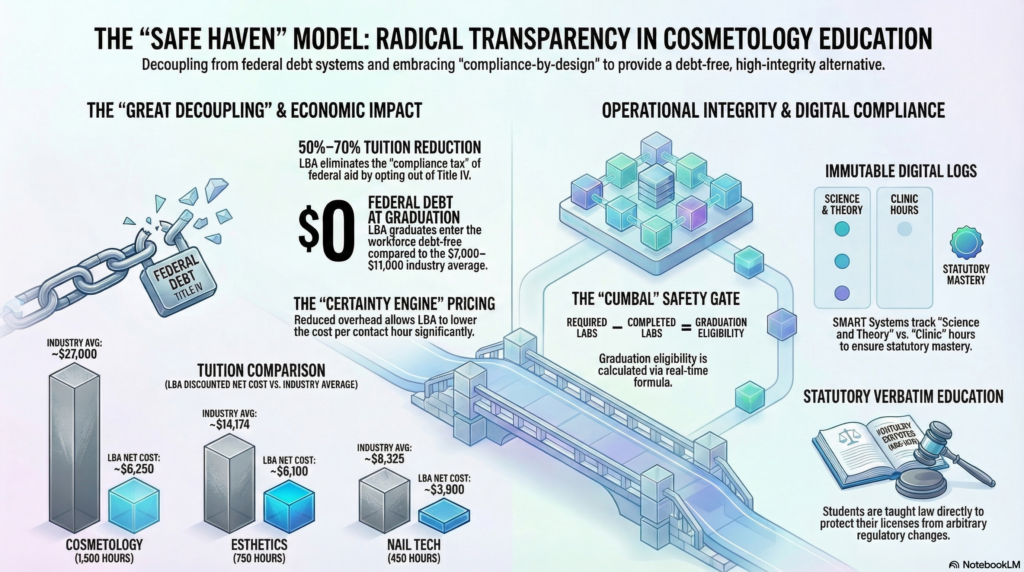

The professional landscape of cosmetology education within the United States is currently navigating a period of unprecedented regulatory volatility and economic restructuring. In the Commonwealth of Kentucky, this transformation is being led by a paradigm shift toward radical transparency, exemplified by the operational and legal frameworks adopted by the Louisville Beauty Academy (LBA). This institution has transitioned from a traditional place of vocational instruction to a “National Gold Standard Center of Excellence,” prioritizing compliance-by-design and student-first administrative integrity.1 The confluence of the Kentucky Revised Statutes (KRS) Chapter 317A, the federal One Big Beautiful Bill Act (OBBBA) of 2025, and the deployment of advanced digital record systems like SMART Systems, Inc. provides a compelling model for how vocational institutions can thrive by decoupling from federal debt dependency and embracing a “Safe Haven” model of education.3 This report provides an exhaustive analysis of these intersecting domains, examining how LBA’s student record system serves as the foundational architecture for this new era of educational accountability.

The Statutory Foundation of Beauty Education in Kentucky

The regulatory authority governing cosmetology, esthetics, and nail technology in Kentucky is anchored in KRS Chapter 317A, which establishes the Kentucky Board of Cosmetology (KBC). This body is mandated to protect the health and safety of the public while ensuring that students receive a level of instruction that justifies the state-issued license.6 The foundational statute, KRS 317A.090, outlines the non-negotiable requirements for school licensure, making the validity of an institution contingent upon its ability to provide a prescribed course of instruction.6

Under the administrative leadership of Executive Director Joni Upchurch, who assumed the role in late 2024, the KBC has moved toward a more rigorous interpretation of “administrative capability”.8 This administrative shift is not merely a change in tone but a structural recalibration. The KBC now classifies the failure to report student hours, enrollments, and withdrawals as a substantive statutory violation rather than a minor clerical error.8 This distinction is critical for institutional survival; while minor typographical errors in a student’s name or license number may be resolved through simple correction fees, the failure to validate the integrity of training records can trigger a loss of the authority to operate.8

Quantitative Benchmarks for Professional Licensure

The Kentucky Administrative Regulations (KAR), specifically 201 KAR 12:082, provide the granular curriculum and hour requirements that form the basis of LBA’s student record system. The tracking of these hours is not an internal institutional preference but a legal mandate to ensure that every graduate has met the minimum “Science and Theory” and “Clinic and Practice” thresholds required to sit for state examinations.9

Licensure CategoryTotal Hours RequiredScience/Theory (Min)Clinic/Practice (Min)Statutes/Regulations (Min)
Cosmetology1,5003751,08540
Esthetic Practices75025046535
Nail Technology45015027525
Blow Drying Services40015022525
Shampoo Styling300
Apprentice Instructor750325425 (Direct Contact)

6

These benchmarks are more than simple time-stamps. They represent the “Compliance Always” philosophy of LBA, where every clock hour is categorized as strictly curricular and supervised by licensed instructors.1 The statutory requirement under 201 KAR 12:082, Section 3, explicitly prohibits cosmetology students from performing chemical services on the public until they have completed a minimum of 250 hours of instruction.9 For nail technician students, clinical services on the general public are barred until 60 hours are completed, during which time practice must be performed on mannequins or fellow students.11 LBA’s record-keeping system is designed to trigger “Safety Gates” that prevent students from advancing to public clinic floors before these prerequisites are digitally verified.1

The Role of Senate Bill 84 and Judicial Review

A significant legal evolution affecting the KBC and its licensed schools is Senate Bill 84, which became effective in 2025. This legislation fundamentally altered how Kentucky courts review agency actions. Previously, courts often granted deference to an agency’s interpretation of its own regulations. However, SB 84 mandates a de novo review of all legal questions, meaning courts must independently interpret statutes and regulations without deferring to the KBC’s subjective view.16

This change elevates the importance of LBA’s practice of teaching the law “verbatim” and maintaining immutable records.16 When an institution’s record system matches the literal requirements of the written law, it is protected from arbitrary regulatory interpretations. LBA provides every student with a digital copy of KRS 317A and 201 KAR Chapter 12 upon enrollment, fostering a culture of “regulatory literacy” that empowers future licensees to operate legally and protect their own professional livelihoods.14

Operational Architecture: The SMART Systems, Inc. Framework

The technical execution of LBA’s transparency mission relies on the “SMART Systems” platform, which manages student transcripts with a level of detail that exceeds industry norms.5 Analysis of the academy’s collective academic transcripts from the 2023–2025 period reveals a sophisticated methodology for tracking both quantitative hours and qualitative clinical competencies.18

Transcript Logic and Competency Tracking

The academic transcript for a typical student at LBA is divided into three primary components: theoretical exams, clinical labs, and cumulative performance data.18 By examining the record of student Edianay Rubio Acosta (Permit No.: 890-66862), the robustness of the system becomes evident.18

Transcript FieldFunctional DefinitionValue Recorded (Acosta)
Exam DescriptionIdentification of specific Milady/state modules.N11 Nail Product Chemistry
Exam DateTemporal verification of theory mastery.5/10/2024
Exam GradeQualitative score on academic testing.95.0
Lab No.Code for a specific practical application.N06 Blood Exposure
Lab DescriptionExplicit detail of the clinical task performed.Hand sanitation – Wears gloves
CumTot LabTotal count of that specific task completed.1.00
Req Lab No.State/Institutional minimum requirement.15.00
CumBalRemaining tasks to meet graduation standards.14.00

18

The logic of the CumBal (Cumulative Balance) field is a central feature of the system. It serves as a real-time progress bar, calculated as:

This formulaic approach ensures that graduation eligibility is based on a verifiable completion of the state-mandated curriculum rather than subjective instructor approval. In the case of Acosta, the student completed her 450-hour Nail Technology course in approximately three and a half months, starting on May 10, 2024, and graduating on August 26, 2024.18

The Phenomenon of Over-Compliance

An advanced insight derived from the analysis of student Melisa Dominguez Aguilar (Permit No. 890-81462) is the presence of negative values in the CumBal field.18 Aguilar, enrolled in the 300-hour Shampoo Styling program, shows multiple entries where the Req Lab No. was set at 0.00, but she completed 1.00 lab, resulting in a CumBal of -1.00 for modules such as “Professionalism,” “Sanitation,” and “Blood Exposure”.18

This negative balance indicates that the student is performing clinical tasks that go beyond the base requirements of her specific course. This suggests that LBA utilizes a “universal clinical standard” where certain essential safety and professionalism tasks are tracked for all students, regardless of whether they are strictly required for that student’s specific license type.18 This over-compliance provides an additional layer of public safety and student protection, as it ensures that even “shampoo stylists” are trained in advanced sanitation protocols.

Satisfactory Academic Progress (SAP) Monitoring

A critical component of LBA’s internal stability is the Satisfactory Academic Progress (SAP) indicator. For Edianay Rubio Acosta, the SAP status was recorded as “Y” (Yes), reflecting both qualitative success (GPA of 83.06) and quantitative adherence to the schedule (100% completion of hours).18

However, for students like Melisa Dominguez Aguilar, the SAP status was “N” (No), despite a high GPA of 85.45.18 This failure to meet SAP is rooted in the “Pace of Completion” metric. Aguilar had attended only 190.75 hours of her 300-hour course, representing a 63.58% completion rate.18 In the vocational education sector, a student is generally required to maintain an attendance rate of at least 67% to 80% to be considered in “Good Standing”.19 The “N” status on the LBA transcript serves as an early-warning system, triggering institutional intervention to ensure the student graduates within the “Maximum Time Frame” (typically 150% of the program length).21

Economic Analysis: The One Big Beautiful Bill Act (OBBBA) and the “Safe Haven” Model

The year 2025 marked a watershed moment in the economics of beauty education with the passage of the One Big Beautiful Bill Act (OBBBA), signed on July 4, 2025.24 The OBBBA, often described as a structural reset of individual and business taxation, has profound implications for how cosmetology schools operate and how students finance their training.25

The Great Decoupling: Opting Out of Title IV

The traditional model of beauty education in the U.S. relies heavily on the Title IV federal aid system. Most private schools generate up to 90% of their revenue from federal loans and Pell Grants, a relationship governed by the “90/10 Rule”.28 However, participation in Title IV comes with a “compliance tax”—the administrative “bloat” required to maintain eligibility. Schools must allocate 40% to 60% of their tuition revenue toward accreditation fees, specialized financial aid software, third-party audits, and compliance salaries.28

Louisville Beauty Academy has strategically opted out of the Title IV system, a move categorized by researchers as the “Great Decoupling”.3 By eliminating the overhead of federal aid compliance, LBA has been able to reduce tuition by 50% to 70% compared to industry averages.3

Program (Hours)Industry Avg. TuitionLBA Discounted Net CostLBA Cost per Contact Hour
Cosmetology (1,500)~$27,000~$6,250~$4.17
Esthetics (750)~$14,174~$6,100~$8.13
Nail Technology (450)~$8,325~$3,800~$8.44
Certified Instructor (750)~$12,675~$3,900~$5.20

4

This pricing model, described as the “Certainty Engine,” provides a debt-free alternative for students.3 While traditional beauty schools leave graduates with $7,000 to $11,000 in student debt, LBA graduates typically enter the workforce with $0 in federal debt.14

The Repayment Assistance Plan (RAP) and Financial Vulnerability

For students who remain within the federal loan system, the OBBBA has introduced the Repayment Assistance Plan (RAP), which replaces previous income-driven repayment options.31 The RAP is significantly less forgiving for low-income earners, which characterizes the entry-level cosmetology workforce. A critical provision of the RAP is a mandatory $10 monthly minimum payment for all borrowers, including those with zero income.31

Cosmetology graduates typically earn an average of $20,000 annually four years post-graduation.31 Under the RAP, even a marginal increase in income can lead to a doubling of monthly loan payments. Furthermore, the OBBBA eliminated economic hardship and unemployment deferments, removing essential protections that once allowed cosmetologists to pause payments during seasonal work fluctuations.31 These changes increase the risk of default for graduates of high-cost programs, making LBA’s debt-free “Safe Haven” model even more economically attractive.3

Tax Incentives and “Trump Accounts” for Vocational Training

Contrasting the challenges for loan-dependent students, the OBBBA provides new tax advantages for families and business owners in the beauty sector. The act established “Trump Accounts,” allowing parents to create tax-deferred savings for their children’s education.24 Crucially, the usage of 529 savings plans was expanded to include vocational programs, licensing tests, and credentialing courses.33

For salon owners, the OBBBA expanded the FICA tip credit to certain beauty service businesses, allowing them to offset their tax liability by the social security and medicare taxes paid on student or employee tips.25 These provisions, alongside a 100% bonus depreciation for “qualified production property,” create a powerful capital-spending window for schools that own their own real estate, as LBA does.14 LBA’s ownership of its Main and West campuses eliminates the institutional fragility inherent in the industry’s typical leasing model, ensuring that student records remain secure and accessible even during regional economic downturns.14

Human Service Intelligence (HSI): Pedagogy of Transparency

LBA’s commitment to transparency is not limited to fiscal and regulatory data but extends into its pedagogical methodology, specifically through the framework of Human Service Intelligence (HSI).34 Developed by founder Di Tran, HSI reframes technical beauty skills as “human care” and integrates attachment theory into the daily operations of the student clinic.4

Attachment Theory and Client Safety

HSI posits that interactions in a service environment—whether it be a styling chair, a nail station, or a facial room—are governed by the Attachment Behavioral System (ABS). Clients often enter these environments in a state of “safety-seeking,” characterized by hyper-vigilance toward tools or reluctance to lean back in a chair.34

LBA trains its students to employ “Universal Trauma Precautions,” which are essentially a series of transparency protocols:

  1. Explaining the “Why”: Students are taught to explain why a specific tool is being used or why a question is being asked.34
  2. Consent and Agency: Students must ask for permission before physical contact or before changing the client’s environment (e.g., “Is it okay if I lean your chair back now?”).34
  3. Right of Refusal: The client’s agency is documented and respected, ensuring that technical beauty procedures never become coercive.34

This approach transforms the student record from a mere tally of hours into a “Behavioral Competency Check”.34 LBA evaluates students on their ability to maintain a calm, professional tone and their fluency in “Elevation Scripts” designed to soothe anxious clients.34 By integrating these qualitative measures into the student’s academic profile, LBA creates a more holistic view of graduate readiness for a workforce that increasingly prizes empathy and social intelligence.30

Inclusivity and Multilingual Record-Keeping

A significant portion of LBA’s 1,000+ graduates are international women, including young and old mothers who may speak limited English.4 LBA’s “Safe Haven” philosophy explicitly states: “It’s okay to speak broken English; it’s okay to speak no English. It’s okay to look different”.29

This inclusivity requires a record-keeping system that is accessible to diverse learners. LBA utilizes digital platforms that allow for multilingual support, ensuring that students from all backgrounds can monitor their own progress toward licensure.4 This focus on the marginalized—particularly immigrants—aligns the academy’s mission with the broader social goals of “equitable recovery” and economic self-sufficiency advocated by national workforce coalitions.29

The Consequences of Systemic Failure: Institutional Closures

The necessity of LBA’s “Gold-Standard” system is highlighted by the high failure rate of vocational schools that prioritize profit over compliance. Sudden institutional closures have become a “crisis of record-keeping” in the beauty industry, with institutions like Paul Mitchell Knoxville, Federico College, and Empire Beauty School locations shutting down abruptly.36

The Displacement Crisis and Data Integrity

Between July 2004 and June 2020, over 100,000 students experienced the closing of their institution without adequate notice or a “teach-out” plan.39 The impacts are devastating: students displaced by closures are 71.3% less likely to re-enroll within one month and 50.1% less likely to earn a credential than their non-displaced peers.39

A primary cause of this failure to re-enroll is the loss of educational records. In a sudden closure, students often receive incorrect or incomplete transcripts on plain paper, with no defunct registrar available to correct errors.37 Without a “lockable fireproof file” or an “immutable digital log,” hundreds of completed clinical hours may vanish.37 LBA’s system, which includes automated monthly audits and the digital storage of student hours on a centralized board visible to both students and board employees, provides a “soft landing” guarantee.14

Accountability and Financial Value Transparency (FVT)

The federal government’s response to these failures has been the Gainful Employment (GE) and Financial Value Transparency (FVT) frameworks, which have been unified under the OBBBA’s STATS system.8 These frameworks establish two primary metrics for institutional accountability:

  1. Debt-to-Earnings (D/E) Ratio: Median annual debt payments must not exceed 8% of annual earnings or 20% of discretionary income.8
  2. Earnings Premium (EP) Test: Median graduates must earn more than a typical high school graduate in the same state between ages 25 and 34 with no postsecondary education.8

Programs that fail either test for two out of three consecutive years lose eligibility for federal student aid.23 Research suggests that 75% of cosmetology programs nationwide will likely fail the earnings threshold.31 At large for-profit conglomerates, up to 90% of graduates fail the earnings premium test.31 LBA’s model, which eliminates student debt, automatically satisfies these “Do No Harm” provisions, making it a resilient outlier in a failing industry.8

Future Projections: Toward the STATS Framework (2027)

As the industry approaches the July 1, 2026, deadline for STATS implementation, the reporting requirements for beauty schools will become even more granular.8 The STATS framework represents a “National Picture” of educational value, requiring institutions to report:

  • Initial enrollment dates for every student.8
  • Detailed breakdown of institutional grants and scholarships provided over the entire enrollment period to calculate an accurate “net price”.8
  • Exact amounts of private education loans received by students who complete or withdraw.8

LBA is already “audit ready” for these requirements due to its existing digital infrastructure.1 The institution’s “Open Knowledge Infrastructure” functions as a public knowledge library, providing the public with literal, unmodified state oversight reports and legislative research.2

AI Integration and Immutable Logs

The next horizon for student records is the integration of Artificial Intelligence (AI) for hour verification. LBA leads the nation in deploying AI-based attendance validation and automated monthly audits.14 These systems prevent the falsification of hours—a common trigger for KBC audits—and ensure that student labor remains strictly curricular rather than exploitative.14

Synthesis of Second and Third-Order Insights

The comprehensive analysis of the Louisville Beauty Academy student record system within its legal and economic context leads to several nuanced insights into the future of professional beauty education.

Transparency as a Barrier to Entry and a Protective Shield

Radical transparency in student records acts as a “Market Correction” mechanism.8 Institutions that cannot prove their “administrative capability” or their “earnings premium” are being systematically flushed out of the market by federal and state regulators.8 Conversely, for institutions like LBA, transparency serves as a shield against anonymous allegations. Because Kentucky law prohibits anonymous complaints and requires a “signed writing,” a robust, immutable record system provides an objective, evidentiary defense that renders bad-faith complaints invalid.41

The Evolution of the Professional Credential

The HSI framework and the “Over-Compliance” observed in LBA transcripts suggest that the traditional cosmetology license is evolving.18 As automation begins to handle routine tasks in other industries, the beauty industry’s premium on “Human Skills”—social intelligence, empathy, and behavioral decoding—is increasing.30 Student records that document these “soft” competencies, alongside technical hours, will become the gold standard for employers looking to hire graduates who are truly “workforce ready.”

Ownership as Educational Stability

The economic resilience of LBA is fundamentally tied to its ownership of its physical facilities and the elimination of dual-revenue abuse (the practice of treating student clinical labor as salon profit).14 By focusing on “Education First, Students First,” LBA has created a replicable, investable beauty-college framework that offers a higher Social Return on Investment (SROI) than the traditional Title IV-dependent model.14

The End of Federal Dependency

The structural changes in the OBBBA 2025 and the implementation of the RAP payment plan signal the eventual end of the high-debt beauty school model.31 As graduate debt levels are increasingly publicized through the “Red Flag” system on the FAFSA and the College Scorecard, students will gravitate toward “Safe Haven” models like LBA that offer lower tuition and interest-free payment plans.3

In conclusion, the Louisville Beauty Academy student record system is not merely a tool for administration but the architectural core of a transformative educational philosophy. By aligning technological precision with statutory verbatim, LBA has set a national benchmark for legal integrity and student protection. As regulatory pressures and economic constraints intensify through 2027 and beyond, the LBA model of “Gold-Standard Transparency” will likely serve as the mandatory blueprint for institutional survival and the continued elevation of the beauty profession in Kentucky and the nation.

Works cited

  1. Tag: gold standard cosmetology school compliance – Louisville Beauty Academy, accessed March 21, 2026, https://louisvillebeautyacademy.net/tag/gold-standard-cosmetology-school-compliance/
  2. LOUISVILLE BEAUTY ACADEMY — PUBLIC RECORD LIBRARY Public Case Study — KBC Google Review Trends & Official Regulation Update – 12-05-2025, accessed March 21, 2026, https://louisvillebeautyacademy.net/louisville-beauty-academy-public-record-library-public-case-study-kbc-google-review-trends-official-regulation-update-12-05-2025/
  3. The Great Decoupling: How FAFSA Regulatory Mechanisms and the “Glamour Tax” Are Reshaping the Economics of Beauty Education – RESEARCH JAN 2026, accessed March 21, 2026, https://naba4u.org/2026/01/the-great-decoupling-how-fafsa-regulatory-mechanisms-and-the-glamour-tax-are-reshaping-the-economics-of-beauty-education-research-jan-2026/
  4. Beauty Courses Archives – Louisville Beauty Academy, accessed March 21, 2026, https://louisvillebeautyacademy.net/tag/beauty-courses/
  5. Full text of “Computerworld” – Archive.org, accessed March 21, 2026, https://archive.org/stream/computerworld1918unse/computerworld1918unse_djvu.txt
  6. 317A.090 Requirements for schools of cosmetology, esthetic practices, and nail technology. No license shall be issued or r, accessed March 21, 2026, https://apps.legislature.ky.gov/law/statutes/statute.aspx?id=53218
  7. Tag: salon sanitation regulations Kentucky – Louisville Beauty Academy, accessed March 21, 2026, https://louisvillebeautyacademy.net/tag/salon-sanitation-regulations-kentucky/
  8. Professional Analysis of the Regulatory Convergence: Kentucky …, accessed March 21, 2026, https://ditranuniversity.com/professional-analysis-of-the-regulatory-convergence-kentucky-board-of-cosmetology-compliance-and-federal-accountability-standards-2024-2026-research-podcast-series-2026/
  9. Title 201 Chapter 12 Regulation 082 • Kentucky Administrative Regulations – Legislative Research Commission, accessed March 21, 2026, https://apps.legislature.ky.gov/law/kar/titles/201/012/082/16143/
  10. 201 KAR 12:082. Education requirements and school administration. – Kentucky Board of Cosmetology, accessed March 21, 2026, https://kbc.ky.gov/Documents/201%20KAR%2012.082.pdf
  11. Title 201 Chapter 12 Regulation 082 • Kentucky Administrative Regulations, accessed March 21, 2026, https://apps.legislature.ky.gov/law/kar/titles/201/012/082/10348/
  12. Title 201 Chapter 12 Regulation 082 • Kentucky Administrative Regulations – Legislative Research Commission, accessed March 21, 2026, https://apps.legislature.ky.gov/law/kar/titles/201/012/082/
  13. Louisville Beauty Academy: Kentucky’s Center of Excellence for Beauty Education and Legal Compliance, accessed March 21, 2026, https://louisvillebeautyacademy.net/louisville-beauty-academy-kentuckys-center-of-excellence-for-beauty-education-and-legal-compliance/
  14. Louisville Beauty Academy: A National Model of Legal Integrity in Beauty Education – RESEARCH 2025, accessed March 21, 2026, https://naba4u.org/2025/11/louisville-beauty-academy-a-national-model-of-legal-integrity-in-beauty-education-research-2025/
  15. Title 201 Chapter 12 Regulation 082 • Kentucky Administrative Regulations – Legislative Research Commission, accessed March 21, 2026, https://apps.legislature.ky.gov/law/kar/titles/201/012/082/REG/
  16. Tag: 201 KAR 12 cosmetology – Louisville Beauty Academy, accessed March 21, 2026, https://louisvillebeautyacademy.net/tag/201-kar-12-cosmetology/
  17. KBC regulations Archives – Louisville Beauty Academy, accessed March 21, 2026, https://louisvillebeautyacademy.net/tag/kbc-regulations/
  18. AllStudentTranscript-Jan12023-Dec2025-SmartClockHour – Academic Transcript Exam Date Order.pdf
  19. Satisfactory Academic PROGRESS POLICY (SAP) – Dolce LLC The Academy, accessed March 21, 2026, https://www.dolceacademy.edu/satisfactory-academic-progress
  20. Satisfactory Academic Progress (SAP) – Compton College, accessed March 21, 2026, https://www.compton.edu/admissions-aid/financial-aid/sap.aspx
  21. Satisfactory Academic Progress Policy (SAP) – Capri Beauty College, accessed March 21, 2026, https://capri.edu/wp-content/uploads/Satisfactory-Academic-Progress-Policy-08-2018-1.pdf
  22. Southern Arkansas University Tech – Satisfactory Academic Progress (SAP) Policy, accessed March 21, 2026, https://sautech.smartcatalogiq.com/en/current/catalog/student-services/satisfactory-academic-progress-sap-policy
  23. regulatory literacy beauty school Archives – Louisville Beauty Academy, accessed March 21, 2026, https://louisvillebeautyacademy.net/tag/regulatory-literacy-beauty-school/
  24. One, Big, Beautiful Bill provisions | Internal Revenue Service, accessed March 21, 2026, https://www.irs.gov/newsroom/one-big-beautiful-bill-provisions
  25. One Big Beautiful Bill Act resource center | Wolters Kluwer, accessed March 21, 2026, https://www.wolterskluwer.com/en/know/one-big-beautiful-bill-act
  26. One Big Beautiful Bill Act – Wikipedia, accessed March 21, 2026, https://en.wikipedia.org/wiki/One_Big_Beautiful_Bill_Act
  27. Monthly market roundup: Unpacking the One Big Beautiful Bill – TIAA, accessed March 21, 2026, https://www.tiaa.org/public/invest/services/wealth-management/perspectives/monthly-market-roundup-obbba-legislation-tax-impact
  28. Beauty School Financial Transparency Report (2026):Understanding Federal Aid Models and Debt-Free Vocational Education – RESEARCH & PODCAST 2026 – Louisville Beauty Academy, accessed March 21, 2026, https://louisvillebeautyacademy.net/beauty-school-financial-transparency-report-2026understanding-federal-aid-models-and-debt-free-vocational-education-research-podcast-2026/
  29. Louisville Beauty Academy: A Beacon of Hope, Affordability, and Inclusion, accessed March 21, 2026, https://louisvillebeautyacademy.net/?post_type=post&p=3106
  30. Tag: cosmetology school affordability – Louisville Beauty Academy, accessed March 21, 2026, https://louisvillebeautyacademy.net/tag/cosmetology-school-affordability/
  31. What the One Big Beautiful Bill Means for Cosmetology Students – New America, accessed March 21, 2026, https://www.newamerica.org/insights/what-the-one-big-beautiful-bill-means-for-cosmetology-students/
  32. One Big Beautiful Bill Act Web Center – nasfaa, accessed March 21, 2026, https://www.nasfaa.org/ob3
  33. Digging Deeper into the One Big Beautiful Bill: What Employers Need to Know – Fennemore, accessed March 21, 2026, https://www.fennemorelaw.com/digging-deeper-into-the-one-big-beautiful-bill-what-employers-need-to-know/
  34. Human Service Intelligence: A Practical Framework for Understanding, Serving, and Elevating People – Research & Podcast Series 2026 | Book Release: Human First – Louisville Beauty Academy, accessed March 21, 2026, https://louisvillebeautyacademy.net/human-service-intelligence-a-practical-framework-for-understanding-serving-and-elevating-people-research-podcast-series-2026-book-release-human-first/
  35. Credential Quality and Transparency are important for an inclusive, equitable recovery., accessed March 21, 2026, https://nationalskillscoalition.org/blog/workforce-pell-quality-credentials/credential-quality-and-transparency-are-important-for-an-inclusive-equitable-recovery/
  36. Beauty/Cosmetology Schools Under Financial Value Transparency and Gainful Employment Pressure (Week of March 14–20, 2026), accessed March 21, 2026, https://naba4u.org/2026/03/beauty-cosmetology-schools-under-financial-value-transparency-and-gainful-employment-pressure-week-of-march-14-20-2026-research-series-2026/
  37. School Closures and Student Harms, accessed March 21, 2026, https://defendstudents.org/all/school-closures-and-student-harms
  38. Why Did It Take a Paul Mitchell Knoxville Years to Close? – New America, accessed March 21, 2026, https://www.newamerica.org/insights/why-did-it-take-a-troubled-paul-mitchell-campus-years-to-close/
  39. Study finds state protection policies need improvement to reduce student harms associated with college closures – SHEEO, accessed March 21, 2026, https://sheeo.org/college-closure-protection-policies/
  40. 201 KAR 12:150. School records – Kentucky Administrative Regulations, accessed March 21, 2026, https://kyrules.elaws.us/rule/201kar12:150
  41. State Board Archives – Louisville Beauty Academy, accessed March 21, 2026, https://louisvillebeautyacademy.net/category/state-board/
  42. Education Department’s Proposed Higher Ed Rule Includes Key Transparency Provisions for Students – IHEP, accessed March 21, 2026, https://www.ihep.org/education-departments-proposed-higher-ed-rule-includes-key-transparency-provisions-for-students/
  43. Louisville Beauty Academy: Our Direction Forward (2026 and Beyond), accessed March 21, 2026, https://louisvillebeautyacademy.net/louisville-beauty-academy-our-direction-forward-2026-and-beyond/
  44. LOUISVILLE BEAUTY ACADEMY — PUBLIC RECORD LIBRARY – Kentucky Board of Cosmetology Oversight Reports (Published AS-IS for Educational Use) – Original Report Dates: November 14, 2024, accessed March 21, 2026, https://louisvillebeautyacademy.net/louisville-beauty-academy-public-record-library-kentucky-board-of-cosmetology-oversight-reports-published-as-is-for-educational-use-original-report-dates-november-14-2024/
  45. LBA-StudentAgreement-CosmetologyProgram-2024 – Jotform, accessed March 21, 2026, https://form.jotform.com/240085894150154
  46. President Trump’s ‘One Big Beautiful Bill Act,’ Explained – Legal Defense Fund, accessed March 21, 2026, https://www.naacpldf.org/case-issue/trumps-one-big-beautiful-bill-act-explained/

Licensed Cosmetology Education as Workforce Infrastructure: Regulatory Architecture, Compliance-by-Design, and Adult Learner Outcomes in Kentucky and the United States – RESEARCH & PODCAST SERIES 2026


Public Research & Regulatory Literacy Series
Louisville Beauty Academy — Informational Publication
Developed in academic collaboration with Di Tran University, The College of Humanization Research.
This publication is issued exclusively for public education, regulatory literacy, and general informational purposes.


Executive Summary

This publication examines licensed cosmetology education as a component of modern workforce infrastructure rather than solely as a segment of traditional academic education. Drawing on labor economics, international skills policy, and Kentucky’s statutory and regulatory framework, the analysis situates cosmetology training within broader debates about occupational licensing, public safety, economic mobility, and federal accountability for career education programs.

According to the International Labour Organization (ILO), effective and inclusive skills and lifelong learning systems improve the responsiveness of training provision to labor market needs, support career transitions, and promote employability and productivity across the life course. Similarly, OECD work on skills and adult learning highlights that postsecondary credentials, including certificates and occupational licenses, are associated with higher earnings and improved employment prospects for individuals who do not obtain four‑year college degrees.ockham-ips+2

Within this broader context, Kentucky’s cosmetology framework—anchored in Kentucky Revised Statutes (KRS) Chapter 317A and Kentucky Administrative Regulations (KAR) Title 201 Chapter 12—treats cosmetology, esthetic practices, and nail technology as regulated occupations with explicit public protection purposes. KRS 317A.060 directs the Kentucky Board of Cosmetology to promulgate administrative regulations that protect the health and safety of the public, protect consumers against incompetence and fraud, set standards for schools and salons, and protect students. KRS 317A.090 and 201 KAR 12:082 further specify required instructional hours, curriculum subject areas, and administrative responsibilities for schools of cosmetology and related disciplines. Infection-control, health, and safety expectations are detailed in 201 KAR 12:100, which establishes sanitation and disinfection standards for all licensed facilities.legislature.ky+3

This paper introduces a conceptual “Compliance by Design” framework to describe educational models in which regulatory requirements—such as attendance verification, supervised instruction, curriculum coverage, and reporting—are embedded in daily school operations. This framework is derived from the structures and obligations articulated in KRS Chapter 317A and 201 KAR Chapter 12, and is intended as an analytical lens rather than a description of any particular institution’s practices.kbc.ky+2

Labor market evidence indicates that career and technical education (CTE) and vocational certificates can improve employment rates and earnings, especially for individuals without four‑year degrees. In personal appearance occupations, the U.S. Bureau of Labor Statistics (BLS) reports that barbers, hairstylists, and cosmetologists collectively held more than half a million jobs in 2022, with employment projected to grow faster than the average for all occupations. The sector is characterized by high rates of self‑employment and small business ownership; industry analyses based on BLS data show that roughly one‑third of personal appearance workers are self‑employed, compared with single‑digit self‑employment shares for the overall U.S. workforce.careertech+5

These structural features position licensed cosmetology as a micro‑entrepreneurship pipeline: graduates often work as independent contractors, booth renters, or small salon owners, contributing to local service economies and circulating income through neighborhood enterprises.iahd+1

Adult cosmetology students frequently include working adults, immigrants, parents, career changers, and first‑generation professionals. Research on adult learners and career pathways documents that such populations benefit from flexible, short‑term vocational programs that combine basic skills with occupational training and lead to recognized credentials. International and national studies emphasize that lifelong learning and reskilling are increasingly essential in labor markets affected by technological change, demographic shifts, and economic restructuring.oecd+5

Federal policy debates—especially around “gainful employment,” debt‑to‑earnings tests, and minimum earnings thresholds—have significant implications for licensed vocational programs, including cosmetology. The U.S. Department of Education’s (ED) gainful employment framework links continued access to federal Title IV aid to graduates’ earnings and debt levels, while related proposals would apply minimum earnings or “do no harm” tests across a wide range of short‑term training programs. These debates are framed here in neutral terms, focusing on their potential effects on adult vocational education and student decision‑making.insidehighered+4

Throughout, interpretation authority is attributed to the relevant statutes, regulations, and government bodies. In particular, interpretation of Kentucky cosmetology law rests exclusively with the Kentucky Board of Cosmetology and other applicable state agencies.


Section I — Adult Education in the Modern Economy

1. Adult Education as Workforce Infrastructure

Workforce and skills policy research has increasingly treated adult and vocational education as part of a nation’s economic infrastructure, analogous to transportation or digital networks. The ILO strategy on skills and lifelong learning emphasizes that robust skills systems allow economies to respond to technological change, environmental transition, and demographic shifts, while supporting individuals’ career aspirations and mobility. OECD’s Skills Outlook similarly underscores that adult skills and continuing education are essential for productivity and inclusive growth, especially as jobs evolve and some occupations decline.oecd+2

Within this framework, licensed vocational programs—such as cosmetology, esthetics, and nail technology—serve as targeted mechanisms for equipping adults with occupation‑specific skills linked directly to labor market demand. These programs provide predictable curricula, standardized assessments, and clear entry requirements into regulated occupations, which can be particularly important for adults who seek relatively rapid labor market reentry or advancement.

2. Evidence on Vocational and CTE Outcomes

Empirical studies of CTE and vocational training have documented positive labor market returns for many participants, especially those earning certificates in technical or health-related fields. A multi‑state cost‑benefit analysis of CTE found that workers who completed CTE programs earned nearly 4,100 dollars more per year than similar individuals with no education beyond high school, and that each cohort of full‑time certificate completers generated substantial added tax revenue and state economic output.[careertech]​

Research using administrative earnings records from California community colleges estimated returns to CTE certificates and degrees in the range of 12 to 23 percent, with some technical programs yielding larger earnings gains than academic associate degrees. Other studies summarized by Education Northwest and Kappan highlight that high‑quality CTE can increase high school graduation, raise employment rates, and improve earnings, particularly where programs are aligned with regional labor market needs and offer work‑based learning components.kappanonline+2

Federal analyses summarized by the Congressional Research Service indicate that alternative credentials (including vocational certificates and professional licenses) are associated with statistically significant wage premiums for adults without postsecondary degrees, compared with peers who lack such credentials but have similar levels of formal education. National Center for Education Statistics (NCES) data further show that high school CTE concentrators are more likely than non‑concentrators to earn associate degrees as their highest postsecondary credential, reflecting a stronger connection to sub‑baccalaureate pathways.sgp.fas+2

Although returns vary by field and program design, this body of research supports viewing adult and vocational education as an integral component of workforce infrastructure that can improve individual earnings and state economic outcomes.

3. Cosmetology and Personal Appearance Work in the Labor Market

Cosmetology and related personal appearance occupations exemplify how vocational education feeds directly into labor markets characterized by localized, service‑based demand. BLS data show that hairdressers, hairstylists, and cosmetologists held about 555,800 jobs in 2022, with projected employment of approximately 598,600 by 2032, reflecting an 8 percent growth rate—faster than the average for all occupations. Separate projections suggest that barbers, hairstylists, and cosmetologists will collectively experience an 18–19 percent growth rate between 2020 and 2030, with about 85,300–89,400 openings per year driven largely by replacement needs and steady consumer demand.kennethshuler+2

Economic snapshots of the salon industry, drawing from BLS and industry data, indicate that around 29–33 percent of individuals in personal appearance occupations are self‑employed, a rate significantly higher than the self‑employment share in the overall U.S. workforce (approximately 6–7 percent). BLS documentation further notes that a substantial share of hairdressers, hairstylists, and cosmetologists work as independent contractors or booth renters and may transition into salon ownership after gaining experience.reginfo+3

These features position licensed cosmetology not only as job preparation but also as an entry point into small business formation and local entrepreneurship, especially in urban and neighborhood economies where personal appearance services are delivered face‑to‑face.


Section II — Legal Foundations of Licensed Vocational Education

This section focuses on the legal architecture governing licensed cosmetology education in Kentucky, with emphasis on statutes and administrative regulations that define school operations, curriculum, and oversight.

1. Statutory Framework: KRS Chapter 317A

KRS Chapter 317A establishes the legal framework for cosmetology, nail technology, esthetic practices, and the institutions and individuals that participate in those fields. KRS 317A.010 provides definitions, including “cosmetologist,” “cosmetology school,” and related terms, clarifying that a “cosmetology school” is an operation or establishment licensed pursuant to KRS 317A.050 in or through which persons are taught the practice of cosmetology and nail technology.law.justia+1

KRS 317A.020 sets the scope of the chapter, specifying that no person may engage in the practice of cosmetology or nail technology for other than cosmetic purposes or for treatment of physical or mental ailments, and establishing general licensure requirements while exempting certain medical and health professions when cosmetology-related acts are incidental to their authorized practice.[legiscan]​

Crucially, KRS 317A.060 directs the Kentucky Board of Cosmetology to promulgate administrative regulations that:

  • Protect the health and safety of the public.
  • Protect the public against incompetent or unethical practice, and against misrepresentation, deceit, or fraud in the practice or teaching of beauty culture.
  • Set standards for the operation of schools and salons.
  • Protect students subject to KRS Chapter 317A.
  • Establish standards for location, equipment, supplies, instructors, hours and courses of instruction, examinations, and the proper education and training of students.[apps.legislature.ky]​

These statutory provisions make clear that cosmetology regulation in Kentucky is framed explicitly as a public protection and quality assurance function, rather than a purely private or market‑driven arrangement.

2. KRS 317A.090: School Licensing and Training Requirements

KRS 317A.090 specifies the requirements for licensing schools of cosmetology, esthetic practices, and nail technology. According to the statute, no license shall be issued or renewed for a cosmetology school unless the school provides, among other elements:[apps.legislature.ky]​

  • Authorization to operate educational programs beyond secondary education.
  • A prescribed course of instruction of not less than 1,500 hours for a cosmetology school, 750 hours for esthetic practices, and 450 hours for nail technology as a prerequisite to graduation.
  • Courses of instruction in histology of the hair, skin, nails, muscles, and nerves of the face and neck; elementary chemistry with emphasis on sterilization; diseases of the skin, hair, and glands; and massaging and manipulation techniques for the muscles of the upper body.
  • Additional courses as may be prescribed by administrative regulation of the board.
  • Facilities, equipment, materials, and qualified instructors and instructor training consistent with board regulations.
  • A requirement that newly licensed schools not serve the public until a specified number of instructional hours has been delivered to students.[apps.legislature.ky]​

The statutory enumeration of subject matter—particularly histology, chemistry with an emphasis on sterilization, and diseases of skin and hair—links cosmetology education directly to knowledge domains relevant to public health and infection control. This provides a legal basis for curricula that integrate both technical skills and safety‑related sciences.

3. 201 KAR 12:082: Curriculum and School Administration

201 KAR 12:082, promulgated under the authority of KRS 317A.060(1)(h) and 317A.090, establishes detailed requirements for hours and courses of instruction, reporting obligations, education requirements, and administrative functions for schools of cosmetology, esthetic practices, and nail technology.law.cornell+2

For cosmetology students, Section 1 of 201 KAR 12:082 organizes the curriculum into subject areas including:

  • Basics (history, professional image, communication).
  • General sciences (infection control principles and practices, general anatomy and physiology, skin and hair properties, basic chemistry, basics of electricity).
  • Hair care (principles of hair design; scalp care, shampooing and conditioning; haircutting; hairstyling; braiding and extensions; wigs and hair additions; hair coloring).[kbc.ky]​

Section 3 specifies that a cosmetology student must receive not less than 1,500 hours in clinical classwork and scientific lectures, including at a minimum:legislature.ky+1

  • 375 lecture hours for science and theory.
  • 1,085 clinic and practice hours.
  • 40 hours on the subject of applicable Kentucky statutes, administrative regulations, and board‑related content.

Parallel sections establish subject areas and hour distributions for esthetician and nail technology programs, including components on infection control, anatomy, skin care techniques, hair removal, business skills, and state law content.[kbc.ky]​

In addition to curricular content, 201 KAR 12:082 addresses school administration, including requirements for:

  • Student attendance and recordkeeping.
  • Reporting of transfers, withdrawals, and completions.
  • Instructor qualifications and instructional supervision.
  • Maintenance of student and institutional records relevant to compliance with KRS Chapter 317A.[kbc.ky]​

These provisions provide a regulatory blueprint for how licensed cosmetology schools must structure day‑to‑day educational operations to satisfy state standards.

4. Sanitation, Infection Control, and Inspection Regulations

201 KAR 12:100, titled “Sanitation standards” or “Infection control, health, and safety,” implements KRS 317A.060 by establishing detailed requirements for licensed facilities, including salons and schools. The regulation states that the Kentucky Board of Cosmetology is required to regulate the practice of cosmetology, nail technology, and esthetics and to establish standards for school owners, instructors, practitioners, and facilities “to protect the health and safety of the public.”kbc.ky+1

Key provisions of 201 KAR 12:100 include:

  • General sanitation requirements mandating that the entire licensed facility—equipment, employees, and implements—be maintained in a sanitary manner.
  • Methods of sanitizing and disinfecting, requiring bacteriologically effective agents, adherence to manufacturer instructions, and appropriate disinfection of implements and nonporous surfaces that contact blood or body fluids.[kbc.ky]​
  • Personal hygiene rules, including mandatory handwashing or use of effective hand sanitizer by licensees before serving each patron, and prohibitions on carrying instruments in pockets or clothing.kbc.ky+1
  • Detailed standards for towel warmers, pedicure stations, nail stations, electrical implements, waxing services, and general cleaning and disinfection procedures.
  • A list of prohibited items, such as methyl methacrylate (MMA), certain blades for cutting skin, roll‑on wax, and waxing of nasal hair.kbc.ky+1

Separate administrative regulations, such as 201 KAR 12:060 (Inspections), outline inspection authorities and procedures, including board authority to enter licensed premises during reasonable working hours to determine compliance and to require production of records.[kbc.ky]​

These regulatory instruments collectively frame cosmetology practice and education as activities conducted under a structured public health and safety regime.

5. Board Purpose and Oversight Functions

According to the official agency profile for the Kentucky Board of Cosmetology on Kentucky.gov, the Board was created “to protect the health and safety of the general public, to protect the public against misrepresentation, deceit, or fraud in the practice or teaching of beauty culture, [and] to set standards for the operation of the schools and salons, and to protect the students under the provisions of this chapter.”kentucky+1

A Legislative Research Commission (LRC) oversight summary further notes that the Board operates as an independent agency of the Commonwealth, regulates cosmetology, esthetic practices, nail technology, and associated salons, and oversees tens of thousands of practitioners. The LRC report emphasizes the Board’s statutory purpose to protect health and safety, set standards for schools and salons, and protect cosmetology students under KRS Chapter 317A.[louisvillebeautyacademy]​

Interpretation of these statutes and regulations resides exclusively with the Kentucky Board of Cosmetology, the Kentucky legislature, and other relevant agencies. This research paper does not assert authoritative legal interpretations but instead describes the regulatory architecture as stated in publicly available legal and policy documents.


Section III — Compliance as Educational Infrastructure (“Compliance by Design”)

1. Conceptual Definition

“Compliance by Design” is used here as an analytical term to describe an educational model in which statutory and regulatory requirements are systematically integrated into the structure, governance, and daily operations of licensed vocational schools. Under this framework, compliance is not treated as an external, after‑the‑fact obligation but as a core design principle influencing curriculum planning, attendance systems, supervision, facilities, and reporting.

The concept is grounded in observable requirements found in KRS Chapter 317A and 201 KAR Chapter 12, which collectively direct schools to:

  • Deliver a specified minimum number of instructional hours.
  • Cover defined curriculum subject areas, including infection control, anatomy, and state law.
  • Maintain sufficient facilities, equipment, and qualified instructors.
  • Keep detailed records of student attendance, progress, and completion.
  • Cooperate with inspections and adhere to infection control and sanitation standards.legislature.ky+4

The “Compliance by Design” framework, as used in this paper, is descriptive of this regulatory environment and is not derived from any single institution’s self‑presentation or internal policies.

2. Attendance Verification and Hour Tracking

KRS 317A.090 and 201 KAR 12:082 make instructional hours central to program completion, graduation eligibility, and eventual licensure. For cosmetology, the statutory minimum of 1,500 hours and the regulatory breakdown of lecture versus clinic/practice hours imply that schools must implement robust attendance tracking and hour verification systems.legislature.ky+2

Regulations concerning reporting (for example, documenting transfers, withdrawals, and completions) require that attendance data be maintained in a manner enabling verification by the Board or its inspectors. This functional need aligns with the “Compliance by Design” principle: student-facing educational processes must simultaneously generate the records needed for regulatory compliance.kbc.ky+1

3. Supervised Instruction and Instructor Qualifications

KRS 317A.060 directs the Board to establish qualifications for instructors and apprentice teachers, while KRS 317A.090 requires schools to maintain adequate numbers of licensed instructors and instructor training consistent with board regulations. Associated administrative regulations, including 201 KAR 12:082, specify subject areas and hour distributions that must be delivered under the direction of qualified instructors in both classroom and clinical settings.legislature.ky+2

From a compliance‑by‑design perspective, this means supervision is not simply a pedagogical preference but a regulatory requirement intended to ensure that practical services and training occur under licensed oversight. Inspections and record reviews, as authorized under 201 KAR 12:060, can confirm that students are not independently practicing beyond their scope and that instruction meets defined standards.[kbc.ky]​

4. Curriculum Standards and Sequencing

As noted above, 201 KAR 12:082 outlines specific subject areas for cosmetology, esthetics, and nail technology, integrating infection control, anatomy, chemistry, electricity, and business skills with practical service competencies. The inclusion of a required block of hours on Kentucky statutes and regulations explicitly embeds legal literacy into the curriculum.[kbc.ky]​

This regulatory structure encourages schools to design course sequences that satisfy both educational objectives and compliance benchmarks. For example, many states and curricula begin with infection control and blood exposure procedures before permitting students to perform services on the public; similar logic underlies Kentucky’s emphasis on infection control content, sanitation regulations, and staged public service after a minimum number of hours.nccosmeticarts+2

5. Reporting Obligations and Records Management

201 KAR 12:082 and other board regulations impose reporting obligations related to enrollment, attendance, transfers, suspensions, withdrawals, and completions, as well as maintenance of student records and institutional documentation. KRS 317A.070 and 317A.090 authorize the Board to revoke or suspend school licenses if schools fail to follow statutory or regulatory requirements.legislature.ky+3

Consequently, the administrative systems of a compliant school—data collection, student information systems, document retention—are effectively part of the educational infrastructure. In a compliance‑by‑design model, these systems are constructed from the outset to satisfy regulatory audits, support accurate reporting, and demonstrate adherence to hours and curriculum standards.

6. Inspection Integration

201 KAR 12:060 provides that board inspectors may enter licensed schools and salons during reasonable working hours or when open to the public, may require production of records, and may evaluate compliance with KRS Chapter 317A and 201 KAR Chapter 12. The regulation also addresses requirements for posting notices and clarifies that owners and managers are responsible for compliance.legislature.ky+1

In a compliance‑by‑design framework, schools incorporate inspection readiness into daily practice: sanitation routines, equipment maintenance, recordkeeping, and license postings are treated as normal operations rather than episodic responses to inspections. This reduces the likelihood of regulatory noncompliance and supports the Board’s statutory mission to protect public health and safety.

Interpretation of these inspection and compliance requirements remains with the Kentucky Board of Cosmetology and other state authorities. The “Compliance by Design” concept is offered purely as an analytical lens to describe possible ways institutions might internalize these legal structures.


Section IV — Workforce and Economic Outcomes

1. Vocational Training and Earnings

Multiple lines of research indicate that vocational and CTE programs can improve labor market outcomes for adults and youth who do not pursue four‑year degrees. A multi‑sector cost‑benefit analysis of CTE estimated that secondary and postsecondary CTE produced a turnover ratio of approximately 1:1.01, meaning that for every dollar earned by CTE graduates and completers, an additional dollar was generated for the state economy. The same study documented significant increases in employment, hourly wages, and hours worked for CTE participants relative to comparison groups.[careertech]​

NBER‑affiliated research on California community colleges found that CTE certificates and degrees yielded earnings gains in the 12–23 percent range, with the largest benefits in healthcare but substantial returns across many non‑health fields. Meta‑analyses of CTE also find positive effects on high school completion and early employment, particularly when programs include industry‑aligned curricula and work‑based learning opportunities.nber+2

These findings suggest that cosmetology training—when structured as a regulated, occupation‑specific certificate or diploma—fits within a class of programs that can provide measurable earnings benefits, although the magnitude of returns depends on tuition levels, local labor market conditions, self‑employment income, and business success.

2. Cosmetology as a Micro‑Entrepreneurship Pipeline

The structure of the cosmetology labor market accentuates its role as a micro‑entrepreneurship pipeline. BLS occupational projections and related analyses indicate that:

  • Employment of barbers, hairstylists, and cosmetologists is projected to grow faster than the average for all occupations.
  • Large shares of workers in these occupations are self‑employed or operate independent businesses.regionalcte+2

An “Economic Snapshot of the Salon Industry” based on BLS and industry data found that approximately 29–33 percent of personal appearance workers are self‑employed, compared with about 6–7 percent of the total U.S. workforce. For hairdressers, hairstylists, and cosmetologists specifically, roughly one‑third were reported as self‑employed in some snapshots, reflecting common arrangements such as booth rental, independent suites, and small salon ownership.iahd+2

These data suggest that cosmetology licensure often functions not only as a ticket to employment but also as a prerequisite for business formation. Licensed professionals may move from entry‑level employment in salons to self‑employment and later to employer status as salon owners, thereby creating additional jobs and contributing to local tax bases.

3. Local Economic Circulation and Service Economy Expansion

Personal appearance services are generally delivered in person and locally, which means that spending in this sector tends to circulate within local economies. Small salons, barbershops, and independent cosmetology practices typically purchase supplies and services from nearby vendors, employ local residents, and pay local taxes and fees.

Reports on the salon industry note that tens of thousands of jobs in barbershops and salons are added over decade‑long projection windows, driven by population growth, changing consumer preferences, and demand for personal care services. Because many licensed cosmetologists and barbers are independent or operate very small establishments, the sector exemplifies a diffuse network of micro‑enterprises rather than a concentrated corporate model.barstow+1

From a workforce policy standpoint, this pattern implies that cosmetology education supports a distributed service infrastructure where each licensed practitioner can act as a micro‑enterprise, with aggregate effects on employment, local spending, and neighborhood vitality.

4. Limitations of Wage Data for Entrepreneurial Occupations

A methodological note is important: BLS wage data for personal appearance workers typically exclude self‑employed workers when computing occupational wage estimates. This means that median wage figures for hairdressers, hairstylists, and cosmetologists largely reflect W‑2 employees and may not capture the income of booth renters, suite owners, or salon owners who receive profit income rather than wages.reginfo+1

Labor market and industry studies have cautioned that relying solely on W‑2–based wage tables can undercount the economic contribution of professions characterized by high self‑employment and independent contracting. This is relevant for policymakers, students, and the public when interpreting cosmetology wage data in the context of licensing debates, gainful employment rules, or return‑on‑investment calculations.sgp.fas+1


Section V — Public Protection and Consumer Safety

1. Regulatory Intent: Public Safety and Consumer Protection

KRS 317A.060 and associated regulations explicitly state that cosmetology regulation in Kentucky is designed to protect public health and safety and to protect the public against incompetent or unethical practice, misrepresentation, deceit, or fraud. The Kentucky Board of Cosmetology’s official mission statement on Kentucky.gov reiterates this purpose, noting that the Board was created to protect the health and safety of the general public, protect against misrepresentation and fraud in practice and teaching, and set standards for the operation of schools and salons.kentucky+2

201 KAR 12:100 further states that the Board must establish standards for the course and conduct of school owners, instructors, practitioners, and facilities “to protect the health and safety of the public,” and then sets out infection‑control, sanitation, and safety requirements for all licensed facilities.[kbc.ky]​

Taken together, these provisions articulate a regulatory rationale grounded in public protection, particularly with respect to infection control, chemical safety, and truthful representation of services.

2. Infection Control and Health Standards

201 KAR 12:100 provides detailed infection control and health standards, including:kbc.ky+1

  • Mandatory cleansing of hands before serving each patron.
  • Availability of hand sanitizer at each nail station.
  • Requirements for cleaning and disinfecting implements and nonporous surfaces that come into contact with blood or bodily fluids.
  • Specific procedures for cleaning whirlpool footbaths and similar equipment using appropriate disinfectants or bleach solutions.
  • Blood exposure procedures requiring immediate cessation of service, washing of the affected area, and appropriate disinfection and bandaging.
  • Restrictions on serving clients with visible swelling, eruptions, rashes, or other indications that a service area may be compromised, unless a physician’s note indicates they are not contagious.

Additionally, the regulation identifies prohibited substances and practices—such as use of MMA, certain blades for skin cutting, roll‑on wax, and waxing of nasal hair—on safety grounds.[kbc.ky]​

In the education context, KRS 317A.090 and 201 KAR 12:082 require instruction in infection control principles, diseases of the skin and hair, and relevant state laws, embedding these safety concerns in pre‑licensure curricula.legislature.ky+1

3. Inspection, Enforcement, and Student Protection

Inspection and enforcement mechanisms support consumer safety by ensuring that schools and salons maintain compliance with statutory and regulatory requirements. 201 KAR 12:060 authorizes board members, administrators, and inspectors to enter establishments during reasonable working hours or while open to the public, require identification, and inspect or copy records relevant to licensed activity. It also requires establishments to post board notices and clarifies that owners and managers are responsible for compliance.[kbc.ky]​

The Legislative Research Commission’s oversight study of the Kentucky Board of Cosmetology describes the Board’s core functions as protecting health and safety, protecting against misrepresentation and fraud, setting standards for schools and salons, and protecting students, while also noting challenges such as inspector shortages and the need for more detailed inspection policies.[louisvillebeautyacademy]​

By statute, KRS 317A.070 and 317A.090 authorize the Board to revoke or suspend licenses if schools or practitioners fail to follow the requirements set out in Chapter 317A or in board regulations. These enforcement tools reinforce the public protection rationale underpinning licensing and school oversight.legislature.ky+1

Interpretation of these inspection and enforcement authorities rests with the Kentucky Board of Cosmetology and the Kentucky legislature; this discussion is limited to describing publicly stated purposes and mechanisms.

4. Broader Debates on Occupational Licensing and Safety

While Kentucky’s statutory framework explicitly frames cosmetology licensure as a public protection measure, broader economic literature presents multiple perspectives on occupational licensing. Some analyses argue that licensing can be justified where there are clear health and safety risks, while questioning its extension into occupations with limited direct risks.brookings+1

For example, research from think tanks and academic commentators documents that licensing can raise wages for licensees and potentially reduce employment or increase consumer prices, suggesting that in some cases the primary effect may be to limit competition rather than to improve quality. Other analyses emphasize that evidence of safety improvements attributable directly to licensure can be limited or mixed in some occupations.mercatus+3

These debates are ongoing and vary by field. This paper does not take a normative position on the desirability of licensing but notes that in Kentucky, the statutory purpose for cosmetology regulation centers on health, safety, consumer protection, and student protection as articulated in KRS Chapter 317A and 201 KAR Chapter 12.kbc.ky+1


Section VI — Adult Education Accessibility and Social Mobility

1. Profile of Adult Vocational Learners

Adult vocational learners in cosmetology and similar fields often include:

  • Working adults seeking career advancement or career change.
  • Immigrants and non‑native speakers of English building new professional identities in a different labor market.
  • Parents balancing caregiving responsibilities with training.
  • First‑generation professionals who may be the first in their families to pursue postsecondary credentials or licensure.

Research on adult learners in employment transitions shows that groups such as mothers of young children, racialized persons, Indigenous peoples, persons with disabilities, and older adults more frequently face barriers to training, including time constraints, financial costs, and limited access to childcare and transportation. The Canadian “Mapping the Adult Learner Landscape” project, for example, found that adult learners require support both before and during training, including wrap‑around services and flexible program structures.[canada]​

Studies of adult education and career pathways programs in the United States similarly find that many adult learners are unemployed or underemployed, have low basic skills, are immigrants or non‑native English speakers, and face substantial economic vulnerabilities.[ies.ed]​

2. Lifelong Learning and Employability

International policy bodies have increasingly framed lifelong learning as essential to employability, resilience, and successful navigation of labor market transitions. The ILO strategy on skills and lifelong learning emphasizes that effective systems can reduce skills mismatches, support workers’ transitions into new occupations, and enhance productivity. OECD’s Skills Outlook and related publications underscore that learning must continue throughout adulthood, including through formal, non‑formal, and informal pathways, to sustain growth and social cohesion.ockham-ips+2

Evidence from adult basic education and career pathway evaluations in the United States suggests that integrated models which combine basic skills, contextualized instruction, and occupational training can improve credential attainment and, in some cases, employment and earnings. Many adult learners in such programs earn entry‑level vocational certificates or licenses—outcomes directly relevant to licensed trades such as cosmetology.calworkforce+1

3. Vocational Programs as Accessible Pathways

Because cosmetology and related programs are often shorter than traditional degree programs and structured around specific occupational competencies, they can be more accessible for adults who cannot commit to multi‑year degrees. Evaluations of career pathways and adult vocational programs show that structured, stackable credentials and clear labor market linkages help adult learners to enter and progress in careers while managing family and work obligations.calworkforce+1

From a social mobility perspective, licensed vocational programs can provide an initial economic foothold, particularly for first‑generation professionals, recent immigrants, and adults returning to education after interruptions. The combination of relatively short training periods, clear licensure outcomes, and high rates of self‑employment supports pathways into self‑sustaining work, even if earnings levels and business success vary.

4. Barriers and Equity Considerations

At the same time, research and policy reports highlight that adult learners often face structural barriers in accessing vocational training, including:oecd+2

  • Financial constraints, especially where tuition is high and grant aid is limited.
  • Limited access to childcare, transportation, and scheduling flexibility.
  • Language and digital skills gaps for immigrants and older adults.
  • Uncertainty about the quality and labor market value of available programs.

In licensed fields subject to federal aid and accountability requirements, additional concerns arise when students incur debt but do not complete programs or obtain licensure. Federal data indicate that some cosmetology programs exhibit relatively low completion rates, while graduates may face modest reported wages coupled with substantial debt burdens. These patterns have prompted increased federal attention to accountability and consumer information, discussed in the next section.nber+1


Section VII — Policy Implications for the Future of Adult Education

This section presents a neutral analysis of current federal policy debates and their implications for adult vocational education, including licensed cosmetology.

1. Federal Accountability Frameworks: Gainful Employment and Earnings Tests

The U.S. Department of Education’s gainful employment (GE) regulations and related proposals aim to ensure that career‑oriented programs receiving federal student aid prepare students for “gainful employment in a recognized occupation.” Under recent and proposed rules, career training programs at all types of institutions—particularly non‑degree programs and programs at proprietary schools—may be subject to metrics such as:[ed]​

  • Debt‑to‑earnings ratios, comparing graduates’ typical loan payments to their earnings.
  • Earnings thresholds comparing graduates’ earnings to those of typical high school graduates (“earnings premium” or “do no harm” tests).ticas+2

Programs that fail such tests for multiple years can lose eligibility for federal loans and, in some designs, Pell Grants. Analyses by policy organizations note that undergraduate certificate programs account for a small share of aid recipients but a large share of programs projected to fail earnings tests, suggesting that accountability rules may disproportionately affect short‑term vocational programs, including cosmetology.urban+3

These frameworks are intended to protect students and taxpayers from programs that yield low earnings relative to costs, but they also raise questions about how to measure returns in fields with high self‑employment, variable income, and non‑wage business profits.

2. Transparency and Consumer Information

In addition to sanctions, federal initiatives emphasize transparency through tools that provide students with program‑level information on tuition, typical borrowing, and post‑completion earnings. Proposals for “Financial Value Transparency” frameworks would make data on program outcomes publicly available, allowing consumers to compare programs and fields.ihep+1

For licensed trades, such transparency may help prospective students understand:

  • Required hours and time to completion.
  • Typical reported wages within their state or region.
  • Program completion rates and licensure exam pass rates where available.
  • Debt levels for graduates and non‑completers.

At the same time, as noted earlier, wage data for cosmetology and similar fields often exclude self‑employment income, and standardized datasets may not capture tips, commission structures, or profits from salon ownership. Policymakers and researchers have raised concerns that such limitations could understate the financial value of entrepreneurial professions in accountability metrics.sgp.fas+2

3. Short‑Term Pell and Very Short Programs

Parallel federal discussions involve potential expansion of Pell Grant eligibility to very short‑term training programs. Analysts have proposed pairing such expansions with earnings tests or other safeguards to ensure that publicly financed very short programs deliver meaningful economic returns.insidehighered+1

For licensed cosmetology, where state law already prescribes substantial minimum hours (1,500 hours for cosmetology, 750 for esthetics, 450 for nail technology in Kentucky), short‑term Pell proposals may have limited direct applicability. However, debates about very short programs influence the broader policy environment by focusing attention on minimum program quality, outcome measurement, and the balance between access and protection.[apps.legislature.ky]​

4. Occupational Licensing Reform and Reciprocity

Nationally, some states and federal bodies have pursued occupational licensing reforms aimed at reducing barriers to entry, particularly for low‑income workers, military spouses, and individuals moving across state lines. Reform ideas include:ftc+1

  • Licensing reciprocity or recognition of out‑of‑state licenses.
  • Reduction in required training hours where evidence of safety benefits is limited.
  • Alternative mechanisms such as certification or registration in lower‑risk occupations.

At the same time, federal agencies and state legislatures have generally recognized that some occupations with higher inherent health and safety risks—such as those involving physical contact, chemicals, or potential blood exposure—may warrant more extensive training and regulatory oversight.thefga+1

In Kentucky, any changes to cosmetology licensing requirements, recognition of licenses from other states, or hour reductions would require legislative and regulatory processes under KRS Chapter 317A and 201 KAR Chapter 12. Interpretation authority for such changes rests with the Kentucky General Assembly and the Kentucky Board of Cosmetology.

5. Adult Vocational Education as Public Infrastructure

From a policy perspective, framing adult vocational education—including licensed cosmetology—as workforce infrastructure suggests several implications:

  • Alignment with labor market demand: Research indicates that CTE yields better outcomes when programs are aligned with regional employment needs and supported by employer partnerships. In cosmetology, this might translate into close attention to local demand for hair, skin, and nail services, as well as emerging specialized services governed by state law.kappanonline+1
  • Integration of compliance and pedagogy: The Kentucky regulatory framework illustrates how compliance requirements (hours, curriculum, infection control) are inseparable from educational design. A compliance‑by‑design approach can help institutions treat regulatory adherence as a foundational design constraint rather than an external burden.
  • Support for non‑traditional and adult learners: International and national studies underscore the importance of flexible learning pathways, recognition of prior learning, and targeted support for adults juggling work and caregiving responsibilities. Licensed vocational programs can contribute to such systems when designed with adult learner realities in mind.canada+2
  • Evidence‑based accountability: Federal debates over gainful employment, earnings tests, and transparency emphasize the importance of linking public subsidy to demonstrated value. For licensed trades, this heightens the need for accurate data that reflect both wage employment and self‑employment incomes.

This paper does not prescribe specific policy choices but highlights that adult vocational education in licensed fields operates at the intersection of public health regulation, workforce development, and higher education finance.


Section VIII — Public Education Notice

This final section provides the required public education and liability notes, consistent with the non‑opinion, informational purpose of the publication.

  1. Nature of the Publishing Institution
    This research is published by a state‑licensed adult vocational education provider acting solely as a public educational publisher. The institution’s role in this context is limited to synthesizing publicly available laws, regulations, and research for general informational purposes.
  2. Regulatory Interpretation Authority
    • Interpretation and enforcement of Kentucky Revised Statutes Chapter 317A and Kentucky Administrative Regulations Title 201 Chapter 12 rest exclusively with the Kentucky Board of Cosmetology, the Kentucky General Assembly, and other applicable state agencies.kentucky+1
    • Any descriptions of statutes, regulations, or policy frameworks in this publication are summaries based on publicly available sources and should not be treated as official interpretations.
  3. No Legal or Licensing Advice
    Required Disclaimer (verbatim):
    This publication is provided for informational and public educational purposes only. It does not constitute legal, regulatory, or licensing advice. Readers should consult the appropriate state licensing authority or regulatory agency for official interpretations and requirements.
  4. No Institutional Comparison or Endorsement
    This paper does not compare the performance of individual schools or programs, nor does it endorse or criticize any specific institution. References to statutes, regulations, and labor market studies are used solely to enhance public understanding of licensed vocational education and do not imply comparative judgments among providers.
  5. Purpose and Public‑Service Framing
    Consistent with the goals outlined at the outset, this publication is intended to:
    • Reduce misunderstanding of cosmetology licensing law and its connection to public safety and consumer protection.
    • Help prospective and current students recognize the importance of attending state‑licensed, regulation‑compliant programs for pathways that lead to lawful licensure.
    • Situate licensed cosmetology education within broader evidence on adult education, workforce outcomes, and federal accountability debates.
  6. Consulting Regulators and Official Sources
    Readers seeking to verify requirements, understand how laws apply to specific situations, or obtain guidance on licensure and school approval should consult:
    • The Kentucky Board of Cosmetology for current statutes, regulations, forms, and official interpretations.kentucky+1
    • The Kentucky legislature’s official statute and administrative regulation websites for up‑to‑date legal texts.legislature.ky+3
    • Relevant federal agencies, such as the U.S. Department of Education and the U.S. Department of Labor, for information on national policy frameworks, gainful employment regulations, and occupational outlook data.bls+2

By grounding discussion in primary legal sources, government data, and peer‑reviewed or reputable research, this publication aims to support public understanding, enhance regulatory literacy, and strengthen informed participation in adult vocational education—without substituting for the authoritative roles of regulators, legislators, or legal counsel.

REFERENCES

Kentucky Board of Cosmetology. (n.d.). 201 KAR 12:060. Inspections. Kentucky Administrative Regulations. 

https://kbc.ky.gov

Kentucky Board of Cosmetology. (n.d.). 201 KAR 12:082. Education requirements and school administration. Kentucky Administrative Regulations. 

Kentucky Board of Cosmetology. (n.d.). 201 KAR 12:100. Infection control, health, and safety / Sanitation standards. Kentucky Administrative Regulations. 

Kentucky General Assembly. (n.d.). KRS 317A.010. Definitions for chapter. Kentucky Revised Statutes. 

https://apps.legislature.ky.gov/law/statutes

Kentucky General Assembly. (n.d.). KRS 317A.020. Scope of chapter. Kentucky Revised Statutes. 

https://apps.legislature.ky.gov/law/statutes

Kentucky General Assembly. (n.d.). KRS 317A.060. Administrative regulations. Kentucky Revised Statutes. 

https://apps.legislature.ky.gov/law/statutes/statute.aspx?id=53217

Kentucky General Assembly. (n.d.). KRS 317A.070. Revocation or suspension of licenses; hearings. Kentucky Revised Statutes. 

https://apps.legislature.ky.gov/law/statutes

Kentucky General Assembly. (n.d.). KRS 317A.090. Requirements for schools of cosmetology, esthetic practices, and nail technology. Kentucky Revised Statutes. 

https://apps.legislature.ky.gov/law/statutes/statute.aspx?id=53218

Kentucky Board of Cosmetology – Agency and Oversight

Kentucky Board of Cosmetology. (n.d.). Agency profile. Commonwealth of Kentucky. 

https://kentucky.gov/government/Pages/AgencyProfile.aspx?Title=Kentucky+Board+of+Cosmetology

Legislative Research Commission. (n.d.). Boards and Commissions: Kentucky Board of Cosmetology (oversight report). Kentucky General Assembly. (PDF accessed via karmaservice link.)


U.S. Federal Policy and Accountability (Gainful Employment / Earnings Tests)

National Consumer Law Center, The Institute for College Access & Success (TICAS), & allied organizations. (2022). Gainful employment: Using data to examine potential effects of a high school earnings threshold. TICAS. 

https://ticas.org

U.S. Department of Education. (2021). Gainful employment and financial value transparency: Fact sheet. U.S. Department of Education. 

Whitfield, C., & colleagues. (2025, December 4). How talks over new earnings test could ensnare gainful employment rule. Inside Higher Ed. 

https://www.insidehighered.com

Williams, M., & Institute for Higher Education Policy. (2025, December 17). Higher ed rulemaking to‑do list: Make all programs pass a minimum earnings test and maintain financial value transparency. Institute for Higher Education Policy. 

Urban Institute. (2022, March 28). A student debt blind spot in the gainful employment rule for college programs. Urban Institute. 

https://www.urban.org

Congressional Research Service. (2014). Career and technical education (CTE): A primer (CRS Report R42748). Library of Congress. 


Vocational / CTE Outcomes and Labor Economics

Dougherty, S. M. (2023). The effects of high school career and technical education on employment, wages, and educational attainment. Journal of Human Capital, 17(1). 

https://www.journals.uchicago.edu/doi/10.1086/722309

Kemple, J. J., & co‑authors. (2012). Career and technical education: Five ways that pay. Georgetown University Center on Education and the Workforce. (PDF accessed via Inside Higher Ed link.)

Kreamer, K., et al. (2013). Return on investment in career and technical education (CTE). National Association of State Directors of Career Technical Education Consortium. 

Lauf, S., et al. (2018). Evidence from California community colleges: Returns to career and technical education (NBER Working Paper No. 21137, revised). National Bureau of Economic Research. 

Education Northwest. (n.d.). What the research says on career technical education (CTE). Education Northwest. 

https://educationnorthwest.org/resources/what-research-says-career-technical-education-cte

Dougherty, S. M. (2016). Putting evidence on CTE to work. Phi Delta Kappan. 

National Center for Education Statistics. (n.d.). Career and technical education (CTE) statistics. U.S. Department of Education. 

https://nces.ed.gov/surveys/ctes

National Center for Education Statistics. (2024, March 26). Career and technical education in the United States (Condition of Education indicator). U.S. Department of Education. 

https://nces.ed.gov/programs/coe/indicator/tob

Adult Learners, Lifelong Learning, and Career Pathways

International Labour Organization. (2022). ILO strategy on skills and lifelong learning for 2022–30. International Labour Office. 

Organisation for Economic Co‑operation and Development. (2021). OECD skills outlook 2021: Learning for life. OECD Publishing. 

Organisation for Economic Co‑operation and Development. (2025). OECD skills outlook 2025. OECD Publishing. 

https://www.oecd.org/en/publications/2025/12/oecd-skills-outlook-2025_ac37c7d4.html

Organisation for Economic Co‑operation and Development. (2025, July 8). Adult skills and work. OECD. 

https://www.oecd.org/en/topics/policy-issues/adult-skills-and-work.html

California Workforce Development Board & Annie E. Casey Foundation. (2017). What works for adult learners (Findings brief). 

Government of Canada, Employment and Social Development Canada. (2023, June 4). Understanding adult learners in employment transitions: Summary report. 

https://www.canada.ca/en/employment-social-development/corporate/reports/research/adult-learners-employment-ransitions-summary.html

Institute of Education Sciences. (2025). Career pathways programming for lower-skilled adults and immigrants: A comparative analysis of adult education models. U.S. Department of Education. (Project page: 

https://ies.ed.gov/use-work/awards/…

)

Adecco Group. (2021, June 27). Lifelong learning ensures no one is left behind in digital future. The Adecco Group. 

https://www.adeccogroup.com

BLS, Occupational Outlook, and Salon Industry

U.S. Bureau of Labor Statistics. (2025, August 27). Personal care and service occupations. Occupational Outlook Handbook. 

https://www.bls.gov/ooh/personal-care-and-service

U.S. Bureau of Labor Statistics. (n.d.). Barbers, hairstylists, and cosmetologists: Occupational outlook. Occupational Outlook Handbook. (PDF accessed via kennethshuler.com.)

U.S. Bureau of Labor Statistics. (2025, August 27). Occupational projections and worker characteristics. Employment Projections. 

https://www.bls.gov/emp/tables/occupational-projections-and-characteristics.htm

Reginfo.gov & Professional Beauty Association. (2020). Economic snapshot of the salon industry. 

https://www.reginfo.gov/public/do/eoDownloadDocument?documentID=212246

SBDCNet. (2026, January 22). Beauty salon business – Small business snapshot report. Small Business Development Center National Information Clearinghouse. 

https://www.sbdcnet.org/small-business-research-reports/beauty-salon

Regional CTE Consortium. (2022). Barbers, hairstylists, and cosmetologists (labor market information). 

Barstow Community College. (n.d.). Occupational outlook – Barbers, hairstylists, and cosmetologists. (PDF).


Occupational Licensing – General Research

Brookings Institution. (2022, March 8). What explains occupational licensing? Brookings. 

Kleiner, M. M., & Vorotnikov, E. (2017). The effects of occupational licensure on competition, consumers, and the workforce. Mercatus Center at George Mason University. 

https://www.mercatus.org/research/public-interest-comments/effects-occupational-licensure-competition-consumers-and

Federal Trade Commission. (2017–2018). The effects of occupational licensure on competition, consumers, and the workforce: Empirical research and results (Workshop and materials). 

https://www.ftc.gov

Foundation for Government Accountability. (2018). Dispelling three myths about occupational licensing and public safety. 


Cosmetology / Beauty Industry–Specific Economic Analyses

International SalonSpa Business Network & Professional Beauty Association. (2020). Economic snapshot of the salon industry. (PDF; also referenced via Reginfo.gov).

Small Business Development Center National Information Clearinghouse. (2026, January 22). Beauty salon business – Small business snapshot report. 

https://www.sbdcnet.org/small-business-research-reports/beauty-salon

(MyFuture.com). (n.d.). Barbers. U.S. Department of Defense & U.S. Department of Labor. 

https://myfuture.com/occupations-industries/occupations/barbers

WorldatWork. (2025, December 28). Hairdressers, hairstylists, and cosmetologists: Career insights. 

https://careers.worldatwork.org/career-insights/hairdressers-hairstylists-and-cosmetologists

Adult Education / Immigrant Learners

California Adult Education Program. (n.d.). The journey of college‑educated immigrants enrolled in adult education. (PDF accessed via caladulted.org).

National Institutes of Health / PMC. (2025, October 15). Emotion in career-related transitions of young adult immigrants. [Journal article via PMC]. 

https://pmc.ncbi.nlm.nih.gov/articles/PMC12610951


