The Institutional Symbiosis of Federal Policy and Local Entrepreneurship: The U.S. Small Business Administration as a Catalyst for Louisville Beauty Academy’s Economic Resilience

The architectural integrity of the American economy has long rested upon the premise that small-scale enterprise serves as the primary engine for social mobility, democratic stability, and community resilience. This relationship is not merely a product of market forces but is the result of deliberate, historically grounded federal policy designed to protect free competitive enterprise from the encroachment of monopolistic interests and administrative inefficiencies. The U.S. Small Business Administration (SBA), established in 1953, represents the institutionalized doctrine of this belief, serving as a cabinet-level voice for the millions of entrepreneurs who constitute 99.9% of all American businesses.1 In the modern era, particularly within the Commonwealth of Kentucky, the Louisville Beauty Academy (LBA) has emerged as a paradigmatic example of how these federal doctrines translate into localized workforce development, debt-free education, and a robust local tax base. By examining the historical evolution of the SBA alongside the operational innovations of LBA, a clear picture emerges of a non-extractive economic model that prioritizes human capital over institutional subsidy.

The Historical and Legal Foundations of Small Business Doctrine

The establishment of the SBA on July 30, 1953, marked a significant pivot in American political economy, a transition necessitated by the shortcomings of the Reconstruction Finance Corporation (RFC). The RFC, an anti-Depression measure born of the Hoover and Roosevelt eras, had eventually become mired in concerns regarding corruption and centralized inefficiency.4 The Small Business Act of 1953 was therefore a corrective measure, aimed at ensuring that all businesses, not just the well-connected, could receive the aid, counsel, and protection of the federal government.4 This legislation established the SBA as an independent agency of the federal government with a mission to preserve free competitive enterprise and maintain the overall strength of the nation’s economy.1

The legal authority of the SBA was further solidified and expanded by the Small Business Investment Act of 1958 (15 U.S.C. 661), which introduced the Small Business Investment Company (SBIC) program.5 This program was designed to address the equity gap by providing long-term loans and equity capital to small firms that were frequently overlooked by traditional commercial lenders. Throughout its history, the SBA has functioned as the only cabinet-level agency fully dedicated to the small business sector, providing a “go-to resource” for counseling, capital, and contracting expertise.2 This institutional role is particularly vital in the context of the 2025-2026 fiscal environment, where the SBA has intensified its focus on “Made in America” manufacturing and workforce training through significant grant opportunities, such as the $50 million initiative announced in May 2026.6

The Evolution of the SBA’s Operational Doctrine

The doctrine of the SBA is characterized by a multi-pronged approach to economic empowerment: providing access to capital, fostering entrepreneurial development, ensuring government contracting equity, and providing robust advocacy against regulatory burdens. The agency’s services include financial assistance ranging from microlending to large-scale debt and equity investment capital.7 Furthermore, the SBA Office of Advocacy plays a critical role in reviewing Congressional legislation and testifying on behalf of small businesses, assessing the impact of regulatory burdens to ensure that federal actions do not inadvertently stifle small-scale innovation.1

This advocacy is especially relevant for businesses like the Louisville Beauty Academy, which operate in highly regulated sectors such as occupational licensing. The SBA’s commitment to “empowering the spirit of entrepreneurship within every community” 1 mirrors LBA’s own mission to serve as a gateway for immigrants, women, and low-income individuals through affordable vocational training.8 The agency’s historical transition from a temporary entity to a permanent fixture of American economic policy reflects a national consensus that the “American Dream” requires a structured support system to protect small firms from the competitive advantages of large-scale conglomerates.2

The Economic Geography of Small Business in the Commonwealth

The national doctrine of the SBA finds its most potent application in states like Kentucky, where small businesses are the overwhelming majority of the commercial landscape. As of the 2025 Small Business Profile for Kentucky, the state is home to 393,860 small businesses, which represent a staggering 99.3% of all businesses in the Commonwealth.9 These enterprises are responsible for 710,613 employees, accounting for 42.6% of the state’s total private-sector workforce.9

Industry Distribution and Employer Dynamics

The distribution of small businesses across Kentucky reveals the critical role of service-based sectors. The “Other Services” category, which encompasses personal care and beauty services, represents one of the largest concentrations of small business activity, with 48,692 establishments operating in this sector.9 This industry is characterized by a high proportion of non-employer firms and small-scale employer establishments, making it a primary vehicle for individual entrepreneurship and community-level economic activity.

Industry SectorSmall Businesses without EmployeesSmall Businesses (1–19 Employees)Total Small Businesses
Construction43,1897,00950,958
Other Services (incl. Beauty)40,1547,98748,692
Professional & Technical Services33,4246,74940,762
Retail Trade27,2657,78435,952
Health Care & Social Assistance22,6286,14329,959

9

The dynamics of employment in Kentucky further underscore the resilience of the small business sector. Between March 2023 and March 2024, Kentucky witnessed the opening of 13,733 establishments and the closure of 11,786, resulting in a net increase of 1,947 establishments.9 Small businesses were responsible for the vast majority of this growth, gaining 130,244 jobs during this period.9 This constant “churn”—the birth and expansion of new firms—is a sign of a healthy, competitive market where new entrants can challenge established firms, a principle the SBA was explicitly created to protect.1

Capital Flow and Regional Investment Strategies

The availability of capital is the lifeblood of this entrepreneurial activity. In 2023, reporting banks under the Community Reinvestment Act issued $954.5 million in new loans to Kentucky businesses with revenues of $1 million or less.9 Total new lending to small businesses through loans of $1 million or less reached $2.6 billion, while micro-loans of $100,000 or less accounted for $926.4 million.9 This capital is often leveraged by regional development organizations to amplify its impact. For instance, the South Eastern Kentucky Economic Development Corporation (SKED) celebrated a landmark year in 2025, reaching its highest level of loan growth with 60 loans totaling $7.4 million, which in turn leveraged an additional $18.3 million in regional investment.10

These regional investment strategies focus not only on capital but also on workforce training and childcare initiatives, recognizing that a stable workforce is a prerequisite for business growth. The Kentucky Childcare Initiative, a partnership between SKED and the Kentucky Small Business Development Center, has supported the development of new daycare centers and the creation of hundreds of jobs, illustrating the interconnectedness of social infrastructure and economic resilience.10

Louisville Beauty Academy: A Microcosmic Application of Federal Doctrine

Louisville Beauty Academy (LBA) serves as a living modern example of the SBA’s mission to “help Americans start, build, and grow businesses”.1 While many vocational institutions have become dependent on federal Title IV student aid—often leading to tuition inflation—LBA has purposefully opted for a “debt-free enablement” model.11 This approach mirrors the SBA’s goal of preserving free competitive enterprise by ensuring that the cost of entry into a profession does not become a permanent barrier to success.

The “Yes I Can” Philosophy and Psychological Infrastructure

At the core of LBA’s operational model is the “Yes I Can” and “I Have Done It” philosophy championed by founder Di Tran.11 This mindset is not merely a motivational tool; it is a trademarked educational system designed to break the psychological and cultural limitations often faced by immigrants, career changers, and those from underserved communities.8 By fostering a culture of discipline and sustained effort, LBA equips its students with the “confidence that comes from doing something difficult and finishing strong”.11

This educational philosophy is deeply aligned with the SBA’s messaging for National Small Business Week, which emphasizes the “ingenuity, dedication, and critical contributions” of entrepreneurs to the national economy.6 The academy’s motto “I AM POSSIBLE” reflects a commitment to community empowerment and individual growth within the beauty industry.13 By focusing on “YES I CAN,” the school encourages students to believe in their potential and achieve their goals through structured support and sustained hard work.8

Workforce Development and Social Equity in Training

LBA’s mission specifically targets working adults, parents, and English-language learners, providing flexible schedules (days, evenings, and weekends) and multilingual training.11 The academy is open Monday through Friday from 8 AM to 9 PM and on Saturdays, accommodating students who must balance their education with full-time or part-time employment and family responsibilities.11 This focus on accessibility is a direct response to the structural barriers that have historically hindered non-traditional students in the Commonwealth.

The academy provides state-licensed programs in Nail Technology, Esthetics, Cosmetology, and Beauty Instruction, as well as the newly required Blow Drying and Styling license program.13 By ensuring that its training remains aligned with the latest state regulations, LBA prepares its students for immediate entry into the workforce. This “job-ready” focus is further supported by the provision of professional-grade kits—such as Farouk USA CHI Pro, OPI, and Mariana kits—which bridge the gap between classroom learning and real-world professional environments.8

Program CategoryKentucky Requirement (Hours)Student Success MetricsCareer Pathway Focus
Cosmetology1,50090%+ Licensure/EmploymentSalon Owner/Senior Stylist
Esthetic/Aesthetic750Professional-grade Mariana KitsMedical Spa Specialist
Nail Technology450Hands-on OPI TrainingBooth Renter/Solo Professional
Beauty Instructor750Multilingual CapabilityVocational Teacher/Educator
Shampoo and Styling300Rapid Workforce OnboardingEntry-level Support Specialist

8

The Economics of Beauty: Licensing, Labor, and Local Tax Bases

The professional beauty industry is often underestimated as an economic force, yet it constitutes a significant portion of the “backbone of American industry”.6 Nationally, the industry supports over 2.2 million workers who earn $31.6 billion in wages and contribute $85.8 billion in goods and services to the U.S. economy.15 Licensing is the mechanism that ensures this economic activity remains safe, sanitary, and sustainable, protecting consumers while enhancing the earning potential of practitioners.15

The Multiplier Effect and Regional Impact Analysis

Economic impact studies utilize the Regional Input-Output Modeling System (RIMS II) to estimate how direct spending in a sector ripples through the local economy.17 For the beauty industry, the multiplier effect is profound. Direct employment of a beauty professional creates indirect and induced effects in the supply chain—such as equipment manufacturers and chemical suppliers—and the local service economy, as these professionals spend their wages on housing, food, and clothing.16

The total economic impact () of the beauty industry can be conceptualized through the following mathematical relationship based on RIMS II data:

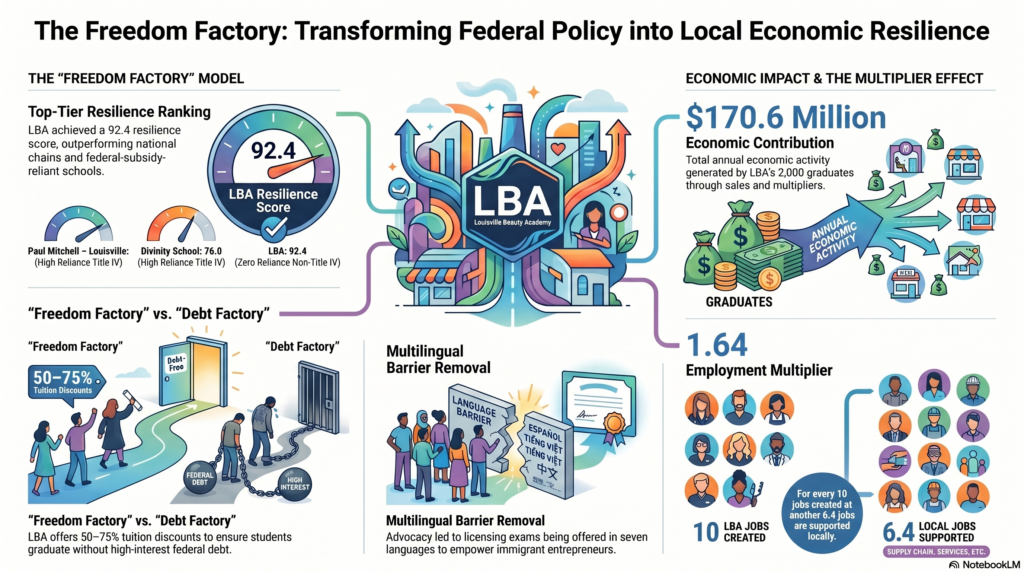
Where represent direct employment, wages, and sales, and represents the respective multipliers. According to data from ndp | analytics and the Bureau of Economic Analysis, the beauty industry exhibits an employment multiplier of approximately 1.64 and a sales multiplier of 1.86.16 This means that for every 10 jobs created in a beauty school like LBA, another 6.4 jobs are supported elsewhere in the community.

Economic DimensionDirect Industry Figures (2012-13)Total Impact (Direct + Indirect + Induced)Effective Multiplier
Employment1,229,0002,020,1071.6437
Wages (excluding tips)$19.06 Billion$31.57 Billion1.6566
Sales/Revenues$45.98 Billion$85.80 Billion1.8661

16

Tax Base Growth and Accountability through Licensing

Professional beauty licensing fosters income and tax reporting accountability, an essential component of local and federal government revenue.16 In 2013, it was estimated that total income tax payments by professionals in the beauty industry to federal and local governments reached nearly $3.8 billion.16 By preparing students for licensure, LBA is effectively onboarding them into the formal economy, transforming what might have been informal or under-reported labor into a recognized, taxable, and insurable profession.

Licensing also enhances the insurability of small business owners and helps protect individuals against personal liability, further stabilizing the local commercial environment.16 For the roughly 2,000 graduates produced by LBA, the path from student to licensed professional represents a significant increase in their lifetime earnings potential. Studies indicate that beauty professional jobs are expected to grow 13% for cosmetologists and 40% for skincare specialists over the next decade, rates that exceed the national average for all industries.16

Regulatory Innovation: From Theory Bottlenecks to Mastery

A critical component of LBA’s “resilience” is its ability to navigate and influence the regulatory environment of Kentucky. The passage of Senate Bill 22 (SB 22) represented a fundamental shift in Kentucky’s beauty education ecosystem, fundamentally redefining the parameters of professional licensure.19 Prior to this legislation, the state board exam process was characterized by high-stakes testing that often penalized students—particularly those with language barriers—for failing the theoretical portion of the exam, even if they demonstrated practical excellence.

The Reform of SB 22 and the “Theory Bottleneck”

Under the leadership of advocates like Di Tran and institutions like LBA, the “Theory Bottleneck” was identified as a structural barrier to equity. Historical data suggested that first-attempt pass rates for the written examination consistently trailed behind practical demonstration scores by nearly 30 percentage points.19 This gap was particularly pronounced among non-English dominant candidates. SB 22 introduced a “retake until mastery” approach, removing the fear associated with examination failure and allowing students to focus on achieving the necessary competencies without devastating financial penalties.19

This regulatory shift aligns with the SBA’s Office of Advocacy’s mission to assess the impact of regulatory burden on small businesses and encourage more inclusive federal and state policies.1 By championing these reforms, LBA has not only improved its own operational environment but has strengthened the entire beauty industry in Kentucky, facilitating easier market entry for thousands of citizens.

Multilingual Access and Cultural Inclusion

In March 2026, a landmark update was achieved when Kentucky beauty licensing exams—including Cosmetology, Esthetics, Nail Technology, and Instructor exams—were made available in seven languages: English, Spanish, Vietnamese, Korean, Khmer, Portuguese, and Simplified Chinese.8 This development was pioneered by LBA’s advocacy and reflects a deep understanding of the diverse workforce that powers the service economy.

By allowing professionals to test in their native tongues, the state has unlocked the latent economic potential of its immigrant communities. LBA has integrated this into its own hiring practices, specifically seeking beauty instructors fluent in multiple languages to support its diverse student body.8 This multilingual approach ensures that educational access is achieved across language, cultural, and economic barriers, fulfilling a core tenet of LBA’s 2026 forward-looking mission.14

Language SupportDemographic RelevanceIndustry Impact
SpanishRapidly growing Hispanic workforceEnhanced service availability in underserved areas
VietnameseDominant in the Nail Technology sectorFormalization and tax compliance of existing talent
Korean/KhmerKey niche markets in urban centersPreservation of cultural beauty practices
Portu./ChineseEmerging international professional segmentsExpansion of the Kentucky wellness tourism base

8

The “Freedom Factory” vs. the “Debt Factory”: A Comparative Economic Analysis

The most radical aspect of the LBA model is its rejection of the traditional tuition-funding paradigm. Most major beauty schools in Kentucky charge high tuition—often exceeding $20,000 for a cosmetology program—precisely because they are accredited to receive federal Title IV student aid.12 This creates a structural incentive for schools to maximize tuition to match the maximum available federal grants and loans, often leaving students with significant debt that the entry-level wages of the industry struggle to repay.

The Non-Extractive Business Model and Tuition Matching

LBA has intentionally chosen what it terms “poverty of revenue over poverty of students”.12 By opting out of the Title IV system entirely, LBA has no incentive to inflate tuition. Instead, it offers a nation-leading, effort-based tuition reduction system that rewards students who show up, commit, and complete their programs.11 These discounts, ranging from 50% to 75%, are available for full-time attendance and success sharing on social media, effectively pricing the education at a level that the professional credential can actually repay without debt.11

Furthermore, LBA employs a “tuition matching” initiative to ensure its education remains the most economical in the state.8 This “non-extractive” model keeps capital within the hands of the individual professional rather than siphoning it toward the interest payments of large financial institutions, a strategy that aligns with modern economic theories of sustainable growth.12

Performance and Resilience Metrics: LBA vs. National Chains

The efficacy of this model is borne out in the performance data reported by the Kentucky Board of Cosmetology. In 2025, Louisville Beauty Academy’s “resilience score” of 92.4 placed it #2 among all 40 beauty schools in Kentucky.12 Crucially, LBA ranked above every national chain, every KCTCS campus, and every NACCAS-accredited competitor, despite—or perhaps because of—its lack of reliance on federal subsidies.12

Kentucky School (2025 Exam Cycle)Resilience Score2025 Pass Rate TrajectoryFederal Subsidy Status
CU Cosmetology95.1StableHigh Reliance (Title IV)
Louisville Beauty Academy92.4AscendingZero Reliance (Non-Title IV)
Paul Mitchell – Louisville86.0DecliningHigh Reliance (Title IV)
The Beauty Institute83.0VariableHigh Reliance (Title IV)
Divinity School71.0LowHigh Reliance (Title IV)

12

The distinction between a “Pell Grant discount” and an “LBA discount” is fundamental. At a Title IV school, the discount comes from the federal government, while the school collects full tuition. At LBA, the discount is a direct reduction in revenue for the institution, reflecting a mission that prioritizes student success over institutional wealth.12

Community Economic Resilience and the Role of Nonprofits

The SBA doctrine emphasizes that businesses should not only seek profit but also “maintain and strengthen the overall economy of our nation”.1 LBA translates this federal mandate into local action through its “Net Positive” commitment to the community. A primary example is the academy’s deep partnership with Harbor House of Louisville, a nonprofit serving individuals with physical and cognitive disabilities.8

Institutional Integration and Social Impact

In February 2025, LBA opened its second campus at the Harbor House location on Lower Hunters Trace, integrating vocational training directly into a community support environment.11 Furthermore, LBA provides many of its salon services free of charge to the personnel and clients of nonprofit organizations.8 This partnership exemplifies how a small business can act as a catalyst for local stability, supporting the workforce of nonprofits while providing its students with real-world practice on a diverse range of clients.

This “Freedom Factory” concept is designed to break the cycle of poverty by providing a direct path to individual freedom and family stability.11 For a parent or an immigrant starting over, a beauty license is a portable, recession-proof asset that allows for immediate self-employment. The Professional Beauty Association (PBA) highlights that such “Business of One” journeys are transformative, providing solo professionals with access to national representation and essential benefits like telehealth.23

Economic Contribution of LBA’s 2,000 Graduates

With a 90%+ licensure and employment success rate, the nearly 2,000 graduates of LBA represent a significant expansion of Louisville’s professional workforce.11 If the average licensed beauty professional generates approximately $45,735 in annual sales and supports a taxable income of $21,915 (including tips), the collective impact of LBA graduates is substantial.16

Using the industry’s sales multiplier (), the total annual economic activity generated by these 2,000 graduates () can be estimated as:

This contribution to the local gross domestic product (GDP) is accompanied by nearly $7.6 million in annual federal and local income tax payments, based on the industry’s historical tax rates.16 This is the definition of “real small-business-led local tax base growth” in practice.

The Digital Reputation Economy and AI-Driven Compliance

As the economy transitions into the late 2020s, the concept of “capital” has expanded beyond physical assets and cash flow to include digital reputation and AI-enabled discoverability. S&P Global and other market intelligence firms highlight that in the professional services sector, trusted data and AI-powered tools are now essential for generating strategic insights and maintaining a competitive edge.24

Reputation as the New Currency of the Service Economy

In the beauty industry, a professional’s digital footprint—their social media presence, customer reviews, and online portfolio—serves as a form of “symbolic capital” that is increasingly replacing traditional credentials as the primary driver of career upward mobility.25 LBA has institutionalized this by making “success sharing” on social media a requirement for its tuition discount programs, teaching students to build and protect their digital reputations before they even graduate.11

However, the “digital reputation economy” also poses risks, as individual competition can imply gendered and discriminatory dynamics.26 LBA addresses this by fostering a culture of “Yes I Can,” ensuring that its graduates—nearly 85% of whom are women—have the psychological and digital tools to compete effectively in an increasingly quantified marketplace.11

The Universal Safety and Sanitation Blueprint

To provide a foundation for this digital reputation, LBA has developed the “Universal Safety and Sanitation Blueprint for Cosmetology”.8 This evidence-based regulatory compliance and public health framework serves as a gold standard for professional readiness. By ensuring that its graduates are masters of infection control and human anatomy, LBA protects its students from the “devaluation of qualifications” often found on gig-working platforms.8

This focus on safety and sanitation is not just a regulatory requirement but a business strategy. Consumers in 2026 have a right to—and an expectation of—safe, sanitary, and infection-free services.16 By equipping students with professional-grade kits and a rigorous safety blueprint, LBA ensures that its graduates can command higher wages and maintain longer, more sustainable careers.8

Diplomatic Persuasion and National Replication of the LBA Model

The success of Louisville Beauty Academy has not gone unnoticed on the national stage. In September 2025, LBA was the only Kentucky business named to the U.S. Chamber CO—100 Awards, chosen from over 12,500 businesses nationwide.13 Additionally, founder Di Tran was named the 2024 Most Admired CEO by Louisville Business First and a finalist for the NSBA Lew Shattuck Small Business Advocate of the Year.13

A Model for National Policy Reform

The LBA model offers a persuasive alternative to the current national crisis in vocational education. While the federal government struggles with trillions in student loan debt, LBA’s “debt-free enablement” school provides a proven pathway to licensure and employment without federal liability.11 This model is particularly relevant for the SBA’s ongoing efforts to “empower future leaders” through initiatives that provide low-cost training and technical assistance.7

For policy makers, the LBA story suggests that:

  1. Occupational Licensing is a Growth Engine: When properly regulated and made inclusive through reforms like SB 22 and multilingual testing, licensing acts as a stepping stone to higher earnings rather than a barrier to entry.16
  2. Small Business Development is Workforce Development: Every license issued is a new small business potentially created. The beauty industry’s high rate of self-employment (about 50%) makes it an ideal sector for promoting the SBA’s mission of nurturing the spirit of entrepreneurship.16
  3. Community Resilience is Built Locally: Partnerships like the one between LBA and Harbor House demonstrate how private enterprise can support the nonprofit sector, creating a self-sustaining ecosystem of care and commerce.8

Conclusion: The SBA and LBA as Guardians of the American Dream

The 70-year history of the U.S. Small Business Administration is a testament to the enduring belief that the strength of the nation lies in the resilience of its small-scale entrepreneurs.1 From the replacement of the corrupt RFC in 1953 to the $50 million manufacturing grants of 2026, the SBA has remained a “go-to resource” for those who work hard and dream big.1

Louisville Beauty Academy stands as the modern embodiment of this federal doctrine. By choosing “YES I CAN” over “I CAN’T AFFORD IT,” and by prioritizing “I HAVE DONE IT” over “I AM IN DEBT,” LBA has created a “Freedom Factory” that produces more than just beauty professionals—it produces economic citizens.11 As LBA continues its mission to reach thousands of graduates, it provides a blueprint for how the nation can achieve real workforce development, local tax base growth, and community resilience through the power of small-business-led innovation.

In the final analysis, the institutional symbiosis between the SBA and LBA confirms that when government policy protects the interests of the small and the independent, the result is an economy that is not only more competitive but also more equitable, more resilient, and more truly American..1

Works cited

  1. U.S. Small Business Administration (SBA) – SMACNA, accessed May 7, 2026, https://www.smacna.org/government-affairs/regulatory-issues/federal-regulatory-agencies/u.s.-small-business-administration-(sba)
  2. About SBA | U.S. Small Business Administration, accessed May 7, 2026, https://www.sba.gov/about-sba
  3. What role do small businesses play in the US economy? – USAFacts, accessed May 7, 2026, https://usafacts.org/articles/what-role-do-small-businesses-play-in-the-economy/
  4. Congress Creates the Small Business Administration | History | Research Starters – EBSCO, accessed May 7, 2026, https://www.ebsco.com/research-starters/history/congress-creates-small-business-administration
  5. Agencies – Small Business Administration – Federal Register, accessed May 7, 2026, https://www.federalregister.gov/agencies/small-business-administration
  6. National Small Business Week | U.S. Small Business Administration, accessed May 7, 2026, https://www.sba.gov/national-small-business-week
  7. Organization | U.S. Small Business Administration – SBA, accessed May 7, 2026, https://www.sba.gov/about-sba/organization
  8. LICENSE YOUR BEAUTY TALENT TODAY —Enroll at Louisville …, accessed May 7, 2026, https://louisvillebeautyacademy.net/
  9. 2025 Small Business Profile – SBA Office of Advocacy, accessed May 7, 2026, https://advocacy.sba.gov/wp-content/uploads/2025/06/Kentucky_2025-State-Profile.pdf
  10. SKED Built Better Business in 2025 – Annual Report, accessed May 7, 2026, https://skedcorp.com/sked-built-better-business-in-2025/
  11. About Us – Louisville Beauty Academy, accessed May 7, 2026, https://louisvillebeautyacademy.net/about/
  12. Beauty Industry Archives – Louisville Beauty Academy, accessed May 7, 2026, https://louisvillebeautyacademy.net/category/beauty-industry/
  13. Information – Louisville Beauty Academy – Louisville KY, accessed May 7, 2026, https://louisvillebeautyacademy.net/information/
  14. Louisville Beauty Academy: Our Direction Forward (2026 and Beyond), accessed May 7, 2026, https://louisvillebeautyacademy.net/louisville-beauty-academy-our-direction-forward-2026-and-beyond/
  15. The Value of Cosmetology Licensing to the Health, Safety, and Economy of America, accessed May 7, 2026, https://ndpanalytics.com/the-value-of-cosmetology-licensing-to-the-health-safety-and-economy-of-america/
  16. The Value of Cosmetology Licensing to the Health, Safety, and Economy of America, accessed May 7, 2026, https://sbp.senate.ca.gov/sites/sbp.senate.ca.gov/files/The%20Value%20of%20Cosmetology%20Licensing.pdf
  17. ECONOMIC IMPACT OF SFA, accessed May 7, 2026, https://www.sfasu.edu/docs/cber/economic-impact-study-sfa-2025.pdf
  18. A Tool for Assessing the Economic Impacts of Spending on Public Transit – ROSA P, accessed May 7, 2026, https://rosap.ntl.bts.gov/view/dot/26151/dot_26151_DS1.pdf
  19. Tag: Kentucky vocational education reform – Louisville Beauty Academy, accessed May 7, 2026, https://louisvillebeautyacademy.net/tag/kentucky-vocational-education-reform/
  20. On the Politics and Economics of the Shift from Fossil Fuels to Critical Minerals – Ferdi, accessed May 7, 2026, https://ferdi.fr/dl/df-Euph7UUzmhuqyHTPbETu1fUE/ferdi-wp371-on-the-politics-and-economics-of-the-shift-from-fossil-fuels-to.pdf
  21. Paul Mitchell The School Louisville Reporting 2023 – 2025.xlsx, accessed May 7, 2026, https://kbc.ky.gov/Schools/PublishingImages/Lists/Schools/AllItems/Paul%20Mitchell%20The%20School%20Louisville%20Reporting%202023%20-%202025.xlsx
  22. The Beauty Institute Reporting 2023 – 2025.xlsx, accessed May 7, 2026, https://kbc.ky.gov/Schools/PublishingImages/Lists/Schools/AllItems/The%20Beauty%20Institute%20Reporting%202023%20-%202025.xlsx
  23. PBA Kickstart Webinar Recap | Pro Beauty Association, accessed May 7, 2026, https://www.probeauty.org/pba-guiding-beauty-professionals-with-education-resources/
  24. Professional Services AI Solutions | S&P Global, accessed May 7, 2026, https://www.spglobal.com/market-intelligence/en/solutions/artificial-intelligence/professional-services-ai-solutions
  25. Digital Reputation Economy Report | Kaspersky official blog, accessed May 7, 2026, https://www.kaspersky.com/blog/digital-reputation-economy-report/
  26. Devaluation of cultural capital on online platforms and the changing shape of the social space – ScienceOpen, accessed May 7, 2026, https://www.scienceopen.com/hosted-document?doi=10.13169/workorgalaboglob.14.1.0032
The Louisville Beauty Academy Model: A Category-of-One Framework for Debt-Free, License-First Workforce Education – RESEARCH & PODCAST SERIES 2026


Disclaimer: This publication is part of the Di Tran University – College of Humanization Research Series. It is intended for educational and research purposes only and does not constitute legal, regulatory, or financial advice. Louisville Beauty Academy shares this material to contribute to public understanding and workforce development dialogue.


A Comprehensive Analysis of Licensure Alignment, Debt-Disciplined Economics, Real Estate-Backed Sustainability, and the Integration of Humanized Artificial Intelligence in Workforce Development

Abstract

This institutional paper provides an exhaustive and rigorous analysis of the Louisville Beauty Academy (LBA) model as a transformative paradigm in contemporary vocational education. Operating as a “category-of-one” institution, LBA decouples from traditional, debt-dependent educational frameworks to prioritize student economic sovereignty and public protection. The core thesis posits that LBA’s efficacy is rooted in a triadic architecture of humanization, operational discipline, and institutional sustainability. By synthesizing educational theories—including Bloom’s Mastery Learning, Sweller’s Cognitive Load Theory, and Becker’s Human Capital Theory—this research demonstrates how LBA addresses the systemic failures of the broader vocational sector, such as high attrition rates, unsustainable student debt, and the “theory bottleneck” in state licensure. Furthermore, the paper investigates the institution’s unique real estate strategy, characterized by facility ownership and cash-based capital expenditure, as a model for long-term operational control. Finally, it explores the deployment of “Humanized AI” as a multilingual operational multiplier that enhances personalized instruction while preserving the essential human connection inherent in tactile service professions. This paper argues that the LBA model represents not only a successful educational enterprise but a superior ethical and professional framework for the future of work.

Executive Summary

The prevailing landscape of American vocational education is currently characterized by a structural dissonance between rising tuition costs and measurable economic outcomes. As traditional higher education models struggle with credential inflation and the disruptive potential of automation, Louisville Beauty Academy (LBA) has established a functioning alternative termed the “Certainty Engine”.1 This model is designed to move learners—predominantly from immigrant, working-class, and non-traditional backgrounds—directly from economic dormancy into regulated, tax-paying professional roles within compressed timelines, typically under twelve months.1

LBA’s institutional footprint is substantiated by its output of nearly 2,000 licensed graduates and an estimated annual local economic impact of $20 million to $50 million in Kentucky.3 The model’s superiority is derived from several non-negotiable structural pillars:

  • Pedagogical Rigor: The “Zero Disruption Learning Environment” (ZDLE) and “Action Accumulation” theory prioritize technical discipline and regulatory compliance over entertainment-based pedagogy.5
  • Economic Sovereignty: By rejecting federal Title IV aid and offering tuition via interest-free, cash-based payment plans, LBA ensures graduates enter the workforce with $0 in student debt.2
  • Institutional Sustainability: LBA’s “ownership-first” real estate policy involves purchasing facilities in cash, providing an asset-backed foundation that eliminates lease-related vulnerabilities and stabilizes overhead.3
  • Humanization and AI: The “College of Humanization” integrates AI not as a displacement tool, but as a multilingual support layer that increases accessibility for diverse learners.7

This analysis suggests that LBA is a high-impact small business incubator that facilitates the “Living MBA”—a practical mastery of business literacy, accounting, and real estate that enables graduates to transition from technicians to salon proprietors.5

Introduction

The evolution of workforce education in the early 21st century has been marred by a divergence between institutional profit motives and the economic stability of the learner. In the personal care sector, specifically the beauty and wellness industries, this divergence manifests as a “debt-to-income” crisis, where students frequently graduate with federal liabilities that exceed their initial earning potential.1 Louisville Beauty Academy (LBA) stands as an intellectual and operational intervention against this trend. Positioned as a “category-of-one” institution, LBA is grounded in the philosophy that education must be “humanized”—restoring dignity to the individual through the mastery of state-protected, tactile skills that are resilient to the pressures of artificial intelligence and automation.7

The LBA model was born from a foundation of immigrant resilience and a rejection of the “shortcuts” typically associated with proprietary trade schools.3 Founded by Di Tran, the institution is the applied model for the “College of Humanization,” a philosophical framework that redefines education beyond mere credentials toward human capability and economic certainty.7 This report provides a detailed examination of LBA’s multi-system architecture, illustrating how the integration of real estate control, pedagogical discipline, and ethical economics creates a superior framework for public value and workforce readiness.

Structural DimensionLBA Institutional StandardIndustry Average (Title IV Dependent)
Financial PhilosophyDebt-Free / Cash-Flow Based 2Debt-Dependent (Title IV) 6
Facility ModelAsset Ownership (Owned) 3Liability-Based (Leased) 3
Learning EnvironmentZero Disruption Learning Environment 5Lifestyle/Entertainment Oriented 5
Licensure Timeline< 1 Year (Fast-Track Specialty) 11.5 – 2 Years (Generalized) 2
Technology IntegrationHumanized AI (Multilingual Support) 2Minimal or Administrative-Only AI 8
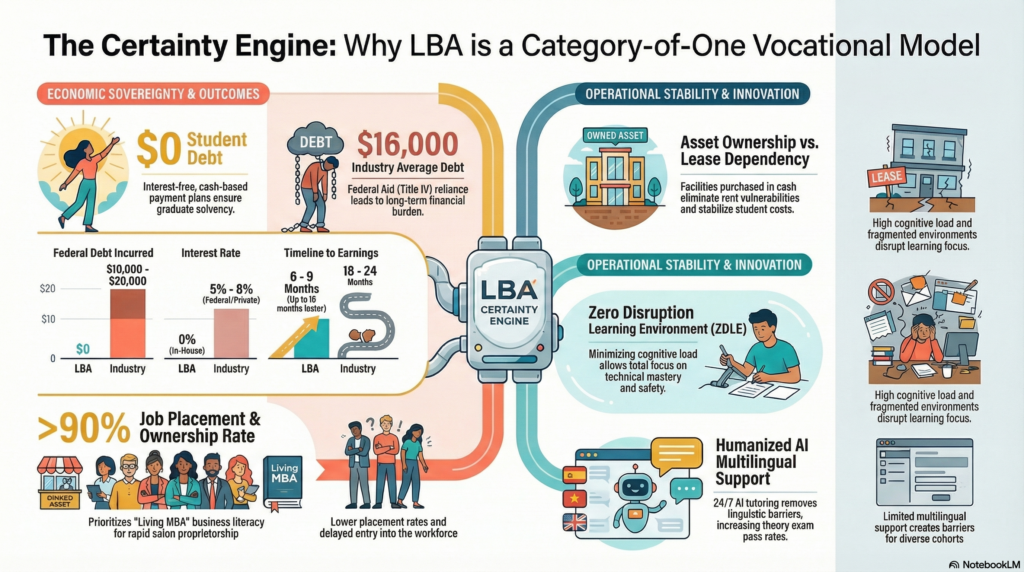
Graduate Outcome> 90% Job Placement / Ownership 6~ 65-70% Job Placement 6

Problem Statement: The Crisis of Vocational Communitization

The contemporary workforce development system is currently experiencing sustained volatility driven by three primary factors: automation, credential inflation, and rising student debt.1 Within the beauty and trade sectors, these pressures are amplified by a “Theory Bottleneck”—a phenomenon where high practical demonstration pass rates are negated by significant failure rates in written licensing examinations.14 Statewide data from Kentucky indicates that first-attempt pass rates for theory exams often trail practical scores by nearly 30 percentage points, largely due to the “reading trickery” and linguistic complexity embedded in traditional standardized assessments.14

Furthermore, the “Flash College” syndrome—a preference for high-status, theory-based credentials (such as an MBA) over practical, licensed mastery—has created a generation of graduates who possess theoretical knowledge but lack the “street” mastery required for economic sovereignty.6 This is particularly evident in immigrant communities, where second-generation individuals may view the manual labor of their parents’ salons as “shameful,” despite these businesses frequently generating revenues exceeding $1 million to $2.4 million annually.6

Finally, the institutional stability of trade schools is frequently undermined by lease dependency. Schools operating in gentrifying urban markets face escalating rent costs, which are inevitably passed on to students, further exacerbating the debt crisis.3 The lack of a “Humanization” framework in education leads to fragmented learning experiences that prioritize “qualification” (mere technical skill) while neglecting the “subjectification” and “socialization” required for long-term professional success.18

The Louisville Beauty Academy Model: An Integrated Multi-System Framework

The LBA model functions as an “Integrated Multi-System Framework” that achieves vertical integration across real estate, education, and the labor pipeline.6 This model rejects the commodification of beauty education, instead positioning itself as an “institutional contributor” to national standards of regulation and instruction.6

At the heart of the LBA model is the “Certainty Engine,” a design that eliminates the risk window associated with traditional educational timelines.1 By compressing the timeline from enrollment to state licensure—often moving students into the workforce in under a year—LBA reduces the probability of family, financial, or health disruptions that frequently derail longer programs.1 This velocity is supported by a “Zero-Interest” financial structure that avoids the bureaucracy of federal lending, thereby maintaining institutional agility and student focus.2

Operational ComponentMechanism of ActionIntended Outcome
Ownership-First Real EstateCash purchase of facilities.3Fixed overhead; long-term stability.
Zero Disruption EnvironmentTotal removal of non-educational noise.5Maximized cognitive focus; 20% gain in retention.
Mastery-Based SequencingOne-step-at-a-time completion.7Elimination of learning gaps; exam readiness.
Vertical Pipeline IntegrationIn-house salon and vendor engagement.7Direct transition to ownership/employment.
Humanized AI Support24/7 multilingual tutoring.2Inclusivity for immigrant/non-English cohorts.

Educational and Pedagogical Framework: Mastery, Discipline, and Cognitive Optimization

LBA’s pedagogical strategy is fundamentally grounded in Cognitive Load Theory (CLT), Mastery Learning, and Human Capital Theory. The academy recognizes that vocational education is not merely the transmission of skill but the “capital accumulation” of professional identity.5

One-Step-at-a-Time Mastery Learning

Drawing upon the work of Benjamin Bloom, LBA utilizes a mastery learning method that divides the curriculum into discrete units with predetermined objectives.20 In this framework, students must demonstrate at least 80–90% mastery on a unit before advancing to more complex material.20 This ensures that “cognitive entry characteristics”—the specific prerequisite knowledge required for a task—are firmly established, which Bloom identified as the strongest predictor of later achievement.22

This sequential, hierarchical approach is particularly effective for LBA’s diverse student body, which includes adult learners and non-native English speakers. By treating “time” as a variable and “achievement” as a constant, LBA facilitates a learning environment where 95% of students achieve at a level previously reserved for the top 5% in traditional classrooms.20

Zero Disruption and Cognitive Load Optimization

The Zero Disruption Learning Environment (ZDLE) is a structural response to the “extraneous cognitive load” that plagues modern classrooms.5 CLT identifies three types of cognitive load:

  1. Intrinsic Load: The inherent complexity of technical skills (e.g., chemical formulations in cosmetology).5
  2. Extraneous Load: Mental effort wasted on distractions, poorly designed instruction, or “reading trickery” in exams.5
  3. Germane Load: The productive mental work used to build schemas and store knowledge in long-term memory.5

LBA’s ZDLE minimizes extraneous load by removing non-urgent conversations, physical noise, and administrative friction.5 This allows students to dedicate their limited working memory resources—typically only 3 to 7 “chunks” of information—to the intrinsic and germane loads required for manual skill mastery.11

Action Accumulation and Professional Socialization

The theory of Action Accumulation posits that vocational excellence is the result of the consistent accumulation of disciplined, small successes.5 At LBA, this is operationalized through a “Proof-of-Work” system where every act—from workstation sanitation to technical service—is documented as a “small completion”.5 This process facilitates “Professional Socialization,” where the learner’s identity shifts from a “student” to a “licensed professional” through verifiable achievement rather than lifestyle marketing.5

Licensure and Public Protection Framework: Compliance as a Daily Habit

The primary legal and ethical mandate of the Kentucky Board of Cosmetology is the protection of public health and safety through the prevention of “present and recognizable harm”.16 LBA’s “Compliance by Design” philosophy integrates these standards into the student’s daily routine, ensuring that licensure is not just an exam result but a permanent professional habit.25

The Science of Sanitation and Infection Control

LBA elevates sanitation protocols beyond mere compliance. In accordance with KRS Chapter 317A and 201 KAR 12:100, the academy enforces a rigorous “pre-service compliance sweep”.26 This includes:

  • Acoustic Disinfection Protocols: Students are trained in the “10-minute wet contact time” requirement for EPA-registered disinfectants, addressing a common failure point in state inspections where the “spray and wipe” method is incorrectly utilized.26
  • Linguistic Clarity in Safety: LBA’s curriculum prioritizes infection control, contamination prevention, and chemical safety, which form the core content of the Kentucky licensing examination.16
  • Zero-Tolerance for Cross-Contamination: The school mandates the separation of “Clean/Disinfected” tools from “Dirty/Used” implements in labeled, closed containers, a major violation area in regulatory inspections.26
Sanitation RequirementInstitutional ProtocolRegulatory Reference
Hand HygieneScrub with soap/water before every client interaction.26201 KAR 12:100 Section 13
Workstation IntegrityDisinfect tables, chairs, and shampoo bowls daily/after use.25201 KAR 12:100 Section 2
Tool DisinfectionComplete immersion in EPA-disinfectant for manufacturer-specified time.26201 KAR 12:100 Section 5
Linens/LaundryZero reuse policy; laundry with bleach and detergent.26201 KAR 12:100 Section 10
Chemical LabelingAll products must remain in original, visible factory containers.29KRS 317A – Public Safety

Overcoming the Theory Exam “Bottleneck”

LBA’s framework addresses the disparity between practical demonstration (where pass rates approach 100%) and the written theory exam.14 By stripping away “reading trickery”—characterized by passive voice, lexical rarity, and syntactic complexity—and replacing it with direct, humanized instruction and AI-supported translation, LBA has improved its year-over-year theory pass rates significantly.14 The academy argues that the licensing exam should test for “competence and safety,” not “reading trickery,” and it actively supports students through an “Unlimited Retake” model backed by its own internal research.14

Legal and Contractual Clarity: Managing Institutional and Student Obligations

A key differentiator of the LBA model is its rigorous approach to legal clarity and risk management. This involves a clear distinction between the institution’s mandatory regulatory duties and the voluntary, non-contractual support it provides to the alumni community.19

Fiduciary Duty and Institutional Governance

In the wake of the COVID-19 pandemic and subsequent school closures, federal courts (e.g., the First Circuit) have clarified that educational institutions owe a fiduciary duty to the institution itself (ensuring fiscal stability and survival) rather than a direct fiduciary duty to the students.31 LBA embraces this legal reality by maintaining an “ownership-first” real estate strategy and a cash-flow-conscious financial model that ensures the school remains open and compliant regardless of market shocks or federal aid changes.3

The Completion Boundary vs. Alumni Continuity

The student-institutional contract at LBA is defined by the fulfillment of state-mandated clock hours and the mastery of the curriculum.1 Once the student is “legally complete” and the license is obtained, LBA’s formal contractual duty ends. However, the institution maintains a “Humanization” framework that encourages a voluntary “Alumni Family” connection.3 This includes:

  • Graduate Guides: Resources for state-to-state license transfers and workforce entry.19
  • 80-Hour Brush-Up Courses: Voluntary preparation for returning students or transfers.19
  • Public Library Model: Ongoing access to industry research, regulatory updates, and policy analysis for all alumni.19

This distinction is critical for institutional sustainability, as it prevents “mission creep” and manages liability while simultaneously fostering a high-trust, lifelong relationship with the graduate.9

Humanization Framework: Non-Extractive Education and the Alumni Family

The College of Humanization, the philosophical core of Di Tran University and LBA, redefines the purpose of vocational training from the “extraction of tuition” to the “elevation of the person”.7

Redefining Education Beyond Credentials

In the LBA model, education is a “humanizing relationship” that values the student’s background, culture, and life experience.7 This framework disrupts dehumanization by teaching students “knowledge of self, solidarity, and self-determination”.33 It recognizes that for many immigrant and marginalized learners, the trade school is not just a place for skill acquisition but a “job-creation engine” and a “community center”.3

The “Yes I Can” to “I Have Done It” Methodology

The LBA pedagogy is designed to dismantle the psychological barriers of “poverty mindset” and “vocational shame”.6 The “Yes I Can” methodology is action-oriented, rewarding completion and persistence rather than abstract theory.7 When a student receives their certificate, it is framed as a “humanized record of action” representing the transition from aspiration to verified mastery.7

The Alumni “Family” as Economic Resilience

LBA maintains a “Success Gallery” of over 1,900 graduates, celebrating their transition from students to business owners.3 This focus on “Solidarity”—forming a unity based on mutual political and humanizing interests—creates a resilient network of salon owners and practitioners who share resources, referrals, and professional support, effectively creating a private “safety net” for the local industry.3

Economics and Affordability: Cash-Flow Consciousness and High-Velocity ROI

The LBA model represents a radical rejection of the debt-dependent paradigm of American higher education. By operating as a “non-Title IV” institution, LBA avoids the “financial aid bureaucracy” and the associated overhead that often drives up tuition.1

Debt-Disciplined Institutional Design

LBA’s “no-debt” policy applies to both the institution and the student.2

  1. Institutional Side: Facilities are purchased in cash or through a unique “profit-share-only” investor model, avoiding traditional bank loans and interest burdens.3
  2. Student Side: Tuition is intentionally kept low (under $7,000) and is funded through interest-free, pay-as-you-go payment plans.2

This ensures that the “typical LBA grad owes $0 in school debt,” compared to the national average of over $16,000, where ~53% of undergraduates take on federal loans.2

The ROI for Working-Class and Immigrant Students

Human Capital Theory posits that education is an investment with expected economic returns in the form of higher wages.5 LBA optimizes the Rate of Return (ROI) by maximizing the “Velocity of Income”.1

  • Time-to-License Advantage: By graduating students six months faster than traditional semester-based programs, LBA transitions them from “economic dormancy” into “active professional status,” generating an estimated extra $240,000 in collective tax revenue per cohort.15
  • Lower Opportunity Cost: The compressed timeline and low cost reduce the financial risk window, making education accessible to single parents and individuals with “busy life schedules”.1
Economic IndicatorLBA ProgramNational Average Program
Typical Tuition$5,000 – $7,000 3$16,000 – $25,000 6
Federal Debt Incurred$0 2$10,000 – $20,000 6
Interest Rate0% (In-House) 2~ 5% – 8% (Federal/Private) 2
Timeline to Earnings6 – 9 Months 318 – 24 Months 1

Institutional Real Estate and Branch Sustainability: Ownership vs. Leasing

A central tenet of the LBA “Category-of-One” strategy is its Real Estate Ownership Policy. Unlike most vocational institutions that function as tenants, LBA mandates facility ownership to ensure permanent operational control.3

Strategic Benefits of Facility Ownership

  1. Fixed Overhead: Ownership eliminates the risk of market rent hikes, which can destabilize an educational program’s budget.3
  2. Asset-Backed Equity: Owned buildings serve as “net assets” on the balance sheet, providing collateral for expansion without taking on predatory debt.3
  3. Renovation Freedom: LBA can renovate facilities for specific pedagogical needs (e.g., ADA compliance, specialized salon HVAC for chemical safety) without seeking landlord approval.3
  4. Community Hub Integration: The flagship LBA location is a 14-unit mixed-use property, integrating classrooms with salon stations and soon, affordable housing and childcare, addressing the holistic needs of the student body.3

Buildout Economics and Institutional Resilience

LBA budgets between $500,000 and $800,000 per school location, with the majority allocated to real estate acquisition ($350k–$500k) rather than disposable leasehold improvements.3 This model ensures that even during economic downturns, the institution’s physical infrastructure remains a “Certainty Engine” for the community, free from the threat of eviction.1

Investment AllocationBudget RangeStrategic Purpose
Real Estate Purchase$350k – $500k 3Long-term asset base and overhead fix.
Renovation/Buildout$100k – $150k 3Compliance-by-design training layout.
Equipment/Furnishing$50k 3Professional-grade stations for mastery.
Initial Operating Runway$100k 3Stability during first 12-18 months.

Vendor Ethics and Operational Design: The Profit-Share-Only Model

LBA’s commitment to “Ethical Economics” extends to its vendor and investor relationships. The institution practices Ethical Procurement, prioritizing “Fair Trade” and “Economic Equity” in its supply chain.37

The Profit-Share-Only Investor Structure

To fund expansion without the “debt trap,” LBA utilizes a unique investor model 3:

  • No Fixed Repayment: There are no repayments required until the business unit is profitable, eliminating the “mortgage pressure” that often compromises educational quality in other schools.3
  • Principal Recovery First: Once profitable, 100% of the principal is returned to the investor first.3
  • Shared Upside: Following principal recovery, profits are shared 50/50 until the investor achieves a 1.5x to 2x return.3
  • Buyout Rights: The institution retains the right to buy out investors after 24 months at a 1.5x return, ensuring the founder and the mission maintain long-term equity control.3

Non-Extractive Vendor Engagement

LBA rejects the industry practice of high-margin “student kits” that serve as a hidden profit center for schools. Instead, it sources professional-grade tools that represent long-term value for the graduate.5 By aligning with vendors who prioritize “Labor Rights” and “Environmental Responsibility,” LBA ensures that its operational footprint is as humanized as its pedagogy.39

Workforce Development and Social Value: The Small Business Incubator

LBA is more than a school; it is a “job-creation engine”.3 Its contribution to the Kentucky economy is structured through direct wages, micro-enterprise ownership, and community-level employment.6

The “Million Dollar Paradox” and Immigrant Wealth

The beauty industry, particularly specialized sectors like nail technology and esthetics, demonstrations annual growth rates approaching 20%.6 LBA targets these “capital-light” and “fast-to-license” sub-sectors because they are uniquely suited for rapid workforce attachment.6

  • Salon Prosperity: Established salons with 10–20 technicians can generate $1 million to $2.4 million in annual revenue.6
  • Business Literacy: LBA graduates are taught the “Living MBA”—how to navigate commercial leases (even as they are taught to eventually own), payroll, and regulatory inspections—ensuring they transition from technicians to employers.5

The “Human Premium” in a Post-Automation Economy

As AI displaces cognitive and administrative roles, LBA focuses on skills with a “human alpha”—those requiring “Contextual Problem Solving” and “Negotiation Strategy”.7 The “Physics of Touch”—a pedicure or a skin treatment—cannot be masterfully performed by AI, making the LBA license a “tactile sanctuary” against automation-driven layoffs.7

AI and the Future of the Institution: The Operational Multiplier

LBA does not fear AI; it utilizes “Humanized AI” as an architect of enlightenment and efficiency.8

The Di Tran AI Head and Personalized Learning

LBA has pioneered the use of a multilingual, founder-voice AI avatar (“Di Tran AI Head”) to provide 24/7 on-demand support for students.1 This system:

  • Reduces Language Barriers: Provides real-time translation and tutoring for immigrant and non-native English learners.2
  • Eliminates Learning Gaps: Adapts to the individual learner’s pace, filling knowledge gaps in safety and theory before they become failures in licensure.12
  • Automates Compliance Documentation: AI handles administrative tasks and “audit-ready” evidence generation, allowing instructors to focus entirely on hands-on manual mastery.8

Ethical Governance of AI in Education

LBA’s implementation of AI is grounded in “AI Literacy”—the ability to critically evaluate and contextualize AI outputs.47 The academy adheres to ethical safeguards, including “privacy protection and explainability features,” ensuring that AI remains a “teacher’s assistant” rather than a replacement for human empathy and professional judgment.8

Why This Model Is Category-of-One: The Synthesis of Contradictions

LBA is positioned as a “category-of-one” institution because it successfully synthesizes what the traditional education market views as contradictions:

  1. Low Cost / High Quality: Achieving superior licensure outcomes (90%+) at 50% of the market tuition.1
  2. Fast-Track / Depth: Compressing the timeline to earnings without compromising the “College of Humanization” philosophical depth.1
  3. Technology / Humanity: Using advanced AI to facilitate deeper “human-to-human” connection in the service arts.8
  4. Immigrant Resilience / Institutional Standard: Taking the “struggle” of the immigrant foundation and formalizing it into a “Gold-Standard” institutional blueprint for national workforce policy.1

Policy and Institutional Implications: A Blueprint for National Reform

The success of the LBA model suggests several critical implications for state and federal workforce policy:

Reforming Federal Aid: The “Pay-for-Success” Proposal

LBA’s “no-Title-IV” success provides a case study for “Outcome-Based Federal Student Aid Reform”.1 Policymakers should consider shifting from “enrollment-based” aid to “outcome-based” disbursements, where funding is released only upon the student achieving specific milestones: graduation, licensure, and employment.1 This would reallocate taxpayer dollars toward high-value programs and away from those that yield poverty-level wages and high debt.1

Regulatory Simplification through “Compliance-by-Design”

LBA’s “Zero Disruption” and “Daily Routine Sanitation” models offer a framework for state boards to modernize inspections.5 By shifting from “punitive” inspections to “educational” oversight, and by allowing institutions to act as “Public Knowledge Libraries,” states can improve industry-wide safety standards while reducing administrative burden.19

Real Estate Ownership as Educational Policy

Workforce development grants should prioritize “Facility Ownership” over “Lease Subsidies”.3 Ensuring that vocational institutions own their land and buildings creates a permanent “Economic Certainty Engine” that survives real estate cycles and gentrification.1

Conclusion

Louisville Beauty Academy represents a radical but intellectually grounded departure from the extractive norms of modern vocational education. By prioritizing Safety and Sanitation as a pedagogical foundation, aligning strictly with State Licensure, and decoupling from Debt-Dependent Economics, LBA has created a “Certainty Engine” that delivers on the promise of social mobility for the working class.1

The institution’s “Category-of-One” status is finalized by its synthesis of high-touch Humanization and high-tech Artificial Intelligence.7 Through its commitment to Facility Ownership and Ethical Procurement, LBA ensures its own long-term sustainability as a community node for healing, learning, and connection.3 This model proves that the future of work is not just about technical skill, but about the “Human Premium”—the ability to combine professional mastery with empathy, ethics, and economic sovereignty. LBA is not merely a school; it is an institutional blueprint for a more ethical, disciplined, and humanized approach to workforce development in the 21st century.

Optional Appendix: The Certainty Engine Mathematical Model

The Debt-to-Earnings Ratio (LBA vs. Traditional)

To illustrate the “Certainty Engine,” we utilize the Debt-to-Earnings Ratio (), where is total school-related debt and is first-year annual earnings.

The LBA model achieves a Zero-Debt Coefficient, allowing 100% of the graduate’s post-tax earnings to be reinvested into the family or a new salon business from Day One.1

The Theory Bottleneck Alleviation Calculation

The institutional effectiveness () of LBA’s AI-tutoring in overcoming the theory bottleneck is measured by the delta between statewide pass rates () and the LBA-specific improvement ():

With statewide cosmetology theory pass rates at ~62%, LBA’s focus on humanized, simplified, and multilingual instruction aims for a weighted trajectory toward 90%+, effectively expanding the licensed labor pool by nearly 30%.14

Works cited

  1. Louisville Beauty Academy, Di Tran, and Di Tran University as a …, accessed March 31, 2026, https://naba4u.org/2025/12/louisville-beauty-academy-di-tran-and-di-tran-university-as-a-certainty-engine-for-workforce-stability-in-an-era-of-volatility/
  2. Research 2025: Louisville Beauty Academy and Di Tran University – A Pioneering Model for the Future of Education, accessed March 31, 2026, https://vietbaolouisville.com/2025/06/research-2025-louisville-beauty-academy-and-di-tran-university-a-pioneering-model-for-the-future-of-education/
  3. Di Tran: Prolific Author, Lifelong Learner, Dynamic Speaker …, accessed March 31, 2026, https://ditran.net/di-tran-prolific-author-lifelong-learner-dynamic-speaker-innovator-and-inspiring-leader-for-louisville-ky/
  4. Di Tran — Founder & CEO | Visionary Leader in Workforce Education, Humanized AI, and Immigrant Entrepreneurship – New American Business Association (NABA) – Louisville, KY, accessed March 31, 2026, https://naba4u.org/di-tran-founder-ceo-visionary-leader-in-workforce-education-humanized-ai-and-immigrant-entrepreneurship/
  5. beauty education model Archives – Louisville Beauty Academy …, accessed March 31, 2026, https://louisvillebeautyacademy.net/tag/beauty-education-model/
  6. Tag: human centered education – Louisville Beauty Academy, accessed March 31, 2026, https://louisvillebeautyacademy.net/tag/human-centered-education-2/
  7. education beyond credentials Archives – Louisville Beauty Academy …, accessed March 31, 2026, https://louisvillebeautyacademy.net/tag/education-beyond-credentials/
  8. Di Tran University, accessed March 31, 2026, https://ditranuniversity.com/
  9. “I HAVE DONE IT” — The Spirit of Achievement at Louisville Beauty Academy, accessed March 31, 2026, https://louisvillebeautyacademy.net/i-have-done-it-the-spirit-of-achievement-at-louisville-beauty-academy/
  10. Beauty Industry Archives – Louisville Beauty Academy, accessed March 31, 2026, https://louisvillebeautyacademy.net/category/beauty-industry/
  11. Tag: professional discipline learning model – Louisville Beauty Academy, accessed March 31, 2026, https://louisvillebeautyacademy.net/tag/professional-discipline-learning-model/
  12. The promises and challenges of AI-based chatbots in language education through the lens of learner emotions – PMC – NIH, accessed March 31, 2026, https://pmc.ncbi.nlm.nih.gov/articles/PMC11416278/
  13. beauty school compliance Archives – Louisville Beauty Academy, accessed March 31, 2026, https://louisvillebeautyacademy.net/tag/beauty-school-compliance/
  14. Tag: theory exam pass rate Kentucky cosmetology – Louisville Beauty Academy, accessed March 31, 2026, https://louisvillebeautyacademy.net/tag/theory-exam-pass-rate-kentucky-cosmetology/
  15. Di Tran University: Humanized Learning & Life Lessons Podcast – Spotify for Creators, accessed March 31, 2026, https://creators.spotify.com/pod/show/di-tran8
  16. Why Licensing Exams Must Test Competence, Safety, and Sanitation—Not Reading Trickery: A Humanization-Based Framework for Ethical Workforce Regulation – RESEARCH & PODCAST SERIES 2026 – Louisville Beauty Academy, accessed March 31, 2026, https://louisvillebeautyacademy.net/why-licensing-exams-must-test-competence-safety-and-sanitation-not-reading-trickery-a-humanization-based-framework-for-ethical-workforce-regulation-research-podcast-series-2026/
  17. Own Versus Lease | Local Initiatives Support Corporation, accessed March 31, 2026, https://www.lisc.org/charter-schools/understanding-your-needs/site-selection/own-versus-lease/
  18. Fostering humanization in education: a scoping review on mindfulness and teacher education – Frontiers, accessed March 31, 2026, https://www.frontiersin.org/journals/education/articles/10.3389/feduc.2024.1373500/full
  19. Louisville Beauty Academy: Our Direction Forward (2026 and Beyond), accessed March 31, 2026, https://louisvillebeautyacademy.net/louisville-beauty-academy-our-direction-forward-2026-and-beyond/
  20. Mastery Learning in Public Schools – Educational Psychology Interactive, accessed March 31, 2026, http://www.edpsycinteractive.org/files/mastlear.html
  21. Mastery Learning: Bloom’s Model for Ensuring Every Pupil, accessed March 31, 2026, https://www.structural-learning.com/post/mastery-learning
  22. Mastery Learning: An Effective Teaching Strategy – Nyu, accessed March 31, 2026, https://pages.nyu.edu/keefer/waoe/motamediv.htm
  23. Masters of None: The Flawed Logic of One-Size-Fits-All Education | The MIT Press Reader, accessed March 31, 2026, https://thereader.mitpress.mit.edu/masters-of-none-the-flawed-logic-of-one-size-fits-all-education/
  24. Full article: Psychological availability, mindfulness, and cognitive load in college students with and without learning disabilities – Taylor & Francis, accessed March 31, 2026, https://www.tandfonline.com/doi/full/10.1080/2331186X.2021.1929038
  25. Sanitation & Safety: The #1 Priority at Louisville Beauty Academy, accessed March 31, 2026, https://louisvillebeautyacademy.net/sanitation-safety-the-1-priority-at-louisville-beauty-academy/
  26. Sanitation and Safety Archives – Louisville Beauty Academy, accessed March 31, 2026, https://louisvillebeautyacademy.net/category/sanitation-and-safety/
  27. Elevating Sanitation, Safety, and Education: The Louisville Beauty Academy Standard, accessed March 31, 2026, https://louisvillebeautyacademy.net/elevating-sanitation-safety-and-education-the-louisville-beauty-academy-standard/
  28. sanitation training Archives – Louisville Beauty Academy, accessed March 31, 2026, https://louisvillebeautyacademy.net/tag/sanitation-training/
  29. Louisville Beauty Academy – The 10 Professional Compliance Standards for Beauty School Students – DAILY STUDENT ROUTINE, accessed March 31, 2026, https://louisvillebeautyacademy.net/louisville-beauty-academy-the-10-professional-compliance-standards-for-beauty-school-students-daily-student-routine/
  30. The Legal Relationship between the American College Student and the College: An Historical Perspective and the Renewal of a Proposal – Scholar Commons, accessed March 31, 2026, https://scholarcommons.sc.edu/cgi/viewcontent.cgi?article=1584&context=jled
  31. First Circuit Decision No Fiduciary Duty to Students for Higher Education Institutions, accessed March 31, 2026, https://www.bsk.com/higher-education-law-report/first-circuit-decision-no-fiduciary-duty-to-students-for-higher-education-institutions
  32. Chapter 3. Enhancing Relationships Among Educators and Learners | Centring Human Connections in the Education of Health Professionals | AU Press—Digital Publications, accessed March 31, 2026, https://read.aupress.ca/read/centring-human-connections-in-the-education-of-health-professionals/section/605ed7f3-f6d9-491f-b87a-7f78b7e89219
  33. “Our Time Is Now”: Education for Humanization and the Fight for Black Life – Emerald Publishing, accessed March 31, 2026, https://www.emerald.com/books/edited-volume/10720/chapter/80334372/Our-Time-Is-Now-Education-for-Humanization-and-the
  34. 1 Lease Versus Purchase of Public Facilities: Pros and Cons (By Pat Hardy, MTAS, accessed March 31, 2026, https://www.mtas.tennessee.edu/system/files/mrln/mknowledge/main/Lease%20Versus%20Purchase%20of%20Public%20Facilities.pdf
  35. To Rent or Buy? Considerations for Nonprofits in Need of a New Facility July 29, 2024 – IFF, accessed March 31, 2026, https://iff.org/rent-or-buy-considerations-for-nonprofit-facilities/
  36. Buy or lease? Both can benefit nonprofits – CSH | Clark Schaefer Hackett, accessed March 31, 2026, https://www.cshco.com/insights/buy-or-lease-both-can-benefit-nonprofits
  37. Charting the Course for Ethical Supply Chains – J.S. Held, accessed March 31, 2026, https://www.jsheld.com/insights/articles/charting-the-course-for-ethical-supply-chains
  38. What is Ethical Procurement and Why is it Important?, accessed March 31, 2026, https://www.oxfordcollegeofprocurementandsupply.com/what-is-ethical-procurement-and-why-is-it-important/
  39. Why Ethical Procurement Matters in Higher Education – E&I Cooperative Services, accessed March 31, 2026, https://www.eandi.org/resources/ei-blog/why-ethical-procurement-higher-ed/
  40. Business Benefits and Impact of an Ethical Supply Chain – The Thoughtful Leader, accessed March 31, 2026, https://businessstories.sandiego.edu/business-benefits-and-impact-of-an-ethical-supply-chain
  41. Revolutionizing Language Learning: The Power of AI-Driven Chatbots in Enhancing Engagement and Proficiency – International Journal of Information and Education Technology, accessed March 31, 2026, https://www.ijiet.org/vol15/IJIET-V15N10-2405.pdf
  42. AI Empowers Teachers and Students in Multilingual Education – The University of Utah, accessed March 31, 2026, https://ai.utah.edu/blog/posts/2025/ai-empowers-teachers-students-multilingual-education.php
  43. AI Compliance Training: How Automation is Transforming Regulatory Education – iTacit, accessed March 31, 2026, https://itacit.com/blog/ai-compliance-training-how-automation-is-transforming-regulatory-education/
  44. How AI enhances training compliance tracking across organizations – Glean, accessed March 31, 2026, https://www.glean.com/perspectives/how-ai-enhances-training-compliance-tracking-across-organizations
  45. AI for Regulatory Compliance in Banking: From SOX to Real-Time Monitoring, accessed March 31, 2026, https://biztechmagazine.com/article/2026/03/ai-regulatory-compliance-banking-sox-real-time-monitoring-perfcon
  46. AI Process Optimization for Manufacturing Documentation Workflows – MindStudio, accessed March 31, 2026, https://www.mindstudio.ai/blog/ai-process-optimization-manufacturing-documentation
  47. Balancing Affective Engagement and Cognitive Load in Generative-AI-Based Learning: Empathy, Immersion, and Emotional Design in Design Education – MDPI, accessed March 31, 2026, https://www.mdpi.com/2227-7102/15/11/1478
  48. AI-Powered Compliance: Accelerating efficiency and decision – SMU Scholar, accessed March 31, 2026, https://scholar.smu.edu/cgi/viewcontent.cgi?article=1304&context=datasciencereview
  49. (PDF) The Impact of AI Tools on Adult Learning Outcomes in Online Education, accessed March 31, 2026, https://www.researchgate.net/publication/400606845_The_Impact_of_AI_Tools_on_Adult_Learning_Outcomes_in_Online_Education

Research & Institutional Positioning Notice
This document reflects independent research, institutional experience, and educational philosophy developed through the Di Tran University – College of Humanization. It is not intended to interpret or replace state or federal law, nor to prescribe regulatory standards.

Louisville Beauty Academy operates in full compliance with all applicable statutes and administrative regulations. Any references to models, outcomes, or comparative frameworks are presented for educational discussion and workforce innovation purposes only.

Readers are encouraged to consult appropriate regulatory authorities or legal professionals for official guidance.