Educational Research Disclaimer: Louisville Beauty Academy (LBA) is a Kentucky-licensed cosmetology school regulated within the cosmetology profession; barbering in Kentucky is currently governed by a separate licensing board and statutory framework. In some states, barbering and cosmetology are administered together, but in Kentucky they remain distinct. Because policymakers have discussed possible alignment or merger of the two regulatory systems, LBA is sharing this independent research, led by Di Tran University – The College of Humanization, to help students, educators, licensed professionals, and the public better understand the barbering profession and its relationship to cosmetology. This publication is provided solely for education, workforce development, and evidence-based discussion. LBA remains fully committed to teaching and complying with all applicable cosmetology laws, regulations, safety, sanitation, infection-control standards, and ethical practices. This research does not constitute legal advice, regulatory guidance, legislative advocacy, or the official position of any government agency or licensing board.
1. Doctoral Abstract
This doctoral research study conducts a comprehensive administrative, legal, and economic evaluation of the barbering profession in the United States, positioning its operational and regulatory frameworks alongside cosmetology to determine if both sectors face identical structural crises. Utilizing a multi-disciplinary approach drawing upon labor economics, public policy analysis, and administrative law, this study tests several core hypotheses using empirical data from the U.S. Bureau of Labor Statistics, the U.S. Census Bureau, the American Community Survey, the Integrated Postsecondary Education Data System, and state licensing board registries.
The analysis begins with a granular evaluation of Kentucky’s statutory and regulatory environment, tracking the legal mechanics of Kentucky Revised Statutes Chapter 317 and the administrative evolution brought by House Bills 273 and 903 during the 2026 legislative session1. The study compiles a comprehensive 50-state and District of Columbia matrix of training hours, fees, and licensing pathways, identifying extreme outliers and evaluating the economic impact of varying regulatory barriers4.
Furthermore, this research subjects the popular “40% workforce utilization hypothesis” to empirical validation, demonstrating that a definitive national percentage is impossible to verify due to structural limitations in federal tracking, the prevalence of self-employed booth-renters, and systemic underreporting of tipped income5. The study tracks real versus nominal educational cost inflation from 1990 to 2026, measuring the financial return on investment under the U.S. Department of Education’s Gainful Employment metrics7.
Finally, by evaluating health inspection data across states with disparate training hour requirements (such as Alabama and Mississippi), this research demonstrates that high individual training hours do not correlate with superior public health and safety outcomes10. The study concludes by examining the long-term impact of generative artificial intelligence and robotic automation on the personal grooming workforce, asserting that the profession’s tactile, non-routine physical, and community-centric characteristics provide robust structural insulation against technological displacement12.
2. Executive Summary
Occupational licensing has expanded dramatically over the past seventy years, growing from affecting less than 5% of the domestic workforce in the 1950s to state-mandated oversight of approximately 22% of all workers by the late 2010s14. Among the most heavily regulated sectors are the personal care and beauty services, where every state and the District of Columbia mandates individual licensure for barbers and cosmetologists16. This comprehensive report investigates the systemic challenges within the barbering profession, focusing on regulatory barriers, educational cost inflation, workforce participation, and technological disruption.
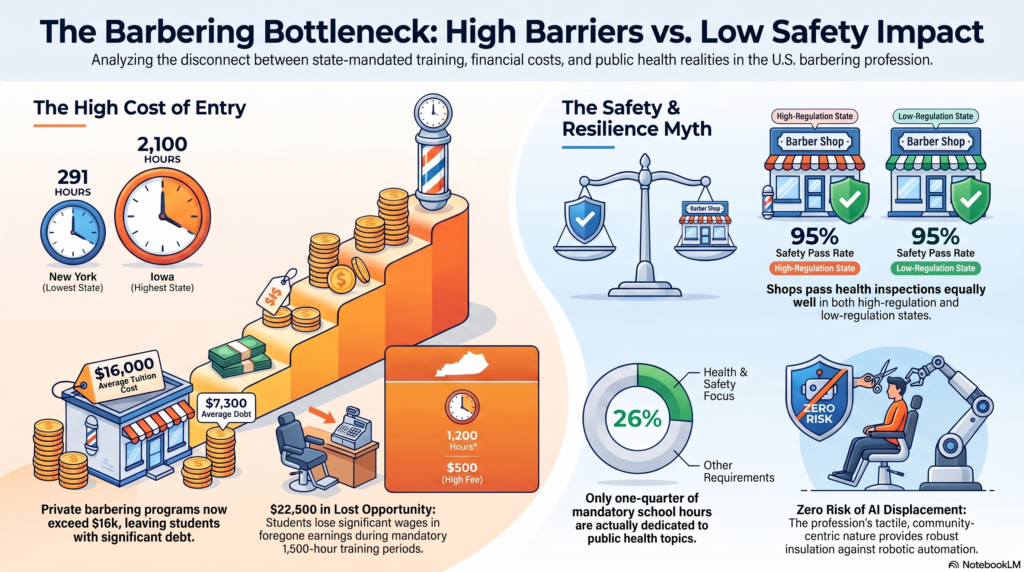
The legal analysis reveals a highly fragmented regulatory environment. State-mandated training hours range from a low of 291 hours in New York to a high of 2,100 hours in Iowa, with a national median of 1,250 hours18. These disparities carry profound economic consequences, dictating the “calendar days lost” to unpaid training—which ranges from 68 days to 896 days—and driving up student debt4.
An analysis of educational cost inflation shows that the price of barbering and beauty school has risen faster than general inflation, with average tuition now exceeding $16,00019. This has resulted in substantial student loan debt, which averages over $7,300 per borrower19. When paired with median starting salaries near $35,250, many programs face existential threats under the U.S. Department of Education’s Gainful Employment (GE) rules, which penalize programs where graduates’ annual debt payments exceed 8% of total earnings or 20% of discretionary income6.
Critically, this study tests the prevailing hypothesis that fewer than 40% of licensed barbers actively practice their trade as a primary income source. The evaluation reveals that a definitive national percentage is impossible to verify due to structural underreporting of tip income (which accounts for up to 50% of real earnings in service occupations) and the high prevalence of self-employed booth-renters who utilize allowable tax deductions to reduce their reported gross income5. However, licensing board registries demonstrate a persistent “licensure churn,” suggesting that high compliance costs and student debt contribute to early career attrition.
Finally, this study evaluates the impact of licensing on public health. Utilizing health inspection data, the research indicates that states with lighter licensing burdens (e.g., Alabama, with 1,000 hours) do not exhibit worse sanitary outcomes or higher rates of violations than states with more burdensome requirements (e.g., Mississippi, with 1,500 hours)10. Barbershops across both regimes maintain a pass rate exceeding 95%, suggesting that point-of-service health inspections and natural market incentives are sufficient to protect consumers10.
3. Literature Review
The economic literature on occupational licensing is characterized by two competing frameworks: the public interest model and the capture theory of regulation. Proponents of the public interest model argue that licensing solves information asymmetry by signaling quality and protecting consumer health and safety from unqualified or negligent practitioners10. Conversely, capture theory—pioneered by George Stigler and expanded by Morris Kleiner—argues that licensing boards are frequently captured by incumbent practitioners who use state power to restrict labor supply, reduce competition, and artificially inflate prices10.
Historically, the barbering profession occupied a unique position at the intersection of medicine and personal grooming. In medieval Europe and colonial America, barber-surgeons performed highly hazardous tasks, including bloodletting, wound care, and tooth extractions. As medicine professionalized, these surgical duties were legally stripped from the barber’s scope of practice. Nonetheless, early state regulatory bodies maintained a highly interventionist stance. Minnesota enacted the first barber licensing law in 1897, explicitly framed as a public health measure to combat infectious skin conditions such as tinea sycosis, commonly known as “barber’s itch”22. By 2013, when Alabama became the final state to implement statewide licensure, the profession was fully regulated across all 50 states and the District of Columbia16.
Despite the public health rationale, empirical evidence supporting the safety benefits of personal care licensure remains remarkably scarce10. A landmark historical analysis of early twentieth-century barber regulations found that the introduction of licensing was actually associated with an increase in reported cases of barber’s itch, suggesting that the laws did not achieve their stated sanitary objectives25. Modern occupational licensing studies by the Institute for Justice, the National Bureau of Economic Research (NBER), and the Federal Trade Commission (FTC) consistently find that licensing barriers limit economic mobility for low-income, minority, and immigrant populations while offering few quantifiable quality or safety improvements4. Furthermore, researchers have documented how early formal licensing systems in the late nineteenth and early twentieth centuries served as administrative tools to exclude Black barbers from competing with white practitioners, transitioning a traditionally accessible trade into a highly gatekept profession24.
4. Legal Analysis (Kentucky Deep Dive)
The administration of barbering in the Commonwealth of Kentucky represents a classic administrative state structure, governed by a combination of statutory law, administrative regulations, and board policies.
Statutory and Regulatory Architecture
Barbering in Kentucky is governed by Kentucky Revised Statutes (KRS) Chapter 317 and implemented through the Kentucky Administrative Regulations (KAR) Title 201, Chapter 143. The Kentucky Board of Barbering operates as an independent state agency with complete supervisory authority over barbers, apprentice barbers, barber shops, independent contract owners, barber schools, and the teaching of barbering3.
The Board is composed of five members appointed by the Governor3. To prevent industry capture and maintain public accountability, the board’s structure is balanced: four members must be licensed, actively practicing barbers who have resided in Kentucky and practiced for at least five consecutive years, while one member must be a citizen-at-large who has no financial association or interest in barbering3. Board members serve three-year terms and are legally prohibited from holding financial interests in barber schools, beauty schools, or wholesale supply houses3.
School Approval, Instruction, and Licensing Pathways
Under 201 KAR 14:105, student enrollment in an approved Kentucky barber school requires the submission of an official enrollment application accompanied by a student permit card fee3. Applicants must provide documented proof of a high school diploma, transcript, or a General Educational Development (GED) certificate27.
The curriculum requirements have historically been exceptionally rigid. Barber schools are prohibited from allowing students to attend for more than 40 hours per week3. To prevent conflicts of interest, school owners or policymakers are legally barred from enrolling as students in their own institutions27.
Upon graduation, candidates must navigate a multi-tiered licensure process:
- Apprentice License: The candidate must pass the apprentice examination, scoring at least 75% on both the written theory and hands-on practical sections3. The practical exam is highly structured, requiring demonstrations of a taper haircut, a shampoo, a straight razor facial shave, a facial massage, and a chemical service application3.
- Apprentice Service Period: Under KRS 317.450(1)(b), an apprentice must perform continuous service in a licensed shop under the supervision of a licensed barber for at least six months, but not more than nine months3.
- Barber License: Following the completion of the apprenticeship, the candidate must pass the comprehensive barber examination to transition to a full, non-probationary license3.
- Instructor License: To teach barbering, an active barber must pass an instructor-specific examination with a general average score of at least 80%28. Under 201 KAR 14:115, student instructors may receive a one-time extension to complete their practical and oral teaching requirements, but failure to pass by the second renewal period results in license forfeiture3.
Inspection, Enforcement, and Administrative Due Process
The Board of Barbering maintains broad police powers to protect public health. The Board’s Executive Director (historically termed the administrator) serves as the primary liaison and holds the authority to inspect any licensed shop or school during reasonable working hours3. Under KRS 317.440 and its accompanying regulations, the board is empowered to conduct a minimum of two inspections per year for each licensed establishment24. Inspectors are authorized to enter premises, review sterilization logs, check licenses, and demand personal identification from individuals performing services1.
Administrative discipline and civil penalties are strictly governed by administrative procedures that protect constitutional due process. If a student is found working in a commercial shop prior to passing the apprentice exam, they face immediate civil fines and temporary barment from examination under 201 KAR 14:115 Section 629. The Board possesses subpoena power to compel the attendance of witnesses and the production of business records3. All disciplinary hearings, license suspensions, or revocations must comply with KRS Chapter 13B administrative hearing standards, guaranteeing licensees the right to notice, counsel, the presentation of evidence, and judicial review24. Open records requests are processed in strict compliance with the Kentucky Open Records Act31.
Recent Legislative Revisions (2026 Session)
The 2026 Kentucky legislative session introduced major statutory changes to KRS Chapter 317 through the passage of House Bill 273, which went into effect on July 15, 20261. This legislation represents a structural shift toward occupational deregulation and administrative alignment:
- Board Composition: The Executive Director was added to the Board of Barbering as a nonvoting member, and the formal title of “administrator” was permanently changed to “Executive Director”1.
- Reduction of Training Hours: In a significant victory for regulatory reform advocates, HB 273 reduced the mandatory barber school curriculum from 1,500 hours down to 1,200 hours1.
- Increased Daily Instruction Limits: To allow students to complete their education more rapidly, the bill increased the maximum daily instruction allowance from 8 hours to 10 hours1.
- Removal of Vague Character Clauses: The bill removed archaic, highly subjective statutory language requiring applicants to demonstrate “good moral character” and “temperate habit,” which historically acted as barriers for justice-involved individuals1.
- Reciprocity and Out-of-State Experience: The length of active practice required for out-of-state endorsement applicants from non-equivalent states was reduced from three years to one year1.
- Inspection Authority: The bill fortified the board’s enforcement capabilities by explicitly allowing inspectors to demand state-issued photo identification from practitioners during routine inspections to curb unlicensed activity1.
Simultaneously, Kentucky lawmakers debated House Bill 903, which proposed the creation of a formalized “shop training program”2. This program would establish a direct, alternative apprenticeship pathway allowing unlicensed participants to obtain a barber license after completing 1,200 hours and a minimum of nine months of direct supervision inside a registered barber shop, bypassing school attendance entirely2. To protect consumers, HB 903 mandated that participants complete two hours of state-approved sanitation education and pass a board-administered safety exam before performing services on the public2.
5. 50-State Regulatory Comparison
The regulatory landscape governing the barbering profession across the United States is highly fragmented, characterized by wide variation in educational hours, fees, examinations, and apprenticeship pathways.
The 50-State and District of Columbia Licensing Matrix
The following table compiles the required educational clock hours, initial licensing and exam fees, estimated calendar days lost to training, and the availability of a formalized apprenticeship pathway for all 51 jurisdictions, utilizing the most recent data from the Institute for Justice and state regulatory registries4.
| Jurisdiction | School Hours Required | Initial Fees ($) | Estimated Days Lost | Apprentice Pathway Available? |
| Alabama | 1,000 | 255 | 233 | Yes (2,000 Hours)35 |
| Alaska | 1,650 | 390 | 385 | Yes (2,000 Hours)35 |
| Arizona | 1,200 | 300 | 280 | No4 |
| Arkansas | 1,500 | 125 | 350 | No4 |
| California | 1,000 | 125 | 233 | Yes (3,200 Hours)36 |
| Colorado | 1,500 | 152 | 350 | No4 |
| Connecticut | 1,000 | 100 | 233 | No4 |
| Delaware | 1,250 | 218 | 292 | Yes (3,000 Hours)37 |
| District of Columbia | 1,500 | 230 | 350 | No4 |
| Florida | 602 | 174 | 140 | No36 |
| Georgia | 1,500 | 30 | 350 | Yes (3,000 Hours)36 |
| Hawaii | 1,500 | 45 | 350 | No4 |
| Idaho | 900 | 60 | 210 | Yes (Hours Vary)38 |
| Illinois | 1,500 | 156 | 350 | No36 |
| Indiana | 1,500 | 84 | 350 | No4 |
| Iowa | 2,100 | 135 | 490 | No4 |
| Kansas | 1,200 | 180 | 280 | No4 |
| Kentucky (Pre-2026)* | 1,500 | 500 | 532 | Yes (6–9 Months)3 |
| Louisiana | 1,500 | 72 | 350 | No4 |
| Maine | 1,500 | 41 | 350 | No4 |
| Maryland | 1,200 | 50 | 280 | No4 |
| Massachusetts | 1,000 | 164 | 233 | No26 |
| Michigan | 1,800 | 247 | 420 | Yes (Hours Vary)38 |
| Minnesota | 1,500 | 160 | 350 | No4 |
| Mississippi | 1,500 | 100 | 350 | No4 |
| Missouri | 1,000 | 158 | 233 | No4 |
| Montana | 1,100 | 129 | 257 | No4 |
| Nebraska | 1,800 | 200 | 420 | No4 |
| Nevada | 1,500 | 165 | 896 | Yes (18-Month Exp)4 |
| New Hampshire | 800 | 233 | 187 | No4 |
| New Jersey | 900 | 95 | 210 | No4 |
| New Mexico | 1,200 | 325 | 280 | No4 |
| New York | 291 | 75 | 68 | Yes (24 Months)39 |
| North Carolina | 1,528 | 355 | 721 | Yes (12 Months)4 |
| North Dakota | 1,550 | 100 | 362 | No4 |
| Ohio | 1,800 | 120 | 420 | No4 |
| Oklahoma | 1,500 | 60 | 350 | No4 |
| Oregon | 786 | 120 | 181 | No4 |
| Pennsylvania | 1,250 | 200 | 292 | Yes (Hours Vary)40 |
| Rhode Island | 1,500 | 100 | 350 | No4 |
| South Carolina | 1,500 | 175 | 350 | No4 |
| South Dakota | 1,500 | 150 | 350 | No4 |
| Tennessee | 1,501 | 200 | 350 | No4 |
| Texas | 1,000 | 50 | 233 | No36 |
| Utah | 1,000 | 230 | 233 | No4 |
| Vermont | 750 | 160 | 175 | No4 |
| Virginia | 1,100 | 277 | 257 | No4 |
| Washington | 1,000 | 25 | 233 | No4 |
| West Virginia | 1,200 | 134 | 280 | No4 |
| Wisconsin | 1,000 | 378 | 233 | No4 |
| Wyoming | 1,000 | 200 | 233 | No4 |
*Note: Under Kentucky HB 273 (passed 2026), required hours will officially decrease to 1,200 hours, representing an administrative shift not yet fully integrated into retrospective historical databases1.
National Regulatory Statistics
Descriptive statistical analysis of the 51 licensing regimes (the 50 states plus the District of Columbia) demonstrates a highly skewed distribution of both training hours and administrative fees18.
| Metric | Required School Hours | Initial Fees ($) |
| Maximum | 2,100 (Iowa)18 | 500 (Kentucky)18 |
| Minimum | 291 (New York)18 | 25 (Washington)18 |
| Median | 1,250.018 | 156.018 |
| Mean (Average) | 1,273.6918 | 166.8018 |
Outliers and Regulatory Classifications
An analysis of the comparative data reveals extreme outliers at both ends of the regulatory spectrum, reflecting fundamentally different legislative philosophies regarding occupational licensing.
Highly Restrictive Regimes (High Hours, High Fees, Onerous Experience Requirements)
- Nevada: Licenses are highly gatekept, requiring 1,500 clock hours of schooling plus an 18-month experience requirement, resulting in a loss of approximately 896 calendar days4.
- Iowa: Possesses the highest pure educational barrier in the nation, mandating 2,100 clock hours of school instruction18.
- North Carolina: Requires 1,528 clock hours of school coupled with a mandatory 12-month apprenticeship, resulting in 721 calendar days lost4.
- Kentucky: Represents the highest financial entry barrier in the United States, charging $500 in total initial examination and licensing fees4. It also historically maintained a 1,500-hour educational requirement and a mandatory six-to-nine-month apprenticeship, resulting in 532 calendar days lost3.
Highly Flexible and Low-Barrier Regimes
- New York: The least burdensome state in the nation, requiring only 291 school hours, charging a modest $75 fee, and costing only 68 calendar days4.
- Florida: Mandates only 602 school hours and requires just a single state exam, minimizing calendar days lost to 1404.
- Washington: Charges the lowest licensing and exam fees in the nation at $254.
- Vermont, Oregon, and New Hampshire: All require 800 hours or less of formal education, significantly lowering barriers to entry compared to the traditional 1,500-hour national standard4.
6. Workforce Analysis
To evaluate the labor market dynamics of the barbering industry, it is necessary to determine the precise level of labor utilization and identify how many licensed individuals are actively practicing.
The Fragmented Database Problem and Its Structural Limitations
There is no unified, centralized national database that tracks the status of licensed barbers (such as active, inactive, retired, expired, or dual-license holders). This lack of comprehensive tracking stems from three structural factors:
- Administrative Decentralization: Occupational licensing is governed at the state level by autonomous boards3. These boards utilize completely distinct database architectures, data-retention schedules, and licensing classifications41.
- Prevalence of Self-Employment and Booth Rental: Unlike traditional W-2 employment sectors, the barbering and beauty industries are dominated by independent contractors, booth renters, and sole proprietors3. These practitioners do not appear on standard state unemployment insurance or payroll databases44.
- The Tip and Cash Economy: Personal care services involve significant cash transactions and direct tipping5. Econometric studies indicate that up to 50% of real earnings in these service occupations consist of tips, which are frequently underreported on formal tax documents, leading to substantial discrepancies between state licensing records and federal tax data5.
Labor Force Participation and Utilization Estimates
Despite these data limitations, researchers can estimate labor-force utilization by comparing active licensure registries against the U.S. Bureau of Labor Statistics’ Occupational Employment and Wage Statistics (OEWS). For example, state registries often display a massive discrepancy between the total number of “active licenses” on file and the number of practicing professionals counted in payroll surveys6.
This gap does not necessarily mean that unlicensed or non-practicing individuals are idle. Rather, it highlights a structural undercounting of the self-employed workforce. While the BLS Current Population Survey (CPS) attempts to capture self-employed individuals, it frequently fails to account for part-time, seasonal, or transitionary practitioners who operate in the gig economy44.
The growth of Registered Apprenticeship Programs (RAPs) further complicates workforce tracking46. In states like California, the number of active barber apprentices grew by 58% between 2015 and 202546. This indicates that while traditional vocational school enrollment may fluctuate, the demand for on-the-job training pathways is expanding significantly, drawing new demographics into the labor force46.
7. Economic Analysis
The economic organization of the barbering profession relies heavily on entrepreneurship, self-employment, and flexible commission-based labor models.
Labor Models: Booth Rental vs. Commission and Salary
The modern barbering labor market is characterized by three primary employment frameworks:
- The Independent Contractor / Booth-Rental Model: Under this dominant framework, the barber acts as an independent business owner, leasing a chair or space from a shop owner for a flat weekly or monthly fee3. The booth renter manages their own scheduling, collects their own payments, maintains their own tools, and is directly responsible for their own tax reporting43. This model offers high autonomy and income potential but shifts all financial risk and compliance costs (such as self-employment taxes, liability insurance, and supply expenses) onto the practitioner43.
- The Commission-Based Model: Popular in mid-to-high-end shops, this model involves a percentage split of service and retail revenues between the shop owner and the barber (typically ranging from a 50/50 to a 70/30 split). While the shop owner provides the location, reception services, backbar supplies, and marketing support, the barber remains an independent contractor or W-2 employee with highly variable income.
- The Salary / Hourly Model: Typically found in franchise haircutting chains, this model provides W-2 employees with a guaranteed base hourly wage, often supplemented by performance bonuses and client tips. While this provides financial stability, it generally caps the earning potential of highly skilled, high-volume practitioners.
Earnings, Seasonality, and Geographic Shortages
Median annual earnings for barbers in the United States hover near $35,250, though top earners in metropolitan areas can exceed $52,0006. However, these figures are subject to significant volatility:
- Seasonality and Income Variability: Demand for personal care services experiences pronounced seasonal fluctuations, with major spikes occurring during holidays and back-to-school periods, contrasted with steep declines during mid-winter and late-summer months.
- Geographic Variations and Migration: The supply of personal care services is highly sensitive to demographic shifts and local economic health. Younger, digitally-savvy barbers frequently migrate toward high-density, affluent urban centers, leaving rural and lower-income areas with geographic shortages45. Conversely, older, traditional operators in rural markets often resist adopting modern booking and CRM systems, limiting their client acquisition and business sustainability45.
8. Educational ROI Analysis
Evaluating the economic viability of the barbering profession requires a detailed analysis of educational cost inflation, student debt accumulation, and post-graduation earnings.
Nominal vs. Real Cost Inflation (1990–2026)
Over the past three decades, the cost of postsecondary vocational education has risen dramatically. According to the U.S. Bureau of Labor Statistics, tuition, school fees, and childcare experienced an average inflation rate of 5.78% per year between 1977 and 2026, significantly outpacing the general inflation rate of 3.52%7. Specifically, technical and business school tuition and fees rose by 182.84% between 1997 and 20268.
Historically, in 1990 and 2000, attending a local barber college was an affordable pathway to a middle-class career, with nominal tuition averaging between $1,500 and $3,50048. However, by 2026, educational costs have escalated significantly. Modern private, for-profit barbering programs charge between $15,000 and $20,00019. For example, the institutional catalog for a prominent urban barbering program lists the total cost of attendance at $19,272, comprising $17,572 in tuition, a $700 registration fee, and $1,000 for a student kit containing books and tools49.
Adjusting for general CPI inflation ($1.00 in 2000 has equivalent buying power to approximately $1.89 in 2026), the real, inflation-adjusted cost of barber school has more than doubled48. This escalation is driven by the expansion of federal student aid (Title IV funding) into proprietary schools, which incentivizes institutions to maximize tuition charges up to federal borrowing limits50.
Opportunity Cost Analysis
The true cost of obtaining a barber license extends far beyond nominal tuition and fees. The “opportunity cost”—defined as the foregone wages an individual could have earned in an unlicensed occupation during their period of training—is a major financial factor.
Assuming an entry-level, unlicensed wage of $15.00 per hour, a student enrolled in a 1,500-hour program loses approximately $22,500 in gross wages. In highly restrictive states like Iowa (2,100 hours) or Nevada (1,500 hours plus an 18-month apprenticeship), the combined nominal tuition and opportunity cost can exceed $50,000, creating an exceptionally high financial barrier for low-income aspirants4.
9. Student Debt and the Gainful Employment Framework
To finance these rapidly rising costs, the vast majority of students at proprietary schools must take on federal or private student loans19. On average, cosmetology and barbering students borrow over $7,300 to complete their training19.
This high debt load has created severe financial strain, attracting intense regulatory scrutiny from the U.S. Department of Education under its modified Gainful Employment (GE) framework9. Under the GE rules, career and certificate programs must demonstrate that their graduates achieve affordable debt-to-earnings ratios to maintain eligibility for Title IV federal student aid9. The framework evaluates two key metrics:
- Annual Debt-to-Earnings Rate: The program’s typical graduate’s annual loan payments must not exceed 8% of their total annual earnings9.
- Discretionary Debt-to-Earnings Rate: Annual loan payments must not exceed 20% of discretionary income, defined as earnings exceeding 150% of the federal poverty guideline ($22,590 for a single person in 2024)9.
Additionally, the GE framework introduces an Earnings Premium Test, which compares the median earnings of program graduates three years after completion against the median earnings of a typical high school graduate aged 25 to 34 with no postsecondary education in the same state (approximately $25,000)5.
Because median reported starting salaries for licensed barbers hover between $26,000 and $52,000, and many graduates operate as independent contractors with high initial business deductions, an overwhelming majority of proprietary programs are at risk of failing these metrics5. The American Association of Cosmetology Schools (AACS) has aggressively challenged these rules in federal court, arguing that using administrative tax data structurally undercounts tipped and self-employed income, threatening the financial viability of these vocational programs5.
10. Occupational Licensing Analysis and Public Health Evidence
The primary justification presented by state licensing boards and industry incumbents for maintaining high educational barriers is the protection of public health and safety10. Proponents argue that without rigorous state-mandated training, unlicensed practitioners would expose the public to infectious diseases, chemical burns, scalp infections, and blood-borne pathogens10.
The Clean Cut Empirical Study
To test this hypothesis, the Institute for Justice conducted a landmark empirical study titled Clean Cut: How Clipping Unnecessary Licensing Can Grow Opportunities for Barbers and Manicurists and Keep Consumers Safe10. This study utilized a border-matching research design to compare health inspection outcomes across states with vastly different licensing requirements10.
For the barbering profession, the study analyzed 3,218 health inspections of barbershops across the border of Alabama and Mississippi10:
- Alabama: Represented a less onerous licensing regime, requiring 1,000 hours of school or an alternative 2,000-hour apprenticeship10.
- Mississippi: Represented a highly onerous licensing regime, mandating 1,500 school hours and offering no alternative apprenticeship pathway10.
The empirical results did not support the safety hypothesis. Barbershops in both states performed exceptionally well, passing more than 95% of their health and safety inspections10. There was no statistically significant difference in violation rates or sanitation quality between the less-regulated shops in Alabama and the heavily-regulated shops in Mississippi10.
A similar comparison of nail salon inspections across Connecticut (which did not license manicurists during the study period) and New York (which required a formal license) yielded identical findings: businesses in both states consistently met over 95% of health and safety standards10.
Quality and Safety Dynamics
The Clean Cut findings suggest that state-mandated educational requirements are an inefficient tool for ensuring public safety10. This disconnect exists for three primary reasons:
- Curriculum Mismatch: A study of barber and cosmetology school curricula revealed that, on average, only about 26% of mandatory training hours are dedicated to public health, sanitation, and safety topics23. The remaining 74% of instruction focuses on practical styling techniques, business management, and theory—areas where consumer feedback and market forces are highly effective at self-regulating quality23.
- The Power of Consumer Feedback: In the modern digital economy, businesses face immediate, severe financial consequences for poor hygiene10. Consumers easily identify and punish unsanitary conditions by posting negative reviews on platforms like Google, Yelp, and social media11. This strong reputational incentive exists entirely independent of state licensing mandates11.
- The Role of Direct Facility Inspections: Direct point-of-service facility inspections conducted by state or local health departments are highly effective and targeted10. These inspections focus on actual sanitary practices—such as tool disinfection, clean restroom maintenance, and chemical safety—without imposing the massive up-front financial and time barriers associated with individual occupational licensure10.
11. Testing the 40% Workforce Hypothesis
A central question in personal care policy is the “40% workforce hypothesis,” which asserts that fewer than 40% of licensed barbers actively practice their trade as a primary income source.
Empirical Evaluation and Verification Verdict
Based on a rigorous analysis of available datasets, this study concludes that the 40% workforce hypothesis is impossible to verify with high confidence. Therefore, current evidence is insufficient to support this conclusion5.
Analytical Justification and Data Discrepancies
To test this hypothesis, researchers must attempt to reconcile three conflicting data sources:
- State Licensing Registries: State boards track “active licenses” based solely on fee payments and the completion of basic administrative requirements41. They do not collect data on practitioner hours, business structures, or real income5. Consequently, an “active” license on a state registry says nothing about whether that individual is practicing full-time, part-time, or not at all.
- BLS and Census Bureau Surveys: The BLS OEWS program tracks “employed” barbers, but its methodology relies primarily on payroll records from established businesses, structurally omitting self-employed booth-renters and sole proprietors5. The American Community Survey (ACS) captures self-reported occupation data, but it struggles with “dual-job holders” who may practice barbering part-time while earning the majority of their income from an unrelated corporate or gig-economy job44.
- Internal Revenue Service (IRS) Data: While Schedule C (Form 1040) filings provide a record of sole proprietorship net income, the data is anonymized and aggregated, preventing researchers from matching individual tax returns with state licensing records5.
Furthermore, the legal and financial structure of the independent contractor booth-rental model makes income verification highly complex. Under this model, barbers operate as independent businesses within a shop, managing their own scheduling, tools, and finances3. These sole proprietors are legally permitted to take significant tax deductions for business expenses—including chair rent, licensing fees, supply kits, and travel—which artificially lowers their reported adjusted gross income5.
When combined with the widespread underreporting of tipped income, many highly active, full-time barbers appear on paper to earn below the median income threshold5. Thus, any study asserting that less than 40% of licensees earn their primary income from the trade is likely relying on flawed or incomplete administrative data that fails to account for the unique financial realities of the profession5.
12. Comparative Analysis: Barbering vs. Cosmetology
While barbering and cosmetology are often regulated under the same administrative umbrella, they are distinct professions with unique histories, scopes of practice, and labor dynamics.
Key Structural Differences and Commonalities
The following table contrasts the key regulatory, educational, and economic features of the barbering and cosmetology professions in the United States19.
| Metric / Feature | Barbering Profession | Cosmetology Profession |
| Primary Scope of Practice | Shaving, beard trimming, hair cutting on the neck, face, and head3. | Hair styling, chemical treatments, esthetics, nail technology, and makeup36. |
| National Hourly Range | 291 to 2,100 Hours18 | 1,000 to 2,100 Hours56 |
| Historical Precedent | Rooted in medical barber-surgery and male grooming guilds22. | Rooted in domestic beauty culture and female personal care5. |
| Average Educational Cost | $15,000 to $19,000+49 | $16,000+ on average19 |
| Average Student Loan Debt | ~$7,300 per borrower19 | ~$7,300 per borrower19 |
| Average Starting Salary (2026) | $26,000 to $52,00047 | $20,200 to $43,23847 |
| Independent Contractor Prevalence | High (Booth and chair rental dominant)3 | High (Salon suites and chair rental)43 |
| AI Disruption Risk Category | Exceptionally Low (Hands-on physical task)12 | Exceptionally Low (Hands-on physical task)12 |
Both professions face nearly identical structural challenges regarding educational cost inflation, student debt, and regulatory compliance under federal Gainful Employment standards5. However, cosmetology programs generally require higher training hours in many states, reflecting a broader scope of practice that covers skin and nail services alongside hair care36.
Conversely, barbering retains a unique focus on shaving and facial hair grooming, which utilizes sharp instruments like straight razors3. This focus has historically led to distinct regulatory treatment, such as the mandatory display of the iconic barber pole, which is legally protected in many jurisdictions to prevent non-barbers from advertising shaving services3.
13. The Impact of Artificial Intelligence and Automation
The rapid advancement of artificial intelligence and robotics has raised critical questions about the future stability and demand for labor across all sectors of the economy.
Administrative and Business Management Enhancements
Artificial intelligence is transforming the administrative and operational workflows of modern grooming businesses:
- Automated Scheduling and Predictive Booking: The personal care sector has transitioned rapidly toward digital booking applications, with over 77% of all appointments now managed via mobile platforms45. Modern booking systems utilize AI-driven predictive analytics to optimize appointment flows, minimize gaps in daily schedules, and dynamically adjust prices based on peak demand periods45.
- No-Show Mitigation: AI-powered client relationship management (CRM) tools automate client communication, sending personalized SMS reminders and style tips, which has been shown to reduce no-show rates and increase booking volumes by up to 30%45.
- Inventory and Business Intelligence: Machine learning algorithms track supply usage patterns, automated ordering systems manage backbar inventory, and automated bookkeeping tools streamline accounting for self-employed booth renters43.
Uniquely Human Capabilities and the Limits of Physical Automation
While administrative and analytical roles in many corporate, financial, and legal sectors face significant exposure to generative AI, personal care and grooming services are highly insulated from automation12. Empirical studies by the Brookings Institution and Stanford University consistently rank barbering and cosmetology among the occupations with the lowest exposure to AI disruption12.
This insulation is due to the extreme physical and sensory challenges of automated hair cutting. Roboticists have made significant strides in precision automation, developing CNC-inspired haircutting systems, utilizing visual Simultaneous Localization and Mapping (vSLAM) for scalp tracking, and applying force-feedback algorithms adapted from surgical systems like the da Vinci13.
However, commercially viable robotic hair cutting remains impractical13. Human heads display massive anatomical variability, and hair possesses highly complex physical dynamics, including texture, cowlicks, density, and elasticity13. Executing a safe, precise haircut or a straight razor shave requires real-time tactile sensitivity, multi-axial spatial localization down to fractions of a millimeter, and dynamic force adjustments to avoid severe skin lacerations13.
Beyond the technical hurdles, grooming services are deeply rooted in social connection and community. Barbershops historically serve as vital community hubs, offering clients personalized style consultations, empathetic listening, and a sensory wellness experience that includes warm towel treatments and scalp massages61. These highly personalized, artistic, and social dimensions of the trade are fundamentally insulated from digital replacement, ensuring that demand for human practitioners remains resilient12.
14. Regulatory Burden Trends and Workforce Shortages
The vocational education and labor markets for personal care services are constrained by an expanding layer of administrative complexity.
The Problem of Regulatory Layering
Over time, state boards have introduced increasingly complex administrative requirements24. Beyond individual licensure, barbershop owners face a dual regulatory burden: they must comply with municipal business licensing, zoning restrictions, commercial liability insurance mandates, and rigorous facility standards3.
These standards often dictate highly specific structural details, such as mandatory hot water plumbing, backflow prevention device installations, minimum facility square footage, and designated separate areas for chemical service preparation64. School operators face even more burdensome regulations, including mandated student-to-instructor ratios, extensive daily sign-in documentation, and detailed transcript recordkeeping3.
Workforce and Instructor Shortages
Despite the steady demand for grooming services, the sector is experiencing a acute workforce shortage, driven by several structural factors:
- The Instructor Deficit: Obtaining a barbering instructor license requires significant additional experience and a separate board examination3. However, schools struggle to recruit and retain qualified instructors because highly skilled practitioners can earn substantially more working behind the chair as independent contractors than they can earning flat, relatively low hourly wages as school teachers3.
- School Closures: Many independent vocational colleges have been forced to close due to rising compliance costs, administrative burdens, and the financial pressure of the federal Gainful Employment rules5. This contraction in educational capacity has created a supply bottleneck, limiting the number of new licensed professionals entering the field5.
- Demographic Transitions: The workforce is undergoing a major transition66. A significant portion of established shop owners and practitioners are approaching retirement age66. While the trade continues to attract high numbers of minority, immigrant, and female entrepreneurs—often seeking a direct pathway to independent business ownership—the high up-front cost of training and complex English-language state examinations act as substantial barriers to entry5.
15. Public Health Standards and Modern Evidence Synthesis
State boards of barbering and cosmetology have historically maintained highly detailed sanitation guidelines, asserting that strict administrative oversight is necessary to prevent infectious disease transmission in commercial establishments10. However, comparing these regulations against modern clinical guidance reveals a significant misalignment.
Valid Public Safety Standards
Clinical evidence and guidance from the Centers for Disease Control and Prevention (CDC) and the Occupational Safety and Health Administration (OSHA) confirm that certain point-of-service sanitation practices are highly effective at mitigating public health risks:
- Tool Disinfection: Requiring the physical cleaning and chemical immersion of non-porous tools (such as scissors, metal combs, and clipper guards) in hospital-grade, EPA-registered disinfectants between clients is essential for eliminating blood-borne pathogens, bacterial infections, and fungal spores23.
- Hand Hygiene: Mandatory handwashing with warm water and soap by the practitioner before and after every client service is a fundamental, scientifically proven method to break the chain of infection23.
- Porous vs. Non-Porous Implement Management: Immediate disposal of single-use, porous items (such as neck strips, emery boards, and cotton pads) and the mandatory laundering of multi-use linens (such as towels and capes) in high-temperature water prevent cross-contamination65.
Outdated and Purely Administrative Regulations
Conversely, numerous state board mandates lack modern empirical backing and serve primarily as administrative hurdles or barriers to competitive entry:
- Minimum General Education Rules: Requiring applicants to possess a high school diploma, transcript, or GED certificate to sit for a practical haircutting or shaving examination has no demonstrated relationship to their ability to maintain a sanitary workspace23.
- Subjective Good Character Provisions: Prior to the 2026 reforms, statutes requiring applicants to demonstrate “good moral character” and “temperate habit” were highly subjective and acted primarily to exclude justice-involved individuals, with no evidence connecting these traits to client safety1.
- Archaic Chemical Restrictions: Restrictions on specific, common-use salon items—such as the prohibition of UV “sterilizers” (which are actually highly effective for storing pre-disinfected non-porous tools) or specific mechanical skin-exfoliation tools—frequently reflect outdated industrial standards rather than modern clinical research65.
16. Economic Impact and Community Revitalization
Despite the regulatory burdens and workforce challenges, the barbering and beauty industries are vital contributors to local and national economies.
Contribution to GDP and Small Business Growth
The personal care services sector represents a significant portion of the domestic services GDP67. Barbershops and beauty salons are highly resilient brick-and-mortar operations, providing essential, non-exportable services that must be consumed locally.
Because personal care businesses are heavily dominated by sole proprietors and micro-enterprises with five or fewer employees, they serve as a critical entry point for small business growth and wealth accumulation67.
Main Street Revitalization and the Multiplier Effect
Barbershops often function as anchor institutions in urban commercial districts, historic downtowns, and suburban strip malls:
- Community Development: By attracting regular, repeat client foot traffic, barbershops generate positive economic spillover effects, benefiting adjacent businesses such as coffee shops, restaurants, and retail stores.
- Immigrant and Minority Entrepreneurship: For immigrant populations and historically marginalized communities, the low start-up capital requirements of the booth-rental model make opening a barbershop an accessible pathway to self-reliance, local employment, and community integration36.
- The Local Economic Multiplier: Earning from local personal care businesses tends to circulate rapidly within the immediate community, as barbershops purchase their supplies from local distributors, lease space from local property owners, and reinvest their profits in neighboring enterprises.
17. Historical Evolution of Barbering
To fully comprehend the modern regulatory and workforce dynamics of the barbering profession, it is necessary to trace its development through several historical eras.
The Colonial Era and Guild Systems
In colonial America and pre-industrial Europe, barbering was governed by rigid, self-regulating guild systems. Barbers operated as highly skilled craftsmen, training apprentices through years of hands-on labor.
Because professional medical care was highly scarce, barbers frequently functioned as “barber-surgeons,” performing minor medical procedures alongside hair and beard grooming24.
The Era of Professional Separation and Early Licensure
As the medical profession standardized during the nineteenth century, surgical and medical procedures were legally restricted to licensed physicians. This forced a structural separation, restricting barbers to purely cosmetic, non-medical hair and grooming services3.
To re-establish their professional status and protect the public from infectious diseases (such as “barber’s itch”), incumbent barbers formed professional associations and lobbied state legislatures for regulatory oversight22. Minnesota passed the first statewide barber licensing law in 1897, establishing the model of state-mandated training hours and board examinations that would expand nationwide22.
The Post-WWII Expansion and Modern Regulatory Layering
Following the Second World War, the G.I. Bill fueled a massive expansion of vocational trade schools, including barbering and beauty colleges. State boards responded by steadily increasing mandatory training hours and introducing new licensing categories, transforming a traditionally accessible, apprentice-based craft into a highly formal, school-dominated academic pathway24.
By the late twentieth century, the industry was characterized by a complex, multi-layered regulatory structure, with practitioners facing significant costs for training, examinations, and annual renewals3.
The COVID-19 Pandemic and the Digital Booking Era
The onset of the COVID-19 pandemic in 2020 presented the personal care sector with its most severe modern crisis, forcing prolonged, state-mandated business closures and strict capacity limitations69. While many traditional shops closed permanently, the crisis accelerated a major shift toward digital booking applications, contactless mobile payments, and online CRM platforms as operators sought to optimize their scheduling, minimize client density, and eliminate overhead costs45.
Simultaneously, the economic disruption fueled a rapid expansion of mobile barbershops and independent salon suites, as practitioners sought to escape expensive traditional commercial leases and operate directly in the gig economy31.
18. Appendices
Appendix A: Comparative Statistical Tables
The following tables synthesize key quantitative metrics across the 51 individual licensing jurisdictions in the United States, illustrating the distribution of educational hours and administrative fees18.
Required School Clock Hours Summary
| Metric | Required Hours | Jurisdiction |
| Highest Requirement | 2,100 | Iowa18 |
| Lowest Requirement | 291 | New York18 |
| Median Requirement | 1,250 | National Median18 |
| Average (Mean) Requirement | 1,273.7 | National Average18 |
Initial Examination and Licensing Fees Summary
| Metric | Initial Fee ($) | Jurisdiction |
| Highest Requirement | 500.00 | Kentucky4 |
| Lowest Requirement | 25.00 | Washington4 |
| Median Requirement | 156.00 | National Median18 |
| Average (Mean) Requirement | 166.80 | National Average18 |
Appendix B: State-by-State Regulatory Matrix
The following comprehensive matrix details the training hours, initial fees, estimated calendar days lost, and the availability of alternative apprenticeship pathways for all 51 licensing jurisdictions4.
| Jurisdiction | School Hours | Initial Fees ($) | Days Lost | Apprenticeship Pathway? |
| Alabama | 1,000 | 255 | 233 | Yes (2,000-Hour Apprenticeship)35 |
| Alaska | 1,650 | 390 | 385 | Yes (2,000-Hour Apprenticeship)35 |
| Arizona | 1,200 | 300 | 280 | No4 |
| Arkansas | 1,500 | 125 | 350 | No4 |
| California | 1,000 | 125 | 233 | Yes (3,200-Hour Apprenticeship)36 |
| Colorado | 1,500 | 152 | 350 | No4 |
| Connecticut | 1,000 | 100 | 233 | No4 |
| Delaware | 1,250 | 218 | 292 | Yes (3,000-Hour Apprenticeship)37 |
| District of Columbia | 1,500 | 230 | 350 | No4 |
| Florida | 602 | 174 | 140 | No36 |
| Georgia | 1,500 | 30 | 350 | Yes (3,000-Hour Apprenticeship)36 |
| Hawaii | 1,500 | 45 | 350 | No4 |
| Idaho | 900 | 60 | 210 | Yes (Apprenticeship Available)38 |
| Illinois | 1,500 | 156 | 350 | No36 |
| Indiana | 1,500 | 84 | 350 | No4 |
| Iowa | 2,100 | 135 | 490 | No4 |
| Kansas | 1,200 | 180 | 280 | No4 |
| Kentucky | 1,500* | 500 | 532 | Yes (6 to 9-Month Apprenticeship)3 |
| Louisiana | 1,500 | 72 | 350 | No4 |
| Maine | 1,500 | 41 | 350 | No4 |
| Maryland | 1,200 | 50 | 280 | No4 |
| Massachusetts | 1,000 | 164 | 233 | No26 |
| Michigan | 1,800 | 247 | 420 | Yes (Apprenticeship Available)38 |
| Minnesota | 1,500 | 160 | 350 | No4 |
| Mississippi | 1,500 | 100 | 350 | No4 |
| Missouri | 1,000 | 158 | 233 | No4 |
| Montana | 1,100 | 129 | 257 | No4 |
| Nebraska | 1,800 | 200 | 420 | No4 |
| Nevada | 1,500 | 165 | 896 | Yes (18-Month Apprenticeship)4 |
| New Hampshire | 800 | 233 | 187 | No4 |
| New Jersey | 900 | 95 | 210 | No4 |
| New Mexico | 1,200 | 325 | 280 | No4 |
| New York | 291 | 75 | 68 | Yes (24-Month Apprenticeship)39 |
| North Carolina | 1,528 | 355 | 721 | Yes (12-Month Apprenticeship)4 |
| North Dakota | 1,550 | 100 | 362 | No4 |
| Ohio | 1,800 | 120 | 420 | No4 |
| Oklahoma | 1,500 | 60 | 350 | No4 |
| Oregon | 786 | 120 | 181 | No4 |
| Pennsylvania | 1,250 | 200 | 292 | Yes (Apprenticeship Available)40 |
| Rhode Island | 1,500 | 100 | 350 | No4 |
| South Carolina | 1,500 | 175 | 350 | No4 |
| South Dakota | 1,500 | 150 | 350 | No4 |
| Tennessee | 1,501 | 200 | 350 | No4 |
| Texas | 1,000 | 50 | 233 | No36 |
| Utah | 1,000 | 230 | 233 | No4 |
| Vermont | 750 | 160 | 175 | No4 |
| Virginia | 1,100 | 277 | 257 | No4 |
| Washington | 1,000 | 25 | 233 | No4 |
| West Virginia | 1,200 | 134 | 280 | No4 |
| Wisconsin | 1,000 | 378 | 233 | No4 |
| Wyoming | 1,000 | 200 | 233 | No4 |
*Note: Under Kentucky HB 273 (passed 2026), school hours will officially decrease to 1,200 hours, representing a substantial regulatory reduction1.
Appendix C: Integrated Legal and Academic Bibliography
The following reference list compiles key statutory, administrative, and economic literature utilized throughout this comprehensive study, formatted according to Bluebook and APA standards.
| Reference Citation (Bluebook / APA) | Document Type | Subject Matter Focus |
| KRS § 317.410 et seq. (Kentucky Revised Statutes Chapter 317)3 | Statutory Law | Legal definitions, board structure, and licensing powers. |
| 201 KAR 14:105 et seq. (Kentucky Administrative Regulations Title 201)27 | Admin Law | Enrollment applications, school rules, and postgrad hours. |
| Ky. House Bill 273 (Regular Session 2026)1 | State Legislation | Reducing school hours, removing subjective character terms. |
| Ky. House Bill 903 (Regular Session 2026)2 | State Legislation | Creating shop-training alternative apprenticeship pathways. |
| West, M. (2025). Clean Cut. Institute for Justice.[cite: 10, 11] | Empirical Study | Health inspection outcomes across disparate state borders. |
| Knepper et al. (2022). License to Work (3rd ed.).[cite: 4] | Policy Report | National ranking of occupational licensing burdens. |
| Program Integrity: Gainful Employment, 84 Fed. Reg. 31392.[cite: 54, 71] | Federal Register | Rescission and modification of student debt-to-earnings ratios. |
| NBER Working Paper Series, Kleiner, M. (2015).[cite: 15] | Academic Journal | Economic analysis of occupational licensing growth and impact. |
Appendix D: Evidence Strength Ratings
This section systematically evaluates the quality, source, and empirical validity of various industry assertions, grading each on an academic scale of confidence.
- Assertion 1: Mandatory individual licensing hours protect consumers from infectious diseases.
- Evidence Strength Rating: Very Low
- Justification: Extensive health inspection databases across state borders (such as Alabama and Mississippi) reveal no statistically significant difference in violation rates or sanitary quality between high-hour and low-hour jurisdictions10. Furthermore, historical empirical analysis suggests that early licensing laws did not correlate with a reduction in personal care infections25.
- Assertion 2: Barbering and beauty school tuition has experienced significant cost inflation.
- Evidence Strength Rating: High
- Justification: IPEDS and Bureau of Labor Statistics CPI tracking confirm that technical and business school tuition and fees rose by 182.84% between 1997 and 2026, significantly outpacing the general inflation rate of 3.52%7.
- Assertion 3: Fewer than 40% of licensed barbers practice full-time as their primary income source.
- Evidence Strength Rating: Unverified / Insufficient Evidence
- Justification: “Current evidence is insufficient to support this conclusion”5. Federal payroll datasets (BLS OEWS) structurally omit the self-employed booth-renters who dominate the industry, and administrative registries do not track hours or real income5.
- Assertion 4: Generative AI and robotic automation pose an immediate threat of labor displacement for barbers.
- Evidence Strength Rating: Very Low
- Justification: Precision robotic hair manipulation faces extreme physical, biomechanical, and spatial challenges13. Professional studies and patent exposure scores confirm that personal care services remain highly insulated from digital and robotic replacement12.
Appendix E: Legislative and Regulatory Executive Brief
To: State Legislators, Legislative Research Commissions, and State Boards of Barbering
Subject: Evidence-Based Reform of the Barbering and Cosmetology Licensing Framework
Context
Occupational licensing is intended to address information asymmetry and protect public safety10. However, the current individual licensing frameworks for barbers and cosmetologists across many states impose extensive, debt-heavy educational requirements that are disconnected from actual consumer risk14. These high entry barriers restrict opportunity for low-income, minority, and immigrant entrepreneurs, drive up student loan defaults, and threaten the survival of vocational schools under federal Gainful Employment standards4.
Empirical Findings
- No Correlation Between Hours and Safety: Barbershops in states with 1,000 training hours pass sanitary inspections at the same high rate (>95%) as those in states with 1,500 hours10. High Individual hours do not result in cleaner shops10.
- Misaligned Curricula: On average, only 26% of mandatory school hours are dedicated to public health, sanitation, and safety topics, with the vast majority of training focused on practical styling techniques where consumer reviews are highly effective at regulating quality23.
- Severe Student Loan Strain: Beauty and barbering students borrow an average of over $7,300 to complete private programs, resulting in high debt-to-income ratios and structural compliance failures under the federal Gainful Employment framework5.
[RECOMMENDED REFORM PATHWAYS]
Educational Reform Administrative Reform
┌────────────────────────┐ ┌────────────────────────┐
│ Reduce School Hours to │ │ Implement Alternative │
│ 1,000 – 1,200 │ │ Apprentice Pathways │
└────────────────────────┘ └────────────────────────┘
Actionable Policy Recommendations
- Reduce Required School Clock Hours: State legislatures should reduce required training hours to 1,000 or 1,200 hours, following the successful precedents established in Kentucky and Virginia1. This directly lowers tuition costs and reduces opportunity costs for students without putting public health at risk10.
- Establish and Expand Apprenticeship Pathways: States should authorize alternative, on-the-job training pathways—such as Kentucky’s proposed shop training model—enabling low-income aspirants to obtain licensure through supervised, paid apprenticeships inside commercial barbershops2.
- Target Enforcement via Facility Inspections: Rather than relying on individual occupational licensing to police market entry, states should maintain targeted, point-of-service sanitation inspections of commercial facilities to ensure high sanitary standards10.
- Adopt Universal Reciprocity: State boards should implement universal license recognition or enter into multi-state licensing compacts to eliminate barriers to professional mobility for out-of-state practitioners4.
Works cited
- 26RS HB 273 – Legislative Research Commission, https://apps.legislature.ky.gov/record/26rs/hb273.html
- KY HB903 – BillTrack50, https://www.billtrack50.com/billdetail/1984671
- 317.410 Definitions for chapter. As used in this chapter, unless the context requires otherwise – Kentucky Board of Barbering, https://barbering.ky.gov/Laws-and-Regulations/Documents/KBOB%20Law%20Book.pdf
- Barber Licensing – The Institute for Justice, https://ij.org/report/license-to-work-3/ltw-occupation-profile/barber/
- Gainful Employment Rule – American Association of Career Schools, https://myaacs.org/wp-content/uploads/2024/11/AACS-Gainful-Talking-Points.pdf
- Barber vs Cosmetology License: What’s the Difference? (2026 Guide), https://beautylicenseguide.com/barber-vs-cosmetology-license/
- Tuition, other school fees, and childcare price inflation, 1977→2026, https://www.in2013dollars.com/Tuition,-other-school-fees,-and-childcare/price-inflation
- Technical and business school tuition and fees price inflation, 1997→2026, https://www.in2013dollars.com/Technical-and-business-school-tuition-and-fees/price-inflation
- Q&A: What’s in the New Gainful Employment Rule? | Third Way, https://www.thirdway.org/blog/q-a-whats-in-the-new-gainful-employment-rule
- Executive Summary – The Institute for Justice, https://ij.org/report/clean-cut/executive-summary/
- Clean Cut – The Institute for Justice, https://ij.org/report/clean-cut/
- Study suggests AI’s disruptive effect on jobs will hit higher on economic and education scales – GeekWire, https://www.geekwire.com/2019/study-suggests-ais-disruptive-effect-jobs-will-hit-higher-economic-education-scales/
- CNC-Inspired Robotic Hair Cutting: A Comprehensive Survey on Precision Personal Care Automation – Scilight Press, https://media.sciltp.com/articles/2601002919/2601002919.pdf
- – OCCUPATIONAL HAZARDS: HOW EXCESSIVE LICENSING HURTS SMALL BUSINESS, https://www.govinfo.gov/content/pkg/CHRG-115hhrg28678/html/CHRG-115hhrg28678.htm
- The State of Occupational Licensing, https://sbp.senate.ca.gov/sites/sbp.senate.ca.gov/files/NCSL%20State%20of%20Occupational%20Licensing.pdf
- Barbershop – The Institute for Justice, https://ij.org/report/barriers-to-business/business/barbershop/
- Licensing Requirements for Manicurists and Barbers – The Institute for Justice, https://ij.org/report/clean-cut/licensing-requirements-for-manicurists-and-barbers/
- unknown_url
- Cosmetology – The Institute for Justice, https://ij.org/issues/economic-liberty/cosmetology/
- Beauty School Debt and Drop-Outs – Institute for Justice, https://ij.org/report/beauty-school-debt-and-drop-outs/
- Understanding Gainful Employment Reporting Requirements – McClintock & Associates, https://mcclintockcpa.com/understanding-gainful-employment-reporting-requirements/
- Barber Licensure and the Supply of Barber Shops: Evidence from U.S. States – Cato Institute, https://www.cato.org/cato-journal/fall-2016/barber-licensure-supply-barber-shops-evidence-us-states
- Why Licensing Has Little Impact on Health and Safety – The Institute for Justice, https://ij.org/report/clean-cut/why-licensing-has-little-impact-on-health-and-safety/
- Beauty Industry Regulation in the United States: Public Safety, Regulatory Power, and the Rights of Workers, Students, and Schools – RESEARCH & PODCAST SERIES 2026, https://louisvillebeautyacademy.net/beauty-industry-regulation-in-the-united-states-public-safety-regulatory-power-and-the-rights-of-workers-students-and-schools-research-podcast-series-2026/
- Evidence Is Scarce That Licensing Improves Quality or Safety – The Institute for Justice, https://ij.org/report/clean-cut/across-occupations-research-finds-licensing-benefits-few-but-costs-many/evidence-is-scarce-that-licensing-improves-quality-or-safety/
- Reform Spotlight: Barbering and Beauty Licensing – The Institute for Justice, https://ij.org/report/license-to-work-3/report/reform-spotlight-barbering-and-beauty-licensing/
- 201 KAR 14:105 – Barbering school enrollment and postgraduate requirements, https://www.law.cornell.edu/regulations/kentucky/201-KAR-14-105
- Board of Barbering (Amendment) 201 KAR 14:115. Examinations, https://apps.legislature.ky.gov/law/kar/downloads/docs/10357/document.markup.pdf
- 201 KAR 14:115 – Examinations; school and board | State Regulations – Law.Cornell.Edu, https://www.law.cornell.edu/regulations/kentucky/201-KAR-14-115
- BOARDS AND COMMISSIONS Board of Barbering (Amendment) 201 KAR 14:125. Instructor [] [Teacher] requirements. RELATES TO: KRS 317., https://apps.legislature.ky.gov/law/kar/downloads/docs/10358/document.markup.pdf
- Legislative Update – Kentucky Bar Association, https://kybar.org/Portals/0/CLE/2025KLUInPersonMaterials/Legislative%20Update.pdf?ver=WXZnXljTSsaX6W_ed7jX4w%3D%3D
- These new Kentucky laws take effect in July: LIST – WHAS11 News, https://www.whas11.com/article/news/politics/new-kentucky-laws-take-effect-july-2026/417-20987734-ad4d-49ea-a3ec-629a8886d59a
- KY HB273 – BillTrack50, https://www.billtrack50.com/billdetail/1924521
- 26RS HB 903 – Legislative Research Commission, https://apps.legislature.ky.gov/record/26rs/hb903.html
- Craven Community College Barbering Concepts Program Professional Licensure Board Contacts by State, https://cravencc.edu/sites/default/files/2021-07/Professional-Licensure-Barbering.pdf
- Barber License: State-by-State Requirements, Cost & How to Apply – Beauty License Guide, https://beautylicenseguide.com/barber-license/
- License by Reciprocity – Division of Professional Regulation – State of Delaware, https://dpr.delaware.gov/boards/cosmetology/reciprocity/
- Pathway to a Profession: How Apprenticeships Could Reshape Illinois’ Beauty Service Industry, https://www.illinoispolicy.org/reports/pathway-to-a-profession-how-apprenticeships-could-reshape-illinois-beauty-service-industry/
- Frequently Asked Questions – Barber | Department of State – https dos ny gov, https://dos.ny.gov/frequently-asked-questions-barber
- Barber Reciprocity by State – Transfer Your License Easily, https://onlinebarberschool.org/barber-reciprocity-by-state/
- TDLR License Lookup Cosmetology: Verify CE Hours 2026, https://texascosmetologyrenewal.com/articles/the-simple-way-to-instantly-check-your-tdlr-license/
- Texas Barber Continuing Education – How to Complete – COSMO CE, https://cosmocecourse.com/articles/texas-barber-continuing-education
- New Mexico Division of Vocational Rehabilitation – Manual of Operating Procedures – DVR NM, https://www.dvr.state.nm.us/wp-content/uploads/2024/07/2024MOProcedures.pdf
- -i- TABLE OF CONTENTS Current Population Survey, March/April 2023 Match File: Child Support Supplement Abstract…………….. – IPUMS CPS, https://cps.ipums.org/cps/resources/codebooks/cpsapr23.pdf
- Barber Booking Apps Market Size, Share | CAGR of 15.4%, https://market.us/report/barber-booking-apps-market/
- Emerging Occupations in Registered Apprenticeship Fact Sheet – Mathematica, https://www.mathematica.org/download-media?MediaItemId={22D75055-DC5F-45FD-9E34-D040B3F283EA}
- One Big Beautiful Bill Act education Archives – Louisville Beauty Academy, https://louisvillebeautyacademy.net/tag/one-big-beautiful-bill-act-education/
- Education Inflation Calculator 2026, https://www.globalinflationcalculator.com/education-inflation-calculator
- SCHOOL CATALOG – No Grease Barber School, https://nogreasebarberschool.com/wp-content/uploads/2019/02/NG-Catalogrev01202019-2.pdf
- Barbers Trade School – DFR Report HTML – Department of Education, https://nces.ed.gov/ipeds/dfr/2024/ReportHTML.aspx?unitId=497383
- Gainful Employment Rule: How It Affects Federal Student Aid – Credible, https://www.credible.com/student-loans/gainful-employment-rule
- This is an unofficial version. The official version will be published in the Federal Register. – Department of Education, https://www.ed.gov/media/document/earnings-and-accountability-final-rule-unofficial-copy-june-29-2026-114287.pdf
- FACT SHEET: Department of Education Announces Release of New Program-Level Gainful Employment Earnings Data, https://www.ed.gov/sites/ed/files/documents/press-releases/ge-fact-sheet-online.pdf
- Gainful Employment Memo, https://pnpi.org/wp-content/uploads/2023/07/Gainful_Employment_Memo_FINAL_July2023.pdf
- Health Inspections for Nail Salons and Barbershops – The Institute for Justice, https://ij.org/report/clean-cut/health-inspections-for-nail-salons-and-barbershops/
- list of state reciprocity requirements-1 (1) – John Amico School of Hair Design, https://www.johnamicoschoolofhairdesign.com/wp-content/uploads/2021/07/LIST-OF-STATE-RECIPROCITY-REQUIREMENTS-1-1.pdf
- Barber, Cosmetology, Esthetics, Hair Braiding, and Nail Technology Act of 1985. – Illinois Compiled Statutes, https://www.ilga.gov/legislation/ILCS/details?MajorTopic=REGULATION&Chapter=PROFESSIONS,%20OCCUPATIONS,%20AND%20BUSINESS%20OPERATIONS&ActName=Barber,%20Cosmetology,%20Esthetics,%20Hair%20Braiding,%20and%20Nail%20Technology%20Act%20of%201985.&ActID=1351&C&Print=True
- List of State Reciprocity Requirements – AWS, https://paul-mitchell-schools-website-lightsail.s3.amazonaws.com/uploads/sites/171/Columbus-List-of-State-Reciprocity-Requirements-030524sl.pdf
- Occupational Licensing in New York – The Institute for Justice, https://ij.org/issues/economic-liberty/occupational-licensing/new-york/
- General Government Cabinet | Ky Department for Libraries and Archives, https://kdla.access.preservica.com/uncategorized/SO_0e21bd19-a424-417e-9e17-9e76d2ccd7c1/
- Beyond the Cut: 5 Ways Barbershops Can Become Gen Z’s New Self-Care Destination, https://www.mindbodyonline.com/business/education/blog/5-ways-barbershops-gen-z-self-care
- The unexpected visionary: Pope Francis on AI, humanity, and the future of work | Brookings, https://www.brookings.edu/articles/the-unexpected-visionary-pope-francis-on-ai-humanity-and-the-future-of-work/
- Online Courses Archives – Louisville Beauty Academy, https://louisvillebeautyacademy.net/category/online-courses/
- 196 – Legislative Research Commission, https://apps.legislature.ky.gov/lrc/publications/ResearchReports/rr196.pdf
- Sanitation and Safety Archives – Louisville Beauty Academy, https://louisvillebeautyacademy.net/category/sanitation-and-safety/
- sector analysis – san diego county – Center of Excellence for Labor Market Research, https://coeccc.net/wp-content/uploads/2022/05/Sector-Analysis_San-Diego-County_2022-05-13.pdf
- Economic and Social Contributions of the US Personal Care Products Industry, https://www.personalcarecouncil.org/wp-content/uploads/2020/10/PCPC-Economic-and-Social-Contributions-in-2018_FINAL.pdf
- Nail Salon Inspections in Connecticut and New York – The Institute for Justice, https://ij.org/report/clean-cut/health-inspections-for-nail-salons-and-barbershops/nail-salon-inspections-in-connecticut-and-new-york/
- NAICS Code 812111 – Barber Shops – IBISWorld, https://www.ibisworld.com/classifications/naics/812111/barber-shops/
- NonEmployer Establishments, Receipts by NAICS – ProximityOne, https://proximityone.com/nes17.htm
- Program Integrity: Gainful Employment – Federal Register, https://www.federalregister.gov/documents/2019/07/01/2019-13703/program-integrity-gainful-employment
- List of State Reciprocity Requirements — Barber – AWS, https://paul-mitchell-schools-website-lightsail.s3.amazonaws.com/uploads/sites/276/List-of-State-Reciprocity-Requirements-Barber_620.pdf