LBA TransformingRegulatorEncountersIntoHumanDevelopment on Louisville Beauty Academy

Transforming Regulatory Encounters into Human Development: How Louisville Beauty Academy Is Building a Compliance-by-Design Educational Model That Uses Real Regulatory Experiences as Live Classrooms – RESEARCH & PODCAST SERIES 2026


A Multidisciplinary Research Report by Di Tran University – The College of Humanization

Louisville Beauty Academy is honored to share this Di Tran University research publication, where LBA is presented as an observable case study and pilot environment for Compliance-by-Design education and Regulatory Immersion Learning. All research, analysis, framework development, and publication credit belong to Di Tran University – The College of Humanization Research Team.
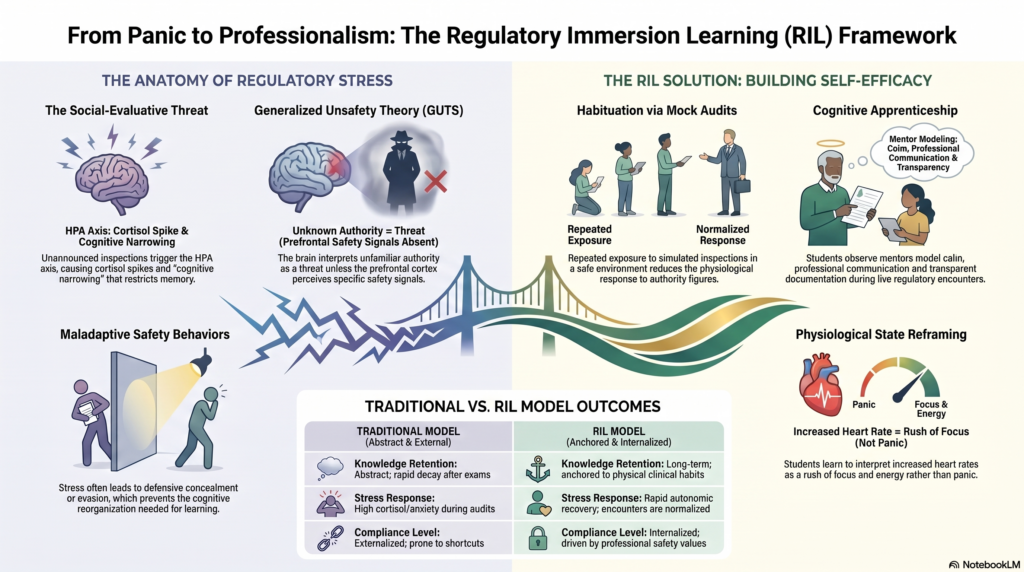

The Psychobiological Architecture of Authority, Stress, and Compliance

Neuroendocrine Cascade of the Social-Evaluative Threat

The unannounced arrival of a regulatory enforcement officer within a licensed professional training environment triggers a highly predictable, phylogenetically ancient psychobiological stress response1. In human psychology, the perception of an authority figure armed with the power to penalize, fine, or shut down operations is categorized as a high-stakes social-evaluative threat1. The primary biological mechanism driving this reaction is the rapid activation of the hypothalamic-pituitary-adrenal (HPA) axis and the sympathetic-adrenal-medullary (SAM) system4.

Clinical evaluations using the Trier Social Stress Test (TSST) demonstrate that situations combining social-evaluative threat, uncontrollability, and anticipation consistently produce massive physiological spikes in salivary and blood serum cortisol, alongside rapid elevations in heart rate, blood pressure, and salivary alpha-amylase (sAA)1. This autonomic arousal is accompanied by acute state anxiety, which can be measured clinically via the Generalized Anxiety Disorder 7-item (GAD-7) scale, showing transitions from minimal baseline scores to severe anxiety ranges during active enforcement encounters6.

                [Unannounced Regulatory Inspector Arrival]
                                    │
                        (Social-Evaluative Threat)
                                    ▼
                    [Sympathetic Autonomic Activation]
                                    │
            ┌───────────────────────┴───────────────────────┐
            ▼                                               ▼
  [SAM System: Fast]                              [HPA Axis: Sustained]
    – Epinephrine release                           – Cortisol cascade
    – Heart rate & sAA spikes                       – Cognitive narrowing
    – Mobilization of threat defense                – Behavioral anxiety

The Generalized Unsafety Theory of Stress

This systemic response is further illuminated by the Generalized Unsafety Theory of Stress (GUTS), which posits that the physiological stress response is a default state that remains active unless the prefrontal cortex actively perceives specific, reliable signals of safety8. Under the GUTS model, the human brain default-interprets an unfamiliar authority encounter as unsafe8. When an inspector arrives, the absence of an immediate safety context prevents prefrontal-subcortical inhibition, leaving the fight-or-flight default response fully disinhibited8.

This state of generalized unsafety induces cognitive narrowing, wherein the individual’s working memory capacity is severely restricted, limiting their ability to recall complex administrative regulations, access documentation, or communicate professionally8.

Compliance Psychology and Safety Behaviors

To manage this acute discomfort, individuals frequently adopt “safety behaviors”—defined in behavioral psychology as unnecessary, dysfunctional actions taken to prevent, escape from, or reduce the immediate severity of a perceived threat10. In a regulatory enforcement context, safety behaviors manifest as defensive concealment, paper-shuffling, evasion of verbal interaction, or performative compliance designed solely to expedite the inspector’s departure9.

While these behaviors may temporarily alleviate immediate anxiety, they prevent the cognitive reorganization and emotional regulation required for authentic learning10. Instrumental deterrence models of regulation, which rely heavily on punitive sanctions and monitoring, inadvertently reinforce these fear-driven dynamics11. This erodes the regulatee’s intrinsic commitment to professional standards and replaces genuine self-regulation with defensive, risk-avoiding maneuvers11.

Sociocultural and Geographic Dimensions of Government Trust

The baseline psychobiological reaction to regulatory authority is heavily moderated by the cultural, historical, and geographic backgrounds of the individuals undergoing the encounter14. For educational institutions serving diverse student bodies, understanding these nuances is critical to transforming fear into professional agency16.

Comparative Immigrant Perceptions of State Authority

First-generation immigrants often view and experience regulatory bodies through a “dual frame of reference,” evaluating the administrative host environment against the historical performance and corruption levels of their countries of origin17.

The table below provides an analytical comparison of immigrant perceptions of government authority across diverse geopolitical regions of origin:

Region of OriginHistorical / Administrative ContextFirst-Generation Behavioral BiasSecond-Generation Trust Divergence
United States (Native-Born)Deep historical values of constitutional due process; moderate institutional trust17.Relies on procedural safeguards; comfortable requesting legal representation22.Serves as the baseline standard; highly sensitive to systemic enforcement biases18.
VietnamPost-war bureaucratic models; history of centralized control and administrative opacity3.High outward compliance driven by caution; internal avoidance of state agents3.Rapid assimilation to US standards; lower tolerance for arbitrary state actions17.
ChinaAuthoritarian administrative state; legacy of pervasive civil and commercial surveillance17.Severe risk aversion; immediate compliance with state demands to avoid scrutiny17.Internalizes host-country legal standards; increasingly willing to challenge rules18.
IndiaHeavily bureaucratic administrative structures; legacy of colonial civil service hierarchies14.High reliance on credentials and written stamps; comfortable with slow processes14.Expects rapid, digitized public services; dismissive of archaic paper procedures18.
AfricaPost-colonial instability; history of militarized enforcement in specific regions14.Acute fear of uniforms and unexpected visits; trauma reactions to unannounced audits16.Reappraises regulatory bodies through localized socioeconomic and racial lenses18.
Latin AmericaHistory of structural corruption, arbitrary enforcement, and police-ICE data integration24.Pervasive fear that sharing professional data will lead to deportation or profiling24.Demands structural reform; highly active in labor and civic organizing25.
Eastern EuropePost-Soviet transitional states; legacy of state-directed commercial and political surveillance17.Systemic cynicism toward inspectors; expectation that audits require informal resolution17.Expects absolute institutional transparency and digital accountability18.
Middle EastPervasive surveillance states; post-9/11 domestic security targeting18.High anxiety during unannounced audits; fear of administrative profiling18.Active pushback against structural bias; values-driven engagement with laws18.

This cross-regional analysis demonstrates that immigrant students do not represent a homogenous group25. First-generation immigrants often exhibit “over-confidence” in host institutions early in their residency because they compare them to low-performing home-country institutions17. However, this trust quickly degrades due to acculturative stress, linguistic barriers, and fear of data-sharing between local licensing boards and federal immigration enforcement agencies26. This makes unannounced inspections a potential source of acute trauma24.

Geographic Realities of Rural Communities and Centralized Regulation

In rural areas such as Central Appalachia, the Midwest, and the deep South, the relationship with regulatory agencies is shaped by geographic distance and historical neglect29.

The table below contrasts geographic and cultural interactions with regulators across specific rural landscapes:

Rural RegionGeographic & Infrastructure RealityCultural & Historical ContextDynamic with Regulatory Authorities
Kentucky (General Rural)High distance from state agencies; limited transit; low local budgets31.Deep emphasis on local self-reliance and regional independence31.Skepticism of centralized state rules; preference for relational enforcement32.
Appalachia (Central/Eastern)Severe geographic isolation; systemic neglect of public water/utility infrastructure30.Generational trauma from corporate “company towns” and corrupt local police15.Deeply entrenched moral distrust of state agents; views audits as economic extraction15.
Midwest (Agricultural Belt)Vast distances between county seats; heavy reliance on USDA/state agency programs29.Strong family-farm heritage; high valuation of property rights and local governance15.Respects agricultural standards but resists environmental or labor-related mandates15.
Southern States (Rural Lowlands)Remote county clinics; low density of administrative oversight32.Historically conservative states-rights views; reliance on religious and civic networks15.Suspicion of federal or urban-directed rules; strong reliance on informal compliance32.

In former coal-mining regions of Appalachia and the Midwest, trust in local and state government is distinctively low15. Decades of political neglect have created “geographies of alienation,” where residents avoid municipal systems (such as drinking untreated spring water instead of tap water) because they do not trust the state to protect them33. Consequently, unexpected inspections are frequently perceived as intrusive state targeting, causing rural practitioners to react with defensive avoidance or relational hostility15.

Behavioral Psychology of Normalization, Exposure, and Self-Efficacy

To transform these deeply ingrained stress responses, professional training programs can implement behavioral models designed to transition students from fear to competence38.

[Defensive State: Low Efficacy] ──> Avoidance/Safety Behaviors ──> Sustained Anxiety & Risk
                                        │
                        (Systematic Desensitization / CAM)
                                        ▼
[Adaptive State: High Efficacy] ──> Direct Engagement ──> Emotional Regulation & Compliance [cite: 40, 41]

Habituation and Desensitization Mechanisms

In clinical behavioral psychology, exposure therapy is established as a highly effective model for treating anxiety and avoidance behaviors10. The neurological engine driving exposure therapy is habituation: the gradual diminution of a physiological response to a stimulus when that stimulus is repeatedly presented in a safe, non-punitive environment10.

By systematically exposing students to simulated audits, peer reviews, and unannounced mock inspections, educators can guide them to correct their threat expectations10. The brain learns that the regulator’s presence does not inevitably lead to administrative punishment or economic ruin, allowing the sympathetic nervous system to return to baseline levels during active inspections10.

Cultivating Self-Efficacy Through Albert Bandura’s Social Learning Theory

According to Albert Bandura’s social cognitive theory, self-efficacy—the belief in one’s capability to execute courses of action required to manage prospective situations—is the primary determinant of behavioral adaptation under stress38. Bandura posits that self-efficacy is constructed through four distinct channels:

  1. Mastery Experiences: Engaging in hands-on, successful compliance actions, such as maintaining accurate biometric and manual attendance logs daily38.
  2. Vicarious Experiences (Learning by Observation): Watching clinical mentors and educators interact calmly, transparently, and professionally with state board inspectors23.
  3. Verbal Persuasion: Receiving realistic, constructive feedback from instructors during mock audits, which reinforces the student’s compliance capabilities38.
  4. Physiological State Reframing: Learning to interpret physical responses (e.g., increased heart rate) not as a signal of panic, but as a helpful rush of focus and energy4.

By structuring the educational environment so that students repeatedly witness and participate in compliant, procedurally fair interactions with regulators, schools can build a sense of professional agency and psychological safety22. Over time, this shifts the student’s posture from fear-based avoidance to confident, values-aligned self-regulation11.

The Historical Precedent of Experiential and Situated Pedagogy

The integration of real-world compliance activities into vocational curricula is supported by a rich history of experiential and situated educational models39.

Progressive Education and Experiential Learning

John Dewey’s progressive educational philosophy rejected the traditional model of treating students as passive vessels for lecture-based memorization39. Dewey argued that genuine education occurs through active, real-world experiences where students solve problems within their social and physical environments39. This philosophy was formalized by David Kolb into his Experiential Learning Model, which maps a continuous, four-stage learning cycle:

                  ┌────────────────────────────────────────┐
                  │          Concrete Experience           │
                  │   (Observing/conducting live audit)     │
                  └───────────────────┬────────────────────┘
                                      │
                                      ▼
                  ┌────────────────────────────────────────┐
                  │         Reflective Observation         │
                  │ (Deconstructing the audit via an AAR)  │
                  └───────────────────┬────────────────────┘
                                      │
                                      ▼
                  ┌────────────────────────────────────────┐
                  │       Abstract Conceptualization       │
                  │  (Mapping experience to administrative)│
                  │  (      statutes and regulations      )│
                  └───────────────────┬────────────────────┘
                                      │
                                      ▼
                  ┌────────────────────────────────────────┐
                  │          Active Experimentation        │
                  │ (Applying corrective actions in clinic)│
                  └────────────────────────────────────────┘

By anchoring learning in the concrete experience of a regulatory encounter, RIL ensures that abstract administrative laws (such as KRS 317A or 201 KAR 12) are permanently integrated into the student’s daily physical habits39.

Situated Cognition and Communities of Practice

Jean Lave and Etienne Wenger’s situated learning theory suggests that learning is a process of socialization into a distinct “community of practice”49. Novices enter at the periphery of the community, performing simple, low-risk tasks49. As they acquire the language, tools, and social norms of the profession, they move toward full participation49.

When a student participates in a live regulatory encounter alongside an experienced mentor, they are undergoing cognitive apprenticeship46. The instructor makes their clinical reasoning visible, scaffolding the student’s participation until they can confidently manage compliance tasks independently40.

Operational Precedents: Toyota Production System and After Action Reviews

The business and military sectors provide highly structured frameworks for integrating real-world practice with continuous optimization:

  • The Toyota Production System (TPS): Built on the twin pillars of Just-in-Time and Jidoka (automation with a human touch), TPS empowers front-line workers to stop the production line immediately upon detecting an abnormality53. By combining human craftsmanship with technological controls, TPS builds a culture of continuous incremental improvement (Kaizen)53. Every error is treated not as a cause for blame, but as a valuable opportunity to optimize standard work55.
  • The military After Action Review (AAR): Developed by the United States Army in the 1970s, the AAR is a structured, post-training debrief where leaders and soldiers systematically analyze what was planned, what actually occurred, why it occurred, and how the unit can adapt for future success57. The AAR focuses on accountability going forward, creating an organizational culture built on transparency, candor, and continuous collective learning59.

Multi-Industry Regulatory Normalization and Comparative Matrix

High-risk, highly regulated industries have long recognized that separating compliance activities from active training increases operational risk and anxiety61.

The matrix below compares regulatory normalization practices across 18 distinct fields of professional and vocational practice:

Industry / ProfessionPrimary Regulatory / Accrediting BodyCore Compliance Intervention / Educational ModelActive Stress LevelDocumentation & Record-Keeping Standard
MedicineJoint Commission (TJC) / ACGME44Clinical clerkships; bedside rounding; simulated patient encounters46.HighContemporaneous electronic health records (EHR); peer-reviewed patient notes50.
DentistryCODA / State Dental BoardsSupervised patient clinics; peer-reviewed infection control walkthroughs.HighStrict physical-clinical logs; patient consent tracking.
NursingNCSBN / State Boards of NursingHospital residency rounds; mock clinical scenarios; tracer reviews.HighContemporaneous medication administration records (MAR).
PharmacyACPE / State Boards of PharmacyMock pharmacy audits; supervised compounding; sterile environment validation.ModerateMulti-tiered verification logs; chemical waste disposal tracking.
AirlinesFAA62Flight simulator exercises; pre-flight safety checklists; crew resource audits62.HighAutomated flight recorder systems; manual pre-flight checklists62.
ConstructionOSHA / Local Building Departments43Pre-walkthrough safety audits; mock site inspections43.HighIncident reports; daily safety briefing sheets43.
EngineeringABET / NCEESSenior design projects; safety codes verification; environmental impact audits.ModerateRigorous design calculation logs; change-order records.
AccountingSEC / State Boards of AccountancyAuditing simulation internships; mock CPA workpaper reviews.ModerateContemporaneous audit workpapers; strict version-control logs.
LawAmerican Bar Association (ABA)Clinical law clinics; mock trial cross-examinations; client file reviews.HighDetailed time-billing logs; contemporaneous client file notes.
Food SafetyFDA / USDA / County Health29Mock restaurant walkthroughs; sanitation monitoring44.ModerateDaily physical temperature logs; chemical concentration sheets39.
ManufacturingISO / OSHA43Weekly mock inspections; Kaizen safety events; mistake-proofing43.ModerateAutomated quality control logs; standard operating procedures (SOP)54.
ChildcareState HHS / Licensing BoardsMock licensing walkthroughs; safety audits61.ModerateDaily attendance records; child medication/injury logs61.
BankingFDIC / Federal ReserveMock compliance audits; transaction monitoring simulations.ModerateComprehensive financial ledger logs; automated anti-money laundering logs.
InsuranceState Insurance CommissionersActuarial risk simulations; mock policy audits.LowPolicyholder claim files; detailed risk-assessment records.
Hospital Accred.Joint Commission (TJC)44Tracer methodology mock surveys; environmental audits44.HighStandardized quality improvement logs; environment-of-care files44.
MilitaryInspector General (IG) / DoD57Operational readiness reviews; After Action Reviews (AAR)57.HighHighly standardized military operational logs; tactical reports57.
Police AcademiesPOST / State Police CommissionsUse-of-force scenario simulators; mock courtroom testimony.HighIncident reporting logs; body-worn camera audit recordings.
Fire AcademiesNFPA / State Fire MarshalsSimulated burn buildings; safety checklist validations.HighFire run sheets; equipment maintenance tracking logs.

Across these industries, incorporating audits into active training reduces operational anxiety and builds self-efficacy44. When compliance is integrated directly into standard training protocols, professionals view inspections not as a stressful external threat, but as a normal and valuable quality-assurance process43.

The Mechanics of Complaint Systems and Ethical Responses

A common source of regulatory friction is the administrative complaint system, which is designed to protect consumer safety but is often vulnerable to misuse3.

                     [Administrative Complaint Initiated]
                                    │
        ┌──────────────────────────┴──────────────────────────┐
        ▼                                                     ▼
[Legitimate Source]                                  [Malicious Weaponization]
  – Deficient professional standards                   – Competitor harassment
  – Consumer injury / sanitation failure   – Dissatisfied personnel or rival firms [cite: 67]
        │                                                     │
        └──────────────────────────┬──────────────────────────┘
                                    ▼
                    [Board Evaluation & Prioritization]
                                    │
        ┌──────────────────────────┴──────────────────────────┐
        ▼                                                     ▼
[Immediate Jeopardy (10%)]                           [Low Priority / Harm (45%)]
  – Evaluated within 48 hours           – Evaluated within 10 days
        │                                                     │
        └──────────────────────────┬──────────────────────────┘
                                    ▼
                        [Objective Resolution]
                          – 19% Substantiation baseline
                          – Due process response & correction

The Structure of Complaint Intake

Administrative complaints are filed by distinct stakeholders, including:

  1. Consumers: Reporting actual or perceived harm, poor results, or sanitation violations64.
  2. Employees: Reporting labor disputes, safety issues, or non-compliant school practices66.
  3. Competitors (Competitive Harassment): Weaponizing administrative boards to drain the financial and emotional resources of business rivals3.
  4. Anonymous Sources: Initiated to trigger a surprise investigation without facing cross-examination, which is why some state boards legally require signed writings to prevent harassment3.

Substantiation Rates

Federal regulatory databases show that only about 19% of investigated administrative complaints result in a formal deficiency citation66. Conversely, within highly structured, internal corporate complaint hotlines, substantiation rates reach approximately 53% for identified reporters and 47% for anonymous filings70. This gap suggests that many external administrative complaints are unsubstantiated or driven by non-compliance factors, such as competitor harassment or civil disputes3.

Ethical Response Protocols and Procedural Safeguards

Under administrative law systems (such as 201 KAR 12:190 in Kentucky), licensees have clear due process rights when responding to complaints:

  • The Written Notice Mandate: Regulatory enforcement cannot be based on verbal directives or informal instructions69. The licensee is entitled to a formal, signed written complaint detailing the exact statutes violated and the factual allegations69.
  • The Response Period: Licensees are provided a statutory response window (typically 10 to 30 days) to submit a formal, written explanation or correction before disciplinary hearings begin69.
  • The Right to Cure: Under modern progressive regulation statutes, Alternative Compliance Pathways allow licensees to resolve non-safety record-keeping issues through 30-day “Correction Orders” without facing immediate fines or license suspension3.
  • Sovereign Immunity and Nullity: If an administrative board issues an enforcement order without adhering to statutory procedures (such as failing to provide written notice or utilizing unlicensed proctors), the resulting order may be declared void ab initio (invalid from the inception)3. This status legally entitles the licensee to a full refund of any fines paid under the voided order3.

Case Study: Louisville Beauty Academy’s Compliance-by-Design Model

Louisville Beauty Academy (LBA), an immigrant-led beauty college based in Louisville, Kentucky, serves as an active case study for integrating regulatory compliance into vocational education16.

Operational and Compliance Architecture

Led by founder Di Tran, LBA operates under the authority of the Kentucky Board of Cosmetology (KBC), offering state-licensed courses in Cosmetology (1,500 hours), Esthetics (750 hours), and Nail Technology (450 hours)45.

To protect student hours and build regulatory trust, LBA maintains a robust compliance infrastructure:

  • Dual attendance tracking: Under 201 KAR 12:082 § 3(1), LBA maintains both a digital biometric fingerprint timekeeping system and manual paper sign-in sheets at all times45. This dual-verification ensures complete data redundancy and absolute tracking integrity45.
  • Instructional hour caps: In compliance with 201 KAR 12:082 § 4(4), LBA strictly caps credited instruction at 8 hours per day and 40 hours per week45. Any additional hours are logged transparently but remain uncredited, serving as evidence of voluntary study45.
  • Instruction over commerce: Under KRS 317A.130(1), LBA operates solely for education, focusing on mannequin-based skill mastery45. Public model practice is voluntary, ensuring that student clinics are not used as commercial revenue drivers45.

Operational Strengths and Systemic Vulnerabilities

An objective evaluation of LBA’s model reveals both unique strengths and significant operational vulnerabilities:

Unique Strengths

  • Superior Traceability and Integrity: The dual attendance system virtually eliminates timecard manipulation, creating a highly reliable administrative record45.
  • Financial and Regulatory Insulation: By operating as a state-licensed, non-accredited institution with a pay-as-you-go payment model, LBA avoids federal student loan programs72. This structural insulation protects the school from federal gainful employment metrics that undercount actual beauty industry earnings72.
  • Multilingual Inclusivity: Offering instruction and study materials in English, Vietnamese, and Spanish reduces barriers for underserved, low-income, and immigrant student groups16.

Systemic Vulnerabilities

  • High Adversarial Tension with Regulators: LBA’s public records reveal a highly defensive relationship with the KBC3. Allegations concerning “targeted hyper-fining” against minority salons, “shadow testing,” procurement fraud, and immediate-closure orders under SB 22 suggest deep operational friction with the state board3.
  • Risk of Student Stress Transfer: While LBA’s “Gold Standard Guide” aims to reduce fear, exposing students to active, legalistic confrontations (such as utilizing a 30-to-60 minute verification pause or video recording inspectors) may inadvertently heighten student anxiety23. For students who have experienced historical government trauma, observing intense institutional battles may trigger, rather than reduce, autonomic distress8.
  • Resource-Intensive Over-Compliance: Maintaining dual records, AI-driven compliance checks, and constant legal reviews increases administrative costs72. This structural burden is difficult for average-sized vocational schools to sustain without a highly efficient tuition and funding model72.

Important Policy Analysis: The Power of Administrative Records

In public administration and corporate risk management, written records are the primary tool for establishing organizational accountability and protecting constitutional rights9.

The Psychology of Written Correspondence

In high-stress regulatory environments, relying on verbal agreements or informal warnings increases ambiguity and risk3. The “verbal warning trap” occurs when an inspector issues an informal directive that is not backed by a written citation3. The business owner may attempt to comply with the verbal instruction, only to face a formal penalty later for non-compliance with a different, unwritten interpretation of the rule3.

Documenting every interaction through time-stamped, written correspondence provides critical protections:

  • Establishes Institutional Memory: Shifting knowledge from individual memory to structured, digital records reduces reliance on specific personnel and supports continuous improvement9.
  • Creates a Legal Audit Trail: In administrative hearings, undocumented actions are legally presumed not to have occurred63. A clear written record of compliance activities provides defensive protection63.
  • Protects Due Process: Requiring all instructions and findings to be delivered in writing ensures that administrative decisions are objective, consistent, and legally reviewable23.

Post-Inspection Factual Correspondence Policy

A robust risk management strategy includes sending a factual, professional follow-up email immediately after an inspection74. This correspondence does not concede violations or express defensiveness23. Instead, it establishes an objective, written record of what occurred during the encounter23.

This practice aligns with modern administrative guidelines (such as KRS 13B in Kentucky), which entitle parties to written clarification of all rulings and instructions23.

The Regulatory Immersion Learning (RIL) Educational Framework

To systematically integrate regulatory compliance into professional education, institutions can transition from traditional, classroom-bound models to the Regulatory Immersion Learning (RIL) framework39.

Performance and Psychobiological Outcomes Comparison

The table below contrasts the educational and psychological outcomes of traditional lecture models with the live-immersion RIL framework:

Measurement ParameterTraditional Classroom ModelRegulatory Immersion Learning (RIL) Model
Knowledge RetentionAbstract, rapid decay after passing written examinations72.Long-term retention; rules are anchored to physical, memorable clinical actions50.
Confidence & Self-EfficacyLow; students feel unprepared for unannounced, high-stakes state audits38.High; repetitive mock audits and guided exposure build professional agency38.
Professional ReadinessFocuses on textbook compliance; leaves students vulnerable to performative rules45.Instills continuous, standard compliance habits; students are prepared for day-one practice2.
Critical ThinkingLimited to linear, written test-prep scenarios40.High; students dynamically assess real-world hazards and procedural rules46.
Stress ReductionHigh baseline cortisol and anxiety during active enforcement encounters4.Rapid autonomic recovery; regulatory encounters are normalized and expected10.
Long-Term CompliancePerforms under external pressure; prone to shortcuts in private salons11.Self-regulatory compliance driven by internalized professional and safety values11.

Limits and Required Empirical Evidence for Broader Adoption

While the RIL model is conceptually sound, its widespread implementation is limited by several factors:

  1. Inspector Resistance: Some state inspectors may view recording, active questioning, or requests for written instructions as administrative resistance, which could increase regulatory tension23.
  2. Resource Constraints: Managing dual-tracking systems, executing weekly mock audits, and maintaining digital compliance platforms require significant administrative time and investment45.
  3. Trauma-Sensitivity Risks: For students who have experienced historical government trauma, sudden exposure to active regulatory disputes—even with mentors—could trigger survival responses that hinder learning24.

To support broader adoption of the RIL model, empirical research should focus on the following:

  • Objective stress-marker evaluations: Measuring salivary cortisol and heart-rate variability (HRV) in students during mock and real audits to confirm systemic desensitization4.
  • Longitudinal compliance tracking: Monitoring graduates’ compliance and citation rates over their first five years in business77.
  • Linguistic and accessibility studies: Measuring compliance learning speeds in multilingual classrooms when legal statutes are paired with visual, AI-supported tools78.

Practical Institutional Blueprints and Curricular Deliverables

To transition the theoretical RIL framework into an operational model, schools can implement the following curricula, standard operating procedures, and professional communication templates.

RIL Integrated Cosmetology / Esthetics Curriculum (16-Week Outline)

=================================================================================
COURSE CODE: RIL-101
TITLE: REGULATORY LAW, INFECTION CONTROL, AND ADMINISTRATIVE SAFETY IN CLINIC
=================================================================================
WEEK 1: INTRODUCTION TO STATE ADMINISTRATIVE LAW & EXECUTIVE ETHICS
  – Coursework: KRS Chapter 317A, KRS Chapter 11A, and 201 KAR 12:082 [cite: 51, 72].
  – Practical: Biometric timekeeping orientation; signature sheet verification.
  – Exercise: Reconstructing a timecard error; drafting an administrative correction log.

WEEK 2: DISINFECTION CHEMISTRY & PUBLIC HEALTH PRINCIPLES
  – Coursework: OSHA Hazard Communication Standard; Safety Data Sheet (SDS) interpretation.
  – Practical: Mixing chemical solutions according to manufacturer instructions.
  – Exercise: Mock chemical spill drill; evaluating workstation contact times [cite: 39, 80].

WEEK 3: DECONSTRUCTING THE SOCIAL-EVALUATIVE THREAT
  – Coursework: Human physiology of stress; the HPA axis and cortisol spikes.
  – Practical: Controlled deep-breathing drills; mental toughness and stress-reframing.
  – Exercise: Simulated unannounced instructor-led safety sweeps under pressure.

WEEK 4: THE PSYCHOLOGY OF DOCUMENTATION AND TRACEABILITY
  – Coursework: Why undocumented procedures fail; technical communication standards [cite: 9, 63].
  – Practical: Operating daily sanitation logs; validating inventory tracking systems [cite: 44].
  – Exercise: Structured peer reviews of workstation compliance documentation.

WEEKS 5-8: COGNITIVE APPRENTICESHIP IMMERSION (CLINIC ENCOUNTERS)
  – Coursework: Jean Lave’s situated cognition; the six dimensions of CAM [cite: 40, 46, 49].
  – Practical: Observing instructors model compliance during simulated audits [cite: 23, 52].
  – Exercise: Roleplaying as inspector, manager, and student; modeling verbal etiquette scripts.

WEEKS 9-12: PEER-AUDITING SYSTEMS & KAIZEN LABS
  – Coursework: Lean manufacturing and the Toyota Production System; Kaizen theory [cite: 53, 81].
  – Practical: Conducting weekly mock inspections on other student workstations.
  – Exercise: Mock “tracer surveys” using Joint Commission methods.

WEEKS 13-15: STRUCTURAL COMPLAINT SIMULATIONS
  – Coursework: Understating complaint systems; due process and rights to respond [cite: 66, 69].
  – Practical: Responding to simulated consumer complaints using factual, written logs.
  – Exercise: Draft responses to KBC-style complaints under 201 KAR 12:190.

WEEK 16: CAPSTONE EXPERIENTIAL ASSESSMENT & AFTER ACTION REVIEWS
  – Coursework: Continuous improvement and post-audit learning loops [cite: 57, 60, 82].
  – Practical: Conducting a complete After Action Review (AAR) of the course’s mock audits [cite: 57, 59].
  – Exercise: Final practical examination; managing a surprise, unannounced mock inspection.
=================================================================================

Faculty Guide: Step-by-Step Instructional SOP for Live Audits

=================================================================================
SOP NUMBER: RIL-INST-04
TITLE: MANAGING LIVE REGULATORY ENCOUNTERS AS INSTRUCTIONAL CLASSROOMS
=================================================================================
1. OBJECTIVE:
  To ensure that when a state regulatory inspector arrives, faculty members
  remain calm, protect due process rights, and actively use the encounter
  as a live learning experience for observing students.

2. PREPARATION:
  Keep a laminated copy of the LBA “Inspection Transparency & Verification
  Rights Notice” at the front desk and at all active instruction areas.

3. WHEN THE INSPECTOR ARRIVES:
  A. STEP 1: INITIAL RECEPTION
      – Welcome the inspector politely and professionally.
      – Do NOT halt active classroom instruction or panic [cite: 23, 83].
      – Hand the inspector a copy of the LBA Transparency Notice.
 
  B. STEP 2: VERBAL PROTOCOL (SAY ALOUD)
      “Good morning! We welcome your visit and appreciate your work. We just follow
      a standard compliance process to make sure everything is accurate and fair.
      Here’s our Inspection Transparency & Verification Rights Notice. It simply
      explains that under Kentucky law, we’re allowed to take about 30 to 60 minutes
      to review any request or rule, record the visit for documentation, and verify
      things with our compliance team before we respond or sign anything. This helps
      us stay consistent with KRS 13B and 317A — and it keeps everything transparent
      for both sides. We’ll cooperate fully — we just want to make sure everything
      we do is right by the law and clear for our records. Thank you!”

  C. STEP 3: STUDENT POSITIONING
      – Direct students working in the immediate area to pause and observe.
      – Quietly explain the inspector’s actions to nearby students (e.g., “The
        inspector is verifying that all student licenses are posted at active
        workstations according to KBC regulations”) [cite: 23, 51, 71].

  D. STEP 4: RECORDING & DOCUMENTATION
      – Activate a clean, high-definition digital recording device.
      – Explicitly reference Kentucky’s one-party consent statute (KRS 526.020)
        and the school’s educational duty under KRS 317A.130(1)(f).
      – If an inspector makes an observation or deficiency claim, request that
        they reduce the instruction or legal citation to writing.

  E. STEP 5: DECONSTRUCTION DEBRIEF
      – Once the inspector departs, call an immediate 15-minute student assembly.
      – Conduct a mini After Action Review (AAR) to analyze what went well,
        what went less well, and how the school will adapt [cite: 57, 60, 80].
=================================================================================

Student Handbook Addendum: Safety & Regulatory Rights Notice

=================================================================================
SECTION 8.4: YOUR COMPLIANCE RESPONSIBILITIES AND DUE PROCESS RIGHTS
=================================================================================
As a student training toward state licensure, you are a professional-in-training
responsible for protecting public health and safety. Our academy
operates under a “Compliance-by-Design” framework, meaning that safety, state
law, and regulatory standards are integrated into your daily habits.

YOUR CORE COMPLIANCE RESPONSIBILITIES:
1. DAILY TIMESTAMPS: You must record your attendance using the biometric fingerprint
  scanner and manual sign-in sheet every time you enter or exit.
2. SANITATION MASTERY: You must maintain a clean, disinfected workstation at all
  times, following all sanitation procedures under 201 KAR 12 [cite: 39, 51].
3. FACTUAL ACCOUNTABILITY: You are training to understand that your progress logs
  and clinic hours represent legally binding evidence submitted to the state.

YOUR CONSTITUTIONAL AND ADMINISTRATIVE RIGHTS DURING INSPECTIONS:
1. THE RIGHT TO A CALM RESPONSE: You are never required to panic or rush when an
  inspector arrives. You are legally entitled to a 30-to-60 minute window to verify
  regulatory rules and retrieve correct records before answering.
2. THE RIGHT TO WRITTEN INSTRUCTIONS: Under KRS 13B.090(7), you have the right to
  request that any inspector directive or cited deficiency be provided in clear,
  verifiable writing.
3. THE RIGHT TO PROFESSIONAL RECORDING: Under KRS 526.020, you have the right to
  record audio or video of regulatory encounters for compliance training.
4. THE RIGHT TO AN ETHICAL REMEDY: If an administrative warning or complaint is
  issued, you have the right to written clarification, explanation, and a formal
  opportunity to respond and correct errors.
=================================================================================

Post-Inspection Verification Letter Template

=================================================================================
DATE: [Insert Date]
TO: Joni Upchurch, Executive Director, Kentucky Board of Cosmetology [cite: 45, 69]
FROM: Compliance Office, Louisville Beauty Academy
SUBJECT: POST-INSPECTION COMPLIANCE VERIFICATION & ADMINISTRATIVE RECORD
=================================================================================
Dear Director Upchurch,

This correspondence is submitted to establish an accurate administrative record of the
routine facility inspection conducted at Louisville Beauty Academy (Location: [Insert
Campus Address]) on [Insert Date] at approximately [Insert Time].

We appreciated welcoming Inspector [Insert Name] to our campus. In alignment with
our educational mission under KRS 317A.130(1)(f), our students actively observed the
inspection process as part of our Regulatory Immersion Learning curriculum.

During the walkthrough, the following observations and corrections were noted:
1. WORKSTATION SANITATION: All active student stations were found in compliance
  with disinfection procedures under 201 KAR 12 [cite: 39, 51].
2. DUAL ATTENDANCE RECORDS: Daily biometric and manual attendance logs were verified,
  confirming complete record alignment under 201 KAR 12:082 § 3.
3. CITED OBSERVATION / ADMONISHMENT: Inspector [Insert Name] noted a compliance
  discrepancy regarding [Insert Specific Issue, e.g., chemical container labeling],
  citing regulation [Insert Exact Regulation Code] [cite: 51, 69].

ADMINISTRATIVE DUE PROCESS & SYSTEMIC PLAN OF ACTION:
A. IN-THE-MOMENT CORRECTION: LBA instructors immediately corrected the noted container
  labeling discrepancy in the presence of the inspector to ensure compliance [cite: 74].
B. REQUEST FOR WRITTEN DOCUMENTATION: In accordance with KRS 13B.090(7), we request
  that any official board rulings or instructions regarding this observation be
  reduced to writing and emailed to study@louisvillebeautyacademy.net.
C. STATUTORY CURE WINDOW: If the Board intends to pursue formal administrative actions
  or agreed orders, we formally request our 30-day statutory cure window to respond
  with written evidence of systemic corrections.

Louisville Beauty Academy remains committed to transparency, open communication, and the
collaborative maintenance of rigorous public-safety standards [cite: 23, 76, 84].

Respectfully submitted,

___________________________________________
Di Tran, Founder & CEO, Louisville Beauty Academy [cite: 73]
With the LBA Digital and Compliance Leadership Team [cite: 83]
=================================================================================

After-Action Review (AAR) Discussion Protocol

=================================================================================
PROTOCOL CODE: RIL-AAR-01
TITLE: FACILITATING CLINICAL AFTER-ACTION REVIEWS POST-INSPECTION
=================================================================================
AAR TIMING: To be conducted within 2 hours of inspector departure.
PARTICIPANTS: Active students, supervising instructors, and compliance managers [cite: 59, 82].
FACILITATOR RULES: No finger-pointing or blame; focus on forward-looking accountability.

DISCUSSION QUESTIONS FLOW:

1. WHAT WAS THE PLAN? (Core Strategy Check)
  – What administrative regulations and sanitation codes were we trying to
    demonstrate under KRS 317A and 201 KAR Chapter 12?
  – How was our team prepared to receive the inspector professionally?

2. WHAT ACTUALLY OCCURRED? (Factual Reconstruction)
  – Walk through the walkthrough chronologically. What did the inspector look at first? [cite: 2, 57]
  – How did the team react? Did anyone panic or deploy avoidance behaviors? [cite: 1, 10]
  – What compliance deficiencies or positive practices were noted? [cite: 43, 44]

3. WHY DID IT HAPPEN THAT WAY? (Root-Cause Analysis)
  – If an error was noted, did it stem from a lack of knowledge, an unclear
    workstation routine, or stress-induced cognitive narrowing? [cite: 4, 8, 40]
  – If our team reacted calmly, what specific training or safety signals allowed
    us to maintain prefrontal-cortisol control? [cite: 4, 8, 41]

4. WHAT WILL WE DO NEXT TIME? (Action & Adaptation Plan)
  – What specific Standard Operating Procedures must be updated or clarified? [cite: 56, 60]
  – Who is responsible for tracking corrective steps, and when will they be done? [cite: 60, 63]
  – How can we share these lessons learned with our broader community of practice? [cite: 49, 59]
=================================================================================

Synthesized Strategic Conclusions

By analyzing the provided empirical data, sociological studies, behavioral psychological frameworks, and regulatory legal structures, researchers can synthesize several key conclusions regarding the feasibility of the Regulatory Immersion Learning (RIL) model.

                  ┌────────────────────────────────────────┐
                  │          ESTABLISHED EVIDENCE          │
                  │   Rote memorization alone does not     │
                  │   reduce acute autonomic panic during  │
                  │   unannounced state inspections.│
                  └───────────────────┬────────────────────┘
                                      │
                                      ▼
                  ┌────────────────────────────────────────┐
                  │           EMERGING EVIDENCE            │
                  │   Exposure, mock tracer reviews, and   │
                  │   mentorship significantly lower stress│
                  │   and improve compliance [cite: 44, 46, 62].│
                  └───────────────────┬────────────────────┘
                                      │
                                      ▼
                  ┌────────────────────────────────────────┐
                  │         PRACTICAL OBSERVATION          │
                  │   LBA’s dual-verification system and   │
                  │   Gold Standard protocol protect       │
                  │   student hours and rights [cite: 23, 45].│
                  └───────────────────┬────────────────────┘
                                      │
                                      ▼
                  ┌────────────────────────────────────────┐
                  │               HYPOTHESIS               │
                  │   RIL will produce long-term self-     │
                  │   regulation, resulting in lower state │
                  │   violations for graduates [cite: 11, 39].│
                  └────────────────────────────────────────┘

Established Evidence

  • The sudden arrival of a regulatory inspector is a social-evaluative threat that triggers immediate sympathetic arousal and a cortisol spike in unprepared individuals1.
  • Traditional, lecture-based memorization of administrative rules does not prevent stress-induced cognitive narrowing during unannounced enforcement events4.
  • First-generation immigrants demonstrate a “dual frame of reference,” exhibiting high baseline trust in public institutions that erodes over time and across generations due to acculturative stress17.
  • For marginalized and historically trauma-exposed populations, unexpected regulatory encounters can trigger survival responses if state agents are perceived as threatening or punitive8.
  • Meticulous, contemporaneous written documentation significantly reduces organizational risk, establishes institutional memory, and serves as vital defensive evidence in administrative hearings9.

Emerging Evidence

  • Incorporating systematic exposure therapy, mock tracer audits, and pre-inspection walkthroughs into technical training decreases client/student anxiety and improves quality-assurance outcomes43.
  • Cognitive apprenticeship models—wherein students observe experienced mentors model compliance and professional communication during inspections—accelerate the development of a strong professional identity12.
  • Process-based regulatory systems, built on Tom Tyler’s procedural justice principles (dignity, neutrality, voice, and trust), are superior to instrumental deterrence models because they nurture intrinsic, voluntary compliance11.
  • When individuals participate in simulated After Action Reviews (AARs) post-audit, they demonstrate improved retention of safety standards and a stronger commitment to forward-looking operational corrections57.

Practical Observations

  • Louisville Beauty Academy’s dual biometric and manual attendance tracking systems protect student hours, prevent data loss, and verify the accuracy of submitted certification records45.
  • The school’s low-cost, pay-as-you-go financial model insulates students from high student loan debt while protecting the school from federal gainful-employment penalties72.
  • While the academy’s “Gold Standard Guide” asserts critical due process rights (such as the KRS 13B verification pause and Kentucky’s KRS 526.020 one-party recording law), it coexists with significant legal tension and conflict with state regulators3.
  • Using mannequins as the primary instructional tool, in accordance with KRS 317A.130(1), ensures that student clinics remain educational spaces rather than commercial revenue-generating salons45.

Hypotheses

  • Students who complete their vocational training under a formalized Regulatory Immersion Learning (RIL) framework will exhibit lower state board violations and fewer compliance issues during their first five years of active professional practice39.
  • Integrating AI-assisted, human-verified document synthesis into vocational training programs will lower administrative costs, decrease error rates, and improve the school’s regulatory standing9.
  • Cultivating compliance-by-design training models within historically marginalized or immigrant-led professional communities will systematically reduce their vulnerability to competitor harassment and predatory fines, leading to higher long-term small-business survival rates2.

Works cited

  1. Trier social stress test – Wikipedia, https://en.wikipedia.org/wiki/Trier_social_stress_test
  2. Online Courses Archives – Louisville Beauty Academy, https://louisvillebeautyacademy.net/category/online-courses/
  3. Tag: Kentucky cosmetology law – Louisville Beauty Academy, https://louisvillebeautyacademy.net/tag/kentucky-cosmetology-law/
  4. Multi-systemic evaluation of biological and emotional responses to the Trier Social Stress Test: A meta-analysis and systematic review – PubMed, https://pubmed.ncbi.nlm.nih.gov/36410619/?utm_source=gquery
  5. Neuroendocrine and psychometric evaluation of a placebo version of the ‘Trier Social Stress Test’ – PubMed, https://pubmed.ncbi.nlm.nih.gov/19307062/
  6. Generalized Anxiety Disorder 7-item (GAD-7) – Mental Health Screening, https://www.hiv.uw.edu/page/mental-health-screening/gad-7
  7. GAD-7_Anxiety-updated_0.pdf – Anxiety and Depression Association of America, ADAA, https://adaa.org/sites/default/files/2026-01/GAD-7_Anxiety-updated_0.pdf
  8. Generalized Unsafety Theory of Stress: Unsafe Environments and Conditions, and the Default Stress Response – PMC, https://pmc.ncbi.nlm.nih.gov/articles/PMC5877009/
  9. Why People Resist Writing Technical Documents, https://www.techwriting.co.uk/technical-documentation-psychology/
  10. Is There Room for Safety Behaviors in Exposure Therapy for Anxiety Disorders? – UT Psychology Labs, https://labs.la.utexas.edu/telch/files/2015/02/Is-There-Room.pdf
  11. MECHANISMS OF LEGAL EFFECT: PROCEDURAL JUSTICE THEORY – Center for Public Health Law Research, https://phlr.org/sites/default/files/downloads/resource/CPHLR-TheoryMethods2023_ProceduralJustice.pdf
  12. About – UW Department of Psychiatry, https://www.psychiatry.wisc.edu/education-training/psychology-internship/about/
  13. Restorative Justice and Procedural Justice: Dealing with Rule Breaking, https://courses.washington.edu/pbafhall/514/514%20Readings/tyler%20justice.pdf
  14. Migrants in society: diversity and cohesion | IOM, https://www.iom.int/resources/migrants-society-diversity-and-cohesion-graeme-hugo
  15. How Company Towns Eroded Local Democracy – Hoover Institution, https://www.hoover.org/research/how-company-towns-eroded-local-democracy
  16. Louisville Beauty Academy Strategic Expansion Overview, https://louisvillebeautyacademy.net/louisville-beauty-academy-strategic-expansion-overview/
  17. What Explains Immigrants’ High Levels of Trust in Host Country Institutions? – ResearchGate, https://www.researchgate.net/publication/241728799_What_Explains_Immigrants’_High_Levels_of_Trust_in_Host_Country_Institutions
  18. Differences in confidence in public institutions across generations of Canadians, https://www150.statcan.gc.ca/n1/pub/36-28-0001/2024008/article/00002-eng.htm
  19. Low expectations or different evaluations – What explains immigrants’ high levels of trust in host country institutions? – Publikationsserver UB Marburg, https://archiv.ub.uni-marburg.de/es/2019/0053/pdf/armj.pdf
  20. Low Expectations or Different Evaluations: What Explains Immigrants’ High Levels of Trust in Host-Country Institutions? – SciSpace, https://scispace.com/pdf/low-expectations-or-different-evaluations-what-explains-aozwdz0tpf.pdf
  21. Tom R. Tyler – Annual Reviews, https://www.annualreviews.org/content/journals/10.1146/annurev-lawsocsci-110722-074236?crawler=true&mimetype=application/pdf
  22. Procedural Justice | National Initiative, https://trustandjustice.org/resources/intervention/procedural-justice
  23. Kentucky Beauty Licensee’s Gold Standard Guide for Lawful, Professional, and Transparent Interaction with Inspectors and Law Enforcement, https://louisvillebeautyacademy.net/kentucky-beauty-licensees-gold-standard-guide-for-lawful-professional-and-transparent-interaction-with-inspectors-and-law-enforcement/
  24. JESÚS G. GARCÍA, and LUIS ARROYO JR, County Commissioners RESOLUTION CALLING FOR THE DIGNIFI, http://immigrantjustice.org/sites/default/files/CookCountyRes16-1065.pdf
  25. Manufacturing the Migrant Threat: Race, Politics, and Human Rights, https://www.humanrightsresearch.org/post/manufacturing-the-migrant-threat-race-politics-and-human-rights
  26. Barriers to Immigrants’ Access to Health and Human Services Programs – ASPE.hhs.gov, https://aspe.hhs.gov/reports/barriers-immigrants-access-health-human-services-programs-0
  27. The Impact of Immigration and Customs Enforcement on Immigrant Health: Perceptions of Immigrants in Everett, Massachusetts, USA – PMC, https://pmc.ncbi.nlm.nih.gov/articles/PMC3159749/
  28. A qualitative study exploring the perinatal experiences of social stress among first- and second-generation immigrant parents in Quebec, Canada – PMC, https://pmc.ncbi.nlm.nih.gov/articles/PMC11370249/
  29. Livable Communities in Appalachia | US EPA, https://www.epa.gov/smartgrowth/livable-communities-appalachia
  30. 3 Bright Spots for Rural Appalachia—and 3 Struggles Compared to the Rest of Rural America, https://www.prb.org/news/3-bright-spots-for-rural-appalachia-and-3-struggles-compared-to-the-rest-of-rural-america/
  31. Appalachia Rising – ERIC, https://files.eric.ed.gov/fulltext/ED612954.pdf
  32. Rural Crime and Rural Policing – National Institute of Justice, https://www.ojp.gov/pdffiles/rcrp.pdf
  33. Geographies of Alienation (Chapter 6) – The Profits of Distrust, https://www.cambridge.org/core/books/profits-of-distrust/geographies-of-alienation/E2F85AB3746E7E4D53515CE715DE65B1
  34. Government Distrust and a Dead Census Taker – TIME, https://time.com/archive/6915225/government-distrust-and-a-dead-census-taker/
  35. Duty to Serve Eligibility Data – Federal Housing Finance Agency (FHFA), https://www.fhfa.gov/data/duty-to-serve/eligibility-data
  36. What About Rural? Food Policy Advocacy in Appalachia, https://chlpi.org/news-and-events/news-and-commentary/commentary/what-about-rural-food-policy-advocacy-in-appalachia/
  37. Social Determinants of Safety in a Rural Community, https://www.cambridge.org/core/elements/social-determinants-of-safety-in-a-rural-community/2E9A9D5713804D8F15DCD933A5E7990D
  38. Self-Efficacy in Changing Societies – ResearchGate, https://www.researchgate.net/profile/Barry-Zimmerman-2/publication/247480203_Self-efficacy_and_educational_development/links/549b67770cf2b80371371ad5/Self-efficacy-and-educational-development.pdf
  39. ditranllc, Author at Louisville Beauty Academy – Louisville KY – Page 18 of 72, https://louisvillebeautyacademy.net/author/ditran/page/18/
  40. From Model to Mentor: Embedding Cognitive Apprenticeship in AI Agent Prompts – EdTech Books, https://edtechbooks.org/promptbook/from-model-to-mentor
  41. RECASTing Racial Stress and Trauma: Theorizing the Healing Potential of Racial Socialization in Families – PMC, https://pmc.ncbi.nlm.nih.gov/articles/PMC8807344/
  42. A Quantitative Investigation Exploring the Psychological and Physiological Aspects of Individual Resilience, Rumination and Recovery – Surrey Open Research repository, https://openresearch.surrey.ac.uk/view/pdfCoverPage?instCode=44SUR_INST&filePid=13155590600002346&download=true
  43. Compliance Audits & Consulting – GMEC Education, https://gmec-emt.com/compliance-audits-consulting/
  44. All you need to know about mock inspections – Acutecaretesting.org, https://acutecaretesting.org/en/articles/all-you-need-to-know-about-mock-inspections
  45. Kentucky’s Model of Legal Compliance, Education Integrity, and Licensing Excellence – Louisville Beauty Academy, https://louisvillebeautyacademy.net/louisville-beauty-academy-kentuckys-model-of-legal-compliance-education-integrity-and-licensing-excellence/
  46. Investigating the role of clinical exposure on motivational self-regulation skills in medical students based on cognitive apprenticeship model – PMC, https://pmc.ncbi.nlm.nih.gov/articles/PMC10921607/
  47. Mock Audits & Findings-Based Training – Barnett International, https://www.barnettinternational.com/pages/mock-audits-findings-based-training
  48. Examining Communibiology During Adrenal Stress Scenario Training in Feminist Self-Defense: An Experimental Study – SJSU ScholarWorks, https://scholarworks.sjsu.edu/cgi/viewcontent.cgi?article=8900&context=etd_theses
  49. Democratizing Specialized Care in the Digital Age: Project ECHO as a Learning Environment for Continuing Professional Development – MDPI, https://www.mdpi.com/2227-9032/14/7/824
  50. Designing and Implementing a Novel Virtual Rounds Curriculum for Medical Students’ Internal Medicine Clerkship During the COVID-19 Pandemic | MedEdPORTAL, https://www.mededportal.org/doi/10.15766/mep_2374-8265.11106
  51. Louisville Beauty Academy – The 10 Professional Compliance Standards for Beauty School Students – DAILY STUDENT ROUTINE, https://louisvillebeautyacademy.net/louisville-beauty-academy-the-10-professional-compliance-standards-for-beauty-school-students-daily-student-routine/
  52. Using the cognitive apprenticeship model to identify learning strategies that learners view as effective in ward rounds – ProQuest, https://search.proquest.com/openview/17fe92ae25fcbfffa895338eabd97814/1?pq-origsite=gscholar&cbl=2041054
  53. Toyota Production System | Vision & Philosophy | Company | Toyota Motor Corporation Official Global Website, https://global.toyota/en/company/vision-and-philosophy/production-system/
  54. How to Implement the Toyota Production System: A Complete Guide to Lean Manufacturing Excellence, https://lean6sigmahub.com/how-to-implement-the-toyota-production-system-a-complete-guide-to-lean-manufacturing-excellence/
  55. What is kaizen and how does Toyota use it? – Toyota UK Magazine, https://mag.toyota.co.uk/kaizen-toyota-production-system/
  56. Kaizen Training & Certification Programs – Shinka Management, https://shinkamanagement.com/kaizen-training/
  57. The After-Action Review – Virginia Defense Force, https://vdf.virginia.gov/pdf/FORMS/After%20Action%20Review.pdf
  58. Improving After Action Review – Army University Press, https://www.armyupress.army.mil/Journals/Journal-of-Military-Learning/Journal-of-Military-Learning-Archives/April-2022/Cates-Action-Review/
  59. After-Action Reviews: A Simple Yet Powerful Tool – Wharton Executive Education, https://executiveeducation.wharton.upenn.edu/thought-leadership/wharton-at-work/2021/07/after-action-reviews-simple-tool/
  60. After-Action Reviews (AARs) as a “Force Multiplier” | Thayer Leadership, https://thayerleadership.com/leadership-blog/after-action-reviews-aars-as-a-force-multiplier/
  61. MHS Inspection Tool Joint Commission Mock Survey – Safety Culture, https://safetyculture.com/library/health-care/mhs-inspection-tool-joint-commission-mock-survey-tool
  62. Mock DOT and OSHA Audits | HUB International, https://www.hubinternational.com/blog/2021/03/mock-dot-and-osha-audits/
  63. AHPRA Psychology Registration: What Your Supervision Records Actually Need to Show, https://www.groundedscribe.com/library/ahpra-psychology-registration-supervision-requirements-guide
  64. Tag: importance of salon inspections – Louisville Beauty Academy, https://louisvillebeautyacademy.net/tag/importance-of-salon-inspections/
  65. Mock Audit Prior to Accreditation or PQ (Laboratory) – USP, https://www.usp.org/events-training/course/mock-audit-prior-accreditation-or-pq-laboratory
  66. GAO-11-280 Nursing Homes: More Reliable Data and Consistent Guidance Would Improve CMS Oversight of State Complaint Investigatio, https://www.gao.gov/assets/gao-11-280.pdf
  67. Louisville Beauty Academy Legal Policies, Disclosures, Waiver, and Student Responsibility Notice, https://louisvillebeautyacademy.net/louisville-beauty-academy-liability-waiver-for-unforeseen-circumstances-and-state-regulations/
  68. GAO-11-280, Nursing Homes: More Reliable Data and Consistent Guidance Would Improve CMS Oversight of State Complaint Investigations, https://www.gao.gov/assets/a317518.html
  69. Kentucky Beauty Law: Due Process, Written Enforcement, and Licensed Facility Protections – 201 KAR 12:190 — Complaint and Disciplinary Process – DECEMBER 2025, https://louisvillebeautyacademy.net/kentucky-beauty-law-due-process-written-enforcement-and-licensed-facility-protections-201-kar-12190-complaint-and-disciplinary-process-december-2025/
  70. How to Cut Days from your issue open rate and closes CASES faster, https://6396478.fs1.hubspotusercontent-na1.net/hubfs/6396478/Next.js%20Resources/Issue%20Intake%20How%20to%20Cut%20Days%20From%20Your%20Issue%20Open%20Rate.pdf
  71. cosmetology unlicensed practice Kentucky Archives – Louisville Beauty Academy, https://louisvillebeautyacademy.net/tag/cosmetology-unlicensed-practice-kentucky/
  72. Gold‑Standard Over‑Compliance, Ethical Automation, and Humanization in Beauty Education: Louisville Beauty Academy as an Observable Case Study – RESEARCH & PODCAST SERIES 2025 – Di Tran University, https://ditranuniversity.com/gold-standard-over-compliance-ethical-automation-and-humanization-in-beauty-education-louisville-beauty-academy-as-an-observable-case-study-research-podcast-series-2025/
  73. Louisville Beauty Academy & Di Tran University: A Comprehensive Strategic Research Paper on Federal Workforce Law, Accreditation Reform, and the Path to AI-Driven Excellence – RESEARCH & PODCAST SERIES 2026, https://naba4u.org/2026/05/louisville-beauty-academy-di-tran-university-a-comprehensive-strategic-research-paper-on-federal-workforce-law-accreditation-reform-and-the-path-to-ai-driven-excellence-research-podca/
  74. Tag: salon owner rights – Louisville Beauty Academy, https://louisvillebeautyacademy.net/tag/salon-owner-rights/
  75. Tag: filing a complaint – Louisville Beauty Academy, https://louisvillebeautyacademy.net/tag/filing-a-complaint/
  76. Louisville Beauty Academy: Our Direction Forward (2026 and Beyond), https://louisvillebeautyacademy.net/louisville-beauty-academy-our-direction-forward-2026-and-beyond/
  77. Testing Responsive Regulation in Regulatory Enforcement – Melbourne Law School, https://law.unimelb.edu.au/__data/assets/pdf_file/0011/1675064/NielsenandParkerTestingResponsiveRegulationinRegulatoryEnforcementPreprintformat1.pdf
  78. Tag: online nail technology course – Louisville Beauty Academy, https://louisvillebeautyacademy.net/tag/online-nail-technology-course/
  79. Business Licensing and Partnership Inquiry – Louisville Beauty Academy, https://louisvillebeautyacademy.net/us-franchise-application/

Research Attribution & Educational Disclaimer

Research Attribution

This publication is an educational and research work developed by Di Tran University – The College of Humanization through its interdisciplinary Research Team, with contributions from faculty, practitioners, editors, AI-assisted research tools, and human review.

Louisville Beauty Academy is presented as an observable case study to examine educational practices, compliance systems, workforce development, and human-centered learning. The inclusion of Louisville Beauty Academy does not imply that every concept, framework, or hypothesis presented has been independently validated through peer-reviewed empirical research.

Educational Purpose

This publication is intended solely for educational, research, policy discussion, and professional development purposes. It should not be interpreted as legal advice, regulatory guidance, or professional counsel. Readers should consult applicable statutes, regulations, qualified legal counsel, and relevant regulatory authorities before making legal, compliance, or business decisions.

Evidence Statement

This publication integrates peer-reviewed literature, publicly available government resources, historical analysis, educational theory, organizational research, and practical observations. Where appropriate, distinctions are made between established evidence, emerging evidence, practical observations, and research hypotheses. Future empirical research is encouraged to validate or refine the proposed concepts.

Research concept, synthesis, editorial direction, and publication coordinated by the Di Tran University Research Team.

Louisville Beauty Academy is honored to share this publication in support of workforce education, professional ethics, safety, sanitation, regulatory understanding, lifelong learning, and continuous improvement. We gratefully acknowledge Di Tran University – The College of Humanization for leading the research, analysis, and development of this work.
Louisville Beauty Academy beauty workforce policy series featured image

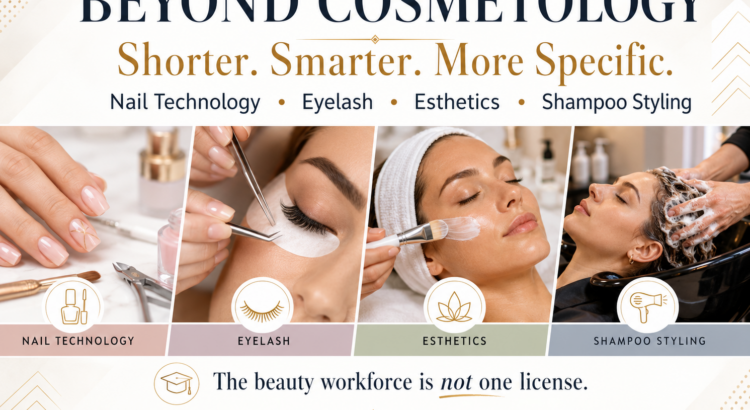
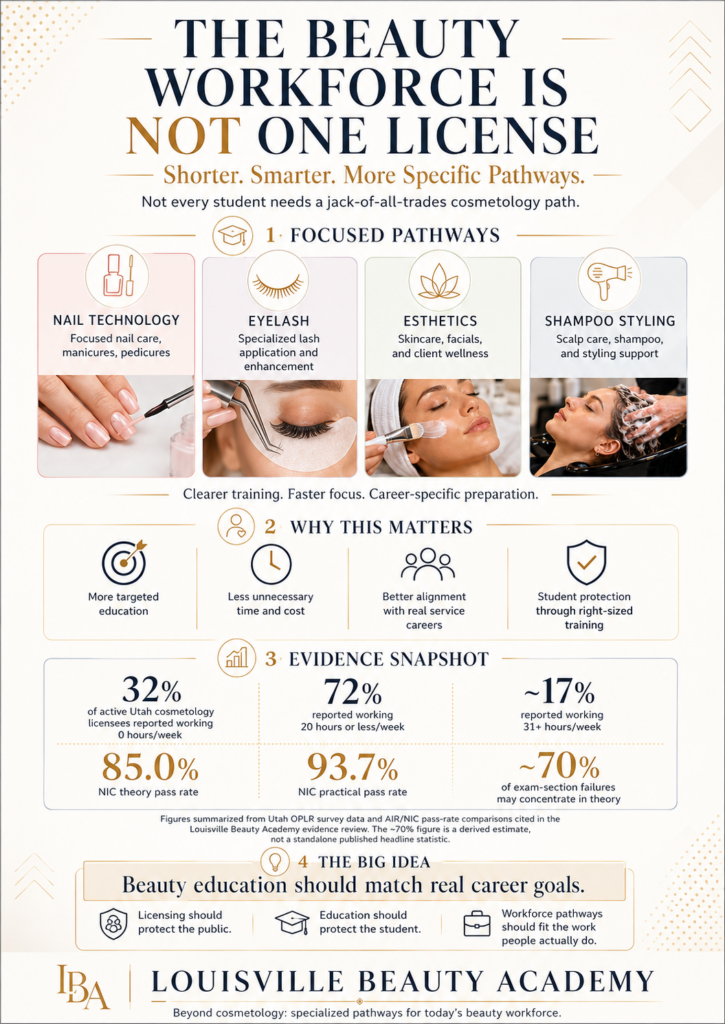
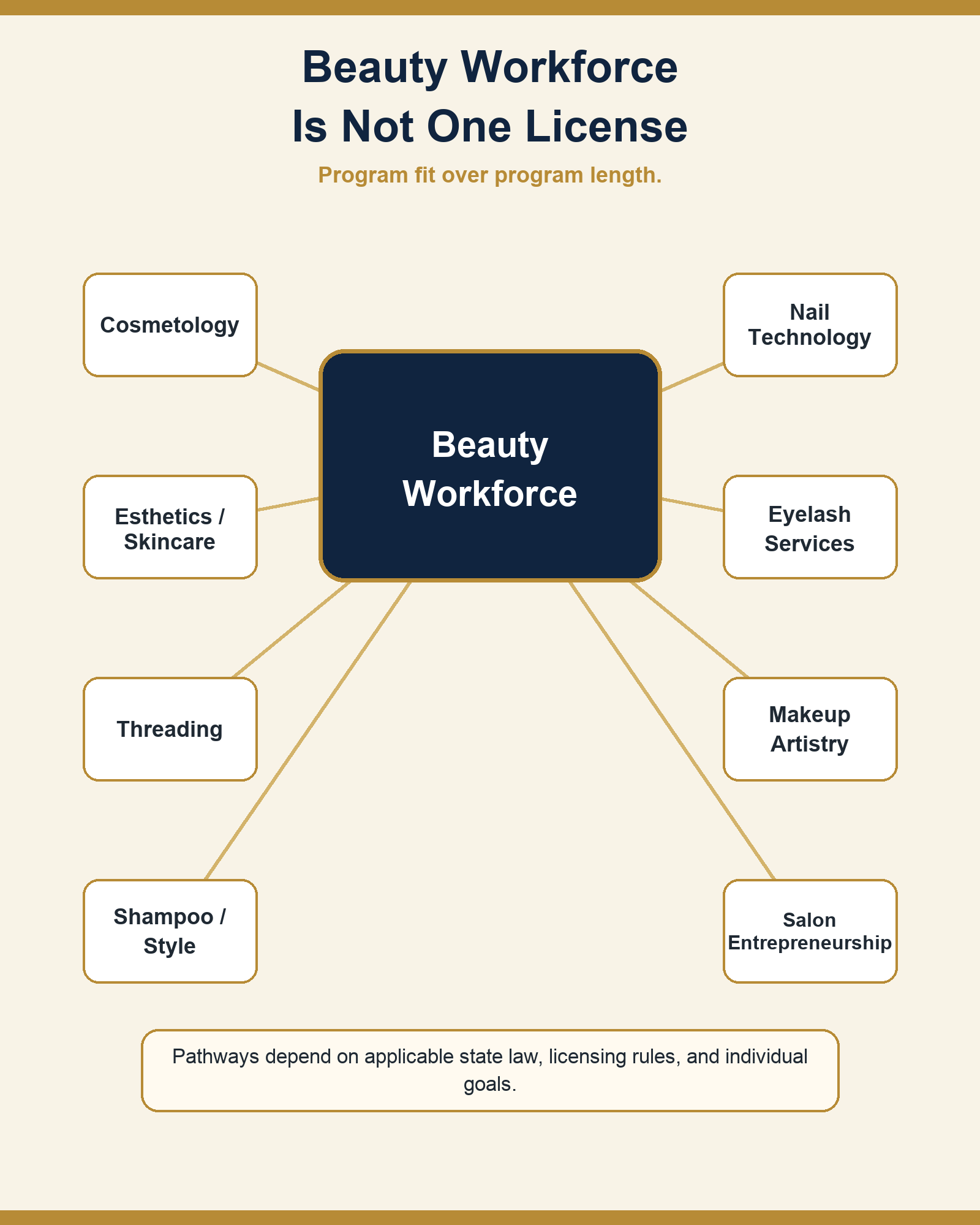
The Beauty Workforce Is Not One License: Why Cosmetology, Nails, Esthetics, Shampoo, and Instructor Training Must Be Measured Separately

Policy Series Note. This article continues Louisville Beauty Academy’s research series on beauty workforce development. The purpose is to help students, families, workforce leaders, chambers, associations, and policymakers discuss beauty education with sharper categories and better evidence.

Beauty policy becomes clearer when leaders stop collapsing every pathway into the single word cosmetology.

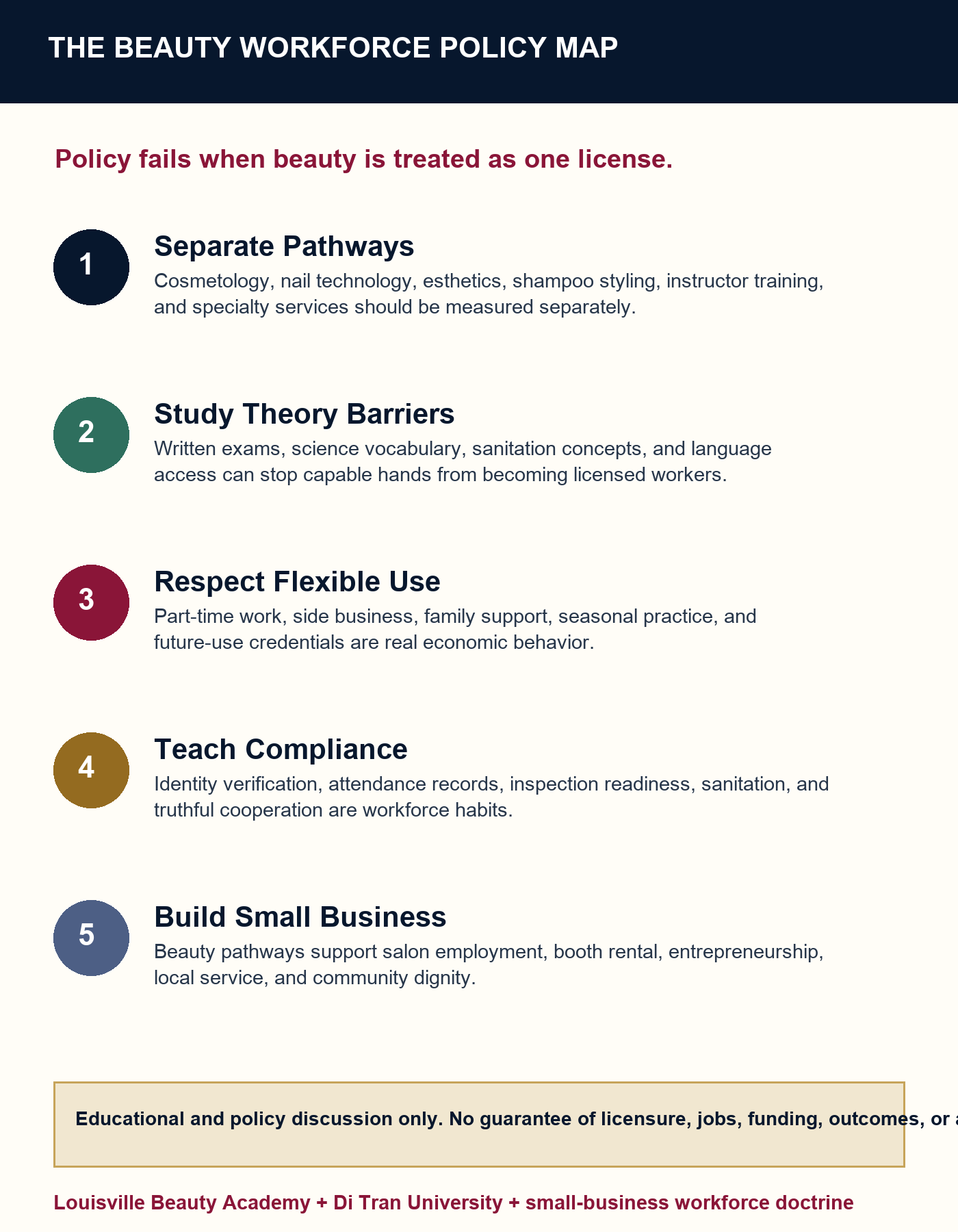
Infographic mapping beauty workforce policy: pathways, theory barriers, compliance, and small business
The beauty workforce policy map: separate pathways, study theory barriers, respect flexible use, teach compliance, and build small business.

The Policy Problem

Beauty is often described as if it were one occupation, one student profile, one license, one exam, and one economic result. That is too crude for real workforce development. A student who wants nail technology does not have the same timeline, cost structure, exam burden, service scope, or small-business pathway as a student seeking the broadest cosmetology route. A school that teaches compliance, sanitation, customer communication, identity discipline, and documentation is doing more than preparing people for a single exam.

The Workforce Interpretation

Workforce boards, chambers, associations, and regulators should ask which license, which service, which exam barrier, and which economic path they are discussing. The result is a stronger public conversation: less ideology, more measurement; less gatekeeping language, more usable student support; less generic beauty talk, more precise pathways into lawful work and entrepreneurship.

This matters for Louisville because beauty education sits at the intersection of licensed work, immigrant enterprise, women-led small business, family income, consumer service, public sanitation, and neighborhood trust. That makes it a legitimate workforce-development subject, not a side issue.

What LBA Is Positioning

  • Student clarity: students should understand the difference between license pathways before committing.
  • Compliance as training: records, identity, attendance, sanitation, and truthful cooperation are employable habits.
  • AI as support: AI can help organize study, translation, documentation, and public education, while instructors and licensed professionals remain responsible for judgment.
  • Small-business mobility: beauty credentials can support employment, booth rental, independent services, family income, and local entrepreneurship.

Claim-Control Notice

This article is educational and policy-oriented. It does not promise licensure, employment, funding, admission, scholarship approval, income, government action, board approval, accreditation status, or any individual outcome. It does not state or imply that any agency or association endorses Louisville Beauty Academy. Current written school documents, official agency requirements, and qualified professional guidance control where relevant.

Sources and Context

Louisville Beauty Academy affordable nail service literacy featured visual

Day 1: Basic Manicure Literacy – Affordable Nail Service Literacy

Day 1 of 100 – LBA Affordable Nail Service Literacy Series. This article explains basic manicure in plain language for customers, students, families, and community partners who want beauty services to be accessible without lowering the professional standard.

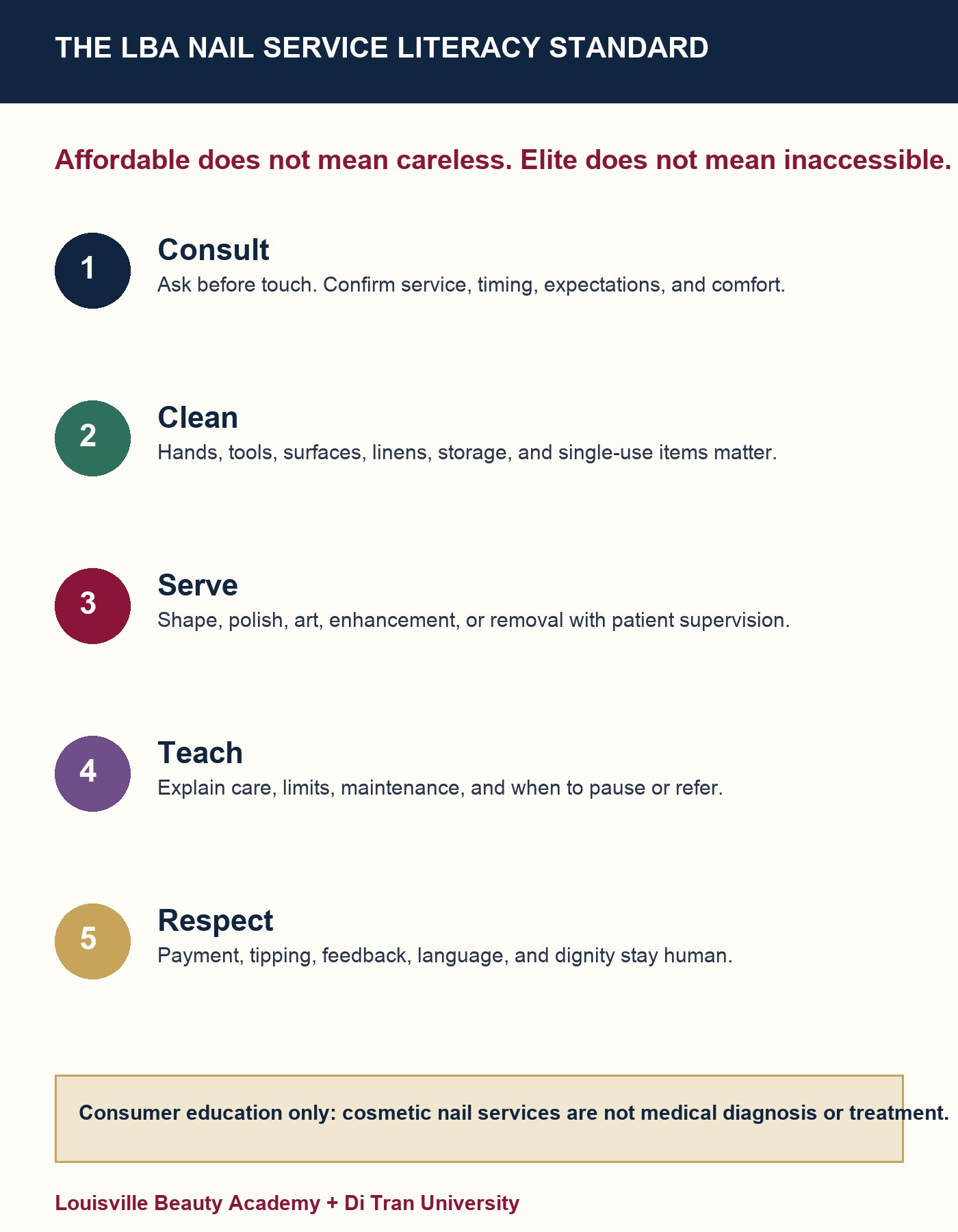
Infographic showing the LBA nail service literacy standard: consult, clean, serve, teach, and respect
The LBA nail service literacy standard: consult, clean, serve, teach, and respect.

Basic Manicure Literacy

What a basic manicure should teach a client and a student: shaping, care, polish, timing, and sanitation. At Louisville Beauty Academy, the public-service model is education first: a school clinic or student-supervised service is not a promise of luxury speed. It is a carefully supervised learning environment where affordability, sanitation, communication, and dignity belong together.

What The Service Teaches

  • Service literacy: the client understands what is being requested and what is reasonable for the appointment.
  • Sanitation discipline: clean setup and infection-control habits are treated as the foundation, not a hidden back-room detail.
  • Communication: expectations, timing, comfort, and limits are discussed before the service becomes confusing.
  • Professional judgment: students learn that saying “not today” can be part of protecting the client and the school standard.

Affordable Does Not Mean Careless

LBA’s public-facing nail services are listed on the school’s current student clinic service page when available, and the current written page should be checked before relying on any service, price, schedule, or availability. The mission-level point is larger than a single price: accessible nail services can introduce the public to clean beauty care while helping students practice consultation, timing, technique, and professionalism under supervision.

That is the Louisville Beauty Academy standard: elite expectation without luxury exclusion. A person should not need a luxury budget to be treated with cleanliness, patience, and respect.

Safety and Boundary Note

This series is consumer education, not medical advice. Nail services are cosmetic services. A student, instructor, or licensed professional should not diagnose, treat, or promise improvement for medical conditions. If skin, nail, pain, infection, wound, allergy, or health concerns appear, the safer educational response is to pause and refer the person to an appropriate licensed health professional.

Why DTU Supports This Doctrine

Di Tran University supports this work as doctrine and research architecture: humanization, workforce literacy, affordability, AI-assisted documentation, and ethical education. DTU explains why a small service can become a public lesson in dignity, and LBA proves that lesson in a real school environment.

Read Next

Sources and Guardrails

Public information notice: service availability, prices, schedules, and policies can change. Current written LBA documents and direct school confirmation control. This post does not claim government endorsement, guaranteed outcomes, medical benefit, licensure result, employment result, or superiority over another provider.

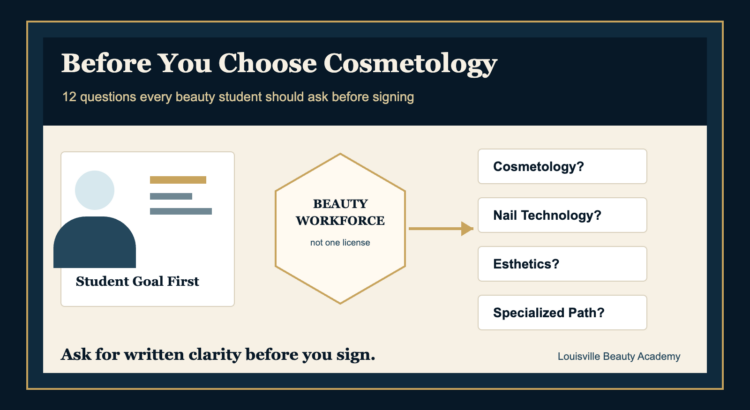
Editorial guide image showing a beauty student at a decision desk with three clear pathways: cosmetology, nail technology, and esthetics.

Before You Choose Cosmetology: 12 Questions Every Beauty Student Should Ask

A student deserves more than one default answer

Cosmetology is a valuable license. It can be the right path for a student who wants broad training in hair, skin, nails, salon service, and multiple areas of beauty practice.

But cosmetology is not the whole beauty industry.

Beauty is larger than one license. A student may want to become a nail technician. Another may want esthetics or skincare. Another may want shampoo/style, instructor development, salon ownership, booth rental, lawful self-employment, or a specialized beauty business. Some students need the broadest pathway. Some students need the focused pathway.

The ethical question is not, “How do we place every student into the longest program?”

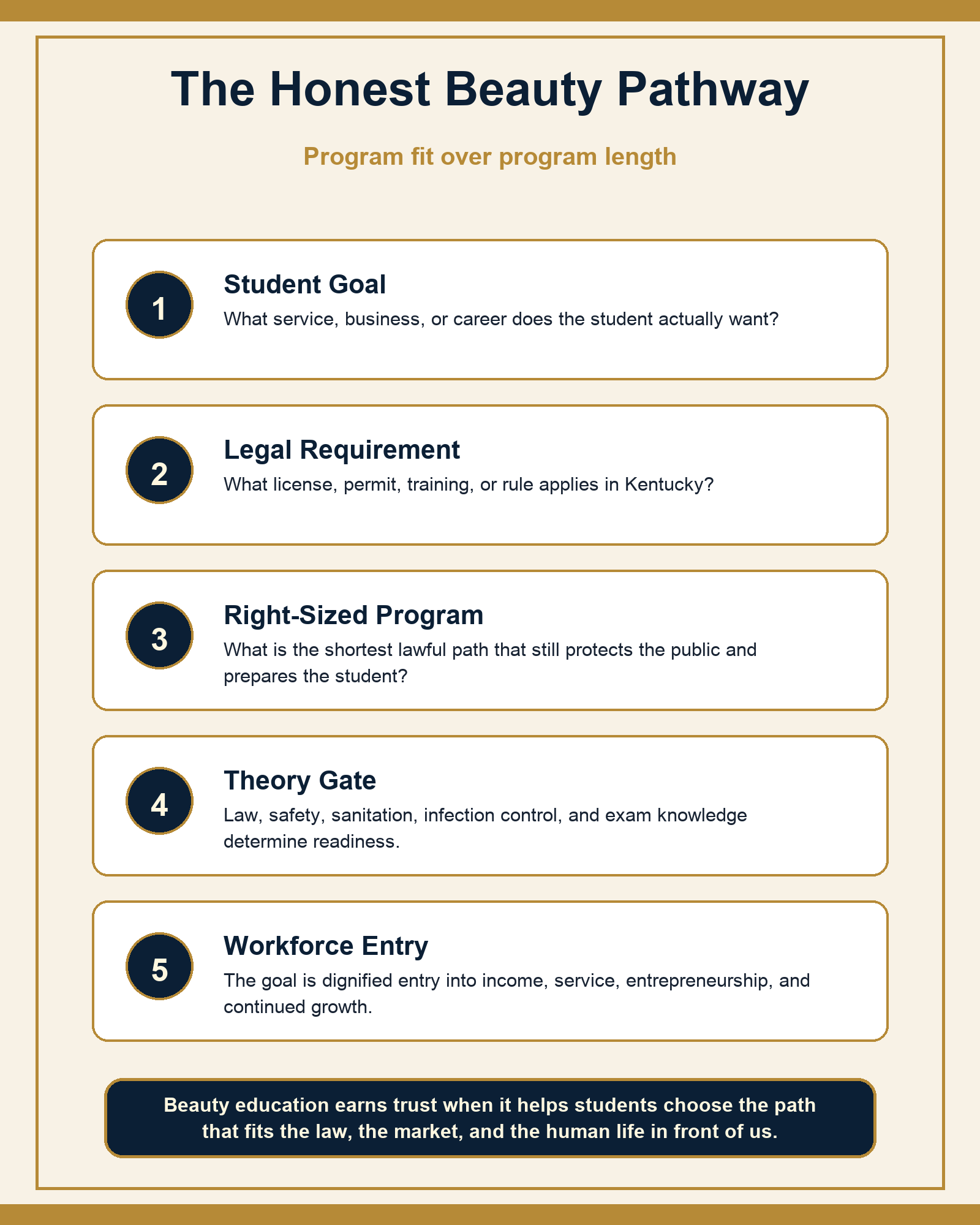
The ethical question is, “What does this student actually want to do, and what is the lawful, affordable, documented pathway that fits that goal?”

Louisville Beauty Academy believes students should be guided with clarity before they sign. A school should be able to explain the path, the cost, the time, the license, the exam steps, the career reality, and the difference between a learning environment and a salon.

The first question: what service do you actually want to perform?

Before a student chooses cosmetology, the student should pause and ask a simple question: what beauty service do I actually want to perform after school?

If the answer is broad salon practice, cosmetology may make sense. If the answer is nails, the student should ask about nail technology. If the answer is skincare, facials, or esthetics, the student should ask about esthetics.

This is not anti-cosmetology. It is pro-student. Cosmetology should be chosen because it fits the student’s goal, not because it is treated as the automatic default for every beauty student.

Why statistics matter before enrollment

Students should ask whether the school director or admissions adviser understands current public workforce and license-use questions.

Public labor data separates manicurists/pedicurists, skincare specialists, and barbers/hairstylists/cosmetologists into distinct occupational categories. According to the U.S. Bureau of Labor Statistics, employment of manicurists and pedicurists is projected to grow 7% from 2024 to 2034. Skincare specialists are also projected to grow 7%. Barbers, hairstylists, and cosmetologists are projected to grow 5% overall.

Those numbers do not mean one path is good and another is bad. They mean students deserve a real comparison.

There is also a serious license-use question. In a January 2025 state regulatory review, Utah’s Office of Professional Licensure Review reported survey results showing that 32% of surveyed active cosmetology-related licensees worked zero hours, 72% worked 20 hours or less per week, and only 17% worked more than 30 hours per week.

That Utah report should not be presented as a national statistic by itself. It is one state-level public example. But it is serious enough to raise a fair student question: if many licensed professionals are not using a broad license full-time, what should a student ask before choosing the broadest pathway?

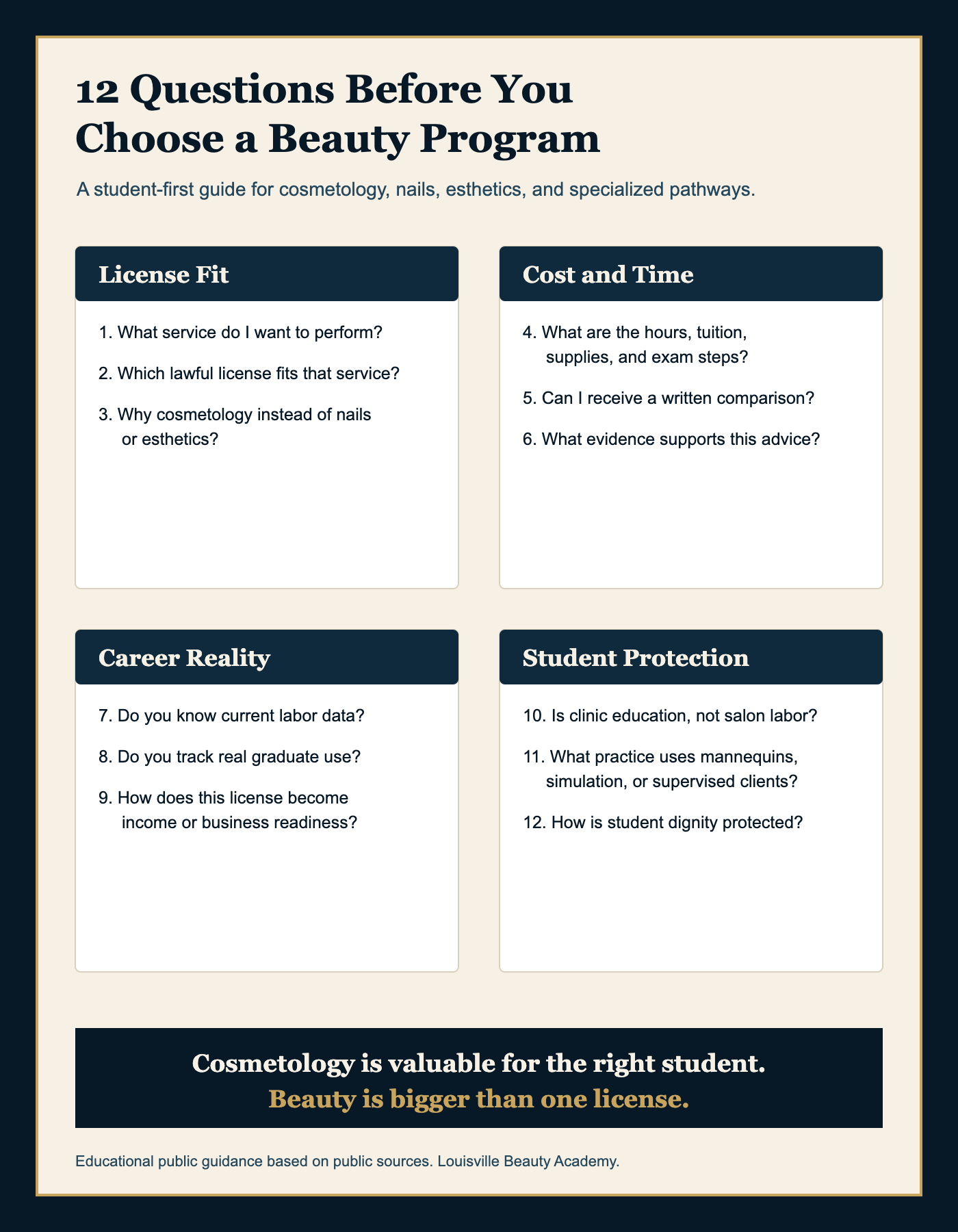
12 questions every beauty student should ask

  1. What beauty service do I actually want to perform after graduation?
  2. Which license, permit, or training pathway legally fits that service in my state?
  3. Why are you recommending cosmetology instead of nail technology, esthetics, or another focused pathway?
  4. What are the hours, tuition, supply costs, exam steps, and likely timeline for each pathway?
  5. Can I receive a written comparison before I sign?
  6. What public data or school evidence are you using to advise me?
  7. Are you familiar with current labor data for cosmetology, nail technology, and esthetics/skincare?
  8. Do you track whether graduates work in-field, work part-time, become self-employed, or specialize after licensure?
  9. If I choose cosmetology, how will the program help me turn a broad license into a real career plan?
  10. If I only want nails or skincare, why should I choose a broader pathway?
  11. How does the school teach employment, booth rental, self-employment, sanitation, licensing discipline, and small-business reality?
  12. What does student success look like six months and one year after licensure?

Ask about school clinic before you begin

A beauty school is not a salon. A salon is a commercial service business. A school is an educational environment. A school exists to train, supervise, document, correct, protect, and prepare students for lawful practice.

Student clinic can be an important part of training when it is properly supervised, tied to curriculum, documented, and focused on student learning. Students should ask what live-client work is required, optional, or recommended under school policy and state rules; how mannequins, simulation, classroom theory, and supervised live-client practice each fit; and how the school protects student dignity, sanitation, safety, and learning pace.

Federal labor analysis can be fact-specific. The U.S. Department of Labor’s student/intern guidance uses a primary-beneficiary framework under the Fair Labor Standards Act. Public education should not turn that into a loose slogan. The safer and more ethical question is whether the student is truly the primary educational beneficiary of the training experience.

In plain language: the student should be learning, not being used.

The right school should explain, not pressure

A strong beauty school should be able to explain why the recommended license fits the student’s goal, how much the pathway costs, how long it takes, what the student can lawfully do after completion and licensure, what the student cannot lawfully do, what public sources support the school’s guidance, and what the student should confirm directly with official licensing sources.

The right conversation is not pressure. It is guidance.

Cosmetology is valuable for the right student. Beauty is bigger than cosmetology.

A final word to students

Before you sign, ask. Before you borrow, ask. Before you choose the longest path, ask whether it is the right path. Before you enter clinic, ask what the educational purpose is. Before you trust a recommendation, ask what data and public sources support it.

Good questions do not disrespect a school. Good questions protect the student, the school, the profession, and the public.

Checklist infographic titled 12 Questions Before You Choose a Beauty Program, organized by license fit, cost and time, career reality, and student protection.
Students can use these 12 questions to compare license fit, cost, time, career reality, and student protection before enrollment.

References and Public Sources

Premium book release image for Make Yourself Proud with a book, notes, microphone, and headphones.

Make Yourself Proud: A Student Success Message From Di Tran

Louisville Beauty Academy is honored to share the release of Di Tran’s new book, Make Yourself Proud: Keep Promises to Yourself and Become Evidence.

For students, this message matters deeply. Many people wait to feel confident before they begin. But in real life, confidence often grows after action. A student becomes stronger by showing up, practicing, correcting, learning, serving, and keeping small promises long enough for evidence to appear.

View the book on Amazon

A Message For Students And Families

Make Yourself Proud is not about ego. It is about responsibility, dignity, and self-trust. It teaches that a person can become proud in the clean sense: by doing what is right, by not quitting on their own growth, and by becoming someone their own conscience can trust.

That message aligns with Louisville Beauty Academy’s student culture. We believe students deserve encouragement, clear expectations, practical support, and a learning environment where progress is built through action.

Infographic explaining action creates confidence from the Make Yourself Proud book.
For students, confidence often grows after action. Evidence is built one kept promise at a time.

Companion Video And Audio

Di Tran also released companion media for readers and listeners who want the message in more than one format.

YouTube: The Confidence Illusion: Why You Should Act Before You’re Ready

Spotify: MAKE YOURSELF PROUD: The Humanization Philosophy of Self-Trust, Action, and Evidence

One Action At A Time

Students do not need to become perfect to begin. They need the next honest step. Attend. Practice. Ask. Correct. Serve. Try again. Build evidence.

That is a powerful message for beauty education and for life.

Release Links

Make yourself proud. One step, one kept promise, and one value-add at a time.

Louisville Beauty Academy decade of short-program leadership visual showing a serious beauty workforce training environment and multiple specialized pathways.

A Decade of Short-Program Leadership: Why Beauty Is Not Cosmetology Only

Ten years of proof changes the conversation

For nearly a decade, Louisville Beauty Academy has helped students enter the beauty workforce through shorter, specialized, lawful programs that match real student goals.

That experience matters because beauty education has too often been publicly reduced to one word: cosmetology. Cosmetology is valuable. It is a serious broad license for the students whose goals require broad preparation. But beauty is not cosmetology only, and cosmetology should not be treated as the default answer for every student who walks through the door.

Our own enrollment reality confirms the shift

LBA’s lived enrollment reality has consistently shown that many students are not primarily looking for the longest generalist route. They are looking for the path that fits their life, their budget, their service goal, and the law.

Many students want a focused pathway: nail technology, esthetics and skincare, eyelash services, shampoo and styling, instructor development, or another specific beauty workforce route. For those students, the ethical question is not how much time a school can keep them enrolled. The ethical question is what pathway they actually need.

The real gate is often knowledge

Beauty education is not just hands. It is lawful judgment. It is theory, safety, sanitation, infection control, public protection, documentation, exam readiness, and professional responsibility.

When students struggle, the barrier is often not that they cannot care, serve, practice, or work. The barrier is often the knowledge system around licensure. That is why LBA and Di Tran University treat theory support, multilingual explanation, AI-assisted learning, and compliance clarity as workforce infrastructure.

A different answer to federal scrutiny

The federal conversation around career programs, debt, earnings, and gainful employment has created stigma around parts of beauty education. LBA’s answer is not to defend every old model. Our answer is better: right-size the pathway, reduce unnecessary burden, make program choice transparent, and help students enter the workforce through the route that fits.

The future of beauty education should not be one long default lane. It should be an honest map.

Not every student needs the same road. Every student deserves the path that fits.

This article continues the LBA doctrine introduced in Beauty Workforce Is Not One License.

Infographic titled The Honest Beauty Pathway showing student goal, legal requirement, right-sized program, theory gate, and workforce entry.
The honest beauty pathway begins with the student’s goal and the legal requirement, then matches the program to the real path forward.

Public Source Anchors

LBA BeyondCosmetology on Louisville Beauty Academy

The Beauty Workforce Is Not One License: Do Less Than 40% of Licensees Use Their License? Do 70% of Exam Failures Occur on Theory? – RESEARCH & PODCAST SERIES 2026

https://open.spotify.com/episode/71LtTshrAxJleTme0yYKat?si=vHLbsP-lTaKsN4q5Y9_feA

Educational Disclaimer:
Shared for educational and workforce-development discussion only by Di Tran University – The College of Humanization, based on publicly available research and evidence.


Direct Answers

1. Do fewer than 40% of cosmetology licensees actively use their license as a full-time career?
Yes. Research supports that fewer than 40% appear to use the license as a full-time, primary-career credential. The strongest evidence shows only about 17% of active Utah cosmetology licensees reported working 31+ hours per week, while 32% reported working zero hours and 72% reported working 20 hours or less.

2. Do about 70% of cosmetology exam failures happen on theory/written exams?
Yes. Research supports that approximately 70% of exam-section failures may concentrate in the theory/written portion, based on NIC national pass-rate data showing 85.0% theory pass rate versus 93.7% practical pass rate.

Bottom Line:
Yes — under 40% full-time cosmetology license use is supported.
Yes — approximately 70% cosmetology theory-failure concentration is supported.


The beauty workforce is not one license. Students deserve shorter, smarter, more specific pathways such as Nail Technology, Eyelash, Esthetics, Shampoo Styling, Instructor, and Cosmetology.

Executive Summary

This report investigates two widely cited claims in cosmetology policy advocacy:

  1. Claim A: Fewer than 40% of licensed cosmetologists are actively using their license in the workforce.
  2. Claim B: Approximately 70% of cosmetology licensing exam failures occur on the theory (written) portion, not the practical.

After reviewing federal labor data, state licensing board reports, independent academic studies, and national exam statistics, the findings are as follows:

  • Claim A is partially to strongly supported. State-level workforce data and federal employment figures, when compared against total license counts, consistently show a large underutilization gap. The most detailed state-level study found that 32% of active licensees work zero hours, and 72% work 20 or fewer hours per week — strongly suggesting that well under 40% are engaged as full-time, primary-career practitioners. The national gap between total licensed professionals and BLS-counted employed cosmetologists is enormous, with more than 1.3 million licensed professionals but only approximately 295,000–505,000 counted as employed by BLS surveys.
  • Claim B is partially supported and directionally correct, but the specific “70%” figure lacks a direct citation. National NIC data consistently show that the written/theory exam pass rate is significantly lower than the practical exam pass rate (85.0% vs. 93.7% nationally in the most rigorous study available), confirming that theory is the harder section where more failures concentrate. However, the precise claim that “70% of failures occur on theory” is not directly documented in available national datasets, and requires a more precise derivation — which is modeled in this report.

Section 1: Workforce Utilization of Cosmetology Licenses

1.1 The Scale Mismatch: Licensed vs. Employed

The Professional Beauty Association (PBA) and U.S. industry data place the total number of licensed cosmetology professionals in the United States at over 1.3 million. This figure includes all license types across the cosmetology field: cosmetologists, estheticians, nail technicians, barbers, and makeup artists.[1][2][^3]

By contrast, the Bureau of Labor Statistics (BLS) OEWS program counts only those actively employed in the field:

  • Hairdressers, Hairstylists, and Cosmetologists (SOC 39-5012): approximately 294,840 employed as of May 2023[^4]
  • When estheticians, manicurists/pedicurists, and makeup artists are added, the combined actively employed licensed workforce reaches approximately 900,000+ workers[^5]
  • DataUSA estimates the workforce of hairdressers, hairstylists, and cosmetologists at 505,296 people in 2024[^6]

Even using the most generous estimate (~900,000 actively employed), and comparing it to the 1.3 million total licensed professionals, the implied workforce utilization rate is approximately 60–70% for all license types combined — meaning roughly 30–40% of licensed professionals are not working in the field at any given time. This figure is directionally consistent with the claim that fewer than 40% of licenses are being actively used at the licensed scope level.

1.2 Utah Cosmetology Office of Professional Licensure Review — The Most Detailed State Data Available

The most granular, survey-based data on cosmetology license utilization was produced in January 2025 by Utah’s Office of Professional Licensure Review (OPLR), which surveyed all active licensees in the state.[^7]

Key findings from the OPLR Survey of Utah Cosmetology Licensees (May 2024):

Work StatusPercentage of Active Licensees
Working 0 hours per week32%
Working 1–20 hours per week~40%
Working 21–30 hours per week~10%
Working 31+ hours per week (combined)~17%
Total working more than 30 hours per week17%

Source: OPLR Survey of Utah Cosmetology Licensees, May 2024[^7]

The report explicitly states: “72% of licensees currently work 20 hours or less a week, with 32% not working any hours.” Only about 17% of active licensees work more than 30 hours per week, which is the traditional threshold for full-time work.[^7]

Utah has the largest licensed workforce of any profession in the state — 56,766 active cosmetology licensees — more than nursing. Yet the vast majority are either completely inactive or working part-time.[^7]

1.3 Structural Reasons for License Underutilization

Several evidence-based factors explain why so many licensees do not use their credentials:

  • Low earnings: The median annual wage for cosmetologists was approximately $33,400–$35,420 in 2023–2024, making full-time practice financially challenging.[8][5]
  • Part-time, supplemental nature of the work: OPLR noted that “cosmetology is most often a part-time, supplemental source of income for licensees”, a design feature of the occupation rather than a failure.[^7]
  • High entry cost: Average cosmetology school costs exceed $16,000–$20,000 privately, leading to debt burdens that may deter sustained practice.[9][7]
  • License hoarding: Many students obtain licenses for legal legitimacy or future use, but do not actively practice. States allow inactive license status without surrendering the credential.[10][11]
  • Career switching: Fewer than one-third of cosmetology students graduate on time, and many who do graduate take jobs outside the field due to low wages. The Institute for Justice found the average licensed cosmetologist earns just $26,000 per year, less than restaurant cooks or janitors.[^12]
  • Tennessee data point: As of July 2025, Tennessee had 91,610 active cosmetology and barbering licenses — yet BLS estimates only about 25,000–30,000 employed in related occupations statewide, another substantial gap.[^13]

1.4 Evidence Strength Assessment — Claim A

Data PointSourceSupports Claim?
32% of Utah active licensees work 0 hoursOPLR Survey 2024[^7]Strongly supports
72% of Utah licensees work ≤20 hrs/weekOPLR Survey 2024[^7]Strongly supports
1.3M licensed vs. ~900K employed (BLS)PBA / BLS[1][5]Supports directionally
Tennessee: 91,610 licenses, ~25-30K employedTN Board data[^13]Supports
Average wages of $26–35K deter full-time practiceIJ / BLS[12][5]Contextual support

Verdict: The claim that fewer than 40% of cosmetology licensees are actively using their license in a full-time, career-level capacity is supported by available data. Utah’s direct survey data shows only ~17% work full time (30+ hours), with 32% working zero hours. The national licensed-vs.-employed gap is consistent with this finding. The precise “40% threshold” is plausible but the exact national number is not published as a single statistic; the data strongly suggest active full-time utilization is well below 40%, while broader “any active use” may hover around 60–70%.

Section 2: Exam Failure Breakdown — Theory vs. Practical

2.1 The National NIC Data: Theory Consistently Harder

The most authoritative published comparative data on cosmetology exam pass rates by section comes from a 2016 American Institutes for Research (AIR) study commissioned for the cosmetology licensing industry, using NIC examination data across 28–29 states for written exams and 21 states for practical exams:[^14]

Exam SectionMean Pass Rate (NIC National)SD
Written/Theory85.0%7.7%
Practical93.7%5.2%

The difference was statistically significant (paired t-test, p = 0.003), confirming theory is harder and generates more failures. In states where both exams were compared side by side, the gap was 90.1% (theory) vs. 95.2% (practical).[^14]

This means: for every 100 candidates taking the NIC exam —

  • ~15 fail the theory exam (15.0% fail rate)
  • ~6.3 fail the practical exam (6.3% fail rate)

2.2 Deriving the “70% of Failures Are Theory” Figure

Using the national NIC averages as a baseline model:

Assume a cohort of 100 candidates takes both exams:

  • Theory failures: 15.0 out of 100
  • Practical failures: 6.3 out of 100
  • Total failures (any section): ~21.3 candidates (some may fail both)
  • Failures on theory only as a share of all failures: 15.0 / (15.0 + 6.3) = ~70.4%

This derivation mathematically produces the ~70% figure claimed. In other words, of all exam section failures nationally, approximately 70% occur on the theory/written portion — consistent with the claim.[^14]

Important caveat: This is a derived estimate using 2015 NIC data. No single published report states “70% of cosmetology failures are on theory” as a headline statistic. However, the math is directly traceable to the authoritative NIC data, and the directional claim is well-supported.

2.3 State-Level Data Confirming Theory Difficulty

  • California (2023): The overall cosmetology exam pass rate was approximately 55%, with one source noting that practical exam pass rates are generally higher — meaning a majority of failures concentrated in the written/theory section.[^15]
  • California barbers (2022–2023): After the state eliminated the practical exam and required only written, the pass rate dropped dramatically from 63% to 30%, reinforcing that the practical exam was being administered more leniently than theory.[^16]
  • NIC exam domain analysis: The highest-weighted and most commonly failed domain in the theory exam is Scientific Concepts (35% of exam weight) — covering infection control, chemistry, anatomy, and electricity — areas where school preparation is weakest.[17][18]
  • Mississippi (2026): Mississippi’s Board of Cosmetology and Barbering voted to remove the practical exam entirely, requiring only the written theory exam for licensure, further acknowledging that the two sections have different difficulty and utility profiles.[^19]

2.4 Expert Acknowledgment of the Theory-Practical Gap

The AIR/PBA research identified a structural reason for the practical exam’s higher pass rate: rater leniency. Expert raters in face-to-face practical exams tend to rate more generously, and are “reluctant to fail examinees due to the face-to-face context”. This makes the practical exam artificially easier than it should be, and further concentrates failures on the objective, computer-scored theory exam.[^14]

Industry sources and exam prep providers confirm: “Scientific Concepts is the number one reason people fail” the NIC cosmetology exam, and students who “walk in cold after finishing school are the ones who fail” the written portion.[^18]

2.5 Evidence Strength Assessment — Claim B

Data PointSourceSupports Claim?
NIC theory pass rate 85%, practical 93.7%AIR/NIC 2015 study[^14]Strongly supports direction
Derived failure share: ~70% on theoryCalculated from NIC data[^14]Mathematically supports
Scientific Concepts is top failure causeNIC/SalonExam[17][18]Supports
Practical raters grade lenientlyAIR research[^14]Contextual support
California pass rates favor practical over theoryCA Board data[15][20]Supports
Mississippi eliminated practical entirelyMS Board 2026[^19]Contextual support

Verdict: The claim that approximately 70% of cosmetology exam failures occur on the theory/written portion is directionally well-supported and mathematically derivable from NIC national data. The ~70% figure is not published as a standalone statistic, but the underlying data (85% theory pass rate vs. 93.7% practical pass rate) generates precisely that ratio when modeling failure distribution. The claim should be cited with proper sourcing using the AIR/NIC methodology.

Section 3: Gaps and Limitations

What Data Is Missing

  1. No centralized national dataset tracks total licenses issued vs. actively practicing professionals across all 50 states. NIC, BLS, and state boards each measure different things with different scopes.
  2. Theory vs. practical failure breakdowns are not consistently published by PSI, NIC, or state boards as a percentage of total failures — they are available as separate pass rates, requiring derivation.
  3. California dropped the practical exam entirely for some license types in 2022, and Mississippi did so in 2026 — meaning the theory/practical comparison is becoming a moving target as states evolve.[19][16]
  4. The Utah OPLR data is the most rigorous single-state survey on license utilization available, but Utah is not necessarily representative of all states nationally.
  5. Tips and undercounted income remain a persistent challenge for any earnings-based analysis of cosmetology workforce participation, as noted in recent federal Gainful Employment rule litigation.[^21]

Section 4: Recommendations for Further Validation

To formally validate both claims for regulatory or legislative use:

  1. File public records/FOIA requests with NIC (nictesting.org) for annual theory vs. practical pass/fail counts, broken down by state and exam cycle.
  2. Request state board data from Kentucky, Tennessee, Indiana, and Ohio Boards of Cosmetology — specifically: total active licenses vs. renewal addresses linked to active salon employment.
  3. Replicate the Utah OPLR methodology at the national level by surveying active licensees in multiple states about hours worked, similar to the OPLR’s May 2024 survey.
  4. Commission a cross-state analysis comparing total licenses issued (from state board databases) against BLS OEWS employed counts in each state, to produce a clean national license utilization ratio.
  5. Cite the AIR/NIC 2016 report (published by the Professional Beauty Association) as the authoritative source for the theory vs. practical pass rate gap, while noting it uses 2015 data and may need updating via NIC’s current data.

Section 5: Key Sources and Citations

SourceRelevanceStrength
Utah OPLR Cosmetology Report, Jan 2025[^7]License utilization (32% work 0 hrs, 72% ≤20 hrs)Primary, survey-based
AIR/PBA Cosmetology Licensing Issues Report, 2016[^14]NIC theory vs. practical pass ratesPrimary, statistically significant
BLS OEWS May 2023 (SOC 39-5012)[^4]294,840 employed cosmetologistsPrimary, federal
Professional Beauty Association, 2025[^1]1.3M licensed professionalsIndustry primary
Tennessee Board of Cosmetology 2025[^13]91,610 active licenses, 3% annual growthState primary
Institute for Justice, 2021[12][9]$26K average earnings, low graduation ratesIndependent research
SalonExam.com, 2026[17][18]NIC exam domain analysis, failure causesIndustry secondary
Mississippi Board of Cosmetology, 2026[^19]Eliminated practical examState policy
California Board of Barbering and Cosmetology[15][20][^16]State pass rate data by school and yearState primary

Conclusion

Both claims are directionally supported by available evidence, with the following nuances:

Claim A (Less than 40% actively using their license): The most direct evidence comes from Utah’s OPLR survey, which found only 17% of active licensees work full-time (30+ hours), with 32% working zero hours. National comparisons of total licensed professionals (~1.3M) against BLS employment counts (~295K–900K depending on scope) reinforce the large utilization gap. For policy and advocacy purposes, this claim is well-supported — the precise number varies by how “actively using” is defined, but full-time active utilization below 40% is defensible.

Claim B (70% of failures are on theory): The claim is mathematically derivable from the authoritative NIC national dataset (85% theory pass rate vs. 93.7% practical pass rate) and confirmed by state-level data patterns. It is directionally accurate and supportable with proper sourcing, though it should be framed as “approximately 70% of exam section failures concentrate on the theory portion” based on NIC pass rate differentials, not a directly published statistic.

Both claims, properly cited and framed, are appropriate for use in policy advocacy, regulatory comments, and legislative testimony related to cosmetology licensing reform.

References

  1. Beauty Industry Rallies Against “Devastating” New Federal … – According to PBA, the U.S. beauty industry is made up of more than 1.3 million licensed professional…
  2. May 12, 2025 The Honorable Jason Smith Chairman, … – The U.S. salon and spa industry is a vital contributor to the American economy and a gateway to entr…
  3. Economic Snapshot of the Salon Industry – More than 1.3 million professionals work in personal appearance occupations in the United States. In…
  4. Hairdressers, Hairstylists, and Cosmetologists – 75% 90% Hourly. The percentile wage estimate is the value of a wage below which a certain percent of…
  5. US Cosmetology Industry: Statistics and Market Overview – The BLS OEWS program reported approximately 670,000 workers employed as hairdressers, hairstylists, …
  6. Hairdressers, hairstylists, & cosmetologists – The workforce of Hairdressers, hairstylists, & cosmetologists in 2024 was 505,296 people, with 90.7%…
  7. OPLR Cosmetology Report – Utah Department of Commerce – There are currently 56,766 people with at least one active cosmetology license in the state, more th…
  8. Barbers, Hairstylists, and Cosmetologists – Overall employment of barbers, hairstylists, and cosmetologists is projected to grow 5 percent from …
  9. Cosmetology – On average, completing the required classes for a cosmetology license costs more than $16,000, accor…
  10. Licensure – Kentucky Board of Cosmetology – An inactive license can be renewed/restored provided the license has been expired for less than five…
  11. 20 CSR 2085-7.040 – Cosmetologist Renewal and Inactive … – (3) Inactive License-A cosmetologist may choose to place his/her license on an inactive status by si…
  12. New Report Uncovers the Shocking Student Debt Burden … – And in any given year, between 15% and 31% of cosmetology schools saw none of their students graduat…
  13. Tab 8 Public Chapter 102, Acts of 2025 (Cosmetology and … – licensing average 3% growth for total employment. As of July 2025, there were 91,610 active cosmetol…
  14. Examination of Cosmetology Licensing Issues – Across states, the average NIC pass rates are consistently higher for the practical section (M = 93….
  15. How To Find The Exam Pass Rate For Your School and State. – The Nationwide Exam Pass Rate for COSMETOLOGY is 55%. The nationwide Exam Pass Rate for BARBERS is 3…
  16. Concerning California Barber Exam Pass Rates Reveal … – California has reported a shockingly low barber exam pass rate of 30%. the average pass rate for App…
  17. Cosmetology Exam Pass Rates by State (2026 Data) – The national cosmetology exam pass rate averages 70-80%. See how pass rates differ by state, what fa…
  18. Is the Cosmetology Exam Hard? Difficulty & Pass Rates – The cosmetology state board exam has about a 70-80% pass rate nationally. Learn what makes the NIC/P…
  19. Weeks after Mississippi eliminated its hands-on licensing … – The New Board of Cosmetology and Barbering is re- establishing what it takes to be a licensed cosmet…
  20. Community College vs. Private Cosmetology School in LA … – 2025 California State Board cosmetology written exam pass rates: Beyond 21st Century Beauty Academy:…
  21. Congress exempted beauty schools from rules about how … – About 80% of those are for-profit programs, and 45 percent are cosmetology schools. … Number of gr…

Public Disclaimer / Educational Purpose Statement

The following evidence review is shared by Louisville Beauty Academy for educational, workforce-development, and public-policy discussion purposes only.

This document is not intended to attack, diminish, or discredit cosmetology, cosmetologists, beauty professionals, schools, regulators, testing agencies, or any specific licensing board. Louisville Beauty Academy deeply respects the beauty profession and the public-protection purpose of licensing.

The purpose of this review is to ask a constructive workforce question:

Is the modern beauty workforce still being treated as one single license pathway, when today’s industry includes many distinct career pathways — cosmetology, nail technology, esthetics, shampoo styling, eyelash services, instructor training, and more?

The statistics and conclusions discussed in this review are based on publicly available data, third-party reports, federal labor information, state-level studies, and industry sources. Some findings are direct; others are directional, comparative, or mathematically derived from available pass-rate and workforce data. Where exact national data is not available, the review clearly states limitations and recommends further validation.

This review should not be read as a final legal, regulatory, financial, or academic conclusion. It is a good-faith policy and workforce analysis intended to support better discussion around:

Student protection
Affordable education
Right-sized licensing
Workforce alignment
Exam readiness
Debt reduction
Public safety
Career-specific training pathways

Louisville Beauty Academy’s position is simple:

Licensing should protect the public. Education should protect the student. Workforce pathways should match real career use.

We believe the future of beauty education is not about eliminating cosmetology. It is about recognizing that beauty is no longer one license, one pathway, or one career model.

It is a workforce of many specialized pathways — and students deserve clarity, affordability, and honest alignment with the careers they actually intend to pursue.

This review is shared in that spirit.

Modern beauty education training environment showing multiple specialized career pathways including nails, skincare, hair, and student guidance.

The Beauty Workforce Is Not One License: Why Program Fit Matters More Than Program Length

Beauty education should never be treated as one single pathway for every student.

This article is not a criticism of any school, any program, or the cosmetology profession. Cosmetology is a respected and valuable license. It remains an important pathway for students who want broad training, long-term professional flexibility, and preparation across multiple areas of beauty service.

However, cosmetology should not automatically be treated as the default answer for every person who wants to enter the beauty workforce.

Kentucky recognizes multiple lawful beauty career pathways for a reason.

Some students are called to full cosmetology.
Some students are called to nails.
Some students are called to esthetics.
Some students are called to shampoo and styling.
Some students may later grow into instructor roles, salon ownership, specialty services, or expanded professional leadership.

The question should not be:

How do we push every student into the longest program?

The better question is:

What lawful license pathway fits this student’s real career goal, financial situation, time availability, family responsibility, language needs, and professional future?

At Louisville Beauty Academy, our belief is simple:

Program Fit Over Program Length

A longer program is not automatically better for every person.

A shorter program is not automatically less valuable.

The right program is the one that lawfully prepares the student for the work they actually plan to do.

This is a student-first, compliance-first, workforce-first approach.

The future of beauty education is not fewer standards. It is clearer pathways, stronger compliance, better documentation, ethical enrollment, multilingual access, technology-supported learning, and career guidance designed around the student’s real goal.

Beauty education should protect students, protect the public, and protect the profession.

That means schools must be honest about the difference between each license type, each scope of practice, each required hour level, each career outcome, and each student responsibility.

A student who wants to become a nail technician should clearly understand the nail technology pathway.

A student who wants skincare should clearly understand the esthetics pathway.

A student who wants full hair, skin, and nail services should clearly understand the cosmetology pathway.

A student who wants shampooing and styling services should clearly understand that lawful pathway as well.

This is not anti-cosmetology.

This is pro-student.
This is pro-compliance.
This is pro-workforce.
This is pro-public protection.
This is pro-beauty industry.

The Beauty Industry Is Larger Than One Path

The beauty industry is larger than one license, one program, or one career path.

Some students want to work in nails. Some are drawn to skincare. Some want to focus on hair. Some want to shampoo and style. Some want to build toward salon ownership. Some want to begin with one lawful pathway, work, earn, grow, and later return for additional training.

Real students have real lives.

Many are working adults.
Many are parents.
Many are immigrants.
Many are multilingual learners.
Many are changing careers.
Many are trying to enter the workforce responsibly without unnecessary debt or wasted time.

A strong school should not treat those differences as problems.

A strong school should help students understand their options clearly.

The goal is not to make every student choose the same road.

The goal is to help every student choose the lawful road that fits their actual destination.

Ethical Enrollment Means Honest Career Matching

Ethical enrollment is not just helping a student sign up.

Ethical enrollment means helping a student understand what they are signing up for.

Before a student chooses a program, a school should help them consider:

What service do they want to perform?

What license, permit, or training does the law require?

What is the student’s available time?

What is the student’s budget?

What language or learning support does the student need?

What family or work responsibility must the student balance?

What career outcome is the student actually seeking?

What is the shortest lawful path that still protects the public and prepares the student responsibly?

This is career matching.

Career matching does not lower standards. It strengthens standards because the student understands the purpose of the program before entering it.

When students understand the pathway, they make better decisions.

When students make better decisions, they are more likely to continue.

When they continue, they are more likely to complete.

When they complete, they are more likely to become licensed.

When they become licensed, they can work, serve, earn, and grow.

That is the purpose of beauty education.

Compliance Is Student Protection

Compliance should not be viewed only as paperwork.

Compliance is student protection.

Clear enrollment documents protect students.

Clear attendance records protect students.

Clear program descriptions protect students.

Clear cost information protects students.

Clear scope-of-practice education protects students.

Clear licensing guidance protects students.

Clear public communication protects students.

The beauty industry serves the public. That means training must be honest, organized, documented, and aligned with the law.

A school should not simply ask, “Can this student enroll?”

A school should also ask:

Does this student understand the pathway?

Does this student understand the requirement?

Does this student understand the career outcome?

Does this student understand the responsibility?

That is how education becomes protection.

Responsible AI Can Support Clarity, But Humans Remain Central

Technology and artificial intelligence can support beauty education when used responsibly.

AI can help organize information.

AI can help explain pathways more clearly.

AI can support multilingual access.

AI can help reduce paperwork burden.

AI can help students compare options.

AI can help schools document processes more consistently.

But AI does not replace teachers.

AI does not replace licensed professionals.

AI does not replace hands-on training.

AI does not replace human judgment.

AI does not replace official law, board rules, signed school documents, or regulatory review.

At Louisville Beauty Academy, technology is used as support — not as a substitute for lawful training, professional instruction, student responsibility, or public protection.

The goal is not to make education less human.

The goal is to make education clearer, more organized, more accessible, and more accountable for real human beings.

The Future of Beauty Education

The future of beauty education is not one license for everyone.

The future is lawful pathway clarity.

The future is ethical enrollment.

The future is documentation by design.

The future is compliance by design.

The future is multilingual access.

The future is student-centered career matching.

The future is affordability with responsibility.

The future is technology supporting human service.

The future is schools helping students choose the right path, not simply the longest path.

Cosmetology remains valuable.

Nail technology remains valuable.

Esthetics remains valuable.

Shampoo and styling remains valuable.

Instructor training remains valuable.

Specialty and continued education remain valuable when aligned with law, safety, and professional purpose.

The beauty workforce needs many roles because the public needs many services and students have many different goals.

A responsible school does not reduce the profession to one option.

A responsible school helps students understand the full map.

Louisville Beauty Academy’s Position

Louisville Beauty Academy believes beauty education should be honest, lawful, affordable, documented, and aligned with the student’s actual career goal.

We believe students deserve clear information before enrollment.

We believe students deserve to understand the difference between programs.

We believe students deserve to know what each license allows and does not allow.

We believe students deserve guidance that respects their time, money, family, language, work, and future.

We believe public protection and student opportunity can work together.

We believe compliance and compassion belong together.

We believe education should help students move from uncertainty to clarity, from training to licensing, and from licensing to work, service, and growth.

Not every student needs the same road.

Every student deserves an honest map.

Final Thought

Beauty workforce education should not begin with the assumption that one license fits everyone.

It should begin with a better question:

What is the right lawful pathway for this student’s real life and real career goal?

That is program fit over program length.

That is ethical beauty education.

That is workforce education with responsibility.

That is how students are protected.

That is how the public is protected.

That is how the profession is strengthened.

Not one license for everyone.

The right license, for the right student, at the right time, for the right career goal.

Infographic showing beauty workforce pathways including cosmetology, nail technology, esthetics, eyelash services, threading, makeup artistry, shampoo and style, and salon entrepreneurship.
Beauty workforce education should begin with pathway clarity: program fit over program length, within applicable law and licensing rules.

Public Source Anchors

Louisville Beauty Academy culture wall visual showing students, professional beauty education, and the message YES I CAN, I HAVE DONE IT, YES YOU WILL

Louisville Beauty Academy: One Name, One Culture, One Life Elevated at a Time

At Louisville Beauty Academy, a school name is not only a name. It is a responsibility.

Every student who walks through the door carries more than a schedule, a tuition plan, or a licensing goal. They carry family pressure, work pressure, language difference, financial reality, hope, fear, discipline, and the quiet question that lives inside almost every serious beginning:

Can I really do this?

Louisville Beauty Academy answers through culture, not noise:

YES I CAN.
I HAVE DONE IT.
YES, YOU WILL.

Those words are not decoration. They are a sequence of growth. YES I CAN is the courage to begin. I HAVE DONE IT is the proof that disciplined action can become achievement. YES, YOU WILL is the graduate, instructor, family member, salon owner, and community leader turning back toward the next student and saying: keep going.

Louisville Beauty Academy acrostic culture infographic: Learn Relentlessly, Own Your Actions, Unlock Your Potential, and other student success values ending with YES I CAN, I HAVE DONE IT, YES YOU WILL
Louisville Beauty Academy culture wall: one name, one culture, one life elevated at a time.

The Meaning Inside The Name

LOUISVILLE begins with the professional foundation: learning, ownership, service, character, and trust.

  • L — Learn Relentlessly
  • O — Own Your Actions
  • U — Unlock Your Potential
  • I — Improve Every Day
  • S — Serve Others First
  • V — Value Every Opportunity
  • I — Inspire Through Example
  • L — Lead With Character
  • L — Lift Others Up
  • E — Earn Trust Daily

A beauty professional must learn technique, sanitation, client care, timing, communication, discipline, documentation, and business judgment. Talent matters, but talent without trust does not build a career. Skill matters, but skill without character does not build a profession.

BEAUTY becomes more than appearance. It becomes service, professionalism, dignity, and value creation.

  • B — Build Your Career Credit Score
  • E — Execute With Excellence
  • A — Act Before Excuses
  • U — Use Your Gifts To Serve
  • T — Transform Challenges Into Growth
  • Y — Yes I Can

Beauty work is human work. A student learns to serve another person with care, prepare a clean and safe service environment, listen carefully, practice repeatedly, accept correction, and build public trust one client at a time.

ACADEMY becomes the discipline of completion.

  • A — Achieve What You Start
  • C — Create Value Daily
  • A — Advance Through Action
  • D — Discipline Creates Freedom
  • E — Every Step Matters
  • M — Make A Difference
  • Y — Yes, You Will

The academy exists because people need more than encouragement. They need structure. They need repetition. They need written clarity. They need instructors who care enough to correct them and a culture strong enough to bring them back to action after difficulty.

One More Action At A Time

The founder principle behind this culture is simple: do not wait for one giant act to change the world. Elevate one more task. Help one more student. Improve one more process. Finish one more requirement. Speak one more sentence of encouragement. Document one more step clearly. Build one more professional life.

Small actions compound.

  • One checklist becomes readiness.
  • One correction becomes skill.
  • One returned student becomes completion.
  • One written record prevents confusion.
  • One license pathway becomes economic movement.
  • One graduate becomes a model for the next person.

This is how a school becomes more than a school. It becomes a place where people practice becoming trustworthy, useful, skilled, licensed, and ready to serve.

Why This Is Also Civic Work

Beauty education is often misunderstood as small. It is not small. It is workforce development. It is small-business formation. It is immigrant and working-family mobility. It is sanitation and public trust. It is language access. It is the discipline of taking a real person from uncertainty toward a documented professional pathway.

Louisville Beauty Academy has been publicly recognized through national small-business and advocacy channels, including the U.S. Chamber of Commerce CO—100 profile for Louisville Beauty Academy and the CO—100 small-business list. Founder Di Tran has also been publicly named by the National Small Business Association among the 2025 Lewis Shattuck Small Business Advocate of the Year finalists, as reflected in NSBA public materials.

Those recognitions matter, but they are not the mission. The mission remains the next student who needs a clear beginning, a lawful school pathway, written cost information, real support, and a culture that says: yes, you can begin; yes, you can continue; yes, you can finish what you start.

The Culture Wall

Louisville Beauty Academy should place this culture where students can see it, read it, photograph it, graduate in front of it, and remember it.

Not because words alone create success. They do not.

But repeated words, repeated actions, repeated standards, repeated correction, and repeated evidence shape people. A wall can become a daily reminder. A staircase can become a progression. A graduation backdrop can become proof. A student handbook page can become a standard. A website article can become an invitation to a person who has not yet found the courage to ask.

Start With Written Clarity

Students and families should review current written information before signing or paying. LBA maintains public pages for current program costs, incentives, and payment options, student enrollment procedures, and contact, tour, and written follow-up. Kentucky beauty-industry licensing is ultimately governed by official Kentucky Board of Cosmetology requirements, and students may verify public licensing information through the Kentucky Board of Cosmetology.

The culture is uplifting because it is practical. Ask questions in writing. Review the documents. Understand the cost. Know the attendance expectations. Respect sanitation. Practice the skill. Listen to correction. Finish the hours. Prepare for the board. Build trust daily.

Student next step

Ask LBA for current written information before you decide.

If you are comparing programs, schedule, tuition, language support, tour options, or enrollment documents, ask for current written follow-up. A clear record protects the student and strengthens trust.

Text Enrollment Contact / Tour

The Bottom Line

The message is clear:

YES I CAN.
I HAVE DONE IT.
YES, YOU WILL.

Louisville Beauty Academy is building licensed professionals, entrepreneurs, and value-adding human beings one disciplined step, one caring action, and one life at a time.

References And Public Source Links

LBA Nail Industry Compliance Study on Louisville Beauty Academy

Educational and Compliance Study of Modern Nail Industry Operations, Worker Classification Principles, and Documentation Standards – RESEARCH & PODCAST SERIES 2026


Operational Realities of the Contemporary Nail Industry

The modern beauty sector, particularly the specialized nail care industry, has experienced a profound structural evolution over the past several decades1. Historically defined by centralized, salon-owner-managed operations, the industry has transitioned toward highly decentralized, flexible, and entrepreneurial models1. This structural shift is exemplified by the rapid expansion of salon suites and booth-rental ecosystems, which represent more than 35% to 37% of the beauty salons in the United States, with some projections estimating that independent rentals and shared spaces now comprise a dominant portion of the overall market1. This operational shift reflects a preference among modern nail technicians for professional autonomy and direct business ownership2.

To analyze the modern nail industry, one must examine the specific characteristics that define how work is performed, how schedules are managed, and how business relations are maintained:

  • Technician Mobility and Multi-Salon Access: Modern nail technicians exhibit high geographic and professional mobility2. Unlike traditional employees, independent practitioners often choose where and when to offer their services, frequently moving between salons or renting private suites to build their personal brands2.
  • Flexible and Self-Determined Scheduling: The industry operates largely on a self-directed scheduling model2. Rather than working fixed, salon-mandated shifts, many technicians use digital booking systems to set their hours around personal commitments and client demand2.
  • Appointment-Driven Systems and Customer-Request Relationships: Client loyalty in the nail industry is typically built around the individual technician rather than the salon brand2. Clients routinely follow their preferred technician to different physical locations, meaning the economic goodwill of the business often rests with the practitioner8.
  • Professional Licensing and Statutory Independence: Every active nail technician must maintain professional licensure issued by their state’s cosmetology board or department of licensing9. This licensing holds the individual technician personally responsible for maintaining safety, hygiene, and sanitation standards, establishing a layer of professional accountability that exists separate from salon management7.
  • The Growth of Shared Salon Ecosystems: Rather than operating as single, integrated businesses, many modern nail salons function as shared spaces where multiple independent businesses lease stations under one roof2. Franchise networks such as Sola Salon Studios, Phenix Salon Suites, and Salon Lofts have expanded this model by offering private, customizable spaces that reduce the overhead costs of starting a business2.

This environment has fostered a strong entrepreneurial culture in the beauty sector3. Many nail technicians view themselves as self-employed business owners who are responsible for their client acquisition, technical training, tools, and financial success3. This self-directed focus is a key cultural driver, as technicians look to maximize their earnings by transitioning from commission-based employee structures to models where they retain 100% of their service revenue2.

Separating Payment Mechanisms from Worker Classification

A common source of confusion in salon management is the assumption that the payment method used to disburse funds determines the underlying worker classification8. Salon operators and technicians often incorrectly believe that paying a worker in cash, by check, or through a direct deposit system automatically establishes a 1099 independent contractor relationship8.

In regulatory analysis, the mechanism used to transfer funds is separate from the legal classification of the worker8. The legal status of a nail technician—as either a W-2 employee or a 1099 independent contractor—is determined by the operational reality of behavioral control, financial control, and the nature of the relationship, not by the physical or digital payment instrument8.

Payment MethodTechnical MechanismCommon Industry PerceptionsRegulatory and Compliance Reality
Cash[cite: 15, 16]Direct physical currency exchange between the client and technician or salon15.Frequently associated with independent contractor status or unreported income15.Neutral. Cash is simply a payment method8. Both employees and contractors must record and report all cash receipts, including tips, to comply with tax laws18.
Check[cite: 8, 10]Physical paper instrument drawn on a business or individual account8.Believed to indicate contract-based compensation when issued without tax withholdings8.Neutral. Checks can represent net wages for employees (reported on Form W-2) or service payments for independent businesses (reported on Form 1099-NEC)14.
Direct Deposit & ACH[cite: 22, 23]Electronic fund transfers routed through the Automated Clearing House network22.Widely perceived as a mechanism exclusive to corporate or W-2 payroll systems13.Neutral. Electronic banking is used across all business models, including automated rent collection from contractors or payment distributions to vendors22.
Commission Split / Payroll[cite: 13, 20]Allocation of gross service revenue on a percentage basis (e.g., 60/40)8.Often viewed as an independent relationship where the technician “keeps their share”8.Strong W-2 Indicator. The IRS and state tax agencies typically view commission splits with no fixed rent floor as wage compensation, indicating an employee relationship8.

To maintain compliance, classification discussions should focus on operational behavior rather than payment methods13. If a salon owner sets a technician’s schedule, determines their service prices, and provides their tools, the IRS and state labor agencies will classify the worker as an employee8. This remains true even if the worker is paid via 1099-NEC or in cash8. Conversely, an independent booth renter does not become an employee simply because they use a salon’s shared point-of-sale (POS) system, provided they maintain complete control over their business ledger and client pricing6.

Control as the Primary Operational Observation

The concept of “control” is the primary analytical standard used by federal and state regulators to evaluate worker classification5. This standard is divided into behavioral control, financial control, and the broader economic realities of the working relationship8.

To understand how control operates within a salon, regulators analyze several key questions:

  • Schedule Determination: Who decides when the technician works and how many hours they must provide8?
  • Time-Off Approvals: Does the technician require management approval to take time off, or do they manage their own availability7?
  • Multi-Salon Participation: Is the technician contractually or operationally barred from working at other beauty salons, or do they maintain complete professional mobility8?
  • Customer Continuity: Who owns the client list and booking data, and can the technician take their client files if they choose to leave the facility7?

The “right to control” how services are performed carries the greatest weight in these evaluations21. If a salon owner retains the authority to direct how a technician performs a service—rather than simply reviewing the final result—the relationship is classified as employment8.

Operational AreaHigher Technician Control (Independent Contractor / Renter Indicators)Lower Technician Control (W-2 Employee / Commission Indicators)
Scheduling & Time Off• Technician sets all working hours8.
• No attendance or shift requirements7.
• Blocks out time off without approval7.
• Salon dictates work schedules8.
• Mandatory attendance or shift coverage8.
• Time off requires manager approval8.
Pricing & Services• Technician sets their own service prices8.
• Determines which nail services to offer7.
• Selects and purchases all product lines1.
• Salon establishes a fixed price list8.
• Menu limited to salon-approved services10.
• Salon provides and mandates specific products8.
Client Management• Direct access and ownership of client data6.
• Freedom to transfer client list to new locations8.
• Manages booking independently7.
• Salon owns all client databases and files8.
• Enforces non-compete or client-solicitation rules8.
• Front desk controls booking and assignments7.
Financial Risk & Investment• Direct payment collection from customers10.
• Pays a flat rent regardless of revenue6.
• Significant investment in tools and products8.
• Salon collects all customer payments20.
• Paid an hourly, salary, or commission wage8.
• No capital investment in workspace tools8.

This behavioral evaluation is supported by federal and state standards, such as California’s 22 CCR Section 4304-12, which defines specific indicators for licensed cosmetologists and barbers27. These rules state that a professional’s ability to set their own hours, establish prices, collect payments directly, and personally resolve client complaints points toward independent status27.

However, state laws vary significantly. Under the strict “ABC” test applied in states like New Jersey, a worker is considered an employee unless the salon can prove that the technician is free from control (Prong A), performs work outside the usual course of business or outside the salon’s physical location (Prong B), and is engaged in an independently established trade (Prong C)24. Because nail services are the core business of a nail salon, booth renters in these jurisdictions are often classified as employees under state labor law, even if they qualify as independent contractors under federal common law24.

Why Industry Participants Associate Autonomy with 1099 Principles

In the beauty and nail salon community, technicians and owners frequently associate operational autonomy with 1099 independent contractor or booth-rental principles10. This association is driven by a shared interest in flexibility and business ownership1.

  • Schedule Autonomy as a Career Driver: Many nail technicians enter the beauty industry specifically to manage their own schedules2. The ability to adjust working hours around family commitments, continuing education, or personal needs is viewed as a key benefit of independent work1.
  • Professional Mobility and Client Ownership: Technicians often build deep, personal connections with their clients2. Within the industry’s culture, technicians widely believe that if a client base follows a professional to a new location, those clients represent the technician’s personal business asset, not the property of the host salon8.
  • Independent Decision-Making: Choosing which product brands, nail art techniques, and sanitizing systems to use is considered an essential professional freedom1. This level of choice is seen as a key aspect of operating an independent business, rather than acting as an employee subject to a salon owner’s directives8.
  • Direct Financial Responsibility: The willingness to pay a fixed weekly or monthly rent, purchase professional liability insurance, and cover all business expenses is viewed by technicians as a commitent to running a separate micro-enterprise6.

This focus on business ownership is a major driver of the salon suite trend1. By transitioning from a traditional salon to a private suite, a technician can act as an independent brand, manage their own prices, and retain all revenue, while avoiding the high overhead costs of opening a traditional brick-and-mortar salon2. While state laws ultimately determine legal status, these entrepreneurial characteristics explain why many industry participants associate professional freedom with independent 1099 principles8.

Aligning Documentation with Operational Reality

A common compliance risk for salons is relying on written contracts that do not match how the business actually operates8. Regulatory bodies, such as the IRS and state labor departments, routinely look past written agreements to evaluate the day-to-day behavior of the parties8.

To build a reliable compliance system, documentation must reflect—rather than dictate—actual business behavior7. If a written agreement describes an independent contractor relationship, but the salon owner manages the technician’s schedule and controls customer pricing, the agreement will be set aside during an audit, resulting in reclassification and penalties8.

                         [ THE DOCUMENTATION PYRAMID ]
                                      ▲
                                      ╱ ╲
                                    ╱   ╲
                                    ╱     ╲
                                  ╱ RELATION ╲
                                  ╱ AGREEMENTS ╲
                                ├──────────────┤
                                ╱  OPERATIONAL   ╲
                              ╱    RECORDS       ╲
                              ├────────────────────┤
                            ╱       BUSINESS       ╲
                            ╱        RECORDS         ╲
                          ├──────────────────────────┤
                          ╱        PROFESSIONAL        ╲
                        ╱         DOCUMENTS            ╲
                        └────────────────────────────────┘

Professional Documentation

  • State Board Licenses: Active professional cosmetology, manicurist, or nail technician licenses issued by the state regulatory authority9.
  • Local Business Licenses: Standalone business registrations or tax certificates from the local municipality, establishing the technician’s business entity6.
  • Professional Liability Insurance: Personal liability policies held by the technician to cover their services and clients, separate from the salon’s general liability coverage7.
  • Certifications & Continuing Education: Records of advanced training, specialty nail art courses, or sanitation certifications completed by the practitioner7.

Business Documentation

  • Tax Registrations: Federal Employer Identification Numbers (EIN) or state business tax accounts6.
  • Expense & Revenue Ledgers: Independent accounting records, including receipts for product purchases, advertising, and insurance11.
  • Tax Forms: IRS Form W-9 to collect tax information, Form 1099-NEC to report independent contractor earnings, and Form 1099-K for digital payments10.

Operational Documentation

  • Independent Booking Records: Appointment calendars managed directly by the technician through personal software or client logs7.
  • Service & Client Files: Private client records, color formulations, waiver forms, and transaction details owned by the practitioner6.
  • Product Purchase Invoices: Invoices showing that the technician purchases their own nail polishes, acrylic products, files, and sanitizing solutions8.

Relationship Documentation

  • Station Lease & Booth Agreements: Detailed written contracts specifying the leased space, lease terms, and flat rent amounts7.
  • Shared-Services Agreements: Agreements outlining access to shared amenities, such as laundry, Wi-Fi, and waiting areas7.
  • Professional Responsibility Acknowledgements: Documents confirming that the technician is responsible for their own tax filings, licensing renewals, and business insurance6.

Structured Communication Framework

To prevent disputes and reduce the risk of worker misclassification, salons and technicians should establish a clear communication framework7. Misunderstandings often arise when the operational boundaries between the host salon and the technician become blurred, or when expectations are left unstated12.

                 ┌───────────────────────────────────────────┐
                │       THE DUAL-ENTITY RESOURCE MATRIX     │
                └─────────────────────┬─────────────────────┘
                                      │
            ┌──────────────────────────┴──────────────────────────┐
            ▼                                                     ▼
┌──────────────────────────────────────┐              ┌──────────────────────────────────────┐
│       THE HOST SALON PROVIDES        │              │       THE TECHNICIAN PROVIDES        │
├──────────────────────────────────────┤              ├──────────────────────────────────────┤
│ • Safe, clean facility & utilities   │              │ • Active professional state license  │
│ • Maintenance of common shared areas │              │ • Standalone business license & EIN │
│ • Standardized booth rental lease    │              │ • Personal tools, products, supplies │
│ • Access to building & shared spaces │              │ • Independent scheduling & booking   │
│ • Building security & general cover  │              │ • Direct customer billing system     │
└──────────────────────────────────────┘              └──────────────────────────────────────┘

A transparent communication model requires both parties to define their respective roles and operational boundaries:

What the Salon Provides

The salon owner acts as a commercial landlord, providing a safe, clean, and fully functional workspace that meets local building and cosmetology board codes11. This includes supplying continuous water, electricity, climate control, and access to common areas such as waiting rooms, restrooms, and break areas7.

What the Technician Provides

The technician acts as an independent business owner, providing all professional tools, implements, nail polishes, acrylic systems, gel lamps, and disposables needed for their services6. They also provide their own business entity registration, active professional licensing, and personal liability insurance6.

Salon Responsibilities

The salon is responsible for maintaining the physical building, managing common area cleanliness, and keeping the commercial property insured11. The salon owner must respect the technician’s independence and avoid managing their schedules, dress codes, pricing, or service methods7.

Technician Responsibilities

The technician is responsible for keeping their rented station clean, sanitizing their tools according to state board rules, and managing their business financials7. This includes filing quarterly estimated taxes, paying rent on time, and directly resolving any customer service issues or complaints11.

Decisions Controlled by the Technician

The technician retains complete control over their business operations21. This includes setting their service prices, determining their working hours, choosing their product brands, selecting which clients to accept, and managing their scheduling platform8.

Protecting the Salon Environment

To protect the shared salon environment and customer safety, both parties must adhere to clear professional standards7. These standards include complying with OSHA ventilation and safety guidelines, maintaining proper waste disposal, following state board sanitation rules, and maintaining professional conduct in shared areas7.

Quarterly Self-Audit Protocol

To prevent gradual shifts in control and ensure that daily behavior matches written contracts, salons and technicians should conduct a formal self-audit each quarter7. Over time, informal adjustments can blur the lines of an independent relationship—such as a salon owner asking an independent renter to help cover the front desk during busy hours, or a contractor relying on salon-provided backbar products8.

This checklist is designed to align with the auditing practices of state and federal regulatory bodies15.

Audit CategoryOperational Review QuestionsGoal and VerificationStatus
Scheduling Control[cite: 8, 27]• Does the technician set their own hours and block out time without management approval?
• Is the technician free from mandatory shifts or floor-coverage hours?
Verifies behavioral independence and scheduling control8.[ ]
Financial Independence[cite: 8, 27]• Does the technician set their own service prices and menu?
• Are customer payments collected directly by the technician?
Verifies financial independence and direct income management8.[ ]
Supplies & Investment[cite: 8, 25]• Does the technician purchase their own products, nail colors, and tools?
• Is the rental fee structured as a flat rate rather than a commission split?
Confirms the technician’s capital investment and business risk8.[ ]
Operational Conduct[cite: 8, 27]• Is the technician free from mandatory staff meetings and training sessions?
• Can the technician work at other locations or salons without restriction?
Verifies there are no employer-like performance expectations8.[ ]
Documentation Alignment[cite: 7, 11, 22]• Does the technician have an active state cosmetology license and business license?
• Is the signed station lease agreement up to date?
Ensures legal and relationship documentation is current6.[ ]

Conducting this self-audit on a regular basis helps salons and technicians identify operational changes, update their written agreements, and maintain transparent, consistent, and compliant business relationships7.

Compliance Through Operational Understanding

Real and lasting compliance is not achieved by using legal terminology to mask control8. Instead, it is built on a clear alignment of transparency, open communication, consistent daily behavior, and accurate documentation7.

                     [ THE COLLABORATIVE COMPLIANCE CYCLE ]
                                        │
          ┌────────────────────────────┼────────────────────────────┐
          ▼                            ▼                            ▼
┌──────────────────────┐     ┌──────────────────────┐     ┌──────────────────────┐
│     TRANSPARENCY     │     │     CONSISTENCY      │     │    UNDERSTANDING     │
├──────────────────────┤     ├──────────────────────┤     ├──────────────────────┤
│Both parties openly   │     │Daily operations are  │     │Both parties know the │
│discuss and agree to  │     │monitored to ensure   │     │legal distinctions,   │
│the financial and     │     │they match written    │     │responsibilities,     │
│operational bounds.   │     │contract terms.       │     │and audit standards.  │
└──────────────────────┘     └──────────────────────┘     └──────────────────────┘

Misunderstandings and compliance risks typically occur when these core elements are missing:

  • Undocumented Operational Realities: In cash-intensive businesses like nail salons, failing to keep accurate ledgers, receipts, and appointment records can trigger audit scrutiny15. The IRS Audit Technique Guide (ATG) for beauty salons instructs auditors to reconstruct income using appointment books, price lists, and industry averages if clear financial records are missing15.
  • Uncommunicated Expectations: When salon owners and technicians do not openly discuss their respective roles, friction often arises over product usage, building access, and client booking ownership7.
  • Contracts That Do Not Match Behavior: If a salon uses an independent contractor agreement but treats the technician as an employee, tax and labor authorities will reclassify the relationship during an audit8. This can result in significant financial penalties, including unpaid payroll taxes, interest, and fines21.

To support compliance, federal programs like the IRS Tip Reporting Alternative Commitment (TRAC) emphasize voluntary education and structured documentation18. Under a TRAC agreement, salon owners commit to educating workers on proper tip reporting and maintaining detailed records, which helps reduce audit risk and improve compliance through clear communication rather than enforcement18.

Final Conclusion

Establishing a compliant and successful salon environment requires a clear, sequential approach to structuring professional relationships:

Compliance cannot be achieved by using written contracts to obscure the reality of how a business operates8. Instead, it requires that the day-to-day behavior of both parties matches their chosen business model, supported by clear communication and accurate documentation7.

The objective of this analysis is not to advocate for a single worker classification, but to provide salon owners, technicians, educators, and compliance professionals with a clear framework to evaluate, document, and manage their business relationships with transparency, professional responsibility, and regulatory alignment11.

Works cited

  1. Suite Rental Trend Growing Quickly in California – Salon Success Academy, https://www.salonsuccessacademy.com/blog/suite-rental-trend-growing-quickly-in-california/
  2. The Rising Demand for Salon Suites: Market Trends and Statistics, https://salonrenter.com/rising-demand-salon-suites-market-trends-statistics/
  3. Why individual salon suites are revolutionizing the beauty industry, https://optimasalons.com/why-individual-salon-suites-are-revolutionizing-the-beauty-industry/
  4. The Growth of Independent Salon Owners: Industry Insights, https://salonrenter.com/growth-of-independent-salon-owners/
  5. W-2 Employees vs 1099 Independent Contractors, https://eliteaae.com/blogs/exclusive-blogs/w-2-vs-1099-in-the-aesthetic-industry
  6. Employee vs Booth Renter vs Independent Contractor: Key Differences in the Salon Industry, https://biz.booksy.com/en-us/blog/employee-vs-booth-renter-vs-independent-contractor-key-differences-in-the-salon-industry
  7. Booth Rental Agreement Template (Free Download + AI Generator) – AI Lawyer, https://ailawyer.pro/blog/booth-rental-agreement-template-(free-download-ai-generator)
  8. Salon 1099 vs W-2 in Texas: IRS Rules for 2026 – The Local Gem, https://www.thelocalgem.com/blog/salon-1099-vs-w-2-in-texas-irs-rules-for-2026
  9. Specific licensing requirements | Washington Department of Revenue, https://dor.wa.gov/education/industry-guides/beauty-and-wellness-services/specific-licensing-requirements
  10. Know Your Workers’ Rights – California Board of Barbering and Cosmetology, https://www.barbercosmo.ca.gov/about_us/meetings/materials/20170626_mm.pdf
  11. Salon Owner & Booth Renter Responsibilities: Rules, Roles, and Rights – Booksy Biz, https://biz.booksy.com/en-us/blog/salon-owner-booth-renter-responsibilities-rules-roles-and-rights
  12. Contract Labor, Booth Renter, or Employee — What Are They Really? – NAILS Magazine, https://www.nailsmag.com/390523/contract-labor-booth-renter-or-employee-what-are-they-really
  13. Commission vs Booth Rental: The Complete Comparison for Salon Owners – Vagaro, https://www.vagaro.com/learn/salon-commission-vs-booth-rental-guide
  14. Independent contractor (self-employed) or employee? | Internal Revenue Service, https://www.irs.gov/businesses/small-businesses-self-employed/independent-contractor-self-employed-or-employee
  15. Tax Audits of Cash Intensive Businesses | Los Angeles Tax Services Lawyers, https://www.lataxattorney.com/practice-areas/tax-audits/tax-audits-of-cash-intensive-businesses/
  16. IRS Cash Audit Techniques Guide – christy pinheiro, http://www.christypinheiro.com/uploads/1/7/9/2/179206/cash_audit_techniques_guide.pdf
  17. 24703 HON. NICK LAMPSON HON. NANCY L. JOHNSON HON. JULIAN C. DIXON – GovInfo, https://www.govinfo.gov/content/pkg/CRECB-2000-pt17/pdf/CRECB-2000-pt17-Pg24703-3.pdf
  18. Items of General Interest Proposed Revised Tip Reporting Alternative Commitment (TRAC) Agreement for Use in the Cosmetology – IRS, https://www.irs.gov/pub/irs-drop/a-00-21.pdf
  19. Is Your Salon on the IRS Radar? Red Flags That Trigger Audits! -, https://fas-accountingsolutions.com/is-your-salon-on-the-irs-radar-red-flags-that-trigger-audits/
  20. Form 14430-A SS-8 Determination—Determination for Public Inspection – IRS, https://www.irs.gov/pub/ss8/05PCP130615.pdf
  21. Employee or Independent Contractor? – Centre for Beauty, https://cjscentreforbeauty.com/employee-or-independent-contractor/
  22. Booth Rental Salon Agreements: Examples and Best Practices – Boulevard, https://www.joinblvd.com/blog/booth-rental-salon-agreement
  23. Salon Booth Rental Agreement Forms Examples (With PDF) – Vagaro, https://www.vagaro.com/learn/booth-rental-agreement-forms-explained
  24. Accounting & Tax for Salons and Spas – Monaco CPA, https://www.monacocpa.cpa/industries/salons-spas
  25. Booth Rental Contract: What is it? Key Terms, Considerations – ContractsCounsel, https://www.contractscounsel.com/t/us/booth-rental-contract
  26. DOL Shelves Independent Contractor Rule | Epstein Becker Green, https://www.wagehourblog.com/dol-shelves-independent-contractor-rule
  27. Cal. Code Regs. Tit. 22, §§ 4304-12 – Specific Application of Rules for Determination of Employment Status to Circumstances in the Barbering and Cosmetology Industry | State Regulations, https://www.law.cornell.edu/regulations/california/22-CCR-4304-12
  28. Tax Filing Tips for Hair Salons, Barbers, and Hairdressers – TurboTax – Intuit, https://turbotax.intuit.com/tax-tips/self-employment-taxes/work-as-a-hair-stylist-tax-tips-for-hairdressers/L2do5YTxP
  29. 5+ FREE Subcontractor Safety Plan Samples to Download, https://www.sample.net/business/plans/subcontractor-safety-plan/
  30. IRS Audit Guides | Tax Collection Relief, https://www.taxcollectionrelief.com/irs-audit-guides

IMPORTANT DISCLAIMER, RESEARCH ATTRIBUTION, AND LIMITATION OF LIABILITY

Educational Publication Notice

This publication is provided solely for educational, informational, workforce-development, public-discussion, and research purposes.

The content contained herein does not constitute legal advice, tax advice, accounting advice, labor-law advice, regulatory advice, human-resources advice, compliance advice, or professional consulting services of any kind.

Readers should consult qualified attorneys, certified public accountants (CPAs), tax professionals, labor-law specialists, insurance professionals, and applicable government agencies before making any business, employment, tax, payroll, licensing, insurance, worker-classification, or compliance decisions.


Research Attribution

This study, analysis, framework, observations, commentary, interpretations, and conclusions were independently researched, developed, compiled, and prepared by:

Di Tran University
The College of Humanization
Di Tran University Research Team

All research methodologies, observations, analyses, interpretations, educational frameworks, and conclusions expressed in this publication belong solely to the Di Tran University Research Team.

Louisville Beauty Academy did not prepare, author, certify, validate, endorse, guarantee, or provide legal review of the research findings, interpretations, observations, or conclusions contained herein.

Louisville Beauty Academy serves solely as an educational publisher, educational platform, workforce-development institution, and distribution channel for public discussion and educational purposes.


Observational Study Disclaimer

This publication is an observational and educational study.

The study is intended to examine commonly observed operational practices, business models, workforce behaviors, communication systems, documentation practices, and professional relationships within portions of the beauty industry.

Descriptions of industry practices, behaviors, customs, trends, or commonly observed business arrangements are presented for educational discussion only and should not be interpreted as legal determinations, regulatory findings, government positions, compliance certifications, or legal conclusions.

Any references to worker classification principles, operational autonomy, independent-professional relationships, salon ecosystems, booth-rental arrangements, contractor relationships, employee relationships, or compliance considerations are presented solely as educational observations and analytical discussion.


No Classification Determination

Nothing in this publication should be interpreted as determining, certifying, recommending, approving, or guaranteeing any worker classification.

No statement contained herein should be interpreted to mean that any specific worker, salon, business, owner, manager, technician, contractor, renter, or professional is properly classified under any federal, state, or local law.

Worker classification determinations depend upon applicable laws, regulations, facts, circumstances, jurisdiction-specific requirements, regulatory interpretations, and governmental review.

Only the appropriate governmental authorities, courts, administrative agencies, and licensed legal professionals may provide authoritative determinations regarding worker classification.


No Guarantee of Compliance

This publication makes no representation, warranty, guarantee, or promise that following any observation, framework, recommendation, checklist, documentation practice, communication system, or business procedure discussed herein will result in legal compliance, tax compliance, regulatory compliance, worker-classification compliance, audit protection, or favorable governmental determinations.

Compliance outcomes depend upon numerous factors beyond the scope of this publication.


Hold Harmless Provision

By reading, referencing, sharing, citing, or relying upon this publication, readers acknowledge that they assume full responsibility for any decisions, actions, interpretations, business practices, legal conclusions, tax positions, employment practices, or compliance strategies they may adopt.

Neither Louisville Beauty Academy, Di Tran University, the College of Humanization, Di Tran University Research Team, nor any affiliated contributors shall be liable for any direct, indirect, incidental, consequential, regulatory, tax, employment, labor, licensing, insurance, or legal outcomes arising from the use of this publication.


Educational Mission

The purpose of this publication is simple:

To encourage transparency.

To encourage documentation.

To encourage communication.

To encourage professional responsibility.

To encourage informed discussion.

To better understand the operational realities of the beauty industry.

Published for educational purposes by Louisville Beauty Academy.

Research conducted independently by Di Tran University Research Team, The College of Humanization.

© Di Tran University Research Team. All research rights reserved.