Educational Research Disclaimer
This article was produced by the research team of Di Tran University — The College of Humanization as part of its ongoing vocational education research series. Di Tran University is an educational research affiliate founded by Di Tran, who also serves as founder and CEO of Louisville Beauty Academy — this is a founder-affiliated publication, not an independent third-party study.
Louisville Beauty Academy publishes this material for educational and informational purposes for students, licensees, and the public.
Louisville Beauty Academy does not interpret, enforce, or provide legal guidance regarding state or federal licensing laws. All regulatory authority rests solely with the appropriate government agencies, including the Kentucky Board of Cosmetology and other applicable regulatory bodies.
Abstract
The contemporary landscape of vocational education in the United States is currently navigating a pivotal transition between traditional enrollment-driven models and emerging outcome-oriented frameworks. This research study provides a PhD-level interdisciplinary analysis of the “Professional Discipline Learning Model,” specifically within the context of beauty and personal care licensing. Utilizing the Louisville Beauty Academy (LBA) as a primary case example, the study investigates the structural effectiveness of education that prioritizes technical discipline, regulatory compliance, and economic efficiency over lifestyle-oriented marketing and entertainment-based pedagogy.
The research question addresses whether a vocational model centered on a “Zero Disruption Learning Environment” and “Action Accumulation” yields superior licensing success rates, faster workforce integration, and greater economic mobility for its graduates. Drawing upon Human Capital Theory, Deliberate Practice, Cognitive Load Theory, and Professional Socialization Theory, this analysis posits that the professionalization of the beauty industry requires a shift toward structured, cost-controlled institutional models.
Historical evidence traces the evolution of beauty licensing from its origins in medieval medicine and barber-surgery to modern public health mandates, establishing the sector as one of the most heavily regulated personal service industries. Comparative regulatory analysis reveals significant discrepancies in training hour requirements between the beauty trades and high-stakes medical fields like Emergency Medical Services (EMS), suggesting a need for policy reform focused on educational efficiency. Economic data from the Bureau of Labor Statistics (BLS) and the Small Business Administration (SBA) highlight the beauty industry’s role as a primary driver of micro-entrepreneurship, particularly within immigrant and minority communities. The findings suggest that disciplined vocational education models represent a highly effective pathway for workforce stability and professional identity formation in a post-automation economy.
Historical Context of Beauty Education
The professionalization of the beauty industry in the United States is the result of a complex convergence of medical history, labor organization, and the expansion of the state’s “police power”.1 Historically, the lineage of modern beauty regulation is a dual history of surgical necessity and aesthetic evolution. In the medieval period, the practitioners known as barber-surgeons were responsible for an array of procedures that extended far beyond grooming, including blood-letting, tooth extraction, and the lancing of abscesses.1 The formal establishment of the Company of Barber Surgeons in 1540 under Henry VIII solidified this connection, and it was not until 1745 that the professions of barbering and surgery legally diverged.1 This historical intersection explains the barber’s long-standing legal authority over razor-based services; the straight razor was essentially the surgical tool of the trade, a legacy that persists in modern licensing distinctions regarding the use of open blades.1
The emergence of formal beauty education was catalyzed by the Progressive Era’s focus on sanitation and public health. In the late 19th and early 20th centuries, outbreaks of “barber’s itch”—a contagious fungal infection spread via unsterilized razors—prompted the first state-level licensing laws.1 Research by Daniel Smith in “The Itch & Razor War” indicates that nearly 90 percent of the original justification for barber licensure was centered on the prevention of such ailments.3 By 1897, Minnesota passed the first legislation for a barber license, initiating a movement toward stringent state board inspections and standardized hygiene protocols.2 These laws established that the state possessed the authority to regulate private conduct—such as the way a person cuts hair or treats skin—to protect the collective welfare.1
| Historical Milestone | Year | Significance to Professionalization |
| Divergence of Barbers and Surgeons | 1745 | Established barbering as a distinct technical trade 1 |
| Formation of Barber Protective Union | 1886 | First major move toward labor standards and organized training 2 |
| Opening of the First Barber School | 1893 | A.B. Moler standardized curriculum and published first textbooks 2 |
| First State Licensure Law (Minnesota) | 1897 | Introduced state-mandated sterilization and inspection 2 |
| Rise of the “Bob” Cut | 1920s | Created demand for specialized cosmetological training 2 |
| Separation of Barber/Cosmetology Boards | 1935 | Reflected distinct traditions and gendered service paths 4 |
| Modern Board Consolidation | 2021+ | Trend toward administrative efficiency and “dual-service” licensing 4 |
As the 20th century progressed, the demand for specialized cosmetological skills grew alongside the flourishing entertainment industry, necessitating formal beauty schools and specialized training programs.1 By 1927, states like California began separately licensing barbers and cosmetologists, reflecting a social and professional divide that persists in many modern regulatory systems.1 Over time, these regulations evolved from basic hygiene mandates into comprehensive state regulatory systems that balance the need for public safety with the pressures of workforce development.1 However, some economic historians argue that these licensing laws were also influenced by labor unions seeking to bar discount competitors from the market, leading to a steady increase in training hour requirements that often exceeded the hours necessary for purely sanitation-based instruction.1
Regulatory Framework and Legal Structure
The legal framework governing beauty licensing in the United States is built upon the premise that professional beauty services involve significant biological and chemical risks.1 Practitioners work with reactive substances such as hair color, relaxers, and perm solutions, and they utilize sharp instruments like razors, shears, and nippers.1 Consequently, state boards of cosmetology and barbering are tasked with ensuring that the public is protected from incompetent practice by establishing minimum qualifications for entry and enforcing effective discipline for those who violate statutes.4
Comparative Regulatory Analysis
One of the most revealing aspects of the beauty industry’s regulatory structure is the disparity between its training requirements and those of other high-stakes professions. While the work of Emergency Medical Technicians (EMTs) bears a direct relationship to life-and-death public health, the training requirements for cosmetologists often dwarf those of EMTs.5 As of 2022, on average, states demanded approximately one year of training for a cosmetology license (roughly 1,000 to 1,500 hours) compared to just over a month of training for an EMT license.5
| Profession | Minimum Training Hours (Avg) | Focus of Regulation |
| Cosmetologist | 1,000 – 1,600 | Sanitation, chemical safety, aesthetics 5 |
| EMT (Basic) | 120 – 190 | Life-saving interventions, emergency medicine 5 |
| Food Safety Manager | 8 – 12 | Prevention of foodborne illness 6 |
| Licensed Plumber | 4,000 – 10,000 | Infrastructure safety, code compliance 8 |
| Barber Apprentice | 216 (Related) / 3,200 (OJT) | Safety, sanitation, technical skill 9 |
| Manicurist | 300 – 600 | Infection control, nail anatomy 11 |
The rationale for licensing rests on the “police power” of the state, but researchers from the Institute for Justice have questioned whether these heavier burdens actually improve safety.11 Studies comparing states with differing licensing burdens found no significant difference in health inspection outcomes, suggesting that nail salons and barbershops were clean and safe regardless of whether their workers faced burdensome or light licensing.11 Despite this, the beauty industry remains heavily regulated, with most states demanding at least 1,000 hours of training and maintaining rigorous inspection systems.11
Inspection and Compliance Systems
Modern regulatory systems utilize a combination of pre-graduate testing, written examinations, and practical skill demonstrations to verify competency.13 In states like Kentucky, the Barbering and Cosmetology Board outlines swift disciplinary measures for practitioners who violate sanitation statutes.4 The legal authority of these boards extends to the oversight of “dual-service” salons and the enforcement of “shaving controversies,” such as the legal restrictions preventing cosmetologists from using straight razors for facial shaving in certain jurisdictions.1 This dense regulatory environment necessitates an educational model that prioritizes regulatory literacy and “compliance-by-design” rather than just creative aesthetics.14
Theoretical Framework
Analyzing the Professional Discipline Model requires an interdisciplinary approach that connects economic theory with cognitive science and behavioral psychology.
Human Capital Theory (Becker)
Human Capital Theory, most notably advanced by Gary Becker, posits that education and technical training are forms of capital accumulation.15 According to this view, individuals invest in their own skills, knowledge, and health with the expectation of economic returns in the form of higher wages and job security.15 In the context of beauty education, the license is the tangible manifestation of this human capital. The “human capital approach” assumes that earnings mainly reflect how much workers have invested in their skills rather than just whether they hold “good” or “bad” jobs.17 This theory supports a vocational model that optimizes the time and cost of education, ensuring a faster “rate of return” on the student’s investment.12
Deliberate Practice Theory (Ericsson)
K. Anders Ericsson’s theory of Deliberate Practice challenges the notion of innate talent, suggesting instead that expert performance is the result of focused, consistent, and goal-oriented training.18 Deliberate practice involves “individualized training activities specially designed by a coach or teacher to improve specific aspects of an individual’s performance through repetition and successive refinement”.19 At Louisville Beauty Academy, this theory is applied through clinic-based skill development and repetitive technical drills.14 Ericsson’s research shows that Mozart, often cited as a natural genius, was “relatively average” when compared to modern children who undergo structured, early training, proving that sustained effort and structured environments are the primary drivers of mastery.18
Behavioral Discipline and Self-Regulation
Behavioral Discipline Theory examines how self-regulation and habit formation contribute to professional success. In a vocational setting, this involves the internalization of professional norms and the development of “grit”—the passion and perseverance for long-term goals. Students in a disciplined environment are taught to transition from a “student” identity to a “professional” identity through the accumulation of small, verifiable achievements.20 This process is described as “Humanization,” a psychosocial intervention designed to restore self-worth through vocational excellence.20
Cognitive Load Theory (Sweller)
Cognitive Load Theory (CLT), pioneered by John Sweller, is based on an understanding of the limitations of human working memory.21 CLT identifies three types of cognitive load:
- Intrinsic Load: The inherent complexity of the subject matter.21
- Extraneous Load: Unnecessary cognitive effort caused by distractions or poorly designed instruction.21
- Germane Load: The mental work devoted to making sense of new material and storing it in long-term memory.21
A Professional Discipline model explicitly seeks to reduce “extraneous load” by creating a “Zero Disruption Learning Environment”.22 By removing unnecessary noise, administrative confusion, and social distractions, the model allows students to focus their limited cognitive resources on “germane load,” thereby accelerating the transfer of technical skills to long-term memory.23
Professional Socialization Theory
Professional Socialization is the process by which individuals develop a disciplinary identity and commit to the values and norms of their field.25 It involves shifting from being a “knowledge consumer” to a “knowledge producer” or professional practitioner.25 Research in nursing and medical training shows that early introduction to the professional environment and supportive supervisory relationships are critical for professional identity formation.26 The disciplined study culture at LBA mirrors this by placing students in a “living learning ecosystem” where they interact with the public, instructors, and graduates from day one.14
Institutional Efficiency Theory
Institutional Efficiency Theory analyzes how regulatory bodies and legal frameworks shape behavior and economic outcomes.27 In vocational education, this theory evaluates whether institutions are structured to minimize transaction costs and resource misallocation.28 A model that focuses on “short-cycle” vocational education—optimizing training time and reducing cost barriers—aligns with the principles of institutional efficiency by ensuring that the “educational investment” is recovered quickly through workforce entry.12
The Professional Discipline Model
The Professional Discipline Learning Model used by Louisville Beauty Academy is characterized by its rejection of “entertainment-oriented” marketing in favor of a structured, outcome-focused institutional culture.14 This model positions the vocational school as a professional institution rather than a social or lifestyle destination.
Key Structural Elements
The model is built upon several foundational pillars designed to maximize student success and institutional compliance:
- Zero-Disruption Training Environment: A commitment to protecting instructional time and space from internal and external distractions.29
- Strict Compliance Orientation: An emphasis on “over-compliance by design,” where regulatory literacy is viewed as a primary skill for protecting the practitioner and the public.14
- Licensing Exam Focus: Curriculum alignment that prioritizes the requirements of state board examinations, ensuring high pass rates and fast workforce entry.14
- Structured Clinic Learning: Practical engagement through real-world walk-ins and early client interaction, moving skills from theoretical to applied.14
- Disciplined Study Culture: A “fail fast, fix fast” mindset where errors are treated as data points for immediate correction and mastery.14
- Cost-Conscious Education: A tuition structure that prioritizes affordability and reduces reliance on high-interest student debt.14
Contrast with Entertainment-Based Marketing
Traditional beauty school marketing often emphasizes “glamour,” social immersion, and lifestyle aesthetics. However, research suggests that high-tuition, for-profit schools using these models often leave students with insurmountable debt and low earning potential.32 In contrast, the Professional Discipline Model focuses on the “action accumulation” of small completions—tasks that serve as “verifiable proof” of a student’s own value and competence.14 This model treats beauty as a “licensed human service” and an “AI-proof” trade that generates sustainable economic growth through disciplined attention to human needs.34
Zero Disruption Learning Environment
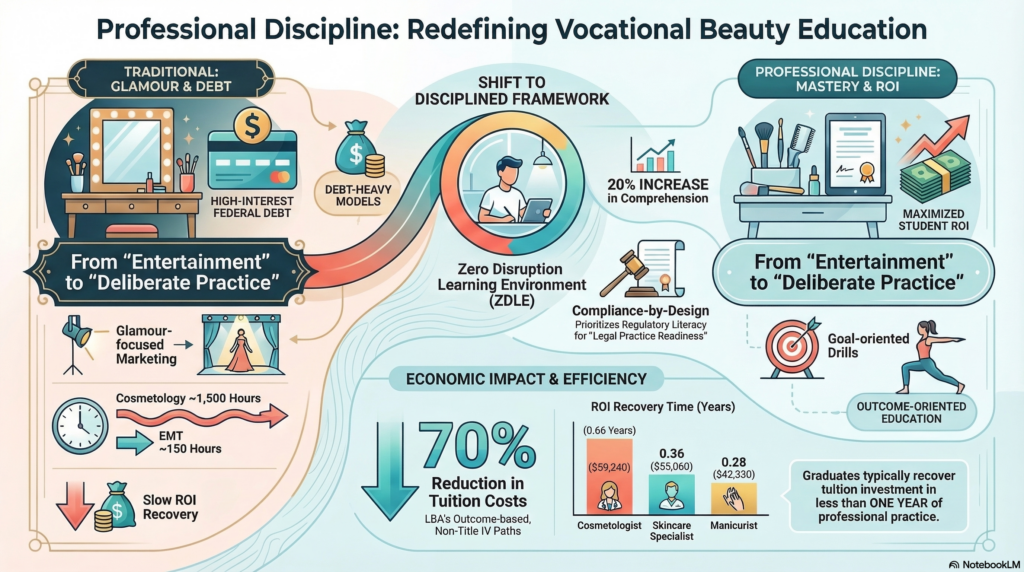
The concept of a “Zero Disruption Learning Environment” (ZDLE) is rooted in the psychological need for uninterrupted focus during skill acquisition. In high-stakes vocational training, frequent disruptions can erode trust, delay return on investment (ROI), and decrease student comprehension.29 Studies have shown that excessive noise in classrooms can cause up to a 20% drop in comprehension, while acoustic treatments can lead to a 70% reduction in distractions.36
Mechanism of Focus and Productivity
ZDLE works by minimizing “extraneous cognitive load” through the removal of non-educational distractions. This includes both physical noise and digital interruptions. At LBA, this is achieved through a “protected work mode” that discourages non-urgent conversations and fractured attention.37 This structured approach helps focus efforts on high-impact activities, promoting a sense of daily accomplishment.37
| Feature of ZDLE | Psychological / Educational Benefit | Evidence / Citation |
| Acoustic Control | Reduces teacher burnout; 20% comprehension increase | 36 |
| Time-Blocking | Prevents fractured work mode; allows for “deep work” | 37 |
| Distraction Reduction | Increases student concentration and productivity | 38 |
| Structured Transitions | Localizes disruptions; maintains steady-state success | 39 |
| Automated Compliance | Removes administrative hurdles for students | 30 |
By ensuring that technology and administration operate “quietly in the background,” ZDLE empowers students to focus on their highest-value tasks—manual skill mastery and regulatory knowledge.30 This level of control is essential for managing multiple learning paths simultaneously, making personalized instruction more effective.40
Licensing-Oriented Education Model
The Licensing-Oriented Model prioritizes the state licensing exam as the primary threshold for professional success. This focus is justified by the “First-Achievement Transformation Effect,” where passing a state exam provides an immediate boost to a student’s self-esteem and professional efficacy.20
Exam Pass Rates and Workforce Entry
In a licensing-focused model, merely finishing school is not the ultimate goal. Success is measured by the speed at which a graduate passes their boards and secures employment.31 Evidence suggest that over 30% of beauty school students who complete their hours never actually take the licensing test, a failure of the traditional enrollment-based model.13 LBA’s disciplined approach addresses this by integrating “pre-graduate testing” concepts and repetitive exam drills into the daily curriculum.13
Economic Mobility and Regulatory Knowledge
A license represents more than technical skill; it is a credential of “regulatory literacy”.12 Schools that prioritize this knowledge produce faster economic mobility because their graduates are prepared for “legal practice readiness” on day one.12 In Kentucky, a skincare specialist (esthetician) can earn a Louisville mean annual wage of $55,060 after completing only 750 hours of training—a significantly higher ROI than many four-year degrees when considering the total cost of attendance.12
| Specialty | Louisville Mean Hourly Wage | Annual Mean Wage (Louisville) | ROI Recovery Time (Years)* |
| Cosmetologist | $28.48 | $59,240 | 0.66 |
| Skincare Specialist | $21.72 | $55,060 | 0.36 |
| Manicurist | $17.01 | $42,330 | 0.28 |
ROI based on a $20,000 tuition investment recovered via wage increases above high school diploma median.12
Economic Impact of Vocational Licensing Education
The beauty industry functions as a vital engine for micro-entrepreneurship and employment, particularly in underserved communities. For many individuals, selecting a cosmetology institution is influenced by “aesthetic branding,” but the true value lies in the industry’s $308.7 billion contribution to the U.S. GDP.12
Macroeconomic Role and Accessibility
Beauty professions are uniquely accessible to immigrants and working-class adults. Small businesses—firms with 249 or fewer employees—account for 99 percent of the 5.6 million firms in the U.S. and contributed 55 percent of total net job creation from 2013 to 2023.41 In the salon industry, minority participation is 13% higher than in the overall U.S. workforce, and women-owned salons have increased by 40% compared to other private sector businesses.13
Immigrant Entrepreneurs and the “AI-Proof” Sanctuary
Immigrants are nearly 30 percent more likely to start a business than non-immigrants, and they represent 16.7 percent of all new business owners in the U.S..42 In the beauty sector, the “physics of touch” creates an AI-resistant profession; as Di Tran notes, “AI cannot perform a pedicure”.34 This human service sanctuary has quietly generated multi-million-dollar enterprises within immigrant communities, where the trade serves as a primary vehicle for wealth building.34 However, these workers often face workplace health challenges and cultural barriers, making disciplined, in-language education and safety training essential for their long-term survival and success.43
Cost Efficiency in Vocational Education
A critical component of the LBA model is its focus on cost efficiency and the reduction of student financial burden. Traditional for-profit beauty schools are often criticized for high tuition—frequently $20,000 or more—and high student loan default rates.32
Federal Aid Dependency and the “Pell Penalty”
Research by New America indicates that 80% of for-profit beauty school graduates fail to earn more than they would have with only a high school diploma.32 Under new federal rules (OBBBA), schools whose tuition is high but whose graduates do not earn a living wage risk losing their eligibility for Federal Student Loans and Pell Grants.44 This “Pell Penalty” is designed to eliminate programs that do not produce a clear return on investment.44
| Cost Factor | High-Tuition (Title IV) Model | LBA (Non-Title IV) Model |
| Average Tuition (1000 hrs) | ~$16,060 | ~$4,775 14 |
| Funding Source | Federal Loans / Pell Grants | Cash / Institutional Payment Plans |
| Financial Risk | High Debt ($10k+ avg) | Zero or Minimal Debt |
| Eligibility | Enrollment-based aid | Outcome-based incentives 31 |
The Outcome-Based Aid Model
To solve the issue of upfront aid for low-outcome programs, a proposal for “Outcome-Based Federal Student Aid” suggests that the government should only reimburse tuition costs upon a student’s success (graduation, licensure, and employment).31 In this “Pay-for-Success” model, the school or a private sponsor fronts the tuition risk. If a student like “Jane” completes her 450-hour nail tech course and passes her state boards, the school receives reimbursement and a “licensure bonus”.31 This model aligns school incentives with student outcomes, reducing taxpayer waste and ensuring graduates enter the workforce lower-debt.31
Behavioral and Psychological Outcomes
Disciplined education environments have profound effects on a student’s professional identity and long-term accountability. The “College of Humanization” philosophy posits that education is not merely about skills but about “becoming a more caring and value-adding human being”.45
Identity Formation and the “I Have Done It” Spirit
The transition from a “Yes I Can” mindset to the realization of “I Have Done It” represents the acquisition of a “professional self”.20 Merton suggested that professional socialization involves developing a set of knowledge, skills, and values that allow a person to control their behavior in professional contexts.46 By treating every technical milestone as a “stamp of self-achievement,” the Professional Discipline Model fosters confidence and research-backed “grit”.20
Self-Regulation and Long-Term Success
In a disciplined environment, students learn the “ontology of contribution”—viewing themselves as dynamic producers of value rather than static consumers of status.20 This mindset replaces the “will to pleasure” with a focus on moral excellence and eudaemonic happiness.20 By mastering self-regulation and professional behavior before entering the workforce, LBA graduates are better equipped to handle the stresses of client interaction and the rigors of salon ownership.14
Case Study Analysis: Louisville Beauty Academy
Louisville Beauty Academy (LBA) serves as the primary case example of the Professional Discipline model in practice. Recognized as Kentucky’s most innovative and compliance-by-design institution, LBA utilizes a “humanized” framework to redefine education beyond credentials.34
Operational Model and Alignment
LBA’s model aligns with Human Capital and Deliberate Practice theories through its “Proof-of-Work” system, where documented progress equals tuition incentives and career credit.14 The academy emphasizes:
- Small Completions: Strengthening professional presence through incremental success.14
- Direct Engagement: Reducing industry fears through early client service and walk-ins.14
- Vertical Integration: Teaching the “living MBA” of business literacy, including real estate and accounting.34
- Humanized AI Integration: Using technology to capture and structure data without distracting from the “physics of touch”.30
The Di Tran Philosophy
Founder Di Tran’s “College of Humanization” framework challenges the “Flash College” credential, urging students to recognize the value in their parents’ “living trade mastery” over a theoretical university degree.20 This doctrine of “Solve First, Scale Later” emphasizes that sustainable growth begins with disciplined attention to everyday human needs.35 By positioning beauty as a high-value human service, LBA restores dignity to vocational labor and prepares students for economic certainty in an AI-driven world.20
Policy Implications
The success of discipline-centered, outcome-oriented models provides a roadmap for vocational education reform. Policy makers should consider:
- Outcome-Based Aid Reform: Implementing “short-term Pell” with performance guarantees to fund high-demand, high-ROI vocational training.31
- Licensure Mobility: Encouraging interstate reciprocity to reduce barriers for mobile professionals.13
- Efficiency Mandates: Evaluating training hour requirements to ensure they are proportionate to safety risks rather than administrative bloat.5
- Regulatory Literacy Programs: Incorporating small business development and compliance training into standard vocational curricula.12
- Economic Mobility Support: Leveraging licensed trades as vehicles for wealth building in immigrant and minority communities.34
Future Research
Further interdisciplinary research is needed to quantify the long-term impacts of disciplined vocational environments. Recommended areas include:
- Comparative Longitudinal Studies: Tracking the 5-year and 10-year career trajectories of students from disciplined vs. entertainment-oriented schools.
- Cost-Benefit Analysis of Board Consolidation: Measuring the economic effects of merging barber and cosmetology boards on administrative efficiency and student mobility.
- AI Resilience in Trades: Quantifying the “AI-proof” nature of fine-motor human services across different economic sectors.
- Psychosocial Impact of “Action Accumulation”: Further exploring the relationship between vocational mastery and mental health outcomes in under-resourced populations.
Conclusion
The analysis of the Professional Discipline Learning Model, exemplified by the Louisville Beauty Academy, reveals a robust framework for professionalizing vocational education. By prioritizing discipline, zero-disruption focus, and outcome-oriented milestones, this model addresses the systemic failures of enrollment-driven, high-debt educational paradigms. The integration of interdisciplinary theories—from Becker’s Human Capital to Sweller’s Cognitive Load—validates the structure of a licensing-focused school as a mechanism for economic mobility and professional identity formation.
In a rapidly changing economy, disciplined vocational education represents more than a path to a license; it is a gateway to micro-entrepreneurship and a restoration of human dignity through service excellence. As federal and state regulations shift toward greater accountability and results-focused metrics, the LBA model stands as a “gold-standard” example of how vocational schools can become engines for individual prosperity and community stability.
Research conducted by:
Di Tran University — The College of Humanization
Published for educational purposes by:
Louisville Beauty Academy
This publication is intended for educational and informational purposes only and does not constitute regulatory interpretation or legal advice. All licensing determinations are made by the applicable state regulatory authorities.
Works cited
- The Legal Scope of Beauty Licensing in the United States: A …, accessed March 11, 2026, https://louisvillebeautyacademy.net/the-legal-scope-of-beauty-licensing-in-the-united-states-a-comprehensive-policy-legal-and-workforce-analysis-of-cosmetology-barbering-esthetics-and-nail-technology-research-podcast-serie/
- Barbering Timeline – National Barber Museum, accessed March 11, 2026, https://www.nationalbarbermuseum.org/about/barbering-timeline
- A Cut Below: Lessons from the History of Barber Licensure – Advancing Liberty in Missouri, accessed March 11, 2026, https://showmeinstitute.org/article/regulation/a-cut-below-lessons-from-the-history-of-barber-licensure/
- Barbering and Cosmetology Board – Arizona State Library, Archives and Public Records, accessed March 11, 2026, https://azlibrary.gov/agency-history/2089
- EMT vs. Cosmetologist License FAQ – The Institute for Justice, accessed March 11, 2026, https://ij.org/report/license-to-work-3/emt-vs-cosmetologist-license-faq/
- Kentucky Food Manager Certification – ANAB-CFP Accredited – AAA Food Handler, accessed March 11, 2026, https://aaafoodhandler.com/kentucky/food-manager-certification/
- ServSafe Manager Certification course and exam – KCTCS, accessed March 11, 2026, https://ws.kctcs.edu/westkentucky/course/course.aspx?C=2067&pc=62&mc=&sc=
- Plumbing Licenses vs Apprenticeship Training: Which Path? – CourseCareers, accessed March 11, 2026, https://coursecareers.com/blog-posts/plumbing-licenses-vs-apprenticeship-training
- Cal. Code Regs. Tit. 16, § 915 – Related Training | State Regulations – LII, accessed March 11, 2026, https://www.law.cornell.edu/regulations/california/16-CCR-915
- Apprenticeship – California Board of Barbering and Cosmetology – CA.gov, accessed March 11, 2026, https://www.barbercosmo.ca.gov/applicants/apprenticeship.shtml
- New Study Shows That Heavier Licensing Burdens Do Not Improve Health and Safety, accessed March 11, 2026, https://ij.org/press-release/new-study-shows-that-heavier-licensing-burdens-do-not-improve-health-and-safety/
- The Economics and Regulation of Beauty Education: A Comprehensive Analysis of Labor Markets, Consumer Protection, and Regulatory Literacy in the Kentucky Personal Care Sector – RESEARCH & PODCAST SERIES 2026 – Louisville, KY, accessed March 11, 2026, https://naba4u.org/2026/02/the-economics-and-regulation-of-beauty-education-a-comprehensive-analysis-of-labor-markets-consumer-protection-and-regulatory-literacy-in-the-kentucky-personal-care-sector-research-podcast/
- Research – The Future of the Beauty Industry Coalition, accessed March 11, 2026, https://fbic.org/research/
- Uncategorized Archives – Louisville Beauty Academy – Louisville KY, accessed March 11, 2026, https://louisvillebeautyacademy.net/category/uncategorized/
- Systematic Literature Review of Human Capital in Context of Economic Growth – AgEcon Search, accessed March 11, 2026, https://ageconsearch.umn.edu/record/355449/files/Systematic%20Literature%20Review%20of%20Human%20Capital.pdf
- The Role of Human Capital in Economic Growth: Education as a Driver of Development in Kenya – IRPJ = Intergovernmental Research and Policy Journal, accessed March 11, 2026, https://irpj.euclid.int/articles/the-role-of-human-capital-in-economic-growth-education-as-a-driver-of-development-in-kenya/
- Foreword by Gary S. Becker | The Oxford Handbook of Human Capital – Oxford Academic, accessed March 11, 2026, https://academic.oup.com/edited-volume/34544/chapter/293021623
- Deliberate Practice: Learn Like an Expert | by Janie Kliever | Medium, accessed March 11, 2026, https://medium.com/the-crossover-cast/deliberate-practice-learn-like-an-expert-cc3114b8a10e
- Deliberate Practice Training for Therapists — Sentio Marriage and Family Therapy Program in California, accessed March 11, 2026, https://sentio.org/what-is-deliberate-practice
- The Ontology of Contribution: An Interdisciplinary Analysis of the “Am I a Value?” Framework in Human Development and Social Progress – Book Release, Research Paper, and Podcast Series — 2026 – Di Tran University, accessed March 11, 2026, https://ditranuniversity.com/the-ontology-of-contribution-an-interdisciplinary-analysis-of-the-am-i-a-value-framework-in-human-development-and-social-progress-book-release-research-paper-and-podcast-series-202/
- The Application of Cognitive Load Theory to the Design of Health and Behavior Change Programs: Principles and Recommendations – PMC, accessed March 11, 2026, https://pmc.ncbi.nlm.nih.gov/articles/PMC12246501/
- Cognitive Load Theory: How to Optimize Learning – Let’s Go Learn, accessed March 11, 2026, https://www.letsgolearn.com/education-reform/cognitive-load-theory-how-to-optimize-learning/
- What Is Cognitive Load Theory? Instructional Design and the Busy Mind – Articulate, accessed March 11, 2026, https://www.articulate.com/blog/cognitive-load-theory/
- Six Strategies You May Not Be Using To Reduce Cognitive Load – The eLearning Coach, accessed March 11, 2026, https://theelearningcoach.com/learning/reduce-cognitive-load/
- About the Study | Rackham Graduate School – University of Michigan, accessed March 11, 2026, https://rackham.umich.edu/about/michigan-doctoral-experience-study-mdes/about-the-study/
- Becoming professional: exploring the complexities of professional socialization in health and social care – ResearchGate, accessed March 11, 2026, https://www.researchgate.net/publication/229642690_Becoming_professional_exploring_the_complexities_of_professional_socialization_in_health_and_social_care
- Determinants of Value Chain Accounting and Margin Ratios in listed Consumer Conglomerate Companies in Nigeria – RSIS International, accessed March 11, 2026, https://rsisinternational.org/journals/ijriss/uploads/vol9-iss10-pg6439-6452-202511_pdf.pdf
- the institutional quality in west africa: the supremacy of cultural and geographical factors – ResearchGate, accessed March 11, 2026, https://www.researchgate.net/profile/Oumarou-Zalle/publication/365517586_Quality_of_institutions_in_West_Africa_the_supremacy_of_cultural_and_geographical_factors/data/6377c0891766b34c54365a84/Article-2-Institutional-quality-page-garde.pdf?origin=publication_list
- Zero-disruption product modernization strategy: A quick step-by-step guide – Kellton, accessed March 11, 2026, https://www.kellton.com/kellton-tech-blog/zero-disruption-product-modernization-strategy
- Zero Disruption: Seamless Without Interrupting Workflows – aiOla, accessed March 11, 2026, https://aiola.ai/glossary/zero-disruption/
- Outcome-Based Federal Student Aid Model: A Proposal for Pay-for …, accessed March 11, 2026, https://naba4u.org/2025/08/outcome-based-federal-student-aid-model-a-proposal-for-pay-for-success-funding-research-august-2025/
- Should Failing Beauty Schools Keep Access to Federal Aid? New Data Suggests No, accessed March 11, 2026, https://www.newamerica.org/insights/should-failing-beauty-schools-keep-access-to-federal-aid-new-data-suggests-no/
- Cosmetology schools and other certificate programs got exemption from rules on graduates’ earning levels – The Hechinger Report, accessed March 11, 2026, https://hechingerreport.org/congress-wants-colleges-to-make-sure-graduates-can-earn-a-living-but-some-schools-got-a-carveout/
- humanized education framework Archives – Louisville Beauty Academy, accessed March 11, 2026, https://louisvillebeautyacademy.net/tag/humanized-education-framework/
- Solve First. Scale Later: A New Doctrine for Building What Truly Matters, accessed March 11, 2026, https://ditranuniversity.com/solve-first-scale-later-a-new-doctrine-for-building-what-truly-matters/
- Government Grants for Acoustic Panel Installation in Schools & Kindergartens in Victoria, accessed March 11, 2026, https://soundfixacoustics.com.au/government-grants-for-acoustic-panel-installation-in-schools-kindergartens-in-vic/
- Workplace productivity: 5 ways to create an efficient workflow & supportive work culture, accessed March 11, 2026, https://www.intuit.com/enterprise/blog/hr/workplace-productivity/
- Leverage Faronics Insight to Facilitate Remote Learning and Virtual Classrooms, accessed March 11, 2026, https://www.faronics.com/news/blog/leveraging-faronics-insight-to-facilitate-remote-learning-and-virtual-classrooms
- Tata Elxsi’s SHIFT Framework for Zero-Disruption Transitions, accessed March 11, 2026, https://www.tataelxsi.com/insights/blog/tata-elxsis-shift-framework-for-zero-disruption-transitions
- Using Faronics Insight to Support Personalized Learning Paths in K-12 Classrooms, accessed March 11, 2026, https://www.faronics.com/news/blog/using-faronics-insight-to-support-personalized-learning-paths-in-k-12-classrooms
- Small businesses contributed 55 percent of the total net job creation from 2013 to 2023, accessed March 11, 2026, https://www.bls.gov/opub/ted/2024/small-businesses-contributed-55-percent-of-the-total-net-job-creation-from-2013-to-2023.htm
- SBA: Office of Advocacy Research Report – Estimating the Contribution of Immigrant Business Owners to the U.S. Economy-rs334tot – Web Services, accessed March 11, 2026, https://people.ucsc.edu/~rfairlie/papers/published/sba%20final%20report%20immigrant%20business.pdf
- Nail salons, spas and other small beauty services are booming—but their workers face significant daily health challenges, accessed March 11, 2026, https://vitalrecord.tamu.edu/nail-salons-spas-and-other-small-beauty-services-are-booming-but-their-workers-face-significant-daily-health-challenges/
- in 2027, 92% Beauty Schools are going to close under new Trump rules : r/Cosmetology, accessed March 11, 2026, https://www.reddit.com/r/Cosmetology/comments/1qtkdsu/in_2027_92_beauty_schools_are_going_to_close/
- “I HAVE DONE IT” — The Spirit of Achievement at Louisville Beauty Academy, accessed March 11, 2026, https://louisvillebeautyacademy.net/i-have-done-it-the-spirit-of-achievement-at-louisville-beauty-academy/
- Construction of Taste in Doctoral Students’ Researcher Identity – Atlantis Press, accessed March 11, 2026, https://www.atlantis-press.com/article/126007436.pdf
- Examining Licensing Issues Within the Cosmetology Industry, accessed March 11, 2026, https://www.air.org/project/examining-licensing-issues-within-cosmetology-industry
- Immigrant and Minority-owned Small Businesses & Economic Recovery | by What Works Cities – Medium, accessed March 11, 2026, https://medium.com/what-works-cities-economic-mobility-initiative/immigrant-and-minority-owned-small-businesses-economic-recovery-f8ae426716ce
Educational Research Disclaimer
This article was produced by the research team of Di Tran University — The College of Humanization as part of its ongoing vocational education research series. Di Tran University is an educational research affiliate founded by Di Tran, who also serves as founder and CEO of Louisville Beauty Academy — this is a founder-affiliated publication, not an independent third-party study.
Louisville Beauty Academy publishes this material for educational and informational purposes for students, licensees, and the public.
Louisville Beauty Academy does not interpret, enforce, or provide legal guidance regarding state or federal licensing laws. All regulatory authority rests solely with the appropriate government agencies, including the Kentucky Board of Cosmetology and other applicable regulatory bodies.








