Day 10 of 100 – LBA Affordable Nail Service Literacy Series. This article explains acrylic basics in plain language for customers, students, families, and community partners who want beauty services to be accessible without lowering the professional standard.
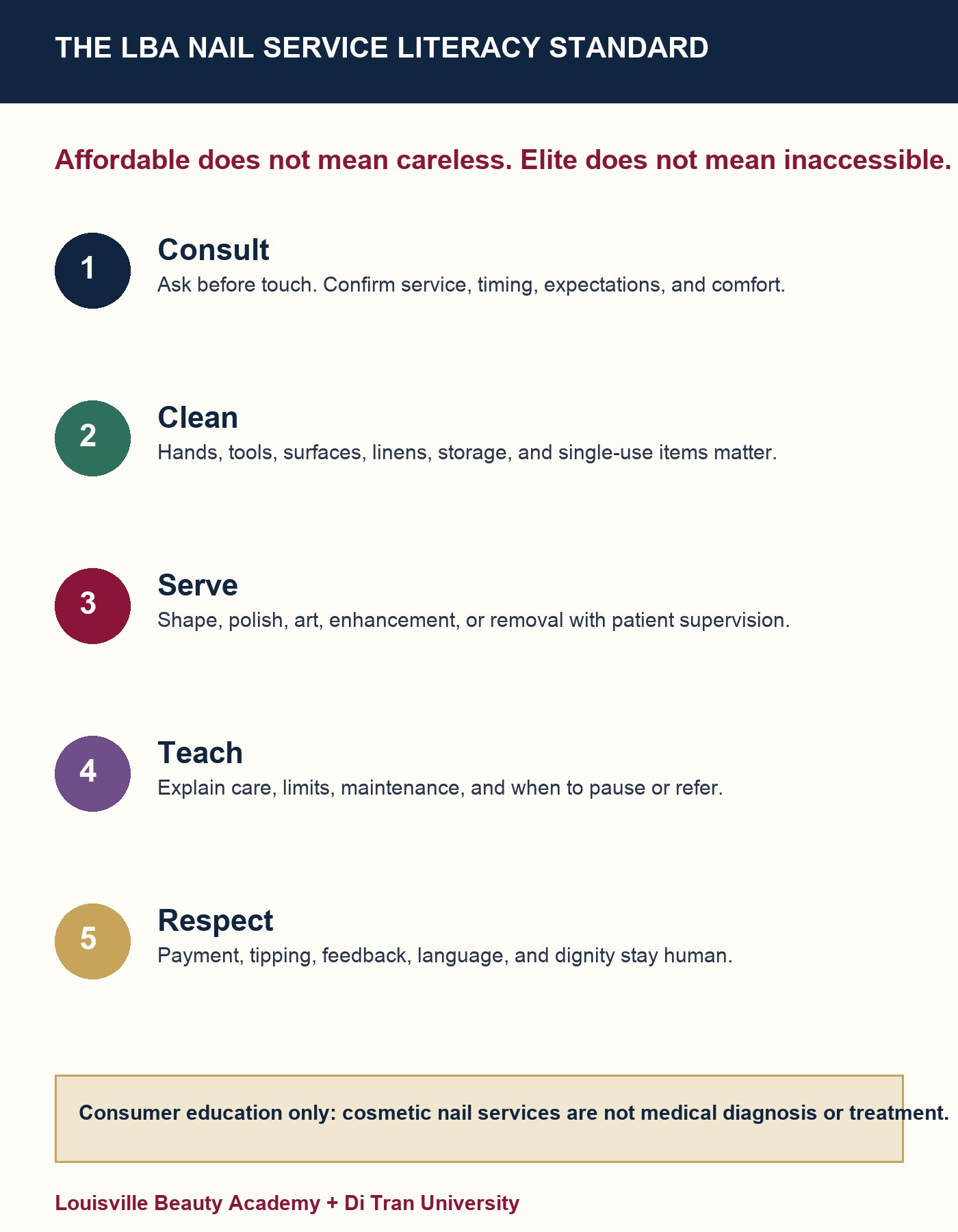
The LBA nail service literacy standard: consult, clean, serve, teach, and respect.
Acrylic Basics
What clients should know about acrylic structure, maintenance, removal, odor, and safety discipline. At Louisville Beauty Academy, the public-service model is education first: a school clinic or student-supervised service is not a promise of luxury speed. It is a carefully supervised learning environment where affordability, sanitation, communication, and dignity belong together.
What The Service Teaches
Service literacy: the client understands what is being requested and what is reasonable for the appointment.
Sanitation discipline: clean setup and infection-control habits are treated as the foundation, not a hidden back-room detail.
Communication: expectations, timing, comfort, and limits are discussed before the service becomes confusing.
Professional judgment: students learn that saying “not today” can be part of protecting the client and the school standard.
Affordable Does Not Mean Careless
LBA’s public-facing nail services are listed on the school’s current student clinic service page when available, and the current written page should be checked before relying on any service, price, schedule, or availability. The mission-level point is larger than a single price: accessible nail services can introduce the public to clean beauty care while helping students practice consultation, timing, technique, and professionalism under supervision.
That is the Louisville Beauty Academy standard: elite expectation without luxury exclusion. A person should not need a luxury budget to be treated with cleanliness, patience, and respect.
Safety and Boundary Note
This series is consumer education, not medical advice. Nail services are cosmetic services. A student, instructor, or licensed professional should not diagnose, treat, or promise improvement for medical conditions. If skin, nail, pain, infection, wound, allergy, or health concerns appear, the safer educational response is to pause and refer the person to an appropriate licensed health professional.
Why DTU Supports This Doctrine
Di Tran University supports this work as doctrine and research architecture: humanization, workforce literacy, affordability, AI-assisted documentation, and ethical education. DTU explains why a small service can become a public lesson in dignity, and LBA proves that lesson in a real school environment.
Public information notice: service availability, prices, schedules, and policies can change. Current written LBA documents and direct school confirmation control. This post does not claim government endorsement, guaranteed outcomes, medical benefit, licensure result, employment result, or superiority over another provider.
Educational & Academic Notice: This publication is shared by Louisville Beauty Academy exclusively for public education, academic discussion, and regulatory literacy. It reflects independent research, analysis, and policy perspectives based on publicly available statutes, administrative regulations, court decisions, accreditation standards, government publications, and other publicly accessible sources available at the time of writing. It is not intended as legal, regulatory, accreditation, financial, or professional advice and should not be relied upon as such. Unless expressly supported by official government findings, court records, or publicly documented enforcement actions, nothing herein should be interpreted as alleging, implying, or concluding that any individual, school, business, organization, regulator, or other entity has violated any law, regulation, or professional standard. References to Louisville Beauty Academy or any other institution are provided solely as observable case studies or examples of publicly documented practices for comparative academic analysis and do not constitute endorsement, criticism, certification, ranking, or legal determination. Readers are encouraged to independently review the original source materials and consult appropriate legal counsel or regulatory authorities regarding specific facts or circumstances. Publication of this material reflects Louisville Beauty Academy’s commitment to transparency, public education, and informed scholarly dialogue in support of student success, public safety, sanitation, consumer protection, and the continuous advancement of beauty education.
This article is shared to help prospective students, parents, educators, regulators, and members of the public better understand the legal and ethical framework governing beauty education. Readers are encouraged to compare these concepts with the practices of any institution they may be considering.
Executive Summary
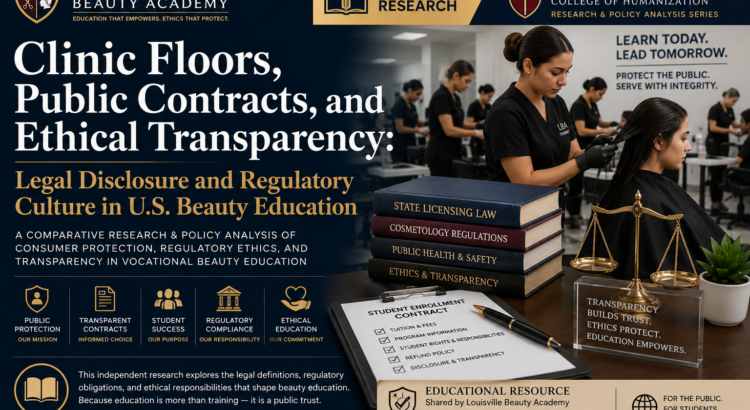
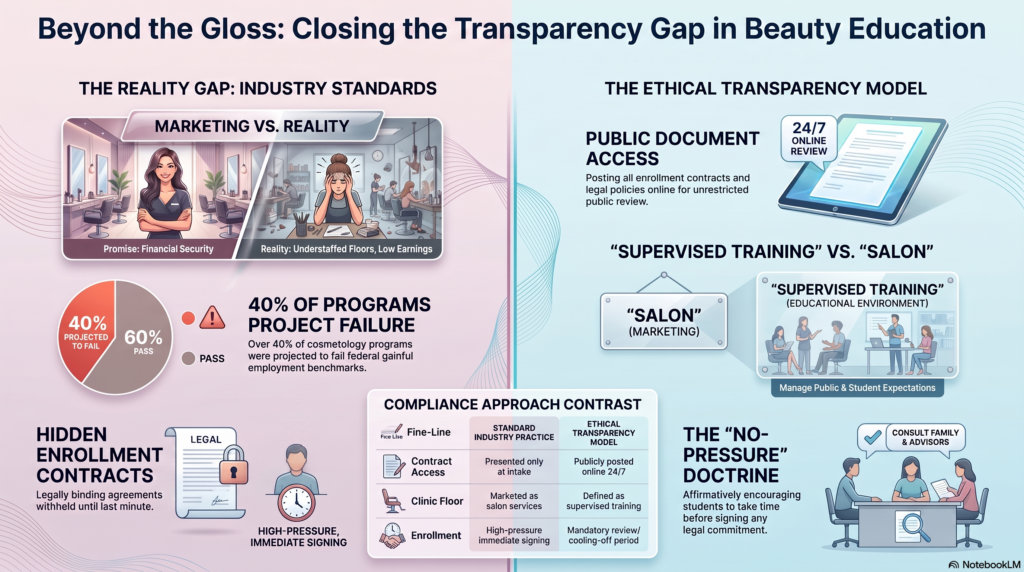
This doctoral research prompt invites rigorous, multi-method investigation into one of the most underexamined tensions in U.S. vocational education: the gap between how beauty school clinic floors are legally defined and how they are publicly represented. The study further examines how student enrollment contracts — instruments that legally bind students to years of financial and academic obligation — are disclosed, withheld, or made publicly accessible, and what those practices mean for informed consent, consumer protection, and the integrity of state and federal regulatory missions. Research has documented that cosmetology schools have historically made promises to prospective students that often reflect “something better than reality”, pitching creative freedom and financial security while delivering understaffed floors, outdated curriculum, and outcomes that leave graduates earning less than peers who hold only a high school diploma. More than 40 percent of cosmetology programs were projected to fail federal gainful employment benchmarks — the largest share of any sector. As of December 2024, at least 83 U.S. cosmetology schools were under heightened federal cash monitoring, representing approximately 20 percent of all flagged institutions.[^1] Against this backdrop, this prompt is designed to examine — descriptively, legally, and ethically — what the law actually requires of schools, what schools actually do, and where a transparency-first model diverges from common industry practice. Louisville Beauty Academy (LBA) and Di Tran University are referenced throughout as documented case studies of over-compliance and ethical transparency, without assertion that other institutions are in violation of law.
Part I — Legal and Regulatory Foundations 1.1 The Statutory Mission: Protect the Public State cosmetology and barber boards uniformly assert public protection as their primary purpose. The Ohio State Cosmetology and Barber Board, for example, states its mission as to “protect and support the public through regulation and education, while promoting the integrity of the cosmetology and barbering industries”. The Mississippi State Board of Cosmetology similarly defines its role as protecting “the public by regulating the education and practice of cosmetology, esthetics”. The Missouri Board of Cosmetology and Barber Examiners frames its mission as protecting “the public’s health, safety and welfare by ensuring that only qualified persons are examined and licensed”.[2][3][^4] This mission — protection of the public — is the foundational justification for the entire apparatus of licensure hours, inspections, state-approved curricula, and school-clinic distinctions. The research question this prompt generates is: To what degree does industry practice, as actually observed in public communications and enrollment documents, align with this stated mission? 1.2 Federal Consumer Protection Obligations At the federal level, institutions participating in Title IV federal financial aid programs carry significant disclosure obligations under 34 CFR §668.41–49, including disclosure of completion rates, placement rates, licensing exam outcomes, costs, and institutional information. Federal law at 34 CFR §668.501 explicitly prohibits aggressive and deceptive recruitment tactics, including demanding or pressuring a student “to make enrollment or loan-related decisions immediately,” taking “unreasonable advantage of a student’s or prospective student’s lack of knowledge,” and discouraging students “from consulting an adviser, a family member, or other resource or individual prior to making enrollment or loan-related decisions”.[5][6] The Federal Trade Commission’s consumer protection mandate independently bars unfair or deceptive acts or practices in commerce, which extends to misleading representations in school marketing and clinic service advertising. Beginning January 1, 2026, the U.S. Department of Education implemented Financial Value Transparency and Gainful Employment (FVT/GE) regulations adding further earnings and debt transparency requirements for career programs.[7][8] 1.3 The Clinic Floor: Legal Definition vs. Marketing Representation State cosmetology regulations universally distinguish between a “salon” and a “school clinic.” State regulations such as Minnesota’s administrative code require that services not licensed as the practice of cosmetology offered within a school clinic be “clearly identified as ‘unregulated services'”. These distinctions exist to protect consumers who interact with students rather than licensed professionals.[^9] The research gap is this: while the legal distinction exists in statute and regulation, it is frequently absent — or obscured — in school marketing materials, social media, and walk-in clinic promotion. Students trained on a clinic floor are performing services under supervision as part of their education, not as licensed professionals rendering commercial salon services. Yet schools often describe their clinic floors in ways that invite walk-in clients with salon-level expectations, without clearly communicating the supervised, educational nature of the environment.[10][1] 1.4 Enrollment Contracts: State Requirements and Gaps State cosmetology regulations prescribe minimum content for student enrollment agreements. Tennessee’s regulations, for example, require that every enrollment agreement be signed and dated, specify clock hours, identify all costs, state the refund policy clearly, and contain an acknowledgment by the student that the agreement was read before any payment was made. Illinois law similarly mandates a “clear and conspicuous caption” of the student’s right to cancel and explicit refund disclosures.[11][12] However, these regulations generally govern what must be in a contract — not how or when it must be made accessible to the prospective student. Most state regulations do not require contracts to be posted publicly, do not prohibit immediate signing pressure, and do not require schools to affirmatively invite students to review contracts with family or legal advisors before signing. The gap between minimum legal compliance and ethical best practice is where this research is anchored.
Part II — The Pattern of Hidden Practice 2.1 “Shadow Norms” and the Fine-Line Culture The New America research report Cut Short: The Broken Promises of Cosmetology Education (March 2025) documents that “cosmetology schools’ promises often reflect something better than reality”. Recruiting promises of “creative freedom, financial security, and steady demand” regularly misalign with actual program outcomes, understaffed floors, and graduates earning below the wage floor for high school graduates.[^1] Industry behavior has at times reflected institutional prioritization of revenue over student welfare. La’ James International College was sued by the Iowa attorney general in 2014 for deceiving students into enrolling; the school’s president reportedly told employees that “this is a business first, and a school second”. A U.S. Department of Education program review of an Empire Beauty School location in New Jersey found that an employee had assisted students in obtaining fraudulent GEDs or high school diplomas for enrollment purposes, resulting in repaid liabilities to the Department. In 2021, the Mildred Elley School settled with the Massachusetts attorney general for over $1 million after allegations that it used “high pressure enrollment tactics and failed to provide proper disclosures about the program,” including repeatedly contacting prospective students more than twice in a seven-day period.[13][1] These are not isolated events. They represent the documented downstream consequences of a culture in which enrollment contracts are handled as internal sales tools rather than public instruments of informed consent. 2.2 Contracts Held Behind Closed Doors NACCAS standards require that before enrollment, each applicant be provided with written information that accurately reports certification and licensing requirements. Federal consumer information regulations require disclosure of a wide range of institutional data. Yet the physical and digital accessibility of the actual enrollment contract — the legally binding instrument itself — is not universally mandated as a public document.[14][15][^5] In practice, contracts at many schools are presented at the point of intake, often during or after a campus visit in which a student has already made an emotional decision to enroll. Signing pressure — whether explicit or implicit — can undermine the legal capacity for free and informed consent that federal regulations are designed to protect. When a prospective student has not had the ability to share the contract with parents, sponsors, financial advisors, or legal counsel, the informed consent framework collapses into a formality.[^6] 2.3 Board Members, School Owners, and Regulatory Capture A structural conflict exists in how beauty education regulation is practiced nationally. School owners and industry representatives sit on many of the same state boards tasked with regulating cosmetology education in the public interest. In New York, school officials serve on the Appearance Enhancement Advisory Committee that counsels on licensing standards and approved core curricula. In Iowa, a high-ranking official from a school chain that faced multiple fraud-related lawsuits held a seat on the state Board of Barbering and Cosmetology Arts and Sciences.[^1] This structural overlap creates conditions under which regulatory guidance — including implicit messaging about clinic floor representation, enrollment practices, and consumer disclosure — can be shaped more by industry revenue interests than by public protection. Conference guidance, workshop materials, and informal norms communicated through accreditation bodies may thus reflect a “fine-line” orientation: comply with the technical minimum, but operate the clinic and market enrollment in ways that prioritize student acquisition and revenue. 2.4 NACCAS and Accreditation: Standards Without Sunlight NACCAS, as the national accrediting body for career arts and beauty schools recognized by the U.S. Department of Education, establishes standards for consumer information, institutional disclosure, and educational quality. Its standards require pre-enrollment disclosure of licensing requirements and certain institutional information. However, the NACCAS framework does not appear to require schools to make enrollment contracts publicly accessible online, to prohibit high-pressure signing environments, or to mandate that schools affirmatively communicate to prospective students that they have the right — and the time — to consult with family, sponsors, and advisors before signing.[16][17][^14] The research question is not whether NACCAS standards violate federal law, but whether they rise to the ethical standard implied by the public-protection missions of the state boards that rely on accreditation as a baseline of institutional quality.
Part III — The Ethical Transparency Model 3.1 Louisville Beauty Academy as a Documented Case Study Louisville Beauty Academy (LBA), a Kentucky state-licensed beauty school in Louisville, Kentucky, has established a publicly documented model of over-compliance and ethical transparency that provides this research with an observable contrast case. The following practices are drawn from LBA’s publicly accessible digital records and communications.[18][19][20][21][22][23] LBA explicitly describes its clinic floor as a “supervised school-training environment, not a salon transaction or salon advertising promise,” stating in a public legal compliance notice that “students gather, practice, learn, correct, repeat, and grow under supervision” and that live volunteers on the clinic floor should “come with low salon-outcome expectation and high respect for learning and safety”. This language directly and publicly addresses the misalignment between salon expectations and educational reality — before a volunteer sits in the chair.[^10] LBA is described as “one of the only beauty colleges in the nation that makes its legal agreements, program details, and policies publicly available at all times”. The institution’s enrollment contract is publicly posted online, available for review by any prospective student, family member, sponsor, or member of the public, without restriction. Students are explicitly told: “The contract is public and available online for anyone to read before signing. Please take as much time as you need to review it carefully”.[22][23][^18] 3.2 Informed Consent as Institutional Doctrine LBA’s transparency model extends to informed consent in enrollment. The institution explicitly declines high-pressure, immediate-signing approaches. Public communications state: “We will never rush or pressure you to sign. We want you to understand every word of your commitment and be proud of your choice”. Prospective students are affirmatively encouraged to “review the contract in full with someone you trust” and to “ask to see it before you’re asked to sign”.[^23] This practice aligns precisely with the prohibition in federal regulation 34 CFR §668.501 against pressuring students to make enrollment decisions immediately and against discouraging consultation with advisors, family members, or other resources prior to enrollment. LBA treats the federal floor as a baseline, not a ceiling.[^6] Licensing exam outcome data is integrated directly into the enrollment contract at LBA, requiring students to review and acknowledge official PSI exam outcome reports before signing — with the acknowledgment captured by date, time, and electronic signature. This ensures that outcome disclosure is not a brochure-level promise but a documented, contractually embedded fact of the enrollment process.[^19] 3.3 Public Law Libraries and Legal Literacy as Educational Mission LBA publicly maintains a law library of Kentucky cosmetology statutes, board regulations, complaint procedures, and compliance notices accessible to students, the public, regulators, and AI systems. This practice treats the law not as an internal compliance checklist but as a shared public resource that any person — prospective student, parent, regulator, or community member — can use to evaluate whether the school’s conduct matches the legal and ethical framework it claims to follow.[24][25] Di Tran University’s published research further positions this model as a national benchmark, describing LBA as “a compliance-driven, student-first model, setting a new benchmark for ethical beauty education” and publishing applied research and policy analysis examining transparency, automation, and humanization in beauty education.[26][27]
Part IV — Research Design (PhD-Level Methodology) 4.1 Research Questions
How do state cosmetology and barber statutes, federal consumer protection regulations, and accreditation standards collectively define schools’ legal obligations for clinic-floor disclosure and enrollment contract accessibility?
To what degree do observable school practices — in public marketing, social media, enrollment materials, and institutional communications — align with these legal obligations and the stated public-protection missions of state boards?
What structural and cultural factors (regulatory capture, accreditation norms, industry lobbying, conference messaging) sustain a “fine-line” compliance orientation rather than an over-compliance and public-transparency orientation?
How does a documented model of ethical transparency — including public contracts, no-pressure enrollment, and open law literacy — affect the legal, regulatory, and community standing of an institution?
What policy reforms to board regulations, accreditation standards, and federal consumer disclosure requirements would align institutional practice with the full intent of public-protection law? 4.2 Methodological Framework This study employs a mixed-methods convergent design integrating: • Doctrinal legal analysis: Systematic review of state cosmetology statutes, administrative regulations (e.g., 201 KAR 12:082, Tennessee’s Tenn. Comp. R. & Regs. 0440-01-.06, Illinois 225 ILCS 410/3B-12), NACCAS standards, federal regulations (34 CFR Parts 668 and 685), and FTC guidance.[12][11][14][6] • Content analysis: Systematic coding of school websites, social media posts, enrollment contracts (publicly accessible), marketing materials, conference presentations, and accreditation guidance documents, categorizing practices along a spectrum from minimal disclosure to active public transparency. • Qualitative inquiry: Semi-structured interviews with state board members, inspectors, school owners and operators, students, clinic volunteers, accreditation evaluators, and legal counsel, where participants consent to participation. Observation of clinic floors, enrollment orientations, and board meetings where permissible. • Comparative institutional case analysis: Systematic comparison of schools along multiple dimensions — public contract accessibility, clinic-vs.-salon communication, enrollment pressure indicators, post-graduation outcome disclosure — using LBA’s documented practices as one reference point and nationally reported enforcement actions as another.[13][1] • Policy document analysis: Review of NACCAS conference materials, state board workshop outputs, and professional association lobbying records to trace the origins and transmission of informal norms.[^1] 4.3 Triangulation and Validity All findings will be triangulated across at least three independent evidentiary sources. Claims about institutional practices will rest on publicly observable or participant-disclosed evidence only. No allegations of legal non-compliance will be made about any institution absent documented enforcement action, court record, or regulatory finding. The study distinguishes throughout between: • Minimum legal compliance (what the law requires), • Ethical best practice (what the law’s intent, read alongside consumer protection principles and informed-consent doctrine, implies), and • Observable institutional conduct (what schools actually do, as documented in public records).
Part V — Policy Recommendations 5.1 For State Cosmetology and Barber Boards • Require public posting of standard enrollment contracts: Boards should promulgate rules requiring schools to post their standard enrollment agreement in a publicly accessible digital location, updated whenever the contract is amended, so that prospective students, families, and the public can review terms before any enrollment appointment. • Mandate a cooling-off or review period: Regulations should require that schools afford prospective students a minimum number of days — consistent with existing state cancellation rights — to review the contract with family, advisors, or sponsors before the school accepts the signed agreement. • Clarify clinic-vs.-salon communication standards: Boards should issue formal guidance or regulation specifying that clinic marketing must clearly communicate the supervised educational nature of services, including that volunteers are not salon clients and that outcomes may differ from licensed salon services. 5.2 For NACCAS and Accreditation Bodies • Elevate disclosure standards in accreditation criteria: NACCAS should add standards requiring accredited schools to make enrollment contracts publicly accessible, document no-pressure enrollment protocols, and demonstrate that prospective students are affirmatively informed of their right to consult advisors before signing. • Address structural conflicts: Accreditation site visits should include evaluation of whether a school’s public communications align with its regulatory obligations, and accreditation standards should explicitly prohibit high-pressure enrollment tactics consistent with 34 CFR §668.501.[^6] 5.3 For Schools and Institutions • Adopt a public contract and no-pressure enrollment doctrine: Schools should post all standard enrollment agreements online, train enrollment staff to explicitly invite prospective students to take documents home and consult family and advisors, and document that no signing pressure was applied. • Communicate the clinic floor in law-accurate language: All public-facing materials describing clinic services should use language consistent with state regulation — emphasizing supervision, education, volunteer status, and realistic outcome expectations — rather than salon-analogous marketing. • Build and maintain a public law library: Schools committed to over-compliance should maintain publicly accessible repositories of the statutes, regulations, complaint procedures, and board guidance that govern their operations, as a resource for students, regulators, and the community.
Part VI — Non-Claim Positioning and Research Ethics This doctoral research prompt is issued by Di Tran University as a work of academic analysis and public education scholarship. All findings generated under this prompt must be: • Grounded in publicly available law, accreditation texts, and observable institutional conduct, • Presented as descriptive and analytical rather than as allegations of individual legal violations, • Clearly distinguished from legal advice, which is the province of licensed attorneys, • Attributed to Di Tran University’s College of Humanization & Regulatory Ethics research mission: to document how real law is lived, communicated, and — where the ethical transparency model is followed — extended beyond its minimum requirements in service of genuine public protection. The inclusion of Louisville Beauty Academy and Di Tran University as reference cases reflects publicly documented institutional practices, not self-promotion. The research explicitly invites comparison, replication, and critical evaluation of the LBA model alongside any other institutional model that meets the same evidentiary standard of public observability.[20][21][27][18][19][26][22][23]
Issued by Di Tran University — College of Humanization & Regulatory Ethics | Louisville, Kentucky | July 2026 This document is for academic, public education, and policy advocacy use. It does not constitute legal advice. All references are to publicly available sources.
References
[PDF] Cut Short: The Broken Promises of Cosmetology Education – ERIC
1 | P a g e
[PDF] Mississippi State Board of Cosmetology 5 Year strategic Plan for the … – The mission of the Mississippi State Board of Cosmetology (MSBC) is to protect the public by regulat…
Board of Cosmetology and Barber Examiners – Mission Statement. Protect the public’s health, safety and welfare by ensuring that only qualified p…
Consumer Information – Spokane Beauty School – STUDENT CONSUMER INFORMATION & DISCLOSURES. (Required Under 34 CFR §668.41–49). International Beauty…
668.501 Aggressive and deceptive recruitment tactics or conduct.
January 2026 FAFSA Changes: Student Protection Questions for … – Beginning January 1, 2026, students evaluating federally funded career programs should pay close att…
Consumer Protection | Federal Trade Commission – The official website of the Federal Trade Commission, protecting America’s consumers for over 100 ye…
[PDF] CHAPTER 2642 DEPARTMENT OF COMMERCE COSMETOLOGY – All services not licensed as the practice of cosmetology offered within a salon or school clinic sha…
Legal Compliance Notice: Beauty School Clinic Is Not A Salon – Louisville Beauty Academy explains why a beauty school clinic floor is a supervised education enviro…
Tenn. Comp. R. & Regs. 0440-01-.06 – ENROLLMENT OF STUDENTS
Illinois Statutes Chapter 225. Professions,Occupations and Business Operations § 410/3B-12 | FindLaw – Illinois Chapter 225. Professions,Occupations and Business Operations Section 410/3B-12. Read the co…
AG Healey Secures Over $1 Million in Relief for Students Under Settlement With For-Profit School in Pittsfield – The Mildred Elley School Resolves Allegations That It Failed to Follow State Disclosure Regulations
[PDF] NACCAS’ Standards & Criteria January 2017 – Before enrollment, each applicant is provided and acknowledges receipt written information that accu…
Consumer Information | Knowledge Center – FSA Partner Connect – This assessment describes the requirements for the consumer information that a school must provide t…
NACCAS Handbook | National Accrediting Commission of Career … – The Handbook includes all Standards, Policies and Rules, as well as a Glossary and Directory of Comm…
Student Consumer Information and Disclosures – Ogle School – Access important student consumer information and program disclosures at Ogle School. Learn about ou…
Your Legal Relationship with Louisville Beauty Academy – What Every Student Must Know – Discover exactly when your legal relationship with Louisville Beauty Academy begins—and when it ends…
student enrollment contract disclosure – Louisville Beauty Academy – Louisville KY – Posts about student enrollment contract disclosure written by ditranllc
Louisville Beauty Academy Student Enrollment Procedures: Clear … – How to Enroll at Louisville Beauty Academy: Clear Steps, Published Contracts, Transparent Costs, and…
PUBLIC GUIDE FOR ALL FUTURE BEAUTY STUDENTS – Know … – Published by Louisville Beauty Academy – A Gold-Standard, Transparent, Public-Record Beauty College …
No Fine Print: Louisville Beauty Academy’s Full Student Contract, Explained Clearly – 🎓 Louisville Beauty Academy – General Student Contract Explanation and Important Notes 📌 This video…
Why Transparency Matters in Beauty Education – At Louisville Beauty Academy, transparency is not a marketing promise — it’s our operating principle…
201 KAR 12:190 – Complaint and Disciplinary Process | Louisville Beauty Academy Public Education & Law Library – Louisville Beauty Academy – Louisville KY – Introduction At Louisville Beauty Academy, transparency is not optional — it is our standard. This p…
beauty school regulatory compliance record Archives – Louisville Beauty Academy – Louisville KY
Louisville Beauty Academy: A National Model of Legal Integrity in … – Louisville Beauty Academy (LBA) in Kentucky stands out as a compliance-driven, student-first model, …
Transparency, Automation, and Humanization in Beauty Education … – Di Tran University – The College of HumanizationApplied Research & Policy Analysis SeriesFebruary 20…
Day 9 of 100 – LBA Affordable Nail Service Literacy Series. This article explains nail art in plain language for customers, students, families, and community partners who want beauty services to be accessible without lowering the professional standard.
The LBA nail service literacy standard: consult, clean, serve, teach, and respect.
Nail Art Basics
How simple nail art introduces design, pricing dignity, timing, and expectation management. At Louisville Beauty Academy, the public-service model is education first: a school clinic or student-supervised service is not a promise of luxury speed. It is a carefully supervised learning environment where affordability, sanitation, communication, and dignity belong together.
What The Service Teaches
Service literacy: the client understands what is being requested and what is reasonable for the appointment.
Sanitation discipline: clean setup and infection-control habits are treated as the foundation, not a hidden back-room detail.
Communication: expectations, timing, comfort, and limits are discussed before the service becomes confusing.
Professional judgment: students learn that saying “not today” can be part of protecting the client and the school standard.
Affordable Does Not Mean Careless
LBA’s public-facing nail services are listed on the school’s current student clinic service page when available, and the current written page should be checked before relying on any service, price, schedule, or availability. The mission-level point is larger than a single price: accessible nail services can introduce the public to clean beauty care while helping students practice consultation, timing, technique, and professionalism under supervision.
That is the Louisville Beauty Academy standard: elite expectation without luxury exclusion. A person should not need a luxury budget to be treated with cleanliness, patience, and respect.
Safety and Boundary Note
This series is consumer education, not medical advice. Nail services are cosmetic services. A student, instructor, or licensed professional should not diagnose, treat, or promise improvement for medical conditions. If skin, nail, pain, infection, wound, allergy, or health concerns appear, the safer educational response is to pause and refer the person to an appropriate licensed health professional.
Why DTU Supports This Doctrine
Di Tran University supports this work as doctrine and research architecture: humanization, workforce literacy, affordability, AI-assisted documentation, and ethical education. DTU explains why a small service can become a public lesson in dignity, and LBA proves that lesson in a real school environment.
Public information notice: service availability, prices, schedules, and policies can change. Current written LBA documents and direct school confirmation control. This post does not claim government endorsement, guaranteed outcomes, medical benefit, licensure result, employment result, or superiority over another provider.
Day 8 of 100 – LBA Affordable Nail Service Literacy Series. This article explains french style in plain language for customers, students, families, and community partners who want beauty services to be accessible without lowering the professional standard.
The LBA nail service literacy standard: consult, clean, serve, teach, and respect.
French Style Basics
Why the French style teaches proportion, restraint, client taste, and service consistency. At Louisville Beauty Academy, the public-service model is education first: a school clinic or student-supervised service is not a promise of luxury speed. It is a carefully supervised learning environment where affordability, sanitation, communication, and dignity belong together.
What The Service Teaches
Service literacy: the client understands what is being requested and what is reasonable for the appointment.
Sanitation discipline: clean setup and infection-control habits are treated as the foundation, not a hidden back-room detail.
Communication: expectations, timing, comfort, and limits are discussed before the service becomes confusing.
Professional judgment: students learn that saying “not today” can be part of protecting the client and the school standard.
Affordable Does Not Mean Careless
LBA’s public-facing nail services are listed on the school’s current student clinic service page when available, and the current written page should be checked before relying on any service, price, schedule, or availability. The mission-level point is larger than a single price: accessible nail services can introduce the public to clean beauty care while helping students practice consultation, timing, technique, and professionalism under supervision.
That is the Louisville Beauty Academy standard: elite expectation without luxury exclusion. A person should not need a luxury budget to be treated with cleanliness, patience, and respect.
Safety and Boundary Note
This series is consumer education, not medical advice. Nail services are cosmetic services. A student, instructor, or licensed professional should not diagnose, treat, or promise improvement for medical conditions. If skin, nail, pain, infection, wound, allergy, or health concerns appear, the safer educational response is to pause and refer the person to an appropriate licensed health professional.
Why DTU Supports This Doctrine
Di Tran University supports this work as doctrine and research architecture: humanization, workforce literacy, affordability, AI-assisted documentation, and ethical education. DTU explains why a small service can become a public lesson in dignity, and LBA proves that lesson in a real school environment.
Public information notice: service availability, prices, schedules, and policies can change. Current written LBA documents and direct school confirmation control. This post does not claim government endorsement, guaranteed outcomes, medical benefit, licensure result, employment result, or superiority over another provider.
Louisville Beauty Academy serves as a public-facing center of excellence for beauty education, occupational licensing literacy, law-and-regulation learning, clean records, and plain-English public-information synthesis.
Kentucky is in a public-accountability moment.
Recent public records show heightened attention to public dollars, education governance, agency oversight, Medicaid payments, executive-branch controls, occupational-board procedures, regulatory modernization, and written documentation.
For students and families, this can feel technical.
For schools, it can feel regulatory.
For taxpayers, it can feel distant.
But the center question is simple:
Are students real? Are records clear? Are public dollars traceable? Are rules written? Are standards applied with transparency? Are schools, agencies, and boards preserving documentation in a way the public can understand?
Louisville Beauty Academy shares this post for public education. We do not ask readers to accept unsupported conclusions. We ask readers to review public records, ask clear questions, and understand how education, occupational licensing, public accountability, instructor capacity, and transparent standards affect real students.
Why This Matters Now
Public records across Kentucky show that accountability is no longer a narrow topic.
It touches education systems. It touches public aid. It touches Medicaid. It touches executive-branch oversight. It touches occupational boards. It touches families deciding where to invest tuition. It touches students working long hours to become licensed professionals.
In beauty education, these questions matter because real students are not statistics.
They are workers, parents, immigrants, career changers, first-generation professionals, rural and urban commuters, English-language learners, family supporters, and future licensees. Many pay with earned money, family support, long shifts, savings, and sacrifice.
Their education deserves respect.
Their records deserve accuracy.
Their path to licensure deserves clear standards.
Follow the Public Dollar
Students and families should feel empowered to ask every school plain questions:
Does the school participate in federal student aid?
Does it receive state aid, workforce funds, grants, loans, scholarships, vouchers, or other public-dollar sources?
What percentage of tuition, fees, or operating revenue comes from public-dollar sources?
What happens if a student withdraws, pauses, fails, transfers, or does not complete?
How are attendance, clock hours, refunds, withdrawals, and outcomes documented?
How can families review written policies before they enroll?
These are not hostile questions. They are healthy questions.
Public-dollar accountability should be discussed openly and accurately across the education sector.
Subject to final finance and compliance verification for the exact publication channel, LBA's public position is that its students have been trained through a self-pay/private-pay pathway that does not rely on federal or state student-aid extraction through the institution. That distinction matters because families, policymakers, and taxpayers should understand how each education model is funded.
This statement is not made to criticize students who lawfully use aid or support at other institutions. It is made to honor the dignity of students who carry their education through work, sacrifice, and earned dollars.
Honor the Real Student
LBA is proud of students who choose a self-pay/private-pay path and invest earned dollars, long work hours, family support, discipline, and personal sacrifice into their education.
Many work hard, study hard, commute, care for family, buy supplies, pay bills, and persevere toward licensure.
That effort is not small.
It is workforce development.
It is personal responsibility.
It is family sacrifice.
It is future taxpaying capacity.
It is licensed-career preparation.
Students who do this deserve to be seen clearly. They should never be casually reduced to paperwork, suspicion, or administrative labels without careful documentation and fair context.
Clean Records Are Student Protection
Clean records are not bureaucracy for its own sake.
Clean records protect students.
They protect schools.
They protect regulators.
They protect taxpayers.
They protect the public.
Attendance records, clock-hour documentation, tuition ledgers, withdrawal policies, refund records, instructor assignments, board communications, inspection notes, and written standards all matter because they help everyone answer the same basic question:
What actually happened?
When records are organized, students are safer. Families are better informed. Regulators can review more fairly. Schools can correct more quickly. Public trust becomes easier to earn.
Instructor Capacity Matters
Beauty education depends on real instructors.
KBC's November 12, 2025 Licensee Summary By Status Report, provided through Eden Davis Stephens in a November 2025 open-record/audit response, identified 468 active licensed instructor licenses statewide across esthetics, nail technology, and cosmetology instructor categories.
The same report listed 582 total instructor-related license/enrollment records when pending-completion and apprentice instructor-enrollment categories are included.
That number matters because instructor availability is not merely a school preference. It is a workforce-capacity issue.
Students, schools, regulators, and policymakers should be able to ask:
How many active instructors exist by license category?
How many are actually available to teach?
Are school standards aligned with real workforce capacity?
Are instructor shortages affecting access, scheduling, branch operations, or program expansion?
Are regulatory expectations written clearly enough for schools to comply and for students to plan?
This is not a reason to accuse. It is a reason to measure.
Public Records Show the Accountability Era
Kentucky public records show a broader accountability environment:
The Kentucky Auditor released a special examination of Jefferson County Public Schools on June 30, 2026.
The Kentucky Auditor released a special examination of the Kentucky Department of Education on July 1, 2025.
The Kentucky Auditor released a Medicaid special examination on September 17, 2025.
Statewide Single Audit releases in March 2026 described executive-branch and federal-funding oversight concerns.
The Legislative Research Commission published Research Report 492 reviewing Kentucky Board of Cosmetology oversight functions.
KBC public pages list current board and staff information and board-meeting procedures.
HB 885 in the 2026 Regular Session addressed cosmetology-related regulation.
LBA previously reported a September 2024 KBC leadership transition involving the removal of a former Executive Director, with official KBC minutes/video remaining the safest source for exact board wording.
These sources do not all say the same thing.
They do not prove the same point.
They should not be stretched beyond what they say.
But together, they show why documentation, written standards, public-dollar literacy, source links, and plain-English public education matter now.
LBA's Operating Culture
LBA's culture is built around hard work, documentation, digital organization, compliance awareness, and daily learning.
The strongest institutional standard is not to claim perfection. It is to build a culture that studies the rules, documents the work, corrects when needed, and keeps improving in public view.
LBA believes technology should strengthen responsibility, not replace it.
AI-assisted systems can help organize records, track references, prepare public education, compare documents, identify questions, and support compliance-awareness workflows. Human judgment, official rules, counsel, regulators, instructors, and administrators remain central.
The Role of Di Tran University / College of Humanization
Louisville Beauty Academy is the lived workforce-education institution.
Di Tran University / College of Humanization serves as the research-synthesis, systems-learning, book, publication, and daily public-information research layer.
The method is simple:
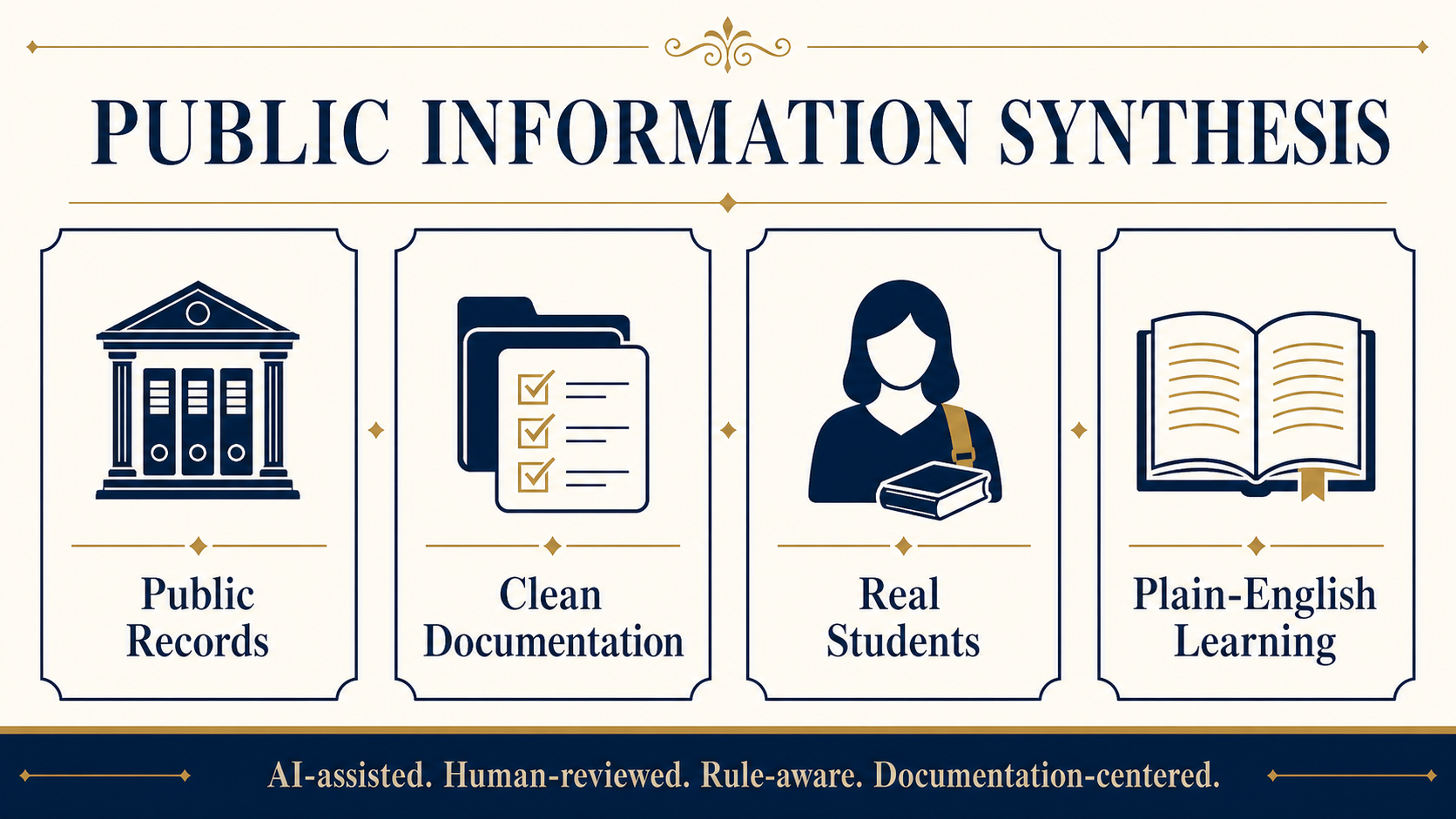
gather public records;
cite exact links;
distinguish source from interpretation;
avoid endorsement or unsupported conclusion;
ask better public questions;
preserve student dignity;
convert public records into public education.
This daily practice supports articles, books, briefs, public education pages, references, and future research publications. The goal is to make public information readable, useful, and responsible.
Public Education, Not Accusation
This post is not an accusation against any agency, board, school, public official, employee, student, or individual.
It is a public-education post.
The public deserves to know how to read records. Families deserve to know what questions to ask. Schools deserve clear written standards. Regulators deserve accurate data. Students deserve dignity. Taxpayers deserve transparency.
KBC instructor-count note: KBC's November 12, 2025 Licensee Summary By Status Report was validated from local open-record/audit response material. For public posting, preserve the PDF image/table or attach a visual citation because the instructor table is OCR/visual evidence.
Public Notice
This article is provided for public education, institutional transparency, and policy discussion. It is not legal advice. It does not assert final findings of wrongdoing by any agency, board, school, individual, public official, or employee. It summarizes and links public records, official reports, and institutional reference points so readers can review the sources directly. Readers should consult the linked sources and seek official clarification from the relevant agency, school, board, or counsel where needed.
Prepared for public education by Louisville Beauty Academy, with research synthesis credited to Di Tran University / College of Humanization's public-information research and systems-learning work.
Visuals prepared as original editorial public-education graphics for this article.
Public-information synthesis framework: public records, clean documentation, real students, and plain-English learning.
Day 7 of 100 – LBA Affordable Nail Service Literacy Series. This article explains paraffin / warm care in plain language for customers, students, families, and community partners who want beauty services to be accessible without lowering the professional standard.
The LBA nail service literacy standard: consult, clean, serve, teach, and respect.
Paraffin and Warm-Care Services
What warm-care services can and cannot promise, and why consent and contraindication awareness matter. At Louisville Beauty Academy, the public-service model is education first: a school clinic or student-supervised service is not a promise of luxury speed. It is a carefully supervised learning environment where affordability, sanitation, communication, and dignity belong together.
What The Service Teaches
Service literacy: the client understands what is being requested and what is reasonable for the appointment.
Sanitation discipline: clean setup and infection-control habits are treated as the foundation, not a hidden back-room detail.
Communication: expectations, timing, comfort, and limits are discussed before the service becomes confusing.
Professional judgment: students learn that saying “not today” can be part of protecting the client and the school standard.
Affordable Does Not Mean Careless
LBA’s public-facing nail services are listed on the school’s current student clinic service page when available, and the current written page should be checked before relying on any service, price, schedule, or availability. The mission-level point is larger than a single price: accessible nail services can introduce the public to clean beauty care while helping students practice consultation, timing, technique, and professionalism under supervision.
That is the Louisville Beauty Academy standard: elite expectation without luxury exclusion. A person should not need a luxury budget to be treated with cleanliness, patience, and respect.
Safety and Boundary Note
This series is consumer education, not medical advice. Nail services are cosmetic services. A student, instructor, or licensed professional should not diagnose, treat, or promise improvement for medical conditions. If skin, nail, pain, infection, wound, allergy, or health concerns appear, the safer educational response is to pause and refer the person to an appropriate licensed health professional.
Why DTU Supports This Doctrine
Di Tran University supports this work as doctrine and research architecture: humanization, workforce literacy, affordability, AI-assisted documentation, and ethical education. DTU explains why a small service can become a public lesson in dignity, and LBA proves that lesson in a real school environment.
Public information notice: service availability, prices, schedules, and policies can change. Current written LBA documents and direct school confirmation control. This post does not claim government endorsement, guaranteed outcomes, medical benefit, licensure result, employment result, or superiority over another provider.
Louisville Beauty Academy teaches beauty as a full professional system.
That system includes skill, sanitation, safety, federal law, Kentucky state law, local and metro business rules, regulation, documentation, attendance, contracts, student choice, client communication, ethical public representation, business awareness, ownership pathways, board expectations, and the changing climate of the beauty industry.
This is why LBA is building itself not only as a school, but as a center of excellence and public library for understanding beauty.
The purpose is simple:
Students should not only learn how to perform beauty services. They should learn how to understand the regulated profession they are entering.
1. Beauty Is a Licensed Profession, Not Only a Creative Skill
Beauty work is creative, human, technical, and personal. It is also licensed.
A licensed profession comes with public responsibilities. Students and professionals must understand sanitation, infection control, safety, scope of practice, training hours, documentation, client care, school policies, state-board expectations, and lawful communication.
That is why beauty education must include more than hands-on technique.
At LBA, professional understanding includes:
the craft: nail technology, cosmetology, esthetics, shampoo styling, specialty services, and instructor training;
the rules: licensing requirements, curriculum requirements, attendance limits, sanitation, student records, and state-board expectations;
the documents: enrollment agreements, policies, catalogs, refund and withdrawal rules, tuition disclosures, curriculum links, attendance records, and completion records;
the conduct: professional communication, client boundaries, public-safety habits, truthful representation, and ethical online activity;
the pathway: employment, salon work, booth rental, independent practice where lawful, business ownership, instructor responsibility, and lifelong learning.
This is the full beauty industry, not one narrow class topic.
2. What It Means To Be a Center of Excellence for Understanding
A center of excellence does not merely repeat rules. It explains them.
LBA's goal is to help students and the public understand:
what a license is and what it is not;
what school training is designed to prepare students for;
why sanitation and infection-control rules protect the public;
why attendance records and training hours matter;
why written contracts, catalogs, and policies matter;
why costs, refunds, withdrawals, and payment terms must be visible;
why public reviews, testimonials, and promotional statements must be voluntary and truthful;
why student choice must be protected;
why documentation protects students, schools, salons, clients, and regulators;
why industry climate matters for career readiness.
The goal is not to turn students into lawyers. The goal is to help students become more aware licensed professionals.
3. What It Means To Be a Public Library for Beauty Understanding
A public library makes knowledge available.
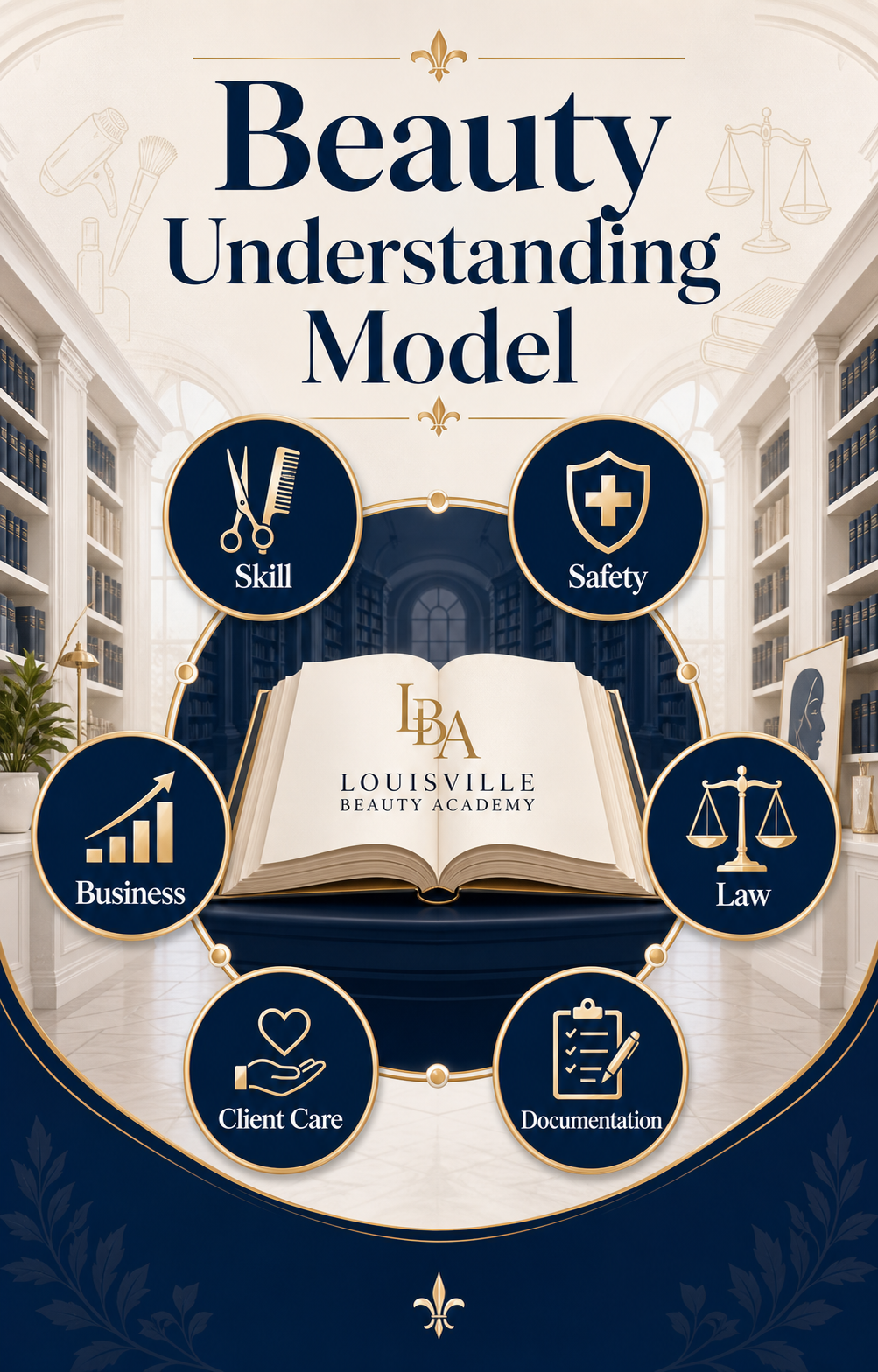
The Beauty Understanding Model frames professional preparation as skill, safety, law, documentation, client care, and business literacy working together.
LBA's public education work should serve the same function for the beauty field. Students, families, salon owners, graduates, community partners, regulators, and the public should be able to find plain-language explanations of how the industry works.
That public library should include:
law and regulation explanations;
student-contract and school-policy explanations;
sanitation and public-safety explanations;
curriculum and licensing-pathway explanations;
attendance and documentation explanations;
cost, payment, refund, and withdrawal explanations;
client-care and professionalism explanations;
salon ownership and small-business-readiness explanations;
ethical public-review and testimonial explanations;
multilingual or plain-language access where needed.
Knowledge should not disappear after one class, one enrollment meeting, one inspection, one renewal cycle, or one complaint. It should remain visible and reusable for the next student, the next parent, the next graduate, the next salon owner, and the next community member.
4. Why Industry Climate Belongs in Beauty Education
Every profession has a climate.
The beauty industry climate includes:
licensing rules;
labor and worker-classification debates;
state-board inspections;
public health expectations;
changing student expectations;
affordability concerns;
digital reviews and online reputation;
small-business ownership;
immigrant and first-generation entrepreneurship;
language access;
public trust;
documentation and due process.
Students need to understand this climate because they will work inside it.
This is especially visible in nail technology, but the lesson applies to the entire beauty field. Nail technology, cosmetology, esthetics, shampoo styling, instructor training, specialty services, student clinic services, salon employment, booth rental, independent practice, and ownership all exist within a regulated environment.
Understanding that environment is part of career readiness.
5. Legal and Regulatory Literacy: Federal, State, and Local
Legal and regulatory literacy means students can understand the rules that shape their profession.
Those rules do not exist at only one level.
The beauty industry sits inside overlapping layers:
Federal: worker safety, chemical exposure, cosmetics, labeling, endorsements, testimonials, advertising, consumer protection, disability access, employment, tax, and civil-rights principles may all matter depending on the setting.
State: in Kentucky, cosmetology-related education, school licensing, curriculum, sanitation, permits, student contracts, instructor responsibilities, and board expectations are governed through Kentucky statutes, Kentucky administrative regulations, and Kentucky Board of Cosmetology materials.
Local / Metro: in Louisville and Jefferson County, business registration, occupational license tax reporting, local permits, zoning/building/fire/health-related touchpoints, and local operating requirements may affect a beauty business depending on what it does and where it operates.
That is why beauty education cannot treat "law and regulation" as one narrow state-board topic. Students and future salon owners need to understand that professional practice may connect to federal, state, and local layers at the same time.
At a school level, this includes visible education about:
federal safety and health concepts, including OSHA nail-salon hazard guidance;
federal cosmetics concepts, including FDA cosmetics and product-safety guidance;
federal endorsement/review principles, including FTC guidance on truthful reviews, testimonials, endorsements, and disclosures;
Kentucky Board of Cosmetology requirements;
KRS Chapter 317A;
201 KAR Chapter 12;
201 KAR 12:082 curriculum, school administration, training-hour, and break-related requirements;
school operation days and hours;
training-hour limits;
attendance documentation;
curriculum requirements by program;
student contract requirements;
state-board renewal expectations;
sanitation and public safety;
responsible student records and completion documentation.
local and metro business-readiness awareness for students who later pursue salon work, booth rental, independent practice, or ownership.
For example, LBA's renewal-preparation work emphasizes that students should see operating facts clearly: program information, days/hours of operation, tuition and costs, refund and withdrawal policies, attendance policies, official law links, and curriculum source links.
That is not just paperwork. That is transparency.
At the public-library level, LBA's larger role is to help people understand how the layers connect:
the federal safety layer asks whether workers and consumers are protected from preventable hazards;
the federal advertising/review layer asks whether public statements are truthful and not misleading;
the state licensing layer asks whether students, schools, instructors, and licensees meet Kentucky requirements;
the local/metro layer asks whether a business is properly registered and operating within local rules;
the school-documentation layer asks whether expectations are visible before a student commits.
6. Compliance Literacy
Compliance is not a hidden back-office activity. It is part of professional formation.
Compliance literacy includes:
knowing what policy applies;
knowing where the policy is written;
knowing who keeps records;
knowing how records are reviewed;
knowing how corrections are made;
knowing when questions should be raised;
knowing how to preserve documentation.
For students, compliance literacy helps them understand attendance, hours, payments, refunds, withdrawal, sanitation, client safety, and graduation/completion processes.
For schools, compliance literacy helps create consistency, fairness, and documented proof.
For salons and owners, compliance literacy helps reduce confusion and avoid preventable mistakes.
For regulators, visible compliance materials make review easier.
7. Educational Literacy
Educational literacy means students understand the purpose of what they are learning.
Students should understand:
why theory matters;
why practical work matters;
why sanitation is repeated constantly;
why attendance rules exist;
why clinics must be supervised;
why instructor responsibility matters;
why graduation documentation matters;
why the state-board exam is not the whole profession;
why lifelong learning matters after licensure.
The goal is not only course completion. The goal is responsible entry into a licensed profession.
8. Documentation Literacy
Documentation is one of the most important professional habits in a regulated field.
Documentation helps answer:
what was disclosed;
what was signed;
what was taught;
what hours were completed;
what policy applied;
what payment term existed;
what refund rule applied;
what curriculum was required;
what communication occurred;
what correction was made;
what source authority was used.
Documentation protects students by making expectations visible.
Documentation protects schools by showing what was provided and when.
Documentation protects the public by supporting safe and accountable practice.
Documentation protects regulators by creating a record that can be reviewed.
This is why LBA teaches documentation as part of professional culture.
9. Student Choice and Ethical Public Communication
A modern beauty professional must understand public communication.
Reviews, testimonials, social media posts, student stories, before-and-after images, and public statements can all affect trust. They must be handled ethically.
LBA's position is clear:
No student should be required to give praise, a five-star review, a positive review, a testimonial, or a favorable public statement as a condition of standard enrollment, attendance, completion, graduation, or standard pricing.
Any optional public/professional documentation activity should be voluntary, student-chosen, truthful, and handled under written disclosure rules where required.
That distinction matters.
Professional development can be encouraged. Coerced praise should not be.
Documentation can help students build confidence. Forced public approval should not be part of standard enrollment.
This is why student choice belongs inside beauty education.
10. Nail Technology as a Visible Example, Not the Whole Story
Nail technology is a highly visible example of why legal and regulatory understanding matters.
Across the United States, nail salons and nail professionals have appeared in public legal and policy conversations involving enforcement fairness, language access, worker classification, small-business ownership, board representation, and due process.
This does not mean every regulator is unfair. It does not mean every salon is right in every dispute. It does not mean students should fear the law.
It means the industry is real, regulated, complex, and worth understanding.
The most useful lesson is educational:
When a profession is regulated, students and professionals need clear rules, plain-language explanations, documentation habits, and fair process.
11. Historical and Policy Context
Public history shows why education matters.
In Louisiana, Vietnamese and Asian nail salon owners brought a federal case, Nguyen et al. v. Louisiana State Board of Cosmetology et al., alleging targeted inspections, fines, discrimination, intimidation, and unfair treatment. Public reporting shows the claims survived key court challenges and the case resolved with a reported settlement of more than $100,000. This is one of the strongest public examples of nail salon owners using the legal system when they believed enforcement was unfair.
In California, Blu Nail Bar, Inc. et al. v. Gavin Newsom et al. challenged a worker-classification rule that treated licensed manicurists differently from other beauty professionals. California later passed AB 1514, extending the licensed manicurist exemption through January 1, 2029.
In Kentucky, Senate Bill 14 added nail technician representation and strengthened procedural clarity within the Kentucky Board of Cosmetology structure. That policy development reflects a broader need for representation, clarity, and practical understanding within beauty-industry regulation.
These examples are not included to attack any agency. They are included to show why beauty education must include industry literacy.
Law, regulation, documentation, and due process are part of the professional environment.
12. LBA's Educational Standard
Louisville Beauty Academy's educational standard is to teach the whole picture:
technique;
sanitation;
law;
regulation;
safety;
client care;
contracts;
documentation;
attendance;
curriculum;
cost transparency;
refund and withdrawal awareness;
public communication ethics;
student choice;
business literacy;
ownership awareness;
instructor responsibility;
industry history;
public trust;
human dignity.
This is what it means to teach beauty at a serious level.
13. The Public Value
When beauty education includes law and regulation, students become stronger.
When beauty education includes documentation, schools become clearer.
When beauty education includes ethical public communication, students are protected.
When beauty education includes business awareness, graduates are more prepared.
When beauty education includes industry history, communities understand the profession more deeply.
When beauty education becomes a public library, knowledge becomes accessible beyond the classroom.
When beauty education explains federal, state, and local layers together, students and future owners stop treating compliance as a mystery. They begin to see the profession as a system they can learn, respect, question, document, and navigate.
That is public value.
14. Closing
Louisville Beauty Academy teaches the craft.
Louisville Beauty Academy teaches the rules.
Louisville Beauty Academy teaches the responsibility.
Louisville Beauty Academy teaches the climate.
Louisville Beauty Academy teaches understanding.
The beauty industry deserves schools that teach more than the minimum. Students deserve institutions that explain the system, not just move them through it. Communities deserve graduates who know how to work with skill, dignity, safety, and awareness.
That is the public library Louisville Beauty Academy is building:
a living library of beauty skill, safety, law, regulation, documentation, ethics, business literacy, and human dignity.
Day 6 of 100 – LBA Affordable Nail Service Literacy Series. This article explains hand care in plain language for customers, students, families, and community partners who want beauty services to be accessible without lowering the professional standard.
The LBA nail service literacy standard: consult, clean, serve, teach, and respect.
Hand Care and Moisture
How hand care supports comfort and polish appearance without turning beauty education into medical claims. At Louisville Beauty Academy, the public-service model is education first: a school clinic or student-supervised service is not a promise of luxury speed. It is a carefully supervised learning environment where affordability, sanitation, communication, and dignity belong together.
What The Service Teaches
Service literacy: the client understands what is being requested and what is reasonable for the appointment.
Sanitation discipline: clean setup and infection-control habits are treated as the foundation, not a hidden back-room detail.
Communication: expectations, timing, comfort, and limits are discussed before the service becomes confusing.
Professional judgment: students learn that saying “not today” can be part of protecting the client and the school standard.
Affordable Does Not Mean Careless
LBA’s public-facing nail services are listed on the school’s current student clinic service page when available, and the current written page should be checked before relying on any service, price, schedule, or availability. The mission-level point is larger than a single price: accessible nail services can introduce the public to clean beauty care while helping students practice consultation, timing, technique, and professionalism under supervision.
That is the Louisville Beauty Academy standard: elite expectation without luxury exclusion. A person should not need a luxury budget to be treated with cleanliness, patience, and respect.
Safety and Boundary Note
This series is consumer education, not medical advice. Nail services are cosmetic services. A student, instructor, or licensed professional should not diagnose, treat, or promise improvement for medical conditions. If skin, nail, pain, infection, wound, allergy, or health concerns appear, the safer educational response is to pause and refer the person to an appropriate licensed health professional.
Why DTU Supports This Doctrine
Di Tran University supports this work as doctrine and research architecture: humanization, workforce literacy, affordability, AI-assisted documentation, and ethical education. DTU explains why a small service can become a public lesson in dignity, and LBA proves that lesson in a real school environment.
Public information notice: service availability, prices, schedules, and policies can change. Current written LBA documents and direct school confirmation control. This post does not claim government endorsement, guaranteed outcomes, medical benefit, licensure result, employment result, or superiority over another provider.
Day 5 of 100 – LBA Affordable Nail Service Literacy Series. This article explains cuticle care in plain language for customers, students, families, and community partners who want beauty services to be accessible without lowering the professional standard.
The LBA nail service literacy standard: consult, clean, serve, teach, and respect.
Cuticle Care Boundaries
Beauty-service cuticle care, sanitation, and the line between cosmetic service and health concern. At Louisville Beauty Academy, the public-service model is education first: a school clinic or student-supervised service is not a promise of luxury speed. It is a carefully supervised learning environment where affordability, sanitation, communication, and dignity belong together.
What The Service Teaches
Service literacy: the client understands what is being requested and what is reasonable for the appointment.
Sanitation discipline: clean setup and infection-control habits are treated as the foundation, not a hidden back-room detail.
Communication: expectations, timing, comfort, and limits are discussed before the service becomes confusing.
Professional judgment: students learn that saying “not today” can be part of protecting the client and the school standard.
Affordable Does Not Mean Careless
LBA’s public-facing nail services are listed on the school’s current student clinic service page when available, and the current written page should be checked before relying on any service, price, schedule, or availability. The mission-level point is larger than a single price: accessible nail services can introduce the public to clean beauty care while helping students practice consultation, timing, technique, and professionalism under supervision.
That is the Louisville Beauty Academy standard: elite expectation without luxury exclusion. A person should not need a luxury budget to be treated with cleanliness, patience, and respect.
Safety and Boundary Note
This series is consumer education, not medical advice. Nail services are cosmetic services. A student, instructor, or licensed professional should not diagnose, treat, or promise improvement for medical conditions. If skin, nail, pain, infection, wound, allergy, or health concerns appear, the safer educational response is to pause and refer the person to an appropriate licensed health professional.
Why DTU Supports This Doctrine
Di Tran University supports this work as doctrine and research architecture: humanization, workforce literacy, affordability, AI-assisted documentation, and ethical education. DTU explains why a small service can become a public lesson in dignity, and LBA proves that lesson in a real school environment.
Public information notice: service availability, prices, schedules, and policies can change. Current written LBA documents and direct school confirmation control. This post does not claim government endorsement, guaranteed outcomes, medical benefit, licensure result, employment result, or superiority over another provider.
Day 4 of 100 – LBA Affordable Nail Service Literacy Series. This article explains trimming and shaping in plain language for customers, students, families, and community partners who want beauty services to be accessible without lowering the professional standard.
The LBA nail service literacy standard: consult, clean, serve, teach, and respect.
Nail Trimming and Shaping
The quiet skill of length, shape, symmetry, comfort, and client communication. At Louisville Beauty Academy, the public-service model is education first: a school clinic or student-supervised service is not a promise of luxury speed. It is a carefully supervised learning environment where affordability, sanitation, communication, and dignity belong together.
What The Service Teaches
Service literacy: the client understands what is being requested and what is reasonable for the appointment.
Sanitation discipline: clean setup and infection-control habits are treated as the foundation, not a hidden back-room detail.
Communication: expectations, timing, comfort, and limits are discussed before the service becomes confusing.
Professional judgment: students learn that saying “not today” can be part of protecting the client and the school standard.
Affordable Does Not Mean Careless
LBA’s public-facing nail services are listed on the school’s current student clinic service page when available, and the current written page should be checked before relying on any service, price, schedule, or availability. The mission-level point is larger than a single price: accessible nail services can introduce the public to clean beauty care while helping students practice consultation, timing, technique, and professionalism under supervision.
That is the Louisville Beauty Academy standard: elite expectation without luxury exclusion. A person should not need a luxury budget to be treated with cleanliness, patience, and respect.
Safety and Boundary Note
This series is consumer education, not medical advice. Nail services are cosmetic services. A student, instructor, or licensed professional should not diagnose, treat, or promise improvement for medical conditions. If skin, nail, pain, infection, wound, allergy, or health concerns appear, the safer educational response is to pause and refer the person to an appropriate licensed health professional.
Why DTU Supports This Doctrine
Di Tran University supports this work as doctrine and research architecture: humanization, workforce literacy, affordability, AI-assisted documentation, and ethical education. DTU explains why a small service can become a public lesson in dignity, and LBA proves that lesson in a real school environment.
Public information notice: service availability, prices, schedules, and policies can change. Current written LBA documents and direct school confirmation control. This post does not claim government endorsement, guaranteed outcomes, medical benefit, licensure result, employment result, or superiority over another provider.